
Introduction
Fuel Planning for Long Distance Driving | A long-distance drive can feel completely manageable when you look at the route on a map, but the situation can change quickly when fuel consumption doesn’t go exactly as expected. A journey that should take a few hours may include traffic, road diversions, long stops, high temperatures, air-conditioning use, extra passengers, luggage, or unexpected delays. Each of these factors can affect how much fuel your vehicle actually uses.
This is why fuel planning for long distance driving should be part of your preparation before you leave, rather than something you think about after the fuel warning light appears.
For drivers travelling around Dubai and across the UAE, proper fuel planning can make a long journey more comfortable and reduce the risk of an avoidable roadside fuel emergency. If you need roadside fuel assistance in Dubai, Fuel Delivery Dubai provides information about getting fuel support when a vehicle unexpectedly runs low or runs out of fuel.
The good news is that fuel planning doesn’t have to be complicated. You don’t need a perfect mathematical prediction of every litre your car will use. You need a realistic understanding of your vehicle’s fuel economy, the distance you plan to travel, the conditions you may encounter, and the places where you can refuel.
This guide explains how to plan fuel for a long journey, estimate realistic range, calculate fuel requirements, choose refuelling points, prepare for traffic and delays, reduce unnecessary consumption, and respond safely if your fuel level becomes dangerously low.
What Is Fuel Planning for Long Distance Driving?
Fuel planning is the process of estimating how much fuel your vehicle will need for a journey and deciding when and where you should refuel before the tank reaches a critical level.
A basic fuel plan considers more than the distance between your starting point and destination.
You should also think about:
- Your vehicle’s actual fuel economy
- Current fuel level
- Fuel tank capacity
- Expected traffic
- Driving speed
- Air-conditioning use
- Number of passengers
- Luggage and vehicle load
- Road conditions
- Possible route changes
- Available petrol stations
- Unexpected delays
- Your return journey
The purpose isn’t to predict the journey with mathematical perfection. The purpose is to create enough margin that normal changes in driving conditions don’t immediately turn into a fuel emergency.
A driver who knows the distance but doesn’t know the vehicle’s real-world fuel consumption is still missing an important part of the calculation.
Likewise, a driver who knows the car’s average but doesn’t know where the next practical refuelling opportunity is can still end up in trouble.
Good fuel planning connects both.
Why Fuel Planning Matters on Long-Distance Journeys
Running low on fuel during a short local trip is inconvenient.
Running out of fuel on a long highway journey can become a safety problem.
On a long-distance route, you may encounter conditions that weren’t present when you started. Traffic may become heavier. A road may be temporarily restricted. You may need to take a different exit. A passenger may request an unplanned stop. Your vehicle may consume more fuel because of continuous air-conditioning use.
Even a relatively small difference in fuel economy can become significant over several hundred kilometres.
For example, a vehicle achieving 12 km/L will require less fuel over a 400 km journey than the same vehicle averaging 10 km/L under heavier conditions.
That’s why your fuel plan should be based on realistic driving rather than an ideal number.
The Main Goal of Fuel Planning
The goal is simple:
Reach your destination with enough fuel flexibility to deal with normal unexpected conditions.
That means you shouldn’t necessarily plan to use almost the entire tank before the next refuelling stop.
Instead, think in terms of a planned refuelling window.
You know approximately when you’ll need fuel, where you can get it, and what you’ll do if your original plan changes.
💡 Pro Tip: Treat your dashboard’s estimated range as a planning tool, not a guaranteed promise of how many kilometres you can safely drive.
How to Calculate Fuel Needed for a Long-Distance Drive
The basic calculation is straightforward.
If you know your journey distance and your realistic fuel economy, you can estimate the fuel required.
The formula is:
Fuel required = Distance ÷ Fuel economy
For example:
- Journey distance: 500 km
- Realistic fuel economy: 10 km/L
Calculation:
500 ÷ 10 = 50 litres
So the estimated fuel requirement is approximately 50 litres.
However, this doesn’t mean you should put exactly 50 litres in the tank and assume the journey is guaranteed.
The calculation is a starting point.
Your real consumption can change because of:
- Heavy traffic
- High speed
- Frequent acceleration
- Frequent braking
- Air conditioning
- Heavy luggage
- Low tyre pressure
- Strong wind
- Road gradients
- Idling
- Vehicle condition
This is why a practical fuel plan includes a reasonable reserve.
Use Your Real-World Fuel Economy
One of the biggest mistakes drivers make is using a fuel-economy figure that doesn’t match how their vehicle actually performs.
Your car may have a published fuel-economy figure, but your real-world average depends on how and where you drive.
A vehicle may achieve one figure in controlled testing and a different figure when driven with passengers, luggage, air conditioning and real traffic.
Your own fuel records are therefore extremely useful.
How to Measure Your Actual Fuel Average
A simple full-tank method can help.
- Fill the tank.
- Reset the trip meter.
- Drive normally.
- Refill the tank.
- Record how many litres were added.
- Record the kilometres travelled.
- Divide kilometres by litres.
For example:
600 km ÷ 50 litres = 12 km/L
Repeat this over more than one tank if possible.
One trip may be unusually efficient because of clear roads. Another may be inefficient because of congestion. Several measurements provide a more realistic baseline.
For long-distance planning, use a figure that reflects the type of driving you’re about to do.
If you’re planning a highway journey, your highway fuel average is more useful than your worst city-traffic average.
If your route includes a large amount of urban traffic, use a mixed-driving estimate instead.
Fuel Economy Is Not a Fixed Number
Your fuel economy can change throughout the same journey.
This is an important point because many drivers assume that once they’ve calculated their average, it will remain constant.
It may not.
For example, your vehicle could start the journey on an open highway and achieve good economy. Later, traffic could become heavy and reduce your average.
Similarly, a vehicle travelling at a moderate highway speed may use less fuel than the same vehicle driven continuously at a significantly higher speed.
Other factors can also change.
Factors That Can Change Fuel Economy
- Driving speed
- Acceleration style
- Braking frequency
- Traffic
- Air conditioning
- Tyre pressure
- Vehicle load
- Roof-mounted equipment
- Road surface
- Hills and gradients
- Vehicle maintenance
- Weather conditions
Because of these variables, a fuel plan should always include some flexibility.
Estimate Your Remaining Fuel Range
Once you know your approximate fuel economy, you can estimate how far the fuel currently in your tank may take you.
The basic formula is:
Estimated range = Fuel remaining × Fuel economy
For example:
- Estimated fuel remaining: 25 litres
- Realistic fuel economy: 12 km/L
25 × 12 = 300 km
That suggests approximately 300 km of theoretical range.
But theoretical range and practical trip planning are not exactly the same thing.
You shouldn’t automatically decide that you can drive the full 300 km before looking for fuel.
You still need to consider traffic, route changes, A/C use and other factors.
For more detailed guidance, see How to Estimate Remaining Fuel Range in Dubai.
You can also use Understanding Vehicle Fuel Range to understand why range estimates can change during a journey.
Why You Shouldn’t Drive to the Absolute Range
Suppose your dashboard says you have 100 km of estimated range left.
It may be tempting to think:
“My destination is 80 km away, so I have enough fuel.”
But the calculation leaves only a 20 km difference.
If traffic increases, the route changes or the vehicle consumes more fuel than expected, that margin can disappear.
A better approach is to ask:
Where can I safely refuel before my remaining fuel becomes critical?
That changes the focus from maximum theoretical range to practical journey planning.
This is particularly important when travelling through unfamiliar areas.
Understand Your Fuel Gauge
The fuel gauge is useful, but it isn’t a precision measuring instrument.
A gauge provides an approximate indication of fuel level. The movement of the needle or digital indicator doesn’t necessarily correspond perfectly to an exact number of litres.
Some vehicles may appear to remain near full for a while and then move more quickly through the middle or lower range.
For that reason, you shouldn’t calculate a long-distance trip simply by saying:
“The gauge is at half, so I have exactly half my tank available.”
For more detail, read How Accurate Is a Car Fuel Gauge?.
The better approach is to combine:
Fuel gauge + recent fuel consumption + distance travelled + remaining route
That gives you a much more useful picture.
What Does the Low Fuel Warning Light Really Mean?
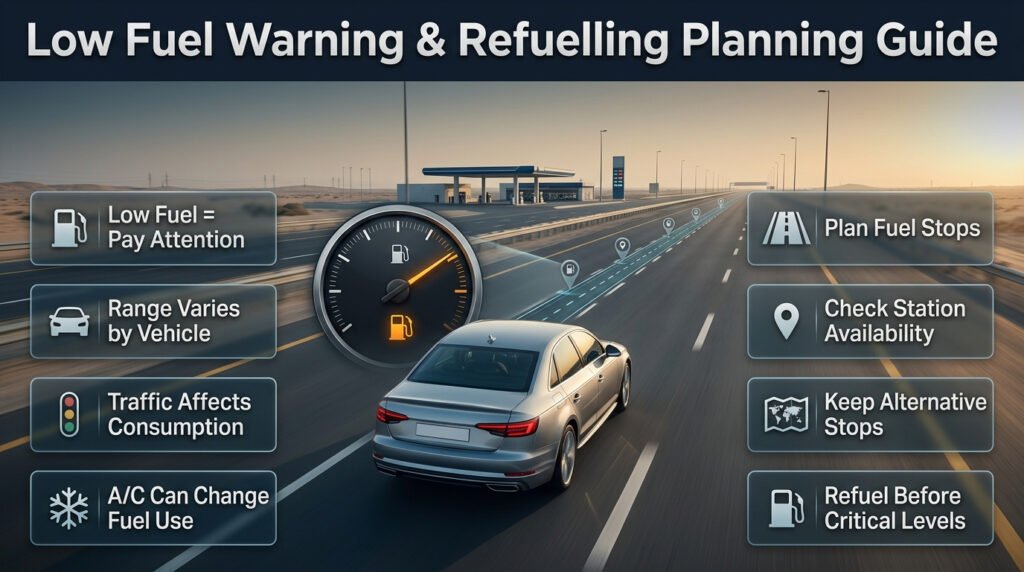
The low fuel warning light tells you that the fuel level has reached a low threshold determined by the vehicle.
It does not provide a universal guaranteed distance.
One vehicle may provide a different amount of remaining fuel than another.
Even the same vehicle may travel different distances after the warning appears depending on:
- Traffic
- Speed
- Road conditions
- Driving style
- A/C use
- Vehicle load
For a detailed explanation, see Low Fuel Warning Light Meaning in Dubai.
If you’re already driving with the warning light illuminated, your priority should be finding a suitable refuelling option rather than trying to discover exactly how many kilometres remain.
How Far Can You Drive on Low Fuel?
There is no single distance that applies to every vehicle.
The remaining range after the warning light depends on the vehicle’s fuel tank design, remaining fuel and current fuel consumption.
A small efficient car and a large SUV can have very different results.
Even two vehicles with similar engine sizes can behave differently.
You can learn more about this issue in How Far Can a Car Drive on Low Fuel in Dubai?.
The most important lesson is:
Don’t turn a warning light into a target.
The warning is an indication that you should pay attention to the fuel level—not an invitation to continue driving until the engine stops.
Plan Refuelling Stops Before You Leave
A long journey becomes much easier when you know approximately where you’ll refuel.
You don’t have to create an overly complicated schedule.
Simply identify suitable fuel stops along the route.
Before departure, consider:
- Starting fuel level
- Total distance
- Expected fuel economy
- Major highway sections
- Fuel station availability
- Traffic
- Possible route changes
- Destination distance from the last planned fuel stop
If you’re travelling somewhere unfamiliar, having more than one potential refuelling option is helpful.
A single station may be closed, inaccessible or inconvenient because of traffic or route changes.
Don’t Wait Until the Tank Is Almost Empty
One of the most avoidable fuel mistakes is delaying refuelling because the driver believes there is still enough range.
The problem isn’t necessarily the current fuel level.
The problem is reduced flexibility.
When your tank is comfortably supplied, you have options.
When the fuel level becomes critically low, every detour becomes more stressful.
You may find yourself changing lanes unnecessarily, searching for stations while watching the range estimate, or worrying about whether the next station is actually reachable.
Refuelling earlier can eliminate that pressure.
Calculate Fuel for the Entire Journey
Don’t calculate only the distance to the destination.
Think about the complete travel plan.
Ask yourself:
- Is the journey one-way?
- Am I returning the same day?
- Will I drive locally after arriving?
- Will I make additional stops?
- Is there a detour planned?
- Will I need to drive around the destination area?
A 400 km destination doesn’t necessarily mean 400 km of total driving.
If you expect another 50 km of local driving after arrival, your fuel plan should account for it.
Include the Return Journey
This is especially important when travelling to an area where fuel stations may be less convenient.
If you’re driving 300 km to a destination and plan to return the same day, don’t assume the destination is your fuel-planning endpoint.
Think about:
Outbound distance + local driving + return distance
Then identify where you will refuel.
Consider Traffic Before Calculating Fuel
Traffic is one of the biggest reasons why a simple distance calculation can become inaccurate.
A 300 km journey on a flowing highway isn’t necessarily equivalent to 300 km involving heavy stop-and-go traffic.
Repeated acceleration and braking consume energy.
Long periods of idling also use fuel without increasing your distance travelled.
For Dubai drivers, traffic conditions can change considerably depending on the route and time of day.
This is why How Traffic Affects Fuel Economy in Dubai is relevant when preparing for a long journey.
You can also read Stop-and-Go Driving Fuel Efficiency for a closer look at how repeated stopping and acceleration influence fuel use.
Plan Around Heavy Traffic Where Practical
You can’t always avoid congestion.
Work schedules, appointments and road conditions may leave you with no choice.
But when your schedule is flexible, route and timing decisions can sometimes reduce unnecessary fuel consumption.
Before departure, consider:
- Current traffic conditions
- Expected peak periods
- Alternative routes
- Roadworks
- Major events
- Accident-related congestion
The shortest route isn’t automatically the most fuel-efficient route.
A route with fewer interruptions and smoother traffic can sometimes produce more predictable fuel consumption than a slightly shorter route filled with repeated stops.
For practical strategies, see How to Reduce Fuel Use in Traffic.
Highway Driving and Fuel Planning
Long-distance highway driving can be more predictable than heavily congested urban driving because the vehicle can maintain a more consistent speed.
However, highway driving isn’t automatically economical at every speed.
As speed increases, aerodynamic resistance becomes increasingly important.
That means continuously driving at very high speeds can increase fuel consumption even when traffic is flowing smoothly.
For practical guidance, review Fuel-Efficient Highway Driving and Highway Driving Fuel Efficiency.
The aim isn’t to drive unnaturally slowly.
The aim is to drive smoothly, safely and consistently within the applicable speed limits.
Smooth Driving Makes Fuel Consumption More Predictable
Aggressive acceleration followed by hard braking wastes the energy used to build speed.
A smoother approach is generally more predictable.
Look further ahead.
If traffic is slowing, avoid accelerating hard only to brake again moments later.
Maintain an appropriate following distance.
Use gradual acceleration when conditions allow.
For more information, Smooth Driving Techniques for Better Fuel Economy covers practical driving habits that can help reduce unnecessary fuel use.
Similarly, How Acceleration Affects Fuel Consumption explains why the accelerator plays an important role in overall consumption.
Braking Habits Also Matter
Braking itself doesn’t consume fuel in the same direct way as acceleration, but repeated unnecessary acceleration followed by braking means you’re repeatedly using fuel to create speed and then discarding that speed.
This is particularly noticeable in congested traffic.
Anticipating traffic can help.
If you can safely see that vehicles ahead are slowing, there may be no reason to continue accelerating toward them.
For more detail, see How Braking Habits Affect Fuel Economy in Dubai.
📌 Quick Tip: Smooth driving doesn’t mean driving slowly regardless of conditions. It means avoiding unnecessary changes in speed while maintaining safe and legal driving behaviour.
Choose a Practical Highway Speed
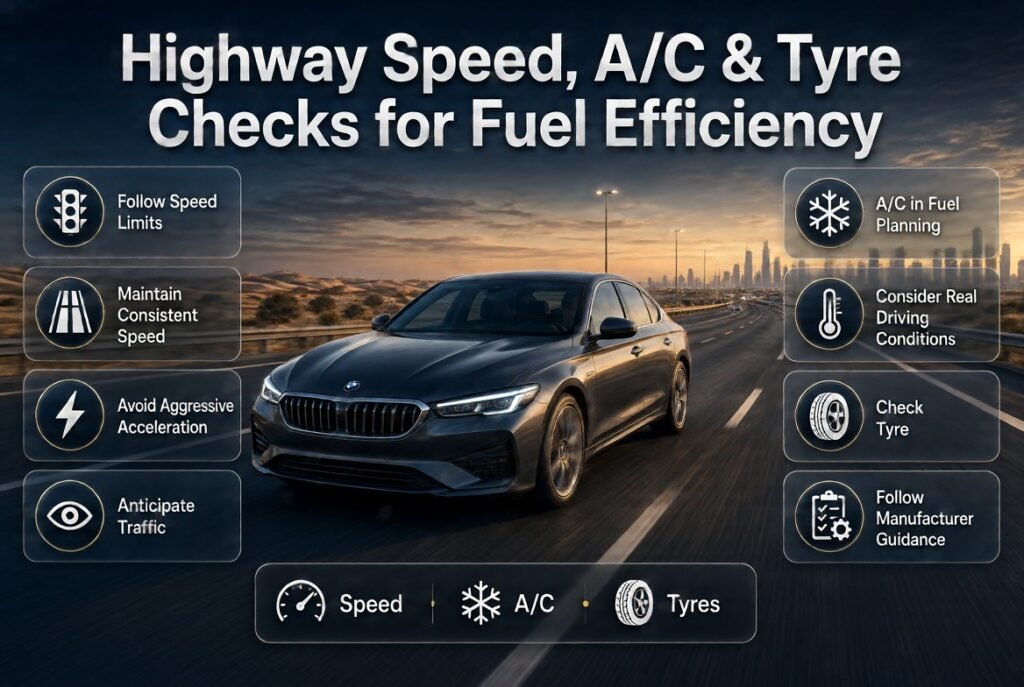
There isn’t one universal speed that produces the best fuel economy for every vehicle.
Different cars have different engines, transmissions, gearing and aerodynamic characteristics.
However, unnecessarily high speed can increase fuel consumption.
Your priority should be:
- Follow posted speed limits.
- Maintain a consistent speed where traffic permits.
- Avoid aggressive acceleration.
- Avoid unnecessary speed changes.
- Look ahead and anticipate traffic.
- Use cruise control appropriately where conditions allow.
You can read Optimal Driving Speed for Fuel Efficiency in Dubai for additional guidance.
Air Conditioning Should Be Included in Your Fuel Plan
For Dubai drivers, air conditioning is often a normal part of driving rather than an occasional extra.
Therefore, don’t calculate your long-distance fuel requirement assuming you’ll drive without A/C if you know you’ll actually use it.
The impact can vary depending on the vehicle and driving conditions.
It can also be different between highway and slow traffic.
For more information, see Air Conditioning and Fuel Consumption.
The practical lesson is simple:
Use real driving conditions when estimating fuel consumption.
If you normally use the A/C throughout a summer journey, your fuel planning should reflect that.
Check Tyre Pressure Before a Long Trip
Tyre pressure is an easy item to overlook during trip preparation.
Incorrect pressure can affect rolling resistance, handling and tyre wear.
Before a long journey:
- Check tyre pressure.
- Follow the manufacturer’s recommended pressure.
- Check the spare tyre if applicable.
- Inspect tyres for visible damage.
- Don’t simply inflate tyres to the maximum number printed on the tyre sidewall.
For more information, see Tyre Pressure and Fuel Efficiency.
A tyre check takes very little time and is useful not only for fuel economy but also for overall journey safety.
Reduce Unnecessary Vehicle Weight
Extra weight means the vehicle has more mass to move.
That doesn’t mean you should remove essential emergency equipment or compromise passenger safety.
It simply means there’s little reason to carry unnecessary heavy items for every trip.
Before leaving, look through the boot.
Remove things that have accumulated over time but aren’t needed for the journey.
Examples include:
- Unused tools
- Heavy equipment
- Old boxes
- Sports equipment not needed for the trip
- Unnecessary stored items
For a detailed explanation, see How Vehicle Weight Affects Fuel Economy.
You can also review Car Load and Fuel Consumption if you’re travelling with significant luggage or passengers.
Don’t Ignore Roof Racks and External Equipment
External accessories can affect aerodynamics, particularly during highway driving.
If you’re carrying a roof box, rack or other equipment, consider whether it is actually needed for the journey.
If it’s not required, removing it may reduce unnecessary aerodynamic drag.
Useful related guidance includes:
- Roof Racks and Fuel Economy
- Vehicle Accessories and Fuel Economy in Dubai
- Vehicle Drag and Fuel Consumption in Dubai
- How Aerodynamics Affects Fuel Efficiency
The key is balance.
Don’t remove something essential just to chase a tiny efficiency improvement.
Instead, remove equipment you don’t need.
Don’t Forget Gear and Transmission Behaviour
For manual vehicles, inappropriate gear selection can affect engine speed and fuel consumption.
For automatic vehicles, smooth throttle use and avoiding unnecessary aggressive acceleration can help maintain efficient operation.
Drivers should follow their vehicle manufacturer’s recommendations rather than trying to force a particular gear or driving technique that isn’t appropriate for the vehicle.
For related information, see:
The goal isn’t to manipulate the transmission constantly.
Good driving should feel smooth and controlled.
Use a Practical Fuel Reserve
A fuel reserve is the amount of fuel you intentionally keep available rather than planning to use every last litre.
There isn’t one universal reserve number that works for every vehicle or route.
The appropriate margin depends on:
- Distance between fuel stations
- Route type
- Traffic
- Vehicle fuel economy
- Tank size
- Weather
- Availability of alternative routes
- Your familiarity with the area
A long highway journey through areas with frequent refuelling opportunities may be different from a remote route where stations are much farther apart.
The key principle is:
Your reserve should reflect the uncertainty of your route.
The less predictable the route, the more important it becomes to avoid running the tank close to empty.
Fuel Planning for Hot Weather
Hot weather can affect how you approach a long journey.
In Dubai, extreme heat means drivers may use air conditioning continuously, and vehicle systems can operate under demanding conditions.
Before a long trip, make sure your vehicle is in good condition.
Check:
- Tyres
- Coolant
- Battery condition
- Engine warning lights
- Fluid levels where appropriate
- Air-conditioning operation
- General vehicle condition
Fuel planning isn’t separate from vehicle preparation.
A vehicle problem can cause an unexpected delay, and a delay can change your fuel requirements.
Plan for Unexpected Delays
One of the easiest mistakes is assuming the journey will take exactly as long as the navigation app initially predicts.
Long-distance travel rarely follows a perfect schedule.
You may encounter:
- Traffic
- Construction
- Road closures
- Accidents
- Rest stops
- Navigation changes
- Mechanical issues
- Passenger needs
- Unexpected detours
This is another reason why fuel planning should include a margin.
If your entire plan depends on arriving at the destination with almost no fuel remaining, even a modest delay can create a problem.
Fuel Planning Should Include Your Destination
Don’t stop thinking about fuel when you arrive.
Ask:
- Is there fuel available near the destination?
- Will I need to drive around after arrival?
- Is the return journey starting soon?
- Is the nearest practical station on the route back?
If you’re staying overnight, refuelling at a convenient time may make the next morning easier.
A little planning at the destination can prevent another unnecessary low-fuel situation.
A Practical Example of Long-Distance Fuel Planning
Imagine you’re planning a 600 km journey.
Your vehicle normally achieves 12 km/L on comparable highway trips.
Step 1: Calculate Basic Fuel Requirement
600 ÷ 12 = 50 litres
So your basic estimate is 50 litres.
Step 2: Consider Conditions
Now ask:
- Will you use A/C?
- Is there likely to be traffic?
- Are you carrying several passengers?
- Is the boot heavily loaded?
- Will there be detours?
- Is the route mostly highway?
If the answer to several questions is yes, don’t assume your best-ever fuel economy will continue throughout the journey.
Step 3: Identify Refuelling Points
Rather than trying to complete the entire trip on the first tank, identify suitable stations along the route.
Step 4: Keep a Practical Reserve
Don’t plan your arrival around an almost-empty tank.
Step 5: Monitor During the Trip
Compare actual fuel use with your original estimate.
If consumption is higher than expected, refuel earlier.
This is the difference between active fuel planning and simply hoping the fuel lasts.
Common Fuel Planning Mistakes
Mistake 1: Using the Manufacturer’s Best Number
A published fuel-economy figure isn’t necessarily the number your vehicle will achieve in your actual conditions.
Use your real-world experience whenever possible.
Mistake 2: Treating Range as a Guarantee
A displayed range is an estimate.
Traffic and driving conditions can change it.
Mistake 3: Waiting for the Fuel Warning
The warning light is not a refuelling appointment.
If you already know where a suitable station is, refuel before the situation becomes urgent.
Mistake 4: Ignoring the Return Journey
Planning only the outbound distance can leave you underprepared later.
Mistake 5: Forgetting Local Driving
The destination isn’t always the end of the journey.
Mistake 6: Ignoring Traffic
A 500 km route doesn’t necessarily consume the same amount of fuel every time.
Mistake 7: Carrying Unnecessary Weight
Heavy items in the vehicle can affect efficiency.
Mistake 8: Ignoring Tyre Pressure
Tyres should be checked before a long journey.
Mistake 9: Driving Aggressively
Hard acceleration followed by hard braking is rarely a good fuel-planning strategy.
Mistake 10: Depending on One Refuelling Point
If your route allows alternatives, know them.
What to Pack for a Fuel-Focused Long Journey
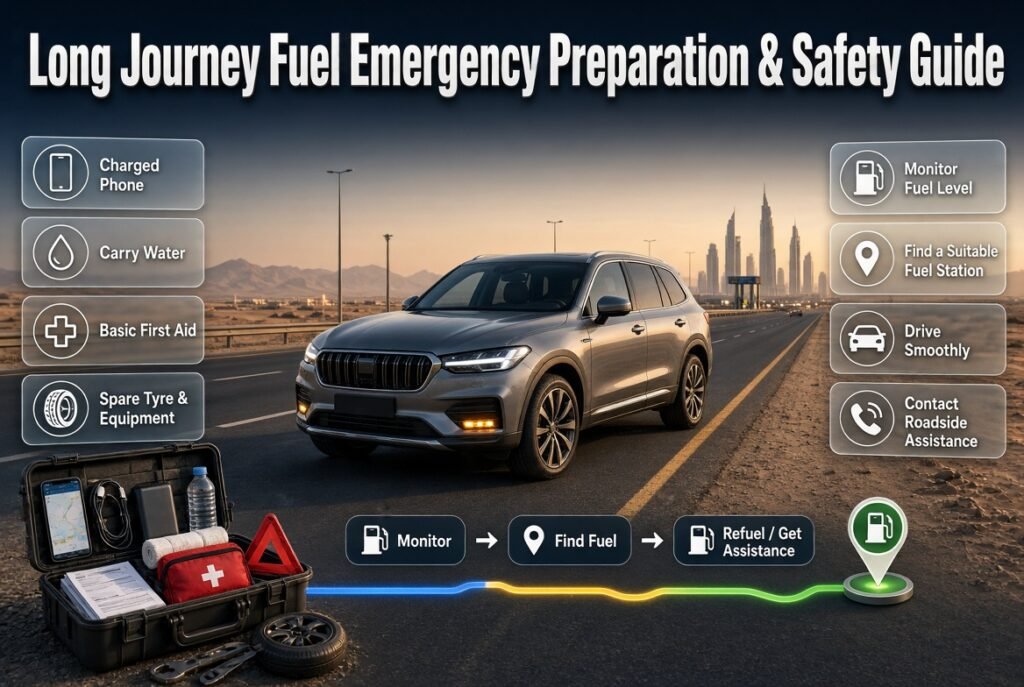
A good long-distance preparation kit doesn’t have to be excessive.
Consider carrying:
- Fully charged phone
- Charging cable or power bank
- Vehicle documents as appropriate
- Emergency contact information
- Basic first-aid supplies
- Water
- Warning equipment appropriate for your vehicle and local requirements
- Spare tyre and required equipment if fitted
- Basic vehicle tools where appropriate
Fuel planning should be part of a wider emergency plan.
For broader preparation, see Road Trip Emergency Preparation.
What If Your Fuel Level Drops Unexpectedly?
If your fuel level becomes lower than expected while you’re still driving, don’t panic.
First, assess the situation.
Ask:
- How much range does the vehicle estimate?
- Where is the nearest suitable fuel station?
- Is traffic slowing the journey?
- Is there a safer or more direct route?
- Can you reach a station without unnecessary detours?
Drive smoothly.
Avoid aggressive acceleration.
Don’t make unsafe manoeuvres simply to save a few minutes.
If you can safely reach a fuel station, refuel before the tank becomes critical.
What If Your Car Runs Out of Fuel?
Once the engine stops because the fuel tank is empty, the situation changes.
You are no longer simply planning a refuelling stop.
You now have a roadside emergency.
Your first priority should be safety.
If the vehicle can be moved to a safer location without creating additional danger, do so.
Then:
- Switch on hazard lights.
- Keep passengers in the safest available location.
- Avoid standing in active traffic.
- Don’t walk along an unsafe highway looking for fuel.
- Contact appropriate roadside assistance.
- Share your location clearly.
- Confirm whether your vehicle needs petrol or diesel.
For detailed guidance, see What to Do When Your Car Runs Out of Fuel.
Safety After Running Out of Fuel
Running out of fuel can be stressful, especially when you’re travelling with family or when the vehicle stops on a busy road.
The biggest mistake is allowing the fuel problem to create a second safety problem.
For example, walking along a high-speed road may expose you to significantly more danger than waiting safely for assistance.
Useful guidance includes:
- Emergency Roadside Fuel Advice
- Car Ran Out of Fuel Safety in Dubai
- Safely Dealing With an Empty Fuel Tank
- Steps After Running Out of Petrol
- Running Out of Fuel on the Road
The important principle is simple:
Solve the fuel problem without creating a traffic-safety problem.
Running Out of Fuel on a Highway
Highway fuel emergencies require extra caution because vehicles may be travelling at high speeds and there may be limited safe places to walk or wait.
If your car stops:
- Turn on hazard lights.
- Move the vehicle away from moving traffic if it can be done safely.
- Stay in the safest available position.
- Avoid standing unnecessarily close to the traffic lane.
- Don’t walk along the highway searching for fuel.
- Contact roadside assistance.
- Give your direction of travel.
- Provide an exit number, landmark or other identifiable location where possible.
For additional information, see Running Out of Fuel on a Highway.
You can also review Highway Fuel Emergency Safety in Dubai and Highway Breakdown Safety Procedures in Dubai.
General Roadside Breakdown Safety
Not every roadside emergency is caused by fuel.
A vehicle may stop because of:
- Battery problems
- Tyre damage
- Engine problems
- Overheating
- Electrical faults
- Mechanical failures
The same safety principles apply.
Move away from active traffic where safely possible.
Use appropriate warning systems.
Communicate your location clearly.
Don’t attempt repairs in a dangerous traffic position.
For broader advice, see:
- Roadside Breakdown Safety Tips in Dubai
- What to Do During a Roadside Breakdown
- Staying Safe During a Car Breakdown
- Vehicle Breakdown Safety Procedures
- Roadside Vehicle Emergency Precautions
Fuel planning reduces the chance of one type of emergency, but overall roadside preparation helps you respond to problems you didn’t anticipate.
Fuel Planning and Fuel-Saving Driving Are Connected
Fuel planning tells you how much fuel you need.
Fuel-efficient driving helps reduce how quickly you use it.
Both matter.
You can start with a good fuel plan and still consume more than expected if you drive aggressively throughout the journey.
For broader advice, see Fuel Saving Driving Tips.
The most practical habits include:
- Smooth acceleration
- Predictable braking
- Appropriate speed
- Correct tyre pressure
- Avoiding unnecessary idling
- Removing unnecessary load
- Keeping the vehicle properly maintained
The objective isn’t to obsess over every small fuel-saving technique.
It is to avoid obvious and unnecessary fuel waste.
Why Idling Matters During Long Trips
Idling uses fuel even though the vehicle isn’t travelling any distance.
This becomes particularly relevant when drivers stop for long periods but leave the engine running unnecessarily.
For more information, see:
During a long journey, unavoidable waiting will happen.
The important thing is not to assume that every minute of idling is free simply because the car isn’t moving.
Vehicle Maintenance Is Part of Fuel Planning
A fuel plan assumes that the vehicle is operating normally.
If something is wrong mechanically, fuel consumption may change.
Before a long journey, pay attention to:
- Dashboard warning lights
- Tyre condition
- Tyre pressure
- Fluid levels
- Battery condition
- Brakes
- Engine behaviour
- Unusual noises
- Cooling system
- Air-conditioning performance
If your fuel economy has suddenly deteriorated without an obvious change in driving conditions, don’t simply accept it as normal.
Investigate the cause.
Fuel planning works best when the vehicle itself is in reasonable condition.
A Professional Pre-Trip Fuel Checklist
Use this checklist before leaving:
Fuel
- Check current fuel level
- Know your realistic km/L
- Estimate fuel required
- Identify refuelling points
- Include a reasonable reserve
- Consider the return journey
Vehicle
- Check tyre pressure
- Inspect tyres
- Check warning lights
- Check basic fluid levels
- Remove unnecessary load
- Check fuel type requirement
Route
- Confirm total distance
- Check traffic
- Identify major exits
- Note possible refuelling points
- Consider alternative routes
- Account for destination driving
Emergency
- Charge your phone
- Know how to share your location
- Carry basic emergency supplies
- Know what to do if fuel becomes critically low
- Know how to respond if the vehicle stops
A Simple Fuel Planning Formula You Can Reuse
For almost any long-distance trip, start with this:
1. Find total distance.
Example:
500 km
2. Find realistic fuel economy.
Example:
12 km/L
3. Calculate basic fuel requirement.
500 ÷ 12 = approximately 41.7 litres
4. Add practical flexibility.
Don’t assume your best-case economy.
5. Identify refuelling points.
Know where you’ll refuel before the tank becomes critically low.
6. Monitor actual consumption.
If your vehicle uses fuel faster than expected, adjust your plan.
This method is simple enough to use before almost any long-distance journey.
How Do I Calculate How Much Fuel I Need for a Long-Distance Drive?
The easiest way to estimate fuel requirements is to combine your total journey distance with your vehicle’s real-world fuel economy. For example, if your journey is 600 km and your car normally gives around 12 km per litre, the basic calculation would be 600 ÷ 12, which equals approximately 50 litres.
However, professional fuel planning shouldn’t stop at that calculation. Your actual consumption can change because of traffic, air conditioning, driving speed, vehicle load, road conditions and unexpected detours. This is why you should use a realistic average from your own driving experience rather than relying only on the manufacturer’s advertised fuel economy.
Important points to consider:
Calculate the complete journey distance, not just the distance to your destination.
Use your normal real-world fuel average.
Consider traffic and stop-and-go driving.
Include regular air-conditioning use when planning in Dubai.
Account for passengers, luggage and additional vehicle weight.
Keep a practical reserve instead of planning to use every litre.
Identify suitable refuelling points before the fuel level becomes critical.
A good fuel calculation gives you a starting point, but a good fuel plan also prepares you for conditions that may increase consumption during the journey.
How Much Fuel Reserve Should I Keep for a Long Road Trip?
There isn’t one fixed fuel-reserve amount that works for every vehicle or every route. The right reserve depends on your vehicle’s fuel economy, tank capacity, traffic conditions, distance between fuel stations and how predictable your journey is.
For example, a driver travelling through an area with frequent fuel stations has more flexibility than someone travelling on a long highway stretch where refuelling options are limited. Similarly, a vehicle that normally gets excellent fuel economy may have a different practical reserve requirement from a larger vehicle with higher fuel consumption.
The most important principle is not to plan your journey around the absolute maximum range of the vehicle.
Before starting a long trip, consider:
How far the next reliable fuel station is.
Whether traffic could significantly increase travel time.
Whether you’ll be using the A/C continuously.
Whether the vehicle is heavily loaded.
Whether alternative fuel stations are available.
Whether you still need to drive after reaching your destination.
Whether you have enough fuel for unexpected delays.
Keeping a reasonable reserve gives you flexibility. It means a traffic delay or route change is less likely to turn a normal journey into a roadside fuel emergency.
Can I Trust My Car’s Estimated Fuel Range on a Long-Distance Journey?
Your vehicle’s estimated fuel range can be very useful, but it should be treated as an estimate rather than a guaranteed distance. The number displayed on the dashboard is influenced by fuel level and the vehicle’s recent or expected fuel consumption.
If you’re driving smoothly on an open highway, the estimated range may remain relatively stable. But if you suddenly encounter heavy traffic, frequent acceleration, long periods of idling or higher-speed driving, your vehicle may consume fuel faster than expected and the estimated range can decrease.
This is why experienced drivers don’t plan a long trip solely around the dashboard range.
Use the range estimate together with:
Your actual remaining fuel level.
Your recent fuel consumption.
The total distance remaining.
Traffic conditions.
Planned refuelling locations.
Possible route changes.
Your vehicle’s normal highway fuel economy.
For example, if your dashboard shows 150 km of estimated range but the nearest practical fuel station is almost that far away, relying entirely on the displayed number creates unnecessary risk. Refuelling earlier gives you more control over the situation.
The dashboard is therefore best used as one source of information, not as permission to drive until the tank is nearly empty.
Does Traffic, Air Conditioning and Vehicle Load Really Affect Long-Distance Fuel Planning?
Yes, these factors can make a noticeable difference to how much fuel your vehicle uses, which is why they should be considered when planning a long-distance journey.
A distance calculation assumes that your vehicle will consume fuel at a particular average rate. Real driving isn’t that consistent. Heavy traffic can create repeated acceleration and braking, while extended idling uses fuel without adding kilometres to the journey. Air conditioning can also affect consumption, and carrying additional passengers or heavy luggage changes the load the vehicle has to move.
For drivers in Dubai, these factors are especially relevant because air conditioning is commonly used during hot weather and traffic conditions can vary considerably.
Before a long journey, check:
Traffic: Congestion can increase fuel consumption and journey time.
A/C use: Base your calculation on realistic driving conditions.
Vehicle load: Remove unnecessary heavy items from the vehicle.
Tyre pressure: Check it according to the manufacturer’s recommended pressure.
Driving style: Avoid unnecessary hard acceleration and braking.
Speed: Higher speeds can increase fuel consumption.
Roof equipment: Remove unnecessary roof racks or external equipment when practical.
The key is not to calculate the effect of every individual factor perfectly. Instead, use a realistic fuel-economy figure that reflects how you’ll actually drive.
What Should I Do If My Car Runs Out of Fuel During a Long-Distance Drive?
If your vehicle runs completely out of fuel, the priority changes from fuel planning to roadside safety. Don’t try to solve the problem by walking along a busy highway to find a petrol station, especially where vehicles are travelling at high speed.
If the vehicle can be moved safely away from active traffic, do so. Turn on the hazard lights and keep passengers in the safest available location. Then arrange appropriate roadside fuel assistance and provide clear information about where the vehicle is located.
When requesting fuel assistance, provide as much useful location information as possible.
Have these details ready:
Your current location or live location.
Direction of travel.
Nearest exit or junction.
Nearby landmark if available.
Vehicle make and model if requested.
Correct fuel type: petrol or diesel.
Any important roadside safety concern.
If you’re on a highway, don’t assume that walking to the nearest station is the safest solution. Waiting safely for assistance can be much more appropriate than exposing yourself or passengers to moving traffic.
Most importantly, running out of fuel should be treated as something to prevent through planning, not as a normal way to determine how far your vehicle can travel. A sensible fuel reserve, planned refuelling stops and regular monitoring can greatly reduce the chance of reaching this situation.
Conclusion
Planning fuel for a long-distance drive is about more than simply calculating the distance and dividing it by your vehicle’s average fuel economy. A reliable fuel plan considers real-world driving conditions, traffic, air-conditioning use, vehicle load, driving speed, road conditions and the availability of suitable refuelling points along the route.
Before starting your journey, calculate the complete travel distance, use a realistic fuel average based on your own driving experience and identify convenient places to refuel before the tank becomes critically low. Your dashboard’s estimated range can provide useful information, but it should be treated as a guide rather than a guaranteed distance.
For drivers travelling in Dubai and across the UAE, preparing for changing traffic conditions, frequent A/C use and unexpected delays can make fuel planning even more important. Keeping a sensible reserve provides additional flexibility if the journey takes longer than expected or circumstances change.
Ultimately, good fuel planning is about staying prepared rather than pushing your vehicle to its maximum range. A little preparation before a long-distance drive can help you avoid unnecessary delays, reduce roadside problems and make the journey safer and more predictable.
Leave a Reply