Introduction
What to Do When Your Car Runs Out of Fuel | Running out of fuel can happen to anyone. You may misjudge the distance to the next petrol station, get stuck in heavy Dubai traffic, forget to check the fuel gauge, or discover that your vehicle is using more fuel than usual. One moment you’re driving normally; the next, the engine starts losing power and you realize you may not have enough fuel to continue.
Knowing what to do when your car runs out of fuel can make the situation much safer and less stressful.
If you’re in Dubai and need practical roadside fuel assistance, you can also use Fuel Delivery Dubai as a helpful resource for emergency refueling information.
The most important thing is not to panic. Your first priority should be getting the vehicle into a safe position, away from moving traffic. After that, you can determine whether you can safely obtain fuel yourself or whether you need roadside assistance.
This guide explains what to do step by step, what not to do, how to stay safe on Dubai roads, how emergency fuel delivery works, what happens to your vehicle after it runs completely dry, and how to prevent the problem from happening again.
What Should You Do First When Your Car Runs Out of Fuel?
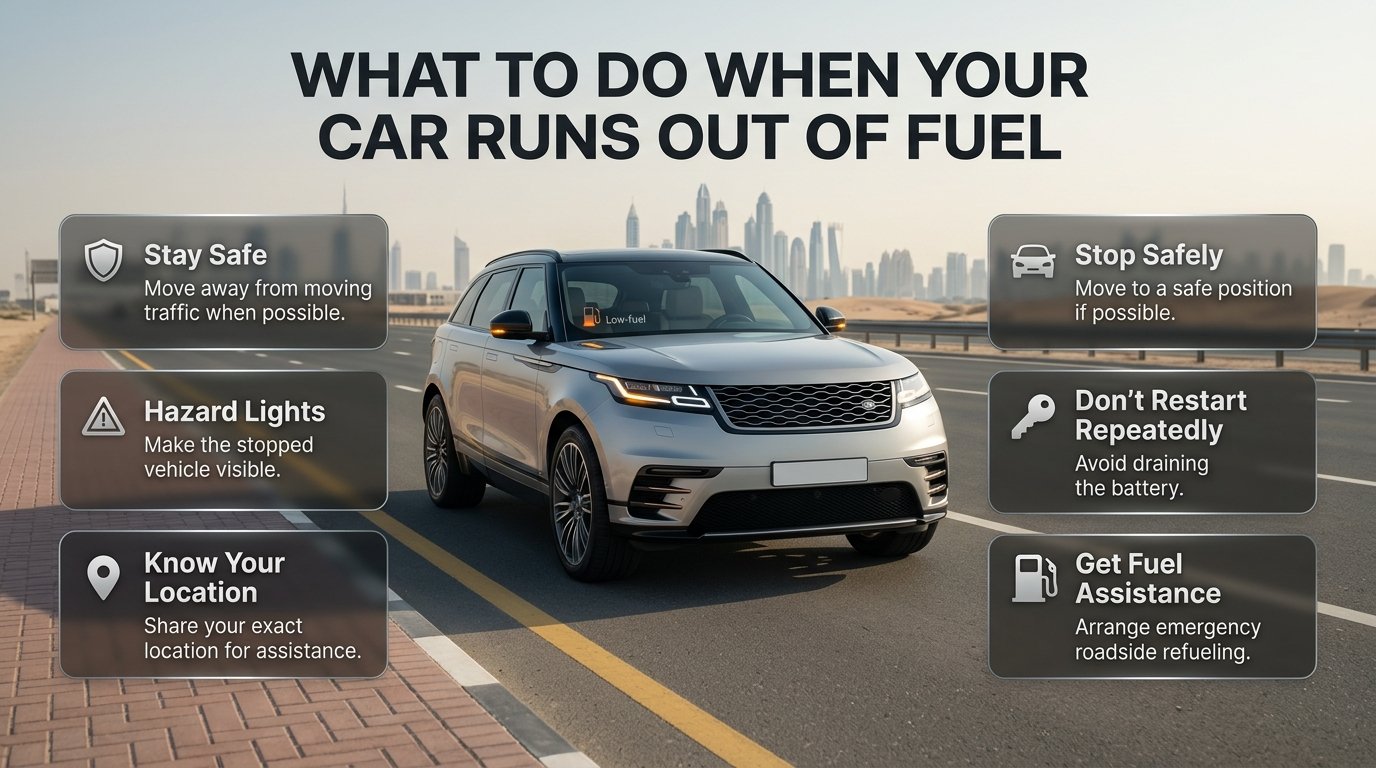
If your car runs out of fuel while driving, safely move it as far away from traffic as possible, switch on the hazard lights, turn off unnecessary electrical systems, and remain in a safe location. Don’t keep trying to restart the engine because repeated attempts can drain the battery.
The correct response is simple:
- Stay calm.
- Switch on your hazard warning lights.
- Move the vehicle to a safe location if it still has enough momentum.
- Park as far from moving traffic as possible.
- Turn off the engine.
- Avoid repeatedly trying to restart it.
- Contact roadside assistance or arrange fuel delivery.
- Stay somewhere safe while waiting.
The exact steps depend on where the vehicle has stopped.
A car that runs out of fuel on a quiet residential road is very different from one that stops in a fast-moving lane on a major Dubai highway.
Step 1: Recognize the Signs That You’re Running Out of Fuel
Your vehicle usually gives you warning signs before the fuel tank becomes completely empty.
The most obvious sign is the fuel gauge reaching the empty mark. However, you may also notice changes in how the vehicle behaves.
Common warning signs include:
- Engine hesitation
- Loss of acceleration
- Sudden reduction in power
- Engine misfiring
- Difficulty maintaining speed
- Engine RPM dropping
- The engine cutting out
- A low-fuel warning appearing on the dashboard
If the engine begins losing power, don’t assume the problem is automatically mechanical.
A nearly empty fuel tank can produce similar symptoms.
Why Does a Car Lose Power When Fuel Is Low?
An internal-combustion engine needs a continuous supply of fuel and air to produce power.
When the fuel supply becomes insufficient, the engine can’t maintain normal combustion. Eventually, the engine may stop running altogether.
This can happen relatively quickly once the tank reaches a very low level.
What Should You Do When the Engine Starts Losing Power?
If you suspect you’re running out of fuel, don’t wait until the vehicle completely stops in the middle of traffic.
Reduce speed gradually and look for a safe place to pull over.
Possible safe locations include:
- A designated emergency stopping area
- A safe shoulder where permitted
- A parking area
- A service road
- A nearby petrol station
- Another location safely away from traffic
Your objective isn’t simply to stop the car.
Your objective is to stop the car somewhere safe.
💡 Pro Tip: If your low-fuel warning appears and you’re already close to a petrol station, avoid unnecessary detours. Gentle acceleration and smooth driving may help you reach a safe refueling point.
Step 2: Get Your Car Out of the Traffic Flow

Once the vehicle starts losing power, your biggest concern is road safety.
A stationary vehicle in an active traffic lane can become a serious hazard.
If the engine still responds, use whatever remaining momentum you have to move toward a safer location.
Don’t make a sudden turn or dangerous maneuver just to reach the shoulder.
What If the Car Has Already Stopped?
If your vehicle has completely stopped, switch on the hazard lights immediately.
If your vehicle can be moved safely without exposing you to traffic, position it as far away from moving vehicles as possible.
If moving the vehicle isn’t safe, don’t put yourself in danger trying to push it.
This is especially important on highways and high-speed roads.
⚠ Common Mistake: Some drivers immediately get out and start pushing their vehicle without considering approaching traffic. A few extra meters of vehicle movement aren’t worth risking your safety.
Step 3: Turn On the Hazard Lights
Hazard warning lights help alert other road users that your vehicle has a problem.
Use them as soon as you realize you’re experiencing a breakdown or fuel-related stoppage.
At night, in poor visibility, or on busy roads, making your vehicle noticeable becomes even more important.
Avoid sitting in a stationary car with the hazard lights turned off while waiting for assistance.
Other drivers may not realize that your vehicle isn’t moving.
Step 4: Stop Repeatedly Trying to Start the Engine
One of the most common reactions to an empty fuel tank is repeatedly turning the ignition or pressing the start button.
Unfortunately, this doesn’t create fuel.
If the tank is empty, the engine won’t continue running simply because you keep trying.
Repeated starting attempts can place unnecessary demand on the battery.
This creates a second problem.
You may start with an empty fuel tank and eventually end up with:
Empty tank + weak battery
That makes the situation more complicated.
Steps After Running Out of Petrol
If your car runs out of petrol in Dubai, follow a few simple steps to stay safe and get back on the road without taking unnecessary risks. Turn on your hazard lights, move the vehicle to a safe location if you can do so without danger, and avoid standing in or near moving traffic. Check your surroundings and keep your phone available so you can contact roadside assistance or emergency fuel delivery. Provide your exact location, vehicle details, and the type of petrol required so help can reach you efficiently. For a complete step-by-step process, focus first on safety, visibility, location sharing, and professional assistance rather than attempting to walk to a petrol station or handle unsafe roadside work yourself.
👉 If your car runs out of petrol in Dubai, follow these Steps After Running Out of Petrol to safely secure your vehicle, assess the situation, and arrange professional fuel assistance without unnecessary roadside risks.
Can Trying to Start a Car Without Fuel Damage It?
Occasional attempts to start the vehicle generally aren’t the same as operating it without proper lubrication or coolant, but repeated cranking is unnecessary and can drain the battery and starter system.
Once you’re reasonably sure the problem is an empty tank, stop trying to restart the engine.
Arrange for fuel instead.
What If You Run Out of Fuel on a Dubai Highway?
Running out of fuel on a highway requires more caution than stopping on a residential street.
High-speed traffic creates a greater risk of collision.
If your vehicle begins losing power:
- Keep control of the steering.
- Gradually reduce speed.
- Move toward a safe stopping location when possible.
- Activate hazard lights.
- Avoid sudden lane changes.
- Don’t stand in a live traffic lane.
- Contact roadside assistance.
- Follow instructions from road authorities or emergency personnel.
Your location matters.
Tell the assistance provider:
- Road or highway name
- Direction of travel
- Nearest exit
- Nearby landmark
- Your vehicle’s make and model
- Vehicle color
- Exact location if available through your phone
This information can significantly reduce confusion when assistance is trying to locate you.
What If You Run Out of Fuel in Heavy Dubai Traffic?
Heavy traffic creates a particularly frustrating situation.
The fuel gauge may have already been low, but repeated acceleration and braking can increase fuel consumption.
Traffic jams can also keep a vehicle running for long periods while covering very little distance.
If your fuel becomes critically low in traffic, avoid aggressive driving.
Instead:
- Maintain a smooth driving pattern.
- Avoid unnecessary acceleration.
- Don’t race toward the next opening.
- Switch off unnecessary electrical loads where appropriate.
- Look for a safe opportunity to leave the traffic flow.
- Don’t wait until the engine completely stops if you can safely reach assistance sooner.
If the engine stops, keep the hazard lights on and focus on getting help.
Can You Drive After the Fuel Warning Light Comes On?
Yes, but the remaining driving range isn’t guaranteed.
The low-fuel warning doesn’t mean every vehicle has exactly the same amount of fuel remaining.
Different vehicles use different fuel tank sizes, warning thresholds, fuel consumption rates, and reserve strategies.
Your remaining range can also change dramatically depending on:
- Traffic
- Air conditioning
- Vehicle load
- Driving speed
- Acceleration
- Road conditions
- Tire pressure
- Engine condition
That’s why treating the low-fuel warning as an invitation to drive another long distance is risky.
Why You Shouldn’t Depend on the Estimated Range
Modern cars often display an estimated remaining range.
This is useful, but it’s still an estimate.
For example, if the dashboard says you have 50 km remaining, that doesn’t guarantee you’ll travel 50 km before the engine stops.
A sudden change in driving conditions can alter consumption.
A long traffic jam can make your actual remaining range much lower.
⭐ Expert Tip: Treat the displayed range as a planning tool rather than a promise. If you’re approaching a low-fuel warning, refuel at the next sensible opportunity instead of testing the vehicle’s reserve.
What Happens When a Car Completely Runs Out of Fuel?
When the tank is empty, the engine eventually stops receiving enough fuel to maintain combustion.
You may notice:
- Loss of acceleration
- Engine hesitation
- Reduced power
- Engine stalling
- Dashboard warning lights
- Difficulty restarting
Once the engine stops, steering and braking may feel different depending on the vehicle.
This is why it is better to respond while the car is still moving rather than waiting until the last second.
Car Ran Out of Fuel Safety in Dubai
If your car runs out of fuel in Dubai, prioritize your safety before trying to restart or move the vehicle. Turn on the hazard lights, move to a safe position away from traffic if possible, and avoid walking along busy roads or highways. In hot weather, remain in a safe, air-conditioned location when practical and contact professional roadside assistance or emergency fuel delivery for help.
👉 If your car runs out of fuel in Dubai, follow this practical Car Ran Out of Fuel Safety Guide to learn the safest steps to protect yourself, secure your vehicle, and get professional roadside assistance.
Safely Dealing With an Empty Fuel Tank in Dubai
Dealing with an empty fuel tank in Dubai requires calm decision-making and a strong focus on roadside safety. If your vehicle runs out of petrol, switch on the hazard lights and, if possible, move the car to a safe location away from active traffic. Avoid stopping in dangerous lanes, walking along busy highways, or attempting unnecessary roadside repairs. Dubai’s high temperatures can also make prolonged exposure outside the vehicle uncomfortable and potentially dangerous, so stay in a safe, shaded or air-conditioned place whenever practical. Once you have secured yourself and the vehicle, contact a reliable roadside assistance or emergency fuel delivery service and provide your exact location, vehicle type, and required fuel. The priority is simple: stay visible, stay safe, and get professional help rather than taking unnecessary risks.
👉 If you find yourself with an empty fuel tank in Dubai, follow this practical Safely Dealing With an Empty Fuel Tank Guide for clear steps on staying safe, securing your vehicle, and arranging reliable roadside fuel assistance.
Does Running Out of Fuel Damage the Fuel System?
Running completely out of fuel isn’t something you should make a habit of.
Modern vehicles use fuel pumps and fuel delivery systems that depend on the fuel tank and fuel flow for proper operation.
Depending on the vehicle design, repeatedly operating with very little fuel can place additional stress on the fuel system.
There’s another practical issue.
If the tank becomes completely empty, restarting the engine after adding fuel may not always happen instantly.
The fuel system may need time to restore proper fuel pressure.
Some vehicles may require specific procedures according to the manufacturer’s instructions.
That’s one reason professional roadside assistance can be preferable to experimenting with the vehicle yourself.
Can You Put Fuel in the Car Yourself?
If you’re in a safe location and legally and practically able to obtain fuel, you may be able to add fuel yourself.
However, carrying fuel in an inappropriate container or walking along a high-speed road to find fuel can create serious risks.
Before attempting anything, consider:
- Where the vehicle is parked
- Whether you’re exposed to traffic
- Whether you have a suitable approved fuel container
- Whether local rules allow what you’re planning
- Whether you can safely transport fuel
- Whether roadside fuel delivery is available
If you’re in an unsafe location, professional assistance is usually the better choice.
What Is Emergency Fuel Delivery?
Emergency fuel delivery is a roadside service that brings an appropriate fuel supply to a vehicle that has run out of fuel.
Instead of leaving your vehicle and walking to a petrol station, you contact a fuel delivery provider and give them your location and vehicle details.
The provider brings fuel to you so you can continue your journey or drive to a petrol station.
For Dubai drivers, emergency refueling can be particularly useful when a vehicle stops:
- On a busy road
- During hot weather
- At night
- During heavy traffic
- Far from a petrol station
- In an unfamiliar area
- During a long-distance journey
For additional guidance, see Emergency Roadside Fuel Advice.
What Information Should You Give Roadside Assistance?
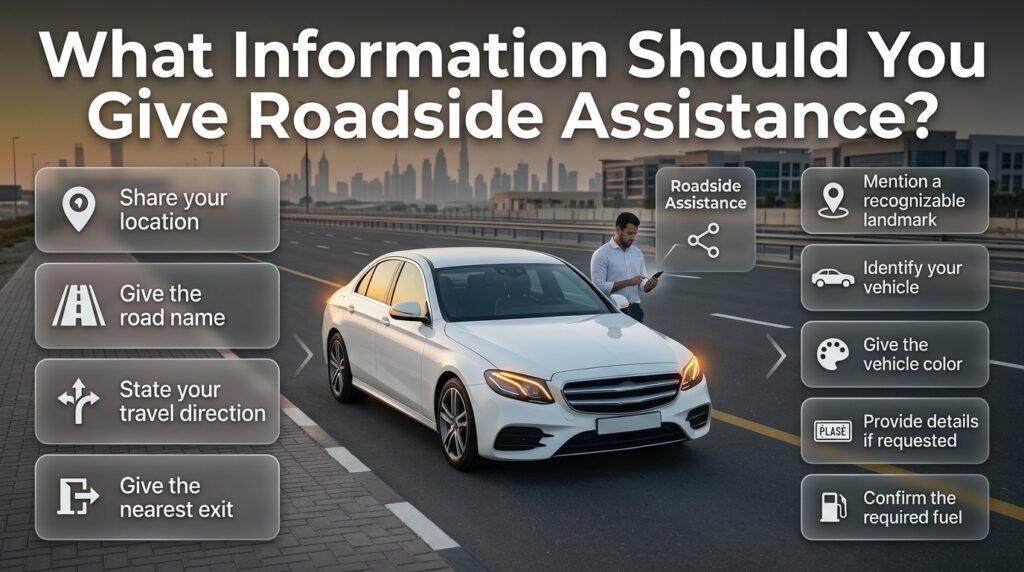
When calling for help, provide accurate information.
A useful description might include:
“My car has run out of fuel. I’m on Sheikh Zayed Road, traveling toward Abu Dhabi, near the nearest recognizable landmark. The vehicle is a white sedan and it’s currently stopped safely with the hazard lights on.”
The more precise your location, the easier it is for assistance to find you.
If possible, provide:
- GPS location
- Road name
- Direction
- Nearest exit
- Landmark
- Vehicle make
- Vehicle model
- Vehicle color
- License plate details if requested
- Fuel type required
Why Is Fuel Type Important?
Petrol and diesel aren’t interchangeable.
Putting the wrong fuel into a vehicle can create a much more serious problem than simply running empty.
Before requesting fuel, verify whether your vehicle uses:
- Petrol
- Diesel
If you’re unsure, check the vehicle handbook, fuel flap label, or manufacturer’s information.
Never guess.
Petrol vs Diesel: Why the Difference Matters
| Feature | Petrol | Diesel |
|---|---|---|
| Common engine type | Spark ignition | Compression ignition |
| Ignition method | Spark plug | Compression |
| Fuel | Petrol/gasoline | Diesel |
| Wrong-fuel risk | Can cause problems | Can cause problems |
| Refueling requirement | Correct petrol grade | Correct diesel |
The fuel cap or manufacturer’s specifications should be your primary reference.
If you’re uncertain, tell the roadside provider that you’re unsure rather than guessing.
What Should You Do While Waiting for Fuel?
Once help has been arranged, your next priority is staying safe.
If the vehicle is in a safe location, remain somewhere protected from traffic and extreme weather.
In hot conditions, particularly in Dubai, heat exposure can become a serious concern.
If remaining inside the vehicle is safer than standing outside, consider the surroundings, ventilation, vehicle location, and weather conditions.
Don’t stand between your vehicle and moving traffic.
Don’t walk along a highway simply because a petrol station appears nearby.
The station may look close on a map but could require crossing dangerous roads.
📌 Quick Tip: Share your live location with the assistance provider when possible. It can be much easier than describing an unfamiliar road or interchange verbally.
Should You Walk to a Petrol Station?
Usually, you shouldn’t walk along a highway to get fuel.
The apparent distance can be misleading, and crossing roads or walking near fast-moving traffic can expose you to unnecessary danger.
If a petrol station is genuinely nearby and accessible through a safe pedestrian route, the situation may be different.
But if your vehicle is stopped on a major road, arranging roadside assistance is generally the safer approach.
Your car can wait.
Your safety shouldn’t be compromised to save a little time.
Can You Push a Car That Has Run Out of Fuel?
Sometimes a vehicle can physically be pushed, but that doesn’t mean you should push it.
Pushing a car near moving traffic can be extremely dangerous.
If you’re in a safe parking area with several people and the vehicle can be moved without risk, limited movement may be possible.
But on a highway or busy road, don’t turn yourself into a pedestrian hazard.
If professional recovery assistance is available, use it.
What Are the Most Common Mistakes After Running Out of Fuel?
Running out of fuel is stressful, and stress can lead to poor decisions.
1. Repeatedly Restarting the Car
This can drain the battery without solving the fuel problem.
2. Standing Behind the Vehicle
Other drivers may not see you clearly, particularly at night.
3. Walking Along a Highway
A nearby petrol station isn’t necessarily safely accessible on foot.
4. Ignoring Hazard Lights
Other drivers need to know your vehicle is stationary.
5. Guessing the Fuel Type
Petrol and diesel should never be treated as interchangeable.
6. Trying to Save Money by Taking Risks
A roadside assistance fee is insignificant compared with the potential consequences of a traffic accident.
7. Continuing to Drive After Severe Fuel Symptoms Begin
If the engine is losing power, don’t assume you can squeeze out another few kilometers.
8. Forgetting the Vehicle Location
Drivers sometimes call for assistance without knowing the road, direction, or nearest landmark.
Use your phone’s location services.
How Can You Prevent Running Out of Fuel?
Prevention is much easier than dealing with an empty tank.
A simple routine can eliminate most fuel emergencies.
Check Your Fuel Before Long Trips
Before starting a long journey, look at:
- Fuel level
- Estimated range
- Traffic conditions
- Planned route
- Petrol stations along the route
Don’t begin a long trip with the assumption that you’ll “find fuel somewhere.”
Don’t Treat the Fuel Warning as a Deadline
The low-fuel warning should encourage you to refuel.
It shouldn’t become a challenge to see how far you can drive.
Monitor Fuel Consumption
If your vehicle normally gets a certain amount of fuel economy but suddenly starts consuming much more fuel, investigate.
Possible causes include:
- Underinflated tires
- Heavy vehicle load
- Aggressive driving
- Excessive idling
- Poor maintenance
- Air-conditioning demand
- Traffic congestion
- Aerodynamic accessories
Understanding fuel-saving driving tips can help reduce unnecessary consumption.
How Driving Style Can Increase the Risk of Running Out of Fuel
Your driving habits directly affect how quickly your fuel disappears.
Hard acceleration consumes more fuel than smooth acceleration.
Frequent unnecessary braking also wastes energy because fuel was used to accelerate the vehicle only for that energy to be discarded through braking.
Traffic creates another challenge.
Stop-and-go driving can significantly reduce practical fuel economy compared with steady cruising.
For drivers who regularly deal with Dubai traffic, understanding how traffic affects fuel economy in Dubai can help with everyday fuel planning.
Does Air Conditioning Affect Fuel Consumption?

Yes.
Air conditioning can increase energy demand, although the exact effect depends on the vehicle, outside temperature, driving conditions, and HVAC system.
In Dubai’s hot climate, AC use is often necessary for comfort and safety.
That doesn’t mean you should avoid using it simply to save a small amount of fuel.
Instead, focus on efficient overall driving.
Useful habits include:
- Avoiding unnecessary idling with the AC running
- Parking in shade when practical
- Ventilating an extremely hot cabin briefly when appropriate
- Maintaining the AC system
- Keeping windows closed at higher speeds when appropriate
Fuel economy should never come at the expense of reasonable occupant safety and comfort.
Does Idling Waste Fuel?
Yes.
A running engine consumes fuel even when the vehicle isn’t moving.
Long periods of unnecessary idling can therefore reduce your effective fuel economy.
This matters particularly in:
- Traffic queues
- Waiting outside buildings
- Pickup areas
- School zones
- Parking lots
- Drive-through queues
If you’re waiting for an extended period and it is safe and appropriate to switch off the engine, doing so may reduce unnecessary fuel consumption.
For a deeper look at the subject, see fuel consumption while idling.
Does Vehicle Load Affect the Risk of Running Out of Fuel?
Yes.
A heavily loaded vehicle generally requires more energy to move than a lightly loaded vehicle.
You don’t need to remove everything from your car, but carrying unnecessary weight for months can contribute to higher fuel consumption.
Before a long journey, check whether you really need:
- Heavy equipment
- Unused tools
- Excess luggage
- Old materials
- Unnecessary cargo
A sensible vehicle load can support better fuel efficiency.
Running Out of Fuel on the Road
Running out of fuel on the road can quickly become a safety concern, particularly on busy roads or highways. If your vehicle loses power because the fuel tank is empty, switch on the hazard lights and, if it is safe to do so, move the car away from moving traffic. Avoid trying to walk along the road or attempting unsafe roadside repairs. Instead, stay in a secure location and contact professional roadside assistance or an emergency fuel delivery service. Providing your exact location and vehicle details can help ensure that assistance reaches you as quickly and safely as possible.
👉 If you are running out of fuel on the road in Dubai, follow this practical Running Out of Fuel on the Road Guide to learn how to secure your vehicle, stay safe around traffic, and arrange professional fuel assistance.
Can a Roof Rack Increase Fuel Consumption?
Yes.
External accessories can increase aerodynamic drag.
A roof box, roof rack, or other external equipment can make the vehicle work harder, particularly at higher speeds.
If you don’t need a roof-mounted accessory, removing it may help reduce unnecessary aerodynamic resistance.
This is one reason vehicle setup and driving style should be considered together when trying to improve fuel economy.
Running Out of Fuel in Extreme Heat
Dubai’s hot weather adds another dimension to a fuel emergency.
A stranded vehicle can become uncomfortable very quickly when temperatures are high.
This makes preparation especially important.
Before a long drive, consider carrying:
- Drinking water
- Phone charger/power bank
- Basic emergency supplies
- Reflective warning equipment where appropriate
- Vehicle documents
- Emergency contact information
Keep your phone sufficiently charged whenever possible.
A working phone can be your most useful emergency tool.
What Should You Keep in Your Car for Fuel Emergencies?
A basic emergency kit can make roadside situations easier.
Consider keeping:
- Phone charger
- Power bank
- Drinking water
- Reflective vest
- Warning triangle where appropriate
- Flashlight
- Basic first-aid supplies
- Vehicle owner’s manual
- Roadside assistance contact information
You don’t need to turn your trunk into a workshop.
The goal is simple preparedness.
What should you do first when your car runs out of fuel?
When your car runs out of fuel, your first priority should be your safety, not getting fuel immediately. If the engine is losing power, keep the steering under control, reduce speed gradually, switch on the hazard lights, and move the vehicle as far away from moving traffic as you can safely manage. Once stopped, apply the parking brake and avoid repeatedly trying to restart the engine. A stationary car in a live traffic lane can become much more dangerous than the empty fuel tank itself.
If you’re in a safe location, check your phone’s GPS and identify your exact position. Then contact roadside assistance, a reliable emergency fuel delivery service, or another appropriate source of help.
Important points:
Turn on your hazard warning lights.
Move away from traffic if it can be done safely.
Don’t keep cranking the engine.
Don’t stand directly behind or in front of the vehicle.
Share your exact location with whoever is coming to help.
If you’re on a busy highway, don’t walk along the road looking for a petrol station.
The key principle is simple: secure the situation first, solve the fuel problem second.
What should you do if your car runs out of fuel on a highway?
Running out of fuel on a highway requires extra caution because vehicles may be traveling at high speed and have limited time to react to a stationary car. If you notice the engine beginning to lose power, activate your hazard lights and gradually steer toward the safest available stopping area while the vehicle still has momentum. Avoid sudden lane changes or aggressive attempts to reach an exit.
Once stopped, keep yourself away from moving traffic. Whether you should remain inside the vehicle or move to a safer location depends on the road layout and circumstances. On a busy highway, stepping into the traffic-side area can be more dangerous than remaining securely inside with your seat belt fastened. If you can safely reach a protected area away from traffic, do so without crossing live lanes.
If you’re stranded on a highway:
Switch on hazard lights immediately.
Position the vehicle as far from traffic as safely possible.
Note the highway, direction, exit, landmark, or location marker.
Contact roadside assistance.
Keep your phone charged and accessible.
Don’t attempt to cross the highway.
Don’t stand behind the vehicle waiting for help.
Follow instructions from emergency or road-support personnel.
If the vehicle cannot be moved safely, don’t risk your life trying to push it into a better position. Your safety is more important than moving the car a few meters.
Can you restart your car after it completely runs out of fuel?
In many cases, a car can be restarted after the correct fuel has been added, but don’t assume it will start instantly. When the tank becomes completely empty, the fuel system may need to restore fuel pressure before the engine can run normally. The exact process varies between vehicles, so the manufacturer’s instructions should take priority.
The biggest mistake is repeatedly turning the ignition or pressing the start button when there’s no fuel available. Continuous cranking can drain the battery and turn a straightforward fuel problem into a second roadside problem.
After the correct fuel has been added:
Give the fuel system a moment to receive the fuel.
Follow the vehicle manufacturer’s starting procedure.
Avoid excessive repeated cranking.
If the engine doesn’t start, stop trying repeatedly.
Contact professional roadside assistance if necessary.
There is also an important difference between petrol and diesel vehicles. Some diesel vehicles can require additional fuel-system priming or bleeding after running completely dry. That’s one situation where professional assistance is preferable to experimenting with the vehicle yourself.
Professional advice: If you’ve added the correct fuel and the vehicle still refuses to start, don’t automatically assume you need more fuel. The problem could now involve the battery, fuel pressure, or another mechanical issue.
Is emergency fuel delivery better than walking to a petrol station?
For many roadside situations, emergency fuel delivery is the safer and more practical option, particularly when your vehicle has stopped on a busy road, highway, unfamiliar area, or location where walking isn’t safe. Roadside assistance providers can bring fuel directly to the stranded vehicle, allowing you to deal with the problem without leaving the car beside moving traffic. Fuel delivery is a recognized form of roadside assistance for empty-tank situations.
Walking may sound simple when a petrol station appears to be nearby, but distance can be deceptive. You may have to cross roads, walk beside fast-moving traffic, or carry fuel back to the vehicle. Those risks aren’t worth taking simply to avoid a roadside assistance call.
Emergency fuel delivery makes particular sense when:
You’re on a highway.
Traffic is moving quickly.
You’re traveling at night.
The weather is extremely hot.
You have children, elderly passengers, or other vulnerable passengers.
You’re unfamiliar with the area.
The nearest station isn’t safely accessible on foot.
You don’t have an approved fuel container.
Your vehicle has stopped in an unsafe location.
For Dubai drivers, this can be especially relevant during long journeys or heavy traffic, where leaving a stranded vehicle and walking around unfamiliar roads can create additional safety problems.
The professional approach is to use the safest available solution rather than simply choosing the cheapest-looking option.
How can you prevent your car from running out of fuel again?
The easiest way to deal with an empty fuel tank is to prevent it from happening in the first place. Don’t treat the low-fuel warning as a challenge to see how many additional kilometers you can squeeze from the vehicle. Your actual remaining range can change with traffic, driving style, air-conditioning use, vehicle load, road conditions, and fuel consumption.
A better approach is to create a personal refueling habit. For example, instead of waiting until the gauge reaches empty, make it a rule to refuel when the tank reaches a comfortable reserve level. This gives you a safety margin if traffic suddenly becomes heavy or you encounter a long stretch without a convenient petrol station.
Useful habits include:
Check your fuel level before long journeys.
Don’t rely completely on the dashboard’s estimated range.
Refuel before entering long or unfamiliar routes.
Keep track of your vehicle’s normal fuel consumption.
Allow extra fuel for heavy traffic.
Avoid unnecessary idling.
Maintain correct tire pressure.
Remove unnecessary weight from the vehicle.
Avoid aggressive acceleration.
Keep your vehicle properly maintained.
Save reliable roadside assistance information in your phone.
Your driving conditions matter too. Stop-start traffic, heavy loads, and other factors can increase fuel consumption, meaning the range you normally expect from a tank may not be realistic on a particularly difficult journey.
Expert takeaway: Don’t plan your journey around the absolute minimum fuel your car can theoretically use. Plan around a reasonable safety margin. That small habit can prevent an inconvenient fuel stop from becoming a roadside emergency.
Conclusion
Running out of fuel can turn an ordinary journey into a stressful roadside situation, but knowing what to do when your car runs out of fuel helps you handle it safely and confidently. The most important step is to protect yourself and other road users before worrying about getting fuel. Move the vehicle to a safe location if possible, switch on the hazard lights, avoid unnecessary engine-start attempts, and arrange reliable roadside assistance or emergency fuel delivery when needed.
For Dubai drivers, preparation is especially valuable because heavy traffic, long-distance routes, high temperatures, and extensive AC use can affect fuel consumption. Don’t wait until the fuel gauge reaches empty before thinking about your next refill. Building a simple habit of checking your fuel level, planning longer journeys, and keeping a reasonable reserve can prevent many fuel emergencies.
If your car does run completely dry, stay calm and avoid risky solutions such as walking along a busy highway or using an unsuitable fuel container. Get professional assistance, make sure the correct fuel is provided, and have the vehicle checked if it doesn’t restart normally.
Ultimately, fuel emergencies are much easier to manage when you’re prepared. A little planning, sensible driving, and timely refueling can keep you moving and help you avoid an unnecessary roadside problem.
Leave a Reply