Introduction
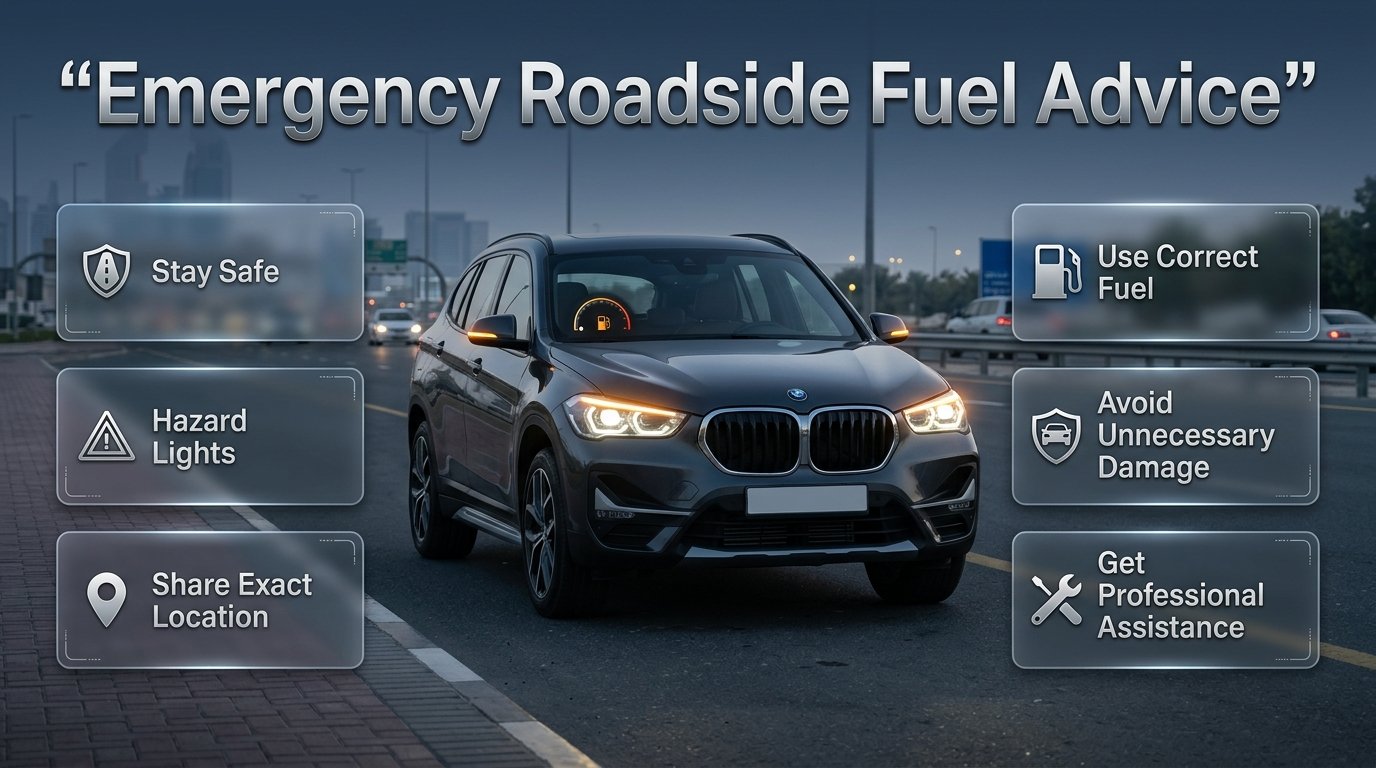
Emergency Roadside Fuel Advice | Running out of fuel is one of those problems that can turn an ordinary journey into a stressful situation within minutes. The engine may begin to hesitate, acceleration may become weak, and suddenly the vehicle stops. If you’re on a busy road, in an unfamiliar area, or travelling at night, the problem becomes more than simply needing petrol or diesel.
This Emergency Roadside Fuel Advice guide explains what to do when your vehicle runs out of fuel, how to stay safe, when emergency fuel delivery makes sense, what to do with petrol and diesel vehicles, how to handle misfuelling, and how to recognize situations where the real problem may be mechanical rather than fuel-related.
If you need fuel brought directly to your vehicle in Dubai, Petrol Delivery to My Location 👉 Fuel Delivery Dubai can be a practical option when reaching a fuel station isn’t safe or convenient.
The goal isn’t simply to get the vehicle moving again. The goal is to solve the problem safely, use the correct fuel, avoid unnecessary damage, and understand when professional assistance is needed.
What Should You Do First When Your Vehicle Runs Out of Fuel?
If your vehicle runs out of fuel while driving, the first priority is safety. Don’t immediately focus on finding a fuel station or repeatedly trying to restart the engine. First, make sure the vehicle is positioned as safely as possible and that you’re protected from surrounding traffic.
If the engine begins losing power, stay calm and look for a safe place to move off the road. If the vehicle still has enough momentum, steer gradually toward a suitable shoulder, emergency lane, parking area, or other safe location where permitted.
Once stopped, switch on the hazard warning lights and assess the situation.
The basic sequence is:
- Stay calm.
- Turn on the hazard lights.
- Move away from moving traffic if it is safe.
- Secure the vehicle.
- Check whether fuel shortage is actually the likely cause.
- Contact suitable roadside assistance if necessary.
- Clearly identify whether the vehicle requires petrol or diesel.
- Wait in a safe location until assistance arrives.
A vehicle stopped safely in a parking area is very different from a vehicle stopped in a live traffic lane. Your response should always reflect the surroundings.
Pro Tip: Don’t treat an empty fuel tank as only a refueling problem. If you’re stranded close to moving traffic, your immediate priority is reducing the safety risk.
Why Is Roadside Safety More Important Than Getting Fuel Quickly?
A driver who runs out of fuel may instinctively think about the fastest way to reach a petrol station. That can lead to poor decisions, such as walking along a highway, crossing multiple lanes, or standing outside the vehicle while traffic passes nearby.
Those actions can create a much greater risk than the original fuel problem.
A stationary vehicle can be difficult for approaching drivers to see, especially at night, around curves, during heavy traffic, or in poor weather.
If the vehicle is in a dangerous location, avoid unnecessary movement around it. Turn on the hazard lights and obtain appropriate assistance.
What Makes a Stopped Vehicle Dangerous?
The risk depends on the location.
A vehicle stopped in a safe parking area may present very little danger. A vehicle stopped in a live lane can be extremely hazardous.
Extra caution is needed on:
- High-speed roads
- Highways
- Busy intersections
- Bridges
- Tunnels
- Blind bends
- Narrow shouldersi
- Poorly lit roads
- Areas with heavy traffic
Never assume that other drivers will notice a stationary vehicle in time.
What If the Vehicle Is Still Moving When It Starts Losing Power?
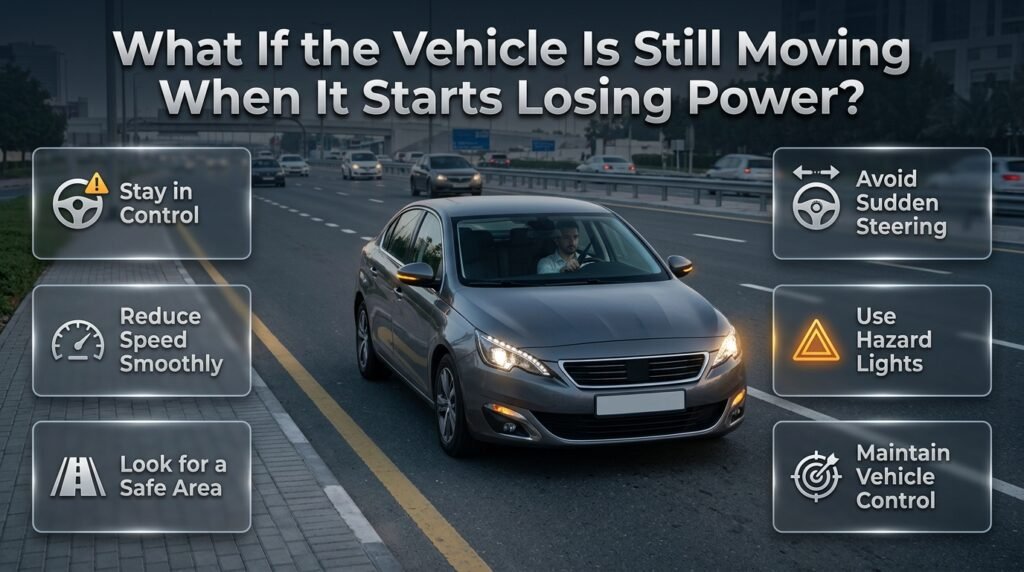
If the engine begins to lose power because the fuel supply is becoming insufficient, don’t wait until the vehicle stops in the middle of traffic.
Look ahead for a safe place to pull over.
Reduce speed smoothly and avoid sudden steering movements. If you can safely move away from traffic, do so while the vehicle still has enough momentum.
Once the vehicle is safely positioned, turn on the hazard warning lights.
If the vehicle is losing power rapidly and there is no safe place to stop, focus on maintaining control rather than attempting complicated troubleshooting while driving.
Why Should You Avoid Sudden Steering?
A driver who suddenly realizes the engine is about to stop may panic and steer aggressively.
That can create another hazard.
Stay controlled. Look for the safest available escape area and make gradual movements whenever possible.
How Can You Tell Whether the Vehicle Actually Ran Out of Fuel?
A vehicle that stops isn’t necessarily a vehicle that has run out of fuel.
Several other problems can cause similar symptoms.
Possible causes include:
- Weak or failed battery
- Fuel pump failure
- Restricted fuel filter
- Electrical fault
- Ignition problem
- Engine overheating
- Sensor failure
- Fuel contamination
- Mechanical failure
The fuel gauge and the events leading up to the breakdown can provide useful clues.
For example, if the fuel gauge was already close to empty and the vehicle began hesitating before stopping, fuel shortage is a reasonable possibility.
If the gauge shows plenty of fuel and the engine suddenly stops, the problem may require further diagnosis.
What Are Typical Signs of an Empty Fuel Tank?
Possible signs include:
- Low-fuel warning appeared earlier.
- Fuel gauge was close to empty.
- Estimated range reached zero.
- Engine began hesitating.
- Acceleration became weaker.
- Engine lost power gradually.
- Vehicle stopped after struggling for a short period.
- Engine cranks but doesn’t start.
These signs aren’t absolute proof.
A mechanical problem can produce very similar symptoms.
What Happens When a Petrol Vehicle Runs Out of Fuel?
A petrol engine requires the correct combination of air, fuel, compression, and ignition to maintain combustion.
When the fuel supply is exhausted, the engine can no longer maintain normal combustion. The vehicle may begin to hesitate or lose power and eventually stop.
After the vehicle stops, the starter may still turn the engine when you attempt to start it. However, turning the engine over doesn’t mean it can run without fuel.
The basic combustion process is explained in greater detail in the guide to the petrol engine combustion process.
Does Running Out of Petrol Automatically Damage the Engine?
Not necessarily.
A petrol vehicle running out of fuel doesn’t automatically mean that the engine has suffered permanent damage.
The more immediate concerns are:
- Roadside safety
- Battery power
- Starter use
- Correct refueling
- Determining whether fuel was actually the problem
Repeatedly trying to start an empty vehicle can drain the battery. If the battery becomes weak, you’ll have both a fuel problem and a starting problem.
Quick Tip: If you’re confident the tank is empty, don’t keep turning the ignition repeatedly. Arrange the correct fuel instead.
What Happens When a Diesel Vehicle Runs Out of Fuel?
Diesel vehicles deserve additional attention after completely running out of fuel.
When the tank becomes empty, air can enter parts of the fuel system that normally contain diesel. Depending on the vehicle design, the engine may not restart immediately after diesel is added.
Some diesel systems require a specific priming procedure before they can operate normally again.
The exact procedure varies between vehicles, so it’s better to follow the manufacturer’s instructions than to guess.
For more information about diesel combustion, see the diesel engine combustion process.
Why Can a Diesel Be More Difficult to Restart After Running Dry?
A diesel fuel system depends on a continuous supply of fuel.
When the system contains air instead of diesel, the engine may not receive fuel in the way it needs to start.
Some vehicles have procedures that allow the system to be primed relatively easily. Others may require specialist attention.
This is one reason diesel drivers shouldn’t assume that adding fuel will always solve the problem immediately.
Expert Tip: If a diesel vehicle has completely run dry and won’t restart after refueling, avoid repeated cranking and check the manufacturer’s recommended procedure or seek qualified roadside assistance.
When Should You Request Emergency Fuel Delivery?
Emergency fuel delivery is useful when the vehicle needs fuel but reaching a fuel station isn’t practical or safe.
It can be especially helpful when:
- You’re stranded on a busy road.
- You’re travelling at night.
- The nearest station is too far away.
- Walking beside the road would be dangerous.
- You have passengers with you.
- You can’t leave the vehicle unattended.
- You’re unfamiliar with the area.
- You don’t have an approved fuel container.
- The vehicle has stopped in a location where obtaining fuel yourself would be difficult.
The decision shouldn’t be based only on distance.
A petrol station may appear to be only a few minutes away on a navigation app, but the route could involve unsafe shoulders, fast traffic, restricted pedestrian access, or other hazards.
What Information Should You Give the Fuel Delivery Provider?
Good information helps the provider understand what assistance is needed.
When requesting fuel delivery, provide:
- Exact location
- Road name
- Direction of travel if relevant
- Nearby landmark
- Vehicle make and model if known
- Petrol or diesel requirement
- Whether the tank is completely empty
- Whether the vehicle is safely parked
- Any access restrictions
If you’re in a parking garage, private property, service road, industrial area, or another location that may be difficult to access, mention it.
Why Is Accurate Location Important?
Saying “I’m somewhere on this road” isn’t always enough.
If the road is long or has several lanes and exits, the provider may need more precise information.
Useful location details can include:
- Building name
- Petrol station nearby
- Exit number
- Junction
- Landmark
- Parking area
- Direction of travel
Clear location information can reduce unnecessary delays.
How Can You Confirm Whether Your Vehicle Uses Petrol or Diesel?
Never guess.
If you’re unsure, check:
- Fuel cap
- Fuel door markings
- Owner’s manual
- Vehicle documentation
- Dashboard information
- Manufacturer information
If you’re requesting emergency fuel, tell the provider exactly what your vehicle requires.
Petrol and diesel have different properties and are intended for different engine systems.
The broader differences are covered in petrol and diesel fuel types.
Petrol vs. diesel comparisons
Petrol and diesel vehicles have different characteristics that can affect fuel economy, driving experience, maintenance requirements, and suitability for different types of journeys. Petrol may be a practical choice for drivers who mainly make shorter trips and regular city journeys, while diesel can be more suitable for longer-distance driving and vehicles that regularly cover higher mileage. Understanding these differences can help drivers choose the right fuel type for their vehicle and avoid confusion during refueling or a roadside fuel emergency.
For a detailed breakdown of fuel economy, driving suitability, maintenance needs, and the key differences between both fuel types, read our complete Petrol vs. Diesel Comparisons guide.
What Should You Do If You Put the Wrong Fuel in Your Vehicle?
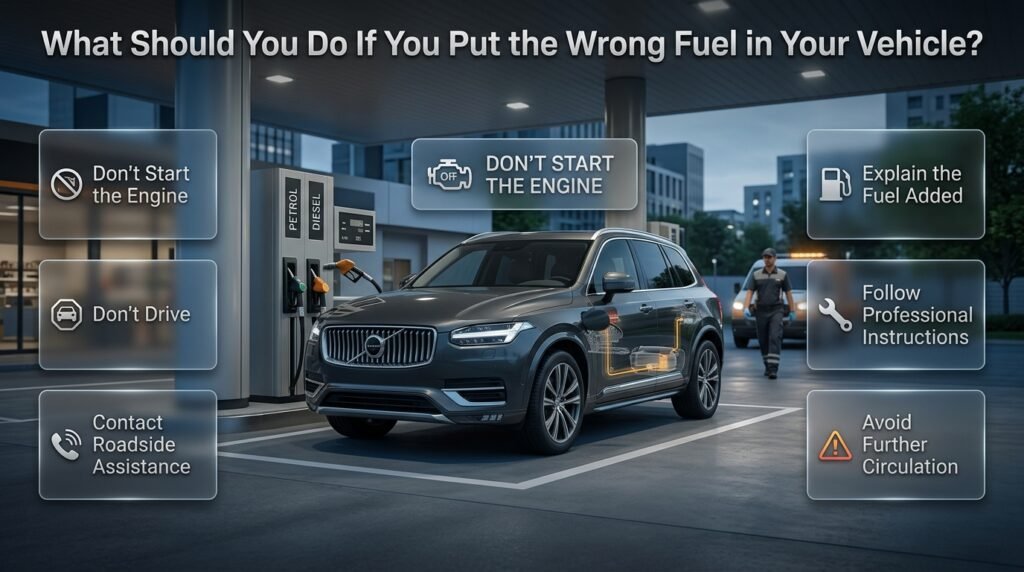
Misfuelling requires a different response from simply running out of fuel.
If you accidentally put petrol into a diesel vehicle or diesel into a petrol vehicle, don’t start the engine just to see whether it works.
If you discover the mistake before starting:
- Don’t start the engine.
- Don’t drive the vehicle.
- Move it only if doing so is safe and necessary.
- Contact suitable roadside assistance.
- Explain what fuel was added.
- Follow professional instructions.
Why Is Starting a Misfuelled Vehicle a Problem?
Starting the engine can circulate the incorrect fuel through the fuel system.
That can increase the extent of the contamination and potentially make the corrective work more complicated.
The exact consequences depend on:
- Vehicle design
- Fuel system
- Amount of incorrect fuel
- Whether the engine was started
- Whether the vehicle was driven
- How long it operated
Common Mistake: Adding the correct fuel on top of the wrong fuel isn’t automatically a safe solution. The appropriate response depends on the vehicle and circumstances.
What Should You Do If Petrol Is Put Into a Diesel Vehicle?
Don’t start the engine if you realize the mistake before starting.
Petrol and diesel have different characteristics, and diesel fuel systems can be particularly sensitive to incorrect fuel.
The safest approach is to contact qualified assistance and explain exactly what happened.
Don’t attempt to solve the problem by guessing how much diesel needs to be added.
What Should You Do If Diesel Is Put Into a Petrol Vehicle?
The same basic principle applies.
Don’t start the engine if the mistake is discovered before starting.
Tell the roadside service what happened and how much incorrect fuel was added if you know.
The vehicle may require fuel removal and appropriate system checks before normal operation.
Does Fuel Grade Matter During a Fuel Emergency?
Yes.
An emergency doesn’t remove the vehicle’s fuel requirements.
If your vehicle manufacturer recommends a specific petrol specification or octane rating, that recommendation should be followed.
For example, some engines are designed to operate on regular petrol while others recommend or require higher octane fuel.
You can learn more about this subject in the guide to regular vs premium petrol octane.
Is Higher-Octane Petrol Always Better?
No.
Higher octane doesn’t automatically mean that every engine will produce more power or better fuel economy.
Octane describes resistance to certain types of abnormal combustion.
The correct choice depends on the vehicle manufacturer’s recommendation.
During an emergency, the priority is obtaining fuel that meets the vehicle’s requirements rather than choosing fuel simply because the number is higher.
Why Does Fuel Quality Matter?
Fuel quality can affect combustion and fuel-system performance.
Suitable fuel should meet the relevant specification and be appropriate for the vehicle.
Problems with fuel quality can potentially involve:
- Water
- Sediment
- Incorrect fuel
- Storage issues
- Other contaminants
For a broader understanding of the subject, see fuel quality standards.
You can also learn how fuel condition can influence vehicle operation in fuel quality and engine performance.
What Are the Characteristics of Good-Quality Petrol?
Good-quality petrol should be suitable for the vehicle and meet the relevant fuel specification.
Drivers shouldn’t judge fuel quality simply by color or smell.
More useful considerations include:
- Appropriate specification
- Reliable source
- Proper handling
- Suitable storage
- Absence of obvious contamination
For a more detailed discussion, read good quality petrol characteristics.
Can Contaminated Fuel Cause a Vehicle to Stop?
Yes, contaminated fuel can contribute to poor engine operation and, in some circumstances, cause a vehicle to stop.
However, it’s important not to blame contamination simply because the engine performs badly.
Symptoms such as:
- Hesitation
- Misfiring
- Hard starting
- Loss of power
- Rough running
- Stalling
can also have mechanical or electrical causes.
If you suspect petrol contamination, see contaminated petrol symptoms.
For diesel-related contamination, see contaminated diesel causes.
What Causes Fuel Contamination?
Fuel contamination can happen for different reasons.
Possible sources include:
- Water entering the fuel
- Dirt or sediment
- Incorrect fuel
- Poor storage
- Contaminated containers
- Handling problems
- Corrosion or debris within fuel systems
Not every suspected contamination event can be confirmed from symptoms alone.
For a detailed overview, read causes of fuel contamination.
What Should You Do If You Suspect Contaminated Fuel?
Don’t automatically keep driving.
If the vehicle begins behaving abnormally after refueling, pay attention to when the symptoms appeared.
For example:
If the engine was running normally before refueling and began running poorly immediately afterward, fuel quality may be worth investigating.
But that timing doesn’t prove contamination.
A professional should consider other possible causes as well.
If fuel testing is required, fuel quality testing basics provides useful background on what fuel testing involves.
How Much Emergency Fuel Should Be Delivered?
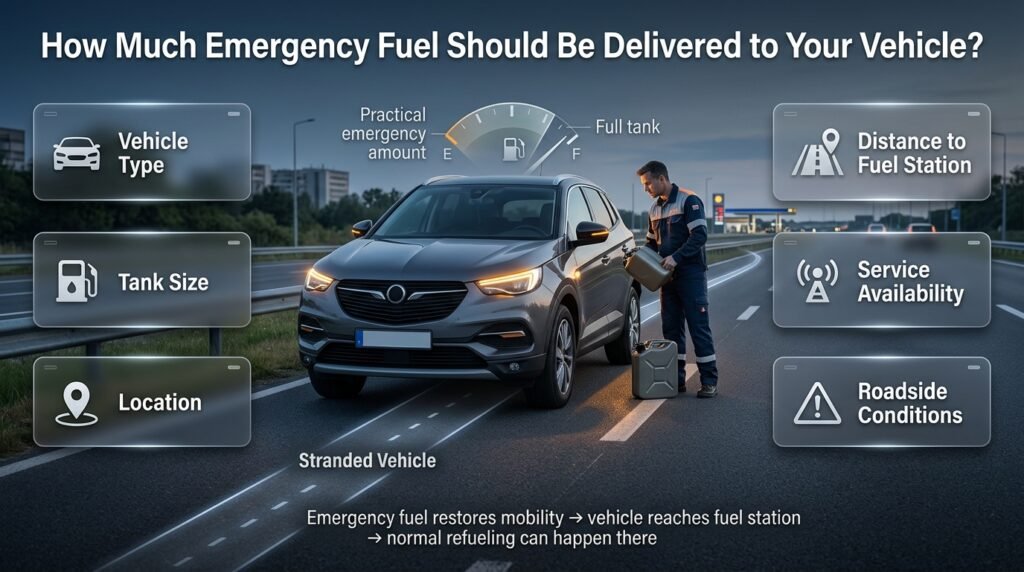
There’s no single amount that applies to every vehicle.
The right amount depends on:
- Vehicle type
- Tank size
- Location
- Distance to a suitable station
- Service availability
- Roadside conditions
The purpose of emergency fuel is generally to provide enough fuel to restart the vehicle and reach a suitable location.
You don’t necessarily need a complete tank delivered at the roadside.
Why Isn’t a Full Tank Always Necessary?
Suppose your vehicle stops only a short distance from a suitable petrol station.
In that situation, enough fuel to restart the vehicle and reach the station may be sufficient.
However, if you’re in an isolated location or expect a long wait before reaching a fuel station, the circumstances may be different.
Discuss the situation with the provider.
What Should You Check After Fuel Is Delivered?
Once the correct fuel has been added, start the vehicle using the normal procedure recommended for that vehicle.
Don’t immediately accelerate away.
First observe the vehicle.
Check whether:
- The engine starts normally.
- The idle is stable.
- Warning lights appear.
- There is any unusual smell.
- Fuel is leaking.
- The engine sounds normal.
- Acceleration feels normal.
- The vehicle continues running.
If everything appears normal, proceed carefully.
If the vehicle still behaves abnormally, stop and seek further assistance.
What If the Vehicle Still Doesn’t Start After Refueling?
Don’t automatically assume you need more fuel.
Possible reasons include:
- Weak battery
- Fuel pump failure
- Fuel-system issue
- Diesel system requiring priming
- Electrical fault
- Contaminated fuel
- Mechanical problem
- Original problem wasn’t actually fuel shortage
If the engine doesn’t start after proper refueling, further diagnosis may be necessary.
How Do You Distinguish a Fuel Emergency From a Mechanical Breakdown?
The following comparison can help:
| Situation | Possible Explanation | Appropriate Response |
|---|---|---|
| Fuel gauge near empty and engine loses power | Fuel shortage | Correct emergency fuel |
| Fuel gauge shows plenty but engine stops | Mechanical/electrical issue possible | Diagnosis |
| Wrong fuel added | Misfuelling | Professional fuel assistance |
| Engine runs badly after refueling | Fuel or mechanical issue | Further diagnosis |
| Diesel won’t restart after running dry | Air/fuel-system issue possible | Vehicle-specific assistance |
| Vehicle won’t crank | Battery/electrical issue possible | Battery or roadside assistance |
| Fuel leak visible | Fuel-system problem | Stop and seek professional help |
This is only a general guide. Vehicle-specific diagnosis should take priority.
What Are the Most Common Emergency Fuel Mistakes?
Waiting Until the Tank Is Completely Empty
Many drivers repeatedly postpone refueling because they believe the vehicle still has enough range.
The problem is that estimated range isn’t a guarantee.
Traffic, driving style, air conditioning, load, road conditions, and other factors can change consumption.
Better approach: Treat the low-fuel warning as a reminder to refuel.
Repeatedly Trying to Start the Engine
If the tank is empty, the engine cannot run normally without fuel.
Repeated attempts can drain the battery.
Better approach: Once fuel shortage is reasonably confirmed, arrange appropriate assistance.
Walking to the Nearest Fuel Station Without Considering Safety
A station may look close.
That doesn’t mean walking there is safe.
Better approach: Consider traffic, road design, temperature, lighting, and pedestrian access.
Guessing the Fuel Type
This can create a much more serious problem.
Better approach: Verify whether the vehicle requires petrol or diesel before adding anything.
Assuming More Fuel Will Fix Everything
If the vehicle still doesn’t run after correct refueling, there may be another fault.
Better approach: Stop troubleshooting randomly and seek proper assistance.
What Should You Keep in Your Vehicle?
A practical emergency kit doesn’t need to be complicated.
Useful items include:
- Charged mobile phone
- Phone charger
- Power bank
- Flashlight
- Basic first-aid supplies
- Reflective safety equipment where appropriate
- Water
- Vehicle documentation
- Basic roadside emergency equipment
An approved fuel container can be useful in some circumstances, but don’t carry fuel in an unsuitable household container.
Fuel storage and transportation should follow applicable safety requirements.
Why Should You Avoid Carrying Fuel in Ordinary Bottles?
Household bottles aren’t designed for fuel.
They may leak, deform, fail to seal properly, or create additional fire and exposure hazards.
If fuel must be transported, use an appropriate approved container designed for that purpose and follow applicable regulations.
For many drivers, professional roadside fuel assistance is simpler and safer than trying to transport fuel themselves.
What Should You Do During a Fuel Emergency at Night?
Nighttime increases visibility challenges.
Make the vehicle as visible as reasonably possible using hazard lights and appropriate vehicle lighting.
Avoid standing close to moving traffic.
When calling for assistance, provide precise location information.
For example, instead of saying:
“I’m on the highway.”
Provide useful information such as:
- Road name
- Direction
- Exit
- Nearby landmark
- Parking area
- Building
- Junction
The more precise the location, the easier it is for assistance to reach you.
How Should You Handle a Fuel Emergency With Passengers?
Passenger safety matters too.
Keep passengers away from moving traffic.
Children should not be allowed to wander around the roadside.
If the vehicle is safely parked, keeping everyone together while waiting for assistance may be appropriate.
Avoid sending passengers on foot to find fuel simply because a station appears nearby.
What If You Run Out of Fuel on a Highway?
A highway presents additional risk because surrounding vehicles may be travelling at high speed.
The priority is to get the vehicle away from moving traffic if that can be done safely.
Turn on the hazard lights and obtain assistance.
Don’t stand in the traffic lane.
Don’t attempt to cross multiple lanes to find fuel.
Don’t assume other drivers will notice the stopped vehicle.
What If the Vehicle Stops in Extreme Heat?
High temperatures can make a roadside wait uncomfortable and potentially dangerous.
If you’re in a hot environment:
- Keep water available.
- Avoid unnecessary physical exertion.
- Keep passengers together.
- Stay away from traffic.
- Follow local safety guidance.
- Keep communication devices charged.
Extreme heat can also affect vehicle components, so don’t assume every engine stop is caused by an empty tank.
Dubai Driving and Fuel Insights
Driving in Dubai comes with specific fuel and roadside considerations, particularly because high temperatures, extensive highway networks, heavy traffic periods, frequent air-conditioning use, and long-distance routes can all affect vehicle operation. Drivers should keep the fuel level comfortably above empty, plan refueling stops before longer journeys, monitor tyre pressure, and pay attention to vehicle cooling and air-conditioning systems during extreme heat. In busy urban areas, avoiding unnecessary idling and aggressive acceleration can also help reduce fuel consumption. For drivers travelling through unfamiliar areas or facing an unexpected fuel shortage, knowing the location and access conditions around major roads, parking areas, and fuel stations can make roadside assistance easier to arrange. Good preparation is especially valuable in Dubai because a short fuel shortage can become more challenging when combined with intense heat or heavy traffic.
For a complete Dubai-focused guide covering local driving conditions, fuel efficiency, extreme-weather considerations, and practical vehicle advice, explore our Dubai Driving and Fuel Insights Guide for helpful information tailored to Dubai drivers.
Seasonal Car Care Tips
Seasonal car care is important for keeping your vehicle safe, reliable, and efficient throughout the year. In Dubai, changing temperatures and extreme summer heat can put extra stress on the battery, tires, engine fluids, cooling system, and air conditioning. Regularly checking tire pressure, coolant, engine oil, brakes, lights, and battery condition can help prevent unexpected problems. Before a long journey, it is also wise to inspect the spare tire and remove unnecessary weight from the vehicle. Simple seasonal maintenance can improve overall vehicle performance and help you avoid costly repairs caused by neglected components.
For practical advice on preparing your vehicle for Dubai’s changing weather conditions, explore our Seasonal Car Care Tips guide, covering essential checks that can help maintain vehicle reliability, safety, and performance throughout the year.
How Can You Prevent Running Out of Fuel?
Prevention is much easier than emergency recovery.
A few simple habits can dramatically reduce the chance of being stranded.
Refuel Before the Tank Becomes Critically Low
There’s no universal percentage that every driver must follow.
Your reserve should reflect your driving environment.
If you frequently travel long distances, drive in heavy traffic, or visit areas with fewer fuel stations, maintaining a larger reserve may make sense.
Plan Fuel Stops on Long Journeys
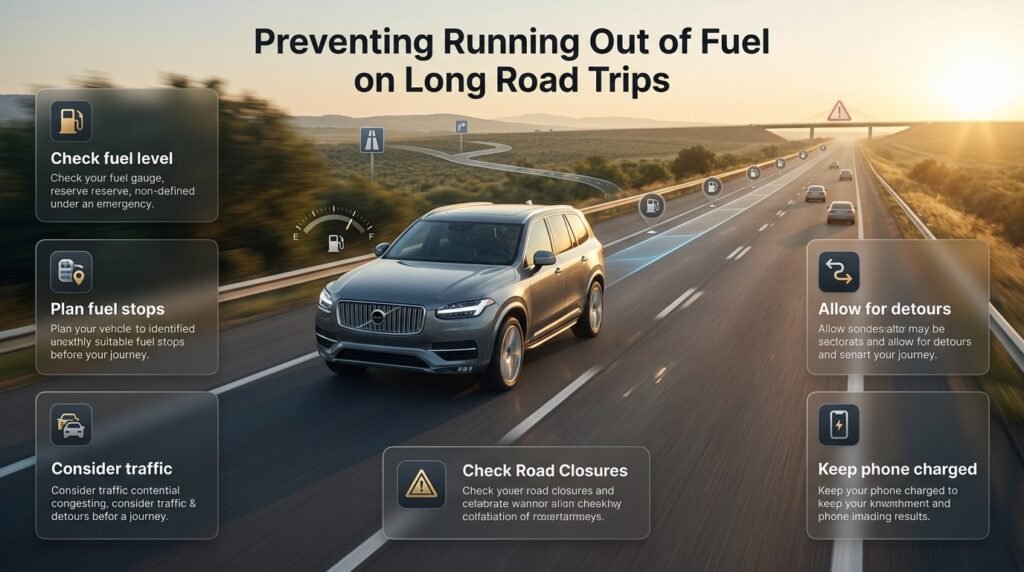
Before starting a long trip:
- Check fuel level.
- Identify fuel stations along the route.
- Consider traffic.
- Allow for detours.
- Consider road closures.
- Avoid leaving with an almost empty tank.
- Keep your phone charged.
Fuel planning is particularly important when travelling through unfamiliar areas.
Why Should You Not Rely Completely on the Estimated Range?
The remaining-range display is an estimate.
It can change depending on:
- Average fuel consumption
- Traffic
- Driving style
- Speed
- Air conditioning
- Vehicle load
- Road conditions
For example, a vehicle may show a certain remaining range during steady highway driving but consume fuel more quickly after entering heavy traffic.
Treat the range as useful information, not a guaranteed promise.
Fuel-saving driving tips
Fuel-saving driving is mainly about keeping fuel consumption steady rather than making sudden changes in driving style. Smooth acceleration, avoiding unnecessary hard braking, maintaining a consistent speed where road conditions allow, and reducing unnecessary idling can help a vehicle use fuel more efficiently. Drivers should also pay attention to tyre pressure, vehicle load, traffic conditions, and air-conditioning use, because these factors can influence fuel consumption. Instead of relying only on the estimated driving range, monitoring actual fuel usage over time can help identify changes in efficiency and encourage better driving habits.
For a more detailed guide on improving fuel efficiency and developing practical driving habits, read our complete guide to Fuel-Saving Driving Tips for helpful information you can apply to everyday driving.
Vehicle maintenance guides
Regular vehicle maintenance can help reduce the risk of unexpected fuel-related problems and roadside breakdowns. Checking the fuel system, fuel filter, fuel pump, battery, tyres, and fuel gauge can help identify issues before they become more serious. A vehicle that is properly maintained is also easier to monitor for unusual fuel consumption, starting problems, or sudden loss of power. For drivers who want to understand how routine maintenance can support reliable vehicle performance and reduce avoidable roadside issues, a dedicated maintenance guide can provide more practical information.
For practical advice on routine servicing, inspections, and maintenance habits that can help prevent avoidable vehicle problems, read our complete Vehicle Maintenance Guides.
Can Vehicle Maintenance Help Prevent Fuel Emergencies?
Yes, although maintenance can’t prevent forgetting to refuel.
A faulty fuel gauge can cause inaccurate readings.
A restricted fuel filter can create fuel-delivery problems.
A failing fuel pump can cause symptoms that look like fuel shortage.
A mechanical problem can also cause unexpected stalling.
Regular maintenance helps identify these issues before they become roadside emergencies.
What If the Fuel Gauge Is Inaccurate?
An inaccurate gauge can make fuel planning difficult.
Possible warning signs include:
- Gauge remains at one level unusually long.
- Gauge drops suddenly.
- Gauge indicates fuel even when the vehicle won’t start.
- Estimated range seems inconsistent.
- Refueling amounts don’t match expectations.
If the gauge appears unreliable, don’t continue relying on it without investigation.
Track actual fuel consumption and have the system inspected when appropriate.
What If You Keep Running Out of Fuel?
Repeated fuel emergencies are worth investigating.
The problem may simply be a habit of delaying refueling.
But repeated incidents can also point to:
- Fuel gauge problems
- Unexpected fuel consumption
- Fuel leakage
- Incorrect range estimates
- Changes in driving conditions
- Vehicle maintenance issues
If your vehicle suddenly starts consuming much more fuel than before, investigate rather than assuming the change is normal.
How Does Fuel Quality Relate to Vehicle Performance?
Fuel quality can influence how consistently an engine operates.
However, fuel quality shouldn’t become the default explanation for every performance problem.
For example, a vehicle with a damaged ignition component may misfire even when the fuel is perfectly suitable.
Similarly, a restricted air intake can reduce performance without any fuel contamination.
This is why fuel diagnosis should consider the whole vehicle.
What Factors Can Affect Fuel Quality?
Fuel quality can be influenced by several factors.
These can include:
- Storage conditions
- Water exposure
- Contamination
- Handling
- Fuel system condition
- Environmental conditions
Drivers interested in the broader subject can read about factors affecting fuel quality.
What Should Fleet Operators Know About Fuel Emergencies?
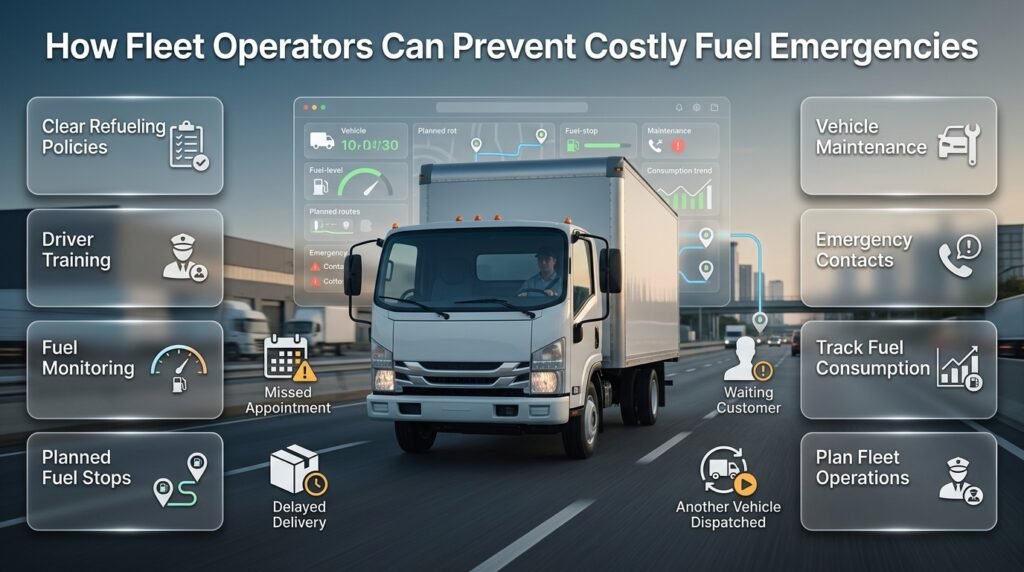
Fuel emergencies can be especially costly for commercial vehicles.
When a company vehicle runs out of fuel, the impact isn’t limited to the fuel itself.
The driver may miss an appointment.
A delivery may be delayed.
A customer may be waiting.
Another vehicle may need to be dispatched.
Fleet operators can reduce these problems through simple procedures.
Useful fleet practices include:
- Clear refueling policies
- Driver training
- Fuel monitoring
- Planned fuel stops
- Vehicle maintenance
- Emergency contact procedures
- Fuel consumption tracking
A well-managed fleet treats fuel availability as part of operational planning.
Why Is Fuel Consumption Tracking Useful?
Tracking fuel consumption can reveal changes that aren’t obvious from the dashboard.
For example, if a vehicle historically consumes a consistent amount of fuel but suddenly begins using substantially more, the change deserves attention.
Possible explanations include:
- Increased traffic
- Different routes
- Heavy loads
- Driving style
- Tyre pressure
- Maintenance issues
- Fuel quality
The purpose isn’t to blame the driver or the fuel immediately.
It’s to identify unusual patterns early.
What Should You Do If Fuel Is Leaking?
A visible fuel leak changes the situation.
Don’t treat it as a normal empty-tank emergency.
Avoid driving the vehicle.
Keep away from ignition sources and obtain appropriate professional assistance.
A fuel leak can create safety hazards that aren’t solved simply by adding more fuel.
If you notice a strong fuel smell or visible leakage, tell the roadside provider when requesting assistance.
Can You Use a Fuel Additive During an Emergency?
A fuel additive isn’t a substitute for the correct fuel.
If your vehicle is empty, adding an additive won’t provide the fuel needed to operate the engine.
If you’re dealing with suspected contamination or a performance issue, don’t randomly add products without understanding the vehicle and the problem.
First identify the actual issue.
What If the Vehicle Runs Poorly After Refueling?
Pay attention to the symptoms.
If the engine starts but immediately runs poorly, consider:
- Incorrect fuel
- Contaminated fuel
- Battery condition
- Fuel delivery
- Ignition
- Air intake
- Sensors
- Other mechanical causes
Don’t automatically continue driving in the hope that the problem will disappear.
If necessary, have the vehicle inspected.
What Is the Difference Between Emergency Fuel and Fuel-System Repair?
Emergency fuel addresses a lack of fuel.
Fuel-system repair addresses a fault within the system that supplies or manages fuel.
For example:
Empty tank: needs suitable fuel.
Failed fuel pump: needs diagnosis and repair.
Blocked filter: may need replacement or cleaning depending on the vehicle.
Contaminated fuel: may require testing and fuel-system service.
Wrong fuel: may require draining and corrective procedures.
Understanding this difference prevents wasted time.
How Can You Make a Long Road Trip Safer From a Fuel Perspective?
Before leaving:
- Check fuel level.
- Know the route.
- Identify fuel stops.
- Consider traffic.
- Check tyres.
- Ensure the vehicle is maintained.
- Keep communication devices charged.
- Carry basic emergency equipment.
During the trip:
- Monitor the fuel gauge.
- Don’t ignore warnings.
- Refuel when practical.
- Avoid relying entirely on estimated range.
- Pay attention to unusual fuel consumption.
A few minutes of preparation can prevent hours of roadside inconvenience.
What should I do if my car runs out of fuel on the road?
When a vehicle runs out of fuel, the first priority is roadside safety, not immediately finding a petrol station. If the engine begins losing power, stay calm and gradually move the vehicle toward the safest available position away from moving traffic, provided you can do so safely. Once stopped, switch on the hazard lights and assess whether the problem is genuinely an empty tank or potentially another vehicle fault. Roadside-safety guidance recommends getting as far away from traffic as safely possible and making the disabled vehicle visible.
If the vehicle is in a dangerous position, don’t take unnecessary risks by pushing it, crossing traffic, or walking along a highway. Contact appropriate roadside assistance or emergency fuel delivery and give them your exact location.
Important points:
Turn on hazard warning lights.
Move away from traffic only if it’s safe.
Don’t repeatedly try to restart an empty tank.
Give the assistance provider your exact location.
Clearly tell them whether the vehicle needs petrol or diesel.
If you’re unsure whether fuel is actually the problem, mention the symptoms rather than assuming.
The key is to treat an empty fuel tank as a roadside safety situation first and a refueling problem second.
How much fuel should I get when my car runs out of fuel?
The right amount depends on the vehicle and your situation. Emergency roadside fuel is generally intended to provide enough fuel to get the vehicle running again and allow you to reach a suitable fuel station or another safe destination. You don’t necessarily need a completely full tank delivered to the roadside.
For example, if you’re stranded a short distance from a fuel station, a modest amount may be enough to restart the vehicle and reach the station. On the other hand, if you’re in an area where fuel stations are far apart, the practical requirement may be different. Some roadside services specifically describe emergency fuel as enough to reach the nearest station rather than a full refill.
Before requesting assistance, tell the provider that the tank is empty and explain where you’re located. They can then determine what type and quantity of assistance is appropriate.
Keep these points in mind:
Don’t assume a tiny amount will work for every vehicle.
Don’t automatically request a full tank.
Tell the provider your vehicle type.
Confirm whether it uses petrol or diesel.
Consider how far you need to travel after restarting.
Follow the vehicle manufacturer’s requirements where applicable.
The purpose of emergency fuel is to restore mobility safely, not necessarily to complete a full refueling stop beside the road.
What happens if a diesel car runs completely out of fuel?
A diesel vehicle can require more attention after running completely dry because air may enter the fuel system. Depending on the vehicle’s design, simply adding diesel may not always be enough to restart the engine. Some diesel systems require priming or a manufacturer-specific procedure before the fuel system can operate correctly again.
This is why diesel drivers shouldn’t repeatedly crank the engine after running out of fuel. Repeated starting attempts can also weaken the battery, creating another problem while you’re already stranded.
The exact restart procedure isn’t the same for every diesel vehicle. Some manufacturers provide specific instructions, while others recommend qualified assistance after a complete fuel-system interruption. For example, manufacturer guidance can specify particular refueling and restart procedures for individual models, which is why generic instructions shouldn’t replace the vehicle handbook.
For a diesel fuel emergency:
Move the vehicle to a safe position.
Switch on hazard lights.
Add the correct diesel.
Follow the manufacturer’s restart procedure.
Avoid endless cranking.
If it doesn’t restart, arrange qualified roadside assistance.
Tell the technician that the vehicle completely ran out of diesel.
The important distinction is that adding fuel and restarting a diesel vehicle aren’t always the same simple process.
What should I do if I put the wrong fuel in my car?
If you’ve put the wrong fuel into your vehicle, don’t start the engine if you haven’t already done so. This is one of the most important pieces of misfuelling advice because starting the engine can circulate the incorrect fuel through the fuel system and increase the potential for damage. Both the AA and RAC recommend keeping the engine off and obtaining professional assistance.
If you’re still at a petrol station, tell the station staff what happened and move the vehicle to a safe position if this can be done without creating a hazard. Then contact a suitable fuel-drain or roadside assistance service.
If you’ve already started the vehicle, switch it off as soon as it is safe to do so. Don’t continue driving simply because the vehicle still appears to be running.
What you should do:
Don’t start the engine if you haven’t already.
Don’t drive the vehicle.
Tell the roadside provider exactly what fuel was added.
Mention approximately how much was added if you know.
Explain whether the engine was started.
Don’t try to “fix” the problem by randomly adding more fuel.
Have the incorrect fuel removed by an appropriate professional.
Petrol in a diesel vehicle can be particularly concerning because diesel fuel systems rely on fuel properties that differ from petrol.
The most important rule is simple: if you’ve misfuelled, stop the situation from getting worse before worrying about getting back on the road.
Why won’t my car start after I have added fuel?
Adding fuel doesn’t guarantee that a vehicle will restart because an empty tank isn’t the only reason a vehicle can stop.
If the vehicle has been repeatedly cranked while empty, the battery may have become weak. A diesel vehicle that has run completely dry may require fuel-system priming. Alternatively, the original problem may not have been lack of fuel at all. A failed fuel pump, electrical fault, restricted fuel system, ignition problem, or another mechanical issue can produce similar symptoms.
That’s why continuing to add fuel or repeatedly turning the ignition isn’t a good troubleshooting strategy.
If the vehicle still won’t start:
Check that the correct fuel was added.
Avoid repeated starting attempts.
Pay attention to dashboard warning lights.
Note whether the engine cranks normally.
Tell the technician what happened before the vehicle stopped.
Mention whether it ran completely out of fuel.
If it’s diesel, mention that specifically.
Arrange further roadside diagnosis if necessary.
A useful example is a car that shows a low-fuel warning, loses power, receives the correct fuel, and then still refuses to start. At that point, assuming “it just needs more fuel” could delay finding a battery or fuel-system problem.
Professional takeaway: emergency fuel delivery solves a genuine fuel shortage. It shouldn’t be treated as a substitute for diagnosing a vehicle that continues to malfunction after correct refueling.
Conclusion
An emergency fuel problem can happen to any driver, but the way you respond can make a major difference. If your vehicle runs out of fuel, your first priority should always be roadside safety. Move away from traffic when it is safe, use your hazard lights, and avoid taking unnecessary risks simply to reach a fuel station.
Whether you drive a petrol or diesel vehicle, make sure the correct fuel is added. Diesel vehicles may require additional attention after running completely dry, while putting the wrong fuel into a vehicle requires a different response altogether. If misfuelling occurs, don’t start or drive the vehicle unnecessarily—get professional assistance.
It’s also important to remember that not every vehicle that stops has an empty fuel tank. If the car still won’t start after receiving the correct fuel, there may be a battery, fuel-system, electrical, or mechanical problem that needs proper diagnosis.
Good emergency fuel planning is ultimately about prevention, preparation, and making safe decisions under pressure. Keep your fuel level under control, plan refueling stops on longer journeys, don’t rely completely on the estimated driving range, and know what to do before a fuel emergency happens.
When reaching a fuel station isn’t safe or practical, Fuel Delivery Dubai can provide a convenient option for drivers who need fuel brought to their vehicle. The most important rule is simple: stay safe first, use the correct fuel, and get professional help when the situation requires more than a simple refill.
Leave a Reply