Introduction
Fuel Quality Standards | When you put petrol or diesel into a vehicle, it’s easy to think that all fuel is basically the same. If the engine starts and the vehicle moves, the fuel must be fine—right? Not necessarily.
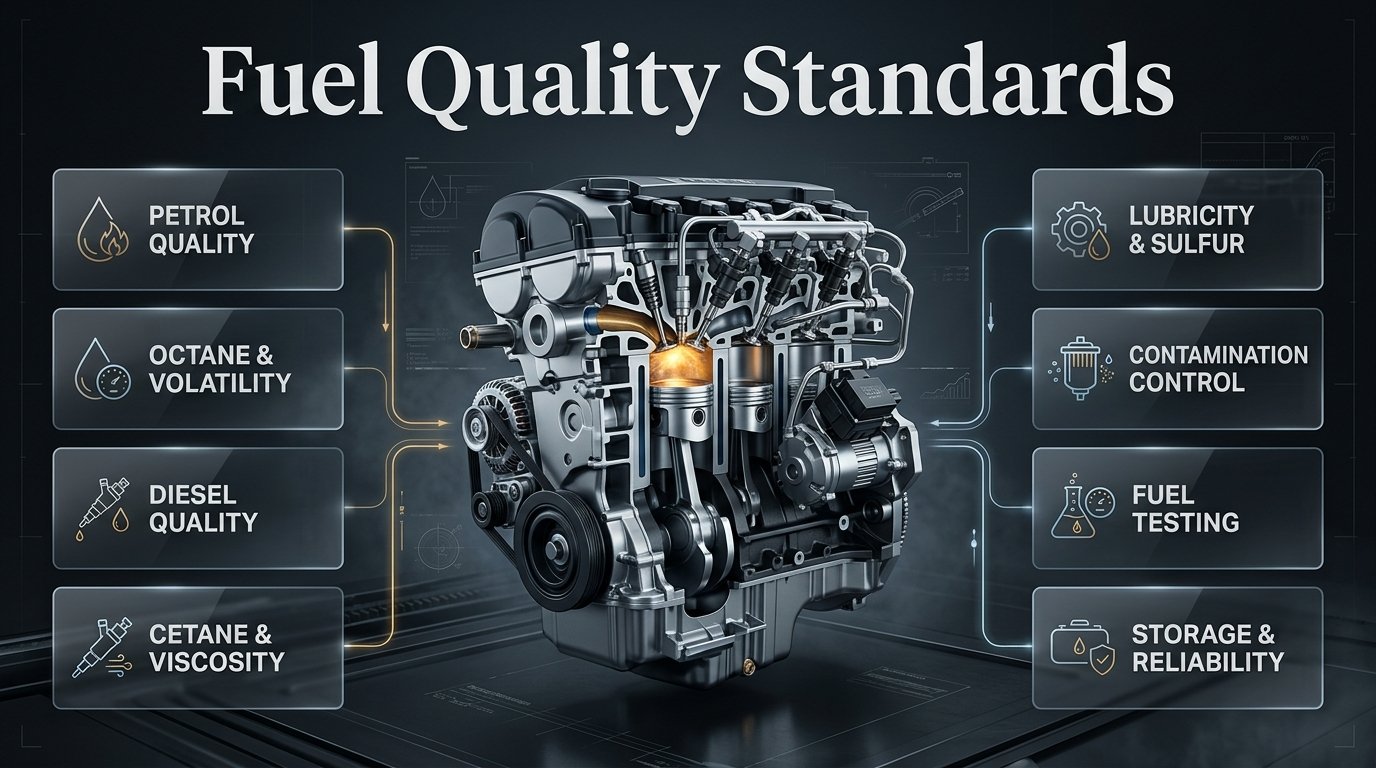
Fuel quality is much more than whether an engine can burn the fuel. The chemical and physical properties of fuel affect combustion, fuel injection, engine performance, emissions, component wear, storage stability, and even the reliability of modern fuel systems.
This is why fuel quality standards exist. They establish measurable requirements that fuel must meet before it can be considered suitable for a particular application.
For example, petrol needs appropriate octane quality and volatility for a spark-ignition engine, while diesel needs suitable cetane quality, viscosity, lubricity, sulfur content, and contamination control for a compression-ignition engine.
If you’re looking for a broader introduction to automotive fuel, you can start with Out of Petrol Dubai 👉 FuelDeliveryDubai.
In this guide, we’ll explain fuel quality standards in simple language, compare petrol and diesel requirements, look at the most important fuel properties, explain how fuel is tested, discuss contamination and storage, cover common mistakes, and provide practical advice for drivers, businesses, and fleet operators.
What Are Fuel Quality Standards?
Fuel quality standards are technical requirements that define the acceptable properties of a particular fuel. They establish limits or ranges for characteristics that influence fuel performance, safety, storage, combustion, emissions, and compatibility with an engine.
In simple terms, a fuel quality standard answers one important question:
Does this fuel have the properties required for its intended engine and application?
There isn’t one universal standard for every type of automotive fuel. Petrol and diesel have different requirements because they work differently inside an engine.
A petrol engine generally uses spark ignition. A diesel engine uses compression ignition. Because the combustion processes are different, the fuels need different characteristics.
Fuel standards can cover properties such as:
- Octane rating
- Cetane number
- Sulfur content
- Viscosity
- Volatility
- Flash point
- Water and sediment
- Lubricity
- Distillation characteristics
- Stability
- Corrosion behavior
- Density
- Contamination limits
The exact requirements depend on the fuel type, grade, market, engine technology, and applicable regulations.
Why Do Fuel Quality Standards Matter?
Without quality standards, fuel could vary significantly from one supplier, batch, or location to another.
One batch might have unsuitable combustion characteristics. Another could contain excessive contamination. Another might have properties that aren’t compatible with a modern emissions-control system.
Standards help create consistency.
They are important because they can help:
- Protect fuel-system components
- Support reliable engine operation
- Maintain predictable combustion
- Control emissions
- Reduce contamination risks
- Protect modern emissions equipment
- Improve fuel-handling safety
- Give suppliers measurable quality targets
- Provide laboratories with defined testing requirements
A useful way to think about fuel standards is this:
Fuel quality isn’t based on appearance or price. It’s based on whether the fuel meets the technical requirements for its intended use.
What Makes Fuel High Quality?
High-quality fuel isn’t simply fuel that allows an engine to run.
A fuel should have the right characteristics for its application and should remain within the relevant specification throughout transportation, storage, handling, and use.
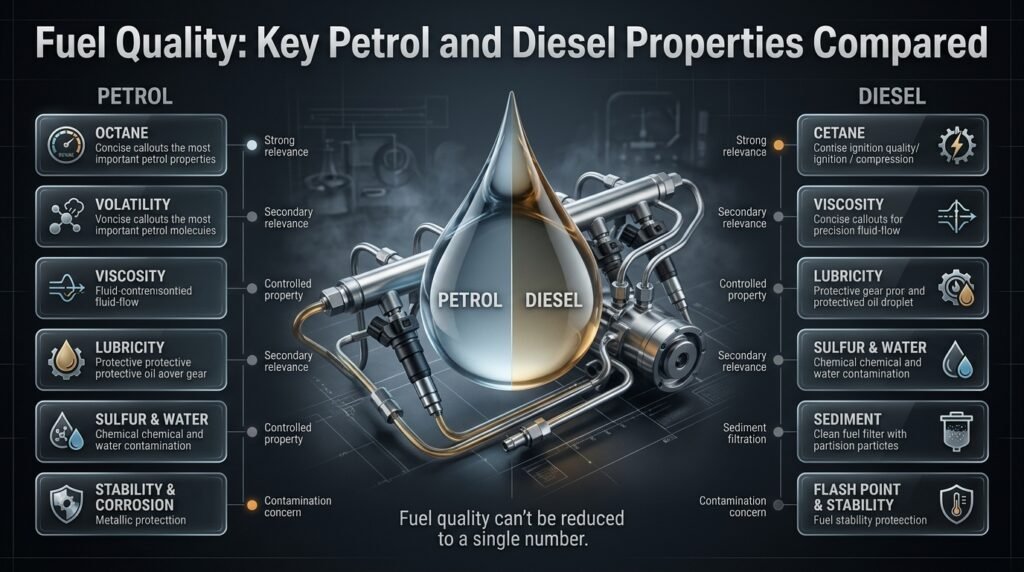
The properties that matter most depend on whether you’re dealing with petrol or diesel.
| Fuel Quality Property | Petrol | Diesel |
|---|---|---|
| Octane | Very important | Not the primary quality measure |
| Cetane | Not the primary quality measure | Very important |
| Volatility | Very important | Less significant |
| Viscosity | Important to fuel-system design | Very important |
| Lubricity | Relevant | Particularly important |
| Sulfur | Controlled | Controlled |
| Water | Harmful | Particularly problematic |
| Sediment | Undesirable | Undesirable |
| Flash point | Different considerations | Important |
| Distillation | Important | Important |
| Stability | Important | Important |
| Corrosion | Important | Important |
This comparison shows why fuel quality can’t be reduced to a single number.
A petrol fuel could have an appropriate octane rating but still have another issue. Similarly, diesel could have suitable cetane quality but contain water or sediment.
That’s why professional fuel-quality evaluation considers multiple properties.
What Are the Main Fuel Quality Standards?
There isn’t one worldwide fuel-quality standard.
Different countries and regions use different technical standards and regulations. Some specifications are developed by ASTM International, while European markets commonly use EN standards. National regulators may also establish additional requirements.
The important thing is to identify the correct standard for the correct fuel and market.
ASTM Fuel Standards
ASTM International develops technical standards and test methods used throughout the petroleum and fuel industries.
For automotive spark-ignition fuel, ASTM D4814 is an important specification for gasoline and certain gasoline-oxygenate blends.
For diesel fuel, ASTM D975 covers several diesel fuel grades and addresses numerous important fuel properties.
These specifications are useful because they turn the general concept of “good fuel” into measurable technical requirements.
A supplier can test a batch of fuel against the appropriate requirements rather than simply claiming that the fuel is high quality.
European Fuel Standards
European fuel markets commonly use:
- EN 228 for petrol
- EN 590 for diesel
These standards establish technical requirements for fuels intended for compatible road vehicles.
However, it’s important not to assume that a standard used in one region automatically represents the legal requirement everywhere.
Local laws and regulations can establish additional requirements.
Why Does the Market Matter?
Consider someone saying:
“This is standard diesel.”
From a technical perspective, that’s incomplete.
You still need to know:
- What country is the fuel being sold in?
- Which diesel grade is it?
- Which specification applies?
- What engine is using it?
- What local regulations apply?
This becomes particularly important for commercial users purchasing fuel in bulk.
What Is Petrol Fuel Quality?
Petrol, also called gasoline, is mainly used in spark-ignition engines.
Its quality influences:
- Combustion
- Knock resistance
- Vaporization
- Starting
- Drivability
- Fuel-system behavior
- Emissions
- Deposit formation
Understanding the different types of automotive fuel is useful before looking at quality specifications. For that background, see types of automotive fuel.
Why Is Octane Important?
Octane rating is one of the best-known measurements associated with petrol.
Octane describes a fuel’s resistance to knock under specified testing conditions.
Engine knock can occur when part of the unburned fuel-air mixture auto-ignites instead of burning in the controlled manner intended by the engine designer.
This uncontrolled combustion can create pressure waves that are undesirable for the engine.
Higher-octane petrol has greater resistance to this type of abnormal combustion.
But there is an important distinction:
Higher octane does not automatically mean higher overall fuel quality.
Octane is one characteristic of petrol. It isn’t a complete description of the fuel.
Why Does Engine Design Affect Octane Requirements?
Modern petrol engines may use:
- Turbochargers
- High compression ratios
- Direct injection
- Variable valve timing
- Advanced ignition control
- Electronic engine management
These technologies can increase the importance of using fuel with the appropriate octane rating.
If an engine requires a particular minimum octane rating, consistently using fuel below that requirement can increase the likelihood of knock under certain operating conditions.
Modern engine-control systems may respond by adjusting ignition timing and other parameters, but following the manufacturer’s fuel recommendation is still the better approach.
What Are RON, MON and AKI?
Octane numbers can be confusing because different markets use different rating systems.
RON
RON stands for Research Octane Number.
It is determined using a standardized test method designed to measure knock resistance under specified conditions.
MON
MON stands for Motor Octane Number.
It uses different test conditions from RON and generally represents more severe operating conditions.
AKI
AKI means Anti-Knock Index.
In markets that display AKI on fuel pumps, it is calculated as:
AKI = (RON + MON) ÷ 2
This is why an octane number displayed in one country shouldn’t automatically be compared directly with a number displayed in another country without checking which rating system is being used.
What Is Petrol Volatility?
Volatility describes how easily petrol changes from liquid into vapor.
This property matters because petrol must vaporize appropriately for combustion.
If volatility isn’t suitable for the operating conditions, a vehicle can experience problems such as:
- Difficult starting
- Poor drivability
- Vapor-related issues
- Rough running under certain conditions
This is one reason petrol specifications include volatility-related requirements.
Why Does Temperature Affect Petrol Quality?
Fuel doesn’t behave exactly the same way in cold and hot conditions.
In cold weather, petrol needs to vaporize sufficiently for reliable starting.
In very hot conditions, excessive vapor formation can create different problems.
This is why fuel formulations and specifications can take seasonal and climatic conditions into account.
For drivers in hot climates, fuel behavior under high ambient temperatures can be particularly relevant.
What Is Distillation in Fuel Testing?
Distillation characteristics describe how different portions of a fuel vaporize as temperature increases.
This is useful because fuel doesn’t consist of one single chemical compound. It contains a mixture of hydrocarbons and, depending on the formulation, other components.
Testing how fuel behaves during controlled heating provides information about its volatility characteristics.
For petrol, this can help assess whether the fuel is likely to provide appropriate vaporization across different operating conditions.
For diesel, distillation characteristics also matter because they influence fuel behavior during injection and combustion.
What Is Diesel Fuel Quality?
Diesel fuel is designed for compression-ignition engines.
The engine compresses air to a high pressure, causing the air temperature to rise. Diesel fuel is then injected into the hot compressed air, where it ignites under the appropriate conditions.
This means diesel quality depends heavily on:
- Ignition quality
- Injection characteristics
- Viscosity
- Lubricity
- Sulfur
- Cleanliness
- Water content
- Sediment
- Stability
If you’re looking for a broader explanation of petrol and diesel categories, see petrol and diesel fuel types.
Why Is Cetane Number Important?
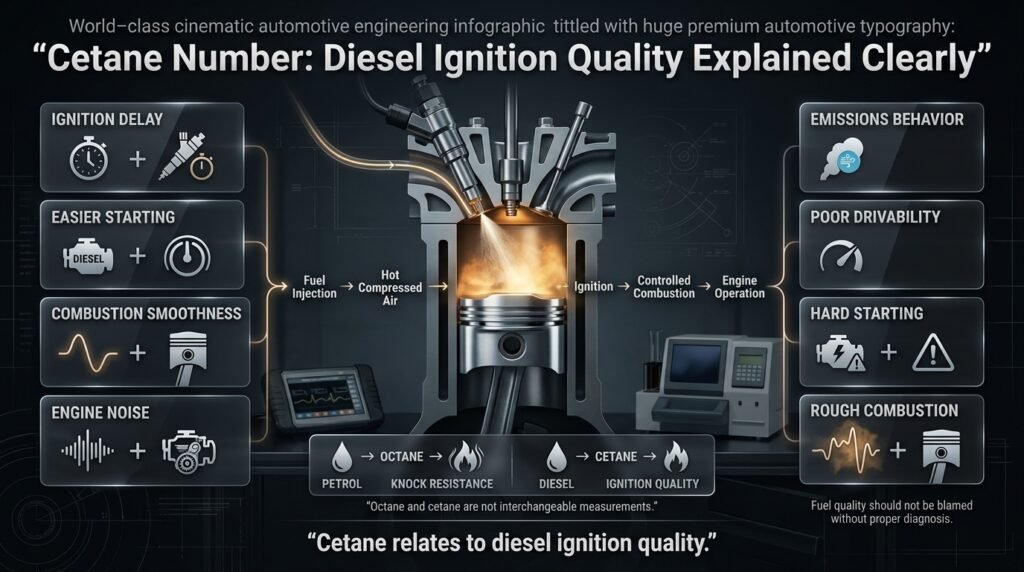
Cetane number is associated with diesel fuel’s ignition quality.
A suitable cetane quality allows fuel to ignite appropriately after injection into hot compressed air.
It can influence:
- Ignition delay
- Starting
- Combustion smoothness
- Engine noise
- Emissions behavior
The important distinction is:
Octane is associated with resistance to knock in petrol.
Cetane is associated with ignition quality in diesel.
These are not interchangeable measurements.
What Happens When Ignition Quality Is Unsuitable?
If diesel fuel’s ignition characteristics aren’t appropriate, combustion may become less controlled.
Depending on the engine and fuel conditions, this can contribute to:
- Hard starting
- Rough combustion
- Increased noise
- Poor drivability
- Increased emissions
However, engine performance depends on many factors, so fuel quality shouldn’t be blamed without proper diagnosis.
Why Is Diesel Viscosity Important?
Viscosity describes a fluid’s resistance to flow.
Diesel fuel needs an appropriate viscosity because the fuel system must move, meter, and inject the fuel consistently.
Viscosity can influence:
- Pump operation
- Fuel metering
- Injector behavior
- Spray characteristics
- Lubrication
- Fuel-system performance
Modern diesel systems operate at very high pressures and use extremely precise components.
That makes appropriate fuel properties increasingly important.
Why Is Diesel Lubricity Important?
Lubricity refers to a fuel’s ability to reduce wear between moving components.
Diesel fuel can contribute to lubrication within fuel-system components.
This is especially important in modern high-pressure fuel systems.
Poor lubricity can contribute to increased wear in components such as fuel pumps and injectors.
Unlike color or smell, lubricity cannot be reliably assessed by a normal driver.
It requires an appropriate laboratory test.
Expert Tip: When evaluating diesel fuel, don’t focus only on cetane and sulfur. Lubricity, viscosity, water, sediment, and cleanliness can be just as important for modern fuel-injection equipment.
Why Is Sulfur Content Important?
Sulfur occurs naturally in crude oil and can remain in petroleum products unless it is removed during refining.
Modern fuel specifications establish sulfur limits because sulfur compounds can contribute to emissions and can interfere with some emissions-control technologies.
This is why low-sulfur and ultra-low-sulfur fuels have become important in many markets.
Sulfur requirements vary according to the applicable standard and local regulations.
Why Modern Engines Need Appropriate Sulfur Levels
Modern vehicles may use sophisticated emissions-control systems such as:
- Catalytic converters
- Diesel particulate filters
- Diesel oxidation catalysts
- Selective catalytic reduction systems
- Oxygen sensors
- Advanced exhaust-treatment systems
These systems are designed around particular fuel and emissions requirements.
Fuel quality therefore affects not only the engine but also the broader emissions-control system.
Why Is Water a Serious Fuel Contaminant?
Water is one of the most important contaminants to control in automotive fuel.
It can enter fuel through:
- Condensation
- Poor storage
- Contaminated tanks
- Damaged equipment
- Incorrect handling
- Contaminated delivery systems
- Environmental exposure
Water is particularly concerning in diesel fuel systems.
It can contribute to:
- Corrosion
- Injector damage
- Fuel-pump wear
- Filter problems
- Microbial growth
- Poor combustion
- Fuel-system failure
Modern diesel injection equipment has very small internal clearances, so contamination can become a serious issue.
What Is Fuel Sediment?
Sediment refers to unwanted solid material in fuel.
It can include:
- Dirt
- Rust
- Tank deposits
- Corrosion particles
- Dust
- Other foreign material
Sediment can block fuel filters and interfere with fuel-system components.
For vehicles using fuel from large storage tanks, sediment management is especially important because contamination can accumulate over time.
How Is Fuel Quality Tested?
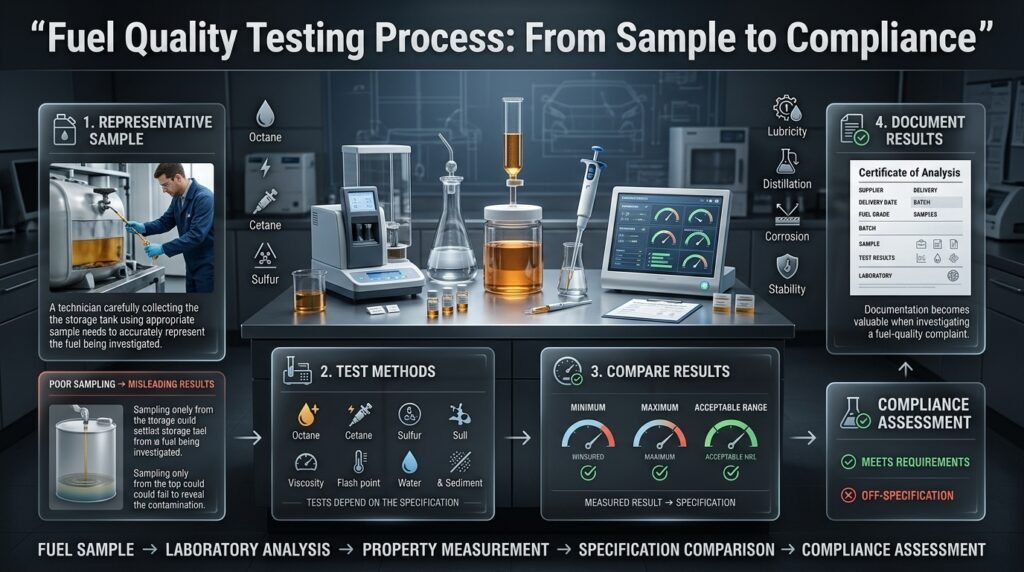
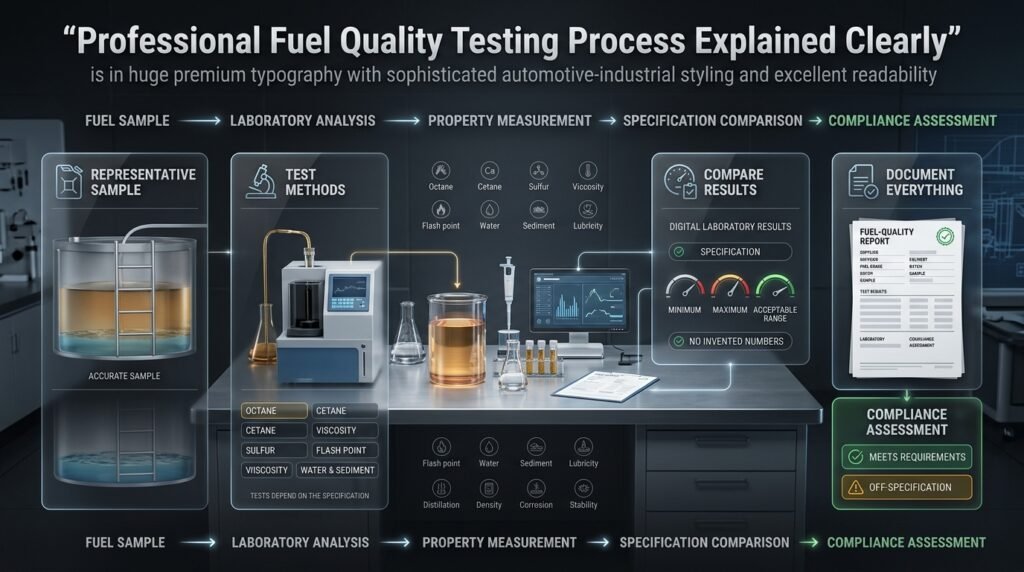
Professional fuel testing follows a structured process.
The basic sequence is:
Fuel sample → Laboratory analysis → Property measurement → Specification comparison → Compliance assessment
Each stage has a purpose.
Step 1: Collect a Representative Sample
The sample needs to accurately represent the fuel being investigated.
This sounds simple, but poor sampling can produce misleading results.
For example, if water has settled at the bottom of a storage tank but the sample is taken only from the top, the test might not reveal the actual contamination problem.
Step 2: Select Appropriate Test Methods
The laboratory selects test methods according to the applicable fuel specification.
Testing may include:
- Octane
- Cetane
- Sulfur
- Viscosity
- Flash point
- Water and sediment
- Lubricity
- Distillation
- Density
- Corrosion
- Stability
Not every fuel requires every test.
The applicable standard determines which properties need to be evaluated.
Step 3: Compare Results With Requirements
The measured results are compared with the specification.
A requirement may establish:
- A minimum
- A maximum
- An acceptable range
If the measured result falls outside the requirement, the fuel may be considered off-specification for that particular property.
Step 4: Document Everything
Professional fuel-quality management should include documentation such as:
- Supplier details
- Delivery date
- Fuel grade
- Batch information
- Sample details
- Test results
- Laboratory information
- Certificate of analysis
Good documentation becomes extremely valuable when investigating a fuel-quality complaint.
What Is a Certificate of Analysis?
A Certificate of Analysis, often called a COA, is documentation showing test results for a specific product sample or batch.
For fuel, a COA can provide information about properties that were tested and the specification against which they were evaluated.
But a COA should be interpreted carefully.
Check:
- Which batch was tested?
- When was it tested?
- Which laboratory performed the testing?
- Which standard was used?
- Which test methods were used?
- Was the sample representative?
- Was the fuel stored correctly after testing?
A COA is useful evidence, but it shouldn’t be treated as permanent proof that every quantity of fuel from the same supplier is always compliant.
Can You Tell Fuel Quality by Looking at It?
Only to a very limited extent.
Visual inspection can sometimes identify obvious problems such as:
- Cloudiness
- Visible particles
- Sediment
- Water separation
- Unusual contamination
But visual inspection cannot confirm many important technical properties.
You cannot reliably determine:
- Octane
- Cetane
- Sulfur
- Lubricity
- Detailed volatility
- Distillation characteristics
- Oxidation stability
by simply looking at fuel.
Common Mistake: Assuming that clear fuel is automatically high-quality fuel. Appearance can reveal obvious contamination, but it cannot replace laboratory testing.
How Does Poor Fuel Quality Affect an Engine?
The effect depends on what is wrong with the fuel.
Low-Octane Petrol
If petrol has an octane rating below the engine’s requirement, the risk of knock can increase under conditions where the engine is susceptible.
Modern engine management may adjust operation to reduce the risk, but using the manufacturer’s recommended fuel remains the best practice.
Contaminated Petrol
Water or solid contaminants can interfere with fuel delivery and combustion.
Possible symptoms include:
- Hesitation
- Misfire
- Difficult starting
- Stalling
- Poor acceleration
Poor Diesel Quality
Unsuitable diesel can affect:
- Injection
- Ignition
- Lubrication
- Combustion
- Fuel-system components
Possible symptoms include:
- Rough running
- Difficult starting
- Loss of power
- Injector issues
- Increased smoke
- Poor acceleration
These symptoms aren’t unique to fuel problems, so diagnosis should consider the entire vehicle.
What Are the Signs of Possible Fuel Contamination?
Fuel contamination should be considered when vehicle problems appear suddenly, particularly if they begin soon after refueling.
Possible signs include:
- Sudden loss of power
- Rough idle
- Hard starting
- Engine hesitation
- Stalling
- Unusual exhaust smoke
- Fuel-filter restriction
- Multiple vehicles developing similar symptoms
The timing of symptoms is useful evidence.
For example, if a vehicle operates normally for weeks and develops severe problems immediately after a particular refueling event, investigating the fuel makes sense.
However, timing alone doesn’t prove contamination.
What Should You Do If You Suspect Bad Fuel?
Don’t immediately assume that expensive engine components have failed.
Start by collecting evidence.
Step 1: Keep the Fuel Receipt
Record:
- Date
- Time
- Supplier or station
- Fuel type
- Fuel grade
- Vehicle mileage
Step 2: Record the Symptoms
Write down when the problem started and what changed.
Step 3: Have the Vehicle Diagnosed
A qualified technician should check whether the symptoms are consistent with a fuel problem.
Step 4: Inspect the Fuel System
Depending on the vehicle, inspection may include:
- Fuel filter
- Water separator
- Fuel pump
- Injectors
- Fuel lines
- Tank
Step 5: Test the Fuel When Appropriate
If contamination is suspected, a properly collected fuel sample can be sent for appropriate laboratory testing.
This provides much stronger evidence than guessing from symptoms.
Fuel Quality and Fuel Economy
Fuel quality can affect fuel economy, but it isn’t the only factor.
Fuel consumption also depends on:
- Driving habits
- Traffic
- Vehicle weight
- Tire pressure
- Air-conditioning use
- Engine temperature
- Maintenance
- Road conditions
- Aerodynamics
- Transmission
- Vehicle load
For that reason, a small change in fuel economy doesn’t automatically prove a fuel-quality problem.
However, significantly contaminated or unsuitable fuel can affect combustion and fuel-system operation.
The right approach is to evaluate fuel quality together with other possible causes.
Fuel Quality During Transportation and Delivery
Fuel quality isn’t only determined at the refinery.
The fuel passes through several stages before it reaches the engine:
Refining → Storage → Transportation → Distribution → Delivery → Vehicle Tank → Engine
Every stage can potentially introduce contamination if equipment isn’t maintained properly.
Possible risks include:
- Water entering tanks
- Dirty storage equipment
- Cross-contamination
- Sediment
- Incorrect fuel transfer
- Poorly maintained hoses
- Improper handling
This is why quality management needs to continue throughout the supply chain.
Why Fuel Storage Matters
Good fuel can become problematic if it is stored poorly.
Storage problems may include:
- Water accumulation
- Tank corrosion
- Sediment
- Microbial contamination
- Oxidation
- Cross-contamination
- Poor filtration
For businesses storing fuel, regular inspection is therefore an important part of quality control.
Good Fuel Storage Practices
A sensible fuel-storage program can include:
- Regular tank inspection
- Water monitoring
- Tank cleaning when necessary
- Proper filtration
- Contamination prevention
- Accurate delivery records
- Fuel sampling when appropriate
- Maintenance of dispensing equipment
The goal is simple:
Don’t allow good fuel to become poor fuel through bad storage.
Fuel Quality Standards for Fleet Operators
Fuel quality becomes even more important for fleet operators.
A private driver may have one vehicle.
A fleet operator may have dozens or hundreds.
If a contaminated fuel delivery enters a shared storage tank, multiple vehicles could potentially be affected.
The consequences may include:
- Vehicle downtime
- Filter replacements
- Injector repairs
- Diagnostic costs
- Lost productivity
- Delivery delays
- Customer service problems
This is why fleet operators benefit from formal fuel-quality procedures.
Fleet Fuel Quality Checklist
- Use approved suppliers
- Record bulk deliveries
- Keep supplier documentation
- Monitor storage tanks
- Check for water
- Maintain filters
- Inspect dispensing equipment
- Track fuel-related vehicle complaints
- Investigate repeated symptoms
- Retain appropriate samples
- Use laboratory testing when justified
The goal isn’t to make fuel management unnecessarily complicated.
It’s to create enough control that problems can be detected early.
Common Fuel Quality Mistakes
Mistake 1: Choosing Fuel Only by Price
Cheap fuel isn’t automatically poor quality, and expensive fuel isn’t automatically better.
The correct fuel is the one that meets the vehicle’s requirements and applicable specification.
Mistake 2: Assuming Higher Octane Is Always Better
Higher octane provides greater knock resistance.
But it doesn’t automatically mean:
- More power
- Better mileage
- Better combustion
- Better overall fuel quality
The engine’s design determines whether higher octane provides a meaningful benefit.
For a detailed comparison, see regular vs premium petrol octane.
Mistake 3: Confusing Octane and Cetane
Remember:
Petrol → Octane
Diesel → Cetane
They describe different fuel characteristics.
Mistake 4: Ignoring Water
Water can be extremely damaging to diesel fuel systems.
Don’t assume that because fuel looks normal, water isn’t present.
Mistake 5: Judging Quality by Color
Color isn’t a complete fuel-quality test.
Mistake 6: Assuming One Standard Applies Everywhere
Fuel standards vary between countries and markets.
Always identify the applicable specification.
Mistake 7: Ignoring Storage
Fuel quality can change after delivery if storage conditions are poor.
Mistake 8: Blaming Fuel for Every Engine Problem
Hard starting, rough running, poor fuel economy, and loss of power can have many causes.
Fuel should be investigated when the evidence supports it.
Expert Advice for Maintaining Fuel Quality
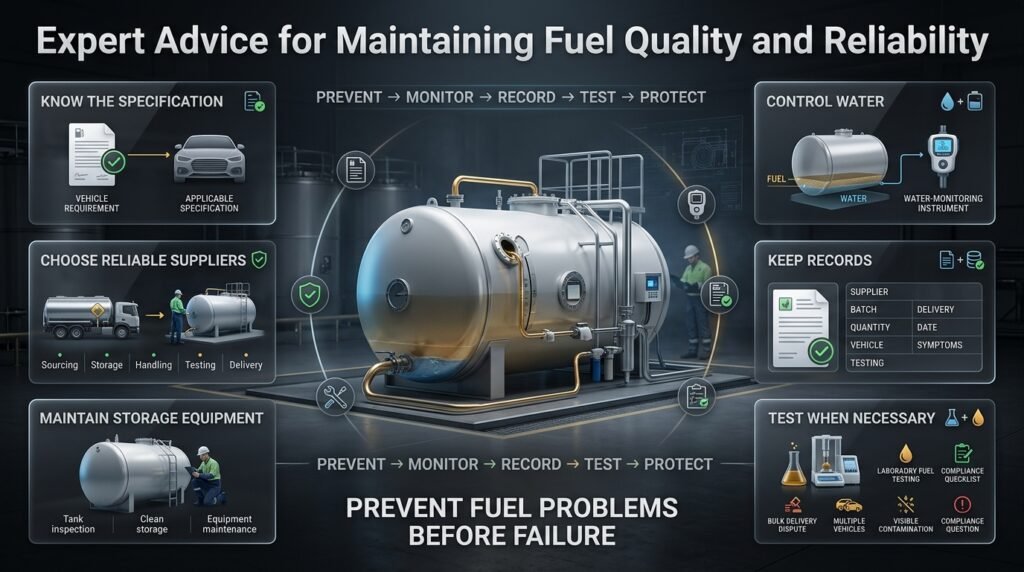
Professionals generally focus on preventing fuel problems rather than waiting until a vehicle fails.
Know the Required Specification
Start with the vehicle manufacturer’s fuel requirements.
Then identify the applicable market and regulatory specification.
Choose Reliable Suppliers
Supplier quality-control procedures matter.
A reputable supplier should have clear processes for fuel sourcing, storage, handling, testing, and delivery.
Maintain Storage Equipment
For bulk users, the fuel tank is part of the fuel system.
A poorly maintained tank can contaminate otherwise good fuel.
Control Water
Regular water monitoring is especially important for diesel storage.
Keep Records
Documentation makes fuel-quality investigations much easier.
Keep information about:
- Supplier
- Batch
- Delivery
- Quantity
- Date
- Vehicle
- Symptoms
- Testing
Test When Necessary
Routine laboratory testing may not be necessary for every private driver.
But testing becomes much more valuable when:
- A bulk delivery is disputed
- Multiple vehicles are affected
- Contamination is visible
- Expensive equipment is at risk
- Fuel compliance is questioned
How Do You Choose the Correct Fuel?
Choosing the correct fuel doesn’t have to be complicated.
Step 1: Check the Owner’s Manual
Look for the manufacturer’s recommended fuel type and minimum requirements.
Step 2: Identify the Correct Fuel
Make sure you’re selecting petrol, diesel, or another approved fuel.
Step 3: Check the Octane Requirement
For petrol vehicles, follow the manufacturer’s recommended minimum octane rating.
Step 4: Check Diesel Requirements
For diesel vehicles, use the correct grade and specification.
Step 5: Avoid Unapproved Mixing
Don’t mix fuels or use additives unless they are approved for the vehicle and application.
Step 6: Use a Reliable Fuel Source
Consistency and proper quality control are more important than simply finding the lowest price.
Why Fuel Quality Matters More in Modern Engines
Modern engines are highly precise systems.
They can use:
- High-pressure fuel injection
- Turbocharging
- Direct injection
- Electronic engine management
- Variable valve timing
- Precision injectors
- Exhaust after-treatment
- Multiple sensors
These technologies can improve performance and efficiency, but they also depend on predictable fuel properties.
The combustion process explains why.
For petrol vehicles, understanding how fuel and air are mixed, compressed, ignited, and burned makes the relationship between fuel quality and engine operation much easier to understand. See petrol engine combustion process.
Diesel engines have a different process because ignition occurs through compressed air and fuel injection. The details are explained in diesel engine combustion process.
Fuel Quality vs Fuel Type: What’s the Difference?
These terms are often confused.
Fuel type describes what the fuel is.
Examples include:
- Petrol
- Diesel
- Ethanol blends
- Biodiesel blends
- Other approved automotive fuels
Fuel quality describes whether that fuel meets the required properties and specification.
A vehicle can receive the correct fuel type and still have a fuel-quality problem.
For example, a diesel vehicle could receive diesel fuel, but the fuel could still contain excessive water or sediment.
So:
Correct fuel type ≠ automatically correct fuel quality.
Fuel Quality vs Octane Rating
Octane is only one component of petrol quality.
Imagine two petrol samples with the same octane rating.
They could still differ in other characteristics depending on their formulation, additives, storage conditions, contamination, and applicable specification.
Therefore:
High octane does not automatically mean perfect fuel quality.
Octane answers one specific question:
How resistant is the fuel to knock under the specified test conditions?
Fuel quality asks a much broader question:
Does the fuel meet all relevant requirements for its intended use?
Fuel Quality vs Brand Name
A well-known fuel brand can provide confidence, but brand recognition isn’t itself a technical specification.
Fuel quality depends on the complete supply chain:
Product specification + refining/blending + transportation + storage + handling + testing
Even good fuel can be compromised by poor storage or contamination.
That’s why fuel-quality management should look beyond the name printed on a pump.
How Fuel Quality Supports Emissions Control
Fuel quality and emissions control are closely connected.
Modern vehicles use a combination of combustion management and exhaust after-treatment to control pollutants.
Fuel properties can influence:
- Combustion behavior
- Deposit formation
- Exhaust emissions
- Emissions-system operation
Sulfur control is particularly important because modern emissions systems are designed around fuels with defined sulfur limits.
Using fuel that doesn’t meet the vehicle or market requirements can create problems beyond the engine itself.
What Are Fuel Quality Standards and Why Are They Important?
Fuel quality standards are technical requirements that define the acceptable characteristics of petrol, diesel, and other fuels for their intended applications. They help establish measurable limits for properties such as octane, cetane, sulfur, viscosity, volatility, water and sediment, lubricity, and other fuel characteristics. The purpose isn’t simply to make fuel “good”; it’s to make its performance predictable and suitable for the engine and operating conditions.
For example, ASTM D4814 covers automotive spark-ignition fuels and considers characteristics needed across different operating conditions, including volatility and water tolerance. ASTM also notes that fuel specifications can be revised as fuel technology, vehicle requirements, and testing methods change.
Why this matters in real-world driving
A fuel can look normal and still fail an important technical requirement. That’s because some quality characteristics can’t be identified simply by looking at the fuel.
Fuel quality standards help control things such as:
Combustion performance
Knock resistance in petrol
Ignition quality in diesel
Fuel-system protection
Contamination levels
Emissions-related properties
Storage and handling characteristics
Compatibility with modern engines
The important point is that fuel quality isn’t measured by one property. A petrol fuel with the correct octane can still have another quality issue, while diesel with suitable cetane quality can still suffer from water contamination or inadequate lubricity.
Professional takeaway
When someone says, “This is high-quality fuel,” the next question should be:
“According to which specification?”
That question separates a general marketing claim from a measurable technical requirement.
What Are the Most Important Fuel Quality Parameters?
There isn’t one single parameter that determines whether fuel is good or bad. The important properties depend on whether you’re dealing with petrol or diesel and what the fuel is intended for.
For petrol, octane, volatility, distillation characteristics, sulfur, stability, and other composition-related properties can be important. For diesel, cetane quality, viscosity, lubricity, sulfur, flash point, water and sediment, distillation, and cold-operability characteristics can be relevant.
ASTM’s diesel specification, for example, covers multiple fuel grades and includes requirements related to properties such as sulfur, viscosity, flash point, water and sediment, cetane quality, and lubricity.
Petrol vs diesel: the key difference
Fuel property
Petrol
Diesel
Octane
Major consideration
Not the primary measure
Cetane
Not the primary measure
Major consideration
Volatility
Very important
Less dominant
Viscosity
Important to fuel-system design
Particularly important
Lubricity
Relevant
Very important
Water contamination
Harmful
Particularly concerning
Sulfur
Regulated
Regulated
Distillation
Important
Important
Flash point
Different considerations
Important
Stability
Important
Important
Why these properties matter
Octane relates to petrol’s resistance to knock.
Cetane relates to diesel’s ignition quality.
Viscosity affects how fuel flows and behaves within the fuel system.
Lubricity is important because fuel can contribute to the protection of moving fuel-system components, particularly in diesel systems.
Water and sediment can interfere with fuel delivery and damage sensitive components.
Sulfur is controlled in many fuel specifications because it affects emissions and can interact with modern emissions-control technologies.
Professional takeaway
Don’t judge fuel quality by one impressive number.
A technically sound fuel assessment looks at the complete specification, not just octane, cetane, sulfur, or price.
Does Higher Octane Mean Better Fuel Quality?
Not necessarily. Higher octane means greater resistance to knock; it does not automatically mean that the fuel is superior in every aspect.
This is one of the most common misunderstandings about petrol quality.
Octane is specifically related to a fuel’s resistance to abnormal combustion or knock under standardized test conditions. ASTM identifies octane testing as part of the system used to characterize antiknock performance and match fuel with engine requirements.
For example, if a vehicle requires a minimum octane rating, using fuel that meets or exceeds that requirement is appropriate. But putting a significantly higher-octane fuel into an engine that doesn’t require it doesn’t automatically transform the fuel into “better quality” fuel.
What higher octane actually does
Higher-octane petrol can provide greater resistance to knock.
This can be particularly relevant in engines with:
Higher compression ratios
Turbocharging
Advanced ignition strategies
Certain direct-injection systems
Performance-oriented engine designs
The engine manufacturer determines the fuel requirement.
What higher octane doesn’t automatically mean
Higher octane doesn’t automatically guarantee:
Better fuel economy
More power in every engine
Cleaner fuel
Better storage stability
Lower contamination
Better lubricity
Better overall fuel quality
That’s why octane should be viewed as one part of petrol quality rather than the complete definition of quality.
A practical example
Imagine two petrol fuels:
Fuel A: Meets the vehicle’s required octane specification and all applicable quality requirements.
Fuel B: Has a higher octane rating but has a separate problem with another fuel property.
Fuel B shouldn’t automatically be considered better simply because its octane number is higher.
That’s the difference between one fuel characteristic and overall fuel quality.
Professional takeaway
The best fuel isn’t necessarily the fuel with the highest octane.
The best fuel is the one that meets the vehicle manufacturer’s requirements and the applicable fuel specification.
How Can You Tell If Petrol or Diesel Fuel Is Poor Quality?
You usually can’t determine complete fuel quality simply by looking at it. Some obvious contamination can be detected visually, but many important fuel properties require standardized laboratory testing.
You may notice visible problems such as:
Cloudiness
Sediment
Suspended particles
Water separation
Unusual contamination
Unexpected appearance
But visual inspection can’t reliably tell you the fuel’s:
Octane
Cetane
Sulfur content
Lubricity
Detailed volatility
Distillation characteristics
Oxidation stability
This is why professional fuel-quality assessment relies on appropriate sampling and laboratory testing.
When should you become suspicious?
One of the strongest practical clues is timing.
If a vehicle has been operating normally and suddenly develops problems immediately after refueling, fuel quality becomes one reasonable area to investigate.
Possible symptoms include:
Hard starting
Rough idle
Hesitation
Sudden loss of power
Stalling
Poor acceleration
Unusual exhaust behavior
Fuel-filter problems
However, these symptoms don’t prove that the fuel is bad.
The same symptoms can result from:
Ignition problems
Sensors
Air-intake problems
Fuel-pump faults
Injector issues
Electrical problems
Mechanical faults
What should you do?
If you suspect fuel contamination:
1. Keep the fuel receipt.
Record the supplier, date, fuel type, and approximate quantity.
2. Record when the symptoms started.
The timing can help a technician establish whether the problem may be fuel-related.
3. Have the vehicle diagnosed.
Don’t replace expensive components simply because the problem appeared after refueling.
4. Inspect the fuel system when appropriate.
A technician may check the filter, fuel tank, injectors, pump, or water separator depending on the vehicle.
5. Test the fuel if the evidence justifies it.
Laboratory testing provides much stronger evidence than judging fuel quality by color or smell.
Why diesel deserves special attention
Water and contamination are particularly important concerns in modern diesel fuel systems.
High-pressure injection systems contain precision components that require appropriate fuel properties and cleanliness.
For fleet operators, the situation is even more important. If several vehicles develop similar symptoms after receiving fuel from the same delivery, the fuel supply deserves serious investigation.
Professional takeaway
A visual check can identify obvious contamination, but only appropriate testing can establish many important fuel-quality properties.
Conclusion
Understanding fuel quality standards is essential for choosing the right fuel, protecting modern engines, and avoiding unnecessary fuel-system problems. Fuel quality isn’t determined by price, brand name, color, or a single number such as octane or cetane. It depends on whether the fuel meets the correct technical specification and contains the properties required for its intended engine.
For petrol, factors such as octane rating, volatility, sulfur content, stability, and distillation characteristics can influence performance and combustion. For diesel, cetane quality, viscosity, lubricity, sulfur, water, sediment, and cleanliness are particularly important because modern diesel injection systems operate under demanding conditions.
The most practical approach is simple: always follow the vehicle manufacturer’s fuel recommendation, use fuel from a reliable source, and don’t assume that premium or higher-octane fuel is automatically better for every vehicle. For businesses and fleet operators, proper storage, supplier records, water control, and fuel testing can provide an additional layer of protection.
Ultimately, good fuel quality means using the right fuel, meeting the right specification, preventing contamination, and maintaining that quality from storage to the engine. When these factors are properly controlled, drivers and businesses can support reliable engine performance, protect sensitive fuel-system components, and reduce the risk of fuel-related problems.
For more practical information about automotive fuel, fuel types, and fuel-related services, visit Out of Petrol Dubai 👉 FuelDeliveryDubai.
Leave a Reply