Introduction
Good Quality Petrol Characteristics | When you put petrol into your car, you expect the engine to start easily, run smoothly, and deliver the performance you normally get. Most drivers think about fuel quality only when something goes wrong. A car may suddenly hesitate, idle roughly, consume more fuel, make unusual noises, or become difficult to start after refueling.
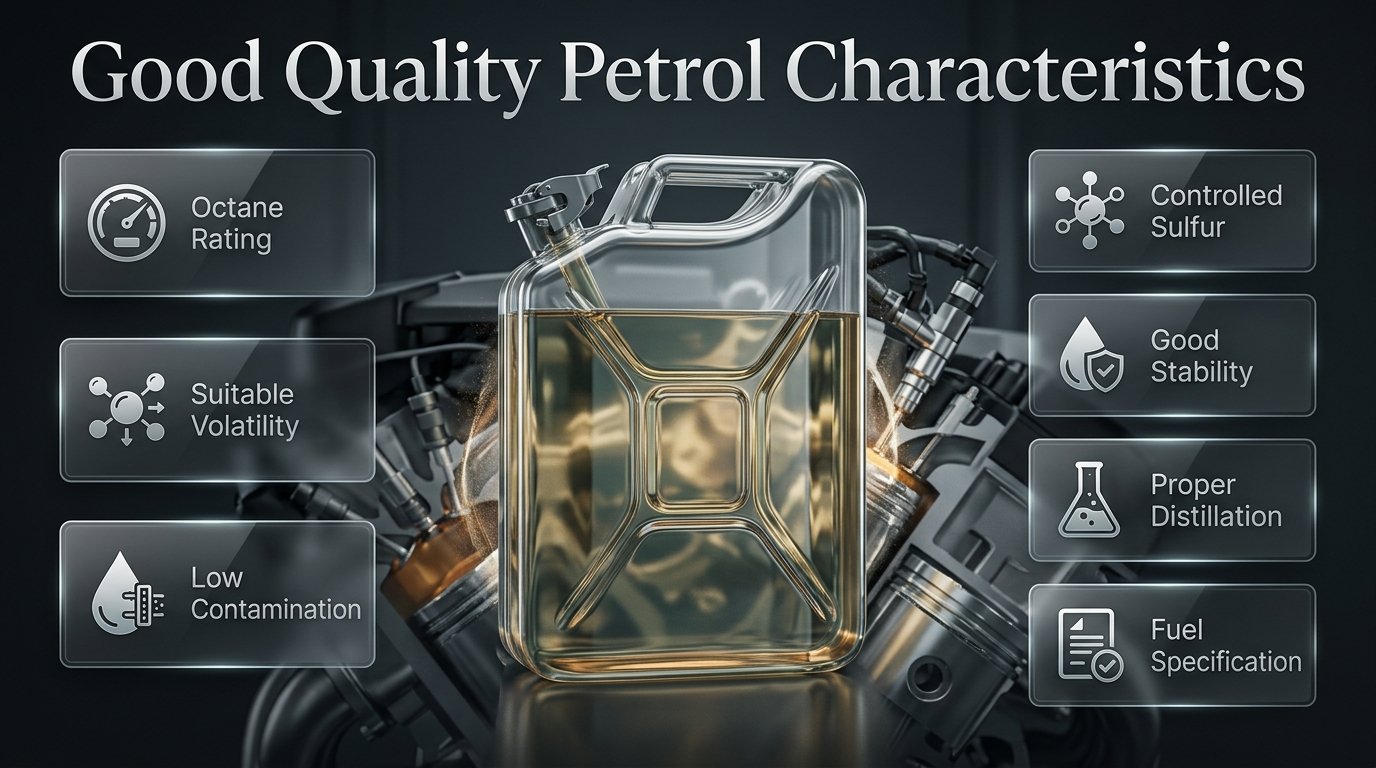
That is why understanding good quality petrol characteristics is more useful than simply knowing the difference between regular and premium fuel. Petrol quality depends on several technical properties working together. Octane rating is important, but so are volatility, sulfur content, stability, distillation characteristics, cleanliness, contamination control, and compliance with the required fuel specification.
For a broader introduction to fuels and related automotive topics, you can visit Out of Petrol Dubai 👉 Fuel Delivery Dubai.
This guide explains what makes petrol high quality, how each characteristic affects engine operation, how poor fuel can create problems, why higher octane doesn’t always mean better fuel, how to choose suitable petrol, and what drivers and fleet operators should know about fuel storage and handling.
What Is Good Quality Petrol?
Good quality petrol is fuel that meets the appropriate technical specification for its intended engine and application while maintaining suitable physical and chemical properties throughout its supply, storage, and dispensing process.
In simple terms, good petrol should be correctly specified, clean, stable, suitable for the engine, and properly handled.
A high-quality petrol supply should generally have characteristics such as:
- The correct octane rating
- Suitable volatility
- Controlled sulfur content
- Appropriate distillation characteristics
- Good oxidation and storage stability
- Low levels of unwanted contamination
- Minimal water and sediment
- Appropriate additive formulation
- Consistent quality
- Compliance with applicable fuel standards
The important point is that fuel quality is not determined by one number.
A petrol product can have a high octane rating and still have a contamination problem. Likewise, a fuel can be completely suitable for one engine but inappropriate for another because the engines have different fuel requirements.
This is why the best petrol isn’t necessarily the most expensive petrol or the fuel with the highest octane number. The best fuel is the one that meets the required specification for the engine and is maintained properly throughout the supply chain.
Why Does Petrol Quality Matter?
Petrol is a critical part of the combustion process in a spark-ignition engine. The engine needs fuel that can be delivered, vaporized, mixed with air, and burned in a controlled way.
Modern petrol engines are particularly sensitive to fuel-system conditions because they use sophisticated components such as:
- Electronic fuel injectors
- Knock sensors
- Oxygen sensors
- Catalytic converters
- Electronic engine-control units
- High-pressure fuel systems in some applications
- Turbochargers in many modern engines
When petrol meets the correct specification, the engine-management system can work with predictable fuel characteristics.
When fuel is unsuitable or contaminated, problems can sometimes develop in the fuel system or combustion process.
Potential symptoms can include:
- Hard starting
- Rough idle
- Hesitation
- Poor acceleration
- Misfiring
- Unusual engine noise
- Reduced drivability
- Increased emissions
- Fuel-system contamination
- Unexpected fuel consumption
However, these symptoms don’t automatically prove that the petrol is poor quality. Mechanical and electrical problems can create almost identical symptoms.
For example, a failing ignition coil can cause misfires, while a dirty injector can cause hesitation. A faulty sensor can affect fuel control, and worn spark plugs can create rough running.
Therefore, fuel quality should always be considered alongside the overall condition of the vehicle.
What Are the Main Characteristics of Good Quality Petrol?
There isn’t one characteristic that defines good petrol. Instead, quality is the result of multiple properties being controlled together.
The most important characteristics include:
- Appropriate octane rating
- Correct volatility
- Low water contamination
- Low sediment and unwanted contaminants
- Controlled sulfur content
- Good storage stability
- Suitable distillation characteristics
- Consistent combustion behavior
- Consistent quality
- Proper additive formulation
Let’s look at each one in detail.
1. Appropriate Octane Rating
Octane rating is one of the most familiar petrol characteristics.
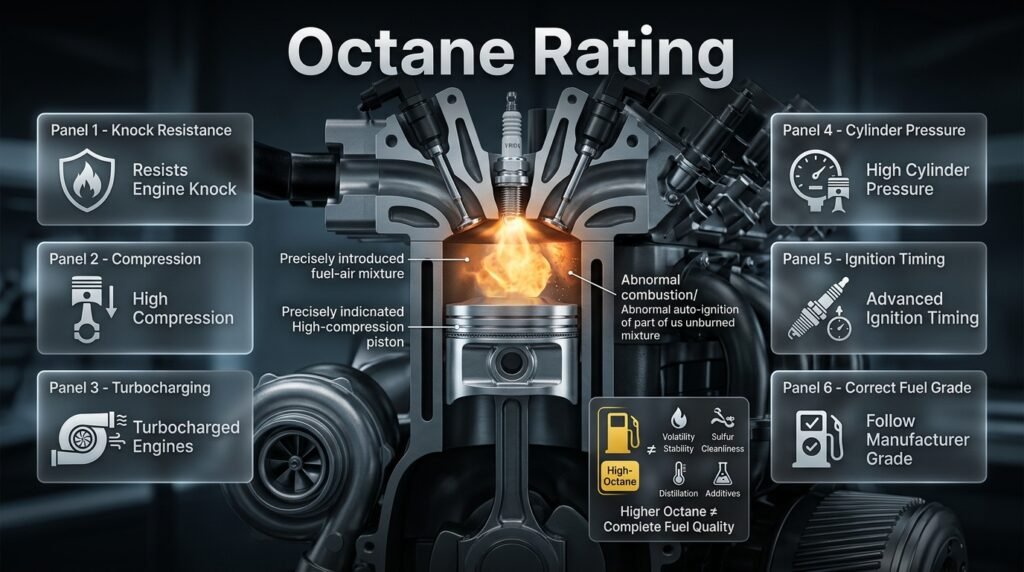
It describes the fuel’s resistance to knock, which is abnormal combustion associated with uncontrolled auto-ignition of part of the unburned mixture in the cylinder.
A higher octane fuel generally has greater resistance to knock.
This becomes especially important in engines designed with:
- High compression ratios
- Turbocharging
- Supercharging
- High cylinder pressures
- Advanced ignition timing
- Performance-oriented combustion systems
The vehicle manufacturer specifies the minimum octane requirement because the engine’s combustion system has been designed around particular fuel characteristics.
Why does octane matter?
If an engine requires a particular minimum octane rating and lower-octane petrol is used, the engine may become more susceptible to knock under certain operating conditions.
Modern engines often have knock sensors and electronic controls that can detect abnormal combustion and adjust ignition timing. These systems help protect the engine, but they don’t change the manufacturer’s recommended fuel requirement.
Using the correct octane remains the best approach.
For a deeper explanation of octane grades and the difference between ordinary and premium petrol, read Regular vs Premium Petrol Octane.
Does higher octane mean higher-quality petrol?
Not necessarily.
Octane is only one part of fuel quality.
A petrol’s overall quality can also depend on:
- Volatility
- Sulfur
- Stability
- Water contamination
- Sediment
- Distillation behavior
- Additive formulation
- Specification compliance
A higher octane number doesn’t automatically prove that every other property of the fuel is superior.
Pro Tip: Always check the vehicle manufacturer’s recommended fuel grade before deciding that premium or higher-octane petrol is necessary.
2. Proper Volatility
Petrol needs to vaporize properly so it can mix with air before combustion.
This characteristic is known as volatility.
The fuel needs an appropriate balance. If it doesn’t vaporize adequately under the relevant conditions, starting and drivability may suffer. If it is excessively volatile for the operating environment, unwanted vapor-related problems may occur.
Fuel specifications therefore control volatility and related properties.
Why is volatility important?
Appropriate volatility can help support:
- Reliable starting
- Smooth warm-up
- Good acceleration
- Proper fuel-air mixing
- Stable combustion
- Consistent drivability
Volatility requirements can also be influenced by climate and seasonal conditions.
A fuel formulation suitable for one operating environment may need different volatility characteristics from fuel used in a significantly different climate.
What happens when volatility is unsuitable?
The engine may have difficulty forming the fuel-air mixture required for proper combustion.
Possible symptoms can include:
- Starting difficulties
- Poor warm-up behavior
- Hesitation
- Unstable operation
But again, these symptoms have multiple possible causes.
A driver shouldn’t assume that a starting problem automatically means poor fuel volatility.
3. Low Water Contamination
Water is an unwanted contaminant in petrol.
Good fuel-quality management aims to prevent water from entering the fuel during transportation, storage, and dispensing.
Water can create problems because a petrol engine is designed to receive fuel with predictable characteristics. Significant water contamination can interfere with fuel delivery and combustion.
Possible effects include:
- Difficult starting
- Hesitation
- Misfiring
- Rough running
- Poor acceleration
- Fuel-system corrosion
- Fuel-pump problems
How can water enter petrol?
Water can enter fuel through:
- Tank leaks
- Poor seals
- Condensation
- Damaged storage equipment
- Improper handling
- Poorly maintained dispensing systems
This is particularly important for businesses using bulk storage.
Common Mistake: Assuming that fuel is automatically good because it looks clean. Some forms of contamination cannot be identified reliably through ordinary visual inspection.
Proper storage and maintenance are therefore essential parts of fuel quality.
4. Low Sediment and Contamination
Good quality petrol should be protected from unwanted particles and other contaminants.
Contamination can occur during several stages of the fuel supply chain.
For example:
- Storage tanks can accumulate deposits.
- Transportation equipment can introduce contamination.
- Poorly maintained dispensing equipment can affect fuel cleanliness.
- Cross-contamination can occur if equipment is not properly managed.
Modern fuel systems use precision components, especially fuel injectors.
Contamination can interfere with fuel filters, pumps, injectors, and other parts of the fuel system.
For a broader overview of automotive fuel categories and applications, see Types of Automotive Fuel.
Why is cleanliness important?
Clean fuel helps the fuel-delivery system operate as intended.
If contamination becomes significant, it may contribute to:
- Restricted fuel flow
- Fuel-filter loading
- Injector problems
- Poor spray patterns
- Pump wear
- Poor engine performance
Preventing contamination is usually much better than trying to diagnose and repair fuel-system problems afterward.
5. Controlled Sulfur Content
Sulfur is naturally associated with crude oil and is controlled during fuel processing.
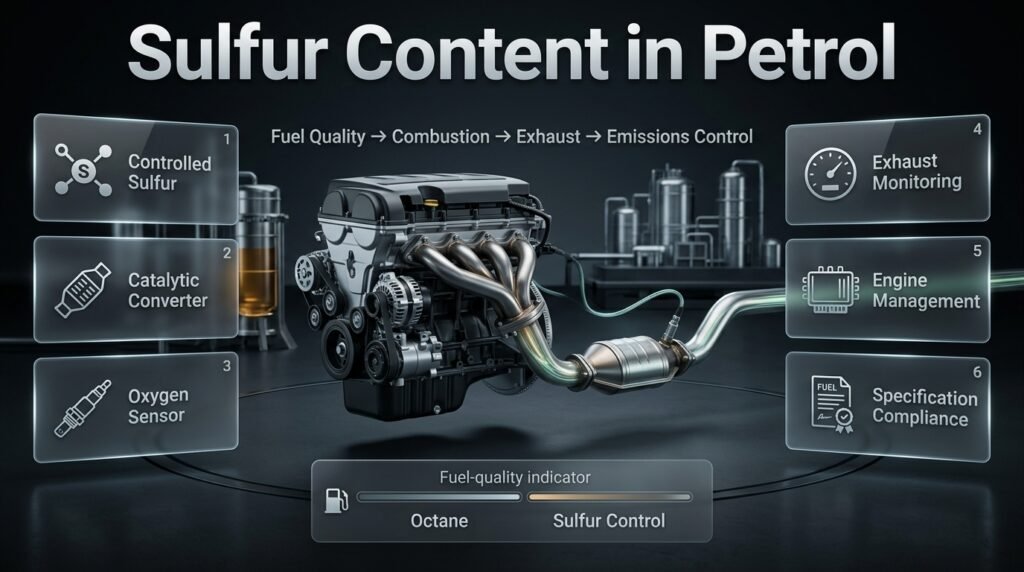
Modern petrol specifications establish sulfur limits because excessive sulfur can contribute to emissions concerns and affect emissions-control systems.
Modern vehicles rely on components such as:
- Catalytic converters
- Oxygen sensors
- Exhaust monitoring systems
- Engine-management systems
Fuel quality therefore affects more than the engine itself.
Why does sulfur matter?
Excessive sulfur can interfere with the operation of emissions-control technologies.
This is one reason modern fuel specifications consider many properties beyond octane.
A driver may never notice sulfur content directly, but it remains an important part of the technical quality of the fuel.
Expert Tip: When comparing petrol products, don’t focus exclusively on octane. Specification compliance, including control of sulfur and other regulated properties, is equally important.
For a detailed look at why fuel specifications matter, see Fuel Quality Standards.
6. Good Oxidation and Storage Stability
Petrol can change over time.
Exposure to oxygen, heat, and unsuitable storage conditions can contribute to oxidation and fuel degradation.
Good quality petrol should have appropriate stability for its intended storage and distribution conditions.
This characteristic is particularly important for:
- Backup generators
- Seasonal vehicles
- Emergency equipment
- Fleet vehicles
- Bulk fuel tanks
- Vehicles that aren’t driven frequently
Why does fuel stability matter?
Fuel that has deteriorated may contribute to:
- Starting problems
- Poor drivability
- Deposits
- Fuel-system issues
- Changes in combustion behavior
The quality of storage conditions is therefore important.
A fuel product can meet the required specification when produced, but poor storage and handling can compromise its condition later.
Quick Tip: Fuel quality doesn’t end at the refinery. The storage tank, transportation equipment, dispensing system, and handling process are all part of the fuel-quality chain.
7. Appropriate Distillation Characteristics
Petrol is a complex mixture of hydrocarbons rather than a single chemical compound.
Its distillation characteristics describe how portions of the fuel evaporate across a range of temperatures.
This is important because different parts of the fuel influence different aspects of engine operation.
Appropriate distillation behavior can affect:
- Starting
- Warm-up
- Acceleration
- Driveability
- Vaporization
- Combustion
Why does distillation matter?
An engine operates across a wide range of conditions.
It may start when cold, warm up, idle in traffic, accelerate quickly, and operate at highway speed.
The fuel needs to behave appropriately throughout these conditions.
Distillation characteristics are therefore part of the broader technical specification used to evaluate petrol.
Unlike octane, however, they aren’t something an ordinary driver can accurately determine at a fuel station. Appropriate laboratory testing is required.
8. Good Combustion Performance
Good quality petrol should support controlled combustion when used in an engine designed for that fuel.
Combustion depends on the interaction of:
- Fuel
- Air
- Compression
- Spark timing
- Engine temperature
- Injection
- Combustion-chamber design
- Engine-management controls
Petrol quality is therefore one component of a much larger system.
To understand what happens inside a gasoline engine after petrol is delivered, read about the Petrol Engine Combustion Process.
What does good combustion look like?
A properly functioning engine should produce controlled and repeatable combustion.
That supports:
- Smooth operation
- Predictable acceleration
- Appropriate emissions
- Efficient energy conversion
- Reliable drivability
If combustion becomes abnormal, symptoms can include:
- Misfiring
- Hesitation
- Rough running
- Knock
- Reduced performance
But these symptoms can also result from mechanical problems, so diagnosis remains important.
9. Consistent Fuel Quality
Consistency is often overlooked when people discuss petrol quality.
Drivers generally expect fuel meeting the same specification to provide consistent characteristics.
Consistency depends on quality management throughout the supply chain.
This includes:
- Production
- Refining
- Blending
- Transportation
- Storage
- Distribution
- Dispensing
A fuel product can be properly produced but later become compromised through poor storage or contamination.
Why is consistency especially important for fleets?
For a private driver, a fuel problem can mean inconvenience and repair costs.
For a fleet operator, the same issue can affect multiple vehicles.
Possible consequences include:
- Vehicle downtime
- Increased maintenance
- Reduced productivity
- Driver complaints
- Fuel-system repairs
- Unexpected operating expenses
For this reason, commercial fuel users should treat fuel quality as part of their broader fleet-management strategy.
10. Properly Controlled Additives
Petrol can contain carefully formulated additives intended to provide specific benefits.
Depending on the applicable formulation and specification, additives may support properties such as:
- Deposit control
- Corrosion protection
- Oxidation stability
- Fuel-system cleanliness
- Other performance requirements
However, the idea that “more additives always means better petrol” is incorrect.
Additives need to be correctly formulated, controlled, and compatible with the fuel.
Should you add aftermarket fuel additives?
Not automatically.
If a vehicle manufacturer doesn’t recommend a particular additive, adding it simply because the product claims to improve performance isn’t necessarily beneficial.
If the engine has a genuine fuel-system problem, the first step should be diagnosis.
An additive isn’t a substitute for:
- Correct fuel specification
- Proper vehicle maintenance
- Clean fuel
- Good storage
- Professional diagnosis
Good Quality Petrol vs Poor Quality Petrol
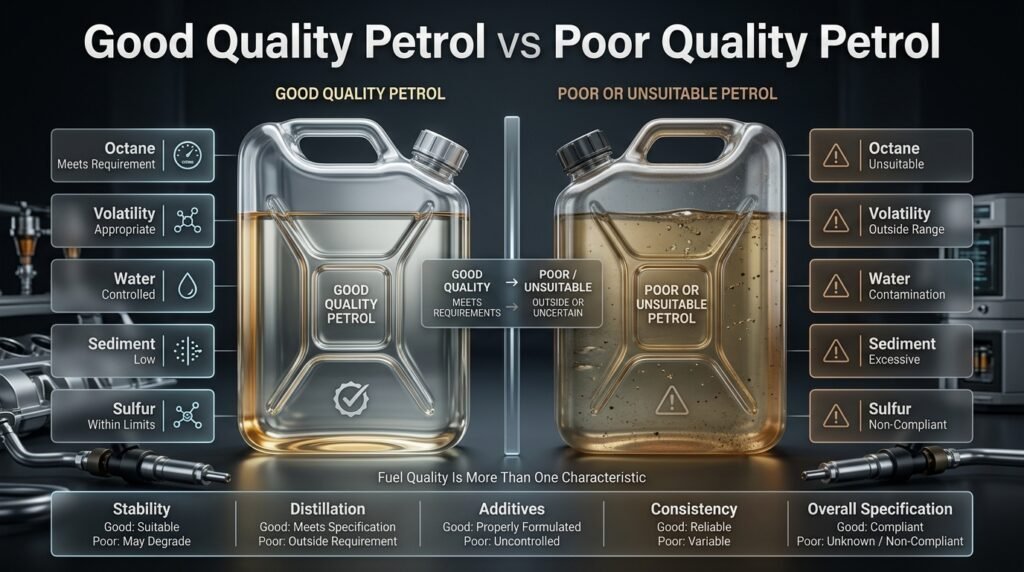
| Characteristic | Good Quality Petrol | Poor or Unsuitable Petrol |
|---|---|---|
| Octane | Meets engine requirement | Below or unsuitable for requirement |
| Volatility | Appropriate for specification | Outside suitable range |
| Water | Properly controlled | Significant contamination |
| Sediment | Low and controlled | Excessive contamination |
| Sulfur | Within applicable limits | Excessive or non-compliant |
| Stability | Suitable for intended storage | More likely to degrade |
| Distillation | Meets specification | Outside required characteristics |
| Additives | Properly formulated | Improper or uncontrolled |
| Consistency | Reliable | Variable or uncertain |
| Overall specification | Compliant | Unknown or non-compliant |
The table highlights an important point: good petrol is a combination of characteristics, not a single feature.
Does Higher Octane Mean Better Quality Petrol?
No.
This is one of the most common misconceptions among drivers.
Octane tells us about resistance to knock.
It doesn’t directly tell us whether the fuel has:
- Low contamination
- Proper volatility
- Low sulfur
- Good storage stability
- Suitable distillation characteristics
- Correct additive formulation
Consider two hypothetical fuels.
Fuel A has a very high octane rating but has been poorly stored and contaminated.
Fuel B has the octane rating required by the vehicle and has been properly stored and handled.
Fuel A isn’t automatically the better fuel simply because its octane number is higher.
The correct choice is based on the complete fuel specification.
What Is the Difference Between Fuel Quality and Octane?
The easiest way to understand this is:
Octane = resistance to knock
Fuel quality = the complete set of characteristics that determine whether fuel is suitable for its intended use
Fuel quality can include:
- Octane
- Volatility
- Sulfur
- Stability
- Distillation
- Contamination control
- Additives
- Specification compliance
This distinction is important because consumers sometimes treat octane as a complete measurement of fuel quality.
It isn’t.
Octane is important, but it is only one part of the overall picture.
How Does Good Quality Petrol Affect Engine Performance?
Good quality petrol provides predictable characteristics that allow an engine to operate according to its design.
It can support:
- Smooth combustion
- Reliable starting
- Consistent acceleration
- Proper knock resistance
- Stable fuel delivery
- Appropriate emissions performance
But fuel quality doesn’t magically increase an engine’s maximum power.
Engine performance depends on many other factors, including:
- Engine design
- Airflow
- Compression ratio
- Turbocharging
- Fuel injection
- Ignition timing
- Engine management
- Exhaust design
- Mechanical condition
This is why switching to a more expensive petrol doesn’t automatically make an ordinary engine significantly more powerful.
Can Good Quality Petrol Improve Fuel Economy?
Good fuel helps an engine operate with the characteristics for which it was designed, but fuel economy is influenced by many factors.
These include:
- Driving style
- Traffic
- Tire pressure
- Vehicle load
- Road conditions
- Engine temperature
- Air-conditioning use
- Aerodynamics
- Transmission
- Vehicle maintenance
- Engine design
If a vehicle is suffering because of unsuitable or contaminated fuel, correcting the fuel problem may help restore normal operation.
But using premium fuel in an engine that doesn’t require it shouldn’t automatically be expected to produce a large improvement in mileage.
A practical example
Imagine two identical cars using fuel that meets the same specification.
One driver maintains proper tire pressure, avoids unnecessary acceleration, keeps the engine serviced, and limits excessive idling.
The other driver accelerates aggressively, carries unnecessary weight, and has underinflated tires.
The second vehicle can consume substantially more fuel even though both cars are using the same quality petrol.
Fuel is important, but it isn’t the only factor controlling fuel economy.
How Can You Tell If Petrol Quality Is Poor?
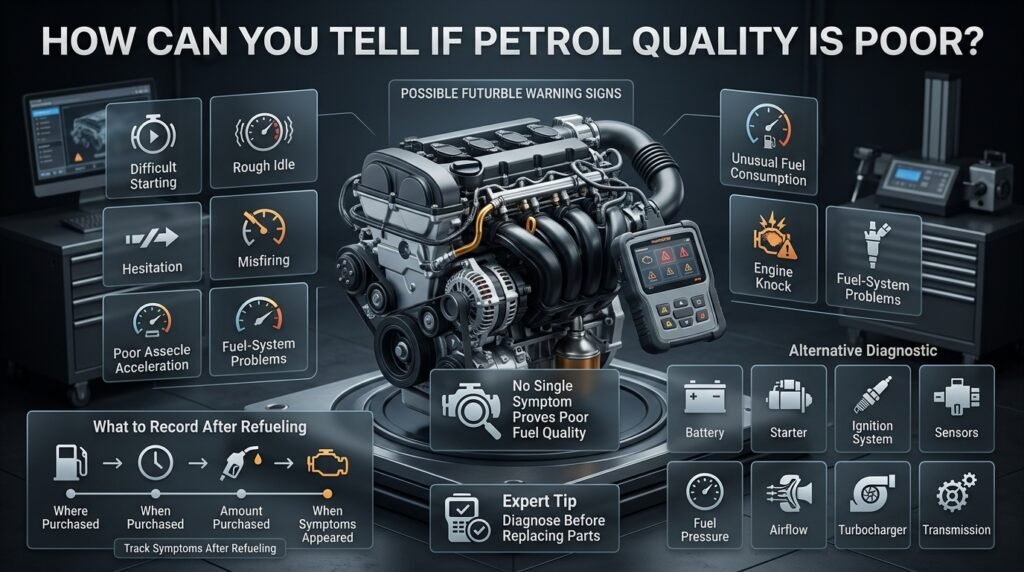
This is where drivers need to be careful.
There is no single symptom that proves petrol is poor quality.
Potential warning signs may include:
- Difficult starting
- Rough idle
- Hesitation
- Misfiring
- Poor acceleration
- Reduced drivability
- Unusual fuel consumption
- Engine knock
- Fuel-system problems
But each of these can have other causes.
For example:
Difficult starting
Could be related to fuel, but it could also involve the battery, starter, ignition system, sensors, or fuel-pressure system.
Rough idle
Could be related to contaminated fuel, but it could also result from vacuum leaks, dirty injectors, ignition problems, or sensors.
Poor acceleration
Could involve fuel quality, but could also be caused by turbocharger problems, ignition faults, restricted airflow, or transmission issues.
What should you do?
If unusual behavior starts shortly after refueling, record:
- Where you purchased the petrol
- When you purchased it
- Approximate amount purchased
- When the symptoms appeared
- Whether the symptoms continue after subsequent refueling
This information can help a technician investigate the problem more effectively.
Expert Tip: Don’t immediately replace expensive parts simply because a vehicle develops symptoms after refueling. Diagnose the vehicle and consider fuel quality as one possible cause.
Can You Identify Good Petrol by Its Color?
Not reliably.
Visual appearance may sometimes reveal obvious contamination, but it can’t establish the complete technical quality of petrol.
You cannot accurately determine properties such as:
- Octane rating
- Sulfur content
- Volatility
- Distillation behavior
- Oxidation stability
- Detailed contamination levels
simply by looking at the fuel.
This is why professional fuel-quality assessment relies on appropriate testing and specification requirements.
Color can be useful for certain identification purposes in particular fuel systems, but it shouldn’t be treated as a universal quality test.
What Can Contaminate Petrol?
Several things can compromise petrol after production.
Water
Water can enter through leaks, condensation, damaged seals, or poor storage practices.
Sediment
Dirt and particles can accumulate in storage systems or enter through poor handling.
Cross-contamination
Different fuel products can become mixed if storage or transportation equipment isn’t properly managed.
Degradation
Long-term exposure to heat, oxygen, and unsuitable storage conditions can affect fuel stability.
Poorly maintained equipment
Dirty tanks, hoses, filters, or dispensing systems can introduce unwanted material.
This is why fuel quality must be considered across the entire supply chain.
How Storage Conditions Affect Petrol Quality
Storage is a major part of fuel quality management.
For an ordinary driver, this might simply mean avoiding unnecessary long-term storage of petrol.
For businesses using bulk tanks, the issue becomes much more important.
Good fuel-storage practices include:
- Maintaining suitable tanks
- Preventing water entry
- Inspecting tank condition
- Maintaining dispensing equipment
- Avoiding cross-contamination
- Monitoring stored fuel
- Following appropriate maintenance procedures
Why does storage matter?
Imagine that a supplier provides petrol that meets the required specification.
If that petrol is then stored in a damaged or poorly maintained tank, the fuel can become contaminated.
The problem isn’t necessarily the original fuel product.
It may be the storage environment.
This is why fuel quality is a supply-chain responsibility.
How to Choose Good Quality Petrol
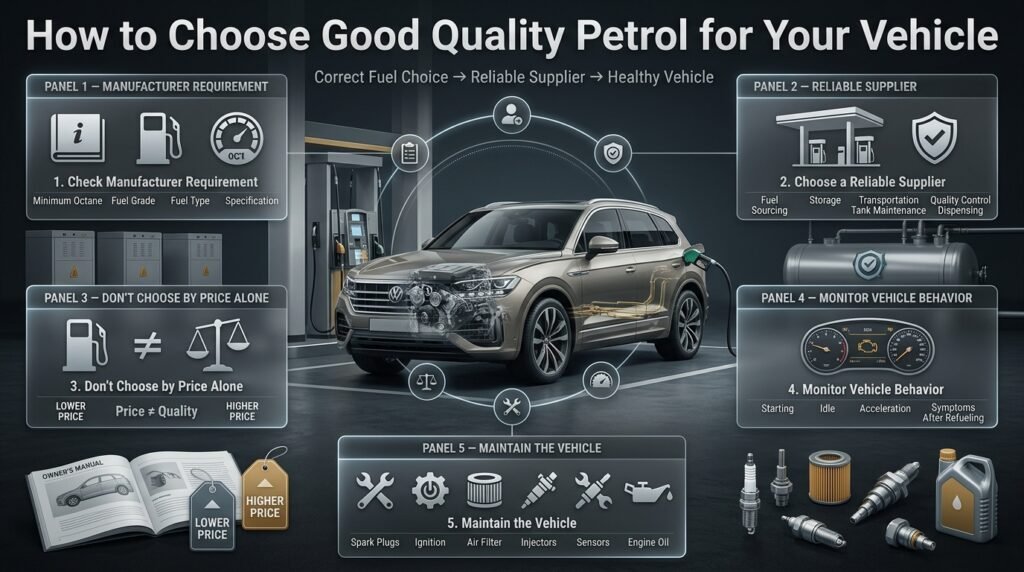
Choosing the right petrol doesn’t need to be complicated.i
Step 1: Check the Vehicle Manufacturer’s Requirement
Start with the owner’s manual or official manufacturer information.
Look for:
- Minimum octane
- Recommended fuel grade
- Fuel type
- Any applicable specification
- Special fuel requirements
Don’t assume that premium petrol is necessary unless the manufacturer recommends it.
Why this matters
The engine has been designed around specific fuel characteristics.
Following the manufacturer’s requirement is the safest starting point.
Step 2: Choose a Reliable Supplier
A reliable supplier should have appropriate procedures for:
- Fuel sourcing
- Storage
- Transportation
- Quality control
- Tank maintenance
- Dispensing
Brand reputation can provide some confidence, but fuel quality ultimately depends on the actual product and how it has been handled.
Step 3: Avoid Choosing Fuel Only by Price
The cheapest fuel isn’t automatically poor quality.
The most expensive fuel isn’t automatically the best.
Price can be influenced by many commercial factors.
The more useful questions are:
- Does it meet the required specification?
- Is the supplier reliable?
- Is the fuel properly stored?
- Is the correct octane being used?
- Is there a history of contamination or problems?
Step 4: Monitor Vehicle Behavior
Pay attention to unusual changes after refueling.
If a problem appears immediately after a particular fuel purchase, record the details.
Don’t automatically conclude that the fuel is responsible, but don’t ignore the timing either.
Step 5: Maintain the Vehicle
Even excellent petrol cannot fix a poorly maintained engine.
Keep up with manufacturer-recommended maintenance for:
- Spark plugs
- Ignition components
- Air filters
- Fuel filters where applicable
- Injectors
- Sensors
- Engine oil
- Other service items
Good fuel and good maintenance work together.
Common Mistakes People Make About Petrol Quality
Mistake 1: Thinking Expensive Petrol Is Always Better
Price isn’t a technical definition of quality.
A more expensive product may have a higher octane grade or different formulation, but that doesn’t mean every property is automatically better for every engine.
Better approach
Choose according to specification and manufacturer requirements.
Mistake 2: Choosing Petrol Only by Octane
Octane is important but doesn’t describe the complete fuel.
Why it happens
Octane is one of the easiest fuel characteristics for consumers to see at the pump.
Why it’s misleading
Other properties can also affect fuel performance and compatibility.
Better approach
Consider the complete fuel specification.
Mistake 3: Assuming Premium Petrol Is Necessary for Every Car
Premium fuel is not automatically required by every petrol engine.
Better approach
Follow the manufacturer’s recommendation.
Mistake 4: Judging Fuel by Color
Visual appearance cannot establish the complete quality of petrol.
Better approach
Use reliable suppliers and specification-based quality control.
Mistake 5: Blaming Petrol for Every Engine Problem
Many mechanical and electrical faults produce symptoms similar to poor fuel.
Better approach
Diagnose before replacing parts or making conclusions about the fuel.
Mistake 6: Ignoring Storage Conditions
Bulk fuel users sometimes focus heavily on purchasing fuel but overlook their own tanks and equipment.
Better approach
Treat storage and dispensing systems as part of fuel-quality management.
Mistake 7: Adding Too Many Fuel Additives
More additives don’t automatically mean better performance.
Better approach
Use additives only when appropriate and compatible with the vehicle and fuel system.
Petrol Quality and the Combustion Process
Understanding petrol quality becomes easier when you understand what the fuel actually has to do inside an engine.
In a typical spark-ignition engine, petrol is mixed with air and the mixture is ignited by a spark.
The combustion process depends on:
- Fuel delivery
- Air intake
- Fuel-air mixing
- Compression
- Spark timing
- Flame propagation
- Expansion of combustion gases
- Exhaust
Fuel characteristics influence several stages of this process.
For example:
- Octane affects knock resistance.
- Volatility influences vaporization.
- Fuel composition influences combustion and emissions.
- Contamination can interfere with fuel delivery.
- Stability affects how fuel behaves during storage.
This is why fuel quality is directly connected to engine operation.
Petrol vs Diesel Fuel Quality
Petrol and diesel aren’t interchangeable products.
They are designed around different engine-combustion systems.
Petrol engines typically use spark ignition, while diesel engines use compression ignition.
That means the important fuel properties aren’t exactly the same.
For a broader explanation of both fuel types, see Petrol and Diesel Fuel Types.
Understanding this distinction is important for anyone managing different types of vehicles or fuel supplies.
Why Petrol and Diesel Have Different Fuel Requirements
Petrol engines and diesel engines use different combustion strategies.
A petrol engine generally relies on a spark to initiate combustion.
A diesel engine compresses air to a high temperature and then injects fuel into the hot compressed air, allowing ignition under the appropriate conditions.
Because the combustion systems are different, petrol and diesel fuels have different performance requirements.
To understand the diesel side of the process in greater detail, read Diesel Engine Combustion Process.
This is another reason why choosing the correct fuel type matters as much as choosing the correct fuel grade.
Good Quality Petrol and Modern Emissions Systems
Fuel quality isn’t only about engine performance.
Modern vehicles are designed to control exhaust emissions using technologies such as:
- Catalytic converters
- Oxygen sensors
- Electronic fuel control
- Exhaust monitoring
- Engine-management software
Fuel properties can influence how these systems operate.
Controlled sulfur content is particularly important because excessive sulfur can interfere with emissions-control performance.
This is one reason modern fuel standards cover multiple characteristics instead of simply defining an octane number.
Good Quality Petrol for Fleet Operators
Fleet operators have a greater need to manage fuel quality because the financial consequences can multiply quickly.
If one vehicle experiences a fuel-related issue, the repair may be inconvenient.
If twenty vehicles experience similar issues, the impact can include:
- Lost operating time
- Additional repairs
- Driver downtime
- Reduced productivity
- Increased maintenance costs
- Customer-service problems
What should fleet managers monitor?
A practical fuel-management approach can include:
- Fuel supplier records
- Fuel delivery dates
- Fuel volumes
- Vehicle fuel consumption
- Storage-tank condition
- Tank maintenance
- Unexpected performance changes
- Repeated problems after specific deliveries
If several vehicles develop similar problems after receiving fuel from the same source, the pattern deserves investigation.
It still doesn’t automatically prove that the fuel caused the problem, but it provides useful evidence.
Expert Advice for Maintaining Petrol Quality
Professionals generally focus on preventing fuel-quality problems rather than waiting for vehicle failures.
Use the Correct Specification
The manufacturer’s requirement should be the starting point.
Don’t choose fuel solely based on price or marketing language.
Purchase From Reliable Sources
A reliable supplier should have suitable quality-control procedures.
Maintain Storage Tanks
For bulk users, the storage tank is effectively part of the fuel system.
A dirty or damaged tank can compromise otherwise suitable fuel.
Control Water
Water contamination should be prevented through suitable storage and maintenance procedures.
Keep Dispensing Equipment Clean
Hoses, pumps, filters, and other equipment should be maintained properly.
Track Repeated Problems
If multiple vehicles experience similar issues, look for common factors rather than treating every incident separately.
Maintain Vehicles Properly
Fuel quality and vehicle condition should always be considered together.
A Practical Fuel Quality Decision Guide
When you’re unsure whether a petrol product is suitable, use this simple decision process.
Question 1: Is it the correct fuel type?
If the vehicle requires petrol, use petrol. Don’t confuse petrol with diesel or another fuel product.
Question 2: Does the octane meet the manufacturer’s requirement?
If yes, move to the next question.
If no, choose the correct grade.
Question 3: Is the supplier reliable?
If the supplier has established quality-control and storage practices, that’s a positive sign.
Question 4: Is the fuel properly stored?
For bulk users, check tank condition and contamination control.
Question 5: Is the vehicle itself maintained?
If the engine has maintenance problems, fuel quality alone won’t solve them.
Question 6: Are there unusual symptoms?
If yes, document the timing and have the vehicle properly diagnosed.
This approach prevents drivers from making decisions based on one characteristic alone.
What are the most important characteristics of good quality petrol?
Good quality petrol isn’t judged by one property alone. The most important characteristics include appropriate octane rating, suitable volatility, controlled sulfur content, good storage stability, proper distillation characteristics, low contamination, and compliance with the applicable fuel specification. These properties work together to support reliable starting, smooth combustion, good drivability, and compatibility with modern fuel and emissions systems.
A professional way to evaluate petrol is to look at the complete fuel specification, rather than relying only on the octane number shown at the pump.
Important characteristics include:
Octane rating — provides resistance to engine knock.
Volatility — affects vaporization, starting, and drivability.
Sulfur content — needs to remain within applicable limits, particularly because sulfur can affect emissions-control systems.
Stability — helps fuel remain suitable during storage.
Distillation characteristics — influence how different portions of the fuel evaporate.
Contamination control — helps protect fuel-system components.
Additive formulation — can support properties such as deposit control and oxidation stability.
The biggest mistake is treating “high octane” as a complete definition of “high quality.” Octane is important, but it is only one part of the overall picture.
Does higher octane mean better quality petrol?
Not necessarily. Higher octane primarily means that petrol has greater resistance to auto-ignition and knock under the conditions measured by the applicable octane test. It doesn’t automatically mean the fuel is superior in every other quality characteristic.
This distinction is important because many drivers see a higher number at the fuel pump and assume that it must be better for their vehicle.
In reality, the right question is:
“What fuel does my engine require?”
A higher-octane fuel can be beneficial when an engine is designed or recommended to use it. Some high-compression or turbocharged engines are more sensitive to knock and may require or benefit from higher-octane fuel.
But if a vehicle is designed to operate correctly on a lower minimum octane, simply paying more for a higher grade doesn’t automatically produce a major improvement in performance or fuel economy.
What to remember
Higher octane = greater knock resistance.
Higher octane ≠ automatically cleaner fuel.
Higher octane ≠ automatically better volatility.
Higher octane ≠ automatically lower contamination.
Higher octane ≠ automatically better storage stability.
The best petrol is the one that meets the vehicle manufacturer’s requirements and the applicable fuel specification.
How can poor-quality petrol affect engine performance?
Poor-quality or unsuitable petrol can contribute to starting problems, hesitation, rough running, misfires, reduced drivability, abnormal combustion, or fuel-system problems, particularly when the fuel is contaminated or doesn’t meet the engine’s required characteristics.
However, this is where professional diagnosis matters.
A driver may notice that the engine begins running poorly after refueling and immediately blame the petrol. Sometimes that suspicion is justified, especially when several vehicles experience similar symptoms from the same fuel source. But many engine faults produce exactly the same symptoms.
For example:
A worn spark plug can cause misfiring.
A failing ignition coil can cause hesitation.
A dirty injector can affect acceleration.
A faulty sensor can change fuel control.
Low fuel pressure can create poor engine performance.
Contaminated petrol can also cause similar symptoms.
Modern fuel-injection systems depend on precise fuel delivery. Fuel-quality issues can interfere with that process, while sulfur and other fuel properties can also matter for emissions-control systems.
If problems appear after refueling
Keep a record of:
Where the fuel was purchased
When the vehicle was refueled
Approximately how much fuel was added
When the symptoms started
Whether the symptoms continue after subsequent refueling
That information can help a technician determine whether the fuel is actually a likely cause.
Professional advice: Don’t replace expensive engine components simply because a vehicle starts behaving differently after refueling. Diagnose the vehicle first and consider fuel quality alongside other possible causes.
How important is petrol volatility, and what happens if it is too high or too low?
Volatility is extremely important because petrol needs to vaporize appropriately for the engine to form a suitable fuel-air mixture. If volatility isn’t appropriate for the operating conditions, starting, warm-up, acceleration, and overall drivability can be affected.
Petrol is not burned as a simple pool of liquid fuel. In a spark-ignition engine, the fuel needs to become sufficiently vaporized and mixed with air before combustion can occur.
That’s why fuel specifications control volatility.
If volatility is too low
The fuel may not vaporize as readily under certain conditions, which can contribute to:
Difficult starting
Poor warm-up
Hesitation
Reduced drivability
If volatility is too high
Excessive vapor formation can create other problems under some conditions, including vapor-related fuel-system issues and increased evaporative emissions.
This is why more volatile does not automatically mean better petrol.
Fuel needs the appropriate volatility for the application and operating environment.
The EPA, for example, uses Reid Vapor Pressure (RVP) as one measure of gasoline volatility and regulates gasoline vapor pressure in certain circumstances to control evaporative emissions.
Professional takeaway
When judging petrol quality, don’t ask only:
“Does this fuel have high octane?”
Also consider:
“Does the fuel have the appropriate volatility and other properties required by its specification?”
That is a much more technically accurate way to evaluate fuel quality.
Can you tell if petrol is good quality just by looking at it?
No. Visual inspection alone cannot reliably determine the complete quality of petrol. Looking at fuel may reveal obvious contamination in some situations, but important characteristics such as octane, volatility, sulfur content, stability, and detailed distillation behavior require appropriate testing.
This is one of the most common misconceptions among everyday drivers.
People sometimes try to judge petrol by:
Color
Clarity
Smell
Appearance
Whether the engine feels powerful immediately after refueling
These observations can occasionally provide clues, but they aren’t substitutes for specification-based quality control.
For example, you cannot accurately determine the octane rating simply by looking at the fuel. You also can’t reliably determine sulfur content or vapor-pressure characteristics through visual inspection.
What should you look at instead?
For a professional assessment, focus on:
Whether the fuel meets the applicable specification
Whether the octane is appropriate for the vehicle
Whether the supplier follows proper quality-control procedures
Whether storage tanks are maintained
Whether water contamination is controlled
Whether dispensing equipment is properly managed
Whether the fuel has been handled correctly
The strongest indicator of fuel quality isn’t a particular color or appearance. It’s compliance with the appropriate specification combined with proper storage, handling, and quality control.
Bottom line
A clean-looking fuel sample isn’t automatically proof of high-quality petrol, just as a higher-priced fuel isn’t automatically better.
Good petrol is specification-compliant petrol that is appropriate for the engine and has been properly produced, stored, transported, and dispensed.
Conclusion
Understanding good quality petrol characteristics helps you make a smarter fuel choice instead of judging petrol only by price, brand, or octane number. Good petrol is more than simply high-octane fuel. Its overall quality depends on several properties working together, including appropriate octane rating, suitable volatility, controlled sulfur content, good stability, proper distillation characteristics, cleanliness, and protection against water and other contamination.
For everyday drivers, the best approach is straightforward: follow the vehicle manufacturer’s recommended fuel specification, purchase petrol from a reliable supplier, and don’t assume that premium or higher-octane fuel is automatically better for every engine. If your vehicle develops rough running, hesitation, misfires, or starting problems after refueling, investigate the issue properly rather than immediately blaming the fuel.
For businesses and fleet operators, fuel quality deserves even more attention because poor storage or contamination can affect multiple vehicles and increase operating costs. Proper tank maintenance, fuel handling, supplier selection, and record keeping can help maintain consistent fuel quality.
Ultimately, good quality petrol is petrol that meets the required specification, is suitable for the engine, remains clean and stable, and is properly handled from storage through delivery to the vehicle. Choosing fuel this way protects the engine, supports reliable performance, and helps you avoid unnecessary fuel-related problems.
For more practical information about fuel, automotive fuel types, and fuel quality, visit Out of Petrol Dubai 👉 Fuel Delivery Dubai.
Leave a Reply