
Introduction
Petrol Engine Combustion Process | Imagine turning the key or pressing the start button and hearing the engine come to life. The crankshaft begins rotating, the pistons move up and down, and the vehicle is ready to move. It feels simple from the driver’s seat, but inside the engine, thousands of carefully timed combustion events are happening every minute.
The petrol engine combustion process is what makes all of this possible. Petrol doesn’t simply burn inside the engine and create movement. The engine carefully controls air, fuel, compression, ignition timing, combustion pressure, and exhaust gases so that the chemical energy stored in petrol can be converted into useful mechanical power.
Understanding this process also explains many everyday engine questions. Why does a petrol engine need a spark plug? Why does the air-fuel ratio matter? What does compression actually do? Why can the wrong octane fuel cause knocking? Why does a misfire reduce performance? And why doesn’t using more expensive petrol automatically make every engine more powerful?
This guide explains the complete petrol combustion process in practical, easy-to-understand language. You’ll learn how the four-stroke cycle works, what happens inside the combustion chamber, how fuel injection and spark timing are controlled, how octane affects combustion, what causes abnormal combustion, and what drivers should know about maintaining efficient engine operation.
For a broader introduction to automotive fuel, you can also explore Fuel Fundamentals.
For drivers dealing with a car ran out of petrol Dubai 👉 Fuel Delivery Dubai, understanding the correct fuel requirements can also be useful when arranging emergency fuel delivery.
What Is the Petrol Engine Combustion Process?
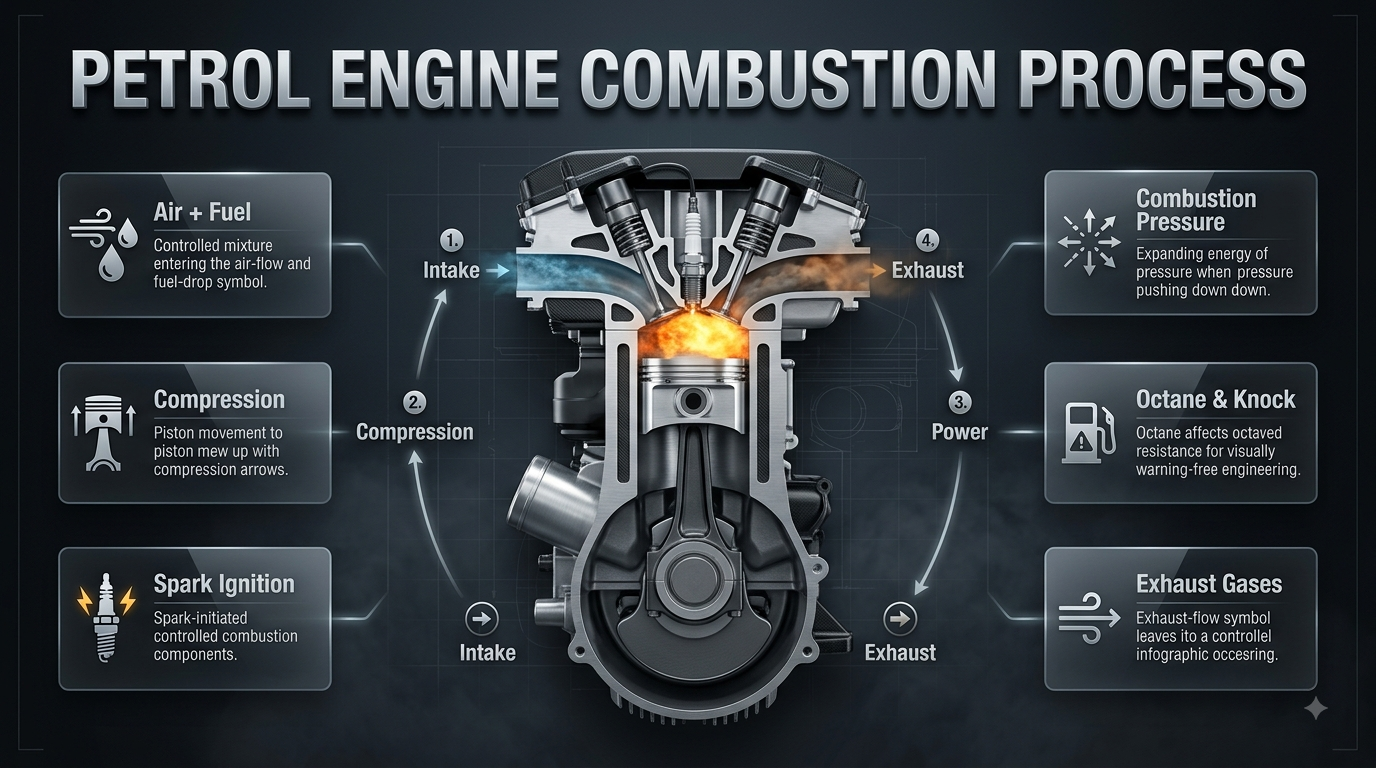
The petrol engine combustion process is the controlled burning of a petrol-air mixture inside an engine’s combustion chamber. In a conventional four-stroke petrol engine, air and fuel enter the cylinder, the mixture is compressed, a spark plug initiates combustion, and the resulting high-pressure gases push the piston downward to produce mechanical power.
The important word is controlled.
An engine isn’t designed simply to burn as much fuel as possible. It needs the correct amount of fuel and air, the right compression, and a precisely timed spark. When these factors work together, combustion produces a controlled rise in cylinder pressure that moves the piston efficiently.
The basic sequence can be simplified as:
Air + Petrol → Compression → Spark → Combustion → Pressure → Piston Movement → Crankshaft Rotation
The process repeats continuously while the engine is running.
In a four-stroke engine, each cylinder completes four basic strokes:
- Intake
- Compression
- Power
- Exhaust
These four strokes work together to prepare the mixture, release its energy, and clear the cylinder for the next cycle.
Why Is Combustion So Important in a Petrol Engine?
Combustion is the central process that determines how effectively a petrol engine converts fuel into useful power.
When combustion occurs correctly, the engine can deliver:
- Smooth acceleration
- Stable idle
- Consistent power
- Good fuel economy
- Controlled exhaust emissions
- Reliable operation
- Efficient energy conversion
When combustion isn’t occurring correctly, the engine may hesitate, misfire, knock, consume more fuel, produce excessive emissions, or lose power.
This is why problems that appear to be “fuel problems” aren’t always caused by the fuel itself. A petrol engine depends on several systems working together.
A useful way to think about combustion is:
Fuel + Air + Compression + Spark + Correct Timing = Controlled Combustion
If one of these factors is significantly wrong, the combustion event can be affected.
How Does a Four-Stroke Petrol Engine Work?
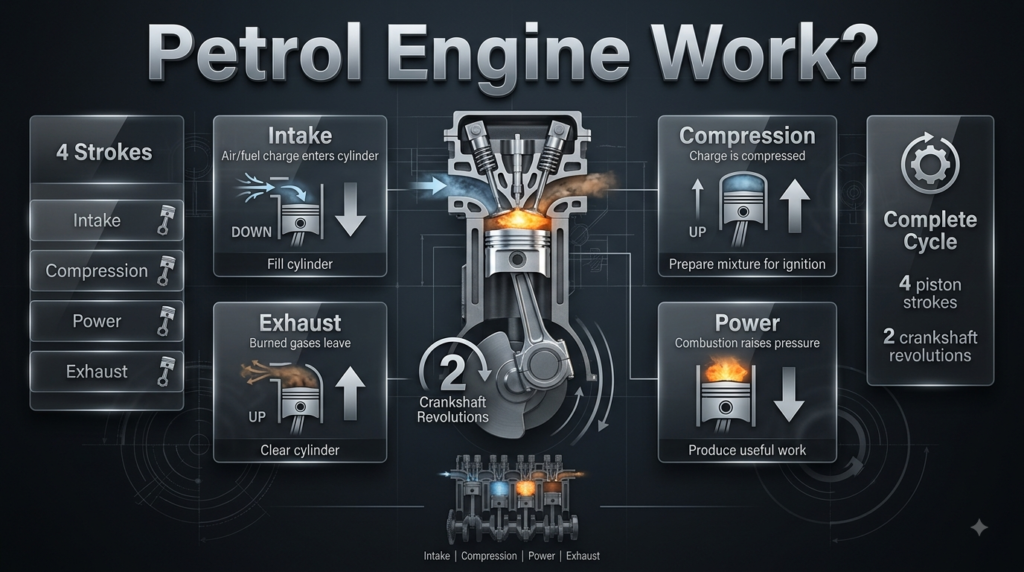
Most conventional petrol engines use a four-stroke operating cycle. The piston moves through four strokes while the crankshaft completes two full revolutions.
The four stages are:
| Stroke | What Happens | Piston Direction | Main Purpose |
|---|---|---|---|
| Intake | Air/fuel charge enters cylinder | Down | Fill cylinder |
| Compression | Charge is compressed | Up | Prepare mixture for ignition |
| Power | Combustion raises pressure | Down | Produce useful work |
| Exhaust | Burned gases leave | Up | Clear cylinder |
The engine doesn’t perform these stages slowly one after another. At normal engine speeds, the entire process happens extremely quickly.
In a multi-cylinder engine, the cylinders are also staggered. While one cylinder is producing power, another can be compressing its mixture and another can be completing its exhaust stroke.
This carefully coordinated sequence is what allows the crankshaft to rotate smoothly.
1. Intake Stroke: How Air and Petrol Enter the Engine
The combustion process begins with the intake stroke.
The piston starts near the top of the cylinder and moves downward. At the appropriate time, the intake valve opens, allowing fresh air or an air-fuel charge to enter the cylinder.
The exact way petrol enters depends on the engine design.
Older petrol engines commonly used carburetors to mix fuel with incoming air. Modern engines almost universally use electronic fuel injection, with fuel being introduced through injectors.
There are two common approaches:
Port Fuel Injection
With port fuel injection, the injector sprays petrol into the intake port near the intake valve. The fuel mixes with incoming air before entering the combustion chamber.
Direct Fuel Injection
With direct injection, the injector sprays petrol directly into the combustion chamber.
Direct injection allows the engine management system to control fuel delivery very precisely and can support different combustion strategies depending on engine design and operating conditions.
Why Is Air Important During Petrol Combustion?
Petrol needs oxygen to burn.
The air entering the engine contains approximately 21% oxygen by volume, along with mostly nitrogen and smaller amounts of other gases.
The engine therefore isn’t simply consuming petrol. It’s processing a carefully controlled mixture of fuel and air.
This is why restricting airflow can affect engine performance.
For example, if an engine cannot receive the required amount of air, the fuel system may not be able to produce the intended combustion conditions.
The engine management system continuously monitors operating conditions and adjusts fuel delivery accordingly.
Professional Advice
Don’t assume that adding more fuel automatically produces more power.
An engine needs the right air-fuel balance. Too much fuel can create a rich mixture, while too little fuel relative to available air can create a lean mixture. The correct mixture depends on engine design and operating conditions.
2. Compression Stroke: Preparing the Mixture
After the intake stroke, the intake valve closes.
The piston then begins moving upward while both intake and exhaust valves remain closed.
This is the compression stroke.
As the piston rises, it reduces the space available to the air-fuel charge. This increases the pressure and temperature of the mixture.
Compression is extremely important because it prepares the charge for efficient combustion.
A petrol engine’s compression ratio describes the relationship between the cylinder’s maximum volume and minimum volume.
For example, if an engine has a 10:1 compression ratio, the mixture is compressed into a space roughly one-tenth of its original maximum cylinder volume.
Why Does Compression Matter?
Higher compression can improve an engine’s ability to extract useful energy from fuel.
However, compression also increases the temperature and pressure of the mixture before ignition. If conditions become unfavorable, the unburned mixture can become more susceptible to abnormal combustion.
This is one reason engine compression and fuel octane requirements are closely related.
High-compression engines often require higher-octane petrol because they can be more sensitive to knock.
You can learn more about this relationship in our guide to fuel octane number.
3. Spark Ignition: How Combustion Begins
Near the end of the compression stroke, the spark plug creates an electrical spark inside the combustion chamber.
That spark provides the initial energy required to start combustion.
This is why conventional petrol engines are called spark-ignition engines.
The spark itself is extremely small, but it starts a chemical reaction that spreads through the prepared mixture.
The combustion process begins close to the spark plug and develops outward through the air-fuel mixture.
The location of the spark plug inside the combustion chamber is therefore important. Engine designers position the spark plug to help the flame travel effectively through the chamber.
Why Does the Spark Occur Before the Piston Reaches the Top?
A common question is why the spark doesn’t simply occur exactly when the piston reaches its highest point.
The reason is that combustion takes time.
The mixture doesn’t instantly release all of its energy the moment the spark occurs. A flame develops and propagates through the combustion chamber.
Because the engine is moving rapidly, the spark is normally initiated before top dead center under many operating conditions.
This gives combustion time to develop so that cylinder pressure rises at an appropriate point in the piston cycle.
The exact amount of ignition advance depends on factors such as:
- Engine speed
- Engine load
- Compression ratio
- Engine temperature
- Fuel characteristics
- Combustion-chamber design
- Intake conditions
Modern engine control systems adjust ignition timing continuously.
4. Power Stroke: How Combustion Produces Engine Power
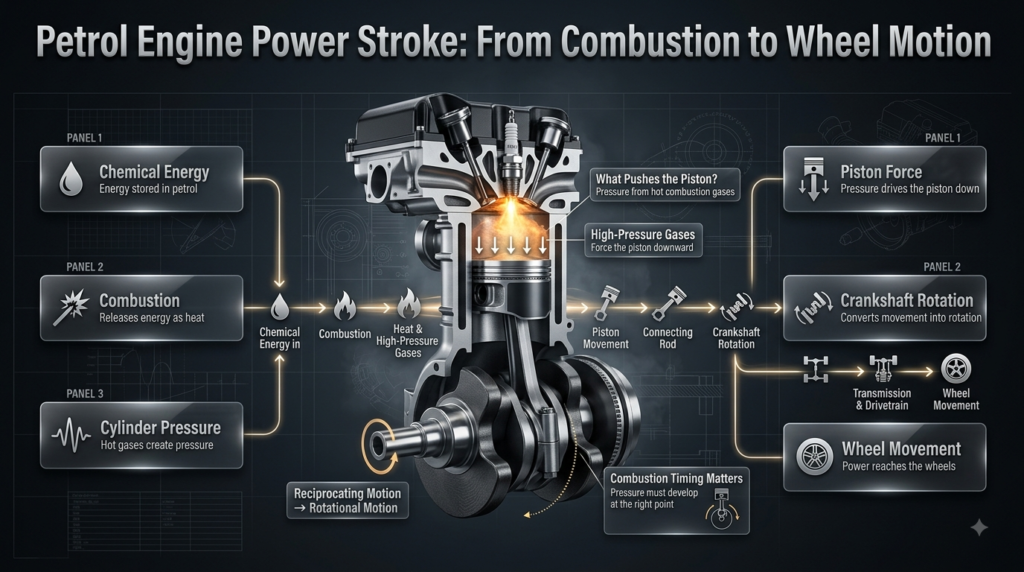
The power stroke is where the chemical energy in petrol becomes mechanical work.
Once the spark initiates combustion, the flame travels through the air-fuel mixture.
The combustion reaction releases energy, producing extremely hot gases and a rapid increase in cylinder pressure.
That pressure acts against the piston.
The piston is forced downward, and its movement is transferred through the connecting rod to the crankshaft.
The crankshaft converts the piston’s up-and-down movement into rotational movement.
That rotational movement is then transferred through the drivetrain to the wheels.
The complete energy path looks like this:
Chemical energy in petrol
↓
Combustion
↓
Heat and high-pressure gases
↓
Piston movement
↓
Connecting rod
↓
Crankshaft rotation
↓
Transmission and drivetrain
↓
Wheel movement
This is the fundamental reason an internal combustion petrol engine can move a vehicle.
What Actually Pushes the Piston?
The flame itself isn’t physically pushing the piston.
The important factor is the pressure created by the hot combustion gases.
When the mixture burns, the temperature and pressure inside the cylinder increase substantially. That pressure acts over the surface area of the piston and creates a downward force.
The connecting rod then transfers that force to the crankshaft.
This distinction is useful because it explains why combustion timing matters so much.
The engine wants cylinder pressure to reach a useful level at the right point in the piston cycle.
If pressure develops too early or too late, the engine cannot convert the available energy as effectively.
5. Exhaust Stroke: Removing Combustion Gases
After the power stroke, the piston begins moving upward again.
The exhaust valve opens, allowing the burned gases to leave the cylinder.
The piston pushes the remaining exhaust gases into the exhaust system.
These gases then travel through components such as:
- Exhaust manifold
- Catalytic converter
- Exhaust pipes
- Resonator
- Muffler
- Tailpipe
Once the exhaust gases have been removed, the cylinder is ready for another intake stroke.
The four-stroke cycle then starts again.
What Happens Chemically During Petrol Combustion?
Petrol is a complex mixture of hydrocarbons rather than a single chemical compound.
During ideal combustion, hydrocarbons react with oxygen and primarily produce carbon dioxide, water, and energy.
A simplified representation is:
Hydrocarbon fuel + Oxygen → Carbon dioxide + Water + Energy
Real-world engine combustion isn’t perfectly ideal.
The exhaust can also contain substances such as:
- Carbon monoxide
- Unburned hydrocarbons
- Nitrogen oxides
- Particulate matter under certain conditions
The engine and its emissions-control systems work together to reduce these unwanted pollutants.
This is one reason modern petrol engines require precise fuel injection and electronic control.
What Is the Air-Fuel Ratio in a Petrol Engine?
The air-fuel ratio describes the amount of air compared with the amount of fuel entering the engine.
For petrol, the commonly referenced stoichiometric air-fuel ratio is approximately 14.7:1 by mass.
That means approximately 14.7 units of air are required for one unit of petrol by mass under idealized stoichiometric conditions.
However, this doesn’t mean a petrol engine operates at exactly 14.7:1 under every circumstance.
The engine may adjust the mixture depending on:
- Engine temperature
- Engine load
- Acceleration
- Starting conditions
- Emissions requirements
- Catalyst operation
- Engine speed
What Is a Rich Fuel Mixture?
A rich mixture contains relatively more fuel compared with the amount of air.
Certain operating conditions may require a richer mixture.
For example, additional fuel may be used during some cold-start conditions because fuel vaporization behaves differently when the engine is cold.
However, an excessively rich mixture can reduce efficiency and increase certain emissions.
What Is a Lean Fuel Mixture?
A lean mixture contains relatively more air compared with fuel.
Some modern petrol engines can operate under carefully controlled lean conditions depending on their design and operating strategy.
However, extremely lean mixtures can cause combustion problems, misfires, increased combustion temperatures under certain circumstances, or emissions challenges.
The ideal mixture therefore isn’t simply “more fuel” or “more air.”
It’s the mixture appropriate for the engine’s current operating conditions.
What Role Does the Fuel Injector Play?
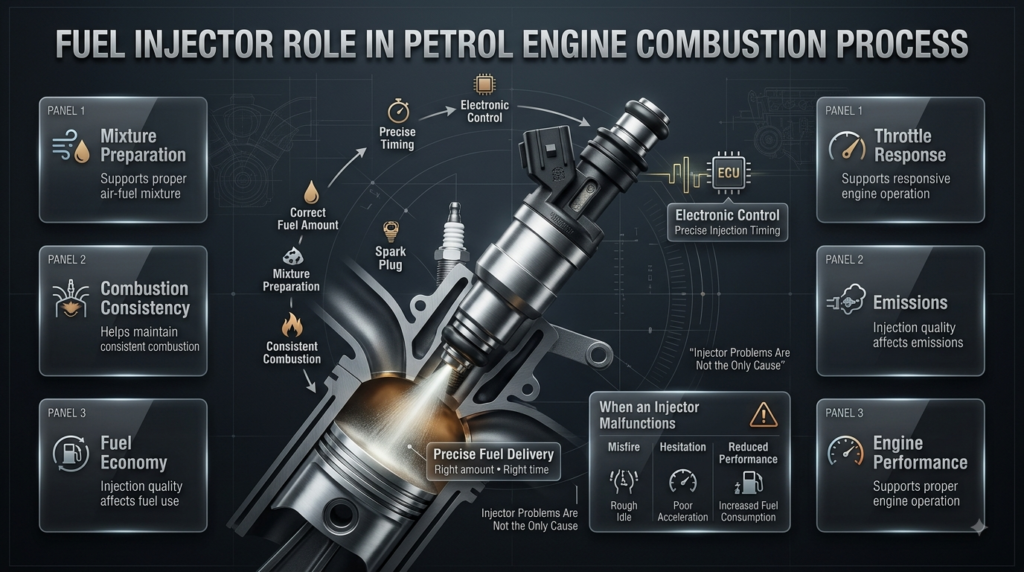
The fuel injector controls the delivery of petrol into the engine.
Modern injectors operate with extremely precise timing and are controlled electronically.
The injector must deliver the appropriate amount of fuel at the appropriate time.
Fuel injection quality affects:
- Mixture preparation
- Combustion consistency
- Fuel economy
- Throttle response
- Emissions
- Engine performance
A dirty or malfunctioning injector may deliver fuel incorrectly.
Depending on the fault, this can cause:
- Rough idle
- Hesitation
- Misfire
- Poor acceleration
- Increased fuel consumption
However, injector problems are only one possible cause of poor combustion.
What Is Ignition Timing?
Ignition timing refers to the point at which the spark plug fires in relation to piston position.
The engine control unit adjusts ignition timing according to current operating conditions.
At different engine speeds and loads, the best ignition timing can change.
Important factors include:
- RPM
- Engine load
- Cylinder pressure
- Engine temperature
- Knock tendency
- Fuel characteristics
The goal is to produce a useful pressure rise at the appropriate point in the piston cycle.
What Happens If Ignition Timing Is Too Early?
If the spark occurs too early, combustion pressure may develop before the piston has reached the appropriate position.
This can reduce efficiency and, under certain conditions, increase the possibility of knock or other abnormal combustion.
Severe or persistent abnormal combustion can place significant stress on engine components.
What Happens If Ignition Timing Is Too Late?
If ignition occurs too late, the engine may not extract as much useful work from the combustion gases.
Some energy may remain in the exhaust gases rather than contributing efficiently to piston movement.
Excessively retarded ignition can therefore contribute to:
- Reduced performance
- Increased fuel consumption
- Higher exhaust temperatures
- Poor combustion efficiency
Modern ECUs continuously adjust timing to prevent these problems.
How Does an ECU Control Petrol Combustion?
The engine control unit, commonly called the ECU, acts as the engine’s electronic control center.
It receives information from various sensors and uses programmed control strategies to determine how the engine should operate.
Depending on the vehicle, sensors can include:
- Crankshaft position sensor
- Camshaft position sensor
- Oxygen sensor
- Mass airflow sensor
- Manifold pressure sensor
- Throttle-position sensor
- Coolant-temperature sensor
- Intake-air temperature sensor
- Knock sensor
The ECU uses this information to manage fuel injection and ignition timing, along with many other engine functions.
Why Does the ECU Need So Much Information?
Consider how different the engine’s requirements are during:
Cold starting
The engine needs different fuel and ignition control than it does after reaching operating temperature.
Idling
The engine is producing relatively little power but needs to remain stable.
Hard acceleration
The engine needs significantly more airflow and fuel.
Highway cruising
The engine may operate at a relatively steady load with different efficiency priorities.
Climbing a hill
The engine experiences increased load and cylinder pressure.
The ECU allows modern petrol engines to adapt to these changing conditions.
What Is Flame Propagation in a Petrol Engine?
After the spark occurs, combustion begins in a small region around the spark plug.
A flame front then moves through the remaining combustible mixture.
This process is called flame propagation.
The speed and behavior of flame propagation depend on many factors, including:
- Air-fuel mixture
- Temperature
- Pressure
- Turbulence
- Combustion-chamber design
- Fuel properties
- Engine speed
Engine designers use combustion-chamber geometry and airflow patterns to encourage efficient flame propagation.
The objective is controlled combustion rather than uncontrolled burning.
What Is Normal Combustion?
Normal petrol engine combustion begins with the spark plug and develops through the air-fuel mixture in a controlled way.
The cylinder pressure rises as combustion progresses, producing useful force on the piston.
Normal combustion depends on:
- Correct fuel quantity
- Suitable air supply
- Appropriate compression
- Correct ignition timing
- Suitable fuel characteristics
- Proper engine temperature
When these factors are balanced, the engine can operate smoothly and efficiently.
What Is Abnormal Combustion?
Abnormal combustion occurs when the combustion process doesn’t follow the intended pattern.
Two important forms are knock and pre-ignition.
Although they’re sometimes used interchangeably in casual conversation, they aren’t exactly the same phenomenon.
What Is Engine Knock?
Engine knock is associated with unwanted autoignition of part of the unburned mixture during the combustion process.
Instead of following the intended flame propagation, portions of the remaining mixture can ignite rapidly under conditions that produce abnormal pressure waves.
Drivers may hear this as:
- Pinging
- Metallic rattling
- Knocking
Knock can become more likely under conditions such as:
- High engine load
- High cylinder temperature
- High compression
- Certain ignition timing conditions
- Insufficient octane for the engine’s requirements
- Combustion-chamber deposits
Modern petrol engines often use knock sensors to detect combustion behavior and allow the ECU to adjust ignition timing.
What Is Pre-Ignition?
Pre-ignition occurs when the air-fuel mixture begins burning before the intended spark event.
A hot spot inside the combustion chamber can sometimes act as an unintended ignition source.
Potential contributors can include:
- Excessive temperatures
- Hot deposits
- Certain abnormal operating conditions
- Component or combustion-chamber issues
Pre-ignition can be particularly serious because combustion begins at an unintended point in the piston cycle.
It shouldn’t be confused with normal spark ignition or ordinary knock.
How Does Octane Affect Petrol Engine Combustion?
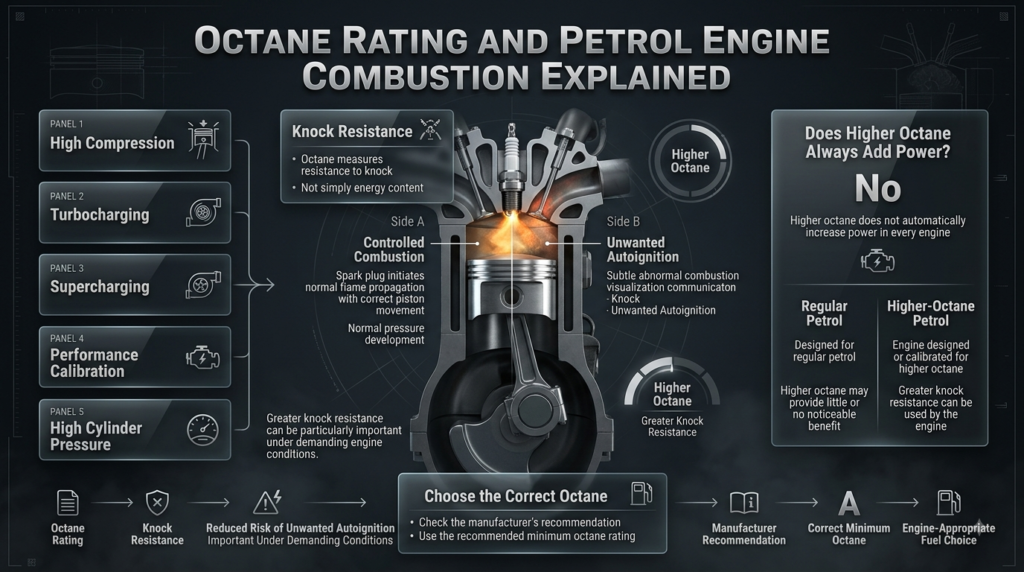
Octane rating measures a petrol’s resistance to knock.
It does not simply measure how much energy the fuel contains.
A higher-octane petrol is more resistant to unwanted autoignition under demanding conditions.
This can be particularly important in engines with:
- High compression ratios
- Turbocharging
- Supercharging
- Performance-oriented calibrations
- High cylinder pressures
For a detailed explanation of octane and what the number actually means, see Octane Rating for Petrol Engines.
Does Higher-Octane Petrol Always Give More Power?
No.
This is one of the most common misunderstandings about petrol.
Higher-octane fuel isn’t automatically more powerful in every engine.
If a vehicle is designed to operate normally on regular petrol, using a significantly higher octane fuel may provide little or no noticeable performance benefit.
However, if an engine manufacturer specifies or recommends higher octane, the engine may be calibrated to take advantage of its greater knock resistance.
For a more detailed comparison, see Regular vs Premium Petrol Octane.
Expert Tip
Don’t choose petrol based only on the highest number at the station.
Check the vehicle owner’s manual or fuel-filler information and use the manufacturer’s recommended minimum octane rating.
Petrol Engine Combustion and Compression Ratio
Compression ratio is one of the important characteristics of a petrol engine.
A higher compression ratio can improve thermal efficiency because it allows the engine to extract more useful work from the combustion process.
But higher compression also increases pressure and temperature before combustion.
That creates a greater challenge for knock resistance.
Engine designers therefore balance:
- Compression ratio
- Combustion-chamber design
- Ignition timing
- Fuel octane
- Cooling
- Airflow
- Engine load
This is why you can’t look at compression ratio in isolation and determine which fuel an engine needs.
How Turbocharging Changes Petrol Combustion
Turbocharging forces more air into the engine than it could normally draw under certain operating conditions.
More air allows the engine to burn more fuel and potentially produce more power from a given engine displacement.
However, turbocharging also increases cylinder pressure and temperature.
That makes combustion control especially important.
A turbocharged petrol engine may therefore use:
- Higher-octane fuel requirements
- Sophisticated ignition control
- Knock sensors
- Direct injection
- Intercooling
- Advanced ECU calibration
The exact strategy depends on the engine.
What Is the Role of the Intercooler?
In a turbocharged engine, compressing intake air can increase its temperature.
An intercooler helps reduce the temperature of compressed intake air before it enters the engine.
Cooler intake air can be beneficial because it is denser and can help the engine control combustion under demanding conditions.
Reducing intake temperature can also help reduce the tendency toward knock in suitable applications.
Petrol Combustion and Engine Temperature
Temperature has a major influence on combustion.
The engine needs to reach an appropriate operating temperature, but excessive temperatures can create problems.
The cooling system helps manage engine temperature using components such as:
- Coolant
- Radiator
- Water pump
- Thermostat
- Cooling fans
If the engine runs excessively hot, combustion conditions can change and the risk of abnormal combustion may increase.
This is why overheating should never be ignored.
Why Does a Petrol Engine Misfire?
A misfire occurs when combustion in one or more cylinders doesn’t occur correctly.
Possible causes include:
- Worn spark plugs
- Faulty ignition coils
- Injector problems
- Vacuum leaks
- Incorrect fuel mixture
- Sensor faults
- Low compression
- Timing problems
- Fuel-quality issues
A misfire may produce:
- Rough idle
- Shaking
- Hesitation
- Reduced acceleration
- Increased fuel consumption
- Check-engine warning
A serious misfire should be diagnosed promptly.
Can Poor Fuel Cause Combustion Problems?
Fuel quality can influence engine operation, but it’s important not to blame every combustion problem on petrol.
Potential fuel-related problems include:
- Contamination
- Water in fuel
- Incorrect fuel specification
- Poor storage
- Unsuitable octane
However, similar symptoms can also come from ignition, airflow, injectors, compression, or sensors.
A professional diagnosis should consider the entire system.
For a broader look at different automotive fuels, visit Types of Automotive Fuel.
Petrol Combustion vs Diesel Combustion
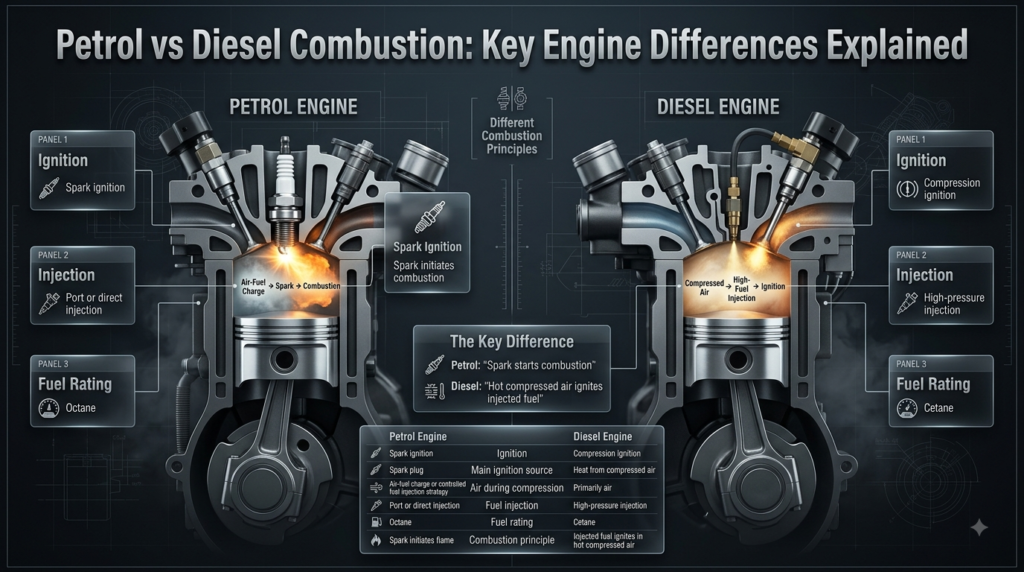
Both petrol and diesel engines are internal combustion engines, but their combustion processes are fundamentally different.
| Feature | Petrol Engine | Diesel Engine |
|---|---|---|
| Ignition | Spark ignition | Compression ignition |
| Main ignition source | Spark plug | Heat from compressed air |
| Air during compression | Air-fuel charge or controlled fuel injection strategy | Primarily air |
| Fuel injection | Port or direct injection | High-pressure injection |
| Fuel rating commonly discussed | Octane | Cetane |
| Typical combustion principle | Spark initiates flame | Injected fuel ignites in hot compressed air |
In a petrol engine, the spark plug is central to starting combustion.
In a conventional diesel engine, fuel is injected into highly compressed, hot air and ignites without a conventional spark ignition event.
For a broader comparison of automotive fuels, see Petrol and Diesel Fuel Types.
How Efficient Is Petrol Engine Combustion?
A petrol engine cannot turn 100% of the fuel’s chemical energy into useful wheel power.
Some energy is lost through:
- Exhaust heat
- Engine cooling
- Friction
- Pumping losses
- Accessory operation
- Other thermodynamic losses
Engine manufacturers therefore work continuously to improve thermal efficiency.
Modern petrol engines use technologies such as:
- Direct injection
- Turbocharging
- Variable valve timing
- Variable valve lift
- Electronic throttle control
- Advanced ignition control
- Cylinder deactivation in selected engines
- Sophisticated ECU strategies
Each technology is designed to improve some aspect of engine operation.
How Do Valves Affect the Combustion Process?
The intake and exhaust valves control the movement of gases into and out of the cylinder.
The intake valve needs to open at the appropriate point to allow fresh charge into the cylinder.
The exhaust valve needs to open at the appropriate point to release burned gases.
Modern engines often use variable valve timing, allowing valve opening and closing events to change according to engine speed and load.
This can improve:
- Airflow
- Torque
- Fuel economy
- Emissions
- Overall engine flexibility
Valve timing is therefore closely connected to combustion quality.
What Happens If the Engine Doesn’t Get Enough Air?
If airflow is restricted, the engine may not be able to achieve its intended operating conditions.
Possible causes include:
- Severely restricted air filter
- Intake obstruction
- Throttle-body problems
- Sensor issues
- Intake system faults
Modern electronic engine management can compensate for some changes, but there are limits.
If airflow is significantly reduced, the engine may lose power and efficiency.
What Happens If the Engine Gets Too Much Unmetered Air?
An intake leak can allow air into the engine without being properly accounted for by the engine management system.
This is often referred to as a vacuum leak or unmetered air leak, depending on the system.
It can affect the air-fuel mixture and may cause:
- Rough idle
- Lean operating conditions
- Hesitation
- Check-engine warnings
- Poor drivability
A proper diagnostic process is required to determine whether an intake leak is actually responsible.
How Do Spark Plugs Affect Combustion?
Spark plugs have a direct role in initiating combustion.
A spark plug that is worn, contaminated, incorrectly gapped, or otherwise faulty may fail to produce the required ignition event consistently.
This can lead to misfires.
Routine maintenance should therefore follow the vehicle manufacturer’s recommended spark-plug inspection and replacement intervals.
Different engines use different spark-plug specifications, so replacing a plug with an unsuitable type isn’t a good idea.
Common Petrol Engine Combustion Problems
Understanding the most common problems makes it easier to recognize when an engine needs attention.
Rough Idling
An unstable idle can be related to ignition, fuel delivery, airflow, sensors, compression, or other engine-management problems.
Hesitation
If the engine hesitates during acceleration, possible causes include fuel-delivery problems, ignition faults, airflow issues, or sensor-related problems.
Knocking
Persistent knocking or pinging under load should not be ignored.
Fuel octane, engine temperature, ignition timing, deposits, and mechanical conditions can all be relevant.
Misfire
A misfire can result from a failure in spark, fuel delivery, compression, or timing.
Poor Fuel Economy
Fuel consumption can increase when combustion isn’t properly controlled, but other factors such as tire pressure, driving conditions, vehicle load, and mechanical problems can also contribute.
How to Diagnose a Petrol Combustion Problem
When a petrol engine develops a combustion-related problem, replacing parts randomly is usually a poor strategy.
A systematic approach is better.
Step 1: Identify the Exact Symptom
Determine whether the vehicle has:
- Rough idle
- Hard starting
- Loss of power
- Misfire
- Knocking
- Increased fuel consumption
- Poor acceleration
The symptom helps narrow the possible causes.
Step 2: Check for Warning Lights
If the check-engine light is illuminated, diagnostic trouble codes can provide useful information.
A code isn’t necessarily the final diagnosis, though.
It identifies a system or condition that needs further investigation.
Step 3: Inspect the Ignition System
Check appropriate components such as:
- Spark plugs
- Ignition coils
- Wiring
- Electrical connections
Step 4: Check Airflow
Inspect the intake system and relevant sensors for faults or restrictions.
Step 5: Check Fuel Delivery
Fuel pressure, injector operation, and fuel quality may need to be evaluated.
Step 6: Check Mechanical Condition
If ignition and fuel systems appear normal, compression and other mechanical conditions may need investigation.
Step 7: Check Timing and Sensors
Crankshaft and camshaft signals are important because the ECU relies on them to synchronize fuel injection and ignition.
Professional Advice
Don’t replace a fuel injector simply because the engine is misfiring. Don’t replace spark plugs simply because the engine feels weak.
A combustion problem has many possible causes.
Diagnose first, replace second.
Common Mistakes Drivers Make With Petrol Combustion
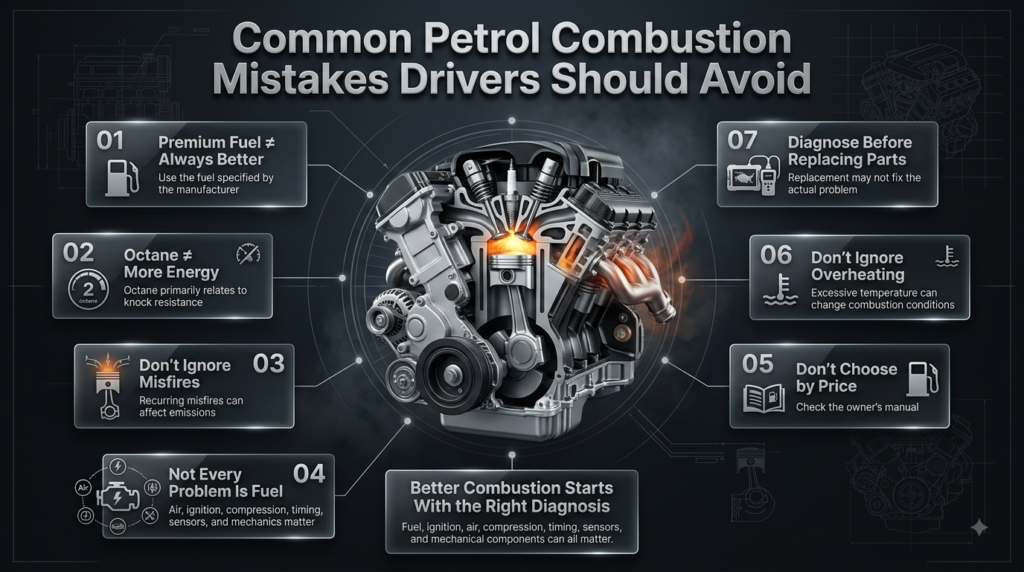
Mistake 1: Thinking Premium Fuel Is Always Better
Premium petrol isn’t automatically better for every engine.
The correct fuel is the one that meets the manufacturer’s specification.
Mistake 2: Thinking Octane Means More Energy
Octane rating primarily relates to resistance to knock.
It isn’t simply a measurement of fuel energy content.
Mistake 3: Ignoring Small Misfires
A recurring misfire isn’t something to ignore because it feels minor.
It can affect emissions and, in severe cases, damage emissions-control components.
Mistake 4: Assuming Every Engine Problem Is a Fuel Problem
Ignition, air, compression, timing, sensors, and mechanical components can all affect combustion.
Mistake 5: Using the Most Expensive Petrol Without Checking the Manual
The price of fuel doesn’t determine whether it’s correct for a particular engine.
Mistake 6: Ignoring Engine Overheating
Excessive temperature can change combustion conditions and increase the risk of serious engine problems.
Mistake 7: Replacing Parts Without Diagnosis
This can become expensive and may not solve the actual problem.
Expert Advice for Maintaining Efficient Petrol Combustion
A professional approach starts with the engine manufacturer’s specifications.
Use the Correct Fuel
Check the recommended octane rating and fuel specification.
If you’re unsure about fuel terminology or ratings, our Fuel Fundamentals resource provides useful background.
Maintain Spark Plugs
Follow the manufacturer’s maintenance schedule.
Don’t Ignore Warning Signs
Knocking, misfires, difficult starting, and unusual power loss should be investigated.
Keep the Cooling System Healthy
Engine temperature affects combustion and overall reliability.
Maintain the Fuel System
Fuel filters, injectors, pumps, and other components should be maintained according to vehicle requirements.
Use Quality Fuel From Reliable Sources
Fuel quality can matter, particularly if contamination or incorrect storage is involved.
Don’t Chase Performance With Random Fuel Choices
If you want to understand whether your engine can benefit from a particular petrol grade, start with the manufacturer’s requirements.
Petrol Engine Combustion Process at Different Driving Conditions
The combustion process isn’t identical during every moment of driving.
During Cold Start
The engine and fuel are cold, so fuel vaporization and combustion conditions differ from normal operating temperature.
The ECU adjusts fuel delivery and ignition strategy accordingly.
During Idling
The engine produces relatively little power, but combustion must remain stable enough to keep the engine running smoothly.
During Normal Cruising
The engine typically operates at a moderate load and can focus heavily on efficiency.
During Hard Acceleration
Airflow and fuel demand increase substantially.
Cylinder pressures can also rise, making knock control particularly important.
During Hill Climbing
Engine load increases, and combustion conditions change accordingly.
This is one reason modern ECUs continuously monitor engine conditions rather than using one fixed ignition and fuel map.
Why Does Combustion Become More Difficult Under High Load?
High engine load generally means the engine is producing more torque.
That can involve:
- More air entering the cylinder
- More fuel being supplied
- Higher cylinder pressure
- Higher combustion temperatures
These conditions can increase the challenge of preventing abnormal combustion.
This is why fuel octane and knock control can become particularly important under high-load operation.
What Happens to Combustion During Engine Acceleration?
When the driver presses the accelerator, the engine management system responds to changing airflow, throttle position, engine speed, and load.
The engine needs to increase fuel delivery appropriately while controlling ignition timing.
Modern engines can make these adjustments extremely quickly.
If the system cannot respond correctly because of a fault, the driver may notice:
- Hesitation
- Flat spots
- Rough acceleration
- Misfires
- Reduced power
The exact cause needs to be diagnosed rather than assumed.
Does Petrol Quality Affect Engine Performance?
Fuel quality can influence engine performance, but the term “quality” includes several factors.
These may include:
- Correct octane rating
- Proper fuel specification
- Cleanliness
- Contamination control
- Proper storage
- Consistent composition
A vehicle should be operated using fuel that meets the manufacturer’s requirements.
For readers comparing fuel categories, our guide to automotive fuel types provides additional context.
How Does Combustion Relate to Fuel Economy?
Fuel economy depends on much more than combustion alone.
It is affected by:
- Engine efficiency
- Vehicle weight
- Aerodynamics
- Transmission
- Tire pressure
- Driving style
- Traffic
- Engine temperature
- Air conditioning load
- Fuel quality
- Maintenance condition
However, inefficient combustion can certainly contribute to increased fuel consumption.
A misfiring engine, incorrect mixture, faulty sensor, or poor ignition system can all reduce efficiency.
How Does Combustion Affect Exhaust Emissions?
Combustion quality has a direct relationship with exhaust emissions.
Incomplete combustion can increase certain pollutants, while high combustion temperatures can contribute to the formation of nitrogen oxides.
Modern petrol vehicles therefore use emissions-control systems to reduce pollutants.
A typical modern vehicle may use:
- Catalytic converter
- Oxygen sensors
- Evaporative emissions controls
- Exhaust gas management systems
- Electronic fuel control
These systems work alongside the combustion process rather than being separate from it.
What Is the Difference Between Combustion and Explosion?
This is an important distinction.
A petrol engine is designed for controlled combustion, not an uncontrolled explosion.
The goal is to create a controlled pressure rise that pushes the piston at the appropriate point in the cycle.
An uncontrolled combustion event can produce abnormal pressure waves and excessive stress.
That’s why ignition timing, fuel characteristics, combustion-chamber design, and engine management are so important.
Why Does a Multi-Cylinder Petrol Engine Run Smoothly?
A four-cylinder, six-cylinder, or eight-cylinder engine doesn’t have all pistons producing power simultaneously.
Instead, combustion events are carefully timed.
While one cylinder may be completing its power stroke, another can be approaching ignition, another can be compressing its mixture, and another can be exhausting.
The crankshaft and flywheel also help smooth rotational motion.
This coordination creates the relatively continuous power delivery that drivers experience.
What Is the Role of the Crankshaft?
The crankshaft converts reciprocating piston movement into rotational movement.
During the power stroke, combustion pressure pushes the piston down.
The connecting rod transfers that force to the crankshaft.
The crankshaft then rotates.
That rotation becomes the engine’s mechanical output and is ultimately transferred through the transmission and drivetrain to the wheels.
Without this conversion, the piston’s movement wouldn’t directly provide the rotational motion required to drive a vehicle.
What Is the Role of the Connecting Rod?
The connecting rod links the piston to the crankshaft.
It transfers force from the piston to the crankshaft during the power stroke and also helps transmit crankshaft movement back to the piston during the other strokes.
It therefore operates under significant mechanical loads.
The connecting rod is a key part of the engine’s mechanical energy-transfer system.
Petrol Combustion Process: A Simple Visual
A simplified four-stroke cycle can be remembered like this:
INTAKE
Air + fuel enters
↓
COMPRESSION
Mixture is compressed
↓
IGNITION
Spark plug fires
↓
COMBUSTION
Pressure rises
↓
POWER
Piston moves down
↓
EXHAUST
Burned gases leave
↓
INTAKE
The cycle begins again.
This simplified sequence captures the basic operating principle of a conventional four-stroke petrol engine.
Petrol Engine Combustion Process vs Fuel Burning Outside the Engine
Burning petrol in open air and combustion inside an engine are very different processes.
When petrol burns outside an engine, most of the released energy becomes heat and light.
Inside an engine, combustion occurs in a controlled chamber where the resulting pressure can act directly on a piston.
The engine’s mechanical design captures part of the combustion energy and converts it into useful mechanical work.
That’s the major difference.
The engine isn’t valuable simply because it burns fuel.
It’s valuable because it controls combustion and converts part of the released energy into mechanical movement.
How Fuel Delivery Supports Combustion
A reliable fuel-delivery system must provide fuel at the correct pressure and quantity.
Depending on the vehicle, the system may include:
- Fuel tank
- Fuel pump
- Fuel lines
- Fuel filter
- Fuel rail
- Injectors
- Pressure-control components
A problem anywhere in this chain can affect engine operation.
For vehicles and fuel-related services, you can also explore FuelDeliveryDubai.
The important point is that fuel delivery and combustion are closely connected, but they aren’t the same thing. A combustion problem can originate from the fuel system, ignition system, airflow system, mechanical condition, or electronic controls.
Can the Wrong Petrol Damage an Engine?
Using fuel that doesn’t meet the manufacturer’s requirements can create problems.
The most important concern with octane is whether the fuel provides sufficient resistance to knock for the engine’s design and operating conditions.
If the manufacturer specifies a minimum octane requirement, consistently using fuel below that requirement isn’t recommended.
On the other hand, using a higher octane than required isn’t necessarily harmful, but it may not provide a meaningful benefit either.
The best choice is to follow the manufacturer’s specification.
How Should You Choose Petrol for Your Engine?
Use this simple process.
Step 1: Check the Owner’s Manual
Look for the recommended minimum octane rating and fuel specification.
Step 2: Check the Fuel-Filler Area
Some vehicles display fuel requirements near the fuel filler.
Step 3: Understand the Rating System
Fuel labels can use different rating systems depending on the market.
Step 4: Follow the Minimum Requirement
Don’t choose fuel based only on price or marketing claims.
Step 5: Consider Manufacturer Recommendations
If premium petrol is recommended for improved performance or required for certain operating conditions, follow that guidance.
For more information, read our guide to octane rating for petrol engines.
How Does Combustion Happen Inside a Petrol Engine?
A petrol engine combustion process starts when a properly prepared air-fuel mixture is compressed inside the cylinder and then ignited by the spark plug. The spark creates a small flame that spreads through the mixture. As the fuel burns, the temperature and pressure inside the cylinder rise rapidly. This pressure pushes the piston downward, and the connecting rod transfers that movement to the crankshaft, producing rotational power.
The process is carefully timed rather than being a random explosion. The intake system supplies air, the fuel system delivers petrol, the piston provides compression, and the ignition system determines when combustion begins. The resulting pressure needs to develop at the right point in the piston cycle so that as much of the released energy as practical is converted into useful mechanical work.
Important points:
The spark plug starts normal combustion.
Compression prepares the air-fuel charge for ignition.
Combustion increases cylinder pressure.
Cylinder pressure pushes the piston downward.
The crankshaft converts piston movement into rotation.
Correct combustion timing is essential for efficient power production.
This is why a problem with the spark, fuel delivery, airflow, compression, or timing can affect the entire combustion process rather than just one individual component.
What Is the Ideal Air-Fuel Ratio for a Petrol Engine?
For petrol engines, the commonly referenced stoichiometric air-fuel ratio is about 14.7:1 by mass. In simple terms, this represents approximately 14.7 parts air for every 1 part of petrol under ideal stoichiometric conditions. However, a modern petrol engine doesn’t necessarily operate at exactly this ratio in every driving situation because the engine control system continuously adapts fuel delivery to operating conditions.
The required mixture can change during cold starts, acceleration, different engine loads, and emissions-control operation. That’s why describing 14.7:1 as a permanent operating ratio would be misleading. It’s better understood as an important reference point for petrol combustion.
What affects the air-fuel mixture?
Engine temperature
Engine speed
Engine load
Throttle position
Airflow
Fuel-injection strategy
Emissions requirements
Driving conditions
A mixture that’s too rich contains excessive fuel relative to available air, while a mixture that’s too lean contains relatively more air. Both conditions can create problems when they move outside the engine’s intended operating range.
Professional tip: Don’t assume that adding more petrol means producing more power. Combustion depends on the correct relationship between fuel and oxygen, along with the right ignition and operating conditions.
Why Does a Petrol Engine Need a Spark Plug?
A conventional petrol engine uses a spark plug to initiate combustion because it is a spark-ignition engine. Near the end of the compression stroke, the ignition system sends high voltage to the spark plug, creating a spark across its electrode gap. That spark starts the flame that then propagates through the prepared air-fuel mixture.
The timing of that spark is just as important as the spark itself. Combustion doesn’t happen instantly, so the engine generally initiates the spark before the piston reaches its exact highest position under many operating conditions. This gives the combustion process time to develop so cylinder pressure can rise at a useful point in the cycle.
A worn or faulty spark plug can therefore affect more than starting. It may cause inconsistent ignition and lead to misfires, rough running, hesitation, reduced performance, or increased emissions.
What a healthy ignition system needs:
Correct spark-plug specification
Proper electrode condition
Appropriate spark gap
Reliable ignition voltage
Correct ignition timing
Consistent combustion across cylinders
This is also why replacing spark plugs with the wrong specification or ignoring persistent misfires isn’t a good maintenance strategy. The ignition system needs to match the engine manufacturer’s design.
What Causes Knocking in a Petrol Engine?
Engine knock occurs when part of the unburned air-fuel mixture auto-ignites instead of being consumed normally by the flame initiated by the spark plug. This unwanted combustion can create rapid pressure fluctuations inside the cylinder and is commonly associated with the metallic pinging or knocking sound heard under certain operating conditions.
Knock becomes particularly important because combustion needs to happen in a controlled sequence. During normal combustion, the flame starts at the spark plug and travels through the mixture. With knock, some of the remaining unburned mixture can ignite unexpectedly because of the pressure and temperature conditions inside the cylinder.
Several factors can increase knock tendency, including:
High engine load
High cylinder temperatures
High compression
Certain ignition-timing conditions
Fuel with insufficient knock resistance for the engine
Combustion-chamber deposits
Certain intake-air conditions
Modern petrol engines often use knock sensors. When the ECU detects knock, it can adjust ignition timing to reduce the likelihood of continued abnormal combustion. This protection can help, although repeated or severe knock should not be treated as normal engine behavior.
The important distinction: engine knock isn’t simply “the engine making a normal combustion sound.” Persistent or severe abnormal combustion can reduce efficiency and place additional stress on engine components.
Does Higher-Octane Petrol Improve Petrol Engine Combustion?
Higher-octane petrol primarily provides greater resistance to knock; it doesn’t automatically mean that the fuel contains more usable energy or that every petrol engine will produce more power. An engine designed or calibrated to benefit from higher octane may be able to operate under conditions that take advantage of that additional knock resistance.
This is particularly relevant to engines with characteristics such as higher compression ratios or turbocharging, where cylinder pressure and temperature can become significant under demanding conditions.
However, putting premium petrol into an engine that is designed to run properly on regular fuel doesn’t automatically create a noticeable performance improvement. The correct approach is to follow the manufacturer’s fuel specification rather than assuming that the most expensive petrol is always the best choice.
When higher octane can matter:
High-compression petrol engines
Turbocharged engines
Performance-oriented engines
Engines with specific premium-fuel recommendations
Situations where the manufacturer specifies a higher minimum octane
Professional advice: Think of octane as knock resistance, not a simple “power rating.” The right petrol is the one that meets the engine manufacturer’s requirements for the way that engine was designed and calibrated.
Conclusion
The petrol engine combustion process is a carefully controlled sequence that turns the chemical energy in petrol into useful mechanical power. From the moment air and fuel enter the cylinder to the final exhaust stroke, every stage has a specific purpose. Proper airflow, fuel delivery, compression, spark timing, and combustion control all need to work together for the engine to operate smoothly and efficiently.
Understanding this process also makes it easier to understand common engine problems. A misfire may come from the ignition or fuel system, while knocking can be related to combustion conditions, engine temperature, ignition timing, or insufficient octane for the engine’s requirements. Similarly, using a higher-octane petrol isn’t automatically better; the correct fuel should always be based on the manufacturer’s specification.
For everyday drivers, the best approach is straightforward: use the recommended fuel, maintain the ignition and fuel systems, don’t ignore unusual engine symptoms, and understand what your engine actually requires. Good combustion isn’t about burning more petrol—it’s about controlling the right amount of fuel and air at the right time and converting that energy into useful power as efficiently as possible.
Leave a Reply