Introduction
Regular vs Premium Petrol Octane | Choosing between regular and premium petrol can be confusing. One fuel grade costs less, another has a higher octane number, and you may wonder whether paying extra actually gives your car better performance.
The answer isn’t simply that premium petrol is “better.” The real difference comes down to octane, engine design, and your vehicle manufacturer’s fuel recommendation.
In this guide to regular vs premium petrol octane, you’ll learn what octane means, how regular and premium petrol differ, whether premium fuel improves performance or fuel economy, and when paying extra actually makes sense.
If you want to understand the broader basics of automotive fuels first, you can also explore Fuel Fundamentals.
For drivers dealing with a car ran out of petrol Dubai 👉 Fuel Delivery Dubai, knowing your vehicle’s recommended petrol grade can also be helpful when arranging emergency fuel delivery.
What Is Octane in Petrol?
Octane is a measure of petrol’s resistance to engine knock or uncontrolled combustion. A higher octane rating means the fuel can withstand greater pressure and heat before it is more likely to ignite prematurely.
In simple terms, octane doesn’t tell you how much power is stored inside the petrol. Instead, it tells you how well the fuel can resist abnormal combustion inside the engine.
A simplified combustion process looks like this:
Air + Petrol → Compression → Spark → Controlled Combustion → Power
When knocking occurs, part of the compressed mixture can ignite unexpectedly:
Air + Petrol → Compression → Uncontrolled Ignition → Pressure Shock → Knock
Higher-octane petrol provides greater resistance to this type of uncontrolled combustion.
This becomes particularly important in engines with:
- High compression ratios
- Turbochargers
- Superchargers
- Higher cylinder pressures
- Advanced ignition timing
- Performance-oriented engine tuning
Pro Tip: Always check whether your vehicle’s fuel specification uses RON or AKI before comparing octane numbers. These systems measure octane differently.
Regular vs Premium Petrol Octane: What’s the Main Difference?
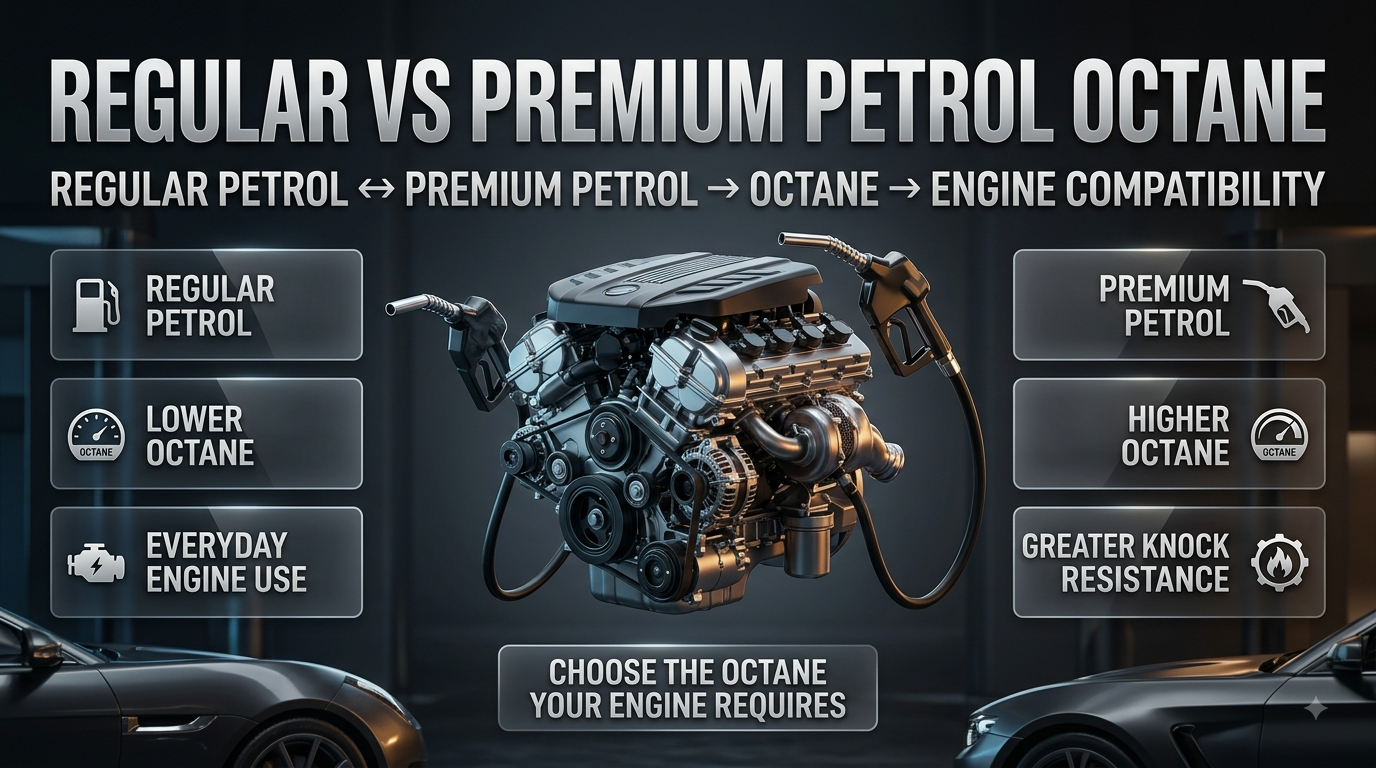
The main difference between regular and premium petrol is their octane rating.
Regular petrol has a lower octane rating, while premium petrol has a higher octane rating and therefore greater resistance to engine knock.
The exact numbers vary depending on the country and fuel-rating system.
| Feature | Regular Petrol | Premium Petrol |
|---|---|---|
| Octane rating | Lower | Higher |
| Knock resistance | Lower | Higher |
| Typical price | Lower | Higher |
| Suitable for regular engines | Yes, when specified | Usually also usable |
| Required by performance engines | Sometimes no | Often yes |
| Potential performance benefit | Normal | Useful for compatible engines |
| Best choice | Engines designed for regular | Engines requiring/recommending premium |
The important point is that higher octane doesn’t automatically mean better fuel for every car.
A vehicle engineered for regular petrol normally doesn’t need premium simply because the premium pump has a larger number.
What Is Regular Petrol?
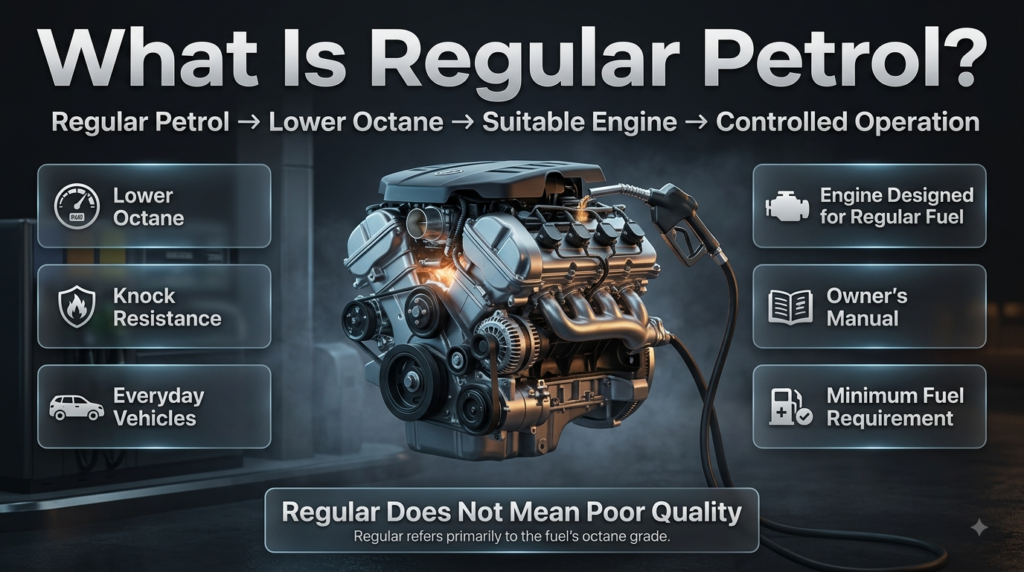
Regular petrol is a lower-octane fuel designed for engines that can operate safely using that level of knock resistance.
For many everyday vehicles, regular petrol is perfectly suitable because the engine’s compression ratio, ignition timing, fuel system, and electronic controls are designed around it.
Regular petrol is generally the sensible choice when:
- Your owner’s manual specifies regular petrol.
- Your fuel-filler door lists regular as the minimum requirement.
- Your engine is designed for regular fuel.
- Premium isn’t required or specifically recommended.
Using regular petrol in a vehicle that requires premium is different. In that situation, the engine may need to adjust its operation to protect itself from knock.
Common Mistake: Thinking “regular” means poor-quality petrol. Regular refers primarily to the fuel’s octane grade. It doesn’t automatically mean the fuel is low quality.
What Is Premium Petrol?
Premium petrol is a higher-octane fuel that provides greater resistance to knock.
Premium fuel is particularly useful in engines that operate with higher compression or cylinder pressure.
This can include:
- Turbocharged engines
- High-compression engines
- Performance cars
- Some luxury vehicles
- Certain modern direct-injection engines
- Engines specifically calibrated for premium fuel
Premium petrol allows an engine designed around higher octane to operate closer to its intended calibration.
However, premium petrol isn’t automatically more powerful.
Its value comes from its higher knock resistance, not from some universal increase in energy content.
Does Premium Petrol Give More Power?
Premium petrol can provide more performance when the engine is designed or calibrated to take advantage of its higher octane.
Higher octane itself doesn’t magically add horsepower.
Instead, an engine designed for premium fuel may be able to maintain more aggressive ignition timing, higher compression, or greater boost without experiencing excessive knock.
Consider two engines:
Engine A: Designed for regular petrol
Engine B: Designed to benefit from premium petrol
Putting premium petrol into Engine A may make little noticeable difference.
Using the recommended premium petrol in Engine B can help the engine deliver the performance intended by its manufacturer.
This is one of the most important differences to understand when comparing regular vs premium petrol octane.
Does Premium Petrol Improve Fuel Economy?
Sometimes, but not always.
Fuel economy depends on many factors, including:
- Engine design
- Driving style
- Traffic conditions
- Vehicle weight
- Tyre pressure
- Engine condition
- Temperature
- Air-conditioning use
- Fuel formulation
- Octane requirement
Some modern engines can adjust ignition timing and other operating parameters based on fuel quality. In certain engines, higher-octane fuel may allow more efficient operation under specific conditions.
But that doesn’t mean every car will get better mileage on premium.
If your vehicle is designed for regular petrol, switching to premium may produce little or no measurable improvement.
Even if premium improves fuel economy slightly, the improvement may not be enough to compensate for its higher price.
A Simple Example
Imagine:
- Regular petrol = lower price
- Premium petrol = higher price
- Regular economy = 12 km/L
- Premium economy = 12.2 km/L
The premium fuel provides slightly better mileage, but that doesn’t automatically make it cheaper to operate the vehicle.
The better comparison is:
Fuel cost per kilometre = Fuel price per litre ÷ Kilometres per litre
This tells you whether the additional efficiency actually offsets the higher fuel price.
Is Premium Petrol Worth the Extra Money?
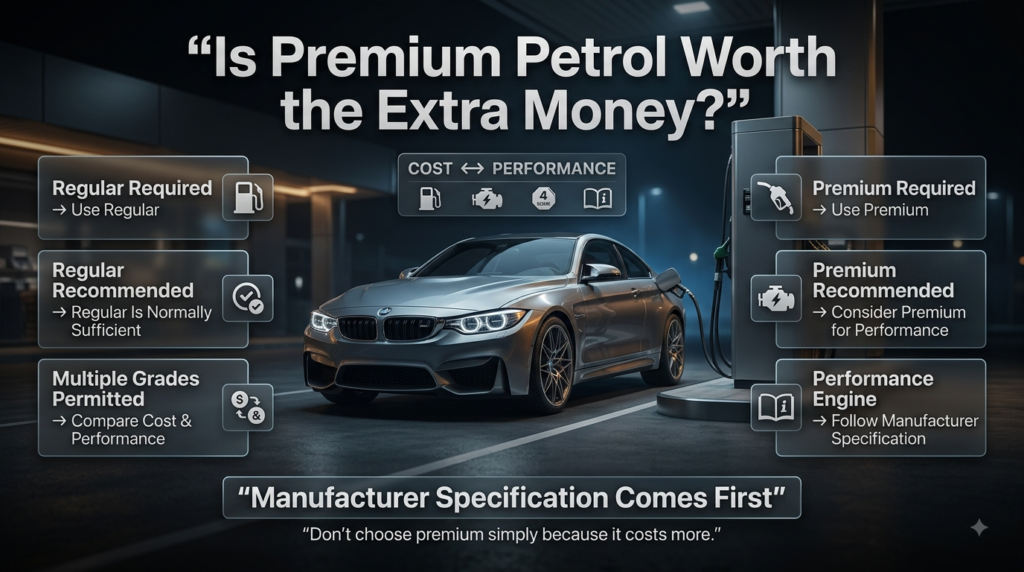
Premium petrol is worth paying for when your vehicle requires it or is specifically designed to benefit from it.
If your vehicle only requires regular petrol, premium may not provide enough benefit to justify the additional cost.
| Vehicle Requirement | Recommended Approach |
|---|---|
| Regular required | Use regular |
| Regular recommended | Regular is normally sufficient |
| Premium required | Use premium |
| Premium recommended | Consider premium for optimal performance |
| Multiple grades permitted | Compare cost and performance |
| Performance engine | Follow manufacturer’s specification |
Don’t decide based only on the words “premium” or “high performance.”
The manufacturer’s specification should come first.
What Happens If You Use Regular Petrol in a Premium Car?
If your vehicle requires premium petrol and you accidentally use regular fuel once, don’t automatically assume that the engine has been damaged.
Many modern engines use knock sensors and electronic engine management systems. These systems can detect combustion problems and adjust ignition timing to reduce the risk of knock.
You may notice:
- Reduced acceleration
- Less engine performance
- Lower fuel economy
- Engine noise under heavy load
- Reduced boost or power in some vehicles
However, the exact response depends on the engine.
If premium fuel is required, return to the manufacturer’s recommended grade as soon as practical.
Quick Tip: If you accidentally fill up with the wrong octane, check your owner’s manual for vehicle-specific instructions instead of relying on generic internet advice.
What Happens If You Put Premium Petrol in a Regular Car?
Putting premium petrol into a vehicle designed for regular fuel generally doesn’t cause damage simply because the octane is higher.
The main issue is whether you’ll receive any meaningful benefit.
For many regular-fuel engines, the answer is little or none under normal driving conditions.
You may simply be paying more for a fuel characteristic that your engine doesn’t need.
That’s why premium petrol should not be treated as a routine performance upgrade.
Regular vs Premium Petrol for Turbocharged Engines
Turbocharged engines deserve special attention because turbocharging increases the amount of air entering the engine.
More air allows the engine to burn more fuel and produce more power, but it can also increase cylinder pressure and combustion temperatures.
Higher cylinder pressure can increase the risk of knock.
That’s one reason many turbocharged engines specify higher-octane petrol.
However, not every turbocharged engine requires premium petrol.
Some turbo engines are specifically designed to operate on regular fuel, while others require or recommend premium.
The presence of a turbocharger alone isn’t enough to determine the correct fuel.
Always check the manufacturer’s specification.
Does Premium Petrol Clean Your Engine Better?
Not necessarily.
This is one of the most common misunderstandings about premium fuel.
Octane rating and detergent quality are separate characteristics.
Higher octane means greater resistance to knock. It doesn’t automatically mean that the fuel contains better cleaning additives.
Fuel quality can involve several characteristics, including:
- Octane rating
- Detergent additives
- Deposit-control additives
- Stability
- Volatility
- Sulfur content
- Fuel formulation
A premium fuel may contain a particular additive package, but you shouldn’t assume that every premium petrol automatically provides superior engine cleaning.
For a broader understanding of the different fuels used in vehicles, see our guide to Types of Automotive Fuel.
Want to Understand Petrol Types in More Detail?
👉 Explore our complete guide to automotive fuel types to learn how petrol grades, diesel, alternative fuels, and other automotive fuel categories differ.
RON vs AKI: Why Octane Numbers Can Look Different
One of the easiest ways to become confused about petrol octane is comparing numbers from different countries.
Two important rating systems are RON and AKI.
RON stands for Research Octane Number.
AKI stands for Anti-Knock Index and is commonly calculated using the Research Octane Number and Motor Octane Number:
AKI = (RON + MON) ÷ 2
Because these systems use different testing methods, you can’t simply assume that the same number represents the same fuel rating.
For example, 95 RON and 95 AKI are not equivalent ratings.
This matters when researching a vehicle imported from another country or when comparing fuel recommendations online.
Expert Tip: When checking your car’s octane requirement, always confirm whether the manufacturer is referring to RON, AKI, or another regional fuel-rating system.
How to Find the Correct Octane for Your Car
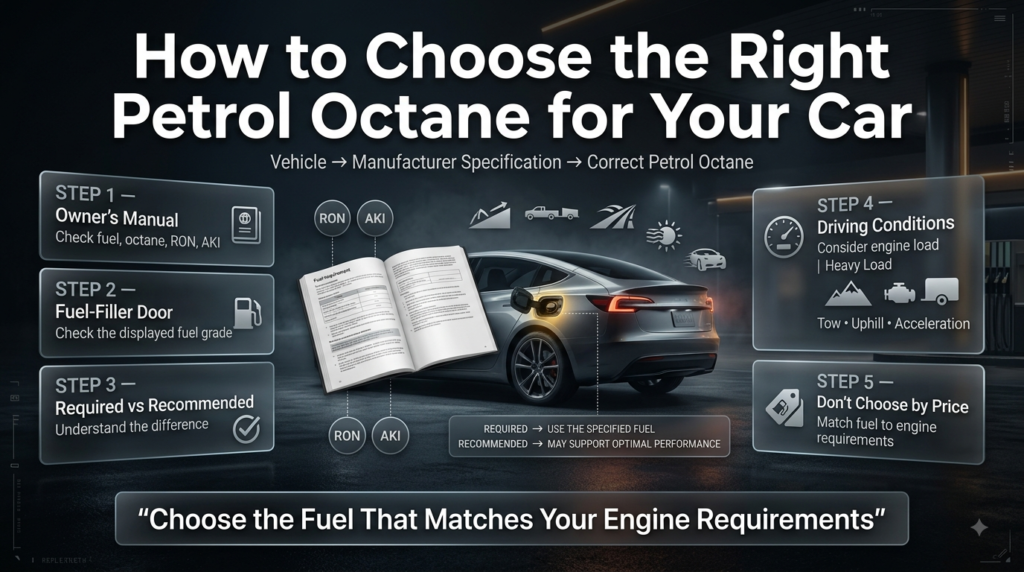
You don’t need to guess which petrol your engine needs. Your vehicle manufacturer normally provides the answer.
Step 1: Check the Owner’s Manual
Start with the owner’s manual.
Look for sections covering:
- Fuel
- Petrol
- Fuel requirements
- Octane
- RON
- AKI
- Minimum fuel grade
The manufacturer may specify a minimum octane rating or recommend a particular grade.
Step 2: Check the Fuel-Filler Door
Many modern vehicles display the required or recommended fuel grade around the fuel-filler opening.
This is particularly useful if you don’t have the owner’s manual available.
Step 3: Understand “Required” vs “Recommended”
These terms can have different meanings.
If premium fuel is required, you should use premium.
If premium fuel is recommended, the manufacturer may be indicating that higher octane can help the engine deliver optimal performance under certain conditions.
Don’t automatically treat these two words as identical.
Step 4: Consider Your Driving Conditions
Some engines operate under greater load during:
- Long uphill climbs
- Heavy towing
- Aggressive acceleration
- High-speed driving
- Hot weather
- High-load operation
If your manufacturer provides specific fuel guidance for these situations, follow it.
Step 5: Don’t Choose Based on Price Alone
The cheapest fuel isn’t necessarily the right fuel.
At the same time, the most expensive petrol isn’t automatically the best option.
The correct fuel is the one that matches your vehicle’s engine requirements.
Regular vs Premium Petrol: Which Is Better for Your Car?
There isn’t one universal winner.
The better fuel is the one that matches the engine’s design.
Choose Regular Petrol When:
- Your owner’s manual specifies regular.
- Your vehicle’s minimum octane requirement is met.
- Your engine was designed around regular petrol.
- Premium isn’t required.
- You want to minimize fuel costs while following the manufacturer’s specification.
Choose Premium Petrol When:
- Your vehicle requires premium.
- Premium is recommended for optimal performance.
- Your engine is specifically calibrated for higher octane.
- Your high-compression engine requires higher knock resistance.
- Your turbocharged engine specifies premium.
- You want the performance characteristics associated with the manufacturer’s premium-fuel recommendation.
What If Your Car Allows Both?
Some vehicles are designed to operate on multiple fuel grades.
In that situation, regular may be the economical everyday option, while premium may provide additional performance under conditions where the manufacturer says it can.
The owner’s manual should determine how you use those grades.
Common Mistakes When Choosing Petrol Octane
1. Assuming Premium Means More Powerful
Premium petrol doesn’t automatically increase horsepower.
Its higher octane rating simply gives the engine greater resistance to knock.
The engine must be capable of taking advantage of that property.
2. Always Choosing the Highest Octane
More isn’t automatically better.
If your engine is designed for regular petrol, buying premium every time may simply increase your fuel bill.
3. Ignoring the Manufacturer’s Requirement
This is the more serious mistake.
If your engine requires higher-octane fuel, regularly using a lower grade can cause the engine to adjust its operation and may reduce performance.
Under demanding conditions, insufficient octane can increase the risk of knock.
4. Confusing RON and AKI
A number without its measurement system can be misleading.
Always check whether the specification is RON or AKI.
5. Assuming All Premium Fuel Is Identical
Different fuel suppliers can use different formulations and additive packages.
Octane is only one aspect of petrol quality.
6. Expecting Guaranteed Fuel-Economy Savings
Premium fuel may improve efficiency in some engines, but there is no universal guarantee.
Your actual fuel consumption and fuel cost are what matter.
Does Premium Petrol Last Longer?
Premium petrol doesn’t automatically last longer simply because it has a higher octane rating.
Fuel storage life depends on several factors, including:
- Storage temperature
- Container quality
- Moisture exposure
- Contamination
- Fuel formulation
- Storage duration
Octane rating and storage life are different characteristics.
If petrol needs to be stored, use appropriate approved containers and follow applicable safety requirements.
Can You Mix Regular and Premium Petrol?
Regular and premium petrol can generally mix inside a petrol vehicle because both are petrol grades.
When mixed, the resulting fuel has an octane characteristic influenced by the amount and rating of each fuel.
However, if your vehicle requires premium petrol, adding regular fuel lowers the overall octane level.
If you accidentally mix different grades, follow your vehicle manufacturer’s instructions.
Don’t assume that adding a small amount of premium immediately restores the tank to a particular octane rating.
Does Driving Style Affect the Value of Premium Fuel?
Yes, driving conditions can affect how much an engine is exposed to knock-prone conditions.
Heavy acceleration, steep climbs, towing, high boost, and high engine loads can increase combustion pressure and temperature.
However, this doesn’t mean every driver should automatically switch to premium.
The manufacturer’s fuel requirement remains the starting point.
If your vehicle permits multiple grades, your driving conditions may influence whether the additional knock resistance is useful.
Can Premium Petrol Help a Performance Car?
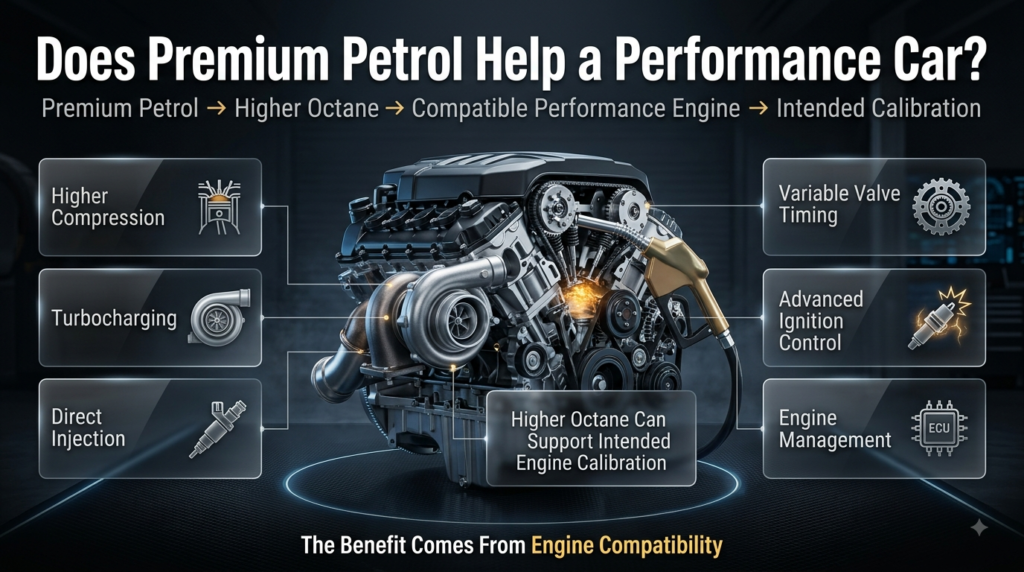
Yes, when the engine is designed for it.
Performance-oriented engines may use:
- Higher compression ratios
- Turbocharging
- Direct injection
- Variable valve timing
- Advanced ignition control
- Sophisticated engine management
These technologies can allow an engine to take advantage of higher-octane fuel.
Premium petrol can therefore help a compatible engine operate closer to its intended calibration.
But again, the benefit comes from engine compatibility, not from premium petrol being universally stronger.
Regular vs Premium Petrol Cost: What Should You Calculate?
Don’t compare only the price shown at the pump.
Compare fuel cost per kilometre.
Use this simple formula:
Fuel cost per kilometre = Fuel price per litre ÷ Kilometres per litre
For example, suppose:
- Regular petrol = 12 km/L
- Premium petrol = 12.2 km/L
If premium costs significantly more, that small efficiency improvement may not offset the higher price.
The most accurate way to decide is to track your own fuel consumption over several tanks under reasonably similar driving conditions.
When Should You Pay More for Premium Petrol?
Paying more for premium makes sense when the higher octane provides a real benefit to your engine.
Premium is particularly worth considering when:
- Your vehicle requires it.
- Your manufacturer recommends it for optimal performance.
- Your engine is specifically calibrated for higher octane.
- Your vehicle’s performance depends on higher-octane fuel.
- You want to maintain the performance specified by the manufacturer.
For an ordinary vehicle designed for regular petrol, paying extra for premium every time may not provide enough benefit to justify the additional cost.
A Simple Petrol Octane Decision Guide
Use this quick decision process before filling your tank.
Does your owner’s manual require premium?
→ Yes: Use premium.
Does it recommend premium but allow regular?
→ Follow the manufacturer’s guidance and decide whether the performance benefit is worth the additional cost.
Does it specify regular petrol?
→ Regular is normally the sensible choice.
Are you unsure about the octane number?
→ Confirm whether the specification uses RON or AKI.
Did you accidentally use a lower grade?
→ Check your vehicle’s instructions and return to the recommended fuel grade.
Want more power from an ordinary engine?
→ Don’t assume premium petrol will automatically create more horsepower.
Expert Advice for Choosing Petrol Octane
A practical approach is to stop thinking of regular and premium as “cheap versus high quality.”
Instead, think of them as different octane grades designed to meet different engine requirements.
Before filling your vehicle:
- Check the manufacturer’s minimum octane requirement.
- Confirm whether the number is RON or AKI.
- Use premium when the engine requires it.
- Don’t pay extra for premium without a reason.
- Consider your actual fuel cost per kilometre.
- If you’re unsure, follow the vehicle manufacturer’s documentation rather than pump marketing.
This approach keeps the decision simple and prevents unnecessary fuel expenses.
Regular vs Premium Petrol: Quick Comparison
| Question | Regular Petrol | Premium Petrol |
|---|---|---|
| Does it have lower octane? | Yes | No |
| Does it resist knock less? | Generally yes | Generally no |
| Is it cheaper? | Usually | Usually not |
| Does it automatically make less power? | No | No |
| Is it suitable for every engine? | No | No |
| Is it required by some vehicles? | Yes | Yes |
| Can it improve performance? | When specified | When compatible |
| Is it always the better choice? | No | No |
| Should you follow the owner’s manual? | Yes | Yes |
The most important lesson is that the correct octane depends on the engine.
Is Premium Petrol Really Better Than Regular Petrol?
Premium petrol isn’t automatically “better” than regular petrol. Its main advantage is a higher octane rating, which means it can resist engine knock under higher pressure and temperature. Whether that advantage matters depends on how the engine was designed.
If your car is designed to run on regular petrol, switching to premium usually won’t transform the vehicle’s performance. AAA testing found no significant improvement in horsepower, fuel economy, or emissions for vehicles designed to operate on regular fuel.
Premium becomes much more important when the manufacturer requires or specifically recommends it. High-compression and turbocharged engines can create conditions where greater knock resistance is useful.
Key points to remember:
Premium means higher octane, not automatically higher overall fuel quality.
Higher octane helps prevent engine knock.
A regular-fuel engine may not be able to take advantage of premium.
A premium-required engine should be given the specified fuel.
Always check the manufacturer’s recommended octane before choosing a fuel grade.
The simplest way to think about it is: premium petrol is a specialized fuel requirement for some engines, not a universal upgrade for every car.
Does Premium Petrol Give Better Mileage or Save Fuel?
Premium petrol can sometimes improve fuel economy, but you shouldn’t assume that it will automatically save money.
The reason is that higher-octane fuel can allow certain engines to operate closer to their intended calibration. In vehicles specifically designed to benefit from premium, this can sometimes produce a modest improvement in efficiency, particularly under demanding driving conditions.
However, the extra fuel economy may not be large enough to compensate for the higher price of premium petrol. AAA’s testing found that vehicles designed for regular fuel showed no meaningful fuel-economy benefit from switching to premium, while vehicles that recommended but didn’t require premium showed more noticeable benefits under extreme conditions such as towing, hauling, and rapid acceleration than during ordinary driving.
A better way to judge the difference is to calculate your actual running cost:
Fuel cost per kilometre = Fuel price per litre ÷ Kilometres per litre
For example, if premium costs substantially more but only gives you a very small improvement in fuel economy, your overall cost per kilometre may still be higher.
Before paying extra for premium, consider:
Your vehicle’s minimum octane requirement
Your actual fuel consumption
The price difference between fuel grades
Whether you mostly drive in traffic or on highways
Whether you regularly tow or carry heavy loads
Whether the manufacturer recommends premium for your engine
So, premium can improve efficiency in the right engine, but “higher octane = better mileage” is not a rule.
What Happens If You Use Regular Petrol in a Car That Requires Premium?
If your vehicle requires premium petrol, regular fuel should not become your normal choice. The reason is simple: the engine was designed to operate with a particular level of knock resistance.
When lower-octane fuel is used, modern engines can often detect knock through sensors and adjust ignition timing or other operating parameters. This can help protect the engine, but it may come at the expense of performance and efficiency.
You may notice symptoms such as:
Slower or less responsive acceleration
Reduced engine performance
Lower fuel economy
Increased engine noise under heavy load
Reduced boost or power in some turbocharged engines
The severity depends on the specific engine and how it is calibrated.
An accidental tank of the wrong grade isn’t necessarily a reason to panic, but you shouldn’t turn an accidental situation into a regular habit. If your vehicle manufacturer specifies premium, return to the recommended octane as soon as practical and follow the instructions in the owner’s manual.
The important distinction is:
Premium required: Use premium as specified.
Premium recommended: The engine may benefit from premium, particularly under demanding conditions.
Regular specified: There is normally no reason to pay extra for premium.
Modern engines have sophisticated controls, but those systems shouldn’t be viewed as permission to ignore the manufacturer’s fuel requirement. Higher octane exists primarily because some engines operate under conditions where greater resistance to knock is needed.
Do Turbocharged Cars Really Need Premium Petrol?
Not every turbocharged car needs premium petrol, but turbocharged engines are more likely to benefit from or require higher-octane fuel because turbocharging can increase cylinder pressure.
A turbocharger forces more air into the engine. This allows the engine to burn more fuel and produce more power from a relatively small displacement. The downside is that higher cylinder pressure can increase the tendency toward knock if the fuel doesn’t provide enough resistance.
That’s why many modern turbocharged and high-performance engines have higher-octane requirements. The U.S. Energy Information Administration notes that turbocharged engines generally require additional design and operating measures to control knock, while higher octane can offset the increased knock risk associated with higher compression and cylinder pressure.
But there’s an important catch: turbocharged doesn’t automatically mean premium-only.
Manufacturers can design turbo engines to operate on regular petrol, premium petrol, or different grades depending on the engine calibration.
Before choosing fuel for a turbo car, check:
The owner’s manual.
The fuel-filler-door label.
The manufacturer’s minimum octane requirement.
Whether premium is required or merely recommended.
Whether the stated rating is RON or AKI.
Professional rule of thumb: Don’t determine fuel grade from the turbocharger alone. Determine it from the manufacturer’s specification for that exact engine.
Does Higher Octane Mean Better-Quality or Cleaner Petrol?
This is one of the biggest misconceptions about premium petrol.
Higher octane does not automatically mean cleaner petrol.
Octane and fuel cleanliness are different characteristics. Octane measures the fuel’s resistance to knock, while detergent and deposit-control additives are related to how a fuel can help control deposits in the fuel system and engine.
That means a fuel with a higher octane rating isn’t automatically a superior fuel in every respect.
For example, you shouldn’t assume:
Higher octane = more cleaning power = better engine
That’s an oversimplification.
A fuel’s overall characteristics can depend on its formulation, additive package, stability, volatility, and other specifications. Even regular-grade petrol can contain effective detergent additives.
This distinction is particularly useful when fuel companies use words such as premium, power, performance, super, or high-octane in marketing. The name alone doesn’t tell you everything about the fuel.
When comparing petrol, look at:
Actual octane rating
Whether the fuel meets the required specification
Detergent/additive characteristics
Manufacturer recommendations
Fuel quality and supplier reputation
Your vehicle’s specific requirements
The most important thing is still the octane requirement of your engine. If your car requires higher octane, use it. If your car is designed for regular petrol, don’t assume that paying more for premium automatically gives you a cleaner engine or better performance.
Quick Expert Takeaway
If you want to make the right fuel decision without wasting money, use this simple rule:
Check the manufacturer’s required octane first → understand whether the rating is RON or AKI → use premium when required → consider premium when recommended → don’t buy higher octane simply because the number is bigger.
That approach is much more reliable than judging petrol by price, marketing, or the word “premium.”
Conclusion
The choice between regular vs premium petrol octane isn’t really about which fuel is more expensive or which one has the bigger number on the pump. It’s about choosing the octane level that matches your engine’s design and the manufacturer’s requirements.
Premium petrol offers greater resistance to engine knock, making it especially important for certain high-compression, turbocharged, and performance-oriented engines. However, if your vehicle is designed to run properly on regular petrol, paying extra for premium doesn’t automatically mean more power, better mileage, or a cleaner engine.
Before making your choice, always check the owner’s manual, fuel-filler label, and manufacturer’s recommended octane rating. Also make sure you understand whether the rating is given in RON or AKI, especially if you’re dealing with an imported vehicle.
The key takeaway is simple: don’t choose petrol based on the highest octane number—choose it based on what your engine actually needs.
Using the correct fuel can help your engine maintain its intended performance, efficiency, and knock protection while avoiding unnecessary fuel costs.
For more useful information about petrol, diesel, and other automotive fuels, explore FuelDeliveryDubai and our detailed guide to petrol and diesel fuel types.
Leave a Reply