Introduction
Steps After Running Out of Petrol | Running out of petrol can happen when you least expect it. You may be stuck in heavy traffic, driving farther than planned, dealing with an unexpected detour, or simply misjudge how much fuel is left in the tank. One moment everything is normal, and the next, the engine starts losing power.
The important thing is not to panic.
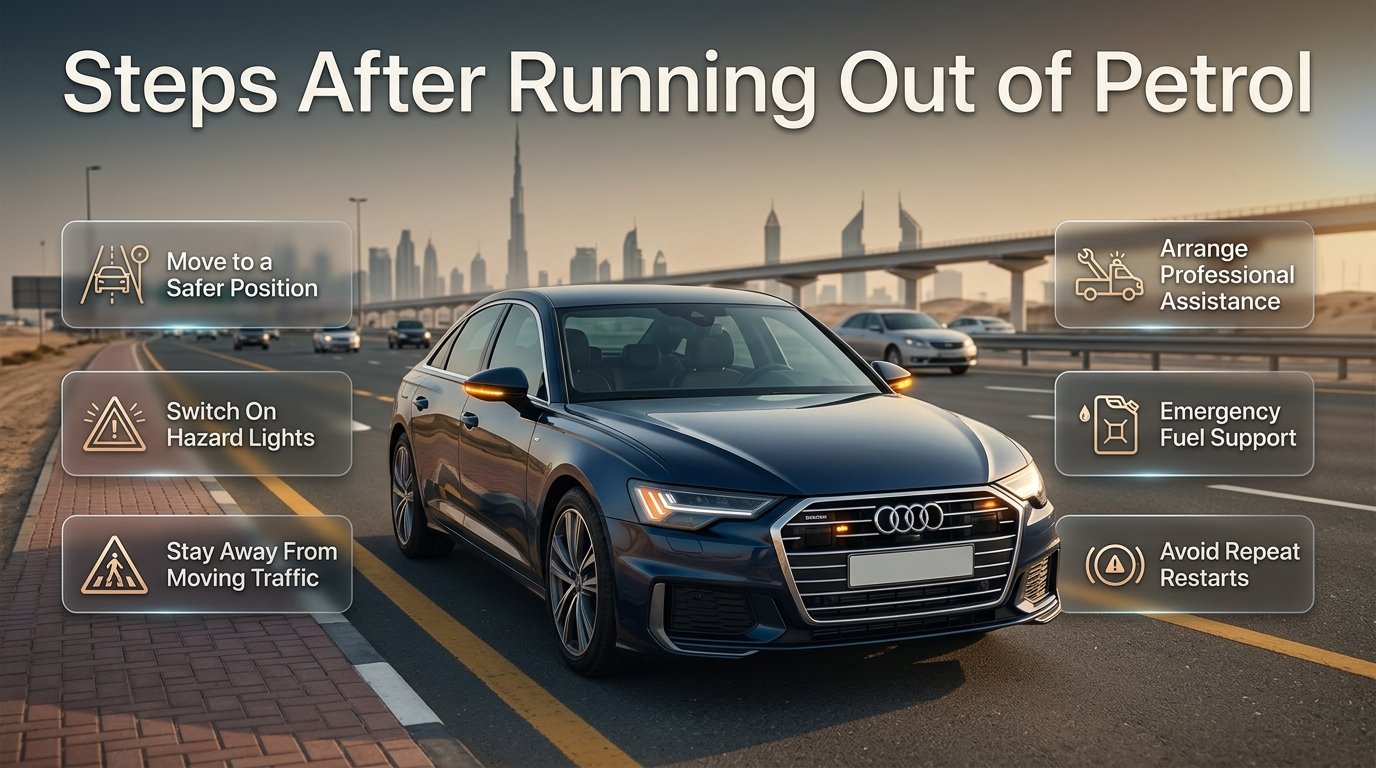
If your car runs out of petrol in Dubai, your first priority should be roadside safety, not immediately finding a petrol station. Move the vehicle to a safer position if you can do so safely, switch on the hazard lights, keep away from moving traffic, and arrange professional assistance.
For drivers who need emergency fuel support, Fuel Delivery Dubai can be a useful resource when a vehicle cannot reach a petrol station under its own power.
This guide explains the steps after running out of petrol, including what to do on highways, how to stay safe in Dubai’s heat, how to arrange emergency fuel, what mistakes to avoid, and what to do if the car still won’t start after refuelling.
What Are the First Steps After Running Out of Petrol?
The first steps after running out of petrol are to stay calm, safely move the vehicle away from active traffic if possible, turn on the hazard lights, apply the parking brake, and assess your surroundings. Once you’re in the safest practical position, contact roadside assistance or emergency fuel delivery and provide your exact location.
Don’t immediately get out and walk toward the nearest petrol station.
That might be reasonable in a quiet parking area, but it can be dangerous on a busy Dubai road or highway.
Your response should depend on where the vehicle stopped.
A Simple Emergency Sequence
Use this basic sequence:
Engine loses power → Move safely → Hazard lights → Stop → Assess danger → Contact assistance → Share location → Wait safely → Add correct fuel → Restart carefully
The order matters.
A full fuel tank won’t help if you put yourself in danger trying to get it.
What Should You Do Immediately When the Engine Stops?
When the engine begins to lose power because the vehicle has run out of petrol, remain calm and keep control of the steering.
You may notice the car:
- Hesitating
- Sputtering
- Losing acceleration
- Responding poorly to the accelerator
- Gradually slowing down
- Eventually stopping
If you’re still moving, use the remaining momentum to reach the safest available location.
Don’t make sudden steering movements simply because you’re worried about the engine stopping.
Your goal is to leave the active traffic lane if you can do so safely.
Once the vehicle is stopped, apply the parking brake and assess the road around you.
Why Moving Early Matters
A vehicle that has already stopped completely may be difficult to move without assistance.
If you recognize that the engine is losing power, you may have only a short amount of momentum remaining.
That is why experienced drivers don’t wait until the vehicle comes to a complete stop in the middle of a lane before thinking about safety.
If there is a safe shoulder, emergency stopping area, parking area, or side road available, moving toward it early can make the situation much safer.
What If the Car Stops in the Middle of Traffic?
Running out of petrol in traffic is one of the most stressful situations a driver can face.
If your vehicle stops in an active lane, turn on the hazard lights immediately.
If you can safely move the vehicle out of the traffic lane, do so.
However, don’t take a dangerous risk just to move a few metres.
A driver trying to push or steer a disabled car through moving traffic may be exposed to vehicles approaching from behind.
If the vehicle cannot be moved safely, make it as visible as possible and contact appropriate roadside assistance or road authorities.
Avoid standing in front of or behind the vehicle.
What Passengers Should Do
Passengers should also remain calm.
Keep children and other passengers away from moving traffic.
If the vehicle is in a safe position, remaining inside while waiting for assistance may be appropriate.
If the vehicle is in an immediately dangerous location, follow local emergency or roadside safety instructions and move to the safest available place.
The correct decision depends on the exact road environment.
What Should You Do If You Run Out of Petrol on a Dubai Highway?

A highway requires extra caution because vehicles may be travelling at high speed and approaching drivers may have limited time to react.
If you notice that you’re running out of fuel while driving on a highway, don’t wait until the engine completely stops if you can safely move toward the shoulder or another designated stopping location.
Once stopped:
- Turn on the hazard lights.
- Apply the parking brake.
- Keep the vehicle as far from moving traffic as safely possible.
- Avoid unnecessary roadside activity.
- Contact professional assistance.
- Give your exact location and direction of travel.
- Keep yourself and passengers away from active traffic.
- Wait for assistance in the safest available position.
If you need more detailed guidance about roadside situations, Emergency Roadside Fuel Advice can provide additional context.
Why Highway Situations Need More Care
A stationary car can be difficult for approaching drivers to judge.
Even if your hazard lights are flashing, another vehicle may approach quickly.
That’s why you shouldn’t stand beside the car taking photographs, checking the engine, or trying to perform unnecessary repairs.
Your vehicle isn’t the only thing that needs protection.
Your personal safety is more important than getting the car moving quickly.
Should You Turn on the Hazard Lights?
Yes, hazard lights can help make a stopped or disabled vehicle more visible to approaching traffic.
Use them when appropriate to the situation.
They are particularly useful when:
- Your vehicle has stopped unexpectedly
- You’re positioned near moving traffic
- Visibility is reduced
- It’s nighttime
- Other drivers may not immediately understand that your vehicle is disabled
Don’t assume that hazard lights make an unsafe position safe.
They improve visibility, but they don’t remove the danger of passing traffic.
📌 Quick Tip: If the vehicle has stopped in a dangerous position, focus on getting appropriate assistance rather than spending time trying to diagnose the car yourself.
Should You Keep Trying to Start the Car?
If you’re confident that the tank is empty, repeatedly trying to start the engine isn’t useful.
The starter may continue turning the engine, but without sufficient fuel, the engine cannot operate normally.
Repeated attempts can also put unnecessary demand on the battery.
Instead of repeatedly turning the ignition on and off, concentrate on arranging assistance.
If you’re not completely sure that the vehicle ran out of petrol, tell the roadside provider what happened.
For example:
“The fuel warning was on, the engine lost power, and now the vehicle won’t restart.”
That information helps distinguish a likely fuel problem from a possible mechanical or electrical fault.
How Can You Tell If the Car Actually Ran Out of Petrol?
An empty fuel tank is more likely when several signs happen together.
You may have:
- A nearly empty fuel gauge
- A low-fuel warning
- A very low estimated driving range
- Engine hesitation
- Loss of acceleration
- Sputtering before the engine stops
- No successful restart afterward
However, a no-start condition doesn’t always mean an empty fuel tank.
A vehicle can stop because of:
- Battery problems
- Fuel pump problems
- Electrical faults
- Engine problems
- Sensor faults
- Other mechanical issues
If your fuel gauge still shows a significant amount of fuel, don’t automatically assume you need more petrol.
Tell the assistance provider exactly what you experienced.
Why You Shouldn’t Walk to a Petrol Station
Walking to a petrol station might seem like an easy solution.
In Dubai, it may not be.
The nearest petrol station could be closer by road than by a safe pedestrian route.
You may have to deal with:
- Fast-moving traffic
- Wide roads
- Highway barriers
- Limited pedestrian access
- Extreme heat
- Long walking distances
- Lack of shade
- Unsafe road crossings
A route that looks short on a navigation app doesn’t necessarily mean it’s safe to walk.
This is especially important if your car is on a highway.
What Is the Safer Alternative?
If the vehicle is safely stopped, arrange fuel assistance that comes directly to your location.
This keeps you from unnecessarily exposing yourself to traffic and extreme weather.
⭐ Expert Tip: On a high-speed road, don’t measure the risk by how close the petrol station looks. Measure it by whether there’s a safe pedestrian route. If there isn’t, stay with a proper assistance plan.
How Does Dubai’s Heat Affect a Fuel Emergency?
Dubai’s hot climate adds another concern to a roadside fuel emergency.
A short wait can become uncomfortable quickly, particularly during the hottest part of the day.
Heat exposure becomes more important when:
- You are stranded for an extended period
- You have limited water
- Children are travelling with you
- Elderly passengers are present
- You are standing outside the vehicle
- The vehicle is in direct sunlight
Avoid unnecessary walking or physical effort.
Keep drinking water available when possible.
If you or a passenger develops serious symptoms such as confusion, fainting, severe weakness, or other signs of heat illness, seek emergency medical assistance.
The fuel problem can wait.
A serious health emergency should not.
What Should You Do If You Run Out of Petrol in a Parking Area?
A parking area is usually easier to manage than a highway, but you still need to avoid creating an obstruction.
If your car runs out of petrol in a mall, residential parking area, office parking facility, or petrol station access road, first make sure the vehicle isn’t blocking important routes.
If possible:
- Move into a normal parking space
- Avoid blocking entrances
- Avoid fire access areas
- Avoid blocking other vehicles
- Turn on hazard lights if the vehicle is creating an obstruction
- Contact fuel assistance
- Provide the parking level or section
When contacting a provider, don’t just give the building name.
Give useful details such as:
Mall name + parking level + section + nearest entrance
That can save time when the assistance vehicle arrives.
How Should You Contact Emergency Fuel Assistance?

Once you’re safe, contact a reliable fuel delivery or roadside assistance provider.
Explain the problem clearly.
A useful message would include:
- Your exact location
- Direction of travel if on a road
- Vehicle make and model
- Petrol requirement
- Nearby landmark
- Whether you’re safely parked
- Whether the vehicle is blocking traffic
For example:
“My car ran out of petrol. I’m safely stopped near [landmark], travelling toward [direction]. It’s a [vehicle make/model]. I need petrol assistance.”
This is much more useful than simply saying, “I need fuel.”
Why Your Exact Location Matters
Dubai has many major roads, exits, service roads, parking areas, and parallel routes.
A road name alone may not identify your position accurately.
If possible, share:
- GPS location
- Nearest exit
- Road direction
- Building
- Landmark
- Parking level
- Street name
If you’re on a highway, direction of travel is particularly important.
What Type of Petrol Should You Request?
Before fuel is delivered, confirm the fuel type required by your vehicle.
Petrol vehicles may have different octane requirements, and diesel vehicles require a completely different fuel.
Check:
- Fuel-filler flap label
- Owner’s manual
- Vehicle documentation
- Manufacturer recommendations
If you’re uncertain, don’t guess.
The wrong fuel can create a bigger problem than an empty tank.
What Happens If You Put the Wrong Fuel in the Car?
If the wrong fuel has been added, don’t start the engine unless a qualified professional has specifically confirmed that it is safe to do so.
Starting the engine can circulate the incorrect fuel through the vehicle’s fuel system.
The appropriate response may involve:
- Fuel draining
- Fuel-system inspection
- Vehicle recovery
- Professional diagnosis
The exact solution depends on the vehicle and circumstances.
Always tell the assistance provider exactly what happened.
How Much Fuel Should You Add?
The right amount depends on your situation.
You don’t necessarily need a complete tank just to restart the vehicle.
For example, if you’re stranded a short distance from a petrol station, enough fuel to safely reach that station may be practical.
However, don’t cut things unnecessarily close.
Traffic can change.
The vehicle may consume more fuel than expected.
A longer journey requires a more sensible reserve.
The important point is that fuel should be added in a sufficient amount for your circumstances.
Will the Car Start Immediately After Fuel Is Added?
It may, but you shouldn’t assume it will always start on the first attempt.
After the tank has completely emptied, the fuel system may need to restore normal fuel delivery.
Some vehicles may also have specific procedures recommended by the manufacturer.
Follow the owner’s manual where possible.
If the vehicle doesn’t start:
- Don’t repeatedly crank it for long periods.
- Don’t start changing components yourself.
- Tell the technician the vehicle ran completely out of fuel.
- Allow the professional to assess the situation.
A no-start condition after refuelling can sometimes indicate another issue.
What If the Car Still Won’t Start After Adding Petrol?
This is an important situation.
If the vehicle has received the correct petrol and still won’t start, don’t automatically request more fuel.
Possible reasons include:
- Weak battery
- Fuel-system problem
- Fuel pump issue
- Electrical fault
- Engine fault
- Incorrect fuel
- Another mechanical problem
Listen to what happens when you attempt to start the car.
If the engine doesn’t crank normally, the battery may be involved.
If it cranks but doesn’t start, the issue may be elsewhere.
Either way, professional diagnosis is preferable to repeated experimentation.
Can Running Out of Petrol Damage the Vehicle?
Running out of petrol once doesn’t automatically mean your vehicle has suffered serious permanent damage.
However, repeatedly driving until the tank is completely empty isn’t a good habit.
The fuel system is designed to operate with an adequate fuel supply, and keeping the tank extremely low for extended periods isn’t ideal.
More importantly, an empty tank creates a roadside safety problem.
A car that runs out of fuel in a quiet parking area is inconvenient.
A car that runs out of fuel in a high-speed traffic lane can be dangerous.
What If You’re Driving With Children?
Children need extra supervision during a fuel emergency.
If the vehicle is safely stopped, keep children inside or in the safest available location according to the situation.
Don’t let them walk along the roadside.
Don’t allow them to stand behind the car.
In hot weather, pay attention to water and heat exposure.
If you need to exit the vehicle because the location is unsafe, keep everyone together and follow appropriate roadside or emergency instructions.
What If You’re Alone?
If you’re alone, your phone becomes one of your most important emergency tools.
Make sure the assistance provider can contact you.
Share your location.
Keep your phone available.
Avoid walking away from the vehicle without a clear reason.
If you’re on a highway, don’t assume that walking to the nearest station is safe simply because you can see signs for it.
Arrange appropriate assistance whenever possible.
What Should You Do While Waiting for Help?
After contacting assistance, your job is mainly to stay safe and remain reachable.
Use this checklist:
- Keep the vehicle in the safest practical position.
- Keep hazard lights on where appropriate.
- Stay away from moving traffic.
- Keep your phone available.
- Keep passengers together.
- Have water available.
- Confirm the correct fuel type.
- Keep your location details ready.
- Follow instructions from the assistance provider.
- Avoid unnecessary roadside repairs.
Don’t make the situation more complicated while waiting.
What Are the Biggest Mistakes Drivers Make?
1. Waiting Until the Car Completely Stops in a Lane
If you already know you’re critically low on fuel, don’t ignore the warning signs.
When the engine begins losing power, use the remaining momentum to reach a safer location if possible.
2. Repeatedly Cranking the Engine
If the tank is empty, repeated starting attempts won’t create fuel.
They may also reduce battery charge.
3. Walking Along a Highway
This exposes you to traffic and potentially extreme heat.
Arrange assistance instead.
4. Guessing the Fuel Type
Never assume.
Check the vehicle’s specification.
5. Standing Behind the Car
Approaching drivers may not see you in time.
Keep yourself away from moving traffic.
6. Trying DIY Repairs
An empty tank doesn’t justify removing fuel-system components beside a busy road.
Get professional assistance.
7. Ignoring Heat
Dubai’s weather can make a roadside emergency much more serious.
Keep water available and minimize unnecessary exposure.
8. Giving an Incomplete Location
“Near Dubai Mall” or “on Sheikh Zayed Road” may not be enough.
Provide more precise information.
9. Assuming the Range Display Is Exact
A dashboard estimate is not a guarantee.
Traffic and driving conditions can change your actual fuel consumption.
10. Driving on Empty as a Habit
Don’t make maximum range your goal.
Keeping a sensible fuel reserve is safer.
What Should You Keep in Your Car?
You don’t need to turn your car into an emergency warehouse.
A few practical items can make a difference:
- Charged mobile phone
- Phone charging cable
- Drinking water
- Vehicle documents
- Emergency contact details
- Basic first-aid supplies
- Appropriate reflective safety equipment
- Owner’s manual
It’s also useful to know:
- Your vehicle’s fuel type
- Recommended fuel specification
- Roadside assistance contact
- How to share your location
- Basic vehicle information
Preparation is much easier before an emergency happens.
How Can You Prevent Running Out of Petrol?

The simplest prevention strategy is to refuel before the tank reaches a critically low level.
Don’t wait until you’re almost empty if you know you’re about to enter:
- Heavy traffic
- A long highway journey
- An unfamiliar area
- A route with limited refuelling opportunities
- A period of extreme heat
Check Fuel Before Long Trips
Before leaving, look at:
Fuel level → Route → Traffic → Distance → Refuelling opportunities
If the trip is long, identify suitable places to refuel before leaving.
This is especially useful when driving outside your normal routine.
Why Traffic Makes Low Fuel More Risky
A dashboard range estimate is based on fuel consumption assumptions.
Heavy traffic can change those assumptions.
Stop-and-go driving requires frequent acceleration and deceleration.
Long delays can also keep you on the road much longer than expected.
If you begin a journey with a very low fuel level and then encounter unexpected congestion, your remaining range may disappear faster than expected.
That’s why experienced drivers don’t treat the last few kilometres of estimated range as guaranteed.
Should You Drive Until the Fuel Warning Light Appears?
It’s better not to make the warning light your regular refuelling target.
The warning indicates that fuel is getting low.
It isn’t an instruction to continue until the tank is empty.
The exact amount remaining varies between vehicles.
Your vehicle might have enough fuel for some distance after the warning appears, but the actual distance depends on fuel consumption and driving conditions.
Use the warning as a reminder to refuel.
Can Air Conditioning Affect the Situation?
Air conditioning increases energy demand, although the exact effect varies according to the vehicle and operating conditions.
In Dubai, using AC is often necessary because of the heat.
Don’t put yourself at risk by refusing to use cooling simply to save a small amount of fuel.
Instead, plan fuel stops sensibly.
When the vehicle has already run out of petrol, the priority is no longer fuel economy.
It’s safety and assistance.
What If You Run Out of Petrol at Night?
Nighttime creates a visibility challenge.
Approaching drivers may have less time to notice a stationary vehicle.
Use appropriate vehicle lights and hazard warnings.
Avoid standing in dark areas near traffic.
Don’t walk along a road simply because it appears quiet.
A road that feels quiet can still have vehicles travelling at high speed.
Arrange assistance and remain in the safest available position.
What If You Run Out of Petrol in a Busy Area?
In a crowded urban location, the main concern may be obstruction rather than highway speed.
If possible, move into a safe parking area or side location.
Don’t block:
- Intersections
- Driveways
- Emergency access
- Building entrances
- Active traffic lanes
Once safely positioned, contact fuel assistance and provide a recognizable landmark.
How Can You Prepare for a Long Dubai Drive?
Before a long journey, spend a few minutes checking the basics.
Fuel
Start with an appropriate fuel level.
Route
Know your route and potential refuelling points.
Traffic
Consider whether congestion could significantly extend the trip.
Phone
Charge your phone before leaving.
Water
Keep drinking water in the car.
Vehicle
Check basic vehicle condition before departure.
Assistance
Know who you can contact if the vehicle becomes disabled.
This preparation is simple, but it can prevent a small problem from becoming a major disruption.
What Should You Do After the Immediate Emergency Is Over?
Once the vehicle has been refuelled and you’re safely back on the road, don’t simply forget about the incident.
Ask why you ran out.
Did you:
- Misjudge the remaining range?
- Ignore the fuel warning?
- Get stuck in unexpected traffic?
- Take an unplanned detour?
- Forget to refuel before a long trip?
Understanding the reason can help prevent the same situation next time.
If the vehicle behaves abnormally after refuelling, such as continuing to lose power or refusing to start properly, arrange a professional inspection.
For additional safety information, see Car Ran Out of Fuel Safety in Dubai.
When Should You Choose Fuel Delivery Instead of Towing?
Fuel delivery makes sense when the main problem is simply an empty tank and the vehicle is otherwise functioning normally.
Towing or recovery may be more appropriate when:
- The car doesn’t start after refuelling.
- There’s a suspected mechanical failure.
- The wrong fuel was added.
- The vehicle is damaged.
- The vehicle is in an unsafe location.
- The car needs workshop diagnosis.
Don’t keep requesting fuel if the evidence suggests the problem is something else.
How Does an Empty Tank Differ From a Mechanical Breakdown?
The symptoms can overlap.
An empty tank often follows a low-fuel warning and gradual loss of power.
A mechanical fault can happen with plenty of fuel remaining.
That’s why context matters.
Think about what happened immediately before the engine stopped.
If the gauge was nearly empty and the car gradually lost power, fuel is a likely explanation.
If the gauge showed plenty of fuel and the vehicle suddenly stopped, professional diagnosis may be more appropriate.
What Should You Know About Fuel Range?
Your dashboard’s estimated range is useful for planning.
But it isn’t a promise.
The calculation can change based on:
- Speed
- Acceleration
- Traffic
- Air conditioning
- Vehicle weight
- Road conditions
- Driving style
- Recent fuel consumption
If your dashboard says you have 30 km left, don’t plan a route that requires exactly 30 km.
Give yourself a margin.
What Is the Safest Way to Deal With an Empty Tank?
The safest approach is to reduce your exposure to traffic, heat, and unnecessary roadside activity.
If you’re already stranded, focus on:
1. Safe positioning
Get away from moving traffic where possible.
2. Visibility
Use hazard lights appropriately.
3. Communication
Contact assistance and share your exact location.
4. Correct fuel
Confirm what your vehicle requires.
5. Professional support
Don’t attempt risky repairs or highway walking.
For a more detailed guide to the problem itself, Safely Dealing With an Empty Fuel Tank in Dubai is another useful resource.
What should you do first after running out of petrol?
When your car runs out of petrol, the first priority is getting yourself and the vehicle into the safest possible position. If the engine is losing power but the car is still moving, use the remaining momentum to move away from active traffic where it is safe to do so. Once stopped, switch on the hazard lights, apply the parking brake, and avoid repeatedly trying to restart the engine.
The next step is to assess your location. A car stopped in a quiet parking area is a very different situation from a vehicle stranded on a busy Dubai highway. Once you’re safe, contact roadside assistance or an emergency fuel delivery service and provide your exact location.
Important points:
Move away from moving traffic if it can be done safely.
Turn on hazard lights to make the vehicle more visible.
Don’t repeatedly crank an empty fuel tank.
Keep passengers away from active traffic.
Share your exact location with the assistance provider.
Don’t walk along a highway simply to find a petrol station.
The key is to solve the safety problem first and the fuel problem second. Trying to get petrol quickly isn’t useful if the way you attempt it puts you in danger.
Is it safe to walk to a petrol station after your car runs out of petrol?
Walking to a petrol station can be an option in a quiet, pedestrian-friendly area, but it isn’t automatically safe. On a Dubai highway, major road, or location without proper pedestrian access, walking beside the road can expose you to fast-moving traffic, extreme heat, and unsafe crossings. In that situation, arranging fuel delivery or roadside assistance directly to the vehicle is usually the more sensible approach.
The distance shown on a navigation app can also be misleading. A petrol station may look close geographically while having no safe walking route from where your vehicle has stopped.
Before considering walking, ask yourself:
Is there a proper pedestrian path?
Is the route completely away from high-speed traffic?
Is the weather safe for walking?
Is the petrol station genuinely accessible on foot?
Do you have enough water?
Are you responsible for children or other passengers?
If the answer to these questions isn’t reassuring, don’t take the risk.
For highway situations, remember:
Don’t walk along an active highway.
Don’t cross multiple lanes to reach a station.
Don’t carry fuel beside moving traffic unless the route is genuinely safe and permitted.
Don’t leave vulnerable passengers alone in an unsafe location.
Contact professional roadside assistance instead.
A few extra minutes waiting for assistance is far better than turning a simple empty-tank problem into a roadside accident or heat-related emergency.
Can you restart a car immediately after adding petrol?
A petrol vehicle may restart after the correct fuel has been added, but you shouldn’t assume it will always start instantly. When the tank has been completely emptied, the fuel system needs to restore fuel delivery before the engine can run normally. The exact starting procedure can vary between vehicles, so the manufacturer’s instructions should take priority.
If the engine doesn’t start on the first attempt, avoid continuously holding the starter. Repeated long attempts can unnecessarily drain or overheat the starter system and may leave you with a second problem—a weak or flat battery.
Instead, give the vehicle a short, sensible starting attempt according to the manufacturer’s procedure. If it still doesn’t start, contact roadside assistance and explain that the vehicle had completely run out of petrol before fuel was added.
After adding petrol:
Confirm that the correct fuel was supplied.
Follow the vehicle’s recommended starting procedure.
Avoid repeated, prolonged cranking.
Check whether the engine is actually turning over normally.
If it still won’t start, request professional assistance.
Don’t assume that adding more fuel will solve every no-start problem.
If the vehicle had fuel remaining before it stopped, or if it still refuses to start after receiving the correct petrol, there may be another issue such as a battery, fuel-system, electrical, or mechanical fault.
That’s why a professional assessment is preferable to repeatedly experimenting at the roadside.
What should you do if your car runs out of petrol on a highway in Dubai?
Running out of petrol on a highway is more serious than running out in a quiet parking area because approaching vehicles may be travelling at high speeds. If the engine starts losing power, concentrate on maintaining control and moving toward the safest available stopping position without making sudden or dangerous movements.
Once the vehicle is stopped, switch on the hazard lights and make the vehicle as visible as possible. Avoid standing directly beside the vehicle or behind it where approaching traffic could put you at risk. Contact appropriate roadside assistance and provide your road name, direction of travel, nearest exit, landmark, or GPS location.
On a highway, your priorities should be:
Get out of the active traffic lane if safely possible.
Make the vehicle visible.
Keep away from moving traffic.
Don’t attempt roadside repairs.
Don’t walk along the highway looking for fuel.
Contact professional assistance quickly.
Follow instructions from relevant road or emergency authorities.
One important point is that hazard lights don’t make an unsafe location safe. They simply help communicate that your vehicle has stopped or is experiencing a problem.
If you’re in a dangerous position, don’t spend valuable time trying to diagnose the engine or calculate how far the nearest petrol station is. Get appropriate help and focus on personal safety.
How can you prevent running out of petrol again?
The best way to handle an empty fuel tank is to prevent it from happening in the first place. Don’t treat the low-fuel warning or the dashboard’s estimated range as a challenge to see how many kilometres you can squeeze from the tank. The displayed range is an estimate, and real-world fuel consumption can change with traffic, speed, acceleration, air conditioning, vehicle load, and driving conditions.
A better habit is to maintain a reasonable fuel reserve, especially before long journeys or when you know you’ll be driving through heavy Dubai traffic.
Simple prevention habits:
Refuel before the tank becomes critically low.
Don’t depend entirely on the “distance to empty” display.
Check fuel before long trips.
Consider expected traffic before setting off.
Know where suitable petrol stations are along your route.
Refuel before entering an unfamiliar or congested area.
Keep your phone charged for roadside emergencies.
Save a reliable roadside assistance or fuel delivery option.
For Dubai drivers, this matters even more during periods of heavy congestion. A journey that normally takes a short time can become much longer when traffic builds up, increasing the chance that a low fuel reserve disappears before you reach a station.
The professional approach is simple: don’t plan your journey around the last few kilometres of fuel. Keep a buffer.
That small habit can prevent the much bigger inconvenience of being stranded on the roadside.
Conclusion
Running out of petrol can be stressful, especially when it happens in heavy Dubai traffic or on a busy highway. But knowing the right steps after running out of petrol can help you handle the situation safely and avoid turning a simple fuel problem into a serious roadside emergency.
The most important thing is to put safety first. Move your vehicle away from active traffic if it is safe to do so, switch on the hazard lights, avoid repeated attempts to start an empty tank, and arrange reliable roadside assistance or emergency fuel delivery. Never put yourself at unnecessary risk by walking along a highway or attempting repairs beside fast-moving traffic.
Once the correct fuel has been added, follow your vehicle manufacturer’s starting instructions. If the car still won’t start, don’t assume that more petrol will solve the problem. A battery, fuel-system, electrical, or mechanical issue may require professional attention.
Most importantly, use the experience to improve your future driving habits. Check your fuel level before long journeys, allow extra fuel for unexpected traffic and delays, and don’t treat the dashboard’s remaining range as a guaranteed distance.
A little preparation can save you from a lot of trouble. Keep your phone charged, know how to request assistance, and maintain a sensible fuel reserve so that an empty tank doesn’t leave you stranded in an unsafe location.
Leave a Reply