Introduction
Safely Dealing With an Empty Fuel Tank | Running out of fuel is one of those situations most drivers don’t expect until it happens. You may be driving through Dubai traffic, heading home after a long day, or travelling on a highway when the fuel warning suddenly becomes a much bigger problem than you expected. The engine starts losing power, the car slows down, and within moments you realize that the fuel tank is empty.
In that situation, the most important thing isn’t finding fuel as quickly as possible. It’s keeping yourself, your passengers, and other road users safe.
If you regularly drive around Dubai and want to understand your options for emergency refuelling,Need Petrol Emergency Dubai 👉 Fuel Delivery Dubai can be a useful resource when you need fuel delivered to a stranded vehicle.
This guide explains safely dealing with an empty fuel tank, including what to do when the engine stops, how to handle a stranded vehicle on a busy road, when to request emergency fuel assistance, what mistakes to avoid, and how better fuel planning can prevent the situation in the first place.
What Does It Mean When Your Fuel Tank Is Empty?
An empty fuel tank means the engine no longer has enough fuel available to maintain normal operation. Before the engine stops completely, you may notice several warning signs, although they can vary between vehicles.
The car might hesitate when accelerating, feel unusually weak, begin sputtering, or lose power while climbing or accelerating. In some situations, the engine may simply stop without giving the driver much additional warning.
The important point is that the fuel gauge and estimated driving range aren’t guarantees.
Your vehicle’s remaining range is normally an estimate based on recent fuel consumption. If your driving conditions suddenly change, the remaining fuel may disappear faster than expected.
For example, a vehicle travelling smoothly on an open road may consume fuel at a very different rate from the same vehicle sitting in heavy stop-and-go traffic with the air conditioning running.
Why Is an Empty Fuel Tank Dangerous?
The lack of fuel isn’t necessarily the most dangerous part of the situation.
The bigger problem is where the vehicle stops.
A vehicle that runs out of fuel in a shopping-centre parking area is inconvenient. A vehicle that stops in a live highway lane can become a serious road hazard.
Once the engine stops, some vehicle systems may also behave differently. Depending on the vehicle, steering and braking may require more physical effort because power assistance can be reduced or lost.
That’s why drivers should avoid waiting until the final moment to react.
If you can safely move toward a protected area before the engine stops completely, doing so can make the entire situation much safer.
What Should You Do First When Your Car Runs Out of Fuel?
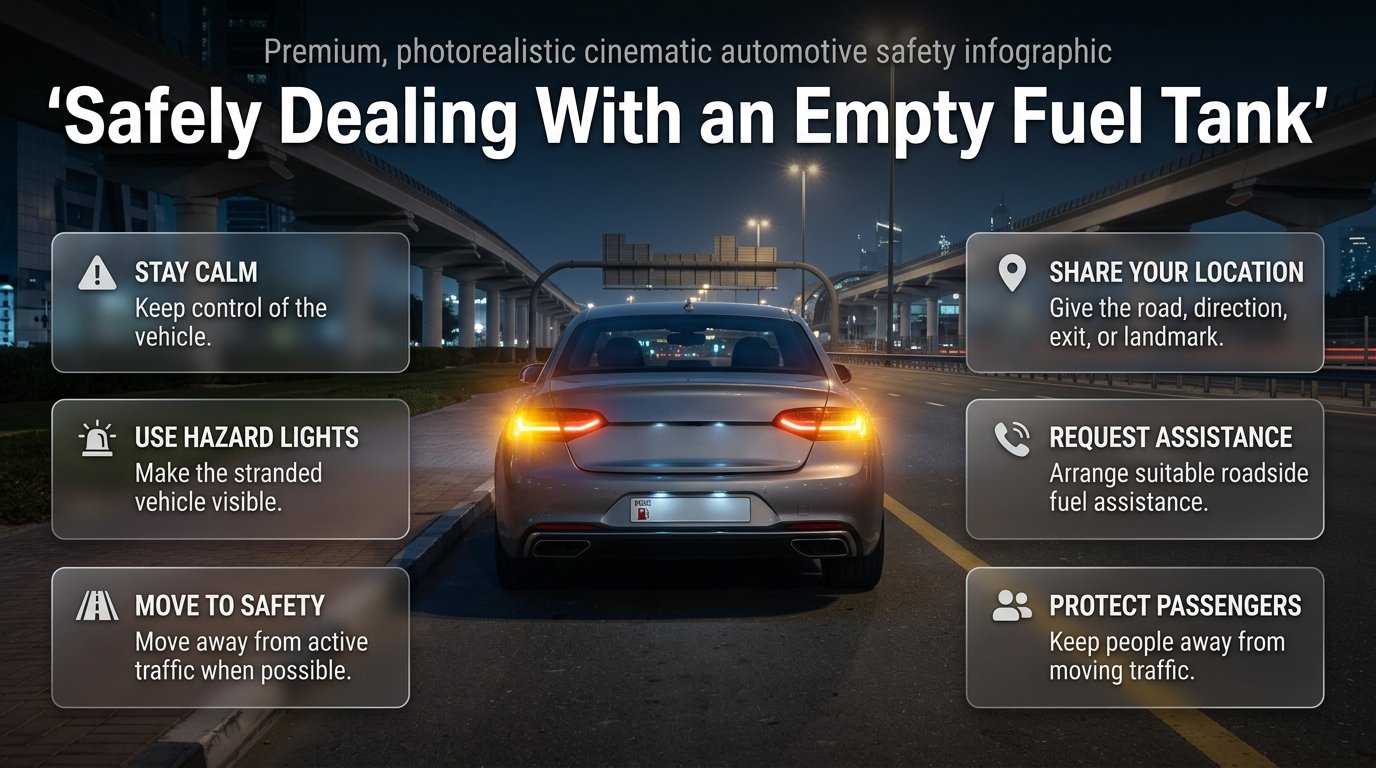
The first priority is to get yourself and the vehicle out of danger.
If the engine is still running but the vehicle is clearly running out of fuel, look for the safest practical place to stop. If the vehicle has already lost power, maintain control and try to move it away from active traffic if this can be done safely.
Once stopped:
- Switch on the hazard warning lights.
- Turn the engine off.
- Apply the parking brake or select Park.
- Assess the surrounding traffic.
- Keep passengers away from moving vehicles.
- Contact appropriate roadside assistance.
- Give the provider your exact location.
- Wait in the safest available position.
Don’t immediately leave the vehicle to search for fuel.
Your first question should be:
“Am I somewhere safe?”
Only after that should you focus on getting fuel.
How Can You Safely Move a Vehicle With Very Low Fuel?
If the fuel warning light has just appeared, you may still have enough fuel to reach a nearby safe location. However, don’t assume that you have a specific number of kilometres remaining.
Instead, consider the road environment.
If you’re approaching:
- A safe parking area
- A petrol station
- A service road
- A suitable shoulder
- An emergency stopping area
- Another protected location
you may be able to move there if doing so doesn’t require dangerous driving.
Avoid aggressive acceleration.
When fuel is critically low, sudden acceleration can increase fuel consumption and may leave you with even less time to find a safe stopping position.
The goal isn’t to squeeze every possible kilometre out of the tank.
The goal is to reach safety without creating another hazard.
What If the Engine Stops While You’re Driving?
An engine that stops unexpectedly can be alarming, particularly when you’re travelling at speed.
Try to remain calm and maintain control of the vehicle.
Depending on the vehicle, the steering wheel may feel heavier and the brake pedal may require more effort. You should continue steering toward the safest available area while paying close attention to surrounding traffic.
Use your hazard warning lights when appropriate.
If the vehicle can still roll, use its remaining momentum carefully to reach a safer position.
Don’t make sudden movements simply because you realize the fuel has run out.
A rushed lane change can be more dangerous than the original fuel problem.
What If You Can’t Move the Vehicle?
Sometimes there’s simply nowhere safe to move.
If the vehicle remains in a dangerous position:
- Activate hazard lights.
- Make the vehicle as visible as reasonably possible.
- Contact roadside assistance.
- Provide precise location information.
- Avoid standing in traffic.
- Follow instructions from appropriate road or emergency authorities.
Don’t attempt to push a vehicle through active traffic unless it is clearly safe and appropriate to do so.Steps After Running Out of Petrol
If your car runs out of petrol in Dubai, follow a few simple steps to stay safe and get back on the road without taking unnecessary risks. Turn on your hazard lights, move the vehicle to a safe location if you can do so without danger, and avoid standing in or near moving traffic. Check your surroundings and keep your phone available so you can contact roadside assistance or emergency fuel delivery. Provide your exact location, vehicle details, and the type of petrol required so help can reach you efficiently. For a complete step-by-step process, focus first on safety, visibility, location sharing, and professional assistance rather than attempting to walk to a petrol station or handle unsafe roadside work yourself.
👉 If your car runs out of petrol in Dubai, follow these Steps After Running Out of Petrol to safely secure your vehicle, assess the situation, and arrange professional fuel assistance without unnecessary roadside risks.
Should You Stay Inside the Vehicle?
There isn’t one universal answer because the safest choice depends on the vehicle’s exact location.
If you’re safely parked away from traffic, remaining inside the vehicle while waiting for assistance may be reasonable.
If the vehicle is in a dangerous traffic position, the safest location may instead be a protected area away from moving vehicles, provided you can reach that area without exposing yourself to greater danger.
The key principle is:
Don’t choose your position based only on comfort. Choose it based on traffic risk.
A comfortable seat inside a vehicle doesn’t automatically make a dangerous roadside location safe.
Likewise, standing beside a vehicle isn’t automatically safer just because you’re outside.
Why Highways Require Extra Caution
Running out of fuel on a highway is significantly different from running out of fuel in a residential parking area.
Vehicles may be travelling at high speeds, and approaching drivers may have limited time to react to a stopped vehicle.
You should therefore avoid unnecessary activity around the car.
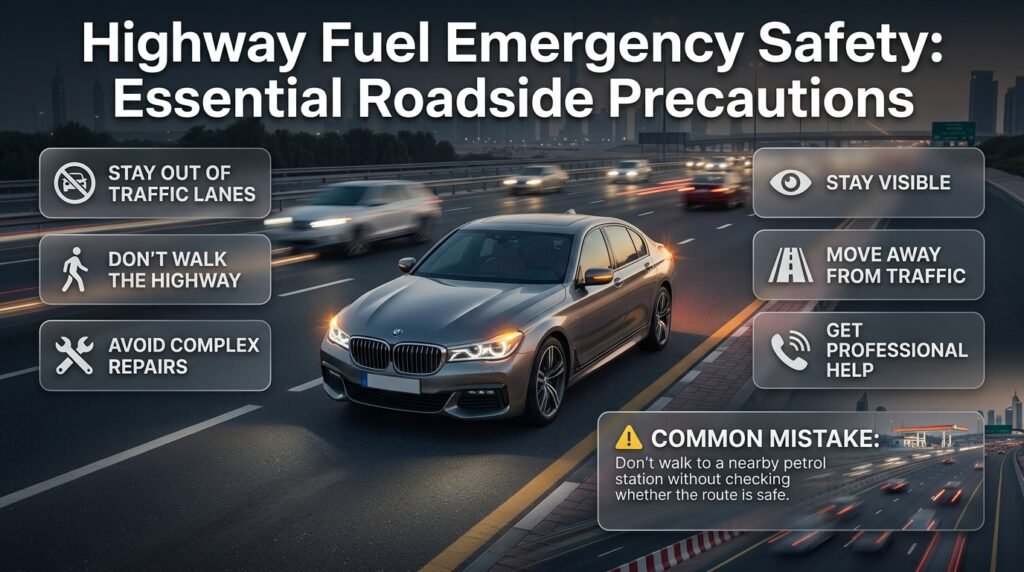
Don’t:
- Stand in a traffic lane.
- Walk along the highway.
- Attempt complex repairs.
- Search for a petrol station on foot.
- Sit on the edge of the roadway.
- Cross multiple lanes to reach an exit.
- Assume other drivers will automatically notice you.
Instead, concentrate on visibility, getting away from moving traffic where safely possible, and obtaining professional assistance.
⚠️ Common Mistake: A driver may see a petrol station nearby and decide to walk there. On a highway, “nearby” doesn’t necessarily mean safely reachable. The road layout, barriers, traffic speed, and pedestrian access all matter.
What Is the Safest Way to Get Fuel After Running Out?
For many stranded drivers, the safest practical solution is to arrange roadside fuel delivery or another suitable roadside assistance service.
Instead of leaving the vehicle and walking to a station, you can request assistance at the vehicle’s location.
This can be especially useful when:
- You’re on an unfamiliar road.
- You’re travelling on a highway.
- Traffic is heavy.
- The weather is extremely hot.
- You’re travelling with children.
- The nearest petrol station isn’t safely accessible on foot.
- You don’t have a suitable fuel container.
- You don’t want to expose yourself to unnecessary roadside risk.
For more detailed emergency guidance, you can also read Emergency Roadside Fuel Advice.
The broader principle is simple:
When you’re stranded, bring the solution to the vehicle instead of unnecessarily taking yourself into a dangerous environment.
Running Out of Fuel on the Road
Running out of fuel on the road can quickly become a safety concern, particularly on busy roads or highways. If your vehicle loses power because the fuel tank is empty, switch on the hazard lights and, if it is safe to do so, move the car away from moving traffic. Avoid trying to walk along the road or attempting unsafe roadside repairs. Instead, stay in a secure location and contact professional roadside assistance or an emergency fuel delivery service. Providing your exact location and vehicle details can help ensure that assistance reaches you as quickly and safely as possible.
👉 If you are running out of fuel on the road in Dubai, follow this practical Running Out of Fuel on the Road Guide to learn how to secure your vehicle, stay safe around traffic, and arrange professional fuel assistance.
What Information Should You Give Roadside Fuel Assistance?
When contacting a fuel delivery or roadside assistance provider, location accuracy is extremely important.
Don’t simply say:
“I’m on Sheikh Zayed Road.”
That’s usually not enough.
Try to provide:
- Road name
- Direction of travel
- Nearest exit
- Nearest landmark
- Building or business name
- Service road information
- Parking area
- Vehicle make and model
- Vehicle colour if useful
- Correct fuel type
- Any other identifying details
If your phone provides a location-sharing feature, use it where appropriate and safe.
Why Exact Location Matters
Dubai has a large and complex road network. Two vehicles can be on the same major road but be separated by several kilometres or different carriageways.
A clear description helps the assistance provider understand where to go.
For example:
Better:
“Vehicle stopped on the right side near Exit 42, travelling toward Abu Dhabi, close to the service-road entrance.”
Less useful:
“I’m somewhere on the highway.”
The more accurately you describe your location, the easier it can be for help to find you.
What Fuel Should You Request?
Before arranging fuel delivery, confirm the fuel type required by your vehicle.
Most conventional petrol vehicles require petrol, while diesel vehicles require diesel. However, you shouldn’t rely on assumptions based on the vehicle’s appearance or brand.
Check:
- Fuel cap label
- Owner’s manual
- Vehicle documentation
- Manufacturer information
- Previous refuelling information
If you’re unsure, verify before accepting fuel.
Why Fuel Type Matters
Putting the wrong fuel into a vehicle can create a much bigger problem than simply running out.
For example, a driver who accidentally puts petrol into a diesel vehicle may need additional professional assistance instead of simply continuing the journey.
That’s why identifying the correct fuel is an important part of safely dealing with an empty fuel tank.
Can You Walk to a Petrol Station?
Sometimes you can physically walk to a petrol station, but that doesn’t mean you should.
The decision depends on the road environment.
Ask yourself:
- Is there a safe pedestrian path?
- Is the route away from traffic?
- Is the weather suitable?
- Is the station actually accessible from your location?
- Would you need to cross a highway?
- Would you have to walk beside moving traffic?
- Are there barriers or restricted areas?
If the answer involves walking along a high-speed road, crossing dangerous traffic, or exposing yourself to extreme heat, don’t take the risk simply to save time.
Professional assistance may be a much safer option.
Why Dubai’s Heat Makes Fuel Emergencies More Serious
Dubai’s climate adds another factor that drivers need to consider.
During very hot weather, sitting or standing outdoors for an extended period can become uncomfortable and potentially unsafe, particularly for vulnerable passengers.
This is one reason fuel emergencies shouldn’t be treated casually.
If your vehicle is stranded, avoid unnecessary walking and don’t assume you can comfortably reach a distant petrol station.
Keep drinking water available when practical, keep your phone charged, and arrange assistance promptly.
What About Air Conditioning?
Air conditioning can increase energy demand and therefore affect fuel consumption.
However, this doesn’t mean you should simply switch off the AC in unsafe heat.
Driver and passenger safety comes first.
A better strategy is to avoid unnecessary engine idling before the fuel becomes critically low and maintain sensible fuel planning throughout the journey.
What Happens Inside the Fuel System When the Tank Is Empty?
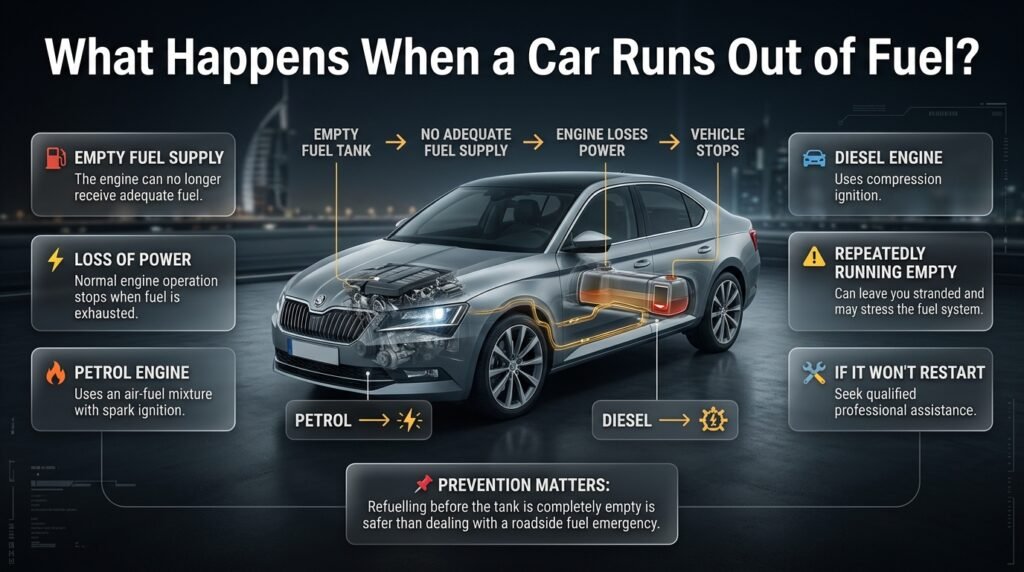
A modern vehicle’s fuel system is designed to deliver fuel from the tank to the engine under controlled conditions.
When the fuel supply becomes exhausted, the engine can no longer receive the fuel it needs to continue combustion.
The result is a loss of power.
In a petrol engine, the combustion process requires an appropriate mixture of air and fuel together with ignition from the spark plugs.
A diesel engine operates differently, using compression ignition.
But in both cases, the engine can’t continue normal operation without an adequate fuel supply.
That’s why an empty tank isn’t something the engine can simply “work through.”
Can Running Out of Fuel Damage the Car?
Running out of fuel once doesn’t automatically mean the vehicle has suffered major damage.
However, repeatedly allowing the tank to become completely empty isn’t a good driving habit.
It can leave you stranded in unsafe locations and may place additional stress on the fuel system depending on the vehicle design.
Some vehicles may also require specific procedures after completely exhausting their fuel supply.
If the vehicle doesn’t restart normally after the correct fuel has been added, don’t keep experimenting.
Contact a qualified professional.
The important lesson is that prevention is easier than dealing with an empty tank on the roadside.
Running Out of Fuel on the Road
Running out of fuel on the road can quickly become a safety concern, particularly on busy roads or highways. If your vehicle loses power because the fuel tank is empty, switch on the hazard lights and, if it is safe to do so, move the car away from moving traffic. Avoid trying to walk along the road or attempting unsafe roadside repairs. Instead, stay in a secure location and contact professional roadside assistance or an emergency fuel delivery service. Providing your exact location and vehicle details can help ensure that assistance reaches you as quickly and safely as possible.
👉 If you are running out of fuel on the road in Dubai, follow this practical Running Out of Fuel on the Road Guide to learn how to secure your vehicle, stay safe around traffic, and arrange professional fuel assistance.
Should You Keep Restarting the Engine?
No.
If the engine has stopped because the tank is genuinely empty, repeatedly attempting to start it won’t solve the fuel shortage.
Repeated starting attempts can also waste the remaining electrical energy in the vehicle’s battery.
If you suspect that fuel is the reason the engine stopped, focus on:
- Reaching a safe position.
- Switching on hazard lights.
- Conserving battery power.
- Contacting assistance.
- Confirming the correct fuel type.
- Waiting safely.
Once the appropriate fuel has been added, follow normal starting procedures.
Can a Car Run on the Last Few Drops of Fuel?
It’s better not to think of fuel as something that can be squeezed down to the final drop.
The fuel gauge isn’t a laboratory measurement of exactly how much usable fuel remains.
The vehicle may behave differently depending on road angle, fuel-tank design, driving conditions, and fuel consumption.
For this reason, the low-fuel warning should be treated as a planning signal.
Low fuel means it’s time to think about refuelling—not time to test how far you can drive after the warning.
How Does Traffic Increase the Risk of Running Out of Fuel?
Traffic is one of the biggest reasons fuel estimates can become unreliable.
Imagine that your normal route is 30 kilometres.
Under light traffic, you may complete the journey quickly.
During severe congestion, however, you could spend much longer on the road while repeatedly accelerating, braking, and idling.
The distance may remain 30 kilometres, but the fuel used may be considerably different.
That’s why drivers should consider:
Distance + traffic + driving time + weather + vehicle load
rather than distance alone.
For drivers who want to understand this issue in more detail, the site’s guide on What to Do When You Run Out of Fuel in Dubai provides additional guidance related to fuel emergencies.
How Does Idling Affect an Almost Empty Fuel Tank?
Idling occurs when the engine remains running while the vehicle is stationary.
The vehicle isn’t moving, but the engine is still consuming fuel.
When the fuel level is already extremely low, unnecessary idling can reduce the amount of fuel available for reaching a safe location.
This can happen during:
- Traffic queues
- School pickup
- Waiting outside shops
- Drive-through queues
- Long parking waits
- Roadside stops
If you know the vehicle is critically low on fuel, avoid unnecessary engine operation whenever doing so is safe and appropriate.
What Should You Do if You Run Out of Fuel in Heavy Traffic?
Heavy traffic requires extra patience.
Don’t panic and attempt to force the vehicle into a dangerous position.
If the engine is still responding, use the vehicle’s remaining momentum carefully and move toward the safest available area.
If it has stopped:
- Switch on hazard lights.
- Keep the vehicle visible.
- Avoid sudden movements.
- Contact assistance.
- Stay away from active traffic where possible.
- Provide accurate location details.
If traffic is moving around your vehicle, don’t assume you can safely exit simply because vehicles are passing slowly.
The traffic environment can change quickly.
What If You Run Out of Fuel at Night?
Darkness can make a stranded vehicle harder for other drivers to notice.
Use hazard lights and make the vehicle as visible as reasonably possible.
Avoid standing in dark areas beside the road.
If your vehicle has stopped in a dangerous position, prioritize getting yourself to a genuinely protected location rather than focusing entirely on the car.
When contacting assistance, clearly explain that the incident has occurred at night and provide nearby lighting, signs, exits, or landmarks that can help identify the vehicle.
⭐ Expert Tip: If you’re stranded at night, don’t assume that a familiar road is automatically safe. Reduced visibility can change the risk significantly.
What If You Have Passengers With You?
Passengers can make a fuel emergency more complicated.
Children, elderly passengers, or anyone who is uncomfortable in heat may need additional consideration.
The driver should remain calm and give clear instructions.
Avoid letting passengers wander around the roadside.
Instead:
- Keep everyone together where practical.
- Stay away from moving traffic.
- Keep water available.
- Keep communication clear.
- Arrange assistance quickly.
- Follow appropriate local safety instructions.
Don’t allow frustration to turn into risky decisions.
A few extra minutes of waiting for proper assistance is usually preferable to putting passengers in an unsafe roadside environment.
Should You Carry an Emergency Fuel Container?
Some drivers keep approved fuel containers for emergencies.
However, a fuel container isn’t a replacement for safe roadside planning.
Fuel is flammable and must be stored and transported appropriately.
A container should never be treated like an ordinary water bottle or stored carelessly in the passenger compartment.
If obtaining fuel requires walking beside a highway, carrying a container doesn’t solve the underlying safety problem.
In many roadside situations, professional fuel delivery is the more practical option.
What Emergency Items Should You Keep in Your Car?
A basic emergency kit can make unexpected stops easier to manage.
Useful items may include:
- Charged mobile phone
- Phone charging cable
- Drinking water
- Vehicle documents
- Emergency contact information
- Basic first-aid supplies
- Suitable reflective safety equipment
- Torch or phone flashlight
These items are intended to support safety.
They shouldn’t encourage you to perform dangerous roadside work.
For example, having a flashlight doesn’t make it safe to inspect your engine beside a high-speed road at night.
What Should You Do After Fuel Is Delivered?
Once the correct fuel has been added, don’t immediately assume everything is normal.
Check the area around the vehicle and make sure the vehicle is in a safe position before attempting to continue.
Follow the vehicle manufacturer’s normal starting procedure.
If the vehicle starts normally, drive cautiously and consider stopping at a suitable petrol station to restore your normal fuel reserve.
If the vehicle doesn’t start:
- Don’t keep attempting to start it repeatedly.
- Don’t guess at mechanical problems.
- Contact appropriate roadside assistance.
- Explain that the vehicle has received the correct fuel.
- Request further diagnosis if necessary.
A vehicle that remains inoperative after refuelling may have another issue.
How Can You Prevent an Empty Fuel Tank?
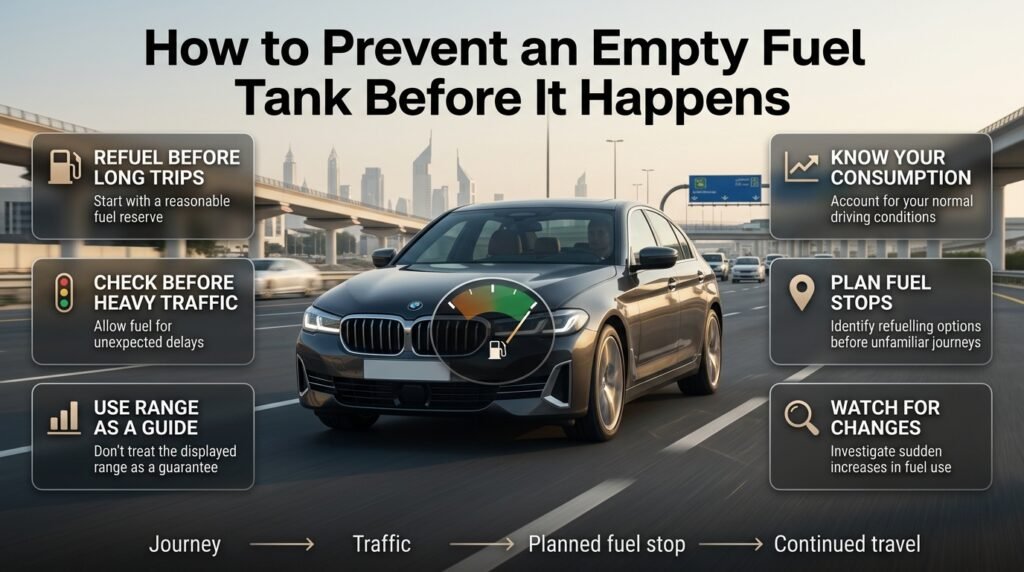
The easiest fuel emergency to handle is the one that never happens.
Develop a simple habit of checking your fuel level before long journeys and before entering areas where traffic is likely to be heavy.
Don’t wait until the tank is almost completely empty.
Practical Prevention Habits
Refuel Before Long Trips
A long journey isn’t the right time to test the lowest possible fuel level.
Start with a reasonable reserve.
Check Fuel Before Heavy Traffic
If you’re about to enter a congested area, consider whether your current fuel level is sufficient for delays.
Don’t Depend Entirely on the Range Display
The displayed range is an estimate.
Use it as a guide rather than a guarantee.
Know Your Typical Consumption
If your vehicle normally consumes more fuel during city driving than highway driving, account for that difference.
Plan Fuel Stops
For unfamiliar routes, identify practical refuelling opportunities before leaving.
Watch for Changes
If your fuel consumption suddenly becomes worse than normal, investigate the cause rather than simply accepting it.
How Driving Style Can Make Fuel Run Out Faster
Fuel consumption isn’t determined only by engine size.
Driving style also matters.
Aggressive acceleration, unnecessary braking, excessive speed, and prolonged idling can all increase fuel use.
Smooth driving allows you to maintain more consistent momentum.
For example, if traffic ahead is slowing down, looking further ahead may allow you to ease off the accelerator instead of accelerating and then braking hard.
This reduces unnecessary energy use and can make driving more predictable.
Drivers interested in improving efficiency can combine better fuel planning with practical fuel-saving driving habits.
The goal isn’t to drive unnaturally slowly.
It’s to avoid wasting fuel through unnecessary actions.
How Can Air Conditioning Affect Fuel Planning?
In Dubai, air conditioning is often a normal part of driving rather than an optional luxury.
Using AC can increase the vehicle’s energy demand, but drivers shouldn’t compromise personal safety simply to save a small amount of fuel.
Instead, focus on efficient overall driving.
Useful habits include:
- Avoiding unnecessary idling with AC running.
- Parking in shade when practical.
- Ventilating the vehicle before driving when appropriate.
- Maintaining the vehicle’s cooling system.
- Keeping the AC system properly serviced.
- Avoiding unnecessary aggressive acceleration.
A well-maintained vehicle and sensible driving habits are more useful than trying to eliminate necessary AC use.
What Are the Most Common Empty-Tank Mistakes?
Mistake 1: Ignoring the Fuel Warning
Some drivers see the warning light but continue driving because they believe they still have plenty of range.
Why it happens: The driver has successfully driven with the warning light on before.
Why it’s risky: Traffic or route changes can consume the remaining fuel.
Better approach: Treat the warning as a reminder to refuel.
Mistake 2: Walking Along the Highway
Why it happens: The driver sees a petrol station nearby.
Why it’s dangerous: A highway isn’t necessarily safe for pedestrians.
Better approach: Arrange roadside assistance.
Mistake 3: Standing Beside the Vehicle
Why it happens: The driver wants to watch for approaching help.
Why it’s dangerous: Passing traffic can create serious risk.
Better approach: Stay in a protected area where possible.
Mistake 4: Repeatedly Starting the Engine
Why it happens: The driver hopes the vehicle will suddenly restart.
Why it doesn’t help: If fuel is exhausted, starting attempts don’t create fuel.
Better approach: Stop repeated attempts and request assistance.
Mistake 5: Guessing the Fuel Type
Why it happens: The driver isn’t certain.
Why it’s dangerous: Incorrect fuel can create a second vehicle problem.
Better approach: Verify before refuelling.
Mistake 6: Treating the Range Display as Exact
Why it happens: The number looks precise.
Why it’s misleading: The estimate depends on recent consumption and conditions.
Better approach: Maintain a reasonable fuel reserve.
Expert Advice for Safer Fuel Management
Experienced drivers don’t simply react when the fuel gauge reaches empty.
They build fuel planning into their normal routine.
Before a long trip, consider:
Fuel level → distance → traffic → weather → AC use → vehicle load → refuelling opportunities
This takes only a few seconds but can prevent an inconvenient or dangerous roadside situation.
Another useful habit is to refuel when it’s convenient rather than waiting until the tank becomes critically low.
You don’t need to fill the tank every time the gauge moves slightly.
But you should avoid turning “I’ll refuel later” into a repeated habit.
⭐ Expert Tip: If your route involves highways, unfamiliar roads, or heavy traffic, leave yourself more flexibility than you would for a short local journey.
Empty Fuel Tank Safety Checklist
Use this checklist if your vehicle runs out of fuel:
- Stay calm.
- Maintain control if the vehicle is still moving.
- Move to the safest available location if possible.
- Switch on hazard lights.
- Turn off the engine once safely stopped.
- Apply the parking brake or select Park.
- Keep away from active traffic.
- Don’t walk along a highway.
- Don’t attempt dangerous roadside repairs.
- Contact appropriate roadside assistance.
- Give your exact location.
- Confirm the correct fuel type.
- Keep your phone available.
- Follow safety instructions.
- Don’t repeatedly attempt to start an empty vehicle.
Quick Decision Guide: What Should You Do?
| Situation | Best General Response |
|---|---|
| Low fuel warning appears | Plan to refuel soon |
| Vehicle still moving but losing power | Move toward a safe location if possible |
| Engine stops in a parking area | Secure vehicle and arrange fuel |
| Engine stops on a busy road | Activate hazards and prioritize traffic safety |
| Engine stops on a highway | Avoid traffic exposure and request assistance |
| Petrol station appears nearby | Check whether it is actually safe to reach on foot |
| Unsure about fuel type | Verify before refuelling |
| Vehicle won’t restart after fuel | Request professional assistance |
| Extremely hot weather | Avoid unnecessary outdoor exposure |
| Heavy traffic | Allow extra fuel reserve for delays |
What should you do immediately when your car runs out of fuel?
When the engine starts losing power because the fuel has run out, your first priority should be controlling the vehicle and getting it away from moving traffic, not finding fuel immediately. If the car is still moving and you can safely steer it, use the remaining momentum to reach the nearest suitable shoulder, emergency stopping area, parking area, or another protected location. Switch on your hazard lights so approaching drivers understand that your vehicle has a problem.
Once you’re safely stopped, turn the engine off and avoid repeatedly trying to restart it. If you’re on a busy road or highway, don’t leave the vehicle simply to walk to a petrol station. Contact roadside assistance or a suitable fuel-delivery service and provide your exact location. Official road-safety guidance also recommends moving to a safe place, using hazard lights, and contacting assistance after a breakdown.
Important points:
Move away from active traffic if you can do so safely.
Switch on hazard warning lights.
Don’t make sudden lane changes just to reach a petrol station.
Avoid standing beside the vehicle in fast-moving traffic.
Give assistance providers your road, direction, exit, and landmark.
Treat safety as the first problem to solve; fuel comes second.
Is it safe to walk to a petrol station after running out of fuel?
Walking to a petrol station isn’t automatically safe just because the station looks nearby. The actual route may require you to walk beside fast-moving traffic, cross a major road, pass through restricted areas, or travel a considerable distance in extreme heat. This is particularly important in Dubai, where high temperatures can make prolonged outdoor exposure uncomfortable and potentially dangerous.
If your car has stopped on a highway or another high-speed road, walking along the road to find fuel is generally a poor choice. Instead, remain in a safe location and arrange roadside assistance or emergency fuel delivery. Recent UAE guidance specifically advises drivers not to expose themselves unnecessarily to traffic and to seek professional help after a breakdown.
Before considering walking, ask yourself:
Is there a proper pedestrian path?
Can I reach the station without crossing dangerous traffic?
Am I away from highway traffic?
Is the weather suitable for walking?
Do I have passengers who need to remain with the vehicle?
Would professional fuel delivery be safer?
If the answer involves walking along a highway, crossing multiple lanes, or exposing yourself to extreme heat, don’t take the risk simply to get fuel faster.
What should you do if your car runs out of fuel on a Dubai highway?
A highway breakdown needs more caution because vehicles are travelling at higher speeds and may have limited time to react to a stationary car. If the vehicle begins losing power, switch on the hazard lights and, only if you can do it safely, steer toward the nearest suitable safe area away from active traffic. Once stopped, avoid attempting repairs or standing casually beside the vehicle.
Your next step should be to contact appropriate roadside assistance and give a precise description of where you are. Mention the road, direction of travel, nearest exit, landmark, service road, or other identifying information. If the situation creates an immediate danger to people or traffic, treat it as an emergency and contact the appropriate emergency service. Dubai-focused breakdown guidance similarly emphasizes hazards, moving away from active traffic when safe, and providing precise location information.
Highway safety checklist:
Keep hazard lights activated.
Don’t walk along the highway looking for fuel.
Don’t attempt complicated repairs beside moving traffic.
Don’t stand between the vehicle and passing traffic.
Share your exact location with assistance.
Follow instructions from road authorities or emergency responders.
If there is an immediate danger, injury, fire, or serious road obstruction, seek emergency help rather than treating it as an ordinary fuel delivery.
Can running out of fuel damage your car or fuel pump?
Running out of fuel once doesn’t automatically mean your engine or fuel pump has been seriously damaged, but repeatedly driving until the tank is completely empty isn’t a good maintenance habit. Once the fuel supply is exhausted, the engine can no longer operate normally because it isn’t receiving the fuel required for combustion. The immediate consequence is usually loss of power and being stranded rather than automatic engine failure.
The bigger concern is making empty-tank driving a regular habit. It can leave you stopped in an unsafe location and may create additional problems depending on the vehicle’s fuel-system design. Some vehicles may also require specific procedures before they restart normally after completely exhausting their fuel supply. If the correct fuel has been added and the vehicle still won’t start or runs abnormally, it’s better to have it professionally checked instead of repeatedly cranking the engine.
Good practice:
Don’t deliberately test how far the car can travel after the gauge reaches empty.
Treat the low-fuel warning as a refuelling reminder.
Avoid repeated starting attempts when you know the tank is empty.
Refuel before long journeys.
Allow extra fuel for heavy traffic and unexpected delays.
If the vehicle doesn’t restart normally after refuelling, arrange professional assistance.
How can you prevent your car from running out of fuel in Dubai traffic?
The easiest way to deal with an empty fuel tank is to prevent it from happening. In Dubai, fuel planning shouldn’t be based only on the number of kilometres in your journey. Heavy traffic can dramatically increase journey time, while repeated acceleration, braking, idling, and air-conditioning use can affect real-world fuel consumption.
A journey that normally takes 30 minutes may take much longer during congestion. If your tank is already close to empty, that delay can turn a routine trip into a roadside emergency. Instead of relying completely on the estimated range displayed by the vehicle, keep a sensible fuel reserve and refuel before entering a long stretch of heavy traffic or starting a long-distance journey.
Simple fuel-planning habits:
Check your fuel level before leaving.
Refuel before long journeys.
Don’t treat the estimated range as an exact guarantee.
Consider traffic when calculating your fuel needs.
Avoid unnecessary idling.
Monitor unusual changes in fuel consumption.
Know where practical refuelling points are along unfamiliar routes.
Keep your phone charged in case roadside assistance is needed.
Professional takeaway: Good fuel management isn’t about constantly keeping the tank completely full. It’s about maintaining enough reserve that normal traffic, route changes, or unexpected delays don’t leave you stranded in a dangerous location.
Conclusion
Running out of fuel can turn into a stressful situation, but the right response can keep a simple fuel problem from becoming a serious roadside emergency. When your tank is empty, focus first on safety. If possible, move the vehicle away from active traffic, switch on the hazard lights, avoid standing beside the vehicle on a busy road, and arrange reliable roadside fuel assistance.
For Dubai drivers, good fuel planning is equally important. Heavy traffic, long delays, high temperatures, air-conditioning use, and changing driving conditions can all affect how quickly your fuel is consumed. Don’t rely completely on the estimated range or wait until the tank is completely empty before refuelling.
The safest approach is simple: plan ahead, maintain a reasonable fuel reserve, and know what to do if the unexpected happens. If your vehicle does run out of fuel, don’t take unnecessary risks by walking along a highway or attempting unsafe roadside work. Get to a safe position, request the right assistance, and let the fuel problem be solved professionally.
Leave a Reply