Introduction
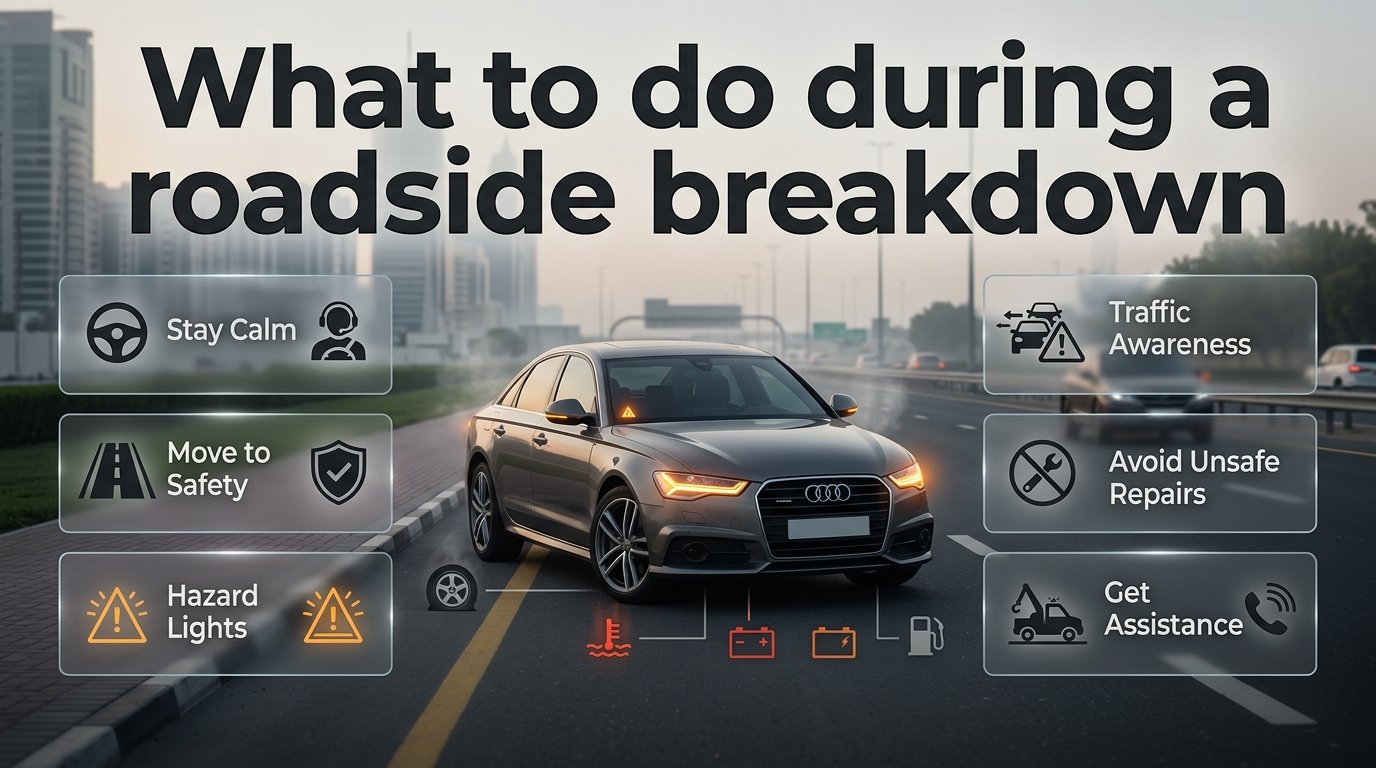
What to do during a roadside breakdown | A roadside breakdown can turn an ordinary journey into a stressful situation within minutes. Your car may suddenly lose power, a tire may fail, the engine may overheat, the battery may die, or you may simply run out of fuel. The important thing is not to panic. Knowing what to do during a roadside breakdown helps you make safer decisions when you have limited time to think.
A breakdown isn’t always dangerous because of the mechanical problem itself. In many situations, the bigger risk comes from surrounding traffic, poor visibility, extreme weather, or attempting a repair in an unsafe location.
If you’re dealing with a vehicle problem in Dubai, having access to reliable information and emergency support can make the situation much easier to manage. Fuel Delivery Dubai can also be a useful resource when the breakdown is specifically related to an empty fuel tank.
This guide explains what to do from the moment you notice something is wrong until professional help arrives. You’ll learn how to choose a safer stopping location, what to do on a highway, whether you should stay inside your vehicle, how to deal with fuel, tires, batteries, and overheating, and which common mistakes can make a breakdown more dangerous.
What Should You Do First During a Roadside Breakdown?
The first priority during a breakdown is safety, not repair. Keep control of the vehicle, reduce speed gradually, move as far away from moving traffic as safely possible, activate your hazard lights, and assess the situation before deciding what to do next.
Think of the immediate response as:
Control the car → Find a safer position → Warn other road users → Protect passengers → Call for assistance → Deal with the vehicle
This order matters.
When drivers panic, they often concentrate on the mechanical problem. They may immediately open the bonnet, inspect a tire, or try restarting the engine repeatedly. But if the vehicle has stopped beside fast-moving traffic, getting out and standing beside it can create a much greater risk than the original fault.
Stay Calm and Keep Control
If you notice a problem while driving, don’t immediately slam on the brakes unless there’s an immediate emergency.
Instead, keep both hands on the steering wheel and pay attention to how the vehicle is responding.
You may notice:
- Loss of engine power
- Difficulty accelerating
- Strange noises
- Steering problems
- Brake problems
- Warning lights
- Engine temperature rising
- Smoke or unusual smells
- A flat or damaged tire
- Fuel warning or an empty tank
Try to maintain a predictable path and reduce speed smoothly.
If the vehicle is still controllable, look ahead for a safer place to stop.
💡 Pro Tip: If you notice a serious warning before the vehicle completely fails, use the remaining mobility of the car to reach a safer location. A parking area or service station is usually much better than stopping on a narrow roadside shoulder.
Where Is the Safest Place to Stop a Broken-Down Car?
The safest stopping location is generally one that creates the greatest practical separation between your vehicle and moving traffic.
Depending on the road, this could be:
- A designated emergency stopping area
- A wide shoulder where stopping is appropriate
- A service station
- A parking area
- A safe side road
- A designated breakdown area
- Another location clearly separated from active traffic
If the vehicle is becoming unreliable, don’t wait until it completely stops before thinking about where to go.
For example, imagine you’re driving on a busy road and the engine begins losing power. You still have some control, but the vehicle is struggling.
You have two choices:
Option A: Continue driving until the engine finally stops.
Option B: Use the remaining power to reach a safer stopping location.
Option B may prevent you from becoming stranded in a much more dangerous position.
Avoid Dangerous Stopping Locations
Try not to stop:
- Around a blind bend
- Immediately after a hill crest
- In an active traffic lane
- Near an intersection
- In a location with poor visibility
- On a very narrow shoulder
- Where approaching drivers have little time to react
Of course, emergencies don’t always give you a choice.
If the vehicle suddenly stops and cannot be moved, don’t take unnecessary risks trying to relocate it.
What If the Vehicle Cannot Be Moved?
Sometimes the vehicle simply won’t move.
This can happen after:
- A major engine failure
- Transmission failure
- Severe overheating
- A damaged wheel
- A serious electrical problem
- A completely flat or damaged tire
- Running out of fuel
- A collision
If the car cannot be moved safely, activate the hazard lights and concentrate on protecting yourself and your passengers.
Don’t repeatedly accelerate or attempt aggressive maneuvers to force a disabled vehicle to move.
If you’re blocking an active traffic lane or are in immediate danger, contact appropriate emergency or roadside assistance as soon as possible.
⚠ Common Mistake: Don’t risk losing control of the vehicle just because you want to move it a few extra meters. If the car isn’t responding normally, professional help may be the safer solution.
Should You Turn on Hazard Lights During a Breakdown?
Yes. Hazard warning lights help alert approaching drivers that your vehicle is stopped or experiencing a problem.
Turn them on when you recognize that your vehicle has broken down, particularly when the car is stationary in a location where other drivers may approach.
However, hazard lights don’t make an unsafe location safe.
A stopped vehicle with hazard lights can still be hit by another vehicle, especially on a fast road.
That’s why the priorities remain:
Safe location + visibility + distance from traffic + appropriate assistance
If your vehicle has additional warning equipment, use it only when doing so can be done safely and in accordance with local requirements.
Should You Stay Inside Your Car During a Breakdown?
There isn’t one answer that applies to every breakdown.
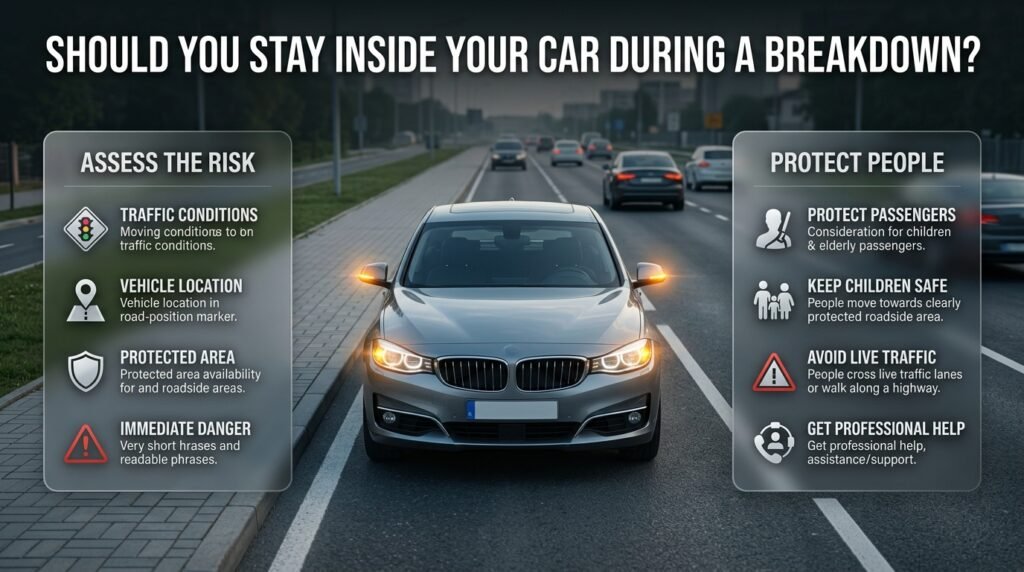
The right decision depends on where the vehicle has stopped, how fast surrounding traffic is moving, whether there is a protected area nearby, and whether leaving the vehicle would expose you to greater danger.
If you’re stopped in a dangerous traffic environment, don’t automatically get out simply because you want to inspect the car.
Standing beside a broken-down vehicle on a busy highway can be extremely dangerous.
If there’s a safe route to a protected location away from traffic, leaving the vehicle may be appropriate. But don’t cross live traffic lanes or walk along a highway simply to get farther away from the car.
Protect Your Passengers
Passengers need to be considered too.
Children, elderly passengers, and anyone unfamiliar with roadside safety should not be allowed to wander around the vehicle.
If evacuation is safe, move everyone to a protected area away from traffic.
If evacuation isn’t safe, keep passengers in the safest available position and wait for professional assistance.
The goal isn’t to follow one universal rule. The goal is to choose the option that exposes people to the least immediate danger.
What Should You Do During a Roadside Breakdown on a Highway?
Highway breakdowns require additional caution because traffic is faster and approaching drivers have less time to react.
If your vehicle begins failing on a highway, stay calm and focus on maintaining control.
Follow This Sequence
1. Reduce speed smoothly.
Avoid sudden braking or aggressive steering.
2. Look for a safer stopping area.
If possible, move away from active traffic lanes.
3. Turn on hazard lights.
Make other drivers aware that something is wrong.
4. Stop as far from moving traffic as safely possible.
Don’t place yourself in additional danger trying to achieve a perfect position.
5. Assess the situation.
Look for smoke, fire, fuel leakage, overheating, or other serious hazards.
6. Contact appropriate assistance.
Give your exact location and direction of travel.
7. Avoid unnecessary roadside work.
A repair isn’t worth risking your life.
A highway shoulder may appear wide, but vehicles can still pass extremely close at high speeds.
⭐ Expert Tip: Treat a highway breakdown as a traffic-safety problem first and a mechanical problem second.
What Should You Check After the Vehicle Stops?
Once you’re in the safest practical position, assess the vehicle from a safe location.
You don’t need to become a mechanic.
You’re looking for obvious signs that indicate whether the vehicle is safe to approach or whether you should simply wait for professional help.
Look for:
- Smoke
- Fire
- Steam
- Fuel smell
- Fluid leaking beneath the vehicle
- Damaged tires
- Warning lights
- Electrical smells
- Severe engine noise
- Visible damage
Smoke or Fire
If you see fire or significant smoke, don’t concentrate on repairing the vehicle.
Move yourself and passengers away from the immediate danger when it can be done safely and contact emergency assistance.
Fuel Leakage
A strong fuel smell or visible fuel leak requires caution.
Don’t smoke or use flames near the vehicle.
Avoid creating sparks and don’t attempt an improvised fuel repair beside traffic.
Overheating
If the engine is overheating, don’t immediately open the radiator or coolant reservoir if the system is hot and pressurized.
Hot coolant and steam can cause serious burns.
Allow the vehicle to cool and arrange professional assistance if needed.
What If Your Car Runs Out of Fuel?
Running out of fuel is one of the most frustrating roadside problems because it can often be prevented with better planning.
However, even careful drivers can misjudge fuel range.
Traffic congestion, detours, unfamiliar roads, long distances, extreme heat, and inaccurate assumptions about remaining range can all contribute.
If your vehicle runs out of fuel, the first priority is still the same:
Get yourself and the vehicle into the safest practical position.
If the vehicle still has enough momentum and control, move away from active traffic.
Once safely stopped:
- Turn on hazard lights.
- Don’t repeatedly attempt to restart the engine.
- Check your exact location.
- Arrange appropriate fuel assistance.
- Keep yourself away from moving traffic.
- Wait in the safest available position.
For a more detailed fuel-specific guide, see What to Do When Your Car Runs Out of Fuel in Dubai.
You can also read Emergency Roadside Fuel Advice for additional guidance on handling a fuel-related emergency.
Don’t Walk to a Fuel Station on a Highway
One of the most dangerous reactions to an empty tank is deciding to walk for fuel.
If you’re on a high-speed road, walking beside traffic can expose you to serious danger.
Don’t assume a fuel station that appears close on a map is safe to reach on foot.
Instead, provide your exact location to an appropriate fuel delivery or roadside assistance provider.
For drivers specifically dealing with this situation, Running Out of Fuel on the Road explains why location and personal safety should come before finding fuel yourself.
What Should You Do If Your Car Runs Out of Petrol in Dubai?
Dubai driving can involve long routes, heavy traffic, major highways, and periods of extreme heat.
An empty fuel tank in the middle of a journey can therefore become more than an inconvenience.
If you’re stranded because the tank is empty:
- Move away from traffic if possible.
- Activate hazard lights.
- Avoid walking beside highways.
- Keep passengers away from traffic.
- Share your exact location.
- Arrange suitable fuel assistance.
- Don’t keep trying to drive an empty vehicle.
For another practical explanation, see Steps After Running Out of Petrol.
If you’re already stopped with an empty tank, the focus should be on getting the correct fuel safely rather than trying to improvise.
You can also review Safely Dealing With an Empty Fuel Tank in Dubai for more fuel-emergency guidance.
What If You Get a Flat Tire During a Breakdown?
A flat tire doesn’t always mean you should immediately get out and change it.
The location matters.
Changing a tire in a quiet, protected parking area is completely different from changing one on a busy highway shoulder.
If a tire fails while you’re driving:
1. Keep Control
Don’t make sudden steering movements.
2. Reduce Speed
Slow down gradually when possible.
3. Move to a Safer Position
If the vehicle remains controllable, reach an appropriate stopping location.
4. Turn on Hazard Lights
Make your vehicle more noticeable.
5. Assess the Location
Ask yourself whether it’s genuinely safe to stand beside the vehicle.
6. Call for Assistance if Necessary
If traffic is passing close by, professional assistance is often the safer choice.
📌 Quick Tip: Having a spare tire doesn’t mean you have to change it yourself. The spare is equipment; it isn’t a requirement to perform a roadside repair in an unsafe environment.
What Should You Do If Your Car Battery Dies?
A dead battery can leave you stranded without warning.
You may notice:
- Slow engine cranking
- Clicking when starting
- Dim lights
- Electrical accessories not working
- Complete loss of starting power
If the vehicle is safely parked away from traffic, a jump-start may be possible if you understand your vehicle’s correct procedure.
But if you’re stopped in a dangerous location, don’t focus on experimenting with cables.
Modern vehicles can contain sensitive electronic systems, and incorrect jump-starting can potentially cause damage.
If you’re unsure about the correct procedure, arrange professional assistance.
Don’t Keep Turning the Key
Repeatedly trying to start a vehicle with a weak battery may not solve anything.
If the battery is clearly discharged, get the correct assistance rather than repeatedly attempting the same action.
What If the Engine Overheats?
Overheating is a breakdown warning that should be taken seriously.
You may notice:
- Temperature gauge rising
- Temperature warning light
- Steam
- Coolant smell
- Reduced engine performance
- Fluid leaking under the vehicle
If the vehicle begins overheating, safely stop as soon as practical.
Once stopped, switch off the engine when appropriate and keep away from hot engine components.
Never Immediately Open a Hot Cooling System
A hot cooling system can be pressurized.
Opening the wrong cap while the engine is hot can release scalding coolant or steam.
Give the vehicle time to cool.
If you’re uncertain about the cause, professional assistance is safer than attempting a roadside repair.
⚠ Common Mistake: Some drivers continue driving because the destination is “only a few minutes away.” A short distance can still turn an overheating problem into serious engine damage.
What Information Should You Give Roadside Assistance?
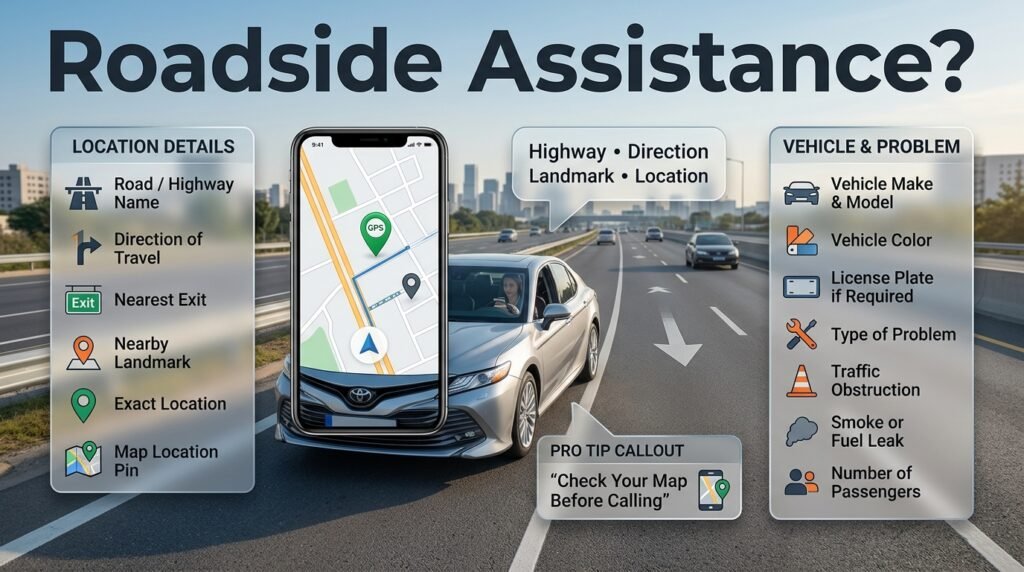
Once you’ve decided to call for help, make the location easy to understand.
Don’t simply say:
“My car broke down on the highway.”
That may not be enough.
Instead, provide:
- Road or highway name
- Direction of travel
- Nearest exit
- Nearby landmark
- Exact location shown by your phone
- Vehicle make
- Vehicle model
- Vehicle color
- License plate details if required
- Type of problem
- Whether the vehicle blocks traffic
- Whether there is smoke
- Whether there’s a fuel leak
- Number of passengers
Why Direction Matters
Many major roads have separate carriageways.
Saying which direction you’re travelling can save time.
For example:
“I’m on the highway travelling toward [destination], approximately one kilometer after [landmark].”
is much more useful than simply naming the highway.
💡 Pro Tip: Before calling, open your map application and check the road name, direction, nearest landmark, and location pin. Giving accurate information can make it easier for assistance to find you.
Should You Repair the Vehicle Yourself?
Sometimes a minor problem can be handled by the driver.
But the question isn’t only:
“Can I fix it?”
The better question is:
“Can I fix it safely here?”
That’s an important difference.
A simple tire change in a protected parking area may be reasonable for someone who knows how to do it.
The same tire change beside high-speed traffic may be an unnecessary risk.
Avoid DIY Repairs When:
- Traffic is moving close to the vehicle.
- The shoulder is extremely narrow.
- Visibility is poor.
- The vehicle is unstable.
- Fuel is leaking.
- There’s smoke or fire.
- The engine is extremely hot.
- You don’t have the correct tools.
- You aren’t confident about the repair.
- You would need to crawl under the vehicle.
A professional recovery service can deal with the mechanical problem after getting the vehicle to a safer location.
How Does Extreme Heat Affect Roadside Breakdowns in Dubai?
Heat can make a breakdown considerably more uncomfortable and can also increase the importance of planning.
A stationary vehicle in hot weather can become an uncomfortable environment, particularly when passengers are waiting for assistance.
Before long journeys, consider:
- Fuel level
- Coolant and cooling-system condition
- Tire condition
- Battery condition
- Engine oil according to manufacturer requirements
- Air-conditioning operation
- Phone battery
- Drinking water
Don’t Let the AC Become Your Only Plan
If you’re waiting for help in extreme heat, using the vehicle’s air conditioning may provide temporary comfort when the vehicle can safely run.
But don’t assume you can keep the engine running indefinitely.
Fuel level, battery condition, engine temperature, and the nature of the breakdown all matter.
If the engine has overheated, for example, continuing to run it may not be appropriate.
What Emergency Equipment Should You Keep in Your Car?
A basic emergency kit doesn’t have to be complicated.
Useful items can include:
- Charged mobile phone
- Charging cable
- Power bank
- Drinking water
- Flashlight
- Basic first-aid supplies
- Vehicle documents
- Emergency contact details
- Appropriate reflective safety equipment
- Spare tire equipment where applicable
- Basic tools appropriate for your vehicle
The purpose of emergency equipment is to help you manage a problem—not to encourage risky roadside repairs.
A reflective item may improve visibility, but it doesn’t make standing on a highway shoulder safe.
The most valuable emergency resource is often still a charged phone and accurate location information.
What Are the Most Common Roadside Breakdown Mistakes?
Knowing what not to do can be just as important as knowing what to do.
Mistake 1: Trying to Fix the Car Immediately
A driver hears a strange noise and immediately opens the bonnet.
Why does this happen?
Because people naturally want to solve the problem.
Why can it be dangerous?
The vehicle may be stopped in an unsafe location.
Better approach: Secure your position first. Inspect the vehicle only if doing so is safe.
Mistake 2: Standing Beside the Vehicle
Drivers sometimes stand outside the car while waiting for help.
This can expose them to passing traffic.
Better approach: Choose the safest available position based on the road environment.
Mistake 3: Walking Along a Highway
Running out of fuel can make drivers think:
“The petrol station is probably nearby.”
Walking beside fast traffic is not a safe solution.
Better approach: Arrange assistance and provide your exact location.
Mistake 4: Repeatedly Restarting the Engine
If the engine has stopped because of overheating or a serious mechanical problem, repeatedly restarting it isn’t necessarily helpful.
Better approach: Identify warning signs and seek appropriate assistance.
Mistake 5: Ignoring Warning Lights
A warning light may appear before the actual breakdown.
Drivers sometimes continue because the car still feels normal.
Better approach: Take significant warnings seriously and move to a safe location when possible.
Mistake 6: Forgetting the Direction of Travel
On major roads, simply giving the road name may not be enough.
Better approach: Tell assistance which direction you’re travelling and provide the nearest exit or landmark.
Mistake 7: Carrying Out Repairs in Poor Visibility
Nighttime, dust, rain, glare, and heavy traffic can make roadside repairs more dangerous.
Better approach: Get professional assistance when the environment isn’t suitable for a repair.
How Can You Prevent a Roadside Breakdown?
Not every breakdown can be prevented.
Mechanical failures happen.
But regular checks can reduce the likelihood of being stranded.
Check Your Fuel Before Long Trips
Don’t make “nearly empty” your normal refuelling point.
Consider refuelling before entering:
- Heavy traffic
- Long highway stretches
- Unfamiliar areas
- Routes with fewer fuel stations
- Extremely hot conditions
- Long-distance journeys
Your fuel planning should consider more than the dashboard range estimate.
Check Tire Pressure and Condition
Incorrect tire pressure can affect handling, tire wear, and fuel economy.
Before long trips, check the pressure according to your vehicle manufacturer’s recommendations.
Look for:
- Visible damage
- Uneven wear
- Low pressure
- Cracks
- Objects embedded in the tire
Pay Attention to the Battery
If the vehicle is becoming difficult to start, don’t wait for complete failure before investigating.
A battery problem can turn into a roadside breakdown with very little warning.
Don’t Ignore Overheating
Temperature problems should be addressed early.
If the temperature gauge behaves unusually or a warning appears, investigate the cause rather than continuing until the vehicle stops.
Follow the Manufacturer’s Maintenance Schedule
Regular servicing helps identify problems before they become emergencies.
Maintenance doesn’t guarantee that a vehicle won’t break down, but it reduces the likelihood of avoidable failures.
What Should You Do During a Breakdown at Night?
Nighttime creates an additional visibility problem.
Other drivers may have less time to notice a stationary vehicle or a person near the roadside.
If you break down at night:
- Turn on hazard lights.
- Stop in the safest available position.
- Avoid standing beside the vehicle unnecessarily.
- Keep passengers away from traffic.
- Use appropriate visibility equipment when it can be done safely.
- Contact assistance.
- Give your exact location.
Don’t assume that because your hazard lights are flashing, every approaching driver has seen you.
Remain cautious until assistance arrives.
What If You Break Down in Heavy Traffic?
A breakdown in congestion can be particularly stressful.
Cars may be moving slowly, but there can still be little space around your vehicle.
If possible, move into a safer position.
If you can’t move:
- Turn on hazard lights.
- Keep calm.
- Don’t make unpredictable movements.
- Assess whether leaving the vehicle is actually safe.
- Contact assistance.
- Provide your exact location.
Don’t attempt to push the vehicle yourself if doing so puts you in the path of traffic.
⭐ Expert Tip: A stationary car in slow traffic can still be struck because drivers are distracted, changing lanes, or focused on surrounding vehicles.
How Should You Handle a Breakdown With Children in the Car?
Children can make a roadside emergency more challenging because they may not understand the danger posed by traffic.
Keep them away from the roadway.
Don’t allow children to:
- Stand beside the car
- Walk toward traffic
- Play around the vehicle
- Walk to look for help
- Cross a road unnecessarily
If you can safely reach a protected area, keep the entire group together.
If leaving the vehicle would expose everyone to greater danger, remain in the safest available position until assistance arrives.
What If You Don’t Know What’s Wrong With the Car?
You don’t need to diagnose the exact fault before requesting assistance.
Describe what you observed.
For example:
Instead of saying:
“The transmission is broken.”
say:
“The car suddenly lost power and won’t accelerate.”
Instead of:
“The engine has a coolant problem.”
say:
“The temperature warning came on and I saw steam.”
This gives the roadside professional useful information without requiring you to guess the mechanical cause.
What If the Vehicle Starts Working Again?
A common situation is that a vehicle breaks down, stops, and then appears to work again.
For example, the engine may restart after several minutes.
Don’t automatically assume the problem has disappeared.
If the vehicle experienced:
- Overheating
- Sudden loss of power
- Serious warning lights
- Strange noises
- Steering problems
- Brake problems
- Electrical failure
the underlying fault may still exist.
If possible, move to a safe location and have the problem assessed.
Continuing a long journey simply because the engine restarted can leave you stranded again—possibly in a worse location.
Roadside Breakdown Safety Checklist
Keep this checklist in mind whenever something goes wrong.
Before stopping
- Stay calm.
- Maintain steering control.
- Reduce speed gradually.
- Look for a safer stopping position.
- Avoid sudden movements.
After stopping
- Turn on hazard lights.
- Check your surroundings.
- Look for smoke, fire, leaks, or overheating.
- Keep away from moving traffic.
- Don’t attempt an unsafe repair.
When calling for assistance
- Give your exact location.
- State the road name.
- Give your direction of travel.
- Mention the nearest exit or landmark.
- Describe the vehicle.
- Explain the symptoms.
- Mention any immediate hazards.
While waiting
- Stay in the safest available location.
- Keep passengers away from traffic.
- Don’t walk along highways.
- Don’t perform unnecessary repairs.
- Remain alert to surrounding traffic.
A Simple Decision Guide for Different Breakdown Situations
| Breakdown situation | Recommended first response |
|---|---|
| Engine losing power | Maintain control and move toward a safer location |
| Vehicle completely stops | Hazard lights and immediate safety assessment |
| Flat tire | Reach a safe position before considering tire replacement |
| Empty fuel tank | Move safely if possible and arrange fuel assistance |
| Dead battery | Seek battery assistance if a safe jump-start isn’t possible |
| Engine overheating | Stop safely and avoid opening a hot cooling system |
| Smoke or fire | Prioritize personal safety and emergency assistance |
| Vehicle stuck in active lane | Warn traffic and seek appropriate emergency assistance |
| Breakdown at night | Increase visibility and minimize exposure to traffic |
| Breakdown in extreme heat | Protect passengers from heat while waiting for help |
The mechanical fault matters, but the location and surrounding traffic often determine the safest immediate response.
When Should You Call Professional Roadside Assistance?
Call professional assistance when the vehicle cannot be safely driven or when attempting a repair would expose you to unnecessary danger.
This includes situations such as:
- Major engine problems
- Serious overheating
- Flat tires in dangerous locations
- Dead batteries
- Empty fuel tanks
- Transmission problems
- Electrical failures
- Vehicle immobilization
- Unknown mechanical faults
- Breakdowns on busy highways
You don’t have to prove that the vehicle is completely broken before requesting help.
If you’re uncertain whether continuing to drive is safe, professional assessment can prevent the problem from becoming worse.
Why Fuel Planning Matters Before a Long Drive
Fuel-related breakdowns are particularly frustrating because they can often be avoided.
Before a long journey, think beyond the fuel gauge.
Consider:
Fuel level + Distance + Traffic + Route + Weather + Refuelling opportunities
For example, a vehicle that normally has enough fuel for a particular journey may not have the same practical range during heavy traffic.
Stop-and-go driving can consume more fuel than smooth, consistent driving.
Similarly, an unfamiliar route may contain fewer convenient refuelling opportunities than expected.
That’s why it makes sense to refuel before reaching an unnecessarily low level.
If the worst happens, the fuel emergency resources at Fuel Delivery Dubai can help you understand your options.
A Realistic Example: Breakdown on a Busy Dubai Road
Imagine you’re driving during a busy period.
The engine begins losing power.
Traffic is moving quickly around you.
You still have enough control to steer.
A poor response would be to keep driving until the engine completely dies.
A better response would be:
Notice the problem → Reduce speed → Look for a safe stopping area → Activate hazards → Move away from traffic → Stop → Assess → Request assistance
Now consider a different situation.
The vehicle suddenly stops and cannot move.
You don’t have the option of choosing a better stopping location.
In that case:
Hazard lights → Stay alert → Assess traffic danger → Protect passengers → Call assistance
The correct response changes according to circumstances.
That’s why good breakdown preparation isn’t about memorizing one rigid procedure.
It’s about understanding the priorities.
What Professional Drivers Understand About Breakdowns
Experienced drivers tend to recognize that the first few minutes are about risk management.
They don’t automatically assume the problem is minor.
They look at:
- Traffic speed
- Road position
- Visibility
- Vehicle condition
- Weather
- Passenger safety
- Availability of a protected area
- Whether the vehicle can move
They also avoid unnecessary roadside work.
This is especially important on highways.
A five-minute mechanical repair isn’t worth taking a major personal risk.
The vehicle can be recovered.
The mechanical problem can be diagnosed later.
Your first job is to get people out of immediate danger.
What Should You Do After the Breakdown Has Been Resolved?
Once the vehicle has been recovered or repaired, don’t simply forget the incident.
Think about why it happened.
Ask:
- Was the fuel level too low?
- Was a warning light ignored?
- Was the battery showing signs of weakness?
- Were the tires overdue for inspection?
- Was maintenance delayed?
- Did the vehicle overheat?
- Was there an issue that should be repaired before another journey?
A breakdown is an inconvenience, but it can also provide useful information about the condition of your vehicle.
If the problem was fuel-related, change your refuelling habits.
If it was maintenance-related, schedule the necessary inspection.
If it was caused by an aging battery or tire, replace the component before another long trip.
What should I do immediately if my car breaks down on the road?
When your car starts showing signs of a breakdown, your first priority should be controlling the vehicle and getting it into the safest practical position, not trying to diagnose or repair the problem immediately. Reduce your speed gradually, avoid sudden steering or braking, switch on your hazard lights, and look for a safe place away from moving traffic. If the vehicle cannot be moved, make it as visible as possible and arrange appropriate roadside or emergency assistance.
The right response can vary depending on whether you’re on a quiet road, busy street, or high-speed highway. Don’t take unnecessary risks trying to move a vehicle that has completely lost control or power.
Important points:
Stay calm and maintain steering control.
Reduce speed gradually where possible.
Move away from active traffic if you can do so safely.
Turn on your hazard warning lights.
Assess smoke, fire, fuel leaks, overheating, or other immediate hazards.
Don’t start roadside repairs until you’ve established that the location is safe.
Contact professional assistance if the vehicle cannot be safely driven.
Professional advice: Think about the location of the breakdown before the mechanical fault. A minor mechanical problem in a parking area is usually much easier to manage than the same problem on a busy highway shoulder.
Should I stay inside my car or get out during a roadside breakdown?
Whether you should remain inside your vehicle depends on the position of the car and the surrounding traffic. If your vehicle is safely off the road and there is no immediate danger, staying inside with your seat belt fastened may provide protection while you wait for assistance. However, if the vehicle is in a dangerous position where it could be struck by traffic, remaining inside may not always be the safest option.
The key is not to follow a blanket rule such as “always stay inside” or “always get out.” Consider traffic speed, road layout, visibility, weather, and whether you can reach a genuinely protected location without crossing dangerous traffic.
Keep these points in mind:
Never stand unnecessarily beside a vehicle on a high-speed road.
Don’t walk into an active traffic lane.
If leaving the vehicle is safer, move toward a protected area away from traffic.
If staying inside is safer, keep your seat belt fastened and doors secured.
Keep children and passengers away from moving traffic.
If there’s smoke or fire, personal safety becomes the immediate priority.
Professional advice: Before opening the door, look at the traffic environment. Getting out just to inspect a tire or open the bonnet isn’t worth exposing yourself to fast-moving vehicles.
What should I do if my car breaks down on a highway?
A highway breakdown requires extra caution because vehicles are travelling at higher speeds and approaching drivers may have very little time to react. If your vehicle is still controllable, reduce speed smoothly and move toward a safe shoulder, emergency stopping area, rest area, or exit where practical. Turn on your hazard lights and avoid unnecessary roadside repairs.
If the vehicle cannot leave the traffic lane, don’t put yourself at greater risk by trying to push it. Make the vehicle visible, contact appropriate assistance, and clearly explain that you’re in a potentially dangerous position.
If you break down on a highway:
Keep both hands on the steering wheel while the vehicle is moving.
Avoid sudden braking or sharp steering.
Move as far away from moving traffic as safely possible.
Turn on hazard lights.
Don’t stand directly behind or in front of the vehicle.
Don’t walk along the highway looking for help.
Give assistance your road name, direction, nearest exit, landmark, or other location details.
Follow instructions from roadside or emergency professionals.
Professional advice: A highway shoulder should never be treated like a normal parking space. Even when your vehicle is technically off the main lane, passing traffic can still create serious danger. Your goal should be to minimize the amount of time you and your passengers are exposed to that environment.
What should I do if my car runs out of fuel during a roadside breakdown?
If your vehicle runs out of fuel, first focus on getting the car and passengers into the safest practical position. If the vehicle still has enough momentum and control to reach a safe stopping area, do so carefully. Once stopped, switch on the hazard lights and arrange appropriate fuel or roadside assistance rather than walking along a busy road searching for a petrol station.
Running out of fuel can be particularly stressful in heavy traffic or on a long highway route. However, panic can lead to poor decisions, such as repeatedly trying to restart the vehicle or walking through an unsafe traffic environment.
If you’ve run out of fuel:
Move away from active traffic if possible.
Turn on your hazard lights.
Avoid repeated attempts to drive an empty vehicle.
Check your exact location using your phone.
Don’t walk along a highway to find fuel.
Tell the assistance provider your direction of travel and nearest landmark.
Keep passengers in the safest available location while waiting.
For a detailed fuel-specific situation, you can also refer readers to Steps After Running Out of Petrol.
Professional advice: Don’t think of an empty fuel tank as simply a “fuel problem.” Once your vehicle is stranded beside moving traffic, it becomes a roadside safety situation. Solve the location and safety problem first, then deal with the fuel.
When should I call professional roadside assistance instead of trying to fix the car myself?
Professional roadside assistance is the better option whenever attempting the repair yourself could expose you or your passengers to unnecessary danger. A simple problem may be manageable in a safe parking area, but the same repair can become hazardous beside fast-moving traffic, at night, in poor visibility, or in extreme weather.
You also shouldn’t attempt repairs when you’re dealing with serious warning signs such as smoke, fire, fuel leakage, severe overheating, major steering problems, or significant mechanical damage. In these situations, getting the vehicle professionally inspected or recovered is generally more sensible than experimenting at the roadside.
Consider professional assistance when:
The vehicle cannot be moved safely.
You’re stopped beside high-speed traffic.
The problem is unfamiliar or serious.
The engine is overheating.
You see smoke or flames.
You smell or see leaking fuel.
The tire is damaged and the location isn’t safe for changing it.
The battery is completely dead and you aren’t confident about jump-starting it.
The vehicle has suffered major mechanical or electrical failure.
You aren’t sure whether continuing to drive could make the problem worse.
Professional advice: Don’t measure the decision by asking, “Can I fix this?” Ask, “Can I fix this safely where I am?” That small distinction can prevent a minor vehicle problem from becoming a much more serious roadside emergency.
Conclusion
A roadside breakdown can be stressful, but knowing what to do during a roadside breakdown helps you stay calm and make safer decisions. The most important thing is to protect yourself and your passengers before thinking about repairs. Keep control of the vehicle, move away from moving traffic when it is safe to do so, use your hazard lights, and avoid unnecessary roadside work.
Whether the problem is an empty fuel tank, flat tire, dead battery, overheating engine, or an unexpected mechanical failure, don’t take risks just to get back on the road quickly. If the vehicle can’t be safely driven or the breakdown has occurred in a dangerous location, professional roadside assistance is often the safest choice.
A little preparation also goes a long way. Check your fuel level, tires, battery, and warning lights before longer journeys, especially when driving through heavy traffic or unfamiliar areas.
Remember: the vehicle can be repaired or recovered, but your safety comes first.
Leave a Reply