
Introduction
How to Estimate Remaining Fuel Range in Dubai | Running low on fuel is one of those situations that seems simple until you’re actually sitting in traffic watching the number on your dashboard fall. Your car may show 80 km remaining, while your destination is 65 km away. On paper, you should make it. But what happens if traffic suddenly becomes heavier, the air conditioner is working continuously, or you have to take a longer route?
This is why knowing how to estimate remaining fuel range is more useful than simply looking at the fuel gauge.
Your vehicle’s Distance to Empty (DTE) is an estimate, not a guaranteed distance. Vehicle manufacturers explain that the displayed figure can vary with driving conditions, driving habits, vehicle condition, and even factors such as whether the vehicle is parked on an uneven surface.
For drivers in Dubai, this matters because traffic, high temperatures, air conditioning, highway speeds, frequent stops, and changing routes can all affect real-world fuel consumption.
If you’re already running very low and cannot safely reach a petrol station, Fuel Delivery Dubai can be a practical option for getting roadside fuel assistance.
In this guide, you’ll learn how to calculate your approximate remaining range manually, understand your car’s range display, account for Dubai driving conditions, create a realistic safety margin, and recognize when it’s better to refuel rather than gamble on the final kilometres.
What Is Remaining Fuel Range?
Remaining fuel range is the approximate distance your vehicle can travel using the fuel currently available in the tank.
Modern vehicles often display this as:
- Distance to Empty
- DTE
- Range
- Range Remaining
- Miles to Empty
- Kilometres to Empty
The vehicle estimates the amount of fuel remaining and combines it with fuel-consumption information to predict how far you may be able to drive.
A simple version of the calculation is:
Remaining Range = Fuel Remaining × Fuel Economy
For example, if your car has approximately 10 litres of usable fuel remaining and is averaging 10 km per litre:
10 × 10 = 100 km
That gives you a theoretical remaining range of about 100 km.
However, the important word is theoretical.
If your next 100 km involves heavy traffic, aggressive acceleration, high-speed highway driving, extra vehicle weight, or significant air-conditioning use, your actual consumption may be higher.
That means the real distance available could be less.
💡 Pro Tip: Think of remaining fuel range as a planning estimate, not a promise that your vehicle will definitely travel that distance.
How Do You Calculate Remaining Fuel Range?
The easiest way to estimate remaining fuel range is to combine two pieces of information:
- Approximately how much fuel remains.
- How efficiently your vehicle is currently using fuel.
If your fuel economy is expressed in kilometres per litre, use:
Remaining Range = Litres Remaining × km/L
Example
Suppose:
- Fuel remaining = 12 litres
- Average fuel economy = 10 km/L
Calculation:
12 × 10 = 120 km
Your estimated range is approximately 120 km.
But if you know you’ll be driving through heavy traffic and your realistic economy in those conditions is closer to 8 km/L:
12 × 8 = 96 km
Now your practical estimate is closer to 96 km.
That difference of 24 km can matter if you’re trying to reach a petrol station near the edge of your calculated range.
How Do You Calculate Range When Fuel Consumption Is L/100 km?
Many cars display fuel consumption as litres per 100 kilometres (L/100 km) rather than kilometres per litre.
In that case, use:
Remaining Range = (Fuel Remaining ÷ L/100 km) × 100
Example
Suppose your vehicle has:
- 15 litres remaining
- Average consumption of 10 L/100 km
Calculation:
15 ÷ 10 × 100 = 150 km
Your theoretical range is therefore approximately 150 km.
If consumption increases to 12 L/100 km:
15 ÷ 12 × 100 = 125 km
The same 15 litres now gives you only about 125 km.
This illustrates an important point: your remaining fuel hasn’t changed, but your estimated range has changed because your consumption has changed.
Is the Car’s Distance-to-Empty Reading Accurate?
Your car’s Distance-to-Empty reading can be useful, but it shouldn’t be treated as an exact measurement.
Vehicle manufacturers describe DTE as an estimated distance based on the remaining fuel, and they warn that actual driving distance can differ. Driving conditions, driving habits, and vehicle condition can all affect the result.
Modern systems can be quite sophisticated and may use recent driving behaviour and other vehicle information to update the estimate. Consumer Reports also notes that modern in-vehicle computers can be quite accurate while still recommending that drivers leave themselves a safety margin.
The important distinction is:
Accurate estimate ≠ guaranteed distance.
If your dashboard says 100 km, that number is useful for planning. It doesn’t mean the vehicle has a guaranteed 100 km of fuel remaining under every possible driving condition.
Why can the number change?
Imagine this situation:
You leave a petrol station and drive 30 km on an open road. Your vehicle is consuming fuel efficiently.
Then you enter severe congestion.
Your car may begin consuming more fuel because of:
- Repeated acceleration
- Frequent braking
- Extended idling
- Low-speed crawling
- Increased AC demand
The estimated range may fall faster than you expect.
The reverse can also happen. If you leave congestion and start driving smoothly at a steady speed, the vehicle may revise its estimate upward.
What Is the Best Formula for Estimating Remaining Range?
For everyday use, remember this simple formula:
If your car uses km/L:
Range = Remaining litres × km/L
If your car uses L/100 km:
Range = (Remaining litres ÷ L/100 km) × 100
Example
You estimate that you have 8 litres remaining.
Your vehicle normally achieves 10 km/L.
8 × 10 = 80 km
Your theoretical range is 80 km.
But you shouldn’t automatically plan a 79 km journey based on that calculation.
A more sensible approach is to ask:
What if my consumption becomes worse?
If your realistic low-condition economy is 8 km/L:
8 × 8 = 64 km
Now you have a much more conservative figure.
This is why good fuel planning involves more than basic mathematics.
How to Estimate Fuel Remaining From Your Fuel Gauge
Not every car provides an exact number of litres remaining.
Older vehicles and simpler dashboards may only show:
- Full
- 3/4
- 1/2
- 1/4
- Empty
You can make a rough estimate using your tank capacity.
Suppose your vehicle has a 60-litre tank and the gauge appears to be around one-quarter.
A basic approximation would be:
60 × 0.25 = 15 litres
If your car averages 10 km/L:
15 × 10 = 150 km
That gives you an estimated theoretical range.
But you should be careful with this method because fuel gauges aren’t precision measuring devices.
The gauge position doesn’t necessarily correspond perfectly to an exact percentage of the tank.
Why Fuel Gauge Readings Aren’t Perfect
The fuel tank isn’t simply a perfectly shaped rectangular container.
Tank design, fuel movement, the sender unit, calibration, and vehicle angle can all influence how the gauge behaves.
A vehicle parked on an incline may also produce a different reading from one parked on level ground. Manufacturer manuals specifically note that DTE or fuel-related readings can behave abnormally when the vehicle isn’t on level ground.
This is why you shouldn’t calculate your entire journey based on:
“The needle is exactly at one-quarter, so I definitely have 15 litres.”
It’s better to treat the gauge as an approximate indication and use your refuelling history to improve the calculation.
The Most Reliable Way to Learn Your Car’s Real Fuel Economy
If you want better fuel-range estimates, one of the most useful things you can do is track your own fuel consumption.
You don’t need complicated equipment.
Use the full-tank method.
Step 1: Fill the tank
Fill the vehicle to your normal full level.
Step 2: Reset the trip meter
Set your trip meter to zero.
Step 3: Drive normally
Use the car under your normal conditions.
Step 4: Refill the tank
At the next refill, note how many litres you add.
Step 5: Record the distance
Check the kilometres shown on the trip meter.
Step 6: Calculate your fuel economy
For example:
- Distance travelled = 500 km
- Fuel added = 50 litres
Calculation:
500 ÷ 50 = 10 km/L
Your actual observed fuel economy is approximately 10 km/L.
Doing this over several refuelling cycles gives you a much better baseline than relying on one trip.
Why Your Own Fuel Economy Matters More Than a Brochure Figure
A manufacturer’s fuel-economy figure can be useful when comparing vehicles, but it doesn’t necessarily represent your everyday driving.
Your actual fuel consumption can be affected by:
- Driving style
- Traffic
- Speed
- AC use
- Tyre pressure
- Vehicle load
- Road conditions
- Vehicle condition
- Acceleration habits
- Idling
- Highway driving
Two drivers can own the same vehicle and achieve noticeably different fuel economy.
That’s why your own long-term data is valuable when estimating remaining range.
How Dubai Traffic Changes Remaining Fuel Range
Dubai driving conditions can change dramatically during a single journey.
You might start on an open road and then enter a congested section where the vehicle spends a significant amount of time moving slowly.
Stop-and-go driving can increase fuel consumption because the vehicle repeatedly accelerates from low speeds and may spend time idling.
Suppose you have 10 litres remaining.
At 11 km/L:
10 × 11 = 110 km
But if heavy traffic reduces your economy to 8 km/L:
10 × 8 = 80 km
That’s a difference of 30 km.
If you’re planning a journey of 90 km, the first calculation might make you feel comfortable.
The second calculation tells you that you should refuel first.
For drivers dealing with congestion regularly, understanding how traffic affects fuel economy in Dubai can help explain why the estimated range sometimes drops faster than expected.
Does Air Conditioning Reduce Remaining Fuel Range?
Air conditioning can affect fuel consumption because the system requires energy to operate.
In Dubai’s climate, AC use is a normal part of driving for much of the year, so range calculations should reflect realistic conditions rather than ideal laboratory-style conditions.
You don’t need to turn off the AC simply to save a small amount of fuel when you’re uncomfortable or when doing so could affect your wellbeing.
Instead, account for normal AC usage when estimating range.
A realistic calculation
Suppose your vehicle normally achieves:
10.5 km/L
But during very hot conditions with heavy AC use, your observed consumption is closer to:
9 km/L
If you have 10 litres remaining:
Using 10.5 km/L:
105 km
Using 9 km/L:
90 km
That’s a 15 km difference.
For a driver who is already close to empty, that difference can be significant.
Does Driving Speed Affect Remaining Fuel Range?
Yes.
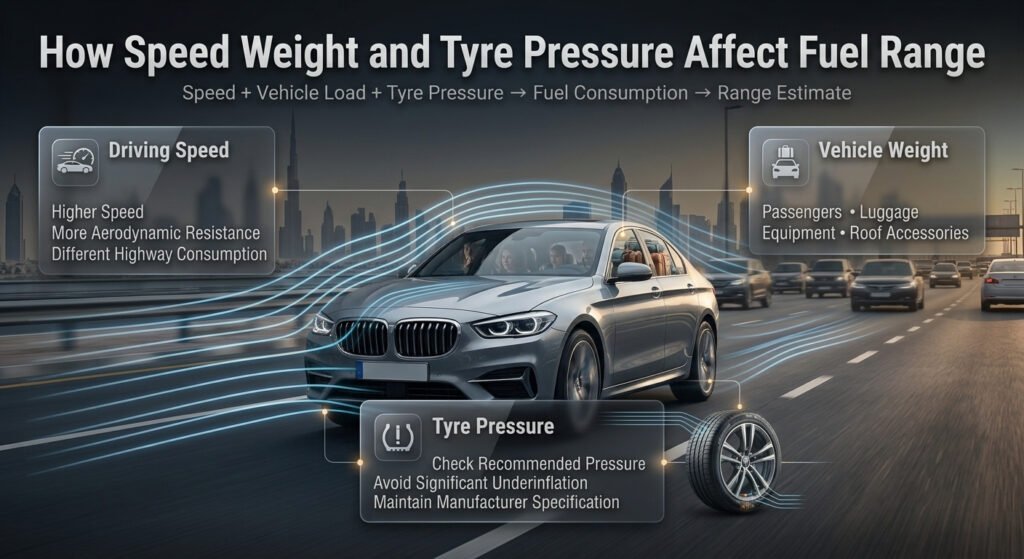
Speed can have a meaningful effect on fuel consumption because aerodynamic resistance increases as vehicle speed rises.
This is particularly relevant on Dubai’s major highways.
A driver might achieve one fuel-economy figure during moderate-speed driving and another during sustained high-speed driving.
If you’re estimating range for a highway trip, use a fuel-consumption figure that resembles your normal highway driving rather than your best city or mixed-driving result.
For longer journeys, resources such as Highway Driving Fuel Efficiency can help you understand how driving behaviour affects fuel use.
The important principle is:
Don’t calculate your highway range using your most optimistic fuel-economy number.
Does Vehicle Weight Affect Fuel Range?
Yes, vehicle load can affect fuel consumption.
A vehicle carrying additional passengers, luggage, equipment, tools, or other unnecessary items may require more energy, especially during repeated acceleration.
This doesn’t mean you should remove necessary equipment or travel without luggage.
It means that a fuel-range calculation should reflect the vehicle as it will actually be driven.
For example, if you normally drive alone but are now carrying several passengers and luggage for a long trip, your normal fuel-economy figure may be less representative.
Before a long journey, consider:
- Passenger weight
- Luggage
- Tools
- Equipment
- Roof-mounted accessories
- Trailer loads, where applicable
A realistic range estimate should always reflect the actual vehicle condition.
Can Tyre Pressure Affect Fuel Range?
Yes.
Tyre pressure can influence rolling resistance and therefore affect fuel consumption.
If tyres are significantly underinflated, the vehicle may require more energy to move.
Before a long journey, check the tyre pressure recommended by the vehicle manufacturer.
Don’t simply overinflate tyres because you believe higher pressure will always improve fuel economy.
The correct approach is to maintain the manufacturer’s recommended pressure.
Good tyre maintenance also supports handling and road safety, which is especially important when travelling longer distances.
How to Estimate Range When Your Car Shows L/100 km
Let’s look at a practical example.
Imagine your dashboard shows:
Fuel consumption: 11 L/100 km
You estimate that:
14 litres remain
Use:
14 ÷ 11 × 100 = 127.3 km
Your theoretical remaining range is approximately:
127 km
Now suppose you’re expecting heavy traffic and believe consumption could increase to 13 L/100 km.
Calculate again:
14 ÷ 13 × 100 = 107.7 km
Your conservative estimate is now approximately:
108 km
If your destination is 100 km away, the trip may still look possible mathematically, but the margin is very small.
That is the point where refuelling becomes the sensible choice.
What Is the Difference Between Theoretical and Practical Range?
This distinction is extremely important.
Theoretical range
The distance calculated from:
Fuel × average consumption
Practical range
The distance you can reasonably expect under the actual conditions you’re about to encounter.
Safe planning range
The distance you are comfortable relying on while keeping enough margin for unexpected changes.
| Range Type | What It Means | Best Use |
|---|---|---|
| Dashboard range | Vehicle’s computer estimate | General reference |
| Theoretical range | Mathematical calculation | Understanding fuel capacity |
| Practical range | Estimate using real conditions | Journey planning |
| Conservative range | Practical range with extra margin | Low-fuel situations |
The mistake many drivers make is treating theoretical range as safe planning range.
They aren’t the same thing.
How Much Safety Margin Should You Keep?
There isn’t one universal number that applies to every vehicle and every journey.
Your safety margin should depend on the circumstances.
A short urban trip with multiple nearby petrol stations is different from a long highway journey where the next convenient refuelling point is far away.
Your margin should become larger when:
- Traffic is unpredictable
- You are travelling a long distance
- You’re unfamiliar with the route
- The weather is extreme
- Your vehicle is heavily loaded
- Your fuel economy is uncertain
- Petrol stations are widely spaced
- You’re already close to the low-fuel warning
The principle is simple:
The more uncertainty you have, the less you should rely on the final part of your theoretical range.
Example: Should You Drive 70 km With 80 km of Range?
This is exactly the type of situation where fuel-range planning matters.
Suppose:
- Dashboard range = 80 km
- Destination = 70 km
You technically appear to have 10 km of margin.
But ask:
- Is traffic currently heavy?
- Is the AC running?
- Is your dashboard estimate based on recent economical driving?
- Are you carrying extra weight?
- Is there a petrol station on the route?
- Could you need to take a detour?
- Is your vehicle’s range display behaving normally?
If the answers are uncertain, relying on that 10 km margin isn’t wise.
A much better decision is to refuel before continuing if a convenient station is available.
Why You Shouldn’t Use Your Best Fuel Economy for Range Planning
Imagine your vehicle normally gets between:
8.5 and 11 km/L
Your best result is 11 km/L.
You have 10 litres remaining.
At 11 km/L:
110 km
But if your current conditions produce 8.5 km/L:
85 km
That’s a 25 km difference.
If you’re 90 km away from your destination, the optimistic calculation says:
“I can probably make it.”
The conservative calculation says:
“I need fuel.”
When the consequence of being wrong is getting stranded, conservative planning is the better approach.
⭐ Expert Tip: Use your lower realistic fuel-economy figure when the trip is important or the fuel level is already low.
What Happens to the Range Display in Heavy Traffic?
Your vehicle may update the displayed range as your fuel consumption changes.
For example:
You start with:
Range: 120 km
After entering severe congestion, you may notice the number dropping more quickly than the distance you’re actually travelling.
This can happen because the vehicle’s estimate is being influenced by changing fuel consumption.
Modern vehicles may use recent driving information to calculate the estimate rather than simply using a fixed lifetime fuel-economy figure. The exact calculation varies by manufacturer and vehicle.
That’s why you shouldn’t assume that the displayed number will always decrease at exactly the same rate as the odometer.
Can the Estimated Range Increase While You’re Driving?
Yes.
This sometimes surprises drivers.
Suppose your vehicle initially shows:
70 km remaining
You then leave heavy traffic and drive smoothly on an open road.
Your fuel consumption improves.
The vehicle may recalculate and show:
75 km
or another higher estimate.
This doesn’t mean fuel has been added to the tank.
It means the computer has revised its prediction based on the latest information.
The same thing can happen in reverse.
If your driving becomes less efficient, the estimated range can fall faster.
Should You Trust the Number After Refuelling?
Give the system time to update.
Different vehicles have different fuel-level and range-estimation systems. Some manufacturer manuals note that adding only a small amount of fuel may not immediately produce a corresponding change in the fuel gauge or Distance-to-Empty calculation.
After refuelling:
- Make sure the vehicle is properly stopped.
- Follow the vehicle’s normal refuelling procedure.
- Allow the dashboard to update.
- Check the range after driving if necessary.
Don’t assume that a small fuel addition will always produce an exact proportional increase in the displayed range.
How to Estimate Remaining Range Before a Long Drive
Before starting a long trip, use this simple process.
Step 1: Check your fuel level
Look at the gauge and DTE display if available.
Step 2: Check your actual fuel economy
Use your recent driving history rather than an ideal figure.
Step 3: Consider the route
Ask whether you’re driving:
- In the city
- Through heavy traffic
- On a highway
- Through mixed conditions
Step 4: Account for AC
Use the consumption you normally experience in similar weather.
Step 5: Consider vehicle load
Passengers and luggage can change the operating conditions.
Step 6: Calculate conservatively
Use a realistic lower-end consumption figure.
Step 7: Identify a refuelling point
Don’t wait until the tank is almost empty.
Step 8: Keep a reserve
Leave yourself room for unexpected delays.
This takes only a few minutes and can prevent a much bigger problem later.
What Should You Do When Your Fuel Range Becomes Very Low?
Once the range becomes critically low, the objective should shift from optimizing fuel economy to getting to a safe refuelling option.
If a petrol station is nearby and accessible, refuel.
If you’re already too far away, don’t keep driving simply because the dashboard still shows a few kilometres.
If your vehicle stops, move it away from active traffic if you can do so safely, switch on the hazard lights, and arrange appropriate assistance.
For a more detailed response, see Emergency Roadside Fuel Advice.
What If Your Car Runs Out of Fuel?
If the engine stops because the tank is empty, safety becomes the first priority.
Move to safety if possible
If the vehicle still has enough momentum and it can be moved safely, position it away from moving traffic.
Use hazard lights
Make the vehicle more visible to approaching drivers.
Don’t stand in active traffic
Avoid walking around unnecessarily, particularly on busy roads.
Share your location
Provide an accurate location, road direction, exit, landmark, or live location where possible.
Confirm the fuel type
Make sure the assistance provider knows whether the vehicle needs petrol or diesel.
For additional guidance, see Car Ran Out of Fuel Safety in Dubai.
If the vehicle is already completely empty, Safely Dealing With an Empty Fuel Tank in Dubai provides further practical safety guidance.
Why You Shouldn’t Walk Along a Highway for Fuel
A common mistake is assuming that walking to the nearest petrol station is the easiest solution.
On a busy road or highway, that can create a much greater safety risk.
Fast-moving traffic, limited pedestrian space, poor visibility, and unfamiliar road layouts can make walking along the roadway dangerous.
If your car has stopped, stay focused on:
- Safe vehicle positioning
- Visibility
- Getting occupants away from immediate traffic exposure
- Communicating your location
- Arranging appropriate roadside help
If you’re specifically dealing with a highway situation, Running Out of Fuel on a Highway provides more focused advice.
How to Estimate Range During Highway Driving
Highway range planning deserves special attention because the consequences of running out of fuel can be more serious.
Before entering a long highway section:
Check your range
Don’t start with an extremely low fuel level.
Use realistic highway economy
Don’t use an unusually good city-driving result.
Identify fuel stops
Know where you can refuel during the journey.
Don’t rely on zero
Never plan around the assumption that the vehicle will continue after the DTE reaches zero.
Watch the range during the trip
If the estimate begins falling faster than expected, adjust your plan.
For broader highway emergency guidance, see Highway Fuel Emergency Safety in Dubai.
You can also review Highway Breakdown Safety Procedures in Dubai to understand what to do if a fuel issue becomes a wider roadside emergency.
What Does a Low-Fuel Warning Mean?
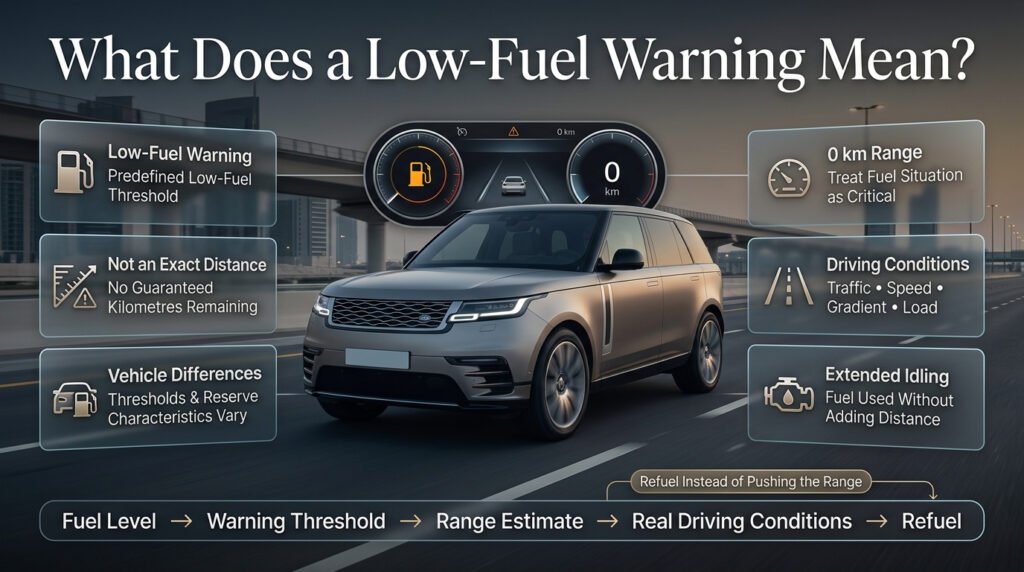
A low-fuel warning indicates that the vehicle has reached a predefined low-fuel threshold.
It does not mean:
“You have exactly X kilometres left.”
The remaining distance depends on the vehicle and driving conditions.
Different vehicles can have different warning thresholds, fuel capacities, and reserve characteristics.
So when the warning appears, the best response is to start thinking about refuelling rather than trying to determine exactly how much further you can push the vehicle.
Can You Drive After the Range Reaches 0 km?
You shouldn’t plan to.
Some vehicles may continue operating for a short distance after the displayed range reaches zero, but there is no universal guaranteed distance.
One vehicle may continue longer than another.
Even the same vehicle may behave differently depending on:
- Traffic
- Speed
- Road gradient
- Fuel consumption
- Vehicle load
- Temperature
- Fuel-level accuracy
Therefore:
0 km means you should treat the fuel situation as critical.
Do not use another driver’s experience of driving 10, 20, or 30 km beyond zero as evidence that your vehicle will do the same.
How Does Idling Affect Fuel Range?
Idling uses fuel even though the vehicle isn’t travelling.
This becomes particularly relevant when you’re stuck in traffic.
If your vehicle is running while stationary for long periods, fuel is being consumed without adding kilometres to the trip.
This can reduce your effective fuel economy.
Understanding Fuel Consumption While Idling can help you understand why extended stationary periods can affect your overall range.
The key point isn’t that every short stop is a major fuel problem.
It’s that repeated or prolonged idling becomes relevant when you’re already operating with a low fuel level.
How Driving Style Can Change Your Remaining Range
Aggressive acceleration can increase fuel consumption.
Repeated hard acceleration followed by heavy braking is especially inefficient in congested conditions.
If your fuel is already low, smooth and predictable driving can help you avoid unnecessary consumption.
Useful habits include:
- Accelerate smoothly
- Avoid unnecessary hard acceleration
- Maintain a steady speed where conditions allow
- Anticipate traffic
- Avoid unnecessary braking and acceleration cycles
- Don’t drive aggressively simply to reach the petrol station faster
For more detail, you can review How Acceleration Affects Fuel Consumption.
How Braking Habits Relate to Fuel Range
Braking itself doesn’t directly consume fuel in the same way acceleration does, but repeated unnecessary acceleration followed by braking wastes the energy you just used to accelerate.
In traffic, constantly moving quickly and then braking can therefore contribute to higher fuel consumption.
If you’re trying to reach a petrol station with limited fuel, smoother traffic anticipation can help.
How Braking Habits Affect Fuel Economy in Dubai provides more detail on how braking patterns connect with overall fuel efficiency.
How Gear Selection Can Affect Fuel Consumption
The gear your vehicle uses can influence engine efficiency, depending on the vehicle and driving conditions.
Modern automatic transmissions generally manage gear selection automatically, but driving behaviour still matters.
Manual transmission drivers should also avoid using unnecessarily high or low gears for the conditions.
For a deeper understanding of this topic, see Gear Shifting and Fuel Economy.
For automatic vehicles, Fuel-Efficient Use of Automatic Transmission covers practical considerations for efficient driving.
The important point for range estimation is that your fuel economy is a result of how the entire vehicle is being operated.
Does Vehicle Aerodynamics Affect Remaining Fuel Range?
Yes.
Aerodynamic drag becomes increasingly important as vehicle speed rises.
Roof racks, external accessories, open windows at higher speeds, and other changes to the vehicle’s aerodynamic profile can affect energy consumption.
This matters most during sustained highway driving.
If your vehicle normally achieves a certain economy without additional aerodynamic accessories, don’t automatically assume it will deliver exactly the same range when the vehicle configuration changes.
For related information, see Vehicle Drag and Fuel Consumption in Dubai and How Aerodynamics Affects Fuel Efficiency.
What Are the Most Common Fuel Range Estimation Mistakes?
Mistake 1: Treating DTE as a guarantee
The number on the dashboard is an estimate.
Better approach: Keep a practical margin.
Mistake 2: Using your best-ever fuel economy
Your best highway economy may not apply in Dubai traffic.
Better approach: Use a realistic average.
Mistake 3: Ignoring traffic
A 30 km route can take much longer in congestion.
Better approach: Consider both distance and expected driving conditions.
Mistake 4: Ignoring AC
Hot-weather driving may not match your mild-weather consumption.
Better approach: Use your normal AC-use economy.
Mistake 5: Waiting until zero
The final part of your theoretical range isn’t a safety reserve you should deliberately consume.
Better approach: Refuel earlier.
Mistake 6: Assuming the gauge is perfectly linear
The gauge doesn’t necessarily correspond precisely to an exact percentage.
Better approach: Use actual refuelling data.
Mistake 7: Ignoring vehicle load
A heavily loaded vehicle can behave differently from an unloaded one.
Better approach: Adjust your expectations.
Mistake 8: Relying on another driver’s experience
Another car may have a different tank, engine, fuel system, and range calculation.
Better approach: Learn your own vehicle.
How Can You Make Your Fuel Range Estimates More Accurate?
The best method is to combine several sources of information rather than relying on only one.
Use your dashboard
It gives you an immediate estimate.
Use your fuel records
They tell you what your vehicle actually achieves.
Consider current conditions
Traffic and temperature matter.
Use conservative assumptions
Especially when fuel is low.
Compare expected distance with available range
Don’t simply look at the number without considering the route.
Maintain the vehicle
Tyres, engine condition, and other mechanical factors can affect fuel consumption.
Recalculate when conditions change
If traffic suddenly becomes severe, your original calculation may no longer be appropriate.
A Practical Fuel Range Planning Example
Imagine you’re driving through Dubai.
Your vehicle has:
- 55-litre tank
- Approximately 12 litres remaining
- Normal economy of 10 km/L
- Heavy traffic expected
Theoretical range:
12 × 10 = 120 km
But based on previous traffic driving, your vehicle may achieve only 8.5 km/L.
Conservative range:
12 × 8.5 = 102 km
Now imagine your destination is 85 km away.
At first glance, 120 km seems comfortable.
But 102 km gives you only a 17 km margin.
If congestion becomes worse, you may have even less.
A smarter decision would be to identify a convenient refuelling point rather than relying on the full theoretical range.
What If the Nearest Petrol Station Is Within Your Estimated Range?
Consider more than distance.
Suppose your car shows:
Range: 60 km
The nearest petrol station is:
45 km away
You technically have 15 km of estimated margin.
But ask:
- Is the station definitely accessible from your route?
- Could traffic significantly delay you?
- Are you certain the DTE reading is behaving normally?
- Is your current consumption worse than the number used by the estimate?
- Could you take a wrong turn?
- Are there alternative stations?
If the margin is small, refuelling at an earlier station is generally the better choice.
How Can You Build a Personal Fuel Range Baseline?
You don’t need to maintain complicated spreadsheets.
A simple record can include:
| Trip | Distance | Fuel Added | Approx. Economy |
|---|---|---|---|
| Trip 1 | 400 km | 40 L | 10 km/L |
| Trip 2 | 450 km | 45 L | 10 km/L |
| Trip 3 | 360 km | 40 L | 9 km/L |
| Trip 4 | 500 km | 48 L | 10.4 km/L |
After several entries, you can see a pattern.
You may discover:
- City average: 8.5–9 km/L
- Mixed driving: 9.5–10 km/L
- Highway: 10–11 km/L
Now you have much better information for future range planning.
If you’re heading into heavy traffic, use the city figure.
If you’re taking a long highway journey, use the highway figure.
This is much more useful than relying on one generic number.
Should You Keep the Tank Above One-Quarter?
There isn’t a universal rule that every driver must follow, but maintaining a reasonable fuel buffer is a sensible habit.
Consumer Reports recommends avoiding excessive reliance on the final portion of the tank and notes that drivers benefit from keeping a meaningful amount of fuel available rather than constantly pushing the range limit.
For everyday Dubai driving, keeping more fuel available can be especially useful when:
- Traffic is unpredictable
- You have long commutes
- You frequently use highways
- You don’t know where the next convenient station is
- You regularly travel long distances
The goal isn’t to keep the tank full at all times.
It’s to avoid making very low fuel a normal driving condition.
What Should You Do If Your Range Estimate Suddenly Drops?
Don’t panic.
First, look at the driving conditions.
If you’ve just entered heavy traffic, the vehicle may be recalculating based on increased consumption.
If the range is falling unusually quickly, check:
- Fuel level
- Recent driving conditions
- Tyre condition
- Driving behaviour
- Route changes
- Whether the vehicle is behaving normally
If you suspect a mechanical problem rather than ordinary fuel consumption, don’t continue driving simply to test how far the fuel will last.
And if the vehicle eventually stops because of an empty tank, follow appropriate roadside safety procedures.
What to Do During a Roadside Breakdown provides broader guidance for safely handling an unexpected stop.
What If Running Out of Fuel Happens on a Busy Road?
A fuel shortage can quickly become a roadside safety issue.
If the vehicle stops:
- Keep calm.
- Move away from active traffic if possible and safe.
- Switch on hazard lights.
- Avoid standing in moving traffic.
- Share your exact location.
- Arrange appropriate roadside assistance.
- Confirm the correct fuel type before delivery.
For additional precautions, see Roadside Breakdown Safety Tips in Dubai.
You can also review What to Do During a Roadside Breakdown for broader breakdown guidance.
How Should You Share Your Location for Fuel Assistance?
When you’re low on fuel or already stranded, an accurate location can save time.
Instead of saying only:
“I’m on Sheikh Zayed Road.”
provide more useful information when possible:
- Road name
- Direction of travel
- Exit number
- Nearby landmark
- Service road
- Shoulder location, where applicable
- Live location
This helps the fuel-delivery provider identify where you actually are.
You should also confirm:
- Petrol or diesel
- Vehicle type
- Any special access issue
- Whether the vehicle is safely positioned
For general roadside precautions, Roadside Vehicle Emergency Precautions provides additional guidance.
How to Avoid Running Out of Fuel in the First Place

The easiest fuel emergency to handle is the one you prevent.
Build a few habits into your normal driving routine.
Don’t wait for zero
Refuel before the tank becomes critically low.
Know your normal economy
Your own historical data is valuable.
Watch the DTE trend
Don’t look at the number only once.
Consider traffic
Dubai congestion can change your fuel consumption considerably.
Plan highway trips
Know where you’ll refuel before starting a long journey.
Keep your vehicle maintained
Tyres and vehicle condition affect efficiency.
Don’t ignore warning signs
If the range is falling unusually fast, investigate rather than simply pushing onward.
Fuel Range Planning for Long-Distance Journeys
Long trips require more planning because you have more kilometres during which conditions can change.
Before departure, check:
- Current fuel level
- Estimated range
- Recent average economy
- Route distance
- Expected traffic
- Planned stops
- Fuel stations along the route
- Vehicle load
- Tyre pressure
For additional long-distance efficiency advice, see Improving Fuel Economy on Long Trips.
You can also review Long-Distance Driving Fuel Efficiency Tips when planning a longer journey.
The goal isn’t to calculate the absolute maximum distance your vehicle can travel.
The goal is to know when you should stop for fuel before the situation becomes urgent.
Why Smooth Driving Helps When Fuel Is Low
If you’re already approaching a petrol station with limited fuel, smooth driving can reduce unnecessary fuel consumption.
That means:
- Avoid unnecessary hard acceleration
- Maintain a steady pace where practical
- Anticipate traffic
- Avoid unnecessary braking
- Don’t race between traffic lights
- Follow safe speed limits
For more detailed efficiency advice, Fuel Saving Driving Tips provides broader guidance.
Similarly, Smooth Driving Techniques for Better Fuel Economy explains how smoother driving can support more consistent fuel consumption.
How Does Optimal Speed Affect Fuel Range?
There isn’t one speed that maximizes economy for every vehicle and road.
However, unnecessary high speeds can increase aerodynamic drag and fuel consumption.
When estimating range, consider the speed you actually expect to maintain.
For more information, see Optimal Driving Speed for Fuel Efficiency in Dubai.
The important lesson is:
A range estimate is only useful when the assumptions behind it resemble the journey you’re actually about to make.
What Are the Key Signs That You Should Refuel Now?
You should strongly consider refuelling when:
- The low-fuel warning has appeared.
- Your DTE is falling rapidly.
- Your destination is close to your estimated maximum range.
- Traffic is becoming heavier.
- You are entering a highway.
- You’re travelling somewhere unfamiliar.
- The next petrol station isn’t clearly accessible.
- Your vehicle’s fuel economy has recently worsened.
- You don’t trust the fuel gauge or DTE reading.
If you’re thinking, “I might make it if everything goes perfectly,” that’s usually a good indication that you should refuel.
What If You Don’t Trust Your Fuel Gauge?
If your fuel gauge has become unreliable, don’t make it your only source of information.
Instead:
Start with a known fuel level
Fill the tank when practical.
Reset the trip meter
Create a clear distance reference.
Record fuel added
Write down how many litres you put in.
Calculate actual consumption
Compare kilometres travelled with litres added.
Track the pattern
Repeat the process over several refuelling cycles.
This can reveal whether the vehicle is consistently achieving the economy you expect.
If you suspect the gauge itself is inaccurate, How Accurate Is a Car Fuel Gauge? is particularly relevant.
Remaining Fuel Range vs Fuel Consumption
These terms are related but not identical.
Fuel consumption tells you how much fuel the vehicle uses.
Fuel range tells you approximately how far the remaining fuel can take you.
For example:
Fuel consumption: 10 L/100 km
Fuel remaining: 20 L
Therefore:
20 ÷ 10 × 100 = 200 km
If your consumption increases to 12 L/100 km:
20 ÷ 12 × 100 = 167 km
The tank contains the same 20 litres, but your available range has changed.
That’s why fuel consumption is one of the most important inputs when estimating range.
Can Vehicle Condition Affect Range?
Yes.
A vehicle that isn’t operating efficiently may consume more fuel than usual.
Potential factors can include:
- Tyre pressure
- Engine condition
- Brake drag
- Air filter condition
- Alignment issues
- Faulty sensors
- Excessive vehicle load
- Aerodynamic changes
You don’t need to diagnose a mechanical fault every time fuel economy changes slightly.
But if consumption changes dramatically without an obvious reason, it may be worth having the vehicle inspected.
A Simple Formula You Can Save
For km/L:
Remaining range = litres remaining × km/L
For L/100 km:
Remaining range = litres remaining ÷ L/100 km × 100
Example
10 litres remaining
9 km/L
10 × 9 = 90 km
Then adjust your expectations for:
- Traffic
- AC
- Speed
- Load
- Road conditions
- Driving style
The final decision should always be based on the practical range, not simply the mathematical maximum.
How Do I Calculate How Much Fuel Range I Have Left?
The easiest way to estimate your remaining fuel range is to combine the amount of fuel left in the tank with your vehicle’s real-world fuel economy. For example, if you have approximately 10 litres remaining and your car normally achieves 10 km per litre, the theoretical range is around 100 km. However, you shouldn’t treat that 100 km as a guaranteed distance. Traffic, air conditioning, driving speed, vehicle load, road conditions, and driving habits can all increase fuel consumption.
For a more realistic estimate, use the fuel economy your vehicle normally achieves under conditions similar to your current journey rather than using its best-ever mileage.
Practical points:
Use Remaining Fuel × Realistic km/L for a basic calculation.
If your vehicle shows L/100 km, use Fuel Remaining ÷ L/100 km × 100.
Base your calculation on recent real-world fuel consumption.
Use a more conservative figure when traffic or AC use is expected to be high.
Keep a safety margin instead of planning to use every kilometre of your calculated range.
How Accurate Is the Distance-to-Empty Reading on a Car?
The Distance-to-Empty reading is helpful for understanding your approximate remaining range, but it shouldn’t be treated as a guaranteed distance. Your vehicle calculates the figure using fuel-level information and fuel-consumption data, and the estimate can change as driving conditions change. For example, a car showing 100 km of range after efficient highway driving may show a lower estimate after entering heavy traffic because fuel consumption has increased.
This is particularly important in Dubai, where congestion, high temperatures, continuous air-conditioning use, and highway speeds can create very different fuel-consumption conditions during the same journey.
Practical points:
Treat Distance-to-Empty as a planning estimate, not a promise.
Don’t assume the displayed number will always decrease at the same rate as your odometer.
Heavy traffic can make the estimated range fall faster.
More efficient driving can sometimes cause the displayed range to increase.
Don’t deliberately drive until the display reaches zero.
Leave additional fuel margin when the journey involves unpredictable traffic or long distances.
How Can I Estimate Remaining Fuel Range Without a Distance-to-Empty Display?
If your vehicle doesn’t have a Distance-to-Empty display, you can still estimate your remaining range by combining the fuel-tank capacity, approximate fuel level, and actual fuel economy. For example, if your car has a 60-litre tank and the gauge appears to show approximately one-quarter remaining, you could roughly estimate 15 litres. If your real-world fuel economy is 10 km/L, the theoretical range would be around 150 km.
However, a traditional fuel gauge isn’t designed to provide a precise litre measurement. The shape of the fuel tank, vehicle position, fuel-level sensor, and gauge calibration can all affect the reading. For better accuracy, track your kilometres and fuel added over several refuelling cycles.
Practical points:
Check your vehicle’s total fuel-tank capacity.
Treat the fuel gauge as an approximate indication.
Record how many kilometres you travel between refuelling stops.
Record how many litres you add during each refill.
Calculate your actual km/L over several trips.
Use your personal fuel-consumption history whenever possible.
Be more conservative when the fuel level becomes very low.
How Do Traffic, Air Conditioning, and Driving Speed Affect Remaining Fuel Range?
Your remaining fuel range can change when your driving conditions change. A vehicle that achieves good fuel economy on an open road may consume considerably more fuel in stop-and-go traffic, during repeated acceleration, or at higher speeds. Air conditioning can also contribute to fuel consumption, which is particularly relevant for Dubai drivers because AC use is often necessary during hot weather.
This is why using your most optimistic fuel-economy figure can give you a misleading range estimate. If you’re driving through congestion, carrying additional weight, using the AC continuously, or travelling at higher speeds, it’s better to calculate your expected range using a more conservative figure.
Practical points:
Heavy stop-and-go traffic can increase fuel consumption.
Frequent acceleration and braking can reduce efficiency.
Higher speeds can increase aerodynamic resistance.
Continuous AC use can affect overall fuel consumption.
Extra passengers and luggage can reduce practical range.
Use the fuel economy you normally achieve under similar conditions.
Recalculate your expectations if driving conditions suddenly become worse.
What Should I Do If My Remaining Fuel Range Is Too Low to Reach a Petrol Station?
When the estimated range is close to the distance you need to travel, don’t assume the calculation will work perfectly. A small difference between your remaining range and the distance to a petrol station leaves little room for traffic, route changes, increased fuel consumption, or unexpected delays. If a petrol station is safely accessible before your fuel becomes critically low, refuelling early is the smarter choice.
If you’re already too far from a petrol station or your vehicle has stopped because it has run out of fuel, the priority should shift from fuel economy to roadside safety. Move the vehicle away from active traffic if you can do so safely, switch on the hazard lights, avoid walking along a busy road or highway, and arrange appropriate roadside fuel assistance. When requesting help, provide your road name, direction, nearby exit or landmark, and confirm whether the vehicle requires petrol or diesel.
Practical points:
Don’t deliberately drive until the range reaches zero.
Refuel early when your available margin is small.
If the vehicle stops, prioritize a safe position rather than walking for fuel.
Switch on hazard lights to improve visibility.
Stay away from active traffic where possible.
Share your live location or accurate roadside position.
Confirm the correct fuel type before requesting fuel delivery.
Take extra precautions when stopped on a highway because of fast-moving traffic.
Conclusion
Estimating your remaining fuel range is useful for making better driving decisions, but it should always be treated as an estimate rather than an exact promise. Your actual range depends on how much fuel remains, your vehicle’s real-world fuel economy, traffic conditions, driving speed, air-conditioning use, vehicle load, road conditions, and driving habits.
For drivers in Dubai, keeping a reasonable fuel reserve is especially important when travelling through heavy traffic or taking longer highway journeys. Instead of waiting until the fuel warning appears or the Distance-to-Empty figure becomes extremely low, use your recent fuel-consumption history to plan ahead and refuel with enough margin.
If your fuel range becomes critically low, focus on reaching a safe place rather than trying to maximize every remaining kilometre. And if the vehicle eventually runs out of fuel, prioritize roadside safety, make your location clear, confirm the required fuel type, and arrange appropriate assistance rather than walking along a busy road or highway.
A little fuel planning can prevent an inconvenient situation from becoming a roadside emergency.
Leave a Reply