Introduction
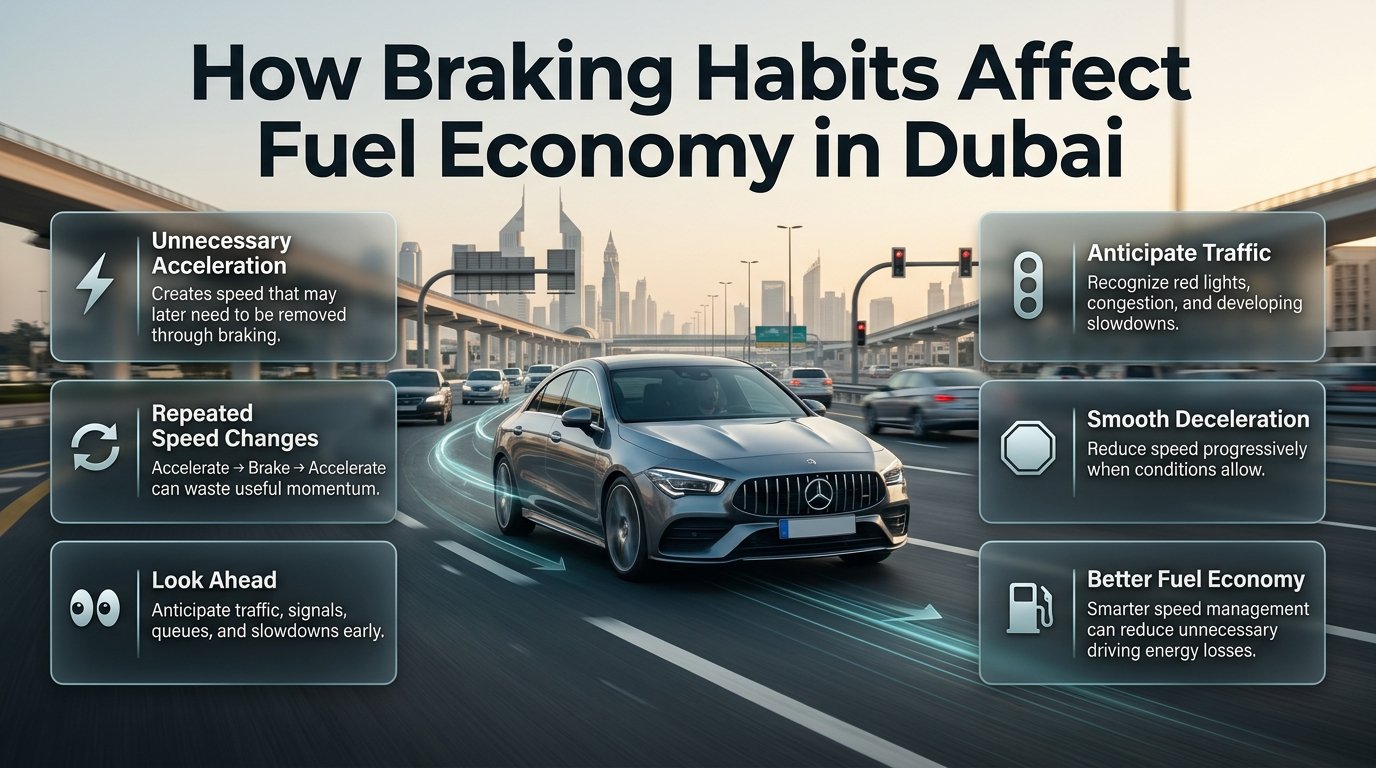
How Braking Habits Affect Fuel Economy in Dubai | You press the accelerator, the car gains speed, and everything feels normal. Then traffic begins to slow, a red light appears ahead, or another vehicle changes lanes, so you apply the brakes. A few seconds later, traffic starts moving again and you accelerate once more. This cycle can happen dozens of times during an ordinary journey, yet many drivers rarely consider how repeated changes in speed can influence fuel consumption.
Understanding how braking habits affect fuel economy starts with recognizing that braking does not use fuel directly in the same way acceleration does. Instead, the connection comes from the relationship between acceleration, vehicle momentum, speed, and deceleration. When you use fuel to build unnecessary speed and then remove that speed by braking, the vehicle may need additional fuel to regain its momentum afterward.
For drivers in Dubai, where traffic signals, congestion, multilane roads, roundabouts, and frequent changes in traffic flow are common, learning to manage speed more intelligently can make everyday driving smoother and more efficient. Anticipating traffic conditions, maintaining an appropriate following distance, and avoiding unnecessary acceleration can reduce the need for repeated braking and acceleration. If you need practical roadside fuel support in Dubai, Fuel at My Location Dubai 👉 Fuel Delivery Dubai can be a useful resource.
The goal of this guide is not to suggest that drivers should avoid braking or delay braking when safety requires it. Safe braking must always come first. Instead, the focus is on identifying unnecessary braking, understanding what causes repeated speed changes, Optimal Driving Speed for Fuel Efficiency in Dubaiand developing smoother driving habits that can help reduce wasted energy without compromising road safety.
By understanding the connection between braking, acceleration, traffic awareness, and fuel consumption, Dubai drivers can make better decisions behind the wheel while creating a smoother and potentially more economical driving experience.
Does Braking Directly Use Fuel?
Braking itself generally doesn’t consume fuel in the same way acceleration does. The more important issue is what happens to the energy your engine has already used to move the vehicle.
When a vehicle accelerates, fuel energy is converted into mechanical energy that increases the vehicle’s speed. Once the vehicle is moving, it has kinetic energy.
When conventional brakes are applied, much of that kinetic energy is converted into heat through friction and released through the braking system.
The basic relationship is:
Fuel energy → acceleration → vehicle movement → braking → energy lost → acceleration again
If you accelerate again after braking, the engine has to provide additional energy to restore the vehicle’s speed.
That’s why repeated unnecessary braking can be associated with higher fuel consumption.
Fuel-Saving Driving Tips
Fuel-saving driving tips can help drivers reduce unnecessary fuel consumption and make everyday journeys more economical. Smooth acceleration, gradual braking, maintaining a steady speed, and avoiding unnecessary idling can improve overall fuel efficiency. Drivers should also keep tires properly inflated, remove unnecessary weight, and avoid excessive speeds that increase aerodynamic drag. In Dubai, where traffic congestion, hot weather, and frequent highway driving can affect fuel use, combining efficient driving habits with regular vehicle maintenance can help reduce fuel waste and support better long-term fuel economy.
For practical strategies to reduce fuel consumption through smoother driving, better speed control, reduced idling, proper tire pressure, and smarter daily driving habits, explore our detailed Fuel-Saving Driving Tips guide.
How Acceleration Affects Fuel Consumption in Dubai
Acceleration has a direct impact on fuel consumption, especially when drivers frequently accelerate hard or increase speed quickly in busy Dubai traffic. Rapid acceleration requires the engine to produce more power, which can increase fuel use compared with gradual and controlled acceleration. Frequent stop-and-go driving can make this effect more noticeable because the vehicle repeatedly uses extra energy to regain speed after each stop. For better fuel economy, accelerate smoothly, maintain a safe and consistent pace, and anticipate traffic conditions to avoid unnecessary speed changes.
For a practical understanding of how rapid acceleration, frequent speed changes, and stop-and-go traffic can increase fuel consumption, explore our detailed How Acceleration Affects Fuel Consumption in Dubai guide and learn how smoother acceleration can support better fuel economy.
A simple real-world example
Imagine you’re travelling at 60 km/h and can already see a traffic queue several hundred metres ahead.
You continue accelerating because the road immediately in front of you is clear. Your speed reaches 75 or 80 km/h, but the queue doesn’t move. You then brake firmly.
The extra speed didn’t provide much useful progress.
You created additional momentum and then removed it.
Now imagine noticing the queue earlier. Instead of continuing to accelerate, you release the accelerator and allow the vehicle to reduce speed naturally where appropriate. You may still need to brake, but you’re no longer carrying unnecessary speed toward the queue.
The important lesson is simple:
Braking isn’t necessarily the wasteful action. Unnecessary acceleration followed by braking is the bigger issue.
Why Does Aggressive Braking Often Go With Poor Fuel Economy?
Aggressive braking is frequently the final part of a larger driving pattern.
A driver who brakes hard on a regular basis may also:
- Accelerate aggressively.
- Follow vehicles too closely.
- Drive faster than the traffic requires.
- React late to changing traffic.
- Ignore traffic signals until approaching them.
- Chase small gaps.
- Change lanes frequently.
- Focus only on the vehicle immediately ahead.
These behaviors create repeated changes in vehicle speed.
Consider two drivers approaching the same red traffic light.
Driver A
Driver A sees that the road ahead is clear and accelerates. The traffic light is red, but the driver continues at the same speed until close to the intersection. The brakes are then applied firmly.
Driver B
Driver B sees the red signal from farther away. The accelerator is released earlier, speed is reduced progressively, and braking is used when necessary.
Both drivers may stop at exactly the same traffic light.
The difference is that Driver A created unnecessary speed before stopping.
Driver B managed speed earlier.
This illustrates an important principle:
Good fuel economy is often the result of good speed management rather than simply good braking.
How Vehicle Momentum Affects Fuel Economy

Momentum is one of the most useful concepts when thinking about fuel-efficient driving.
A moving vehicle already has energy associated with its motion. If road conditions allow you to maintain that movement safely, you don’t need to repeatedly use engine power to recreate speed that you unnecessarily removed.
This doesn’t mean momentum should always be preserved.
Sometimes you need to stop.
Sometimes traffic requires a significant reduction in speed.
Sometimes a hazard means you must brake immediately.
The important distinction is between necessary deceleration and avoidable speed loss.
An inefficient driving cycle
Accelerate → gain unnecessary speed → brake → slow down → accelerate again
A smoother driving cycle
Observe → accelerate appropriately → maintain useful speed → anticipate → decelerate smoothly → continue or stop
The second pattern generally involves fewer unnecessary energy changes.
What Is Anticipatory Driving?
Anticipatory driving means looking ahead and recognizing what is likely to happen before it becomes an immediate problem.
It’s one of the most valuable habits for improving braking behavior.
Instead of focusing only on the car directly in front of you, look farther ahead whenever visibility and traffic conditions allow.
You may see:
- A red traffic signal.
- A line of stopped vehicles.
- Several cars slowing.
- A pedestrian crossing.
- A bus preparing to stop.
- A vehicle turning.
- A roundabout becoming congested.
- Roadworks.
- A lane closure.
- A speed hump.
- Vehicles merging.
- Traffic building near an intersection.
The earlier you recognize a slowdown, the more time you have to manage your speed.
Why anticipation matters
Suppose six vehicles ahead begin slowing.
If you’re watching only the vehicle immediately in front of you, you may notice the problem late.
By the time the nearest vehicle brakes, you may have to brake too.
If you’re already aware that traffic farther ahead is slowing, you can stop accelerating earlier and allow the situation to develop.
That can reduce unnecessary braking.
Pro Tip: Look beyond the vehicle directly in front of you. Good observation gives you more time to make gradual decisions instead of sudden ones.
Roof Racks and Fuel Economy in Dubai
Roof racks can affect fuel economy by increasing a vehicle’s aerodynamic drag, particularly when driving at higher speeds on Dubai’s highways. Even when the rack is not carrying cargo, its added exposure to airflow can create additional resistance, which may require more engine power to maintain speed. The effect can become greater when carrying bulky items such as bicycles, luggage, or roof boxes. If a roof rack is not needed for a particular journey, removing it can help keep the vehicle more aerodynamic. For regular users, choosing a streamlined design, securing cargo properly, and avoiding unnecessary weight can support better fuel efficiency.
If you regularly use a roof rack for luggage, bicycles, or other equipment, our detailed Roof Racks and Fuel Economy in Dubai guide explains how roof-mounted accessories can increase aerodynamic drag and influence fuel consumption, especially during highway driving.
How Following Distance Affects Braking and Fuel Economy
Following distance is usually discussed in relation to safety, but it also affects driving smoothness.
When you follow too closely, small changes in the vehicle ahead can force you to make larger changes in your own speed.
The car ahead slows slightly.
You brake.
It accelerates.
You accelerate.
It slows again.
You brake again.
This repeated cycle can make your driving less efficient.
A reasonable following distance gives you more time to respond.
Instead of immediately pressing the brake pedal, you may have enough space to release the accelerator and allow the vehicle to slow gradually.
A suitable gap can provide:
- More reaction time.
- Better visibility.
- Smoother deceleration.
- Fewer unnecessary speed changes.
- More comfortable driving.
- Better control in changing traffic.
The correct following distance depends on speed, weather, visibility, road conditions, and traffic.
Don’t treat one fixed distance as appropriate for every situation.
The principle is simple:
Give yourself enough space to respond safely and smoothly.
How Aerodynamics Affects Fuel Efficiency
Aerodynamics plays an important role in fuel efficiency, especially when a vehicle is traveling at higher speeds. As speed increases, air resistance creates more drag, requiring the engine to use additional energy to keep the vehicle moving. Features such as roof racks, cargo boxes, open windows, and bulky external accessories can increase aerodynamic drag and contribute to higher fuel consumption. Keeping the vehicle streamlined, removing unnecessary external equipment, and maintaining a sensible highway speed can help reduce resistance and support more efficient driving.
For a clearer understanding of how air resistance, vehicle design, speed, roof accessories, and external load can influence your car’s fuel consumption, explore our detailed How Aerodynamics Affects Fuel Efficiency guide.
Vehicle Drag and Fuel Consumption in Dubai
Vehicle drag can have a significant effect on fuel consumption, particularly as driving speed increases. Aerodynamic resistance becomes more noticeable on highways, meaning vehicles may need more engine power to maintain higher speeds. Roof racks, cargo boxes, open windows at high speeds, and bulky external accessories can increase drag and reduce efficiency further. In Dubai, where drivers often use high-speed roads for longer journeys, keeping the vehicle streamlined and removing unnecessary external equipment can help reduce aerodynamic resistance. Combining good aerodynamics with moderate speeds and smooth driving can support better overall fuel economy.
For a deeper understanding of how aerodynamic resistance, driving speed, roof equipment, external cargo, wind, and vehicle design can influence fuel consumption, explore our detailed Vehicle Drag and Fuel Consumption in Dubai guide.
Fuel-Efficient Use of Automatic Transmission
Using an automatic transmission efficiently can help reduce unnecessary fuel consumption, especially during Dubai’s busy traffic and frequent stop-and-go driving. Avoid aggressive acceleration, sudden braking, and repeatedly switching between Drive and other gears when it is not necessary. When waiting for longer periods, follow the vehicle manufacturer’s guidance rather than keeping the engine unnecessarily engaged. Regular transmission maintenance and using the correct manufacturer-recommended fluid can also support smooth gear changes and efficient vehicle operation. The key is to let the transmission work naturally while maintaining a smooth, predictable driving style.
For practical guidance on using an automatic transmission more efficiently, including smooth acceleration, proper gear modes, traffic management, and highway driving habits, explore our detailed Fuel-Efficient Use of Automatic Transmission guide.
Gear Shifting and Fuel Economy in Dubai
Gear shifting has a direct impact on how efficiently a vehicle uses fuel, particularly in Dubai’s busy traffic and changing road conditions. Driving in the appropriate gear helps keep the engine operating within an efficient range, while unnecessarily high engine speeds or using the wrong gear can increase fuel consumption. Manual drivers can improve efficiency by shifting smoothly and selecting the appropriate gear for their speed and road conditions. Automatic transmissions generally manage gear changes themselves, but smooth acceleration and avoiding unnecessary aggressive driving can still support better fuel economy.
For a practical understanding of how to choose the right gear, avoid unnecessary engine strain, and improve fuel efficiency in Dubai’s city traffic and highway conditions, read our detailed Gear Shifting and Fuel Economy in Dubai guide.
Does Gentle Braking Improve Fuel Economy?
Gentle braking can support better fuel economy when it results from early anticipation.
However, gentle braking should never mean delayed braking.
If you see a hazard that requires immediate action, brake appropriately.
The fuel-saving opportunity exists when you have enough distance and visibility to reduce speed gradually.
Example: Approaching a red light
A reactive approach looks like this:
Maintain speed → approach queue → brake hard → stop
A more anticipatory approach looks like this:
Observe → release accelerator → reduce speed → brake progressively → stop
The second approach may reduce unnecessary speed before braking.
The key isn’t how softly you press the brake pedal.
The key is how early you recognize the need to slow down.
Why Acceleration After Braking Matters
The relationship between braking and fuel consumption becomes clearer when you look at what happens immediately afterward.
Imagine you brake from 70 km/h to 40 km/h.
If the road opens and you immediately accelerate hard back to 70 km/h, your engine needs to provide energy to restore the vehicle’s speed.
Now imagine you had anticipated the slowdown and reduced speed earlier.
You may not have needed to lose as much speed in the first place.
This is why braking and acceleration should be considered as one system.
Acceleration creates vehicle speed.
Braking removes vehicle speed.
Anticipation manages the transition between the two.
If you want to understand the acceleration side of the equation in more detail, 👉 How Acceleration Affects Fuel Consumption in Dubai explains how throttle behavior, aggressive acceleration, and speed changes can influence fuel consumption.
How Traffic Lights Affect Fuel Economy
Traffic lights are predictable road features, which means they provide an opportunity to improve anticipation.
If you can see a red light from a distance, you already have useful information.
You know that you may need to stop.
Instead of continuing to accelerate toward it, you can assess:
- How far away the intersection is.
- Whether vehicles are already stopped.
- Whether traffic is slowing.
- Whether the signal may change.
- Whether there is enough space to reduce speed smoothly.
This doesn’t mean trying to predict traffic signals perfectly.
It simply means avoiding unnecessary acceleration when a stop is already likely.
What if the light turns green?
If the signal changes before you reach the intersection and traffic begins moving, you may be able to continue without coming to a complete stop.
That can be more efficient than:
Accelerate → brake → stop → accelerate again
But never speed up to catch a light or change your driving behavior in a way that compromises safety or traffic-law compliance.
Vehicle Accessories and Fuel Economy
Vehicle accessories and fuel economy are closely connected because certain add-ons can increase aerodynamic drag, vehicle weight, or electrical load. Roof racks, cargo boxes, oversized accessories, and other external equipment may make the engine work harder, especially during highway driving. Even small changes can affect fuel consumption when they are used regularly. For better efficiency, remove unnecessary accessories when they are not needed, keep external equipment streamlined, and avoid carrying extra weight without a purpose. In Dubai, where long highway journeys and high-speed driving are common, choosing practical accessories and maintaining the vehicle properly can help support better overall fuel economy.
For a practical guide on how roof racks, cargo boxes, extra weight, larger wheels, and other accessories can influence fuel consumption, read our detailed Vehicle Accessories and Fuel Economy in Dubai guide before choosing or removing accessories from your vehicle.
Does Stop-and-Go Traffic Increase Fuel Consumption?
Stop-and-go traffic can make fuel economy worse because it repeatedly interrupts vehicle momentum.
The basic cycle is:
Start → accelerate → move → brake → stop → accelerate again
Each stop removes the vehicle’s previous momentum.
When traffic begins moving, the engine must provide energy to accelerate the vehicle again.
If this happens repeatedly, fuel consumption can rise.
Tire Pressure and Fuel Efficiency
Tire pressure plays an important role in fuel efficiency because underinflated tires create greater rolling resistance, forcing the engine to work harder and potentially increasing fuel consumption. Maintaining the recommended tire pressure can help your vehicle roll more efficiently while also supporting better handling, braking, and tire wear. In Dubai’s hot climate, checking tire pressure regularly is especially useful because temperature changes can affect pressure readings. Always follow the vehicle manufacturer’s recommended pressure rather than relying on the maximum pressure printed on the tire sidewall.
For practical guidance on maintaining the correct tire pressure, reducing unnecessary rolling resistance, and supporting better fuel economy in Dubai’s driving conditions, read our detailed Tire Pressure and Fuel Efficiency guide.
Stop and Go Driving Fuel Efficiency
Stop and go driving fuel efficiency can be significantly affected by repeated acceleration, braking, and short periods of idling. Every time a vehicle moves from a complete stop, the engine requires additional energy to accelerate, especially in heavy traffic. Frequent braking also wastes momentum that could otherwise help maintain efficient movement. A smoother approach is to anticipate traffic, maintain a safe following distance, and avoid unnecessary speed changes whenever conditions allow. Reducing aggressive driving in congested areas can help lower fuel consumption and make daily driving more economical.
For practical ways to handle repeated stops and starts while using less fuel, 👉 Stop and Go Driving Fuel Efficiency provides a helpful guide.
Why city traffic is difficult
Urban driving can involve:
- Traffic signals.
- Congestion.
- Junctions.
- Roundabouts.
- Pedestrian crossings.
- Buses.
- Delivery vehicles.
- Lane changes.
- Short gaps.
- Frequent speed limits.
Not all of these can be controlled by the driver.
However, your reaction to them can be controlled.
A better response to congestion
When traffic is moving slowly, don’t feel that you need to accelerate aggressively toward every available gap.
How to Reduce Fuel Use in Traffic
How to reduce fuel use in traffic starts with smoother acceleration, controlled braking, and avoiding unnecessary idling. Keep a safe following distance so you can respond gradually to changing traffic instead of repeatedly accelerating and braking. When traffic is temporarily stopped, avoid unnecessary engine idling whenever it is safe and practical. Planning your route around severe congestion can also reduce time spent in stop-and-go conditions. These simple habits can make daily driving more efficient while reducing unnecessary fuel consumption.
For practical strategies to save fuel during congested journeys, 👉 How to Reduce Fuel Use in Traffic offers useful driving guidance.
Instead:
- Look farther ahead.
- Maintain an appropriate gap.
- Accelerate progressively.
- Avoid unnecessary lane changes.
- Expect traffic to slow again.
- Reduce speed early when appropriate.
Sometimes moving slightly more steadily through a congested section can result in fewer unnecessary speed changes.
How Traffic Affects Fuel Economy
How traffic affects fuel economy is closely linked to frequent stopping, starting, and prolonged idling. Heavy congestion forces the engine to repeatedly accelerate from low speeds, which can consume more fuel than smooth, steady driving. Stop-and-go traffic also reduces the distance covered while the engine continues running, making each litre of fuel less productive. Maintaining a safe following distance and anticipating traffic flow can help reduce unnecessary braking and acceleration. In Dubai, planning routes and avoiding severe congestion when practical can further support better fuel efficiency.
For practical tips on managing congestion and reducing unnecessary fuel use, 👉 How Traffic Affects Fuel Economy in Dubai offers a useful guide.
Should You Maintain Momentum in Heavy Traffic?
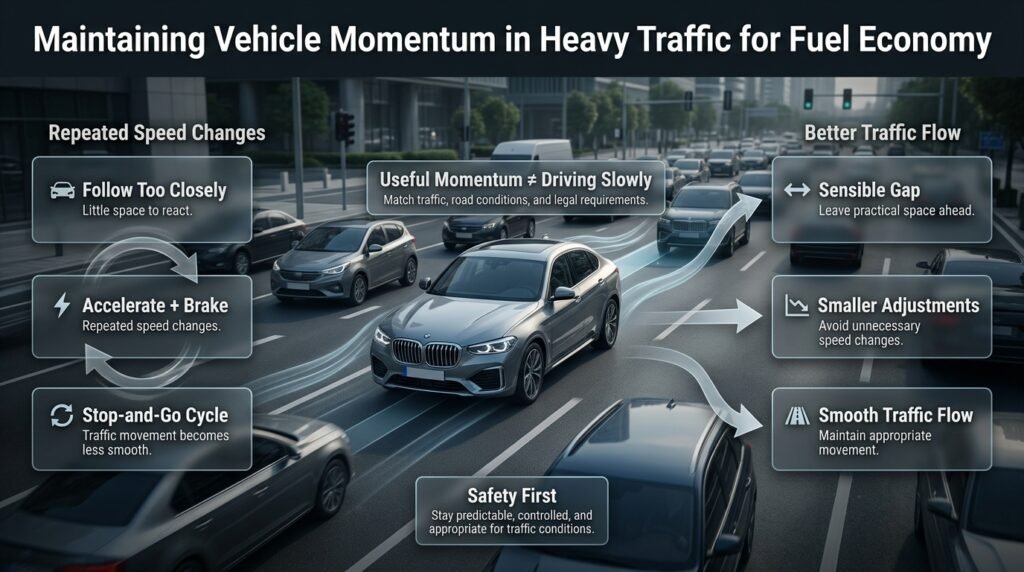
When traffic is moving, maintaining useful momentum can be more efficient than repeatedly racing toward the vehicle ahead and stopping.
Suppose vehicles are moving at 20 km/h.
One driver follows closely and repeatedly presses the accelerator and brake.
Another driver maintains a sensible gap and allows traffic movement to develop.
The second driver may be able to make smaller speed adjustments.
Maintaining momentum doesn’t mean driving slowly
Fuel-efficient driving isn’t about becoming an obstacle for other road users.
You should maintain an appropriate speed for the road, traffic, and legal requirements.
The aim is to avoid unnecessary changes in speed while remaining predictable and safe.
Does Engine Braking Save Fuel?
Engine braking occurs when you release the accelerator while the vehicle remains in gear, allowing the drivetrain and engine to contribute to deceleration.
Modern fuel-injected vehicles may reduce or temporarily stop fuel injection during certain closed-throttle deceleration conditions.
The exact behavior varies between vehicles.
Factors can include:
- Engine design.
- Transmission type.
- Engine temperature.
- Vehicle speed.
- Selected gear.
- Engine-management software.
- Operating conditions.
Engine braking can therefore be useful, but it shouldn’t be treated as a guaranteed fuel-saving trick.
When engine braking can be useful
It can help during:
- Long downhill sections.
- Controlled speed reductions.
- Approaches to slower traffic.
- Winding roads.
- Situations where you want to reduce service-brake use.
However, if you need to stop quickly, use the brakes.
Expert Tip: Engine braking is best understood as a speed-control tool that can complement normal braking. It isn’t a substitute for the brake pedal when a prompt stop is required.
Is Coasting in Neutral More Fuel Efficient?
Neutral coasting is often promoted as a fuel-saving technique, but it isn’t automatically more efficient in modern vehicles.
When you release the accelerator while remaining in gear, the engine-management system may reduce fuel delivery during certain deceleration conditions.
When you shift into neutral, the engine may continue operating at idle.
The exact fuel consumption depends on the vehicle.
There is also a control issue.
Remaining in an appropriate gear keeps the drivetrain connected and can provide engine braking.
Practical advice
Don’t shift into neutral simply because someone claims it always saves fuel.
Instead, focus on habits that are useful across almost every vehicle:
- Anticipate traffic.
- Avoid unnecessary acceleration.
- Maintain a sensible speed.
- Decelerate smoothly.
- Brake when required.
- Follow manufacturer recommendations.
These habits provide a more reliable foundation for efficient driving.
Does Braking Less Always Mean Better Fuel Economy?
No.
This is an important point because some fuel-saving advice can be misunderstood.
You should never try to minimize brake use regardless of circumstances.
Necessary braking is good driving.
Unnecessary braking is what you want to reduce.
You should brake when:
- A hazard appears.
- Traffic slows.
- A pedestrian crosses.
- A traffic signal requires a stop.
- A vehicle changes direction unexpectedly.
- Road conditions require a lower speed.
- You need to maintain a safe following distance.
- An emergency occurs.
The correct question isn’t:
“How can I use my brakes less?”
It’s:
“How can I avoid creating unnecessary speed that I’ll later need to remove?”
That mindset encourages safer and more efficient decisions.
Braking Habits in City Driving
City driving provides frequent opportunities to practice better braking habits.
Traffic may change quickly.
You might have an open road one moment and a stopped queue a few seconds later.
Look ahead
Don’t wait until the nearest vehicle brakes.
Watch the larger traffic pattern.
Read traffic signals
A red signal visible ahead gives you time to adjust.
Avoid racing between intersections
Accelerating aggressively toward the next signal may not save meaningful time.
Maintain an appropriate gap
This provides more time to respond.
Avoid unnecessary lane changes
Frequent lane changes can create extra acceleration and braking.
Stay patient in congestion
Trying to gain a few car lengths can create repeated speed changes without significantly reducing your overall journey time.
For a broader set of practical techniques that complement better braking habits, 👉 Fuel-Saving Driving Tips can help you build a more complete fuel-efficient driving routine.
Braking Habits on Highways
Highway driving usually provides longer periods of relatively steady movement.
Highway Driving Fuel Efficiency
Highway driving fuel efficiency depends largely on maintaining a steady speed, avoiding unnecessary acceleration, and minimizing sudden braking. Constant speed helps the engine operate more efficiently, while aggressive driving can increase fuel consumption. Using cruise control where appropriate and maintaining properly inflated tires can also support better economy on longer journeys. Avoiding excessive speed is important because aerodynamic resistance rises as speed increases. By combining smooth driving with good vehicle maintenance, drivers can improve fuel efficiency and get more useful distance from every litre of fuel.
For practical tips on maintaining better fuel economy during longer highway journeys, 👉 Highway Driving Fuel Efficiency provides a useful guide.
That can make unnecessary braking easier to avoid when traffic conditions are predictable.
However, higher speeds also mean that speed changes involve more energy.
Air Conditioning and Fuel Consumption
Air conditioning can have a noticeable effect on fuel consumption, especially during hot weather and heavy traffic. When the AC system is running, the engine needs additional power to operate the compressor, which can increase fuel use. In Dubai’s hot climate, however, avoiding AC completely is not practical or comfortable. A better approach is to use the system efficiently by parking in shade when possible, ventilating the cabin briefly before cooling it, maintaining the AC system properly, and avoiding unnecessary idling with the AC running. These simple habits can help reduce unnecessary fuel consumption while keeping the cabin comfortable.
For practical tips on reducing unnecessary fuel consumption while keeping your car comfortable in Dubai’s hot climate, explore our detailed Air Conditioning and Fuel Consumption guide, which explains how AC use, traffic, idling, driving speed, and vehicle maintenance can affect overall fuel economy.
Useful highway habits
- Look well ahead.
- Maintain an appropriate following distance.
- Avoid unnecessary acceleration.
- Monitor traffic several vehicles ahead.
- Anticipate lane changes.
- Adjust speed before traffic becomes heavily compressed.
- Avoid repeatedly changing lanes.
- Brake appropriately when required.
If you see traffic slowing far ahead, don’t wait until the vehicle immediately in front of you brakes before considering what is happening.
Early observation can give you more options.
Long-Distance Driving Fuel Efficiency Tips
Long-distance driving fuel efficiency tips can help drivers reduce fuel consumption and get better mileage on extended journeys. Maintain a steady speed, avoid sudden acceleration, and anticipate traffic to minimize unnecessary braking. Before departure, check tire pressure, remove unnecessary cargo, and ensure the vehicle is properly maintained. Planning the route and fuel stops can also reduce detours and inefficient driving. These simple habits make long trips smoother, more economical, and easier on your vehicle.
For practical ways to improve mileage and reduce fuel waste during extended journeys, 👉 Long-Distance Driving Fuel Efficiency Tips provides useful guidance for more economical driving.
Improving Fuel Economy on Long Trips
Improving fuel economy on long trips starts with planning the journey and maintaining smooth, consistent driving throughout the route. Keeping a steady speed, avoiding unnecessary acceleration, and anticipating traffic can help reduce wasted fuel. Proper tire pressure and regular vehicle maintenance are also important for maintaining efficient performance. Removing unnecessary cargo can reduce the vehicle’s workload, while using air conditioning sensibly may help limit additional fuel consumption. With these simple habits, drivers can achieve better mileage and make long-distance travel more economical.
For practical strategies to save fuel and maintain better mileage during extended journeys, 👉 Improving Fuel Economy on Long Trips offers useful guidance.
Fuel-Efficient Highway Driving
Fuel-efficient highway driving is mainly about maintaining a steady, moderate speed and avoiding unnecessary acceleration or braking. Smooth cruising allows the engine to operate more consistently, while sudden speed changes can increase fuel consumption. Keeping tires properly inflated, reducing unnecessary vehicle weight, and using air conditioning sensibly can also support better efficiency. Avoiding excessive speed is especially important because aerodynamic drag increases as speed rises. By combining smooth driving habits with proper vehicle maintenance, drivers can improve mileage and reduce fuel costs on longer journeys.
For practical strategies to maintain better mileage and reduce fuel consumption on longer journeys, 👉 Fuel-Efficient Highway Driving provides a useful guide.
How Highway Speed Affects Fuel Consumption
How highway speed affects fuel consumption is mainly influenced by aerodynamic resistance and engine workload. As speed increases, the vehicle requires more energy to overcome air resistance, which can cause fuel consumption to rise. Driving at a steady, moderate speed is generally more efficient than maintaining very high speeds or constantly changing speed. Sudden acceleration and unnecessary braking can further reduce fuel economy. By following sensible speed limits and maintaining smooth, consistent highway driving, drivers can improve mileage and make each litre of fuel go further.
For a clearer understanding of how speed influences fuel use on highways, 👉 How Highway Speed Affects Fuel Consumption provides practical guidance for more efficient driving.
How Road Conditions Change Braking Technique
Fuel economy should never be separated from road safety.
Rain, dust, standing water, poor visibility, steep roads, road debris, and unexpected hazards can all change the correct braking response.
A driving technique that works well on a clear, dry road may not be appropriate under different conditions.
In difficult conditions
You may need to:
- Reduce speed.
- Increase following distance.
- Brake earlier.
- Avoid sudden steering.
- Watch farther ahead.
- Allow more reaction time.
The purpose of fuel-efficient driving is to use energy intelligently without reducing your safety margin.
Common Mistake: Trying to preserve momentum at all costs on a wet or hazardous road. If road conditions require braking, brake. Fuel savings are never more important than safe control.
How Speed Changes Influence Fuel Consumption
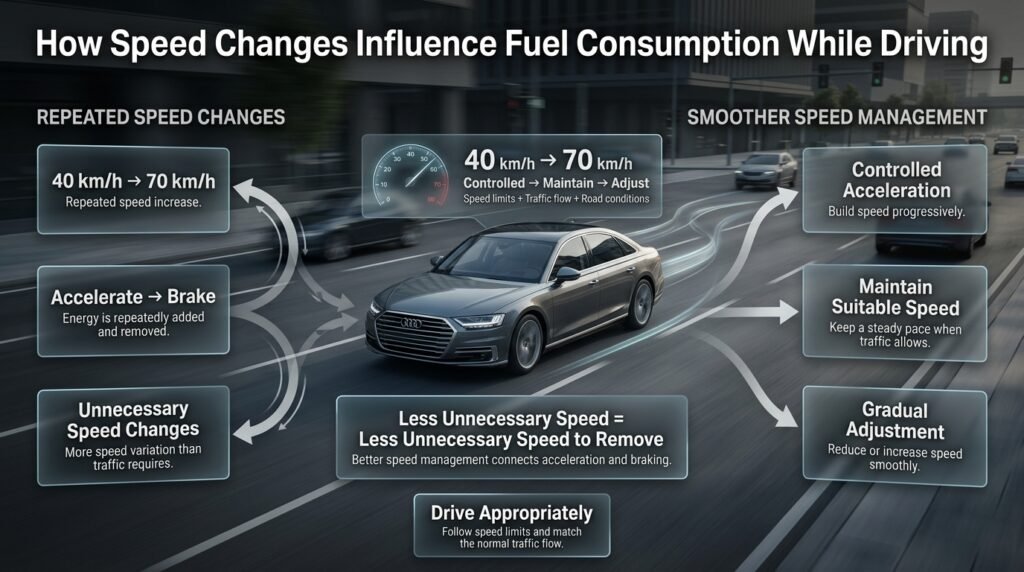
Braking habits are closely connected with speed variation.
Suppose a driver repeatedly changes speed between 40 km/h and 70 km/h.
The engine must repeatedly provide energy to increase the vehicle’s speed.
The brakes then remove that energy when the vehicle slows.
A smoother pattern might be:
40 km/h → controlled acceleration → suitable speed → maintain → gradual adjustment
when traffic allows.
This doesn’t mean ignoring speed limits or driving below the normal flow.
It means avoiding unnecessary bursts of speed.
Why this matters
The less unnecessary speed you create, the less unnecessary speed you have to remove.
That makes speed management one of the most important links between acceleration and braking.
Optimal driving speed for fuel efficiency
For better fuel economy, optimal driving speed for fuel efficiency generally means maintaining a steady, moderate speed rather than driving aggressively or accelerating frequently. At higher speeds, aerodynamic drag increases significantly, forcing the engine to work harder and consume more fuel. Smooth cruising on highways can therefore deliver better efficiency than rapid acceleration and frequent speed changes. In Dubai, where traffic and road conditions can vary, maintaining a consistent speed whenever safely possible can help reduce unnecessary fuel use. Avoiding sudden acceleration and keeping a safe following distance also supports more efficient driving. The ideal speed ultimately depends on the vehicle, road conditions, traffic, and manufacturer recommendations.
For a practical understanding of how smoother braking, better anticipation, and controlled speed changes can support fuel efficiency, 👉 How Braking Habits Affect Fuel Economy in Dubai provides expert guidance to help you develop safer and more economical driving habits.
How Smooth Driving Supports Better Fuel Economy
Smooth driving is not the same as slow driving.
A smooth driver can still:
- Accelerate when needed.
- Brake firmly in an emergency.
- Maintain normal road speeds.
- Change lanes.
- Overtake when legal and safe.
- Respond quickly to hazards.
The difference is that the driver avoids unnecessary extremes.
Instead of constantly moving between high and low speeds, the driver tries to maintain an appropriate flow.
This can make driving more comfortable for passengers as well as potentially reducing unnecessary fuel use.
For a more detailed look at this broader approach, 👉 Smooth Driving Techniques for Better Fuel Economy in Dubai provides additional practical guidance.
Fuel-Efficient Driving Techniques
Fuel-efficient driving techniques can help reduce unnecessary fuel consumption while making everyday driving smoother and more economical. Avoid sudden acceleration, harsh braking, and frequent speed changes, as these habits can waste fuel. Maintaining a steady speed and keeping a safe following distance allows you to anticipate traffic instead of constantly accelerating and braking. Reducing unnecessary idling and removing excess weight from the vehicle can also improve overall efficiency. On highways, moderate and consistent speeds are generally more economical than aggressive high-speed driving.
For practical ways to reduce fuel use and improve your driving habits, 👉 Fuel-Efficient Driving Techniques offers a helpful guide.
Common Braking Mistakes That Can Waste Fuel
1. Accelerating toward a red light
You can already see that the signal is red, but you continue accelerating.
Why it happens: The driver focuses on current road space instead of future traffic.
Why it’s inefficient: The extra speed may only result in more braking.
Better approach: Stop accelerating earlier and manage the approach.
2. Following too closely
A short gap means less reaction time.
Why it happens: Some drivers don’t want another vehicle entering the gap.
Why it’s inefficient: Small traffic changes force larger reactions.
Better approach: Maintain an appropriate following distance.
3. Waiting for the vehicle ahead to brake
You don’t react until the nearest vehicle slows.
Why it happens: Limited forward observation.
Why it’s inefficient: You have fewer opportunities for gradual deceleration.
Better approach: Look beyond the nearest vehicle.
4. Accelerating aggressively after every slowdown
Traffic moves slightly, and you immediately try to regain maximum speed.
Why it happens: The driver wants to recover lost time.
Why it’s inefficient: Another slowdown may occur seconds later.
Better approach: Accelerate progressively and read the traffic pattern.
5. Chasing small gaps
You accelerate toward every available opening.
Why it happens: A desire to stay ahead in traffic.
Why it’s inefficient: The opening may close quickly, forcing another braking event.
Better approach: Prioritize steady traffic flow.
6. Trying not to brake for fuel savings
This is potentially dangerous.
Why it happens: Misunderstanding the relationship between braking and fuel economy.
Why it’s harmful: Delayed braking reduces safety.
Better approach: Brake whenever necessary and reduce only unnecessary braking.
7. Using inappropriate engine-braking techniques
A driver may select a low gear unnecessarily because they believe it always saves fuel.
Better approach: Use the transmission as recommended for the vehicle and situation.
A Step-by-Step Strategy for Better Braking and Fuel Economy
Step 1: Scan farther ahead
What to do: Look beyond the nearest vehicle.
Why it matters: You gain more information and reaction time.
Professional advice: Make long-range observation part of normal driving.
Common mistake: Waiting for the nearest car to brake before reacting.
Step 2: Identify developing slowdowns
What to do: Watch for queues, traffic signals, pedestrians, turns, and congestion.
Why it matters: These features can tell you that speed will soon need to change.
Professional advice: Treat traffic information as something to anticipate, not merely react to.
Step 3: Stop accelerating when appropriate
What to do: If a slowdown is clearly developing, don’t continue increasing speed unnecessarily.
Why it matters: You’re preventing additional momentum from being created and then removed.
Quick example: If traffic is stopped ahead, reaching it faster doesn’t make the queue disappear.
Step 4: Maintain a sensible gap
What to do: Leave enough room to respond.
Why it matters: Space gives you more options.
Common mistake: Driving close to the vehicle ahead simply to prevent other cars from merging.
Step 5: Allow controlled deceleration
What to do: When safe, release the accelerator and allow the vehicle to slow.
Why it matters: This can reduce unnecessary brake use.
Professional advice: Never confuse controlled deceleration with delaying necessary braking.
Step 6: Brake appropriately
What to do: Use the brakes whenever the situation requires them.
Why it matters: Safety comes first.
Professional advice: Smooth braking is useful when you have time; firm braking is appropriate when a situation demands it.
Step 7: Accelerate progressively afterward
What to do: Once traffic clears, build speed smoothly.
Why it matters: It prevents another immediate cycle of excessive acceleration and braking.
Braking and Fuel Economy: Quick Comparison

| Driving habit | Likely effect | Better approach |
|---|---|---|
| Hard acceleration followed by hard braking | Creates unnecessary speed changes | Accelerate progressively |
| Following too closely | Encourages frequent braking | Maintain a suitable gap |
| Ignoring a red light until close | Causes late braking | Observe signals early |
| Looking far ahead | Improves anticipation | Keep scanning traffic |
| Chasing every gap | Creates repeated acceleration | Prioritize steady movement |
| Smooth deceleration | Reduces abrupt speed changes | Slow early when appropriate |
| Emergency braking | Necessary for safety | Brake immediately when required |
| Excessive speed changes | Can increase energy use | Maintain a suitable steady speed |
How to Measure Whether Your Driving Has Improved
You don’t need to guess whether your driving habits are changing.
Pay attention to your driving pattern.
Ask yourself:
- Am I braking less often because I’m anticipating traffic?
- Am I still accelerating aggressively?
- Do I often brake immediately after accelerating?
- Am I following too closely?
- Do I notice red lights early?
- Am I smoother in congestion?
- Am I maintaining a more consistent speed?
- Do passengers experience fewer sudden movements?
These questions can reveal improvement even before you see a measurable difference in fuel consumption.
Track fuel use over time
Fuel economy should be compared across similar journeys.
Record:
- Distance.
- Fuel added.
- Route.
- Traffic conditions.
- Weather.
- Vehicle load.
- Tire pressure.
- Air-conditioning use.
Suppose you travel 500 km using 40 litres.
Your approximate fuel economy is:
500 ÷ 40 = 12.5 km/L
Later, you travel 540 km using 40 litres.
That’s:
540 ÷ 40 = 13.5 km/L
That may indicate an improvement, but don’t automatically attribute the entire difference to braking.
Fuel economy is influenced by many variables.
The useful measure is a consistent trend across similar conditions.
What Other Factors Affect Fuel Economy?
Braking is only one part of the larger picture.
Aggressive acceleration
Hard throttle inputs can require more fuel.
Excessive speed
Aerodynamic resistance increases as speed rises.
Tire pressure
Incorrect pressure can increase rolling resistance.
Vehicle weight
Carrying unnecessary cargo requires additional energy.
Car Load and Fuel Consumption
Car load and fuel consumption are closely connected because carrying extra weight makes the engine work harder, particularly during acceleration, uphill driving, and frequent stops. Unnecessary luggage, equipment, or heavy items can gradually reduce fuel efficiency and increase the amount of fuel needed for a journey. Keeping only essential items in the vehicle can help reduce its overall workload. However, driving style, tire pressure, traffic conditions, and vehicle maintenance also influence fuel economy. For better mileage, combine sensible loading with smooth and consistent driving habits.
For practical guidance on how vehicle load can influence fuel use and mileage, 👉 Car Load and Fuel Consumption explains how managing unnecessary weight can support better fuel efficiency.
How Vehicle Weight Affects Fuel Economy
How vehicle weight affects fuel economy becomes especially noticeable during acceleration, frequent stops, and city driving. A heavier vehicle requires more energy to get moving, which can increase fuel consumption over time. Carrying unnecessary luggage, tools, or equipment can therefore reduce overall mileage, particularly on longer journeys with repeated speed changes. Removing items you do not need can help reduce the vehicle’s workload and improve efficiency. However, weight is only one factor, alongside driving habits, tire pressure, traffic, and vehicle condition.
For practical guidance on reducing unnecessary load and improving fuel efficiency, 👉 How Vehicle Weight Affects Fuel Economy explains how extra weight can influence fuel consumption.
Idling
A stationary engine can consume fuel without moving the vehicle.
For practical guidance on reducing wasted fuel during traffic stops and long waits, 👉 Car Idling Fuel Consumption in Dubai explains how unnecessary idling can affect fuel efficiency.
Air conditioning
Cooling the cabin can increase fuel demand depending on the vehicle and conditions.
Maintenance
Engine, tire, brake, and other maintenance problems can influence efficiency.
Traffic
Congestion increases stopping and starting.
Route planning
A route with fewer stops may sometimes be more efficient than a shorter route filled with congestion.
Driving style
Aggressive acceleration combined with frequent braking is generally less efficient than smoother speed management.
The best results come from looking at these factors together.
Fuel Consumption While Idling
Fuel consumption while idling can quietly increase fuel use even when a vehicle is not moving. Leaving the engine running during long waits, traffic stops, or unnecessary parking periods means the engine continues to burn fuel without covering any distance. In Dubai, frequent congestion and hot weather can make extended idling especially common. Turning the engine off when it is safe and practical to do so can help reduce unnecessary fuel consumption. Avoiding prolonged idling is a simple driving habit that can improve overall fuel efficiency and reduce wasted fuel.
or practical guidance on reducing unnecessary fuel use while waiting or parked, 👉 Fuel Consumption While Idling explains how idling affects your vehicle’s fuel economy.
How to Build Better Braking Habits Gradually
Changing every driving behavior at once can be difficult.
A better approach is to work on one habit at a time.
Week 1: Observe
Pay attention to what causes you to brake.
Don’t try to change everything yet.
Notice patterns.
Week 2: Look ahead
Start deliberately scanning farther down the road.
Look for traffic signals, queues, and slowdowns.
Week 3: Improve acceleration
Avoid aggressive acceleration toward predictable slowdowns.
Try progressive throttle control.
Week 4: Improve deceleration
When conditions allow, release the accelerator earlier and reduce speed progressively.
Week 5: Combine everything
Now bring the habits together:
Observe → anticipate → stop unnecessary acceleration → decelerate smoothly → brake when necessary → accelerate progressively
With practice, this can become a natural part of your driving style.
Expert Advice for Better Braking and Fuel Economy
Experienced drivers don’t usually think about fuel economy as a collection of isolated tricks.
They think about vehicle control.
They observe traffic.
They recognize patterns.
They manage speed.
They maintain appropriate space.
They avoid unnecessary reactions.
They still brake firmly when safety requires it.
Five principles worth remembering
1. Look farther ahead.
The road immediately in front of you is only one part of the driving environment.
2. Manage speed before braking becomes urgent.
Early decisions are generally smoother.
3. Don’t create speed you don’t need.
If traffic is slowing, aggressive acceleration is unlikely to help.
4. Give yourself space.
A reasonable gap provides more time to respond.
5. Never sacrifice safety for fuel economy.
This is the most important principle of all.
Does Hard Braking Increase Fuel Consumption?
Hard braking doesn’t directly consume fuel in the same way that pressing the accelerator does. The real fuel-economy problem is the driving pattern that leads to hard braking. If you accelerate quickly, gain unnecessary speed, and then brake heavily because traffic or a red light is ahead, much of the energy used to build that speed is lost through braking. When traffic moves again, the engine has to use more energy to accelerate the vehicle back up to speed. The U.S. Department of Energy’s fuel-economy guidance identifies rapid acceleration and braking as a major source of reduced mileage, particularly in stop-and-go traffic.
A practical driver shouldn’t think, “I need to use my brakes as little as possible.” That’s the wrong lesson. The better approach is to ask, “Why did I need to brake so hard in the first place?” If the answer is that you noticed a queue, traffic signal, or slowdown too late, improving anticipation can make a much bigger difference.
What to do instead:
Look several vehicles ahead when visibility allows.
Notice red lights, queues, and slowing traffic early.
Stop accelerating when a slowdown is clearly developing.
Maintain a sensible following distance.
Reduce speed progressively when conditions allow.
Use firm braking immediately whenever safety requires it.
Real-world example:
Imagine you’re travelling toward a red traffic signal. The road is open, so you accelerate from 50 to 70 km/h. As you get closer, you realize the light is still red and several cars are waiting. You then brake firmly to stop.
Now imagine approaching the same light without that extra acceleration. You recognize the red signal early, release the accelerator, allow the vehicle’s speed to fall, and apply the brakes progressively as necessary.
The second approach doesn’t mean avoiding braking. It means avoiding unnecessary speed before braking.
That distinction is at the heart of fuel-efficient driving. Consumer Reports’ 2026 testing also found that hard acceleration and braking reduced fuel economy in its tests, reinforcing the value of smoother speed management.
How Does Anticipating Traffic Reduce Fuel Consumption?
Anticipating traffic is one of the most effective ways to improve braking habits because it gives you time. When you recognize a developing slowdown early, you can adjust your speed gradually instead of waiting until the last moment and then making a sudden stop.
Think about what happens when you’re following a car too closely. The driver ahead brakes, so you immediately brake. They accelerate, so you accelerate. They brake again, so you brake again. This creates a constant cycle of acceleration and deceleration.
Now give yourself more space and look farther ahead. You may see that traffic five or six cars ahead is already slowing. Instead of accelerating into that traffic, you can ease off the accelerator and allow your vehicle to lose speed naturally where appropriate.
The Vehicle Certification Agency specifically recommends anticipating the road and other road users to smooth out driving and avoid unnecessary acceleration and braking.
A professional way to think about it
Don’t drive only according to what’s happening right now.
Drive according to what is likely to happen next, while remaining prepared for unexpected events.
For example, if you see:
A red traffic signal
A line of stopped vehicles
Several brake lights ahead
A pedestrian approaching a crossing
A bus preparing to stop
A congested roundabout
Vehicles merging into your lane
Road construction
you already have information that may require a speed adjustment.
That information gives you an opportunity to stop adding speed.
Practical habits to develop
Keep your eyes moving beyond the vehicle immediately ahead.
Check traffic signals early.
Watch brake lights farther down the road.
Leave enough space to respond progressively.
Avoid accelerating simply because a small gap has opened.
Expect traffic near intersections to change quickly.
Expert insight: Good fuel economy often begins before the brake pedal is touched. The earlier you recognize a problem, the less dramatic your response usually needs to be.
This is also why smooth driving isn’t about driving unusually slowly. It’s about making fewer unnecessary speed changes. Michelin recommends smooth acceleration and early, gradual braking as part of fuel-efficient driving.
Is Engine Braking More Fuel-Efficient Than Using the Brakes?
Engine braking can be useful for fuel economy, but the answer depends on the vehicle and how the system operates. In many modern fuel-injected vehicles, when you release the accelerator while the vehicle remains in gear under suitable conditions, the engine-control system can activate deceleration fuel cut-off (DFCO). During DFCO, fuel injection can be reduced to zero while the vehicle’s wheels keep the engine turning through the drivetrain.
This is different from simply shifting into neutral.
When the vehicle is in gear and the conditions for fuel cut-off are met, the engine may not need fuel to maintain combustion during that period of deceleration. In neutral, however, the engine still needs to idle, which means it generally requires some fuel.
So how should you use engine braking?
Use it as a speed-control technique, not as a competition to see how little you can use the brake pedal.
For example, you’re travelling downhill and the vehicle is gradually gaining speed. Depending on the vehicle, selecting an appropriate gear can increase engine braking and reduce the amount of continuous friction-brake use required.
Similarly, when approaching a slowdown, releasing the accelerator early can allow the vehicle to decelerate before you need the brake pedal.
But there’s an important safety rule
Don’t delay necessary braking simply because you’re trying to use engine braking.
If traffic stops unexpectedly, a pedestrian enters the road, or another vehicle creates a hazard, use the brakes immediately.
Fuel economy comes second to maintaining control.
What about coasting in neutral?
This is where many online fuel-saving tips become misleading.
There isn’t a universal rule that shifting into neutral saves fuel. On many modern fuel-injected vehicles, in-gear deceleration can activate fuel cut-off, while neutral leaves the engine idling. Vehicle design and transmission calibration matter, so the owner’s manual is the appropriate reference for vehicle-specific behavior.
Professional recommendation:
Keep the vehicle under control.
Use an appropriate gear.
Let the vehicle decelerate naturally when conditions permit.
Don’t shift to neutral simply because someone says it always saves fuel.
Never coast with the engine switched off.
The real fuel-saving opportunity is still anticipation and speed management, not a clever transmission trick.
Does Following Distance Affect Braking and Fuel Economy?
Yes, following distance can have a meaningful indirect effect on fuel-efficient driving because it determines how much time you have to react.
A driver who follows extremely closely has very few options. If the vehicle ahead slows, they have to react quickly. That usually means braking. When traffic starts moving again, they accelerate. If the vehicle ahead slows again, they brake again.
This creates the familiar:
Accelerate → Brake → Accelerate → Brake
cycle.
A sensible following distance gives you a larger buffer. Instead of immediately reacting to every small movement of the vehicle ahead, you can observe the broader traffic pattern and make smaller speed adjustments.
The U.S. Department of Energy specifically recommends anticipating traffic and maintaining adequate spacing to avoid unnecessary braking and acceleration.
Consider this everyday situation
You’re travelling in moderate traffic and the car ahead suddenly slows by 10 km/h.
If you’re very close, you may need to brake immediately.
If you have a reasonable gap, you may have enough time to:
Notice the slowdown.
Release the accelerator.
Allow your speed to reduce.
Determine whether the traffic ahead is actually stopping.
Brake progressively if needed.
That extra space gives you time to think instead of forcing you to react.
Better following-distance habits
Don’t drive close simply to prevent another vehicle from merging.
Give yourself more room at higher speeds.
Increase the gap when visibility is poor.
Increase spacing in rain or other difficult conditions.
Expect traffic to compress near intersections.
Don’t constantly chase the vehicle ahead.
There is also a comfort benefit. Smoother speed changes reduce the constant forward-and-back movement passengers experience during aggressive stop-and-go driving.
One important clarification
Increasing following distance doesn’t mean leaving an unnecessarily large gap that disrupts normal traffic flow.
The objective is a safe, practical buffer that gives you enough reaction time to manage speed smoothly.
The best fuel-saving driving habit isn’t simply “brake less.”
It’s “give yourself enough space so you don’t have to brake unnecessarily.”
What Is the Best Braking Technique for Better Fuel Economy?
The best technique is anticipatory, progressive braking combined with sensible acceleration.
There isn’t one magical braking method that will suddenly transform fuel economy. Instead, good results come from managing the entire speed cycle.
A practical sequence looks like this:
Observe → Anticipate → Stop unnecessary acceleration → Decelerate → Brake when required → Accelerate progressively
This approach is supported by fuel-economy guidance that consistently recommends smooth acceleration, avoiding sudden braking, maintaining appropriate spacing, and anticipating traffic.
Step 1: Observe what’s happening ahead
Don’t wait until the vehicle immediately in front of you reacts.
Look farther down the road.
Step 2: Identify whether you’ll need to slow
If you can already see stopped traffic or a red light, there’s little reason to keep building speed toward it.
Step 3: Come off the accelerator early
When safe and appropriate, reducing throttle input can begin the speed-management process before braking becomes urgent.
Step 4: Let the vehicle decelerate naturally where appropriate
Depending on the vehicle, transmission, road and traffic conditions, releasing the accelerator while remaining in gear may allow controlled deceleration and potentially activate fuel cut-off.
Step 5: Use the brakes when needed
Don’t hesitate to brake.
If you need to stop, stop.
If the situation requires firm braking, use firm braking.
Step 6: Accelerate smoothly after the slowdown
Once traffic begins moving again, don’t automatically try to regain maximum speed as quickly as possible.
Build speed progressively and match the traffic and road conditions.
The biggest mistake to avoid
Don’t turn fuel-efficient driving into overly cautious braking.
A driver who waits too long to brake because they want to “save fuel” is not driving efficiently—they’re creating a safety problem.
Fuel economy should come from better anticipation, not delayed reactions.
Conclusion
Understanding how braking habits affect fuel economy is really about learning how to manage speed more intelligently. Braking itself isn’t the main problem. The bigger issue is repeatedly accelerating to unnecessary speeds and then using the brakes to remove that extra momentum. Every time you create and lose speed without making useful progress, you may be using more fuel than necessary.
The best approach is to look farther ahead, maintain a sensible following distance, anticipate traffic lights and slowdowns, and release the accelerator early when conditions allow. When braking is necessary, brake confidently and safely rather than delaying it to save fuel. After slowing down, accelerate progressively instead of immediately trying to regain maximum speed.
For everyday Dubai driving, these small changes can make a noticeable difference in how smoothly your vehicle moves through traffic. Better braking habits work best when combined with sensible acceleration, appropriate speed, correct tire pressure, regular maintenance, and good route awareness.
Most importantly, don’t try to save fuel by avoiding necessary braking. Safety always comes first. The real goal is simple: create less unnecessary speed, lose less unnecessary momentum, and make every acceleration and braking decision count.
Leave a Reply