Introduction
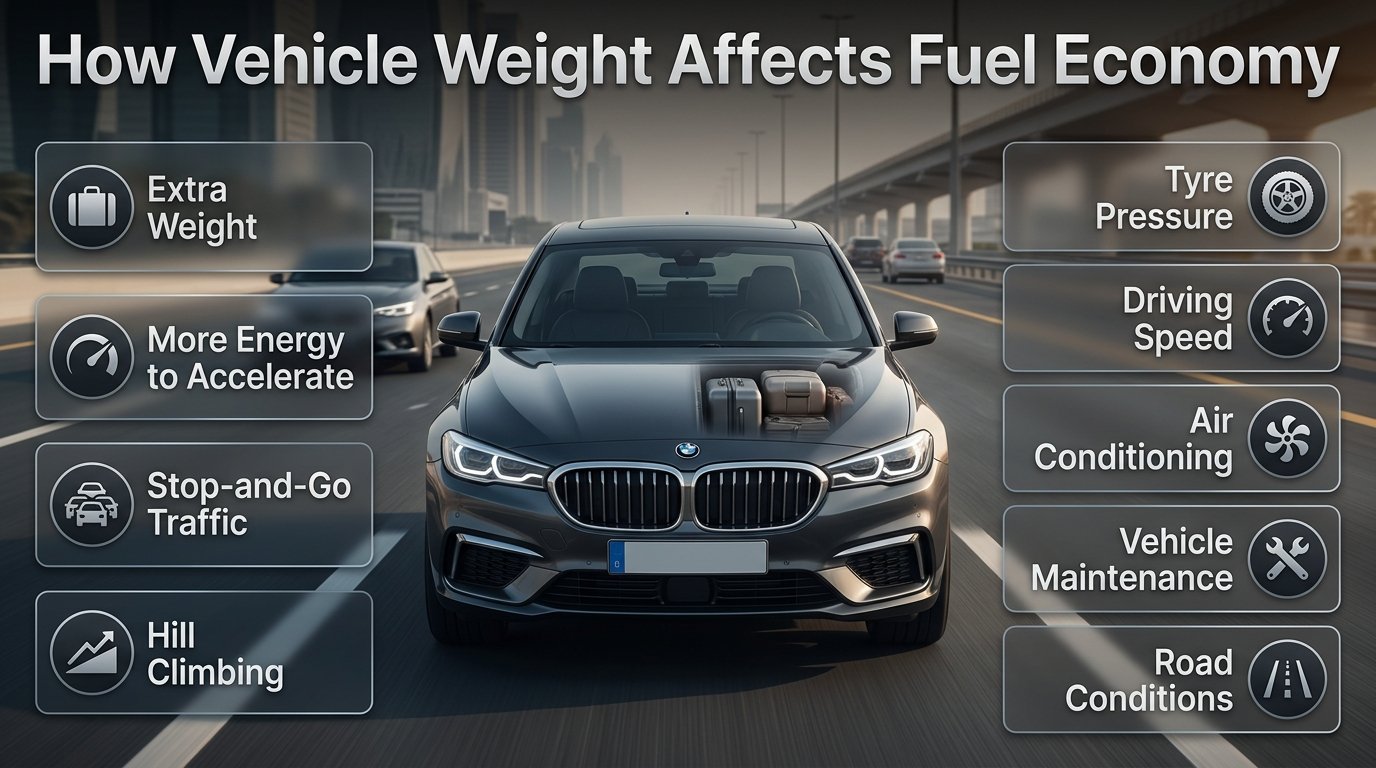
How vehicle weight affects fuel economy | Every vehicle carries a certain amount of weight, but many drivers do not realize how strongly that weight can influence fuel consumption. Whether you drive a small car through Dubai traffic or take a fully loaded vehicle on a long highway journey, the amount of weight your engine has to move can affect how much fuel the vehicle uses.
A heavier vehicle generally requires more energy to accelerate, especially when driving in stop-and-go traffic. Extra weight can also make the engine work harder during hill climbs, repeated acceleration, and certain driving conditions. While removing a few unnecessary items from the trunk will not suddenly transform a vehicle’s fuel economy, reducing unnecessary load is one practical part of an overall fuel-efficient driving strategy.
For drivers who need fuel assistance while travelling around Dubai, Fuel Delivery Dubai can also be a useful roadside resource when a vehicle runs out of fuel.
Vehicle weight is only one factor affecting fuel economy. Speed, acceleration, braking habits, traffic, tyre pressure, road conditions, air conditioning, vehicle maintenance, and trip length can all influence fuel consumption. Understanding how these factors work together makes it easier to improve efficiency without relying on unrealistic fuel-saving claims.
This guide explains how vehicle weight affects fuel economy, why extra cargo can increase fuel use, how weight matters more in some driving conditions than others, and what drivers can realistically do to reduce unnecessary fuel consumption.
What Does Vehicle Weight Mean?
Vehicle weight refers to the total mass that the engine and drivetrain must move.
This includes much more than the vehicle itself. Depending on the situation, the total moving weight can include:
- The vehicle body
- Engine and transmission
- Fuel in the tank
- Driver
- Passengers
- Luggage
- Tools
- Spare equipment
- Cargo
- Accessories
- Other items stored inside the vehicle
Manufacturers publish different weight specifications for vehicles. These can include curb weight, gross vehicle weight, payload capacity, and gross vehicle weight rating.
For everyday fuel-economy discussions, the most important idea is simple:
The more mass a vehicle has to move, the more energy may be required to accelerate it.
This does not mean every kilogram has the same effect under every condition. The impact depends on how and where the vehicle is driven.
A vehicle travelling at a steady speed on a flat road may experience a different effect from additional weight than the same vehicle repeatedly accelerating away from traffic lights.
That distinction is particularly important when discussing fuel economy in cities.
How Extra Weight Affects Fuel Consumption
The basic relationship between weight and fuel consumption comes from the energy needed to move the vehicle.
When a vehicle accelerates, the engine must provide enough force to increase the vehicle’s speed. A heavier vehicle has greater inertia, meaning more energy is needed to achieve the same acceleration.
For example, imagine two otherwise similar vehicles travelling from a traffic light.
One carries only the driver.
The other carries the driver, several passengers, luggage, and additional equipment.
The second vehicle has greater total mass. When both vehicles accelerate to the same speed, the heavier vehicle requires more energy for that acceleration.
If this happens once, the difference may be small.
But city driving can involve hundreds of acceleration and deceleration events.
That is where the effect can become more noticeable.
This is one reason smooth driving can complement weight reduction. If unnecessary weight is removed while the driver also avoids aggressive acceleration, the vehicle may operate more efficiently.
For more information about the relationship between acceleration and fuel consumption, see How Acceleration Affects Fuel Consumption.
Why Weight Matters More in Stop-and-Go Traffic
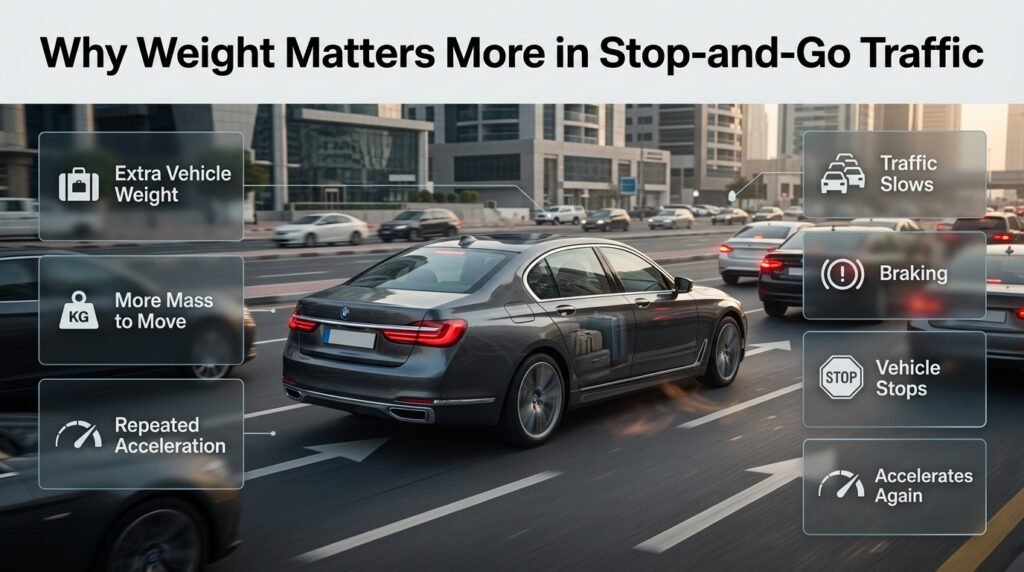
Extra vehicle weight can become especially relevant in urban traffic.
Consider a typical city journey.
The vehicle starts moving.
It accelerates.
Traffic slows.
The driver brakes.
The vehicle stops.
The driver accelerates again.
This cycle may repeat dozens or even hundreds of times during a busy journey.
Every time the vehicle accelerates, the engine must provide energy to overcome the vehicle’s inertia and increase its speed.
If the vehicle is carrying unnecessary weight, the engine has more mass to move during each acceleration.
This does not mean a heavily loaded vehicle will always consume dramatically more fuel. Modern engines, transmissions, and hybrid systems can behave differently depending on their design.
However, repeated acceleration makes vehicle mass more relevant than steady cruising on a flat road.
This is also why reducing unnecessary cargo can be more meaningful for drivers who regularly deal with congested urban roads.
Vehicle Weight and Highway Fuel Economy
Highway driving is somewhat different.
Once a vehicle has reached a steady cruising speed, the engine is primarily working against forces such as:
- Aerodynamic drag
- Rolling resistance
- Mechanical losses
- Road gradient
- Drivetrain losses
Vehicle mass still matters, particularly because heavier vehicles generally experience greater rolling resistance and require more energy when climbing hills.
However, aerodynamic drag can become a major factor at higher speeds.
This means removing a small amount of weight may not have the same effect on highway fuel consumption as reducing excessive speed or improving aerodynamic efficiency.
For example, carrying a few unnecessary bags in the trunk may have a relatively modest effect during steady highway cruising, while driving significantly faster can substantially increase aerodynamic resistance.
For more information about speed and fuel use, see How Highway Speed Affects Fuel Consumption.
Gear Shifting and Fuel Economy in Dubai
Gear shifting has a direct impact on how efficiently a vehicle uses fuel, particularly in Dubai’s busy traffic and changing road conditions. Driving in the appropriate gear helps keep the engine operating within an efficient range, while unnecessarily high engine speeds or using the wrong gear can increase fuel consumption. Manual drivers can improve efficiency by shifting smoothly and selecting the appropriate gear for their speed and road conditions. Automatic transmissions generally manage gear changes themselves, but smooth acceleration and avoiding unnecessary aggressive driving can still support better fuel economy.
For a practical understanding of how to choose the right gear, avoid unnecessary engine strain, and improve fuel efficiency in Dubai’s city traffic and highway conditions, read our detailed Gear Shifting and Fuel Economy in Dubai guide.
Vehicle Accessories and Fuel Economy
Vehicle accessories and fuel economy are closely connected because certain add-ons can increase aerodynamic drag, vehicle weight, or electrical load. Roof racks, cargo boxes, oversized accessories, and other external equipment may make the engine work harder, especially during highway driving. Even small changes can affect fuel consumption when they are used regularly. For better efficiency, remove unnecessary accessories when they are not needed, keep external equipment streamlined, and avoid carrying extra weight without a purpose. In Dubai, where long highway journeys and high-speed driving are common, choosing practical accessories and maintaining the vehicle properly can help support better overall fuel economy.
For a practical guide on how roof racks, cargo boxes, extra weight, larger wheels, and other accessories can influence fuel consumption, read our detailed Vehicle Accessories and Fuel Economy in Dubai guide before choosing or removing accessories from your vehicle.Air Conditioning and Fuel Consumption
The Difference Between Weight and Aerodynamic Drag
Vehicle weight and aerodynamic drag are often discussed together, but they are not the same thing.
Weight is related to the mass of the vehicle and the gravitational force acting on it.
Aerodynamic drag is the resistance created as the vehicle moves through air.
At low speeds, weight-related factors can be relatively important.
At higher speeds, aerodynamic resistance becomes increasingly significant.
This explains why a vehicle can be affected by both cargo weight and speed, but for completely different physical reasons.
For example:
A heavy suitcase in the trunk adds mass.
A roof-mounted cargo box changes the vehicle’s aerodynamic profile.
Both can increase fuel consumption, but they do so through different mechanisms.
This is why fuel-efficient driving requires more than simply removing heavy objects from the vehicle.
How Much Does an Extra Load Affect Fuel Economy?
There is no single fuel-economy penalty that applies to every vehicle.
The effect of extra weight depends on several variables:
- Vehicle size
- Engine type
- Transmission
- Hybrid or non-hybrid design
- Total vehicle weight
- Amount of additional cargo
- Driving speed
- Road gradient
- Traffic conditions
- Acceleration frequency
- Tyre condition
- Driving style
- Weather
- Air conditioning use
Adding a small amount of weight to a large vehicle may have a relatively small percentage effect.
The same load can represent a much larger percentage increase for a lightweight compact car.
For example, adding 100 kg to a vehicle weighing 2,000 kg represents a much smaller percentage increase than adding 100 kg to a vehicle weighing 1,000 kg.
Therefore, it is more useful to think in terms of additional percentage of vehicle mass and driving conditions rather than expecting one universal fuel-saving number.
Why Unnecessary Cargo Should Be Removed
Drivers sometimes treat the trunk as permanent storage.
Over time, this can lead to a vehicle carrying:
- Old tools
- Sports equipment
- Heavy boxes
- Spare parts
- Unused luggage
- Bottled liquids
- Construction materials
- Extra equipment
- Other items that are rarely needed
Each individual item may seem insignificant.
But several heavy items together can add a meaningful amount of mass.
Removing unnecessary cargo is one of the simplest fuel-efficiency practices because it requires no mechanical modification.
You do not need to buy special equipment.
You do not need to change the engine.
You simply remove things that do not need to be carried.
A useful habit is to inspect your trunk every few weeks and ask:
“Do I actually need to carry this every day?”
If the answer is no, consider storing it somewhere else.
Passengers Also Add Weight
Cargo is not the only source of additional weight.
Passengers also increase the total mass of the vehicle.
A vehicle carrying five adults naturally weighs more than the same vehicle carrying only the driver.
This does not mean drivers should avoid passengers to save fuel. Passengers are an intended part of vehicle use.
Instead, the important point is understanding why a fully loaded vehicle may consume more fuel than an unloaded one.
The effect may become more noticeable during:
- Frequent acceleration
- Hill climbing
- Stop-and-go traffic
- Short urban journeys
- Repeated starts
- Heavy traffic conditions
The driver cannot realistically eliminate passenger weight, but they can combine the additional load with smooth acceleration, proper tyre pressure, and sensible speeds.
Vehicle Load and Hill Climbing
Driving uphill is another situation where weight becomes important.
Gravity acts against the vehicle as it climbs.
A heavier vehicle requires more energy to gain elevation because more mass is being lifted against gravity.
This is why a heavily loaded vehicle may feel less responsive when climbing a steep road.
The driver may need to use more throttle.
The transmission may select a lower gear.
Engine speed may increase.
Fuel consumption can rise.
If a journey involves repeated hills, additional weight can become more significant than it would be on a flat route.
Drivers who frequently travel through hilly areas should therefore pay attention to unnecessary cargo.
Vehicle Weight and Engine Work
The engine does not directly “feel” weight in the same way a person feels a heavy object.
Instead, the engine produces torque through the drivetrain, and that torque ultimately moves the vehicle.
When more mass must be accelerated, the drivetrain needs to provide the necessary force.
Modern transmissions are designed to manage these conditions automatically.
An automatic transmission may change gears depending on throttle position, speed, load, and road gradient.
A continuously variable transmission may adjust its operating ratio.
A hybrid system may use electric assistance.
Despite these differences, the basic physical principle remains:
More mass requires more energy to accelerate.
The technology determines how efficiently that energy is supplied, but it does not eliminate the underlying physics.
How Driving Style Changes the Effect of Vehicle Weight
Weight does not operate independently of driving style.
A driver who accelerates aggressively will generally place greater energy demands on a heavily loaded vehicle than someone who accelerates gradually.
Suppose two vehicles carry the same additional cargo.
Driver A accelerates hard after every traffic light.
Driver B accelerates smoothly and anticipates traffic.
The second driver may achieve better fuel economy even though both vehicles have the same load.
This is why weight reduction should be viewed as one part of a broader fuel-efficiency strategy.
For practical techniques, see Fuel-Saving Driving Tips.
Smooth Acceleration Becomes More Important With Extra Load
A smooth acceleration strategy is useful in almost every vehicle, but it can be particularly helpful when the vehicle is carrying additional weight.
Instead of immediately pressing the accelerator deeply, the driver can:
- Begin moving smoothly.
- Accelerate progressively.
- Watch traffic ahead.
- Avoid unnecessary bursts of speed.
- Reach the desired speed without excessive throttle.
- Maintain a steady pace when conditions allow.
The objective is not to accelerate so slowly that the vehicle becomes a traffic hazard.
The goal is controlled acceleration that matches road conditions.
For a deeper discussion, see Smooth Driving Techniques for Better Fuel Economy.
Braking and Vehicle Weight
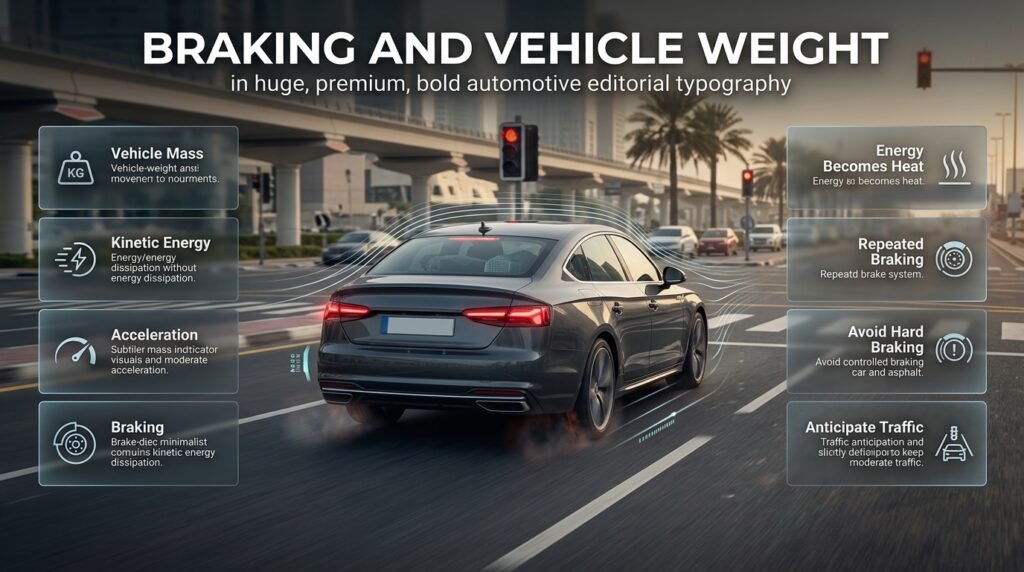
Braking is also connected to vehicle mass.
When a moving vehicle brakes, its kinetic energy must be dissipated, mainly through the braking system.
A heavier vehicle travelling at the same speed has more kinetic energy than a lighter vehicle.
If the driver repeatedly accelerates and then brakes, some of the energy previously used to accelerate the vehicle is effectively lost as heat through the brakes.
This is one reason unnecessary stop-and-go driving can reduce efficiency.
Good anticipation can help.
Instead of accelerating aggressively toward a red light and then braking hard, a driver may be able to reduce speed earlier when traffic conditions permit.
For more detail, see How Braking Habits Affect Fuel Economy.
Heavy Vehicles and Stop-and-Go Driving
Stop-and-go driving combines several fuel-consuming processes:
- Starting from rest
- Accelerating
- Changing speed
- Braking
- Idling
- Repeating the cycle
A heavier vehicle has more mass involved in every acceleration event.
This makes load management particularly relevant for drivers who spend a large amount of time in urban traffic.
Dubai drivers can encounter this situation during busy periods when traffic becomes congested and journey times increase.
Reducing unnecessary cargo cannot eliminate traffic, but it can remove one avoidable source of additional load.
For more information, see How Traffic Affects Fuel Economy in Dubai.
Vehicle Weight and Idling
Idling is slightly different because a stationary vehicle is not using engine power to accelerate its mass.
When the vehicle is stopped and the engine is running, the primary fuel use comes from keeping the engine operating and powering systems such as the air conditioning.
Therefore, additional cargo does not have the same direct acceleration effect while the vehicle is stationary.
However, heavy traffic often combines idling with repeated acceleration.
For example:
The vehicle waits.
It moves forward.
It stops.
It moves again.
It waits again.
In this situation, both idling and vehicle mass can contribute to overall fuel consumption.
More information about this subject is available in Fuel Consumption While Idling.
Vehicle Weight and Tyre Rolling Resistance
Tyres play an important role in how efficiently a vehicle moves.
When the vehicle becomes heavier, the tyres carry greater loads.
This can increase rolling resistance.
Rolling resistance is the resistance that occurs as tyres deform and interact with the road surface.
Several factors influence rolling resistance, including:
- Vehicle weight
- Tyre construction
- Tyre pressure
- Road surface
- Tyre condition
- Temperature
This is another reason why maintaining the correct tyre pressure is important.
A driver trying to improve fuel economy should not focus only on cargo weight while ignoring tyre condition.
Why Correct Tyre Pressure Matters
Tyre pressure affects rolling resistance, handling, braking, and tyre wear.
Underinflated tyres can increase rolling resistance and may cause the vehicle to require more energy to move.
Drivers should follow the vehicle manufacturer’s recommended tyre pressure rather than relying on the maximum pressure printed on the tyre sidewall.
The correct pressure is normally specified by the manufacturer and may be found on a door-jamb label, owner’s manual, or other official vehicle documentation.
When carrying heavy loads, drivers should also check whether the manufacturer specifies different tyre-pressure recommendations for loaded conditions.
This is especially important before long journeys.
Does a Full Fuel Tank Increase Fuel Consumption?
Yes, fuel itself has weight.
A full tank carries more fuel mass than a nearly empty tank.
That additional fuel must also be transported by the vehicle.
However, this does not mean drivers should keep the tank nearly empty to save fuel.
The practical effect of fuel weight is generally much less important than basic driving habits, safe fuel management, and avoiding unnecessary cargo.
Fuel is necessary for the vehicle to operate.
The sensible approach is to maintain an appropriate fuel level for the journey rather than repeatedly trying to minimize tank weight.
This is particularly important for drivers travelling long distances or in areas where fuel availability may be limited.
Vehicle Drag and Fuel Consumption in Dubai
Vehicle drag can have a significant effect on fuel consumption, particularly as driving speed increases. Aerodynamic resistance becomes more noticeable on highways, meaning vehicles may need more engine power to maintain higher speeds. Roof racks, cargo boxes, open windows at high speeds, and bulky external accessories can increase drag and reduce efficiency further. In Dubai, where drivers often use high-speed roads for longer journeys, keeping the vehicle streamlined and removing unnecessary external equipment can help reduce aerodynamic resistance. Combining good aerodynamics with moderate speeds and smooth driving can support better overall fuel economy.
For a deeper understanding of how aerodynamic resistance, driving speed, roof equipment, external cargo, wind, and vehicle design can influence fuel consumption, explore our detailed Vehicle Drag and Fuel Consumption in Dubai guide.
Tire Pressure and Fuel Efficiency
Tire pressure plays an important role in fuel efficiency because underinflated tires create greater rolling resistance, forcing the engine to work harder and potentially increasing fuel consumption. Maintaining the recommended tire pressure can help your vehicle roll more efficiently while also supporting better handling, braking, and tire wear. In Dubai’s hot climate, checking tire pressure regularly is especially useful because temperature changes can affect pressure readings. Always follow the vehicle manufacturer’s recommended pressure rather than relying on the maximum pressure printed on the tire sidewall.
For practical guidance on maintaining the correct tire pressure, reducing unnecessary rolling resistance, and supporting better fuel economy in Dubai’s driving conditions, read our detailed Tire Pressure and Fuel Efficiency guide.
Fuel-Efficient Use of Automatic Transmission
Using an automatic transmission efficiently can help reduce unnecessary fuel consumption, especially during Dubai’s busy traffic and frequent stop-and-go driving. Avoid aggressive acceleration, sudden braking, and repeatedly switching between Drive and other gears when it is not necessary. When waiting for longer periods, follow the vehicle manufacturer’s guidance rather than keeping the engine unnecessarily engaged. Regular transmission maintenance and using the correct manufacturer-recommended fluid can also support smooth gear changes and efficient vehicle operation. The key is to let the transmission work naturally while maintaining a smooth, predictable driving style.
For practical guidance on using an automatic transmission more efficiently, including smooth acceleration, proper gear modes, traffic management, and highway driving habits, explore our detailed Fuel-Efficient Use of Automatic Transmission guide.
Does Removing the Spare Tyre Save Fuel?
Removing a spare tyre may reduce vehicle weight, but this is not necessarily a good everyday fuel-saving strategy.
A spare tyre exists for a practical safety reason.
If you experience a puncture far from a repair facility, having an appropriate spare tyre can be extremely valuable.
Before removing safety equipment to reduce weight, drivers should consider the consequences.
Fuel economy should not be improved at the expense of basic roadside preparedness.
The same principle applies to:
- Jack
- Wheel tools
- Emergency equipment
- Required safety items
The best approach is to remove unnecessary weight rather than essential equipment.
Roof Cargo and Weight
Roof cargo deserves special attention because it can affect both weight and aerodynamics.
A roof box, luggage carrier, or other roof-mounted equipment can add mass.
At the same time, it can increase aerodynamic drag.
This combination may make roof cargo more significant for highway fuel economy than ordinary items stored inside the vehicle.
If roof equipment is not needed, removing it can be beneficial.
Even an empty roof rack can alter airflow around a vehicle.
Therefore, drivers who use roof-mounted equipment only occasionally should consider removing it when it is not required.
Roof Racks and Fuel Economy in Dubai
Roof racks can affect fuel economy by increasing a vehicle’s aerodynamic drag, particularly when driving at higher speeds on Dubai’s highways. Even when the rack is not carrying cargo, its added exposure to airflow can create additional resistance, which may require more engine power to maintain speed. The effect can become greater when carrying bulky items such as bicycles, luggage, or roof boxes. If a roof rack is not needed for a particular journey, removing it can help keep the vehicle more aerodynamic. For regular users, choosing a streamlined design, securing cargo properly, and avoiding unnecessary weight can support better fuel efficiency.
If you regularly use a roof rack for luggage, bicycles, or other equipment, our detailed Roof Racks and Fuel Economy in Dubai guide explains how roof-mounted accessories can increase aerodynamic drag and influence fuel consumption, especially during highway driving.
Vehicle Weight Versus Vehicle Size
A larger vehicle is not automatically inefficient.
Modern vehicle design has produced many examples of relatively large vehicles with efficient powertrains.
However, larger vehicles often have greater mass and may require more energy to accelerate than smaller vehicles.
The important comparison is not simply:
“Big car versus small car.”
Instead, consider:
- Total mass
- Engine efficiency
- Powertrain technology
- Aerodynamics
- Tyres
- Transmission
- Driving conditions
- Driving style
A modern hybrid SUV, for example, can have a very different fuel-consumption profile from an older large petrol vehicle.
Therefore, vehicle weight is an important variable, but it should not be used as the only explanation for fuel economy.
Hybrid Vehicles and Vehicle Weight
Hybrid vehicles introduce another important consideration.
Many hybrids use regenerative braking to recover some of the energy that would otherwise be lost during braking.
This can improve efficiency in stop-and-go driving.
However, the vehicle still has to accelerate its mass.
Regenerative braking does not eliminate the energy required to accelerate a heavier vehicle.
Instead, it can recover a portion of energy during deceleration.
This makes hybrid systems particularly interesting when discussing weight and urban fuel economy.
The battery system itself also adds weight, but the overall powertrain can still provide strong fuel efficiency depending on the vehicle design and operating conditions.
Electric Vehicles and Weight
The same physical principles apply to electric vehicles.
An electric motor can convert electrical energy into motion very efficiently, but additional mass still requires additional energy to accelerate.
Regenerative braking can recover some energy during deceleration.
However, it cannot recover all the energy used during acceleration.
This means weight remains relevant even when the vehicle does not use petrol or diesel.
The difference is that the energy source and powertrain are different.
Therefore, the basic relationship between mass, acceleration, and energy remains important across different vehicle technologies.
Does Vehicle Weight Affect Fuel Economy More Than Speed?
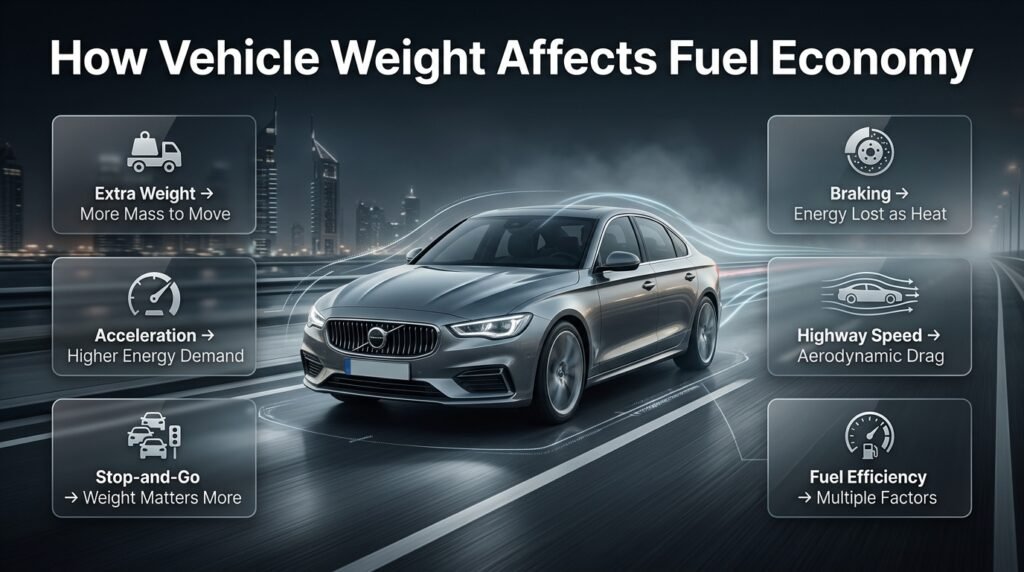
There is no universal answer.
The effect depends on driving conditions.
At low and moderate speeds with frequent acceleration, additional weight can be relatively important.
At high highway speeds, aerodynamic drag can become a dominant factor.
This means reducing unnecessary cargo and reducing excessive speed can both contribute to efficiency, but through different mechanisms.
A driver should not assume that removing 20 kg of luggage will compensate for driving significantly faster.
Likewise, slowing down does not mean carrying hundreds of kilograms of unnecessary equipment becomes irrelevant.
Fuel-efficient driving works best when several small improvements are combined.
How Aerodynamics Affects Fuel Efficiency
Aerodynamics plays an important role in fuel efficiency, especially when a vehicle is traveling at higher speeds. As speed increases, air resistance creates more drag, requiring the engine to use additional energy to keep the vehicle moving. Features such as roof racks, cargo boxes, open windows, and bulky external accessories can increase aerodynamic drag and contribute to higher fuel consumption. Keeping the vehicle streamlined, removing unnecessary external equipment, and maintaining a sensible highway speed can help reduce resistance and support more efficient driving.
For a clearer understanding of how air resistance, vehicle design, speed, roof accessories, and external load can influence your car’s fuel consumption, explore our detailed How Aerodynamics Affects Fuel Efficiency guide.
How Vehicle Load Affects Long-Distance Driving
Long journeys often involve a different type of vehicle loading.
Drivers may carry:
- Multiple passengers
- Suitcases
- Food
- Water
- Sports equipment
- Camping equipment
- Tools
- Other travel supplies
Some of this weight is necessary.
The goal is not to travel without luggage.
Instead, organize the load intelligently.
Before a long journey, remove anything that is not needed.
Place heavier objects securely and according to the vehicle manufacturer’s loading recommendations.
Avoid exceeding the vehicle’s rated payload.
Check tyre pressure according to the manufacturer’s recommendations for the loaded condition.
Then drive smoothly and maintain a sensible cruising speed.
For additional long-trip efficiency guidance, see Improving Fuel Economy on Long Trips.
Vehicle Load and Long-Distance Fuel Efficiency
Long-distance driving provides an opportunity to maintain relatively consistent speed.
This can reduce the number of acceleration events compared with urban traffic.
However, the vehicle may remain loaded for several hours.
That means the additional mass continues to affect rolling resistance and the energy required for changes in speed and elevation.
A heavy load may therefore matter more over a long journey than it would during a very short trip, simply because the vehicle operates for a longer distance and time.
For long-distance travel, efficiency should therefore be considered as a complete system:
Vehicle load + speed + tyres + driving style + route + maintenance + weather.
Car Load and Fuel Consumption
The amount of weight carried by a vehicle can influence fuel consumption, particularly during frequent acceleration, hill climbing, and stop-and-go driving. Extra luggage, heavy equipment, or unnecessary items in the trunk increase the vehicle’s overall weight, requiring more energy to move. While a small amount of additional weight may have a limited effect on a single trip, carrying unnecessary loads regularly can gradually reduce fuel efficiency. For better economy, remove items you do not need, distribute essential luggage safely, and avoid treating your vehicle as permanent storage. In Dubai, combining a sensible vehicle load with smooth driving and proper tire pressure can help support more efficient everyday driving.
For practical tips on how luggage, heavy equipment, passenger load, and unnecessary items can affect your vehicle’s fuel consumption, explore our detailed Car Load and Fuel Consumption guide and learn how to manage vehicle weight more efficiently.
How Air Conditioning Interacts With Fuel Economy
Air conditioning can increase energy consumption, especially in hot weather.
In Dubai’s climate, air conditioning is often an important part of normal driving rather than an occasional luxury.
The driver therefore needs to balance comfort and efficiency.
A heavily loaded vehicle may already require additional energy during acceleration, while air conditioning adds another demand on the vehicle’s energy system.
This does not mean drivers should avoid using air conditioning when temperatures are high.
Comfort and safety matter.
Instead, practical habits can include:
- Parking in shade when possible
- Ventilating a very hot cabin before driving
- Keeping windows closed at higher speeds when appropriate
- Maintaining the air-conditioning system
- Avoiding unnecessary idling with the engine running
Fuel economy should never come at the expense of safe cabin temperature management.
Air Conditioning and Fuel Consumption
Air conditioning can have a noticeable effect on fuel consumption, especially during hot weather and heavy traffic. When the AC system is running, the engine needs additional power to operate the compressor, which can increase fuel use. In Dubai’s hot climate, however, avoiding AC completely is not practical or comfortable. A better approach is to use the system efficiently by parking in shade when possible, ventilating the cabin briefly before cooling it, maintaining the AC system properly, and avoiding unnecessary idling with the AC running. These simple habits can help reduce unnecessary fuel consumption while keeping the cabin comfortable.
For practical tips on reducing unnecessary fuel consumption while keeping your car comfortable in Dubai’s hot climate, explore our detailed Air Conditioning and Fuel Consumption guide, which explains how AC use, traffic, idling, driving speed, and vehicle maintenance can affect overall fuel economy.
How Maintenance Can Reduce the Impact of Extra Weight
A well-maintained vehicle generally operates more effectively than one with neglected maintenance.
Important areas include:
- Correct tyre pressure
- Proper wheel alignment
- Clean air filters where applicable
- Correct engine oil
- Healthy brakes
- Properly functioning sensors
- Transmission maintenance
- Cooling system condition
Maintenance cannot remove the physical effect of extra weight.
However, it can prevent additional mechanical inefficiencies from being added to the problem.
For example, a vehicle carrying extra cargo and suffering from severely underinflated tyres may consume more fuel than one carrying the same cargo with correctly maintained tyres.
This demonstrates why fuel efficiency should be approached as a system rather than a single trick.
Common Mistakes Drivers Make With Vehicle Weight
Keeping the Trunk Permanently Full
Many drivers rarely inspect their trunk.
Over time, unnecessary items accumulate.
A regular clean-out is an easy improvement.
Removing Safety Equipment
Saving a small amount of weight is not worth sacrificing essential emergency equipment.
Ignoring Payload Limits
A vehicle should never be loaded beyond its manufacturer’s rated capacity.
Focusing Only on Weight
Weight is important, but speed, tyres, acceleration, traffic, and maintenance can also have major effects.
Expecting Dramatic Fuel Savings
Removing a few items should not be treated as a guaranteed way to transform fuel economy.
Ignoring Aerodynamics
Roof racks and external cargo can affect airflow as well as weight.
How to Reduce Unnecessary Vehicle Weight
A practical weight-reduction checklist can be simple.
Step 1: Empty the Trunk
Remove everything you do not regularly need.
Step 2: Check the Cabin
Look under seats and inside storage compartments.
Step 3: Remove Seasonal Equipment
If something is only needed during a particular season or activity, store it when it is not required.
Step 4: Check Roof Equipment
Remove roof carriers and racks when they are not needed, provided doing so is appropriate for the vehicle.
Step 5: Keep Essential Safety Equipment
Do not remove equipment required for safe operation or emergency situations.
Step 6: Check Tyre Pressure
Use the manufacturer’s recommended pressure.
Step 7: Review Your Driving Style
Combine sensible loading with smooth acceleration and anticipation.
Step 8: Monitor Fuel Consumption
Compare fuel economy over multiple journeys rather than judging the effect from one trip.
How to Measure Whether Your Vehicle Is Becoming More Efficient
Fuel economy should be measured consistently.
One simple method is to record:
- Distance travelled
- Fuel added
- Driving conditions
- Number of passengers
- Approximate vehicle load
For example, if you remove unnecessary cargo, do not expect the fuel gauge to immediately prove the difference.
Instead, compare several similar journeys.
A single journey can be affected by:
- Traffic
- Wind
- Temperature
- Route
- Speed
- Air conditioning
- Driving behaviour
Longer-term comparisons are more useful.
Fuel Economy Is About the Whole Driving System
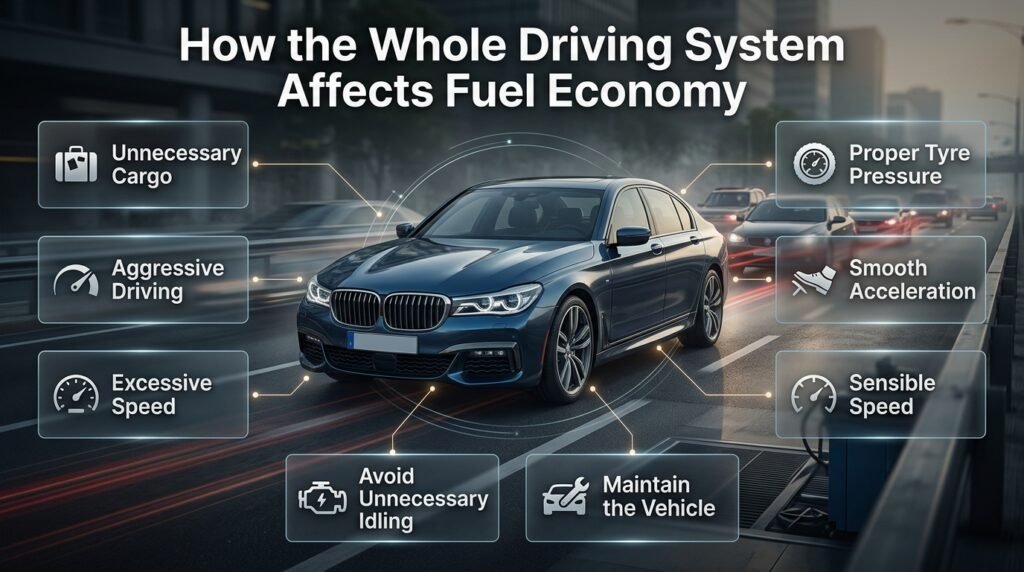
A vehicle’s fuel consumption is rarely caused by one factor.
Imagine a driver who:
- Carries unnecessary cargo
- Drives aggressively
- Uses excessive speed
- Has underinflated tyres
- Spends a long time idling
- Brakes heavily
- Travels through severe traffic
Removing only the cargo may help, but it will not solve the entire problem.
Now imagine the same driver also:
- Removes unnecessary load
- Checks tyre pressure
- Accelerates smoothly
- Anticipates traffic
- Avoids unnecessary idling
- Maintains a sensible speed
- Keeps the vehicle properly maintained
The combined improvement can be much more meaningful.
That is the better way to think about fuel economy.
Fuel-Efficient Driving and Vehicle Load in Dubai
Dubai presents several conditions that can influence fuel consumption.
These may include:
- Heavy urban traffic
- Frequent stops
- Long highway journeys
- High temperatures
- Extensive air-conditioning use
- Motorway driving
- Short trips
- Congested intersections
Because of these conditions, vehicle load should be considered alongside other fuel-economy factors.
A driver who spends most of the day in traffic may benefit more from smooth acceleration and reducing unnecessary idling.
A driver who regularly travels on highways may need to pay more attention to speed and aerodynamics.
A driver carrying heavy equipment every day should pay particular attention to payload and tyre pressure.
The right strategy depends on how the vehicle is actually used.
Does Removing Weight Always Save Money?
Reducing unnecessary weight can improve efficiency, but the financial benefit depends on how much fuel consumption changes.
If the vehicle travels only a few kilometres per week, the difference may be difficult to notice.
If a vehicle travels many kilometres every day while carrying a substantial unnecessary load, the cumulative effect may be more relevant.
Fleet operators may have an even stronger reason to monitor vehicle load because vehicles can accumulate high annual mileage.
For commercial fleets, fuel efficiency can become a significant operating cost.
Vehicle Weight and Fleet Fuel Management
Businesses operating multiple vehicles should pay close attention to unnecessary load.
Fleet vehicles may carry:
- Tools
- Spare parts
- Equipment
- Materials
- Delivery items
- Protective equipment
Some of these items are essential.
Others may remain inside vehicles simply because nobody regularly checks them.
A fleet fuel-management program can include:
- Regular vehicle inspections.
- Load reviews.
- Tyre-pressure checks.
- Driver training.
- Fuel-consumption monitoring.
- Maintenance schedules.
- Route planning.
- Speed management.
- Idle-time monitoring.
The goal is not to make every vehicle as light as possible.
The goal is to ensure that each vehicle carries what it actually needs without exceeding its intended payload.
Does Weight Affect Diesel Vehicles Differently?
Diesel vehicles are also affected by additional weight.
Diesel engines often produce strong low-speed torque, which can make them well suited to carrying loads.
However, greater torque does not eliminate the energy required to accelerate additional mass.
A diesel vehicle carrying heavy cargo may still consume more fuel than the same vehicle when lightly loaded.
The difference depends on engine design, gearing, driving conditions, load, and speed.
Therefore, diesel vehicles should follow the same basic principles:
Carry necessary loads, avoid unnecessary weight, maintain the vehicle, and drive efficiently.
Petrol vs Diesel and Vehicle Load
Both petrol and diesel vehicles are affected by weight, but their powertrains can respond differently.
Petrol engines often operate across a wider range of engine speeds and may respond differently to changes in load.
Diesel engines are commonly designed around high torque and efficient operation under load.
Neither type is immune to the effect of additional mass.
For a broader comparison of these fuel types, see Petrol and Diesel Fuel Types.
The important point is that fuel type does not remove the fundamental relationship between mass and energy.
Octane Rating Does Not Remove the Effect of Weight
Some drivers associate fuel economy entirely with fuel quality or octane rating.
Octane rating is important for petrol engines because it relates to resistance to knock.
However, using a higher-octane petrol than the vehicle requires does not make unnecessary vehicle weight disappear.
If the vehicle is overloaded or carrying unnecessary cargo, the engine still has to move that mass.
For more information about petrol octane, see Octane Rating for Petrol Engines.
The correct fuel specification should always be followed according to the vehicle manufacturer’s recommendations.
How Vehicle Weight Affects Acceleration
Acceleration is where the relationship between mass and energy becomes particularly easy to understand.
Imagine pushing two shopping carts.
One is empty.
The other is filled with heavy items.
It takes more effort to accelerate the heavier cart.
A vehicle follows the same basic physical principle, although its engine and drivetrain provide the force.
The heavier the vehicle, the more energy is needed to change its speed.
That is why weight becomes especially relevant when a vehicle repeatedly accelerates.
Why Smooth Speed Matters
Once a vehicle reaches a steady speed, maintaining that speed on a flat road generally requires less energy than repeatedly accelerating and braking.
This is why efficient drivers try to anticipate traffic.
For example, if traffic ahead is already slowing, there may be little benefit in accelerating hard only to brake moments later.
A smoother driving pattern can reduce unnecessary energy transfers.
This becomes even more useful when the vehicle is carrying additional weight.
How to Prepare a Loaded Vehicle for a Long Journey
Before starting a long trip, use this checklist.
Check the Load
Make sure everything inside the vehicle is actually needed.
Distribute Cargo Properly
Follow the vehicle manufacturer’s recommendations for cargo placement and weight distribution.
Check Payload
Never exceed the rated payload or gross vehicle weight limits.
Check Tyres
Set tyre pressure according to the manufacturer’s recommendation for the load.
Check Fluids and Maintenance
A long journey is a good reason to make sure the vehicle is properly maintained.
Remove External Cargo When Unnecessary
If a roof carrier is not required, consider removing it.
Plan the Journey
Avoid unnecessary detours and excessive stop-and-go conditions where practical.
Drive Smoothly
Avoid aggressive acceleration and unnecessary braking.
A Practical Example
Consider a family vehicle used for a weekend trip.
Before leaving, the driver places:
- Four passengers
- Several suitcases
- Sports equipment
- Tools
- Unused boxes
- Other miscellaneous items
The driver could remove the boxes and unnecessary equipment before leaving.
The passengers and required luggage remain.
The vehicle is still fully loaded, but some unnecessary mass has been eliminated.
The driver then:
- Checks tyre pressure
- Uses smooth acceleration
- Maintains a sensible highway speed
- Avoids unnecessary braking
- Uses air conditioning appropriately
- Keeps the vehicle maintained
No single action guarantees a dramatic fuel saving.
But together, these decisions create a more efficient operating pattern.
Is a Lighter Vehicle Always Better?
Not necessarily.
A vehicle must be designed for its intended purpose.
Removing structural material, safety systems, or essential equipment simply to reduce weight is not an appropriate fuel-saving strategy for normal drivers.
Manufacturers balance:
- Safety
- Durability
- Performance
- Comfort
- Payload
- Fuel efficiency
- Technology
Drivers should therefore focus on unnecessary load, not structural vehicle modifications.
The Best Weight-Saving Strategy for Everyday Drivers
For most drivers, the practical strategy is extremely simple:
Do not carry things you do not need.
You do not need to modify the vehicle.
You do not need to remove essential equipment.
You do not need to obsess over every kilogram.
Instead:
- Clean the trunk regularly.
- Remove unused equipment.
- Avoid unnecessary roof cargo.
- Stay within payload limits.
- Keep tyres correctly inflated.
- Drive smoothly.
- Maintain the vehicle properly.
These habits are realistic and easy to maintain.
What is the most effective way to improve fuel economy while driving?
The most effective approach is not one special trick; it is a combination of smooth driving, sensible speed, reduced idling, proper tyre pressure, and regular vehicle maintenance. Your driving style has a direct effect on how hard the engine has to work. Hard acceleration, unnecessary braking, excessive speed, and frequent speed changes can all increase fuel consumption. The EPA specifically recommends driving smoothly, avoiding aggressive acceleration and braking, reducing unnecessary idling, keeping tyres properly inflated, and maintaining the vehicle properly.
For everyday driving, think about keeping the vehicle’s movement as consistent as practical. Instead of accelerating hard and then braking heavily at the next traffic light, look further ahead and adjust your speed gradually. This doesn’t mean driving unusually slowly or interfering with normal traffic; it means avoiding unnecessary changes in speed.
Practical habits that can make a difference:
Accelerate progressively instead of flooring the accelerator.
Anticipate traffic lights and congestion.
Avoid unnecessary hard braking.
Maintain a steady, appropriate speed on open roads.
Remove unnecessary items from the vehicle.
Keep tyres at the manufacturer’s recommended pressure.
Avoid leaving the engine running when you are stopped for an unnecessary extended period.
Follow the manufacturer’s maintenance schedule.
The important point is consistency. A driver who combines several modest improvements can often achieve a more meaningful result than someone looking for a single “fuel-saving trick.”
Does driving at high speed really use more fuel?
Yes. Higher speeds generally require more fuel, particularly as aerodynamic drag becomes increasingly important. The faster a vehicle travels, the more work the engine must do to overcome air resistance. This is one reason why a car can sometimes consume noticeably more fuel on a fast highway journey even when there are few stops and starts. The EPA identifies speeding as a factor that can reduce fuel economy.
However, there is no single speed that is automatically the most fuel-efficient for every vehicle. Engine design, transmission gearing, vehicle shape, tyres, road conditions, wind, traffic, and terrain all matter. Therefore, it is better to think in terms of avoiding unnecessarily high speeds rather than assuming that one exact number will produce the best result for every car.
For highway driving, maintaining a legal and reasonably steady speed is generally more efficient than repeatedly accelerating to a high speed and then slowing down.
For better highway fuel economy:
Avoid unnecessary speeding.
Keep your speed reasonably steady.
Use cruise control when road and traffic conditions make it appropriate.
Avoid repeated acceleration and braking.
Consider wind, hills, traffic, and road conditions.
Follow posted speed limits and drive according to conditions.
This is particularly relevant on long-distance journeys because even a small difference in fuel consumption can become significant over hundreds of kilometres.
How much does tyre pressure affect fuel economy?
Tyre pressure matters because tyres are constantly deforming as they roll along the road. When a tyre is under-inflated, rolling resistance can increase, meaning the vehicle needs more energy to keep moving. The EPA notes that under-inflation increases tyre wear and reduces fuel economy.
This is why checking tyre pressure should be part of normal vehicle care rather than something you only do when a tyre looks visibly flat.
One important detail is that you should not simply inflate tyres to the maximum pressure printed on the tyre sidewall. The correct everyday pressure is normally the vehicle manufacturer’s recommended pressure, which can be found on the vehicle information label or in the owner’s manual.
Make tyre pressure part of your routine:
Check pressure regularly.
Use the manufacturer’s recommended pressure.
Check tyres when they are appropriately cool, following the vehicle/tyre manufacturer’s guidance.
Inspect for unusual wear.
Check for slow leaks if pressure repeatedly drops.
Don’t deliberately overinflate tyres to try to save fuel.
Proper tyre pressure is also about more than fuel economy. It can affect tyre wear, handling and overall driving safety, so maintaining the recommended pressure provides several benefits at the same time.
Does idling waste fuel, and should I turn the engine off when waiting?
Unnecessary idling does consume fuel because the engine is running while the vehicle is not travelling. That means you are using fuel without gaining any distance from it. The EPA recommends avoiding unnecessary idling because it wastes fuel and contributes to emissions.
The practical question is not whether you should switch the engine off at every stop. In normal traffic, repeatedly shutting down and restarting the vehicle may not be appropriate or safe. Instead, focus on avoidable extended idling.
For example, if you are parked and waiting for someone for an extended period, leaving the engine running simply to keep the car operating can waste fuel. Modern vehicles may also have automatic start-stop systems designed specifically to reduce fuel consumption during certain stop-and-go situations. The EPA notes that start-stop systems can provide fuel-saving benefits where the engine would otherwise be idling.
Better idling habits include:
Avoid leaving the engine running unnecessarily while parked.
Don’t use extended idling as a routine habit.
Use your vehicle’s start-stop system if equipped and appropriate.
Don’t switch the engine off in situations where doing so could compromise safety.
During traffic congestion, concentrate on smooth progress rather than repeatedly revving and braking.
The goal is not to obsess over every few seconds of engine operation. The goal is to eliminate avoidable periods of unnecessary idling from your normal driving routine.
Why does my car use more fuel in traffic even though I am not driving very fast?
Heavy traffic can significantly affect fuel economy because a vehicle may spend a large amount of time accelerating, braking, stopping and idling without covering much distance. Low average speed does not automatically mean low fuel consumption.
In stop-and-go traffic, the engine repeatedly has to move the vehicle away from a standstill, and the driver may then need to brake again a short distance later. This cycle can be particularly inefficient compared with maintaining a steady speed on an open road. The EPA lists stop-and-go congestion among the conditions that can lower fuel economy.
Traffic conditions are also especially relevant in cities such as Dubai, where congestion, frequent junctions, high temperatures and air-conditioning use can combine to increase the vehicle’s workload. The exact impact varies considerably according to the vehicle, traffic conditions, driving style and weather.
To reduce unnecessary fuel consumption in traffic:
Leave enough space to avoid constant braking and acceleration.
Look ahead instead of reacting at the last second.
Accelerate smoothly when traffic starts moving.
Avoid unnecessary lane changes and aggressive acceleration.
Reduce unnecessary idling where it is safe and practical.
Combine trips when possible.
Keep the vehicle properly maintained.
Plan journeys around predictable congestion when practical.
The biggest mistake is trying to “beat” traffic by constantly accelerating into small gaps and then braking again. Smooth anticipation is generally a better strategy for both fuel economy and comfortable driving.
Ultimately, fuel economy is influenced by how you drive, where you drive, vehicle condition, tyres, load, weather, air-conditioning use and many other factors. That is why the same car can produce different fuel-consumption results for two different drivers.
Conclusion
Improving fuel economy does not depend on one secret technique or a single change to your vehicle. Real-world fuel consumption is usually the result of several factors working together, including driving style, speed, traffic, tyre pressure, vehicle load, maintenance, idling, road conditions, weather, and air-conditioning use.
The most practical approach is to build better habits into your everyday driving. Accelerate smoothly, avoid unnecessary hard braking, maintain a sensible and steady speed, reduce avoidable idling, keep your tyres at the recommended pressure, remove unnecessary weight, and make sure your vehicle receives proper maintenance. These small improvements may not produce dramatic results individually, but together they can make your driving more efficient.
For drivers in Dubai, traffic and hot weather can make fuel management even more important. Planning journeys, avoiding unnecessary stop-and-go driving when possible, and using the vehicle’s air conditioning sensibly can help you manage fuel consumption without sacrificing comfort or safety.
If you unexpectedly run low on fuel during a journey, getting reliable assistance can also prevent unnecessary stress and delays. For emergency refuelling support in Dubai, you can visit Fuel Delivery Dubai.
The key is to focus on consistent, sensible driving rather than unrealistic fuel-saving claims. When good driving habits, proper tyre pressure, regular maintenance, and thoughtful trip planning become part of your routine, you can make better use of every litre of fuel while keeping your vehicle running efficiently.
Leave a Reply