

Introduction
Roof Racks and Fuel Economy | Adding a roof rack to a vehicle can make transportation much easier. Roof racks are useful for carrying bicycles, luggage, camping equipment, skis, boxes, and other bulky items that may not fit comfortably inside the vehicle. However, there is an important trade-off that many drivers overlook: roof racks and fuel economy are closely connected because anything mounted above the vehicle can change its aerodynamic performance.
For drivers in Dubai, this can become particularly noticeable during longer highway journeys. A vehicle travelling at higher speeds has to push through more air, and a roof rack or roof-mounted cargo can increase aerodynamic drag. Over time, that additional resistance may cause the engine to use more fuel.
If you need practical information about fuel availability or emergency refueling while travelling, Fuel Delivery Dubai provides a useful resource for drivers who unexpectedly run low on petrol.
The effect of a roof rack is not identical for every vehicle. The rack design, vehicle shape, driving speed, cargo size, wind conditions, installation, and whether the rack is loaded all influence the final result. A small, streamlined rack may have a relatively modest effect, while a large roof box or bulky equipment can create considerably more aerodynamic resistance.
Understanding these factors can help you decide when a roof rack is worth using, when it should be removed, and how to transport cargo with less unnecessary fuel consumption.
What Is a Roof Rack?
A roof rack is a mounting system attached to the roof of a vehicle. It normally consists of crossbars, mounting feet, rails, or other supporting components designed to carry additional equipment.
Depending on the vehicle and rack system, drivers may use roof racks for:
- Bicycles
- Luggage
- Roof boxes
- Camping equipment
- Kayaks
- Surfboards
- Skis
- Sports equipment
- Work tools
- Large lightweight items
- Outdoor recreation equipment
Roof racks solve a practical problem: they create additional carrying capacity without occupying passenger or luggage space inside the vehicle.
However, they also change the vehicle’s external shape.
That change matters because a moving vehicle constantly interacts with the air surrounding it.
When the vehicle travels slowly, the aerodynamic effect of a roof rack may be relatively small. As speed increases, aerodynamic resistance becomes much more important.
This is one reason roof racks and fuel economy become particularly relevant during highway driving.
How Roof Racks Affect Fuel Economy
The basic relationship is straightforward.
A vehicle needs energy to overcome several types of resistance while moving. These include:
- Aerodynamic drag
- Rolling resistance
- Mechanical resistance
- Road gradient
- Acceleration demands
A roof rack primarily affects aerodynamic drag.
When air flows smoothly around a vehicle, the vehicle experiences a certain amount of resistance. Adding bars, mounts, boxes, bicycles, or other equipment interrupts that airflow.
The result can be additional turbulence and drag.
The engine then has to produce more power to maintain the same road speed.
More engine power generally means more fuel is being consumed.
This doesn’t mean that every roof rack will dramatically reduce fuel economy. The actual effect depends heavily on the design and operating conditions.
For example, a bare aerodynamic crossbar system may create much less drag than a large cargo box carrying bulky equipment.
The difference can become especially important at higher speeds.
Why Speed Matters So Much

One of the most important factors when discussing roof racks and fuel economy is vehicle speed.
Aerodynamic drag increases rapidly as speed increases. In simplified terms, aerodynamic drag is related to the square of vehicle speed.
That means increasing speed doesn’t produce a proportional increase in aerodynamic resistance.
For example, if speed increases significantly, the air resistance faced by the vehicle can rise much faster than the speed itself.
This is why a roof rack that seems almost irrelevant during city driving may become more noticeable during highway travel.
Consider two situations.
Low-Speed Urban Driving
A driver travels through city streets at relatively modest speeds.
The vehicle repeatedly:
- Accelerates
- Brakes
- Stops
- Turns
- Waits in traffic
In this situation, the roof rack still creates aerodynamic drag, but other factors may dominate overall fuel consumption.
Traffic congestion, acceleration, idling, and frequent stopping can have a major influence.
High-Speed Highway Driving
Now consider the same vehicle travelling continuously at highway speed.
The vehicle is constantly pushing through the surrounding air.
If a roof rack or roof box increases drag, the engine has to work against that additional resistance for the entire journey.
This can make the aerodynamic penalty more relevant.
For more information about driving conditions and fuel use, see our guide on how highway speed affects fuel consumption.
Roof Rack vs Loaded Roof Rack
There is an important difference between installing a roof rack and actually carrying something on it.
A roof rack by itself adds some external components to the vehicle.
But adding cargo can increase the aerodynamic effect substantially.
For example:
Bare crossbars → moderate aerodynamic disturbance
Roof box → larger frontal area and altered airflow
Bicycle → significant turbulence depending on mounting position
Large bulky equipment → potentially much greater aerodynamic resistance
The shape of the cargo matters.
A streamlined object allows air to flow around it more efficiently.
A tall, wide, irregularly shaped object can create more turbulence.
This is why drivers shouldn’t assume that every roof-mounted load has the same effect on fuel economy.
Do Empty Roof Racks Waste Fuel?
Yes, an empty roof rack can still affect fuel consumption.
This is an important point because some drivers assume that the rack becomes irrelevant once the cargo has been removed.
The rack itself remains exposed to airflow.
Crossbars, supports, mounting feet, and other components can create additional drag.
However, the amount of additional fuel consumed varies greatly depending on:
- Rack design
- Vehicle shape
- Bar dimensions
- Bar position
- Driving speed
- Wind
- Vehicle height
- Other aerodynamic modifications
A low-profile aerodynamic rack may create relatively little additional resistance compared with a bulky rack system.
An older, wide, poorly streamlined rack may have a greater effect.
Therefore, if you only need your roof rack occasionally, removing it when it isn’t needed can be a sensible fuel-efficiency practice.
Does Removing a Roof Rack Save Fuel?
Potentially, yes.
Removing an unused roof rack eliminates the aerodynamic disturbance caused by the rack itself.
The savings may not always be dramatic, especially during slow urban driving. But during frequent highway travel, reducing unnecessary external equipment can make more sense.
Think about the difference between:
Vehicle with no roof rack
and
Vehicle carrying an unused rack for hundreds of kilometres
The second setup continuously exposes additional components to airflow.
Even a small aerodynamic penalty can accumulate over a long distance.
This is particularly relevant for drivers who frequently travel between cities or spend considerable time on highways.
If the rack is not being used for several weeks or months, removing it can be a practical choice.
Roof Boxes and Fuel Consumption
Roof boxes deserve special attention.
A roof box provides valuable storage space, but its relatively large size can significantly change the vehicle’s aerodynamic profile.
A roof box generally:
- Increases frontal area
- Changes airflow over the roof
- Creates additional turbulence
- Adds weight
- Can increase aerodynamic drag
The size and shape of the box matter.
A long, streamlined box designed for aerodynamic efficiency may perform better than a short, tall, box-shaped carrier.
Installation also matters.
A poorly positioned box can interfere with airflow more than a correctly positioned one.
Drivers should follow the manufacturer’s installation instructions and avoid unnecessary oversized equipment.
Roof-Mounted Bicycles and Fuel Economy
Bicycles can be particularly interesting from an aerodynamic perspective.
A bicycle is not shaped like a smooth aerodynamic container. It contains:
- Wheels
- Frame tubes
- Handlebars
- Pedals
- Seat
- Multiple exposed components
When mounted on top of a vehicle, these components interact directly with the airflow.
At highway speed, the bicycle can therefore increase turbulence and drag.
This doesn’t mean cyclists should avoid roof-mounted transportation.
It simply means that drivers should understand the fuel trade-off.
If a bicycle is being transported only occasionally, the additional fuel consumption may be acceptable.
For frequent long-distance transportation, comparing different carrying systems may be worthwhile.
Roof Rack Weight Also Matters
Aerodynamics is only part of the story.
A roof rack and its cargo also add weight to the vehicle.
Additional weight can increase the energy required to accelerate the vehicle.
This is especially noticeable in:
- Stop-and-go traffic
- Frequent acceleration
- Hilly roads
- Heavy congestion
Suppose a vehicle carries a heavy roof box filled with equipment.
The vehicle now has two separate challenges:
- Additional mass
- Additional aerodynamic drag
The aerodynamic effect becomes increasingly important at higher speeds, while the weight effect becomes especially relevant when the vehicle repeatedly changes speed.
This is why reducing unnecessary cargo can help improve overall efficiency.
Weight vs Aerodynamics: Which Matters More?
There is no single answer for every driving situation.
The importance of weight and aerodynamic drag changes depending on how the vehicle is being driven.
During City Driving
Vehicle weight can have a significant effect because the vehicle repeatedly accelerates from low speeds.
A heavier vehicle requires more energy to accelerate.
During Highway Driving
Aerodynamic drag becomes increasingly important.
A roof rack, roof box, or bulky cargo can therefore have a greater influence on fuel consumption.
During Long Trips
Both factors can matter.
The vehicle may carry extra weight for hundreds of kilometres while simultaneously experiencing increased aerodynamic drag.
For this reason, efficient long-distance packing should consider both cargo weight and cargo shape.
Why Roof Cargo Can Be Worse Than Cargo Inside the Vehicle
Whenever possible, placing suitable cargo inside the vehicle may be more aerodynamically efficient than placing it on the roof.
Why?
Because the vehicle’s exterior shape has already been designed to manage airflow.
Cargo inside the vehicle doesn’t normally increase the vehicle’s external frontal shape.
Roof cargo does.
For example, a suitcase placed inside the luggage compartment changes the vehicle’s mass but doesn’t significantly change its external aerodynamic profile.
The same suitcase placed inside a roof box can affect both:
- Vehicle weight
- Aerodynamic drag
This doesn’t mean internal storage is always better. Safety, passenger space, cargo dimensions, and vehicle capacity must also be considered.
But from an aerodynamic perspective, keeping suitable cargo inside the vehicle can often be advantageous.
Gear Shifting and Fuel Economy in Dubai
Gear shifting has a direct impact on how efficiently a vehicle uses fuel, particularly in Dubai’s busy traffic and changing road conditions. Driving in the appropriate gear helps keep the engine operating within an efficient range, while unnecessarily high engine speeds or using the wrong gear can increase fuel consumption. Manual drivers can improve efficiency by shifting smoothly and selecting the appropriate gear for their speed and road conditions. Automatic transmissions generally manage gear changes themselves, but smooth acceleration and avoiding unnecessary aggressive driving can still support better fuel economy.
For a practical understanding of how to choose the right gear, avoid unnecessary engine strain, and improve fuel efficiency in Dubai’s city traffic and highway conditions, read our detailed Gear Shifting and Fuel Economy in Dubai guide.
How Roof Racks Affect Different Types of Vehicles
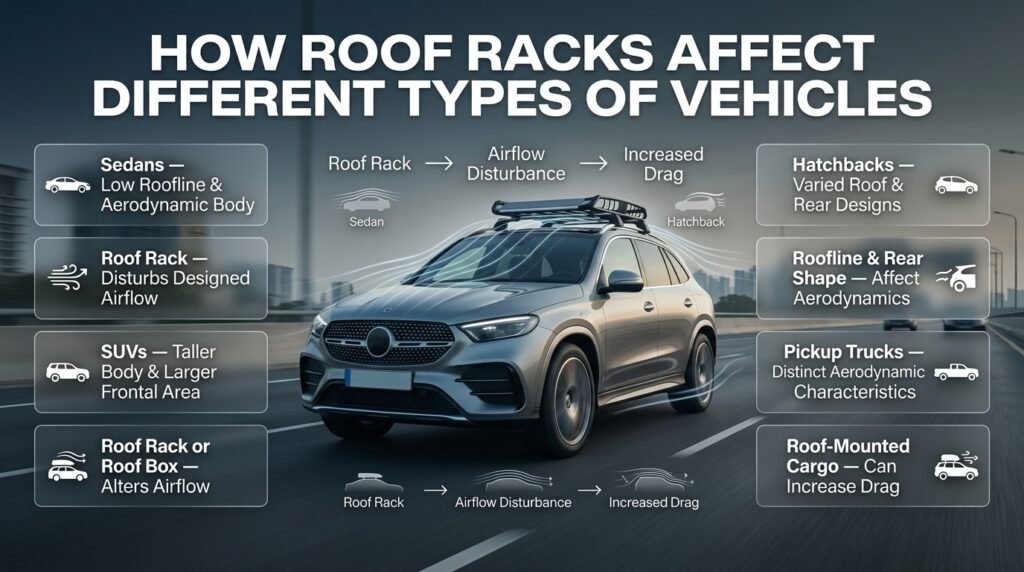
The effect of a roof rack can differ depending on vehicle design.
Sedans
Sedans generally have a relatively low roofline and aerodynamic body shape.
A roof rack adds external components above the designed body profile.
Because the vehicle is relatively low, the rack can become a noticeable disturbance to airflow.
SUVs
SUVs are taller and generally have larger frontal areas.
They may already experience more aerodynamic resistance than a low sedan.
Adding a roof rack or roof box can further alter airflow.
However, the exact effect depends on the individual vehicle.
Hatchbacks
Hatchbacks can have varied roof and rear designs.
A roof rack may have a different aerodynamic effect depending on the vehicle’s roofline and rear shape.
Pickup Trucks
Pickup trucks often have different aerodynamic characteristics because of their body design.
Roof-mounted cargo can still increase drag, particularly when the equipment extends significantly above the roofline.
The key point is that there is no universal fuel-consumption penalty that applies equally to every vehicle.
Vehicle Accessories and Fuel Economy
Vehicle accessories and fuel economy are closely connected because certain add-ons can increase aerodynamic drag, vehicle weight, or electrical load. Roof racks, cargo boxes, oversized accessories, and other external equipment may make the engine work harder, especially during highway driving. Even small changes can affect fuel consumption when they are used regularly. For better efficiency, remove unnecessary accessories when they are not needed, keep external equipment streamlined, and avoid carrying extra weight without a purpose. In Dubai, where long highway journeys and high-speed driving are common, choosing practical accessories and maintaining the vehicle properly can help support better overall fuel economy.
For a practical guide on how roof racks, cargo boxes, extra weight, larger wheels, and other accessories can influence fuel consumption, read our detailed Vehicle Accessories and Fuel Economy in Dubai guide before choosing or removing accessories from your vehicle.
Vehicle Drag and Fuel Consumption in Dubai
Vehicle drag can have a significant effect on fuel consumption, particularly as driving speed increases. Aerodynamic resistance becomes more noticeable on highways, meaning vehicles may need more engine power to maintain higher speeds. Roof racks, cargo boxes, open windows at high speeds, and bulky external accessories can increase drag and reduce efficiency further. In Dubai, where drivers often use high-speed roads for longer journeys, keeping the vehicle streamlined and removing unnecessary external equipment can help reduce aerodynamic resistance. Combining good aerodynamics with moderate speeds and smooth driving can support better overall fuel economy.
For a deeper understanding of how aerodynamic resistance, driving speed, roof equipment, external cargo, wind, and vehicle design can influence fuel consumption, explore our detailed Vehicle Drag and Fuel Consumption in Dubai guide.
Does a Roof Rack Affect Fuel Economy in Dubai?
Dubai provides an interesting environment for studying roof racks and fuel economy.
The city has extensive highway networks and high-speed roads.
Drivers may also travel significant distances between different parts of Dubai and the wider UAE.
At higher speeds, aerodynamic efficiency becomes increasingly relevant.
In addition, Dubai’s climate can introduce environmental conditions such as:
- High temperatures
- Strong sunlight
- Occasional dusty conditions
- Crosswinds
- Heavy air-conditioning use
- Long highway journeys
Air-conditioning is a separate factor from roof-rack drag, but it can also influence overall fuel consumption.
Drivers therefore need to consider the complete driving environment rather than blaming one factor for every change in fuel economy.
Fuel-Efficient Use of Automatic Transmission
Using an automatic transmission efficiently can help reduce unnecessary fuel consumption, especially during Dubai’s busy traffic and frequent stop-and-go driving. Avoid aggressive acceleration, sudden braking, and repeatedly switching between Drive and other gears when it is not necessary. When waiting for longer periods, follow the vehicle manufacturer’s guidance rather than keeping the engine unnecessarily engaged. Regular transmission maintenance and using the correct manufacturer-recommended fluid can also support smooth gear changes and efficient vehicle operation. The key is to let the transmission work naturally while maintaining a smooth, predictable driving style.
For practical guidance on using an automatic transmission more efficiently, including smooth acceleration, proper gear modes, traffic management, and highway driving habits, explore our detailed Fuel-Efficient Use of Automatic Transmission guide.
Air Conditioning and Roof Racks: A Combined Effect
Dubai drivers often rely heavily on air conditioning.
When the AC system is operating, the engine may have to provide additional energy to run the compressor and associated systems.
Now imagine combining that with:
- Roof cargo
- High highway speed
- Heavy traffic
- Low tyre pressure
- Aggressive acceleration
The total effect can become more significant than any individual factor.
This illustrates an important principle:
Fuel efficiency is usually the result of multiple small decisions rather than one magic trick.
Reducing roof-rack drag can help, but it should be part of a broader fuel-efficiency strategy.
Air Conditioning and Fuel Consumption
Air conditioning can have a noticeable effect on fuel consumption, especially during hot weather and heavy traffic. When the AC system is running, the engine needs additional power to operate the compressor, which can increase fuel use. In Dubai’s hot climate, however, avoiding AC completely is not practical or comfortable. A better approach is to use the system efficiently by parking in shade when possible, ventilating the cabin briefly before cooling it, maintaining the AC system properly, and avoiding unnecessary idling with the AC running. These simple habits can help reduce unnecessary fuel consumption while keeping the cabin comfortable.
For practical tips on reducing unnecessary fuel consumption while keeping your car comfortable in Dubai’s hot climate, explore our detailed Air Conditioning and Fuel Consumption guide, which explains how AC use, traffic, idling, driving speed, and vehicle maintenance can affect overall fuel economy.
Does Wind Make Roof Racks Less Efficient?
Yes.
Wind can change the aerodynamic conditions around a vehicle.
A strong headwind effectively increases the airspeed experienced by the vehicle.
For example, a car travelling at a particular road speed into a strong headwind may experience airflow equivalent to travelling through air at a higher relative speed.
Because aerodynamic drag increases strongly with relative airspeed, the effect can become noticeable.
Crosswinds can also alter airflow around roof-mounted equipment.
A bulky roof box or large object may respond differently to wind than a bare vehicle.
Therefore, the same roof rack may produce different fuel-consumption results on different days.
Why Roof Rack Design Matters
Not all roof racks are designed equally.
Modern systems may use aerodynamic profiles intended to reduce turbulence.
Other designs may prioritize:
- Low cost
- Maximum carrying capacity
- Universal compatibility
- Ease of installation
- Heavy-duty use
A rack designed for heavy equipment may not have the same aerodynamic characteristics as a low-profile touring rack.
When purchasing a roof rack, drivers who care about fuel economy should consider aerodynamic design as one factor alongside:
- Load capacity
- Vehicle compatibility
- Security
- Noise
- Installation
- Durability
- Manufacturer specifications
Fuel efficiency should not be the only consideration.
How to Improve Fuel Economy When Using a Roof Rack
You don’t necessarily need to stop using a roof rack to reduce its effect on fuel consumption.
Several practical steps can help.
1. Remove the Rack When You Don’t Need It
If the roof rack is only used occasionally, remove it during periods when it isn’t required.
This eliminates its aerodynamic contribution.
2. Choose an Aerodynamic Design
When buying a rack, consider low-profile designs with smoother shapes.
Avoid unnecessarily bulky systems if your normal cargo requirements are modest.
3. Avoid Oversized Roof Boxes
Choose a box that matches your actual needs.
A huge carrier used to transport a few small items adds unnecessary external size.
4. Keep Cargo Secure and Compact
Arrange equipment so that it creates as little unnecessary exposed surface area as possible.
Follow the manufacturer’s instructions and never compromise safe loading for aerodynamic efficiency.
5. Avoid Excess Weight
Don’t use the roof as a storage area for items you don’t actually need.
Extra weight can increase fuel use, particularly in stop-and-go driving.
6. Check the Rack Installation
A poorly installed rack may sit incorrectly or create unnecessary airflow disturbance.
Always follow the manufacturer’s instructions.
7. Drive Smoothly
A roof rack is only one part of the fuel-consumption equation.
Smooth acceleration and appropriate speed can help reduce overall fuel use.
For more practical guidance, see fuel-saving driving tips.
The Relationship Between Roof Racks and Highway Driving
Highway driving is where the aerodynamic effects of roof equipment become particularly important.
At steady high speed, the engine spends a large amount of energy overcoming aerodynamic resistance.
A roof rack can increase that resistance.
This is why the same rack may have a small effect during a short urban trip but a more noticeable effect during a long highway journey.
Imagine driving 10 kilometres through a city versus driving 300 kilometres on a highway.
During the city journey, the vehicle may spend considerable time:
- Stopping
- Accelerating
- Waiting
- Turning
During the highway journey, it may spend hours continuously moving through the air.
The aerodynamic difference therefore has much more time to influence total fuel consumption.
Roof Racks and Long-Distance Driving
Long-distance travel deserves special consideration.
Suppose you’re preparing for a road trip.
You may be tempted to install a roof box several days before departure.
If the vehicle remains equipped with the box throughout the entire trip, you’re accepting its aerodynamic effect for every kilometre.
A more efficient approach is to think carefully about:
- What must be transported
- What can fit inside the vehicle
- What needs roof storage
- How much weight is necessary
- Whether the roof carrier is needed after reaching the destination
Good packing isn’t just about fitting everything into the vehicle.
It can also influence fuel efficiency.
How Much Fuel Does a Roof Rack Use?
There is no single universal number.
You may see online claims stating that a roof rack always increases fuel consumption by a specific percentage.
These claims should be treated cautiously.
The actual result can vary because of:
- Vehicle type
- Rack design
- Cargo shape
- Cargo weight
- Driving speed
- Wind
- Road conditions
- Tyre condition
- Traffic
- Driving style
- Air-conditioning use
A small aerodynamic rack on one vehicle may have a very different effect from a large roof box on another.
Therefore, instead of assuming one fixed percentage, it is better to understand the underlying principle:
More aerodynamic drag generally means more energy is required to maintain speed.
How to Measure Your Own Roof Rack’s Fuel Impact
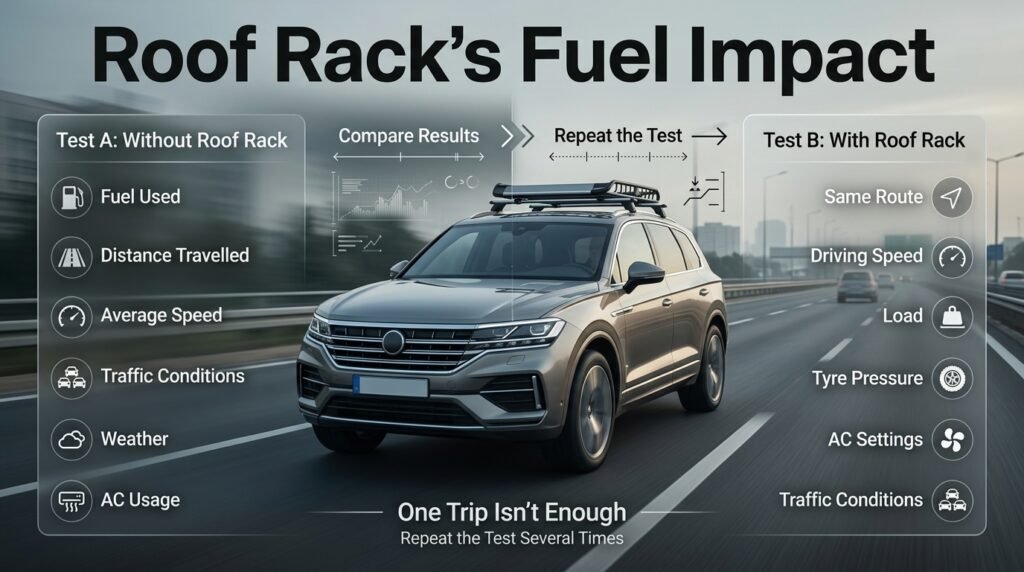
If you want to know how much your specific setup affects fuel economy, you can conduct a simple comparison.
Use the same vehicle and try to keep conditions as consistent as possible.
Test A: Without Roof Rack
Record:
- Fuel used
- Distance travelled
- Average speed
- Traffic conditions
- Weather
- AC usage
Calculate your average fuel economy.
Test B: With Roof Rack
Repeat a similar journey with the rack installed.
Keep the following as consistent as possible:
- Route
- Driving speed
- Load
- Tyre pressure
- AC settings
- Traffic conditions
Then compare the results.
One trip isn’t enough to establish a reliable difference.
Repeating the test several times can provide a better indication.
Why One Fuel-Economy Test Can Be Misleading
Suppose your vehicle gets worse fuel economy with the roof rack installed.
Does that automatically prove the rack caused the entire difference?
Not necessarily.
Maybe:
- The second trip had stronger headwinds.
- Traffic was heavier.
- You accelerated more aggressively.
- Tyre pressure was lower.
- The AC was used more.
- The vehicle carried additional passengers.
- The road had more elevation changes.
Fuel economy is affected by many variables.
For this reason, controlled comparisons are more useful than comparing two completely different trips.
Roof Rack Noise and Fuel Efficiency
A roof rack can also create noticeable wind noise.
Noise itself doesn’t necessarily mean a specific amount of fuel is being wasted, but it can indicate that the rack is significantly disturbing airflow.
If you hear:
- Whistling
- Humming
- Wind rushing
- Vibrations
the rack may be interacting strongly with airflow.
However, noise level alone is not a precise measurement of aerodynamic drag.
A quiet rack isn’t automatically the most fuel-efficient rack, and a noisy rack doesn’t automatically have a huge fuel penalty.
Still, excessive wind noise can be a useful reminder to review rack positioning and installation.
How Aerodynamics Affects Fuel Efficiency
Aerodynamics plays an important role in fuel efficiency, especially when a vehicle is traveling at higher speeds. As speed increases, air resistance creates more drag, requiring the engine to use additional energy to keep the vehicle moving. Features such as roof racks, cargo boxes, open windows, and bulky external accessories can increase aerodynamic drag and contribute to higher fuel consumption. Keeping the vehicle streamlined, removing unnecessary external equipment, and maintaining a sensible highway speed can help reduce resistance and support more efficient driving.
For a clearer understanding of how air resistance, vehicle design, speed, roof accessories, and external load can influence your car’s fuel consumption, explore our detailed How Aerodynamics Affects Fuel Efficiency guide.
Common Mistakes Drivers Make With Roof Racks
Leaving the Rack Installed Permanently
If you only use the rack occasionally, keeping it installed year-round may create unnecessary aerodynamic drag.
Carrying Unnecessary Equipment
Some drivers leave bike mounts, roof boxes, or other accessories attached even when they aren’t needed.
Overloading the Roof
Roof racks have specific weight limits.
Exceeding them can create safety risks and may affect vehicle handling.
Ignoring Aerodynamic Shape
A bulky load can create substantially more airflow disturbance than a compact load.
Driving Faster to Compensate for Extra Travel Time
Higher speeds generally increase aerodynamic resistance significantly.
If a roof rack is already increasing drag, aggressive highway speeds can compound the effect.
Roof Rack Safety Should Come First
Fuel economy should never take priority over safe transportation.
Always follow the manufacturer’s:
- Maximum load rating
- Installation instructions
- Speed recommendations
- Cargo securing requirements
Make sure the cargo is properly attached.
Check straps and mounting points before travelling.
Also consider the increased vehicle height.
A roof box, bicycle, or other roof-mounted item may make the vehicle too tall for certain:
- Parking garages
- Covered areas
- Low bridges
- Drive-through structures
A fuel-efficient setup is not useful if the cargo isn’t transported safely.
Can Driving More Slowly Reduce Roof Rack Fuel Penalty?
Generally, reducing speed can reduce aerodynamic resistance.
This is particularly relevant when carrying roof-mounted equipment.
At lower speeds, aerodynamic drag is reduced.
However, drivers should always follow posted speed limits and drive according to road conditions.
The goal isn’t to drive unnaturally slowly.
Instead, avoid unnecessary high speeds and aggressive acceleration.
A consistent, appropriate speed can help improve overall efficiency.
You can also learn more about optimal driving speed for fuel efficiency in Dubai.
Roof Racks and Tyre Pressure
Roof racks don’t directly change tyre pressure requirements, but the added load can make correct tyre pressure more important.
When carrying additional cargo, consult the vehicle manufacturer’s recommended tyre-pressure information.
Underinflated tyres can increase rolling resistance.
That means a vehicle carrying roof equipment could experience both:
- Additional aerodynamic resistance
- Additional rolling resistance
If you’re trying to improve fuel economy, it’s sensible to check tyre pressure regularly.
Don’t inflate tyres beyond the manufacturer’s recommended limits simply to chase fuel savings.
Correct pressure is the goal.
Tire Pressure and Fuel Efficiency
Tire pressure plays an important role in fuel efficiency because underinflated tires create greater rolling resistance, forcing the engine to work harder and potentially increasing fuel consumption. Maintaining the recommended tire pressure can help your vehicle roll more efficiently while also supporting better handling, braking, and tire wear. In Dubai’s hot climate, checking tire pressure regularly is especially useful because temperature changes can affect pressure readings. Always follow the vehicle manufacturer’s recommended pressure rather than relying on the maximum pressure printed on the tire sidewall.
For practical guidance on maintaining the correct tire pressure, reducing unnecessary rolling resistance, and supporting better fuel economy in Dubai’s driving conditions, read our detailed Tire Pressure and Fuel Efficiency guide.
Does Roof Rack Position Matter?
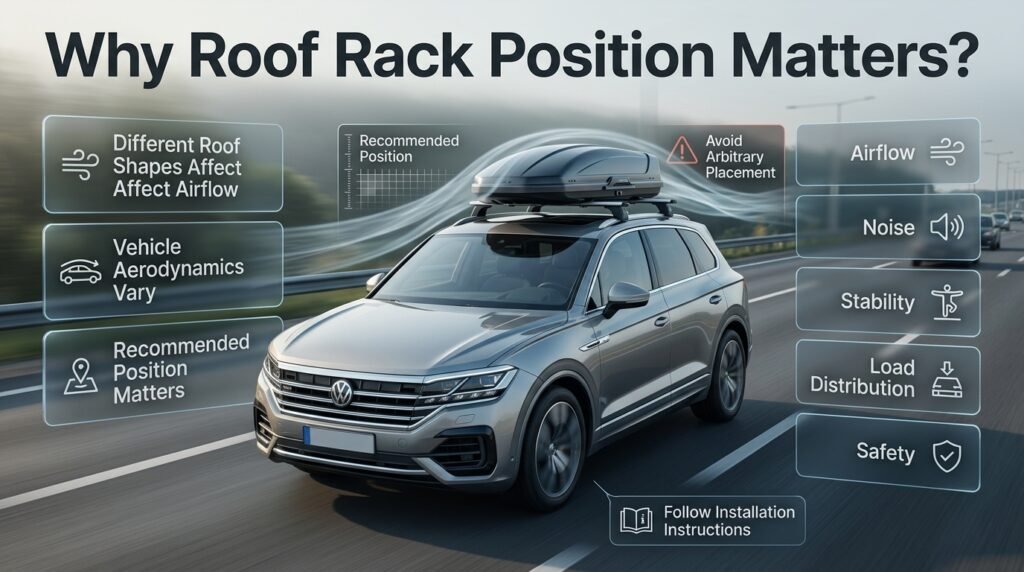
Yes.
Where the rack or roof box sits can influence airflow.
Different vehicles have different roof shapes and aerodynamic characteristics.
The manufacturer or rack manufacturer may specify a recommended position.
Moving equipment arbitrarily can affect:
- Airflow
- Noise
- Stability
- Load distribution
- Safety
Therefore, the best approach is to follow the installation instructions rather than experimenting with placement solely for fuel economy.
Roof Rack vs Rear Cargo Carrier
Drivers who frequently transport bulky items may consider alternatives to roof storage.
Depending on the vehicle, options can include:
- Rear-mounted carriers
- Trailer systems
- Internal cargo storage
- Folding equipment
- Vehicle-specific transport systems
Each has its own aerodynamic, weight, cost, and safety considerations.
A rear-mounted system may sometimes create less aerodynamic resistance than a roof-mounted system, but that isn’t guaranteed.
The best option depends on the vehicle and the type of cargo.
Why Cargo Shape Matters More Than Many Drivers Expect
Weight is easy to understand.
A 20-kilogram object weighs 20 kilograms regardless of where you put it.
But aerodynamic drag depends heavily on shape and position.
A lightweight but bulky object can create significant drag.
A heavier but compact object may have a smaller aerodynamic effect.
This is why roof transportation isn’t simply a matter of calculating kilograms.
You should also consider:
- Height
- Width
- Frontal area
- Surface shape
- Orientation
- Exposure to airflow
In other words, how the cargo interacts with air can matter as much as how much it weighs during high-speed travel.
Roof Racks and Stop-and-Go Traffic
Aerodynamic drag becomes less dominant at low speeds, but roof racks can still contribute to overall inefficiency.
In congested Dubai traffic, however, other factors may become more significant.
Repeated acceleration requires energy.
Frequent braking converts some of that kinetic energy into heat rather than allowing it to be reused.
Long periods of idling can also consume fuel without moving the vehicle.
For information about this specific issue, read fuel consumption while idling.
This is why drivers shouldn’t expect removing a roof rack to solve all fuel-consumption problems in urban traffic.
Combining Roof Rack Management With Efficient Driving
The best fuel-efficiency strategy combines several sensible practices.
For example:
Use the roof rack only when needed.
Avoid unnecessary cargo.
Maintain correct tyre pressure.
Drive smoothly.
Avoid unnecessary high speeds.
Reduce excessive idling.
Keep the vehicle properly maintained.
This approach addresses multiple sources of fuel consumption at the same time.
You can also review smooth driving techniques for better fuel economy for additional practical strategies.
How Acceleration Interacts With Extra Roof Cargo
Additional roof cargo can increase the vehicle’s weight.
Whenever you accelerate, the engine needs to provide energy to increase the vehicle’s kinetic energy.
A heavier vehicle requires more energy to achieve the same acceleration.
If you combine extra weight with aggressive acceleration, fuel consumption can increase further.
For example, repeatedly accelerating a heavily loaded vehicle from traffic lights requires more energy than gently building speed.
You can read more about this relationship in how acceleration affects fuel consumption.
Braking Also Matters
Roof cargo doesn’t directly make braking inefficient, but additional mass changes the amount of kinetic energy involved in stopping.
If you’re constantly accelerating and braking, more energy is being added and then dissipated.
A smoother driving style can reduce these unnecessary energy changes.
Anticipating traffic, maintaining appropriate following distance, and avoiding unnecessary hard acceleration followed by hard braking can contribute to better overall efficiency.
For more information, see how braking habits affect fuel economy in Dubai.
Traffic, Roof Racks, and Fuel Consumption
Traffic can make fuel consumption unpredictable.
A vehicle with a roof rack travelling steadily at a moderate highway speed may achieve reasonable efficiency.
The same vehicle in severe congestion may consume more fuel because of:
- Repeated acceleration
- Frequent braking
- Idling
- Low average speed
- AC operation
This means you shouldn’t judge your roof rack purely from fuel economy during a single traffic-heavy journey.
For a deeper look at this issue, see how traffic affects fuel economy in Dubai.
Should You Remove Your Roof Rack Before a Road Trip?
It depends on whether you need it.
If you’re travelling without roof cargo and the rack is easily removable, taking it off can reduce unnecessary aerodynamic drag.
If you need the rack for bicycles, luggage, or other equipment, removing it obviously isn’t practical.
Instead, focus on:
- Efficient loading
- Proper installation
- Compact cargo arrangement
- Appropriate driving speed
- Correct tyre pressure
- Smooth driving
The goal isn’t to eliminate every source of resistance.
The goal is to avoid resistance that provides no useful benefit.
The Best Roof Rack Strategy for Fuel Economy
A practical strategy can be summarized in a few steps.
Before the Trip
Ask yourself:
Do I actually need the roof rack?
If no, remove it.
If yes, determine exactly what you need to carry.
While Loading
Avoid unnecessary items.
Distribute the load correctly.
Secure everything according to manufacturer instructions.
Before Driving
Check:
- Tyre pressure
- Rack mounting
- Cargo straps
- Maximum load
- Vehicle height
During the Journey
Maintain an appropriate speed.
Accelerate smoothly.
Avoid unnecessary braking.
Monitor traffic conditions.
After the Trip
Remove the rack or roof box if it won’t be needed for future journeys.
This simple routine can reduce unnecessary fuel consumption while keeping the system practical.
Do roof racks reduce fuel economy?
Yes, a roof rack can reduce fuel economy because it changes the way air flows over the vehicle. Even when the rack is carrying nothing, the crossbars and mounting hardware sit in the airflow and create additional aerodynamic drag. The faster the vehicle travels, the more noticeable this effect becomes. Research has found measurable fuel-consumption increases from roof racks, although the exact percentage varies considerably with vehicle design, rack shape, speed, and weather conditions.
The important point is that the weight of an empty roof rack is usually not the main issue. Aerodynamics is. At highway speeds, the engine has to produce additional power to overcome the extra resistance created by the rack.
Key points:
Empty crossbars can still increase aerodynamic drag.
The effect becomes more important as driving speed increases.
Box-shaped or poorly streamlined racks generally create more resistance.
The actual fuel penalty differs between vehicles and rack designs.
If the rack is only needed occasionally, removing it afterward can help maintain better highway fuel economy.
For example, a Car and Driver test found that removing factory crossbars from a Kia Carnival improved highway fuel economy by about 12% at 75 mph, demonstrating how much aerodynamic accessories can matter at higher speeds.
How much does a roof rack affect fuel consumption at highway speeds?
There is no single percentage that applies to every car, because the result depends on the vehicle, crossbar design, load, driving speed, wind, and whether a roof box or other equipment is attached. However, research consistently shows that the penalty becomes more significant at higher speeds because aerodynamic drag rises rapidly with velocity.
One important distinction is between an empty roof rack and a loaded roof rack. An empty rack may create a relatively modest penalty, while adding bicycles, luggage, skis, a ladder, or a roof box can substantially increase the frontal area and turbulence around the vehicle.
Published testing has produced very different results under different conditions. For example, one review reported roughly a 1–3% fuel-consumption increase for roof racks at 70–90 km/h, while other highway tests have found considerably larger effects at higher speeds or with additional rooftop equipment.
What affects the result most:
Vehicle speed
Shape and height of the crossbars
Roof rack design
Size and shape of the cargo
Whether a roof box is installed
Headwind and crosswind
Vehicle body shape
Highway versus city driving
So, rather than promising a fixed percentage, it is more accurate to say that roof-rack fuel consumption becomes increasingly relevant as speed rises.
Does removing a roof rack improve fuel economy?
Removing an unused roof rack can improve fuel economy, particularly if you regularly drive on highways or other roads at relatively high speeds. The reason is straightforward: once the crossbars and other exposed components are removed, the vehicle presents a cleaner surface to the airflow.
This doesn’t mean every driver will see a dramatic improvement on every trip. In slow city traffic, aerodynamic drag is generally less important than it is during sustained highway driving. But during a long, fast journey, even a relatively small aerodynamic penalty can accumulate over hundreds of kilometres.
A real-world test illustrates this clearly. When Car and Driver removed the factory crossbars from a Kia Carnival, its highway fuel economy improved from the previous result by around 3 mpg at 75 mph.
A practical approach is:
Keep the rack installed when you genuinely need it.
Remove detachable crossbars when they are not being used.
Take off unused roof boxes after a trip.
Avoid leaving bike carriers mounted permanently.
Check the manufacturer’s instructions before removing or reinstalling components.
This is especially useful for drivers who only use their roof equipment for occasional holidays, sports trips, or moving bulky items. There is little benefit in accepting additional aerodynamic drag every day for equipment that is used only a few times a year.
Does a roof box use more fuel than an empty roof rack?
In most situations, a roof box has a greater effect on fuel economy than an empty set of crossbars because it presents a larger object to the airflow and can increase both frontal area and aerodynamic drag. The difference can become substantial during highway driving.
A roof box also adds some weight, but its aerodynamic effect is often the more important factor at higher speeds. Research reviewing different studies found that roof boxes can produce significantly higher fuel consumption, with the exact penalty depending heavily on vehicle type, speed, and box design.
A particularly useful example comes from a 2025 Car and Driver comparison. In testing a Toyota Grand Highlander Hybrid, a rooftop carrier returned 21 mpg, compared with 25 mpg using a hitch-mounted carrier under the tested conditions. That is not a universal result for every vehicle, but it demonstrates why the location and aerodynamic shape of cargo equipment matter.
When using a roof box, consider:
Choose a streamlined design rather than a very boxy one.
Pack only what you actually need.
Avoid unnecessary weight.
Position the box according to the manufacturer’s instructions.
Keep highway speed moderate.
Remove the box when the trip is finished.
The key lesson is that roof storage is convenient, but convenience can come with an aerodynamic fuel penalty.
How can I reduce the fuel economy penalty of a roof rack?
The best strategy is not necessarily to stop using a roof rack. Instead, use it intelligently and reduce the amount of aerodynamic resistance it creates. Since aerodynamic drag becomes increasingly important at higher speeds, sensible rack use can make a noticeable difference during long-distance driving.
Start by removing the rack or crossbars when they are not required. If you need a permanent system, choose components designed with aerodynamics in mind. A streamlined crossbar generally creates less turbulence than a large, square-profile bar, and an aerodynamic cargo box can be preferable to an unnecessarily bulky design. Research has specifically identified aerodynamic design as an important factor in reducing the drag created by roof-mounted equipment.
Practical fuel-saving steps:
Remove unused roof bars.
Remove the roof box between trips.
Choose aerodynamic crossbars.
Select a streamlined roof box if you regularly need extra cargo space.
Keep the load as light as practical.
Pack cargo neatly inside the box.
Secure everything correctly rather than allowing loose items to create additional turbulence.
Avoid unnecessary high-speed driving when carrying rooftop equipment.
Check tyre pressure and other basic vehicle-efficiency factors as well.
The biggest mistake is assuming that one accessory automatically has a fixed fuel penalty. Real-world fuel economy is affected by several factors at the same time. A roof rack may be relatively insignificant during slow urban driving but become much more important during a long highway journey.
For drivers who regularly travel long distances, the combination of less rooftop equipment, better aerodynamic design, sensible loading, and moderate highway speed is a much more reliable approach to maintaining fuel economy than relying on one single fuel-saving trick.
Conclusion
Roof racks are useful when you need extra carrying space, but they can have a noticeable effect on fuel economy, especially during highway driving. The main reason is not simply the weight of the rack. The bigger issue is aerodynamic drag created when crossbars, roof boxes, bicycles, luggage, or other equipment disturb the airflow around the vehicle.
The effect becomes more important as driving speed increases. An empty roof rack can create additional resistance, while a loaded rack or large roof box can increase it further. For drivers who regularly travel long distances, removing unnecessary rooftop equipment and choosing more aerodynamic designs can help reduce wasted fuel.
The practical approach is simple: use the roof rack when you need it, keep the load as light and streamlined as possible, and remove detachable equipment when it is no longer required. Combined with sensible highway speeds, correct tyre pressure, smooth driving, and proper vehicle maintenance, these small decisions can contribute to better overall fuel efficiency.
Ultimately, roof racks and fuel economy are closely connected through aerodynamics. You do not necessarily need to stop using a roof rack; you simply need to understand when it creates the greatest fuel penalty and manage it accordingly.
Leave a Reply