Introduction
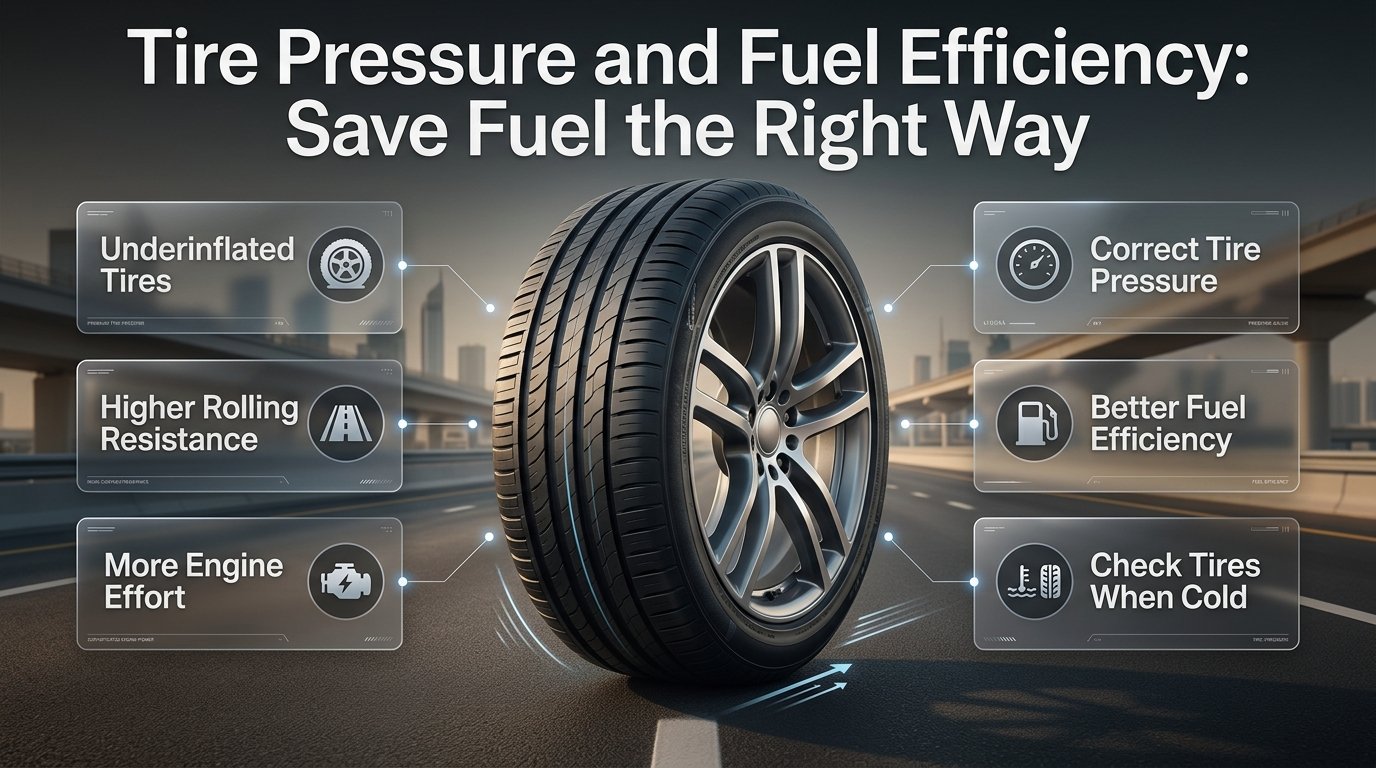
Tire Pressure and Fuel Efficiency | You fill your fuel tank, drive the same roads every day, and still notice that your car seems to be using more fuel than before. Before blaming fuel quality, engine performance, air conditioning, or traffic, there’s one simple thing worth checking: your tires.
The relationship between tire pressure and fuel efficiency is often underestimated. When tires are underinflated, they can create greater rolling resistance. This means the engine has to work harder to keep the vehicle moving, which can contribute to higher fuel consumption. For drivers in Dubai, where hot temperatures, busy roads, and long highway journeys are common, keeping tires properly inflated is a particularly useful maintenance habit.
For more practical information about fuel services and fuel-related driving resources, visit Fuel Delivery Dubai.
But there’s an important point: the answer isn’t to put as much air into the tires as possible. The goal is to maintain the tire pressure recommended by your vehicle manufacturer.
In this guide, we’ll explain exactly how tire pressure affects fuel economy, how rolling resistance works, how temperature changes tire pressure, how often you should check your tires, whether overinflation really saves fuel, and how tire pressure works together with speed, acceleration, traffic, vehicle load, aerodynamics, and driving habits.
Does Tire Pressure Affect Fuel Efficiency?
Yes, tire pressure can affect fuel efficiency because it influences rolling resistance. When a tire is underinflated, it generally flexes more as it rolls over the road. That extra deformation increases resistance, requiring additional energy from the engine to keep the vehicle moving.
The basic relationship is:
Low tire pressure → more tire deformation → higher rolling resistance → more engine effort → potentially higher fuel consumption
The actual impact isn’t identical for every vehicle. It depends on how low the pressure is, the tire design, vehicle weight, driving speed, road surface, temperature, and other conditions.
That’s why it’s better not to focus on one universal fuel-saving percentage.
The practical lesson is much simpler:
Keep your tires at the pressure recommended by the vehicle manufacturer.
This helps the tires operate as intended while supporting fuel efficiency, handling, braking, and tire wear.
What Is Rolling Resistance?
Rolling resistance is the force that works against a tire as it rolls along the road.
A tire isn’t a completely rigid object. As it rotates, the rubber and internal structure deform where the tire meets the road. The tire then returns toward its original shape as it moves away from the contact patch.
That deformation requires energy.
Some of that energy is converted into heat instead of being used to move the vehicle forward.
When a tire is underinflated, it usually deforms more. Greater deformation can mean greater rolling resistance.
The engine therefore has to provide additional energy to maintain the same movement.
A Simple Example
Imagine trying to push two carts.
One has properly inflated wheels that roll easily.
The other has soft wheels that deform against the ground.
The second cart requires more effort.
Vehicle tires are much more sophisticated than simple cart wheels, but the principle is similar: more rolling resistance requires more energy.
That’s why tire pressure is one of the factors that can influence fuel economy.
What Tire Pressure Should You Use?
The correct tire pressure is the pressure specified by your vehicle manufacturer.
You can usually find the recommended pressure on:
- The driver’s door-jamb sticker
- The driver’s door frame
- The owner’s manual
- Manufacturer documentation
- A vehicle information label
Some vehicles require different pressures for the front and rear tires.
Others specify different pressures for normal loads and maximum loads.
Always check the information for your specific vehicle rather than assuming that every car uses the same pressure.
Don’t Use the Maximum Tire Pressure as Your Target
A common mistake is looking at the number printed on the tire sidewall and assuming that’s the pressure the vehicle should normally have.
That’s not necessarily correct.
The number printed on the sidewall may represent the tire’s maximum rated inflation pressure under specified conditions. It isn’t automatically the recommended operating pressure for your vehicle.
Your vehicle manufacturer’s recommendation takes the entire vehicle into account.
It considers things such as:
- Vehicle weight
- Tire size
- Load distribution
- Suspension
- Handling
- Braking
- Tire construction
- Passenger and cargo requirements
For normal driving, use the manufacturer’s recommended pressure.
How Does Low Tire Pressure Increase Fuel Consumption?
Underinflated tires can increase fuel consumption because they tend to create greater rolling resistance.
When tire pressure drops, the tire can flex more as it rotates.
That increased flexing consumes energy.
The engine must then work harder to overcome the additional resistance.
The difference may not be obvious from the driver’s seat. You may not hear the engine working harder, and the car may still feel completely normal.
But fuel efficiency is measured over many kilometers.
If you drive thousands of kilometers every year, consistently carrying unnecessary rolling resistance can become worth addressing.
Low Tire Pressure Can Cause Other Problems
Fuel consumption isn’t the only concern.
Significantly underinflated tires can also contribute to:
- Increased tire flexing
- Greater heat buildup
- Uneven tire wear
- Changes in steering response
- Reduced handling precision
- Potential changes in braking behavior
- Increased stress on the tire
This makes tire pressure both a fuel-efficiency issue and a basic vehicle-maintenance issue.
Can Overinflating Tires Improve Fuel Economy?
This is one of the most common misconceptions about tire pressure.
Increasing tire pressure can affect rolling resistance, but that doesn’t mean you should deliberately inflate your tires beyond the manufacturer’s recommendation.
Excessive tire pressure can change how the tire interacts with the road and may affect:
- Ride comfort
- Handling
- Braking
- Tread contact
- Tire wear
- Vehicle behavior over rough surfaces
The potential fuel-economy benefit isn’t a reason to ignore the recommended pressure.
Expert Tip
Don’t use excessive tire pressure as a fuel-saving shortcut.
The objective is not maximum pressure.
The objective is correct pressure.
Your manufacturer’s recommended tire pressure provides the intended balance between efficiency, handling, comfort, tire wear, and vehicle performance.
Underinflated Tires vs Correct Tire Pressure
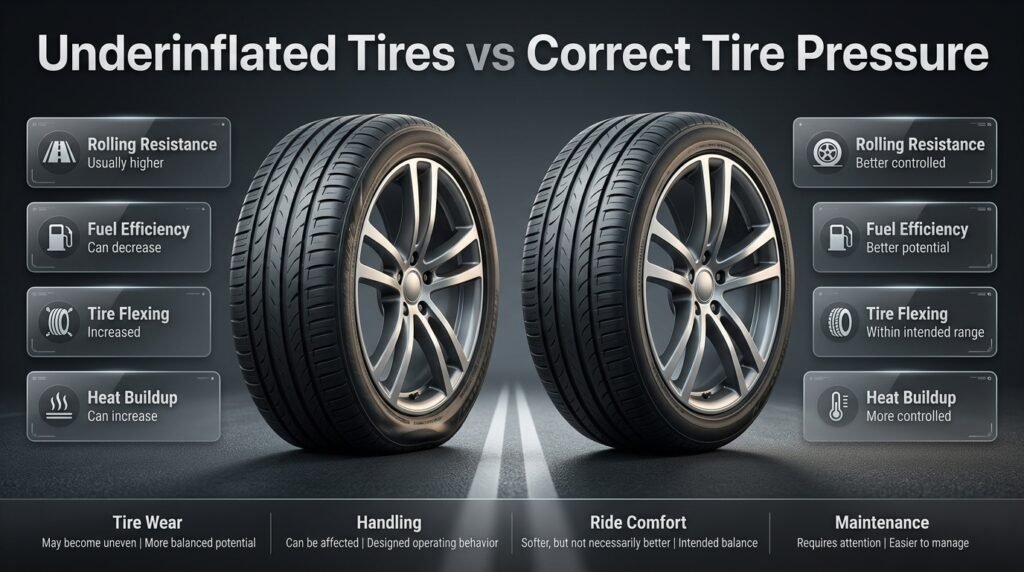
| Factor | Underinflated Tires | Correct Tire Pressure |
|---|---|---|
| Rolling resistance | Usually higher | Better controlled |
| Fuel efficiency | Can decrease | Better potential |
| Tire flexing | Increased | Within intended range |
| Heat buildup | Can increase | More controlled |
| Tire wear | May become uneven | More balanced potential |
| Handling | Can be affected | Designed operating behavior |
| Ride comfort | Softer, but not necessarily better | Intended balance |
| Tire maintenance | Requires attention | Easier to manage |
Correct pressure doesn’t guarantee a specific fuel-saving result, but it prevents one easily avoidable source of inefficiency.
Why Tire Pressure Changes With Temperature
Tire pressure doesn’t stay exactly the same throughout the day.
Temperature affects the air inside the tire.
When the air becomes warmer, pressure generally increases. When it cools, pressure decreases.
Driving also warms the tires.
This means a tire checked immediately after a long journey may show a higher pressure than the same tire would show after sitting overnight.
This is particularly important in hot climates such as Dubai.
Why Cold Tire Pressure Matters
Vehicle manufacturers normally specify tire pressure based on cold-tire conditions.
For the most useful comparison:
- Park the vehicle for several hours.
- Check the tires before extended driving.
- Compare the reading with the manufacturer’s recommendation.
- Adjust pressure if necessary.
- Check regularly.
Common Mistake
Don’t see a higher reading on a hot tire and immediately release air.
A warm tire can naturally show a higher pressure.
If you release air while the tire is hot, the pressure may become too low after the tire cools.
Why Tire Pressure Matters in Dubai
Dubai’s climate makes tire maintenance particularly important.
During hot weather, the air temperature and road surface temperature can be very high. Vehicles may also spend significant time in traffic or travel long distances on highways.
Drivers often use air conditioning heavily, especially during the hottest months.
These conditions don’t mean tire pressure is the only thing affecting fuel economy. Far from it.
But when multiple factors are increasing fuel consumption, it’s useful to control the factors you can easily manage.
Proper tire pressure is one of them.
Dubai Driving Conditions That Can Affect Fuel Economy
A typical journey may involve:
- High ambient temperatures
- Hot road surfaces
- Heavy air-conditioning use
- Traffic congestion
- Frequent acceleration and braking
- Long highway driving
- High cruising speeds
- Heavy vehicle loads
Maintaining proper tire pressure can’t eliminate all these effects, but it can help prevent unnecessary rolling resistance.
For more practical ways to reduce fuel consumption, see Fuel-Saving Driving Tips.
Fuel-Efficient Driving Techniques
Fuel-efficient driving techniques can help reduce unnecessary fuel consumption while making everyday driving smoother and more economical. Avoid aggressive acceleration, sudden braking, and excessive speeding, as these habits can make the engine work harder and waste energy. Instead, maintain a steady speed, anticipate traffic changes, and accelerate gradually whenever road conditions allow. Keeping the tires properly inflated, removing unnecessary vehicle weight, and avoiding prolonged idling can further support better fuel economy. In Dubai, where drivers may experience heavy traffic, high temperatures, and frequent highway travel, combining efficient driving habits with regular vehicle maintenance can make a noticeable difference over time.
For practical advice on smoother acceleration, controlled braking, steady-speed driving, reducing unnecessary idling, and other habits that can support better fuel economy, explore our detailed Fuel-Efficient Driving Techniques guide.
How to Check Tire Pressure Correctly
Checking tire pressure is one of the easiest vehicle-maintenance tasks you can perform.
You don’t need to wait for a warning light.
Step 1: Find the Recommended Pressure
Look at the manufacturer’s sticker, usually found on the driver’s door frame or door jamb.
You can also check the owner’s manual.
Write down the recommended front and rear pressures if they’re different.
Step 2: Check the Tires When Cold
Whenever practical, check pressure before driving or after the vehicle has been parked for several hours.
This gives you a more useful comparison with the manufacturer’s cold-pressure recommendation.
Step 3: Remove the Valve Cap
Unscrew the valve cap carefully.
Keep the cap clean and don’t lose it.
Step 4: Attach a Pressure Gauge
Press the gauge firmly against the valve stem.
A poor seal can allow air to escape and result in an inaccurate reading.
Step 5: Check Every Tire
Don’t check only the tire that looks low.
Measure all four tires.
If your vehicle has a conventional spare, check that as well.
Step 6: Adjust the Pressure
Add air if the pressure is below the recommended level.
If pressure is too high, adjust it according to the manufacturer’s specification.
Step 7: Check the Reading Again
After adjusting the pressure, confirm the final reading.
Replace the valve cap securely.
How Often Should You Check Tire Pressure?
For most drivers, checking tire pressure about once a month is a sensible routine.
You should also check it before long trips.
Additional checks are worthwhile if:
- A TPMS warning appears
- One tire looks unusual
- The vehicle feels different
- You recently repaired a tire
- You suspect a slow leak
- The vehicle is carrying a heavy load
- You’re preparing for a long highway journey
Tires can lose air gradually.
Waiting until a tire looks visibly flat isn’t a good maintenance strategy.
Does TPMS Replace Manual Tire Checks?
No.
A Tire Pressure Monitoring System, or TPMS, is a useful safety feature that can warn the driver when tire pressure falls below a specified threshold.
But TPMS shouldn’t replace regular pressure checks.
A warning system isn’t necessarily telling you that every tire is exactly at the manufacturer’s recommended pressure.
It may simply indicate that pressure has dropped enough to trigger the system.
Better Approach
Use both:
Regular manual checks + TPMS monitoring
This gives you a better picture of tire condition.
How Tire Pressure Affects Highway Fuel Economy
Highway driving involves continuous tire rotation over long distances.
If the tires are underinflated, additional rolling resistance remains present throughout the journey.
That doesn’t mean tire pressure is the largest factor in highway fuel economy.
At higher speeds, aerodynamic drag becomes increasingly important.
This is why a fuel-efficient highway strategy should include both proper tire pressure and sensible speed.
For additional information, see Highway Driving Fuel Efficiency.
You can also read Fuel-Efficient Highway Driving.
How Highway Speed Affects Fuel Consumption
As vehicle speed increases, aerodynamic drag becomes increasingly significant.
This means a car can use more fuel at very high highway speeds even if the engine is operating normally and the tires are correctly inflated.
For example, imagine two drivers traveling on the same highway.
Driver A:
- Correct tire pressure
- Smooth acceleration
- Sensible cruising speed
- Minimal unnecessary braking
Driver B:
- Correct tire pressure
- Aggressive acceleration
- Higher cruising speed
- Frequent braking
The second driver can still use significantly more fuel even though both vehicles have identical tire pressure.
For more detail, read How Highway Speed Affects Fuel Consumption.
Air Conditioning and Fuel Consumption
Air conditioning can have a noticeable effect on fuel consumption, especially during hot weather and heavy traffic. When the AC system is running, the engine needs additional power to operate the compressor, which can increase fuel use. In Dubai’s hot climate, however, avoiding AC completely is not practical or comfortable. A better approach is to use the system efficiently by parking in shade when possible, ventilating the cabin briefly before cooling it, maintaining the AC system properly, and avoiding unnecessary idling with the AC running. These simple habits can help reduce unnecessary fuel consumption while keeping the cabin comfortable.
For practical tips on reducing unnecessary fuel consumption while keeping your car comfortable in Dubai’s hot climate, explore our detailed Air Conditioning and Fuel Consumption guide, which explains how AC use, traffic, idling, driving speed, and vehicle maintenance can affect overall fuel economy.
Improving Fuel Economy on Long Trips
Before starting a long journey, tire pressure should be part of your basic vehicle check.
Check:
- Tire pressure
- Tire condition
- Spare tire
- Tread
- Vehicle load
- Warning lights
- Basic fluid levels
Then combine maintenance with efficient driving.
Useful guidance is available in Improving Fuel Economy on Long Trips and Long-Distance Driving Fuel Efficiency Tips.
Pro Tip
Don’t check your tires only after you’ve started a long trip.
Check them before leaving home, when they’re cold.
That gives you time to correct pressure or address a problem before you’re far from assistance.
How Acceleration Affects Fuel Economy
Tire pressure is only one part of the fuel-consumption equation.
Acceleration also matters.
Hard acceleration requires more engine power.
If you accelerate aggressively and then have to brake shortly afterward, some of the energy used to accelerate the vehicle is effectively wasted.
A smoother approach is to accelerate progressively and anticipate traffic conditions.
For a detailed explanation, see How Acceleration Affects Fuel Consumption in Dubai.
Practical Driving Example
Instead of:
Hard acceleration → high speed → sudden braking
try:
Smooth acceleration → appropriate speed → early traffic awareness → gentle braking
This can make driving more comfortable while supporting better fuel efficiency.
How to Reduce Fuel Use in Dubai Traffic
Reducing fuel use in Dubai traffic starts with smoother, more predictable driving. Heavy congestion, frequent stopping, rapid acceleration, and unnecessary idling can all increase fuel consumption. Instead of constantly accelerating and braking, maintain a safe following distance and anticipate traffic flow so you can slow down gradually when needed. Avoid leaving the engine running unnecessarily while parked or waiting, and keep your tires properly inflated. Planning your route around severe congestion when practical can also reduce time spent in stop-and-go traffic. These simple habits can help your vehicle use fuel more efficiently during busy Dubai commutes.
For practical strategies to reduce unnecessary fuel consumption during Dubai’s congested roads, including smoother acceleration, better traffic anticipation, reducing idling, and route planning, explore our detailed How to Reduce Fuel Use in Dubai Traffic guide.
Fuel-Efficient Highway Driving in Dubai
Fuel-efficient highway driving in Dubai is mainly about maintaining a steady, sensible speed and avoiding unnecessary changes in acceleration. Rapid acceleration, frequent braking, and excessive speeds can increase fuel consumption, while smooth driving helps the engine operate more efficiently. Before a long highway trip, check tire pressure, remove unnecessary weight, and make sure the vehicle is properly maintained. Using cruise control on suitable roads and keeping windows closed at higher speeds can also help reduce unnecessary aerodynamic resistance. By combining good vehicle preparation with consistent driving habits, you can make highway journeys more efficient and reduce avoidable fuel use.
For practical strategies to reduce unnecessary fuel consumption on Dubai highways, including maintaining a steady speed, managing acceleration, reducing aerodynamic drag, and preparing your vehicle before a long journey, explore our detailed Fuel-Efficient Highway Driving in Dubai guide.
How Braking Habits Affect Fuel Economy
Braking is necessary for safe driving, but unnecessary braking can indicate that you’re repeatedly accelerating and then throwing away that momentum.
For example:
Accelerate hard → approach slower traffic → brake heavily → accelerate again
This cycle can increase fuel consumption.
A driver who looks farther ahead can often reduce unnecessary acceleration and braking.
Learn more in How Braking Habits Affect Fuel Economy in Dubai.
What Is the Best Driving Speed for Fuel Efficiency?
There isn’t one universal speed that produces the best fuel economy for every vehicle.
Different engines, transmissions, tires, vehicle shapes, road conditions, and speed limits affect the result.
However, unnecessary high-speed driving generally increases aerodynamic drag.
The practical approach is to:
- Follow posted speed limits.
- Avoid unnecessary high speeds.
- Maintain a steady speed where traffic permits.
- Avoid repeated acceleration and braking.
For more information, read Optimal Driving Speed for Fuel Efficiency in Dubai.
How Highway Speed Affects Fuel Consumption
Highway speed has a significant effect on fuel consumption because aerodynamic resistance increases as a vehicle travels faster. At moderate speeds, the engine can often operate more efficiently, while driving at very high speeds requires substantially more energy to overcome air resistance. Frequent speed changes, rapid acceleration, and unnecessary overtaking can also increase fuel use. On Dubai highways, maintaining a steady and sensible speed, following posted speed limits, and using cruise control where appropriate can help reduce unnecessary fuel consumption and make long-distance driving more efficient.
To understand how different highway speeds, aerodynamic drag, acceleration, and driving consistency can influence your vehicle’s fuel consumption, explore our detailed How Highway Speed Affects Fuel Consumption guide before your next long-distance journey.
Tire Pressure and Stop-and-Go Driving
Stop-and-go traffic can be particularly hard on fuel economy.
The vehicle repeatedly:
- Accelerates
- Slows down
- Stops
- Accelerates again
Correct tire pressure can’t eliminate the fuel required for repeated acceleration.
But underinflated tires can add unnecessary rolling resistance to the equation.
That makes proper inflation one of the basic things worth getting right.
For more information, see Stop-and-Go Driving Fuel Efficiency.
How to Reduce Fuel Use in Traffic
You can’t control traffic congestion, but you can control your response to it.
Try to:
- Look farther ahead.
- Avoid racing toward red lights.
- Maintain a sensible following distance.
- Accelerate progressively.
- Avoid unnecessary lane changes.
- Reduce unnecessary braking.
- Avoid excessive idling when practical.
A smoother driving style can reduce the number of acceleration-and-braking cycles.
For additional strategies, read How to Reduce Fuel Use in Traffic.
Tire Pressure and Fuel Consumption While Idling
Idling is different from rolling resistance because the tires aren’t moving.
When the vehicle is stationary but the engine is running, fuel may still be consumed even though the vehicle isn’t traveling.
This can be particularly relevant in traffic, waiting situations, and other extended stationary periods.
Correct tire pressure won’t reduce fuel used during idling because the tires aren’t rolling.
However, both issues belong to the same bigger fuel-efficiency strategy: eliminate unnecessary energy losses.
For more information, see Fuel Consumption While Idling and Car Idling Fuel Consumption in Dubai.
Does Vehicle Weight Affect Fuel Economy?
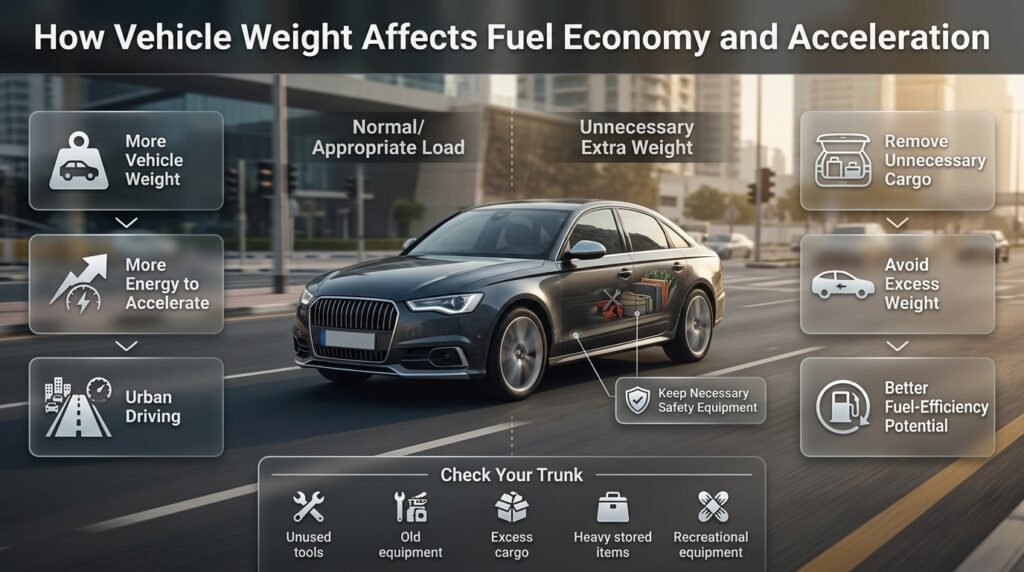
Yes.
A heavier vehicle generally requires more energy to accelerate.
You shouldn’t remove necessary equipment or safety items simply to save fuel.
Instead, avoid carrying unnecessary heavy objects for long periods.
Examples can include:
- Unused tools
- Old equipment
- Excess cargo
- Heavy items stored permanently in the trunk
- Unnecessary recreational equipment
The effect can become more noticeable when driving in urban conditions with frequent acceleration.
For more information, read How Vehicle Weight Affects Fuel Economy.
You can also explore Car Load and Fuel Consumption.
Vehicle Accessories and Fuel Economy
Vehicle accessories and fuel economy are closely connected because certain add-ons can increase aerodynamic drag, vehicle weight, or electrical load. Roof racks, cargo boxes, oversized accessories, and other external equipment may make the engine work harder, especially during highway driving. Even small changes can affect fuel consumption when they are used regularly. For better efficiency, remove unnecessary accessories when they are not needed, keep external equipment streamlined, and avoid carrying extra weight without a purpose. In Dubai, where long highway journeys and high-speed driving are common, choosing practical accessories and maintaining the vehicle properly can help support better overall fuel economy.
For a practical guide on how roof racks, cargo boxes, extra weight, larger wheels, and other accessories can influence fuel consumption, read our detailed Vehicle Accessories and Fuel Economy in Dubai guide before choosing or removing accessories from your vehicle.
Do Roof Racks Affect Fuel Economy?
Yes, roof racks and other external equipment can affect fuel economy by changing the vehicle’s aerodynamic profile.
The effect generally becomes more important at higher speeds.
If you only need a roof rack for occasional trips, removing it when it’s not required can reduce unnecessary aerodynamic drag.
The same applies to roof boxes and other large external accessories.
Learn more in Roof Racks and Fuel Economy.
How Aerodynamics Affects Fuel Efficiency
Aerodynamic drag is the resistance created as the vehicle moves through the air.
At low speeds, rolling resistance and other factors can be relatively important.
As speed rises, aerodynamic drag becomes increasingly significant.
Vehicle design affects drag through factors such as:
- Body shape
- Frontal area
- Airflow management
- Roof accessories
- Open windows
- Vehicle speed
This is separate from tire pressure, but both contribute to the amount of energy required to keep the vehicle moving.
For more information, read How Aerodynamics Affects Fuel Efficiency.
What Is Vehicle Drag?
Vehicle drag is the resistance created by air as a vehicle travels through it.
A vehicle with greater aerodynamic resistance requires more energy to maintain speed.
That’s one reason highway fuel economy can deteriorate when speed becomes excessive.
Tire pressure affects rolling resistance, while vehicle design and speed affect aerodynamic drag.
These factors work together.
For more information, see Vehicle Drag and Fuel Consumption.
Does Automatic Transmission Affect Fuel Efficiency?
Yes.
Modern automatic transmissions continuously adjust gear selection according to conditions such as vehicle speed, throttle input, engine load, and other information.
Drivers can support efficient transmission operation by avoiding unnecessary aggressive acceleration and allowing the transmission to shift normally.
However, transmission efficiency doesn’t eliminate tire-related resistance.
If tires are underinflated, the powertrain still has to overcome the additional rolling resistance.
For more information, read Fuel-Efficient Use of Automatic Transmission.
How Gear Shifting and Fuel Economy Are Connected
The transmission helps keep the engine operating in an appropriate range.
Frequent unnecessary high-RPM operation can affect fuel consumption, while modern automatic transmissions often select higher gears when conditions allow.
But gear selection is only one part of fuel efficiency.
The vehicle also has to overcome:
- Rolling resistance
- Aerodynamic drag
- Vehicle weight
- Mechanical losses
- Road resistance
Proper tire pressure helps reduce avoidable rolling resistance.
For more information, see Gear Shifting and Fuel Economy.
Does Tire Pressure Affect Tire Wear?
Yes.
Incorrect tire pressure can change how the tread contacts the road.
Underinflation can increase tire flexing and may contribute to abnormal wear.
Overinflation can also change the contact pattern.
If you notice unusual tread wear, don’t automatically assume pressure is the only problem.
Other possible causes include:
- Wheel alignment
- Suspension problems
- Tire imbalance
- Damaged components
- Incorrect tire installation
A professional inspection can help identify the real cause.
Can Tire Pressure Affect Braking?
Tire pressure can influence how a tire interacts with the road, which means maintaining the correct pressure is important for predictable vehicle behavior.
Braking performance depends on many factors, including:
- Tire pressure
- Tire condition
- Road surface
- Vehicle speed
- Brake condition
- Vehicle load
- Weather
- Driver reaction
Proper pressure is therefore one component of maintaining the vehicle as designed.
Can Tire Pressure Affect Acceleration?
It can influence rolling resistance and the way the tire behaves, although acceleration is also heavily affected by engine output, throttle input, transmission behavior, vehicle weight, and traction.
If tires are significantly underinflated, increased rolling resistance can make the vehicle work harder.
However, aggressive acceleration remains a much more obvious fuel-consumption factor in many everyday driving situations.
Does Tire Pressure Affect Electric Vehicle Efficiency?
Yes.
Electric vehicles still have tires that roll over the road.
Although an EV uses electrical energy rather than gasoline or diesel, rolling resistance still consumes energy.
Underinflated tires can increase resistance and therefore require additional energy from the battery.
This can reduce efficiency and potentially affect driving range.
EV drivers should therefore follow the tire-pressure recommendation provided by the vehicle manufacturer.
Does Tire Size Affect Fuel Economy?
Tire size and design can influence fuel economy.
Factors include:
- Tire width
- Tire diameter
- Construction
- Rubber compound
- Tread design
- Rolling-resistance characteristics
- Overall wheel-and-tire weight
However, changing tire size isn’t automatically a fuel-saving improvement.
Replacement tires should be appropriate for the vehicle and meet its load and speed requirements.
Fuel efficiency should never be considered separately from safety, compatibility, and handling.
Common Tire Pressure Mistakes Drivers Make
Checking Pressure Only When the Tire Looks Flat
A tire can be significantly below its recommended pressure without appearing obviously flat.
Why it happens: Drivers rely on visual inspection.
Why it’s a problem: Visual inspection isn’t a reliable way to measure tire pressure.
Better approach: Use a pressure gauge regularly.
Using the Maximum Sidewall Pressure
The number printed on the tire isn’t necessarily the correct pressure for the vehicle.
Why it happens: It’s an easy number to see.
Why it’s a problem: Maximum tire pressure and recommended vehicle pressure are different concepts.
Better approach: Follow the vehicle manufacturer’s specification.
Checking Only One Tire
One tire may look low while another is also below specification.
Better approach: Check all four tires.
Waiting for the TPMS Warning
The warning system is useful, but it isn’t designed to replace routine maintenance.
Better approach: Check pressure manually on a regular schedule.
Checking Hot Tires and Releasing Air
Warm tires can show higher readings.
Better approach: Use cold tire pressure as your normal reference.
Forgetting the Spare Tire
A spare can lose air while sitting unused.
Better approach: Check it periodically.
Thinking More Pressure Always Means Better Mileage
Higher pressure isn’t automatically better.
Better approach: Follow the manufacturer’s recommended pressure.
Signs That Your Tires May Have a Pressure Problem
Pay attention if you notice:
- TPMS warning
- Repeated pressure loss
- Uneven tread wear
- Vehicle pulling to one side
- Unusual vibration
- Changes in steering feel
- A visibly low tire
- Repeated need to add air
- Possible sidewall damage
If one tire consistently loses air while the others remain stable, don’t simply keep adding air.
Have the tire inspected.
A slow leak can come from a puncture, valve problem, wheel issue, or another source.
How to Build a Simple Tire-Maintenance Routine

You don’t need a complicated system.
Every Month
Check:
- Front tire pressure
- Rear tire pressure
- Spare tire pressure
- Tread condition
- Visible damage
- Uneven wear
Before a Long Journey
Check:
- Cold tire pressure
- Loaded-vehicle pressure requirements
- Tire condition
- Spare
- Vehicle load
- Warning lights
During Hot Weather
Pay attention to:
- Pressure consistency
- Repeated pressure loss
- Tire damage
- Unusual wear
- Changes in handling
Expert Tip
A few minutes of preventive checking is easier than dealing with a tire problem during a long journey.
How to Measure Your Fuel Economy
If you want to know whether your fuel-saving efforts are actually working, measure your fuel consumption instead of relying on how the vehicle feels.
A simple method is to use the same refueling approach over several tanks.
Step 1
Fill the tank to a consistent level.
Step 2
Record the odometer reading.
Step 3
Drive normally.
Step 4
Refuel and record how much fuel you added.
Step 5
Calculate:
Distance traveled ÷ fuel used = fuel economy
For example:
600 km ÷ 50 liters = 12 km/L
Repeat the calculation across multiple tanks.
One trip can be misleading because traffic, weather, passengers, air-conditioning use, and driving speed can change consumption.
Why Tire Pressure Alone Won’t Transform Fuel Economy
It’s important to keep expectations realistic.
If your tires are already at the manufacturer’s recommended pressure, adding more air isn’t necessarily going to produce a major improvement.
If the tires are significantly underinflated, correcting the pressure can remove unnecessary rolling resistance.
But your vehicle’s fuel consumption is influenced by many factors.
These include:
- Driving speed
- Acceleration
- Braking
- Traffic
- Idling
- Vehicle weight
- Aerodynamics
- Tire condition
- Engine condition
- Transmission behavior
- Weather
- Air-conditioning use
- Road surface
This is why a complete fuel-efficiency strategy is more useful than relying on one trick.
Expert Advice for Better Fuel Efficiency
If you’re serious about reducing unnecessary fuel consumption, start with the basics.
1. Maintain Correct Tire Pressure
Make regular tire-pressure checks part of your maintenance routine.
2. Drive Smoothly
Avoid unnecessary hard acceleration.
3. Anticipate Traffic
Look ahead and reduce unnecessary braking.
4. Avoid Excessive Speed
Follow speed limits and avoid unnecessarily high cruising speeds.
5. Remove Unnecessary Weight
Don’t carry heavy objects you don’t need.
6. Remove Unused Roof Equipment
If a roof rack or box isn’t needed, consider removing it.
7. Reduce Unnecessary Idling
Avoid leaving the engine running unnecessarily when conditions allow.
8. Maintain Your Vehicle
Don’t ignore warning lights, tire problems, or mechanical issues.
9. Monitor Fuel Consumption
Track your results over several tanks.
10. Inspect Tires Regularly
Pressure isn’t the only consideration. Tire condition matters too.
For a broader guide, see Fuel-Efficient Driving Techniques.
A Practical Fuel-Efficiency Checklist for Dubai Drivers
Before a long trip, run through this quick checklist.
Tires
- Check cold tire pressure
- Follow the manufacturer’s specification
- Check all four tires
- Inspect tread
- Look for damage
- Check the spare
Vehicle Load
- Remove unnecessary cargo
- Secure essential items
- Check loaded-pressure recommendations
- Remove unnecessary roof equipment
Driving
- Accelerate smoothly
- Maintain a sensible speed
- Anticipate traffic
- Avoid unnecessary braking
- Avoid unnecessary idling
Maintenance
Keep routine servicing up to date
Check warning lights
Address repeated tire pressure loss
Monitor uneven tire wear
How Does Tire Pressure Affect Fuel Efficiency?
Tire pressure affects fuel efficiency mainly through rolling resistance. When a tire is underinflated, it generally flexes more as it rolls along the road. That extra deformation creates additional resistance, so the engine has to use more energy to keep the vehicle moving. The lower the tire pressure gets below the manufacturer’s recommended level, the more important this effect can become. NHTSA specifically notes that underinflation increases rolling resistance and reduces fuel economy.
This doesn’t mean a slightly low tire will suddenly cause a dramatic increase in fuel consumption. The actual effect depends on the vehicle, tire, pressure difference, road conditions, speed, load, and temperature. The practical point is to avoid carrying unnecessary rolling resistance every time you drive.
What to remember:
Underinflated tires generally increase rolling resistance.
Higher rolling resistance means the engine needs more energy.
Correct pressure can help prevent unnecessary fuel consumption.
Fuel economy is also affected by speed, acceleration, traffic, vehicle load, and aerodynamics.
Proper tire pressure should be viewed as part of an overall fuel-efficiency strategy.
A useful way to think about it is simple: your tires are part of the system that transfers engine power to the road, so their condition directly influences how efficiently the vehicle moves.
What Is the Best Tire Pressure for Fuel Economy?
The best tire pressure for fuel economy is the pressure recommended by your vehicle manufacturer, not the maximum pressure printed on the tire sidewall. You can normally find the correct specification on the driver’s door-jamb or door-frame label or in the owner’s manual. NHTSA specifically advises drivers to use the vehicle manufacturer’s recommended pressure rather than the number shown on the tire itself.
This distinction is important because the pressure printed on the tire and the pressure recommended for the vehicle serve different purposes. The tire’s sidewall marking can indicate its maximum rated pressure, whereas your vehicle’s placard is designed around that particular vehicle’s weight, tire size, load requirements, handling, and operating characteristics.
Don’t assume that increasing pressure above the recommended level will automatically improve mileage. While inflation pressure can influence rolling resistance, excessive pressure can also change ride quality, handling, tread contact, and wear.
For the correct pressure:
Check the driver’s door-jamb label.
Check the owner’s manual if you’re unsure.
Follow separate front/rear recommendations when provided.
Use the manufacturer’s loaded-vehicle recommendation when applicable.
Check pressure when the tires are cold.
Don’t use the tire sidewall maximum as your normal target.
The professional approach is to optimize the vehicle according to its manufacturer’s specification, rather than chasing fuel economy with extra air.
How Much Fuel Can You Save by Keeping Tires Properly Inflated?
There isn’t one reliable fuel-saving percentage that applies to every car, which is why it’s better to avoid claims such as “proper tire pressure will always save exactly X%.” The actual improvement depends on how far the tires were below specification and on the vehicle and driving conditions. The U.S. Department of Energy says keeping tires properly inflated can improve gas mileage by an average of about 0.6%, with potential improvements of up to 3% in some circumstances.
NHTSA also highlights the financial benefit of proper inflation and says properly inflated tires can save drivers money on fuel.
The important takeaway is that correct tire pressure isn’t a magic fuel-saving trick. If your tires are already properly inflated, you shouldn’t expect a dramatic improvement simply by adding more air. The biggest opportunity comes from correcting tires that are meaningfully underinflated and then maintaining the correct pressure consistently.
For better real-world fuel economy, combine tire maintenance with:
Smooth acceleration
Sensible highway speeds
Less unnecessary braking
Reduced idling
Proper vehicle load
Good vehicle maintenance
Removing unnecessary roof equipment
Regular tire inspections
For example, a driver who corrects tire pressure but continues aggressive acceleration and high-speed driving may see less overall improvement than someone who combines proper tire pressure with efficient driving habits.
That’s why tire pressure should be one part of your fuel-saving routine, not the entire strategy.
Should You Check Tire Pressure When the Tires Are Hot or Cold?
For the most accurate comparison with the manufacturer’s recommended pressure, check tire pressure when the tires are cold. In practical terms, NHTSA describes a cold tire as one that hasn’t been driven for at least three hours. Driving heats the tires, and warmer tires can show higher pressure readings than cold tires.
This matters even more in a hot climate such as Dubai. A vehicle that has been driven on hot roads for an extended period may have substantially warmer tires than it did when parked overnight.
The mistake is to see a higher reading on a hot tire and immediately let air out. That can leave the tire underinflated once it cools.
A better routine is:
Check pressure before a long drive.
Ideally check after the vehicle has been parked for several hours.
Compare the reading with the manufacturer’s cold-pressure recommendation.
Adjust the pressure when appropriate.
Recheck the tires regularly.
Don’t release air simply because a warm tire reads higher.
If you discover a tire is significantly low while you’re already on the road, safety comes first. NHTSA notes that a tire should not be left significantly underinflated simply because it is warm; correct it appropriately and then recheck it at cold temperature when possible.
The professional rule is simple: use cold tire pressure as your normal reference point, especially when you’re trying to maintain consistent tire pressure and fuel efficiency.
Does Overinflating Tires Improve Fuel Efficiency?
Overinflating tires is not a recommended way to improve fuel economy. Tire pressure does influence rolling resistance, but deliberately going above the vehicle manufacturer’s recommended pressure can change the tire’s contact with the road and affect handling, ride comfort, tread wear, and overall vehicle behavior. NHTSA recommends using the pressure specified by the vehicle manufacturer rather than simply inflating to the pressure shown on the tire.
This is an important distinction because fuel economy is only one part of vehicle performance. A tiny change in rolling resistance isn’t worth compromising the pressure range the vehicle was designed to use.
Think of it this way:
Underinflation: more rolling resistance and potentially poorer efficiency.
Correct inflation: intended balance of efficiency, handling, comfort, and tire life.
Excessive inflation: not a sensible shortcut to fuel savings and may create other disadvantages.
The better approach is:
Find the recommended pressure on the vehicle placard.
Check the tires when cold.
Maintain that pressure consistently.
Adjust for specified load conditions when your vehicle manufacturer provides different recommendations.
Don’t use the tire’s maximum sidewall pressure as your everyday target.
If you’re trying to reduce fuel consumption, you’re usually better off combining correct tire pressure with smooth driving, sensible speed, reduced unnecessary load, less idling, and proper vehicle maintenance rather than experimenting with excessive tire pressure.
Final Expert Takeaway
If you’re optimizing an article around tire pressure and fuel efficiency, these five FAQs are the strongest ones to prioritize because they answer the real decisions a driver needs to make:
How does tire pressure affect fuel efficiency?
What is the best tire pressure for fuel economy?
How much fuel can properly inflated tires save?
Should tire pressure be checked hot or cold?
Does overinflating tires improve fuel efficiency?
Together, they cover the cause, correct pressure, potential savings, measurement method, and biggest misconception—without turning the FAQ section into repetitive SEO filler.
Conclusion
Tire pressure may seem like a small maintenance detail, but it can make a real difference to how efficiently your vehicle uses fuel. When tires are underinflated, they generally create more rolling resistance, forcing the engine to work harder to keep the vehicle moving. Over time, that extra resistance can contribute to higher fuel consumption, increased tire wear, and less predictable handling.
The best approach isn’t to overinflate your tires in an attempt to save fuel. Instead, check the manufacturer-recommended tire pressure regularly and measure it when the tires are cold. This simple habit is especially useful for Dubai drivers dealing with high temperatures, heavy traffic, long highway journeys, and frequent air-conditioning use.
For the best results, combine correct tire pressure with smooth acceleration, sensible driving speeds, reduced unnecessary braking, proper vehicle loading, limited idling, and regular maintenance. You can also explore our fuel-saving driving tips for practical ways to improve your vehicle’s overall fuel economy.
Ultimately, better fuel efficiency doesn’t come from one magic trick. It comes from consistently reducing unnecessary energy loss—and maintaining the right tire pressure is one of the easiest places to start.
Leave a Reply