Introduction
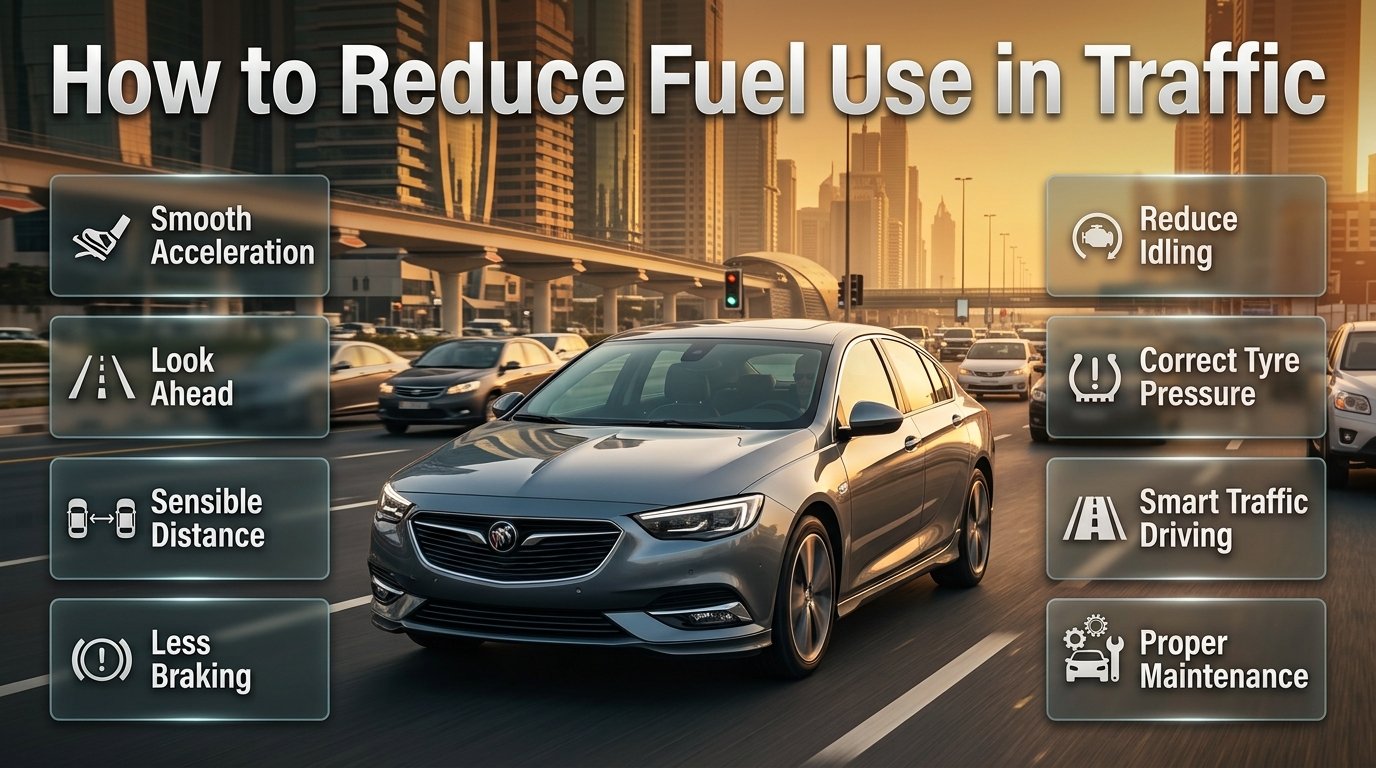
How to Reduce Fuel Use in Traffic | You leave home with enough fuel for the day, but after spending a long time in traffic, the fuel gauge may seem to drop faster than expected. The distance covered can be surprisingly short, yet your engine has been working continuously through acceleration, braking, stopping, restarting, and idling. This is why knowing how to reduce fuel use in traffic in Dubai can make a real difference to everyday driving costs.
Traffic is one of the most challenging conditions for fuel economy because your vehicle rarely gets the opportunity to maintain a steady operating pattern. Instead, you’re constantly responding to vehicles ahead, traffic signals, merging traffic, road congestion, and unexpected slowdowns.
You can’t control every part of the road. You can’t remove a traffic jam or make every driver around you drive efficiently. What you can control is your own driving style.
Smooth acceleration, sensible following distance, better anticipation, fewer unnecessary braking events, appropriate idling habits, correct tyre pressure, and proper vehicle maintenance can all help reduce avoidable fuel consumption.
For drivers in Dubai, these habits can be particularly useful during busy commuting periods when congestion, high temperatures, and air-conditioning use can make driving more demanding.
Fuel Delivery to Car Dubai 👉 Fuel Delivery Dubai.
This guide explains practical ways to use less fuel in Dubai traffic without compromising safety. You’ll learn why congestion increases fuel consumption, how to handle stop-and-go conditions, what driving habits waste fuel, how to approach traffic lights, whether idling is worth avoiding, how air conditioning affects efficiency, and how to measure whether your changes are actually working.
Why Does Traffic Increase Fuel Consumption?
Traffic increases fuel consumption because your vehicle repeatedly changes speed instead of maintaining a relatively steady pace.
On a clear road, you may accelerate to a suitable speed and maintain it for several minutes. In heavy traffic, you may accelerate for a few seconds, brake, stop, move forward again, and repeat the process several times.
A typical congested journey may look like this:
Stop → Accelerate → Brake → Stop → Idle → Move → Brake → Stop
Every acceleration requires energy. When you brake, much of the vehicle’s kinetic energy is converted into heat through the braking system. If you then accelerate again, the engine has to use fuel to rebuild that speed.
That’s why repeated acceleration and braking can be inefficient.
Traffic can increase fuel use because of:
- Frequent stops
- Aggressive acceleration
- Sudden braking
- Low-speed crawling
- Extended idling
- Constant lane changes
- Poor route selection
- Heavy vehicle loads
- Incorrect tyre pressure
- High air-conditioning demand
- Poor vehicle maintenance
However, traffic isn’t automatically wasteful for every driver to the same degree.
A driver who anticipates traffic and maintains a sensible gap may use fuel differently from someone who repeatedly races toward every opening and brakes at the last moment.
For a deeper explanation, read how traffic affects fuel economy.
The key idea is simple:
You can’t eliminate traffic, but you can eliminate some unnecessary movement within traffic.
What Is the Best Way to Reduce Fuel Use in Traffic?
The most practical way to reduce fuel use in traffic is to avoid unnecessary acceleration, braking, idling, and speed changes while maintaining safe and legal driving.
Instead of reacting at the last moment, look farther ahead. Give yourself enough space to respond gradually. When traffic starts moving, accelerate smoothly rather than aggressively. When you see congestion developing ahead, begin adapting your speed before you reach the queue.
A useful system is:
Look ahead → Create space → Accelerate smoothly → Anticipate → Brake when necessary → Avoid unnecessary idling
This approach works because it reduces the number of times your vehicle is forced into an unnecessary acceleration-braking cycle.
It doesn’t mean you should drive unusually slowly.
It doesn’t mean you should avoid braking.
It doesn’t mean you should turn off your air conditioner in extreme heat.
It means you should make each driving decision with the traffic situation in mind.
1. Look Farther Ahead
One of the most useful fuel-saving habits in traffic is learning to look beyond the vehicle directly in front of you.
Many drivers watch only the car immediately ahead. If that car brakes, they brake. If it accelerates, they accelerate. If it brakes again, they repeat the process.
This creates a reactive driving pattern.
A more experienced driver constantly scans the road ahead.
You should watch for:
- Brake lights several vehicles ahead
- Traffic signals
- Queues forming at junctions
- Vehicles merging
- Lane closures
- Roadworks
- Pedestrian crossings
- Roundabouts
- Vehicles changing lanes
- Congestion building around exits
When you notice a slowdown early, you have more time to reduce acceleration.
Instead of continuing at the same speed until you’re very close to the queue, you can ease off earlier when safe.
Why Does Looking Ahead Save Fuel?
Imagine you’re travelling at 50 km/h and can already see traffic slowing 100 metres ahead.
If you ignore the queue, you may continue accelerating or maintaining speed until you have to brake firmly.
If you recognise the slowdown early, you can gradually reduce your speed.
The second approach avoids creating unnecessary speed that you will immediately have to remove.
This is also a safety advantage because anticipation gives you more time to respond.
Pro Tip: Don’t focus exclusively on the bumper directly ahead. Keep scanning the entire traffic environment so you can predict what is likely to happen next.
2. Maintain a Sensible Following Distance
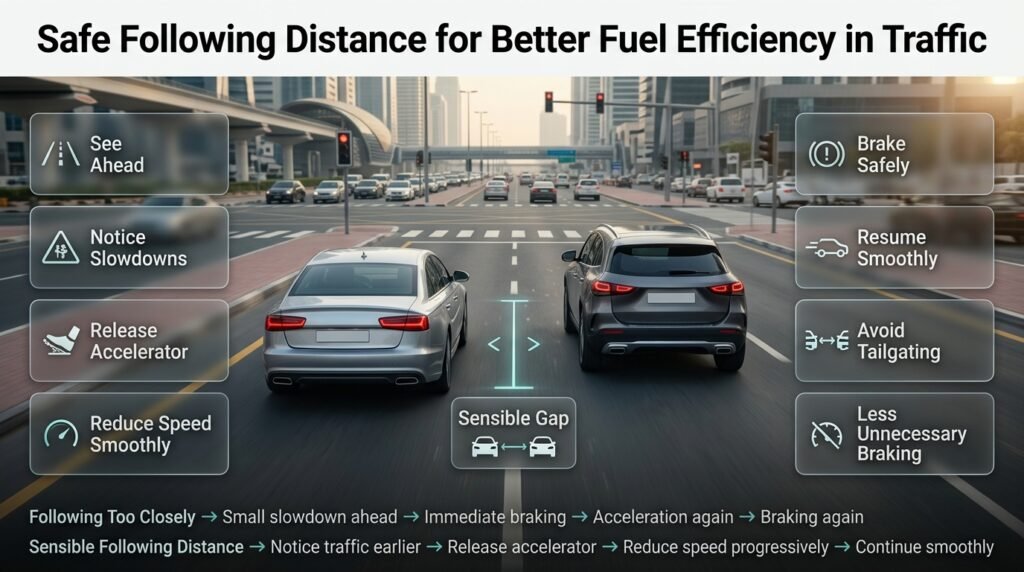
Following too closely is one of the easiest ways to create unnecessary braking.
When you’re only a short distance behind another vehicle, even a small change in its speed can force you to brake.
Then the vehicle ahead accelerates, so you accelerate.
It brakes again, so you brake again.
This repeated pattern can continue throughout the entire traffic queue.
A sensible following distance gives you more room to absorb small changes in speed.
What Should You Do?
Maintain enough space to:
- See what’s happening ahead.
- Notice slowdowns earlier.
- Release the accelerator.
- Reduce speed progressively.
- Brake safely when necessary.
- Resume movement smoothly.
The correct gap depends on speed, road conditions, visibility, traffic, and the vehicle you’re driving.
Don’t focus on creating an enormous empty space.
The objective is simply to create enough reaction time for smooth and safe driving.
Common Mistake
Some drivers close every gap because they don’t want another vehicle to merge.
This can encourage aggressive acceleration and braking.
If another driver safely merges into your lane, you can simply adjust your following distance again.
Trying to defend every metre of road rarely makes a meaningful difference to the total journey.
3. Accelerate Smoothly
When traffic starts moving, avoid treating the opening as a race.
Aggressive acceleration can increase fuel demand, especially if another traffic slowdown is only a short distance ahead.
Smooth acceleration means increasing speed progressively while keeping an eye on traffic conditions.
It doesn’t mean driving so slowly that you interfere with normal traffic.
For more information, read How Acceleration Affects Fuel Consumption in Dubai.
Smooth Acceleration vs Aggressive Acceleration
A smooth driver:
- Applies the accelerator progressively.
- Watches traffic while accelerating.
- Matches traffic appropriately.
- Avoids unnecessary bursts of speed.
- Prepares for slowdowns ahead.
An aggressive driver may:
- Press the accelerator heavily.
- Race toward small gaps.
- Accelerate hard after every stop.
- Chase vehicles moving slightly faster.
- Brake sharply when the queue slows.
The problem isn’t acceleration itself.
Acceleration is necessary to move.
The problem is accelerating harder or more often than the situation requires.
For practical guidance on smoother acceleration, controlled braking, steady-speed driving, and better traffic anticipation, explore our detailed Smooth Driving Techniques for Better Fuel Economy in Dubai guide to develop more fuel-efficient driving habits.
4. Don’t Race Toward a Red Traffic Light
A common fuel-wasting habit is accelerating toward a red light even when the queue is already visible.
You may gain a few seconds of movement, but if you’re going to stop at the same signal anyway, that additional acceleration may have achieved very little.
Consider this situation:
You see a red light 200 metres ahead.
Traffic is already stopped.
Instead of continuing at a high speed, you gradually reduce acceleration and allow the vehicle to slow when appropriate.
If the light remains red, you’ve avoided unnecessary speed.
If it turns green, traffic may begin moving again and you can accelerate normally.
You should never make an unsafe manoeuvre or drive unusually slowly just to save fuel.
The goal is simply to avoid unnecessary acceleration when a stop is already obvious.
5. Reduce Unnecessary Braking
Braking is essential for safety.
Never avoid braking when a hazard requires you to stop or slow down.
However, frequent hard braking can sometimes indicate that you’re responding too late to traffic conditions.
For example, if you repeatedly accelerate toward queues and then brake sharply, your driving pattern is creating unnecessary energy loss.
Read How Braking Habits Affect Fuel Economy in Dubai for more detail.
What Should You Change?
Instead of thinking:
“I need to use the brakes less.”
Think:
“I need to avoid unnecessary situations that require hard braking.”
That means:
- Looking farther ahead.
- Maintaining a sensible following distance.
- Anticipating traffic signals.
- Avoiding aggressive lane changes.
- Reducing acceleration when congestion appears.
When braking is necessary, brake safely.
Fuel economy should never take priority over road safety.
6. Learn How to Handle Stop-and-Go Traffic
Stop-and-go traffic is particularly challenging because the vehicle repeatedly moves and stops.
You may travel only a few metres before traffic stops again.
Trying to maintain a perfectly steady speed isn’t realistic in this situation.
Instead, focus on reducing unnecessary changes in speed.
You can find more information in stop and go driving fuel efficiency.
A Better Stop-and-Go Strategy
When traffic begins moving:
- Accelerate progressively.
- Watch several vehicles ahead.
- Don’t chase every gap.
- Maintain a safe following distance.
- Expect traffic to slow again.
- Avoid unnecessary lane changes.
- Reduce speed gradually when possible.
Imagine traffic moves forward 10 metres.
You could accelerate quickly, close the gap, brake, and stop.
Or you could allow the traffic to move naturally while maintaining controlled spacing.
The second method may feel less aggressive, but it avoids turning every small movement into a full acceleration-and-braking cycle.
Expert Tip
In heavy congestion, patience can actually support fuel efficiency.
If the entire road is limited by a bottleneck, accelerating aggressively won’t remove the bottleneck.
It simply changes how quickly you reach it.
Tire Pressure and Fuel Efficiency
Tire pressure plays an important role in fuel efficiency because underinflated tires create greater rolling resistance, forcing the engine to work harder and potentially increasing fuel consumption. Maintaining the recommended tire pressure can help your vehicle roll more efficiently while also supporting better handling, braking, and tire wear. In Dubai’s hot climate, checking tire pressure regularly is especially useful because temperature changes can affect pressure readings. Always follow the vehicle manufacturer’s recommended pressure rather than relying on the maximum pressure printed on the tire sidewall.
For practical guidance on maintaining the correct tire pressure, reducing unnecessary rolling resistance, and supporting better fuel economy in Dubai’s driving conditions, read our detailed Tire Pressure and Fuel Efficiency guide.
Gear Shifting and Fuel Economy in Dubai
Gear shifting has a direct impact on how efficiently a vehicle uses fuel, particularly in Dubai’s busy traffic and changing road conditions. Driving in the appropriate gear helps keep the engine operating within an efficient range, while unnecessarily high engine speeds or using the wrong gear can increase fuel consumption. Manual drivers can improve efficiency by shifting smoothly and selecting the appropriate gear for their speed and road conditions. Automatic transmissions generally manage gear changes themselves, but smooth acceleration and avoiding unnecessary aggressive driving can still support better fuel economy.
For a practical understanding of how to choose the right gear, avoid unnecessary engine strain, and improve fuel efficiency in Dubai’s city traffic and highway conditions, read our detailed Gear Shifting and Fuel Economy in Dubai guide.
Highway Driving Fuel Efficiency
Highway driving fuel efficiency depends largely on maintaining a steady speed, avoiding aggressive acceleration, and reducing unnecessary aerodynamic resistance. Driving at very high speeds can increase fuel consumption because air resistance rises rapidly as speed increases. Before a highway trip, check tire pressure, remove unnecessary items from the vehicle, and ensure the engine is properly maintained. On suitable roads, cruise control can help maintain a consistent speed, while smooth acceleration and gradual braking can prevent unnecessary fuel use. These simple habits can help your vehicle use fuel more efficiently during longer highway journeys.
For a practical guide to maintaining better fuel efficiency on highways, including speed management, smooth acceleration, vehicle preparation, and reducing unnecessary fuel consumption, explore our detailed Highway Driving Fuel Efficiency guide.
7. Avoid Unnecessary Idling
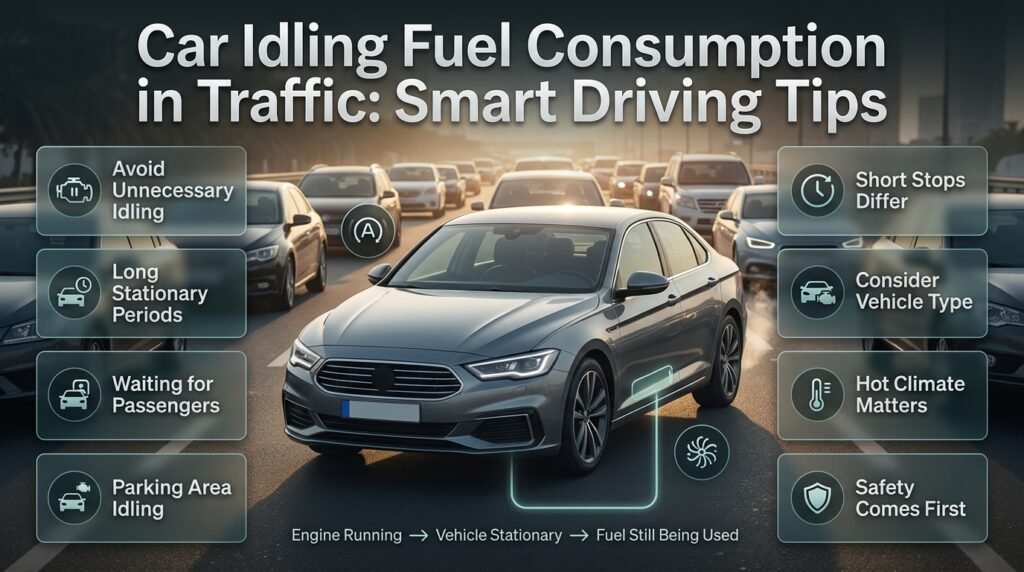
Idling is another source of fuel consumption in traffic.
The engine can continue consuming fuel even though the vehicle isn’t travelling.
Common situations include:
- Waiting outside a store.
- Sitting in a parking area.
- Waiting for a passenger.
- Remaining stationary during a prolonged queue.
- Leaving the engine running out of habit.
For more information, read fuel consumption while idling.
Should You Turn Off Your Engine?
It depends on the situation.
If you’re stopped for only a few seconds, repeatedly switching the engine off and on isn’t necessarily useful.
If you’re safely stationary for a longer period, shutting the engine down may be appropriate depending on your vehicle, weather, climate-control requirements, and manufacturer recommendations.
Many modern cars use automatic stop-start systems for this reason.
In Dubai’s hot climate, you also need to consider cabin temperature and occupant comfort.
Don’t turn off the air conditioning or engine if doing so would create an unsafe or unreasonable situation.
The goal is to avoid unnecessary prolonged idling, not to shut down your vehicle every time traffic pauses.
8. Avoid Constant Lane Changes
When traffic is slow, every lane can appear to have a faster section.
One driver moves left.
Then another vehicle moves right.
Soon everyone is changing lanes repeatedly.
This doesn’t always improve journey time.
Every lane change may require speed adjustments, acceleration, braking, and reacting to surrounding vehicles.
If all lanes are eventually approaching the same congestion point, switching between them may provide little meaningful advantage.
When Should You Change Lanes?
Change lanes when you have a genuine reason, such as:
- Your lane is ending.
- You need to reach an exit.
- Another lane is clearly safer.
- Traffic conditions genuinely justify the move.
Avoid changing lanes simply because another lane appears to be moving one or two vehicles faster.
A predictable driving pattern is generally easier to control and can reduce unnecessary speed changes.
9. Don’t Chase Every Small Gap
Traffic creates impatience.
A driver sees a gap and immediately wants to fill it.
Then another gap appears.
The driver accelerates again.
But congestion often catches up.
This behaviour can create a cycle of:
Gap → Acceleration → Brake → Gap → Acceleration → Brake
Instead of chasing every opening, look at the bigger traffic picture.
Ask:
Will this gap actually help me make meaningful progress?
If traffic ahead is blocked by a signal, junction, accident, construction area, or bottleneck, gaining a few metres may not matter.
A smoother approach can reduce unnecessary fuel consumption and make the journey less stressful.
10. Choose a Route Based on Traffic Conditions
The shortest route isn’t always the most fuel-efficient route.
Imagine two options.
Route A
- 5 kilometres
- Heavy congestion
- Many traffic signals
- Frequent stopping
- Repeated acceleration
Route B
- 7 kilometres
- Moderate traffic
- Fewer stops
- More consistent movement
Route B may sometimes use less fuel despite being longer.
But this isn’t a universal rule.
A longer route can also consume more fuel if it involves higher speeds, hills, heavy loads, or poor traffic conditions.
The key is to consider how the vehicle will travel, not only how far it will travel.
Use traffic information when planning regular journeys and learn which roads tend to create repeated stop-and-go conditions during your commuting hours.
11. Maintain an Appropriate Speed
Many people search for a single “best fuel-saving speed.”
There isn’t one universal number that works for every vehicle.
Fuel economy depends on:
- Engine design
- Transmission
- Vehicle weight
- Aerodynamics
- Road conditions
- Tyres
- Traffic
- Weather
- Air conditioning
- Driving style
For many vehicles, steady moderate-speed driving is more efficient than repeated high-speed acceleration and braking.
For more information, see Optimal Driving Speed for Fuel Efficiency in Dubai.
In traffic, don’t obsess over a particular speed.
Instead, focus on maintaining an appropriate, safe, legal speed with as few unnecessary changes as possible.
12. Use Air Conditioning Sensibly
Air conditioning is particularly important for fuel economy in hot climates.
The system requires energy, and the exact effect varies according to the vehicle and conditions.
In Dubai, however, completely avoiding air conditioning isn’t realistic for many journeys.
Driver comfort and concentration are important.
Instead of turning it off unnecessarily, focus on using it efficiently.
Practical Tips
- Park in shade where possible.
- Use a sunshade when the vehicle is parked.
- Avoid leaving doors open unnecessarily.
- Keep the air-conditioning system maintained.
- Replace the cabin filter according to the vehicle’s maintenance requirements.
- Avoid setting the temperature unnecessarily low.
- Make sure the cooling system is functioning correctly.
If your car has been sitting in direct sunlight, allowing some hot air to escape before demanding maximum cooling can help the cabin cool more efficiently.
The objective isn’t to avoid air conditioning.
It’s to avoid making the system work harder than necessary.
Air Conditioning and Fuel Consumption
Air conditioning can have a noticeable effect on fuel consumption, especially during hot weather and heavy traffic. When the AC system is running, the engine needs additional power to operate the compressor, which can increase fuel use. In Dubai’s hot climate, however, avoiding AC completely is not practical or comfortable. A better approach is to use the system efficiently by parking in shade when possible, ventilating the cabin briefly before cooling it, maintaining the AC system properly, and avoiding unnecessary idling with the AC running. These simple habits can help reduce unnecessary fuel consumption while keeping the cabin comfortable.
For practical tips on reducing unnecessary fuel consumption while keeping your car comfortable in Dubai’s hot climate, explore our detailed Air Conditioning and Fuel Consumption guide, which explains how AC use, traffic, idling, driving speed, and vehicle maintenance can affect overall fuel economy.
Fuel-Efficient Highway Driving in Dubai
Fuel-efficient highway driving in Dubai is mainly about maintaining a steady, sensible speed and avoiding unnecessary changes in acceleration. Rapid acceleration, frequent braking, and excessive speeds can increase fuel consumption, while smooth driving helps the engine operate more efficiently. Before a long highway trip, check tire pressure, remove unnecessary weight, and make sure the vehicle is properly maintained. Using cruise control on suitable roads and keeping windows closed at higher speeds can also help reduce unnecessary aerodynamic resistance. By combining good vehicle preparation with consistent driving habits, you can make highway journeys more efficient and reduce avoidable fuel use.
For practical strategies to reduce unnecessary fuel consumption on Dubai highways, including maintaining a steady speed, managing acceleration, reducing aerodynamic drag, and preparing your vehicle before a long journey, explore our detailed Fuel-Efficient Highway Driving in Dubai guide.
13. Keep Tyres at the Correct Pressure
Tyre pressure can affect fuel economy because it influences rolling resistance.
Underinflated tyres can require more energy to move.
Incorrect pressure can also affect:
- Handling
- Braking
- Tyre wear
- Ride quality
- Vehicle stability
Check your tyre pressure regularly.
Use the manufacturer’s recommended pressure, usually found on the driver’s door-frame label, fuel-filler area, or owner’s manual.
Common Mistake
Don’t use the maximum pressure printed on the tyre sidewall as your normal target.
That number isn’t necessarily the recommended pressure for your specific vehicle.
Check the manufacturer’s specification instead.
14. Maintain the Vehicle Properly
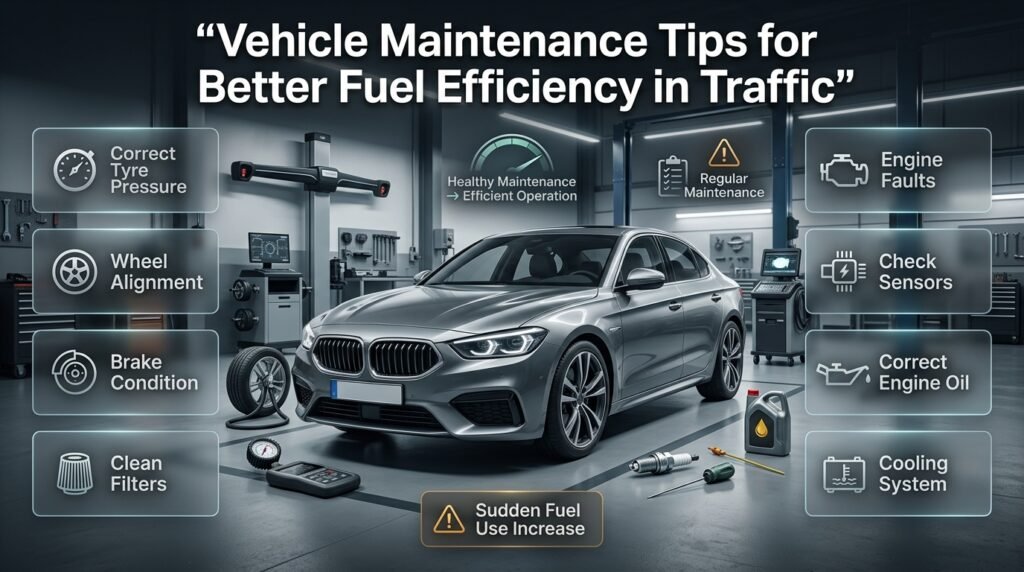
A vehicle that isn’t maintained properly may not operate as efficiently as it should.
If fuel consumption suddenly increases, don’t automatically assume traffic is the only cause.
Possible issues can include:
- Incorrect tyre pressure
- Poor wheel alignment
- Dragging brakes
- Engine faults
- Faulty sensors
- Dirty filters
- Worn spark plugs where applicable
- Incorrect engine oil
- Cooling-system problems
This doesn’t mean every increase in fuel consumption indicates a mechanical fault.
Traffic, weather, route changes, passenger load, and air conditioning can all affect fuel use.
But a sudden and unexplained change deserves attention.
Follow the manufacturer’s recommended maintenance schedule and investigate unusual changes rather than ignoring them.
How Vehicle Weight Affects Fuel Economy
Vehicle weight has a direct influence on fuel economy because a heavier car requires more energy to accelerate and maintain movement, particularly in stop-and-go traffic. Carrying unnecessary luggage, tools, equipment, or other heavy items can gradually increase fuel consumption, especially when the vehicle is used frequently. The effect may be more noticeable during repeated acceleration, hill climbs, and city driving than during steady cruising. Keeping the vehicle load reasonable, removing items that are no longer needed, and distributing essential cargo safely can help reduce unnecessary energy demand and support better overall fuel efficiency.
For a deeper look at how passenger load, luggage, heavy equipment, and overall vehicle weight can influence fuel consumption, explore our detailed How Vehicle Weight Affects Fuel Economy guide for practical ways to manage unnecessary weight and improve driving efficiency.
15. Reduce Unnecessary Vehicle Weight
Extra weight means the vehicle may need more energy to accelerate.
A few small items won’t transform your fuel economy.
However, if you’re carrying substantial unnecessary weight every day, removing it can be sensible.
Check the boot for:
- Old equipment
- Heavy tools
- Unused luggage
- Boxes
- Sports equipment
- Materials left over from previous trips
You don’t need to make your vehicle empty.
Just avoid carrying substantial weight that you don’t actually need.
For practical strategies to reduce unnecessary fuel consumption during Dubai’s congested roads, including smoother acceleration, better traffic anticipation, reducing idling, and route planning, explore our detailed How to Reduce Fuel Use in Dubai Traffic guide.
Vehicle Accessories and Fuel Economy
Vehicle accessories and fuel economy are closely connected because certain add-ons can increase aerodynamic drag, vehicle weight, or electrical load. Roof racks, cargo boxes, oversized accessories, and other external equipment may make the engine work harder, especially during highway driving. Even small changes can affect fuel consumption when they are used regularly. For better efficiency, remove unnecessary accessories when they are not needed, keep external equipment streamlined, and avoid carrying extra weight without a purpose. In Dubai, where long highway journeys and high-speed driving are common, choosing practical accessories and maintaining the vehicle properly can help support better overall fuel economy.
For a practical guide on how roof racks, cargo boxes, extra weight, larger wheels, and other accessories can influence fuel consumption, read our detailed Vehicle Accessories and Fuel Economy in Dubai guide before choosing or removing accessories from your vehicle.
Roof Racks and Fuel Economy in Dubai
Roof racks can affect fuel economy by increasing a vehicle’s aerodynamic drag, particularly when driving at higher speeds on Dubai’s highways. Even when the rack is not carrying cargo, its added exposure to airflow can create additional resistance, which may require more engine power to maintain speed. The effect can become greater when carrying bulky items such as bicycles, luggage, or roof boxes. If a roof rack is not needed for a particular journey, removing it can help keep the vehicle more aerodynamic. For regular users, choosing a streamlined design, securing cargo properly, and avoiding unnecessary weight can support better fuel efficiency.
If you regularly use a roof rack for luggage, bicycles, or other equipment, our detailed Roof Racks and Fuel Economy in Dubai guide explains how roof-mounted accessories can increase aerodynamic drag and influence fuel consumption, especially during highway driving.
Vehicle Drag and Fuel Consumption in Dubai
Vehicle drag can have a significant effect on fuel consumption, particularly as driving speed increases. Aerodynamic resistance becomes more noticeable on highways, meaning vehicles may need more engine power to maintain higher speeds. Roof racks, cargo boxes, open windows at high speeds, and bulky external accessories can increase drag and reduce efficiency further. In Dubai, where drivers often use high-speed roads for longer journeys, keeping the vehicle streamlined and removing unnecessary external equipment can help reduce aerodynamic resistance. Combining good aerodynamics with moderate speeds and smooth driving can support better overall fuel economy.
For a deeper understanding of how aerodynamic resistance, driving speed, roof equipment, external cargo, wind, and vehicle design can influence fuel consumption, explore our detailed Vehicle Drag and Fuel Consumption in Dubai guide.
Car Load and Fuel Consumption
The amount of weight carried by a vehicle can influence fuel consumption, particularly during frequent acceleration, hill climbing, and stop-and-go driving. Extra luggage, heavy equipment, or unnecessary items in the trunk increase the vehicle’s overall weight, requiring more energy to move. While a small amount of additional weight may have a limited effect on a single trip, carrying unnecessary loads regularly can gradually reduce fuel efficiency. For better economy, remove items you do not need, distribute essential luggage safely, and avoid treating your vehicle as permanent storage. In Dubai, combining a sensible vehicle load with smooth driving and proper tire pressure can help support more efficient everyday driving.
For practical tips on how luggage, heavy equipment, passenger load, and unnecessary items can affect your vehicle’s fuel consumption, explore our detailed Car Load and Fuel Consumption guide and learn how to manage vehicle weight more efficiently.
Car Idling Fuel Consumption
Car idling fuel consumption refers to the fuel your vehicle uses while the engine is running but the car remains stationary. Even when the vehicle is not moving, the engine continues to burn fuel to power essential systems, and air conditioning can increase fuel demand. Frequent or prolonged idling during traffic, roadside waiting, or pickup stops can therefore contribute to unnecessary fuel use. To improve overall fuel efficiency, avoid leaving the engine running when it is not needed, while always following safe and practical driving practices.
For practical guidance on car idling fuel consumption in Dubai, including how prolonged idling, traffic delays, and air conditioning can affect fuel use, explore our detailed Car Idling Fuel Consumption in Dubai guide.
16. Pay Attention to Wheel Alignment
Wheel alignment isn’t usually the first thing people think about when discussing fuel economy, but incorrect alignment can affect tyre wear and rolling resistance.
Watch for signs such as:
- Uneven tyre wear
- Vehicle pulling to one side
- Steering wheel sitting off-centre
- Unusual tyre noise
- Changes in handling
Correct alignment is primarily important for proper vehicle operation, tyre life, and handling.
Any possible fuel benefit is an additional consideration.
17. Use Fuel-Efficient Driving Techniques as a Complete System
Fuel-efficient driving isn’t one action.
It’s a combination of habits that work together.
For example:
Look ahead
↓
Maintain space
↓
Accelerate smoothly
↓
Anticipate slowdowns
↓
Avoid unnecessary braking
↓
Manage idling
↓
Maintain tyres
↓
Maintain the vehicle
For more practical guidance, read fuel-efficient driving techniques.
The key is consistency.
A driver who occasionally drives smoothly won’t get the same benefit as someone who naturally anticipates traffic and avoids unnecessary acceleration on every journey.
Fuel-Efficient Use of Automatic Transmission
Using an automatic transmission efficiently can help reduce unnecessary fuel consumption, especially during Dubai’s busy traffic and frequent stop-and-go driving. Avoid aggressive acceleration, sudden braking, and repeatedly switching between Drive and other gears when it is not necessary. When waiting for longer periods, follow the vehicle manufacturer’s guidance rather than keeping the engine unnecessarily engaged. Regular transmission maintenance and using the correct manufacturer-recommended fluid can also support smooth gear changes and efficient vehicle operation. The key is to let the transmission work naturally while maintaining a smooth, predictable driving style.
For practical guidance on using an automatic transmission more efficiently, including smooth acceleration, proper gear modes, traffic management, and highway driving habits, explore our detailed Fuel-Efficient Use of Automatic Transmission guide.
How Aerodynamics Affects Fuel Efficiency
Aerodynamics plays an important role in fuel efficiency, especially when a vehicle is traveling at higher speeds. As speed increases, air resistance creates more drag, requiring the engine to use additional energy to keep the vehicle moving. Features such as roof racks, cargo boxes, open windows, and bulky external accessories can increase aerodynamic drag and contribute to higher fuel consumption. Keeping the vehicle streamlined, removing unnecessary external equipment, and maintaining a sensible highway speed can help reduce resistance and support more efficient driving.
For a clearer understanding of how air resistance, vehicle design, speed, roof accessories, and external load can influence your car’s fuel consumption, explore our detailed How Aerodynamics Affects Fuel Efficiency guide.
How Traffic Signals Affect Fuel Consumption
Traffic signals can create repeated stopping and starting, particularly on busy urban routes.
You can’t control when a signal changes, but you can control how you approach it.
When the Light Is Red
If you can already see a queue, don’t accelerate unnecessarily toward it.
Reduce acceleration progressively when safe.
When the Light Turns Green
Accelerate smoothly and move with traffic.
There is no need to race away from every signal.
When Approaching a Junction
Look beyond the signal.
A green light doesn’t necessarily mean traffic beyond it is moving freely.
You may reach the intersection only to encounter another queue.
Anticipation remains more important than simply reacting to the colour of the signal.
How Following Distance Reduces the Stop-and-Go Effect
Traffic can behave like a wave.
One vehicle brakes slightly.
The next vehicle brakes more.
The next brakes harder.
Eventually, vehicles farther behind may stop completely.
This is partly why traffic can become worse even without a new obstruction.
Maintaining a sensible gap gives you more room to absorb small changes in speed.
Instead of immediately braking because the vehicle ahead slowed by a few kilometres per hour, you may have enough space to adjust progressively.
This doesn’t eliminate congestion.
It simply helps you avoid contributing unnecessary acceleration and braking to your own journey.
Should You Use Cruise Control in Traffic?
Cruise control can be useful in appropriate conditions, but heavy stop-and-go traffic usually isn’t where traditional cruise control provides its biggest benefit.
Cruise control is most useful when traffic is relatively steady and the road conditions are suitable.
In heavy congestion, you’ll frequently need to adjust speed, brake, and respond to vehicles around you.
Adaptive cruise control can handle some of these situations differently, depending on the system and vehicle.
However, drivers should never become dependent on automation.
You remain responsible for monitoring the road and responding appropriately.
For normal city congestion, good anticipation and smooth manual control are often more useful than trying to automate every speed change.
Does Vehicle Load Affect Fuel Use in Traffic?
Yes.
Extra weight can be particularly noticeable during repeated acceleration because the vehicle has to move that additional mass every time it starts moving.
A heavy load may not matter much during a single trip, but carrying unnecessary weight every day can contribute to higher fuel consumption.
This is why commercial vehicles, taxis, and heavily loaded family cars may experience different fuel economy from lightly loaded vehicles even when they travel the same route.
The practical solution is simple:
Carry what you need.
Remove what you don’t.
How Weather Can Affect Fuel Consumption
Fuel economy can change with weather conditions.
Hot weather can increase air-conditioning demand.
Strong winds can increase aerodynamic resistance.
Heavy rain can increase rolling resistance and make driving conditions more demanding.
Extreme temperatures can also affect vehicle systems and fluids.
For Dubai drivers, high temperatures are particularly relevant because air conditioning can operate for long periods.
You can’t control the weather, but you can control how well your vehicle is maintained and how efficiently you operate it within those conditions.
How Highway Speed Affects Fuel Consumption
Highway speed has a significant effect on fuel consumption because aerodynamic resistance increases as a vehicle travels faster. At moderate speeds, the engine can often operate more efficiently, while driving at very high speeds requires substantially more energy to overcome air resistance. Frequent speed changes, rapid acceleration, and unnecessary overtaking can also increase fuel use. On Dubai highways, maintaining a steady and sensible speed, following posted speed limits, and using cruise control where appropriate can help reduce unnecessary fuel consumption and make long-distance driving more efficient.
To understand how different highway speeds, aerodynamic drag, acceleration, and driving consistency can influence your vehicle’s fuel consumption, explore our detailed How Highway Speed Affects Fuel Consumption guide before your next long-distance journey.
How to Save Fuel During a Long Traffic Jam
When you’re stuck in a serious traffic jam, accept that some fuel consumption is unavoidable.
Your objective should be to avoid adding unnecessary consumption.
Do This
- Maintain a safe distance.
- Move smoothly when traffic moves.
- Avoid aggressive acceleration.
- Don’t chase every gap.
- Avoid unnecessary lane changes.
- Monitor the traffic farther ahead.
- Manage prolonged idling appropriately.
- Keep the cabin comfortable without excessive cooling.
- Stay patient.
Don’t Do This
- Race toward every opening.
- Tailgate.
- Accelerate hard and brake immediately.
- Change lanes repeatedly without purpose.
- Make unsafe manoeuvres to save a few seconds.
- Turn off safety-related systems simply to reduce fuel use.
A traffic jam is already inefficient.
Don’t make it worse through unnecessary driving aggression.
Long-Distance Driving Fuel Efficiency Tips in Dubai
Long-distance driving in Dubai can be more fuel-efficient when you maintain a steady speed, avoid unnecessary acceleration and braking, and keep the vehicle properly maintained. Before a long journey, check tire pressure, remove unnecessary weight, and make sure the engine and fluids are in good condition. Using cruise control where appropriate can help maintain a consistent speed on suitable highways, while avoiding excessive speeds can reduce aerodynamic drag and fuel consumption. Planning your route in advance can also help you avoid heavy traffic, unnecessary detours, and prolonged idling.
Planning a long journey in Dubai? Explore our detailed Long-Distance Driving Fuel Efficiency Tips in Dubai guide for practical advice on maintaining steady speeds, reducing unnecessary stops, preparing your vehicle, and improving fuel efficiency throughout your trip.
How to Measure Your Fuel-Saving Progress
If you’re changing your driving habits, you should measure the result properly.
Don’t fill the tank once, drive differently for one day, and expect a clear answer.
Fuel consumption can change from one trip to another because of:
- Traffic
- Temperature
- Route
- Air conditioning
- Vehicle load
- Tyre pressure
- Road conditions
- Driving speed
Instead, monitor fuel consumption over several similar journeys.
Record:
Distance travelled
Fuel added
Typical route
Traffic conditions
Average consumption
Then compare your results over time.
If your fuel economy improves consistently after adopting smoother driving habits, you have stronger evidence that your changes are helping.
A Realistic Example of Improving Traffic Fuel Economy
Imagine a driver who commutes through Dubai every morning.
Before changing their driving habits, they:
- Follow closely.
- Accelerate hard from traffic lights.
- Change lanes frequently.
- Brake late.
- Race toward small gaps.
- Leave the engine running during unnecessary stationary periods.
- Rarely check tyre pressure.
Now imagine the same driver changes their approach.
They begin to:
- Look farther ahead.
- Maintain more reaction space.
- Accelerate progressively.
- Anticipate queues.
- Reduce unnecessary lane changes.
- Manage idling more sensibly.
- Check tyre pressure regularly.
The traffic hasn’t changed.
The road hasn’t changed.
The destination hasn’t changed.
But the driver’s interaction with traffic has changed.
That is the central idea behind fuel-efficient urban driving.
You don’t need perfect traffic.
You need better responses to imperfect traffic.
Improving Fuel Economy on Long Trips in Dubai
Improving fuel economy on long trips in Dubai starts with preparing the vehicle before you leave and maintaining efficient driving habits throughout the journey. Check tire pressure, remove unnecessary luggage, and make sure the engine and other essential systems are properly maintained. During the trip, maintain a steady and sensible speed, avoid aggressive acceleration and unnecessary braking, and use cruise control when road and traffic conditions allow. Reducing aerodynamic drag by removing unused roof racks or bulky external equipment can also help, particularly on highways. These simple practices can reduce unnecessary fuel use and make long-distance driving more efficient and predictable.
Planning a long-distance journey? Our detailed Improving Fuel Economy on Long Trips in Dubai guide offers practical advice on vehicle preparation, steady-speed driving, route planning, reducing aerodynamic drag, and managing fuel consumption more efficiently throughout your trip.
Common Mistakes That Waste Fuel in Traffic
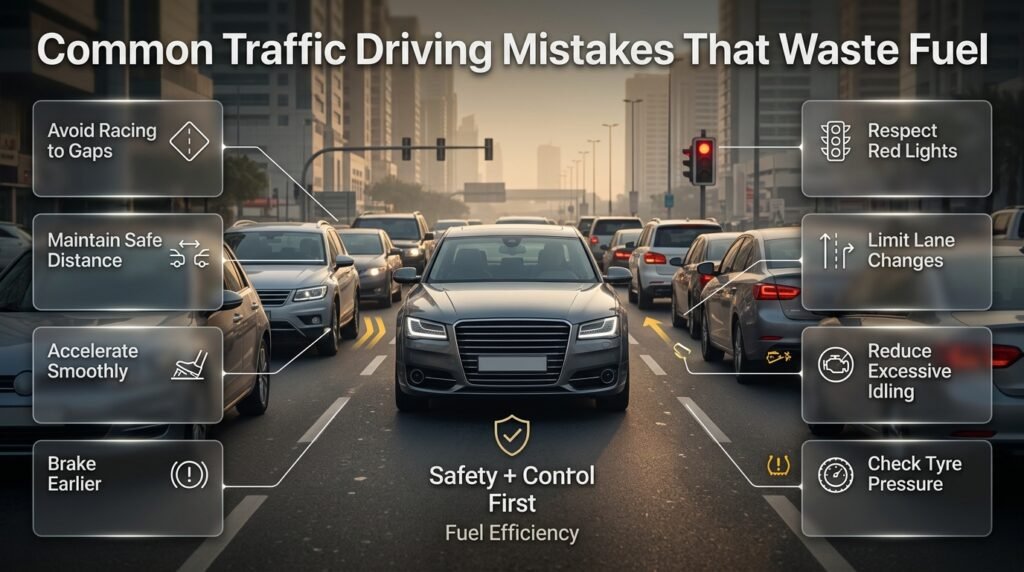
Mistake 1: Racing to Every Gap
Why it happens: Drivers want to feel like they’re making progress.
Why it’s inefficient: The gap may disappear immediately, forcing another braking event.
Better approach: Think about overall traffic flow rather than every individual gap.
Mistake 2: Driving Too Close
Why it happens: Drivers don’t want another vehicle to enter the gap.
Why it’s inefficient: It reduces reaction time and creates frequent braking.
Better approach: Maintain a sensible following distance.
Mistake 3: Hard Acceleration After Every Stop
Why it happens: The driver wants to leave the queue quickly.
Why it’s inefficient: Traffic may stop again shortly afterward.
Better approach: Accelerate smoothly and watch what is happening farther ahead.
Mistake 4: Braking Too Late
Why it happens: The driver reacts only when the vehicle ahead has already slowed significantly.
Why it’s inefficient: Late braking creates abrupt speed changes.
Better approach: Scan several vehicles ahead.
Mistake 5: Accelerating Toward Red Lights
Why it happens: The driver wants to reach the signal quickly.
Why it’s inefficient: They may use fuel to gain speed before stopping anyway.
Better approach: If the queue is clearly visible, reduce acceleration earlier when safe.
Mistake 6: Changing Lanes Constantly
Why it happens: Another lane looks faster.
Why it’s inefficient: The apparent advantage may disappear quickly.
Better approach: Change lanes when necessary or when there’s a genuine traffic benefit.
Mistake 7: Excessive Idling
Why it happens: Leaving the engine running becomes a habit.
Why it’s inefficient: The engine can consume fuel while the vehicle isn’t moving.
Better approach: Consider appropriate engine shutdown during longer safe stationary periods.
Mistake 8: Ignoring Tyre Pressure
Why it happens: Tyres can look normal even when pressure is incorrect.
Why it’s inefficient: Incorrect pressure can increase rolling resistance.
Better approach: Check pressure regularly using the manufacturer’s recommended specification.
Mistake 9: Treating Fuel Savings as More Important Than Safety
Why it happens: The driver becomes overly focused on fuel consumption.
Why it’s dangerous: Some extreme fuel-saving techniques can reduce control or reaction ability.
Better approach: Safety, traffic laws, and vehicle control always come first.
Expert Advice: Think About Unnecessary Energy
One of the most useful ways to understand fuel-efficient traffic driving is to think about energy.
Ask yourself:
“Am I creating speed that I’ll immediately have to remove?”
If you’re accelerating hard toward a visible queue, the answer may be yes.
If you’re changing lanes repeatedly without gaining meaningful progress, you may be creating unnecessary speed changes.
If you’re sitting stationary for a long time with the engine running unnecessarily, you’re consuming fuel without moving.
This mindset helps you identify fuel waste without memorising dozens of rules.
The Professional Approach
Don’t try to eliminate every fuel-consuming action.
Instead, eliminate the actions that provide little or no useful benefit.
That’s a much more realistic approach.
Step-by-Step Method for Better Fuel Economy in Traffic
Step 1: Scan
Look beyond the vehicle immediately ahead.
Why it matters: You get more time to react.
Professional advice: Watch signals, brake lights, queues, merging vehicles, and road conditions.
Common mistake: Looking only at the nearest vehicle.
Step 2: Create Space
Maintain a sensible following distance.
Why it matters: You have more room to slow gradually.
Professional advice: Adjust your following distance according to speed and conditions.
Common mistake: Driving bumper-to-bumper.
Step 3: Accelerate Smoothly
Use progressive accelerator inputs.
Why it matters: You reduce unnecessary aggressive speed changes.
Professional advice: Match traffic instead of racing away from it.
Common mistake: Treating every green signal as a race.
Step 4: Anticipate
Watch for slowdowns before they reach you.
Why it matters: Early anticipation reduces unnecessary hard braking.
Professional advice: Scan several vehicles ahead.
Common mistake: Waiting until the vehicle directly ahead brakes.
Step 5: Brake Safely
Use the brakes whenever safety requires.
Why it matters: Fuel economy must never override safety.
Professional advice: Avoid unnecessary braking, not necessary braking.
Common mistake: Thinking fuel-efficient driving means avoiding brakes completely.
Step 6: Manage Long Stops
Evaluate whether idling is necessary during prolonged stationary periods.
Why it matters: An idling engine can consume fuel without covering distance.
Professional advice: Consider the vehicle, climate, safety, and manufacturer guidance.
Common mistake: Leaving the engine running automatically whenever stationary.
Fuel-Efficient Traffic Driving: Quick Comparison
| Driving Habit | Likely Result | Better Approach |
|---|---|---|
| Hard acceleration | Higher fuel demand | Smooth acceleration |
| Tailgating | More frequent braking | Sensible following distance |
| Late braking | Abrupt speed changes | Anticipate traffic |
| Racing toward red lights | Unnecessary acceleration | Ease off when safe |
| Constant lane changes | Extra speed adjustments | Change lanes with purpose |
| Chasing every gap | More acceleration and braking | Follow overall traffic flow |
| Long unnecessary idling | Fuel use while stationary | Manage prolonged stops sensibly |
| Incorrect tyre pressure | Higher rolling resistance | Use recommended pressure |
| Heavy unnecessary load | More energy needed | Remove unnecessary weight |
| Poor maintenance | Potential efficiency loss | Follow service schedule |
How can I reduce fuel consumption in heavy traffic?
Reducing fuel consumption in heavy traffic is mainly about avoiding unnecessary acceleration, braking, and idling. You can’t control the traffic itself, but you can control how your vehicle responds to it. Look several vehicles ahead instead of reacting only to the car directly in front. When traffic starts moving, accelerate progressively rather than rushing forward, especially when you can already see another slowdown ahead.
Maintaining a sensible following distance is also important. A little extra space gives you more time to respond when traffic slows, which can reduce repeated brake-and-accelerate cycles. If you’re approaching a red light or a visible traffic queue, don’t continue accelerating just to stop again a few seconds later.
Practical points:
Look ahead for queues, signals, and brake lights.
Maintain a sensible following distance.
Accelerate smoothly instead of aggressively.
Avoid chasing small gaps in congested traffic.
Reduce unnecessary lane changes.
Manage prolonged idling sensibly.
Keep tyre pressure at the manufacturer’s recommended level.
The biggest improvement usually comes from changing your overall driving pattern rather than relying on one fuel-saving trick.
Does stop-and-go traffic use more fuel than steady driving?
Stop-and-go traffic generally uses more fuel because the vehicle repeatedly has to accelerate, slow down, and stop. Every time the vehicle loses speed and then needs to accelerate again, the engine has to provide energy to bring the vehicle back up to speed. In addition, the engine may continue running while the vehicle is stationary.
Steady driving is usually easier on fuel consumption because the vehicle can maintain a more consistent operating condition. This is one reason a short journey through severe congestion can sometimes consume more fuel than a longer journey with smoother traffic.
The important point is that you shouldn’t try to eliminate braking altogether. Braking is necessary whenever traffic conditions require it. Instead, focus on avoiding unnecessary speed changes by anticipating what’s happening farther ahead.
What helps in stop-and-go traffic:
Watch traffic several vehicles ahead.
Leave enough room to respond gradually.
Avoid hard acceleration after every stop.
Don’t race toward a gap that will disappear.
Anticipate traffic lights and queues.
Keep your driving predictable and smooth.
Avoid unnecessary prolonged idling.
For a more detailed explanation, see Stop and Go Driving Fuel Efficiency.
Does aggressive acceleration really increase fuel consumption?
Aggressive acceleration can increase fuel consumption because the engine has to produce more power over a short period. The problem becomes even more noticeable when hard acceleration is followed by sudden braking. In that situation, you’ve used fuel to build up speed that you then quickly lose through braking.
This is particularly common in urban traffic. A driver sees a gap, accelerates hard to fill it, reaches the next queue, brakes sharply, waits, and then repeats the process. The journey may not become meaningfully faster, but the vehicle has gone through repeated changes in speed.
Smooth acceleration doesn’t mean crawling away from every traffic light. It means applying the accelerator progressively and choosing a speed that matches the road and traffic conditions.
A better acceleration habit:
Start moving smoothly when traffic allows.
Increase speed progressively.
Watch for congestion before accelerating hard.
Don’t race to close every gap.
Match the flow of traffic safely.
Avoid unnecessary bursts of speed.
Prepare for slowdowns before they become urgent.
You can also learn more from How Acceleration Affects Fuel Consumption in Dubai.
A useful rule is: don’t create speed that you’ll immediately have to remove.
Should I turn off my engine in traffic to save fuel?
How can I reduce fuel consumption in heavy traffic?
Reducing fuel consumption in heavy traffic is mainly about avoiding unnecessary acceleration, braking, and idling. You can’t control the traffic itself, but you can control how your vehicle responds to it. Look several vehicles ahead instead of reacting only to the car directly in front. When traffic starts moving, accelerate progressively rather than rushing forward, especially when you can already see another slowdown ahead.
Maintaining a sensible following distance is also important. A little extra space gives you more time to respond when traffic slows, which can reduce repeated brake-and-accelerate cycles. If you’re approaching a red light or a visible traffic queue, don’t continue accelerating just to stop again a few seconds later.
Practical points:
Look ahead for queues, signals, and brake lights.
Maintain a sensible following distance.
Accelerate smoothly instead of aggressively.
Avoid chasing small gaps in congested traffic.
Reduce unnecessary lane changes.
Manage prolonged idling sensibly.
Keep tyre pressure at the manufacturer’s recommended level.
The biggest improvement usually comes from changing your overall driving pattern rather than relying on one fuel-saving trick.
Does stop-and-go traffic use more fuel than steady driving?
Stop-and-go traffic generally uses more fuel because the vehicle repeatedly has to accelerate, slow down, and stop. Every time the vehicle loses speed and then needs to accelerate again, the engine has to provide energy to bring the vehicle back up to speed. In addition, the engine may continue running while the vehicle is stationary.
Steady driving is usually easier on fuel consumption because the vehicle can maintain a more consistent operating condition. This is one reason a short journey through severe congestion can sometimes consume more fuel than a longer journey with smoother traffic.
The important point is that you shouldn’t try to eliminate braking altogether. Braking is necessary whenever traffic conditions require it. Instead, focus on avoiding unnecessary speed changes by anticipating what’s happening farther ahead.
What helps in stop-and-go traffic:
Watch traffic several vehicles ahead.
Leave enough room to respond gradually.
Avoid hard acceleration after every stop.
Don’t race toward a gap that will disappear.
Anticipate traffic lights and queues.
Keep your driving predictable and smooth.
Avoid unnecessary prolonged idling.
For a more detailed explanation, see Stop and Go Driving Fuel Efficiency.
Does aggressive acceleration really increase fuel consumption?
Aggressive acceleration can increase fuel consumption because the engine has to produce more power over a short period. The problem becomes even more noticeable when hard acceleration is followed by sudden braking. In that situation, you’ve used fuel to build up speed that you then quickly lose through braking.
This is particularly common in urban traffic. A driver sees a gap, accelerates hard to fill it, reaches the next queue, brakes sharply, waits, and then repeats the process. The journey may not become meaningfully faster, but the vehicle has gone through repeated changes in speed.
Smooth acceleration doesn’t mean crawling away from every traffic light. It means applying the accelerator progressively and choosing a speed that matches the road and traffic conditions.
A better acceleration habit:
Start moving smoothly when traffic allows.
Increase speed progressively.
Watch for congestion before accelerating hard.
Don’t race to close every gap.
Match the flow of traffic safely.
Avoid unnecessary bursts of speed.
Prepare for slowdowns before they become urgent.
You can also learn more from How Acceleration Affects Fuel Consumption in Dubai.
A useful rule is: don’t create speed that you’ll immediately have to remove.
What is the most effective driving habit for saving fuel in traffic?
The most useful habit is anticipatory driving—looking farther ahead and adjusting your speed before traffic conditions force you into sudden acceleration or braking. Instead of focusing only on the vehicle directly in front, watch brake lights, traffic signals, queues, merging vehicles, lane closures, and changes several vehicles ahead.
This gives you more time to respond. If you can see traffic slowing 100 metres ahead, you may be able to ease off the accelerator and allow your speed to reduce naturally when safe. A driver who waits until the last moment may need to brake harder and then accelerate again when traffic moves.
No single technique will produce the same result for every vehicle. Your actual fuel economy depends on the vehicle, traffic, route, weather, tyre pressure, air conditioning, load, maintenance, and driving style. That’s why the most effective approach is to combine several good habits consistently.
Focus on these habits first:
Look well beyond the nearest vehicle.
Maintain a sensible following distance.
Accelerate progressively.
Anticipate traffic lights and queues.
Avoid unnecessary hard braking.
Don’t chase every gap.
Limit unnecessary lane changes.
Manage prolonged idling.
Maintain correct tyre pressure.
Keep the vehicle properly serviced.
For a broader guide, see Fuel-Efficient Driving Techniques.
The goal isn’t simply to use less fuel on one journey. It’s to develop a driving style that naturally avoids wasted energy every time you enter heavy traffic.
Conclusion
Learning how to reduce fuel use in traffic isn’t about driving unusually slowly or avoiding necessary braking. It’s about becoming more aware of what’s happening around you and avoiding fuel-wasting actions that don’t actually help you reach your destination faster.
Heavy traffic will always involve some unavoidable fuel consumption, especially when you’re dealing with repeated stops, low-speed movement, long queues, and idling. However, your driving habits can make a noticeable difference. Looking farther ahead, maintaining a sensible following distance, accelerating smoothly, anticipating traffic lights, avoiding unnecessary lane changes, and managing prolonged idling can help reduce wasted fuel during daily city driving.
Your vehicle’s condition matters too. Correct tyre pressure, regular maintenance, reasonable vehicle loading, and sensible air-conditioning use all support better fuel efficiency. For more practical guidance, explore Fuel-Saving Driving Tips and How Traffic Affects Fuel Economy in Dubai.
The most important lesson is simple: you can’t control the traffic, but you can control how you drive through it. By making smoother, more predictable decisions on every journey, you can reduce unnecessary fuel use while keeping your driving safe, comfortable, and efficient.
Leave a Reply