
Introduction
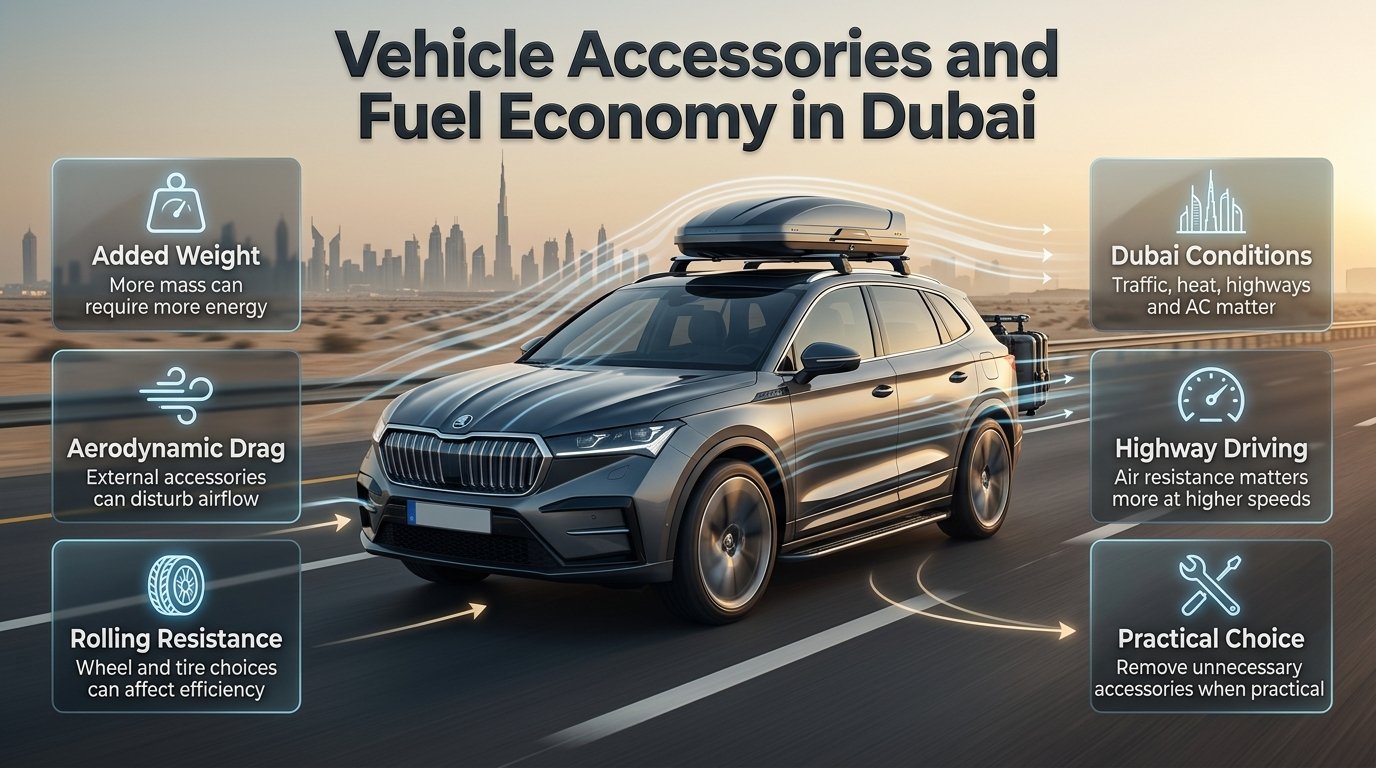
Vehicle Accessories and Fuel Economy in Dubai | Many drivers add accessories to their cars without thinking about how those changes may affect fuel consumption. A roof rack, cargo box, larger wheels, bull bar, external carrier, or even extra equipment in the trunk can change the way a vehicle moves through the air and how much energy it needs to travel.
This is where vehicle accessories and fuel economy become connected. Some accessories have almost no noticeable effect on fuel use, while others can increase aerodynamic drag, add weight, or change rolling resistance enough to make a difference over time.
For drivers in Dubai, this can become even more important. Long highway journeys, high-speed roads, heavy traffic, extreme summer temperatures, and regular air-conditioning use can all influence fuel consumption. If you’re interested in broader practical guidance, the Fuel Delivery Dubai homepage is also a useful starting point for understanding fuel-related driving situations and emergency refueling needs.
The good news is that you don’t have to remove every accessory from your vehicle. The smarter approach is to understand which accessories affect fuel economy, why they affect it, and when the effect becomes significant.
This guide explains how car accessories influence fuel consumption, which accessories create aerodynamic drag, how roof racks and cargo boxes compare with other modifications, whether larger wheels use more fuel, how additional weight affects efficiency, and what drivers can do to reduce unnecessary fuel use without sacrificing practicality.
What Is the Connection Between Vehicle Accessories and Fuel Economy?
Vehicle accessories can affect fuel economy mainly by changing a car’s weight, aerodynamic drag, rolling resistance, or mechanical load. Accessories that increase wind resistance or add substantial weight generally require more energy from the engine. The effect is often small for lightweight, compact accessories but can become noticeable with large external equipment.
A vehicle’s fuel economy isn’t determined by the engine alone. The entire vehicle has to move through its environment.
A simple way to understand it is:
More resistance → more engine effort → more energy required → potentially higher fuel consumption
Accessories can create resistance in several ways:
- Adding weight
- Increasing aerodynamic drag
- Increasing frontal area
- Creating turbulent airflow
- Increasing rolling resistance
- Changing tire characteristics
- Affecting vehicle balance
- Increasing mechanical or electrical load
Not every accessory creates all these effects.
For example, a small phone holder inside the cabin normally has practically no meaningful effect on fuel economy. A large roof cargo box at highway speed is different because it changes the airflow around the vehicle.
How Do Car Accessories Increase Fuel Consumption?
The most important factors are weight and aerodynamics.
When an accessory adds weight, the vehicle needs more energy to accelerate and climb hills. When an accessory increases aerodynamic drag, the engine has to work harder to maintain speed, especially at higher speeds.
Aerodynamic drag becomes increasingly important as vehicle speed rises. This means an accessory that seems insignificant during slow urban driving may become more relevant during a highway trip.
Consider two situations:
City driving
A heavy accessory may influence fuel consumption because the vehicle repeatedly accelerates from stops.
Highway driving
A large roof-mounted accessory may have a stronger influence because aerodynamic resistance becomes increasingly important as speed rises.
This is why there isn’t one universal answer to the question, “Does this accessory increase fuel consumption?”
The correct question is:
How much weight, drag, or rolling resistance does the accessory introduce, and how do I normally drive?
Which Vehicle Accessories Have the Biggest Effect on Fuel Economy?
The accessories most likely to influence fuel economy are those that are large, heavy, externally mounted, or poorly shaped for airflow.
Common examples include:
- Roof racks
- Roof cargo boxes
- Roof-mounted luggage
- Bicycle carriers
- Large external cargo carriers
- Heavy-duty bull bars
- Large off-road accessories
- Oversized wheels and tires
- Heavy spare-wheel carriers
- Trailer equipment
- Large external storage systems
- Permanent equipment mounted to the vehicle
Their effects vary considerably.
A lightweight accessory may have almost no practical impact. A large accessory exposed directly to airflow can be much more significant.
The important principle is not simply “accessories are bad.”
Instead:
The greater the added weight and aerodynamic disruption, the greater the potential impact on efficiency.
Roof Racks and Fuel Economy
Roof racks are one of the most common accessories that can influence fuel economy.
An empty roof rack may not look particularly large, but it sits in an area where airflow can be disturbed. Instead of smoothly passing over the vehicle, air interacts with the rack and its components.
This can increase turbulence and aerodynamic drag.
The effect becomes more relevant as driving speed increases.
For drivers who regularly use a roof rack, removing it when it isn’t needed can be a simple efficiency improvement.
For more detailed information, see Roof Racks and Fuel Economy.
Does an Empty Roof Rack Still Affect Fuel Consumption?
Yes, it can.
An empty roof rack generally creates less resistance than a rack carrying a large load, but it can still disturb airflow.
The actual impact depends on:
- Rack design
- Vehicle shape
- Rack height
- Crossbar shape
- Vehicle speed
- Wind conditions
- Driving distance
The effect may be relatively small during ordinary city driving but more relevant during sustained highway driving.
Should You Remove a Roof Rack?
If you rarely use it, removing it can make sense.
You don’t need to remove a rack every time you drive to the supermarket. However, if you’re preparing for a long highway journey and don’t need the rack, taking it off can eliminate unnecessary aerodynamic resistance.
💡 Pro Tip: If a roof rack is only needed occasionally, consider treating it as removable equipment rather than a permanent part of the vehicle.
Roof Cargo Boxes and Fuel Consumption
A roof cargo box can be extremely useful when you need additional storage.
It can also affect fuel economy more than a small interior accessory because it increases the vehicle’s external profile.
A roof box can:
- Increase frontal exposure
- Disturb airflow
- Create additional turbulence
- Increase aerodynamic drag
- Add weight
Its effect is especially relevant during long-distance highway driving.
A well-designed aerodynamic cargo box is generally preferable to a large, poorly shaped container because its shape can reduce unnecessary airflow disruption.
However, even an aerodynamic roof box isn’t completely invisible to the air.
If you’re carrying a roof box for a long trip, consider whether you genuinely need it. If the equipment can safely fit inside the vehicle without compromising passengers or visibility, internal storage may sometimes be more efficient.
Bicycle Carriers and Fuel Economy
Bicycle carriers are another accessory that can affect fuel consumption.
The impact depends heavily on where the carrier is mounted.
Roof-Mounted Bicycle Carrier
A bicycle on the roof can create significant airflow disruption because the bicycle has an irregular shape.
Frames, wheels, handlebars, and other components can produce turbulence.
Rear-Mounted Bicycle Carrier
A rear-mounted carrier can sometimes have a different aerodynamic effect because it sits behind much of the vehicle’s main body.
However, it still adds weight and changes airflow around the rear of the vehicle.
The practical lesson is simple:
Don’t assume every carrier has the same effect.
Location, shape, speed, and vehicle design all matter.
How Vehicle Weight Affects Fuel Economy
Weight is another important connection between accessories and fuel consumption.
Every additional kilogram becomes part of the vehicle that the engine must move.
The effect is especially noticeable in situations involving repeated acceleration.
For example, imagine a driver carrying unnecessary equipment in the trunk every day:
- Old tools
- Heavy boxes
- Sports equipment
- Spare materials
- Unused camping equipment
- Extra water containers
- Unused accessories
Each item may seem insignificant individually.
Together, however, they can add substantial weight.
For a practical explanation, see How Vehicle Weight Affects Fuel Economy.
You can also read Car Load and Fuel Consumption for a more focused look at how vehicle load influences fuel use.
Does Removing Extra Weight Save Fuel?
It can.
Removing unnecessary weight reduces the amount of mass the vehicle has to accelerate.
The benefit isn’t usually dramatic from removing one small object. The opportunity becomes more meaningful when a vehicle consistently carries a large amount of unnecessary equipment.
This is especially useful for vehicles used every day.
📌 Quick Tip: Once every few months, empty the trunk and ask yourself: “Do I actually need to carry all of this every day?”
Heavy-Duty Bull Bars and Fuel Economy
Bull bars and other heavy protective equipment can add significant weight to a vehicle.
They’re often installed for practical reasons, particularly on vehicles used for off-road driving, commercial work, or demanding environments.
The issue isn’t that bull bars are inherently bad.
The question is whether the additional weight and altered airflow are justified by the vehicle’s purpose.
A heavy steel accessory can contribute to:
- Increased vehicle weight
- Additional frontal area
- Changes in airflow
- Increased fuel consumption
- Potential changes in handling
For a vehicle that genuinely needs the equipment, these trade-offs may be acceptable.
For a vehicle used mainly for urban commuting, unnecessary heavy accessories may provide little practical benefit.
Do Larger Wheels Affect Fuel Economy?
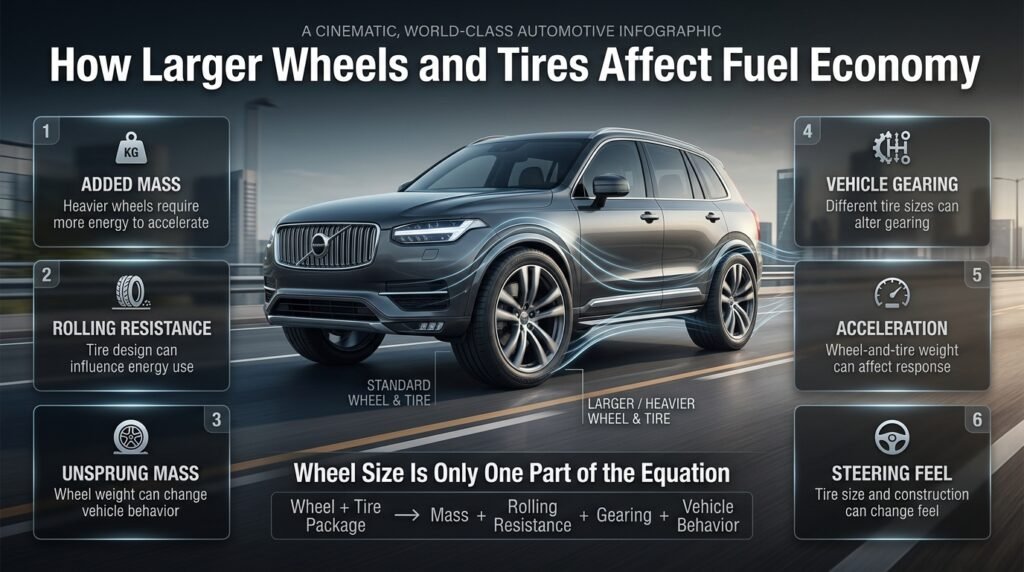
Yes, larger or heavier wheels and tires can affect fuel economy.
Wheel size itself isn’t the only issue.
What matters is the total wheel-and-tire package.
A heavier wheel can increase the mass the vehicle must accelerate. Tire width, tread design, construction, and rolling resistance can also influence energy consumption.
A larger tire may also alter:
- Rolling resistance
- Vehicle gearing
- Unsprung mass
- Acceleration characteristics
- Aerodynamic behavior
- Steering feel
This doesn’t mean larger wheels automatically make a vehicle inefficient.
Modern vehicles are often designed around specific wheel and tire combinations, so replacing them with a significantly different setup can change efficiency.
Should You Choose Smaller Wheels for Better Fuel Economy?
Not necessarily in every case.
If fuel economy is your main priority, a manufacturer-approved wheel and tire combination designed for efficiency may be preferable to an unnecessarily heavy setup.
But safety, braking, handling, comfort, load rating, and vehicle compatibility should always come first.
How Tire Choice Connects Accessories With Fuel Economy
Tires aren’t always thought of as vehicle accessories, but changing tires can influence fuel economy.
Rolling resistance is important because the tire continuously deforms as it rolls.
Factors affecting rolling resistance include:
- Tire construction
- Tire pressure
- Tire size
- Compound
- Tread design
- Vehicle weight
- Road surface
Correct tire pressure is particularly important.
Read Tire Pressure and Fuel Efficiency for more information about how tire pressure affects vehicle efficiency.
A driver who installs new wheels but ignores tire pressure can lose some of the potential efficiency benefits of the setup.
How Aerodynamics Affects Fuel Efficiency
Aerodynamics becomes increasingly important as vehicle speed rises.
At higher speeds, the vehicle must push more air out of the way. Any accessory that creates additional turbulence or increases the effective frontal area can increase aerodynamic resistance.
This is why roof-mounted accessories deserve special attention.
For a deeper explanation, see How Aerodynamics Affects Fuel Efficiency.
You can also explore Vehicle Drag and Fuel Consumption in Dubai for a Dubai-focused discussion of aerodynamic resistance.
A simple airflow concept looks like this:
Clean airflow
Vehicle → → → smooth air movement → → →
Disrupted airflow
Vehicle + accessory → turbulence → turbulence → increased resistance
The larger and less aerodynamic the accessory, the greater the potential disruption.
Why Highway Speed Makes Accessories More Important
Accessories that increase aerodynamic drag tend to matter more when the vehicle travels at higher speeds.
At low speeds, aerodynamic resistance is relatively less dominant compared with other forces.
At highway speeds, however, air resistance becomes a major factor.
This is why an accessory may appear harmless during a short urban trip but become more noticeable during a long highway journey.
Drivers planning a long trip should therefore check:
- Roof rack
- Roof box
- Bicycle carrier
- External cargo
- Windows
- Tire pressure
- Unnecessary weight
For additional guidance, see How Highway Speed Affects Fuel Consumption.
You may also find Highway Driving Fuel Efficiency and Fuel-Efficient Highway Driving useful when preparing for longer journeys.
Do Window Visors Affect Fuel Economy?
Small window visors or rain guards generally have a much smaller effect than large roof-mounted equipment.
Their aerodynamic impact depends on their design and installation.
For most drivers, removing small window visors solely to improve fuel economy is unlikely to be a high-priority action.
There are usually bigger opportunities, such as:
- Avoiding unnecessary roof equipment
- Maintaining correct tire pressure
- Reducing aggressive acceleration
- Avoiding unnecessary idling
- Keeping vehicle weight under control
- Driving smoothly
This is an important principle:
Focus on changes that have meaningful practical impact instead of obsessing over tiny aerodynamic differences.
Do Spoilers Improve or Reduce Fuel Economy?
Spoilers are frequently misunderstood.
A spoiler isn’t automatically a fuel-saving device.
Its primary purpose may relate to airflow management and vehicle stability, particularly at certain speeds.
A properly engineered aerodynamic component can influence airflow in useful ways, but an aftermarket spoiler added mainly for appearance may not provide a meaningful fuel-economy advantage.
Some poorly designed modifications can even increase drag.
Before installing aerodynamic accessories, consider:
- Vehicle design
- Intended purpose
- Quality of engineering
- Installation
- Speed range
- Real-world driving conditions
Don’t assume that something that looks aerodynamic will automatically improve efficiency.
Do Roof-Mounted Accessories Matter More Than Interior Accessories?
Usually, yes.
An accessory inside the cabin generally doesn’t interfere directly with airflow around the vehicle.
Its main potential impact comes from added weight.
A roof-mounted accessory can create both:
Additional weight + aerodynamic drag
This makes external accessories particularly important when thinking about fuel efficiency.
For example:
| Accessory | Added Weight | Aerodynamic Effect | Potential Fuel Impact |
|---|---|---|---|
| Phone holder | Very low | Minimal | Very low |
| Small interior organizer | Low | None | Very low |
| Heavy trunk equipment | Moderate/high | None | Low–moderate |
| Roof rack | Moderate | Moderate | Moderate |
| Roof box | Moderate | High | Moderate/high |
| Roof-mounted bicycles | High | High | Moderate/high |
| Heavy bull bar | High | Moderate/high | Moderate |
| Large external cargo | High | High | Potentially significant |
These are general comparisons rather than fixed fuel-consumption percentages. Actual results vary by vehicle and driving conditions.
How Dubai Driving Conditions Change the Picture
Dubai presents several conditions that can make fuel economy particularly important.
Drivers may encounter:
- Heavy traffic
- Stop-and-go movement
- Long highway journeys
- High temperatures
- Frequent air-conditioning use
- Strong winds
- High-speed roads
- Long periods of idling
An accessory’s effect therefore depends on where and how the vehicle is driven.
For example, a roof box may be more relevant during a long highway trip than during slow city traffic.
Meanwhile, unnecessary weight may become more noticeable in congested areas where the vehicle repeatedly accelerates and brakes.
To understand the broader issue, see How Traffic Affects Fuel Economy in Dubai.
For stop-and-go conditions, Stop and Go Driving Fuel Efficiency provides additional practical guidance.
Vehicle Accessories and Air Conditioning
Accessories aren’t the only factor affecting fuel use.
In Dubai’s hot climate, air conditioning can also place an additional load on the vehicle.
This means drivers should look at the complete picture rather than blaming fuel consumption entirely on an accessory.
For example:
Roof box + high highway speed + strong wind + AC use
can produce a very different fuel-consumption result from:
No roof box + moderate speed + light traffic
For more information, see Air Conditioning and Fuel Consumption.
The practical lesson is to manage the factors you can control rather than focusing on one accessory alone.
How Driving Style Interacts With Accessories
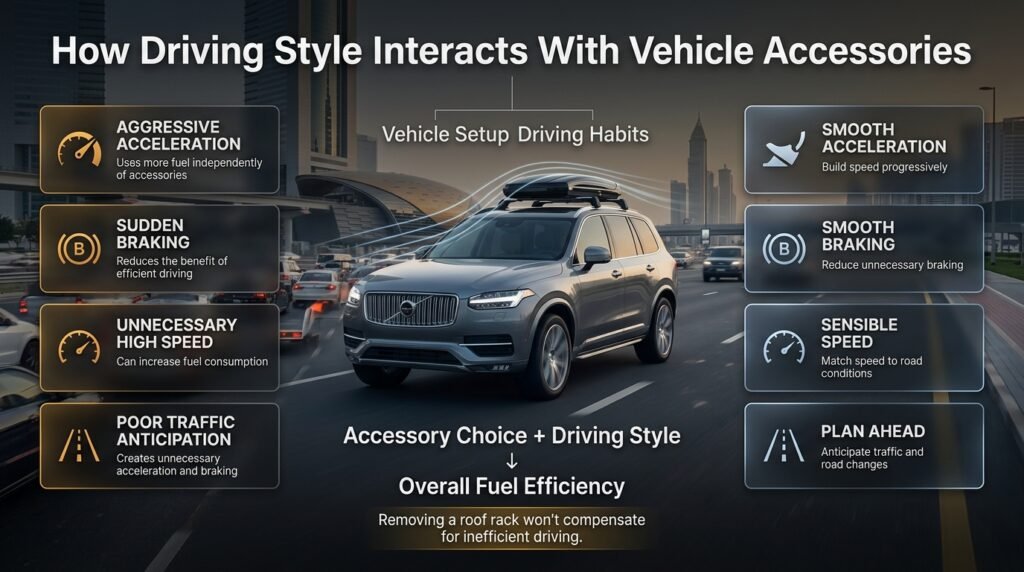
The same accessory can produce different real-world results depending on driving style.
Aggressive acceleration, sudden braking, unnecessary high speeds, and poor traffic anticipation can increase fuel consumption independently of accessories.
That means removing a roof rack won’t compensate for inefficient driving.
For better overall efficiency, combine sensible vehicle setup with good driving habits.
Useful resources include:
- Fuel-Saving Driving Tips
- Smooth Driving Techniques for Better Fuel Economy in Dubai
- How Acceleration Affects Fuel Consumption in Dubai
- How Braking Habits Affect Fuel Economy in Dubai
- Fuel-Efficient Driving Techniques
A smooth driving style can often produce a more meaningful improvement than removing a small accessory.
Does Driving Speed Matter More Than Most Accessories?
In many highway situations, speed can have a substantial influence on fuel consumption because aerodynamic resistance increases as speed rises.
This is why drivers shouldn’t think:
“I installed a roof rack, so I need to worry about the rack only.”
The complete driving pattern matters.
A vehicle with a roof rack driven moderately may sometimes use less fuel than the same vehicle driven aggressively at significantly higher speeds.
For guidance, see Optimal Driving Speed for Fuel Efficiency in Dubai.
The goal isn’t necessarily to drive extremely slowly.
Instead, aim for a sensible speed that matches:
- Posted limits
- Traffic conditions
- Road conditions
- Safety requirements
- Vehicle capability
Vehicle Accessories and Long-Distance Fuel Economy
Long journeys are where accessory choices deserve more attention.
During a short trip, a small increase in fuel consumption may barely be noticeable.
Over hundreds of kilometers, repeated aerodynamic and weight penalties can accumulate.
Before a long journey, inspect:
Exterior
- Roof rack
- Roof box
- Bicycle carrier
- External cargo
- Decorative aerodynamic accessories
- Loose equipment
Interior
- Trunk contents
- Heavy tools
- Unnecessary luggage
- Extra equipment
Tires
- Cold tire pressure
- Tread condition
- Damage
- Load requirements
Driving setup
- Planned speed
- Route
- Traffic
- AC use
- Stops
For more detailed preparation, see Improving Fuel Economy on Long Trips and Long-Distance Driving Fuel Efficiency Tips.
A Simple Pre-Trip Accessory Checklist
Before a long journey, ask:
1. Do I need the accessory?
If not, remove it.
2. Is it mounted externally?
If yes, consider its aerodynamic effect.
3. Is it heavy?
If yes, determine whether carrying it is necessary.
4. Is it loaded?
A roof rack by itself is different from a roof rack carrying bulky luggage.
5. Is everything secure?
Loose equipment can create safety and aerodynamic problems.
6. Are the tires correctly inflated?
Check them when cold and follow the vehicle manufacturer’s specifications.
7. Am I driving efficiently?
Avoid unnecessary acceleration and braking.
Common Mistakes Drivers Make With Vehicle Accessories
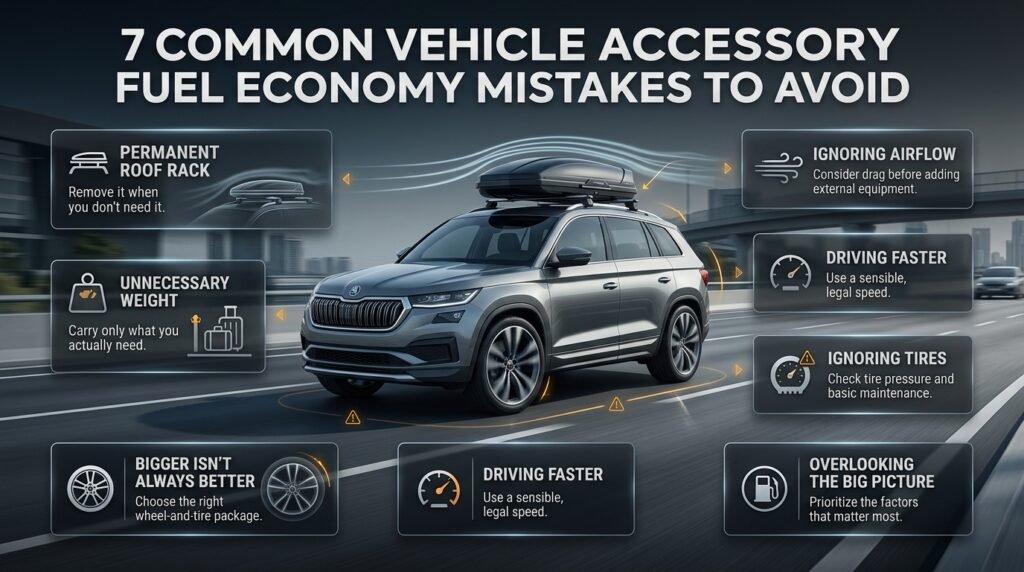
Mistake 1: Leaving a Roof Rack Installed Permanently
Some drivers install a roof rack and never remove it.
If the rack isn’t needed for months, it can become unnecessary aerodynamic equipment.
Better approach: Remove it when practical if you don’t need it.
Mistake 2: Carrying Unnecessary Weight
A trunk can slowly become a storage room.
Tools, equipment, old luggage, and other items may remain inside for months.
Better approach: Clean the vehicle regularly and carry only what you need.
Mistake 3: Assuming Bigger Wheels Are Always Better
Large wheels may improve appearance, but they can change weight and rolling characteristics.
Better approach: Choose wheel and tire combinations appropriate for the vehicle rather than choosing size based only on appearance.
Mistake 4: Installing Accessories Without Considering Airflow
An accessory may look attractive but create unnecessary turbulence.
Better approach: Consider aerodynamic design, especially for roof-mounted equipment.
Mistake 5: Driving Faster to Compensate for Extra Equipment
Some drivers install a roof box or carrier and then increase speed to “save time.”
This can make the efficiency penalty worse.
Better approach: Maintain a sensible, legal speed and avoid unnecessary high-speed driving.
Mistake 6: Focusing on Accessories While Ignoring Tires
A driver may spend time researching aerodynamic accessories while driving with incorrect tire pressure.
Better approach: Start with basic vehicle maintenance.
Mistake 7: Believing Every Accessory Has a Major Fuel Penalty
Not every accessory meaningfully changes fuel economy.
A small interior accessory shouldn’t receive the same attention as a large roof-mounted cargo box.
Better approach: Prioritize high-impact factors.
Expert Advice: How to Balance Accessories and Fuel Economy
A professional approach isn’t about removing everything from the vehicle.
It’s about matching accessories to actual use.
If you regularly transport bicycles, luggage, tools, or equipment, the accessory may be worth the fuel trade-off.
The goal is to avoid unnecessary penalties while keeping the vehicle practical.
Professional recommendation 1: Use removable equipment when possible
If you need a roof rack only for weekend activities, consider removing it afterward.
Professional recommendation 2: Choose aerodynamic designs
When buying roof boxes or carriers, look for designs intended to reduce unnecessary airflow disruption.
Professional recommendation 3: Avoid unnecessary permanent weight
Heavy accessories should have a practical purpose.
Professional recommendation 4: Check manufacturer specifications
Wheel, tire, rack, and load choices should remain within vehicle limits.
Professional recommendation 5: Think about total vehicle efficiency
Don’t judge fuel economy from accessories alone.
Consider:
- Speed
- Traffic
- Tire pressure
- Acceleration
- Braking
- Vehicle load
- AC use
- Maintenance
- Route
- Weather
How to Decide Whether an Accessory Is Worth Keeping
Use this simple decision process.
Do I use it regularly?
If yes, keep it if it serves an important purpose.
If no, consider removing it.
Does it add significant weight?
If yes, ask whether that weight is necessary.
Does it sit outside the vehicle?
If yes, think about aerodynamic drag.
Do I use it mainly at highway speeds?
If yes, aerodynamic effects deserve more attention.
Does it improve safety, utility, or essential functionality?
If yes, fuel economy shouldn’t be the only consideration.
This prevents drivers from making decisions based purely on fuel consumption.
Vehicle Accessories: Fuel Economy Comparison
| Accessory Type | Weight Effect | Drag Potential | Main Concern |
|---|---|---|---|
| Phone mount | Very low | Minimal | Practically negligible |
| Small interior organizer | Low | None | Usually negligible |
| Trunk equipment | Moderate | None | Added weight |
| Roof rack | Moderate | Moderate | Airflow disruption |
| Roof box | Moderate | High | Drag and weight |
| Bicycle carrier | Moderate/high | Moderate/high | External airflow |
| Roof-mounted bicycles | High | High | Significant airflow disruption |
| Bull bar | High | Moderate/high | Weight and frontal airflow |
| Oversized wheels | Moderate/high | Variable | Weight and rolling resistance |
| Large external carrier | High | High | Weight and drag |
These categories are general. Actual fuel consumption depends on the vehicle, accessory design, speed, weather, load, and driving conditions.
Can Removing Accessories Improve Fuel Economy Immediately?
Sometimes, but don’t expect a dramatic change from every accessory.
If you remove a large roof box before a long highway journey, you may reduce aerodynamic drag.
If you remove several heavy items from the trunk, you reduce vehicle mass.
However, fuel economy is influenced by many variables.
For a meaningful comparison, measure fuel consumption over similar driving conditions.
For example:
Trip A
- Same vehicle
- Similar route
- Similar speed
- Roof box installed
Trip B
- Same vehicle
- Similar route
- Similar speed
- Roof box removed
The closer the conditions are, the more useful the comparison becomes.
How to Test Whether an Accessory Is Affecting Fuel Economy
If you want to understand the real effect of an accessory on your vehicle, use a consistent testing method.
Step 1: Record your baseline
Track fuel use without the accessory.
Step 2: Keep your driving style consistent
Avoid comparing aggressive driving with gentle driving.
Step 3: Use similar routes
Traffic and terrain can dramatically affect fuel consumption.
Step 4: Keep tire pressure consistent
Pressure changes can influence results.
Step 5: Compare over multiple trips
One trip isn’t enough to establish a reliable pattern.
Step 6: Consider weather
Wind direction and temperature can change results.
This approach is much better than relying on assumptions.
Accessories That Usually Have Minimal Fuel Impact
Some accessories generally have little practical influence on fuel consumption.
Examples may include:
- Phone holders
- Small dashboard organizers
- Seat covers
- Small interior storage items
- Floor mats
- Small decorative interior accessories
- Lightweight cabin organizers
Their effect is usually far smaller than factors such as high speed, heavy loads, incorrect tire pressure, or aggressive driving.
This helps put the issue into perspective.
You don’t need to remove every accessory to achieve good fuel economy.
Accessories That Deserve More Attention
If fuel economy is a priority, focus first on accessories that are:
- Large
- Heavy
- Externally mounted
- Roof-mounted
- Exposed to direct airflow
- Used at high speeds
- Carrying additional cargo
- Permanently installed
These are the modifications most likely to create a meaningful efficiency trade-off.
Fuel Consumption While Idling and Accessories
Accessories can also influence how drivers think about idling.
For example, someone waiting in a vehicle may keep the engine running to operate air conditioning or other systems.
But idling consumes fuel even though the vehicle isn’t traveling.
For more information, see Fuel Consumption While Idling and Car Idling Fuel Consumption in Dubai.
The important distinction is:
An accessory can affect the fuel required to move the vehicle, while idling consumes fuel without producing useful distance traveled.
These are separate efficiency issues.
How Accessories Affect Stop-and-Go Driving
In heavy traffic, vehicle weight becomes more relevant because the vehicle repeatedly accelerates.
Imagine carrying a large amount of unnecessary equipment every day.
Each time you accelerate, the engine has to move that extra mass.
This is one reason unnecessary cargo can be more relevant in urban driving than drivers expect.
At the same time, repeated braking and acceleration can have a larger influence than a small accessory.
Read How to Reduce Fuel Use in Traffic for practical strategies.
Smooth driving can reduce unnecessary energy loss.
Vehicle Accessories and Automatic Transmissions
Modern automatic transmissions can select gears based on speed, throttle input, engine load, and other conditions.
However, adding substantial weight or aerodynamic resistance still increases the work the vehicle needs to perform.
Drivers shouldn’t attempt to manually manipulate the transmission simply because they have installed accessories.
Instead, use smooth accelerator input and allow the transmission to operate as designed.
For additional information, see Fuel-Efficient Use of Automatic Transmission and Gear Shifting and Fuel Economy.
Do vehicle accessories really affect fuel economy?
Vehicle accessories can affect fuel economy, but the impact depends heavily on what the accessory is, where it is installed, how much weight it adds, and how you drive. A small interior accessory normally has little practical effect, while a roof rack, cargo box, bicycle carrier, heavy bull bar, or large external load can create additional aerodynamic drag or weight that the engine has to overcome. The effect is usually more noticeable during sustained highway driving because aerodynamic resistance becomes increasingly important as speed rises. The U.S. EPA also lists roof racks, extra cargo, speeding, aggressive acceleration, and other factors among things that can reduce fuel economy.
Important points:
Roof-mounted accessories: More likely to affect fuel economy because they disturb airflow.
Heavy accessories: Increase the amount of mass the vehicle has to accelerate.
External cargo: Can create both additional weight and aerodynamic resistance.
Small interior accessories: Usually have such a small effect that they’re not worth worrying about.
Highway driving: Aerodynamic accessories generally matter more as speed increases.
The key is not to assume that every accessory causes a major fuel penalty. Instead, look at the size, weight, location, and aerodynamic shape of the accessory. A driver carrying a large roof box at highway speed has a very different situation from someone using a small phone holder inside the cabin.
Does a roof rack or roof box increase fuel consumption?
A roof rack or roof box can increase fuel consumption because it changes the vehicle’s carefully designed airflow. Even an empty crossbar creates an additional object in the airstream, while a roof box or roof-mounted bicycle creates a much larger aerodynamic disturbance. Research has found that the effect can vary considerably depending on the vehicle, accessory design, speed, and driving conditions. In one real-world test, removing factory crossbars from a Kia Carnival improved highway fuel economy from 25 mpg to 28 mpg at 75 mph.
The important point is that there is no single percentage that applies to every roof rack or roof box. Published testing has produced very different results across vehicles and setups. A research review, for example, found that rooftop cargo boxes could produce substantial fuel-consumption increases, with the effect varying by vehicle and driving cycle.
What you should do:
Remove empty crossbars when you don’t need them, particularly before long highway trips.
Choose an aerodynamic roof box rather than a very boxy design if you need one.
Don’t carry a roof box simply because you have one available.
Pack only the equipment you actually need.
Keep the load secure and within the vehicle’s roof-load limits.
If possible, compare fuel consumption over similar journeys with and without the accessory.
Professional advice: Don’t judge a roof accessory only by its appearance. A slim-looking accessory can still create drag, while a well-designed product may manage airflow better. The most sensible approach is to use roof equipment when it provides genuine utility and remove it when it becomes unnecessary.
Which car accessories have the biggest impact on fuel economy?
The accessories most likely to affect fuel economy are generally those that combine significant weight, large external dimensions, or direct exposure to airflow. Roof boxes, roof-mounted bicycles, large roof racks, external cargo carriers, heavy bull bars, and some oversized wheel-and-tire combinations deserve more attention than small cabin accessories.
This happens for two different reasons. First, heavy equipment increases the mass the engine must move, particularly during acceleration. Second, externally mounted equipment can increase aerodynamic drag. These effects can also occur together. A roof box, for example, adds some weight while also increasing the vehicle’s aerodynamic profile.
Accessories worth paying particular attention to:
Roof racks: Create additional aerodynamic drag.
Roof boxes: Add both weight and a larger aerodynamic profile.
Roof-mounted bicycles: Their irregular shape can create substantial turbulence.
Large external cargo carriers: Add weight and affect airflow.
Heavy bull bars: Increase weight and can alter airflow around the front of the vehicle.
Oversized/heavy wheels: Can affect vehicle mass and rolling characteristics.
Permanent heavy equipment: Adds weight on every journey, even when it isn’t being used.
Accessories that normally aren’t a priority:
Phone holders
Small dashboard organizers
Lightweight interior accessories
Seat covers
Small storage items
The professional way to approach this is to prioritize the biggest sources of resistance first. Removing a few kilograms of small interior equipment may be less useful than removing an unused roof rack before a 300-kilometer highway journey.
Do larger wheels and tires reduce fuel economy?
Larger wheels and tires can reduce fuel economy, but wheel diameter alone doesn’t tell the whole story. What matters is the complete wheel-and-tire package: its weight, width, tire construction, rolling resistance, diameter, and compatibility with the vehicle. A heavier wheel-and-tire combination can require more energy during acceleration, while certain tire choices can increase rolling resistance.
This is why changing from the manufacturer’s original wheel and tire setup to a much larger aftermarket combination shouldn’t be considered purely a styling decision. You may gain a different appearance or handling characteristics, but you can also change ride comfort, acceleration, braking behavior, steering feel, and efficiency.
The EPA specifically recommends maintaining proper tire inflation and notes that low-rolling-resistance tires can help fuel economy.
Before upgrading wheels or tires, check:
Recommended tire size
Load rating
Speed rating
Correct tire pressure
Wheel weight
Tire width
Rolling-resistance characteristics
Clearance
Braking compatibility
Manufacturer specifications
A better fuel-economy approach: If efficiency is important to you, don’t choose wheels solely because they’re larger or visually aggressive. A properly matched, reasonably lightweight wheel-and-tire combination can provide a better balance between appearance, handling, comfort, safety, and fuel consumption.
Also remember that incorrect tire pressure can undermine efficiency regardless of wheel size. That’s why tire maintenance should be considered alongside accessory selection rather than as a separate issue.
Should I remove vehicle accessories before a long highway trip to save fuel?
For large, unused external accessories, removing them before a long highway journey can be a sensible fuel-saving decision. The reason is simple: highway driving gives aerodynamic drag a much larger role in the energy required to keep the vehicle moving. An empty roof rack, roof box, or external carrier can continue disturbing airflow for hundreds of kilometers even though it isn’t providing any useful function during the journey.
This isn’t just theoretical. In a 75-mph highway test, removing factory crossbars from a Kia Carnival improved observed fuel economy by about 12 percent in that particular test vehicle and setup. That result should not be treated as a universal percentage for every car, but it demonstrates why unused roof equipment can matter.
Before a long trip, check:
Roof rack — Remove it if you aren’t using it and the design allows easy removal.
Roof box — Don’t carry an empty box unnecessarily.
Bike carrier — Remove it if there are no bicycles to transport.
External cargo — Reconsider whether everything needs to travel with you.
Trunk weight — Remove tools, equipment, and other items you don’t need.
Tire pressure — Check pressure when the tires are cold according to the manufacturer’s specifications.
Driving speed — Avoid unnecessary high speeds because aerodynamic resistance becomes increasingly important as speed rises.
Driving style — Use smooth acceleration and braking.
The bigger lesson is that accessory removal works best as part of an overall fuel-efficiency strategy. Taking off a roof rack while then driving aggressively at high speed won’t deliver the result you want. Combine a cleaner vehicle setup with sensible speed, smooth driving, correct tire pressure, and reduced unnecessary weight.
For a Dubai driver, this becomes especially useful when preparing for a long highway journey where an accessory may remain exposed to airflow for hours rather than minutes.
Bottom line: Keep accessories that you genuinely need. Remove large external accessories when they’re unnecessary, especially before long highway trips. That’s a practical compromise between vehicle usefulness and fuel efficiency, rather than trying to eliminate every accessory from the car.
Conclusion
Vehicle accessories can make a car more practical, comfortable, and useful, but they can also influence fuel economy when they add unnecessary weight or increase aerodynamic drag. The biggest difference usually comes from large external accessories such as roof racks, roof boxes, bicycle carriers, heavy bull bars, and oversized wheel-and-tire setups.
The solution isn’t to remove every accessory from your vehicle. Instead, think about what you actually need and how often you use it. If a roof rack or cargo box isn’t needed for a particular trip, removing it can reduce unnecessary aerodynamic resistance. Likewise, clearing heavy items from the trunk can reduce the load your engine has to move.
For the best results, combine sensible accessory choices with other fuel-efficient habits. Maintain correct tire pressure, avoid unnecessary idling, accelerate and brake smoothly, and use a reasonable speed for the road conditions. These small decisions work together and can have a much greater effect than focusing on one accessory alone.
Ultimately, good fuel economy comes from finding the right balance between practicality, safety, performance, and efficiency. Keep the accessories that genuinely serve a purpose, remove unnecessary weight and external equipment when possible, and make every journey with a more efficient vehicle setup.
Leave a Reply