Introduction
Optimal Driving Speed for Fuel Efficiency in Dubai | You’re driving through Dubai, the road is clear, traffic is moving smoothly, and everything seems normal. Then you notice that your fuel gauge is falling faster than expected. Many drivers immediately blame the air conditioning, fuel quality, or the vehicle itself, but one of the simplest factors affecting fuel consumption is often overlooked: driving speed.
If you’re trying to understand the optimal driving speed for fuel efficiency, the answer isn’t simply “drive as slowly as possible.” A vehicle can become less efficient when driven too slowly in the wrong conditions, while excessive highway speeds can significantly increase fuel consumption because the engine has to overcome greater aerodynamic resistance.
For drivers looking for practical fuel-related information in Dubai, understanding how speed affects fuel consumption can also help make everyday journeys more predictable and economical. Fuel at My Location Dubai 👉 Fuel Delivery Dubai can also be useful when you need roadside fuel support.
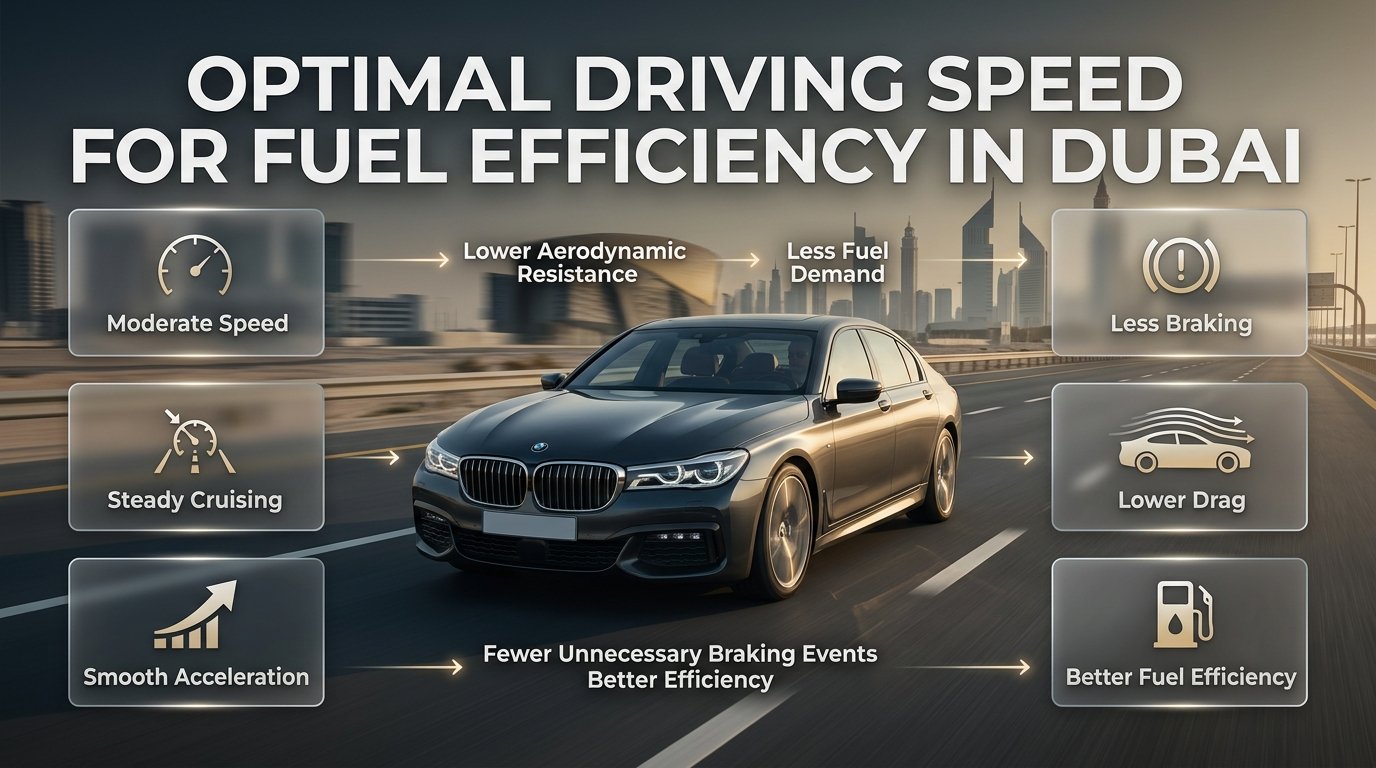
The most efficient approach is generally to maintain a moderate, steady speed, accelerate smoothly, anticipate traffic, and avoid unnecessary braking. However, the exact speed that delivers the best fuel economy depends on the vehicle, engine, transmission, tyres, road conditions, traffic, weather, and driving style.
This complete guide explains how speed affects fuel consumption, why high-speed driving uses more fuel, whether 80 km/h is actually the ideal speed, how highway and city driving differ, how Dubai’s driving conditions can influence fuel economy, and what practical habits can help reduce fuel consumption without making your journeys unnecessarily slow.
What Is the Optimal Driving Speed for Fuel Efficiency?
For many conventional cars, fuel economy is strongest at a moderate and consistent cruising speed rather than during stop-and-go traffic or high-speed highway driving. In suitable conditions, speeds around 50–80 km/h can be highly efficient for many vehicles, while 80–100 km/h can provide a practical balance between fuel economy and journey time on appropriate roads.
There is no universal speed that works perfectly for every car.
A small hatchback, large SUV, diesel sedan, hybrid, turbocharged petrol car, and electric vehicle all respond differently to speed. Transmission gearing, aerodynamic design, engine efficiency, tyre characteristics, and vehicle weight all influence the result.
The basic principle is:
Moderate speed + smooth acceleration + steady cruising + minimal unnecessary braking = better fuel efficiency.
The objective isn’t to drive as slowly as possible. It’s to avoid wasting energy.
At very high speeds, aerodynamic resistance becomes increasingly important. At very low speeds, particularly in urban traffic, repeated stopping and acceleration can become the bigger problem.
Why Does Driving Speed Affect Fuel Consumption?
A moving vehicle needs energy to overcome several types of resistance.
The engine or electric motor must overcome:
- Aerodynamic drag
- Tyre rolling resistance
- Mechanical losses
- Road gradients
- Vehicle weight during acceleration
- Wind resistance
- Transmission losses
At lower speeds, aerodynamic drag is relatively small. As speed increases, however, air resistance becomes much more significant.
This is one reason why a vehicle that delivers excellent fuel economy at moderate highway speeds may consume considerably more fuel when driven much faster.
Speed also affects the engine’s operating conditions. At an efficient cruising speed, an automatic transmission may select a high gear and allow the engine to operate at relatively low RPM. At other speeds or during repeated acceleration, the transmission may select lower gears and the engine may require more fuel.
So when considering fuel economy, don’t look at speed in isolation.
Ask:
How fast am I travelling, how often am I changing speed, and how hard is the engine working to maintain that speed?
That gives you a much more useful picture.
How Aerodynamic Drag Changes With Speed
Aerodynamic drag is one of the most important reasons high-speed driving consumes more fuel.
In simplified terms, aerodynamic drag increases approximately with the square of speed.
That means increasing speed doesn’t increase air resistance in a simple one-to-one relationship.
For example, if a vehicle travels from 80 km/h to 120 km/h, its speed increases by 50%. Under similar aerodynamic conditions, the aerodynamic drag can increase by roughly 125%.
This doesn’t mean fuel consumption itself automatically rises by 125%. Fuel economy depends on many other factors, including engine efficiency, gearing, rolling resistance, road gradient, wind, and vehicle design.
However, the example demonstrates why high-speed driving becomes progressively more demanding.
How Highway Speed Affects Fuel Consumption
How highway speed affects fuel consumption is mainly related to aerodynamic drag and the engine’s workload. As speed increases, the vehicle needs more energy to overcome air resistance, which can raise fuel consumption. Maintaining a steady, moderate speed is generally more efficient than driving at excessive speeds or constantly changing speed. Smooth acceleration and controlled braking can further reduce unnecessary fuel use. By following speed limits and maintaining consistent highway speeds, drivers can improve mileage and make longer journeys more fuel-efficient.
For practical insight into how speed choices can influence fuel use, 👉 How Highway Speed Affects Fuel Consumption provides useful guidance for more efficient highway driving.
A simple way to visualize it
80 km/h
→ Moderate aerodynamic resistance
→ Moderate engine power requirement
→ Potentially strong fuel economy
100 km/h
→ Higher aerodynamic resistance
→ Greater power requirement
→ Fuel economy may begin declining
120 km/h
→ Significantly higher aerodynamic resistance
→ Much greater power requirement
→ Usually higher fuel consumption
This is why reducing highway speed slightly can sometimes produce a surprisingly noticeable improvement in fuel economy.
Is 80 km/h the Most Fuel-Efficient Speed?
Not necessarily.
The idea that every car has an exact fuel-efficient speed of 80 km/h is too simplistic.
For some vehicles, 70 km/h may be very efficient. For others, 80–90 km/h may provide a better balance. A vehicle with tall gearing may remain highly efficient at 100 km/h, while a vehicle with a different transmission or larger frontal area may experience a stronger penalty as speed increases.
The ideal speed depends on:
- Engine size
- Engine design
- Transmission type
- Gear ratios
- Vehicle weight
- Aerodynamic shape
- Tyre pressure
- Tyre type
- Road surface
- Wind
- Temperature
- Air-conditioning demand
- Vehicle load
- Driving technique
Therefore, instead of asking:
“What exact speed saves the most fuel?”
a better question is:
“At what moderate speed does my vehicle cruise smoothly and efficiently under normal conditions?”
That’s a more useful way to approach fuel economy.
Vehicle Drag and Fuel Consumption in Dubai
Vehicle drag can have a significant effect on fuel consumption, particularly as driving speed increases. Aerodynamic resistance becomes more noticeable on highways, meaning vehicles may need more engine power to maintain higher speeds. Roof racks, cargo boxes, open windows at high speeds, and bulky external accessories can increase drag and reduce efficiency further. In Dubai, where drivers often use high-speed roads for longer journeys, keeping the vehicle streamlined and removing unnecessary external equipment can help reduce aerodynamic resistance. Combining good aerodynamics with moderate speeds and smooth driving can support better overall fuel economy.
For a deeper understanding of how aerodynamic resistance, driving speed, roof equipment, external cargo, wind, and vehicle design can influence fuel consumption, explore our detailed Vehicle Drag and Fuel Consumption in Dubai guide.
Fuel-Efficient Use of Automatic Transmission
Using an automatic transmission efficiently can help reduce unnecessary fuel consumption, especially during Dubai’s busy traffic and frequent stop-and-go driving. Avoid aggressive acceleration, sudden braking, and repeatedly switching between Drive and other gears when it is not necessary. When waiting for longer periods, follow the vehicle manufacturer’s guidance rather than keeping the engine unnecessarily engaged. Regular transmission maintenance and using the correct manufacturer-recommended fluid can also support smooth gear changes and efficient vehicle operation. The key is to let the transmission work naturally while maintaining a smooth, predictable driving style.
For practical guidance on using an automatic transmission more efficiently, including smooth acceleration, proper gear modes, traffic management, and highway driving habits, explore our detailed Fuel-Efficient Use of Automatic Transmission guide.
What Is the Best Highway Speed for Fuel Economy?
For many vehicles, maintaining a steady speed around 80–100 km/h can provide a reasonable compromise between fuel efficiency and travel time when the road and traffic conditions permit it.
That doesn’t mean every driver should drive at 80 km/h or 90 km/h regardless of the road.
Traffic laws and road conditions always come first.
If the legal speed limit is higher, the driver should still select a speed appropriate to the conditions and traffic flow. Driving unusually slowly on a high-speed road can create safety problems.
The important fuel-saving lesson is to avoid unnecessary high-speed driving.
For example, if a driver has a choice between:
- Smoothly cruising at a moderate legal speed, or
- Repeatedly accelerating toward a much higher speed and braking for traffic,
the first approach will generally be more fuel-efficient.
Improving Fuel Economy on Long Trips
Improving fuel economy on long trips starts with maintaining a steady speed and avoiding sudden acceleration or unnecessary braking. Before departure, check tire pressure, remove excess weight, and ensure the vehicle is properly maintained. Planning the route can also help reduce detours, congestion, and unnecessary fuel use. Using air conditioning sensibly and avoiding prolonged idling during stops can further support better mileage. These practical habits can make long-distance journeys smoother, more economical, and fuel-efficient.
For practical strategies to reduce fuel consumption and improve mileage on extended journeys, 👉 Improving Fuel Economy on Long Trips offers useful guidance for more economical long-distance driving.
Highway Driving Fuel Efficiency
Highway driving fuel efficiency improves when you maintain a steady, moderate speed and avoid unnecessary acceleration or braking. Consistent cruising helps the engine operate more efficiently, while excessive speed can increase aerodynamic drag and fuel consumption. Keeping tires properly inflated, reducing unnecessary vehicle weight, and using air conditioning sensibly can also support better mileage. Following posted speed limits and driving smoothly throughout the journey can help reduce fuel waste. These simple habits make long highway trips more economical and fuel-efficient.
For practical strategies to maintain better mileage and reduce fuel consumption on highways, 👉 Highway Driving Fuel Efficiency provides a useful guide for more economical driving.
Gear Shifting and Fuel Economy in Dubai
Gear shifting has a direct impact on how efficiently a vehicle uses fuel, particularly in Dubai’s busy traffic and changing road conditions. Driving in the appropriate gear helps keep the engine operating within an efficient range, while unnecessarily high engine speeds or using the wrong gear can increase fuel consumption. Manual drivers can improve efficiency by shifting smoothly and selecting the appropriate gear for their speed and road conditions. Automatic transmissions generally manage gear changes themselves, but smooth acceleration and avoiding unnecessary aggressive driving can still support better fuel economy.
For a practical understanding of how to choose the right gear, avoid unnecessary engine strain, and improve fuel efficiency in Dubai’s city traffic and highway conditions, read our detailed Gear Shifting and Fuel Economy in Dubai guide.
Does Driving Faster Always Use More Fuel?
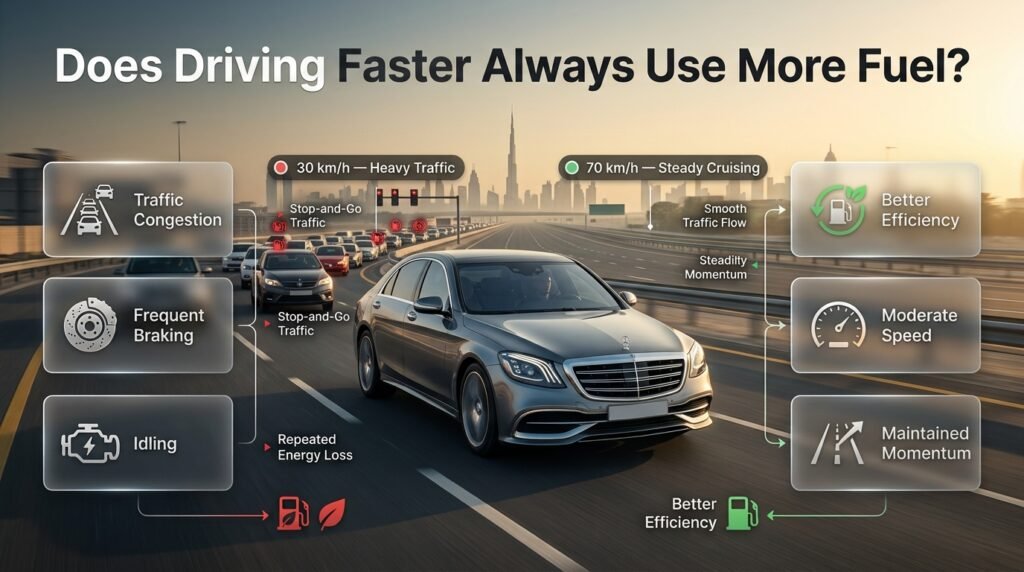
At highway speeds, fuel consumption generally increases as speed rises, but the complete answer is more complicated.
A vehicle travelling at 30 km/h through heavy traffic may consume more fuel per kilometre than the same vehicle travelling steadily at 70 km/h.
Why?
Because the 30 km/h journey may involve:
- Stopping at traffic lights
- Idling
- Accelerating from a standstill
- Braking repeatedly
- Changing lanes
- Waiting in congestion
Meanwhile, the vehicle travelling at 70 km/h may maintain steady momentum.
So “faster” doesn’t always mean “less efficient” or “more efficient.”
Fuel economy is influenced by how the speed is achieved and maintained.
A moderate, steady speed is usually the sweet spot.
Why Stop-and-Go Traffic Is So Inefficient
One of the biggest fuel economy problems in city driving isn’t cruising speed. It’s repeated acceleration.
Every time a vehicle accelerates, the engine must provide energy to increase the vehicle’s kinetic energy.
When you brake, much of that kinetic energy is converted into heat in the braking system.
Then you accelerate again.
The cycle becomes:
Stop → accelerate → brake → stop → accelerate → brake
This repeated process can consume significantly more fuel than smooth cruising.
That’s why a vehicle can sometimes achieve excellent fuel economy on a long highway journey while consuming much more fuel during a short city trip.
The distance may be shorter, but the energy wasted through repeated changes in speed can be substantial.
Fuel-Saving Driving Tips
Fuel-saving driving tips can help drivers reduce unnecessary fuel consumption and make everyday journeys more economical. Smooth acceleration, gradual braking, maintaining a steady speed, and avoiding unnecessary idling can improve overall fuel efficiency. Drivers should also keep tires properly inflated, remove unnecessary weight, and avoid excessive speeds that increase aerodynamic drag. In Dubai, where traffic congestion, hot weather, and frequent highway driving can affect fuel use, combining efficient driving habits with regular vehicle maintenance can help reduce fuel waste and support better long-term fuel economy.
For practical strategies to reduce fuel consumption through smoother driving, better speed control, reduced idling, proper tire pressure, and smarter daily driving habits, explore our detailed Fuel-Saving Driving Tips guide.
Stop and Go Driving Fuel Efficiency
Stop and go driving fuel efficiency can be reduced by frequent acceleration, braking, and repeated stops in congested traffic. Each acceleration from a standstill requires additional engine power, while frequent braking wastes momentum that could otherwise support better mileage. Maintaining a safe following distance and anticipating traffic flow can help reduce unnecessary speed changes. Smooth, controlled driving is generally more efficient than aggressive stop-and-start movements. These habits can help minimize fuel waste and improve overall fuel economy in busy driving conditions.
For practical strategies to reduce fuel waste during repeated stops and starts, 👉 Stop and Go Driving Fuel Efficiency offers useful guidance for smoother, more economical driving.
Tire Pressure and Fuel Efficiency
Tire pressure plays an important role in fuel efficiency because underinflated tires create greater rolling resistance, forcing the engine to work harder and potentially increasing fuel consumption. Maintaining the recommended tire pressure can help your vehicle roll more efficiently while also supporting better handling, braking, and tire wear. In Dubai’s hot climate, checking tire pressure regularly is especially useful because temperature changes can affect pressure readings. Always follow the vehicle manufacturer’s recommended pressure rather than relying on the maximum pressure printed on the tire sidewall.
For practical guidance on maintaining the correct tire pressure, reducing unnecessary rolling resistance, and supporting better fuel economy in Dubai’s driving conditions, read our detailed Tire Pressure and Fuel Efficiency guide.
How Smooth Acceleration Improves Fuel Economy
Speed and acceleration are closely connected.
Two drivers can both travel at an average of 80 km/h but achieve different fuel consumption.
Driver A
- Accelerates aggressively
- Reaches high speeds quickly
- Brakes late
- Accelerates again
- Changes speed constantly
Driver B
- Accelerates progressively
- Reaches cruising speed smoothly
- Maintains a safe following distance
- Anticipates traffic
- Reduces unnecessary braking
Driver B will often achieve better fuel economy.
This is why improving acceleration habits is just as important as choosing a sensible cruising speed.
For a deeper explanation of this relationship, see How Acceleration Affects Fuel Consumption in Dubai.
Smooth Driving Techniques for Better Fuel Economy in Dubai
Smooth driving techniques for better fuel economy in Dubai can help reduce unnecessary fuel consumption while making daily driving safer and more comfortable. Gradual acceleration, gentle braking, maintaining a steady speed, and keeping a safe following distance can reduce frequent speed changes and unnecessary energy use. Drivers can also improve efficiency by anticipating traffic conditions, avoiding aggressive overtaking, and limiting unnecessary idling. On Dubai highways, maintaining a sensible and consistent speed can further reduce fuel consumption. Combining these driving habits with proper tire pressure and regular vehicle maintenance can support better fuel economy over time.
For practical guidance on smoother acceleration, controlled braking, steady-speed driving, and better traffic anticipation, explore our detailed Smooth Driving Techniques for Better Fuel Economy in Dubai guide to develop more fuel-efficient driving habits.
How Aerodynamics Affects Fuel Efficiency
Aerodynamics plays an important role in fuel efficiency, especially when a vehicle is traveling at higher speeds. As speed increases, air resistance creates more drag, requiring the engine to use additional energy to keep the vehicle moving. Features such as roof racks, cargo boxes, open windows, and bulky external accessories can increase aerodynamic drag and contribute to higher fuel consumption. Keeping the vehicle streamlined, removing unnecessary external equipment, and maintaining a sensible highway speed can help reduce resistance and support more efficient driving.
For a clearer understanding of how air resistance, vehicle design, speed, roof accessories, and external load can influence your car’s fuel consumption, explore our detailed How Aerodynamics Affects Fuel Efficiency guide.
Air Conditioning and Fuel Consumption
Air conditioning can have a noticeable effect on fuel consumption, especially during hot weather and heavy traffic. When the AC system is running, the engine needs additional power to operate the compressor, which can increase fuel use. In Dubai’s hot climate, however, avoiding AC completely is not practical or comfortable. A better approach is to use the system efficiently by parking in shade when possible, ventilating the cabin briefly before cooling it, maintaining the AC system properly, and avoiding unnecessary idling with the AC running. These simple habits can help reduce unnecessary fuel consumption while keeping the cabin comfortable.
For practical tips on reducing unnecessary fuel consumption while keeping your car comfortable in Dubai’s hot climate, explore our detailed Air Conditioning and Fuel Consumption guide, which explains how AC use, traffic, idling, driving speed, and vehicle maintenance can affect overall fuel economy.
Vehicle Accessories and Fuel Economy
Vehicle accessories and fuel economy are closely connected because certain add-ons can increase aerodynamic drag, vehicle weight, or electrical load. Roof racks, cargo boxes, oversized accessories, and other external equipment may make the engine work harder, especially during highway driving. Even small changes can affect fuel consumption when they are used regularly. For better efficiency, remove unnecessary accessories when they are not needed, keep external equipment streamlined, and avoid carrying extra weight without a purpose. In Dubai, where long highway journeys and high-speed driving are common, choosing practical accessories and maintaining the vehicle properly can help support better overall fuel economy.
For a practical guide on how roof racks, cargo boxes, extra weight, larger wheels, and other accessories can influence fuel consumption, read our detailed Vehicle Accessories and Fuel Economy in Dubai guide before choosing or removing accessories from your vehicle.
Why Maintaining a Steady Speed Matters
A steady speed helps the vehicle avoid unnecessary changes in engine load.
Imagine driving along a relatively empty highway.
If you constantly move between 90 km/h and 110 km/h, the engine repeatedly has to produce additional power and then reduce it.
If you instead maintain a consistent 90 or 100 km/h where appropriate, the power demand becomes more predictable.
This doesn’t mean you should never change speed.
You should always respond to:
- Traffic
- Road conditions
- Speed limits
- Weather
- Merging vehicles
- Pedestrians
- Roadworks
- Hazards
The goal is to eliminate unnecessary speed changes, not necessary ones.
Does Cruise Control Improve Fuel Efficiency?
Cruise control can help maintain a consistent speed, especially on relatively open roads.
One common problem with normal driving is unconscious speed creep.
You may intend to travel at 90 km/h but gradually increase to 95, 100, or even 105 km/h without noticing.
Cruise control can prevent this.
However, conventional cruise control isn’t automatically the most economical choice on every road.
On steep hills or roads with significant changes in elevation, a driver may sometimes manage speed more efficiently by anticipating the terrain instead of allowing cruise control to aggressively maintain a fixed speed.
Best use of cruise control
Cruise control is most useful when:
- Traffic is light
- The road is relatively predictable
- The road is suitable for its use
- Weather conditions are good
- You can remain fully attentive
Don’t use cruise control in conditions where it reduces your ability to respond safely.
Optimal Speed for Petrol Cars
Petrol vehicles can achieve strong fuel economy when driven smoothly at moderate speeds.
Modern petrol engines often use advanced fuel injection, variable valve timing, turbocharging, cylinder management, and efficient transmissions.
However, these technologies don’t eliminate the effect of aerodynamic drag.
A petrol car travelling at a very high speed still needs considerably more power to push through the air.
For petrol drivers
Focus on:
- Moderate cruising
- Progressive acceleration
- High but appropriate transmission gears
- Correct tyre pressure
- Reduced unnecessary braking
- Proper maintenance
- Avoiding excessive idling
If your vehicle has an instantaneous fuel-economy display, use it to observe trends rather than chasing every momentary reading.
Optimal Speed for Diesel Cars
Diesel engines are often known for strong fuel economy, particularly during longer journeys.
Their efficiency characteristics can make steady highway cruising especially economical.
But diesel vehicles are not immune to high-speed fuel penalties.
A diesel SUV travelling at 120 km/h still has to overcome aerodynamic resistance. If its body is large and upright, the aerodynamic penalty can be even more noticeable.
For diesel drivers, steady cruising can be particularly valuable because the engine may operate efficiently under sustained load.
However, the correct speed still depends on the specific vehicle.
Optimal Speed for Hybrid Cars
Hybrid vehicles behave differently because they combine a combustion engine with an electric motor and battery system.
At lower speeds and during some urban conditions, a hybrid may use electric propulsion or recover energy during braking.
This can make hybrids particularly efficient in stop-start traffic compared with conventional vehicles.
However, highway speed still matters.
At higher speeds, aerodynamic resistance increases, and the vehicle may rely more heavily on its combustion engine.
Hybrid drivers can therefore benefit from:
- Smooth acceleration
- Moderate highway speeds
- Predictive driving
- Gentle braking where appropriate
- Effective use of regenerative braking
- Avoiding unnecessary high-speed driving
The best strategy depends heavily on the hybrid system.
How Dubai Highways Affect Fuel Economy
Dubai has extensive highways designed for relatively high-speed travel.
This creates a different fuel economy environment from a dense urban centre where most journeys involve low-speed congestion.
On open Dubai roads, aerodynamic resistance becomes a significant factor.
A driver travelling smoothly at a moderate legal speed may achieve considerably better fuel economy than someone constantly driving at the upper end of the speed range.
Long highway journeys also provide an opportunity to maintain steady momentum.
Fuel-Efficient Highway Driving
Fuel-efficient highway driving focuses on maintaining a steady speed, smooth acceleration, and controlled braking throughout the journey. Avoiding excessive speed can reduce aerodynamic drag, which increases fuel consumption as speed rises. Keeping tires properly inflated and removing unnecessary weight can also support better mileage on longer trips. Using cruise control where appropriate may help maintain consistent speed on suitable roads. By combining these habits with proper vehicle maintenance, drivers can reduce fuel waste and make highway journeys more economical.
For practical tips to maintain steady speed and improve mileage on longer highway journeys, 👉 Fuel-Efficient Highway Driving offers useful guidance for more economical driving.
Good highway habits include:
- Selecting an appropriate cruising speed
- Maintaining a safe following distance
- Avoiding unnecessary acceleration
- Anticipating traffic
- Using cruise control when suitable
- Checking tyre pressure
- Avoiding unnecessary heavy loads
How Dubai City Traffic Changes the Equation
City driving presents a different challenge.
Even if your average speed is low, fuel consumption can be high because you’re repeatedly starting and stopping.
Signals, roundabouts, congestion, lane changes, parking areas, and short trips all influence fuel economy.
In these situations, trying to maintain a specific speed is less important than managing your acceleration and braking.
For example, if you see a red traffic signal from a distance, there may be little benefit in accelerating aggressively only to stop a few seconds later.
Instead, observe the traffic pattern early and adjust your driving smoothly.
How to Reduce Fuel Use in Traffic
How to reduce fuel use in traffic starts with smoother acceleration, gentle braking, and avoiding unnecessary engine idling. Maintaining a safe following distance gives you more time to anticipate traffic changes and reduces repeated stop-and-go movements. Planning your route to avoid severe congestion when practical can also limit wasted fuel and travel time. Keeping your vehicle properly maintained, including correct tire pressure, further supports efficient driving. By adopting these simple habits, drivers can reduce unnecessary fuel consumption and improve everyday fuel economy.
For practical strategies to save fuel during congested journeys, 👉 How to Reduce Fuel Use in Traffic provides useful guidance for more efficient traffic driving.
How Traffic Affects Fuel Economy
How traffic affects fuel economy becomes particularly important when frequent stops, slow movement, and repeated acceleration increase the engine’s workload. Stop-and-go conditions can waste fuel because the vehicle repeatedly uses energy to accelerate and then loses that momentum through braking. Long waits may also lead to unnecessary idling, further increasing fuel consumption. Maintaining a safe following distance and anticipating traffic changes can help reduce sudden speed adjustments. By driving smoothly and planning routes carefully, drivers can improve fuel economy even in busy traffic conditions.
For practical ways to reduce fuel waste in congested conditions, 👉 How Traffic Affects Fuel Economy in Dubai explains how traffic patterns and driving habits can influence fuel efficiency.
How Braking Habits Affect Fuel Economy
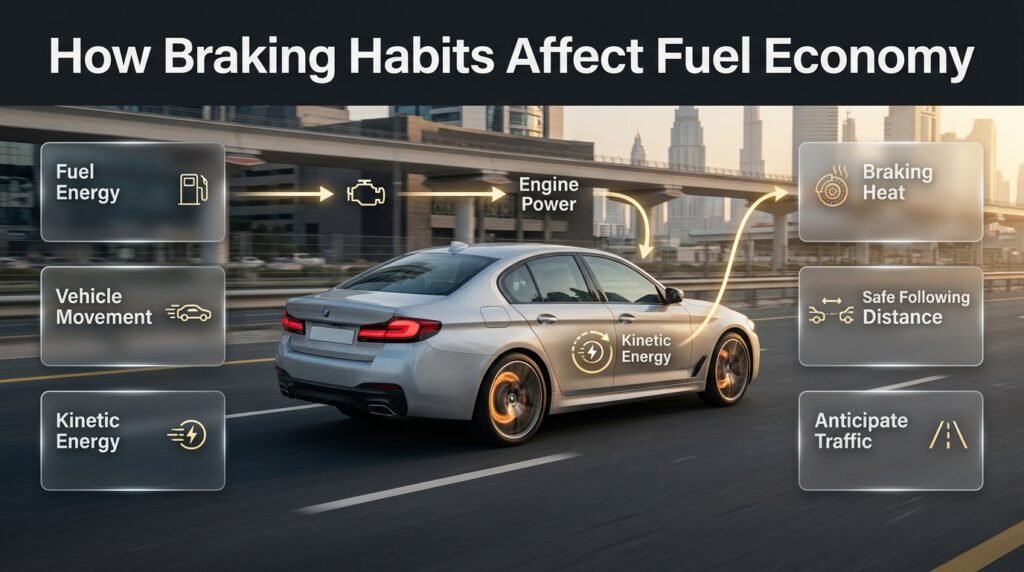
Braking doesn’t directly “use fuel” in the same way acceleration does, but unnecessary braking can waste energy that your engine previously used to accelerate the vehicle.
The process is straightforward:
Fuel energy → engine power → vehicle movement → kinetic energy → braking heat
If you accelerate aggressively and then brake immediately, much of the energy used to increase speed is lost.
This is why anticipation is so valuable.
Maintaining a safe distance gives you more time to respond to changing traffic conditions without unnecessary hard braking.
For more information, read How Braking Habits Affect Fuel Economy in Dubai.
What Is More Important: Speed or Acceleration?
Both matter, but they affect fuel economy differently.
Speed primarily becomes important because aerodynamic drag increases rapidly at higher road speeds.
Acceleration matters because producing rapid changes in speed requires additional engine power.
A driver who maintains a moderate speed but accelerates aggressively between every traffic light can still waste fuel.
Likewise, a driver who accelerates smoothly but maintains an unnecessarily high highway speed can also experience poor fuel economy.
The strongest strategy combines both:
Moderate speed + smooth acceleration + predictable braking.
Does Driving at 60 km/h Save More Fuel Than 80 km/h?
Not necessarily.
If both speeds can be maintained steadily under identical conditions, the lower speed may provide better aerodynamic efficiency.
However, real-world driving isn’t always identical.
At 60 km/h, the vehicle might operate in a different gear, encounter more traffic, or spend more time in areas requiring frequent speed changes.
At 80 km/h, the transmission may use a high gear and maintain steady momentum.
Therefore, the answer depends on the vehicle and environment.
The important lesson is not that 60 km/h is always better than 80 km/h.
It’s that steady moderate-speed driving is generally more efficient than unnecessary high-speed driving or stop-start driving.
Does Driving at 100 km/h Save Fuel Compared With 120 km/h?
In many vehicles, yes.
Increasing highway speed from 100 km/h to 120 km/h significantly increases aerodynamic resistance.
The engine must generate more power simply to maintain the higher speed.
The exact fuel difference depends on the vehicle, wind, road surface, tyres, engine, transmission, and other factors.
A large SUV can experience a more noticeable aerodynamic penalty than a small, streamlined sedan.
This is one reason why reducing speed slightly on long journeys can improve fuel economy without requiring any mechanical modification to the vehicle.
How Tyre Pressure Affects Fuel Efficiency
Tyres are in constant contact with the road, and their rolling resistance affects how much energy the vehicle needs to move.
Underinflated tyres can increase rolling resistance.
That means the engine has to work harder to maintain motion.
Before trying to optimise your driving speed, make sure your tyres are correctly inflated according to the vehicle manufacturer’s recommended specification.
Check pressure when the tyres are in appropriate conditions and follow the instructions provided for your vehicle.
Don’t assume that the maximum pressure printed on the tyre sidewall is the correct everyday pressure for your car.
Why tyre pressure matters in Dubai
Dubai’s hot climate can cause tyre pressures to change as temperature changes.
This makes regular checks particularly useful.
Correct tyre pressure can support:
- Better fuel economy
- More consistent handling
- More even tyre wear
- Better braking performance
- Longer tyre life
How Vehicle Weight Affects Fuel Consumption
The heavier the vehicle, the more energy it generally requires to accelerate.
This doesn’t mean that a heavy vehicle will always consume more fuel than a light vehicle under every condition, but weight is an important factor.
If your car contains items that you don’t need, removing unnecessary weight can slightly reduce energy requirements.
Examples might include:
- Unused equipment
- Heavy tools
- Excess cargo
- Unnecessary storage items
The effect may be small for individual items, but removing unnecessary weight is still a sensible part of an overall fuel-efficiency strategy.
How Vehicle Weight Affects Fuel Economy
How vehicle weight affects fuel economy is most noticeable during acceleration, frequent stops, and uphill driving because a heavier vehicle requires more energy to move. Carrying unnecessary luggage, tools, or equipment can therefore increase fuel consumption and reduce mileage. Removing items that are not needed can help lower the vehicle’s workload and support better efficiency. However, weight is only one factor, alongside driving habits, tire pressure, traffic, and vehicle condition. Keeping the vehicle sensibly loaded can help make everyday and long-distance driving more economical.
For practical guidance on managing vehicle load and reducing unnecessary fuel consumption, 👉 How Vehicle Weight Affects Fuel Economy explains how excess weight can influence mileage and efficiency.
Car Load and Fuel Consumption
Car load and fuel consumption are closely connected because extra weight can make the engine work harder, especially during acceleration, uphill driving, and frequent stops. Carrying unnecessary luggage, tools, or equipment may gradually increase fuel consumption and reduce mileage. Removing items that are not needed can help reduce the vehicle’s workload and support better efficiency. However, driving style, tire pressure, traffic, and vehicle condition also affect fuel economy. Keeping your car sensibly loaded is a simple way to support more economical driving.
For practical guidance on managing vehicle load and minimizing fuel waste, 👉 Car Load and Fuel Consumption explains how excess weight can affect fuel efficiency.
Do Roof Racks Increase Fuel Consumption?
Yes, roof-mounted equipment can affect fuel economy because it changes the vehicle’s aerodynamic profile.
At low speeds, the effect may be relatively modest.
At highway speeds, aerodynamic drag becomes more important, so roof racks, boxes, carriers, and other external equipment can have a greater impact.
If you don’t need a removable roof rack or carrier, taking it off can reduce aerodynamic drag.
This is another example of why fuel economy isn’t controlled by the engine alone.
The entire vehicle interacts with the air around it.
Roof Racks and Fuel Economy
Roof racks and fuel economy are closely connected because external equipment can increase aerodynamic drag and make the engine work harder, particularly at highway speeds. An empty roof rack may still affect airflow, while loaded racks, roof boxes, or bulky equipment can increase resistance even further. Removing the rack when it is not needed can help reduce unnecessary drag and support better fuel efficiency. Proper installation and sensible loading are also important for maintaining stable airflow and avoiding unnecessary fuel consumption during longer journeys.
For practical guidance on reducing aerodynamic drag and improving efficiency when using roof-mounted equipment, 👉 Roof Racks and Fuel Economy explains how roof racks can influence fuel consumption.
How Wind Changes the Best Fuel-Efficient Speed
Wind can dramatically change the energy required to maintain a given road speed.
A strong headwind effectively increases the speed of air flowing over the vehicle.
For example, a car travelling at 90 km/h into a significant headwind may experience aerodynamic conditions similar to travelling at a substantially higher air-relative speed.
This can reduce fuel economy.
A tailwind can have the opposite effect.
Because wind conditions change from journey to journey, don’t judge your vehicle’s fuel economy based on one trip alone.
Does Air Conditioning Affect Fuel Consumption?
In a hot climate such as Dubai, air conditioning is an important part of everyday driving.
In conventional vehicles, the air-conditioning system requires mechanical energy from the engine, which can increase fuel consumption.
However, avoiding air conditioning entirely in extreme heat isn’t a sensible fuel-saving strategy.
Instead, use the system efficiently.
Practical habits include:
- Park in shade when possible.
- Use a sunshade when parked.
- Allow accumulated hot air to escape when practical.
- Keep the air-conditioning system maintained.
- Replace filters according to manufacturer recommendations.
- Avoid unnecessary idling just to cool the cabin when the vehicle isn’t being used.
Comfort and safety should always come before minor fuel savings.
Short Trips Can Produce Poor Fuel Economy
A vehicle may consume more fuel per kilometre during short trips because the engine doesn’t have enough time to reach its most efficient operating temperature.
Short journeys often also involve:
- Cold starts
- Parking manoeuvres
- Low-speed driving
- Traffic signals
- Frequent acceleration
- Frequent stops
If several small errands can safely be combined into one journey, doing so may reduce unnecessary cold starts and repeated short-distance driving.
This is especially useful when you’re trying to improve average fuel consumption over weeks or months rather than focusing on one individual trip.
Fuel Consumption While Idling
Fuel consumption while idling occurs when the engine continues running even though the vehicle is stationary. Extended idling during traffic, waiting periods, or parked stops can waste fuel without adding any distance to your journey. Turning the engine off when safe and practical can help reduce unnecessary fuel use, while avoiding frequent and prolonged idle periods supports better overall efficiency. In hot climates like Dubai, drivers should also balance fuel-saving efforts with passenger comfort and safety.
For practical advice on minimizing unnecessary fuel use during stationary periods, 👉 Fuel Consumption While Idling explains how prolonged idling can affect fuel efficiency.
Car Idling Fuel Consumption
Car idling fuel consumption can increase unnecessarily when the engine remains running while the vehicle is stationary. Extended idling during traffic, waiting periods, or parking consumes fuel without adding any distance to the journey. Reducing unnecessary idle time can therefore help improve overall fuel efficiency and lower fuel waste. In Dubai’s hot climate, drivers should balance fuel-saving practices with comfort and safety, especially when air conditioning is needed. Smart idling habits, combined with smooth driving, can contribute to better mileage over time.
For practical guidance on reducing unnecessary fuel use while your vehicle is stationary, 👉 Car Idling Fuel Consumption in Dubai explains how prolonged idling can affect fuel efficiency.
Common Mistakes That Reduce Fuel Economy
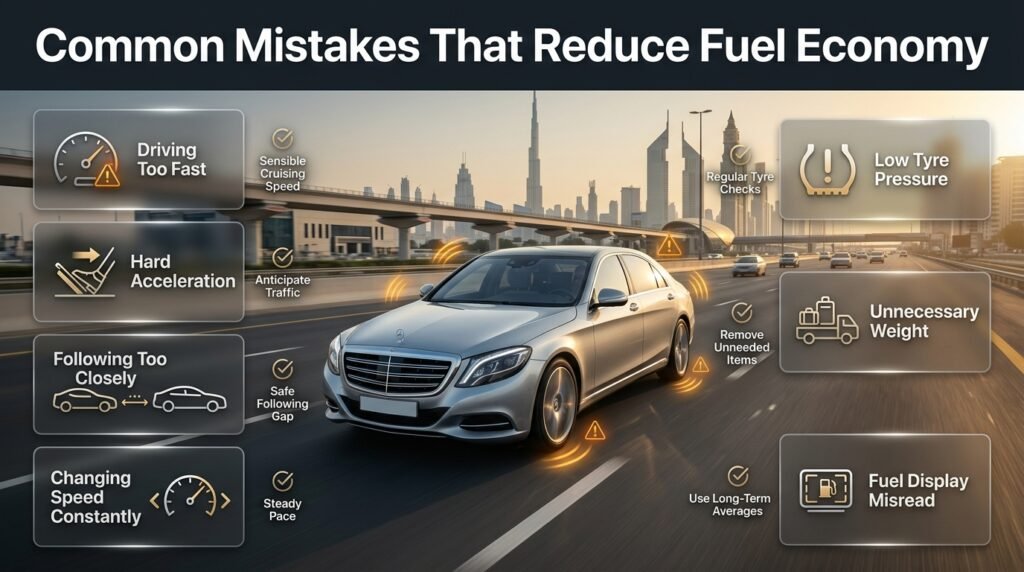
Driving Too Fast
One of the most common mistakes is treating the highest comfortable speed as the most efficient speed.
It isn’t.
High-speed driving increases aerodynamic resistance and generally requires more fuel.
Better approach: Maintain a sensible legal cruising speed.
Accelerating Toward Red Lights
Some drivers accelerate hard whenever traffic begins moving, even when they can already see a red light ahead.
That creates unnecessary fuel consumption.
Better approach: Look farther ahead and anticipate traffic.
Following Too Closely
Following another vehicle too closely reduces your ability to respond gradually.
You may have to brake suddenly and accelerate again.
Better approach: Maintain an appropriate safety gap.
Constantly Changing Speed
Repeatedly changing between moderate and high speeds increases energy demand.
Better approach: Maintain a steady pace when conditions allow.
Ignoring Tyre Pressure
Underinflated tyres can increase rolling resistance.
Better approach: Check tyre pressures regularly.
Carrying Unnecessary Weight
Heavy items that remain in the vehicle permanently add unnecessary load.
Better approach: Remove items you don’t need.
Using Fuel Economy Displays Incorrectly
Instantaneous fuel-economy readings can fluctuate dramatically.
Better approach: Use long-term averages to judge your actual improvement.
A Practical Fuel-Efficient Driving Method
Fuel-Efficient Driving Techniques
Fuel-efficient driving techniques can help reduce unnecessary fuel consumption while improving overall driving efficiency. Smooth acceleration, gentle braking, and maintaining a consistent speed allow the vehicle to use fuel more effectively. Keeping a safe following distance also helps avoid repeated stop-and-go movements in traffic. Drivers can further improve mileage by avoiding unnecessary idling, maintaining correct tire pressure, and removing excess weight. Together, these practical habits can make everyday driving more economical without compromising safety.
For practical ways to improve mileage through smoother acceleration, braking, and speed control, 👉 Fuel-Efficient Driving Techniques offers a useful guide.
You don’t need complicated techniques to improve your driving.
Follow this basic process.
Step 1: Observe the Road Ahead
Don’t focus exclusively on the vehicle immediately in front of you.
Look several vehicles ahead when possible.
This helps you anticipate:
- Traffic slowing
- Signals changing
- Lane congestion
- Merging vehicles
- Roadworks
- Sudden stops
Step 2: Accelerate Smoothly
When traffic moves, increase speed progressively rather than flooring the accelerator.
The goal is to reach your desired cruising speed without unnecessary engine load.
Step 3: Select a Sensible Cruising Speed
Choose a speed that is:
- Legal
- Safe
- Appropriate for traffic
- Appropriate for weather
- Reasonable for your vehicle
Step 4: Maintain Momentum
Once you reach cruising speed, avoid unnecessary changes.
Step 5: Anticipate Braking
If traffic ahead is slowing, don’t continue accelerating until you’re forced to brake.
Step 6: Check the Vehicle
Make sure tyres, fluids, filters, and other maintenance items are handled according to the manufacturer’s schedule.
How to Measure Your Own Optimal Driving Speed
General advice is useful, but your own vehicle can provide even better information.
You can compare fuel economy at different speeds over several similar journeys.
For example:
| Test | Average Speed | Distance | Fuel Used |
|---|---|---|---|
| 1 | 70 km/h | 50 km | Record |
| 2 | 80 km/h | 50 km | Record |
| 3 | 90 km/h | 50 km | Record |
| 4 | 100 km/h | 50 km | Record |
Try to keep conditions as similar as possible.
Record:
- Average speed
- Fuel consumed
- Traffic
- Temperature
- Wind
- Air-conditioning use
- Passenger/load
- Tyre condition
- Route
Don’t make conclusions from one trip.
Repeat the comparison several times.
This can reveal where your specific vehicle performs best.
Why Your Car’s Manufacturer Matters
Different manufacturers tune their vehicles differently.
Some vehicles are designed for efficient urban driving.
Others are optimised for highway cruising.
Some use continuously variable transmissions.
Others use six-, eight-, nine-, or ten-speed automatic transmissions.
Manual vehicles depend heavily on driver gear selection.
Hybrid vehicles introduce electric assistance.
These differences mean two vehicles travelling at exactly 90 km/h can have different fuel consumption.
This is why a professional fuel-efficiency strategy should always consider the vehicle rather than relying on a universal speed recommendation.
How Transmission Type Affects Efficient Speed
Transmission technology plays an important role.
Manual Transmission
The driver controls gear selection.
Using a suitable high gear at steady speed can help reduce unnecessary engine RPM.
However, selecting a gear that’s too high for the conditions can cause the engine to struggle.
Automatic Transmission
Modern automatic transmissions can select gears automatically according to speed, throttle position, load, and other factors.
A steady cruising speed often allows the transmission to select an efficient high gear.
CVT
Continuously variable transmissions can adjust engine speed smoothly rather than using fixed gears.
They may keep the engine near an efficient operating point under suitable conditions.
Hybrid Transmission
Hybrid systems can combine engine and electric-motor operation to optimise efficiency across different conditions.
The important lesson is simple:
Let the vehicle’s transmission work efficiently rather than forcing unnecessary speed changes.
Fuel Efficiency and Driving Time: Finding the Balance
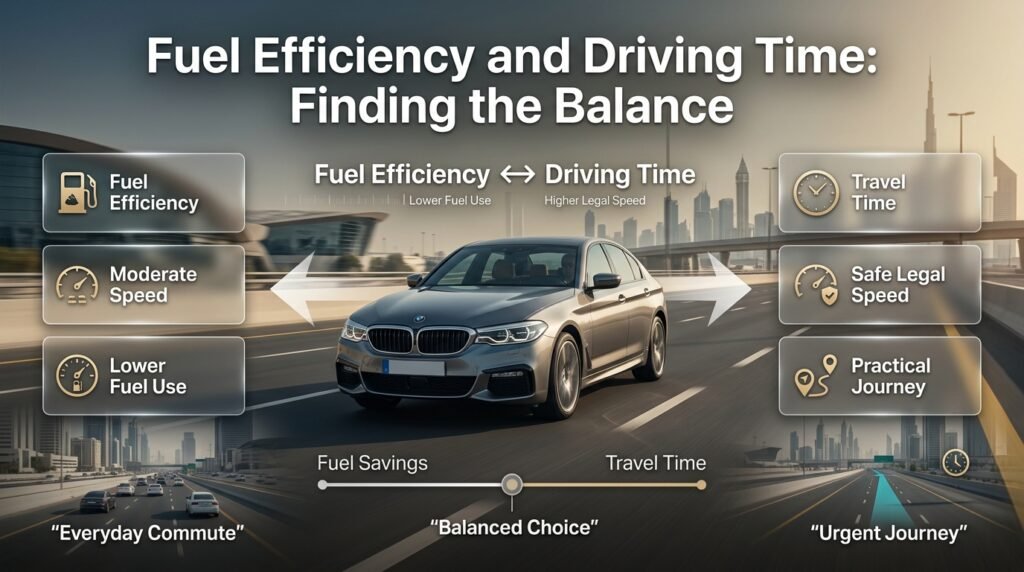
Fuel economy isn’t the only factor that matters.
Suppose one driver travels 100 km at a moderate speed and uses less fuel but takes significantly longer.
Another driver travels at a higher legal speed, uses more fuel, but saves substantial time.
The best decision depends on the purpose of the trip.
For everyday commuting, a small speed reduction may be worthwhile if it produces consistent fuel savings.
For an urgent journey, safety and practical travel time may matter more.
The ideal strategy is therefore not:
“Always drive as slowly as possible.”
It’s:
“Choose an efficient speed that remains safe, legal, practical, and appropriate for the road.”
Pro Tips for Better Fuel Economy
Pro Tip 1: Watch Traffic Far Ahead
The farther ahead you can anticipate traffic, the less likely you are to make unnecessary speed changes.
Pro Tip 2: Don’t Race Between Signals
If the next signal is already red, reaching it faster doesn’t help.
Pro Tip 3: Keep Your Speed Consistent
Smoothness usually beats aggression.
Pro Tip 4: Don’t Obsess Over One Exact Number
Your vehicle’s best speed may not be exactly 80 km/h.
Pro Tip 5: Compare Long-Term Averages
One trip can be affected by wind, traffic, temperature, and load.
Pro Tip 6: Maintain Your Tyres
Correct pressure supports efficient rolling and safe handling.
Pro Tip 7: Remove Unnecessary Equipment
Extra weight and aerodynamic accessories can reduce efficiency.
Pro Tip 8: Respect Traffic Flow
Fuel savings should never come from driving dangerously slowly on roads designed for higher-speed traffic.
Long-Distance Driving Fuel Efficiency Tips
Long-distance driving fuel efficiency tips can help you achieve better mileage while reducing unnecessary fuel consumption on extended journeys. Maintain a steady speed, accelerate smoothly, and avoid frequent braking whenever traffic conditions allow. Before starting the trip, check tire pressure, remove unnecessary cargo, and make sure the vehicle is properly maintained. Planning your route and fuel stops can also reduce detours and inefficient driving. These simple practices can make long-distance travel more economical, comfortable, and fuel-efficient.
For practical ways to improve mileage and reduce fuel waste during extended journeys, 👉 Long-Distance Driving Fuel Efficiency Tips provides useful guidance for more economical driving.
When Fuel Economy Should Not Be Your Priority
There are situations where fuel economy should take a back seat.
If you need to accelerate to merge safely, do it.
If traffic requires you to maintain the normal flow, do so.
If weather conditions require reduced speed, slow down.
If an emergency requires rapid action, safety comes first.
Never drive dangerously slowly just to save fuel.
Fuel-efficient driving should make you a smoother and more aware driver, not an unpredictable one.
The correct hierarchy is:
- Safety
- Traffic laws
- Road conditions
- Traffic flow
- Driving efficiency
Optimal Speed vs Other Fuel-Saving Factors
Speed is important, but it isn’t the only factor affecting fuel consumption.
| Factor | Potential effect |
|---|---|
| Excessive speed | Increased aerodynamic resistance |
| Hard acceleration | Higher immediate fuel demand |
| Frequent braking | Wastes kinetic energy |
| Underinflated tyres | Increased rolling resistance |
| Heavy load | More energy needed for acceleration |
| Roof equipment | Increased aerodynamic drag |
| Strong headwind | Higher aerodynamic resistance |
| Poor maintenance | May reduce efficiency |
| Excessive idling | Fuel used without travelling |
| Stop-start traffic | Frequent energy losses |
This comparison demonstrates why fuel efficiency requires a complete approach.
You can drive at a sensible speed and still waste fuel if you accelerate aggressively, carry unnecessary weight, or neglect your tyres.
What Fuel-Efficient Driving Really Looks Like
Imagine two cars leaving the same location in Dubai.
The first driver accelerates quickly whenever traffic moves. The driver changes lanes frequently, follows closely, brakes hard, and accelerates again. On open roads, the driver travels at high speed whenever possible.
The second driver accelerates progressively, maintains a safe gap, observes traffic ahead, keeps a moderate cruising speed, and avoids unnecessary braking.
Both drivers may arrive at almost the same time.
But the second driver is using the vehicle’s energy more intelligently.
That’s the real meaning of fuel-efficient driving.
It isn’t about driving painfully slowly.
It’s about avoiding waste.
What is the most fuel-efficient speed for driving?
For most conventional cars, the most fuel-efficient speed is usually found in a moderate, steady cruising range rather than at very low or very high speeds. In many vehicles, roughly 50–80 km/h can be highly efficient under suitable conditions, while 80–100 km/h often provides a practical balance between fuel economy and travel time on highways. However, there isn’t one speed that works perfectly for every vehicle because engine size, gearing, aerodynamics, tyre pressure, road conditions, and load all change the result.
The important point is that fuel efficiency comes from how smoothly you maintain speed, not simply from choosing the lowest number on the speedometer. A car travelling steadily at 80 km/h may use less fuel than one travelling at 60 km/h through constant stop-and-go traffic.
What actually helps:
Maintain a moderate speed appropriate for the road.
Avoid unnecessary high-speed driving.
Accelerate progressively instead of aggressively.
Keep a safe following distance so you don’t repeatedly brake.
Maintain steady momentum whenever traffic allows.
Follow the vehicle manufacturer’s recommendations for tyres and maintenance.
Professional takeaway: Don’t chase a “magic” speed such as exactly 80 km/h. Find the range where your car cruises smoothly, the transmission can use an appropriate gear, and you aren’t constantly accelerating and braking.
Does driving at 100 km/h use more fuel than 80 km/h?
In most vehicles, yes, travelling at 100 km/h will generally consume more fuel than travelling at 80 km/h under otherwise similar conditions. The main reason is aerodynamic resistance. As speed increases, the vehicle has to push through considerably more air, and that additional resistance requires more engine power. Transport guidance from Natural Resources Canada, for example, notes that fuel consumption rises as speed moves above about 80 km/h and gives an example where travelling at 120 km/h requires substantially more fuel than 100 km/h.
The difference becomes especially relevant on long highway journeys. A small increase in fuel consumption may not seem important during a 10-kilometre trip, but over hundreds of kilometres, the extra fuel can become noticeable.
At the same time, don’t assume that 80 km/h will always produce better real-world results. If driving at 80 means holding up normal traffic, constantly changing speed, or using an unsuitable gear, the expected advantage can be reduced.
For better highway economy:
Compare 80, 90 and 100 km/h under similar conditions.
Keep your speed as consistent as possible.
Avoid repeatedly accelerating above your chosen cruising speed.
Consider wind, traffic and road gradient when comparing results.
Measure fuel economy over several trips rather than one journey.
Professional takeaway: If fuel economy is your priority, reducing unnecessary highway speed can be one of the simplest changes you can make. But choose a safe, legal and traffic-appropriate speed, not simply the lowest possible speed.
Why does driving faster reduce fuel efficiency?
The biggest reason is aerodynamic drag. As your car moves faster, the air pushes back against it more strongly. This resistance increases rapidly with speed, so the engine has to produce progressively more power just to keep the vehicle moving at the same speed. That’s why a car can feel effortless at moderate highway speeds but require noticeably more fuel when driven much faster.
There’s another factor that drivers often overlook: high-speed driving frequently comes with more aggressive acceleration. A driver travelling quickly may accelerate hard to overtake, then brake for traffic, then accelerate again. That combination creates additional fuel consumption beyond the aerodynamic penalty.
The most efficient driving pattern is therefore not simply “slow driving.” It’s steady driving with controlled acceleration.
Think of the difference like this:
Efficient pattern:
Smooth acceleration → moderate cruising → anticipate traffic → gentle speed reduction
Inefficient pattern:
Hard acceleration → high speed → late braking → hard acceleration again
To reduce the high-speed penalty:
Avoid unnecessary bursts of speed.
Maintain a consistent cruising speed.
Use the highest appropriate gear without forcing the engine.
Leave enough distance to react smoothly.
Reduce speed gradually when traffic conditions allow.
Don’t treat the maximum legal speed as an efficiency target.
Professional takeaway: The speedometer doesn’t tell the whole story. Engine load, RPM, acceleration, braking and aerodynamic drag all work together to determine how much fuel your car actually uses.
Is driving slower always better for fuel economy?
No, and this is one of the most misunderstood parts of fuel-efficient driving. Driving slower can reduce aerodynamic resistance, but extremely slow driving doesn’t automatically produce the best fuel economy. If you’re moving through congested traffic, repeatedly stopping, accelerating, or keeping the engine in an unsuitable gear, your fuel consumption can still be high. Recent fuel-efficiency guidance also emphasises that every vehicle has its own efficient speed range rather than one universal number.
This is particularly important in urban driving. A vehicle travelling at a low average speed because of traffic lights and congestion may consume more fuel per kilometre than the same vehicle cruising smoothly at a higher but moderate speed on an open road.
That’s why professional fuel-efficient driving focuses on momentum and predictability, not simply reducing the speedometer reading.
A better approach is to:
Drive at a sensible speed for the road.
Avoid unnecessary stops and starts.
Look ahead for traffic signals and congestion.
Accelerate smoothly when traffic begins moving.
Avoid braking hard for situations you could have anticipated.
Allow the transmission to operate in an appropriate gear.
Example: If you can see a red signal 300 metres ahead, accelerating aggressively to reach it sooner doesn’t save fuel. You may simply use more fuel to gain speed that you’ll immediately lose through braking.
Professional takeaway: The goal isn’t “drive as slowly as possible.” The goal is “use as little unnecessary energy as possible while maintaining safe and normal traffic flow.”
What is the best speed for fuel efficiency on a highway?
For many cars, a steady moderate highway speed around 80–100 km/h can offer a useful balance between fuel economy and journey time, but the exact sweet spot depends on the vehicle and the road. Recent automotive guidance continues to point toward moderate highway speeds as a practical efficiency range, while real-world driver reports also commonly show better fuel averages at moderate speeds than at 120 km/h or above.
Your vehicle’s transmission is particularly important here. At a suitable cruising speed, an automatic or manual transmission can keep the engine operating in an efficient range without unnecessary RPM. But choosing a speed simply because someone says “80 km/h is best” isn’t professional advice. A large SUV, compact hatchback, diesel sedan and hybrid can all have different efficiency characteristics.
For highway fuel economy, focus on the complete driving pattern:
Choose a legal and safe cruising speed.
Keep that speed reasonably consistent.
Avoid unnecessary overtaking and acceleration.
Maintain correct tyre pressure.
Reduce unnecessary vehicle weight.
Use cruise control when road and traffic conditions make it appropriate.
Monitor long-term fuel consumption rather than one-trip readings.
One useful real-world observation is that Pakistani drivers have reported noticeable differences in fuel economy between 80, 100 and 120 km/h, although these are individual vehicle experiences rather than universal laboratory results.
Conclusion
Finding the optimal driving speed for fuel efficiency isn’t about following one fixed number on the speedometer. The most effective approach is to maintain a moderate, steady, and road-appropriate speed while avoiding unnecessary acceleration, sudden braking, and excessive highway speeds. For many vehicles, moderate cruising can provide a strong balance between fuel economy and practical journey time.
The biggest improvement often comes from combining sensible speed with better driving habits. Look ahead, maintain a safe following distance, accelerate smoothly, and allow your vehicle to maintain momentum whenever traffic conditions permit.
For Dubai drivers, these habits are especially useful on long highway journeys, where high speeds can increase aerodynamic drag and fuel consumption significantly.
Keep these points in mind:
- Choose a safe and legal cruising speed rather than chasing one “perfect” number.
- Avoid unnecessary high-speed driving.
- Maintain a steady pace whenever road conditions allow.
- Accelerate progressively instead of aggressively.
- Anticipate traffic to reduce unnecessary braking.
- Keep tyres correctly inflated and the vehicle properly maintained.
- Judge your fuel economy over several journeys, not from one trip.
Ultimately, fuel-efficient driving is about using energy intelligently. A moderate speed, smooth driving style, and good awareness of traffic can help you travel farther on the same amount of fuel without making your driving slow, uncomfortable, or impractical.
Leave a Reply