Introduction
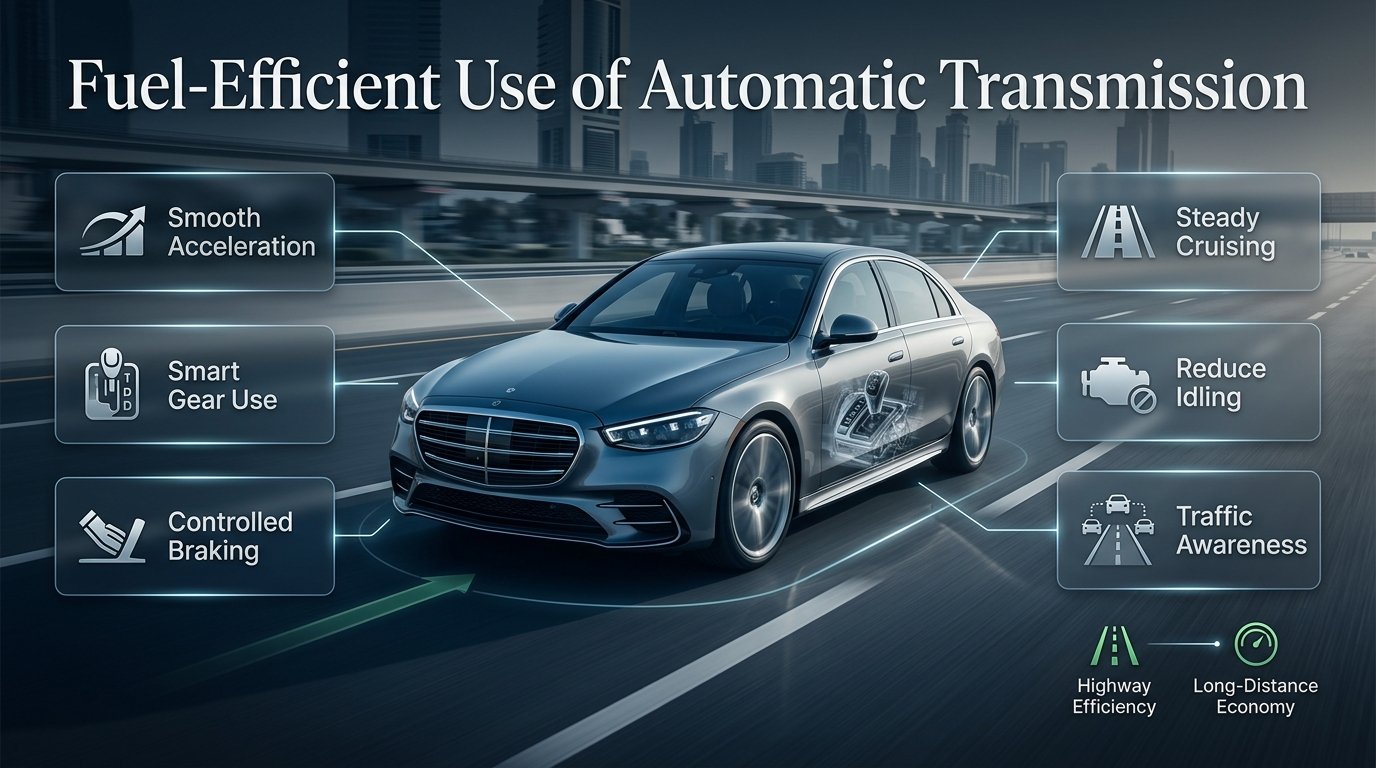
Fuel-Efficient Use of Automatic Transmission | If you drive an automatic car, you may have noticed that fuel consumption changes dramatically depending on how you use the accelerator, brakes, gears, and traffic conditions. Two drivers can use the same car on the same road and still get noticeably different fuel economy.
The good news is that fuel-efficient use of automatic transmission doesn’t require complicated driving techniques. Modern automatic transmissions are designed to select gears for you, but your driving habits still influence how often the transmission shifts, how hard the engine works, and how much fuel the vehicle consumes.
This guide explains how to drive an automatic transmission efficiently, when to use D, N, R, and P, how acceleration and braking affect fuel consumption, how to handle Dubai traffic, and which common automatic-driving habits waste fuel. You’ll also learn how to improve fuel economy during city driving, highway trips, stop-and-go traffic, and long-distance journeys.
For broader fuel-saving guidance, you can also explore Fuel Delivery Dubai and its practical fuel-saving driving tips.
What Does Fuel-Efficient Use of an Automatic Transmission Mean?
Fuel-efficient use of an automatic transmission means operating the vehicle in a way that allows the engine and transmission to work smoothly without unnecessary acceleration, braking, shifting, or idling. The goal isn’t to drive unusually slowly; it’s to maintain a steady, appropriate speed and avoid wasting energy.
An automatic transmission normally chooses the gear ratio based on factors such as vehicle speed, engine load, throttle position, and transmission design. The driver therefore doesn’t need to manually select every gear.
However, the accelerator pedal still has a major influence.
Aggressive throttle inputs can cause the transmission to downshift, increasing engine speed and fuel consumption. Gentle acceleration allows the transmission to progress through its ratios more smoothly and reach an efficient cruising gear sooner.
In simple terms:
Smooth inputs → fewer unnecessary downshifts → lower engine load → better potential fuel economy.
This is closely related to smooth driving techniques for better fuel economy.
How Does an Automatic Transmission Affect Fuel Economy?
Automatic transmissions can help fuel economy because they continuously select appropriate gear ratios without requiring the driver to shift manually. Modern transmissions may have many forward ratios, allowing the engine to operate closer to an efficient speed across different driving conditions.
Older automatic transmissions often had fewer gears and could keep engine speed relatively high. Modern systems, including continuously variable transmissions (CVTs), dual-clutch transmissions (DCTs), and multi-speed automatics, use different strategies to improve efficiency.
Still, transmission technology isn’t the whole story.
Fuel economy depends on the complete vehicle system:
- Engine efficiency
- Transmission design
- Vehicle weight
- Tire pressure
- Driving speed
- Acceleration habits
- Traffic conditions
- Road gradient
- Air conditioning use
- Aerodynamic drag
- Vehicle maintenance
That means an efficient automatic transmission can still consume significant fuel if the driver repeatedly accelerates hard, brakes late, and sits idling in traffic.
Which Automatic Transmission Modes Should You Use?
Understanding the basic gear positions is one of the easiest ways to avoid unnecessary fuel use and transmission stress.
| Mode | Main purpose | Normal use |
|---|---|---|
| P | Park | Parking the vehicle |
| R | Reverse | Moving backward |
| N | Neutral | Specific situations where neutral is appropriate |
| D | Drive | Normal forward driving |
| S | Sport | More responsive acceleration |
| L/1/2 | Low gearing | Certain steep or demanding conditions |
D — Drive
For normal driving, D is usually the correct choice.
Once you’re moving, allow the automatic transmission to select the appropriate gears. Constantly trying to influence the transmission with unnecessary manual inputs can reduce the smoothness you’re trying to achieve.
S — Sport
Sport mode generally prioritizes responsiveness rather than minimum fuel consumption. Depending on the vehicle, it may hold lower gears longer and keep the engine at higher RPM.
Use it when the driving situation calls for stronger response—not simply because the vehicle feels more powerful in that mode.
L or Low Gears
Low gearing can be useful in specific situations such as steep descents, difficult terrain, or when the owner’s manual recommends it.
Using a low gear unnecessarily on normal roads can keep engine RPM higher than needed.
For a practical understanding of how to choose the right gear, avoid unnecessary engine strain, and improve fuel efficiency in Dubai’s city traffic and highway conditions, read our detailed Gear Shifting and Fuel Economy in Dubai guide.
P — Park
Use P when the vehicle is parked.
Don’t use P while the vehicle is still moving. Allow the car to stop completely before selecting Park.
N — Neutral
Neutral disconnects the engine’s drive force from the wheels. It isn’t necessary every time the car stops briefly.
For example, repeatedly shifting from D to N at every traffic light can add unnecessary actions without delivering a meaningful fuel-saving benefit.
⚠ Common Mistake:
Don’t treat N as a fuel-saving button. In normal automatic driving, selecting Neutral every few seconds isn’t a substitute for good traffic anticipation or reducing unnecessary idling.
How Should You Accelerate an Automatic Car to Save Fuel?

The most useful acceleration technique is smooth, progressive throttle application.
When a light turns green, you don’t need to crawl away from the intersection. At the same time, there’s usually little benefit in pressing the accelerator aggressively and forcing the transmission to make rapid downshifts.
A practical approach is:
- Release the brake smoothly.
- Apply moderate accelerator pressure.
- Allow the vehicle to build speed progressively.
- Ease off once you reach the desired speed.
- Maintain a steady throttle whenever traffic permits.
The exact accelerator position varies between vehicles, so don’t focus on a specific percentage. Focus instead on smoothness and avoiding unnecessary bursts of acceleration.
For a deeper explanation, see how acceleration affects fuel consumption.
Why Hard Acceleration Uses More Fuel
Strong acceleration requires the engine to produce more power. Depending on the vehicle and transmission, the automatic gearbox may respond by selecting a lower gear.
That increases engine speed and can increase fuel consumption.
There are situations where stronger acceleration is necessary—for example, joining a fast-moving road or completing a safe maneuver. Fuel efficiency should never override safety.
The goal is efficient acceleration when conditions allow it, not dangerously slow driving.
Why Steady Speed Is Important for Automatic Transmission Fuel Economy
Once the vehicle reaches an appropriate cruising speed, maintaining that speed smoothly can reduce unnecessary changes in engine load.
Constantly moving between acceleration and deceleration wastes energy. Every time you accelerate after losing speed, the engine has to provide additional energy to bring the vehicle back up to speed.
This is particularly noticeable on open roads.
For more information about choosing an appropriate cruising speed, see optimal driving speed for fuel efficiency in Dubai.
💡 Pro Tip:
Don’t chase a single “perfect” speed for every vehicle. The efficient cruising range depends on the car, engine, transmission, road, traffic, tires, and weather. A moderate, legal, steady speed is generally more useful than constantly changing your speed to hit an arbitrary number.
How Does Braking Affect Automatic Transmission Fuel Economy?
Braking doesn’t directly “use fuel” in the same way acceleration does, but unnecessary braking creates a cycle that wastes energy.
Consider this example:
Accelerate → brake → accelerate again → brake again
Every acceleration requires the engine to put energy back into the vehicle after some of its previous kinetic energy has been removed through braking.
Instead, when traffic conditions allow, look farther ahead and anticipate changes.
If you see a red light, slowing gradually may be more efficient than maintaining speed until the last moment and then braking hard.
This doesn’t mean coasting blindly or failing to use the brake when necessary. Safety always comes first.
For more detail, read how braking habits affect fuel economy in Dubai.
Should You Shift an Automatic Car Into Neutral at Traffic Lights?
For ordinary short stops, you generally don’t need to shift an automatic transmission into Neutral simply to save fuel. Modern vehicles are designed to manage idle operation and transmission engagement.
If you’re stopped for an extended period, follow your vehicle manufacturer’s instructions. Some vehicles may have specific recommendations, and systems such as automatic start-stop can also change how the engine behaves during stops.
The bigger fuel-saving opportunity is often reducing unnecessary engine running rather than repeatedly moving between D and N.
📌 Quick Tip:
At a normal traffic signal, concentrate on anticipating traffic, avoiding unnecessary acceleration, and keeping the vehicle stationary safely. Don’t repeatedly switch between D, N, and D just because you believe every gear change saves fuel.
For more information, see fuel consumption while idling and car idling fuel consumption.
How Can You Drive an Automatic Car Efficiently in Dubai Traffic?
Dubai driving can present a combination of heavy traffic, frequent signals, highways, high temperatures, and extensive air-conditioning use.
In congested traffic, the most effective strategy is usually to avoid unnecessary movement rather than constantly trying to gain one or two car lengths.
Try these habits:
- Watch traffic several vehicles ahead.
- Avoid aggressive launches from every signal.
- Leave enough space to reduce unnecessary braking.
- Don’t accelerate toward a queue that is already slowing.
- Avoid unnecessary lane changes.
- Keep a consistent pace when traffic permits.
- Don’t leave the engine running unnecessarily when parked.
- Use the vehicle’s climate-control system sensibly.
- Maintain correct tire pressure.
These habits are especially useful because stop-and-go driving creates repeated acceleration and braking cycles.
For a deeper look at urban driving, explore how traffic affects fuel economy in Dubai, stop and go driving fuel efficiency, and how to reduce fuel use in traffic.
Is Highway Driving More Fuel-Efficient With an Automatic Transmission?
Highway driving can provide favorable fuel economy because there may be fewer stops and less repeated acceleration. Once the vehicle reaches a suitable cruising speed, the transmission can often select a higher gear and keep engine speed relatively low.
However, excessive speed can work against this advantage.
As road speed increases, aerodynamic resistance becomes increasingly important. The engine has to produce more power to overcome air resistance, so fuel consumption can rise.
For longer journeys, focus on:
- Maintaining a steady legal speed
- Avoiding unnecessary overtaking
- Using cruise control when appropriate
- Checking tire pressures before departure
- Removing unnecessary cargo
- Avoiding unnecessary roof equipment
- Planning fuel and rest stops
Related guidance is available in highway driving fuel efficiency and fuel-efficient highway driving.
You can also learn more about how highway speed affects fuel consumption.
Should You Use Cruise Control With an Automatic Transmission?
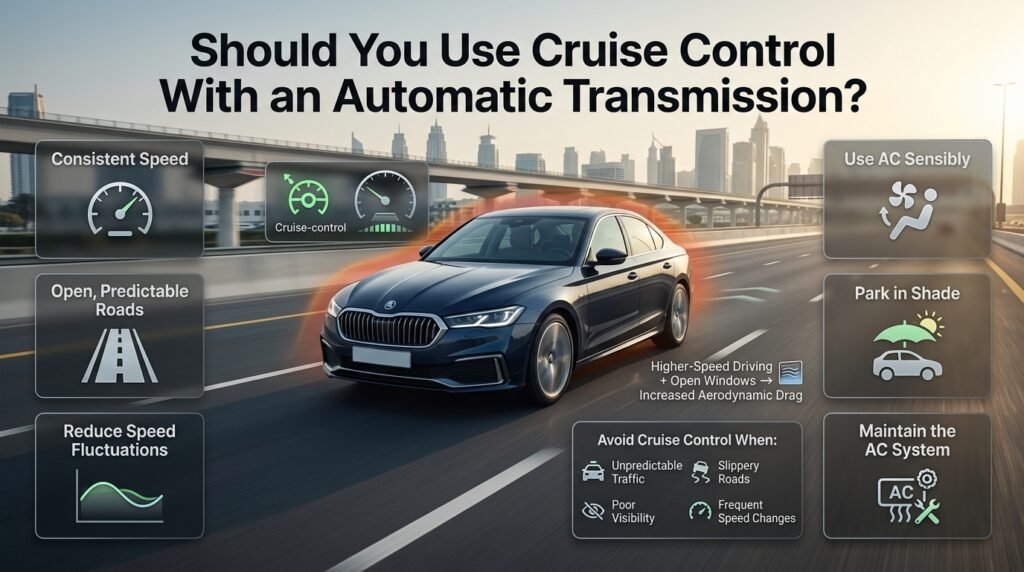
Cruise control can be useful on relatively open, predictable roads because it helps maintain a consistent speed.
A driver may unconsciously vary speed by repeatedly pressing and releasing the accelerator. Cruise control can reduce some of these fluctuations.
However, it isn’t appropriate for every situation.
Avoid relying on cruise control where traffic is unpredictable, roads are slippery, visibility is poor, or frequent speed changes are required.
On suitable highways, it can complement fuel-efficient automatic driving by reducing unnecessary speed variation.
Does Air Conditioning Affect Fuel Economy?
Yes. Air-conditioning systems require energy, and that energy ultimately comes from the vehicle’s engine or electrical system.
In hot climates such as Dubai, air conditioning can therefore affect fuel consumption.
But there’s an important practical point: don’t sacrifice safety or comfort in extreme heat simply to save a small amount of fuel.
Instead:
- Park in shade where possible.
- Ventilate a very hot cabin briefly before driving when practical.
- Use the climate system sensibly.
- Keep windows closed at higher speeds when appropriate.
- Maintain the air-conditioning system properly.
At highway speeds, opening windows can also increase aerodynamic drag, so the best choice depends on speed and conditions.
Air Conditioning and Fuel Consumption
Air conditioning can have a noticeable effect on fuel consumption, especially during hot weather and heavy traffic. When the AC system is running, the engine needs additional power to operate the compressor, which can increase fuel use. In Dubai’s hot climate, however, avoiding AC completely is not practical or comfortable. A better approach is to use the system efficiently by parking in shade when possible, ventilating the cabin briefly before cooling it, maintaining the AC system properly, and avoiding unnecessary idling with the AC running. These simple habits can help reduce unnecessary fuel consumption while keeping the cabin comfortable.
For practical tips on reducing unnecessary fuel consumption while keeping your car comfortable in Dubai’s hot climate, explore our detailed Air Conditioning and Fuel Consumption guide, which explains how AC use, traffic, idling, driving speed, and vehicle maintenance can affect overall fuel economy.
How Vehicle Weight and Aerodynamics Affect Automatic Transmission Efficiency
The transmission doesn’t operate independently from the rest of the vehicle.
A heavier vehicle generally requires more energy to accelerate. Similarly, external equipment such as roof racks, roof boxes, and bulky cargo can increase aerodynamic drag.
Before a long trip, remove items you don’t actually need.
This can include:
- Heavy tools
- Unused equipment
- Unnecessary luggage
- Empty storage containers
- Unused roof carriers
For related information, see how vehicle weight affects fuel economy and car load and fuel consumption.
If your vehicle has removable roof equipment, also read roof racks and fuel economy.
Aerodynamics matter even more as speed increases. Learn more about how aerodynamics affects fuel efficiency and vehicle drag and fuel consumption.
Vehicle Accessories and Fuel Economy
Vehicle accessories and fuel economy are closely connected because certain add-ons can increase aerodynamic drag, vehicle weight, or electrical load. Roof racks, cargo boxes, oversized accessories, and other external equipment may make the engine work harder, especially during highway driving. Even small changes can affect fuel consumption when they are used regularly. For better efficiency, remove unnecessary accessories when they are not needed, keep external equipment streamlined, and avoid carrying extra weight without a purpose. In Dubai, where long highway journeys and high-speed driving are common, choosing practical accessories and maintaining the vehicle properly can help support better overall fuel economy.
For a practical guide on how roof racks, cargo boxes, extra weight, larger wheels, and other accessories can influence fuel consumption, read our detailed Vehicle Accessories and Fuel Economy in Dubai guide before choosing or removing accessories from your vehicle.
Tire Pressure and Fuel Efficiency
Tire pressure plays an important role in fuel efficiency because underinflated tires create greater rolling resistance, forcing the engine to work harder and potentially increasing fuel consumption. Maintaining the recommended tire pressure can help your vehicle roll more efficiently while also supporting better handling, braking, and tire wear. In Dubai’s hot climate, checking tire pressure regularly is especially useful because temperature changes can affect pressure readings. Always follow the vehicle manufacturer’s recommended pressure rather than relying on the maximum pressure printed on the tire sidewall.
For practical guidance on maintaining the correct tire pressure, reducing unnecessary rolling resistance, and supporting better fuel economy in Dubai’s driving conditions, read our detailed Tire Pressure and Fuel Efficiency guide.
What Are the Biggest Automatic Driving Mistakes That Waste Fuel?
Many fuel-wasting habits aren’t caused by the transmission itself. They’re caused by the way the driver interacts with the vehicle.
1. Aggressive acceleration
Why it happens: The driver wants quick movement away from traffic lights.
Why it’s inefficient: Strong throttle input can increase engine output and trigger lower-gear operation.
Better approach: Accelerate firmly enough for safe traffic flow, but smoothly.
2. Constantly changing lanes
Why it happens: The driver believes another lane will always move faster.
Why it’s inefficient: Frequent lane changes often involve repeated acceleration and braking.
Better approach: Choose an appropriate lane and maintain a predictable pace.
3. Braking late
Why it happens: The driver isn’t looking far enough ahead.
Why it’s inefficient: Late braking throws away kinetic energy that could have been preserved through gradual deceleration.
Better approach: Scan farther ahead and anticipate traffic.
4. Using Sport mode unnecessarily
Why it happens: Sport mode makes the vehicle feel more responsive.
Why it’s inefficient: The transmission may hold lower gears longer and keep engine speed higher.
Better approach: Use normal Drive mode when fuel economy is the priority.
5. Excessive idling
Why it happens: Drivers leave the engine running while waiting.
Why it’s inefficient: The engine consumes fuel without moving the vehicle.
Better approach: Avoid unnecessary idling while following safe and manufacturer-recommended practices.
6. Ignoring tire pressure
Underinflated tires can increase rolling resistance and make the engine work harder.
Check the pressure according to the vehicle manufacturer’s recommended specification rather than simply using the maximum pressure printed on the tire sidewall.
A Simple Step-by-Step Method for Fuel-Efficient Automatic Driving
Step 1: Start smoothly
What to do: Start driving with controlled accelerator input.
Why it matters: It reduces unnecessary engine RPM and aggressive transmission downshifts.
Professional advice: Don’t accelerate painfully slowly. Match normal traffic safely.
Common mistake: Flooring the accelerator immediately after every stop.
Step 2: Build speed progressively
What to do: Allow the automatic transmission to shift naturally.
Why it matters: Smooth acceleration gives the transmission an opportunity to select appropriate ratios.
Example: Instead of repeated accelerator bursts, use one controlled acceleration phase.
Step 3: Look ahead
What to do: Watch traffic beyond the vehicle immediately ahead.
Why it matters: Better anticipation reduces unnecessary braking and acceleration.
Common mistake: Accelerating toward a traffic queue and braking moments later.
Step 4: Maintain a steady speed
What to do: Once you’re at an appropriate speed, maintain it where traffic allows.
Why it matters: Constant speed reduces unnecessary changes in engine load.
Step 5: Slow down early when appropriate
What to do: If traffic is clearly slowing, ease off the accelerator earlier.
Why it matters: It can reduce the need for hard braking.
Professional advice: Never coast or slow in a way that compromises control or traffic safety.
Step 6: Use the correct mode
What to do: Use D for ordinary driving unless another mode is specifically appropriate.
Why it matters: It allows the transmission’s normal control strategy to manage gear selection.
Step 7: Maintain the vehicle
What to do: Keep tires correctly inflated and address maintenance issues promptly.
Why it matters: Mechanical problems can increase fuel consumption regardless of how carefully you drive.
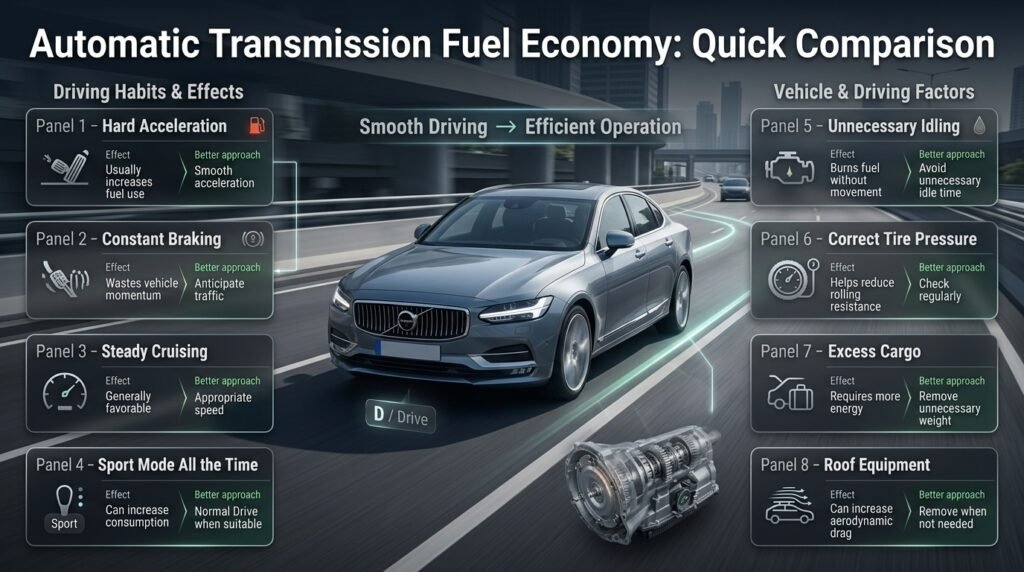
Automatic Transmission Fuel Economy: Quick Comparison
| Driving habit | Fuel-efficiency effect | Better approach |
| Hard acceleration | Usually increases fuel use | Smooth progressive acceleration |
| Constant braking | Wastes vehicle momentum | Anticipate traffic |
| Steady cruising | Generally favorable | Maintain appropriate speed |
| Sport mode all the time | Can increase consumption | Use normal Drive when suitable |
| Unnecessary idling | Burns fuel without movement | Avoid unnecessary idle time |
| Correct tire pressure | Helps reduce rolling resistance | Check regularly |
| Excess cargo | Requires more energy | Remove unnecessary weight |
| Roof equipment | Can increase aerodynamic drag | Remove when not needed |
Expert Advice for Better Automatic Transmission Fuel Economy
One of the biggest misconceptions is that fuel-efficient driving means driving extremely slowly.
It doesn’t.
The better objective is to reduce unnecessary energy losses while remaining safe, predictable, and appropriate for the road.
Think of the drive as a sequence:
Accelerate smoothly → reach appropriate speed → maintain speed → anticipate changes → decelerate smoothly → repeat
You don’t need to obsess over the transmission’s RPM every second. Modern automatic systems are designed to handle gear selection. Your job is to provide smooth and predictable inputs.
⭐ Expert Tip:
If your fuel economy suddenly becomes much worse despite no change in driving style, don’t immediately blame the transmission. Check tire pressure, maintenance condition, traffic patterns, fuel quality, air-conditioning demand, cargo, and driving speed first. A sudden change in consumption can have several causes.
How to Improve Fuel Economy on Long Automatic-Transmission Trips
Before a long journey, check the basics:
Vehicle checklist
- Tire pressure
- Tire condition
- Engine oil condition
- Air filter where applicable
- Brake condition
- Warning lights
- Cooling system
- Battery and electrical system
- Correct vehicle load
Driving checklist
- Plan the route
- Avoid unnecessary detours
- Maintain a suitable cruising speed
- Reduce unnecessary overtaking
- Use cruise control where appropriate
- Keep the vehicle lightly loaded
- Remove unused roof equipment
For more detailed long-distance advice, visit improving fuel economy on long trips and long-distance driving fuel efficiency tips.
What Is the Most Fuel-Efficient Way to Drive an Automatic Car?
The most fuel-efficient way to drive an automatic car is to use smooth acceleration, controlled braking, an appropriate steady speed, and minimal unnecessary idling. You normally don’t need to manually control the gears because modern automatic transmissions are designed to select suitable ratios according to speed, engine load, and throttle input. Modern multi-speed automatics can also give the engine more opportunities to operate in an efficient range.
The biggest improvement usually comes from changing your driving pattern rather than trying to manipulate the transmission. Avoid repeatedly accelerating hard and then braking heavily. Instead, look farther ahead, anticipate traffic, and build speed progressively when conditions allow.
Practical points to remember:
Use D (Drive) for normal everyday driving.
Accelerate smoothly instead of flooring the accelerator.
Avoid unnecessary hard braking.
Maintain a steady, legal speed when traffic allows.
Reduce unnecessary idling.
Keep tires correctly inflated.
Remove unnecessary weight from the vehicle.
Use cruise control appropriately on suitable open roads.
A useful way to think about it is:
Smooth acceleration → steady cruising → early anticipation → gentle deceleration
A study of automatic-transmission driving found that simple eco-driving instructions that reduced acceleration and deceleration were associated with lower fuel consumption in urban driving.
Should I Put My Automatic Car in Neutral at Red Lights to Save Fuel?
For a normal short traffic-light stop, repeatedly shifting an automatic transmission from D to N usually isn’t the fuel-saving technique drivers imagine it to be. Modern automatic vehicles are designed to manage normal stops while the driver holds the brake, and fuel consumption during a short stop is more strongly related to unnecessary idling than to whether the driver repeatedly moves the selector between D and N.
If you’re sitting in traffic for an unusually long period, the appropriate procedure can depend on the vehicle. Some cars have automatic start-stop systems that already manage engine shutdown during suitable stops, while others have specific manufacturer recommendations.
The important point is not to turn every traffic signal into a gear-changing routine.
Better traffic-light habits include:
Stop smoothly rather than braking aggressively at the last moment.
Avoid accelerating toward a queue that has already stopped.
Watch traffic several vehicles ahead.
Don’t repeatedly move between D and N without a reason.
Follow your owner’s manual for extended stops.
Avoid leaving the engine running unnecessarily when parked.
The EPA specifically identifies avoiding unnecessary idling as a fuel-saving practice, while general eco-driving guidance emphasizes maintaining a steady speed and anticipating stops.
Professional advice:
If your goal is better fuel economy in city traffic, spend more effort improving your acceleration, anticipation, and braking habits than constantly changing transmission positions.
Does Sport Mode Use More Fuel in an Automatic Car?
Sport mode can increase fuel consumption, although the exact effect depends on the vehicle and transmission calibration. Sport settings are generally designed to provide quicker throttle response and stronger acceleration rather than prioritize maximum fuel economy. The transmission may hold lower gears longer or delay upshifts, keeping the engine at higher RPM.
That extra responsiveness can be useful when you genuinely need it. The problem occurs when Sport mode becomes the default setting for ordinary commuting.
For everyday city driving, normal Drive mode is usually the more sensible choice when your priority is fuel efficiency. Sport mode can be appropriate when you need quicker response, such as during certain driving situations where the vehicle manufacturer’s system is designed for it.
Use the modes intelligently:
D: Best general-purpose setting for everyday driving.
S/Sport: Prioritizes responsiveness and performance.
L/low range: Intended for specific conditions where lower gearing is appropriate.
Manual mode: Useful for situations where deliberate gear selection is needed, but it isn’t automatically more economical.
The important thing is to understand that higher RPM isn’t automatically bad, and lower RPM isn’t automatically efficient in every situation. The transmission and engine work together as a system, so forcing the vehicle into an unusual gear isn’t necessarily going to save fuel.
Modern automatic transmissions are specifically engineered to optimize gear selection, and increasing the number of available ratios can give the system more opportunities to keep the engine operating efficiently.
How Can I Improve Automatic Car Fuel Economy in Stop-and-Go Traffic?
Stop-and-go traffic is one of the most challenging conditions for fuel economy because the vehicle repeatedly loses speed and then requires additional energy to accelerate again. The best strategy isn’t to constantly chase small gaps in traffic. Instead, look ahead, maintain a smooth pace, and reduce unnecessary acceleration and braking.
For example, imagine traffic ahead is moving slowly and then stopping every few seconds. If you accelerate hard to close the gap, you’ll probably have to brake again almost immediately. That acceleration doesn’t accomplish much, but the fuel used to accelerate the vehicle has already been spent.
A better approach is to leave an appropriate amount of space and allow your speed to change gradually.
In heavy traffic, focus on:
Looking 10 or more seconds ahead where visibility permits.
Avoiding unnecessary lane changes.
Maintaining a reasonable gap.
Accelerating progressively.
Releasing the accelerator early when traffic begins slowing.
Avoiding aggressive starts from every traffic signal.
Minimizing unnecessary idling when safely possible.
This becomes especially relevant in urban areas where congestion creates repeated stop-and-go cycles. EPA guidance lists aggressive driving, hard acceleration and braking, idling, congestion, excess cargo, and high air-conditioning use among factors that can reduce fuel economy.
A simple rule for city driving:
Don’t drive toward traffic as if the road ahead will remain clear. Drive according to what you can already see developing.
That single change can make automatic driving smoother and can reduce the repeated acceleration-braking cycle that wastes energy.
What Speed Gives the Best Fuel Economy in an Automatic Car?
There isn’t one universal speed that gives the best fuel economy for every automatic car. The efficient speed depends on the vehicle’s engine, transmission, gearing, aerodynamics, tires, road conditions, traffic, and load. However, excessive speed generally reduces fuel economy, largely because aerodynamic resistance increases as road speed rises.
This is why driving faster isn’t simply a matter of reaching your destination sooner. At higher speeds, the vehicle needs more energy to push through the air, and fuel consumption can rise significantly.
For everyday driving, the better strategy is to choose a legal, safe, moderate speed and keep it reasonably steady rather than repeatedly changing speed.
For better highway fuel economy:
Follow the posted speed limit.
Avoid unnecessary high-speed driving.
Maintain a consistent speed when conditions permit.
Use cruise control on appropriate roads.
Avoid unnecessary acceleration and overtaking.
Keep tires correctly inflated.
Remove unnecessary roof equipment and cargo.
EPA guidance specifically notes that speeding uses more fuel and recommends slowing down, accelerating and braking gently, and avoiding unnecessary idling.
This is particularly important on long highway journeys. At higher speeds, aerodynamic drag becomes increasingly significant, so reducing unnecessary speed can have a greater effect than trying to manipulate the automatic transmission manually.
Bottom line: Don’t search for a magic “automatic transmission fuel-saving speed.” Focus on a safe, legal, steady, moderate speed appropriate for your vehicle and road conditions.
Conclusion
Fuel-efficient use of an automatic transmission is less about constantly controlling the gearbox and more about developing smooth, predictable driving habits. Your automatic transmission is designed to select suitable gears, so the biggest gains usually come from how you use the accelerator, how early you anticipate traffic, and how smoothly you slow down.
For better fuel economy, accelerate progressively, avoid unnecessary hard braking, maintain a steady and legal speed, and don’t leave the engine idling when it isn’t needed. In heavy traffic, looking ahead and leaving enough space can reduce the repeated acceleration-and-braking cycle that wastes energy. On highways, controlling speed becomes even more important because aerodynamic resistance increases as speed rises.
Regular vehicle care also matters. Correct tire pressure, sensible vehicle loading, and removing unnecessary roof equipment can support better fuel efficiency alongside good driving habits.
The key is consistency. You don’t need complicated techniques or constant gear changes. Drive smoothly, anticipate what’s ahead, use the transmission’s normal operating modes correctly, and keep the vehicle properly maintained. These simple habits can make automatic driving more economical while also making your journeys smoother, safer, and more comfortable.
Leave a Reply