Introduction
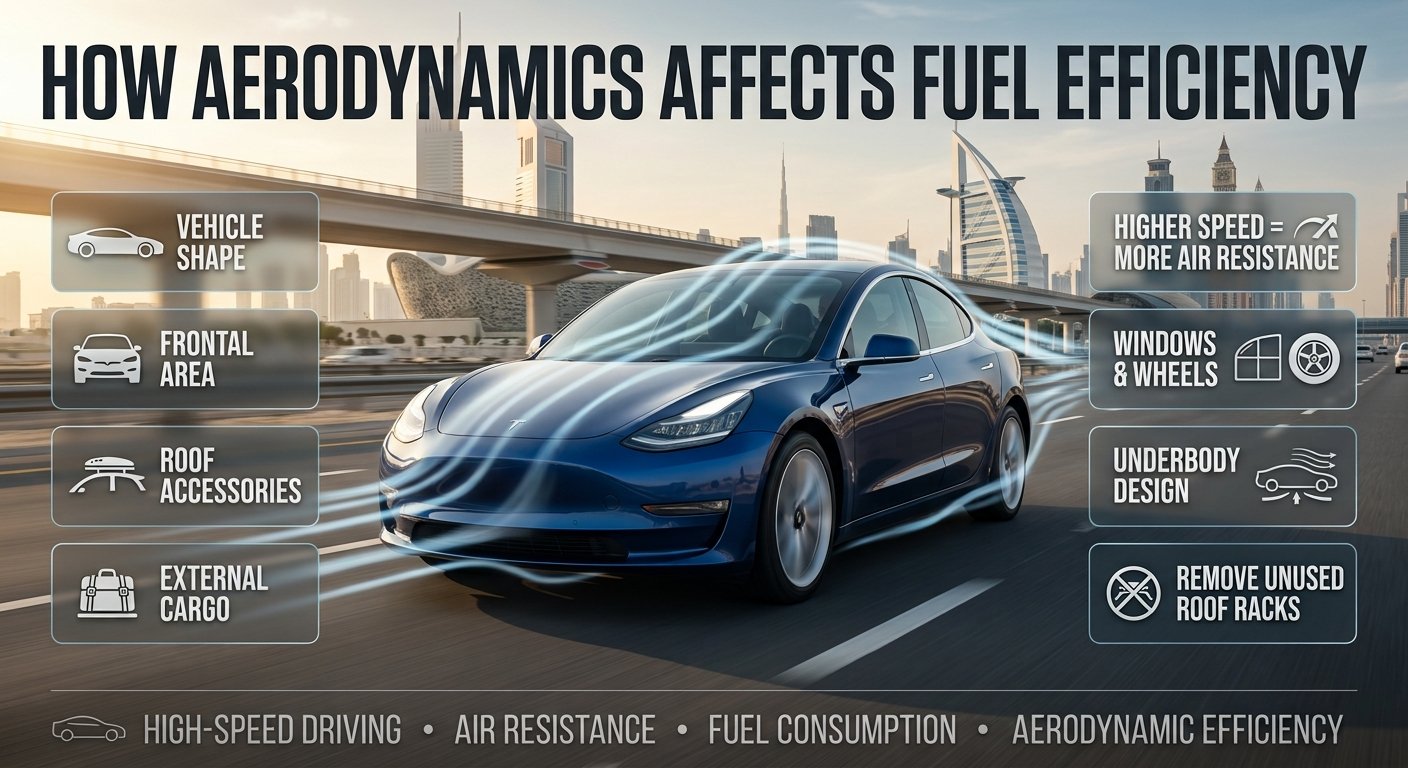
How Aerodynamics Affects Fuel Efficiency | When you drive through Dubai, especially on long highways such as Sheikh Zayed Road or other high-speed routes, your vehicle is constantly pushing through the surrounding air. You may not notice it, but the air creates resistance against the moving vehicle, and the faster you drive, the more energy your engine needs to overcome that resistance. This is where understanding how aerodynamics affects fuel efficiency becomes important.
If you’re looking for practical ways to reduce fuel consumption, you can also explore Fuel Delivery Dubai for fuel-related information and emergency refueling assistance in Dubai.
Aerodynamics isn’t only about sports cars or racing vehicles. It affects ordinary sedans, SUVs, hatchbacks, vans, pickup trucks, and electric vehicles. The shape of the vehicle, its height, frontal area, roof accessories, windows, wheels, underbody, and even external cargo can influence how smoothly air moves around it.
At low speeds, aerodynamic drag is usually less significant than factors such as acceleration, braking, traffic, and rolling resistance. At higher speeds, however, aerodynamic resistance becomes increasingly important. This is one reason why a vehicle may achieve considerably better fuel economy during moderate-speed driving than during sustained high-speed highway travel.
Dubai provides an interesting environment for understanding this relationship. Drivers may experience long highway journeys, high temperatures, air-conditioning use, strong winds, heavy traffic, and extended periods of high-speed travel. Each of these conditions can influence fuel consumption.
The good news is that improving aerodynamic efficiency doesn’t necessarily require expensive modifications. In many cases, simple habits such as removing an unused roof rack, avoiding unnecessary high speeds, keeping external cargo properly secured, and maintaining the vehicle as designed can help.
Let’s look at how aerodynamics works, what creates drag, how speed changes fuel consumption, and what drivers can realistically do to improve efficiency.
What Is Vehicle Aerodynamics?
Vehicle aerodynamics refers to how air moves around a vehicle while it is traveling.
When a stationary car is sitting in a parking lot, air can flow around it relatively easily. Once the car starts moving, however, it has to displace the air in front of it. Air flows over the hood, around the windshield, across the roof, along the sides, underneath the vehicle, and eventually around the rear.
This movement creates several aerodynamic forces.
The most important one for fuel consumption is aerodynamic drag.
Drag is a force that opposes the vehicle’s forward movement. The engine must provide enough power to overcome that resistance while also dealing with rolling resistance, mechanical losses, hills, acceleration, and other demands.
A simplified aerodynamic drag relationship can be expressed as:
Drag ∝ air density × drag coefficient × frontal area × speed²
The most important part for everyday drivers is the speed² relationship.
As speed increases, aerodynamic drag doesn’t simply increase in a straight line. It rises much more rapidly.
For example, if all other conditions remain constant, increasing speed from 50 km/h to 100 km/h results in approximately four times the aerodynamic drag.
That doesn’t mean fuel consumption becomes exactly four times higher because a vehicle has many other sources of energy loss. But it clearly demonstrates why speed becomes such an important factor at highway speeds.
Why Does Aerodynamics Matter for Fuel Efficiency?
Your engine needs energy to move the vehicle forward.
Some of that energy is used to overcome rolling resistance from the tires. Some is used to accelerate the vehicle. Some is lost through mechanical and drivetrain inefficiencies. And at higher speeds, an increasing portion is required to overcome air resistance.
Imagine cycling into a strong wind.
Even if you maintain the same speed, you immediately feel that additional resistance. You have to pedal harder to keep moving.
A car experiences a similar effect.
The difference is that the car always has some aerodynamic resistance, even when the day feels completely calm.
When aerodynamic drag increases, the engine has to produce more power. Producing more power generally requires more fuel in a conventional petrol or diesel vehicle.
This is why aerodynamic efficiency becomes particularly relevant during:
- Highway driving
- Long-distance trips
- Sustained high-speed travel
- Strong headwinds
- Driving with roof equipment
- Driving with external cargo
- Vehicles with large frontal areas
For a complete understanding of highway fuel use, it is useful to combine aerodynamic knowledge with guidance about highway driving fuel efficiency.
How Speed Changes Aerodynamic Drag
Speed is arguably the most important aerodynamic factor that an everyday driver can control.
Consider this simplified example:
| Speed | Relative Aerodynamic Drag |
|---|---|
| 50 km/h | 1× |
| 70 km/h | 1.96× |
| 90 km/h | 3.24× |
| 100 km/h | 4× |
| 110 km/h | 4.84× |
| 120 km/h | 5.76× |
| 130 km/h | 6.76× |
These figures illustrate the mathematical relationship between speed and aerodynamic drag. They should not be interpreted as exact fuel-consumption percentages because real-world fuel economy also depends on engine efficiency, transmission, road conditions, vehicle weight, tires, wind, traffic, and many other factors.
Still, the principle is clear.
Higher speed creates disproportionately greater aerodynamic resistance.
This is why reducing an unnecessarily high cruising speed can sometimes produce a noticeable improvement in highway fuel economy.
Of course, drivers should always follow posted speed limits and local road regulations. Fuel savings should never come at the expense of safe driving.
For a more detailed discussion of speed and fuel use, see optimal driving speed for fuel efficiency in Dubai.
Understanding the Drag Coefficient
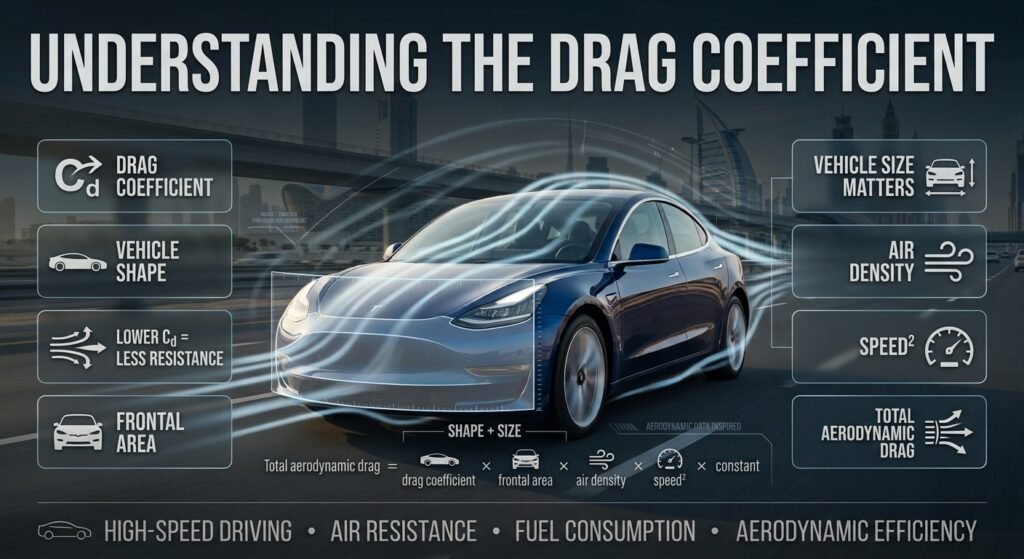
You may have seen the term drag coefficient, or Cd, when reading about vehicle aerodynamics.
The drag coefficient is a measure used to describe how effectively a shape moves through air.
Generally, a lower drag coefficient indicates that a vehicle’s shape creates less aerodynamic resistance under comparable conditions.
However, there is an important detail that is often overlooked.
You cannot judge a vehicle’s total aerodynamic drag simply by looking at its Cd number.
A vehicle’s frontal area also matters.
A very large vehicle may have a relatively good drag coefficient but still experience considerable total drag because it presents a large surface to the incoming air.
A useful simplified relationship is:
Total aerodynamic drag = drag coefficient × frontal area × air density × speed² × constant
This means both the vehicle’s shape and size matter.
Vehicle Drag and Fuel Consumption in Dubai
Vehicle drag can have a significant effect on fuel consumption, particularly as driving speed increases. Aerodynamic resistance becomes more noticeable on highways, meaning vehicles may need more engine power to maintain higher speeds. Roof racks, cargo boxes, open windows at high speeds, and bulky external accessories can increase drag and reduce efficiency further. In Dubai, where drivers often use high-speed roads for longer journeys, keeping the vehicle streamlined and removing unnecessary external equipment can help reduce aerodynamic resistance. Combining good aerodynamics with moderate speeds and smooth driving can support better overall fuel economy.
For a deeper understanding of how aerodynamic resistance, driving speed, roof equipment, external cargo, wind, and vehicle design can influence fuel consumption, explore our detailed Vehicle Drag and Fuel Consumption in Dubai guide.
Why Vehicle Shape Matters
Vehicle designers spend considerable time shaping cars to manage airflow.
A smooth transition from the front bumper to the hood can help control airflow.
The windshield angle influences how air moves toward the roof.
The roof shape affects airflow over the upper portion of the vehicle.
The rear design determines how air separates from the body.
Even small design features can influence turbulence and pressure differences.
Modern vehicles may include:
- Air dams
- Underbody panels
- Wheel deflectors
- Smooth body transitions
- Rear spoilers
- Carefully shaped mirrors
- Aerodynamic wheels
- Controlled grille openings
- Sealed body gaps
These components are designed as part of an overall aerodynamic system.
That is why removing a seemingly unimportant factory panel isn’t always a good idea.
Frontal Area and Fuel Economy
Frontal area describes how much of the vehicle faces the airflow.
A tall SUV, van, or pickup truck may have a larger frontal area than a low sedan.
This means the larger vehicle may need to move more air as it travels.
However, frontal area doesn’t tell the whole story.
Two vehicles with similar dimensions can have different fuel consumption because their shapes, engines, transmissions, tires, weight, and aerodynamic characteristics differ.
This is one reason fuel economy should always be evaluated as a complete system rather than based on a single specification.
How the Underbody Affects Aerodynamics
Many drivers think about airflow only above the vehicle.
But air also moves underneath it.
The underside of a typical vehicle contains many components that can disturb airflow, including:
- Suspension components
- Exhaust components
- Cross members
- Axles
- Mechanical parts
- Uneven surfaces
- Exposed fasteners
- Other structural components
Modern vehicles may use underbody covers to create a smoother surface and better control airflow.
These panels can also help protect components from road debris.
If a factory underbody panel becomes loose or damaged, repairing it according to manufacturer recommendations may be preferable to simply removing it.
An apparently small change underneath the vehicle can alter airflow, noise, cooling, and other characteristics.
Do Wheels and Tires Affect Aerodynamics?
Yes.
Wheels and tires interact directly with the air surrounding the vehicle.
As wheels rotate, they create turbulence around the wheel arches. Tire width, wheel design, spoke shape, and exposed surfaces can all influence airflow.
Some fuel-efficient vehicles therefore use aerodynamic wheel designs.
But wheels and tires have another important effect on fuel economy: rolling resistance.
Rolling resistance is different from aerodynamic drag.
Aerodynamic drag comes from moving through air.
Rolling resistance comes primarily from the interaction between the tires and the road.
Therefore, choosing tires for fuel efficiency involves considering both factors.
Tire pressure also matters. Driving with significantly incorrect tire pressure can increase rolling resistance and affect handling.
Tire Pressure and Fuel Efficiency
Tire pressure plays an important role in fuel efficiency because underinflated tires create greater rolling resistance, forcing the engine to work harder and potentially increasing fuel consumption. Maintaining the recommended tire pressure can help your vehicle roll more efficiently while also supporting better handling, braking, and tire wear. In Dubai’s hot climate, checking tire pressure regularly is especially useful because temperature changes can affect pressure readings. Always follow the vehicle manufacturer’s recommended pressure rather than relying on the maximum pressure printed on the tire sidewall.
For practical guidance on maintaining the correct tire pressure, reducing unnecessary rolling resistance, and supporting better fuel economy in Dubai’s driving conditions, read our detailed Tire Pressure and Fuel Efficiency guide.
How Roof Racks Affect Fuel Economy
Roof racks are one of the most practical aerodynamic factors ordinary drivers can control.
A roof rack adds components to the smooth upper surface of the vehicle. Crossbars, supports, baskets, carriers, and other equipment can disturb airflow.
The effect becomes more important as vehicle speed increases.
An empty roof rack may create less drag than a loaded rack, but it can still affect airflow.
If you regularly use a roof rack for bicycles, luggage, sporting equipment, or other items, the aerodynamic effect can become more noticeable during highway journeys.
This is why roof racks and fuel economy are closely connected.
For a detailed guide on this specific subject, see Roof Racks and Fuel Economy.
Should You Remove an Unused Roof Rack?
If your roof rack is removable and you don’t need it, removing it may reduce aerodynamic drag.
This can be especially useful if you frequently drive long distances at highway speeds.
However, you should always follow the installation and removal instructions provided by the vehicle or rack manufacturer.
Don’t remove structural or permanently installed components simply because they appear aerodynamic.
The practical rule is simple:
If you don’t need a removable exterior accessory, don’t carry it unnecessarily.
Does a Roof Box Increase Fuel Consumption?
A roof box can affect fuel economy for two main reasons.
First, it adds weight.
Second, and often more importantly during high-speed driving, it changes the aerodynamic shape of the vehicle.
A roof box creates additional surface area that interacts with incoming air.
Its effect depends on several factors, including:
- Size
- Shape
- Position
- Vehicle design
- Driving speed
- Wind conditions
- Load inside the box
- Other roof accessories
A well-designed aerodynamic roof box may perform better than a large, poorly shaped cargo container.
If you only use a roof box for occasional trips, removing it when it isn’t needed can help avoid carrying unnecessary aerodynamic equipment.
What About Bicycle Racks?
Bicycle racks can create considerable aerodynamic disturbance because bicycles have irregular shapes with frames, wheels, spokes, handlebars, and other components.
A roof-mounted bicycle can expose a large amount of equipment directly to the airflow.
Rear-mounted systems may interact differently with airflow because they sit behind the main body of the vehicle.
The exact fuel-economy impact depends on the rack type and vehicle.
The key principle is the same:
External equipment changes airflow.
If the equipment isn’t needed for the journey, leaving it at home is generally the simplest way to avoid its aerodynamic effect.
Do Open Windows Reduce Fuel Efficiency?
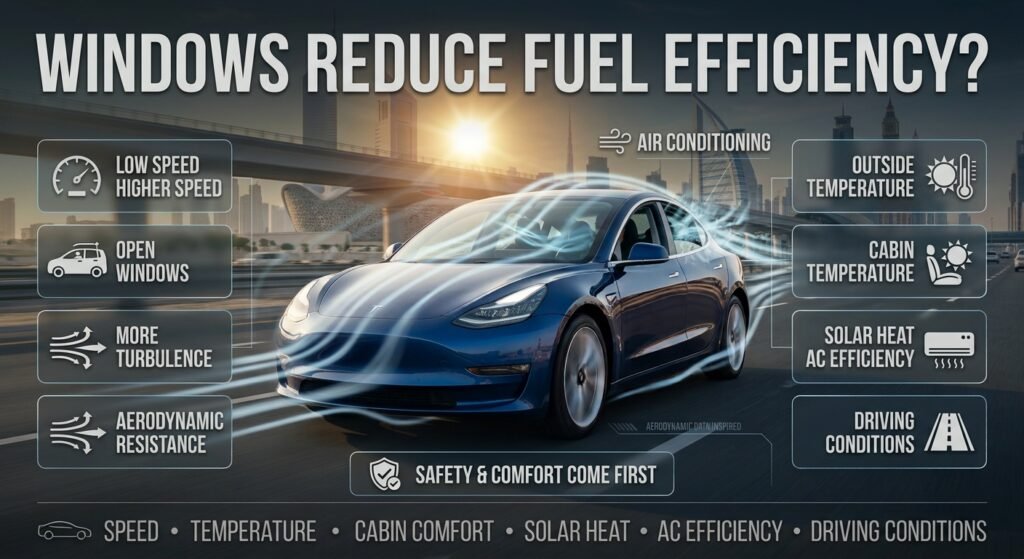
Open windows can influence fuel economy because they change the way air flows around and through the vehicle.
At low speeds, the effect is generally less important.
At higher speeds, opening windows can create additional turbulence and aerodynamic resistance.
This is why drivers sometimes notice a difference between driving with all windows closed and traveling with several windows open on a highway.
However, there is another consideration: air conditioning.
In a hot climate such as Dubai, air conditioning can consume additional energy. Therefore, fuel efficiency isn’t simply a matter of saying “windows open is bad” or “AC is bad.”
The best decision depends on:
- Vehicle speed
- Outside temperature
- Cabin temperature
- Solar heat
- AC efficiency
- Driving conditions
- Personal comfort and safety
During extremely hot weather, maintaining a safe and comfortable cabin environment should take priority.
How Air Conditioning and Aerodynamics Work Together
Dubai’s climate makes air conditioning an important part of everyday driving.
At highway speeds, closed windows generally provide better aerodynamic efficiency than open windows.
However, the AC system requires energy.
This creates a practical balance.
At lower speeds, opening windows may sometimes be a reasonable option if conditions allow.
At higher speeds, closed windows generally help maintain a cleaner aerodynamic profile.
But fuel efficiency shouldn’t be pursued at the expense of driver comfort, concentration, or safety.
A comfortable driver is a safer driver.
Air Conditioning and Fuel Consumption
Air conditioning can have a noticeable effect on fuel consumption, especially during hot weather and heavy traffic. When the AC system is running, the engine needs additional power to operate the compressor, which can increase fuel use. In Dubai’s hot climate, however, avoiding AC completely is not practical or comfortable. A better approach is to use the system efficiently by parking in shade when possible, ventilating the cabin briefly before cooling it, maintaining the AC system properly, and avoiding unnecessary idling with the AC running. These simple habits can help reduce unnecessary fuel consumption while keeping the cabin comfortable.
For practical tips on reducing unnecessary fuel consumption while keeping your car comfortable in Dubai’s hot climate, explore our detailed Air Conditioning and Fuel Consumption guide, which explains how AC use, traffic, idling, driving speed, and vehicle maintenance can affect overall fuel economy.
Does Wind Affect Fuel Economy?
Yes, wind can have a major effect on fuel consumption.
A headwind increases the speed of air relative to the vehicle.
For example, imagine a vehicle traveling at 100 km/h.
If there is a 20 km/h headwind, the vehicle may effectively experience airflow equivalent to approximately 120 km/h relative air speed.
Because aerodynamic drag increases approximately with the square of relative air speed, the additional resistance can be significant.
A tailwind can reduce the aerodynamic demand.
Crosswinds create a more complicated airflow pattern and can affect vehicle stability as well as energy use.
This explains why fuel economy can differ between two journeys over the same route even when the driver uses exactly the same vehicle and driving style.
Why Highway Driving Uses More Fuel at High Speed
Highway driving is often more fuel-efficient than city driving because there may be fewer stops and less acceleration.
But that doesn’t mean every highway speed is equally efficient.
Once a vehicle reaches higher speeds, aerodynamic drag becomes increasingly dominant.
The engine has to continuously produce power simply to maintain the vehicle’s speed.
This creates an important distinction:
City driving: acceleration, braking, traffic, and idling can dominate fuel consumption.
Highway driving: aerodynamic drag can become one of the major factors.
For drivers making long journeys, combining sensible speed with smooth driving can make a meaningful difference.
You can also read fuel-efficient highway driving for practical highway-specific techniques.
Fuel-Efficient Use of Automatic Transmission
Using an automatic transmission efficiently can help reduce unnecessary fuel consumption, especially during Dubai’s busy traffic and frequent stop-and-go driving. Avoid aggressive acceleration, sudden braking, and repeatedly switching between Drive and other gears when it is not necessary. When waiting for longer periods, follow the vehicle manufacturer’s guidance rather than keeping the engine unnecessarily engaged. Regular transmission maintenance and using the correct manufacturer-recommended fluid can also support smooth gear changes and efficient vehicle operation. The key is to let the transmission work naturally while maintaining a smooth, predictable driving style.
For practical guidance on using an automatic transmission more efficiently, including smooth acceleration, proper gear modes, traffic management, and highway driving habits, explore our detailed Fuel-Efficient Use of Automatic Transmission guide.
How Smooth Driving Complements Aerodynamic Efficiency
Aerodynamics alone won’t solve poor fuel economy.
Imagine a vehicle with excellent aerodynamic design but a driver who repeatedly accelerates aggressively and brakes hard.
The aerodynamic advantage can easily be offset by inefficient driving behavior.
Smooth acceleration allows the vehicle to build speed progressively.
Looking ahead can reduce unnecessary braking.
Maintaining a steady speed can prevent repeated energy losses.
For a broader guide, see smooth driving techniques for better fuel economy in Dubai.
Likewise, acceleration has a direct effect on fuel consumption. More aggressive acceleration generally demands more engine power and can increase fuel use.
For that reason, aerodynamic efficiency and driving technique should be considered together.
How Braking Affects the Bigger Fuel-Economy Picture
Braking doesn’t directly create aerodynamic drag, but it can waste energy that the vehicle previously used to accelerate.
When a conventional vehicle brakes, much of its kinetic energy is converted into heat through the braking system.
The driver then needs to use fuel to regain that lost speed.
This is why unnecessary acceleration followed by unnecessary braking is inefficient.
Aerodynamic efficiency becomes most useful when paired with steady driving.
If you want to understand this relationship in more detail, see how braking habits affect fuel economy.
Does Vehicle Weight Affect Fuel Efficiency More Than Aerodynamics?
It depends on the driving environment.
Vehicle weight is particularly important during acceleration and climbing.
Aerodynamic drag becomes increasingly important as speed rises.
For example, a heavy vehicle may use more fuel in stop-and-go traffic because it repeatedly needs to accelerate its mass.
On a highway, however, aerodynamic drag may become a larger factor than the energy required to repeatedly accelerate.
This is why reducing unnecessary load is useful but shouldn’t be confused with aerodynamic optimization.
If you’re carrying heavy equipment that you don’t need, removing it can improve efficiency.
For a deeper explanation, see how vehicle weight affects fuel economy.
Vehicle Accessories and Fuel Economy
Vehicle accessories and fuel economy are closely connected because certain add-ons can increase aerodynamic drag, vehicle weight, or electrical load. Roof racks, cargo boxes, oversized accessories, and other external equipment may make the engine work harder, especially during highway driving. Even small changes can affect fuel consumption when they are used regularly. For better efficiency, remove unnecessary accessories when they are not needed, keep external equipment streamlined, and avoid carrying extra weight without a purpose. In Dubai, where long highway journeys and high-speed driving are common, choosing practical accessories and maintaining the vehicle properly can help support better overall fuel economy.
For a practical guide on how roof racks, cargo boxes, extra weight, larger wheels, and other accessories can influence fuel consumption, read our detailed Vehicle Accessories and Fuel Economy in Dubai guide before choosing or removing accessories from your vehicle.
How Traffic Changes the Importance of Aerodynamics
Traffic can dramatically change the fuel-economy equation.
During heavy congestion, vehicles may spend considerable time:
- Idling
- Accelerating
- Braking
- Crawling
- Stopping
- Repeatedly changing speed
At these speeds, aerodynamic drag is generally less important than during highway cruising.
This means a highly aerodynamic vehicle can still achieve poor real-world fuel economy if it spends hours in stop-and-go traffic.
Dubai’s busy roads demonstrate this clearly.
A vehicle may have excellent highway efficiency but use substantially more fuel during congested journeys.
For more information, read how traffic affects fuel economy in Dubai.
Does Idling Affect Fuel Economy?
Idling is another factor that has little to do with aerodynamics.
When a vehicle is stationary, it isn’t experiencing aerodynamic drag from forward movement in the same way it does while driving.
But the engine may still be consuming fuel.
This means a driver can lose fuel efficiency without traveling any distance.
Long waiting periods outside shops, offices, schools, parking areas, or traffic queues can contribute to unnecessary fuel consumption.
For a more detailed explanation, see fuel consumption while idling.
This is a good example of why fuel economy requires a complete approach.
Aerodynamics matters most during movement, particularly at higher speeds.
Idling matters while the vehicle is stationary.
Both can affect your overall fuel consumption, but for completely different reasons.
Can SUVs Have Good Aerodynamics?
Yes.
Being an SUV doesn’t automatically mean a vehicle has poor aerodynamic efficiency.
Automakers can use careful body design to reduce drag.
However, SUVs often have characteristics such as:
- Greater height
- Larger frontal area
- Larger wheels
- Higher ground clearance
- Greater overall mass
These characteristics can increase energy requirements.
Modern SUVs can still be considerably more efficient than older vehicles because of improvements in engines, transmissions, hybrid systems, tires, and aerodynamic design.
The correct comparison is therefore between specific vehicles rather than categories alone.
Aerodynamics of Pickup Trucks
Pickup trucks create an interesting aerodynamic situation because of their open cargo beds.
Air can flow over the cabin and into or across the bed depending on vehicle design.
Tailgate configuration, bed covers, cargo, and accessories can influence airflow.
You may hear claims that driving with the tailgate down always improves fuel economy.
That’s too simplistic.
The airflow around a pickup is highly dependent on its specific design.
Some configurations may create a pressure pattern inside the bed that influences drag.
Others may behave differently.
Therefore, don’t make permanent modifications based solely on general internet claims.
Vehicle-specific testing or manufacturer guidance is more reliable.
Can Spoilers Improve Fuel Economy?
A spoiler can affect airflow, but it shouldn’t automatically be considered a fuel-saving component.
Some spoilers are designed to influence airflow for stability or performance.
Others are primarily cosmetic.
A poorly designed aftermarket spoiler can add:
- Weight
- Drag
- Turbulence
- Cost
without providing a meaningful fuel-economy advantage.
If a component wasn’t designed specifically for your vehicle, don’t assume that adding it will improve efficiency.
Do Body Kits Affect Aerodynamics?
They can.
A carefully engineered body kit may be designed to manage airflow.
But a purely cosmetic kit can produce unpredictable results.
Oversized bumpers, side skirts, wings, exposed accessories, and other modifications may alter airflow around the vehicle.
They can also increase weight.
For someone focused on fuel economy, factory aerodynamic design is generally a safer starting point than adding random aftermarket components.
Why Factory Aerodynamic Components Matter
Modern vehicle manufacturers don’t install aerodynamic components randomly.
Even small deflectors and panels may serve multiple purposes.
For example, a component may:
- Direct air
- Reduce turbulence
- Improve cooling
- Protect mechanical parts
- Reduce lift
- Improve stability
- Manage airflow around wheels
- Reduce noise
Removing one component can therefore produce unintended consequences.
This is particularly important when modifying underbody panels or air-management components.
If a part is damaged, replacing it with the correct component is usually preferable to permanently removing it.
Practical Ways to Improve Aerodynamic Fuel Efficiency
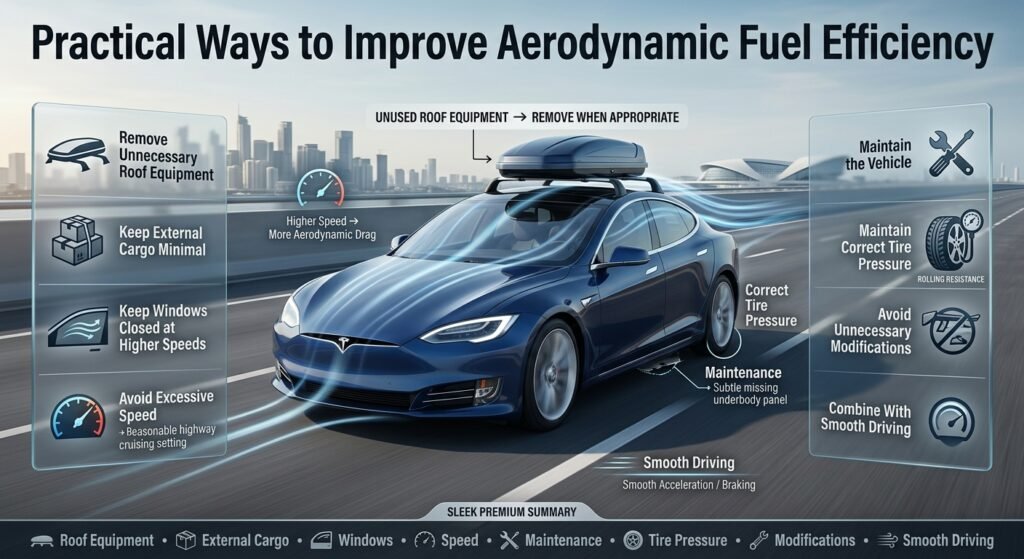
You don’t need a wind tunnel in your garage.
Most drivers can follow a few simple principles.
1. Remove Unnecessary Roof Equipment
If you aren’t using a removable roof rack, bicycle carrier, basket, or roof box, consider removing it when appropriate.
This is especially useful for highway driving.
2. Keep External Cargo Minimal
Only carry what you need.
Large external objects create more aerodynamic disturbance than small, streamlined loads.
3. Keep Windows Closed at Higher Speeds
When traveling at highway speeds, closed windows generally allow cleaner airflow.
4. Avoid Excessive Speed
Higher speed produces disproportionately higher aerodynamic drag.
Follow posted speed limits and maintain a sensible cruising speed.
5. Maintain the Vehicle
A damaged bumper, loose trim, missing underbody panel, or poorly fitted component can change airflow.
6. Maintain Correct Tire Pressure
Although tire pressure primarily affects rolling resistance rather than aerodynamic drag, it is an important part of overall fuel efficiency.
7. Avoid Unnecessary Modifications
Don’t install external accessories solely for appearance if fuel economy is a priority.
8. Combine Aerodynamics With Smooth Driving
Smooth acceleration and braking help maximize the benefits of aerodynamic efficiency.
A Practical Aerodynamic Checklist for Dubai Drivers
Before a long highway trip, ask yourself:
- Do I really need the roof rack today?
- Is the roof box necessary?
- Are external items properly secured?
- Are the windows closed at highway speed?
- Are the tires correctly inflated?
- Is the vehicle carrying unnecessary weight?
- Are any body panels loose?
- Are underbody components properly installed?
- Am I driving at an unnecessarily high speed?
- Am I accelerating and braking smoothly?
These simple questions can help you identify unnecessary sources of fuel consumption.
Common Mistakes That Reduce Aerodynamic Efficiency
Leaving an Empty Roof Rack Installed
Many people install a roof rack once and forget about it.
If you rarely use it, keeping it installed during every journey may create unnecessary aerodynamic drag.
Carrying a Roof Box All Year
A roof box is useful for holidays and long trips.
But if you don’t need it during everyday driving, leaving it installed can add unnecessary drag and weight.
Driving Faster to Save Time
Driving faster may reduce journey time, but it also increases aerodynamic resistance.
The fuel cost of higher speeds can outweigh the small time savings for some journeys.
Opening Windows During High-Speed Travel
Open windows can disturb airflow.
At high speeds, closed windows generally offer better aerodynamic efficiency.
Installing Oversized Exterior Accessories
Large spoilers, bars, carriers, and decorative components can alter airflow.
Always consider function, not appearance alone.
Removing Factory Components
Removing aerodynamic panels without understanding their purpose can create new problems.
Believing One Fuel-Saving Trick Works Everywhere
Fuel economy depends on multiple variables.
A technique that works in one situation may have little effect in another.
How to Measure Whether an Aerodynamic Change Actually Helps
This is one of the most important points.
If you remove a roof rack and your next fuel tank shows better economy, you can’t automatically conclude that the rack was responsible.
Why?
Because many variables may have changed.
For example:
- Wind direction
- Traffic
- Temperature
- Tire pressure
- Passenger weight
- Driving speed
- Route
- Air-conditioning use
- Road surface
can all affect fuel consumption.
A better approach is to compare multiple similar journeys.
For example:
Before: several highway trips with the rack installed.
After: several comparable highway trips with the rack removed.
Try to keep speed, route, load, and driving style as consistent as possible.
The more consistent your testing conditions are, the more meaningful the comparison becomes.
Aerodynamics and Long-Distance Driving
Long-distance journeys are where small efficiency differences can accumulate.
Imagine driving several hundred kilometers.
If aerodynamic drag causes your vehicle to require slightly more energy at every moment, that additional energy requirement continues throughout the journey.
This is why removing unnecessary roof equipment and maintaining sensible highway speeds can matter more on long trips than on a short five-minute drive.
For drivers who frequently travel between Dubai and other emirates, long-distance efficiency can be particularly useful.
You can also explore improving fuel economy on long trips for additional long-distance driving strategies.
Aerodynamics and Emergency Fuel Situations
Aerodynamic efficiency is mainly about preventing unnecessary fuel consumption.
But even efficient driving doesn’t eliminate the possibility of unexpectedly running low on fuel.
A long highway journey, unfamiliar route, heavy traffic, incorrect fuel estimate, or unexpected detour can all affect your fuel requirements.
That’s why it is sensible to monitor your fuel level before longer journeys and know where you can obtain assistance if necessary.
For Dubai drivers, having access to a reliable emergency fuel option can provide additional peace of mind when a vehicle unexpectedly runs low.
Aerodynamics vs Rolling Resistance
It is useful to understand the difference between these two forces.
Aerodynamic drag comes from moving through air.
Rolling resistance comes primarily from tires interacting with the road.
At low speeds, rolling resistance can represent a larger share of the forces opposing motion.
At higher speeds, aerodynamic drag becomes increasingly significant.
This is why fuel-efficiency strategies should change depending on driving conditions.
For city driving:
- Smooth acceleration
- Avoiding unnecessary braking
- Reducing idling
- Correct tire pressure
- Managing traffic
can be particularly important.
For highway driving:
- Sensible speed
- Aerodynamic efficiency
- Proper tire pressure
- Smooth cruising
- Removing unnecessary exterior equipment
can become increasingly important.
Why Aerodynamics Matters for Electric Vehicles Too
Aerodynamics isn’t only relevant to petrol and diesel cars.
Electric vehicles also have to overcome air resistance.
In fact, aerodynamic efficiency can be particularly important for EVs because reducing drag can help reduce energy consumption and potentially extend driving range.
The same principles apply:
- Higher speeds increase drag.
- Roof accessories can increase drag.
- Open windows can disturb airflow.
- External cargo changes airflow.
- Vehicle shape affects resistance.
Therefore, aerodynamic design is important across almost every type of modern road vehicle.
Gear Shifting and Fuel Economy in Dubai
Gear shifting has a direct impact on how efficiently a vehicle uses fuel, particularly in Dubai’s busy traffic and changing road conditions. Driving in the appropriate gear helps keep the engine operating within an efficient range, while unnecessarily high engine speeds or using the wrong gear can increase fuel consumption. Manual drivers can improve efficiency by shifting smoothly and selecting the appropriate gear for their speed and road conditions. Automatic transmissions generally manage gear changes themselves, but smooth acceleration and avoiding unnecessary aggressive driving can still support better fuel economy.
For a practical understanding of how to choose the right gear, avoid unnecessary engine strain, and improve fuel efficiency in Dubai’s city traffic and highway conditions, read our detailed Gear Shifting and Fuel Economy in Dubai guide.
Expert Advice: Focus on the Big Things First
One mistake drivers make is becoming obsessed with tiny aerodynamic details while ignoring much larger sources of fuel consumption.
For example, worrying about a small spoiler while driving aggressively through traffic misses the bigger picture.
A sensible priority order is:
1. Driving behavior
Avoid unnecessary acceleration and braking.
2. Speed
Avoid unnecessarily high highway speeds.
3. Traffic and idling
Reduce unnecessary stationary running and anticipate traffic where possible.
4. Vehicle load
Remove unnecessary weight.
5. Roof equipment
Remove unused external accessories.
6. Tire condition
Maintain proper pressure and suitable tires.
7. Vehicle condition
Repair damaged or loose aerodynamic components.
This approach provides a much more realistic path toward better fuel economy.
Frequently Asked Questions
What are the most effective fuel-efficient driving techniques for saving fuel?
The most effective fuel-efficient driving techniques are not complicated driving tricks. They are mainly about keeping the vehicle moving smoothly, avoiding unnecessary speed changes, anticipating traffic, and reducing situations where the engine is working harder than necessary. Rapid acceleration, aggressive braking, excessive idling, high speeds, unnecessary vehicle weight, and incorrect tyre pressure can all increase fuel consumption. The EPA also identifies aggressive driving, idling, excess cargo, roof racks, high speeds, and poor maintenance among the factors that can reduce fuel economy.
For everyday driving, the biggest improvement usually comes from changing how you use the accelerator and brakes. Instead of accelerating hard and then braking sharply at the next signal, look farther ahead and adjust your speed earlier. This allows the vehicle to maintain momentum and reduces the repeated cycle of acceleration and braking. Natural Resources Canada notes that large variations in speed can significantly increase fuel use, while gentle acceleration and steady speeds can improve efficiency.
Practical habits that make the biggest difference:
Accelerate gradually instead of flooring the accelerator.
Maintain a steady speed whenever traffic and road conditions allow.
Look ahead and anticipate red lights, congestion, turns, and slow-moving traffic.
Avoid unnecessary hard braking.
Remove unnecessary items from the vehicle.
Keep tyres at the manufacturer’s recommended pressure.
Avoid leaving the engine running when the vehicle is stationary for an extended period.
Remove unused roof racks or carriers when they are not required.
The goal is not to drive unusually slowly or interfere with normal traffic. Fuel-efficient driving means driving smoothly and intelligently while still following speed limits and maintaining safe distances.
How does highway speed affect fuel consumption, and what is the best speed for fuel efficiency?
Highway speed has a major influence on fuel consumption because aerodynamic resistance increases rapidly as vehicle speed rises. This means a car that is travelling faster does not simply use a little more fuel—it can require substantially more energy to overcome air resistance. Government fuel-economy guidance consistently recommends avoiding unnecessarily high speeds because fuel economy generally decreases as speed increases.
There is no single universal “perfect” speed for every car. The most efficient speed depends on the vehicle’s engine, transmission, tyres, road conditions, traffic, load, and design. Rather than chasing a specific number, a better approach is to stay within the legal speed limit and avoid unnecessary high-speed driving.
For example, constantly moving between 90 and 120 km/h can consume more fuel than maintaining a reasonably steady pace. Cruise control can sometimes help on suitable highways because it prevents unnecessary fluctuations in speed, although the driver should always remain attentive and ready to respond to traffic and road conditions.
For better highway fuel economy:
Follow the posted speed limit.
Avoid unnecessary rapid acceleration.
Maintain a steady speed where conditions permit.
Use cruise control when appropriate.
Keep tyres properly inflated.
Remove unnecessary roof equipment.
Avoid carrying unnecessary cargo.
Keep a safe following distance so you don’t repeatedly accelerate and brake.
For Dubai drivers in particular, this matters during longer highway journeys where maintaining a smooth, predictable pace can be much more efficient than repeatedly changing speed.
Does idling really waste fuel, and when should I turn off my engine?
Yes, prolonged idling consumes fuel even though the vehicle is not travelling anywhere. When the engine is running while the car is stationary, fuel is being burned to keep the engine and vehicle systems operating, but there is no useful distance being covered. The Vehicle Certification Agency specifically advises switching off when a vehicle is likely to remain stationary for more than about a minute, while Natural Resources Canada also highlights unnecessary idling as a significant source of wasted fuel.
This is particularly relevant during long waits, roadside stops, parking situations, and extended queues. In hot climates, drivers may keep the engine running because they want the air conditioning to remain active. That is understandable, but it is still important to recognise that the comfort provided by the AC comes with fuel consumption.
The practical answer is not to switch the engine off every few seconds. Constantly restarting the engine in situations where you will move again almost immediately is not the point. Instead, consider the length of the expected stop and the vehicle’s own stop-start system.
Modern vehicles equipped with automatic stop-start technology are specifically designed to shut the engine down during suitable stationary periods and restart it when needed. Consumer Reports notes that vehicles with stop/start systems can use considerably less fuel in testing when the system is active.
A sensible approach to idling is:
Avoid unnecessary engine running while parked.
If you expect a genuinely extended stop, consider switching off when safe and appropriate.
Use the vehicle’s factory stop-start system if equipped.
Don’t idle simply to “warm up” a modern engine for a long period.
Never sacrifice safety or climate control needs in extreme conditions just to save a small amount of fuel.
Avoid leaving the engine running while waiting outside shops or other locations when there is no practical need.
The important distinction is between necessary idling and unnecessary idling. A short wait in moving traffic is different from sitting stationary for a long period with the engine running.
How can I improve fuel economy when driving in heavy traffic and stop-and-go conditions?
Heavy traffic is one of the most challenging situations for fuel economy because the vehicle repeatedly accelerates, slows down, stops, and starts again. The EPA specifically lists stop-and-go congestion as a factor that can reduce fuel economy, while fuel-efficient driving guidance recommends anticipating traffic and avoiding unnecessary speed changes.
The biggest mistake in congested traffic is trying to maintain an unnecessarily aggressive pace. A driver may accelerate quickly to close a gap, brake hard when traffic stops, then accelerate again when the queue moves. Repeating this cycle wastes energy.
A better strategy is to look several vehicles ahead rather than focusing only on the car immediately in front of you. If you can see traffic slowing down, you can ease off the accelerator earlier instead of continuing to accelerate and then applying the brakes heavily.
This doesn’t mean leaving an enormous gap or driving unpredictably. It means using the available space intelligently and responding gradually to changes in traffic.
Useful techniques for stop-and-go traffic include:
Accelerate gently when traffic begins moving.
Avoid racing toward the next red light.
Watch traffic several cars ahead.
Lift off the accelerator early when a slowdown is obvious.
Avoid unnecessary lane changes and sudden bursts of speed.
Maintain a sensible following distance.
Minimise unnecessary idling during extended stationary periods.
Plan journeys around severe congestion where practical.
Combine errands instead of making multiple separate short trips.
For Dubai driving, traffic conditions can change quickly, so route planning can also make a difference. A slightly longer route that keeps the vehicle moving smoothly may sometimes be more efficient than a shorter route involving prolonged stop-and-go congestion.
The key principle is simple: every unnecessary acceleration followed by unnecessary braking wastes some of the energy you just used to accelerate. Smooth traffic anticipation helps reduce that cycle.
Do tyre pressure, vehicle weight, air conditioning, and roof racks really affect fuel economy?
Yes. Fuel economy is influenced by much more than driving style. Tyre pressure, vehicle weight, aerodynamic drag, maintenance, air conditioning use, and external equipment can all affect how much energy your vehicle needs to move. The EPA specifically identifies extra cargo, roof racks, high AC use, and poor maintenance as factors that can decrease fuel economy.
Tyre pressure is particularly important. Under-inflated tyres create additional rolling resistance, meaning the engine has to work harder to move the vehicle. Natural Resources Canada recommends checking tyre pressure regularly and notes that significant under-inflation can increase fuel consumption.
Vehicle weight matters as well. Carrying unnecessary tools, equipment, luggage, or other heavy items every day means the engine has to move that extra mass during every journey.
Then there is aerodynamic drag. A roof rack, roof box, bicycle carrier, or other equipment mounted outside the vehicle can disturb airflow, particularly at highway speeds. Removing unused roof equipment can therefore be a practical fuel-saving measure.
Air conditioning is a little more complicated. In Dubai’s hot climate, AC is often a genuine necessity rather than an optional accessory. The sensible objective is therefore efficient AC use, not simply turning it off regardless of temperature or safety.
For a more fuel-efficient vehicle setup:
Check tyre pressure according to the vehicle manufacturer’s recommendation.
Remove unnecessary weight from the trunk and cabin.
Take off unused roof racks and carriers.
Keep the vehicle properly maintained.
Use air conditioning sensibly according to weather and comfort requirements.
Avoid treatin
Yes. Fuel economy is influenced by much more than driving style. Tyre pressure, vehicle weight, aerodynamic drag, maintenance, air conditioning use, and external equipment can all affect how much energy your vehicle needs to move. The EPA specifically identifies extra cargo, roof racks, high AC use, and poor maintenance as factors that can decrease fuel economy.
Tyre pressure is particularly important. Under-inflated tyres create additional rolling resistance, meaning the engine has to work harder to move the vehicle. Natural Resources Canada recommends checking tyre pressure regularly and notes that significant under-inflation can increase fuel consumption.
Vehicle weight matters as well. Carrying unnecessary tools, equipment, luggage, or other heavy items every day means the engine has to move that extra mass during every journey.
Then there is aerodynamic drag. A roof rack, roof box, bicycle carrier, or other equipment mounted outside the vehicle can disturb airflow, particularly at highway speeds. Removing unused roof equipment can therefore be a practical fuel-saving measure.
Air conditioning is a little more complicated. In Dubai’s hot climate, AC is often a genuine necessity rather than an optional accessory. The sensible objective is therefore efficient AC use, not simply turning it off regardless of temperature or safety.
For a more fuel-efficient vehicle setup:
- Check tyre pressure according to the vehicle manufacturer’s recommendation.
- Remove unnecessary weight from the trunk and cabin.
- Take off unused roof racks and carriers.
- Keep the vehicle properly maintained.
- Use air conditioning sensibly according to weather and comfort requirements.
- Avoid treating fuel-saving as a reason to compromise safety.
- Check your actual fuel consumption over several journeys rather than judging it from one trip.
Ultimately, the best results come from combining efficient driving habits with sensible vehicle maintenance. No single trick will transform fuel economy overnight, but several small improvements can work together and make a noticeable difference over weeks and months.
Conclusion
Improving fuel economy is less about finding one perfect driving trick and more about developing a consistent set of smart driving habits. Smooth acceleration, controlled braking, steady highway speeds, reduced unnecessary idling, and better anticipation of traffic can all help your vehicle use fuel more efficiently. At the same time, keeping tyres correctly inflated, removing unnecessary weight, maintaining the vehicle properly, and taking off unused roof equipment can support better overall fuel economy.
For Dubai drivers, these habits are especially useful because heavy traffic, long highway journeys, high temperatures, and frequent air-conditioning use can all influence fuel consumption. The practical goal is not to drive unusually slowly or avoid using essential vehicle systems. It is to drive smoothly, plan ahead, maintain your vehicle, and avoid wasting fuel when it provides no useful movement.
If you ever run low on fuel while travelling, commuting, or stuck in traffic, having a dependable emergency refueling option can also give you peace of mind. 👉 Fuel Delivery Dubai
By making fuel-efficient driving techniques part of your everyday routine rather than using them only occasionally, you can reduce
Leave a Reply