Introduction
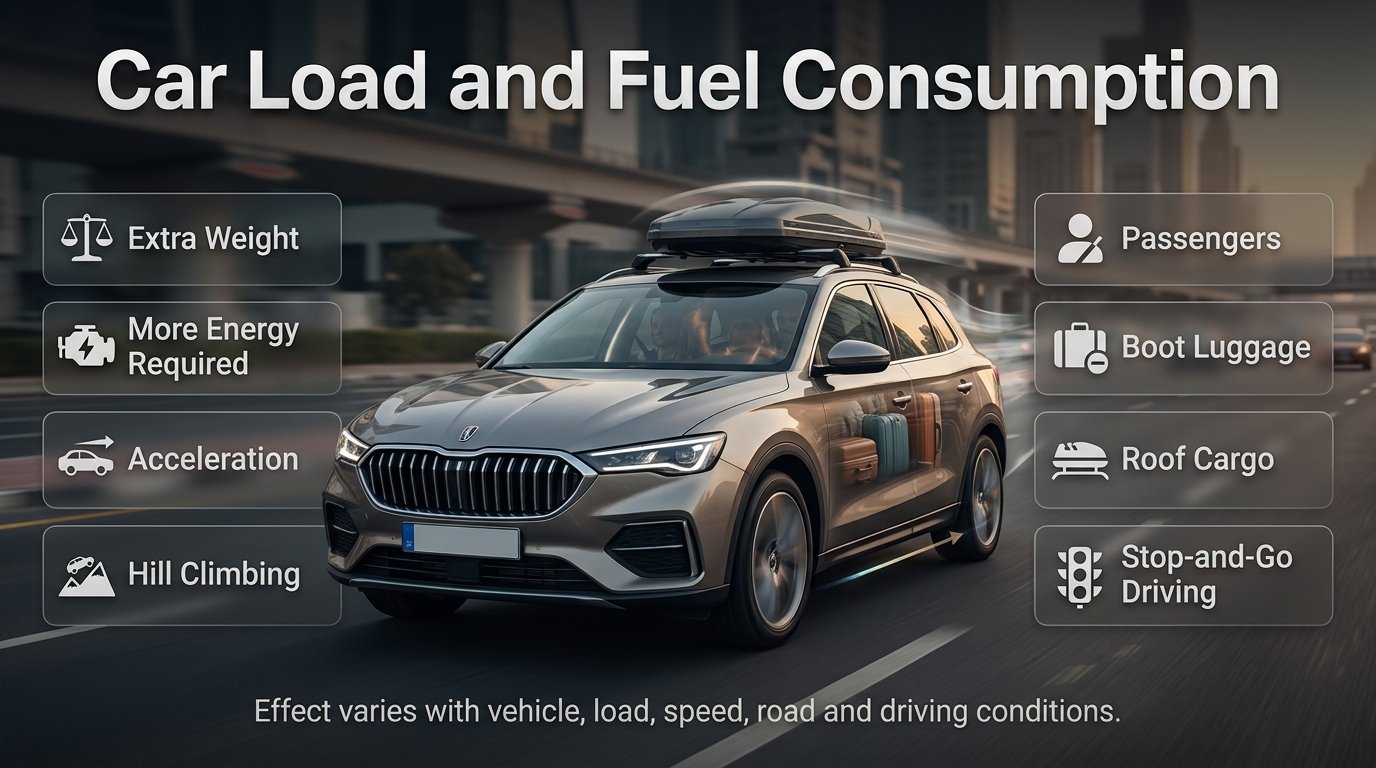
Car Load and Fuel Consumption | If your car seems to be using more fuel than usual, the problem isn’t always the engine, tyres, or driving style. Sometimes, there’s simply too much weight inside or on the vehicle. A boot full of unnecessary items, heavy equipment, extra passengers, or a loaded roof rack can all increase the energy required to move the car.
Understanding car load and fuel consumption can help you reduce unnecessary fuel use without making unrealistic promises about savings. The effect depends on the vehicle, the amount of extra weight, the type of driving, road conditions, speed, and how often you carry the load.
This guide explains how vehicle load affects fuel economy, which types of weight matter most, whether passengers significantly increase fuel use, how roof cargo differs from luggage inside the car, and what you can realistically do to improve efficiency.
For broader information about fuel-related services and automotive fuel topics in Dubai, you can also visit Out of Petrol Dubai 👉 Fuel Delivery Dubai homepage.
What Does Car Load and Fuel Consumption Mean?
Car load and fuel consumption refers to the relationship between the amount of weight a vehicle carries and the amount of fuel required to move it. A heavier vehicle generally needs more energy to accelerate, climb hills, and repeatedly stop and start. However, the effect isn’t identical for every vehicle or every journey.
In simple terms, when you add weight, the engine has more work to do during situations where the vehicle must accelerate or overcome resistance. The difference may be small with a light load on a steady highway journey, but it can become more noticeable in urban traffic with frequent acceleration and braking.
The important point is that extra weight doesn’t automatically mean a dramatic increase in fuel consumption. The effect varies according to driving conditions.
How Does Extra Weight Increase Fuel Consumption?
Extra weight increases the amount of energy needed to accelerate the vehicle. Newton’s second law tells us that greater mass requires greater force to achieve the same acceleration.
A simple example makes this easier to understand.
Imagine two otherwise identical cars. One carries only the driver. The other carries the driver plus several heavy bags and equipment. When both cars accelerate from a traffic light, the heavier car requires more energy to increase its speed.
The difference becomes more relevant when this happens repeatedly.
City driving often involves:
- Starting from traffic lights
- Accelerating after intersections
- Slowing for congestion
- Stopping and starting again
- Climbing ramps or hills
- Changing speed frequently
Every acceleration requires energy. If the vehicle is heavier, more energy is required for the same change in speed.
Fuel-Saving Driving Tips can help you combine load management with other practical fuel-saving habits.
Does a Heavier Car Always Use More Fuel?
Generally, yes, but the size of the effect depends on the circumstances.
A heavier vehicle has greater mass, so accelerating it requires more energy. However, once a vehicle is moving at a steady speed on level ground, the direct effect of additional mass can be less noticeable than during repeated acceleration.
This is why the same extra load can have different effects on different journeys.
In city traffic
Extra weight can matter more because the vehicle repeatedly accelerates from low speeds.
On highways
The effect of weight may be less significant during steady cruising, although hills, acceleration, and other factors still matter.
On steep roads
Extra weight becomes more important because the vehicle needs additional energy to gain elevation.
During stop-and-go traffic
Repeated acceleration makes unnecessary load particularly undesirable.
The best approach isn’t to obsess over a specific percentage of fuel savings. Instead, remove weight that you don’t actually need and focus on the complete driving system.
What Types of Car Load Affect Fuel Economy?
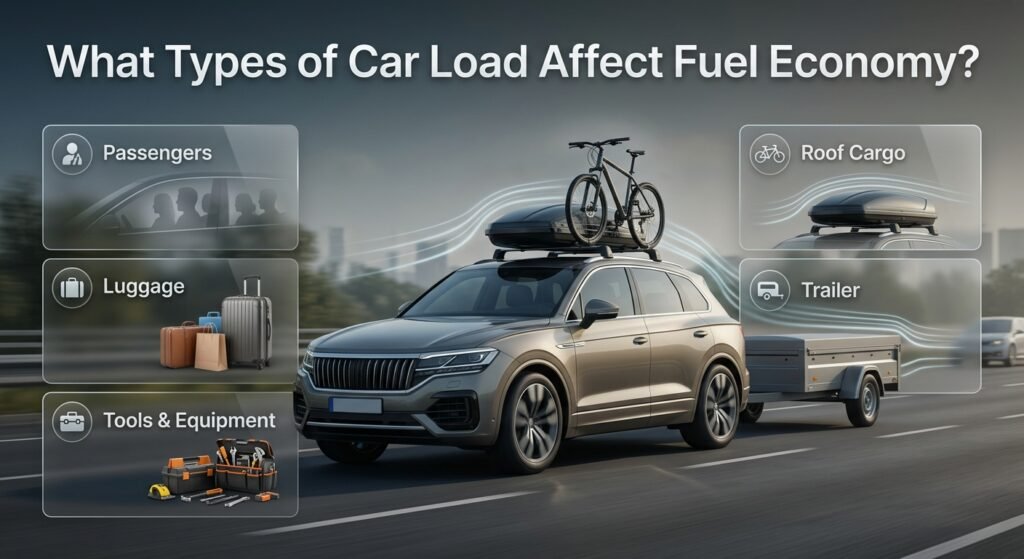
Not all loads affect the vehicle in exactly the same way.
Passengers
Passengers add weight, and therefore increase the vehicle’s total mass. One passenger won’t normally transform a car’s fuel economy, but several passengers can make a noticeable difference, particularly in smaller vehicles.
The effect is also influenced by trip length and driving conditions.
Luggage
Suitcases, shopping bags, tools, sports equipment, and other belongings can add considerable weight when left inside the car permanently.
A common mistake is treating the boot like long-term storage.
If you carry something every day, its weight becomes part of the vehicle’s normal operating load.
Tools and equipment
Work vehicles often carry heavy tools, spare parts, machinery, or other equipment. In these cases, load management can become especially important.
If equipment is genuinely required for work, removing it isn’t practical. But unnecessary items should still be reviewed regularly.
Roof cargo
Roof boxes, bicycles, luggage carriers, and other roof-mounted equipment are different from ordinary luggage because they can also affect aerodynamics.
At higher speeds, aerodynamic drag becomes increasingly important. Therefore, roof-mounted equipment can affect fuel consumption through both additional weight and increased air resistance.
Trailers
A trailer adds weight and aerodynamic resistance. It can therefore have a much larger effect than a small amount of luggage inside the vehicle.
Always follow the vehicle manufacturer’s towing limits and use appropriate equipment.
Why Does Unnecessary Weight Matter More in Stop-and-Go Driving?
Stop-and-go driving is one of the situations where extra weight can become more relevant.
Suppose a car travels through busy Dubai traffic. It accelerates, brakes, stops, and accelerates again dozens or hundreds of times.
The vehicle isn’t simply maintaining one speed.
Each time the driver accelerates, the engine must provide energy to increase the speed of the vehicle. A heavier car requires more energy for the same acceleration.
This doesn’t mean removing a single bag from the boot will suddenly transform fuel economy. The point is cumulative: unnecessary weight, aggressive acceleration, traffic, idling, and poor tyre pressure can work together to increase fuel use.
For more information, see How Traffic Affects Fuel Economy in Dubai.
Does Car Load Affect Highway Fuel Consumption?
Yes, but the effect can be different from urban driving.
On a flat highway at a steady speed, the vehicle doesn’t need to accelerate continuously. As a result, the direct energy penalty from extra mass may be smaller than during repeated city acceleration.
However, additional load still matters when:
- Accelerating onto the highway
- Overtaking
- Driving uphill
- Maintaining speed on gradients
- Carrying a large trailer
- Using roof-mounted cargo
Roof cargo deserves special attention because aerodynamic drag can become a major factor at higher speeds.
If you’re interested in the wider relationship between speed and fuel use, see How Highway Speed Affects Fuel Consumption.
Weight vs Aerodynamics: Which Matters More?
Weight and aerodynamic drag are different factors.
Weight mainly affects how much energy is required to accelerate the vehicle and move it against gravity.
Aerodynamics affects how much resistance the vehicle experiences as it moves through the air.
A small heavy object inside the boot mainly adds mass.
A large roof box adds mass but can also disturb airflow around the vehicle.
This distinction matters because drivers sometimes remove a few kilograms from the boot while leaving a large roof carrier installed for months.
For highway driving, aerodynamic changes can be especially important.
How Aerodynamics Affects Fuel Efficiency
Aerodynamics plays an important role in fuel efficiency, especially when a vehicle is traveling at higher speeds. As speed increases, air resistance creates more drag, requiring the engine to use additional energy to keep the vehicle moving. Features such as roof racks, cargo boxes, open windows, and bulky external accessories can increase aerodynamic drag and contribute to higher fuel consumption. Keeping the vehicle streamlined, removing unnecessary external equipment, and maintaining a sensible highway speed can help reduce resistance and support more efficient driving.
For a clearer understanding of how air resistance, vehicle design, speed, roof accessories, and external load can influence your car’s fuel consumption, explore our detailed How Aerodynamics Affects Fuel Efficiency guide.
How Much Weight Should You Remove From Your Car?
Start with unnecessary items rather than trying to make the vehicle as light as possible.
Check:
- Boot
- Rear seats
- Floor areas
- Door pockets
- Under-seat storage
- Roof rack
- Roof box
- Spare equipment
- Work tools
- Sports equipment
- Old shopping bags
- Unused accessories
Ask yourself a simple question:
“Do I need to carry this on this trip?”
If the answer is no, consider removing it.
You don’t need to remove safety equipment or essential emergency items simply to reduce weight. Safety should always come first.
A Practical Car Load Audit
A quick load audit can be completed in a few minutes.
Step 1: Empty the boot
Remove everything that isn’t needed for your regular journeys.
Step 2: Separate essential and occasional items
Emergency equipment and essential tools can stay. Items used once every few months may not need to remain in the car every day.
Step 3: Check roof equipment
If you’re not using a roof box or rack, check whether the equipment should remain installed.
Step 4: Consider your normal passengers
Don’t worry about occasional passengers. Instead, focus on unnecessary permanent cargo.
Step 5: Check the manufacturer’s load limits
Never exceed the vehicle’s permitted payload, axle limits, roof-load limit, or towing capacity.
Step 6: Combine load management with efficient driving
Reducing weight works best when combined with sensible acceleration, appropriate speed, correct tyre pressure, and good maintenance.
For smoother driving techniques, see Smooth Driving Techniques for Better Fuel Economy in Dubai.
Does Removing Heavy Items From the Boot Save Fuel?
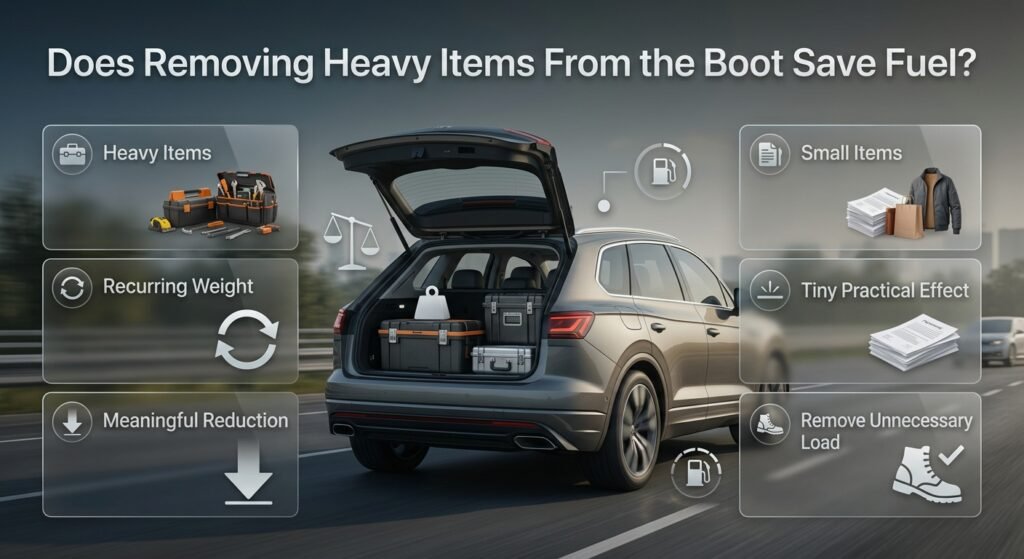
It can help, particularly if the items are heavy and carried continuously.
However, don’t expect every small object to create a measurable difference on every trip.
For example, removing several kilograms of old paperwork or small personal belongings may have a very small practical effect. Removing a permanently carried heavy toolbox, equipment case, or other substantial load is more meaningful.
The goal is not to chase tiny savings.
The goal is to eliminate unnecessary recurring weight.
Does a Full Car Use More Fuel Than an Empty Car?
Usually, a fully loaded car requires more energy than the same car carrying only the driver. The difference depends on how much additional mass is added and how the vehicle is driven.
A large SUV may carry several passengers with relatively little change in normal operation compared with a small car carrying the same additional weight.
Likewise, a short trip on level roads may show a different effect from a long journey involving hills and repeated acceleration.
The vehicle’s engine, transmission, tyres, driving style, and road conditions all influence the final result.
Can Passengers Increase Fuel Consumption?
Yes. Passengers increase vehicle mass, so carrying more people can increase energy demand.
But passenger weight shouldn’t be treated as a reason to avoid necessary journeys or normal car use. The practical lesson is simply that a vehicle carrying a heavy load will generally need more energy than the same vehicle carrying less mass.
For everyday drivers, the more useful action is to remove unnecessary cargo rather than worrying about normal passengers.
What About Air Conditioning in Dubai?
In hot climates such as Dubai, air conditioning can have a noticeable effect on fuel consumption, particularly during demanding conditions.
This is separate from vehicle load, but the factors can occur together.
For example, a heavily loaded vehicle may travel through slow traffic with the air conditioner operating continuously. The total fuel consumption can then be influenced by:
- Vehicle load
- Traffic
- Idling
- Acceleration
- Speed
- Air conditioning
- Tyre pressure
- Road conditions
- Vehicle condition
This is why fuel economy shouldn’t be blamed on one factor without considering the complete driving environment.
Air Conditioning and Fuel Consumption
Air conditioning can have a noticeable effect on fuel consumption, especially during hot weather and heavy traffic. When the AC system is running, the engine needs additional power to operate the compressor, which can increase fuel use. In Dubai’s hot climate, however, avoiding AC completely is not practical or comfortable. A better approach is to use the system efficiently by parking in shade when possible, ventilating the cabin briefly before cooling it, maintaining the AC system properly, and avoiding unnecessary idling with the AC running. These simple habits can help reduce unnecessary fuel consumption while keeping the cabin comfortable.
For practical tips on reducing unnecessary fuel consumption while keeping your car comfortable in Dubai’s hot climate, explore our detailed Air Conditioning and Fuel Consumption guide, which explains how AC use, traffic, idling, driving speed, and vehicle maintenance can affect overall fuel economy.
Car Load and Tyre Pressure
Load and tyre pressure are closely related from a safety and efficiency perspective.
A vehicle’s recommended tyre pressure may vary depending on load and driving conditions. Many vehicles provide separate recommended pressures for normal and heavily loaded operation.
Always use the manufacturer’s recommended pressure rather than guessing.
Underinflated tyres can increase rolling resistance and may also affect handling, braking, and tyre wear.
Don’t increase tyre pressure beyond the manufacturer’s recommendations simply because the car is carrying extra weight.
Tire Pressure and Fuel Efficiency
Tire pressure plays an important role in fuel efficiency because underinflated tires create greater rolling resistance, forcing the engine to work harder and potentially increasing fuel consumption. Maintaining the recommended tire pressure can help your vehicle roll more efficiently while also supporting better handling, braking, and tire wear. In Dubai’s hot climate, checking tire pressure regularly is especially useful because temperature changes can affect pressure readings. Always follow the vehicle manufacturer’s recommended pressure rather than relying on the maximum pressure printed on the tire sidewall.Tire Pressure and Fuel Efficiency
For practical guidance on maintaining the correct tire pressure, reducing unnecessary rolling resistance, and supporting better fuel economy in Dubai’s driving conditions, read our detailed Tire Pressure and Fuel Efficiency guide.
Common Mistakes That Increase Fuel Use
Leaving heavy equipment in the car permanently
Many drivers carry tools or equipment every day even when they aren’t needed.
Why it happens: The boot becomes convenient storage.
Why it’s a problem: The vehicle repeatedly carries weight that isn’t serving a purpose.
Better approach: Review the boot once a week and remove unnecessary items.
Leaving a roof box installed year-round
A roof box can be useful during holidays but unnecessary during normal commuting.
Why it happens: Removing and storing it takes effort.
Why it’s a problem: It can add weight and aerodynamic drag.
Better approach: Remove roof equipment when it isn’t required, following the manufacturer’s instructions.
Roof Racks and Fuel Economy in Dubai
Roof racks can affect fuel economy by increasing a vehicle’s aerodynamic drag, particularly when driving at higher speeds on Dubai’s highways. Even when the rack is not carrying cargo, its added exposure to airflow can create additional resistance, which may require more engine power to maintain speed. The effect can become greater when carrying bulky items such as bicycles, luggage, or roof boxes. If a roof rack is not needed for a particular journey, removing it can help keep the vehicle more aerodynamic. For regular users, choosing a streamlined design, securing cargo properly, and avoiding unnecessary weight can support better fuel efficiency.
If you regularly use a roof rack for luggage, bicycles, or other equipment, our detailed Roof Racks and Fuel Economy in Dubai guide explains how roof-mounted accessories can increase aerodynamic drag and influence fuel consumption, especially during highway driving.
Thinking only about luggage weight
Drivers sometimes remove bags but ignore driving habits.
Why it happens: Weight is easy to see.
Why it’s a problem: Aggressive acceleration, excessive speed, idling, and poor tyre pressure may have a much larger practical effect.
Better approach: Treat load management as one part of fuel-efficient driving.
Overloading the vehicle
Trying to carry too much can create safety problems as well as increase fuel demand.
Better approach: Follow the manufacturer’s payload and roof-load limits.
Fuel-Efficient Use of Automatic Transmission
Using an automatic transmission efficiently can help reduce unnecessary fuel consumption, especially during Dubai’s busy traffic and frequent stop-and-go driving. Avoid aggressive acceleration, sudden braking, and repeatedly switching between Drive and other gears when it is not necessary. When waiting for longer periods, follow the vehicle manufacturer’s guidance rather than keeping the engine unnecessarily engaged. Regular transmission maintenance and using the correct manufacturer-recommended fluid can also support smooth gear changes and efficient vehicle operation. The key is to let the transmission work naturally while maintaining a smooth, predictable driving style.
For practical guidance on using an automatic transmission more efficiently, including smooth acceleration, proper gear modes, traffic management, and highway driving habits, explore our detailed Fuel-Efficient Use of Automatic Transmission guide.
How Acceleration Changes the Effect of Vehicle Load
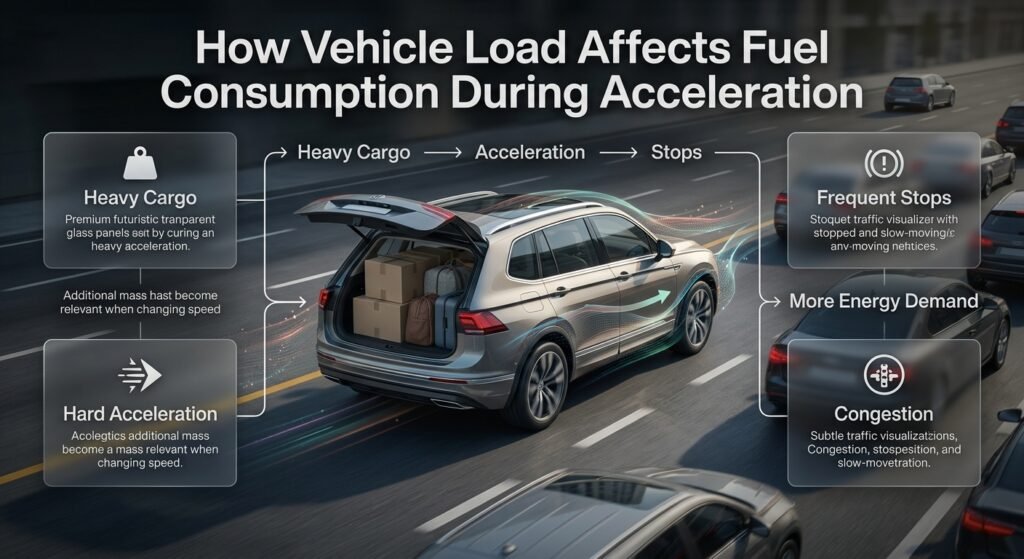
A heavier vehicle doesn’t simply consume more fuel because it exists. The extra mass becomes especially relevant when the vehicle’s speed changes.
Hard acceleration demands substantial engine power.
If you combine:
- Heavy cargo
- Fast acceleration
- Frequent stops
- Congestion
the vehicle can require significantly more energy than during smooth, steady driving.
For a deeper explanation, read How Acceleration Affects Fuel Consumption in Dubai.
Vehicle Accessories and Fuel Economy
Vehicle accessories and fuel economy are closely connected because certain add-ons can increase aerodynamic drag, vehicle weight, or electrical load. Roof racks, cargo boxes, oversized accessories, and other external equipment may make the engine work harder, especially during highway driving. Even small changes can affect fuel consumption when they are used regularly. For better efficiency, remove unnecessary accessories when they are not needed, keep external equipment streamlined, and avoid carrying extra weight without a purpose. In Dubai, where long highway journeys and high-speed driving are common, choosing practical accessories and maintaining the vehicle properly can help support better overall fuel economy.
For a practical guide on how roof racks, cargo boxes, extra weight, larger wheels, and other accessories can influence fuel consumption, read our detailed Vehicle Accessories and Fuel Economy in Dubai guide before choosing or removing accessories from your vehicle.
Vehicle Drag and Fuel Consumption in Dubai
Vehicle drag can have a significant effect on fuel consumption, particularly as driving speed increases. Aerodynamic resistance becomes more noticeable on highways, meaning vehicles may need more engine power to maintain higher speeds. Roof racks, cargo boxes, open windows at high speeds, and bulky external accessories can increase drag and reduce efficiency further. In Dubai, where drivers often use high-speed roads for longer journeys, keeping the vehicle streamlined and removing unnecessary external equipment can help reduce aerodynamic resistance. Combining good aerodynamics with moderate speeds and smooth driving can support better overall fuel economy.
For a deeper understanding of how aerodynamic resistance, driving speed, roof equipment, external cargo, wind, and vehicle design can influence fuel consumption, explore our detailed Vehicle Drag and Fuel Consumption in Dubai guide.
Gear Shifting and Fuel Economy in Dubai
Gear shifting has a direct impact on how efficiently a vehicle uses fuel, particularly in Dubai’s busy traffic and changing road conditions. Driving in the appropriate gear helps keep the engine operating within an efficient range, while unnecessarily high engine speeds or using the wrong gear can increase fuel consumption. Manual drivers can improve efficiency by shifting smoothly and selecting the appropriate gear for their speed and road conditions. Automatic transmissions generally manage gear changes themselves, but smooth acceleration and avoiding unnecessary aggressive driving can still support better fuel economy.
For a practical understanding of how to choose the right gear, avoid unnecessary engine strain, and improve fuel efficiency in Dubai’s city traffic and highway conditions, read our detailed Gear Shifting and Fuel Economy in Dubai guide.
Does Braking Waste the Energy Used to Move Extra Weight?
In a conventional petrol or diesel vehicle, braking converts much of the vehicle’s kinetic energy into heat through the braking system.
This is important because if you’ve accelerated a heavier vehicle and then immediately brake, some of the energy used to accelerate it is effectively lost as heat.
This is one reason unnecessary acceleration and braking can hurt fuel economy.
Good anticipation helps. If traffic is slowing ahead, gradually reducing speed rather than accelerating hard and braking immediately afterward can reduce unnecessary energy use.
See How Braking Habits Affect Fuel Economy in Dubai for more detail.
Expert Advice for Managing Car Load
A practical approach is to think in terms of permanent load versus temporary load.
Permanent load is something the vehicle carries almost every day.
Temporary load is something carried only when needed.
Permanent unnecessary weight deserves the most attention because its effect can accumulate over many trips.
A useful routine is:
- Check the boot regularly.
- Remove unnecessary equipment.
- Remove unused roof accessories.
- Check the vehicle’s load limits.
- Adjust tyre pressure according to manufacturer guidance.
- Drive smoothly.
- Avoid unnecessary idling.
- Keep highway speeds reasonable.
- Track fuel economy over several tanks rather than one trip.
For additional guidance, Fuel-Efficient Driving Techniques provides another useful part of the overall strategy.
Quick Comparison: Which Load Should You Worry About?
| Load Type | Fuel-Economy Impact | What to Do |
|---|---|---|
| One or two normal passengers | Usually modest | Carry normally |
| Small luggage | Usually modest | Remove when unnecessary |
| Heavy permanent equipment | Can be meaningful | Remove when not required |
| Large roof box | Weight + aerodynamic effect | Remove when unused |
| Heavy trailer | Potentially substantial | Use only when necessary |
| Emergency equipment | Small trade-off for safety | Keep it |
| Unnecessary stored items | Avoidable | Remove them |
The table isn’t a promise of a specific percentage improvement. Actual results vary significantly between vehicles and driving conditions.
How to Measure Whether Your Load Changes Fuel Consumption
If you want a more useful answer for your own vehicle, measure instead of guessing.
Use a consistent method:
Fuel economy = distance travelled ÷ fuel consumed
For example, if your vehicle travels 500 km and consumes 50 litres:
500 ÷ 50 = 10 km/L
Record several tanks under similar conditions.
Then remove unnecessary cargo and compare future results.
Don’t judge the difference from a single trip because traffic, weather, tyre pressure, driving style, AC use, and fuel quality can all change the result.
How does extra weight in a car affect fuel consumption?
Extra weight makes the engine work harder, particularly when the vehicle accelerates, climbs hills, or repeatedly slows down and speeds up. A vehicle has to overcome its own inertia every time it gains speed, and carrying additional passengers or cargo increases the mass that needs to be moved. Heavier vehicles also experience greater rolling resistance from the tyres.
The effect is not necessarily dramatic from one small item. Carrying a laptop bag, a few groceries, or one small suitcase is unlikely to transform your fuel economy. The difference becomes more meaningful when a vehicle regularly carries a substantial amount of unnecessary cargo.
This is especially relevant for city driving because frequent acceleration and braking repeatedly require the engine to move the vehicle’s mass. EPA guidance also identifies extra weight as one of the factors that can decrease fuel economy.
Key points:
More weight means more energy is required to accelerate.
Heavy loads can increase tyre rolling resistance.
The impact becomes more noticeable during frequent stop-and-go driving.
Hills and repeated acceleration can make the penalty more apparent.
Removing unnecessary cargo is a simple way to reduce the vehicle’s workload.
How much does 100 kg of extra weight affect fuel economy?
There is no single fuel-consumption percentage that applies to every car, because the effect depends on the vehicle’s original weight, engine, transmission, tyres, road conditions, driving style, and type of journey.
For example, an additional 100 kg represents a relatively small percentage of the total mass of a large SUV but a much larger percentage of a lightweight compact car. The same load therefore does not produce an identical fuel-economy penalty across different vehicles.
The driving environment matters as well. Extra mass has a greater opportunity to affect energy use when the vehicle is repeatedly accelerating, such as in urban traffic. On a steady road, the effect of mass is different because acceleration demands are reduced, although weight still contributes to rolling resistance and affects the energy required on gradients. Vehicle road-load models include mass, rolling resistance, aerodynamic drag, acceleration and road grade as important components.
Key points:
100 kg does not produce a universal percentage change in fuel consumption.
The same load can affect a small car more than a large vehicle.
Stop-and-go driving can make additional weight more noticeable.
Hills increase the energy required to move a heavier vehicle.
Always consider the vehicle’s recommended payload rather than relying on a generic weight-saving formula.
Does carrying passengers increase fuel consumption?
Yes, carrying additional passengers can increase fuel consumption because passengers add weight to the vehicle. However, the practical effect depends on how much additional mass is being carried and how the vehicle is driven.
A car carrying four adults is substantially heavier than the same car carrying only the driver. During acceleration, the engine must provide enough energy to increase the speed of the entire vehicle and its occupants. On uphill roads, additional mass also increases the energy required to gain elevation.
That does not mean passengers should avoid travelling together simply to save fuel. In many situations, taking several passengers in one vehicle can actually be more efficient per person than making separate journeys in multiple cars. The useful lesson is not “drive alone”; it is to understand that vehicle mass is one of several factors affecting energy demand.
This is why fuel economy should be considered as part of the entire driving system rather than judged from vehicle load alone. Vehicle weight, speed, acceleration, tyres, aerodynamics, traffic and accessories can all influence the amount of fuel required.
Key points:
More passengers increase the vehicle’s total operating weight.
The effect is more noticeable with a heavily loaded vehicle.
Acceleration and hill climbing require additional energy.
Passenger travel should be considered in terms of total trips and people transported.
Do not confuse normal passenger loading with exceeding the manufacturer’s payload limit.
Does removing unnecessary items from the trunk really save fuel?
Removing unnecessary items can help reduce fuel consumption, particularly when a vehicle regularly carries a significant amount of unused cargo.
Think about a trunk that contains heavy tools, old equipment, unused luggage, spare materials, or other items that have been left there for weeks. The vehicle is effectively carrying that weight on every trip, even when the items provide no benefit to the journey.
The fuel saving from removing a few lightweight objects may be too small to notice in everyday driving. However, consistently carrying a large unnecessary load adds weight every time the vehicle accelerates and contributes to rolling resistance. EPA guidance specifically lists extra weight from unnecessary items stored in a vehicle among factors that can decrease MPG.
The best approach is therefore practical rather than extreme: remove weight that you genuinely do not need, but keep safety equipment and items required for normal driving.
Key points:
Check the trunk regularly for unnecessary heavy items.
Remove unused tools, equipment and luggage when appropriate.
Do not remove essential emergency or safety equipment just to save weight.
A small weight reduction may produce little noticeable difference.
Regularly carrying a large unnecessary load is more worth addressing.
Is vehicle weight the only factor that affects fuel consumption?
No. Car load is important, but it is only one part of fuel consumption. A vehicle’s fuel economy is influenced by the combined effect of weight, speed, acceleration, tyres, aerodynamics, traffic, road conditions, engine efficiency, air conditioning and driving habits.
At lower speeds, rolling resistance and acceleration can play an important role. At higher speeds, aerodynamic drag becomes increasingly significant because aerodynamic resistance rises rapidly with speed. Research from the National Academies notes that aerodynamic drag becomes particularly important at higher speeds, while vehicle mass affects the energy required to overcome inertia.
This is why removing unnecessary cargo should not be presented as a magic fuel-saving solution. A driver could remove 50 kg from the trunk but still experience poor fuel economy because of aggressive acceleration, high-speed driving, underinflated tyres, heavy traffic, excessive idling or other factors.
A better strategy is to reduce unnecessary load while also improving the other major factors that influence fuel consumption.
Key points:
Vehicle weight is only one part of the fuel-economy equation.
Driving style can have a substantial effect on real-world fuel consumption.
Tyre pressure and rolling resistance matter.
High speeds increase aerodynamic drag.
Stop-and-go traffic increases energy losses through repeated acceleration and braking.
Air conditioning and other accessories can increase fuel demand.
Regular maintenance helps the vehicle operate efficiently.
Professional takeaway
The smartest way to approach car load and fuel consumption is not to obsess over every kilogram. Instead, look for unnecessary weight that the vehicle carries repeatedly, remove it when practical, and combine that improvement with sensible driving and proper vehicle maintenance.
That gives readers a much more realistic understanding of fuel economy: load matters, but fuel consumption is the result of several factors working together.
Conclusion
Car load and fuel consumption are closely connected, but the amount of fuel a vehicle uses is not determined by weight alone. Carrying unnecessary passengers, luggage, tools, equipment, or other heavy items makes the vehicle work harder, especially during acceleration, hill climbing, and stop-and-go driving. While removing a small amount of weight may not create a noticeable difference, regularly carrying a substantial unnecessary load can gradually reduce fuel efficiency.
The best approach is simple and practical: carry what you need, remove unnecessary weight, maintain correct tyre pressure, drive smoothly, avoid excessive acceleration and braking, and keep the vehicle properly maintained. When these habits are combined, they can contribute to more consistent fuel economy and reduce unnecessary fuel use over time.
Ultimately, improving fuel efficiency is not about finding one magic trick. It is about making several sensible changes that reduce the amount of energy your vehicle needs during everyday driving.
Leave a Reply