Introduction
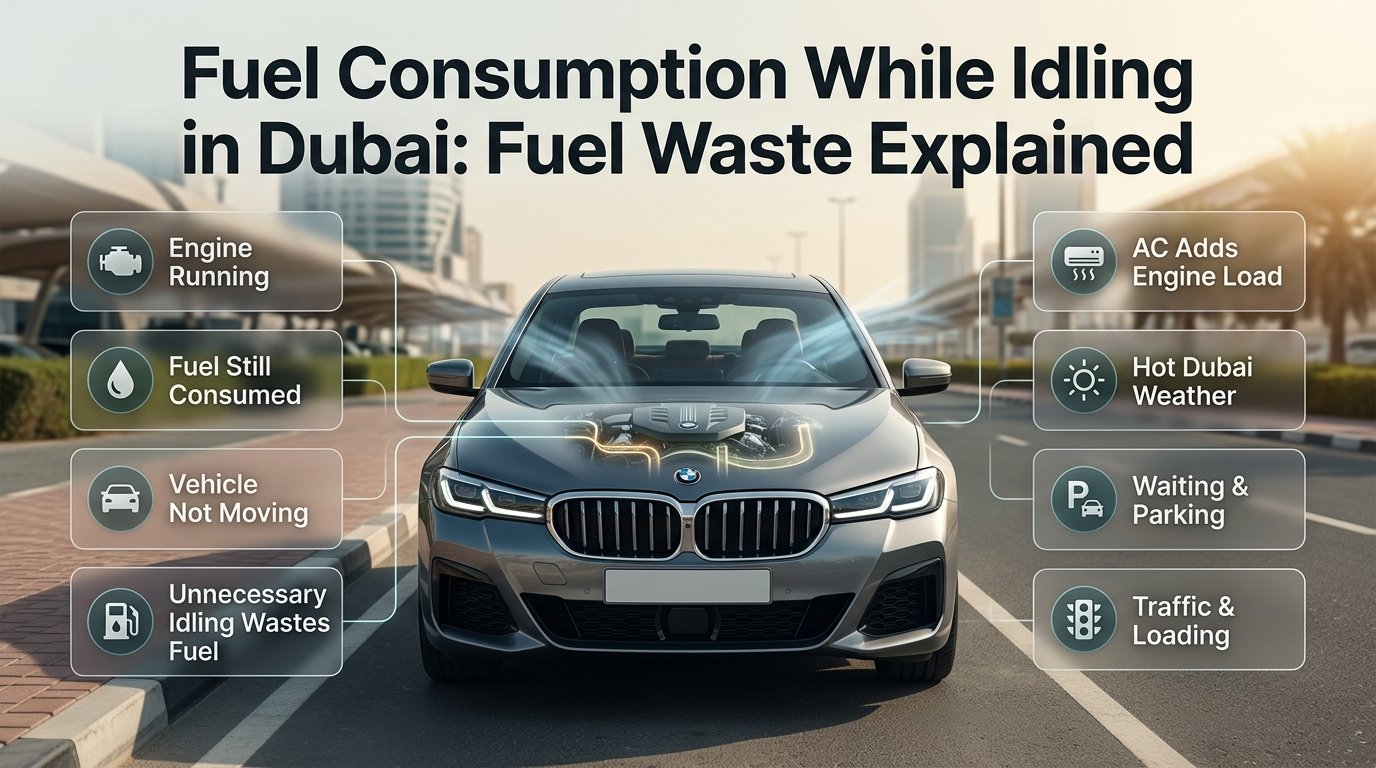
Fuel consumption while idling | Imagine you’re sitting in your car outside a shop, waiting for someone, with the engine running and the air conditioner keeping the cabin comfortable. The car isn’t moving, but the engine is still burning fuel. This is exactly where fuel consumption while idling becomes an overlooked source of wasted petrol or diesel.
Idling may seem harmless because the vehicle isn’t travelling any distance. However, the engine continues consuming fuel to keep itself running, while accessories such as the air conditioner, cooling fans, lights, and electrical systems may also demand energy.
For Dubai drivers, this can matter even more. Hot weather often means drivers leave the engine and air conditioning running while waiting, parked, loading, unloading, or sitting in traffic. Understanding these small fuel-saving opportunities can make everyday driving more efficient.
This guide explains how much fuel a car can use while idling, what affects idle fuel consumption, whether turning the engine off is always better, how air conditioning changes the situation, and which practical habits can reduce unnecessary fuel waste.
Emergency Fuel Near Me 👉 Fuel Delivery Dubai
What Is Fuel Consumption While Idling?
Fuel consumption while idling is the fuel an engine burns while the vehicle is stationary but the engine remains running. The vehicle may be in Park or Neutral, or stopped in traffic, but the engine still needs fuel to maintain its idle speed and operate necessary systems.
A modern engine doesn’t simply “wait” without using energy. It continues combustion hundreds or thousands of times per minute to keep running.
During idling, fuel is mainly used to:
- Maintain engine speed
- Operate the alternator
- Power electrical equipment
- Run the air-conditioning system
- Maintain engine and coolant temperature
- Support emissions-control systems
- Keep other engine-driven components operating
The important point is simple: zero kilometres travelled doesn’t mean zero fuel consumption.
Car Idling Fuel Consumption
Car idling fuel consumption can increase unnecessarily when the engine remains running while the vehicle is stationary. Extended idling during traffic, waiting periods, or parking consumes fuel without adding any distance to the journey. Reducing unnecessary idle time can therefore help improve overall fuel efficiency and lower fuel waste. In Dubai’s hot climate, drivers should balance fuel-saving practices with comfort and safety, especially when air conditioning is needed. Smart idling habits, combined with smooth driving, can contribute to better mileage over time.
For practical guidance on reducing unnecessary fuel use while your vehicle is stationary, 👉 Car Idling Fuel Consumption in Dubai explains how prolonged idling can affect fuel efficiency.
Why Does an Idling Engine Use Fuel?
An internal-combustion engine needs a continuous supply of fuel and air to keep producing enough power to stay running.
When your car is stationary, the engine doesn’t need to produce power for acceleration or overcoming road resistance. However, it still needs enough energy to overcome its own internal friction and operate accessories.
That’s why your fuel gauge can gradually fall even when your vehicle hasn’t moved.
Fuel-Efficient Highway Driving
Fuel-efficient highway driving focuses on maintaining a steady speed, smooth acceleration, and controlled braking throughout the journey. Avoiding excessive speed can reduce aerodynamic drag, which increases fuel consumption as speed rises. Keeping tires properly inflated and removing unnecessary weight can also support better mileage on longer trips. Using cruise control where appropriate may help maintain consistent speed on suitable roads. By combining these habits with proper vehicle maintenance, drivers can reduce fuel waste and make highway journeys more economical.
For practical tips to maintain steady speed and improve mileage on longer highway journeys, 👉 Fuel-Efficient Highway Driving offers useful guidance for more economical driving.
How Aerodynamics Affects Fuel Efficiency
Aerodynamics plays an important role in fuel efficiency, especially when a vehicle is traveling at higher speeds. As speed increases, air resistance creates more drag, requiring the engine to use additional energy to keep the vehicle moving. Features such as roof racks, cargo boxes, open windows, and bulky external accessories can increase aerodynamic drag and contribute to higher fuel consumption. Keeping the vehicle streamlined, removing unnecessary external equipment, and maintaining a sensible highway speed can help reduce resistance and support more efficient driving.
For a clearer understanding of how air resistance, vehicle design, speed, roof accessories, and external load can influence your car’s fuel consumption, explore our detailed How Aerodynamics Affects Fuel Efficiency guide.Vehicle Drag and Fuel Consumption in Dubai
How Much Fuel Does a Car Use While Idling?
There isn’t one universal figure because idle fuel consumption varies significantly between vehicles.
A small modern petrol engine may consume relatively little fuel at idle, while a larger petrol engine, diesel engine, turbocharged engine, or vehicle operating under a heavy accessory load can consume considerably more.
As a practical general range, many passenger vehicles may use roughly 0.5 to 1.5 litres of fuel per hour while idling, although actual consumption can fall below or rise above this range depending on the vehicle and conditions.
The best way to think about the number is as an estimate rather than a fixed rule.
| Vehicle situation | Typical idle tendency |
|---|---|
| Small petrol car, A/C off | Lower |
| Small petrol car, A/C running | Moderate |
| Larger petrol SUV | Higher |
| Diesel vehicle | Often relatively low, but varies |
| Hot-weather idle with strong A/C | Higher |
| Electrical accessories heavily loaded | Higher |
| Cold-start/warm-up period | Can be higher initially |
A Simple Example
Suppose your vehicle consumes approximately 1 litre per hour while idling.
If you leave it running unnecessarily for:
- 10 minutes → about 0.17 litres
- 20 minutes → about 0.33 litres
- 30 minutes → about 0.5 litres
- 60 minutes → about 1 litre
Those numbers aren’t a promise of exact consumption. They’re simply a useful way to understand how small periods of idling can accumulate.
Pro Tip: Don’t judge idling only by a single five-minute wait. Look at your total daily idling time. Ten minutes here, fifteen minutes there, and another twenty minutes in traffic can become a meaningful amount over weeks and months.
What Factors Affect Fuel Consumption While Idling?
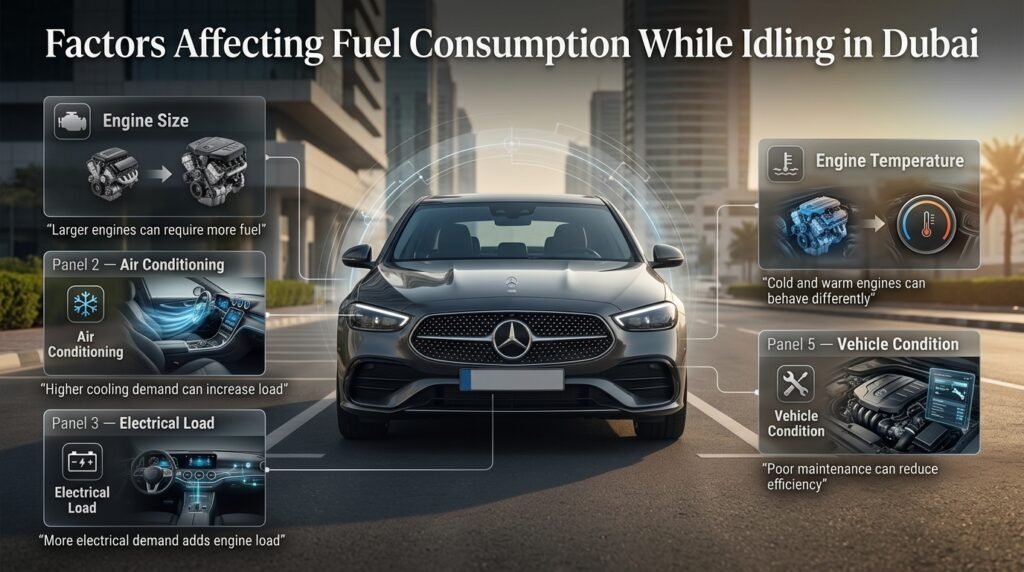
Idle fuel consumption depends on several factors, so two vehicles parked beside each other may use noticeably different amounts of fuel.
1. Engine Size
Engine displacement is one of the obvious factors.
A larger engine generally requires more fuel to maintain operation than a smaller engine, although modern engine technology makes simple engine-size comparisons imperfect.
A compact four-cylinder engine and a large six- or eight-cylinder engine won’t necessarily have the same idle fuel demand.
2. Air Conditioning
The air conditioner is particularly important in Dubai.
When the A/C compressor operates, the engine has to provide additional power. The engine management system compensates for this extra load, which can increase fuel consumption.
The hotter the conditions and the greater the cooling demand, the harder the climate-control system may have to work.
This is one reason sitting in a parked vehicle with the engine and A/C running for a long time can consume substantially more fuel than idling with the A/C switched off.
For practical tips on reducing unnecessary fuel consumption while keeping your car comfortable in Dubai’s hot climate, explore our detailed Air Conditioning and Fuel Consumption guide, which explains how AC use, traffic, idling, driving speed, and vehicle maintenance can affect overall fuel economy.
3. Electrical Load
Lights, infotainment systems, fans, heated equipment, phone chargers, and other electrical components can increase the load on the alternator.
The alternator is driven by the engine, so producing additional electrical power ultimately creates additional engine load.
The effect from an individual phone charger is usually small. The bigger issue is the combined load of multiple systems.
4. Engine Temperature
A cold engine may behave differently from a fully warmed engine.
After startup, the engine management system may temporarily adjust fuel delivery and idle speed as the engine reaches its operating temperature.
Repeatedly starting a cold engine for very short periods can therefore produce different fuel-use patterns than restarting a fully warmed engine.
5. Vehicle Condition
Poor maintenance can also affect fuel consumption.
Issues such as incorrect engine operation, malfunctioning sensors, dirty components, or other mechanical problems may cause inefficient running.
However, don’t assume every high idle-fuel figure means the engine needs a repair. Environmental conditions, engine size, A/C demand, and normal operating strategy can explain a lot of variation.
How Vehicle Weight Affects Fuel Economy
How vehicle weight affects fuel economy is most noticeable during acceleration, frequent stops, and uphill driving because a heavier vehicle requires more energy to move. Carrying unnecessary luggage, tools, or equipment can therefore increase fuel consumption and reduce mileage. Removing items that are not needed can help lower the vehicle’s workload and support better efficiency. However, weight is only one factor, alongside driving habits, tire pressure, traffic, and vehicle condition. Keeping the vehicle sensibly loaded can help make everyday and long-distance driving more economical.
For practical guidance on managing vehicle load and reducing unnecessary fuel consumption, 👉 How Vehicle Weight Affects Fuel Economy explains how excess weight can influence mileage and efficiency.
Tire Pressure and Fuel Efficiency
Tire pressure plays an important role in fuel efficiency because underinflated tires create greater rolling resistance, forcing the engine to work harder and potentially increasing fuel consumption. Maintaining the recommended tire pressure can help your vehicle roll more efficiently while also supporting better handling, braking, and tire wear. In Dubai’s hot climate, checking tire pressure regularly is especially useful because temperature changes can affect pressure readings. Always follow the vehicle manufacturer’s recommended pressure rather than relying on the maximum pressure printed on the tire sidewall
For practical guidance on maintaining the correct tire pressure, reducing unnecessary rolling resistance, and supporting better fuel economy in Dubai’s driving conditions, read our detailed Tire Pressure and Fuel Efficiency guide.
Vehicle Accessories and Fuel Economy
Vehicle accessories and fuel economy are closely connected because certain add-ons can increase aerodynamic drag, vehicle weight, or electrical load. Roof racks, cargo boxes, oversized accessories, and other external equipment may make the engine work harder, especially during highway driving. Even small changes can affect fuel consumption when they are used regularly. For better efficiency, remove unnecessary accessories when they are not needed, keep external equipment streamlined, and avoid carrying extra weight without a purpose. In Dubai, where long highway journeys and high-speed driving are common, choosing practical accessories and maintaining the vehicle properly can help support better overall fuel economy.
For a practical guide on how roof racks, cargo boxes, extra weight, larger wheels, and other accessories can influence fuel consumption, read our detailed Vehicle Accessories and Fuel Economy in Dubai guide before choosing or removing accessories from your vehicle.
Vehicle Drag and Fuel Consumption in Dubai
Vehicle drag can have a significant effect on fuel consumption, particularly as driving speed increases. Aerodynamic resistance becomes more noticeable on highways, meaning vehicles may need more engine power to maintain higher speeds. Roof racks, cargo boxes, open windows at high speeds, and bulky external accessories can increase drag and reduce efficiency further. In Dubai, where drivers often use high-speed roads for longer journeys, keeping the vehicle streamlined and removing unnecessary external equipment can help reduce aerodynamic resistance. Combining good aerodynamics with moderate speeds and smooth driving can support better overall fuel economy.
For a deeper understanding of how aerodynamic resistance, driving speed, roof equipment, external cargo, wind, and vehicle design can influence fuel consumption, explore our detailed Vehicle Drag and Fuel Consumption in Dubai guide.
Fuel-Efficient Use of Automatic Transmission
Using an automatic transmission efficiently can help reduce unnecessary fuel consumption, especially during Dubai’s busy traffic and frequent stop-and-go driving. Avoid aggressive acceleration, sudden braking, and repeatedly switching between Drive and other gears when it is not necessary. When waiting for longer periods, follow the vehicle manufacturer’s guidance rather than keeping the engine unnecessarily engaged. Regular transmission maintenance and using the correct manufacturer-recommended fluid can also support smooth gear changes and efficient vehicle operation. The key is to let the transmission work naturally while maintaining a smooth, predictable driving style.
For practical guidance on using an automatic transmission more efficiently, including smooth acceleration, proper gear modes, traffic management, and highway driving habits, explore our detailed Fuel-Efficient Use of Automatic Transmission guide.
Car Load and Fuel Consumption
Car load and fuel consumption are closely connected because extra weight can make the engine work harder, especially during acceleration, uphill driving, and frequent stops. Carrying unnecessary luggage, tools, or equipment may gradually increase fuel consumption and reduce mileage. Removing items that are not needed can help reduce the vehicle’s workload and support better efficiency. However, driving style, tire pressure, traffic, and vehicle condition also affect fuel economy. Keeping your car sensibly loaded is a simple way to support more economical driving.
For practical guidance on managing vehicle load and minimizing fuel waste, 👉 Car Load and Fuel Consumption explains how excess weight can affect fuel efficiency.
Does Idling Use More Fuel Than Driving?
Idling uses fuel without producing useful travel, which makes it particularly wasteful when the vehicle is stationary for an unnecessary period. However, whether idling uses more fuel per hour than driving depends on the vehicle and driving conditions.
Driving obviously requires additional energy because the engine must move the vehicle and overcome rolling resistance, aerodynamic drag, road gradients, and acceleration demands.
But idling has a different problem: you’re consuming fuel while gaining zero distance.
Consider this:
A vehicle travelling efficiently might use fuel to cover 10 kilometres. A stationary vehicle may use fuel for ten minutes and cover absolutely nothing.
That’s why reducing unnecessary idling can improve overall fuel economy even if the engine’s hourly idle consumption appears small.
Idling in Dubai Traffic: Why It Matters
Dubai driving can involve congested roads, traffic signals, queues, parking areas, pickup zones, and long periods of stop-and-go movement.
Some idling is unavoidable.
For example, stopping temporarily at a traffic signal is part of normal driving. You shouldn’t create unsafe situations simply to avoid using fuel.
How Traffic Affects Fuel Economy
How traffic affects fuel economy becomes particularly important when frequent stops, slow movement, and repeated acceleration increase the engine’s workload. Stop-and-go conditions can waste fuel because the vehicle repeatedly uses energy to accelerate and then loses that momentum through braking. Long waits may also lead to unnecessary idling, further increasing fuel consumption. Maintaining a safe following distance and anticipating traffic changes can help reduce sudden speed adjustments. By driving smoothly and planning routes carefully, drivers can improve fuel economy even in busy traffic conditions.
For practical ways to reduce fuel waste in congested conditions, 👉 How Traffic Affects Fuel Economy in Dubai explains how traffic patterns and driving habits can influence fuel efficiency.
The bigger opportunity is unnecessary stationary idling.
Examples include:
- Waiting outside a school with the engine running
- Sitting in a parking space while waiting for someone
- Leaving the engine running during a long pickup
- Keeping the vehicle running while loading or unloading for an extended period
- Waiting outside a shop or restaurant
- Running the A/C while parked for comfort when there’s no immediate need to remain in the vehicle
If you regularly spend long periods waiting in the car, reducing unnecessary idle time can make a more noticeable difference.
For broader fuel-saving habits, see Fuel-Saving Driving Tips.
Gear Shifting and Fuel Economy in Dubai
Gear shifting has a direct impact on how efficiently a vehicle uses fuel, particularly in Dubai’s busy traffic and changing road conditions. Driving in the appropriate gear helps keep the engine operating within an efficient range, while unnecessarily high engine speeds or using the wrong gear can increase fuel consumption. Manual drivers can improve efficiency by shifting smoothly and selecting the appropriate gear for their speed and road conditions. Automatic transmissions generally manage gear changes themselves, but smooth acceleration and avoiding unnecessary aggressive driving can still support better fuel economy.
For a practical understanding of how to choose the right gear, avoid unnecessary engine strain, and improve fuel efficiency in Dubai’s city traffic and highway conditions, read our detailed Gear Shifting and Fuel Economy in Dubai guide.
Stop and Go Driving Fuel Efficiency
Stop and go driving fuel efficiency can be reduced by frequent acceleration, braking, and repeated stops in congested traffic. Each acceleration from a standstill requires additional engine power, while frequent braking wastes momentum that could otherwise support better mileage. Maintaining a safe following distance and anticipating traffic flow can help reduce unnecessary speed changes. Smooth, controlled driving is generally more efficient than aggressive stop-and-start movements. These habits can help minimize fuel waste and improve overall fuel economy in busy driving conditions.
For practical strategies to reduce fuel waste during repeated stops and starts, 👉 Stop and Go Driving Fuel Efficiency offers useful guidance for smoother, more economical driving.
Should You Turn Off Your Engine When Waiting?
In many situations, turning the engine off during a longer stationary wait can prevent unnecessary fuel consumption.
But the decision should consider safety, traffic conditions, vehicle requirements, and the expected waiting time.
Turn the Engine Off When:
- You’re safely parked.
- You expect to wait for several minutes.
- You don’t need continuous climate control.
- You’re loading or waiting in a safe location.
- Local traffic rules and conditions allow it.
Keep the Engine Running When:
- You’re stopped briefly in normal traffic.
- Turning it off would interfere with safe traffic movement.
- Your vehicle’s manufacturer specifically recommends otherwise in a particular situation.
- You need essential vehicle systems operating for safety.
- You’re in a situation where restarting could create a hazard.
Modern vehicles are generally designed to handle normal engine starting cycles. Many are also equipped with automatic start-stop systems specifically intended to reduce unnecessary idling.
Expert Tip: Don’t turn the engine off and on repeatedly every few seconds. The goal isn’t to eliminate every second of idling. The goal is to avoid meaningful periods of unnecessary stationary running.
What About Automatic Start-Stop Systems?
Automatic start-stop technology is designed to switch the engine off when the vehicle is stationary under suitable conditions and restart it when the driver is ready to move.
The system doesn’t simply shut the engine down randomly. It considers various conditions, which can include battery state, engine temperature, climate-control demand, and driving conditions.
The exact operating strategy differs by manufacturer.
A start-stop system can therefore reduce fuel wasted during repeated stops, particularly in urban driving.
However, drivers shouldn’t try to imitate the system manually in situations where doing so compromises comfort, safety, or normal vehicle operation.
Does Idling With the AC Use More Fuel?
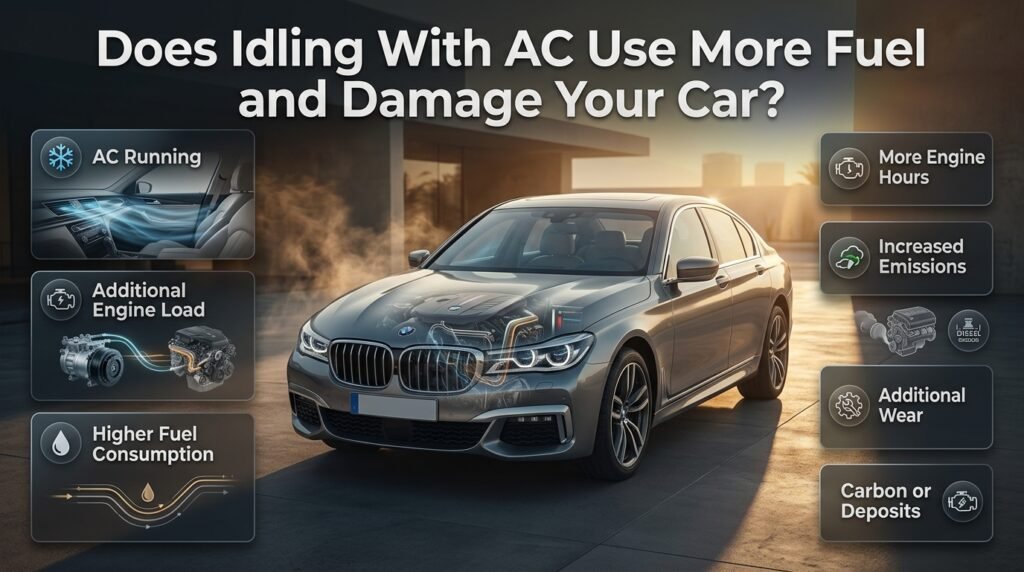
Yes, running the air conditioner while idling generally increases fuel consumption compared with idling without the A/C, because the engine has to provide additional power for the climate-control system.
This effect becomes especially relevant in hot climates such as Dubai.
When the cabin is extremely hot, the A/C system may initially work harder to reduce the interior temperature. Once the cabin reaches the desired temperature, the system’s load can change.
The exact fuel penalty depends on:
- Outside temperature
- Cabin temperature
- A/C setting
- Vehicle size
- Compressor design
- Engine type
- Fan speed
- Vehicle insulation
- Overall climate-control strategy
If you’re safely parked and waiting for a long time, shutting the engine off can eliminate the fuel being consumed during that idle period. But never sacrifice personal safety in extreme heat or other hazardous conditions.
Does Idling Damage a Car?
Short periods of normal idling generally aren’t a reason to panic. Cars are designed to idle.
However, excessive or prolonged idling isn’t an ideal operating habit.
Long periods of idling can contribute to:
- Unnecessary fuel consumption
- Additional engine running hours
- Increased emissions
- Additional wear over the vehicle’s lifetime
- Carbon or deposit-related concerns in certain operating conditions
Diesel engines can have additional considerations because emissions-control systems may behave differently during low-load operation.
The practical takeaway isn’t “never idle.” It’s to avoid idling longer than necessary.
Idling vs Driving: A Practical Comparison
| Situation | Fuel-use concern | Best approach |
| Brief traffic stop | Low practical concern | Remain ready to move |
| Long red-light delay | Moderate | Follow vehicle/start-stop strategy |
| Waiting 10–20 minutes | Significant unnecessary use | Consider switching off safely |
| Waiting 30+ minutes | High unnecessary use | Avoid continuous idling where practical |
| Parked with A/C running | Higher | Switch off if safe and appropriate |
| Heavy congestion | Unavoidable to some extent | Focus on smooth driving |
| Pickup/drop-off queue | Often avoidable | Reduce unnecessary engine-on time |
How Highway Speed Affects Fuel Consumption
How highway speed affects fuel consumption is mainly related to aerodynamic drag and the engine’s workload. As speed increases, the vehicle needs more energy to overcome air resistance, which can raise fuel consumption. Maintaining a steady, moderate speed is generally more efficient than driving at excessive speeds or constantly changing speed. Smooth acceleration and controlled braking can further reduce unnecessary fuel use. By following speed limits and maintaining consistent highway speeds, drivers can improve mileage and make longer journeys more fuel-efficient.
For practical insight into how speed choices can influence fuel use, 👉 How Highway Speed Affects Fuel Consumption provides useful guidance for more efficient highway driving.
How to Reduce Fuel Consumption While Idling
You don’t need complicated techniques. A few practical habits can make a difference.
How to Reduce Fuel Use in Traffic
How to reduce fuel use in traffic starts with smoother acceleration, gentle braking, and avoiding unnecessary engine idling. Maintaining a safe following distance gives you more time to anticipate traffic changes and reduces repeated stop-and-go movements. Planning your route to avoid severe congestion when practical can also limit wasted fuel and travel time. Keeping your vehicle properly maintained, including correct tire pressure, further supports efficient driving. By adopting these simple habits, drivers can reduce unnecessary fuel consumption and improve everyday fuel economy.
For practical strategies to save fuel during congested journeys, 👉 How to Reduce Fuel Use in Traffic provides useful guidance for more efficient traffic driving.
Roof Racks and Fuel Economy
Roof racks and fuel economy are closely connected because external equipment can increase aerodynamic drag and make the engine work harder, particularly at highway speeds. An empty roof rack may still affect airflow, while loaded racks, roof boxes, or bulky equipment can increase resistance even further. Removing the rack when it is not needed can help reduce unnecessary drag and support better fuel efficiency. Proper installation and sensible loading are also important for maintaining stable airflow and avoiding unnecessary fuel consumption during longer journeys.
For practical guidance on reducing aerodynamic drag and improving efficiency when using roof-mounted equipment, 👉 Roof Racks and Fuel Economy explains how roof racks can influence fuel consumption.
1. Plan Waiting Time
If you know you’ll be waiting for someone, consider whether you actually need the engine running.
If the vehicle is safely parked and the wait is going to be several minutes, switching the engine off may be more sensible than allowing it to run continuously.
2. Avoid “Just Leave It Running”
Many drivers develop the habit of leaving the engine running automatically whenever they stop.
Ask yourself:
Am I actually driving right now, or am I simply waiting?
That simple question can prevent a surprising amount of unnecessary fuel use.
3. Use the Vehicle’s Start-Stop System Properly
If your car has automatic start-stop technology, understand how it works instead of immediately disabling it.
If the system temporarily refuses to stop the engine, there may be a legitimate reason, such as climate-control demand or battery conditions.
4. Reduce Unnecessary Waiting
Planning your pickup, parking, and loading activities can reduce stationary engine time.
For example, if you’re waiting for someone who hasn’t arrived yet, parking safely and switching the engine off can be more efficient than sitting with the A/C running continuously.
5. Combine Trips
Reducing unnecessary journeys can have a larger effect than obsessing over a few minutes of idling.
Combine errands where practical and plan routes before leaving.
For more driving-related fuel savings, see Fuel-Efficient Driving Techniques.
Common Mistakes Drivers Make
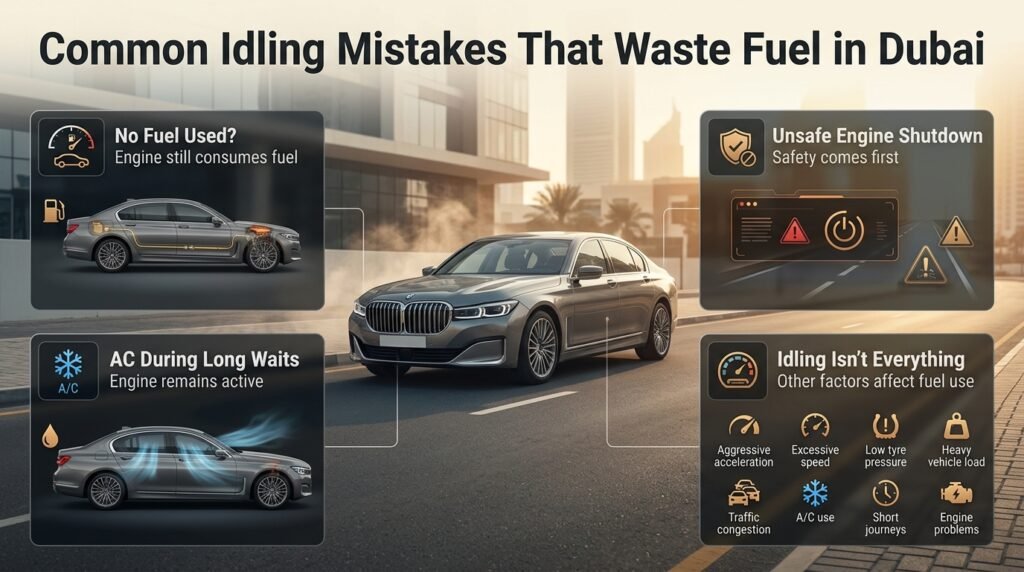
Mistake 1: Assuming a Stationary Car Uses No Fuel
The car isn’t moving, so some drivers assume the engine isn’t consuming fuel.
Why it happens: Fuel economy is often measured in kilometres per litre, making stationary consumption less obvious.
How to avoid it: Think in terms of fuel used per hour when discussing idling.
Mistake 2: Leaving the A/C Running During Long Waits
This is particularly common in hot climates.
Why it matters: The engine remains active and must support the A/C system.
Better approach: If you’re safely parked and don’t need climate control, switch the engine off.
Mistake 3: Turning the Engine Off During Unsafe Situations
Fuel savings should never override safety.
Why it happens: Drivers may become too focused on eliminating fuel consumption.
Better approach: Safety comes first. Reduce idling where it is genuinely unnecessary and safe to do so.
Mistake 4: Blaming Idling for Every Fuel-Economy Problem
High fuel consumption can have many causes.
Potential factors include:
- Aggressive acceleration
- Excessive speed
- Low tyre pressure
- Heavy vehicle load
- Poor maintenance
- Traffic congestion
- A/C use
- Short journeys
- Engine problems
If you want to understand driving behaviour more broadly, read How Acceleration Affects Fuel Consumption in Dubai.
How Can You Estimate Your Own Idle Fuel Consumption?
If you want a more realistic number for your specific car, avoid relying entirely on generic online figures.
Your vehicle’s actual idle consumption can be estimated using controlled observation.
Simple Method
- Start with the engine fully warmed up.
- Park safely in an appropriate location.
- Record the fuel level or use the vehicle’s fuel-consumption data if available.
- Let the vehicle idle for a measured period.
- Record the fuel change where your vehicle’s measurement system is accurate enough.
- Repeat under different conditions, such as A/C on and off.
- Compare the results.
A short test may not be accurate enough because dashboard fuel gauges aren’t precision measuring instruments.
For a better estimate, use repeated observations or manufacturer/service diagnostic data.
Quick Tip: If your vehicle provides an instantaneous fuel-consumption display, remember that some systems aren’t designed to provide a precise idle-fuel measurement. Treat the reading as an indication, not laboratory data.
A Practical Idle-Fuel Reduction Checklist
- Avoid unnecessary engine-on waiting.
- Switch off safely during longer stationary periods.
- Don’t leave the A/C running simply out of habit.
- Use automatic start-stop technology as intended.
- Plan pickups and drop-offs to reduce waiting.
- Maintain correct tyre pressure.
- Keep the engine properly maintained.
- Avoid aggressive acceleration after leaving a stop.
- Combine short trips when practical.
- Monitor your overall fuel consumption rather than one isolated event.
How Idling Fits Into Overall Fuel Economy
Idling is only one part of the fuel-efficiency picture.
A driver can reduce idle time but still waste considerable fuel through aggressive acceleration, excessive speed, unnecessary braking, poor tyre pressure, or inefficient trip planning.
That’s why fuel economy should be treated as a complete driving system.
For example:
Unnecessary idling → wasted fuel
Hard acceleration → increased fuel demand
Unnecessary braking → lost momentum
Repeated acceleration → fuel used to rebuild speed
Poor tyre pressure → increased rolling resistance
These behaviours can interact with each other.
If you’re working on overall economy, our guide to Smooth Driving Techniques for Better Fuel Economy in Dubai can help you build better habits beyond idling.
How Braking and Speed Also Affect Fuel Use
Reducing idle time shouldn’t become the only goal.
For example, a driver might save fuel by switching off during a long wait but then lose those savings through repeated hard acceleration and braking throughout the journey.
Smooth driving is generally more useful than focusing on a single fuel-saving trick.
Likewise, driving faster can increase aerodynamic resistance significantly, while repeated braking throws away some of the momentum you’ve already created.
You can learn more about this in How Braking Habits Affect Fuel Economy in Dubai and Optimal Driving Speed for Fuel Efficiency in Dubai.
Highway Driving Fuel Efficiency
Highway driving fuel efficiency improves when you maintain a steady, moderate speed and avoid unnecessary acceleration or braking. Consistent cruising helps the engine operate more efficiently, while excessive speed can increase aerodynamic drag and fuel consumption. Keeping tires properly inflated, reducing unnecessary vehicle weight, and using air conditioning sensibly can also support better mileage. Following posted speed limits and driving smoothly throughout the journey can help reduce fuel waste. These simple habits make long highway trips more economical and fuel-efficient.
For practical strategies to maintain better mileage and reduce fuel consumption on highways, 👉 Highway Driving Fuel Efficiency provides a useful guide for more economical driving.
Improving Fuel Economy on Long Trips
Improving fuel economy on long trips starts with maintaining a steady speed and avoiding sudden acceleration or unnecessary braking. Before departure, check tire pressure, remove excess weight, and ensure the vehicle is properly maintained. Planning the route can also help reduce detours, congestion, and unnecessary fuel use. Using air conditioning sensibly and avoiding prolonged idling during stops can further support better mileage. These practical habits can make long-distance journeys smoother, more economical, and fuel-efficient.
For practical strategies to reduce fuel consumption and improve mileage on extended journeys, 👉 Improving Fuel Economy on Long Trips offers useful guidance for more economical long-distance driving.
Long-Distance Driving Fuel Efficiency Tips
Long-distance driving fuel efficiency tips can help you achieve better mileage while reducing unnecessary fuel consumption on extended journeys. Maintain a steady speed, accelerate smoothly, and avoid frequent braking whenever traffic conditions allow. Before starting the trip, check tire pressure, remove unnecessary cargo, and make sure the vehicle is properly maintained. Planning your route and fuel stops can also reduce detours and inefficient driving. These simple practices can make long-distance travel more economical, comfortable, and fuel-efficient.
For practical ways to improve mileage and reduce fuel waste during extended journeys, 👉 Long-Distance Driving Fuel Efficiency Tips provides useful guidance for more economical driving.
How Much Fuel Does a Car Use While Idling?
A car continues to burn fuel whenever its internal-combustion engine is running, even if the vehicle is completely stationary. The exact amount depends on engine size, fuel type, engine temperature, idle speed, and the electrical or mechanical load placed on the engine. As a broad practical estimate, many passenger cars use around 0.4 to 1.0 litres of fuel per hour while idling, although smaller engines can use less and larger vehicles can use considerably more.
The important issue isn’t just the amount consumed in one hour. It’s the fact that the vehicle is using fuel while covering zero distance. Repeated waiting periods can therefore reduce your real-world fuel economy.
A 15-minute idle period can use roughly 0.1–0.25 litres in many passenger cars.
A 30-minute wait can potentially use around 0.2–0.5 litres.
Larger engines and heavy accessory loads can consume more.
Professional tip: Don’t rely on one universal litre-per-hour figure for every vehicle. Engine size and operating conditions make a significant difference, so use these numbers as planning estimates rather than exact measurements.
How Much Fuel Does a Car Use While Idling With the AC On?
Running the air conditioner while the engine is idling generally increases fuel consumption because the A/C system places an additional load on the engine. The compressor requires energy, so the engine has to work harder to maintain its operation while also powering the vehicle’s other systems.
This is particularly important in Dubai, where high temperatures can require continuous air conditioning during long periods of stationary waiting. Sitting in a parked car with the A/C running for an extended time can therefore consume considerably more fuel than simply idling without the A/C.
Factors that affect A/C-related fuel consumption include:
Outside temperature
Cabin temperature
Engine size
A/C compressor design
Climate-control settings
Vehicle condition
Cooling demand
Expert advice: If you’re safely parked and expect to wait for a long period, switching the engine off can prevent unnecessary fuel consumption. However, never compromise safety or personal comfort in extreme heat simply to save a small amount of fuel.
Is It Better to Turn Off the Engine During Long Idling?
For a longer stationary wait, switching the engine off generally prevents the fuel that would otherwise be consumed while idling. This is especially useful when you’re parked safely and don’t need the engine running for immediate movement or essential vehicle functions.
However, there’s no need to switch the engine off during every brief stop. A short traffic signal, temporary congestion, or momentary stop is different from sitting in a parking area for 20 or 30 minutes.
A practical approach is:
Brief traffic stop: Follow normal driving and safety requirements.
Long stationary wait: Consider switching the engine off when safe.
Waiting for passengers: Avoid unnecessary engine-on waiting.
Parked outside a shop: Turn the engine off if you expect a long wait.
Vehicles with start-stop: Allow the system to manage suitable stops automatically.
The goal isn’t to eliminate every second of idling. It’s to reduce unnecessary prolonged idling.
Does Idling With the AC On Waste More Fuel Than Idling Without AC?
Yes. In conventional petrol and diesel vehicles, using the A/C while idling normally increases fuel consumption because the compressor adds load to the engine. This additional demand can be particularly noticeable when the vehicle is stationary because the engine is operating at relatively low power.
The amount of extra fuel used isn’t identical for every car. A compact car and a large SUV can have very different A/C and engine loads, especially in extremely hot weather.
The main factors include:
Engine displacement
Outside temperature
Cabin temperature
Compressor efficiency
A/C settings
Vehicle design
Engine condition
For Dubai drivers, prolonged stationary A/C use is therefore worth considering when looking for ways to reduce unnecessary fuel consumption.
Quick tip: Don’t worry excessively about small electrical accessories. The bigger issue is allowing the engine and A/C system to run for long periods when the vehicle isn’t actually being driven.
How Can I Reduce Fuel Consumption While My Car Is Idling?
The most effective approach is to reduce unnecessary engine-running time when the vehicle isn’t moving. You don’t need complicated techniques. Start by identifying situations where the engine is running simply out of habit.
For example, if you’re waiting outside a shop, sitting in a pickup area before your passenger arrives, or parked safely while waiting for someone, consider whether the engine really needs to remain running.
Practical ways to reduce idle fuel consumption include:
Switch the engine off during longer safe waiting periods.
Avoid unnecessary A/C operation while parked.
Use automatic start-stop technology as intended.
Plan pickups and drop-offs to minimise waiting.
Avoid unnecessary warm-up idling.
Keep the engine properly maintained.
Monitor your overall fuel consumption over time.
Professional approach: Don’t try to eliminate unavoidable traffic idling. Focus on the idle time you can actually control. A few minutes may seem insignificant once, but repeated every day can add up to meaningful fuel consumption and unnecessary expense.
Conclusion
Fuel consumption while idling may seem like a small issue, but repeated unnecessary idling can gradually increase fuel use, especially when the engine is running with the air conditioner in Dubai’s hot weather. A stationary vehicle still burns fuel even though it isn’t covering any distance.
The practical solution isn’t to switch off the engine at every traffic light or brief stop. Instead, focus on longer periods when you’re safely parked and simply waiting. Turning the engine off when appropriate, reducing unnecessary A/C operation, using start-stop technology correctly, and avoiding habitual engine-on waiting can help reduce wasted fuel.
For better results, combine idle reduction with other efficient driving habits such as smooth acceleration, sensible speeds, proper tyre pressure, and regular vehicle maintenance. For more practical guidance, explore Fuel Delivery Dubai and its fuel-efficiency resources.
The key is simple: if the car isn’t moving and the engine doesn’t need to be running, unnecessary idling is fuel you could avoid wasting.
Leave a Reply