Introduction
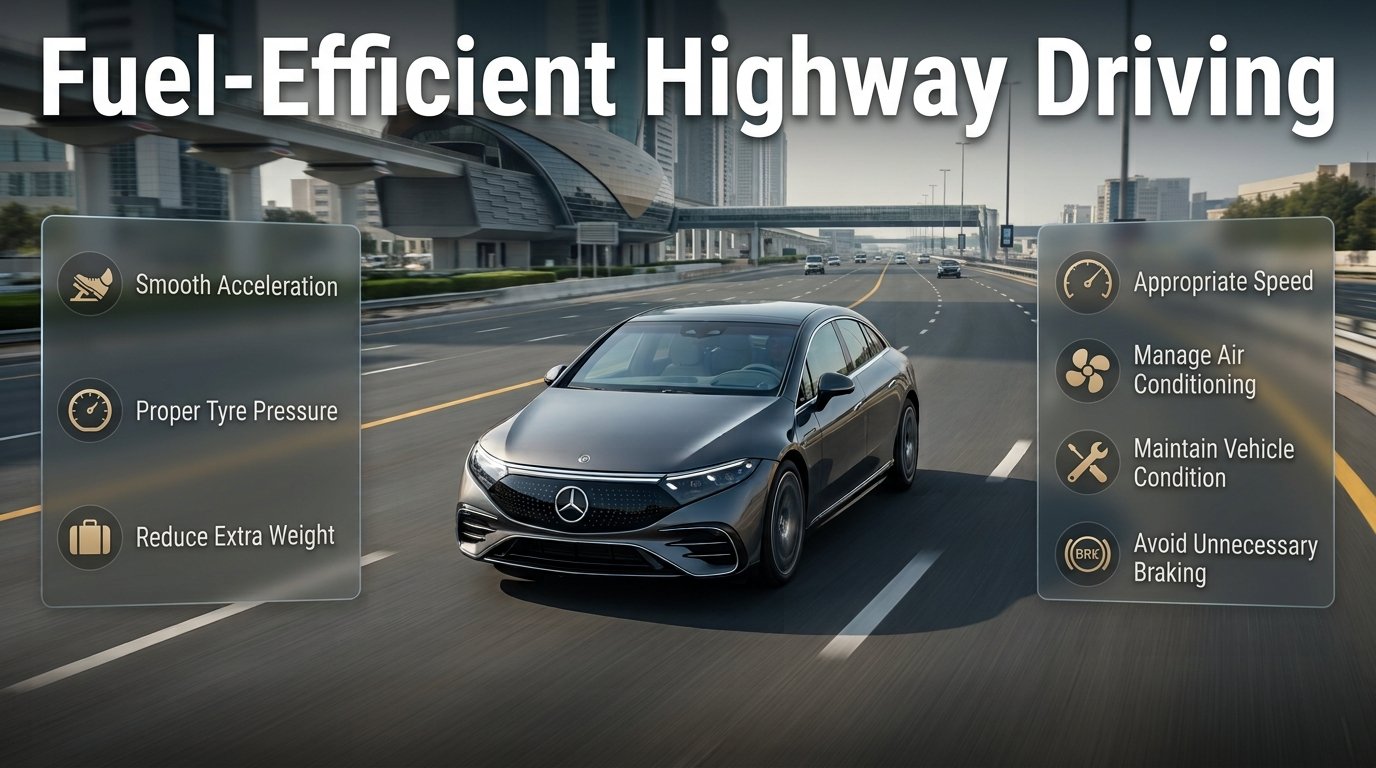
Fuel-Efficient Highway Driving | A long highway trip can look easy on the fuel gauge: steady speed, fewer stops, and plenty of open road. Yet many drivers are surprised when their vehicle uses more fuel than expected. High speeds, aggressive acceleration, unnecessary braking, low tyre pressure, extra weight, strong air-conditioning use, and poor vehicle condition can all reduce fuel economy.
Fuel-efficient highway driving is about getting more distance from the fuel you already have without driving dangerously or unrealistically slowly. The goal isn’t to make every trip painfully cautious. Instead, it’s to reduce the driving habits and vehicle conditions that make the engine work harder than necessary.
In this guide, you’ll learn how highway speed affects fuel consumption, how to accelerate and brake efficiently, whether cruise control can help, how tyre pressure and air conditioning influence fuel economy, what common mistakes waste fuel, and how to build a practical fuel-saving routine before every long drive.
For more general fuel-saving guidance, visit Fuel Delivery to My Location 👉 Fuel Delivery Dubai and explore its related guide to fuel-saving driving tips.
What Is Fuel-Efficient Highway Driving?
Fuel-efficient highway driving means operating a vehicle in a way that reduces unnecessary fuel consumption while maintaining a safe, legal, and comfortable driving speed. The biggest factors usually include speed, acceleration, braking, traffic flow, tyre condition, vehicle load, road conditions, and climate-control use.
The important point is that fuel efficiency isn’t simply about driving slowly. A vehicle can be inefficient at very low speeds in some situations, just as it can become significantly less efficient at high highway speeds.
A good highway-driving strategy keeps the vehicle moving smoothly, avoids unnecessary changes in speed, and uses the engine and transmission in an appropriate operating range.
💡 Pro Tip: The most useful fuel-saving habit on a highway is often anticipation. Looking farther ahead gives you more time to respond smoothly instead of accelerating hard and braking suddenly.
Why Does Highway Driving Affect Fuel Economy?
Highway driving can be more efficient than urban driving because there are generally fewer stops, less idling, and fewer repeated acceleration events. Once a vehicle reaches a steady cruising speed, the engine doesn’t have to repeatedly overcome the energy losses associated with stopping and accelerating from low speed.
However, highway driving introduces another major factor: aerodynamic drag.
As speed increases, aerodynamic resistance becomes increasingly important. The engine must produce more power to push the vehicle through the air. This means a modest increase in cruising speed can have a noticeable effect on fuel consumption.
Other factors also matter:
- Headwinds increase aerodynamic resistance.
- Roof racks and open windows can increase drag.
- Low tyre pressure increases rolling resistance.
- Heavy loads require more energy.
- Frequent overtaking can cause repeated acceleration.
- Strong air-conditioning demand adds engine or electrical load.
- Hills require additional power.
- Poor maintenance can reduce overall efficiency.
This is why two drivers travelling the same highway at similar distances can finish with very different fuel consumption.
Improving Fuel Economy on Long Trips in Dubai
Improving fuel economy on long trips in Dubai starts with preparing the vehicle before you leave and maintaining efficient driving habits throughout the journey. Check tire pressure, remove unnecessary luggage, and make sure the engine and other essential systems are properly maintained. During the trip, maintain a steady and sensible speed, avoid aggressive acceleration and unnecessary braking, and use cruise control when road and traffic conditions allow. Reducing aerodynamic drag by removing unused roof racks or bulky external equipment can also help, particularly on highways. These simple practices can reduce unnecessary fuel use and make long-distance driving more efficient and predictable.
Planning a long-distance journey? Our detailed Improving Fuel Economy on Long Trips in Dubai guide offers practical advice on vehicle preparation, steady-speed driving, route planning, reducing aerodynamic drag, and managing fuel consumption more efficiently throughout your trip.
What Speed Is Best for Fuel Efficiency on the Highway?
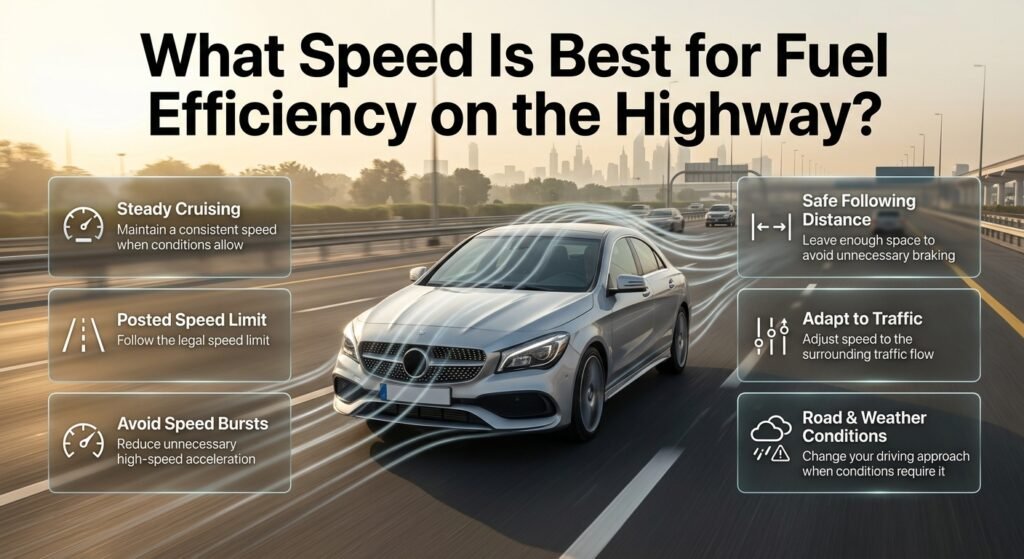
There isn’t one universal speed that produces the best fuel economy for every car. The efficient range depends on the vehicle’s engine, transmission, aerodynamics, tyres, road conditions, load, and legal speed limit.
In general, fuel consumption tends to rise as highway speed becomes higher because aerodynamic drag increases rapidly with speed. Driving at a sensible, consistent speed within the posted limit is usually more efficient than travelling significantly faster.
For a deeper explanation, read Optimal Driving Speed for Fuel Efficiency in Dubai.
Why Higher Speed Uses More Fuel
Imagine two drivers on the same highway.
Driver A maintains a steady legal cruising speed.
Driver B repeatedly accelerates beyond the normal traffic flow, brakes, then accelerates again to regain speed.
Even if both eventually cover the same distance, Driver B is likely to use more fuel because the vehicle repeatedly requires additional energy to accelerate.
At higher speeds, aerodynamic resistance also becomes increasingly significant. The faster the vehicle moves through the air, the more power is required to maintain that speed.
Should You Drive Below the Speed Limit to Save Fuel?
Not automatically.
Driving substantially below the normal flow of traffic can create safety problems and may not be appropriate for the road. Fuel efficiency should never be pursued at the expense of safe traffic participation.
A better approach is to:
- Follow the posted speed limit.
- Maintain a steady speed when conditions allow.
- Avoid unnecessary high-speed bursts.
- Keep a safe following distance.
- Adjust speed for traffic, weather, and road conditions.
How Acceleration Affects Highway Fuel Economy
Hard acceleration demands more power from the engine and can increase fuel consumption. The issue isn’t acceleration itself—every vehicle must accelerate to reach cruising speed—but unnecessary or aggressive acceleration.
A smooth acceleration pattern is usually more efficient than repeatedly pressing the accelerator hard and then immediately braking.
For a more detailed explanation, see How Acceleration Affects Fuel Consumption in Dubai.
How Aerodynamics Affects Fuel Efficiency
Aerodynamics plays an important role in fuel efficiency, especially when a vehicle is traveling at higher speeds. As speed increases, air resistance creates more drag, requiring the engine to use additional energy to keep the vehicle moving. Features such as roof racks, cargo boxes, open windows, and bulky external accessories can increase aerodynamic drag and contribute to higher fuel consumption. Keeping the vehicle streamlined, removing unnecessary external equipment, and maintaining a sensible highway speed can help reduce resistance and support more efficient driving.
For a clearer understanding of how air resistance, vehicle design, speed, roof accessories, and external load can influence your car’s fuel consumption, explore our detailed How Aerodynamics Affects Fuel Efficiency guide.
How Highway Speed Affects Fuel Consumption
Highway speed has a significant effect on fuel consumption because aerodynamic resistance increases as a vehicle travels faster. At moderate speeds, the engine can often operate more efficiently, while driving at very high speeds requires substantially more energy to overcome air resistance. Frequent speed changes, rapid acceleration, and unnecessary overtaking can also increase fuel use. On Dubai highways, maintaining a steady and sensible speed, following posted speed limits, and using cruise control where appropriate can help reduce unnecessary fuel consumption and make long-distance driving more efficient.
To understand how different highway speeds, aerodynamic drag, acceleration, and driving consistency can influence your vehicle’s fuel consumption, explore our detailed How Highway Speed Affects Fuel Consumption guide before your next long-distance journey.
The Better Highway Acceleration Pattern
When entering a highway or passing slower traffic:
- Accelerate smoothly.
- Reach an appropriate speed efficiently.
- Avoid holding unnecessarily high engine speed.
- Once at cruising speed, settle into a steady pace.
- Don’t accelerate simply because an open space appears ahead.
The objective is controlled acceleration rather than extremely slow acceleration.
Expert Tip: Taking too long to reach cruising speed isn’t necessarily efficient. The best approach is smooth, purposeful acceleration followed by steady cruising.
How Braking Habits Affect Fuel Economy
Every time a vehicle accelerates, it uses energy. When you brake, much of the vehicle’s kinetic energy is converted into heat through the braking system.
That doesn’t mean you should avoid braking when safety requires it. It means unnecessary braking followed by unnecessary acceleration should be reduced.
How Braking Habits Affect Fuel Economy in Dubai explains this relationship in more detail.
Look Farther Ahead
One of the simplest techniques is to scan the road well ahead.
If you see:
- Slowing traffic
- A developing queue
- A red light at an upcoming exit
- A vehicle merging
- A lane reduction
- Congestion forming ahead
you can often ease off the accelerator early instead of maintaining speed until the last moment.
This doesn’t mean coasting blindly or delaying necessary braking. It means using better observation to reduce unnecessary speed changes.
Does Cruise Control Save Fuel?
Cruise control can help fuel economy when road conditions allow it because it can maintain a relatively consistent speed. It is most useful on roads that are reasonably open, flat, and predictable.
However, cruise control isn’t automatically more efficient in every situation.
Cruise Control Works Best When:
- Traffic is light.
- The road is relatively flat.
- Speed limits are consistent.
- Weather conditions are good.
- You can remain attentive.
- Frequent speed adjustments aren’t necessary.
Cruise Control May Be Less Useful When:
- Traffic is heavy.
- The road has frequent steep hills.
- Conditions are wet or slippery.
- Traffic speed changes constantly.
- You need frequent overtaking.
- The system causes unnecessary acceleration to maintain speed.
Modern adaptive cruise control can behave differently depending on its settings and vehicle design. It may accelerate and brake automatically as traffic changes, so its fuel effect depends heavily on how it operates in real conditions.
Does Air Conditioning Reduce Highway Fuel Economy?
Yes, air conditioning can increase energy consumption, although the effect varies significantly by vehicle, outside temperature, system design, cabin temperature, and driving conditions.
In very hot climates, such as Dubai, air conditioning can be an important part of everyday driving rather than an occasional luxury.
The practical solution isn’t necessarily to turn the system off and become uncomfortable. Instead:
- Use a sensible cabin temperature.
- Avoid unnecessary maximum cooling for long periods.
- Use recirculation when appropriate.
- Park in shade when possible.
- Vent extremely hot cabin air before relying heavily on the system.
- Keep the air-conditioning system properly maintained.
Comfort and safety matter. A driver shouldn’t compromise concentration or heat management simply to chase a small fuel saving.
Air Conditioning and Fuel Consumption
Air conditioning can have a noticeable effect on fuel consumption, especially during hot weather and heavy traffic. When the AC system is running, the engine needs additional power to operate the compressor, which can increase fuel use. In Dubai’s hot climate, however, avoiding AC completely is not practical or comfortable. A better approach is to use the system efficiently by parking in shade when possible, ventilating the cabin briefly before cooling it, maintaining the AC system properly, and avoiding unnecessary idling with the AC running. These simple habits can help reduce unnecessary fuel consumption while keeping the cabin comfortable.
For practical tips on reducing unnecessary fuel consumption while keeping your car comfortable in Dubai’s hot climate, explore our detailed Air Conditioning and Fuel Consumption guide, which explains how AC use, traffic, idling, driving speed, and vehicle maintenance can affect overall fuel economy.
Long-Distance Driving Fuel Efficiency Tips in Dubai
Long-distance driving in Dubai can be more fuel-efficient when you maintain a steady speed, avoid unnecessary acceleration and braking, and keep the vehicle properly maintained. Before a long journey, check tire pressure, remove unnecessary weight, and make sure the engine and fluids are in good condition. Using cruise control where appropriate can help maintain a consistent speed on suitable highways, while avoiding excessive speeds can reduce aerodynamic drag and fuel consumption. Planning your route in advance can also help you avoid heavy traffic, unnecessary detours, and prolonged idling.
Planning a long journey in Dubai? Explore our detailed Long-Distance Driving Fuel Efficiency Tips in Dubai guide for practical advice on maintaining steady speeds, reducing unnecessary stops, preparing your vehicle, and improving fuel efficiency throughout your trip.
Why Tyre Pressure Matters for Highway Fuel Efficiency
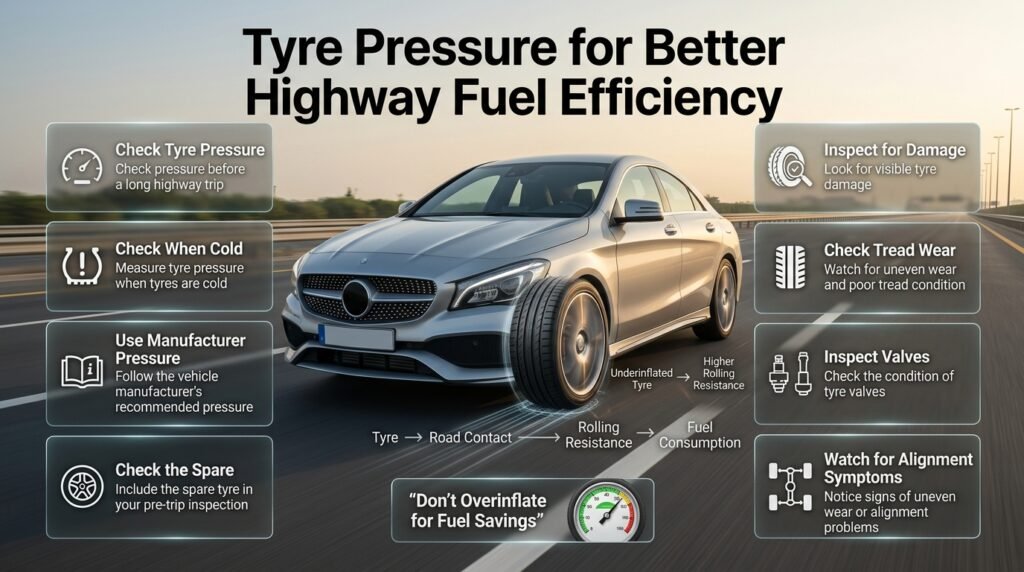
Tyres are the vehicle’s contact point with the road. Incorrect tyre pressure can affect rolling resistance, handling, braking, tyre wear, and fuel consumption.
Underinflated tyres can increase rolling resistance, which means the engine needs to provide more energy to move the vehicle.
Before a long highway trip, check tyre pressure when the tyres are cold and follow the vehicle manufacturer’s recommended pressure rather than relying on the maximum pressure printed on the tyre sidewall.
Tire Pressure and Fuel Efficiency
Tire pressure plays an important role in fuel efficiency because underinflated tires create greater rolling resistance, forcing the engine to work harder and potentially increasing fuel consumption. Maintaining the recommended tire pressure can help your vehicle roll more efficiently while also supporting better handling, braking, and tire wear. In Dubai’s hot climate, checking tire pressure regularly is especially useful because temperature changes can affect pressure readings. Always follow the vehicle manufacturer’s recommended pressure rather than relying on the maximum pressure printed on the tire sidewall.
For practical guidance on maintaining the correct tire pressure, reducing unnecessary rolling resistance, and supporting better fuel economy in Dubai’s driving conditions, read our detailed Tire Pressure and Fuel Efficiency guide.
Highway Tyre Checklist
Before leaving, check:
- Tyre pressure
- Spare tyre pressure
- Visible tyre damage
- Uneven tread wear
- Tread condition
- Valve condition
- Alignment symptoms
Don’t intentionally overinflate tyres beyond the manufacturer’s recommendation to chase fuel savings. Correct pressure is the safer and more appropriate target.
Does Extra Weight Reduce Fuel Economy?
Yes. Carrying unnecessary weight means the vehicle has more mass to move, particularly during acceleration and when climbing hills.
A few items in the trunk won’t suddenly destroy fuel economy, but unnecessary heavy loads become more relevant when they remain in the vehicle permanently or when travelling long distances.
Before a road trip, remove items you don’t need.
Examples include:
- Unused tools
- Heavy equipment
- Old containers
- Sports equipment
- Unnecessary luggage
- Excess cargo
The same principle applies to external equipment. Roof boxes, roof racks, and other accessories can also increase aerodynamic drag, especially at highway speeds.
Should You Keep Windows Closed on the Highway?
At highway speeds, open windows can increase aerodynamic drag. The exact effect depends on the vehicle, window opening, speed, and design.
For this reason, closed windows may generally be preferable when you’re travelling at higher speeds and using air conditioning.
But don’t treat this as an absolute rule for every situation. At lower speeds and comfortable temperatures, opening windows may be perfectly reasonable.
The bigger lesson is to avoid assuming one fuel-saving trick works equally well in every driving condition.
How Road Conditions Affect Fuel Consumption
Highway fuel economy isn’t controlled by the driver alone.
Road conditions can make a substantial difference.
Headwinds
A strong headwind effectively increases the air resistance your vehicle experiences. The engine must work harder to maintain the same road speed.
Hills
Climbing requires additional energy. Fuel consumption can rise sharply on long or steep climbs.
Traffic
Frequent speed changes reduce the advantage of steady highway cruising.
Road Surface
Poor surfaces can increase rolling resistance and make maintaining speed more difficult.
Weather
Extreme heat, strong wind, rain, and other conditions can all affect efficiency.
This is why you shouldn’t judge your driving ability from a single fuel-economy reading. Compare similar routes and conditions over multiple trips.
Fuel-Efficient Highway Driving Step-by-Step
Step 1: Check the Vehicle Before Leaving
What to do: Check tyre pressure, fuel level, visible tyre condition, fluids, and obvious warning signs.
Why it matters: A vehicle in proper operating condition is easier to drive efficiently.
Professional advice: Use the manufacturer’s recommended tyre pressure and maintenance schedule.
Common mistake: Checking only the fuel gauge and ignoring the vehicle’s condition.
Step 2: Remove Unnecessary Weight
What to do: Take unnecessary cargo out of the vehicle.
Why it matters: Less unnecessary mass means less energy is required, particularly during acceleration and climbs.
Common mistake: Keeping heavy items permanently in the trunk because they might be useful someday.
Step 3: Build Speed Smoothly
What to do: Accelerate firmly but progressively when entering the highway.
Why it matters: Extremely aggressive acceleration can waste fuel, while excessively slow acceleration can unnecessarily delay reaching an efficient cruising condition.
Common mistake: Repeatedly accelerating hard and then braking.
Step 4: Settle Into a Consistent Speed
What to do: Once traffic and road conditions permit, maintain a steady legal speed.
Why it matters: Constant speed reduces unnecessary acceleration and braking.
Professional advice: Don’t chase every small gap in traffic.
Step 5: Scan Ahead
What to do: Look beyond the vehicle immediately in front of you.
Why it matters: Early awareness allows smoother adjustments.
Common mistake: Watching only the car directly ahead and reacting at the last second.
Step 6: Use Cruise Control Selectively
What to do: Use cruise control on suitable open roads.
Why it matters: It can help prevent unnecessary speed fluctuations.
Common mistake: Using cruise control automatically in heavy or unpredictable traffic.
Step 7: Monitor Your Fuel Economy
What to do: Compare fuel consumption across similar trips.
Why it matters: One journey doesn’t provide enough information to identify a trend.
Professional advice: Look for patterns rather than chasing a perfect number.
Fuel-Efficient Highway Driving: Best Practices at a Glance
| Driving factor | Better approach | Avoid |
|---|---|---|
| Speed | Maintain a sensible legal speed | Excessive speed |
| Acceleration | Smooth and purposeful | Repeated hard acceleration |
| Braking | Anticipate traffic | Late unnecessary braking |
| Cruise control | Use on suitable roads | Blind use in heavy traffic |
| Tyres | Correct manufacturer pressure | Underinflation or overinflation |
| Load | Carry what you need | Unnecessary heavy cargo |
| Windows | Consider aerodynamics at high speed | Assuming one rule fits every condition |
| A/C | Use comfortably and sensibly | Extreme unnecessary cooling |
| Traffic | Maintain a safe gap | Constantly chasing gaps |
| Maintenance | Follow service recommendations | Ignoring warning signs |
Gear Shifting and Fuel Economy in Dubai
Gear shifting has a direct impact on how efficiently a vehicle uses fuel, particularly in Dubai’s busy traffic and changing road conditions. Driving in the appropriate gear helps keep the engine operating within an efficient range, while unnecessarily high engine speeds or using the wrong gear can increase fuel consumption. Manual drivers can improve efficiency by shifting smoothly and selecting the appropriate gear for their speed and road conditions. Automatic transmissions generally manage gear changes themselves, but smooth acceleration and avoiding unnecessary aggressive driving can still support better fuel economy.
For a practical understanding of how to choose the right gear, avoid unnecessary engine strain, and improve fuel efficiency in Dubai’s city traffic and highway conditions, read our detailed Gear Shifting and Fuel Economy in Dubai guide.
Common Mistakes That Waste Fuel on Highways

Mistake 1: Driving Too Fast
Why it happens: The driver wants to reach the destination sooner.
Why it’s harmful: Higher speeds generally increase aerodynamic resistance and fuel demand.
Better approach: Follow the speed limit and maintain a consistent pace.
Mistake 2: Accelerating to Every Open Gap
Why it happens: Drivers feel that every available gap is an opportunity to make progress.
Why it’s harmful: The vehicle may need to brake again moments later.
Better approach: Think about the overall traffic flow rather than individual gaps.
Mistake 3: Following Too Closely
Why it happens: The driver doesn’t want another vehicle to enter the gap.
Why it’s harmful: It reduces reaction time and often leads to unnecessary braking.
Better approach: Maintain a safe following distance and use the extra space to drive more smoothly.
Mistake 4: Ignoring Tyre Pressure
Why it happens: Tyres look normal even when pressure is incorrect.
Why it’s harmful: Incorrect pressure can affect rolling resistance, handling, and tyre wear.
Better approach: Check pressure regularly and before long journeys.
Mistake 5: Carrying Too Much
Why it happens: Drivers forget what’s stored in the vehicle.
Why it’s harmful: Unnecessary mass adds to the energy required to move the car.
Better approach: Empty the vehicle before major trips.
Mistake 6: Treating Fuel Economy as a Race
Why it happens: Drivers want to achieve the lowest possible number on the dashboard.
Why it’s harmful: Obsessing over economy can encourage unsafe driving or inappropriate speeds.
Better approach: Aim for safe, smooth, predictable driving.
How Traffic Changes Highway Fuel Economy
A highway isn’t automatically fuel-efficient just because it has a high speed limit.
Heavy congestion can turn highway driving into repeated acceleration, braking, and idling. In those conditions, the driving strategy changes.
Read How Traffic Affects Fuel Economy in Dubai for a broader look at traffic-related fuel use.
During congestion:
- Increase following distance where safe.
- Avoid unnecessary lane changes.
- Look ahead for traffic waves.
- Don’t race toward every opening.
- Reduce unnecessary acceleration.
- Stay patient.
Related guides on Stop and Go Driving Fuel Efficiency and How to Reduce Fuel Use in Traffic can help when highway traffic becomes slow and unpredictable.
Roof Racks and Fuel Economy in Dubai
Roof racks can affect fuel economy by increasing a vehicle’s aerodynamic drag, particularly when driving at higher speeds on Dubai’s highways. Even when the rack is not carrying cargo, its added exposure to airflow can create additional resistance, which may require more engine power to maintain speed. The effect can become greater when carrying bulky items such as bicycles, luggage, or roof boxes. If a roof rack is not needed for a particular journey, removing it can help keep the vehicle more aerodynamic. For regular users, choosing a streamlined design, securing cargo properly, and avoiding unnecessary weight can support better fuel efficiency.
If you regularly use a roof rack for luggage, bicycles, or other equipment, our detailed Roof Racks and Fuel Economy in Dubai guide explains how roof-mounted accessories can increase aerodynamic drag and influence fuel consumption, especially during highway driving.
Is Idling Relevant During Highway Trips?
Idling isn’t usually the biggest factor during normal highway cruising, but it matters whenever the vehicle is stopped with the engine running.
For example, a driver may arrive early at a destination, park, and leave the engine running while waiting.
The engine is still consuming fuel even though the vehicle isn’t travelling.
Learn more about fuel consumption while idling and car idling fuel consumption.
The practical rule is simple: don’t leave the engine running unnecessarily when safely parked.
How Maintenance Supports Highway Fuel Economy
Driving technique can’t compensate for every mechanical problem.
A vehicle with maintenance issues may not deliver the fuel economy it should.
Pay attention to:
- Engine warning lights
- Poor acceleration
- Rough running
- Unusual exhaust smoke
- Misfiring
- Poor tyre alignment
- Dragging brakes
- Faulty sensors
- Dirty or restricted filters where applicable
- Low or contaminated fluids
Don’t replace parts simply because someone claims they will magically improve fuel economy. Diagnose the actual problem first.
📌 Quick Tip: If fuel economy suddenly becomes much worse without a major change in your route or driving style, investigate the vehicle rather than assuming the problem is your driving technique.
How to Measure Your Real Highway Fuel Economy
Your dashboard fuel-economy display can be useful, but it isn’t always enough for precise comparisons.
A simple method is:
- Fill the tank.
- Record the odometer or trip distance.
- Drive normally.
- Refill under similar conditions.
- Record the amount of fuel used.
- Calculate distance divided by fuel used.
- Compare several trips.
If you’re using kilometres and litres, you can calculate kilometres per litre:
Fuel economy = kilometres driven ÷ litres used
For example, if you drive 500 km and use 40 litres:
500 ÷ 40 = 12.5 km/L
For a fair comparison, consider similar traffic, weather, road type, load, and air-conditioning use.
Expert Advice for Better Highway Fuel Economy
Experienced drivers don’t normally rely on one magical fuel-saving trick. They build several small habits into every trip.
A practical routine looks like this:
Before driving:
Check tyres, remove unnecessary cargo, plan the route, and make sure the vehicle is ready.
During acceleration:
Build speed smoothly without unnecessary aggression.
During cruising:
Maintain a consistent legal speed whenever conditions allow.
When traffic changes:
Look ahead and adjust early instead of repeatedly accelerating and braking.
When using cruise control:
Use it when the road is predictable and conditions are appropriate.
When approaching hills:
Accept that fuel consumption may rise. Don’t attempt unsafe tactics just to protect a dashboard number.
When finishing the trip:
Review the fuel economy over time rather than judging yourself from one journey.
The biggest gains usually come from consistency.
Fuel-Efficient Highway Driving for Dubai Roads
Dubai’s driving environment adds a few practical considerations.
High temperatures can increase air-conditioning demand. Long, open highways can encourage higher speeds. Traffic can change quickly around major interchanges, and road trips may involve substantial distances.
For Dubai drivers, fuel-efficient highway driving therefore means combining good driving habits with sensible vehicle preparation.
Before a long trip:
- Check tyre pressures.
- Check the spare tyre.
- Inspect tyre condition.
- Remove unnecessary cargo.
- Plan fuel stops.
- Check traffic and route conditions.
- Make sure the air-conditioning system is functioning properly.
- Follow posted speed limits.
- Keep an appropriate following distance.
If you want to explore more related techniques, see Fuel-Efficient Driving Techniques and Smooth Driving Techniques for Better Fuel Economy.
Fuel-Efficient Use of Automatic Transmission
Using an automatic transmission efficiently can help reduce unnecessary fuel consumption, especially during Dubai’s busy traffic and frequent stop-and-go driving. Avoid aggressive acceleration, sudden braking, and repeatedly switching between Drive and other gears when it is not necessary. When waiting for longer periods, follow the vehicle manufacturer’s guidance rather than keeping the engine unnecessarily engaged. Regular transmission maintenance and using the correct manufacturer-recommended fluid can also support smooth gear changes and efficient vehicle operation. The key is to let the transmission work naturally while maintaining a smooth, predictable driving style.
For practical guidance on using an automatic transmission more efficiently, including smooth acceleration, proper gear modes, traffic management, and highway driving habits, explore our detailed Fuel-Efficient Use of Automatic Transmission guide.
How Vehicle Weight Affects Fuel Economy
Vehicle weight has a direct influence on fuel economy because a heavier car requires more energy to accelerate and maintain movement, particularly in stop-and-go traffic. Carrying unnecessary luggage, tools, equipment, or other heavy items can gradually increase fuel consumption, especially when the vehicle is used frequently. The effect may be more noticeable during repeated acceleration, hill climbs, and city driving than during steady cruising. Keeping the vehicle load reasonable, removing items that are no longer needed, and distributing essential cargo safely can help reduce unnecessary energy demand and support better overall fuel efficiency.
For a deeper look at how passenger load, luggage, heavy equipment, and overall vehicle weight can influence fuel consumption, explore our detailed How Vehicle Weight Affects Fuel Economy guide for practical ways to manage unnecessary weight and improve driving efficiency.
Vehicle Accessories and Fuel Economy
Vehicle accessories and fuel economy are closely connected because certain add-ons can increase aerodynamic drag, vehicle weight, or electrical load. Roof racks, cargo boxes, oversized accessories, and other external equipment may make the engine work harder, especially during highway driving. Even small changes can affect fuel consumption when they are used regularly. For better efficiency, remove unnecessary accessories when they are not needed, keep external equipment streamlined, and avoid carrying extra weight without a purpose. In Dubai, where long highway journeys and high-speed driving are common, choosing practical accessories and maintaining the vehicle properly can help support better overall fuel economy.
For a practical guide on how roof racks, cargo boxes, extra weight, larger wheels, and other accessories can influence fuel consumption, read our detailed Vehicle Accessories and Fuel Economy in Dubai guide before choosing or removing accessories from your vehicle.
Car Load and Fuel Consumption
The amount of weight carried by a vehicle can influence fuel consumption, particularly during frequent acceleration, hill climbing, and stop-and-go driving. Extra luggage, heavy equipment, or unnecessary items in the trunk increase the vehicle’s overall weight, requiring more energy to move. While a small amount of additional weight may have a limited effect on a single trip, carrying unnecessary loads regularly can gradually reduce fuel efficiency. For better economy, remove items you do not need, distribute essential luggage safely, and avoid treating your vehicle as permanent storage. In Dubai, combining a sensible vehicle load with smooth driving and proper tire pressure can help support more efficient everyday driving.
For practical tips on how luggage, heavy equipment, passenger load, and unnecessary items can affect your vehicle’s fuel consumption, explore our detailed Car Load and Fuel Consumption guide and learn how to manage vehicle weight more efficiently.
Vehicle Drag and Fuel Consumption in Dubai
Vehicle drag can have a significant effect on fuel consumption, particularly as driving speed increases. Aerodynamic resistance becomes more noticeable on highways, meaning vehicles may need more engine power to maintain higher speeds. Roof racks, cargo boxes, open windows at high speeds, and bulky external accessories can increase drag and reduce efficiency further. In Dubai, where drivers often use high-speed roads for longer journeys, keeping the vehicle streamlined and removing unnecessary external equipment can help reduce aerodynamic resistance. Combining good aerodynamics with moderate speeds and smooth driving can support better overall fuel economy.
For a deeper understanding of how aerodynamic resistance, driving speed, roof equipment, external cargo, wind, and vehicle design can influence fuel consumption, explore our detailed Vehicle Drag and Fuel Consumption in Dubai guide.
What Should You Do If You Miscalculate Your Fuel?
Long-distance driving requires more than fuel-saving habits. You should also plan enough fuel for unexpected delays, detours, traffic, weather, and changes in driving conditions.
If you realize you’re running low, don’t wait until the engine stops. Look for a safe and legitimate refueling option as early as practical.
For drivers in Dubai who need fuel-related assistance, Fuel Delivery Dubai provides information about mobile fuel delivery services.
What is the most fuel-efficient speed for highway and long-distance driving?
There is no single speed that gives the best fuel economy for every car. The ideal range depends on the vehicle’s engine, transmission, aerodynamics, tyre condition, road surface, load and driving conditions. However, fuel consumption generally rises as highway speed increases because aerodynamic drag becomes increasingly significant. Official fuel-economy guidance consistently recommends avoiding unnecessarily high speeds and maintaining a steady, legal speed rather than constantly accelerating and braking.
For long-distance driving, the practical approach is to choose a moderate, steady speed within the posted limit rather than trying to drive as fast as possible. In Pakistan, drivers should also follow the currently prescribed motorway and highway speed limits; the National Highways & Motorway Police restored the standard motorway limit for cars and light transport vehicles to 120 km/h in June 2026.
Key points:
Higher speeds generally increase aerodynamic drag and fuel consumption.
Avoid unnecessary speed changes on open highways.
Use the highest appropriate gear without forcing the engine.
Follow the posted speed limit rather than choosing speed purely for fuel savings.
A steady driving pattern is usually more efficient than repeated acceleration and braking.
Does cruise control really improve fuel efficiency on long highway trips?
Cruise control can be genuinely useful for long-distance fuel economy, particularly when traffic is light and the road is relatively flat. Its main advantage is that it helps prevent the small but repeated speed fluctuations that occur when a driver unconsciously accelerates and releases the accelerator. Maintaining a more consistent speed can reduce unnecessary fuel use. The U.S. Department of Energy and other transport authorities recommend cruise control as an appropriate highway fuel-saving technique.
That does not mean cruise control should be used everywhere. On steep hills, winding roads, heavy traffic or situations requiring frequent speed adjustments, the driver needs to remain fully engaged and control the vehicle according to road conditions. Fuel efficiency should never take priority over safe vehicle control.
Best use of cruise control:
Open highways with relatively light traffic
Relatively flat or gently rolling roads
Consistent speed limits
Good weather and road conditions
Situations where you can maintain proper attention
Avoid relying on it when:
Traffic is frequently slowing or stopping
Roads are slippery or visibility is poor
There are sharp bends or difficult terrain
You need frequent manual speed adjustments
The goal is not simply to switch cruise control on and forget about the road. The goal is to maintain smooth, predictable and appropriate highway speed.
How much do tyre pressure and vehicle maintenance affect long-distance fuel economy?
Tyre pressure and vehicle condition can have a noticeable effect on fuel consumption, especially when a vehicle is driven for hundreds of kilometres. Under-inflated tyres increase rolling resistance, meaning the engine has to work harder to keep the vehicle moving. Proper tyre inflation also supports handling, tyre life and overall road safety.
Maintenance matters as well. Problems affecting the engine, transmission, brakes or wheel alignment can make the vehicle work harder than necessary. The important point is to follow the manufacturer’s maintenance schedule rather than relying on fuel-saving claims or unnecessary treatments.
Before a long highway trip, check:
Tyre pressure according to the vehicle manufacturer’s specification
Tyre condition and tread
Wheel alignment if the vehicle pulls to one side
Engine oil level and recommended oil grade
Coolant level and cooling-system condition
Brake condition
Warning lights on the dashboard
Any unusual vibration, noise or fluid leakage
One important detail is often overlooked: use the recommended tyre pressure listed by the vehicle manufacturer, usually found on the driver’s door-jamb label or in the owner’s manual. The maximum pressure printed on the tyre sidewall is not necessarily the correct operating pressure for your vehicle.
How can I reduce fuel consumption during a long-distance road trip?
The biggest improvement usually comes from combining several small habits rather than relying on one “fuel-saving trick.” Smooth acceleration, gentle braking, sensible speed, correct tyre pressure, reduced unnecessary weight and good vehicle maintenance all work together. Official fuel-economy guidance identifies aggressive acceleration, hard braking, excessive speed, idling, unnecessary cargo and poor maintenance as important factors that can reduce fuel economy.
Long-distance driving also gives you an opportunity to plan ahead. A route with fewer unnecessary stops, less congestion and smoother traffic flow can reduce the amount of acceleration and braking required.
Practical long-distance fuel-saving checklist:
Accelerate smoothly instead of using sudden bursts of power.
Maintain a consistent speed whenever traffic allows.
Anticipate slowdowns rather than braking sharply at the last moment.
Remove unnecessary luggage and heavy items.
Avoid carrying unnecessary roof-mounted cargo because it increases aerodynamic drag.
Keep tyres correctly inflated.
Avoid extended idling during unnecessary stops.
Use air conditioning sensibly, particularly in very hot weather.
Follow the manufacturer’s maintenance schedule.
Track fuel consumption over several trips instead of judging economy from one journey.
A useful way to measure your improvement is to record your distance and fuel used over several tanks. Looking at an average across multiple trips gives you a much more reliable picture than judging fuel economy from a single highway journey.
Does driving smoothly really make a significant difference to highway fuel efficiency?
Smooth driving can make a meaningful difference because every unnecessary acceleration requires additional energy, while hard braking throws away energy that was just produced by the engine. On a long highway journey, repeatedly accelerating, braking and accelerating again can gradually increase fuel consumption.
The key is to read the road ahead. If you can see traffic slowing several hundred metres ahead, there is often no reason to continue accelerating until you reach the slower vehicles and then brake hard. Gradually easing off the accelerator and allowing the vehicle to slow naturally can produce a smoother driving pattern. Government fuel-saving guidance also recommends anticipating traffic, reducing rapid acceleration and braking, and maintaining a steady speed.
Smooth driving does not mean driving unusually slowly or interfering with normal traffic flow. It means using the accelerator and brakes deliberately rather than making frequent, unnecessary changes.
Professional approach to smoother highway driving:
Look several seconds ahead instead of focusing only on the vehicle directly in front.
Leave an appropriate following distance.
Accelerate progressively when joining or overtaking traffic.
Avoid unnecessary overtaking followed by immediate braking.
Lift off the accelerator earlier when a slowdown is clearly approaching.
Maintain a consistent speed when traffic and road conditions permit.
Never sacrifice safe following distance or legal speed limits simply to save fuel.
In practical terms, good highway fuel efficiency is less about one magic technique and more about controlling speed, reducing unnecessary resistance, maintaining the vehicle properly and making fewer wasteful driving inputs. That approach is both more realistic and more sustainable for everyday long-distance driving.
Conclusion
Highway and long-distance fuel efficiency is not about finding one perfect fuel-saving trick. The best results come from combining steady driving, sensible highway speeds, correct tyre pressure, proper vehicle maintenance, reduced unnecessary weight, and careful acceleration and braking. Small improvements may seem insignificant during one short trip, but over hundreds or thousands of kilometres, they can make a noticeable difference to overall fuel consumption.
Before starting a long journey, take a few minutes to check the vehicle and plan the route. During the drive, focus on maintaining a consistent speed, anticipating traffic, avoiding unnecessary acceleration, and using cruise control when road and traffic conditions make it appropriate. These habits can help reduce wasted fuel while also making long-distance driving smoother and more comfortable.
Ultimately, better fuel efficiency is not about driving unusually slowly or compromising safety. It is about driving intelligently, maintaining the vehicle properly, and using fuel only when it is actually needed. By making these habits part of your normal highway driving routine, you can improve fuel economy, reduce unnecessary running costs, and make every long-distance journey more efficient.
Leave a Reply