Introduction
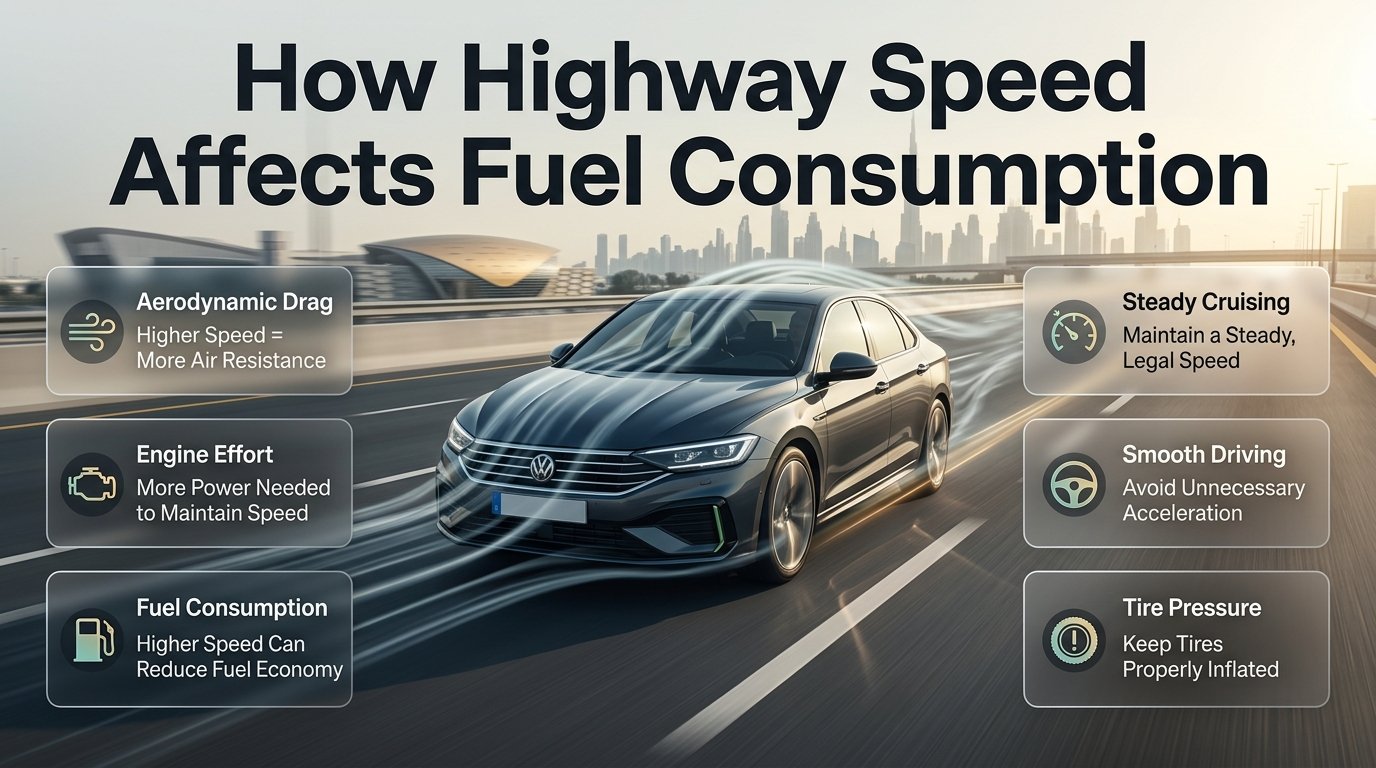
How Highway Speed Affects Fuel Consumption | You can drive for hours on a highway without stopping, yet still notice that your fuel gauge is dropping faster than expected. This often happens when a driver increases speed. At first, driving faster may seem like a simple way to reach the destination sooner, but the relationship between highway speed and fuel consumption is more complicated than it looks.
A vehicle doesn’t use fuel only because the engine is running. It uses energy to overcome rolling resistance, operate the drivetrain, accelerate the vehicle, climb hills, and most importantly at higher speeds, push through the air. As highway speed increases, aerodynamic resistance rises rapidly. That’s why driving at a noticeably higher speed can reduce the number of kilometers or miles you get from each liter or gallon of fuel.
This guide explains exactly how highway speed affects fuel consumption, why aerodynamic drag becomes so important, whether driving slower always saves fuel, how acceleration and braking influence efficiency, how wind and tires change fuel use, and what practical driving habits can help you get better highway fuel economy.
If you’re looking for broader fuel-saving information for drivers in Dubai, you can also visit 👉 Fuel Delivery Dubai.
How Does Highway Speed Affect Fuel Consumption?
Highway speed generally has a direct effect on fuel consumption. As vehicle speed increases, aerodynamic drag rises rapidly, requiring the engine to produce more power to maintain that speed. This means a vehicle normally consumes more fuel per kilometer or mile at higher highway speeds, especially once speed becomes significantly higher than its efficient cruising range.
The important word here is generally.
Fuel consumption doesn’t depend on speed alone. Your vehicle’s engine, transmission, tires, weight, aerodynamics, road surface, wind, temperature, traffic, and driving style all matter.
However, speed becomes increasingly important on an open highway because the vehicle spends most of its time moving continuously through the air.
Consider two situations:
- Vehicle A travels at a moderate, steady highway speed.
- Vehicle B travels considerably faster on the same type of road.
Vehicle B must push through the air at a much greater rate. The engine therefore needs to produce additional power simply to maintain its higher speed.
This is why a driver can experience good fuel economy during a moderate highway journey but significantly worse economy after spending the same route driving aggressively at higher speeds.
Why Does Driving Faster Use More Fuel?
There are several reasons, but aerodynamic drag is one of the most important.
Every vehicle experiences resistance as it moves. Some of that resistance comes from the tires contacting the road. Some comes from the drivetrain. But at highway speeds, air resistance becomes increasingly significant.
Imagine putting your hand outside a moving vehicle.
At low speed, the air feels relatively gentle.
Increase the speed, and the force against your hand becomes much stronger.
A car experiences the same basic effect, except its entire body is moving through the air.
The engine has to provide enough power to overcome that resistance.
Aerodynamic Drag Increases Rapidly With Speed
A simplified physics relationship shows that aerodynamic drag is approximately proportional to the square of speed.
In simple terms:
Higher speed = disproportionately higher aerodynamic resistance.
The power required to overcome aerodynamic drag increases even more rapidly because power is related to both force and speed.
This is one reason why increasing your cruising speed slightly at already-high highway speeds can have a noticeable effect on fuel economy.
For example, going from a moderate speed to a somewhat higher speed doesn’t simply mean the engine is doing “a little more work.” The vehicle is also dealing with substantially greater aerodynamic resistance.
This is especially important for:
- SUVs
- Pickup trucks
- Large sedans
- Vans
- Vehicles with roof racks
- Vehicles carrying external cargo
Their larger frontal areas can make aerodynamic resistance more significant.
What Is Aerodynamic Drag?
Aerodynamic drag is the resistance created by air as a vehicle moves through it.
A vehicle has to displace air around its body. The shape of the vehicle determines how efficiently that air moves around it.
A streamlined vehicle generally moves through air more efficiently than a boxy vehicle.
Several factors influence aerodynamic drag:
- Vehicle speed
- Vehicle shape
- Frontal area
- Air density
- Wind direction
- Roof accessories
- Open windows
- External cargo
Speed is particularly important because aerodynamic resistance rises rapidly as speed increases.
This means that aerodynamic efficiency matters much more on a highway than during slow city driving.
Why High-Speed Driving Can Reduce Miles Per Gallon or Kilometers Per Liter
Fuel economy is commonly measured as:
- Miles per gallon (MPG)
- Liters per 100 kilometers (L/100 km)
- Kilometers per liter (km/L)
Different countries use different measurements, but the basic concept is the same: they tell you how much distance you can travel using a certain amount of fuel.
When speed increases, the amount of fuel needed to travel each kilometer or mile can increase.
For example, imagine a car that achieves:
35 mpg at a moderate highway speed
and later achieves:
28 mpg at a considerably higher speed.
The exact figures are only an example because every vehicle is different.
But the principle is important.
The driver hasn’t necessarily changed the route, vehicle, or fuel. The main difference may simply be the speed at which the vehicle was driven.
Over a short journey, the difference may not seem important.
Over hundreds or thousands of kilometers, however, the additional fuel can become significant.
Is Highway Driving More Fuel-Efficient Than City Driving?
Highway driving is often more fuel-efficient than city driving because the vehicle can maintain a steady speed with fewer stops, less idling, and fewer acceleration cycles. However, this advantage decreases when highway speeds become unnecessarily high. A moderate, steady highway speed can therefore provide much better fuel economy than aggressive high-speed cruising.
City driving creates many opportunities for fuel waste.
A typical urban trip may involve:
- Starting from a stop
- Accelerating
- Braking
- Waiting at traffic lights
- Idling
- Accelerating again
- Changing lanes
- Slowing for pedestrians
- Repeating the cycle
Highway driving generally eliminates many of these conditions.
The engine can remain at a relatively stable operating condition.
The transmission can remain in a high gear.
The vehicle doesn’t repeatedly convert energy into acceleration and then lose much of that energy through braking.
However, highway driving isn’t automatically economical.
If you drive at very high speeds, aerodynamic drag can become a major source of energy consumption.
So the better comparison is:
Steady moderate highway driving vs. stop-and-go city driving
rather than:
Any highway driving vs. any city driving.
For additional information, see 👉 Highway Driving Fuel Efficiency.
What Speed Is Best for Fuel Economy?
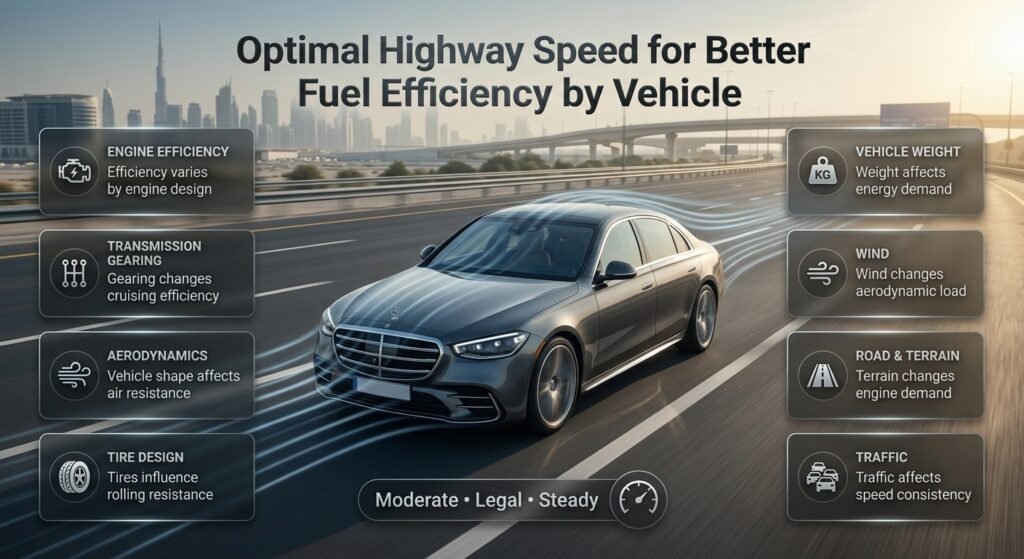
There isn’t a single speed that is perfect for every car.
This is one of the most common misunderstandings about fuel-efficient driving.
A small hybrid, a diesel SUV, a sports sedan, and a large pickup truck can all have different efficiency characteristics.
The ideal cruising speed depends on:
- Engine efficiency
- Transmission gearing
- Vehicle aerodynamics
- Tire design
- Vehicle weight
- Road conditions
- Wind
- Terrain
- Traffic
- Speed limits
Instead of searching for one universal number, focus on the principle:
Use a legal, appropriate, moderate highway speed and maintain it smoothly.
For many vehicles, fuel economy begins to deteriorate noticeably as speed rises beyond a moderate cruising range.
The exact point varies.
That’s why you should avoid advice claiming that one specific speed is always the most fuel-efficient speed for every vehicle.
For a more detailed look at this subject, read 👉 Optimal Driving Speed for Fuel Efficiency in Dubai.
Does Driving 10 mph Faster Really Make a Difference?
It can.
The effect depends on the starting speed.
A 10-mph increase at relatively low speed may have a smaller impact than a 10-mph increase at already-high highway speed.
Why?
Because aerodynamic drag increases rapidly as speed increases.
For example, increasing speed from a moderate cruising speed to a higher highway speed increases the air resistance the vehicle must overcome.
Increasing it again to an even higher speed can produce an even larger aerodynamic penalty.
This is why drivers sometimes notice that fuel economy drops substantially when they regularly travel at high highway speeds.
The vehicle isn’t simply covering the road faster.
It is working harder against the air.
Why Aerodynamic Drag Becomes More Important on Highways
At low speeds, other forms of resistance may represent a larger percentage of the vehicle’s energy demand.
At highway speeds, aerodynamic resistance becomes increasingly important.
Think of the energy required to move a vehicle as a combination of several demands:
Engine energy → drivetrain → tires → road resistance + aerodynamic resistance + acceleration + hills + accessories
At steady highway speed, acceleration isn’t happening constantly.
The road may be flat.
Traffic may be light.
That leaves aerodynamic drag as one of the dominant factors.
This is why highway speed has such a strong relationship with fuel economy.
Vehicle Drag and Fuel Consumption in Dubai
Vehicle drag can have a significant effect on fuel consumption, particularly as driving speed increases. Aerodynamic resistance becomes more noticeable on highways, meaning vehicles may need more engine power to maintain higher speeds. Roof racks, cargo boxes, open windows at high speeds, and bulky external accessories can increase drag and reduce efficiency further. In Dubai, where drivers often use high-speed roads for longer journeys, keeping the vehicle streamlined and removing unnecessary external equipment can help reduce aerodynamic resistance. Combining good aerodynamics with moderate speeds and smooth driving can support better overall fuel economy.
For a deeper understanding of how aerodynamic resistance, driving speed, roof equipment, external cargo, wind, and vehicle design can influence fuel consumption, explore our detailed Vehicle Drag and Fuel Consumption in Dubai guide.
Car Load and Fuel Consumption
The amount of weight carried by a vehicle can influence fuel consumption, particularly during frequent acceleration, hill climbing, and stop-and-go driving. Extra luggage, heavy equipment, or unnecessary items in the trunk increase the vehicle’s overall weight, requiring more energy to move. While a small amount of additional weight may have a limited effect on a single trip, carrying unnecessary loads regularly can gradually reduce fuel efficiency. For better economy, remove items you do not need, distribute essential luggage safely, and avoid treating your vehicle as permanent storage. In Dubai, combining a sensible vehicle load with smooth driving and proper tire pressure can help support more efficient everyday driving.
For practical tips on how luggage, heavy equipment, passenger load, and unnecessary items can affect your vehicle’s fuel consumption, explore our detailed Car Load and Fuel Consumption guide and learn how to manage vehicle weight more efficiently.
Does Acceleration Affect Highway Fuel Consumption?
Absolutely.
Highway fuel consumption isn’t determined only by your cruising speed.
Your acceleration habits matter too.
Suppose you’re driving at 65 mph.
You see an open section of road and accelerate aggressively to 80 mph.
A few minutes later, traffic forces you to slow back to 65 mph.
Then you accelerate again.
This repeated cycle can waste fuel.
The problem isn’t simply that you reached 80 mph.
The problem is that you repeatedly used extra energy to change the vehicle’s speed.
A smoother pattern would be:
Accelerate normally → reach an appropriate speed → maintain it → slow gradually when traffic requires it.
For additional information, see 👉 How Acceleration Affects Fuel Consumption in Dubai.
How Aerodynamics Affects Fuel Efficiency
Aerodynamics plays an important role in fuel efficiency, especially when a vehicle is traveling at higher speeds. As speed increases, air resistance creates more drag, requiring the engine to use additional energy to keep the vehicle moving. Features such as roof racks, cargo boxes, open windows, and bulky external accessories can increase aerodynamic drag and contribute to higher fuel consumption. Keeping the vehicle streamlined, removing unnecessary external equipment, and maintaining a sensible highway speed can help reduce resistance and support more efficient driving.
For a clearer understanding of how air resistance, vehicle design, speed, roof accessories, and external load can influence your car’s fuel consumption, explore our detailed How Aerodynamics Affects Fuel Efficiency guide.
How Vehicle Weight Affects Fuel Economy
Vehicle weight has a direct influence on fuel economy because a heavier car requires more energy to accelerate and maintain movement, particularly in stop-and-go traffic. Carrying unnecessary luggage, tools, equipment, or other heavy items can gradually increase fuel consumption, especially when the vehicle is used frequently. The effect may be more noticeable during repeated acceleration, hill climbs, and city driving than during steady cruising. Keeping the vehicle load reasonable, removing items that are no longer needed, and distributing essential cargo safely can help reduce unnecessary energy demand and support better overall fuel efficiency.
For a deeper look at how passenger load, luggage, heavy equipment, and overall vehicle weight can influence fuel consumption, explore our detailed How Vehicle Weight Affects Fuel Economy guide for practical ways to manage unnecessary weight and improve driving efficiency.
Why Hard Acceleration Uses More Fuel
An engine consumes more fuel when it is required to produce significantly more power.
Hard acceleration creates a high power demand.
This doesn’t mean you should accelerate extremely slowly.
Very slow acceleration can also be impractical and can create traffic problems.
The better approach is smooth and purposeful acceleration.
When entering a highway, accelerate normally until you reach an appropriate speed.
Once you’re cruising, avoid unnecessary bursts of acceleration.
A Simple Example
Imagine two drivers.
Driver A:
- Accelerates smoothly
- Reaches cruising speed
- Maintains speed
- Adjusts gently to traffic
Driver B:
- Accelerates aggressively
- Drives faster than necessary
- Brakes frequently
- Accelerates again
Driver B is likely to use more fuel.
The difference can become significant over repeated trips.
How Braking Habits Affect Fuel Economy
Braking itself doesn’t consume fuel in the same way acceleration does.
The issue is what happens before the braking.
If you accelerate aggressively and then brake soon afterward, much of the energy used to increase the vehicle’s speed is wasted as heat through the braking system.
For example:
Accelerate → gain speed → brake → repeat
is inefficient.
A better strategy is:
Observe traffic → anticipate changes → release accelerator earlier → maintain smoother speed.
This doesn’t mean avoiding braking when braking is necessary.
Safety always comes first.
The goal is simply to reduce unnecessary acceleration followed by unnecessary braking.
You can learn more at 👉 How Braking Habits Affect Fuel Economy in Dubai.
Improving Fuel Economy on Long Trips in Dubai
Improving fuel economy on long trips in Dubai starts with preparing the vehicle before you leave and maintaining efficient driving habits throughout the journey. Check tire pressure, remove unnecessary luggage, and make sure the engine and other essential systems are properly maintained. During the trip, maintain a steady and sensible speed, avoid aggressive acceleration and unnecessary braking, and use cruise control when road and traffic conditions allow. Reducing aerodynamic drag by removing unused roof racks or bulky external equipment can also help, particularly on highways. These simple practices can reduce unnecessary fuel use and make long-distance driving more efficient and predictable.
Planning a long-distance journey? Our detailed Improving Fuel Economy on Long Trips in Dubai guide offers practical advice on vehicle preparation, steady-speed driving, route planning, reducing aerodynamic drag, and managing fuel consumption more efficiently throughout your trip.
Why Maintaining a Steady Speed Saves Fuel
A steady speed allows the engine and transmission to operate without constant changes in power demand.
Imagine these two driving patterns:
Pattern A
60 → 61 → 60 → 62 → 61 → 60
Pattern B
60 → 75 → 60 → 75 → 60
The second pattern requires much more repeated acceleration.
If road and traffic conditions allow, a stable cruising speed is generally the better choice.
This is particularly useful on long highway journeys.
A driver who maintains a predictable speed may achieve better fuel economy than someone who constantly tries to gain a few extra seconds by accelerating into every available gap.
For more practical techniques, see 👉 Smooth Driving Techniques for Better Fuel Economy in Dubai.
Can Cruise Control Improve Highway Fuel Economy?
Cruise control can help improve fuel efficiency when traffic is light, the road is relatively flat, and conditions allow the vehicle to maintain a consistent speed. It can reduce unnecessary speed fluctuations. However, cruise control isn’t ideal for every situation and should not be used when traffic, weather, terrain, or road conditions require frequent driver adjustments.
Cruise control can be useful on:
- Long straight highways
- Flat roads
- Light traffic
- Consistent speed-limit zones
- Good weather
It may be less useful on:
- Steep hills
- Heavy traffic
- Frequent curves
- Poor visibility
- Wet or slippery roads
- Areas requiring constant speed changes
Modern adaptive cruise-control systems can behave differently from conventional cruise control, but the same principle applies: use the system when it supports safe, smooth driving.
Expert Tip: Don’t activate cruise control simply because you want to save fuel. Use it when it helps you maintain an appropriate and stable speed without reducing your attention to the road.
How Wind Changes Highway Fuel Consumption
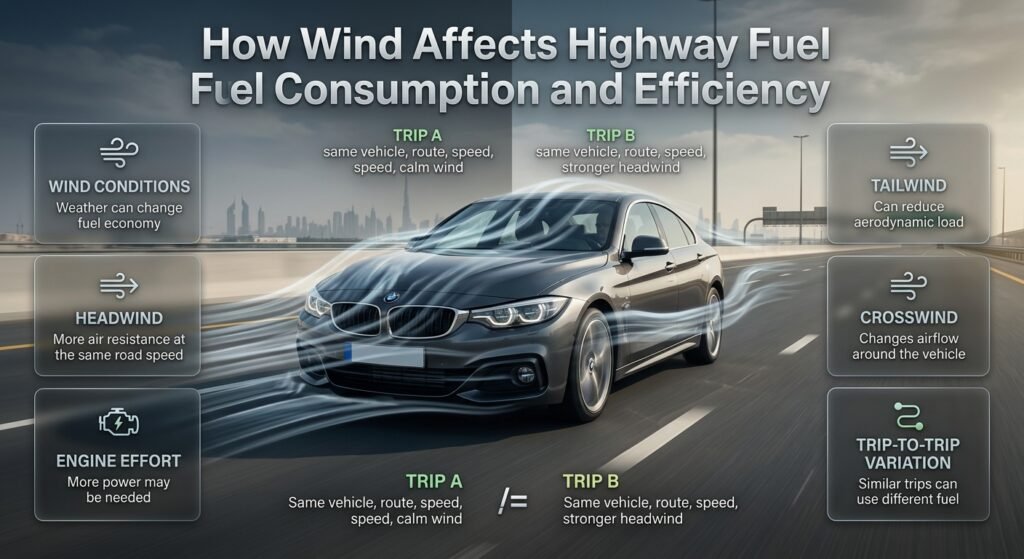
Wind can have a surprisingly large impact on highway fuel economy.
Suppose your car is traveling at 100 km/h.
If there is little wind, the vehicle experiences airflow corresponding roughly to its road speed.
Now imagine a strong headwind.
The vehicle must push through air that is effectively moving toward it.
The aerodynamic load increases.
As a result, the engine needs to produce more power.
A tailwind can have the opposite effect.
Crosswinds can also affect aerodynamic performance.
This explains why fuel economy can vary between two trips even when:
- The driver uses the same car
- The route is similar
- The cruising speed is similar
- The tires are correctly inflated
Weather conditions can change the result.
Does Hot Weather Affect Fuel Consumption?
Temperature can influence vehicle efficiency in several ways.
In very hot weather, air conditioning becomes more important.
The engine or electrical system must provide energy to cool the cabin.
In places such as Dubai, where temperatures can become extremely high, climate control can be a significant part of a vehicle’s energy demand.
Hot weather can also affect:
- Tire pressure
- Air density
- Engine operation
- Battery performance
- Air-conditioning demand
Drivers shouldn’t turn off necessary climate control simply to chase tiny fuel savings, particularly in dangerous heat.
Instead, focus on the larger efficiency factors:
- Appropriate speed
- Smooth driving
- Correct tire pressure
- Vehicle maintenance
- Reduced unnecessary load
Does Air Conditioning Increase Highway Fuel Consumption?
Yes, air conditioning can increase energy consumption.
The exact effect varies according to:
- Outside temperature
- Cabin temperature
- Vehicle type
- Compressor design
- Cooling demand
- Vehicle speed
- Solar heat
- Climate-control settings
In extremely hot climates, the impact can be more noticeable.
There are sensible ways to reduce unnecessary cooling demand.
For example:
- Park in shade when possible.
- Use sunshades when appropriate.
- Vent very hot cabin air before starting a journey.
- Keep doors and windows closed while cooling.
- Use a reasonable temperature setting.
At highway speeds, keeping windows closed can also help maintain the vehicle’s aerodynamic efficiency.
Air Conditioning and Fuel Consumption
Air conditioning can have a noticeable effect on fuel consumption, especially during hot weather and heavy traffic. When the AC system is running, the engine needs additional power to operate the compressor, which can increase fuel use. In Dubai’s hot climate, however, avoiding AC completely is not practical or comfortable. A better approach is to use the system efficiently by parking in shade when possible, ventilating the cabin briefly before cooling it, maintaining the AC system properly, and avoiding unnecessary idling with the AC running. These simple habits can help reduce unnecessary fuel consumption while keeping the cabin comfortable.
For practical tips on reducing unnecessary fuel consumption while keeping your car comfortable in Dubai’s hot climate, explore our detailed Air Conditioning and Fuel Consumption guide, which explains how AC use, traffic, idling, driving speed, and vehicle maintenance can affect overall fuel economy.
How Tire Pressure Affects Highway Fuel Economy
Tires are another important part of fuel efficiency.
Underinflated tires can increase rolling resistance.
Rolling resistance is the energy required to keep the tires moving along the road.
If the tires deform more than intended, the vehicle may need additional energy to maintain speed.
Correct tire pressure can therefore support:
- Fuel efficiency
- Tire life
- Handling
- Braking performance
- Driving stability
Before a long highway trip, check tire pressure according to the vehicle manufacturer’s recommended specification.
Don’t simply use the maximum pressure printed on the tire sidewall as your target.
The manufacturer’s recommended pressure is generally the relevant figure for normal vehicle operation.
Tire Pressure and Fuel Efficiency
Tire pressure plays an important role in fuel efficiency because underinflated tires create greater rolling resistance, forcing the engine to work harder and potentially increasing fuel consumption. Maintaining the recommended tire pressure can help your vehicle roll more efficiently while also supporting better handling, braking, and tire wear. In Dubai’s hot climate, checking tire pressure regularly is especially useful because temperature changes can affect pressure readings. Always follow the vehicle manufacturer’s recommended pressure rather than relying on the maximum pressure printed on the tire sidewall.
For practical guidance on maintaining the correct tire pressure, reducing unnecessary rolling resistance, and supporting better fuel economy in Dubai’s driving conditions, read our detailed Tire Pressure and Fuel Efficiency guide.
Does Extra Weight Increase Fuel Consumption?
Yes.
The heavier the vehicle, the more energy is generally required to accelerate it.
This doesn’t mean removing a few items from your glove compartment will suddenly transform your fuel economy.
The biggest opportunities involve unnecessary heavy cargo.
For example:
- Heavy tools
- Unused equipment
- Large boxes
- Sports gear
- Extra luggage
- Unnecessary materials
If you’re traveling hundreds of kilometers, removing unnecessary cargo can help.
The effect is particularly relevant when the journey includes frequent acceleration or hills.
Do Roof Racks Increase Fuel Consumption?
They can.
Roof racks, roof boxes, bicycles, luggage carriers, and other external accessories change the airflow around the vehicle.
This can increase aerodynamic drag.
At low speed, the difference may be relatively small.
At highway speed, aerodynamic effects become much more important.
If you have a roof accessory installed permanently but only use it occasionally, removing it when it isn’t needed can be a practical fuel-saving measure.
The same principle applies to external cargo.
Roof Racks and Fuel Economy in Dubai
Roof racks can affect fuel economy by increasing a vehicle’s aerodynamic drag, particularly when driving at higher speeds on Dubai’s highways. Even when the rack is not carrying cargo, its added exposure to airflow can create additional resistance, which may require more engine power to maintain speed. The effect can become greater when carrying bulky items such as bicycles, luggage, or roof boxes. If a roof rack is not needed for a particular journey, removing it can help keep the vehicle more aerodynamic. For regular users, choosing a streamlined design, securing cargo properly, and avoiding unnecessary weight can support better fuel efficiency.
If you regularly use a roof rack for luggage, bicycles, or other equipment, our detailed Roof Racks and Fuel Economy in Dubai guide explains how roof-mounted accessories can increase aerodynamic drag and influence fuel consumption, especially during highway driving.
Do Open Windows Affect Highway Fuel Economy?
They can.
At low speeds, opening a window may have relatively little aerodynamic effect.
At higher highway speeds, however, open windows can disrupt airflow around the vehicle.
The result can be increased aerodynamic drag.
This doesn’t mean you should never open a window.
Safety and comfort matter.
But if you’re trying to optimize highway fuel economy, using the vehicle’s climate-control system with windows closed may sometimes be more aerodynamically efficient than driving at high speed with several windows fully open.
Does Vehicle Size Change the Effect of Highway Speed?
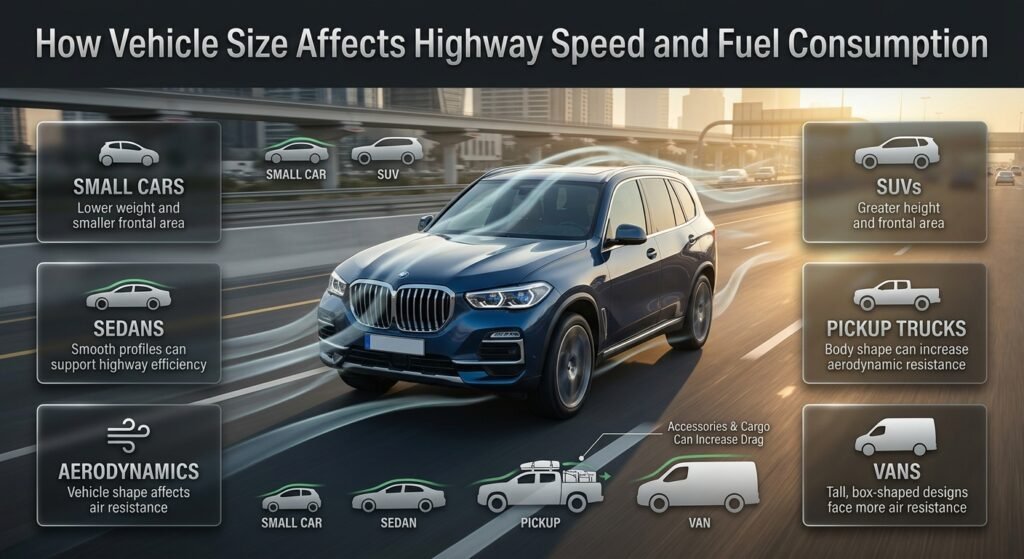
Yes.
Different vehicle designs respond differently to aerodynamic drag.
Small Cars
Small cars can have relatively low weight and frontal area.
Many modern small cars are designed with fuel efficiency in mind.
Sedans
Sedans often have relatively smooth aerodynamic profiles.
Their highway efficiency can be good when driven at moderate speeds.
SUVs
SUVs usually have a larger frontal area and greater height.
At high highway speeds, aerodynamic drag can therefore become more significant.
Pickup Trucks
Pickup trucks can have substantial frontal areas and body shapes that create additional aerodynamic resistance.
Accessories and cargo can make the effect larger.
Vans
Vans are often tall and box-shaped.
This can make aerodynamic resistance particularly important at high speeds.
Vehicle Accessories and Fuel Economy
Vehicle accessories and fuel economy are closely connected because certain add-ons can increase aerodynamic drag, vehicle weight, or electrical load. Roof racks, cargo boxes, oversized accessories, and other external equipment may make the engine work harder, especially during highway driving. Even small changes can affect fuel consumption when they are used regularly. For better efficiency, remove unnecessary accessories when they are not needed, keep external equipment streamlined, and avoid carrying extra weight without a purpose. In Dubai, where long highway journeys and high-speed driving are common, choosing practical accessories and maintaining the vehicle properly can help support better overall fuel economy.
For a practical guide on how roof racks, cargo boxes, extra weight, larger wheels, and other accessories can influence fuel consumption, read our detailed Vehicle Accessories and Fuel Economy in Dubai guide before choosing or removing accessories from your vehicle.
Gear Shifting and Fuel Economy in Dubai
Gear shifting has a direct impact on how efficiently a vehicle uses fuel, particularly in Dubai’s busy traffic and changing road conditions. Driving in the appropriate gear helps keep the engine operating within an efficient range, while unnecessarily high engine speeds or using the wrong gear can increase fuel consumption. Manual drivers can improve efficiency by shifting smoothly and selecting the appropriate gear for their speed and road conditions. Automatic transmissions generally manage gear changes themselves, but smooth acceleration and avoiding unnecessary aggressive driving can still support better fuel economy.
For a practical understanding of how to choose the right gear, avoid unnecessary engine strain, and improve fuel efficiency in Dubai’s city traffic and highway conditions, read our detailed Gear Shifting and Fuel Economy in Dubai guide.
Does Engine Size Affect Highway Fuel Consumption?
Engine size matters, but it doesn’t tell the whole story.
A larger engine may consume more fuel under certain conditions, but engine efficiency, gearing, vehicle weight, aerodynamics, and driving behavior also matter.
A modern large engine may be very efficient under certain operating conditions.
Likewise, a small engine can consume more fuel than expected if it has to work hard to move a heavy vehicle at high speed.
This is another reason why comparing cars only by engine displacement can be misleading.
How Transmission Gearing Affects Highway Fuel Economy
Modern transmissions are designed to keep the engine operating efficiently across different speeds and loads.
At steady highway speed, an automatic transmission may select a high gear to reduce engine RPM.
A manual transmission can similarly operate in a high appropriate gear.
Lower engine RPM can help reduce fuel consumption when the engine is operating efficiently under the given load.
However, high-speed driving can still increase fuel demand even if the engine RPM remains relatively low.
Why?
Because aerodynamic drag doesn’t disappear just because the engine is turning slowly.
The engine still needs to provide the power required to overcome that resistance.
Fuel-Efficient Use of Automatic Transmission
Using an automatic transmission efficiently can help reduce unnecessary fuel consumption, especially during Dubai’s busy traffic and frequent stop-and-go driving. Avoid aggressive acceleration, sudden braking, and repeatedly switching between Drive and other gears when it is not necessary. When waiting for longer periods, follow the vehicle manufacturer’s guidance rather than keeping the engine unnecessarily engaged. Regular transmission maintenance and using the correct manufacturer-recommended fluid can also support smooth gear changes and efficient vehicle operation. The key is to let the transmission work naturally while maintaining a smooth, predictable driving style.
For practical guidance on using an automatic transmission more efficiently, including smooth acceleration, proper gear modes, traffic management, and highway driving habits, explore our detailed Fuel-Efficient Use of Automatic Transmission guide.
Does High-Speed Driving Always Mean High Engine RPM?
No.
Modern vehicles may use:
- Tall gearing
- Multiple transmission ratios
- Overdrive gears
- Continuously variable transmissions
- Hybrid power systems
A vehicle can therefore travel at a high road speed while the engine operates at relatively low RPM.
But low RPM doesn’t automatically mean low fuel consumption.
The engine may still need substantial torque and power to overcome aerodynamic drag.
This distinction is important.
Engine RPM and vehicle speed are related, but they aren’t the same thing as fuel consumption.
How Road Hills Affect Fuel Consumption
A flat highway and a mountainous highway can produce very different fuel-economy results.
When a vehicle climbs a hill, it must gain gravitational potential energy.
The engine therefore has to produce additional power.
Even if you maintain exactly the same speed, fuel consumption can rise.
On a downhill section, the vehicle may require much less engine power.
This is why comparing fuel economy from two different routes can be misleading.
One route may have:
- More hills
- More traffic
- More wind
- More stops
- Different road surfaces
The other may be flatter and smoother.
Long-Distance Driving Fuel Efficiency Tips in Dubai
Long-distance driving in Dubai can be more fuel-efficient when you maintain a steady speed, avoid unnecessary acceleration and braking, and keep the vehicle properly maintained. Before a long journey, check tire pressure, remove unnecessary weight, and make sure the engine and fluids are in good condition. Using cruise control where appropriate can help maintain a consistent speed on suitable highways, while avoiding excessive speeds can reduce aerodynamic drag and fuel consumption. Planning your route in advance can also help you avoid heavy traffic, unnecessary detours, and prolonged idling.
Planning a long journey in Dubai? Explore our detailed Long-Distance Driving Fuel Efficiency Tips in Dubai guide for practical advice on maintaining steady speeds, reducing unnecessary stops, preparing your vehicle, and improving fuel efficiency throughout your trip.
Should You Slow Down on Hills to Save Fuel?
Safety and traffic conditions should always come first.
On an uphill section, maintaining a reasonable legal speed is more important than obsessively protecting a fuel-economy number.
Avoid unnecessary aggressive acceleration just to maintain an exact speed when traffic conditions don’t require it.
Modern vehicles can manage engine load automatically, especially with automatic transmissions.
The practical goal is smooth, safe driving rather than trying to force the vehicle into an unnatural driving pattern.
Highway Fuel Economy and Traffic
A highway isn’t necessarily fuel-efficient if traffic is heavy.
Traffic congestion can transform smooth cruising into:
Accelerate → brake → stop → idle → accelerate
This can greatly increase fuel consumption.
When traffic becomes congested, your strategy should change.
Instead of trying to accelerate aggressively into every available gap, maintain a safe following distance and anticipate traffic movements.
This can reduce unnecessary braking and acceleration.
Read more at 👉 How Traffic Affects Fuel Economy in Dubai.
How to Reduce Fuel Use in Traffic
Traffic requires patience.
One of the biggest mistakes drivers make is trying to maintain the highest possible speed between slowdowns.
Imagine traffic moving at 40 km/h, then stopping, then moving at 60 km/h, then stopping again.
If you accelerate aggressively to 60 km/h only to brake immediately afterward, much of that energy is wasted.
A smoother approach is to:
- Look ahead.
- Maintain a safe gap.
- Anticipate slowdowns.
- Avoid unnecessary acceleration.
- Let the vehicle slow naturally when appropriate.
- Brake when needed for safety.
For more information, see 👉 How to Reduce Fuel Use in Traffic.
Does Idling Waste Fuel During Highway Trips?
Yes.
An idling engine is running without moving the vehicle forward.
That means fuel is being consumed without producing useful distance traveled.
Idling can occur during:
- Traffic congestion
- Waiting for passengers
- Roadside stops
- Parking
- Service-area breaks
- Pickup locations
The amount of fuel consumed while idling varies by vehicle and conditions, but unnecessary idling is still inefficient.
Learn more about 👉 Fuel Consumption While Idling.
Common Mistakes That Waste Fuel on Highways
Mistake 1: Driving Too Fast
Why it happens
The driver wants to arrive sooner.
Why it’s harmful
Aerodynamic resistance rises quickly with speed.
Better approach
Stay within the speed limit and choose a sensible cruising speed.
Mistake 2: Accelerating Into Every Open Gap
Why it happens
Drivers feel that an open gap means they should immediately gain speed.
Why it’s harmful
The additional acceleration may provide very little time savings while increasing fuel consumption.
Better approach
Maintain a steady pace whenever traffic allows.
Mistake 3: Following Too Closely
Why it happens
The driver wants to prevent another vehicle from entering the gap.
Why it’s harmful
Close following reduces reaction time and often leads to repeated braking.
Better approach
Maintain an appropriate following distance.
Mistake 4: Ignoring Tire Pressure
Why it happens
Tire pressure is easy to forget.
Why it’s harmful
Underinflated tires can increase rolling resistance and affect handling.
Better approach
Check tire pressure regularly.
Mistake 5: Carrying Unnecessary Cargo
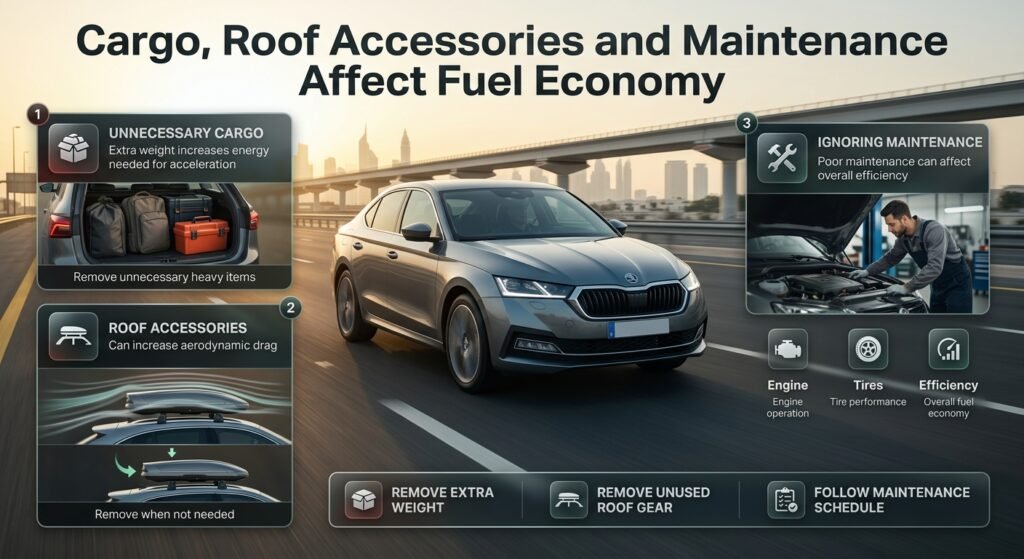
Why it happens
People leave items in the car because they might need them later.
Why it’s harmful
Additional weight increases the energy required for acceleration.
Better approach
Remove unnecessary heavy items.
Mistake 6: Leaving Roof Accessories Installed
Why it happens
Removing them after every trip feels inconvenient.
Why it’s harmful
They can increase aerodynamic drag.
Better approach
Remove them when they’re not needed, especially before long highway trips.
Mistake 7: Ignoring Maintenance
Why it happens
The vehicle still seems to run normally.
Why it’s harmful
Poor maintenance can affect engine operation, tire performance, and overall efficiency.
Better approach
Follow the manufacturer’s maintenance schedule.
Practical Highway Fuel-Saving Strategy
If you want a simple routine, use this approach.
Before the Journey
Check:
- Tire pressure
- Fuel level
- Engine condition
- Cargo weight
- Roof accessories
- Route
- Traffic conditions
- Weather
During Acceleration
Accelerate smoothly.
Don’t crawl unnecessarily, but avoid aggressive bursts of power.
During Cruising
Maintain a stable legal speed.
Avoid constantly changing speed.
During Traffic
Look ahead.
Maintain a safe distance.
Avoid unnecessary acceleration followed by braking.
During Stops
Avoid unnecessary idling where appropriate and safe.
This approach is simple enough for everyday driving and doesn’t require expensive equipment.
How to Measure Your Own Highway Fuel Consumption
One of the best ways to understand your vehicle is to measure it.
Don’t rely only on the dashboard estimate.
A simple fuel-tracking method can give you more useful information.
Step 1: Fill the Tank
Fill the tank consistently.
Step 2: Reset the Trip Meter
Record the starting mileage or kilometers.
Step 3: Drive Normally
Use a consistent route when possible.
Step 4: Refuel
At the next refill, record how much fuel was added.
Step 5: Calculate
For miles per gallon:
Distance traveled ÷ gallons used = MPG
For kilometers per liter:
Kilometers traveled ÷ liters used = km/L
For liters per 100 km:
Liters used ÷ kilometers traveled × 100 = L/100 km
Step 6: Compare Similar Trips
Compare trips with similar:
- Route
- Traffic
- Weather
- Cargo
- Tire pressure
Then look for patterns.
This can tell you much more about your particular vehicle than a generic internet speed recommendation.
A Simple Example of Speed and Fuel Cost
Imagine a driver travels 500 km.
At one moderate highway speed, the vehicle averages:
7 L/100 km
Fuel required:
500 × 7 ÷ 100 = 35 liters
Now suppose the driver increases speed and fuel consumption rises to:
8.5 L/100 km
Fuel required:
500 × 8.5 ÷ 100 = 42.5 liters
That’s an additional:
7.5 liters
on the same 500-km journey.
The figures are hypothetical and will vary by vehicle, but the example shows why a seemingly small change in fuel economy can matter over long distances.
Is Driving Faster Worth the Extra Fuel?
This depends on the individual journey.
Suppose increasing your cruising speed saves only a modest amount of travel time but significantly increases fuel consumption.
You have to decide whether that time saving is worth the additional cost and fuel use.
For many routine journeys, the answer may be no.
If you’re traveling hundreds of kilometers, a moderate reduction in speed can sometimes provide a meaningful fuel saving without making the trip dramatically longer.
Of course, you should always obey the applicable speed limit.
Highway Speed vs Fuel Economy: Quick Comparison
| Driving behavior | Fuel-efficiency effect |
|---|---|
| Moderate steady cruising | Generally favorable |
| Unnecessarily high speed | Generally unfavorable |
| Smooth acceleration | Favorable |
| Hard acceleration | Unfavorable |
| Predictable speed | Favorable |
| Frequent speed changes | Unfavorable |
| Correct tire pressure | Favorable |
| Underinflated tires | Can reduce efficiency |
| Heavy unnecessary cargo | Can reduce efficiency |
| Strong headwind | Increases fuel demand |
| Unnecessary roof equipment | Can increase drag |
| Severe stop-and-go traffic | Usually unfavorable |
| Unnecessary idling | Wastes fuel |
This table summarizes general principles rather than promising a specific fuel-economy result.
Fuel-Efficient Highway Driving in Dubai
Dubai presents some unique driving conditions that can influence fuel consumption.
Drivers may encounter:
- High temperatures
- Extensive highways
- Heavy traffic
- Strong air-conditioning demand
- Long-distance commuting
- Multi-lane roads
- High-speed traffic
- Frequent acceleration and lane changes
These conditions make efficient driving particularly useful.
A sensible approach is to combine:
Legal speed + steady cruising + smooth acceleration + correct tire pressure + proper maintenance.
Don’t focus on one factor while ignoring everything else.
For a complete guide, visit 👉 Fuel-Efficient Highway Driving.
How Dubai’s Heat Can Influence Fuel Use
Extreme heat can increase cooling requirements.
Drivers may use air conditioning for almost the entire journey.
That doesn’t mean you should avoid using the air conditioner.
In Dubai’s climate, keeping occupants comfortable and safe is important.
Instead, reduce unnecessary energy demand by:
- Parking in shade where possible
- Using sunshades
- Venting extreme cabin heat before cooling
- Keeping windows closed while cooling
- Maintaining the air-conditioning system properly
Vehicle maintenance is especially important when operating regularly in extreme temperatures.
Expert Advice: What Professionals Focus On
Fuel-efficient driving isn’t about driving painfully slowly.
It’s about avoiding unnecessary energy waste.
The biggest habits to focus on are:
1. Control Speed
Avoid unnecessary high-speed cruising.
2. Look Ahead
Anticipate traffic instead of reacting at the last second.
3. Accelerate Smoothly
Use the power you need without unnecessary bursts.
4. Maintain Tires
Correct tire pressure matters.
5. Reduce Drag
Remove unnecessary roof equipment.
6. Reduce Weight
Don’t carry heavy items you don’t need.
7. Maintain the Vehicle
Follow the manufacturer’s recommended service schedule.
8. Track Real Consumption
Use actual fuel purchases and distance traveled to understand your vehicle.
Professional Advice: Don’t judge fuel economy from one highway trip. Compare several similar journeys because wind, temperature, traffic, road gradient, tire pressure, and air-conditioning demand can all change the result.
When Slowing Down Doesn’t Save Fuel
It is possible to take fuel-saving advice too far.
Driving extremely slowly can be unsafe or inappropriate for a highway.
Other road users may have to react to you.
The goal isn’t:
Drive as slowly as possible.
The goal is:
Drive at an appropriate, legal, safe, and efficient speed.
Fuel efficiency should never come at the expense of:
- Safety
- Traffic flow
- Visibility
- Proper following distance
- Legal requirements
- Vehicle control
How to Save Fuel Without Slowing Down Too Much
If you don’t want to reduce your highway speed significantly, focus on the other major factors.
You can still improve efficiency by:
- Maintaining proper tire pressure
- Removing unnecessary cargo
- Removing roof equipment
- Avoiding aggressive acceleration
- Maintaining a consistent speed
- Anticipating traffic
- Avoiding unnecessary braking
- Keeping the vehicle properly maintained
- Reducing unnecessary idling
These habits can help without requiring you to make a dramatic change to your normal driving routine.
For more techniques, visit 👉 Fuel-Efficient Driving Techniques.
What Happens If You Run Out of Fuel on a Highway?
Running out of fuel can happen even when the driver thinks there should be enough remaining.
Your estimated range can change because of:
- Higher speeds
- Traffic
- Strong headwinds
- Air-conditioning use
- Hills
- Detours
- Heavy cargo
- Aggressive acceleration
If the fuel warning appears, don’t assume you have exactly the same range you normally get.
Drive safely toward an appropriate fuel station if possible.
If the vehicle becomes stranded, move to a safe location where possible and seek roadside assistance.
Never place yourself in danger by standing in a live traffic lane.
For drivers who need fuel delivered to a stranded vehicle in Dubai, 👉 Fuel Delivery Dubai can provide a starting point for finding roadside fuel assistance.
Does driving faster on the highway use more fuel?
Driving faster on the highway usually increases fuel consumption, and the effect becomes more noticeable as speed gets higher. The main reason is aerodynamic drag. Your vehicle has to push through the air continuously, and the resistance created by that airflow increases rapidly with speed. At highway speeds, aerodynamic drag becomes one of the major forces the engine has to overcome, so maintaining a higher cruising speed requires more power and usually more fuel.
The U.S. Department of Energy reports that fuel economy generally decreases rapidly above 50 mph, while one analysis of 74 light-duty vehicles found that average fuel economy was about 27% lower at 80 mph than at 60 mph. That doesn’t mean every vehicle will experience exactly the same percentage change, but it clearly demonstrates why high-speed cruising can become expensive over a long journey.
What this means for everyday driving:
Higher highway speeds generally mean higher fuel consumption.
The fuel penalty becomes more important at higher speeds.
Aerodynamic drag is a major reason for the increase.
Large SUVs, vans, and boxier vehicles may feel the effect more strongly.
Reducing unnecessary speed can improve fuel economy without changing your vehicle.
The best speed for fuel economy varies by vehicle, so there isn’t one universal number.
The important point is that driving faster doesn’t simply consume fuel in proportion to the extra speed. As speed rises, aerodynamic resistance becomes increasingly important, which is why the jump from a moderate speed to a very high speed can have a much larger effect than drivers expect.
What is the most fuel-efficient speed for highway driving?
There isn’t a single highway speed that is automatically the most fuel-efficient for every car. The optimum point depends on the vehicle’s aerodynamics, engine, transmission, tires, weight, drivetrain, and road conditions. A sensible general approach is to drive at a moderate, steady speed within the legal limit, rather than trying to find one exact number that supposedly works for every vehicle.
Research from Oak Ridge National Laboratory involving 74 different light-duty vehicles found that the best fuel economy occurred around 40 mph in the tested vehicles, with fuel economy declining sharply above about 50 mph. That doesn’t mean 40 mph should be treated as a recommended highway speed today; highway traffic laws and safety obviously take priority. Instead, the research demonstrates an important principle: fuel economy has an efficiency range, and increasing speed beyond that range generally carries a growing fuel penalty.
For practical highway driving:
Follow the posted speed limit.
Avoid unnecessarily high cruising speeds.
Keep your speed relatively consistent.
Use the vehicle’s highest appropriate gear.
Avoid repeated acceleration and braking.
Consider your vehicle’s own fuel-economy information.
Don’t assume a speed recommended for one vehicle will work equally well for another.
A good fuel-saving strategy isn’t about crawling along the highway. It’s about finding a safe, legal, comfortable cruising speed that doesn’t force the vehicle to fight excessive aerodynamic drag.
Why does fuel consumption increase so much at high highway speeds?
The biggest reason is aerodynamic drag, which increases approximately with the square of vehicle speed. In simple terms, doubling speed doesn’t merely double the aerodynamic resistance; the resistance increases much more rapidly. The power required to overcome that drag rises even faster, which is why high-speed driving can have a disproportionate effect on fuel consumption.
At moderate speeds, rolling resistance, drivetrain losses, and other factors are important. As the vehicle moves faster, however, pushing air out of the way becomes increasingly demanding. The National Academies notes that aerodynamic drag accounts for a much larger share of vehicle energy use at high speeds than at low speeds.
This is also why vehicle design matters.
A low, streamlined sedan may move through the air more efficiently than a tall SUV. Add a roof box, bicycle rack, or other external equipment and the airflow can become less efficient. At highway speeds, those differences become more important because aerodynamic effects are already significant.
The main factors to remember are:
Speed: Higher speed creates more aerodynamic resistance.
Vehicle shape: Streamlined vehicles generally experience less drag.
Frontal area: Larger vehicles have more air to push aside.
Roof accessories: External equipment can disturb airflow.
Headwind: Wind coming toward the vehicle increases the aerodynamic load.
Open windows: At highway speed, they can disturb airflow around the vehicle.
So when your fuel economy drops during a fast highway journey, it isn’t necessarily a sign that something is wrong with the engine. The vehicle may simply be using considerably more energy to overcome air resistance.
Is it better to drive at a constant speed or keep changing speed on the highway?
Maintaining a steady and appropriate speed is generally better for fuel economy than repeatedly accelerating and braking. Every time you accelerate, the engine has to supply additional energy to increase the vehicle’s speed. If you then brake shortly afterward, much of that energy is dissipated rather than being used to move you farther down the road.
This is why aggressive highway driving can be inefficient even when the driver’s average speed doesn’t look particularly high.
For example, imagine two drivers traveling through similar traffic.
Driver A maintains a steady 100 km/h when conditions allow, watches traffic ahead, and makes gradual speed adjustments.
Driver B repeatedly accelerates to 120 km/h, brakes back to 100 km/h, accelerates again, and repeats the process.
Driver B is constantly putting energy into changing the vehicle’s speed. If that extra speed doesn’t significantly reduce the journey time, the additional fuel is essentially being spent for very little practical benefit.
Better highway habits include:
Look several vehicles ahead.
Maintain a safe following distance.
Avoid racing toward gaps in traffic.
Accelerate smoothly.
Avoid unnecessary hard braking.
Let off the accelerator early when a slowdown is clearly coming.
Use cruise control when conditions are suitable.
The U.S. Department of Energy specifically notes that aggressive driving—including speeding and rapid acceleration and braking—can significantly reduce fuel economy, while smooth acceleration and braking can improve efficiency.
For a deeper internal resource, you can link this FAQ to 👉 Smooth Driving Techniques for Better Fuel Economy in Dubai.
How can I reduce fuel consumption while driving on the highway?
The most effective approach is to combine moderate speed, smooth driving, proper vehicle maintenance, and reduced aerodynamic resistance. You don’t need a special fuel-saving device or complicated driving technique. Most useful improvements come from controlling the factors you can actually influence.
Start with your speed. Stay within the legal limit and avoid unnecessarily fast cruising. Next, maintain a reasonably steady pace instead of repeatedly accelerating and braking. Correct tire pressure is also important because underinflated tires can increase rolling resistance. The Department of Energy estimates that keeping tires properly inflated can improve fuel economy by around 0.6% on average, with larger benefits possible in some cases.
Then look at the vehicle itself. Remove unnecessary heavy cargo and take off roof-mounted equipment when you don’t need it. External cargo can increase aerodynamic drag, and the effect can become more significant on the highway.
A practical highway fuel-saving routine:
Choose an appropriate speed: Stay within the speed limit and avoid unnecessary high-speed cruising.
Keep a steady pace: Don’t constantly chase small gaps in traffic.
Accelerate smoothly: Use only as much power as the situation requires.
Anticipate traffic: Looking ahead helps reduce unnecessary braking.
Check tire pressure: Use the manufacturer’s recommended pressure.
Remove unnecessary weight: Don’t carry heavy items you don’t need.
Remove roof accessories: Take off roof boxes and racks when they’re not required.
Use cruise control appropriately: It can help maintain a consistent speed on suitable highway sections.
Maintain the vehicle: Engine and tire condition can affect real-world fuel economy.
Monitor actual fuel use: Compare fuel consumption over similar trips rather than relying on one journey.
The biggest mistake is trying to save fuel through one single trick. A driver who reduces speed slightly but has badly underinflated tires, carries unnecessary roof cargo, and constantly accelerates and brakes may still waste more fuel than necessary.
The better approach is to combine several small improvements. Over a long highway journey—and especially over months of regular driving—those habits can add up to a noticeable reduction in fuel consumption.
Conclusion
Understanding how highway speed affects fuel consumption can help you make smarter driving decisions and reduce unnecessary fuel costs. Driving at a higher speed generally increases aerodynamic drag, which means your engine has to work harder to keep the vehicle moving. The faster you go, especially at already-high highway speeds, the more noticeable this effect can become.
The goal isn’t to drive as slowly as possible. Instead, focus on maintaining a safe, legal, and steady speed, avoiding aggressive acceleration and unnecessary braking. Correct tire pressure, regular vehicle maintenance, reduced unnecessary weight, and removing unused roof accessories can also support better fuel economy.
For everyday highway driving, simple habits often make the biggest difference. Drive smoothly, look ahead, maintain a consistent pace, and avoid using extra fuel just to save a few minutes on your journey. Over time, these practical changes can help you get more distance from every liter of fuel while making your highway driving smoother, safer, and more economical.
Leave a Reply