Introduction
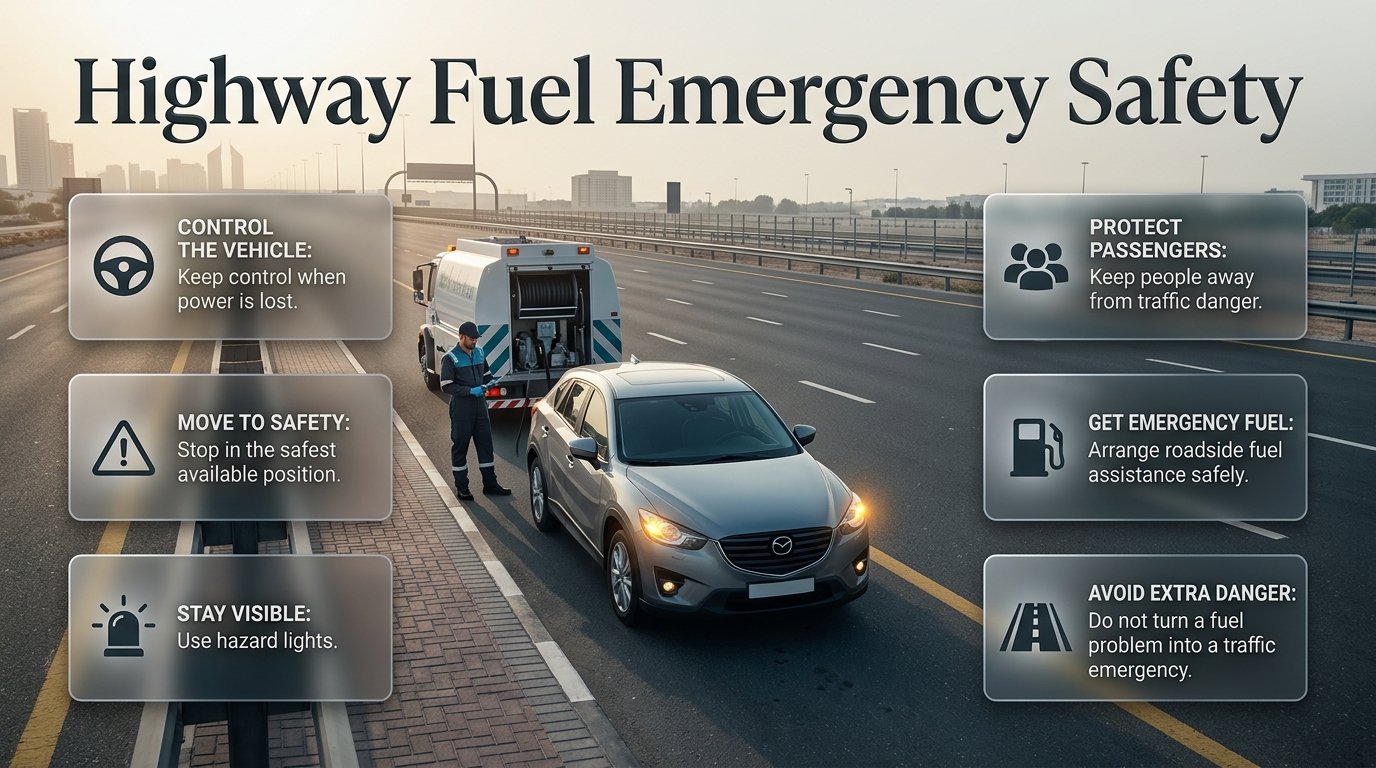
Highway Fuel Emergency Safety | Running out of fuel on a highway can turn a normal drive into a serious roadside situation within minutes. When the engine suddenly loses power, the biggest concern isn’t simply finding petrol. It’s keeping the vehicle, driver, and passengers away from fast-moving traffic.
That’s why highway fuel emergency safety should always come first.
If your car runs out of fuel while traveling on a highway, you need to know how to control the vehicle, where to stop, how to make it visible, whether passengers should remain inside, and how to get fuel without creating another danger.
This guide explains what to do step by step, which mistakes to avoid, how to deal with passengers, and how to arrange emergency fuel assistance safely.
For motorists in Dubai, Fuel Delivery Dubai provides a useful starting point for understanding mobile fuel assistance and roadside refueling.
What Is Highway Fuel Emergency Safety?
Highway fuel emergency safety refers to the precautions drivers and passengers should take when a vehicle runs out of fuel or loses engine power on a high-speed road.
The main objective is to reduce exposure to moving traffic while getting the right assistance.
A safe response generally involves:
- Maintaining control of the vehicle
- Moving away from active traffic when possible
- Turning on hazard lights
- Keeping passengers in a safe position
- Avoiding unnecessary walking near traffic
- Contacting suitable roadside assistance
- Giving accurate location information
- Refueling only when the situation is safe
The correct response can change depending on whether the vehicle is on a wide shoulder, narrow roadside, emergency lane, or active traffic lane.
What Should You Do First When Your Car Runs Out of Fuel on a Highway?
If your car runs out of fuel on a highway, stay calm, maintain control, and move the vehicle toward the safest available position if this can be done without creating additional danger. Once stopped, activate the hazard lights, secure the vehicle, assess the surroundings, and arrange appropriate assistance.
The first few moments are important because approaching drivers may not immediately realize that your vehicle has lost power.
Step 1: Stay Calm and Maintain Control
When the engine starts losing power, your first priority should be controlling the vehicle.
Don’t suddenly brake, swerve, or make an aggressive lane change.
If the vehicle still has momentum, use it carefully to move toward a safer location.
Keep your attention on:
- Steering
- Surrounding traffic
- Safe lane positioning
- Available shoulder space
- Road conditions
Why it matters: A controlled vehicle gives surrounding drivers more time to react.
⚠ Common Mistake: Looking down at the fuel gauge or immediately reaching for your phone while the vehicle is still moving.
Control the vehicle first. Make the call once you’re in a safer position.
Step 2: Move Away From Traffic If It Is Safe
If you have enough momentum and can reach a shoulder or designated stopping area safely, gradually move toward it.
Don’t make a risky lane change simply because you want to reach the shoulder.
A safe movement is more important than reaching a particular stopping point.
If you cannot safely move across a lane, don’t force the maneuver. Contact emergency assistance and explain that the vehicle is stopped in or close to an active traffic lane.
For a broader guide to this situation, see Running Out of Fuel on the Road.
Step 3: Turn On Your Hazard Lights
Once stopped, activate the vehicle’s hazard warning lights.
This helps communicate to approaching drivers that your vehicle is stationary or experiencing a problem.
Hazard lights are particularly useful when:
- Traffic is heavy
- Visibility is reduced
- The vehicle is stopped unexpectedly
- It’s nighttime
- The vehicle is near a roadway
💡 Pro Tip: Hazard lights improve visibility, but they don’t make a dangerous location safe. Your priority should still be reducing exposure to moving traffic.
Step 4: Secure the Vehicle
Once you’ve reached a safe stopping position, apply the parking brake and make sure the vehicle isn’t likely to roll.
Don’t leave doors open toward moving traffic.
Don’t stand directly behind the vehicle.
Don’t gather passengers around the car.
The fewer people exposed to traffic, the better.
Should You Stay Inside the Vehicle After Running Out of Fuel?
If the vehicle is safely positioned away from moving traffic, remaining inside may be appropriate while waiting for assistance. If the vehicle is stopped in a dangerous position or there is an immediate hazard, the correct response depends on the circumstances and instructions from emergency responders.
This is why there isn’t one universal rule that applies to every highway breakdown.
When Remaining Inside May Be Reasonable
If your vehicle is securely stopped on a suitable shoulder and there is no immediate danger, staying inside can reduce unnecessary exposure to traffic.
Passengers should:
- Remain calm
- Stay together
- Keep children close
- Avoid standing beside the vehicle
- Avoid walking along the road
- Wait for assistance
When the Situation Is More Serious
If the vehicle is stopped in an active lane, near a blind curve, or in another dangerous location, contact emergency assistance immediately.
Follow instructions from authorities or emergency responders regarding where you and your passengers should position yourselves.
⭐ Expert Tip: Never assume that getting out of the vehicle is automatically safer. On a high-speed road, pedestrians can be extremely difficult for approaching drivers to see and avoid.
For more information, read Car Ran Out of Fuel Safety in Dubai.
What Should Passengers Do During a Highway Fuel Emergency?
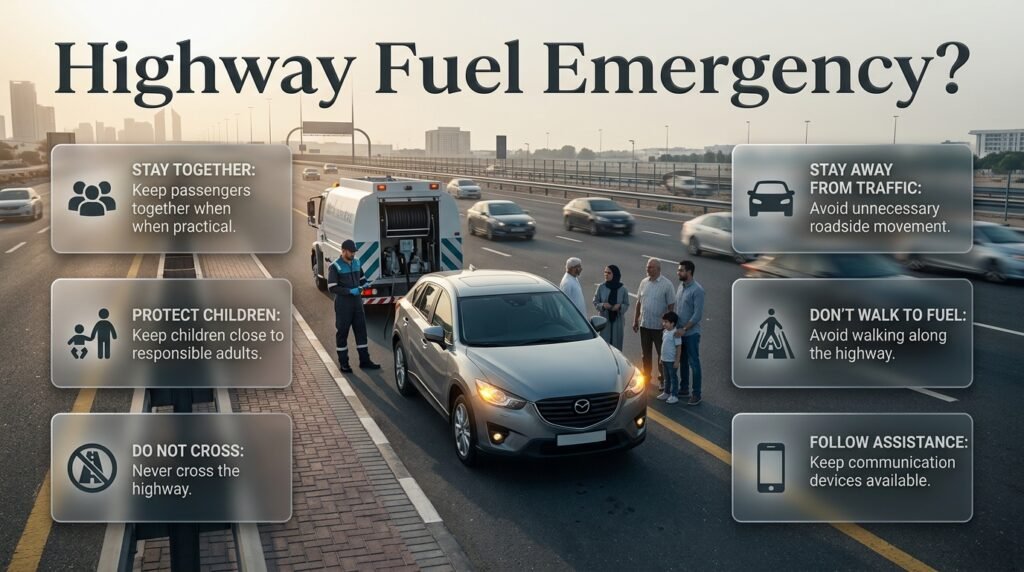
Passengers should remain calm and avoid unnecessary movement around the vehicle. Children should stay close to responsible adults, and nobody should cross the highway or walk toward passing traffic.
A passenger may think that walking to a petrol station is helpful, but on a highway this can create a separate and potentially more serious safety problem.
Passenger Safety Checklist
Passengers should:
- Stay together when practical
- Keep children away from traffic
- Avoid crossing the highway
- Never walk between moving vehicles
- Avoid standing directly behind the car
- Avoid approaching passing vehicles
- Follow instructions from emergency personnel
- Keep communication devices available
If the vehicle is safely positioned, there is usually little benefit in having everyone leave the car and move around the roadside.
Why Is Walking on a Highway Dangerous?
Highway traffic can be fast, unpredictable, and difficult for pedestrians to judge correctly.
A driver approaching from behind may not expect someone to be walking along the shoulder. A vehicle may also drift toward the shoulder because of distraction, tire problems, fatigue, or another emergency.
For that reason, walking several hundred meters—or several kilometers—to find fuel isn’t a sensible solution when safer assistance options are available.
If your vehicle has an empty tank, see Safely Dealing With an Empty Fuel Tank in Dubai for additional guidance.
How Can You Make a Stopped Vehicle More Visible?
A stopped vehicle should be made as visible as reasonably possible without exposing the driver or passengers to unnecessary traffic risk.
Start with the vehicle’s hazard lights.
Depending on the circumstances and available equipment, additional warning equipment may also be useful when it can be deployed safely.
Practical Visibility Measures
- Activate hazard lights
- Keep appropriate vehicle lighting operating
- Use reflective safety equipment when suitable
- Avoid standing in active traffic
- Avoid walking behind the vehicle
- Make your location clear to the assistance provider
⚠ Common Mistake: Don’t enter a live traffic lane to place a warning device. A safety measure should never create a greater personal risk.
Should You Try to Restart the Car?
If the fuel tank is genuinely empty, repeatedly trying to restart the vehicle won’t solve the problem.
It may also place unnecessary strain on the battery.
A driver should first consider whether the symptoms actually point to an empty tank.
For example:
Fuel gauge empty → engine loses power → vehicle stops → fuel shortage is likely
But:
Fuel gauge shows fuel → engine suddenly stops → warning lights appear → another vehicle problem may exist
If the second situation occurs, don’t automatically assume you only need petrol.
What If You’re Not Sure the Fuel Tank Is Empty?
A vehicle can stop for many reasons besides running out of fuel.
Possible causes include:
- Empty fuel tank
- Battery failure
- Alternator problem
- Fuel pump issue
- Electrical fault
- Engine problem
- Overheating
- Mechanical failure
Look for warning signs before deciding what assistance you need.
Smoke, unusual noises, overheating, warning lights, fluid leaks, or a burning smell may indicate that the problem is more serious than an empty tank.
In such circumstances, requesting general roadside assistance or vehicle recovery may be more appropriate than simply requesting fuel.
For a broader breakdown guide, see What to Do During a Roadside Breakdown.
How Do You Get Fuel During a Highway Emergency?
Once your vehicle is safely positioned, contact a suitable roadside fuel delivery or recovery service.
Give the provider enough information to locate you accurately.
Useful details include:
- Highway name
- Direction of travel
- Nearest exit
- Nearby landmark
- Road marker or kilometer point
- Vehicle make and model
- Vehicle color
- Fuel type required
- Current location
- Whether passengers are present
The better your location information, the easier it is for assistance to reach you.
What Should You Tell the Fuel Delivery Provider?
A simple message could include:
“My car has run out of petrol. I’m on [highway], traveling [direction], near [exit or landmark]. I’m in a [vehicle color and model]. The car is safely stopped on the shoulder.”
This is much more useful than simply saying, “I’m stuck on the highway.”
📌 Quick Tip: If your phone allows location sharing, sending your precise location can make it easier for the provider to find you.
Is Emergency Fuel Delivery Safer Than Walking to a Petrol Station?
In many highway situations, arranging emergency fuel delivery is safer than walking alongside a high-speed road.
Instead of leaving the vehicle, the driver can remain in a safer location while assistance brings the required fuel directly to the car.
This can be especially useful when:
- The highway is busy
- The nearest petrol station isn’t visible
- The vehicle is far from an exit
- Passengers are present
- Children are traveling with you
- Weather conditions are uncomfortable
- The road doesn’t provide a safe pedestrian route
Emergency fuel delivery is designed to solve the fuel problem without requiring the stranded driver to travel along the highway on foot.
For practical advice on roadside fuel situations, see Emergency Roadside Fuel Advice.
What Information Should You Give Before Fuel Is Delivered?
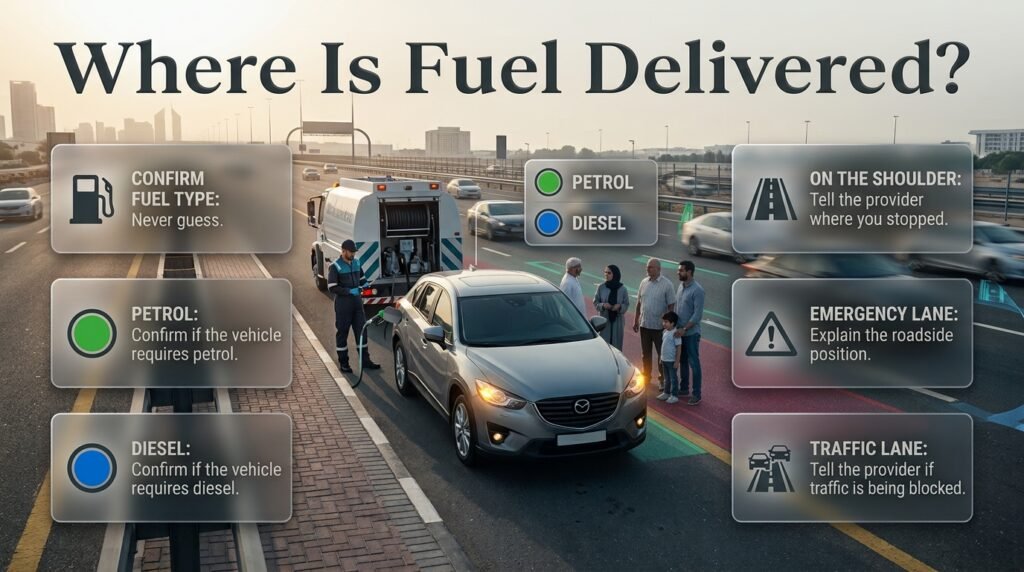
Before fuel is supplied, make sure the provider knows the correct fuel type.
This is particularly important because putting the wrong fuel into a vehicle can create another problem.
Confirm whether the vehicle requires:
- Petrol
- Diesel
If you’re unsure, check the vehicle’s fuel label, owner’s manual, manufacturer’s information, or another reliable source.
Never guess.
You should also tell the provider whether the vehicle is:
- Safely on the shoulder
- In an emergency lane
- Partially blocking traffic
- Completely stopped in a traffic lane
This allows the assistance team to understand the roadside conditions before arriving.
What Should You Do After Emergency Fuel Arrives?
Once the correct fuel has been supplied, don’t immediately accelerate back onto the highway.
First make sure the vehicle is ready to move.
Check:
- Fuel cap is properly secured
- Vehicle is operating normally
- No warning signs have appeared
- Surrounding traffic is clear
- You have enough space to rejoin the road
Signal appropriately and return to traffic only when it is safe.
If the engine still doesn’t start after the appropriate fuel has been added, don’t keep trying indefinitely.
The vehicle may have another fault.
At that point, recovery or mechanical assistance may be necessary.
For a useful step-by-step reference, read Steps After Running Out of Petrol.
What If Your Car Runs Out of Fuel in a Traffic Lane?
A vehicle that stops in an active highway lane presents a significantly greater risk than one safely positioned on a shoulder.
In this situation, treat the problem as an urgent roadside safety issue.
Immediate Priorities
- Activate hazard lights.
- Maintain awareness of surrounding traffic.
- Contact emergency assistance.
- Explain that the vehicle is in an active lane.
- Follow instructions from emergency responders.
- Avoid standing behind the vehicle.
- Don’t ask passengers to direct traffic.
- Don’t attempt dangerous pushing or lane crossing.
The goal isn’t to repair the car immediately.
The goal is to reduce the risk of a collision.
Highway Fuel Emergency Safety at Night
A fuel emergency at night can be more difficult because visibility is reduced.
Other drivers may see your vehicle later than they would during daylight.
At night:
- Keep hazard lights activated
- Stay in the safest available position
- Avoid walking along the road
- Keep your phone available
- Communicate your location clearly
- Use suitable reflective safety equipment when safe
- Follow emergency instructions
Don’t become so focused on your phone that you stop paying attention to the surrounding environment.
Highway Fuel Emergency Safety in Hot Weather
Hot weather adds another consideration to roadside emergencies.
If the vehicle is safely positioned and its air conditioning is functioning, staying inside can help reduce heat exposure while waiting.
Keep drinking water available when possible.
Avoid unnecessary physical activity in extreme heat, especially walking long distances along the roadside.
If the vehicle’s cooling system is malfunctioning or the cabin becomes unsafe, tell the assistance provider or emergency responders about the conditions.
Highway Fuel Emergency Safety in Rain, Dust, or Poor Visibility
Weather can change the risk around a stranded vehicle.
Rain can reduce visibility and increase stopping distances.
Dust can make it harder for approaching drivers to see roadside vehicles.
At night, these conditions can become even more challenging.
During poor visibility:
- Activate hazard lights
- Stay in the safest practical location
- Avoid unnecessary roadside movement
- Give detailed location information
- Follow emergency instructions
- Don’t walk toward traffic looking for assistance
Your location should be communicated using more than one reference whenever possible, such as the highway, direction, nearest exit, and landmark.
What Are the Most Common Highway Fuel Emergency Mistakes?
1. Stopping Suddenly
Drivers sometimes panic when the engine starts losing power.
Why it happens: They think the vehicle will stop immediately.
Why it’s risky: Sudden braking can surprise vehicles behind them.
Better approach: Maintain control and move toward a safe position when possible.
2. Walking to Find Petrol
Why it happens: The driver sees a petrol station nearby.
Why it’s risky: The pedestrian may be exposed to high-speed traffic.
Better approach: Arrange professional assistance.
3. Standing Behind the Vehicle
Why it happens: People want to warn approaching drivers.
Why it’s risky: A driver may not see them in time.
Better approach: Use the vehicle’s warning systems and remain in the safest available position.
4. Repeatedly Starting the Engine
Why it happens: The driver hopes the vehicle will suddenly restart.
Why it’s a problem: Repeated attempts can consume battery power.
Better approach: Once you’ve identified an empty tank, arrange fuel assistance.
5. Crossing the Highway
Why it happens: A station or service road appears to be on the opposite side.
Why it’s dangerous: Crossing multiple lanes exposes pedestrians to moving traffic.
Better approach: Never cross a highway simply to obtain fuel.
6. Giving Poor Location Information
Why it happens: Stress makes it difficult to remember road details.
Why it’s a problem: Assistance may struggle to locate you.
Better approach: Provide highway, direction, exit, landmark, and vehicle details.
7. Trying to Fix Everything Yourself
Why it happens: Drivers want to get moving quickly.
Why it’s risky: A roadside fuel problem can become more dangerous if the driver starts working around the vehicle close to traffic.
Better approach: Focus on safety first and use professional assistance where appropriate.
For more roadside precautions, see Roadside Vehicle Emergency Precautions.
Highway Fuel Emergency Safety Decision Table
| Situation | Recommended General Response |
|---|---|
| Vehicle safely on shoulder | Activate hazards and arrange assistance |
| Vehicle stopped in active lane | Treat as an urgent traffic hazard |
| Fuel gauge clearly empty | Arrange appropriate fuel assistance |
| Fuel remains but engine stops | Consider a mechanical or electrical problem |
| Children are passengers | Keep them away from traffic |
| Nighttime emergency | Increase visibility and minimize movement |
| Poor visibility | Stay in a safe location and communicate clearly |
| Petrol station appears nearby | Don’t walk along the highway |
| Vehicle won’t restart after refueling | Request recovery or mechanical assistance |
What Should You Keep in Your Car for a Fuel Emergency?
A small amount of preparation can make a major difference.
Consider keeping:
- A charged mobile phone
- Portable phone charger
- Drinking water
- Vehicle owner’s manual
- Emergency contact information
- Appropriate reflective safety equipment
- Basic first-aid supplies
- Vehicle registration information
- Insurance information
You don’t need to turn your vehicle into an emergency warehouse.
The objective is to have the basic resources needed to communicate, remain visible, and stay comfortable while waiting for assistance.
How Can You Prevent a Highway Fuel Emergency?
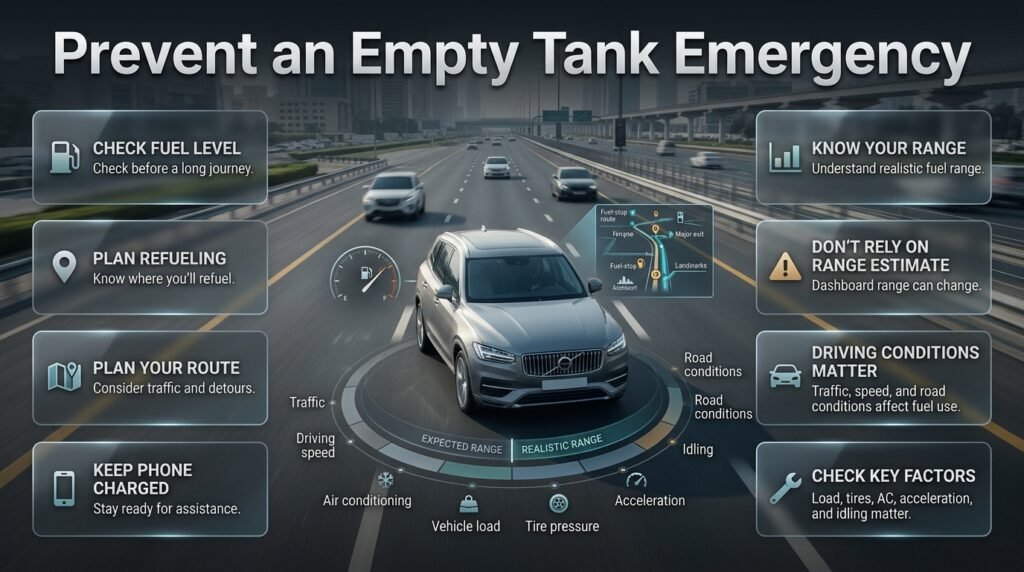
The easiest way to manage an empty tank is to prevent it from happening.
Don’t treat the final portion of your fuel gauge as guaranteed reserve fuel.
Before a long highway journey:
- Check the fuel level.
- Plan where you’ll refuel.
- Consider traffic and detours.
- Understand your vehicle’s realistic range.
- Avoid relying entirely on the dashboard range estimate.
- Keep your phone charged.
- Know major exits and landmarks along your route.
Your actual fuel consumption can change with:
- Traffic
- Driving speed
- Air conditioning
- Vehicle load
- Tire pressure
- Acceleration
- Idling
- Road conditions
This means a vehicle’s expected range can change significantly during a demanding trip.
What Should You Do Before a Long Highway Drive?
A simple pre-trip fuel check takes only a few minutes.
Quick Highway Fuel Checklist
Before leaving:
- ☐ Check fuel level
- ☐ Check tire condition
- ☐ Confirm phone battery
- ☐ Keep water available
- ☐ Know your route
- ☐ Identify major fuel stops
- ☐ Check for obvious vehicle warning signs
During the journey:
- ☐ Monitor fuel level
- ☐ Don’t ignore the fuel warning
- ☐ Avoid unnecessary idling
- ☐ Pay attention to changes in vehicle behavior
- ☐ Refuel before the tank becomes critically low
For motorists who want additional guidance after an empty-tank incident, What to Do When You Run Out of Fuel in Dubai covers the practical steps to take once the vehicle has lost its fuel supply.
What Is the Safest Way to Handle a Highway Fuel Emergency?
The safest approach is to control the vehicle, reduce exposure to traffic, make the vehicle visible, protect passengers, and contact the appropriate assistance.
You don’t need to solve the entire problem yourself.
Don’t walk several kilometers searching for a station.
Don’t cross highway lanes.
Don’t stand behind the vehicle.
Don’t push the car through moving traffic.
Don’t keep restarting an engine when the tank is empty.
Instead, focus on the immediate safety problem and arrange appropriate assistance.
If you want a broader set of precautions for vehicle breakdown situations, see Roadside Breakdown Safety Tips.
You can also review Staying Safe During a Car Breakdown for additional safety procedures when the problem involves more than an empty fuel tank.
What should I do if my car runs out of fuel on the highway?
When your engine starts losing power because you’re out of fuel, your priority should immediately change from reaching your destination to getting the vehicle into the safest possible position. Don’t panic or make a sudden lane change. If the car still has momentum, use it carefully to move toward a shoulder, emergency area, exit, or other safer location. Turn on your hazard lights as soon as you recognize that you’re losing power so approaching drivers have more warning.
Once stopped, avoid treating the situation like a normal petrol-station visit. A highway is not a safe place to walk around unnecessarily. Assess the traffic, keep passengers away from moving vehicles, and contact roadside assistance or an emergency fuel delivery service. Give them your highway, direction of travel, nearest exit or landmark, and vehicle details.
Important points:
Move away from active traffic if you can do so safely.
Turn on hazard warning lights.
Don’t suddenly cross lanes to reach the shoulder.
Don’t walk along the highway searching for fuel.
Give the assistance provider precise location information.
If the vehicle is creating an immediate traffic hazard, contact the appropriate emergency service.
The key principle is simple: the empty tank is the problem you need to solve; moving traffic is the danger you need to manage first.
Is it safe to get out of the car after running out of fuel on a highway?
Getting out isn’t automatically safer. The correct decision depends on where the vehicle has stopped, how close it is to moving traffic, the road layout, and the immediate danger around you. Official highway guidance emphasizes keeping people away from moving traffic and avoiding positions where a collision could push a disabled vehicle into occupants.
If your car is safely positioned away from traffic, unnecessarily walking around the vehicle can increase your exposure to danger. On the other hand, if the vehicle is in a dangerous position, you should follow instructions from emergency responders or the relevant highway authority rather than applying a blanket “stay inside” rule.
Passengers need special attention. Children should remain under control, and nobody should stand behind the vehicle or between the vehicle and approaching traffic.
What passengers should avoid:
Walking along the highway.
Crossing traffic lanes.
Standing directly behind the vehicle.
Approaching passing motorists.
Gathering around the vehicle.
Trying to direct traffic themselves.
Professional approach: Don’t make the decision based on convenience. Make it based on traffic exposure. If you’re unsure what to do in a dangerous location, tell emergency assistance exactly where the vehicle is and follow their instructions.
Should I walk to the nearest petrol station if I run out of fuel on the highway?
Walking to a petrol station may sound like the quickest solution, but on a high-speed highway it can create a much more serious safety problem. A petrol station that looks “nearby” on a map may require walking along an unsafe shoulder, crossing an access road, or even crossing multiple lanes. Highway safety guidance specifically warns against walking along motorways and high-speed roads unless an emergency situation requires it.
A better approach is to stay in a safe location and arrange roadside fuel delivery or recovery assistance. This is particularly important at night, in heavy traffic, during poor visibility, or when you’re traveling with children or other passengers who shouldn’t be exposed to roadside traffic.
Instead of walking for fuel:
Keep the vehicle in the safest available position.
Activate hazard lights.
Contact roadside assistance.
Share your exact location.
Tell the provider which fuel you need.
Wait in the safest practical location.
Remember: A short walk beside a highway isn’t equivalent to a short walk on a normal city street. Vehicles may be traveling at much higher speeds, and drivers may have very little time to react to a pedestrian or stopped vehicle.
How can I safely get emergency fuel when my car runs out on the highway?
The safest way to arrange emergency fuel is to contact a professional roadside fuel delivery or recovery service rather than leaving your vehicle to search for petrol yourself. Once you’ve reached a safe stopping position, give the provider enough information to find you without unnecessary delays.
Your location description should be specific. Instead of saying, “I’m on the highway,” provide the highway name, direction of travel, nearest exit, nearby landmark, road marker or kilometer point if available, and your vehicle’s make, model, and color.
Also confirm the correct fuel type. If you aren’t sure whether your vehicle requires petrol or diesel, check the owner’s manual, fuel label, or manufacturer information before fuel is supplied.
Give the fuel provider:
Highway name
Direction of travel
Nearest exit
Nearby landmark
Exact or shared phone location
Vehicle make and model
Vehicle color
Petrol or diesel requirement
Whether the vehicle is safely on the shoulder
Whether passengers are present
Professional tip: Tell the provider if your vehicle is blocking a traffic lane. That’s an important safety detail because it changes the urgency of the situation.
Once fuel arrives, don’t immediately drive away. Make sure the correct fuel has been supplied, secure the fuel cap, check that the vehicle is operating normally, and only rejoin traffic when the road is clear and it is safe to do so.
What should I do if my car runs out of fuel and stops in a highway traffic lane?
A vehicle that loses power in an active traffic lane should be treated as a serious roadside safety situation, not simply a fuel-delivery problem. The first objective is to reduce the risk of another vehicle striking you.
If the vehicle is still moving, maintain control and try to reach a safer position without making a dangerous maneuver. If you cannot safely leave the lane, activate the hazard lights and contact the appropriate emergency or highway assistance service immediately. Current breakdown guidance consistently prioritizes getting the vehicle away from live traffic where possible and warning approaching drivers.
Don’t stand behind the vehicle to “warn” traffic. Don’t send passengers into the roadway. Don’t attempt to push the vehicle across active lanes unless trained professionals or emergency responders determine that it can be done safely.
If the vehicle is stuck in a live lane:
Switch on hazard lights.
Keep control of the vehicle if it is still moving.
Contact emergency assistance promptly.
Clearly state that you’re stopped in an active lane.
Follow instructions from highway authorities or responders.
Keep passengers away from traffic.
Don’t attempt risky roadside repairs.
Don’t walk into traffic to signal approaching vehicles.
The important distinction is this: when a car is safely on the shoulder, you are mainly solving a fuel problem; when it is stopped in a live lane, you are dealing with a traffic emergency first.
Conclusion
Running out of fuel on a highway can be stressful, but the situation becomes far more manageable when you put safety before speed. The biggest mistake is treating an empty fuel tank like a simple inconvenience and immediately walking to a petrol station or trying to solve the problem while standing close to moving traffic.
If your vehicle loses power, stay calm, maintain control, and move to the safest available position whenever you can do so without creating additional danger. Turn on your hazard lights, keep passengers away from traffic, and arrange professional roadside assistance or emergency fuel delivery rather than taking unnecessary risks.
Remember, the empty tank isn’t always the most dangerous part of the emergency. The real risk comes from fast-moving traffic, poor visibility, unsafe roadside movement, and panic-driven decisions.
A simple approach can make a major difference:
- Control the vehicle.
- Get as far away from moving traffic as safely possible.
- Make the vehicle visible.
- Keep passengers protected.
- Contact the right assistance.
- Refuel safely and check the vehicle before continuing.
Planning ahead also helps prevent these situations. Keep an eye on your fuel level, understand your vehicle’s realistic range, and refuel before the tank becomes critically low—especially before a long highway journey.
When a fuel emergency does happen, don’t take unnecessary chances. Stay calm, stay visible, stay away from traffic, and let professional assistance help you get safely back on the road.
Leave a Reply