Introduction
Staying Safe During a Car Breakdown | A car breakdown can happen without warning. You may be driving through busy Dubai traffic, travelling along a highway, heading to work, or simply going home when the engine suddenly loses power. In that moment, most drivers think about getting the car running again. But the first priority should always be your safety.
Staying safe during a car breakdown means knowing how to control the situation before worrying about the mechanical problem. A flat tyre, dead battery, empty fuel tank, overheating engine, electrical fault, or sudden mechanical failure can all leave you stranded. The safest response is to protect yourself and your passengers, make your vehicle visible to other road users, move away from active traffic when possible, and get appropriate assistance.
For motorists in Dubai, roadside safety deserves extra attention. Busy roads, high-speed highways, heavy traffic, and extreme temperatures can make an ordinary breakdown much more stressful. If you need emergency assistance, Fuel Delivery Dubai provides information about mobile fuel assistance for motorists who have run out of petrol or need help getting fuel to their location.
This guide explains what to do when your vehicle breaks down, where you should wait, when you should leave the car, how to handle an empty fuel tank or overheating engine, what mistakes to avoid, and how to prepare for future roadside emergencies.
What Should You Do First When Your Car Breaks Down?
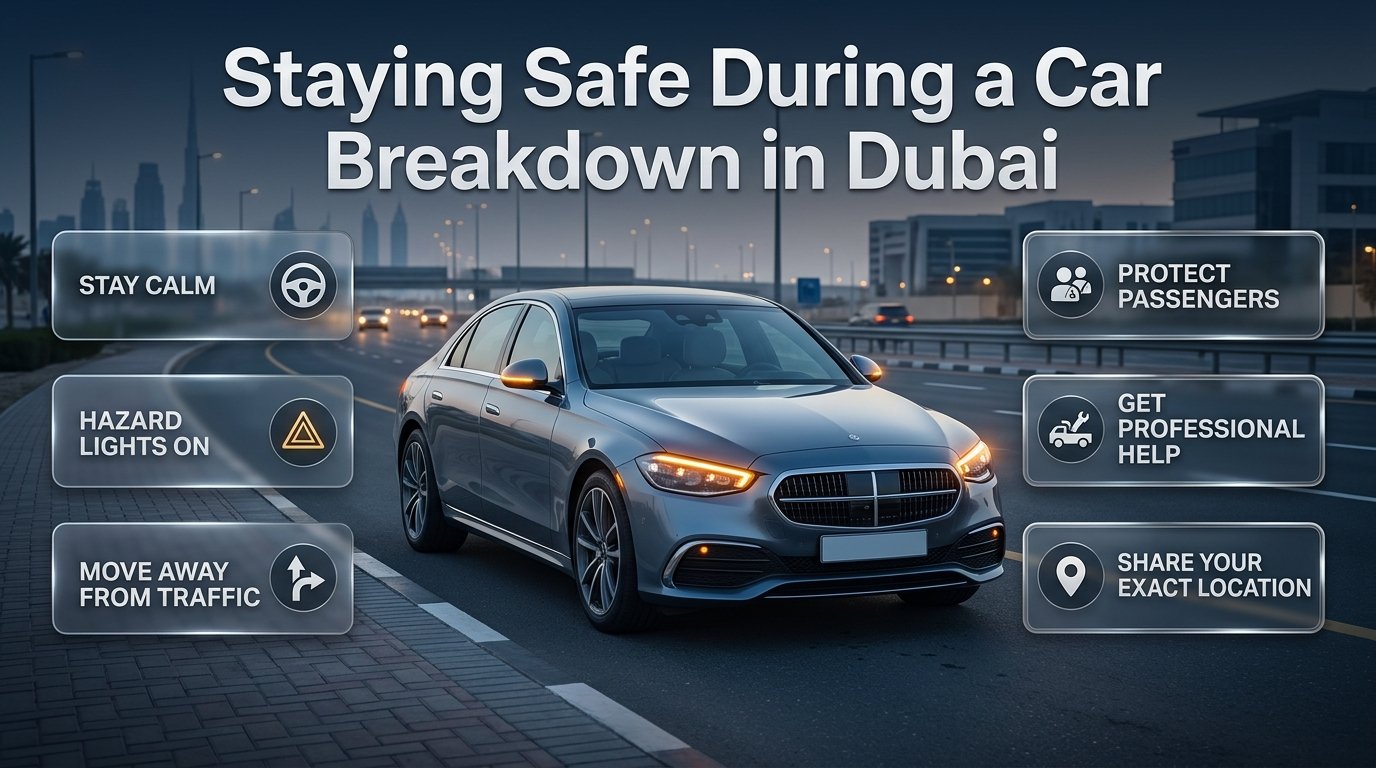
When a car breaks down, the first step is to remain calm, maintain control, and try to move the vehicle to the safest available location. Turn on the hazard lights, reduce speed gradually, avoid sudden manoeuvres, and get away from active traffic if you can do so safely.
The mechanical problem can wait.
Your immediate priorities should be:
- Maintain control of the vehicle.
- Warn approaching drivers.
- Move away from traffic if possible.
- Protect yourself and your passengers.
- Assess the situation from a safe position.
- Contact appropriate roadside assistance.
A breakdown becomes dangerous when drivers panic and make sudden decisions. For example, someone may immediately open the door and step into traffic, attempt to cross a highway, or start repairing a vehicle on the shoulder while cars are passing at high speed.
Those actions can create a much bigger problem than the original breakdown.
Stay Calm and Keep Control
If you notice that the engine is losing power, the steering feels different, a warning light appears, or the vehicle starts behaving abnormally, don’t panic.
Hold the steering wheel firmly and reduce your speed gradually.
Avoid:
- Sudden braking
- Sharp steering
- Abrupt lane changes
- Accelerating aggressively
- Switching lanes without checking traffic
- Stopping unnecessarily in the middle of a lane
If the vehicle is still moving, use the remaining momentum to reach a safer stopping location.
Even if the engine stops, the vehicle may still be steerable. However, some systems may feel different when the engine is no longer running, so be prepared for changes in steering or braking assistance.
Turn on Your Hazard Lights
Hazard warning lights are one of the simplest ways to tell approaching drivers that your vehicle is experiencing a problem.
Turn them on when your vehicle has become disabled or is moving unusually slowly because of a problem.
This is especially important:
- At night
- On high-speed roads
- In heavy traffic
- During poor visibility
- When your vehicle is stopped somewhere unexpected
- When your vehicle is partially obstructing traffic
The purpose is not to make the car completely safe. It is to improve the chance that approaching drivers recognize the hazard early.
💡 Pro Tip: Don’t wait until you’ve figured out what’s wrong with the vehicle before making other drivers aware of the situation. Visibility should come before diagnosis.
Why Is It Important to Move Away From Traffic?
A disabled vehicle close to moving traffic creates a serious roadside hazard. Even if your car is stationary, another driver could fail to notice it, misjudge the distance, or lose control.
If your vehicle can still move safely, try to get it away from active traffic.
Depending on the road, that could mean moving toward:
- A suitable shoulder
- An emergency stopping area
- A designated parking area
- A service road
- A safe side street
- Another protected location away from traffic
Don’t make a dangerous manoeuvre simply to reach a particular location.
For example, if your vehicle is losing power on a busy road, suddenly crossing multiple lanes to reach an exit could be more dangerous than stopping safely where you are.
The goal is not to find the perfect parking location.
The goal is to find the safest practical location available.
What If the Vehicle Cannot Move?
Sometimes the car simply won’t move.
The engine may have stopped completely. The transmission may have failed. A serious electrical fault may prevent restarting. A flat tyre could make continued driving unsafe.
In that situation, don’t keep trying to force the vehicle forward.
Switch on the hazard lights, assess your surroundings, and determine whether you can safely remain inside or reach a protected location.
If the vehicle is blocking a dangerous part of the road, contact the appropriate roadside or emergency service as quickly as possible.
Should You Stay Inside Your Car During a Breakdown?
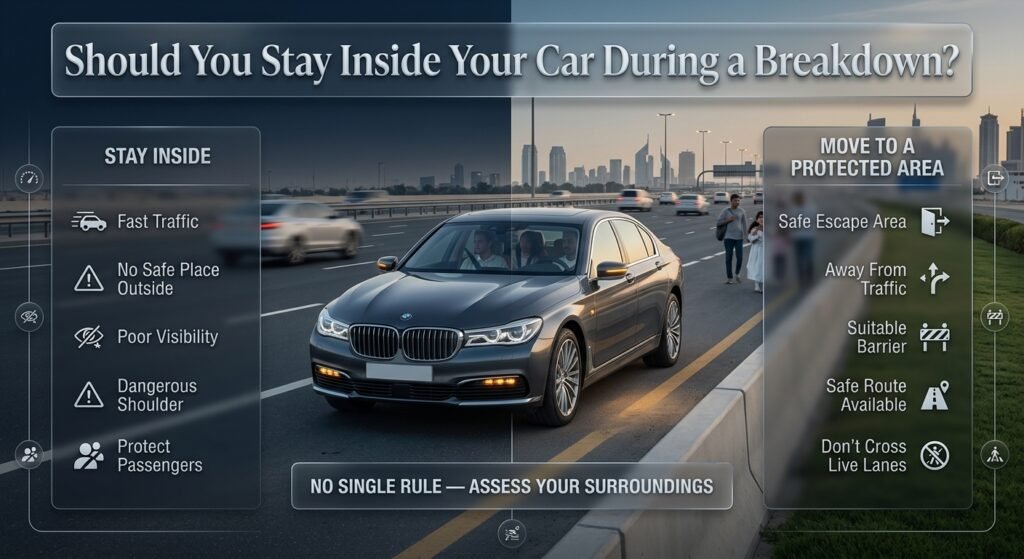
Whether you should stay inside depends on where the vehicle has stopped. If you’re safely away from traffic, getting out may be reasonable. If you’re on a high-speed road with vehicles passing close to you and there is no protected area outside, remaining inside with your seat belt fastened may be safer.
There isn’t one rule that works for every breakdown.
Your decision should consider:
- Traffic speed
- Distance from moving vehicles
- Whether there is a barrier
- Road visibility
- Weather
- Time of day
- Vehicle position
- Availability of a safe escape area
- Condition of passengers
When Staying Inside May Be Safer
Remaining inside can be appropriate when:
- Your vehicle is surrounded by fast-moving traffic.
- There is no safe place to stand.
- Leaving the vehicle would put you directly beside traffic.
- Visibility is poor.
- You are stopped on a dangerous highway shoulder.
- You have children or vulnerable passengers.
- You are waiting for professional assistance.
Keep your seat belt fastened while you’re in the vehicle if traffic remains a significant hazard.
When Leaving the Vehicle May Be Safer
If your car is in a dangerous position and there is a clearly accessible protected area away from traffic, moving yourself and your passengers to that location may be safer.
For example, a safe area beyond a suitable barrier may provide better protection than sitting in a vehicle that is dangerously exposed.
However, don’t cross live traffic lanes to reach safety.
⭐ Expert Tip: Never assume that getting out of the vehicle is automatically safer. The safest decision depends on your surroundings. If reaching a safe area requires walking directly into traffic, don’t do it.
What Should You Do If Your Car Breaks Down on a Highway?
A highway breakdown requires extra caution because vehicles may be travelling at high speeds and have limited time to react to a stationary car.
If the vehicle is still controllable, gradually move toward the safest available stopping position without making sudden lane changes.
Once stopped:
- Turn on hazard lights.
- Keep away from moving traffic.
- Avoid standing behind the vehicle.
- Don’t walk along the highway.
- Don’t attempt unnecessary repairs.
- Contact professional assistance.
- Give your exact location and direction of travel.
Highway shoulders aren’t the same as ordinary parking spaces. Vehicles can still pass close to them, and drivers may not expect pedestrians to be present.
Don’t Stand Behind the Vehicle
One of the most dangerous places to wait is directly behind a broken-down vehicle.
An approaching driver may not see you until it’s too late.
Avoid standing:
- Behind the car
- Between the car and traffic
- On the traffic side of the vehicle
- In the centre of an active lane
If you have to leave the vehicle, move toward a genuinely protected area rather than simply standing a few metres away.
For a more detailed breakdown response, see what to do during a roadside breakdown.
What Should You Do If You Run Out of Fuel?
Running out of fuel is a common reason drivers become stranded. When the fuel tank becomes empty, the engine eventually stops, leaving the vehicle unable to continue.
The safest response is to move the vehicle away from traffic if possible and arrange fuel assistance rather than walking to a petrol station.
If you want a step-by-step guide, see what to do when your car runs out of fuel in Dubai.
Steps After Running Out of Petrol
Once the engine stops:
- Turn on the hazard lights.
- Move away from active traffic if possible.
- Stop attempting unnecessary engine restarts.
- Stay in the safest available location.
- Contact fuel delivery or roadside assistance.
- Give your exact location.
- Confirm the correct fuel type.
- Wait safely for assistance.
You can also review steps after running out of petrol for additional guidance.
Why Shouldn’t You Walk to a Petrol Station?
The nearest fuel station may look close on a map, but walking there can be dangerous.
You could encounter:
- Fast-moving traffic
- Unprotected roadsides
- Long distances
- Extreme heat
- Poor pedestrian access
- Difficult road crossings
- Unfamiliar surroundings
The situation is particularly concerning on highways.
Instead of turning a fuel problem into a pedestrian safety problem, arranging assistance is often the safer option.
For additional guidance, read running out of fuel on the road.
What If the Fuel Gauge Wasn’t Empty?
Sometimes a vehicle stops even though the driver believes there should still be fuel remaining.
Possible reasons include:
- An inaccurate fuel gauge
- Fuel delivery problems
- Fuel system issues
- A very low fuel level
- Vehicle parked on a slope
- Fuel pump problems
Don’t automatically assume the problem is simply an empty tank.
If you’re unsure, tell the assistance provider what happened rather than guessing.
How Can You Safely Deal With an Empty Fuel Tank?
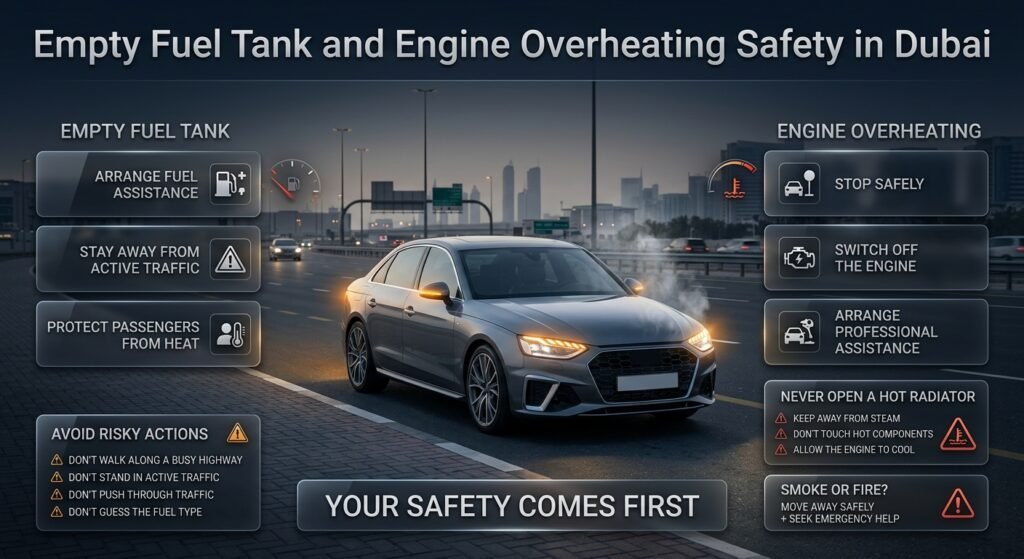
An empty fuel tank can be frustrating, but it doesn’t require risky behaviour.
The important thing is to treat the situation as a roadside safety issue rather than simply a fuel shortage.
If the vehicle has stopped in a safe location, keep the hazard lights on where appropriate and arrange fuel assistance.
This guide to safely dealing with an empty fuel tank in Dubai explains the situation in more detail.
Avoid These Empty-Tank Mistakes
Don’t:
- Walk along a busy highway.
- Stand in an active traffic lane.
- Attempt to push the car through traffic.
- Repeatedly restart the engine until the battery becomes weak.
- Guess the wrong fuel type.
- Leave vulnerable passengers exposed to extreme heat.
- Ignore the location of your vehicle when requesting help.
If you’re in Dubai, heat is another reason not to delay assistance unnecessarily.
What Should You Do If the Engine Overheats?
An overheating engine should be treated as a serious mechanical warning.
If the temperature gauge rises significantly, a temperature warning appears, or steam comes from under the bonnet, safely stop as soon as practical and switch the engine off.
Continuing to drive can cause severe engine damage.
Never Open a Hot Radiator
This is one of the most important overheating safety rules.
A hot cooling system may be pressurized. Opening the radiator cap while the system is hot can release scalding coolant or steam.
Instead:
- Stop safely.
- Switch off the engine.
- Keep away from steam.
- Don’t touch hot engine components.
- Allow the vehicle to cool.
- Arrange professional assistance.
Don’t pour cold water onto a severely overheated engine simply because you want to cool it quickly.
What If You See Smoke?
Smoke should never be ignored.
If there is heavy smoke, a strong burning smell, visible fire, or a suspected electrical or fuel fire, move away from the vehicle when it is safe to do so and seek emergency assistance.
Don’t open the bonnet unnecessarily if there is a suspected fire.
Your vehicle can be replaced.
Your safety cannot.
What Should You Do If Your Battery Dies?
A dead battery can happen unexpectedly, particularly when a battery is ageing or electrical accessories have been left running.
Common causes include:
- Leaving headlights on
- Leaving interior lights on
- Using accessories while the engine is off
- An ageing battery
- Charging-system problems
- Electrical faults
If your vehicle is safely parked, battery assistance may be appropriate.
However, don’t attempt a jump-start if you’re unfamiliar with the procedure.
Incorrectly connecting jump leads can damage electrical systems or create a safety hazard.
Signs Your Battery May Be Weak
Watch for:
- Slow engine cranking
- Clicking when starting
- Dim lights
- Electrical accessories behaving strangely
- Repeated starting difficulties
- A battery warning light
If the battery repeatedly fails, don’t assume another jump-start is the permanent solution.
The battery and charging system should be checked.
What If You Have a Flat Tyre?
A flat tyre can happen because of a puncture, damaged tyre, low pressure, road debris, or another tyre-related problem.
If you notice a sudden loss of tyre pressure while driving, don’t slam on the brakes.
Instead, maintain control, reduce speed gradually, and move to the safest available location.
Should You Change a Tyre Beside the Road?
Only if the vehicle is in a genuinely safe location.
Changing a tyre on a narrow shoulder beside high-speed traffic can expose you to significant danger.
If you’re uncomfortable with the location, call professional roadside assistance.
The few minutes saved by changing a tyre yourself aren’t worth risking your safety.
Don’t Ignore Tyre Damage
Never continue driving on a severely damaged or flat tyre simply because the destination is nearby.
Driving on a flat tyre can damage the wheel and may make the vehicle harder to control.
What Should You Do During a Breakdown at Night?
Nighttime breakdowns require additional caution because visibility is reduced.
Make the vehicle as visible as possible using appropriate warning lights.
Avoid standing beside the road where approaching drivers may not see you.
If you need assistance, provide:
- Road name
- Direction of travel
- Nearest exit
- Nearby landmark
- Building or business
- Petrol station
- Parking area
- Other identifiable location
A vague description such as “I’m on the highway” isn’t enough.
The more accurately you describe your location, the easier it is for assistance to reach you.
Keep Your Phone Charged
A mobile phone can become one of your most important emergency tools.
If you’re travelling long distances, consider carrying a power bank or charging cable.
Don’t wait until the battery is nearly empty before contacting assistance.
How Does Dubai’s Heat Change Breakdown Safety?
Dubai’s climate adds another layer of risk to roadside emergencies.
A vehicle breakdown in extreme heat isn’t simply uncomfortable. Long exposure to high temperatures can become a serious health concern.
This is especially important for:
- Children
- Older adults
- People with mobility limitations
- Anyone without adequate water
- Anyone waiting for an extended period
Heat Safety During a Breakdown
If the vehicle is safely positioned and the engine is functioning normally, remaining inside with the air conditioning may help reduce heat exposure.
However, never continue operating an overheating vehicle just to keep the air conditioner running.
Instead:
- Arrange assistance quickly.
- Drink water when available.
- Avoid unnecessary walking.
- Don’t stand in direct sunlight unnecessarily.
- Keep passengers together.
- Monitor anyone showing signs of heat distress.
Don’t Underestimate a Short Walk
A petrol station that appears to be “just around the corner” may actually be much farther away than expected.
Road layouts, interchanges and restricted pedestrian access can make a short driving distance a difficult walking route.
In Dubai’s heat, the safest option may be to remain protected and arrange assistance.
What Should You Do If Your Car Breaks Down in Heavy Traffic?
Heavy traffic creates a different type of danger.
Your vehicle may stop in a lane while cars continue moving around you.
If possible, use the vehicle’s remaining power to move toward a safer position.
Don’t make an aggressive lane change just to escape the situation.
Once stopped:
- Turn on hazard lights.
- Keep your seat belt fastened.
- Watch surrounding traffic.
- Avoid opening doors toward moving vehicles.
- Call for assistance.
- Give your exact location.
If the vehicle is obstructing traffic and cannot be moved, professional assistance should be contacted promptly.
What If You Break Down in a Parking Area?
A breakdown in a parking area is usually less dangerous than a highway breakdown, but basic safety still matters.
Move the vehicle to a suitable parking position if it can be done safely.
Then:
- Switch on hazard lights where appropriate.
- Park securely.
- Check for obvious problems.
- Contact assistance.
- Avoid unnecessary repairs if you’re unsure of the fault.
A parking-area breakdown may give you more time to diagnose a simple problem, but don’t assume every problem is safe to handle yourself.
What Information Should You Give Roadside Assistance?
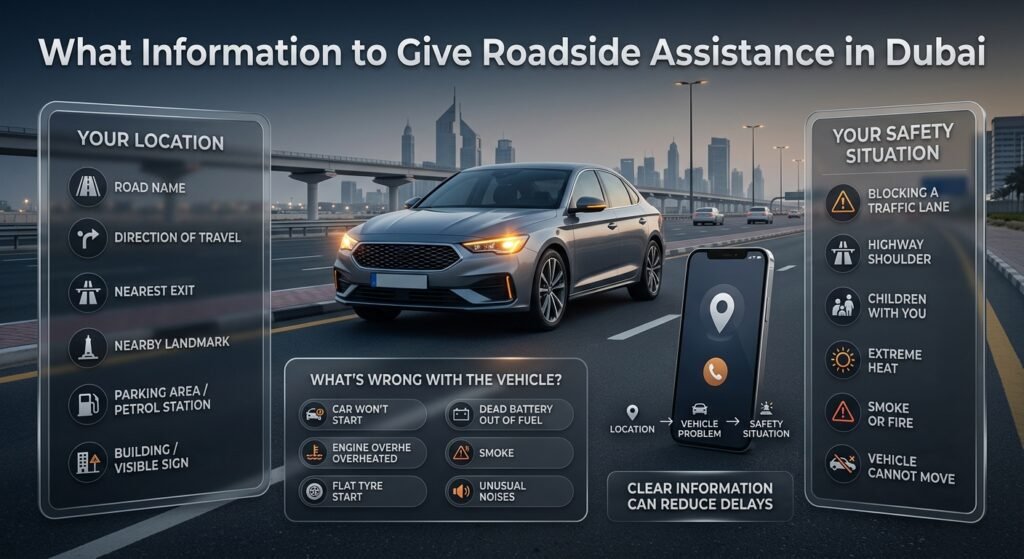
Clear communication can reduce delays.
When calling for assistance, explain:
Your location
Give the:
- Road name
- Direction of travel
- Nearest exit
- Nearby landmark
- Parking area
- Petrol station
- Building
- Visible sign
Your vehicle problem
Tell them whether:
- The car won’t start.
- The engine has overheated.
- You have a flat tyre.
- The battery is dead.
- You’ve run out of fuel.
- There is smoke.
- There is a warning light.
- The vehicle is making unusual noises.
Your safety situation
Tell them if:
- You’re blocking a traffic lane.
- You’re on a highway shoulder.
- You’re travelling with children.
- You’re in extreme heat.
- There is smoke or fire.
- The vehicle cannot move.
This information helps the assistance provider understand the urgency and type of help required.
How Can You Make a Broken-Down Vehicle More Visible?
Visibility is particularly important when a vehicle stops somewhere other drivers don’t expect.
Use hazard warning lights where appropriate.
If you have suitable reflective safety equipment, it can improve visibility when used safely.
However, don’t place warning equipment in a location that requires you to walk into active traffic.
Your safety comes first.
What About Using a Flashlight?
A flashlight can be useful at night for identifying your surroundings or inspecting the vehicle from a safe position.
Avoid standing in the road while using it.
A flashlight should help you see—not encourage you to enter a dangerous area.
Should You Try to Fix the Car Yourself?
It depends on the problem and the location.
A simple issue may be manageable in a safe parking area. But even an easy repair becomes dangerous if you’re standing beside fast-moving traffic.
Before attempting any repair, ask:
Is the vehicle in a safe location?
Do I understand the problem?
Do I have the correct tools?
Can I complete the repair without entering traffic?
Could the repair create another hazard?
If the answer to any of these questions is no, professional assistance is the safer choice.
Common Mistakes Drivers Make During a Breakdown
A breakdown is stressful, and stress often causes people to make decisions they wouldn’t normally make.
Mistake 1: Jumping Out Immediately
A driver hears the engine stop and immediately opens the door.
This can be dangerous when traffic is moving close to the vehicle.
Better approach: Look around first and determine whether exiting is actually safe.
Mistake 2: Trying to Cross the Road
Drivers sometimes see a petrol station on the opposite side and attempt to cross several lanes.
That’s extremely risky.
Better approach: Arrange assistance instead of crossing active traffic.
Mistake 3: Standing Beside the Car
Being only a metre or two away from the vehicle doesn’t necessarily make you safe.
A passing vehicle can move closer unexpectedly.
Better approach: Stay inside when appropriate or move to a genuinely protected location.
Mistake 4: Repairing a Vehicle on a Dangerous Shoulder
A driver may think changing a tyre will only take ten minutes.
But traffic doesn’t stop while the repair is happening.
Better approach: If the position is exposed, call roadside assistance.
Mistake 5: Continuing to Drive an Overheating Car
Drivers sometimes think they can reach a garage before the engine becomes seriously damaged.
That can turn a manageable cooling problem into major engine damage.
Better approach: Stop safely and seek professional help.
Mistake 6: Walking for Fuel
Walking may seem like the easiest solution to an empty tank.
On a highway or in extreme heat, it can be much more dangerous than arranging fuel delivery.
Mistake 7: Forgetting the Exact Location
Saying “I’m near Dubai” doesn’t help an assistance provider find your car.
Better approach: Use road names, exits, landmarks and direction of travel.
Mistake 8: Repeatedly Restarting the Car
If the vehicle doesn’t start, repeatedly turning the ignition may drain a weak battery further.
Better approach: Make a reasonable attempt, then assess the situation.
A Simple Breakdown Safety Decision Guide
When something goes wrong, use this sequence:
Vehicle develops a problem
          ↓
Can I control and move it safely?
          ↓
       YES
          ↓
Move away from active traffic
          ↓
Turn on hazard lights
          ↓
Assess the situation
          ↓
Can I safely solve the problem?
       ↙       ↘
     YES        NO
      ↓          ↓
Safe repair   Call assistance
      ↓          ↓
Check vehicle  Give exact location
      ↓          ↓
Continue only when safe
If the answer to “Can I safely solve the problem?” is uncertain, don’t take unnecessary risks.
What Should You Keep in Your Car for a Breakdown?
A small emergency kit can make roadside problems easier to manage.
Useful items may include:
| Item | Purpose |
|---|---|
| Phone charger | Maintain communication |
| Power bank | Backup phone power |
| Flashlight | Nighttime visibility |
| Drinking water | Heat protection |
| First-aid supplies | Minor injuries |
| Tyre pressure gauge | Check tyre pressure |
| Tyre inflator | Temporary tyre support where appropriate |
| Basic tools | Simple problems in safe locations |
| Vehicle documents | Useful when arranging assistance |
| Emergency contacts | Faster communication |
You don’t need to turn your car into a workshop.
The goal is to carry items that improve safety, communication and basic preparedness.
How Can You Prevent a Roadside Breakdown?
The safest breakdown is the one you prevent before leaving home.
Regular maintenance can identify problems before they become roadside emergencies.
Before a long journey, check:
- Fuel level
- Tyre pressure
- Tyre condition
- Engine oil
- Coolant
- Battery condition
- Lights
- Warning indicators
- Windscreen washer fluid
- Spare tyre or tyre repair equipment
Pay Attention to Warning Signs
Don’t ignore:
- Slow starting
- Unusual engine noises
- Burning smells
- Temperature increases
- Steering changes
- Brake problems
- Vibrations
- Fluid leaks
- Warning lights
- Reduced engine performance
A car that repeatedly shows warning signs is telling you that something needs attention.
Waiting until the vehicle stops completely can leave you stranded in a much less convenient and potentially less safe location.
Why Is Preventive Fuel Management Important?
Fuel level is easy to ignore because the vehicle continues working until it doesn’t.
However, making “nearly empty” your normal refuelling point increases the chance of being stranded.
Your ideal fuel reserve depends on:
- Daily mileage
- Vehicle fuel economy
- Traffic conditions
- Distance between fuel stations
- Highway travel
- Journey length
- Driving habits
If you’re travelling through unfamiliar areas, maintaining a reasonable fuel reserve can provide useful flexibility.
For additional guidance, see Emergency Roadside Fuel Advice.
How Can You Prepare Before a Long Drive?

A few minutes of preparation can make a significant difference.
Before leaving
Check:
- Fuel
- Tyres
- Battery
- Coolant
- Oil
- Lights
- Phone battery
- Water
- Emergency contacts
During the journey
Pay attention to:
- Warning lights
- Temperature gauge
- Unusual sounds
- Steering behaviour
- Brake performance
- Fuel level
If something feels wrong
Don’t automatically continue driving because you’re close to your destination.
A small problem can become a complete breakdown.
If the vehicle is showing serious warning signs, stop safely and seek advice.
Expert Advice: Safety Comes Before the Vehicle
One of the biggest differences between a calm roadside response and a dangerous one is the order in which decisions are made.
Many drivers think:
Car problem → Find the problem → Fix the problem → Continue driving
A safer approach is:
Safety → Visibility → Location → Assistance → Mechanical problem
That order is especially important on busy Dubai roads.
If you’re standing beside a vehicle while traffic passes at high speed, it doesn’t matter how quickly you can identify the mechanical fault.
The location itself has become the main problem.
Think Like a Roadside Professional
Before touching the vehicle, ask:
- Where is traffic coming from?
- How close is it?
- Can approaching drivers see my vehicle?
- Is there a barrier?
- Is there somewhere protected to wait?
- Is the vehicle likely to move?
- Is there smoke or a fuel leak?
- Can I safely access the bonnet or tyre?
- Would calling a professional be safer?
These questions take seconds but can prevent poor decisions.
⭐ Expert Tip: Don’t measure safety by distance alone. Being five metres from your car isn’t automatically safer than being inside it. What matters is your position relative to moving traffic and available protection.
What Should Families Do During a Breakdown?
If you’re travelling with children, safety becomes even more important.
Children shouldn’t be allowed to walk around a roadside breakdown area.
If the vehicle is safely positioned, keeping everyone together can be the simplest option.
If leaving the vehicle is necessary, move everyone toward the safest available protected area and keep the group together.
Don’t send one person ahead to “find help” while others remain exposed.
Travelling With Older Passengers
Older passengers or people with mobility limitations may need additional time and assistance.
Consider their ability to:
- Exit the vehicle
- Walk safely
- Handle heat
- Cross uneven ground
- Remain standing
- Wait outside
The safest plan should account for the most vulnerable passenger.
What If There Is a Fuel Leak?
A suspected fuel leak should be treated seriously.
If you smell a strong fuel odour or see fuel leaking from the vehicle:
- Don’t smoke.
- Avoid flames.
- Don’t attempt an unnecessary repair.
- Move away from the vehicle when safe.
- Contact professional assistance.
A fuel leak can create a fire hazard.
Don’t assume that because the vehicle still starts, it’s safe to continue driving.
What If You See Smoke From the Vehicle?
Smoke can have several causes, including overheating, electrical faults, oil leaks, or other mechanical problems.
Don’t ignore it.
Stop safely and switch off the engine when appropriate.
If there is visible fire or a strong indication of fire, move away from the vehicle and seek emergency assistance.
Don’t put yourself at risk trying to save belongings from the car.
What If the Steering or Brakes Suddenly Fail?
A serious steering or braking problem is an emergency.
If steering becomes difficult or braking performance changes significantly, focus on maintaining control and reducing speed safely.
Avoid sudden manoeuvres.
Look for the safest possible place to stop.
Once stopped, don’t continue driving simply because the vehicle appears to be moving normally again.
A serious control-system problem requires professional inspection.
What If the Breakdown Happens in an Unfamiliar Area?
An unfamiliar location can make a breakdown more stressful because you may not know where you are.
Use your phone to identify:
- Road name
- Nearby business
- Exit
- Landmark
- Direction of travel
- Parking area
If your phone provides location services, use them to help communicate your position.
Don’t walk around searching for signs if doing so places you close to traffic.
Stay with the vehicle or in a protected location when appropriate.
What Should You Do While Waiting for Assistance?
Once you’ve contacted help, the situation may become a waiting game.
Use that time wisely.
Keep Monitoring Your Surroundings
Traffic conditions can change.
A location that seemed reasonably safe may become more exposed as traffic increases or visibility decreases.
Stay Hydrated
In Dubai, keep drinking water when available.
Avoid Unnecessary Repairs
You’ve already contacted assistance.
There’s usually little benefit in repeatedly opening the bonnet or attempting random fixes.
Keep Communication Available
Keep your phone accessible and conserve battery if you expect a long wait.
If your location changes, update the assistance provider.
Roadside Breakdown Safety Checklist
Save this checklist so you don’t have to remember everything during a stressful situation.
Before stopping
- Stay calm.
- Maintain steering control.
- Reduce speed gradually.
- Look for a safe stopping location.
- Avoid sudden lane changes.
- Don’t make unnecessary manoeuvres.
After stopping
- Turn on hazard lights.
- Check surrounding traffic.
- Assess whether the vehicle is safely positioned.
- Look for smoke, fire or fuel leaks.
- Keep passengers protected.
- Don’t attempt an unsafe repair.
When requesting help
- Give the exact location.
- Give the road name.
- State direction of travel.
- Mention the nearest exit.
- Identify a nearby landmark.
- Explain the vehicle problem.
- Tell them if the car is blocking traffic.
While waiting
- Stay away from moving traffic.
- Keep passengers together.
- Avoid walking along highways.
- Stay hydrated.
- Keep your phone available.
- Follow professional instructions.
For an additional checklist-style resource, see roadside breakdown safety tips in Dubai.
What is the safest thing to do when your car breaks down on the road?
When your car breaks down, your first priority should be protecting yourself and your passengers—not figuring out what’s wrong with the vehicle. Keep control of the car, slow down gradually, switch on your hazard lights, and try to move to a safer position away from active traffic if the vehicle can still be driven safely. Once stopped, assess whether it’s safer to remain inside or move to a protected area.
A common mistake is immediately getting out and standing beside the car. On a busy road or highway, that can put you dangerously close to passing vehicles. If there’s no genuinely safe place outside, staying inside with your seat belt fastened may be the better option.
Important points to remember:
Stay calm and avoid sudden steering or braking.
Use hazard lights to make the disabled vehicle more noticeable.
Move away from traffic when you can do so safely.
Never stand between your vehicle and moving traffic.
Don’t attempt a roadside repair simply because you want to get moving quickly.
Contact appropriate roadside assistance and clearly explain your location.
The key principle is simple: don’t turn a vehicle problem into a personal safety emergency. Official breakdown guidance similarly emphasizes getting the vehicle to a place of relative safety and keeping people away from moving traffic whenever possible.
Should you stay inside your car during a breakdown?
Whether you should stay inside depends on where the vehicle has stopped and what is happening around it. If you’re safely parked away from moving traffic, getting out may be reasonable. But if you’re stranded beside a high-speed road with vehicles passing close by and there’s no protected area to reach safely, getting out could expose you to greater danger.
This is why drivers shouldn’t follow a simple rule such as “always stay inside” or “always get out.” Look at the actual situation first. If you can safely reach an area separated from traffic, moving yourself and your passengers there may provide better protection. If you can’t exit safely, remain inside, keep your seat belt fastened, use your hazard lights, and contact assistance.
Consider these factors before opening the door:
How fast is surrounding traffic moving?
Is there a safety barrier or protected area?
Would you have to step directly into traffic?
Is visibility good or poor?
Is your vehicle blocking a live lane?
Are children or vulnerable passengers with you?
Can you reach a safe location without crossing traffic?
On high-speed roads, official guidance specifically recognizes situations where leaving the vehicle isn’t safe and advises occupants to remain inside with seat belts and hazard lights on.
What should you do if your car breaks down on a highway?
A highway breakdown requires more caution because approaching vehicles may be travelling at high speed and may have very little time to react to a stationary vehicle. If your car is still controllable, reduce speed gradually and move toward the safest available stopping area without making a sudden lane change. Once stopped, activate your hazard lights and keep yourself and your passengers away from moving traffic whenever it is safe to do so.
Don’t treat a highway shoulder like a normal parking space. Even when your vehicle is technically off the main lane, passing traffic can still be extremely close. Walking along the road, standing behind the car, or attempting a tyre change in an exposed position can put you directly in danger.
If you break down on a highway:
Keep control of the vehicle.
Move toward a safer stopping area if possible.
Switch on hazard warning lights.
Don’t stand between the vehicle and traffic.
Don’t walk along the highway looking for help.
Avoid unnecessary roadside repairs.
Contact professional roadside assistance.
Give your exact road, direction and nearby landmark.
If you cannot safely exit, remain inside with your seat belt secured.
The most important decision is where you and your passengers wait, not how quickly you can repair the vehicle. Highway breakdown guidance consistently puts distance from moving traffic at the centre of the response.
Is it safe to walk to a petrol station after running out of fuel?
Walking to a petrol station may seem like the quickest solution when your tank is empty, but it can be a poor safety decision—particularly on a highway, busy Dubai road, or during extreme heat. A station that appears close by may not have a safe pedestrian route, and reaching it could require walking beside traffic or crossing roads that aren’t designed for pedestrians.
If the vehicle is safely positioned, the better approach is usually to remain in a protected location and arrange fuel assistance. Tell the provider exactly where the vehicle is and specify whether it needs petrol or diesel. This is especially useful when you’re unfamiliar with the area or the nearest station isn’t realistically accessible on foot.
Before deciding to walk, consider:
Is there a proper pedestrian route?
Are you on a highway or high-speed road?
Would you have to cross active traffic?
Is the weather extremely hot?
Are children or other passengers with you?
Is the petrol station actually accessible from your location?
If the answer to any of these raises concern, don’t take the risk just to save time. For a complete fuel-emergency response, your article can naturally direct readers to What to Do When Your Car Runs Out of Fuel in Dubai and Car Ran Out of Fuel Safety in Dubai.
How can you stay safe during a car breakdown in extreme heat?
A breakdown in extreme heat requires faster planning because waiting beside a disabled vehicle can become physically stressful and potentially dangerous. In Dubai, the heat should be treated as part of the roadside emergency—not as a minor inconvenience. Avoid unnecessary walking, keep water available, and arrange assistance as soon as you know the vehicle cannot safely continue.
If the car is safely positioned and the engine is operating normally, staying inside with the air conditioning may help protect passengers from heat exposure. However, don’t keep an overheating engine running simply to operate the air conditioner. If the temperature warning is active or steam is coming from the engine compartment, switch off the vehicle when safe and seek professional assistance.
For a heat-related breakdown, remember:
Keep drinking water available.
Avoid walking long distances in extreme heat.
Don’t leave children or vulnerable passengers exposed unnecessarily.
Don’t continue driving an overheating vehicle.
Don’t open a hot radiator or coolant system.
Contact assistance before the situation becomes urgent.
Give your exact location so help can reach you efficiently.
Monitor passengers for signs of heat-related distress.
A little preparation also helps. Keeping a charged phone, power bank, water, flashlight and basic emergency supplies in the vehicle can make a breakdown much easier to manage. Road-safety guidance also recommends carrying items such as a phone and charger, flashlight, water and basic emergency equipment.
Conclusion
A car breakdown is stressful, but the situation becomes much easier to manage when you know what to do before panic takes over. The most important rule is simple: protect yourself and your passengers before worrying about the vehicle. Stay calm, use your hazard lights, move away from active traffic when it is safe, and avoid roadside actions that could put you in greater danger.
Whether you’ve run out of fuel, experienced a flat tyre, dead battery, overheating engine, or another mechanical problem, don’t take unnecessary risks just to get back on the road quickly. Walking along a busy highway, standing beside moving traffic, opening a hot radiator, or attempting an unsafe repair can turn a manageable breakdown into a serious emergency.
For drivers in Dubai, extreme heat and busy roads make preparation even more important. Keep your phone charged, carry drinking water, maintain your vehicle properly, and know how to request the right roadside assistance when you need it.
Most importantly, remember this simple approach: get safe, make your vehicle visible, stay away from moving traffic, communicate your exact location, and get professional help when necessary.
A breakdown may stop your journey temporarily, but with the right response, it doesn’t have to put your safety at risk.
Leave a Reply