Introduction
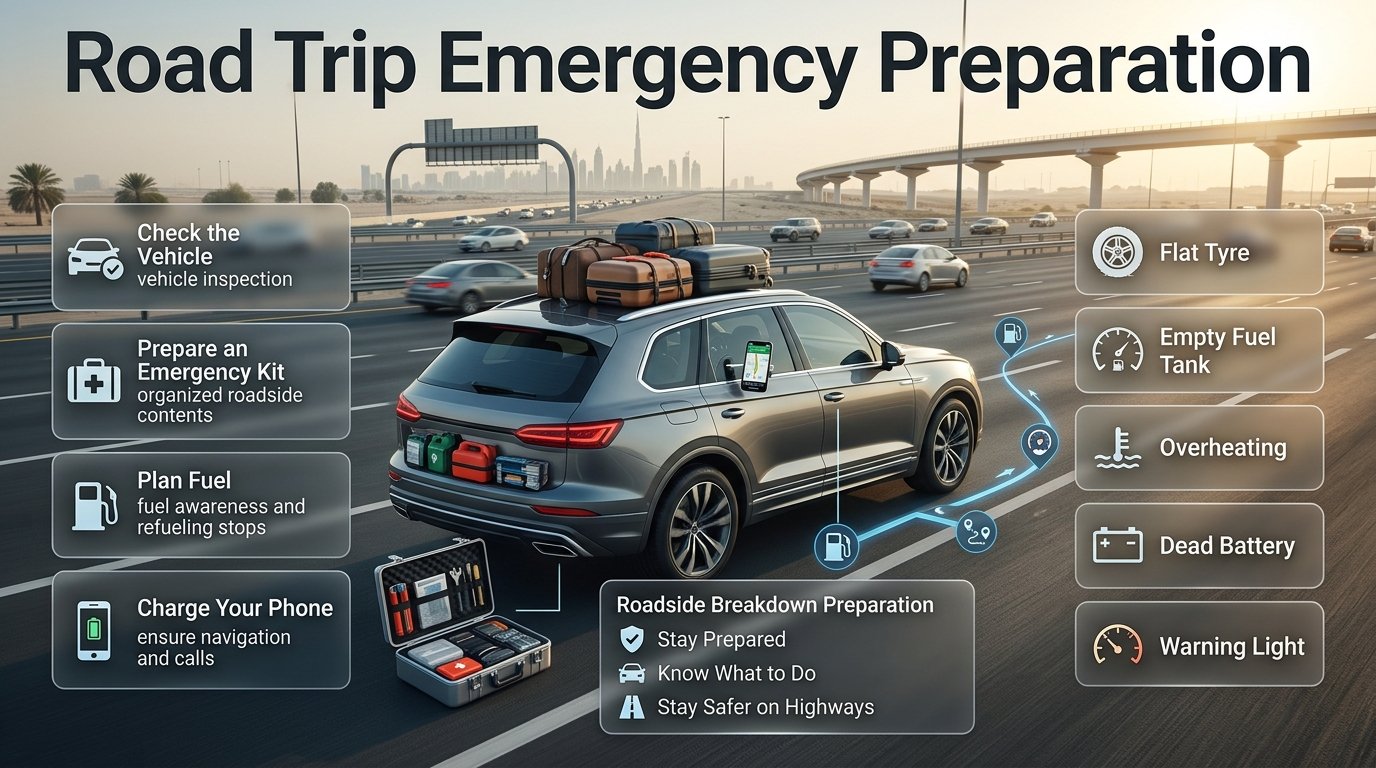
Road Trip Emergency Preparation | A road trip usually starts with excitement. The route is planned, the car is packed, the phone is charged, and you’re ready to leave. But a flat tyre, empty fuel tank, overheating engine, dead battery, or unexpected warning light can change the entire journey within minutes. This is exactly why road trip emergency preparation should be part of your travel plan rather than something you think about only after the car stops.
For drivers travelling around Dubai and across the UAE, preparation deserves extra attention. Long-distance routes, busy highways, high temperatures, heavy traffic, and unfamiliar roads can make a simple vehicle problem more difficult to manage. A few minutes spent checking the vehicle and preparing an emergency plan can make a major difference.
Before a long journey, drivers can also use Fuel Delivery Dubai as a useful reference for understanding roadside fuel assistance and preparing for fuel-related emergencies.
This guide explains what to inspect before a road trip, what to carry in an emergency kit, how to plan fuel properly, what to do if your vehicle breaks down, how to respond if you run out of fuel, and how to stay safer on Dubai highways.
What Is Road Trip Emergency Preparation?
Road trip emergency preparation is the process of preparing your vehicle, emergency equipment, fuel supply, communication tools, route, and passengers before starting a long journey.
The purpose isn’t to predict every possible problem. That’s impossible. Instead, the goal is to make sure that if something unexpected happens, you already know what to do.
A practical preparation plan covers four main areas:
- Vehicle condition
- Emergency equipment
- Fuel and route planning
- Personal and roadside safety
The most important idea is simple: prepare before the emergency, not during it.
When a vehicle is parked safely at home, checking tyre pressure takes a few minutes. When the same tyre fails on a busy highway shoulder, the situation becomes much more stressful.
Dubai’s road-safety guidance also emphasizes vehicle checks and responsible preparation. The RTA driving handbook recommends checking important components such as tyres, lights, fluids, wipers, mirrors, seat belts, and emergency equipment.
Why Is Emergency Preparation Important Before a Road Trip?
A daily commute and a long road trip place different demands on both the driver and vehicle.
During a short city journey, you’re usually close to petrol stations, workshops, residential areas, and other forms of assistance. During a long trip, especially on a highway or remote route, those options may not be immediately available.
A minor problem can become more complicated because of:
- High traffic volume
- High vehicle speeds
- Extreme temperatures
- Long distances
- Poor visibility
- Limited stopping locations
- Low fuel
- Driver fatigue
- Unfamiliar roads
A recent UAE road-trip preparation guide also highlighted tyre condition, fluids, battery health, visibility, emergency equipment, water, communication, and route planning as important preparation points for long journeys.
The real benefit of preparation
Preparation gives you options.
If you know your tyres are healthy, you have enough fuel, your phone is charged, your emergency equipment is accessible, and you know your route, you’re less likely to panic when something goes wrong.
⭐ Expert Tip: Don’t think of emergency preparation as preparing for a breakdown. Think of it as preparing for the possibility that your original plan may suddenly change.
What Should You Check Before a Road Trip?
Before leaving, inspect the parts of the vehicle that can affect safety, reliability, visibility, and your ability to continue driving.
The most important checks include:
- Tyres
- Spare tyre or repair kit
- Battery
- Engine oil
- Coolant
- Brake fluid
- Lights
- Wipers
- Mirrors
- Warning lights
- Fuel level
- Air conditioning
You don’t necessarily need to perform complicated mechanical inspections yourself. If something looks unusual or the vehicle has a known problem, professional inspection is more appropriate.
Check Your Tyres Before Leaving
Tyres deserve special attention because they are the only parts of the vehicle directly contacting the road.
Before a long journey, inspect:
- Tyre pressure
- Tread condition
- Uneven wear
- Cracks
- Cuts
- Bulges
- Foreign objects
- Spare tyre condition
Don’t forget the spare.
A spare tyre with very low pressure doesn’t become useful simply because it’s stored in the boot.
The same applies to the jack and wheel-changing equipment. Make sure the necessary tools are actually present.
Why tyre preparation matters in Dubai
High temperatures can increase the stress placed on tyres, particularly when a vehicle is travelling long distances.
The National’s 2026 UAE road-trip guidance specifically warned that under-inflated tyres can contribute to overheating and blowouts in hot conditions and recommended checking both the normal tyres and spare.
📌 Quick Tip: Check tyre pressure when the tyres are cold and use the vehicle manufacturer’s recommended pressure.
Check the Battery
A battery problem can leave a perfectly healthy-looking vehicle unable to start.
Look for signs such as:
- Slow engine cranking
- Difficulty starting
- Electrical problems
- Battery warning indicators
- Corrosion around terminals
- Repeated need for jump-starting
Heat can also affect battery life. If your battery is old or you’ve noticed starting problems, consider having it tested before a long journey.
A road-trip inspection is a much better time to discover a weak battery than at a remote roadside location.
Check Engine Oil and Other Fluids
Before a long trip, inspect the fluids appropriate to your vehicle.
These may include:
- Engine oil
- Engine coolant
- Brake fluid
- Transmission fluid
- Windscreen washer fluid
Do not open a pressurized cooling system while the engine is hot.
If the vehicle has been losing coolant or oil, topping it up without investigating the reason may only delay a larger problem.
Older UAE guidance also identifies overheating, low engine oil or coolant, tyre problems, and radiator issues among causes associated with vehicle breakdowns.
How Should You Prepare Your Fuel Before a Road Trip?
Fuel planning is one of the easiest parts of road-trip preparation to overlook.
Many drivers think about fuel only in terms of:
How many kilometres can the car travel?
A better question is:
How much reserve do I want available if the journey takes longer than expected?
Traffic, detours, air conditioning, driving speed, road conditions, and driving style can all change fuel consumption.
For that reason, don’t plan your trip around the exact point where the fuel warning light comes on.
Understand Your Vehicle’s Fuel Gauge
Your fuel gauge is useful, but it isn’t a precision measuring instrument.
The displayed level can be affected by:
- Vehicle position
- Fuel-tank design
- Fuel consumption
- Driving conditions
- Gauge calibration
- Recent driving behaviour
If you’re uncertain about your vehicle’s gauge, read How Accurate Is a Car Fuel Gauge? before relying heavily on its reading during a long journey.
The goal isn’t to calculate your range down to the final kilometre.
The goal is to understand your vehicle well enough to avoid unnecessary risk.
How Can You Estimate Remaining Fuel Range?
Your estimated range is more useful when you understand how it is calculated.
For example, a vehicle may show a large remaining range after mostly highway driving. If you then enter heavy stop-and-go traffic with frequent acceleration and air conditioning, actual fuel consumption may increase.
For practical guidance, see How to Estimate Remaining Fuel Range in Dubai.
Use the estimated range as an approximation, not a promise.
⚠ Common Mistake: Waiting until the displayed range becomes extremely low before looking for a petrol station can leave you with very few options if traffic suddenly increases.
What Does the Low Fuel Warning Light Mean?
The low fuel warning light means the vehicle’s fuel level has reached a low threshold.
It doesn’t necessarily mean that the tank is completely empty.
However, it also doesn’t mean you have a guaranteed number of kilometres remaining.
Different vehicles activate the warning at different fuel levels, and actual range depends on the vehicle and current driving conditions.
You can learn more about the subject in Low Fuel Warning Light Meaning in Dubai.
What should you do when the light appears?
The sensible response is to start looking for a suitable refuelling opportunity rather than testing how far the vehicle can go.
If you’re already close to a petrol station, continue carefully.
If you’re on an unfamiliar route, don’t assume the next station will be only a few minutes away.
How Far Can a Car Drive on Low Fuel?
There isn’t one universal answer.
One vehicle might travel significantly farther than another after the warning appears. The difference can depend on:
- Fuel-tank size
- Vehicle fuel economy
- Remaining fuel
- Traffic
- Speed
- Air conditioning
- Driving conditions
- Vehicle load
That’s why How Far Can a Car Drive on Low Fuel in Dubai? is useful for understanding the variables rather than relying on a fixed number.
For emergency preparation, the better strategy is simple: don’t deliberately drive until the tank is almost empty.
What Should Be Included in a Road Trip Emergency Kit?
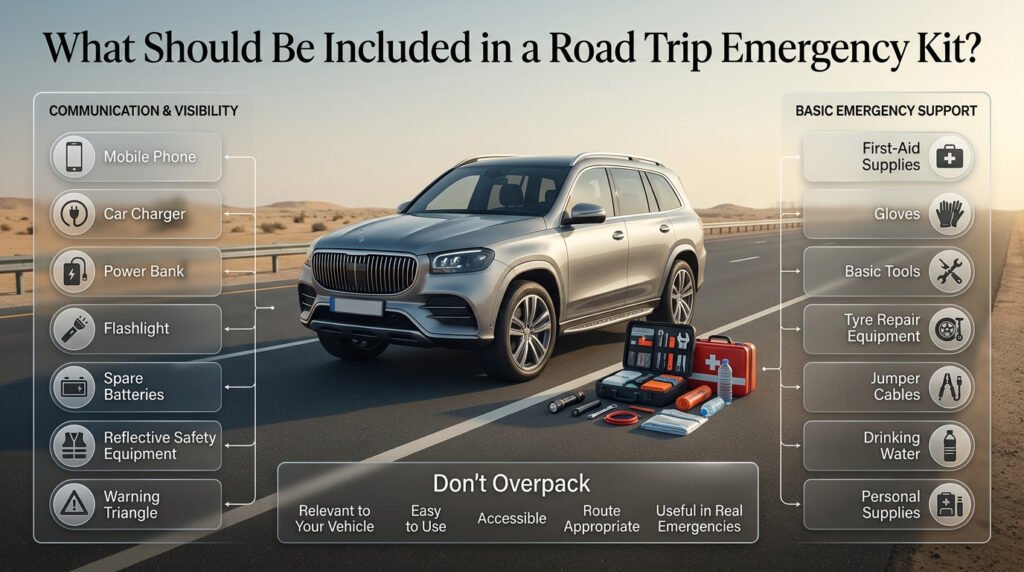
A road-trip emergency kit should help you deal with basic problems, remain visible, communicate with others, and wait safely for assistance.
A practical kit can include:
- Mobile phone
- Car charger
- Power bank
- Flashlight
- Spare batteries
- First-aid supplies
- Reflective safety equipment
- Warning triangle
- Gloves
- Basic tools
- Tyre repair equipment where appropriate
- Jumper cables where appropriate
- Drinking water
- Basic personal supplies
A recent UAE road-trip checklist also recommended items such as jumper cables, first-aid supplies, torch, reflective warning equipment, high-visibility clothing, water, snacks, and a power bank.
Don’t overpack
Emergency preparation doesn’t mean filling the vehicle with unnecessary equipment.
The objective is to carry items that are:
- Relevant to your vehicle
- Easy to use
- Accessible
- Appropriate for your route
- Useful during realistic emergencies
Where Should You Keep Emergency Equipment?
Emergency equipment should be accessible.
This is particularly important for items you may need immediately, such as:
- Phone
- Flashlight
- Warning equipment
- First-aid supplies
- Charging equipment
Don’t place everything under several layers of luggage.
Imagine a tyre failure at night. If your flashlight is buried underneath suitcases, its practical value is reduced.
📌 Quick Tip: Pack the emergency kit last or place it in an accessible compartment so you can reach it without unloading the entire vehicle.
What Personal Supplies Should You Carry?
Vehicle equipment isn’t the whole emergency plan.
Passengers may also need:
- Drinking water
- Necessary medication
- Sunglasses
- Phone chargers
- Basic food or snacks
- Personal hygiene items
- Appropriate clothing
- Important travel documents
For longer journeys, consider the possibility that you may have to wait for assistance rather than assuming the problem will be solved immediately.
This is particularly relevant during hot weather.
How Much Water Should You Carry?
Water is one of the simplest but most important preparations for a long road trip.
The amount depends on:
- Number of passengers
- Trip duration
- Weather
- Route
- Access to services
A recent UAE road-trip safety guide recommended carrying ample water and highlighted the importance of extra supplies for remote or desert journeys.
You don’t need to turn a normal city drive into an expedition, but long-distance travel deserves more preparation than a short local journey.
What Information Should You Know Before Leaving?
If something goes wrong, knowing your exact location can save time.
Before starting the journey, make sure you can identify:
- Road name
- Direction of travel
- Nearest exit
- Interchange
- Landmark
- Nearby service area
- Destination
- Alternative route
If you need roadside assistance, don’t simply say:
“My car stopped on the highway.”
Give useful information such as:
“I’m travelling toward Abu Dhabi, near Exit X, close to [landmark].”
The more accurately you can describe your location, the easier it can be for assistance to find you.
Dubai’s official road-safety platform also provides journey-planning and current road-condition information, reinforcing the value of checking route conditions before travelling.
What Should You Do If Your Car Breaks Down?
If the vehicle develops a serious problem, your first priority should be safety rather than immediately trying to diagnose or repair it.
A simple sequence is:
Step 1: Stay Calm
Don’t make sudden decisions.
Assess whether the vehicle is still moving safely and whether you can reach a safer position.
Step 2: Activate Hazard Lights
Make the vehicle as visible as possible to approaching drivers.
Step 3: Move to a Safer Location if Possible
If the vehicle can still be controlled safely, move away from active traffic where appropriate.
Don’t attempt a dangerous manoeuvre simply to get the vehicle farther off the road.
Step 4: Protect Passengers
Keep passengers away from moving traffic and follow the safest available instructions.
Step 5: Contact Appropriate Assistance
Explain:
- Where you are
- What happened
- Vehicle type
- Whether anyone is injured
- Whether the vehicle is blocking traffic
Step 6: Wait Safely
Don’t stand beside the vehicle unnecessarily, especially on a high-speed road.
For more detailed guidance, see What to Do During a Roadside Breakdown.
What Are the Most Important Roadside Breakdown Safety Rules?
The main principle is:
Traffic safety comes before vehicle repair.
A breakdown can create a secondary danger if the driver focuses entirely on fixing the car while standing close to moving vehicles.
Official Dubai road-safety guidance emphasizes staying alert and following safe-road practices, while the RTA handbook advises drivers not to stop in the middle of the road and to move completely away from traffic when conditions require it.
For a more detailed preparation guide, read Roadside Breakdown Safety Tips in Dubai.
You can also review Staying Safe During a Car Breakdown before taking a long journey.
What If Your Car Runs Out of Fuel?
Running out of fuel is one of the most preventable road-trip emergencies, but it still happens.
The situation may begin with:
- Low fuel warning
- Reduced engine response
- Hesitation
- Loss of power
- Engine stopping
If the vehicle stops because the tank is empty, don’t treat the problem as simply “I need petrol.”
Your first concern is where the vehicle has stopped and whether you’re exposed to moving traffic.
For detailed guidance, read What to Do When Your Car Runs Out of Fuel in Dubai.
What Should You Do Immediately After Running Out of Fuel?
If the vehicle has stopped:
- Turn on hazard lights.
- Assess the traffic around you.
- Move to a safer location if this can be done safely.
- Keep passengers away from moving traffic.
- Contact appropriate assistance.
- Give your exact location.
- Confirm whether the vehicle requires petrol or diesel.
- Follow safety instructions while waiting.
The key mistake to avoid is leaving the vehicle and walking along a busy road to find fuel.
Car Ran Out of Fuel Safety in Dubai provides additional guidance on managing this situation safely.
Should You Walk to a Petrol Station?
Generally, walking along a busy highway or roadside looking for fuel is not a good emergency strategy.
The vehicle may be inconvenient, but walking beside fast-moving traffic can expose you to a completely different hazard.
If you have run out of fuel, arrange suitable roadside assistance or fuel delivery instead.
For more information, see Safely Dealing With an Empty Fuel Tank in Dubai.
What Are the Steps After Running Out of Petrol?
Once the vehicle has stopped, the situation should be handled methodically.
1. Confirm the Problem
Don’t assume every sudden engine stop means the fuel tank is empty.
A dead battery, mechanical fault, electrical failure, or overheating can produce similar symptoms.
2. Make the Vehicle Visible
Use hazard lights where appropriate.
3. Get to Safety
Move away from moving traffic whenever it can be done safely.
4. Arrange Assistance
Give the provider your location and vehicle information.
5. Confirm Fuel Type
Petrol and diesel vehicles require different fuel.
6. Wait Safely
Don’t create another hazard while waiting.
For a detailed breakdown of the process, see Steps After Running Out of Petrol.
What If the Car Stops Because of an Empty Fuel Tank?
A car that stops because of an empty fuel tank requires more than simply finding fuel.
You should also consider:
- Where the vehicle stopped
- Traffic speed
- Road width
- Visibility
- Weather
- Passenger safety
- Whether the vehicle can be moved
If the vehicle is in a dangerous position, don’t focus on fuel delivery before addressing immediate traffic risk.
Car Stops Due to Empty Fuel Tank explains this situation in more detail.
How Should You Handle Running Out of Fuel on the Road?
A local street and a high-speed highway are not the same.
On a normal road, you may have access to parking areas, side streets, shops, or nearby services.
On a highway, the traffic environment can be much more dangerous.
For practical guidance, see Running Out of Fuel on the Road.
The basic principle remains:
Don’t turn a fuel shortage into a pedestrian safety problem.
What Should You Do If You Run Out of Fuel on a Highway?
Highway fuel emergencies require extra caution because vehicles may be travelling at high speeds.
If the engine begins losing power:
- Stay calm.
- Keep control of the vehicle.
- Use hazard lights.
- Move toward a safer position only when it can be done safely.
- Avoid sudden manoeuvres.
- Contact appropriate assistance.
- Provide your direction, road, exit, and landmark.
- Keep passengers away from active traffic.
For a dedicated guide, read Running Out of Fuel on a Highway.
Why Is Highway Fuel Emergency Safety So Important?
The main danger during a highway fuel emergency isn’t the empty tank itself.
It’s the interaction between a stationary vehicle and fast-moving traffic.
Drivers approaching a stopped vehicle may have limited time to react. That’s why visibility, positioning, communication, and passenger safety matter.
Highway Fuel Emergency Safety in Dubai covers the situation in greater detail.
⚠ Common Mistake: Standing beside a broken-down vehicle on the shoulder and assuming you’re automatically safe. A shoulder can still expose you to passing traffic.
What Should You Do During a Highway Breakdown?
The same safety principle applies to mechanical breakdowns.
If the vehicle stops because of:
- Engine failure
- Overheating
- Battery failure
- Tyre failure
- Fuel shortage
- Electrical failure
your first concern should be safety.
Don’t attempt a complex roadside repair simply because you have tools.
For more information, read Highway Breakdown Safety Procedures in Dubai.
How Can You Prepare for Vehicle Breakdown Emergencies?
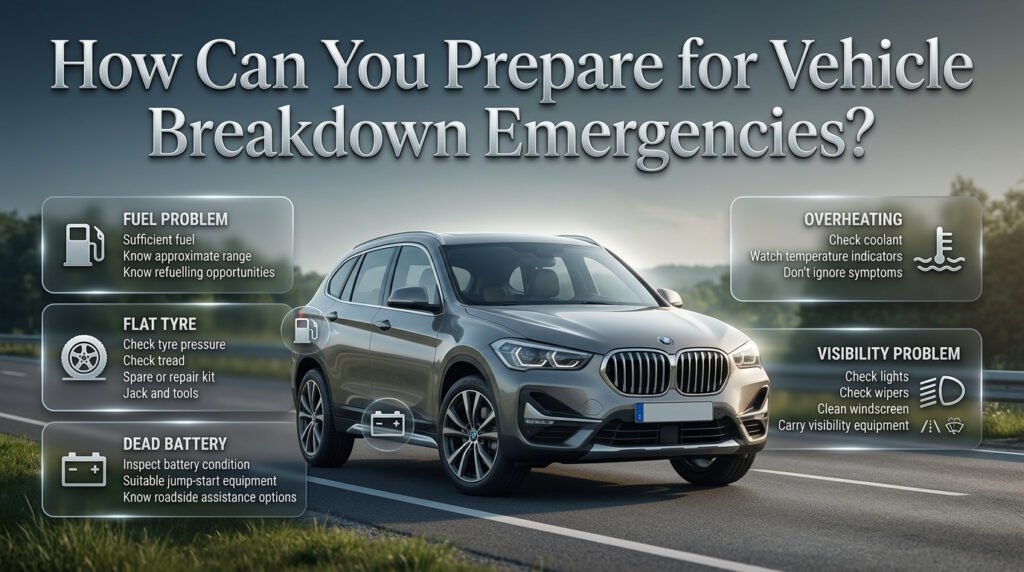
A good emergency plan considers the most likely problems before the journey.
Fuel problem
Preparation:
- Start with sufficient fuel
- Know your approximate range
- Know where refuelling opportunities exist
Flat tyre
Preparation:
- Check tyre pressure
- Check tread
- Confirm spare or repair kit
- Check jack and tools
Dead battery
Preparation:
- Inspect battery condition
- Carry suitable jump-start equipment if appropriate
- Know your roadside assistance options
Overheating
Preparation:
- Check coolant
- Watch temperature indicators
- Don’t ignore overheating symptoms
Visibility problem
Preparation:
- Check lights
- Check wipers
- Clean windscreen
- Carry appropriate visibility equipment
How Can You Prepare for a Road Trip in Hot Weather?
Dubai’s climate makes heat preparation particularly important.
Before departure, check:
- Coolant level
- Tyre pressure
- Battery condition
- Air conditioning
- Engine oil
- Windscreen washer fluid
- Fuel level
Also carry sufficient drinking water.
If the vehicle develops a serious overheating problem, don’t continue driving simply because you are close to your destination. Continuing to drive an overheating vehicle can increase mechanical damage.
What Should You Do If Your Car Overheats?
If the temperature rises abnormally:
- Reduce driving demands.
- Find a safe place to stop.
- Follow the vehicle manufacturer’s instructions.
- Turn off the engine when appropriate.
- Do not open a hot pressurized cooling system.
- Seek assistance if the problem does not resolve safely.
Never assume that adding coolant immediately to a very hot engine is harmless.
The priority is to avoid burns and prevent additional engine damage.
How Does Driver Fatigue Affect Emergency Preparation?
Emergency preparation isn’t only about the vehicle.
The driver is also part of the safety system.
Fatigue can affect:
- Reaction time
- Attention
- Decision-making
- Hazard recognition
- Speed control
Before a long journey, get adequate rest and avoid starting a major trip when you’re already exhausted.
If you notice yourself struggling to stay alert, treat that as a safety issue rather than simply increasing the air conditioning or playing louder music.
Why Should You Plan Your Route Before Leaving?
Route planning helps you identify potential problems before they occur.
Check:
- Main route
- Alternative route
- Petrol stations
- Rest areas
- Major exits
- Destination access
- Expected traffic
- Weather conditions
Dubai’s official road-safety resources provide journey-planning and road-condition information that can help drivers make informed travel decisions.
A route plan doesn’t have to be complicated.
You simply need to know where you’re going and what options you have if the original route becomes difficult.
What Should Families Do Differently?
Families travelling with children or elderly passengers need to think beyond the vehicle itself.
Prepare:
- Drinking water
- Food or snacks
- Necessary medication
- Phone charging
- Child essentials
- Appropriate clothing
- Comfort items for longer waits
If a vehicle breaks down, children shouldn’t be allowed to move around near active traffic.
The same applies to older passengers or anyone who may have difficulty moving quickly.
What Should You Do if an Emergency Happens at Night?
Night-time emergencies require extra visibility.
Keep accessible:
- Flashlight
- Phone
- Power bank
- Hazard lights
- Reflective equipment
- Warning equipment
Don’t assume your phone flashlight is enough.
A dedicated flashlight is easier to use and doesn’t drain your phone battery as quickly.
What Are the Most Common Road Trip Emergency Preparation Mistakes?
Mistake 1: Starting the Journey With a Nearly Empty Tank
This often happens because the driver plans to refuel later.
Why it’s harmful: an unexpected traffic delay or detour can consume the reserve.
Better approach: refuel before the journey reaches the low-fuel stage.
Mistake 2: Ignoring Dashboard Warnings
Some drivers continue because the car still appears to be running normally.
Why it’s harmful: the warning may indicate a developing issue.
Better approach: understand what the warning means before continuing.
Mistake 3: Checking Only the Four Main Tyres
Drivers sometimes forget the spare.
Why it’s harmful: the spare may be underinflated or unusable.
Better approach: inspect the entire tyre-change setup.
Mistake 4: Keeping Emergency Equipment Under Heavy Luggage
Why it’s harmful: you may not be able to reach it quickly.
Better approach: keep essential emergency equipment accessible.
Mistake 5: Walking Along a Highway
Why it’s harmful: it exposes you to moving traffic.
Better approach: arrange appropriate roadside assistance.
Mistake 6: Giving an Incomplete Location
Why it’s harmful: assistance may have difficulty finding you.
Better approach: provide road, direction, exit, landmark, and location information.
Mistake 7: Trying to Repair Everything Yourself
Why it’s harmful: roadside repairs can expose you to traffic, heat, or mechanical hazards.
Better approach: perform only safe, appropriate checks and request professional assistance when necessary.
Mistake 8: Forgetting the Fuel Type
Petrol and diesel are not interchangeable.
Why it’s harmful: misfuelling can create another vehicle problem.
Better approach: confirm the required fuel before assistance arrives.
A Professional Road Trip Emergency Preparation Checklist
Use this before leaving.
Vehicle Inspection
- Tyre pressure checked
- Tyre tread inspected
- Spare tyre checked
- Jack and tools available
- Battery checked
- Engine oil checked
- Coolant checked
- Brake fluid checked
- Lights checked
- Wipers checked
- Mirrors clean
- Warning lights checked
- Air conditioning working
Fuel Preparation
- Tank has adequate fuel
- Route refuelling points identified
- Fuel range understood
- Low-fuel warning behaviour understood
- Petrol/diesel type confirmed
Emergency Equipment
- Phone charged
- Car charger available
- Power bank available
- Flashlight available
- First-aid kit available
- Warning equipment available
- Reflective equipment available
- Gloves available
- Water available
Route Preparation
- Destination confirmed
- Main route reviewed
- Alternative route considered
- Major exits identified
- Petrol stations identified
- Weather checked
- Traffic conditions checked
What Is the Best Order to Follow During a Roadside Emergency?

When something goes wrong, use this simple priority system:
1. Traffic Safety
Can the vehicle be moved safely away from active traffic?
2. Passenger Safety
Are everyone inside the vehicle in the safest available location?
3. Visibility
Are hazard lights and appropriate warning equipment being used?
4. Communication
Can you clearly explain where you are and what happened?
5. Vehicle Problem
Only after safety is addressed should you focus on diagnosing or fixing the vehicle.
This order prevents a common mistake: becoming so focused on the mechanical problem that you forget the surrounding traffic.
When Should You Contact Emergency Services?
Not every breakdown requires emergency services, but situations involving immediate danger may.
Examples can include:
- Collision
- Injury
- Fire
- Serious smoke
- Vehicle creating a major road hazard
- Dangerous highway obstruction
- Other immediate threats to life or road safety
For ordinary mechanical assistance where there is no immediate danger, appropriate roadside assistance may be more suitable.
Dubai’s official road-safety resources provide accident-response guidance, including checking for injuries, safely moving vehicles where appropriate, and contacting emergency services when necessary.
How Can Emergency Fuel Delivery Help During a Road Trip?
Emergency fuel delivery can be useful when a vehicle has run out of fuel and travelling to a petrol station isn’t practical or safe.
Instead of leaving the vehicle and walking along a busy road, you can arrange appropriate assistance and provide your location.
Before requesting fuel, confirm:
- Exact location
- Vehicle make and model
- Petrol or diesel
- Road name
- Direction
- Nearest exit
- Nearby landmark
For detailed fuel-emergency guidance, see Emergency Roadside Fuel Advice.
The service is most useful when it solves the fuel problem without creating a new safety problem.
How Can You Prevent a Fuel Emergency During Long Trips?
The easiest fuel emergency to handle is the one that never happens.
Build these habits:
Refuel before the tank becomes critically low
Don’t make extremely low fuel levels part of your normal driving routine.
Know your vehicle’s real-world consumption
Use your normal driving history instead of relying exclusively on a theoretical fuel-economy figure.
Consider traffic
A vehicle travelling smoothly on a highway may consume fuel differently from the same vehicle in heavy stop-and-go traffic.
Consider air conditioning
In Dubai’s climate, air conditioning is often essential, but it can influence fuel consumption.
Consider vehicle load
Heavy luggage can influence efficiency and handling.
How Can Good Driving Habits Improve Emergency Readiness?
Driving style doesn’t only affect fuel economy.
Smooth driving can also make a long trip more comfortable and reduce unnecessary stress.
Useful habits include:
- Avoid unnecessary hard acceleration.
- Maintain a safe following distance.
- Avoid sudden braking.
- Watch traffic ahead.
- Keep a steady pace.
- Avoid distracted driving.
- Take breaks during long journeys.
A prepared driver is not simply someone who carries an emergency kit. It’s someone who remains observant enough to identify problems early.
What If You Notice a Problem Before the Vehicle Stops?
This is one of the best opportunities to prevent a full roadside emergency.
If you notice:
- Strange vibration
- Loss of power
- Unusual temperature
- Warning light
- Smoke
- Strong fuel smell
- Unusual engine noise
- Steering problems
- Brake problems
don’t automatically continue because the car is still moving.
Find a safe place to assess the situation and seek appropriate assistance if needed.
Early action can sometimes prevent a complete breakdown.
What Should You Do if the Vehicle Becomes Unsafe to Drive?
If the vehicle develops a problem that affects braking, steering, engine temperature, tyre integrity, or another critical safety system, continuing the journey may create additional risk.
Don’t let the pressure of reaching your destination override basic safety.
Your destination is important.
But reaching it safely is more important.
People Also Ask About Road Trip Emergency Preparation
What should I check before a long road trip?
Check tyre pressure and condition, spare tyre or repair equipment, battery, engine oil, coolant, lights, wipers, brakes, fuel level, warning indicators, and emergency equipment. Also check your route and identify suitable refuelling points before leaving.
What should I keep in my car for an emergency?
A practical emergency kit can include a charged phone, power bank, flashlight, first-aid supplies, warning equipment, reflective gear, tyre equipment, gloves, water, and relevant vehicle documents. The exact equipment depends on the vehicle and journey.
How much fuel should I have before a road trip?
You should have enough fuel for the planned journey plus a reasonable reserve. Avoid calculating the trip so closely that reaching the destination depends on using almost every litre in the tank.
What should I do if my car breaks down on a Dubai highway?
Activate the hazard lights and, if the vehicle can be moved safely, get away from active traffic. Keep passengers away from moving vehicles, arrange appropriate assistance, and provide your road, direction, exit, and landmark information.
Is it safe to walk to a petrol station after running out of fuel?
Walking along a busy road or highway can expose you to traffic hazards. It is generally safer to arrange appropriate roadside assistance or fuel delivery rather than walking long distances beside moving traffic.
How accurate is the car’s remaining fuel range?
The displayed range is an estimate, not a guaranteed distance. Traffic, speed, air conditioning, driving style, road conditions, and vehicle load can change actual fuel consumption.
What should I do if the low fuel light comes on?
Treat it as a signal to refuel rather than as permission to continue until the tank is empty. Find a suitable petrol station as soon as reasonably practical, particularly if you’re unfamiliar with the route.
What if my car overheats during a road trip?
Stop in a safe location when possible and follow the manufacturer’s instructions. Don’t open a hot pressurized cooling system. If the temperature remains abnormal or the vehicle cannot safely continue, arrange appropriate assistance.
How can I prepare for a road trip in Dubai’s hot weather?
Check coolant, oil, tyres, battery, air conditioning, lights, and fuel before departure. Carry sufficient water and avoid unnecessary exposure outside the vehicle if a breakdown occurs.
What information should I give roadside assistance?
Provide your exact location, road name, direction of travel, nearest exit, landmark, vehicle make and model, fuel type if relevant, and a short description of the problem. Clear information can help assistance reach you more efficiently.
Road Trip Emergency Preparation: Quick Decision Guide
When something happens, use the following mental checklist.
Low Fuel Warning
Action: Find a suitable refuelling point.
Don’t: Deliberately test the maximum remaining range.
Empty Fuel Tank
Action: Make the vehicle safe, move away from traffic where appropriate, and arrange fuel assistance.
Don’t: Walk along a highway searching for fuel.
Flat Tyre
Action: Stop in the safest available location and assess whether changing the tyre is safe.
Don’t: Attempt a roadside repair in an exposed traffic location.
Overheating
Action: Stop safely and allow the vehicle to cool according to manufacturer guidance.
Don’t: Continue driving an overheating vehicle simply to reach your destination.
Battery Failure
Action: Arrange appropriate jump-start or roadside assistance.
Don’t: Experiment with electrical connections if you’re unsure what you’re doing.
Major Mechanical Problem
Action: Prioritize safety and arrange professional assistance.
Don’t: Attempt complex repairs beside moving traffic.
Expert Advice for Better Road Trip Preparation
The most useful emergency preparation habits are simple enough to repeat before every major journey.
1. Don’t wait for a warning light to start preparing
Preparation should happen before the vehicle becomes critically low on fuel or develops a serious problem.
2. Know your vehicle
Understand:
- Fuel type
- Fuel capacity
- Normal fuel economy
- Warning lights
- Tyre requirements
- Spare tyre location
- Basic fluid checks
3. Keep emergency equipment accessible
A perfect emergency kit is useless if you cannot reach it.
4. Think about location
A breakdown in a parking area is different from one in a live highway lane.
Always consider the environment before deciding what to do.
5. Share your journey when appropriate
For longer or remote journeys, let someone know your intended route and expected arrival time.
6. Don’t ignore small problems
A small warning today can become a major breakdown tomorrow.
7. Put people before the vehicle
A damaged car can be repaired.
An unsafe roadside situation can be much more serious.
Key Takeaways
- Road trip emergency preparation starts before you leave home.
- Check tyres, battery, fluids, lights, wipers, warning indicators, and fuel.
- Don’t depend entirely on the dashboard’s remaining-range estimate.
- Start long journeys with an appropriate fuel reserve.
- Understand what your low-fuel warning means.
- Keep emergency equipment accessible.
- Carry adequate water and essential personal supplies.
- Know your road, direction, exits, and landmarks.
- If the car breaks down, prioritize traffic and passenger safety.
- Don’t walk along busy highways searching for fuel.
- Treat highway emergencies as higher-risk situations.
- Confirm petrol versus diesel before fuel delivery.
- Don’t attempt complex repairs in an unsafe roadside location.
- Contact emergency services when there is immediate danger, injury, fire, or a serious road hazard.
- Use appropriate roadside assistance for non-emergency vehicle problems.
- Prepare for the actual conditions of your journey, not just the distance.
Conclusion
A successful road trip isn’t simply about reaching the destination. It’s about being prepared for the unexpected parts of the journey.
Good road trip emergency preparation starts with basic vehicle checks. Tyres should be in good condition, fluids should be checked, the battery should be reliable, lights and wipers should work properly, and the vehicle should have enough fuel for the planned journey with a sensible reserve.
The next layer is preparation for what happens if something does go wrong. Keep a practical emergency kit, charge your phone, carry water, understand your route, and know how to communicate your location.
Fuel deserves particular attention because running out of petrol or diesel is both preventable and surprisingly stressful when it happens on an unfamiliar road. Understanding your fuel gauge, remaining range, low-fuel warning, and actual driving conditions can help you make better decisions before the tank becomes empty.
If the vehicle does stop, remember the most important rule: protect people before protecting the vehicle. A breakdown, flat tyre, or empty tank can usually be solved with the right assistance. Creating a dangerous roadside situation while trying to solve that problem is what you want to avoid.
For Dubai drivers, especially those travelling on highways or making longer journeys, preparation should be part of the trip itself. Check the car, plan the fuel, carry the essentials, understand the route, and know what to do if the unexpected happens.
That simple approach can turn a stressful roadside emergency into a manageable situation.
What should I check before starting a long road trip?
Before a long road trip, check the parts of your vehicle that can directly affect safety and reliability. Start with the tyres, including the spare tyre, then check the battery, engine oil, coolant, lights, wipers, brakes, fuel level, and dashboard warning lights. Don’t rely only on a vehicle looking fine from the outside; small problems can become serious after hours of driving.
Before leaving, make sure you:
Check tyre pressure and inspect for cuts, cracks, or unusual wear.
Confirm that the spare tyre or repair kit is usable.
Check engine oil and coolant according to the manufacturer’s instructions.
Test headlights, brake lights, indicators, and wipers.
Make sure the battery is starting the vehicle normally.
Fill the fuel tank sufficiently for the planned route.
Keep a charged phone, power bank, flashlight, first-aid kit, and basic emergency equipment accessible.
A final 10-minute inspection before departure can be far more useful than discovering the same problem several hours into the journey.
What emergency items should I keep in my car for a road trip?
A good car emergency kit should help you handle common problems, remain visible, communicate with assistance, and stay reasonably comfortable while waiting for help. You don’t need to carry a professional mechanic’s toolbox, but you should have equipment suited to your vehicle and the type of journey you’re taking.
Useful emergency items include:
Fully charged mobile phone and car charger
Power bank
Flashlight
First-aid kit
Reflective or high-visibility equipment
Warning triangle where appropriate
Gloves
Spare tyre or approved tyre repair equipment
Jack and wheel-changing tools
Jumper cables where suitable for your vehicle
Drinking water
Basic personal supplies
Important vehicle documents
For Dubai road trips, water and reliable communication equipment deserve particular attention because waiting beside a vehicle in hot weather can become uncomfortable quickly.
The most important point is accessibility. Keep essential items somewhere you can reach them without removing all the luggage from the car.
What should I do if my car breaks down during a road trip?
If your vehicle breaks down, don’t immediately focus on repairing it. First, assess the traffic around you and try to move the vehicle to a safer position if it can be done without creating additional danger. Turn on the hazard lights and keep yourself and passengers away from moving traffic as much as reasonably possible.
A practical response is:
Stay calm and maintain control of the vehicle.
Switch on hazard lights.
Move away from active traffic if safely possible.
Avoid standing unnecessarily beside the vehicle.
Contact appropriate roadside assistance.
Clearly provide your road, direction, nearest exit, and landmark.
Explain whether the problem is a flat tyre, empty fuel tank, battery issue, overheating, or another fault.
Don’t attempt a complicated repair simply because you have a few tools in the boot. On a busy Dubai road or highway, the traffic environment may make roadside repairs more dangerous than the original vehicle problem.
What should I do if I run out of fuel on a road trip?
If your car runs out of fuel, treat it as a roadside safety issue rather than simply an inconvenience. Turn on the hazard lights, assess where the vehicle has stopped, and move it to a safer location if that can be done safely. Then arrange suitable roadside fuel assistance and provide accurate location details.
When requesting fuel assistance, provide:
Exact or shared location
Road name
Direction of travel
Nearest exit
Nearby landmark
Vehicle make and model
Petrol or diesel requirement
Avoid walking along a busy road or highway to find a petrol station. A fuel shortage can be solved with assistance, but walking close to fast-moving traffic can introduce a much more serious risk.
Also confirm the required fuel type before fuel is delivered. Putting the wrong fuel into a vehicle can create an additional mechanical problem and delay your journey further.
How can I prepare for a road trip emergency in Dubai’s hot weather?
Preparing for a Dubai road trip requires more attention to heat because high temperatures can place additional demands on the vehicle and make a roadside wait more difficult. Before leaving, check the cooling system, tyres, battery, fluids, air conditioning, and fuel level. Carry enough drinking water and avoid unnecessary roadside exposure if a breakdown occurs.
For hot-weather road trips, remember to:
Check coolant before departure.
Inspect tyre pressure and condition.
Make sure the battery is reliable.
Confirm that the air-conditioning system is working properly.
Carry drinking water for everyone travelling.
Keep your phone and power bank charged.
Avoid continuing to drive if the vehicle is overheating.
Have a clear plan for contacting roadside assistance.
Most importantly, don’t wait until the vehicle stops completely before reacting to signs of trouble. An unusual temperature reading, warning light, loss of power, tyre problem, or strange noise is a reason to reassess the journey before a minor issue becomes a roadside emergency.
Conclusion
Road trip emergency preparation is not about expecting something to go wrong—it is about being ready to respond calmly when something unexpected happens. A properly prepared vehicle, enough fuel, basic emergency equipment, and a clear plan can make a roadside problem much easier to manage.
Before leaving, check your vehicle, fuel level, tire condition, fluids, battery, and essential safety equipment. During the journey, pay attention to your fuel range instead of waiting for the low-fuel warning. If a breakdown or empty-fuel situation occurs, move to a safe location when possible, use hazard lights, and avoid standing close to moving traffic.
For Dubai drivers, preparation is especially important because high temperatures, busy roads, and long highway stretches can make a minor vehicle problem more difficult. Keeping emergency contacts available and knowing where to get roadside fuel assistance can save valuable time when you need help.
A few minutes of preparation before a road trip can prevent unnecessary stress later. Plan your route, monitor your vehicle, carry essential emergency supplies, and make safety your first priority throughout the journey.
Leave a Reply