Introduction
How Far Can a Car Drive on Low Fuel? | Seeing the low fuel warning light come on when you’re still several kilometres away from your destination can be stressful. The first question most drivers ask is simple: how far can a car drive on low fuel? The problem is that there isn’t one number that applies to every vehicle. A small sedan, large SUV, hybrid, and older petrol car can all have very different fuel reserves and fuel consumption.
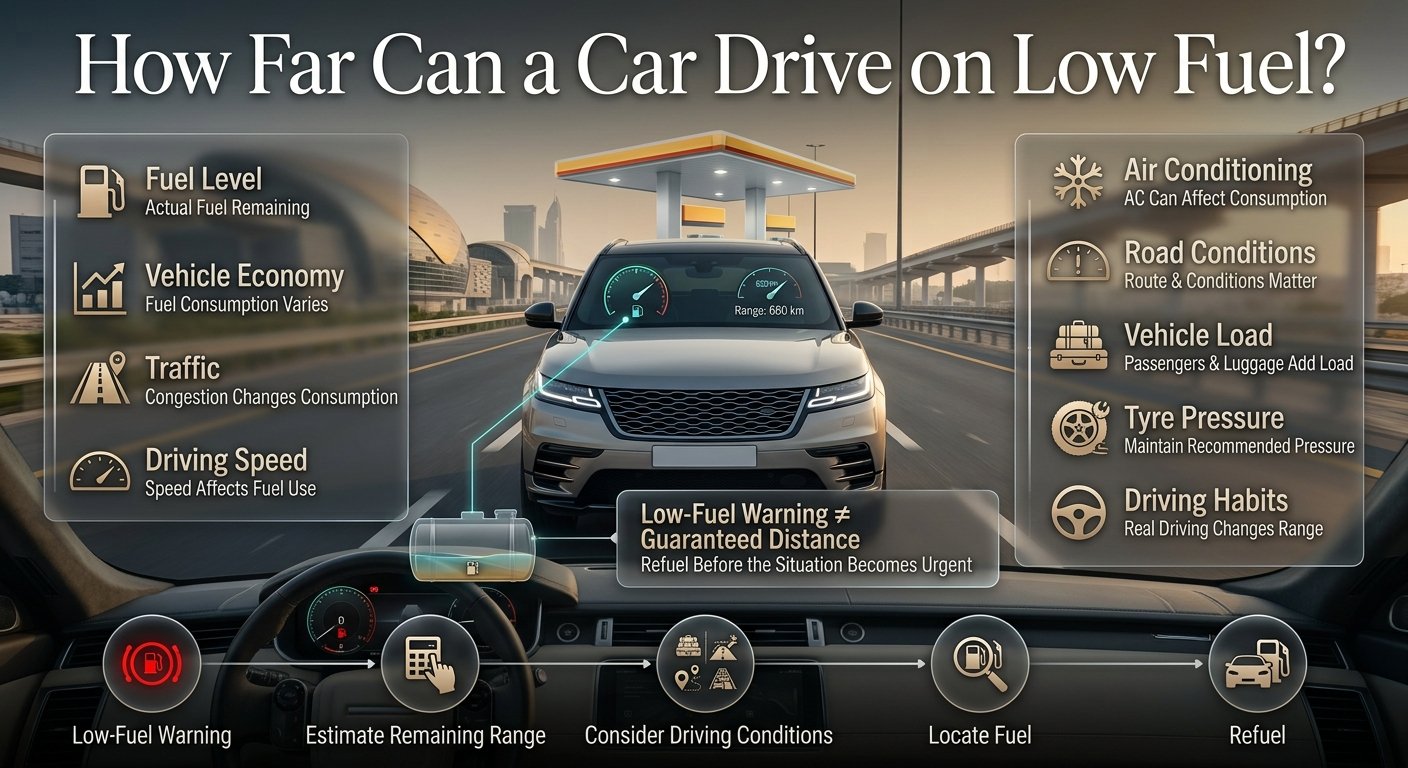
The low-fuel warning is designed to give you time to find fuel, not to tell you that you have a guaranteed number of kilometres remaining. Your actual range depends on how much fuel is left, your vehicle’s fuel economy, traffic, speed, air conditioning, road conditions, vehicle load, tyre pressure, and driving habits.
If you’re in Dubai and already concerned about reaching a petrol station, Fuel Delivery Dubai can be an alternative when you don’t have enough fuel to continue safely. The important thing is to make the decision before the vehicle reaches the point where the engine stops.
This guide explains how low-fuel warnings work, how to estimate remaining range, why your expected kilometres can change suddenly, what happens when a car actually runs out of fuel, and what you should do if you’re stranded.
How Far Can a Car Drive After the Low Fuel Light Comes On?
A car can often travel a number of kilometres after the low-fuel warning appears, but the exact distance depends on the vehicle and driving conditions. Some cars may have enough reserve fuel for several dozen kilometres, while others may have considerably less. There is no universal reserve distance that can safely be applied to every car.
The most important thing to understand is that the low-fuel warning doesn’t mean the fuel tank is completely empty. It normally activates before the vehicle reaches zero usable fuel. However, the amount of fuel remaining at that point varies according to the vehicle’s design.
A car’s remaining range can also change while you’re driving. If you move from an open road into heavy traffic, your fuel consumption may increase. If you accelerate aggressively, drive at high speed, carry a heavy load, or spend a lot of time idling, the same amount of fuel may take you a shorter distance.
So instead of asking:
“How many kilometres can every car drive after the fuel light comes on?”
A better question is:
“How much fuel does my car probably have left, and how efficiently is it using that fuel right now?”
That approach gives you a much more realistic answer.
Why There Is No Fixed Low-Fuel Distance
Drivers sometimes hear statements such as:
- “You always have 50 km after the light.”
- “Every car has 5 litres left.”
- “You can drive another hour after the warning.”
- “The empty mark still gives you plenty of fuel.”
These statements can be misleading.
The fuel-warning threshold is determined by the vehicle manufacturer. Different cars can trigger their warnings at different fuel levels. Even two vehicles with similar tank capacities may have different reserve amounts.
Your actual range is also affected by the way you drive.
For example, imagine two drivers have the same amount of fuel remaining.
Driver A is travelling steadily on an open road.
Driver B is stuck in stop-and-go traffic, repeatedly accelerating and braking, while using the air conditioner.
They may have dramatically different remaining ranges despite having the same amount of fuel.
This is why your own vehicle’s historical fuel consumption is much more useful than a generic number found online.
What Does the Low Fuel Warning Light Actually Mean?
The low-fuel warning light is an early warning that your fuel level has fallen below a predefined threshold. It is intended to encourage you to refuel before the vehicle runs completely out of fuel.
The light doesn’t normally mean:
“The tank is empty.”
It means:
“Your remaining fuel is getting low enough that you should plan to refuel.”
This distinction matters.
If the warning comes on while you’re close to a petrol station, there may be no immediate problem. But if it appears while you’re far away from fuel, sitting in heavy traffic, or travelling on a highway, you need to think about your remaining range more carefully.
For drivers who want to understand the warning itself in more detail, Low Fuel Warning Light Meaning in Dubai explains why the warning appears and why the remaining distance shouldn’t be treated as a fixed figure.
Does the Warning Mean the Tank Is Empty?
Usually, no.
There is generally still some fuel remaining when the warning appears. However, you shouldn’t use that reserve as your normal driving range.
Think of the reserve as a buffer.
It gives you additional time to find fuel if you haven’t refuelled earlier. It isn’t there so you can intentionally drive until the engine stops.
That’s an important difference between having a reserve and relying on a reserve.
How Many Litres Are Left When the Low Fuel Light Comes On?
There isn’t one standard number of litres remaining when the low-fuel warning activates.
The amount depends on the vehicle’s fuel tank, fuel-level sensor, warning calibration, and manufacturer settings.
Some vehicles may have several litres remaining, while others can have a different amount. The owner’s manual may provide useful information, but even the manufacturer’s estimated reserve doesn’t tell you exactly how many kilometres you’ll get in every situation.
For this reason, don’t calculate your emergency range by assuming:
Low fuel light = exactly X litres.
Instead, use several pieces of information together:
- Fuel gauge position
- Distance-to-empty reading
- Your recent fuel economy
- Traffic conditions
- Current journey distance
- Distance to a suitable petrol station
This gives you a more practical picture.
How Do You Calculate How Far You Can Drive on Low Fuel?
The basic calculation is straightforward:
Estimated Range = Fuel Remaining × Fuel Economy
For example, if you believe your car has approximately 6 litres remaining and your vehicle is currently achieving 10 km per litre:
6 × 10 = 60 km
That gives you a theoretical range of approximately 60 kilometres.
But this shouldn’t automatically be interpreted as:
“I can safely drive 60 km.”
Your fuel economy can change.
If traffic becomes heavier and your consumption falls to 8 km/L:
6 × 8 = 48 km
Now your estimated range is closer to 48 km.
This simple example shows why low-fuel range calculations need a safety margin.
A Practical Low-Fuel Range Example
Imagine you’re driving through Dubai and your car normally gives you around 12 km/L.
Your estimated fuel remaining is 5 litres.
The theoretical calculation is:
5 × 12 = 60 km
You might initially think you have 60 km available.
But then you enter heavy congestion.
If your actual economy drops to 8 km/L:
5 × 8 = 40 km
Your potential range has changed by approximately 20 km without adding or removing any fuel.
That’s why drivers should avoid planning around the maximum theoretical range.
💡 Pro Tip: When your fuel is low, calculate a conservative range rather than your best-case range. If the petrol station is 20 km away and your optimistic calculation says you can travel 25 km, that’s an unnecessarily small safety margin.
What Is a Safe Fuel Range?
There isn’t a universal “safe range” after the low-fuel light appears.
Safety depends on how far you need to travel, the traffic conditions, the road you’re using, and whether you have accessible refuelling options.
For example, 30 km of estimated range may be comfortable if the nearest petrol station is 5 km away.
The same 30 km could be risky if the nearest suitable station is 28 km away and you’re entering heavy traffic.
A safe decision therefore depends on the distance you need to cover compared with your realistic remaining range.
The closer those two numbers become, the greater your risk.
What Factors Reduce How Far You Can Drive on Low Fuel?
Low fuel range is affected by much more than the fuel gauge.
1. Traffic
Traffic is one of the biggest variables for urban drivers.
In stop-and-go traffic, the engine continues consuming fuel while the vehicle repeatedly accelerates, slows down, and sometimes remains stationary.
This means the fuel economy you achieve on an open road may not represent what you’ll achieve during congestion.
If you want to understand this more fully, see How Traffic Affects Fuel Economy in Dubai.
The important point is simple:
Don’t use your highway fuel economy to calculate an emergency range while you’re sitting in urban traffic.
2. Driving Speed
Higher road speeds can increase aerodynamic drag.
As speed increases, the engine generally has to provide more energy to overcome air resistance and other forces acting against the vehicle.
If your tank is already very low, unnecessarily high speeds can reduce your available range.
This doesn’t mean you should drive dangerously slowly. Follow the applicable speed limits and traffic conditions.
The objective is to avoid unnecessary fuel consumption while maintaining safe, normal driving.
You can learn more about the relationship between speed and fuel economy in Optimal Driving Speed for Fuel Efficiency in Dubai.
3. Aggressive Acceleration
Hard acceleration can increase fuel consumption.
When fuel is already limited, repeated rapid acceleration followed by braking wastes part of your remaining fuel without necessarily getting you to your destination much faster.
Smooth acceleration is generally a better approach.
You can also read about How Acceleration Affects Fuel Consumption for a deeper explanation of why driving behaviour matters.
4. Braking Habits
Braking itself doesn’t directly consume fuel in the same way acceleration does, but unnecessary braking often means you’ve used energy to accelerate and then have to slow down again.
A smoother driving style that anticipates traffic can reduce unnecessary acceleration and braking.
For practical guidance, How Braking Habits Affect Fuel Economy in Dubai explains how everyday braking behaviour can influence overall efficiency.
5. Air Conditioning
Air conditioning can increase fuel consumption in conventional petrol and diesel vehicles because the system places an additional load on the engine.
In Dubai, however, turning the A/C off isn’t always a sensible emergency strategy.
Extreme heat can make the cabin uncomfortable and may affect driver concentration.
The better approach is to maintain a reasonable cabin temperature while reducing other unnecessary fuel consumption.
For more detail, see Air Conditioning and Fuel Consumption.
6. Vehicle Weight
A heavily loaded vehicle generally requires more energy to accelerate.
If your car contains unnecessary heavy items, removing them can improve fuel efficiency over time.
This doesn’t mean you should remove essential safety equipment or important belongings just because the fuel warning appeared.
Instead, make vehicle weight part of your normal fuel-efficiency strategy.
7. Tyre Pressure
Incorrect tyre pressure can increase rolling resistance and reduce fuel efficiency.
Maintaining the manufacturer’s recommended tyre pressure is therefore useful for both fuel economy and general vehicle safety.
When you’re already low on fuel, however, don’t stop on an unsafe road to make unnecessary adjustments. Safety comes first.
8. Idling
An idling engine consumes fuel even though the vehicle isn’t travelling.
This matters when you’re already operating with a limited fuel supply.
If you’re safely parked and waiting for someone, unnecessary idling can waste fuel.
For more detail, see Fuel Consumption While Idling.
Can You Trust the Distance-to-Empty Display?
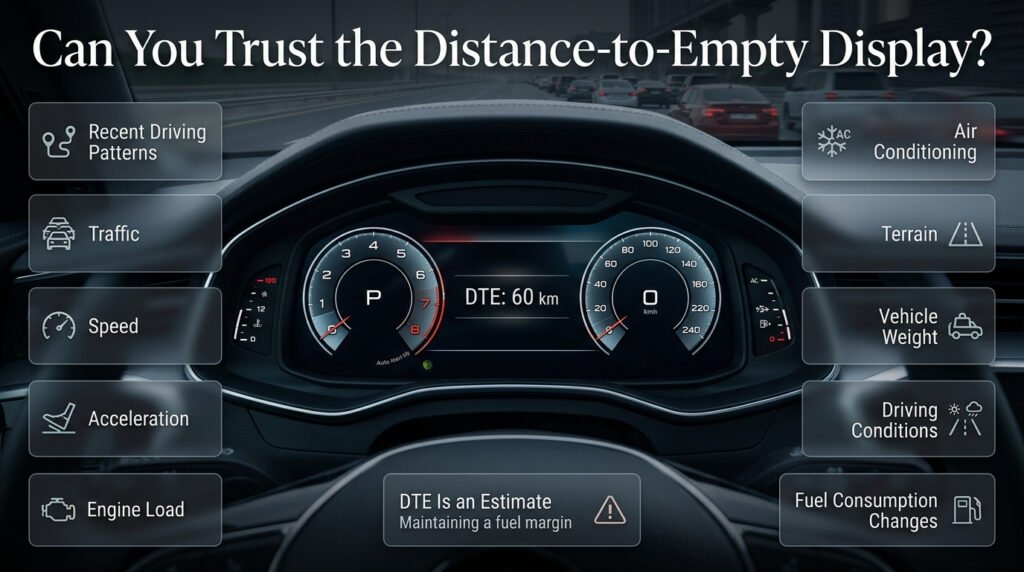
The distance-to-empty display can be extremely useful, but it should be treated as an estimate rather than a guarantee.
Your vehicle calculates the estimated remaining distance based partly on recent fuel consumption.
That means the number can change.
You might see:
DTE: 60 km
Then enter heavy traffic and watch it fall much faster than expected.
Why?
Because your current consumption is worse than the consumption used to produce the earlier estimate.
Similarly, if you move onto a steady road and drive efficiently, the estimate may decrease more slowly.
Why DTE Can Be Misleading
Distance-to-empty can be affected by:
- Recent driving patterns
- Traffic
- Speed
- Acceleration
- Engine load
- Air conditioning
- Terrain
- Vehicle weight
- Driving conditions
So if the display says 40 km, don’t automatically assume that a petrol station 38 km away is a safe choice.
You need a margin.
⚠ Common Mistake: Treating the DTE number as if it were a contractual promise from the car. It isn’t. It’s an estimate based on changing conditions.
How Accurate Is a Car Fuel Gauge?
A fuel gauge is useful, but it isn’t designed to provide laboratory-level measurement of the exact fuel remaining.
The shape of the tank, position of the fuel sensor, vehicle movement, and gauge calibration can all affect what you see.
The gauge may also not move at a perfectly consistent rate.
For example, the needle may appear to remain near full for a while and then seem to fall more quickly later.
That doesn’t necessarily mean the vehicle is malfunctioning.
If you’re interested in understanding this in more detail, read How Accurate Is a Car Fuel Gauge?.
Why You Shouldn’t Calculate Range From the Needle Alone
Suppose your gauge is just above empty.
You can’t reliably say:
“The tank is 10% full, so I have 10% of my maximum range.”
Fuel gauges don’t necessarily work that way.
Your better information sources are:
- Recent fuel economy
- DTE estimate
- Fuel gauge
- Known distance to fuel
- Current traffic conditions
Combining these gives you a more realistic assessment.
What Should You Do When the Low Fuel Light Comes On?
When the warning appears, don’t panic—but don’t ignore it either.
Step 1: Check the Gauge
Look at the fuel gauge and note where it is.
Step 2: Check the DTE
If your vehicle provides a distance-to-empty estimate, use it as supporting information.
Step 3: Consider Current Conditions
Ask yourself:
- Am I in heavy traffic?
- Am I on a highway?
- Is my A/C running continuously?
- Am I carrying a heavy load?
- How far is the nearest petrol station?
- Do I have enough margin?
Step 4: Choose the Nearest Practical Refuelling Option
Don’t necessarily choose the station with the cheapest fuel or the one you normally use.
When fuel is critically low, the priority is reaching a suitable refuelling point safely.
Step 5: Drive Smoothly
Avoid unnecessary acceleration and detours.
Step 6: Get Assistance Before It Becomes Critical
If you’re uncertain that you’ll reach fuel, don’t wait until the engine stops.
Arrange assistance while you still have time to choose a safe location.
Should You Drive Until the Fuel Gauge Reaches Empty?
No.
The “E” mark shouldn’t be treated as your normal refuelling point.
Even if your vehicle can sometimes continue after reaching the empty indication, relying on that reserve creates unnecessary risk.
Consider what could happen:
You see E.
You assume you still have 20 km.
Traffic suddenly becomes heavy.
A road is closed.
You miss an exit.
Your fuel consumption increases.
Now your original calculation is no longer useful.
The problem isn’t simply whether the car can continue.
The problem is whether you have enough margin to deal with something unexpected.
Is It Bad to Drive With Very Low Fuel?
Occasionally reaching a low fuel level doesn’t automatically mean your vehicle will suffer immediate damage.
However, repeatedly driving until the vehicle nearly runs out of fuel is a poor habit.
It increases the chance of:
- Being stranded
- Losing engine power
- Stalling in an unsafe location
- Being delayed in traffic
- Needing roadside assistance
- Creating unnecessary stress
- Having difficulty restarting after fuel is added
The biggest issue is often practical safety.
A driver who refuels earlier has more options.
A driver who waits until the engine stops has very few.
What Happens When a Car Actually Runs Out of Fuel?
When the usable fuel supply becomes insufficient, the engine can begin to hesitate or lose power.
Depending on the vehicle, you may notice:
- Reduced acceleration
- Engine hesitation
- Surging
- Difficulty maintaining speed
- Warning lights
- Engine stalling
- Failure to restart
If this happens while driving, the situation becomes a roadside emergency.
You should focus on getting the vehicle into the safest possible position rather than repeatedly trying to restart it.
For a detailed response, see Car Stops Due to Empty Fuel Tank.
If the vehicle has already stopped because the tank is empty, Steps After Running Out of Petrol provides practical guidance on what to do next.
What Should You Do If Your Car Runs Out of Fuel on the Road?
The first priority is safety.
If possible and safe, move the vehicle away from active traffic.
Turn on the hazard warning lights.
Don’t leave the vehicle and start walking along a busy road looking for fuel.
Instead, arrange appropriate assistance and provide your exact location.
Running Out of Fuel on the Road covers this situation in more detail.
What Information Should You Provide?
When requesting fuel assistance, provide:
- Vehicle make and model
- Correct fuel type
- Exact location
- Live location where possible
- Direction of travel
- Nearest exit
- Nearby landmark
- Road or shoulder position
- Any visible signs
The more useful your location information is, the easier it can be for assistance to find you.
What If You Run Out of Fuel During a Roadside Breakdown?
Running out of fuel isn’t the only possible cause of a stopped vehicle.
If your car has stopped unexpectedly, first consider whether the problem is actually fuel-related.
For example, a vehicle may stop because of:
- Battery failure
- Engine problems
- Overheating
- Electrical faults
- Fuel-system problems
- Mechanical failure
If you know the fuel tank is empty, the solution is straightforward.
If you’re not sure, don’t assume fuel is the only problem.
For broader guidance, see What to Do During a Roadside Breakdown.
How Can You Stay Safe While Waiting for Fuel Assistance?
Your location matters.
A car parked safely in a private parking area is very different from a vehicle stopped beside a fast-moving road.
If you’re in a safe parking area:
- Keep the vehicle secure.
- Provide the correct location.
- Confirm the required fuel.
- Wait for assistance.
If you’re near active traffic:
- Activate hazard lights.
- Stay aware of surrounding traffic.
- Avoid standing unnecessarily close to moving vehicles.
- Don’t walk along a highway.
- Follow local roadside safety requirements.
For more practical advice, read Staying Safe During a Car Breakdown.
You can also review Vehicle Breakdown Safety Procedures if the situation involves more than simply low fuel.
What Are Roadside Vehicle Emergency Precautions?
A low-fuel emergency can become more dangerous when the driver reacts impulsively.
For example, a driver may:
- Walk along a highway
- Stop in an unsafe location
- Try to push a vehicle in moving traffic
- Cross multiple lanes
- Stand behind the car
- Leave children or passengers exposed to traffic
- Continue driving despite serious engine hesitation
These actions can create greater risks than the original fuel problem.
The better approach is to control the situation.
Move to safety where possible, use hazard lights, communicate your location clearly, and arrange appropriate assistance.
For a broader checklist, see Roadside Vehicle Emergency Precautions.
What If You Are Running Low on Fuel on a Highway?
Highway driving requires additional caution because vehicles are travelling at higher speeds and stopping conditions are different.
If your low-fuel warning appears while you’re on a highway, don’t assume you can simply continue until the next exit.
Check your estimated range and identify a realistic refuelling option.
If the remaining range is uncertain, take the safer option.
If your vehicle stops, activate hazard lights and move to a safe position if you can do so without creating additional danger.
For more detailed guidance, read Running Out of Fuel on a Highway.
Why Highway Fuel Emergencies Need More Planning
On a highway, you may have:
- Fewer immediate refuelling opportunities
- Higher traffic speeds
- Longer distances between exits
- Greater difficulty safely leaving the vehicle
- Less opportunity to stop and reassess
That’s why drivers should react earlier.
Highway Fuel Emergency Safety provides additional guidance for handling fuel-related problems in highway environments.
How Does Driving Style Affect Low-Fuel Range?
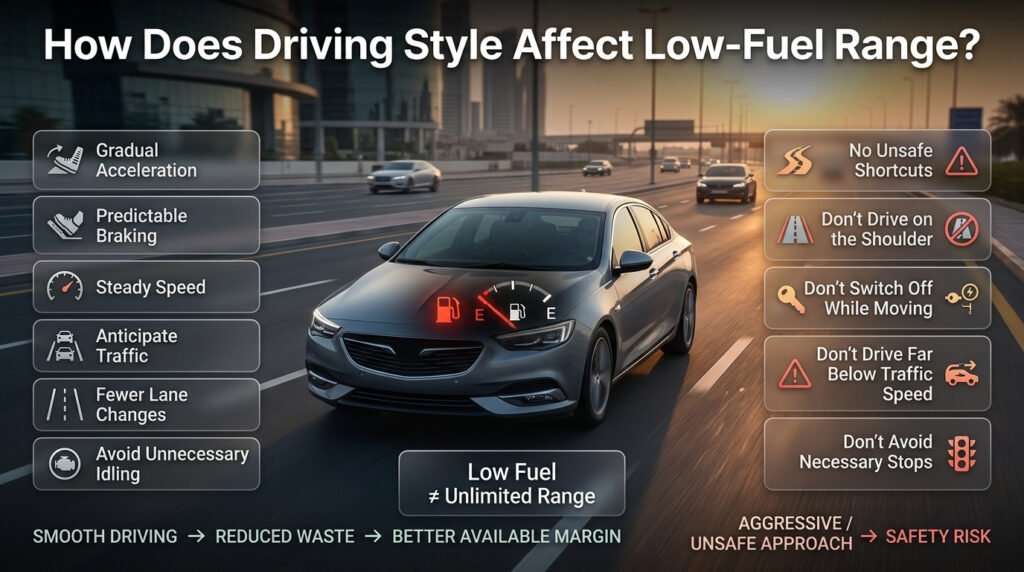
Your driving style can have a noticeable effect on how much distance you get from a small amount of fuel.
A smooth driver and an aggressive driver can use the same remaining fuel at different rates.
Smooth Driving
A smoother driving style usually involves:
- Gradual acceleration
- Predictable braking
- Maintaining a steady speed where appropriate
- Anticipating traffic
- Avoiding unnecessary lane changes
- Avoiding unnecessary idling
These habits are useful even when your fuel tank isn’t low.
For broader advice, Fuel-Saving Driving Tips covers practical habits that can improve everyday efficiency.
Don’t Try Extreme Fuel-Saving Tricks
When people see the low-fuel warning, they sometimes search for extreme methods to stretch the remaining fuel.
Examples include:
- Turning the A/C off in extreme heat
- Driving far below normal traffic speed
- Switching the engine off repeatedly while moving
- Taking unsafe shortcuts
- Driving on the shoulder
- Avoiding necessary stops
These approaches can create safety problems.
The objective should be efficient normal driving, not unsafe driving.
Can Smooth Driving Really Help When Fuel Is Low?
Yes, but there are limits.
Smooth driving can reduce unnecessary consumption, but it cannot turn a nearly empty tank into a full one.
Think of fuel-efficient driving as reducing waste.
If your vehicle has enough fuel to reach a station, efficient driving may give you a better margin.
If the vehicle is already out of usable fuel, no driving technique can solve the problem.
This distinction is important.
Fuel-saving habits are useful for extending available range, not for replacing refuelling.
How Does Vehicle Load Affect Low-Fuel Range?
Vehicle weight matters most during acceleration and repeated urban driving.
If you’re carrying unnecessary heavy equipment, tools, luggage, or other items, your vehicle may require more energy to move.
Over long periods, reducing unnecessary load can contribute to better fuel efficiency.
But if you’re already in a low-fuel emergency, don’t waste time unloading ordinary belongings on the roadside unless there’s a clear and safe reason to do so.
The priority is reaching fuel safely.
Can Tyre Pressure Change How Far You Can Drive?
Yes, tyre pressure can influence rolling resistance and fuel economy.
Underinflated tyres can require more energy to move.
However, tyre pressure isn’t something you should obsess over while you’re in the middle of a fuel emergency.
For normal vehicle care, maintain tyre pressure according to the manufacturer’s recommendation.
The goal is to keep the car operating efficiently before low-fuel situations happen.
How Can You Avoid Running Out of Fuel in the First Place?
The easiest fuel emergency to handle is the one you prevent.
You don’t need complicated equipment or advanced calculations.
A few simple habits can make a significant difference.
Refuel Before the Tank Becomes Critical
You don’t have to wait for the low-fuel warning.
If you know you’ll be driving a long distance, refuel before starting.
Know Your Normal Fuel Economy
Your own vehicle data can be more useful than a generic specification.
If you know that your car normally achieves around 10–12 km/L in your typical driving conditions, you have a better basis for estimating range.
Watch the DTE Trend
Don’t just look at the DTE number once.
Notice how quickly it is falling.
If you’re travelling 5 km but the DTE is dropping by 10 km because of heavy traffic, that’s useful information.
Consider Traffic
A range estimate based on open-road driving may not work in congestion.
Plan Long Trips
For longer journeys, identify suitable refuelling points before you leave.
This is especially useful if you’re travelling through unfamiliar areas.
What Are the Most Common Low-Fuel Mistakes?
Mistake 1: Assuming Every Car Has the Same Reserve
Why it happens: Drivers hear a general rule from friends or online discussions.
Why it’s harmful: Fuel warning thresholds differ between vehicles.
Better approach: Learn your own vehicle’s behaviour.
Mistake 2: Treating the Warning Light as a Distance Counter
The warning light tells you fuel is low.
It doesn’t say:
“You have exactly 50 km left.”
Mistake 3: Trusting DTE Completely
DTE can change when your driving conditions change.
Use it as an estimate.
Mistake 4: Ignoring Traffic
A car may consume much more fuel in congestion than on an open road.
Mistake 5: Driving Aggressively
Hard acceleration and unnecessary speed can reduce your remaining range.
Mistake 6: Waiting for the Engine to Stop
This creates an avoidable roadside emergency.
Mistake 7: Walking for Fuel
Walking beside fast-moving traffic can be dangerous.
Arrange assistance instead.
Mistake 8: Not Confirming Fuel Type
If assistance is bringing fuel, make sure the correct fuel type is clearly communicated before delivery.
What Is the Best Strategy When You Have Only a Few Kilometres of Range?
If your remaining range is very low, don’t overcomplicate the decision.
Ask three questions:
1. Where is the nearest suitable fuel?
2. Can I realistically reach it with a safety margin?
3. If not, where can I safely stop and request assistance?
If the answer to the second question is uncertain, don’t gamble.
It’s usually better to arrange assistance while the vehicle is still in a manageable location than to wait until it stops somewhere dangerous.
How Does Low-Fuel Driving Differ in Dubai?
Dubai’s roads can present very different driving conditions.
You may experience:
- Heavy urban congestion
- High-speed highways
- Long stretches of major roads
- Frequent traffic signals
- High temperatures
- Extensive A/C use
- Large differences between peak and off-peak traffic
These factors can make fuel consumption unpredictable.
A vehicle that performs efficiently on a clear road may consume considerably more during congestion.
That’s why Dubai drivers should be particularly careful about treating the DTE figure as a guaranteed distance.
What If You Can’t Reach a Petrol Station in Dubai?
If you’re running critically low and don’t believe you can safely reach a petrol station, roadside fuel assistance may be a practical option.
The key is to request assistance before the situation becomes more difficult.
When contacting a fuel-delivery provider, have this information ready:
- Vehicle model
- Fuel type
- Current location
- Live location if available
- Direction of travel
- Nearby landmark
- Parking or roadside details
The homepage of Fuel Delivery Dubai provides information about emergency fuel assistance and delivery options across Dubai.
The important thing is to use the service from a safe and accessible location and provide accurate location information.
What Should You Do If You Have Already Run Out of Fuel?
If the engine has stopped because the tank is empty, stop trying to extend the range.
The driving part is finished.
Now the priority is safety and assistance.
1. Move Away From Active Traffic If Safe
If the vehicle can be moved safely to a suitable position, do so.
Don’t attempt risky manoeuvres.
2. Turn on Hazard Lights
This helps alert approaching drivers that your vehicle is stopped or experiencing a problem.
3. Confirm the Fuel Type
Know whether the vehicle needs petrol or diesel before ordering fuel.
4. Share Your Location
Use a live location when possible.
5. Provide Road Details
Mention the road name, direction, nearest exit, landmark, or parking area.
6. Wait in a Safe Position
Avoid standing directly beside fast-moving traffic.
For more information, Car Ran Out of Fuel Safety in Dubai covers the safety considerations in greater detail.
How Can Roadside Fuel Delivery Help?
Roadside fuel delivery is designed for situations where your vehicle doesn’t have enough fuel to reach a normal petrol station.
Instead of leaving the vehicle and searching for fuel, you can arrange for fuel to be brought to a suitable location.
This can be especially useful when:
- Your vehicle has completely run out of fuel
- The nearest station is too far away
- You’re in a private parking area
- You’re at home or an office
- You’re stranded in an accessible roadside location
- You don’t want to arrange towing for a simple fuel shortage
However, location safety remains important.
A fuel delivery provider may not be able to safely access an active traffic lane or restricted location.
Always provide accurate information about where the vehicle is positioned.
What Information Should You Give a Fuel Delivery Provider?
A clear request saves time.
Instead of saying:
“My car is somewhere on Sheikh Zayed Road.”
Give information such as:
“I’m travelling toward Abu Dhabi, near Exit X, beside [landmark], on the accessible shoulder.”
Also mention:
- Vehicle make
- Vehicle model
- Petrol or diesel
- Approximate fuel requirement
- Exact location
- Direction
- Nearby landmark
This makes it easier to understand the situation before assistance is dispatched.
What If You Are Stuck on a Busy Road?
Don’t treat the roadside like a normal parking area.
Your priorities should be:
Safety → Location → Communication → Fuel
Not:
Fuel → Fuel → Fuel
If you’re in an active lane, your immediate concern is avoiding a collision.
If you can safely move to a more secure position, do so.
If you cannot, activate hazard lights and seek appropriate emergency assistance.
For broader guidance, Roadside Breakdown Safety Tips in Dubai is useful even when the original problem is simply low fuel.
How Much Extra Fuel Should You Keep in Mind?
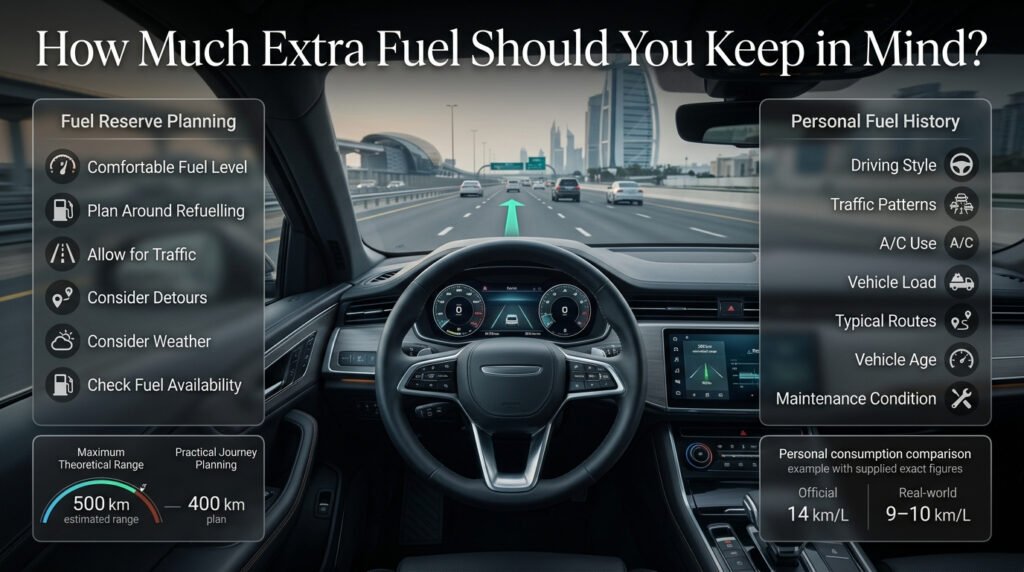
You don’t need to calculate a perfect emergency reserve.
The practical goal is to maintain enough fuel that ordinary delays don’t turn into an emergency.
For everyday driving, many drivers find it more convenient to refuel when the tank reaches a comfortable level rather than waiting for the warning.
For long journeys, plan around refuelling locations rather than the maximum theoretical range.
For example:
If your estimated range is 500 km, don’t plan a 495 km journey without considering traffic, weather, detours, and fuel availability.
A 400 km plan gives you much more flexibility.
Why Your Own Fuel Consumption History Matters
Your vehicle’s official fuel-economy figure is useful for comparison, but your actual driving conditions are more important for emergency calculations.
Suppose your car’s official figure suggests 14 km/L.
But your real-world Dubai driving normally produces 9–10 km/L.
When estimating emergency range, the 9–10 km/L figure is more relevant.
Your own historical data can account for:
- Your driving style
- Traffic patterns
- A/C use
- Vehicle load
- Your typical routes
- Your vehicle’s age
- Maintenance condition
This makes your personal fuel history a valuable reference.
How Can You Improve Fuel Economy Before Low-Fuel Situations Happen?
Low-fuel emergencies are easier to prevent when the vehicle is driven efficiently every day.
Useful habits include:
- Smooth acceleration
- Sensible speed
- Correct tyre pressure
- Avoiding unnecessary idling
- Removing unnecessary weight
- Planning long journeys
- Avoiding unnecessary stop-and-go routes
- Maintaining the vehicle properly
You can also explore How to Reduce Fuel Use in Traffic for practical urban-driving strategies.
The goal isn’t simply to save money on fuel.
Better fuel economy also gives you more flexibility when unexpected delays occur.
What About Automatic Transmission?
Automatic vehicles manage gear selection differently from manual vehicles, but the same basic principles apply.
Smooth acceleration and avoiding unnecessary aggressive driving can help maintain reasonable efficiency.
If you’re interested in how transmission behaviour affects fuel consumption, understanding Fuel-Efficient Use of Automatic Transmission can help you build better driving habits.
Again, these habits aren’t emergency solutions.
They are preventive habits that make low-fuel situations less likely.
How Can Long-Distance Drivers Avoid Low-Fuel Problems?
Long-distance driving requires more planning than short city trips.
Before leaving:
- Check your fuel level.
- Consider the total journey distance.
- Identify refuelling opportunities.
- Consider expected traffic.
- Avoid assuming your maximum theoretical range.
- Keep enough reserve for unexpected delays.
A driver who plans fuel stops doesn’t need to depend heavily on the low-fuel warning.
This is especially important when travelling through unfamiliar areas.
What If the Low-Fuel Light Comes On During a Long Trip?
Don’t panic.
First, identify your current location and the nearest realistic refuelling option.
Then compare the distance with your conservative range estimate.
If you have a comfortable margin, continue normally while driving efficiently.
If the margin is small, refuel at the earliest practical opportunity.
If you don’t believe you can reach fuel safely, arrange assistance.
The worst option is usually doing nothing and hoping the warning light remains on for another hour.
How Far Can a Car Drive After the Low Fuel Light Comes On?
There isn’t a fixed distance that every car can travel after the low fuel light appears. In many vehicles, the warning comes on while there is still some fuel left in the tank, but the amount varies by make, model, tank design, and manufacturer settings. Your actual remaining range also depends on fuel economy, traffic, speed, air conditioning, road conditions, and driving habits.
A car that normally achieves 12 km/L may travel considerably farther on its reserve than a vehicle getting 7–8 km/L. That’s why a general rule such as “you always have 50 km left” shouldn’t be relied upon.
Important points:
The low-fuel light is a warning, not a kilometre countdown.
Reserve fuel differs between vehicles.
Heavy traffic can reduce the available range.
Use your own vehicle’s fuel history when estimating distance.
Refuel as soon as a practical opportunity is available.
How Many Kilometres Can You Drive When the Fuel Gauge Is on Empty?
A fuel gauge reaching “E” doesn’t necessarily mean the engine will stop immediately, but it should never be treated as a guaranteed extra-distance allowance. The gauge is designed to show an approximate fuel level, and the actual amount remaining can vary because of the fuel tank’s shape, sensor position, and vehicle calibration.
Trying to discover how many kilometres your car can travel after reaching empty is risky because the remaining fuel may be very limited. Traffic, inclines, acceleration, and other conditions can make the engine run out sooner than expected.
What you should do:
Treat “E” as a serious refuelling warning.
Don’t deliberately test the vehicle’s maximum reserve.
Avoid unnecessary detours and aggressive acceleration.
Head toward the nearest practical refuelling point.
If reaching fuel isn’t realistic, arrange roadside assistance before the vehicle stops.
Can You Trust the Distance-to-Empty (DTE) Display When Fuel Is Low?
The distance-to-empty display is useful for estimating how far you might travel, but it shouldn’t be treated as an exact guarantee. Your vehicle calculates DTE partly from recent fuel consumption, so the displayed number can change when your driving conditions change.
For example, if your car shows 50 km of remaining range after mostly efficient highway driving, entering heavy Dubai traffic may cause the estimated range to fall much faster. The car is responding to the fact that its current fuel consumption is different from the conditions used for the earlier calculation.
Use DTE as a guide by checking:
Your current fuel gauge position.
Recent average fuel consumption.
Current traffic conditions.
Distance to the nearest petrol station.
Whether your remaining range leaves a reasonable safety margin.
The safest approach is to use DTE as one piece of information, rather than making your entire decision from that single number.
Does Heavy Traffic Reduce How Far a Car Can Drive on Low Fuel?
Heavy traffic can significantly reduce the distance you get from a small amount of remaining fuel. Stop-and-go driving requires repeated acceleration and braking, while the engine may continue consuming fuel when the vehicle is stationary or moving very slowly.
This is particularly important in Dubai, where a journey that normally takes place on an open road can suddenly turn into a congested urban drive. If you calculated your remaining range using your car’s highway fuel economy, that estimate may be too optimistic once you’re stuck in traffic.
When fuel is already low:
Avoid unnecessary acceleration.
Maintain a smooth driving pattern.
Don’t make unnecessary detours.
Monitor how quickly your DTE is decreasing.
Choose a nearby refuelling option instead of waiting for the reserve to become critical.
The key is to calculate your range based on current driving conditions, not your best-ever fuel economy.
What Should You Do If Your Car Runs Out of Fuel Before Reaching a Petrol Station?
If your car actually runs out of fuel, the priority changes from saving fuel to managing a roadside safety situation. If the vehicle is still moving, try to reach a safe position away from active traffic where possible. Once stopped, activate the hazard warning lights and avoid walking along a busy road or highway to search for fuel.
If you’re in Dubai and can’t reach a petrol station, roadside fuel delivery can be a practical solution when the vehicle is in an accessible and safe location. When requesting assistance, give the correct fuel type and provide useful location information so the provider can find you efficiently.
Have these details ready:
Vehicle make and model.
Petrol or diesel requirement.
Exact location or live location.
Direction of travel if you’re on a major road.
Nearest exit or landmark.
Roadside, parking, or shoulder position.
Any visible signs that can help identify the location.
If you’re on a highway, don’t put yourself in additional danger by walking along the road. Focus on staying in a safe position and getting appropriate assistance.
Conclusion
Understanding how far a car can drive on low fuel is useful, but there is no single kilometre figure that applies to every vehicle. The remaining range depends on your car’s fuel capacity, fuel economy, driving speed, traffic, road conditions, air conditioning, vehicle load, and how accurately the fuel gauge or distance-to-empty display is working.
The most important rule is not to treat the low-fuel warning or “0 km” range as a guaranteed amount of driving distance. Once the warning appears, your priority should be finding a safe place to refuel rather than trying to calculate exactly how many kilometres remain.
For Dubai drivers, traffic congestion, long highway routes, high temperatures, and frequent stop-and-go driving can make remaining fuel range less predictable. If your fuel level is critically low, reduce unnecessary driving and avoid taking risks simply to reach a petrol station.
If the vehicle eventually runs out of fuel, move to a safe location when possible, switch on your hazard lights, avoid standing near moving traffic, and arrange appropriate roadside assistance or emergency fuel delivery. Planning ahead and refuelling before the tank becomes critically low is always safer than relying on the last few kilometres of available range.
Leave a Reply