Introduction
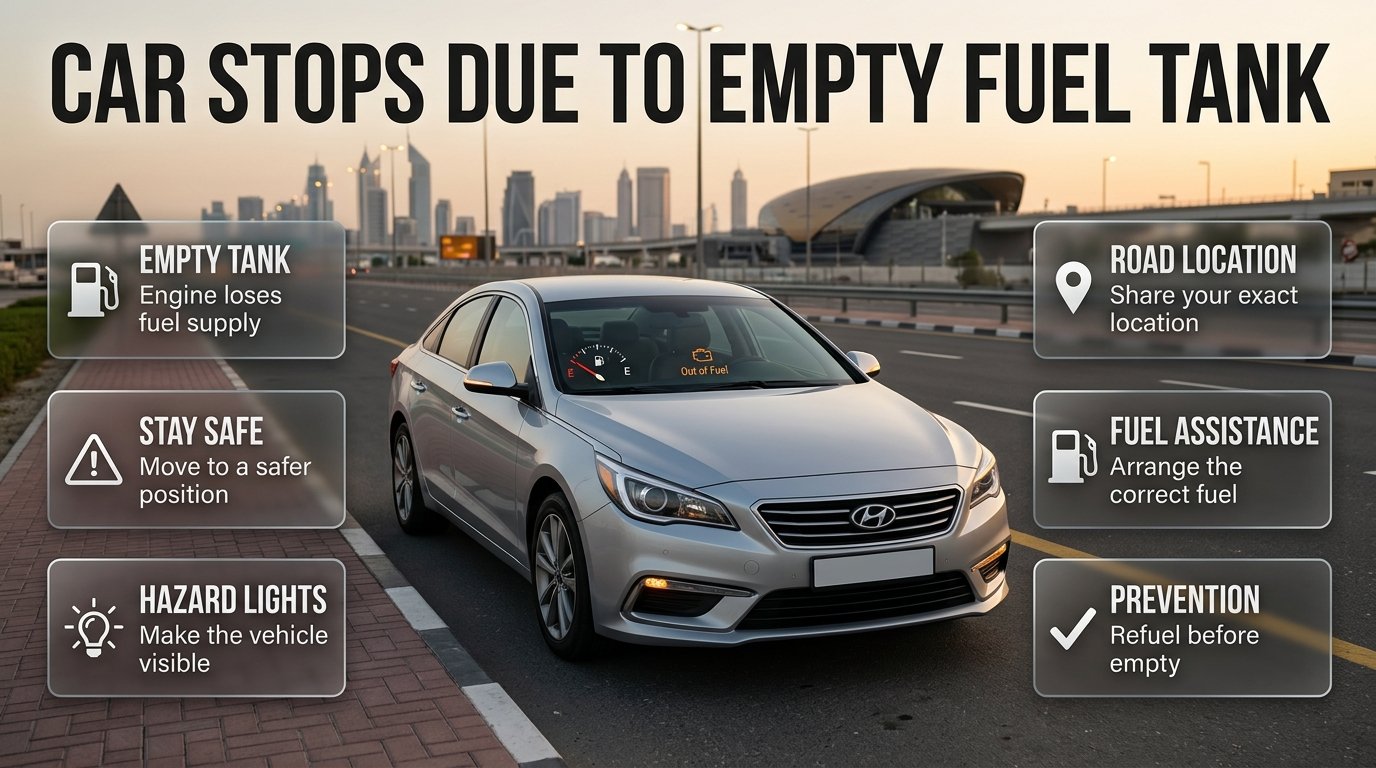
Car Stops Due to Empty Fuel Tank | You’re driving through Dubai, everything seems normal, and then the engine suddenly starts losing power. You press the accelerator, but the car doesn’t respond properly. A few seconds later, the engine stops completely.
You look at the dashboard and see the fuel gauge sitting at empty.
A car stops due to an empty fuel tank because the engine can no longer receive enough fuel to continue combustion. Although running out of fuel is usually preventable, it can become a stressful roadside emergency when it happens in heavy traffic, on a highway, or far from a convenient petrol station.
The important thing is not to panic. An empty fuel tank doesn’t automatically mean that your engine has suffered major damage. The immediate priorities are to make the vehicle as safe and visible as possible, avoid dangerous roadside behavior, and arrange the correct fuel or roadside assistance.
In this guide, you’ll learn what happens when a vehicle runs out of fuel, how to recognize fuel starvation, what to do immediately, what mistakes to avoid, how to deal with the situation on Dubai roads and highways, and how to prevent an empty-tank emergency in the future.
For drivers looking for broader information about mobile fuel assistance and fuel-related roadside emergencies, Fuel Delivery Dubai provides a useful starting point.
What Happens When a Car Stops Due to an Empty Fuel Tank?
When the fuel tank becomes empty, the engine eventually stops because there isn’t enough fuel available for combustion. A modern petrol engine needs a continuous supply of fuel, air, and an ignition source to produce power.
The fuel pump normally draws fuel from the tank and sends it through the vehicle’s fuel system toward the engine. The engine management system controls how much fuel is injected and when combustion occurs.
When usable fuel runs out, that process cannot continue.
In simple terms:
Fuel level becomes very low
          ↓
Fuel warning appears
          ↓
Usable fuel becomes exhausted
          ↓
Fuel delivery becomes insufficient
          ↓
Engine loses power
          ↓
Vehicle slows down
          ↓
Engine stops
Some cars give several warnings before stopping. You might notice weak acceleration, hesitation, surging, or brief loss of power. Other vehicles may appear to stop more suddenly.
The exact behavior depends on the vehicle, fuel-system design, road conditions, and how much fuel was actually available.
Why does the engine need continuous fuel?
Combustion requires the correct mixture of fuel and air. If the fuel supply stops, the engine can’t continue producing the energy required to keep itself running.
That’s why adding the correct fuel can often resolve a genuine empty-tank situation.
However, if the vehicle still doesn’t start after appropriate refueling, you shouldn’t automatically assume that more fuel is the answer. Another fuel-system, electrical, or mechanical problem may be involved.
How Can You Tell If Your Car Stopped Because It Ran Out of Fuel?
A stopped engine doesn’t always mean an empty tank. Cars can stall because of battery problems, alternator issues, overheating, fuel-system faults, electrical problems, or mechanical failures.
However, several clues can point toward fuel starvation.
Common signs include:
- The fuel warning light was already on.
- The fuel gauge was near empty.
- The dashboard showed a very low remaining range.
- The engine hesitated before stopping.
- Acceleration became weaker.
- The engine began surging or losing power.
- The vehicle stopped without obvious mechanical noises.
- The car had been driven considerably farther than usual since its last refueling.
For example, imagine a driver leaves home with a very low fuel level. The dashboard says there are only a few kilometres remaining. Heavy traffic then causes repeated acceleration and braking. After several kilometres, the vehicle begins to hesitate and finally stops.
That is a classic situation where fuel starvation is a strong possibility.
On the other hand, if the fuel gauge shows half a tank and the engine suddenly stops with warning lights, smoke, overheating, or unusual sounds, you should not automatically blame the fuel tank.
Can a Car Drive After the Fuel Gauge Reaches Empty?
Sometimes a vehicle may continue moving for a short distance after the gauge reaches the empty mark, but there is no reliable distance that applies to every vehicle.
Fuel gauges are not precision instruments, and different manufacturers calibrate them differently. The amount of fuel remaining at the “empty” position can vary.
Your vehicle’s actual fuel consumption also changes depending on:
- Traffic
- Speed
- Acceleration
- Vehicle weight
- Tire pressure
- Air conditioning
- Road conditions
- Driving style
- Idling time
This means one driver may have more usable fuel remaining than another even when both dashboards appear to show empty.
⚠ Common Mistake: Never treat the final part of the fuel gauge as guaranteed reserve fuel.
If the dashboard says you’re almost empty, the safest decision is to refuel at the earliest reasonable opportunity.
Why Does a Car Lose Power Before Running Out of Fuel?
Many drivers expect a car to continue running normally until the exact moment the fuel tank becomes completely empty.
In reality, the engine may show symptoms before it stops.
As the usable fuel supply becomes insufficient, the engine may struggle to maintain normal operation. The driver can notice:
- Hesitation
- Surging
- Reduced acceleration
- Rough running
- Engine misfire
- Loss of power
- Stalling
The experience can feel similar to certain mechanical problems.
That’s why the surrounding circumstances matter. If the vehicle was already extremely low on fuel and the symptoms appeared as the fuel level dropped, fuel starvation becomes a reasonable explanation.
If you’d like a broader guide to the immediate response after fuel starvation, see Steps After Running Out of Petrol.
What Should You Do When Your Car Stops Due to an Empty Fuel Tank?
The first rule is simple:
Safety comes before fuel.
Getting fuel is important, but attempting to reach a petrol station in a dangerous way can turn a manageable problem into a serious roadside emergency.
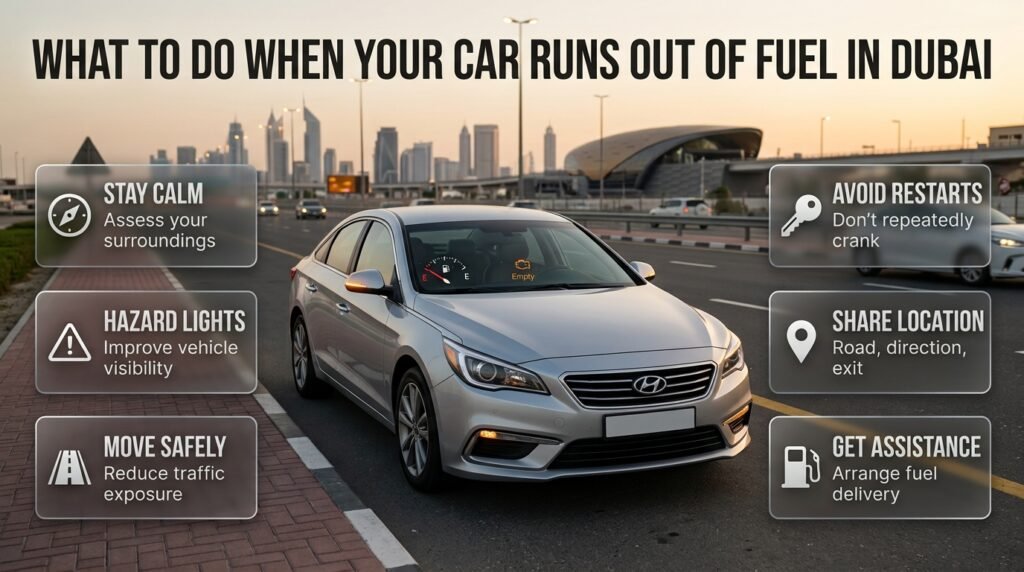
Step 1: Stay calm and assess the location
As soon as the engine stops, don’t panic.
Look around and determine:
- Are you in a live traffic lane?
- Is the vehicle still rolling?
- Can you safely move toward the roadside?
- Are other vehicles approaching quickly?
- Is visibility good?
- Are you on a highway or local road?
- Are you blocking an intersection or entrance?
Your response should depend on the environment.
If the vehicle still has momentum, use that momentum carefully to move toward a safer position if you can do so without creating additional danger.
If the vehicle has completely stopped, switch on the hazard warning lights and focus on visibility and assistance.
Step 2: Turn on your hazard lights
Hazard warning lights help alert approaching drivers that your vehicle is stationary or experiencing a problem.
This is particularly important when your vehicle stops unexpectedly.
Use them when appropriate, especially if:
- You’re near moving traffic.
- Your car is stopped in an unusual location.
- Visibility is poor.
- You’re dealing with a nighttime breakdown.
- Your vehicle cannot be moved immediately.
Don’t assume that other drivers will automatically understand why your car is stopped.
Visibility is one of the first things you should think about.
Step 3: Move the vehicle only if it is safe
If your car still has enough momentum, you may be able to steer it toward a safer location.
Possible safer locations can include:
- A suitable shoulder
- A designated stopping area
- A safe roadside position
- A nearby parking area
- Another location away from moving traffic
But don’t make an aggressive lane change simply to reach a particular spot.
If traffic is heavy, crossing several lanes can be more dangerous than remaining where you are and requesting assistance.
The goal isn’t to move the vehicle as far as possible.
The goal is to reduce your exposure to traffic without creating another hazard.
For additional guidance, read Roadside Breakdown Safety Tips in Dubai.
Step 4: Don’t repeatedly restart an empty car
Once you’ve established that the vehicle has likely run out of fuel, repeatedly turning the ignition isn’t a solution.
If there is no usable fuel reaching the engine, another starting attempt won’t create fuel.
Repeated attempts can also put unnecessary demand on the starter and battery.
Instead:
- Confirm the fuel situation.
- Make the vehicle visible.
- Find a safe position.
- Arrange appropriate assistance.
- Provide your exact location.
If the car has fuel but still won’t start, that’s a different diagnostic situation.
Step 5: Arrange fuel delivery or roadside assistance
Once you’re in a reasonably safe situation, arrange the appropriate service.
When contacting a roadside fuel provider, don’t simply say:
“My car stopped.”
Give useful location information.
For example:
- Road name
- Highway name
- Direction of travel
- Exit number
- Nearby landmark
- Parking area
- Building or business name
- Vehicle make and model
- Petrol or diesel requirement
The more accurately you describe your location, the easier it is for assistance to find you.
For a broader emergency guide, see Emergency Roadside Fuel Advice.
What If Your Car Runs Out of Fuel on a Dubai Highway?
Running out of fuel on a highway requires extra caution because vehicles may be travelling at much higher speeds than on local streets.
The biggest danger isn’t necessarily the empty tank.
It’s the possibility of another vehicle failing to notice your stopped car in time.
If your car stops on a highway:
- Turn on the hazard lights.
- Move to a safer position if you can do so safely.
- Avoid unnecessary movement around the vehicle.
- Don’t walk along the highway looking for fuel.
- Contact appropriate roadside assistance.
- Provide the road name and direction.
- Give your nearest exit or landmark if known.
- Follow applicable road-safety instructions.
Don’t try to walk to a petrol station
A petrol station that looks close on a map may not be safely accessible on foot.
You may need to cross roads, walk beside fast-moving traffic, or travel a considerable distance.
That can create a much greater risk than simply arranging professional assistance.
For more information, see Running Out of Fuel on the Road.
What If Your Car Stops in Heavy Dubai Traffic?
Dubai traffic can change quickly.
A journey that normally takes 20 minutes may take considerably longer when roads become congested. Stop-and-go driving also means frequent acceleration, braking, and idling.
If your fuel level is already very low, unexpected congestion can make the remaining range less predictable.
If the engine stops in traffic:
First, make the vehicle visible
Turn on hazard lights and stay alert to surrounding traffic.
Second, don’t make dangerous lane movements
If you cannot safely move the car, don’t try to force your way through traffic simply because you want to reach the road shoulder.
Third, request assistance
Tell the provider that your vehicle has stopped in active traffic.
This information matters because your situation may be more urgent than a vehicle safely parked in a parking lot.
Fourth, follow local traffic and roadside instructions
Traffic conditions can vary significantly by location.
The safest response is always the one that reduces your exposure to moving vehicles.
If you want additional guidance on what to do during a roadside breakdown, see What to Do During a Roadside Breakdown.
Can Running Out of Fuel Damage Your Car?
Running out of fuel doesn’t automatically mean your engine is damaged.
In many cases, the immediate problem is simply that the engine has no usable fuel to continue operating.
However, repeatedly allowing a vehicle to run completely empty isn’t a good maintenance habit.
Depending on the vehicle, repeated fuel starvation may contribute to fuel-system stress or create starting and priming difficulties after refueling.
The exact consequences vary by vehicle design.
More importantly, an empty tank can leave you stranded in an unsafe location.
That’s why the best strategy is prevention.
Why You Shouldn’t Rely Completely on the Remaining Range Display
Modern vehicles often provide a digital estimate of how far you can travel before the tank becomes empty.
It’s useful.
But it isn’t a guarantee.
The estimate is generally based on recent fuel consumption and other vehicle information. If your driving conditions change, the estimate can change too.
For example:
You have 50 km displayed.
Then traffic becomes extremely congested.
You spend a long period moving slowly and idling.
Your vehicle’s actual consumption changes.
The displayed range may decrease faster than you expected.
This is why experienced drivers don’t plan a journey around the final kilometres of a range estimate.
⭐ Expert Tip: Use the range display as a planning aid, not as permission to delay refueling until the last possible moment.
Why Dubai Traffic Can Make Low Fuel More Difficult to Manage
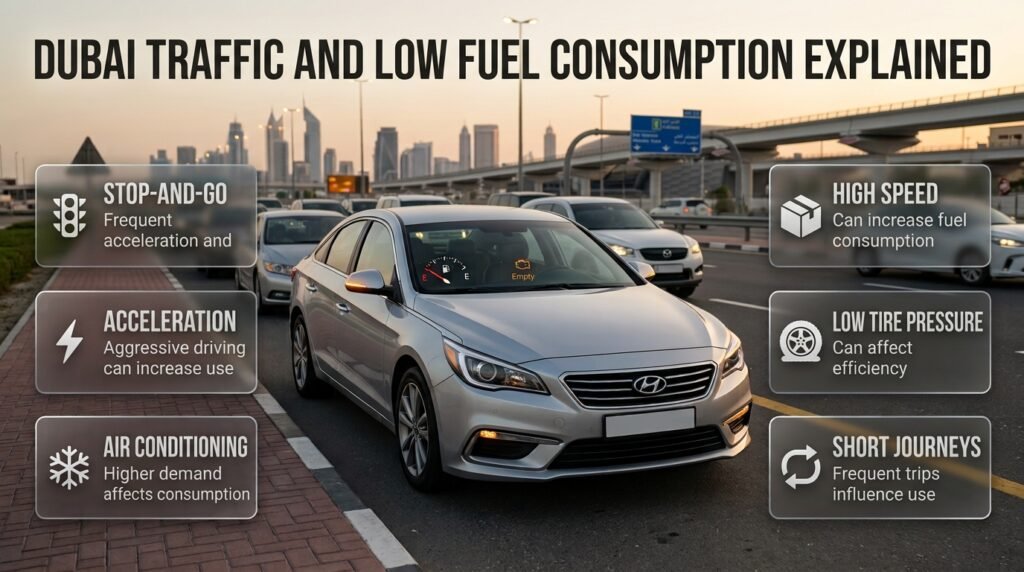
Fuel consumption isn’t constant.
A car travelling smoothly at a steady speed can operate differently from the same vehicle repeatedly accelerating and stopping in congestion.
Factors that can influence consumption include:
- Stop-and-go traffic
- Long periods of idling
- Aggressive acceleration
- High speeds
- Air-conditioning demand
- Heavy loads
- Low tire pressure
- Frequent short journeys
For drivers interested in the relationship between traffic and fuel consumption, How Traffic Affects Fuel Economy in Dubai provides additional information.
Similarly, if your vehicle spends a lot of time stationary with the engine running, understanding Fuel Consumption While Idling can help explain why the fuel gauge may fall even when the car isn’t travelling far.
How Much Fuel Should You Keep in Your Car?
There is no single fuel level that is perfect for every driver.
A better approach is to maintain a reasonable safety margin.
For everyday driving, many motorists find it more practical to refuel before the tank reaches its final portion rather than waiting for the warning light or empty mark.
For longer journeys, increase your margin.
Consider:
- Journey length
- Traffic conditions
- Available petrol stations
- Expected delays
- Highway travel
- Weather
- Vehicle fuel economy
- Your vehicle’s actual range
For example, if you’re starting a long highway journey and the gauge is already near empty, refueling before departure is far more sensible than hoping to find a station at exactly the right time.
What Information Should You Give a Fuel Delivery Service?
Good communication can make roadside assistance much smoother.
When requesting fuel delivery, provide the following:
| Information | Why It Matters |
|---|---|
| Exact location | Helps the team reach you |
| Road name | Identifies the route |
| Direction | Prevents confusion on divided roads |
| Exit number | Helps highway location |
| Landmark | Makes visual identification easier |
| Vehicle model | Helps identify the vehicle |
| Fuel type | Prevents incorrect refueling |
| Current safety situation | Helps assess roadside urgency |
Example
Instead of:
“I’m somewhere on Sheikh Zayed Road.”
Give information such as:
“I’m travelling toward Abu Dhabi, near a known exit or landmark, and the vehicle has stopped because it has run out of petrol.”
The second description is much more useful.
What Happens After Fuel Is Added?
Once the correct fuel has been supplied, the next step depends on the vehicle.
Some cars may restart normally after appropriate fuel is added.
Others may require additional fuel-system priming before normal operation returns.
Don’t assume that immediately turning the key repeatedly is always the correct solution.
If the vehicle doesn’t start:
- Confirm that the correct fuel was supplied.
- Don’t repeatedly crank the engine for long periods.
- Check for obvious dashboard warnings.
- Contact professional roadside assistance if necessary.
- Have the vehicle inspected if the problem continues.
If the vehicle starts normally, drive cautiously at first and monitor the dashboard.
If you only received a small emergency amount of fuel, make your next suitable refueling stop a priority.
What If the Car Still Doesn’t Start After Refueling?
This is an important distinction.
If the car ran out of fuel and still refuses to start after the correct fuel has been added, several possibilities exist.
The vehicle may require additional priming, or the original assumption may have been wrong.
Potential causes can include:
- Weak battery
- Fuel pump problem
- Fuel-system issue
- Electrical fault
- Immobilizer issue
- Starter problem
- Mechanical fault
- Incorrect fuel
Don’t keep trying indefinitely.
If you’re uncertain, professional diagnosis is safer than repeatedly experimenting beside a road.
For more comprehensive vehicle breakdown precautions, read Staying Safe During a Car Breakdown.
Empty Fuel Tank vs Mechanical Breakdown
A car that stops isn’t necessarily out of fuel.
Use the following comparison only as a basic guide:
| Situation | Empty Fuel Tank | Mechanical/Electrical Problem |
|---|---|---|
| Fuel gauge near empty | Common | Possible |
| Low-fuel warning active | Common | Unrelated |
| Engine hesitation | Possible | Possible |
| Sudden loss of power | Possible | Possible |
| Smoke | Usually not | Possible |
| Overheating | Usually not | Possible |
| Strange mechanical noise | Usually not | Possible |
| Correct fuel restores operation | Often | Usually not |
| Vehicle still won’t start after fuel | Possible | Possible |
The key is context.
If the tank was genuinely empty, adding the correct fuel may solve the problem.
If there were other warning signs, the vehicle should be professionally checked.
Common Mistakes Drivers Make When Their Car Runs Out of Fuel
Running out of fuel is frustrating enough. The wrong response can make it much worse.
Mistake 1: Walking along a busy road for fuel
Drivers sometimes think a petrol station is only a few hundred metres away.
The problem is that distance doesn’t tell you whether the route is safe to walk.
Better approach
Arrange suitable roadside assistance rather than exposing yourself to traffic.
Mistake 2: Repeatedly starting the engine
If the tank is empty, the engine cannot manufacture fuel.
Better approach
Stop unnecessary starting attempts and focus on getting the correct fuel.
Mistake 3: Ignoring hazard lights
Other drivers may not understand why you’re stationary.
Better approach
Make your vehicle visible and follow appropriate roadside safety procedures.
Mistake 4: Giving an unclear location
“Near Dubai” isn’t enough.
Better approach
Provide the road, direction, exit, landmark, and other useful location information.
Mistake 5: Guessing the fuel type
Petrol and diesel aren’t interchangeable.
Better approach
Confirm the vehicle’s required fuel before adding anything.
Mistake 6: Trying to push the vehicle in dangerous traffic
A driver may think pushing the car is faster than waiting for assistance.
Better approach
Never turn a fuel problem into a traffic accident. If the location isn’t safe, professional assistance is the better option.
For a broader look at emergency precautions, see Roadside Vehicle Emergency Precautions.
How Can You Prevent Your Car From Running Out of Fuel?
The easiest empty-tank emergency to handle is the one that never happens.
Create a personal refueling rule
Instead of relying on the empty mark, create a simple habit.
For example:
“When my fuel reaches roughly one-quarter, I’ll refuel.”
The exact point isn’t universal.
The purpose is to maintain a buffer.
That buffer gives you additional flexibility if:
- Traffic becomes heavy.
- You miss an exit.
- A station is unavailable.
- You take an unexpected detour.
- You have to make an additional journey.
- The trip takes longer than planned.
Check fuel before long trips
Before a highway journey, ask yourself:
Fuel checklist
- Is the fuel level adequate?
- Do I know the route?
- Where are convenient refueling points?
- Could traffic significantly delay me?
- Am I relying too heavily on the range display?
- Is my phone charged?
- Do I know how to request roadside assistance?
A two-minute check before leaving can prevent a much longer roadside delay.
How Driving Habits Affect the Risk of Running Out of Fuel
Fuel management isn’t only about the tank.
Your driving style influences how quickly the fuel is consumed.
Aggressive acceleration
Hard acceleration demands more fuel than smooth, controlled acceleration.
If your vehicle is already running low, aggressive driving can reduce the remaining range faster than expected.
Heavy braking and acceleration
Repeatedly accelerating and braking wastes energy.
This is particularly relevant in congested traffic.
Excessive idling
The engine can consume fuel while the vehicle is stationary.
That matters during long waits.
High-speed driving
Higher speeds can increase fuel consumption because aerodynamic resistance rises significantly as speed increases.
Drivers planning longer journeys should therefore think about both their fuel level and their driving conditions.
What Should You Do Before a Long Dubai Road Trip?
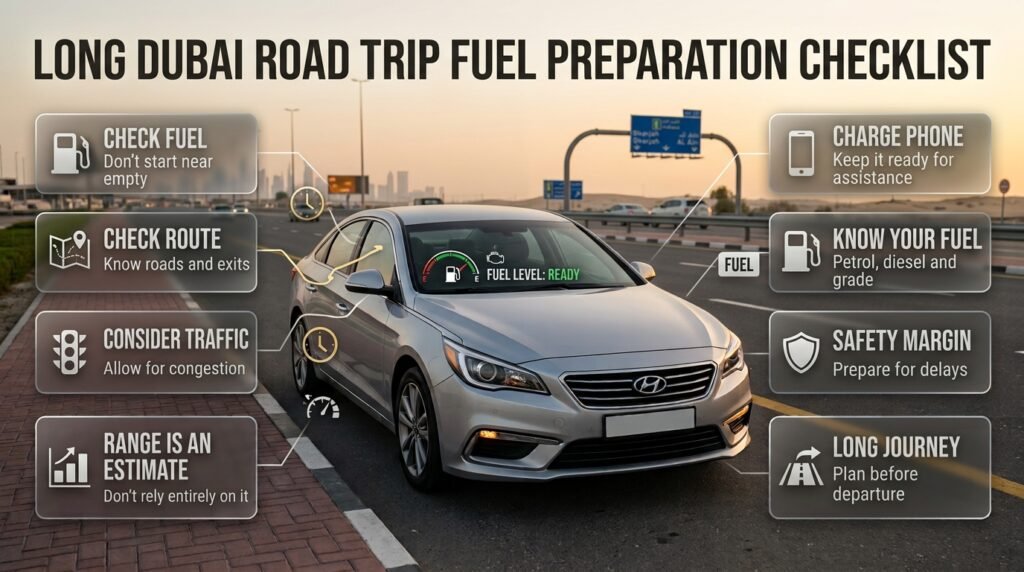
A little preparation goes a long way.
Before leaving:
1. Check the fuel level
Don’t start a long journey with the gauge already near empty.
2. Check the route
Know the major roads, exits, and destinations.
3. Consider traffic
A route that looks short by distance may take much longer during congestion.
4. Don’t rely entirely on range
Treat the displayed range as an estimate.
5. Keep your phone charged
You may need it for navigation or roadside assistance.
6. Know your vehicle
Understand whether your vehicle uses petrol or diesel and what fuel grade it requires.
7. Leave a safety margin
Unexpected delays happen.
What If You Run Out of Fuel in a Parking Area?
A parking area is usually a less stressful situation than a highway, but the same basic principles apply.
Switch on hazard lights if appropriate and assess your surroundings.
If the vehicle is safely parked away from moving traffic, you have more flexibility.
You can then arrange fuel assistance without dealing with fast-moving vehicles.
Still, make sure you provide an accurate location.
For example:
- Parking level
- Building name
- Entrance
- Nearby shop
- Street
- District
- Landmark
The better the location information, the easier it is for assistance to find you.
What If the Vehicle Runs Out of Fuel at Night?
Nighttime breakdowns require additional attention to visibility.
Make sure your vehicle is as visible as possible.
Use hazard warning lights and avoid unnecessary movement around the car.
Don’t assume that because you can see approaching vehicles, their drivers can clearly see you.
At night, judging distance and speed can be more difficult.
For this reason, staying in a safe position and requesting assistance is generally preferable to walking around unfamiliar roads looking for fuel.
What If You Are Traveling With Passengers?
Passenger safety matters too.
If your vehicle stops because of an empty tank, avoid letting passengers wander around the roadside.
Children in particular should not be allowed to move around near active traffic.
Keep everyone organized and focus on obtaining assistance.
If the vehicle is in an unsafe location, follow appropriate local emergency and traffic instructions.
Expert Advice: How Professionals Approach an Empty-Tank Emergency
An experienced roadside response generally starts with the location, not the fuel.
Why?
Because the same empty tank can represent very different levels of risk.
A car parked safely in a parking lot is one thing.
A vehicle stopped in a live highway lane is another.
Professional priorities are usually:
- Assess the location.
- Reduce exposure to traffic.
- Make the vehicle visible.
- Confirm the fuel requirement.
- Identify the exact location.
- Arrange the appropriate response.
- Refuel safely.
- Check whether the vehicle restarts normally.
- Investigate further if it doesn’t.
This sequence is more sensible than immediately focusing only on how to get petrol.
When Should You Treat the Situation as More Than an Empty Fuel Problem?
Don’t assume an empty tank explains every symptom.
Seek professional help if you notice:
- Smoke
- Strong unusual smells
- Engine overheating
- Major fluid leaks
- Loud mechanical noises
- Electrical failure
- Warning lights that remain after refueling
- Vehicle refusing to start after appropriate refueling
- Repeated stalling despite having fuel
These signs may indicate a problem unrelated to the fuel level.
The correct response is diagnosis rather than simply adding more fuel.
A Simple Decision Guide for Drivers
Use this quick guide when your car stops unexpectedly.
Car loses power
      ↓
Check fuel level
      ↓
Was fuel already very low?
      ↓
   YES ↓
Could it be fuel starvation?
      ↓
Move safely if possible
      ↓
Hazard lights
      ↓
Arrange assistance
      ↓
Add correct fuel
      ↓
Does the car restart?
   ↙          ↘
 YES           NO
 ↓             ↓
Drive         Professional
carefully     diagnosis
If the fuel wasn’t low, don’t automatically assume that an empty tank caused the problem.
What to Do After Your Car Has Been Refueled
Once you’re back on the road, don’t simply forget about the incident.
Ask yourself why it happened.
Was it because:
- You forgot to refuel?
- Traffic was much heavier than expected?
- You underestimated consumption?
- Your range display was misleading?
- You delayed refueling too long?
- The vehicle is consuming more fuel than it normally should?
If your fuel economy has changed significantly, investigate the cause.
A sudden increase in consumption can sometimes indicate maintenance issues rather than simply “bad luck.”
Related Roadside Safety Resources
If you’re building a complete understanding of fuel emergencies and roadside breakdowns, the following guides cover different parts of the problem:
- Emergency Roadside Fuel Advice — useful for understanding the immediate response to a fuel emergency.
- What to Do When You Run Out of Fuel in Dubai — focuses specifically on running out of fuel in Dubai.
- Car Ran Out of Fuel Safety in Dubai — covers safety considerations after fuel starvation.
- Safely Dealing With an Empty Fuel Tank in Dubai — provides additional empty-tank safety guidance.
- Running Out of Fuel on the Road — useful for drivers dealing with fuel loss away from a safe parking location.
- Roadside Breakdown Safety Tips in Dubai — focuses on general roadside safety.
- What to Do During a Roadside Breakdown — explains the broader breakdown response.
- Staying Safe During a Car Breakdown — covers staying safe while waiting for assistance.
- Vehicle Breakdown Safety Procedures — useful for understanding a structured breakdown response.
- Roadside Vehicle Emergency Precautions — covers additional precautions during roadside emergencies.
These links work best as supporting resources rather than being treated as a block of promotional links. Each addresses a different aspect of the same broader roadside-safety topic.
What should I do if my car stops because of an empty fuel tank?
When your car stops because it has completely run out of fuel, your first priority should be getting yourself and the vehicle into the safest practical position, not immediately finding a petrol station. If the car is still moving, use the remaining momentum to move away from active traffic only when it is safe to do so. Once stopped, use the hazard lights and arrange appropriate roadside fuel assistance rather than walking beside a busy road or attempting risky maneuvers.
If you’re on a busy Dubai road or highway, your exact location matters. Tell the assistance provider the road name, direction of travel, nearest exit, landmark, and vehicle details. This can make the response much easier.
Important points:
Move away from moving traffic only if you can do it safely.
Switch on hazard warning lights.
Don’t repeatedly restart an engine you know has no fuel.
Don’t walk along a highway looking for a petrol station.
Tell roadside assistance whether the vehicle needs petrol or diesel.
If the car is stopped in an especially dangerous position, prioritize appropriate emergency/roadside assistance.
A fuel emergency is usually manageable when handled calmly. The bigger risk is making a dangerous decision simply because you want to get fuel quickly.
Can a car restart after running completely out of fuel?
A car can often restart after the correct fuel has been added, but it may not always start immediately on the first attempt. When the tank runs dry, the fuel system may no longer have a continuous supply of fuel, so after refueling the system may need to restore normal fuel pressure before the engine can run properly.
This is why a driver shouldn’t panic if the engine doesn’t immediately fire after adding fuel. The correct starting procedure depends on the vehicle, and diesel vehicles can require different procedures from petrol vehicles.
The important thing is to avoid excessive cranking. If the engine still refuses to start after the correct fuel has been added and the appropriate starting procedure has been followed, there may be another problem that needs professional attention.
After adding fuel:
Confirm that the correct fuel type was added.
Allow the fuel system to restore its normal supply.
Follow the vehicle manufacturer’s starting procedure.
Avoid continuously holding the starter for long periods.
Watch the dashboard for warning lights.
If the engine still won’t start, arrange professional roadside assistance.
Professional tip: Don’t assume that adding more fuel will automatically fix a no-start condition. If the car had other symptoms before it stopped—such as overheating, unusual noises, electrical problems, or warning lights—the empty tank may not have been the real cause.
Does running a car completely out of fuel damage the engine or fuel pump?
Running completely out of fuel doesn’t automatically mean that the engine is damaged, but repeatedly driving until the tank is completely dry is not a good habit. The potential concern is mainly the fuel-delivery system. In many vehicles, the fuel pump operates inside the tank and relies on the surrounding fuel for cooling and lubrication; operating with little or no fuel can increase stress on the pump.
There is also another practical issue: once a vehicle repeatedly operates at extremely low fuel levels, the fuel system can become more vulnerable to problems associated with fuel starvation. However, you shouldn’t assume that one empty-tank incident has automatically damaged a component.
What matters is what happens afterward.
Things to watch for after running out of fuel:
Engine struggles to restart.
Engine starts but immediately stalls.
Unusual fuel-pump noise.
Repeated hesitation after refueling.
Engine warning light remains illuminated.
Vehicle loses power again despite having sufficient fuel.
The car refuses to stay running.
If the vehicle starts normally after refueling and continues to operate normally, there may be no obvious immediate problem. But if unusual symptoms remain, a professional inspection is sensible.
Best practice: Don’t make “driving until the warning light has been on for ages” part of your normal driving routine. Keeping a reasonable fuel reserve reduces both the chance of getting stranded and unnecessary stress on the fuel-delivery system.
How far can you drive after the fuel gauge reaches empty?
There is no reliable distance that applies to every car after the fuel gauge reaches empty. Some vehicles may have a small amount of usable fuel remaining when the gauge reaches “E,” while others may run out relatively soon. Your actual remaining range also changes according to traffic, speed, acceleration, air-conditioning use, vehicle load, road conditions, and driving style.
This is particularly important in Dubai because a short-distance journey can become much longer when traffic suddenly becomes congested. A dashboard range estimate is useful for planning, but it should never be treated as a guaranteed number of kilometres.
For example, if your car displays 30 km remaining and you enter heavy stop-and-go traffic, your actual fuel consumption may be very different from the conditions under which that estimate was calculated.
Don’t use the empty mark as a target. Instead:
Refuel before the gauge reaches empty.
Treat the low-fuel warning as a reminder to refuel.
Don’t depend completely on the remaining-range display.
Allow extra fuel for unexpected traffic and detours.
Refuel before long highway journeys.
Learn your vehicle’s normal fuel-consumption pattern.
Expert advice: The question isn’t really “How many kilometres can I drive after empty?” The better question is “Why would I risk finding out?” There is no benefit in deliberately testing your vehicle’s final fuel reserve, especially when the car could stop in an unsafe location.
How can I prevent my car from stopping because of an empty fuel tank?
The most effective way to prevent an empty-fuel emergency is to stop treating the last part of the fuel gauge as usable reserve. Instead, create a personal refueling habit that leaves enough fuel for unexpected traffic, detours, delays, and changes in driving conditions.
For everyday driving, you might choose to refuel when the tank reaches around one-quarter full. The exact level isn’t universal, but the principle is important: maintain a buffer rather than waiting for the warning light.
This becomes even more important before a long Dubai journey. A route that normally seems easy can take considerably longer during congestion, and fuel consumption can increase with repeated acceleration, braking, idling, and air-conditioning use.
A simple prevention checklist:
Check the fuel level before leaving for a long trip.
Refuel before entering a major highway if the tank is already low.
Don’t rely entirely on the dashboard range estimate.
Consider expected traffic and possible detours.
Pay attention to unusually high fuel consumption.
Keep your phone charged for emergencies.
Know your vehicle’s correct fuel type.
Refuel before the tank reaches its final portion.
If your vehicle has suddenly started using considerably more fuel than normal, don’t simply compensate by filling the tank more frequently. Investigate why consumption has changed. Driving conditions can explain some differences, but persistent changes can also point toward maintenance issues.
The professional approach is simple: good fuel management isn’t about squeezing every last kilometre out of a tank. It’s about maintaining enough reserve that an unexpected traffic jam, missed exit, or delayed journey doesn’t turn into a roadside emergency.
Conclusion
A car stops due to an empty fuel tank is stressful, especially when it happens in heavy Dubai traffic, on a highway, or in an unfamiliar area. The most important thing is not to panic or keep trying to restart the vehicle. Focus first on getting the car and everyone inside it to a safer position, switch on the hazard lights, and arrange reliable roadside fuel assistance.
Running completely out of fuel does not automatically mean that your engine has suffered serious damage, but repeatedly driving until the tank is completely dry is not a good habit. Once the correct fuel is added, the vehicle may need a little time for the fuel system to restore normal supply before it starts again.
The best solution, however, is prevention. Keep an eye on the fuel gauge, take low-fuel warnings seriously, and allow extra fuel for Dubai’s traffic, unexpected delays, detours, and longer journeys. If your vehicle does stop because the tank is empty, knowing the correct roadside safety steps can make the situation much easier to manage.
If you need professional roadside fuel assistance in Dubai, Fuel Delivery Dubai can help you get the fuel you need without having to leave your vehicle and search for a petrol station yourself.
Remember: don’t wait until the last few kilometres of fuel to make a refueling decision. A small amount of planning can prevent a much bigger roadside problem.
Leave a Reply