Introduction
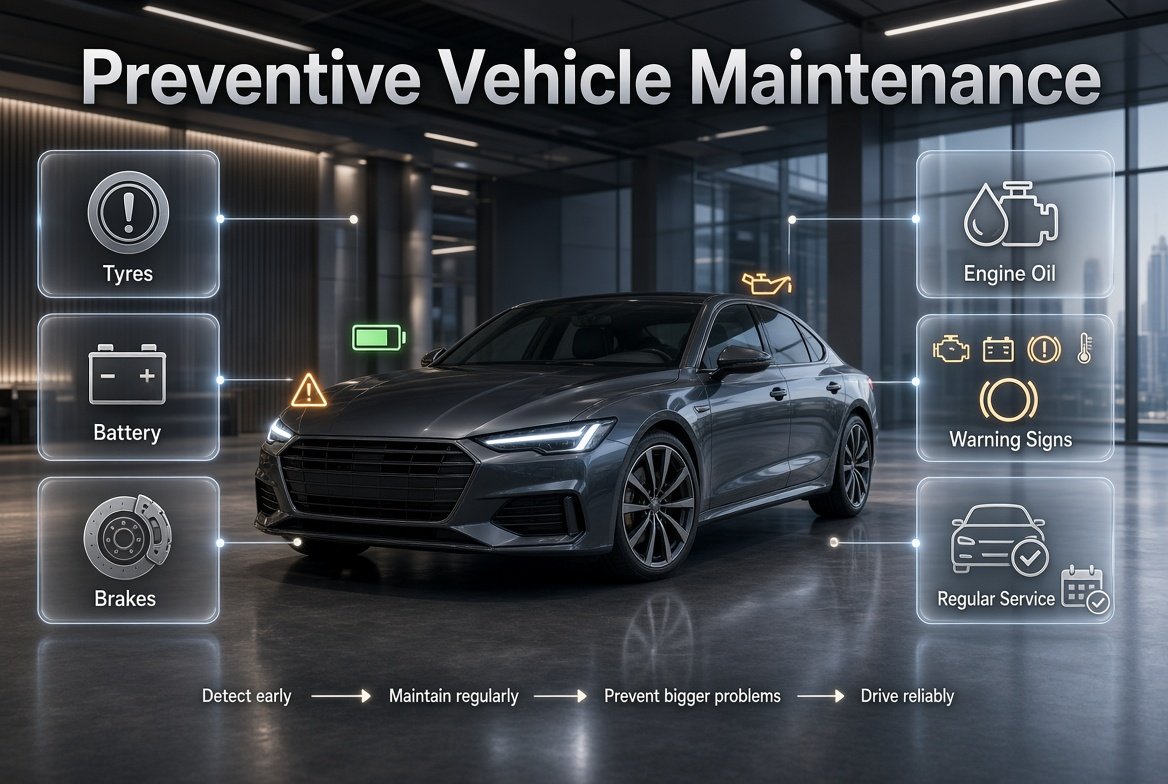
Preventive Vehicle Maintenance | A car rarely becomes unreliable overnight. In many cases, the warning signs appear much earlier: a tyre slowly losing pressure, a battery taking slightly longer to start the engine, a brake making a new sound, an oil level dropping between services, or a dashboard warning that keeps getting ignored.
The problem is that busy drivers often notice these signs but postpone dealing with them. The car still starts, still drives, and seems perfectly usable—until a small maintenance issue becomes a breakdown.
That is exactly why preventive vehicle maintenance is so important. Instead of waiting for a component to fail, preventive maintenance means checking important systems regularly, following the manufacturer’s service schedule, identifying wear early, and dealing with problems before they become more expensive or dangerous.
If you want to understand how a practical maintenance routine works, this guide covers the process from everyday checks to professional servicing. You’ll learn what to inspect, how often to check different components, which warning signs should never be ignored, how maintenance affects fuel efficiency, and what to do when a vehicle problem still occurs despite proper care.
For drivers who also want practical information about fuel emergencies and roadside assistance, Fuel Delivery Dubai provides additional resources for situations where a vehicle needs fuel or roadside support.
What Is Preventive Vehicle Maintenance?
Preventive vehicle maintenance is the regular inspection, servicing, adjustment, and replacement of vehicle components before they fail or create a larger problem. It includes checking tyres, brakes, fluids, battery condition, engine oil, filters, lights, belts, hoses, and other systems according to the vehicle’s requirements.
The basic principle is simple:
Check → Identify wear → Maintain → Replace when necessary → Prevent avoidable failure
Preventive maintenance isn’t about replacing every part as early as possible. It’s about understanding what condition a component is in and taking appropriate action before a minor issue creates a larger problem.
For example, discovering a worn brake component during a scheduled inspection gives you an opportunity to address it before braking performance becomes seriously affected. Similarly, identifying a slow tyre leak early is much easier than discovering it when the tyre has become dangerously underinflated.
Regular maintenance, including oil changes, battery checks and tyre-related care, is widely recognized as an important part of reducing preventable breakdown risks.
Why Is Preventive Vehicle Maintenance Important?
A vehicle is made up of many systems that work together. When one system starts developing a problem, it can sometimes affect other components as well.
Preventive maintenance gives you a chance to catch those problems while they are still manageable.
It Helps Reduce Unexpected Breakdowns
No maintenance plan can guarantee that a vehicle will never break down. Mechanical and electrical components can fail unexpectedly.
However, regular inspections can reduce many avoidable problems.
A technician may discover:
- A weak battery
- Low or contaminated fluids
- A damaged hose
- Worn brake components
- Uneven tyre wear
- A leaking seal
- A loose or damaged belt
- Suspension wear
- An overdue service item
The earlier these issues are identified, the more choices you usually have about when and how to repair them.
It Supports Safer Driving
Some maintenance items are directly related to road safety.
Tyres determine your contact with the road. Brakes determine your ability to slow and stop. Lights help you see and communicate with other road users. Steering and suspension affect how the vehicle responds to road conditions.
That means maintenance isn’t simply about protecting the engine or saving money.
It’s also about keeping the vehicle predictable when you need it most.
It Can Help Control Repair Costs
Preventive maintenance doesn’t mean that every repair will be cheap.
But ignoring a developing problem can allow secondary damage to occur.
A small leak, for example, may be easier to address than an engine problem caused by prolonged overheating or inadequate lubrication.
The objective is not to spend more on maintenance. The objective is to avoid turning manageable maintenance into major repair work.
It Supports Vehicle Longevity
A vehicle’s lifespan depends on many factors, including design, mileage, operating conditions, driving habits and maintenance history.
Keeping fluids at appropriate levels, replacing service items when required, monitoring wear and addressing problems promptly gives important components a better chance of operating as intended.
It Can Support Fuel Efficiency
Maintenance and fuel economy are connected, although maintenance isn’t the only factor affecting fuel consumption.
Tyre pressure, vehicle condition, engine operation, brakes, vehicle load, traffic, speed, air conditioning and driving style can all influence fuel use.
NHTSA notes that proper tyre maintenance affects safety, tyre durability and fuel consumption.
What Does a Complete Preventive Vehicle Maintenance Plan Include?
A good maintenance plan doesn’t focus only on engine oil.
It should cover the systems that affect safety, reliability, performance and everyday usability.
| Vehicle System | What to Monitor | Main Purpose |
|---|---|---|
| Engine | Oil, leaks, unusual sounds | Reliable engine operation |
| Tyres | Pressure, tread, damage | Grip and safe handling |
| Brakes | Pads, discs, fluid, symptoms | Stopping performance |
| Battery | Starting performance and condition | Reliable starting |
| Cooling system | Coolant, leaks, temperature | Engine temperature control |
| Filters | Engine and cabin filters | Airflow and system performance |
| Lights | Headlights, indicators, brake lights | Visibility and communication |
| Suspension | Noise, handling, uneven wear | Stability and comfort |
| Steering | Free play, vibration, pulling | Directional control |
| Fluids | Oil, coolant, brake and other applicable fluids | Proper system operation |
| Belts and hoses | Cracks, wear and leaks | Prevent component failure |
| Emergency equipment | Spare/repair kit and basic supplies | Preparedness during roadside problems |
The exact maintenance requirements vary by vehicle, so the owner’s manual should remain the primary reference for service intervals and specifications.
How Often Should Preventive Vehicle Maintenance Be Done?
There is no single maintenance schedule that applies equally to every car.
A newer petrol car, an older diesel vehicle, a hybrid, an electric vehicle, a heavily used taxi, and a car that sits unused for long periods can have very different maintenance needs.
A useful way to organize maintenance is by frequency.
Daily or Before Driving Checks
You don’t need a workshop inspection every day.
A quick visual and operational check can identify obvious problems.
Look for:
- Warning lights
- Flat-looking tyres
- Fluid leaks
- Unusual smells
- New sounds
- Damaged lights
- Windscreen visibility problems
- Obvious body or tyre damage
If something feels noticeably different from normal, don’t ignore it simply because the vehicle is still moving.
Weekly Checks
Depending on how frequently you drive, a weekly check can include:
- Tyre condition
- General fluid levels
- Fuel level
- Lights
- Windscreen washer supply
- Visible leaks
- Unusual engine sounds
These checks take only a few minutes.
Monthly Checks
A monthly maintenance routine should be more detailed.
Check:
- Tyre pressure
- Tread condition
- Sidewalls
- Battery terminals
- Engine oil according to the manufacturer’s checking procedure
- Coolant level when appropriate
- Brake fluid level
- Wiper blades
- Exterior lights
- Spare tyre or tyre repair equipment
NHTSA recommends checking tyre pressure at least monthly and checking tyres when cold, using the vehicle manufacturer’s recommended pressure rather than the maximum pressure printed on the tyre.
Scheduled Professional Servicing
Professional servicing may include:
- Oil and filter replacement
- Brake inspection
- Fluid inspection
- Battery testing
- Air filter inspection
- Cabin filter replacement
- Suspension inspection
- Steering inspection
- Belt and hose inspection
- Diagnostic scanning
- Manufacturer-specific service items
Follow the service schedule provided for your specific vehicle.
For a practical step-by-step approach to checking your tyres, brakes, fluids, battery, lights, warning signs, steering, suspension, and other important vehicle components, read our complete Regular Vehicle Inspection Guide.
Step-by-Step Preventive Vehicle Maintenance Routine

Step 1: Find Your Manufacturer’s Maintenance Schedule
Start with the owner’s manual.
Don’t assume every vehicle requires the same oil, filter, coolant or service interval.
The manufacturer’s schedule may include both time and mileage requirements.
For example, a service item may be due after a certain number of kilometres or after a particular period, whichever comes first.
Why it matters: Generic advice can be useful for understanding maintenance, but your vehicle’s specifications determine what actually applies to your car.
Common mistake: Copying another driver’s maintenance schedule simply because they own a similar-looking vehicle.
Step 2: Check the Tyres
Tyre maintenance should be one of your highest-priority routine checks.
Inspect:
- Inflation pressure
- Tread
- Sidewalls
- Cuts
- Cracks
- Bulges
- Uneven wear
- Embedded objects
Don’t rely on appearance alone.
A tyre can look normal while its pressure is significantly different from the recommended level.
NHTSA specifically advises using the pressure specified by the vehicle manufacturer, not the number on the tyre sidewall, and checking pressure when the tyres are cold.
Professional advice: If one tyre repeatedly loses pressure, don’t keep inflating it without finding the cause. It could indicate a puncture, valve problem, wheel issue or other fault.
Step 3: Monitor Engine Oil
Engine oil provides lubrication and helps protect internal engine components.
Check the oil according to the manufacturer’s procedure and use the specified oil grade.
Pay attention to:
- Low oil level
- Sudden oil loss
- Visible leaks
- Oil warning lights
- Unusual engine noise
- Overdue oil service
If the oil level repeatedly drops, topping it up may only be treating the symptom.
The cause should be investigated.
Step 4: Inspect Cooling System Components
The cooling system helps keep the engine within its intended operating temperature.
Check for:
- Low coolant
- Visible leaks
- Damaged hoses
- Temperature changes
- Overheating warnings
- Unusual coolant smells
Never casually open a hot cooling system. Hot coolant and steam can cause serious burns.
NHTSA recommends checking coolant levels and specifications and having leaks or cooling-system problems addressed.
Step 5: Check the Battery
A battery can gradually lose performance without giving you much warning.
Possible signs include:
- Slow engine cranking
- Difficulty starting
- Dim electrical systems
- Battery warning indicators
- Corroded terminals
- Repeated jump-start requirements
If the battery is older or the vehicle has shown starting problems, a professional battery and charging-system test can provide more useful information than a visual inspection alone.
Step 6: Inspect Brakes
Brake maintenance is a safety issue, not simply a comfort issue.
Watch for:
- Grinding
- Persistent squealing
- Vibration while braking
- Pulling to one side
- Changes in pedal feel
- Longer stopping distances
- Brake warning lights
During professional servicing, brake pads, discs, calipers and related components can be inspected for wear or damage.
Brake inspection intervals vary by vehicle and use, so manufacturer guidance and actual component condition should determine the schedule.
Step 7: Check Lights and Visibility
Check:
- Headlights
- Brake lights
- Indicators
- Reverse lights
- Hazard lights
- Number-plate lights where applicable
Also check:
- Wiper blades
- Washer fluid
- Windscreen condition
- Mirrors
Visibility problems can become particularly serious at night, during rain, dust or poor weather.
Step 8: Listen for Changes
Experienced drivers often recognize when a vehicle doesn’t sound normal.
A new:
- Clicking
- Grinding
- Squealing
- Whining
- Hissing
- Knocking
- Rattling
shouldn’t automatically be dismissed.
You don’t need to diagnose the problem yourself.
The useful information is simply that the vehicle has changed.
Step 9: Record Everything
Keep a maintenance log.
Record:
- Date
- Mileage
- Service performed
- Parts replaced
- Fluids used
- Inspection findings
- Next service due
This is especially useful when you own an older car or a vehicle with multiple drivers.
A clear service history also makes future troubleshooting easier.
Preventive Tyre Maintenance: What Drivers Commonly Get Wrong
Tyres are often checked only when a driver notices a flat tyre.
That’s too late for preventive maintenance.
A proper tyre routine includes pressure, tread, damage and wear.
Check Pressure When Tyres Are Cold
Pressure changes with temperature and driving.
For a more reliable reading, follow the manufacturer’s recommended checking conditions.
Don’t Use the Sidewall Maximum as Your Normal Target
The maximum pressure printed on a tyre is not necessarily the correct operating pressure for your vehicle.
Use the vehicle manufacturer’s specification.
Look for Uneven Wear
Uneven wear can indicate issues such as incorrect pressure, alignment, balance, suspension condition or other problems.
Don’t simply replace the tyre without investigating the reason for abnormal wear.
Don’t Forget the Spare
A spare tyre is useless if it is flat, damaged, incorrectly stored or missing the required equipment to install it.
NHTSA also recommends checking the spare when checking tyre condition.
Engine Oil, Filters and Fluids
Fluids are often invisible when everything is working properly, which makes them easy to forget.
Engine Oil
Oil should be replaced according to the vehicle manufacturer’s specifications.
Don’t select an oil simply because another car uses it.
Coolant
Use the specified coolant type and follow the manufacturer’s procedures.
Repeated coolant loss should be investigated.
Brake Fluid
Brake fluid is part of the braking system and should be checked and serviced according to manufacturer requirements.
If you notice a sudden fluid-level change or braking problem, professional inspection is appropriate.
Transmission Fluid
Some transmissions require scheduled fluid servicing while others have different maintenance requirements.
Follow the specific vehicle manufacturer’s instructions rather than assuming all automatic transmissions use the same service procedure.
Windscreen Washer Fluid
This is simple but important.
Running out of washer fluid at the wrong time can create an unnecessary visibility problem.
How Preventive Maintenance Affects Fuel Consumption
Fuel economy isn’t determined by one component.
A vehicle’s fuel use can change because of:
- Tyre pressure
- Vehicle load
- Traffic
- Speed
- Acceleration
- Braking
- Idling
- Air conditioning
- Aerodynamics
- Engine condition
- Driving style
That means preventive maintenance should be considered part of a broader fuel-efficiency strategy.
If you want to understand how driving behaviour affects fuel use, resources such as Fuel Saving Driving Tips and Smooth Driving Techniques for Better Fuel Economy can complement a maintenance routine.
The same principle applies to acceleration and braking. Aggressive acceleration can increase fuel demand, while unnecessary braking can force the driver to accelerate again.
For a deeper look, see How Acceleration Affects Fuel Consumption and How Braking Habits Affect Fuel Economy in Dubai.
Preventive Maintenance and Driving Speed
Vehicle maintenance and driving behaviour work together.
Even a well-maintained car can consume more fuel if it is driven aggressively or at speeds that significantly increase aerodynamic resistance.
Understanding the relationship between speed and efficiency can help drivers make better decisions.
For more information, see Optimal Driving Speed for Fuel Efficiency in Dubai.
Similarly, Fuel-Efficient Driving Techniques covers practical driving habits that can support more consistent fuel use.
The goal isn’t to drive unnaturally slowly.
The goal is to avoid unnecessary fuel waste while maintaining safe and appropriate driving behaviour.
Idling, Traffic and Preventive Maintenance
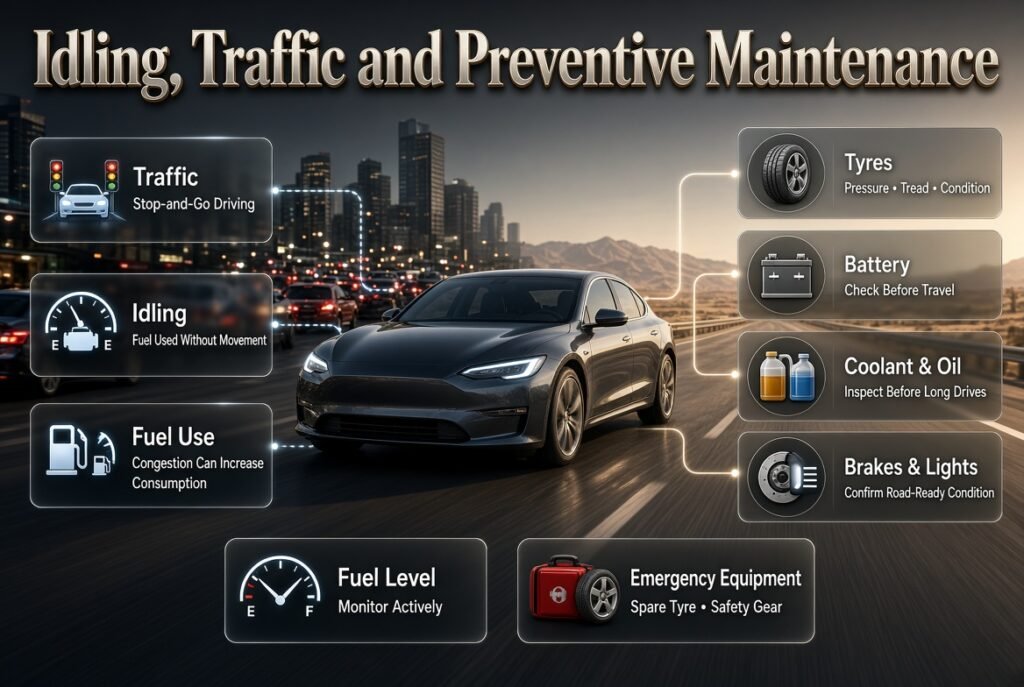
Heavy traffic creates a different set of challenges.
Stop-and-go driving can place additional demands on the vehicle and can increase fuel consumption compared with steady movement.
Unnecessary idling also consumes fuel while producing no useful movement.
If you frequently drive in congested areas, understanding Fuel Consumption While Idling can help put the issue into perspective.
You can also explore:
- Car Idling Fuel Consumption in Dubai
- How Traffic Affects Fuel Economy in Dubai
- Stop-and-Go Driving Fuel Efficiency
- How to Reduce Fuel Use in Traffic
These topics are not replacements for mechanical maintenance. They explain the driving conditions that influence fuel use alongside the vehicle’s mechanical condition.
Highway Driving and Preventive Maintenance
Highway driving can expose problems that may not be obvious during short city trips.
For example, a tyre vibration, cooling problem, steering issue or overheating condition can become much more noticeable during a long continuous drive.
Before a highway journey, pay particular attention to:
- Tyres
- Battery
- Coolant
- Engine oil
- Brakes
- Lights
- Fuel level
- Spare tyre
- Emergency equipment
For fuel-efficiency guidance, Highway Driving Fuel Efficiency and Fuel-Efficient Highway Driving provide additional information.
For longer journeys, Improving Fuel Economy on Long Trips and Long-Distance Driving Fuel Efficiency Tips are also useful resources.
Vehicle Load and Preventive Maintenance
The weight carried by a vehicle affects more than storage space.
Excessive or unnecessary weight can influence:
- Fuel consumption
- Tyre load
- Braking demands
- Suspension load
- Handling
Before a long journey, remove items you don’t actually need.
For more detail, see How Vehicle Weight Affects Fuel Economy and Car Load and Fuel Consumption.
What About Roof Racks and Accessories?
Roof racks, boxes and other external accessories can change airflow around the vehicle.
If they aren’t needed, removing them may be sensible.
You can learn more through Roof Racks and Fuel Economy and Vehicle Accessories and Fuel Economy in Dubai.
Air Conditioning Matters Too
Air conditioning is particularly relevant in hot climates.
It affects vehicle energy use, although the exact impact varies with conditions, vehicle type and operating environment.
See Air Conditioning and Fuel Consumption for more information.
Tyre Pressure, Gears and Vehicle Aerodynamics
Several smaller factors can work together.
Incorrect tyre pressure can increase rolling resistance and affect handling.
Gear selection and transmission behaviour can also affect engine operating conditions.
For automatic vehicles, Fuel-Efficient Use of Automatic Transmission provides additional practical guidance.
For drivers interested in transmission behaviour, Gear Shifting and Fuel Economy explains how shifting patterns relate to fuel consumption.
Aerodynamics also becomes more relevant as speed increases. External drag can affect energy demand, which is why roof accessories and other external modifications can matter.
See Vehicle Drag and Fuel Consumption in Dubai and How Aerodynamics Affects Fuel Efficiency for a deeper explanation.
How Preventive Maintenance Helps Prevent Fuel Emergencies
Preventive vehicle maintenance is usually associated with mechanical components, but practical vehicle preparation also includes fuel awareness.
Running out of fuel isn’t the same as an engine failure, but it can still create a serious roadside situation.
Drivers shouldn’t treat the low-fuel warning as a precise countdown.
Actual remaining range can vary because of:
- Traffic
- Speed
- Air conditioning
- Vehicle load
- Road conditions
- Driving style
- Terrain
- Fuel gauge limitations
If you want to understand this better, see How Far Can a Car Drive on Low Fuel in Dubai?.
It’s also useful to understand Low Fuel Warning Light Meaning in Dubai rather than assuming every vehicle provides exactly the same amount of reserve fuel.
What If Your Car Runs Out of Fuel Despite Good Maintenance?
Preventive maintenance reduces risk, but it cannot eliminate human error or unexpected circumstances.
You might misjudge the distance to a fuel station, encounter unexpected traffic, take a wrong route, or discover that your estimated range is less than expected.
If the vehicle runs out of fuel, move the vehicle to a safe position if possible, activate appropriate hazard warnings, stay away from moving traffic, and seek assistance.
Useful guidance includes Emergency Roadside Fuel Advice, What to Do When Your Car Runs Out of Fuel in Dubai, and Car Ran Out of Fuel Safety in Dubai.
For a more detailed explanation of handling an empty tank, see Safely Dealing With an Empty Fuel Tank in Dubai and Steps After Running Out of Petrol.
If you are already stranded, Running Out of Fuel on the Road explains why roadside safety should come before attempting to solve the fuel problem yourself.
Preventive Maintenance Before a Long Road Trip
A long journey deserves more preparation than an ordinary short drive.
A useful pre-trip inspection includes:
Tyres
Check pressure, tread, sidewalls and visible damage.
Engine Oil
Confirm the level and make sure the vehicle isn’t approaching an overdue service.
Coolant
Check the level when appropriate and look for signs of leakage.
Battery
If starting performance has recently changed, have the battery and charging system checked.
Brakes
Any unusual noise, vibration, pulling or pedal change deserves attention before a long trip.
Lights
Check headlights, brake lights, indicators and other important exterior lights.
Wipers
Make sure the blades clear the windscreen effectively.
Fuel
Plan fuel stops rather than relying on the vehicle’s maximum theoretical range.
Emergency Equipment
Carry essential equipment suitable for the journey.
For a complete preparation approach, read Road Trip Emergency Preparation.
You can also use Vehicle Emergency Checklist for Long Trips to make sure important items aren’t forgotten.
What Should Be in a Vehicle Emergency Kit?
A practical emergency kit doesn’t need to fill your entire boot.
Useful items can include:
- Mobile phone
- Car charger
- Power bank
- Flashlight
- Spare batteries
- First-aid supplies
- Reflective safety equipment
- Warning triangle where appropriate
- Gloves
- Basic tools
- Suitable tyre repair equipment
- Jumper cables
- Drinking water
- Important personal supplies
The purpose is not to perform complex roadside repairs.
The purpose is to help you remain visible, communicate with others, handle simple situations when safe, and wait for professional help.
For more detail, see Essential Roadside Emergency Items in Dubai.
For an easy maintenance routine, use our Routine Car Maintenance Checklist to keep track of the essential checks your vehicle needs for safe and reliable driving.
Common Preventive Maintenance Mistakes Drivers Make
Mistake 1: Waiting for a Warning Light
Not every problem produces a dashboard warning.
A tyre can be damaged without triggering a warning. Brake wear can develop gradually. A small fluid leak may remain unnoticed.
Better approach: Combine dashboard information with regular physical inspection and professional servicing.
Mistake 2: Checking Tyres Only When They Look Flat
Tyres can be significantly underinflated without looking obviously flat.
Better approach: Use a pressure gauge and follow the vehicle manufacturer’s recommended pressure.
Mistake 3: Using the Wrong Fluids
Different engines, transmissions and cooling systems may require specific fluids.
Better approach: Check the owner’s manual or manufacturer specifications before adding or replacing fluids.
Mistake 4: Ignoring Small Leaks
A small leak may appear insignificant.
But repeated fluid loss is a reason to investigate.
Better approach: Identify the source instead of repeatedly topping up the fluid and continuing to drive.
Mistake 5: Servicing Only When the Car Feels Bad
A car can feel normal while scheduled maintenance is overdue.
Better approach: Follow the service schedule even when there are no obvious symptoms.
Mistake 6: Replacing Everything Too Early
Preventive maintenance does not mean replacing every component unnecessarily.
Better approach: Use manufacturer schedules, measured wear, inspection results and professional diagnosis.
Mistake 7: Forgetting the Spare Tyre
A spare that has been sitting untouched for years can still lose pressure or develop age-related problems.
Better approach: Include it in your routine checks.
Mistake 8: Ignoring Vehicle Load
Carrying unnecessary heavy items for months increases the load the vehicle carries every day.
Better approach: Remove items you don’t need, especially before longer journeys.
What Should You Do During a Roadside Breakdown?
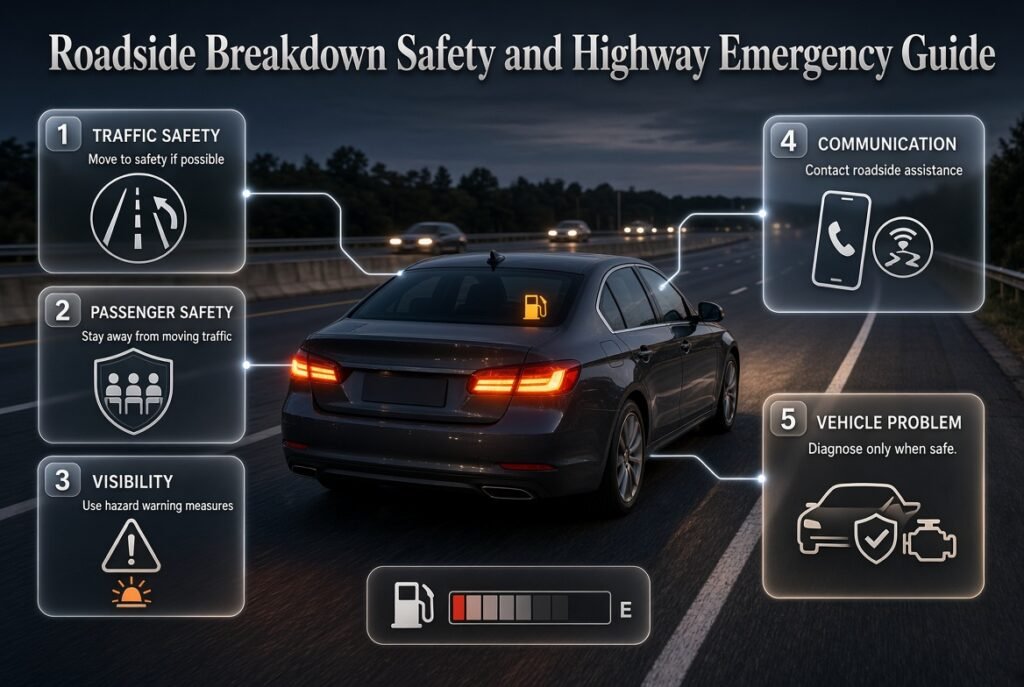
Even a properly maintained vehicle can experience a breakdown.
If it happens, your first priority should not be diagnosing the engine.
Your first priority should be safety.
Use this order:
Traffic safety → Passenger safety → Visibility → Communication → Vehicle problem
Move to a safer location if possible.
Use hazard warning measures appropriately.
Avoid standing unnecessarily close to traffic.
Don’t attempt a roadside repair if the location is unsafe.
For additional guidance, see What to Do During a Roadside Breakdown.
You can also review Staying Safe During a Car Breakdown and Vehicle Breakdown Safety Procedures.
For broader roadside precautions, Roadside Vehicle Emergency Precautions provides another useful reference.
Highway Breakdown Safety Requires Extra Care
A breakdown on a highway can be more dangerous than a problem in a safe parking area because traffic may be moving at higher speeds.
If your vehicle develops a problem on a highway:
- Stay calm.
- Move to a safer position if possible.
- Turn on hazard warning lights.
- Avoid standing in traffic lanes.
- Keep passengers away from moving traffic.
- Contact appropriate roadside assistance.
- Follow instructions from emergency or roadside personnel.
If the problem involves fuel, see Running Out of Fuel on a Highway and Highway Fuel Emergency Safety in Dubai.
For general highway breakdown planning, Highway Breakdown Safety Procedures in Dubai can help you understand the basic safety priorities.
If the vehicle stops specifically because the tank is empty, Car Stops Due to Empty Fuel Tank provides situation-specific information.
Expert Advice: Build a Maintenance Habit, Not a Repair Habit
One of the most practical ways to manage vehicle maintenance is to stop thinking about it as something you do only when the car has a problem.
Instead, create a routine.
A simple system can look like this:
Every drive: Notice warning lights, unusual sounds and obvious tyre issues.
Every few weeks: Check tyres, fluids and visible leaks.
Monthly: Check tyre pressure and condition more carefully.
Before long trips: Perform a complete pre-trip inspection.
At scheduled intervals: Follow the manufacturer’s service requirements.
When something changes: Investigate it rather than waiting for it to become worse.
This approach makes maintenance much easier because you aren’t trying to remember everything at once.
Keep a Simple Maintenance Log
Your maintenance record can be as simple as:
Date → Mileage → Problem/Service → Action Taken → Next Due
For example:
23 September → 72,000 km → Oil service → Oil + filter replaced → Next service according to manufacturer schedule
Over time, this creates a useful history of the vehicle.
Know What You Can Check Yourself
Many drivers can safely handle basic observations:
- Tyre pressure
- Tyre appearance
- Fluid levels where accessible
- Lights
- Wipers
- Warning lights
- Visible leaks
More complex tasks should be left to a qualified technician when they require specialized equipment, lifting the vehicle, opening pressurized systems, or working on safety-critical components.
Preventive Vehicle Maintenance Checklist
Before Regular Driving
- Check for warning lights
- Look at the tyres
- Notice unusual sounds
- Check for visible leaks
- Make sure the windscreen is clear
Monthly
- Check tyre pressure
- Inspect tread
- Inspect sidewalls
- Check accessible fluid levels
- Check lights
- Inspect wipers
- Check battery condition
- Inspect the spare tyre
At Scheduled Service
- Engine oil
- Oil filter
- Air filter
- Cabin filter
- Brakes
- Battery
- Cooling system
- Belts and hoses
- Suspension
- Steering
- Transmission-related service items
- Manufacturer-specific maintenance
Before a Long Trip
- Tyre pressure
- Tyre damage
- Brake condition
- Engine oil
- Coolant
- Battery
- Lights
- Wipers
- Fuel plan
- Spare tyre or repair equipment
- Emergency kit
- Phone and charging equipment
How Often Should You Perform Preventive Vehicle Maintenance?
Preventive vehicle maintenance should be performed continuously rather than as a one-time yearly task. Basic checks such as tyre pressure, fluid levels, warning lights, lights, and visible leaks should be monitored regularly, while professional servicing should follow the vehicle manufacturer’s recommended time and mileage intervals. The correct schedule can vary depending on the vehicle, age, mileage, driving conditions, and how heavily it is used.
A practical maintenance routine should include regular driver checks as well as scheduled professional inspections. If a vehicle is frequently used in heavy traffic, for long-distance driving, or under demanding conditions, it may require closer monitoring than a lightly used vehicle.
Important maintenance points:
Check tyre pressure and condition regularly.
Monitor engine oil and applicable fluid levels.
Pay attention to unusual sounds, vibrations, smells, or warning lights.
Follow the manufacturer’s service schedule.
Have safety-related components such as brakes and steering inspected when required.
Keep a record of completed maintenance and upcoming service requirements.
The key is consistency. Waiting until the vehicle develops an obvious problem turns preventive maintenance into corrective repair.
What Are the Most Important Parts of a Car to Check Regularly?
The most important maintenance areas are the systems that directly affect safety, reliability, and the vehicle’s ability to operate properly. Tyres, brakes, engine oil, cooling system, battery, lights, fluids, belts, hoses, steering, and suspension all deserve regular attention. Not every component needs to be checked at the same frequency, but none should be completely ignored.
Tyres and brakes deserve particular attention because they directly affect your ability to control and stop the vehicle. Engine oil and coolant are important for protecting the engine, while battery condition is essential for reliable starting.
A useful priority list includes:
Tyres: Check pressure, tread, sidewalls, cuts, cracks, and uneven wear.
Brakes: Watch for grinding, unusual squealing, vibration, pulling, or changes in pedal feel.
Engine oil: Monitor the level and follow the correct replacement interval.
Cooling system: Check coolant and investigate leaks or overheating.
Battery: Watch for slow starting, corrosion, or repeated starting problems.
Lights: Make sure headlights, indicators, brake lights, and other important lights work correctly.
Fluids: Check the applicable engine, brake, transmission, steering, coolant, and washer fluids according to the manufacturer’s instructions.
A good maintenance routine isn’t about checking one component repeatedly. It’s about keeping the entire vehicle in a condition where important systems can perform as intended.
Can Preventive Vehicle Maintenance Help Prevent Unexpected Breakdowns?
Preventive maintenance can significantly reduce the risk of many avoidable vehicle problems, but it cannot guarantee that a car will never break down. Components can fail unexpectedly even when a vehicle has been properly serviced. The main benefit of preventive maintenance is that it gives you an opportunity to identify wear, leaks, weak components, and overdue service items before they develop into more serious problems.
For example, a technician may identify a weak battery before it leaves you unable to start the vehicle. A tyre inspection may reveal abnormal wear before the tyre develops a more serious problem. Similarly, detecting a cooling-system leak early can help prevent an overheating situation.
To reduce avoidable breakdown risks:
Don’t ignore new warning lights.
Investigate unusual noises or vibrations.
Repair repeated fluid leaks rather than simply topping up fluids.
Check tyres before long journeys.
Keep the battery condition under observation.
Follow scheduled servicing.
Make sure essential emergency equipment is available.
Plan fuel stops instead of relying on the vehicle’s maximum estimated range.
It’s also important to distinguish between maintenance prevention and emergency preparedness. Good maintenance reduces risk, while an emergency plan helps you respond safely when something unexpected still happens.
Does Preventive Vehicle Maintenance Improve Fuel Economy?
Proper vehicle maintenance can support better fuel efficiency, but maintenance is only one part of the equation. Fuel consumption is also affected by driving style, traffic, vehicle load, tyre pressure, speed, acceleration, braking, air conditioning, road conditions, and the mechanical condition of the vehicle.
For example, incorrect tyre pressure can affect rolling resistance, while unnecessary vehicle weight can increase the energy required to move the car. A vehicle with mechanical problems may also operate less efficiently than intended. Regular maintenance helps ensure that important systems are functioning according to their design.
For better overall fuel efficiency:
Keep tyres at the manufacturer’s recommended pressure.
Remove unnecessary weight from the vehicle.
Follow the recommended engine service schedule.
Address mechanical problems rather than continuing to drive with them.
Avoid unnecessary aggressive acceleration.
Reduce unnecessary idling.
Use smooth and consistent driving techniques.
Plan long journeys and refuelling stops properly.
The important point is that preventive maintenance should not be viewed as a guaranteed fuel-saving trick. Its main purpose is reliability and proper vehicle operation, while efficient driving habits can complement that maintenance.
What Preventive Maintenance Should You Do Before a Long Road Trip?
Before a long road trip, preventive maintenance should focus on the components most likely to affect safety, reliability, and your ability to continue the journey. A vehicle that feels perfectly normal during short trips can still have a tyre, battery, fluid, brake, or cooling-system issue that becomes more noticeable during extended driving.
Start the inspection several days before the trip rather than waiting until the morning of departure. This gives you time to deal with any problem discovered during the check.
Before a long journey, inspect:
Tyre pressure, tread, and sidewalls.
Spare tyre or approved tyre-repair equipment.
Engine oil level and service status.
Coolant level and signs of leakage.
Battery condition and starting performance.
Brake operation and any unusual brake symptoms.
Headlights, brake lights, indicators, and hazard lights.
Windscreen wipers and washer fluid.
Belts, hoses, and visible leaks where appropriate.
Fuel level and planned refuelling points.
Mobile phone, charger, and power bank.
Basic roadside emergency equipment.
Fuel planning is particularly important on longer routes. Don’t calculate your journey around the vehicle’s absolute maximum estimated range. Traffic, speed, air conditioning, vehicle load, driving conditions, and route changes can all affect actual fuel consumption.
A properly prepared vehicle doesn’t guarantee a trouble-free journey, but it gives you a much better chance of identifying problems before you’re far from home or in an inconvenient roadside location.
Conclusion
Preventive vehicle maintenance is one of the simplest ways to keep your car safe, reliable, efficient, and ready for everyday driving. Instead of waiting for a warning light, unusual noise, tyre problem, weak battery, or complete breakdown, regular inspections allow you to identify small issues before they become expensive or inconvenient repairs.
A good maintenance routine should cover the areas that directly affect vehicle safety and reliability, including tyres, brakes, engine oil, fluids, battery, cooling system, lights, and overall vehicle condition. It should also consider how you use your car. Frequent city traffic, long highway journeys, heavy loads, extended idling, aggressive acceleration, and extreme temperatures can all influence maintenance needs and fuel efficiency.
For Dubai drivers, preventive maintenance becomes especially important because daily traffic, high temperatures, long-distance highway driving, and heavy air-conditioning use can place additional demands on a vehicle. Keeping your car properly maintained helps reduce the chances of unexpected problems when you are travelling through busy roads or away from convenient service locations.
The most effective approach is to make vehicle maintenance a routine rather than an emergency response. Follow the manufacturer’s recommended service schedule, check important components regularly, pay attention to changes in your car’s behaviour, and prepare the vehicle properly before long journeys.
Most importantly, maintenance should include emergency preparation as well. Keep essential roadside equipment in the vehicle, know what to do if the car develops a problem, and avoid taking unnecessary risks if you experience a breakdown. If your vehicle ever runs out of fuel, move to a safe position when possible, improve your visibility, and arrange professional roadside assistance rather than walking along a busy road looking for fuel.
A well-maintained vehicle does more than reduce repair costs. It gives you greater confidence behind the wheel, improves day-to-day reliability, supports better fuel efficiency, and helps you respond calmly when unexpected situations occur.
The best time to maintain your vehicle is before a problem happens. A consistent preventive maintenance routine today can help you avoid unnecessary breakdowns, costly repairs, and stressful roadside situations tomorrow.
Leave a Reply