
Introduction
Regular Vehicle Inspection | A car can look perfectly fine from the outside and still have a problem developing underneath. A tyre may be slowly losing pressure, brake components may be wearing down, a battery may be becoming weak, or a fluid leak may have started before you notice any obvious warning.
That’s why regular vehicle inspection is an important part of responsible car ownership. You don’t have to wait for a breakdown, warning light, strange noise, or failed component before checking your vehicle. A simple inspection routine can help you notice changes early and deal with them before they become more complicated.
For drivers in Dubai, keeping a vehicle in good condition is particularly important because daily driving can involve heavy traffic, long highway journeys, high temperatures, frequent air-conditioning use, dusty conditions, and repeated stop-and-go driving. Your vehicle needs to remain dependable in all of these situations.
If you’re looking for broader vehicle-care information, FuelDeliveryDubai.com provides practical guidance for drivers dealing with fuel, roadside situations, and vehicle-related problems.
This guide explains what regular vehicle inspection means, what you should check, how often different checks should be performed, what you can inspect yourself, when professional inspection is necessary, and how to build a simple inspection routine that actually works.
What Is Regular Vehicle Inspection?
Regular vehicle inspection is the process of checking a vehicle’s important safety, mechanical, electrical, and operating components at appropriate intervals to identify damage, wear, leaks, or developing problems.
It can be as simple as checking your tyres and lights before a long journey or as detailed as a professional inspection covering brakes, suspension, steering, fluids, electrical systems, and diagnostic information.
The important point is that inspection isn’t the same thing as repair.
An inspection tells you the condition of the vehicle. Maintenance or repair is what you do when inspection identifies something that needs attention.
A typical inspection can include:
- Tyre pressure and condition
- Brake performance
- Engine oil
- Coolant
- Other vehicle fluids
- Battery condition
- Exterior lights
- Wipers
- Steering
- Suspension
- Belts and hoses
- Warning lights
- Visible leaks
- Unusual sounds
- Unusual smells
- Vehicle performance
The exact inspection requirements depend on the vehicle, its age, mileage, condition, manufacturer recommendations, and how it is being used.
Why Is Regular Vehicle Inspection Important?
The biggest reason for regular inspection is simple: many vehicle problems develop gradually rather than appearing all at once.
A driver may not immediately notice that a tyre is wearing unevenly. A battery may still start the engine today even though its performance has deteriorated. Brake pads can gradually wear while the driver adapts to the changing pedal feel.
Without inspection, these small changes can continue unnoticed.
Regular inspection helps you move from a reactive approach:
“Something broke, so now I need to fix it.”
to a preventive approach:
“Something is changing, so I’ll investigate it before it becomes a bigger problem.”
Regular inspections can help with:
- Identifying safety-related problems early
- Reducing the risk of unexpected breakdowns
- Monitoring tyre condition
- Detecting fluid leaks
- Tracking brake wear
- Identifying battery problems
- Noticing changes in vehicle performance
- Planning maintenance expenses
- Preparing for long-distance journeys
- Maintaining better records of the vehicle’s condition
This doesn’t mean every problem can be prevented. Components can fail unexpectedly, and even a well-maintained vehicle can experience a breakdown.
The purpose of inspection is to improve your ability to identify problems before they become serious.
💡 Pro Tip: Don’t inspect your car only when it feels broken. The most useful inspection is often the one performed when everything still seems normal.
Regular Vehicle Inspection vs Vehicle Maintenance
These terms are often used interchangeably, but they’re not exactly the same.
Vehicle inspection
Inspection means checking the condition of a component.
For example:
- Checking tyre pressure
- Looking for tyre damage
- Checking brake performance
- Looking for fluid leaks
- Checking battery terminals
Vehicle maintenance
Maintenance means carrying out work to keep the vehicle operating correctly.
Examples include:
- Changing engine oil
- Replacing filters
- Replacing worn brake components
- Replacing damaged tyres
- Replacing worn wiper blades
- Servicing the cooling system
Vehicle repair
Repair is generally required when a component has developed a fault or failed.
For example:
- Repairing a coolant leak
- Replacing a failed alternator
- Repairing suspension damage
- Replacing a damaged radiator
A good vehicle-care routine combines all three.
Inspection helps you identify what needs attention. Maintenance keeps components in good condition. Repair deals with faults that have already developed.
How Often Should You Inspect Your Vehicle?
There isn’t one universal inspection interval for every part of a car.
Different components need different levels of attention.
A practical approach is to divide vehicle inspection into three categories:
Frequent driver checks
These are simple checks you can perform regularly without specialist equipment.
Check:
- Tyres
- Lights
- Warning lights
- Visible leaks
- Windscreen condition
- Wipers
- Unusual sounds
- Unusual smells
Periodic checks
These require more attention and may be performed at appropriate intervals based on your vehicle’s maintenance requirements.
Check:
- Fluid levels
- Battery condition
- Belts and hoses
- Brake condition
- Tyre wear
- Suspension symptoms
- Steering behaviour
- Air-conditioning performance
Professional inspections
These should follow the manufacturer’s maintenance recommendations and should also be arranged when your vehicle develops symptoms that require specialist diagnosis.
A professional technician can inspect components that aren’t practical or safe for an ordinary driver to evaluate.
A simple inspection framework
| Type of inspection | Main purpose | Typical approach |
|---|---|---|
| Quick visual check | Spot obvious problems | Frequent |
| Basic condition check | Monitor important components | Periodic |
| Pre-trip inspection | Prepare for longer driving | Before major journeys |
| Professional inspection | Diagnose mechanical condition | According to schedule or symptoms |
| Official technical inspection | Confirm regulatory/roadworthiness requirements where applicable | According to applicable rules |
For Dubai drivers, it’s also important to distinguish routine personal vehicle checks from official RTA technical inspection. RTA technical inspection services are used for specific registration, renewal, export, and related requirements, and applicable inspection rules depend on the vehicle and transaction.
What Should You Check During a Regular Vehicle Inspection?
A useful inspection should cover the components that affect safety, reliability, and everyday operation.
You don’t necessarily need to inspect everything every time.
Instead, focus on the areas most likely to affect your vehicle’s condition.
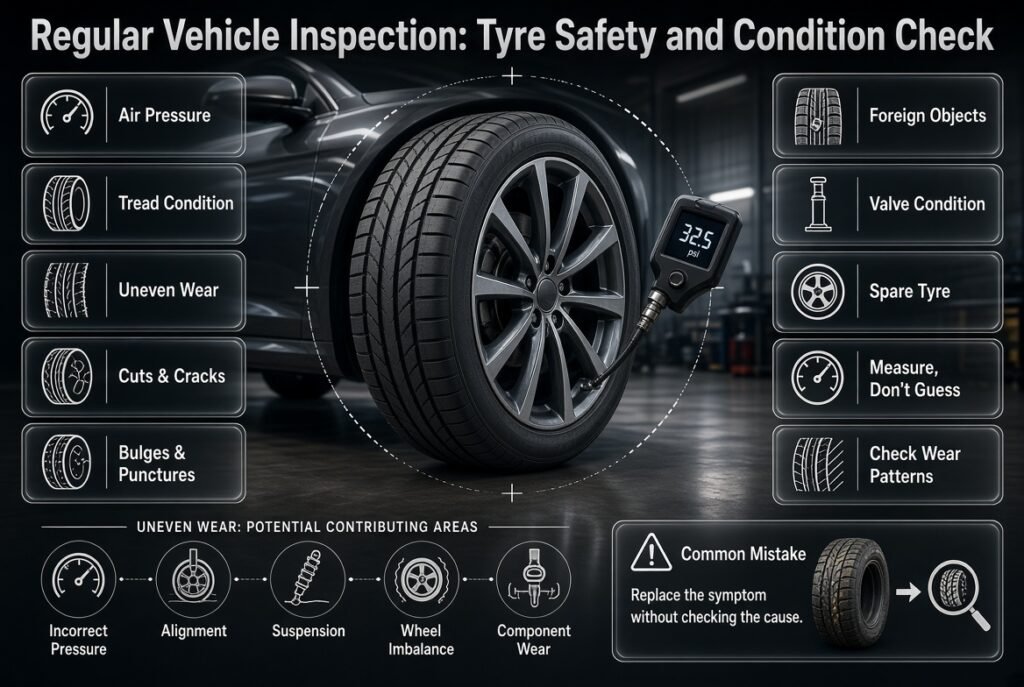
1. Inspect Your Tyres
Tyres should be one of the first things you check because they provide the vehicle’s contact with the road.
A tyre can look acceptable while having incorrect pressure or internal damage.
Check:
- Air pressure
- Tread condition
- Uneven wear
- Cuts
- Cracks
- Bulges
- Punctures
- Foreign objects
- Valve condition
- Spare tyre condition
Correct tyre pressure matters for handling, tyre wear, durability, and fuel consumption. NHTSA recommends checking tyre pressure regularly, including the spare where applicable, using the vehicle manufacturer’s recommended pressure rather than the maximum pressure printed on the tyre.
Don’t judge tyre pressure by appearance
One of the most common mistakes is looking at a tyre and assuming it has enough air because it doesn’t look flat.
Tyre pressure should be measured with an appropriate gauge.
The correct pressure is normally listed on the vehicle’s tyre/loading information label or in the owner’s manual.
Watch for uneven wear
Uneven tread wear can provide useful information.
For example, unusual wear patterns may be associated with:
- Incorrect pressure
- Alignment issues
- Suspension problems
- Wheel imbalance
- Component wear
The tyre itself may not be the only problem.
⚠ Common Mistake: Replacing one visibly worn tyre without investigating why it wore differently from the others.
If one tyre repeatedly develops abnormal wear, find the underlying cause instead of treating the symptom alone.
2. Check the Braking System
Your brakes deserve serious attention because braking performance directly affects vehicle control and stopping.
During a normal inspection, pay attention to how the vehicle behaves rather than trying to diagnose every brake component yourself.
Watch for:
- Squealing
- Grinding
- Vibration
- Pulling while braking
- Soft pedal feel
- Excessive pedal travel
- Changes in stopping response
- Brake warning lights
A change in braking behaviour should not be ignored simply because the car still stops.
Some brake problems are gradual.
The driver may become accustomed to a small change and stop noticing it.
That’s one reason periodic professional brake inspection is valuable.
3. Check Engine Oil
Engine oil performs several important functions inside the engine.
It helps lubricate moving parts, reduce friction, carry contaminants, and assist with heat management.
Check the oil level according to the procedure provided by the vehicle manufacturer.
Depending on the vehicle, this may require the engine to be at a particular temperature or switched off for a certain period.
Look for:
- Correct oil level
- Signs of leakage
- Unusual oil consumption
- Oil contamination
- Changes in engine behaviour
If the oil level repeatedly falls between scheduled services, don’t simply keep adding oil indefinitely.
A technician may need to determine whether the vehicle is consuming oil or developing a leak.
4. Inspect the Cooling System
The cooling system helps keep the engine within its intended operating temperature.
Important components include:
- Coolant
- Radiator
- Hoses
- Expansion tank
- Thermostat
- Cooling fans
- Water pump
A driver can usually inspect the coolant reservoir when the vehicle is safely cool.
Look for:
- Low coolant level
- Visible leaks
- Damaged hoses
- Cracks
- Signs of overheating
- Repeated need to add coolant
Never casually open a hot pressurized cooling system.
Hot coolant can cause serious burns.
⚠ Common Mistake: Treating repeated coolant loss as normal.
Coolant doesn’t normally disappear simply because a vehicle is being driven. If the level repeatedly drops, the cause should be investigated.
5. Check Other Vehicle Fluids
Depending on your vehicle, regular inspection may include:
- Brake fluid
- Transmission fluid
- Power steering fluid
- Washer fluid
- Coolant
Not every modern vehicle allows the driver to check every fluid directly.
Some systems are sealed or designed to be checked using specific procedures.
That’s why the owner’s manual matters.
Don’t assume that a procedure used on one car applies to another.
6. Inspect the Battery
A weak battery can turn into a starting problem with little warning.
Common signs include:
- Slow engine cranking
- Difficulty starting
- Electrical irregularities
- Battery warning indicators
- Corrosion around terminals
- Loose connections
- Visible battery damage
However, a visual inspection cannot always tell you whether a battery is healthy.
A proper battery test can measure its condition more accurately.
If your vehicle repeatedly struggles to start, don’t automatically assume the battery is the only possible cause.
The charging system, starter, electrical connections, or another fault may also need examination.
7. Check Exterior Lights
Walk around the vehicle and verify that the major lights operate correctly.
Check:
- Headlights
- Brake lights
- Turn signals
- Hazard lights
- Parking lights
- Rear lights
- Reverse lights
- Number-plate lights where applicable
A failed light affects more than visibility.
It can also reduce your ability to communicate your intentions to other drivers.
📌 Quick Tip: Turn on the lights and walk around the vehicle rather than checking them only from inside the driver’s seat.
8. Inspect Windscreen Wipers
Wipers are easy to overlook until heavy rain makes their condition obvious.
Look for:
- Streaking
- Skipping
- Cracking
- Noise
- Incomplete clearing
Also check the washer-fluid level and confirm the spray system works.
Clear visibility is a basic safety requirement, so worn wipers shouldn’t be treated as an insignificant cosmetic issue.
9. Look for Fluid Leaks
A puddle under the car can provide an early warning.
However, not every liquid under a vehicle means the same thing.
Air-conditioning condensation can produce clear water, while other fluids may indicate a mechanical problem.
Potential fluids include:
- Engine oil
- Coolant
- Transmission fluid
- Brake fluid
- Power steering fluid where applicable
Don’t rely only on colour to identify a leak.
If you notice a significant, unfamiliar, or recurring leak, have it professionally inspected.
10. Check Belts and Hoses
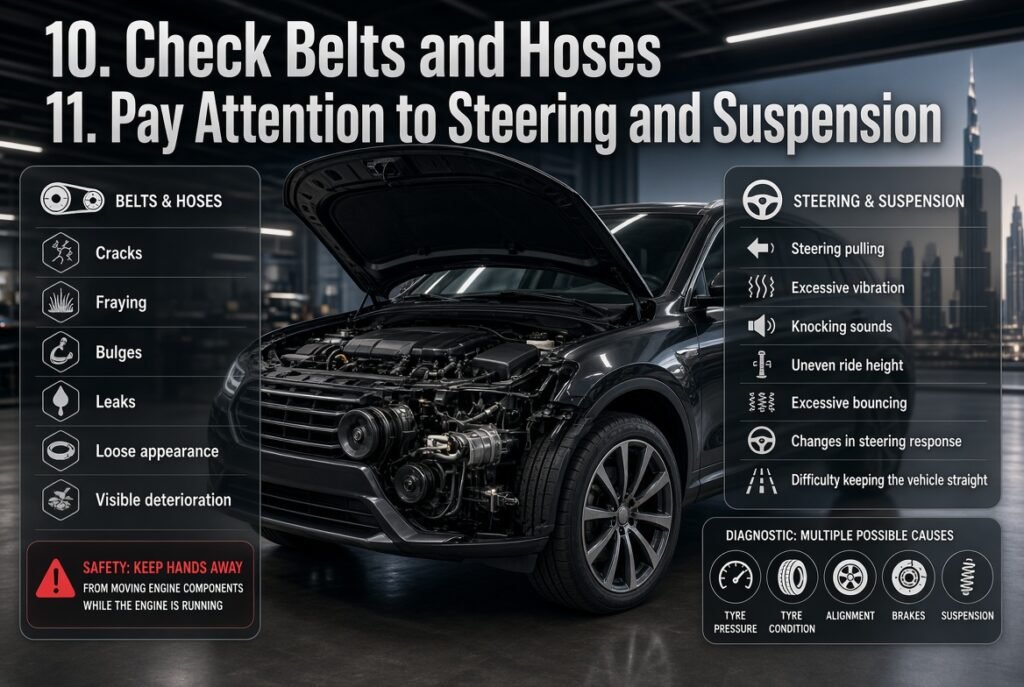
Belts and hoses may become brittle, cracked, loose, or damaged over time.
During a safe visual inspection, look for obvious:
- Cracks
- Fraying
- Bulges
- Leaks
- Loose appearance
- Visible deterioration
Don’t put your hands near moving components while the engine is running.
Some belts are also difficult to assess accurately without professional knowledge.
11. Pay Attention to Steering and Suspension
You don’t necessarily need to remove a wheel or dismantle anything to notice that something may be wrong.
During driving, pay attention to:
- Steering pulling
- Excessive vibration
- Knocking sounds
- Uneven ride height
- Excessive bouncing
- Changes in steering response
- Difficulty keeping the vehicle straight
These symptoms can have several possible causes.
For example, steering pull could be associated with tyre pressure, tyre condition, alignment, brakes, or suspension.
Don’t assume a single cause without proper diagnosis.
12. Check Dashboard Warning Lights
Modern vehicles use electronic warning systems to alert drivers to potential problems.
Don’t ignore warning lights simply because the vehicle continues to drive normally.
Pay attention to:
- Engine warning light
- Battery/charging warning
- Brake warning
- Oil pressure warning
- Temperature warning
- Tyre pressure warning
- Airbag warning
- ABS warning
The owner’s manual explains what individual indicators mean for your vehicle.
A flashing warning or warning accompanied by serious symptoms deserves particularly prompt attention.
How Does Regular Vehicle Inspection Help Prevent Breakdowns?
Inspection doesn’t guarantee that a breakdown won’t happen.
Instead, it reduces the chance that obvious developing problems go unnoticed.
Consider a simple example.
A driver notices that the car has started cranking slightly slower than normal.
They ignore it for several weeks.
Later, the battery becomes too weak to start the engine.
If the driver had treated the change as an inspection finding, they could have tested the battery and charging system before the starting problem became an emergency.
The same principle applies to:
- Slowly losing tyre pressure
- Repeated coolant loss
- Brake noise
- Increasing vibration
- New warning lights
- Fluid leaks
- Unusual engine sounds
The earlier you identify a change, the more options you generally have.
Regular Vehicle Inspection Before a Long Trip
A long trip deserves more attention than a normal short drive.
Before a highway journey, check:
Tyres
- Pressure
- Tread
- Visible damage
- Spare tyre
- Jack and required tools
Fluids
- Engine oil
- Coolant
- Washer fluid
- Other applicable fluids
Visibility
- Headlights
- Brake lights
- Indicators
- Wipers
- Windscreen
Battery and electrical system
- Starting behaviour
- Battery condition
- Warning lights
Vehicle behaviour
- Braking
- Steering
- Vibration
- Unusual noises
Emergency equipment
Depending on your vehicle and local requirements, consider carrying appropriate emergency equipment such as:
- Warning triangle
- Flashlight
- Phone charger
- First-aid supplies
- Basic tools
- Gloves
- Drinking water
- Spare tyre and required equipment
A pre-trip inspection is particularly useful because a problem found at home is usually easier to deal with than a problem discovered on a highway.
How Dubai Conditions Can Affect Vehicle Inspection
Dubai driving conditions can place different demands on vehicles.
High temperatures can affect battery performance, tyres, fluids, cooling systems, and air-conditioning use. Heavy traffic creates frequent acceleration and braking, while long highway journeys can place sustained demands on tyres, brakes, cooling, and other components.
Dust and environmental conditions can also affect filters and general vehicle cleanliness.
This doesn’t mean that every vehicle automatically needs additional servicing outside the manufacturer’s recommendations.
Instead, it means drivers should be observant.
A sensible inspection routine should consider:
- Vehicle age
- Mileage
- Driving frequency
- Highway usage
- Traffic exposure
- Heat exposure
- Vehicle load
- Maintenance history
- Manufacturer recommendations
For a more structured preventive approach, see our guide to Preventive Vehicle Maintenance.
How Vehicle Inspection Can Support Better Fuel Economy
Regular inspection isn’t a fuel-saving technique by itself, but it can identify conditions that may contribute to inefficient operation.
Tyre pressure is one clear example.
Incorrect tyre pressure can affect rolling resistance, tyre wear, handling, and fuel consumption. NHTSA specifically identifies proper tyre inflation as important for safety, durability, and fuel economy.
Other areas worth monitoring include:
- Excessive vehicle weight
- Engine maintenance
- Brake drag
- Tyre condition
- Alignment
- Air filters where applicable
- Driving behaviour
However, don’t assume that every increase in fuel consumption means the vehicle has a mechanical fault.
Fuel economy can also change because of:
- Traffic
- Driving speed
- Air-conditioning use
- Driving style
- Route
- Vehicle load
- Weather
- Fuel quality
- Seasonal conditions
Inspection should therefore be used to investigate changes rather than automatically assigning one cause.
How to Perform a Basic Regular Vehicle Inspection
Here’s a simple step-by-step routine.
Step 1: Look Around the Vehicle
Before starting the engine, walk around the car.
Check:
- Tyres
- Body damage
- Lights
- Mirrors
- Windscreen
- Obvious leaks
Step 2: Check the Dashboard
Start the vehicle and observe the dashboard.
Look for warning lights that remain illuminated after the normal startup sequence.
Step 3: Listen
Don’t rush away immediately.
Listen for:
- Unusual engine noise
- Squealing
- Clicking
- Knocking
- Grinding
- New vibration
Knowing what your car normally sounds like makes changes easier to recognize.
Step 4: Check Basic Fluids
Where your vehicle allows safe owner checks, inspect:
- Oil
- Coolant
- Washer fluid
- Other accessible fluids
Follow the manufacturer’s instructions.
Step 5: Check the Tyres
Measure tyre pressure with a gauge and visually inspect tread and sidewalls.
Don’t forget the spare if your vehicle has one.
Step 6: Test Lights
Check exterior lights and indicators.
Step 7: Notice Driving Changes
When driving safely, pay attention to:
- Braking
- Steering
- Acceleration
- Gear changes
- Vibration
- Stability
Step 8: Record Problems
If you notice something unusual, write it down.
For example:
26 September — slight vibration above highway speed.
That simple note can help a technician understand when and how the problem occurs.
What Should You Do When an Inspection Finds a Problem?
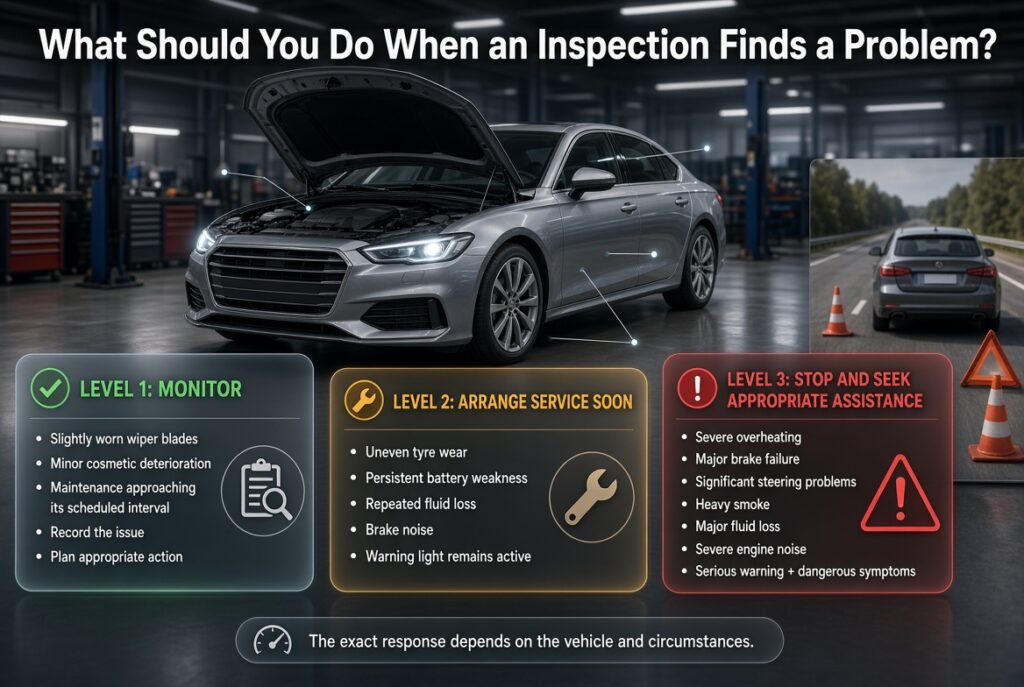
Not every inspection finding requires the same response.
A useful approach is to classify problems into three levels.
Level 1: Monitor
Examples:
- Slightly worn wiper blades
- Minor cosmetic deterioration
- Maintenance approaching its scheduled interval
Record the issue and plan appropriate action.
Level 2: Arrange Service Soon
Examples:
- Uneven tyre wear
- Persistent battery weakness
- Repeated fluid loss
- Brake noise
- Warning light that remains active
These shouldn’t simply be forgotten.
Level 3: Stop and Seek Appropriate Assistance
Examples may include:
- Severe overheating
- Major brake failure
- Significant steering problems
- Heavy smoke
- Major fluid loss
- Severe engine noise
- A serious warning accompanied by dangerous symptoms
The exact response depends on the vehicle and circumstances.
If continuing to drive could create a safety risk, move to a safe location when possible and arrange appropriate assistance.
Common Mistakes During Vehicle Inspection
Mistake 1: Inspecting Only the Exterior
A clean, polished car isn’t necessarily a healthy car.
Mechanical components can deteriorate without visible body damage.
Better approach: Combine exterior inspection with fluid, tyre, warning-light, and driving-behaviour checks.
Mistake 2: Ignoring Small Changes
Drivers often dismiss small noises or vibrations because the car still operates.
The problem may remain small—or it may become progressively worse.
Better approach: Record changes and monitor whether they’re recurring.
Mistake 3: Checking Tyres Only When They Look Flat
A tyre can be significantly underinflated without appearing obviously flat.
Better approach: Use a pressure gauge and follow the vehicle manufacturer’s specification.
Mistake 4: Treating Warning Lights as Suggestions
A warning light is there because the vehicle’s system has detected something that deserves attention.
Better approach: Identify what the warning means and follow the appropriate response.
Mistake 5: Using a Universal Maintenance Schedule
A maintenance interval suitable for one vehicle may not apply to another.
Better approach: Use your manufacturer’s service information as the foundation.
Mistake 6: Assuming a Recent Service Means Nothing Needs Checking
A service is not a permanent guarantee that every component will remain problem-free.
A tyre can be damaged after a service. A battery can weaken later. A new leak can develop.
Better approach: Continue regular observation between services.
Mistake 7: Inspecting a Hot Engine Carelessly
Hot components and pressurized fluids can cause serious injuries.
Better approach: Follow safety instructions and allow components to cool when required.
Expert Advice: Make Inspection a Habit, Not an Event
The best inspection routine is one that you actually follow.
It doesn’t need to be complicated.
Create a simple system:
Frequent → Periodic → Professional
Frequent
Look at the vehicle and pay attention to changes.
Periodic
Perform more detailed checks of tyres, fluids, battery, lights, and other accessible components.
Professional
Follow the manufacturer’s maintenance schedule and obtain professional diagnosis when problems appear.
This approach is easier to maintain than trying to perform an extremely detailed inspection every few days.
⭐ Expert Tip: Learn your vehicle’s normal behaviour. Knowing how your car normally starts, brakes, steers, sounds, and feels makes unusual changes much easier to recognize.
Keeping a Vehicle Inspection Record
A simple record can become surprisingly useful.
Record:
- Date
- Mileage
- Inspection performed
- Condition found
- Parts needing attention
- Work completed
- Parts replaced
- Technician recommendations
- Next service date
For example:
26 September — 64,200 km
- Tyre pressure checked
- Front tyres inspected
- Washer fluid topped up
- No warning lights
- Minor wiper streaking noticed
- Wiper replacement planned
This record gives you a history of the vehicle rather than forcing you to rely on memory.
For a broader checklist approach, see the Routine Car Maintenance Checklist in Dubai.
How a Regular Inspection Fits Into Your Maintenance Schedule
A good maintenance system can look like this:
Daily/regular driving
↓
Notice changes
↓
Frequent visual checks
↓
Tyres • lights • leaks • warning lights
↓
Periodic checks
↓
Fluids • battery • brakes • belts • hoses
↓
Scheduled maintenance
↓
Oil • filters • inspections • manufacturer-required work
↓
Professional diagnosis
↓
Repair or replacement when required
This structure prevents inspection from becoming an isolated activity.
It becomes part of normal vehicle ownership.
For a detailed maintenance schedule, use the Car Maintenance Schedule as a supporting resource.
When Should You Get a Professional Inspection?
A professional inspection is particularly useful when you can’t determine the cause of a problem yourself.
Consider professional inspection if you notice:
- Persistent warning lights
- Brake changes
- Steering issues
- Repeated vibration
- Unusual engine noise
- Repeated overheating
- Coolant loss
- Oil leaks
- Transmission problems
- Starting problems
- Suspension noises
- Uneven tyre wear
- Sudden changes in vehicle behaviour
Professional inspection is also valuable:
- Before purchasing a used vehicle
- After a significant accident
- Before an important long-distance journey
- After a vehicle has been stored for a long period
- When a recurring problem hasn’t been resolved
The purpose isn’t simply to get a list of repairs.
A good inspection should help identify the actual cause of a problem.
Regular Inspection for Older Vehicles
Older vehicles aren’t automatically unreliable, but age and mileage can increase the number of components that need attention.
With an older vehicle, pay particular attention to:
- Rubber components
- Hoses
- Belts
- Battery
- Cooling system
- Suspension
- Steering components
- Brake components
- Oil leaks
- Transmission behaviour
Maintenance history becomes increasingly useful.
Two vehicles of the same age can have very different conditions depending on how they were driven and maintained.
A high-mileage vehicle with consistent maintenance records may be in better condition than a lower-mileage vehicle that has been neglected.
Regular Inspection for Newer Vehicles
Newer vehicles also need inspection.
Modern cars have sophisticated electronic systems, sensors, driver-assistance features, and complex mechanical components.
Technology doesn’t eliminate maintenance.
It changes the way problems may appear.
For example, a modern vehicle may display a warning message before a driver notices a physical symptom.
The correct response is still to understand what the warning means rather than simply resetting it.
Regular Inspection Before Buying a Used Car
A used-car inspection deserves a separate approach.
Don’t rely solely on:
- Exterior appearance
- Interior cleanliness
- Short test drive
- Seller’s verbal claims
A professional inspection can evaluate areas that aren’t obvious during a casual viewing.
Important areas include:
- Engine
- Transmission
- Brakes
- Suspension
- Steering
- Tyres
- Electrical systems
- Cooling system
- Signs of accident damage
- Leaks
- Diagnostic faults
A proper inspection can help you understand what you’re actually buying.
What Is an Official Vehicle Technical Inspection in Dubai?
Routine personal inspection and official technical inspection should not be confused.
In Dubai, RTA provides technical inspection services for applicable vehicle-related transactions such as registration, renewal, and export. The exact requirements depend on the vehicle and transaction.
RTA currently provides online appointment booking for vehicle inspection, and its published information states that technical inspection certificates have a defined validity period for applicable transactions.
RTA also publishes vehicle-testing guidance covering requirements before attending a test, documentation, and testing procedures.
That official inspection process is different from the everyday habit of checking your vehicle’s condition.
You shouldn’t wait for an official inspection requirement to start paying attention to tyres, brakes, fluids, lights, battery, or warning signs.
What Should You Do Before an Official Inspection?
If you’re preparing a vehicle for an official technical inspection, don’t try to hide a problem.
Instead, identify and address legitimate maintenance issues beforehand.
A sensible preparation routine can include:
- Cleaning the vehicle
- Checking lights
- Checking tyres
- Checking obvious leaks
- Confirming required equipment is present
- Reviewing warning lights
- Ensuring relevant documentation is available
- Addressing known mechanical problems
RTA’s published testing guidance lists preparation requirements such as a clean vehicle, clean plate, and accessibility of applicable safety equipment.
Always check current RTA requirements for your specific vehicle and transaction because official procedures can change.
Essential Vehicle Inspection Checklist
Use this as a practical reference.
Tyres
- Correct pressure
- Adequate tread
- No visible bulges
- No major cracks
- No obvious puncture
- No abnormal wear
- Spare tyre checked where applicable
Brakes
- Normal pedal feel
- No grinding
- No unusual vibration
- No pulling
- No brake warning light
Fluids
- Engine oil checked according to manufacturer procedure
- Coolant checked safely
- Washer fluid checked
- Other applicable fluids checked
- No obvious leaks
Electrical
- Battery condition observed
- Headlights working
- Brake lights working
- Indicators working
- Hazard lights working
- No unexplained warning lights
Visibility
- Windscreen clear
- Wipers working
- Washer system working
- Mirrors clean and secure
Driving behaviour
- Steering feels normal
- Braking feels normal
- No unusual vibration
- No unusual engine noise
- No unusual smells
- Gear changes normal
How Regular Inspection Can Save Time and Money
Preventive inspection isn’t about spending money on every small observation.
It’s about making better decisions.
Suppose you notice a tyre losing pressure slowly.
There are several possibilities:
- Minor pressure loss
- Puncture
- Valve problem
- Wheel issue
- Tyre damage
Ignoring it could allow the situation to become more serious.
Checking it early gives you the opportunity to identify the cause.
The same principle applies to a battery that is becoming weak or a brake that has started making an unusual noise.
Early attention doesn’t guarantee a cheap repair, but it can give you more control over when and how you address the problem.
The Role of Essential Vehicle Maintenance
Inspection should not stand alone.
Once an inspection identifies a maintenance requirement, the next step is to deal with it appropriately.
This might mean:
- Replacing a filter
- Changing oil
- Replacing worn tyres
- Servicing brakes
- Testing the battery
- Repairing a leak
- Replacing worn components
Our guide to Essential Vehicle Maintenance Tasks can help you understand the broader maintenance responsibilities that work alongside regular inspection.
How Often Should You Perform a Regular Vehicle Inspection?
The right inspection frequency depends on the vehicle’s age, mileage, condition, driving environment, and manufacturer recommendations. A quick visual check should be part of your normal driving routine, while more detailed inspections should be performed periodically and during scheduled maintenance.
You don’t need to wait for a service appointment to notice obvious changes. Tyre pressure, visible tyre damage, lights, warning indicators, leaks, wipers, and unusual sounds can be checked regularly. More technical areas such as brakes, suspension, steering components, battery performance, and electronic systems may require professional inspection.
For drivers in Dubai, frequent traffic, high temperatures, long-distance highway driving, and regular air-conditioning use make it particularly useful to pay attention to changes in vehicle behaviour.
Important inspection points:
Check tyres and visible damage regularly.
Monitor dashboard warning lights.
Pay attention to new noises, vibrations, or smells.
Check accessible fluid levels according to the manufacturer’s instructions.
Follow the vehicle manufacturer’s scheduled maintenance intervals.
Arrange professional inspection when a recurring or unusual problem appears.
A consistent inspection routine is more useful than waiting for a major symptom. The purpose is to identify changes while they are still manageable.
What Should Be Checked During a Regular Vehicle Inspection?
A proper vehicle inspection should look beyond the engine. A car depends on multiple systems working together, so the inspection should cover safety-related components, fluids, electrical systems, tyres, visibility, and overall driving behaviour.
Start with the tyres because they directly contact the road. Check pressure, tread, uneven wear, cuts, cracks, bulges, and other visible damage. Then check the brakes for changes in pedal feel, unusual sounds, vibration, pulling, or warning lights.
You should also inspect accessible fluids, exterior lights, windscreen wipers, battery condition, visible leaks, belts and hoses, and dashboard warning indicators. During driving, notice whether steering, braking, acceleration, gear changes, or vehicle stability feel different from normal.
A practical inspection should include:
Tyre pressure and tread condition
Brake performance and warning indicators
Engine oil and applicable fluid levels
Coolant level when the vehicle is safely cool
Battery and starting behaviour
Headlights, brake lights, and indicators
Windscreen and wipers
Visible leaks
Belts and hoses where accessible
Steering and suspension symptoms
Dashboard warning lights
Unusual noises, smells, or vibrations
Not every component can be accurately assessed through a visual inspection. If you find something unusual, professional diagnosis may be necessary to identify the actual cause.
What Are the Warning Signs That a Car Needs Professional Inspection?
Some vehicle problems are obvious, while others begin with a small change in how the car sounds, feels, or performs. A warning sign doesn’t necessarily mean the vehicle is about to fail immediately, but it shouldn’t be ignored simply because the car continues to drive.
Pay particular attention to changes in braking, steering, engine temperature, starting performance, acceleration, gear shifting, or electrical behaviour. Persistent dashboard warning lights, unusual vibrations, repeated fluid loss, overheating, smoke, or significant leaks are also reasons to have the vehicle assessed professionally.
The important point is to look for changes from your vehicle’s normal behaviour. Drivers who know how their car normally sounds and feels are often better positioned to notice developing problems.
Professional inspection is particularly important when you notice:
Brake performance changing
Steering becoming unusually heavy or unstable
Persistent warning lights
Repeated overheating
Unusual engine knocking or grinding
Significant fluid leakage
Repeated battery or starting problems
Strong or unusual smells
Excessive vibration
Uneven tyre wear
Transmission behaviour changing
Smoke from the engine or exhaust
If the problem involves braking, steering, severe overheating, major fluid loss, or another condition that could affect immediate safety, avoid continuing to drive until the vehicle can be assessed appropriately.
Is Regular Vehicle Inspection Necessary If My Car Is Running Normally?
A vehicle running normally doesn’t necessarily mean every component is in perfect condition. Many problems develop gradually and may not produce an obvious symptom at first. Regular inspection is designed to identify these changes before they become more noticeable or disruptive.
For example, a tyre may slowly lose pressure without looking flat. A battery may still start the vehicle while its performance is declining. Brake components may wear gradually, allowing the driver to adapt to a small change in pedal response.
This is why inspection should be considered preventive rather than something reserved for vehicles that are already broken.
Regular inspection can help you:
Detect developing problems earlier.
Monitor tyre wear and pressure.
Identify fluid leaks.
Notice changes in braking or steering.
Track battery performance.
Respond to warning lights appropriately.
Prepare the vehicle before long journeys.
Plan maintenance instead of reacting to unexpected failures.
It also gives you a better understanding of your vehicle’s condition. When you combine regular checks with scheduled maintenance and professional inspections when necessary, you have a more complete approach to vehicle care.
Should I Perform a Vehicle Inspection Before a Long Road Trip?
A pre-trip vehicle inspection is particularly useful before a long journey because a minor problem that is manageable at home can become much more difficult when you’re far from a workshop or driving on a busy highway.
Before leaving, pay particular attention to tyres, brakes, engine fluids, coolant, battery condition, lights, wipers, and warning indicators. Also consider the spare tyre and the equipment required to deal with a basic roadside problem.
Don’t limit the inspection to the engine. A long journey places demands on the entire vehicle, and tyres, cooling systems, brakes, electrical components, and visibility equipment all deserve attention.
Before a long trip, check:
Tyre pressure and tread
Spare tyre and required equipment
Brake performance
Engine oil
Coolant
Washer fluid
Battery and starting behaviour
Headlights and brake lights
Indicators and hazard lights
Windscreen and wipers
Dashboard warning lights
Visible leaks
Unusual noises or vibrations
Steering and vehicle stability
It’s also sensible to make sure your phone is charged and that you have suitable emergency equipment for your journey.
A few minutes spent checking the vehicle before departure can give you the opportunity to address a problem in a controlled environment rather than discovering it during a long-distance drive.
Conclusion
Regular vehicle inspection is one of the simplest ways to stay ahead of potential vehicle problems. You don’t need to be a professional mechanic to notice important warning signs. Checking tyres, brakes, fluids, lights, battery condition, warning indicators, leaks, and unusual changes in driving behaviour can help you identify problems before they become more disruptive or expensive.
For Dubai drivers, regular inspection is especially useful because vehicles can experience high temperatures, heavy traffic, frequent air-conditioning use, dusty conditions, and long highway journeys. These conditions make it important to understand your vehicle’s normal behaviour and respond when something changes.
The key is consistency. Don’t wait for a breakdown or serious warning before checking your vehicle. Combine regular driver checks with the manufacturer’s maintenance schedule and professional inspections whenever a problem requires specialist attention.
A few minutes of careful inspection can give you better awareness of your vehicle’s condition, help you prepare for long journeys, and reduce the chances of being caught off guard by an avoidable problem. Regular inspection isn’t about expecting something to go wrong—it’s about being prepared before it does.
Leave a Reply