
Introduction
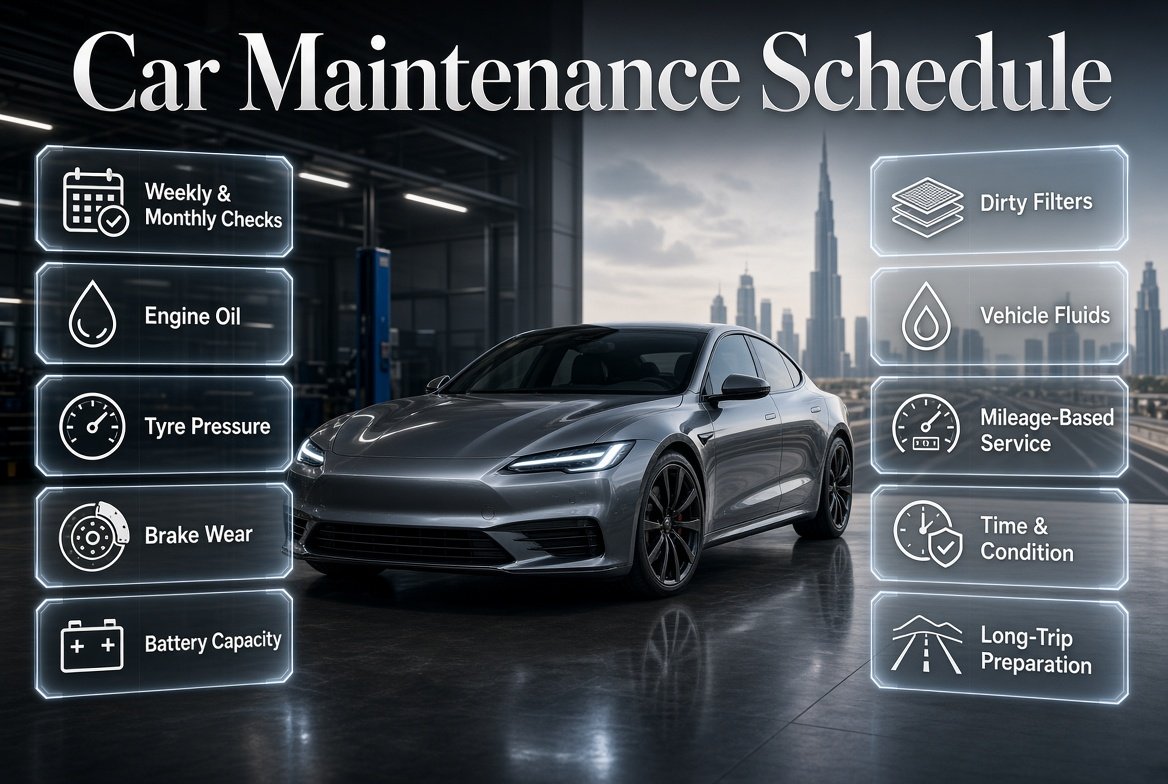
Car Maintenance Schedule| A car can feel completely normal today and still develop a problem tomorrow. The engine may start smoothly, the brakes may feel fine, and the tyres may look perfectly acceptable, while small maintenance issues are quietly developing underneath. Engine oil gets older, tyre pressure changes, filters become dirty, brake components wear, batteries lose capacity, and fluids gradually need attention.
The problem is that many drivers only think about maintenance when a dashboard warning appears or the car starts making an unusual noise.
A proper car maintenance schedule helps you stay ahead of those problems. Instead of waiting for something to fail, you know what should be checked, when routine service is normally due, which items are based on mileage, and which maintenance tasks depend on time or vehicle condition.
For drivers in Dubai and other demanding driving environments, Fuel Delivery Dubai is also a useful roadside resource when a fuel-related problem occurs despite proper planning and maintenance.
This guide explains how to create and follow a practical maintenance schedule for your vehicle. You’ll learn what to check weekly and monthly, what usually happens at different mileage intervals, how climate and traffic can affect maintenance, which jobs require a professional, common mistakes to avoid, and how to prepare your car before a long journey.
What Is a Car Maintenance Schedule?
A car maintenance schedule is a planned system for checking, servicing, inspecting, and replacing vehicle components at appropriate intervals.
Those intervals can be based on:
- Mileage
- Time
- Vehicle age
- Driving conditions
- Climate
- Manufacturer recommendations
- Component condition
- Type of engine and transmission
- How heavily the vehicle is used
The most important thing to understand is that there is no single maintenance schedule that applies to every car.
A small petrol hatchback, a large SUV, a hybrid, and a diesel vehicle may all have different service requirements. Even two cars with similar engines can have different recommended intervals because of their design and manufacturer specifications.
Your owner’s manual and official maintenance schedule should therefore be your primary reference.
A good maintenance plan normally covers:
- Engine oil
- Oil filter
- Engine air filter
- Cabin air filter
- Tyres
- Brakes
- Battery
- Coolant
- Brake fluid
- Transmission fluid
- Spark plugs where applicable
- Belts and hoses
- Steering
- Suspension
- Wheel alignment
- Lights
- Wipers
- Air conditioning
- Cooling system
- Electrical systems
- Scheduled inspections
The purpose isn’t to replace every component as early as possible. The purpose is to inspect and service the right component at the right time.
Why Is a Regular Car Maintenance Schedule Important?
Regular maintenance gives you an opportunity to identify developing problems before they become major failures.
A vehicle that receives proper maintenance can be easier to monitor because you have a clearer idea of what has already been serviced and what is due next.
A consistent maintenance routine can help you:
- Reduce avoidable breakdowns
- Maintain braking performance
- Protect engine components
- Support normal fuel efficiency
- Extend the useful life of components
- Identify leaks early
- Detect tyre problems
- Monitor battery condition
- Maintain cooling-system performance
- Keep the vehicle in better overall condition
- Make repair expenses more predictable
However, maintenance doesn’t guarantee that a vehicle will never break down. Mechanical and electrical components can still fail unexpectedly.
The goal is to reduce preventable problems and catch developing issues as early as reasonably possible.
For example, a tyre that slowly loses pressure may not seem urgent at first. But repeated pressure loss can indicate a puncture, valve problem, wheel issue, or other fault. Ignoring it doesn’t make the underlying problem disappear.
A maintenance routine gives you a system for noticing these changes.
How Often Should a Car Be Serviced?
The correct service interval depends on the vehicle.
Some vehicles have service intervals based on a combination of mileage and time. Others use electronic service monitoring systems. Some maintenance items have much longer intervals than routine oil or inspection work.
Before following any generic schedule, check:
- Owner’s manual
- Manufacturer’s service schedule
- Recommended oil specification
- Recommended fluid specifications
- Vehicle mileage
- Vehicle age
- Previous service history
- Driving conditions
For example, a vehicle used mainly for highway driving may experience different conditions from one used every day in heavy stop-and-go traffic.
A driver who travels only a few kilometres at a time may also have a different maintenance pattern from someone who regularly drives long distances.
Why Mileage Alone Isn’t Enough
Imagine two cars that both have 50,000 km on the odometer.
One has spent most of its life on highways with relatively steady speeds.
The other has spent most of its life in congested urban traffic, with frequent braking, acceleration, idling, and short journeys.
The mileage is identical, but the operating conditions aren’t.
That is why a good maintenance schedule considers both how far the vehicle has travelled and how it has been used.
The manufacturer’s guidance remains the starting point, while actual driving conditions help determine what deserves additional attention.
Car Maintenance Schedule by Time and Mileage
A practical maintenance schedule can be easier to understand when divided into short-term checks, routine service intervals, and major maintenance stages.
The ranges below are general planning guidance. They should not replace the exact schedule specified for your vehicle.
| Maintenance Period | Typical Areas to Check |
|---|---|
| Every few weeks | Tyres, lights, warning lights, visible leaks |
| Monthly | Fluids, battery, tyres, wipers, general condition |
| Around scheduled oil/service interval | Engine oil, filter and routine inspection |
| Around 10,000–20,000 km | Filters, brakes, tyres, fluids and general inspection |
| Around 30,000–50,000 km | More comprehensive inspection and scheduled components |
| Around 60,000–100,000 km | Major manufacturer-specific maintenance |
| Higher mileage | Component condition, wear items and scheduled major service |
The actual interval can be shorter or longer depending on the manufacturer.
Don’t treat these numbers as universal replacement rules.
What Should You Check Every Week?
You don’t need to perform a mechanical inspection every time you drive.
A quick visual and functional check, however, can help you notice changes before they become serious.
Check Your Tyres
Walk around the vehicle and look at the tyres.
Check for:
- Low pressure
- Visible damage
- Cuts
- Cracks
- Bulges
- Punctures
- Uneven tread wear
- Objects stuck in the tread
If one tyre repeatedly loses pressure while the others remain stable, don’t simply keep adding air.
It should be inspected to determine why the pressure is being lost.
Correct tyre pressure also matters for handling, tyre wear, and normal fuel efficiency. Use the pressure recommended by the vehicle manufacturer rather than the maximum pressure printed on the tyre sidewall.
Check Dashboard Warning Lights
When you start the vehicle, pay attention to warning lights.
Some lights are normal during the starting sequence and should go out after the system completes its check.
A warning that remains illuminated can indicate a problem that needs investigation.
Never assume that a warning light is harmless simply because the car still drives normally.
Look Under the Vehicle
If you notice a new fluid mark where the car has been parked, investigate it.
The appearance of a liquid alone isn’t always enough to identify it, but unexplained fluid loss should not be ignored.
A small leak today can become a much larger problem later.
Notice Changes in the Way the Car Feels
Drivers spend more time with their vehicle than most technicians do.
That means you may be the first person to notice:
- A new vibration
- Different steering feel
- Harder braking
- Unusual engine noise
- Delayed starting
- New smells
- Transmission hesitation
- Changes in fuel consumption
Those observations are useful information and should be mentioned during servicing.
Understanding which maintenance tasks require regular attention can make vehicle care much easier. This essential vehicle maintenance guide provides a practical reference for checking the important components and routine service items that support reliable vehicle performance.
Monthly Car Maintenance Checklist
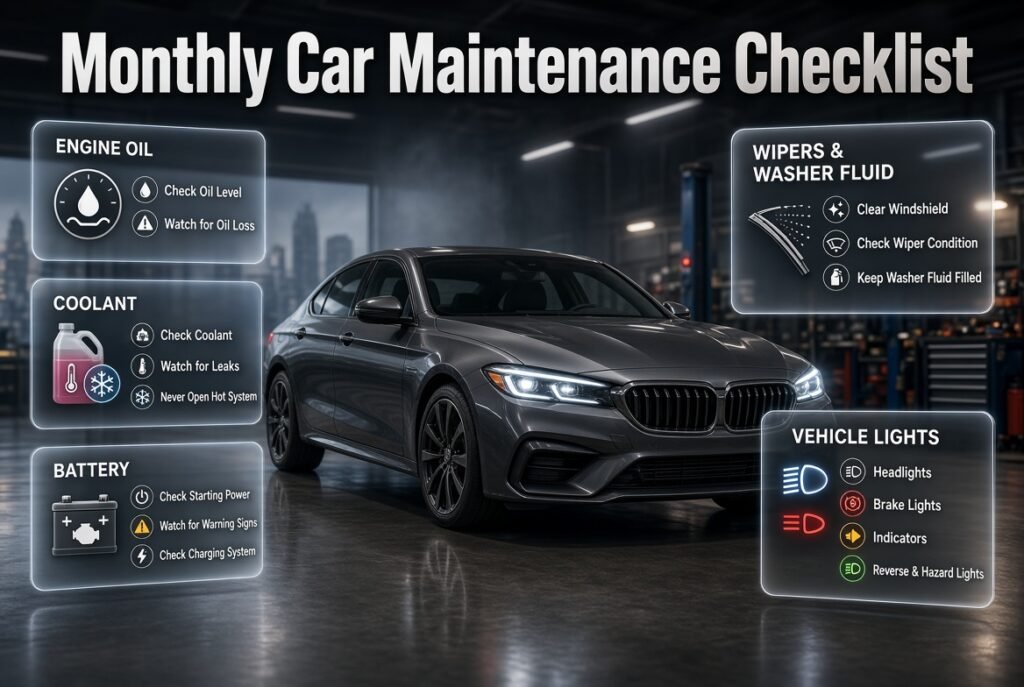
A monthly inspection can be slightly more detailed.
You don’t need to dismantle anything. The objective is to check the basic condition of the vehicle and identify anything that deserves professional attention.
1. Check Engine Oil
If your vehicle has a dipstick, check the oil level according to the manufacturer’s procedure.
Typically, the vehicle should be parked appropriately and the engine should be off for the recommended period before checking.
Some newer vehicles don’t have a traditional dipstick and provide an electronic oil-level reading instead.
Follow your vehicle’s specific instructions.
What If the Oil Level Is Low?
Don’t automatically assume that the engine simply needs an oil change.
Low oil can result from:
- A leak
- Normal oil consumption
- Seal problems
- Engine wear
- Incorrect previous servicing
- Other mechanical problems
If the oil level repeatedly drops between scheduled services, the reason should be investigated.
Pro Tip: Adding oil can restore the correct level, but repeatedly adding oil without finding out why the level is dropping can hide an underlying problem.
2. Check Coolant
The cooling system is one of the most important systems in the vehicle.
Check the coolant reservoir according to the manufacturer’s instructions and only when the system is at a safe temperature.
Never casually open a hot pressurized cooling system.
Watch for:
- Low coolant
- Visible leaks
- Repeated coolant loss
- Overheating
- Temperature warnings
- Steam
- Unusual coolant smells
If coolant repeatedly disappears, topping it up isn’t the complete solution. The cause needs to be investigated.
3. Check the Battery
Look for obvious signs of battery problems.
You may notice:
- Slow engine cranking
- Difficulty starting
- Dim lights
- Electrical glitches
- Repeated loss of charge
- Battery warning messages
Battery condition can be affected by age, temperature, electrical demand, usage patterns, and charging-system condition.
If a relatively new replacement battery repeatedly becomes weak, don’t automatically buy another battery.
The charging system and electrical system should also be checked.
4. Check Wipers and Washer Fluid
Good visibility is essential.
Wiper blades should clear the windshield properly rather than leaving:
- Heavy streaks
- Untouched areas
- Excessive smearing
- Chattering
- Damaged rubber
Keep the washer reservoir filled with an appropriate fluid.
5. Check Lights
Test:
- Headlights
- Brake lights
- Indicators
- Reverse lights
- Hazard lights
- Parking lights
A failed light can affect both your visibility and the ability of other drivers to understand what your vehicle is doing.
What Maintenance Is Normally Done During a Routine Service?
A routine service isn’t necessarily the same for every vehicle.
Depending on the manufacturer’s schedule, it may include:
- Engine oil replacement
- Oil filter replacement
- Fluid inspection
- Tyre inspection
- Brake inspection
- Battery check
- Lights inspection
- Air filter inspection
- Cabin filter inspection
- Suspension inspection
- Steering inspection
- Diagnostic checks
- General visual inspection
The important point is that an oil change alone isn’t always a complete service.
If your vehicle is due for scheduled maintenance, ask what the manufacturer’s service interval requires.
For drivers who want a broader understanding of vehicle-care practices, the Vehicle Maintenance Guides section provides related maintenance information covering tyres, brakes, batteries, cooling systems, preventive maintenance, and long-distance preparation.
Car Maintenance Schedule at 5,000–10,000 km
This range is commonly associated with routine maintenance on some vehicles, but it isn’t universal.
Your vehicle may specify a different interval.
At a routine service, the technician may inspect or service:
- Engine oil
- Oil filter
- Tyres
- Brakes
- Fluid levels
- Battery
- Lights
- Wipers
- Belts
- Hoses
- Suspension
- Steering
If your vehicle uses an oil-life monitoring system, follow the manufacturer’s instructions rather than resetting the system without performing the required service.
Also remember that service intervals can depend on time.
A vehicle that has travelled very little may still need scheduled maintenance because some maintenance items are time-sensitive.
Car Maintenance Schedule at 10,000–20,000 km
As mileage increases, more components deserve detailed inspection.
Depending on the vehicle, this may include:
- Engine air filter
- Cabin air filter
- Brake components
- Tyre condition
- Wheel alignment
- Suspension
- Steering
- Battery
- Belts
- Hoses
- Fluids
- Spark plugs where specified
Don’t automatically replace every component.
Some parts are inspected and replaced only when the manufacturer’s schedule or actual condition requires it.
This distinction is important because unnecessary parts replacement increases maintenance costs without necessarily improving the vehicle.
Car Maintenance Schedule at 30,000–50,000 km
At this stage, a more comprehensive inspection can become increasingly important.
Depending on your model, the service schedule may call for work involving:
- Brake fluid
- Air filter
- Cabin filter
- Spark plugs
- Transmission fluid
- Coolant
- Belts
- Brake components
- Suspension components
- Steering
- Wheel alignment
- Battery
- Cooling system
The exact requirements vary significantly.
This is also an excellent point to review your service history.
If you don’t know when a particular item was last replaced, don’t guess.
Find the previous service record or ask a qualified technician to determine what maintenance is due.
Car Maintenance Schedule at 60,000–100,000 km
Higher-mileage maintenance becomes much more vehicle-specific.
Depending on the manufacturer, major service items may include:
- Transmission fluid
- Spark plugs
- Coolant
- Brake fluid
- Drive belts
- Timing belt where applicable
- Suspension components
- Cooling-system components
- Battery
- Brake components
- Filters
- Wheel alignment
One of the most important mistakes to avoid is assuming that every car needs a timing belt replacement at the same mileage.
Timing-belt intervals are manufacturer-specific.
Likewise, transmission-fluid requirements can vary considerably between different transmissions.
Expert Tip: At higher mileage, don’t ask only, “What should I replace?” Ask, “What does my manufacturer specify at this mileage, and what condition are the remaining components in?”
Which Car Maintenance Tasks Are Most Important?
Not every maintenance task has the same urgency.
A useful way to prioritize vehicle care is:
Priority 1: Safety-Critical Systems
Focus first on:
- Brakes
- Tyres
- Steering
- Suspension
- Lights
- Critical warning systems
Priority 2: Reliability-Critical Systems
Then consider:
- Battery
- Cooling system
- Engine oil
- Transmission
- Belts
- Hoses
Priority 3: Comfort and Convenience
Then maintain:
- Air conditioning
- Cabin filter
- Wipers
- Interior-related systems
This doesn’t mean comfort items are unimportant. It simply gives you a sensible order when time or budget is limited.
If your brakes are behaving abnormally, for example, an air-conditioning service should not be the first priority.
Preventive Maintenance vs Routine Maintenance
These two concepts are related but not identical.
Routine Maintenance
Routine maintenance consists of recurring checks and services.
Examples include:
- Oil changes
- Tyre-pressure checks
- Fluid checks
- Filter replacement
- Scheduled inspections
Preventive Maintenance
Preventive maintenance focuses on dealing with wear or service requirements before failure occurs.
Examples include:
- Replacing a scheduled belt
- Replacing worn tyres
- Servicing fluids at the specified interval
- Testing an aging battery
- Inspecting brake components before they become severely worn
The goal isn’t to replace everything early.
The goal is to follow the manufacturer’s requirements and address genuine signs of wear.
For a deeper explanation of this approach, see Preventive Vehicle Maintenance.
What Car Maintenance Can You Do Yourself?
Many basic checks can be performed by an owner if the vehicle manufacturer’s instructions allow it.
These may include:
- Checking tyre pressure
- Inspecting tyres
- Checking washer fluid
- Inspecting lights
- Checking certain fluid levels
- Looking for visible leaks
- Replacing some wiper blades
- Monitoring warning lights
- Checking service records
However, don’t confuse basic inspection with mechanical repair.
You should have appropriate knowledge and equipment before attempting technical work.
Some vehicle systems are complex and may involve high pressure, hot fluids, electrical hazards, or safety-critical components.
Which Maintenance Jobs Should a Professional Handle?
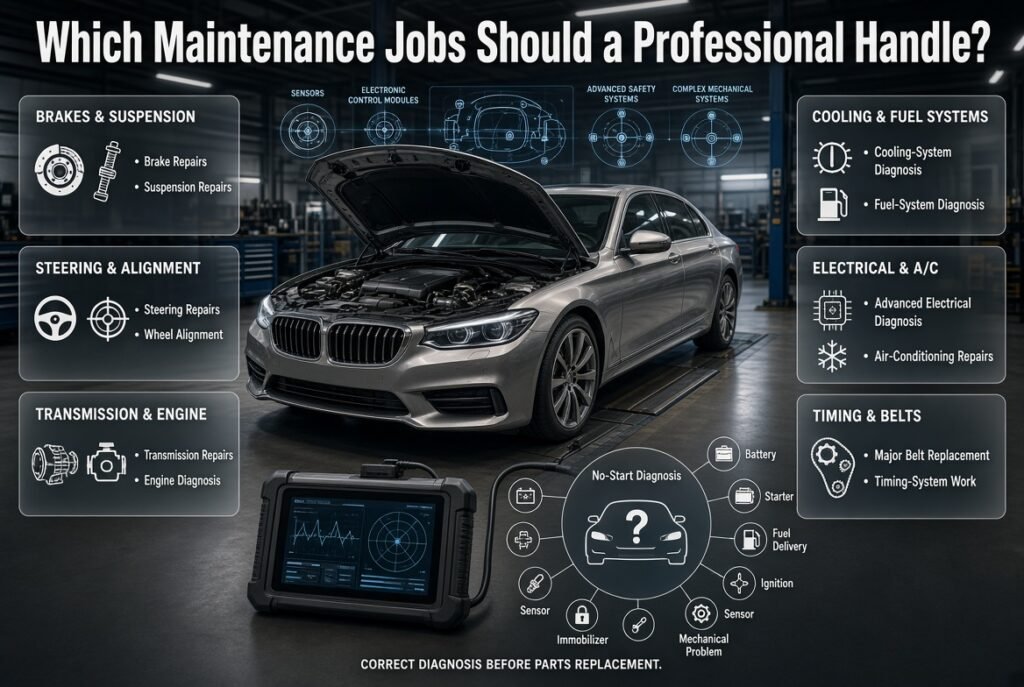
Professional assistance is appropriate for many complex or safety-critical tasks.
These include:
- Brake repairs
- Suspension repairs
- Steering repairs
- Wheel alignment
- Transmission repairs
- Engine diagnosis
- Cooling-system diagnosis
- Fuel-system diagnosis
- Advanced electrical diagnosis
- Air-conditioning repairs
- Diagnostic-system faults
- Major belt replacement
- Timing-system work
Modern cars contain sensors, electronic control modules, advanced safety systems, and complex mechanical systems.
A wrong diagnosis can create additional problems.
For example, a vehicle that won’t start could have a weak battery, starter problem, fuel-delivery issue, ignition problem, sensor fault, immobilizer issue, or another mechanical problem.
Replacing the battery without diagnosis may not solve the actual problem.
How Does Dubai Driving Affect a Car Maintenance Schedule?
Driving conditions matter.
In Dubai, vehicles can experience:
- High ambient temperatures
- Heavy air-conditioning use
- Traffic congestion
- Frequent stop-and-go driving
- Long highway journeys
- Dust
- Extended periods of idling
- High road temperatures
These conditions don’t mean every car automatically needs more frequent servicing than the manufacturer specifies.
They do mean certain components deserve careful attention.
Battery
Heat can contribute to battery deterioration.
Tyres
Tyre pressure changes with temperature, and high road temperatures place additional demands on tyres.
Cooling System
The cooling system must effectively remove engine heat.
Air Conditioning
Frequent air-conditioning use makes the system particularly important for everyday comfort.
Filters
Dusty conditions can make filter inspection worthwhile.
Brakes
Heavy urban traffic means frequent braking and repeated stop-and-go operation.
Seasonal and environmental inspections can complement the manufacturer’s normal service schedule.
Can Poor Maintenance Increase Fuel Consumption?
Yes, vehicle condition can influence fuel efficiency.
Maintenance isn’t the only factor affecting fuel consumption, but mechanical problems and incorrect tyre pressure can contribute to inefficient operation.
Areas worth monitoring include:
- Tyre pressure
- Engine oil
- Air filter
- Spark plugs where applicable
- Fuel system
- Brakes
- Wheel alignment
- Sensors
- Cooling system
- Transmission
Correct maintenance should be based on the manufacturer’s requirements rather than internet claims that a particular replacement is a universal fuel-saving trick.
Driving behaviour matters too.
Smooth acceleration, sensible speeds, avoiding unnecessary idling, and reducing unnecessary vehicle weight can also influence fuel consumption.
This is why maintenance and driving habits should be considered separately but together.
How Does Tyre Maintenance Fit Into a Car Maintenance Schedule?
Tyres deserve more attention than many drivers give them.
They’re the vehicle’s contact point with the road, so their condition influences:
- Grip
- Braking
- Steering
- Stability
- Ride quality
- Tyre life
- Fuel efficiency
Check tyre pressure regularly and before long journeys.
Also inspect for:
- Uneven wear
- Cracks
- Bulges
- Sidewall damage
- Punctures
- Embedded objects
If one tyre repeatedly loses pressure, find the cause.
For more detailed information about the connection between tyre pressure and fuel efficiency, see Tire Pressure and Fuel Efficiency.
What Should You Check Before a Long Road Trip?
A long trip deserves more than a quick glance at the fuel gauge.
Ideally, check the vehicle before the journey rather than discovering a problem halfway through it.
Pre-Trip Maintenance Checklist
- Check tyre pressure
- Inspect tyre tread
- Inspect sidewalls
- Check spare tyre or repair kit
- Check engine oil
- Check coolant
- Check washer fluid
- Inspect brakes
- Check battery condition
- Test lights
- Check wipers
- Check warning lights
- Check air conditioning
- Confirm fuel level
- Review scheduled maintenance
- Remove unnecessary weight
Also check whether your next service is due during the trip.
If it is, completing the service before travelling may be more convenient than trying to manage it during the journey.
A long-distance fuel-efficiency guide also recommends checking tyres, fluids, brakes, battery, lights, warning indicators, luggage, and unnecessary roof accessories before a major journey.
What If You Run Out of Fuel Despite Following Your Maintenance Schedule?
A maintenance schedule can reduce certain fuel-related problems, but it can’t prevent human mistakes such as misjudging the remaining range or failing to refuel.
A faulty fuel gauge can also create inaccurate expectations.
Other fuel-system problems may involve:
- Fuel filter
- Fuel pump
- Fuel delivery
- Sensors
- Electrical systems
- Engine management
If your vehicle stops because it has genuinely run out of fuel, prioritize safety first.
Move to a safe position if possible, use hazard lights, avoid standing unnecessarily in traffic, and arrange appropriate roadside assistance.
For additional guidance on handling fuel-related roadside situations, Emergency Roadside Fuel Advice explains how maintenance, fuel awareness, and roadside preparation can reduce avoidable fuel emergencies.
What Are the Most Common Car Maintenance Mistakes?
Mistake 1: Waiting for a Warning Light
A warning light is not your maintenance calendar.
Many components can wear without triggering a dashboard warning.
Better approach
Follow the manufacturer’s service schedule and perform basic inspections between services.
Mistake 2: Using a Generic Schedule
A friend may tell you to change something every 5,000 km because that’s what they do.
That doesn’t necessarily mean your vehicle needs the same interval.
Better approach
Use the vehicle-specific manufacturer’s schedule.
Mistake 3: Ignoring Small Leaks
A small leak can seem unimportant when the car still drives normally.
But the fluid could be engine oil, coolant, brake fluid, transmission fluid, or another substance.
Better approach
Identify unexplained fluid loss instead of simply cleaning it up and ignoring it.
Mistake 4: Replacing Parts Without Diagnosis
A symptom doesn’t automatically identify the failed component.
A starting problem, for example, doesn’t automatically mean the battery is bad.
Better approach
Diagnose first and replace second.
Mistake 5: Ignoring Tyre Pressure
Tyre pressure gradually changes.
Temperature changes can also affect pressure.
Better approach
Check regularly using a reliable pressure gauge and follow the manufacturer’s recommendation.
Mistake 6: Overfilling Fluids
More isn’t always better.
Oil, coolant, transmission fluid, and other fluids have specified operating levels.
Better approach
Use the correct fluid and correct quantity according to the manufacturer’s instructions.
Mistake 7: Forgetting Time-Based Maintenance
Some drivers focus entirely on mileage.
But a vehicle can age even when it isn’t being driven much.
Better approach
Track both time and mileage.
Mistake 8: Ignoring Small Changes in Driving Behaviour
A vehicle may not fail immediately when something begins to deteriorate.
You may first notice:
- Slight vibration
- Harder starting
- Different braking
- New noise
- Unusual smell
- Reduced cooling
- Changes in fuel consumption
Better approach
Treat changes as useful information rather than waiting for a complete failure.
How Should You Track Your Car Maintenance?
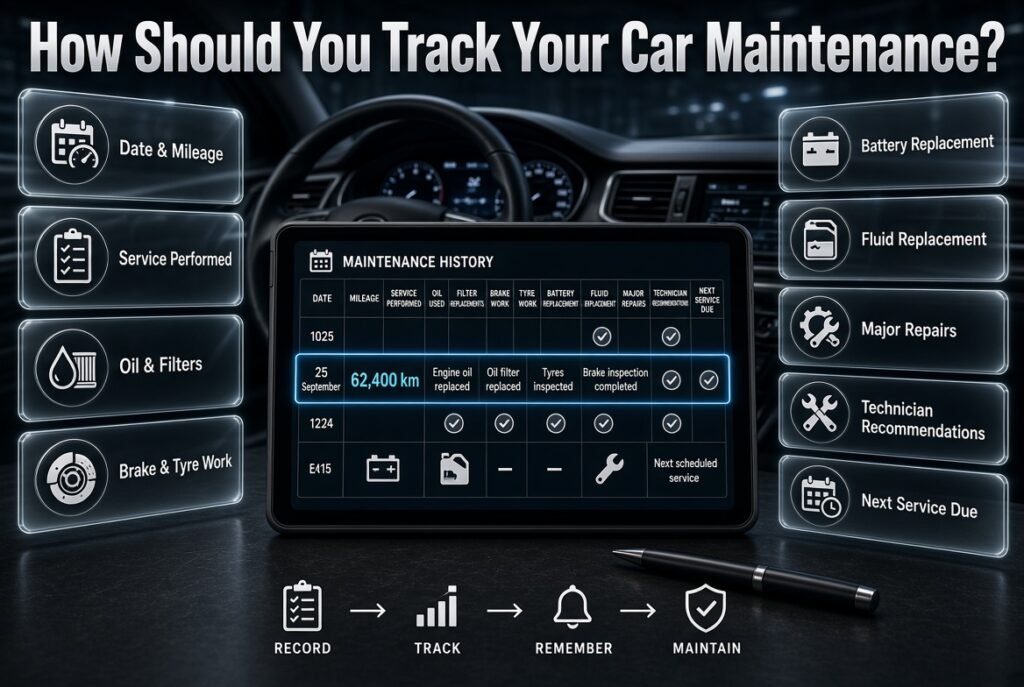
A maintenance record doesn’t need to be complicated.
Keep a simple record containing:
- Date
- Mileage
- Service performed
- Oil used
- Filter replacements
- Brake work
- Tyre work
- Battery replacement
- Fluid replacement
- Major repairs
- Technician recommendations
- Next service due
For example:
25 September — 62,400 km
- Engine oil replaced
- Oil filter replaced
- Tyres inspected
- Brake inspection completed
- Next scheduled service: according to manufacturer interval
This takes less than a minute to record but can be extremely useful later.
It prevents you from wondering, “When did I last change that?”
How Can You Build a Simple Car Maintenance Calendar?
If you’re overwhelmed by different intervals, simplify them.
Create four categories.
Category 1: Regular Checks
Every few weeks:
- Tyres
- Lights
- Warning lights
- Visible leaks
- Washer fluid
Category 2: Monthly Checks
Once a month:
- Engine oil
- Coolant
- Battery
- Wipers
- Tyres
- General vehicle condition
Category 3: Scheduled Services
According to the manufacturer:
- Engine oil
- Filters
- Brakes
- Fluids
- Spark plugs
- Transmission service
- Belts
- Other specified components
Category 4: Pre-Trip Checks
Before long journeys:
- Tyres
- Spare tyre
- Brakes
- Fluids
- Battery
- Lights
- Wipers
- Air conditioning
- Fuel
- Warning lights
This approach is much easier to follow than trying to remember every maintenance item individually.
How Should You Handle an Overdue Car Service?
If you’ve missed a service, don’t assume that the vehicle is immediately damaged.
First determine:
- What service was missed?
- How far past the recommended interval are you?
- What does the manufacturer require?
- Are there any warning signs?
- What is the current mileage?
- What maintenance has already been completed?
Then arrange the overdue service.
If multiple services have been missed, a more comprehensive inspection may be appropriate.
Don’t try to compensate by replacing random parts.
The goal is to identify what is actually due and what condition the vehicle is currently in.
How Should You Maintain an Older Car?
Older vehicles require more attention to condition and history.
Mileage remains important, but it isn’t the only factor.
Consider:
- Vehicle age
- Mileage
- Service history
- Previous repairs
- Fluid leaks
- Battery age
- Tyre age
- Suspension wear
- Cooling-system condition
- Belts and hoses
- Previous accident repairs
An older vehicle with consistent maintenance records can be in better condition than a younger vehicle that has been neglected.
For older cars, the maintenance record becomes particularly valuable because it tells you what has already been replaced.
What Maintenance Should Never Be Ignored?
Some problems are more urgent than ordinary scheduled maintenance.
Do not treat the following as routine inconveniences:
- Major brake problems
- Severe overheating
- Steering problems
- Significant fluid leaks
- Smoke
- Strong fuel smell
- Serious loss of power
- Severe vibration
- Repeated engine stalling
- Critical warning lights
If continuing to drive could create a safety risk or cause major damage, stop when it is safe to do so and seek appropriate assistance.
Maintenance is not only about protecting the car.
It’s also about protecting the people inside and around it.
Car Maintenance Decision Guide
| What You Notice | What to Do |
|---|---|
| Low tyre pressure | Correct pressure and investigate repeated pressure loss |
| Tyre bulge or serious damage | Seek professional tyre assistance |
| Brake vibration | Have the braking system inspected |
| Soft brake pedal | Treat as a safety issue and seek professional assessment |
| Repeated coolant loss | Investigate the cooling system |
| Battery repeatedly goes flat | Test battery and charging system |
| New fluid leak | Identify and investigate |
| Severe engine noise | Avoid unnecessary driving and seek assessment |
| Persistent warning light | Check the meaning and arrange diagnosis |
| Scheduled service due | Follow manufacturer maintenance requirements |
| Vehicle behaves differently after refueling | Report timing and symptoms during diagnosis |
Expert Tips for a Better Car Maintenance Routine
Keep the Owner’s Manual Accessible
You shouldn’t have to guess:
- Oil specification
- Tyre pressure
- Fluid type
- Service interval
- Maintenance requirements
Keep the manual available digitally or physically.
Learn Your Vehicle’s Normal Behaviour
You don’t need to be a mechanic.
Simply learn what normal sounds, steering feel, braking, starting, and engine behaviour are like.
Changes become easier to notice when you know what normal feels like.
Don’t Chase Every Internet Maintenance Trick
The internet contains useful information, but it also contains generic advice that may not apply to your car.
If someone says, “Every car needs this every 10,000 km,” verify it.
Your vehicle may have different requirements.
Diagnose Before Spending Money
If a component fails, understand the cause before buying replacement parts.
This is especially important with:
- Batteries
- Alternators
- Starters
- Sensors
- Fuel pumps
- Ignition components
- Cooling-system parts
Replacing parts randomly can become expensive.
Keep Emergency Equipment Ready
Maintenance reduces risk, but it doesn’t eliminate unexpected problems.
For long journeys, consider carrying appropriate emergency equipment such as:
- Phone
- Charging cable
- Power bank
- Flashlight
- Reflective equipment
- Basic first-aid supplies
- Warning equipment
- Water
- Tyre repair equipment where appropriate
The exact equipment should suit the vehicle and journey.
How Often Should a Car Be Serviced?
A car should be serviced according to the manufacturer’s recommended mileage and time intervals, rather than following one universal schedule. The correct interval depends on the vehicle’s make, model, engine, transmission, age, and how it is driven. Some vehicles may have longer service intervals, while vehicles used in heavy traffic, frequent short trips, extreme temperatures, or other demanding conditions may require additional attention.
It’s also important to understand that a service interval doesn’t mean you should ignore the vehicle until that exact date or mileage. Regular checks between services can identify low fluid levels, tyre problems, battery weakness, leaks, or unusual symptoms before they become larger issues.
Important points to remember:
Follow the maintenance schedule in your owner’s manual.
Track both mileage and time.
Check whether your vehicle has a separate severe-driving schedule.
Don’t ignore warning lights or new symptoms between services.
Keep a record of completed maintenance and the next service due.
What Should Be Included in a Regular Car Maintenance Schedule?
A proper maintenance schedule should cover more than just an engine oil change. Routine maintenance normally includes inspection and, where required, servicing of the engine, tyres, brakes, fluids, battery, filters, lights, suspension, steering, and other vehicle systems. The exact items depend on the manufacturer’s recommended service interval.
A good maintenance schedule also separates regular checks from scheduled replacement work. For example, tyre pressure may need frequent checking, while spark plugs, transmission fluid, coolant, or certain belts may have much longer replacement intervals.
A practical maintenance schedule may include:
Engine oil and oil filter
Tyre pressure and tyre condition
Brake inspection
Battery condition
Coolant and other fluid levels
Engine and cabin air filters
Wipers and lights
Suspension and steering
Belts and hoses
Spark plugs where applicable
Transmission service where specified
Manufacturer-recommended inspections
Is Car Maintenance Based on Mileage or Time?
Car maintenance is usually based on both mileage and time. A vehicle may need certain maintenance after reaching a specific number of kilometres, while other items may have a time-based interval even if the vehicle has travelled very little.
This is particularly important for drivers who don’t use their cars frequently. Low mileage doesn’t mean the vehicle can be left without maintenance for years. Batteries, tyres, fluids, rubber components, and other parts can age even when the odometer barely changes.
For example, a car that has travelled only a few thousand kilometres in a year may still require its scheduled annual inspection or other time-based maintenance.
When planning your maintenance schedule, consider:
Current mileage
Date of the last service
Vehicle age
Previous maintenance history
Driving conditions
Manufacturer’s time-based recommendations
Manufacturer’s mileage-based recommendations
Professional advice: If the mileage interval and time interval are both listed by the manufacturer, don’t automatically choose the one that seems more convenient. Follow the applicable requirement specified for your vehicle.
What Happens If You Don’t Follow Your Car Maintenance Schedule?
Skipping scheduled maintenance can allow small problems to develop without being noticed. The consequences depend on which maintenance was missed, how long it was delayed, and the condition of the vehicle. In some cases, the result may simply be reduced performance or accelerated wear. In others, neglected maintenance can contribute to expensive repairs or a roadside breakdown.
For example, ignoring a low coolant level may allow a cooling-system problem to progress, while neglecting worn tyres or brake components can create a more immediate safety concern. Similarly, repeatedly ignoring battery symptoms can leave a driver dealing with a no-start situation at an inconvenient time.
Common consequences of neglected maintenance include:
Increased component wear
Reduced reliability
Poorer vehicle performance
Higher repair costs
Reduced tyre life
Cooling-system problems
Battery or starting problems
Brake or suspension issues
Unexpected roadside breakdowns
The best approach isn’t to panic if you’ve missed one service. Instead, identify what was due, determine how overdue it is, and arrange the appropriate inspection or service. If several services have been missed, a comprehensive vehicle assessment can help establish what needs attention first.
Does Hot Weather Affect a Car Maintenance Schedule?
Hot weather can place additional demands on several vehicle systems, although it doesn’t automatically mean every car needs a completely different service interval. In hot climates such as Dubai, drivers should pay particular attention to battery condition, tyres, cooling systems, engine oil, air conditioning, and fluid levels, while still following the manufacturer’s official maintenance schedule.
High temperatures combined with heavy traffic and frequent air-conditioning use can create demanding operating conditions. Dust and prolonged driving can also make regular inspection important. Tyre pressure should be monitored because pressure changes with temperature, while the cooling system needs to remain in good condition to manage engine heat.
For hot-weather driving, pay particular attention to:
Tyre pressure and tyre condition
Battery performance
Coolant level and cooling-system condition
Engine oil
Air-conditioning performance
Air filters
Belts and hoses
Brake condition
Warning lights and temperature readings
Professional advice: Don’t automatically shorten every service interval just because the weather is hot. Instead, check your manufacturer’s recommendations and identify whether your driving conditions qualify as severe service. Additional inspections may be more appropriate than unnecessary parts replacement.
Conclusion
A proper car maintenance schedule is not simply a list of service dates or mileage numbers. It is a practical system for keeping your vehicle safe, reliable, efficient, and ready for everyday driving. Regular servicing helps you identify worn parts, fluid issues, tyre problems, battery weakness, brake wear, and other developing faults before they turn into expensive or inconvenient repairs.
The most important point is to follow your vehicle manufacturer’s recommended service intervals while also considering how, where, and how often you drive. Mileage matters, but time matters too. A car that covers fewer kilometres can still need regular maintenance because fluids, batteries, tyres, rubber components, and other parts can deteriorate with age.
For Dubai drivers, regular maintenance can be especially important because high temperatures, heavy traffic, frequent air-conditioning use, dusty conditions, and long-distance highway driving can place additional demands on a vehicle. Keeping up with routine inspections and preventive maintenance can help reduce unexpected breakdowns and maintain more consistent vehicle performance.
A simple approach works best: check the basics regularly, follow the manufacturer’s service schedule, deal with warning signs early, and keep a record of completed maintenance. When routine care becomes part of your driving routine rather than something you do only after a problem appears, your vehicle is much easier to manage in the long term.
Ultimately, good car maintenance is about prevention rather than reaction. Spending a little time and attention on your vehicle today can help you avoid larger repair problems tomorrow, improve driving confidence, and keep your car dependable for the years ahead.
Leave a Reply