
Introduction
Vehicle Emergency Checklist for Long Trips | A long road trip can be enjoyable until a small vehicle problem suddenly turns into a roadside emergency. A flat tyre, weak battery, empty fuel tank, overheating engine, damaged wiper, or unexpected warning light can leave you stranded when you are far from home or travelling through an unfamiliar area.
That is why a proper vehicle emergency checklist for long trips should be prepared before you leave, not after something goes wrong.
If you’re travelling around Dubai or preparing for a longer UAE journey, keeping your vehicle ready is especially important because your route may include busy urban roads, highways, interchanges, and long stretches where stopping safely requires careful planning. Fuel Delivery Dubai can also be useful to keep in mind as part of your roadside emergency planning if an unexpected fuel shortage becomes a problem during your journey.
A good emergency checklist isn’t simply a bag of tools in the boot. It combines vehicle inspection, fuel planning, tyre preparation, emergency equipment, communication, documents, passenger needs, and a clear plan for what to do if the vehicle actually stops.
This guide explains what to check before a long trip, what to carry in your emergency kit, how to prepare for fuel-related problems, what to do during a breakdown, and which mistakes can make a manageable situation much more difficult.
What Is a Vehicle Emergency Checklist for Long Trips?
A vehicle emergency checklist is a practical list of vehicle checks, safety equipment, supplies, documents, and emergency procedures that you prepare before starting a long journey.
The purpose is simple: reduce preventable problems and make unexpected problems easier to manage.
A useful checklist should cover five areas:
- Vehicle condition
- Emergency equipment
- Fuel and range planning
- Driver and passenger safety
- Breakdown and communication procedures
The checklist should be completed before departure rather than while you’re already travelling.
For example, discovering that your spare tyre has no usable pressure after a puncture is not useful preparation. Finding it the evening before your trip gives you time to fix the problem.
Why Should You Prepare Your Vehicle Before a Long Trip?
Long-distance driving places more continuous demands on a vehicle than a short local journey. You may drive for several hours without returning home, passing your normal workshop, or having easy access to replacement equipment.
A minor weakness that isn’t obvious during everyday driving can become noticeable during a long trip.
Examples include:
- An underinflated tyre becoming hotter during extended driving
- An ageing battery failing after repeated starts
- Low coolant contributing to overheating
- Worn wiper blades becoming a problem during poor visibility
- A low fuel level becoming risky when traffic or route changes increase the distance
- Loose luggage becoming a safety issue
- A warning light being ignored until the vehicle develops a larger problem
Preparation doesn’t guarantee that nothing will go wrong. Instead, it improves your ability to identify problems early and respond safely.
Long Trip Vehicle Emergency Checklist
Before leaving, work through this quick checklist:
Vehicle condition
- Engine oil checked
- Coolant level checked
- Brake fluid checked where appropriate
- Windshield washer fluid topped up
- Tyre pressure checked
- Spare tyre checked
- Tyre tread inspected
- Battery condition considered
- Headlights working
- Brake lights working
- Indicators working
- Hazard lights working
- Wipers working
- Mirrors clean and correctly adjusted
- Brakes feel normal
- No unusual engine noises
- No warning lights requiring attention
Emergency equipment
- Phone
- Charging cable
- Power bank
- Flashlight
- Spare batteries if required
- First-aid kit
- Reflective equipment
- Warning triangle where appropriate
- Jumper cables or suitable jump starter
- Tyre pressure gauge
- Jack
- Wheel spanner
- Gloves
- Basic tools
- Water
- Drinking supplies
- Basic non-perishable food for longer journeys
Journey preparation
- Route checked
- Fuel stops identified
- Weather checked
- Traffic conditions considered
- Vehicle documents available
- Insurance/roadside assistance information available
- Important contact numbers saved
- Someone knows your planned route for remote journeys
This checklist is not meant to be carried out mechanically without thinking. If something doesn’t look or feel normal, investigate it before leaving.
Check the Tyres Before a Long Journey
Tyres deserve special attention because they are your vehicle’s direct contact with the road.
Before a long trip, inspect all four tyres and don’t forget the spare. Check pressure according to the vehicle manufacturer’s recommended specification rather than simply using a number printed on the tyre sidewall.
Look for:
- Uneven tread wear
- Cuts
- Bulges
- Cracks
- Embedded objects
- Low pressure
- Visible damage
- Excessively worn tread
The spare tyre should also be ready for use. A spare that has been sitting in the boot for months without inspection isn’t automatically reliable.
Don’t Forget the Wheel Equipment
Check that your vehicle actually contains the equipment required to change a wheel.
Depending on the vehicle, this may include:
- Jack
- Wheel spanner
- Locking wheel-nut key
- Spare tyre
- Tow hook
- Gloves
Some modern vehicles don’t have a conventional spare wheel. They may use a repair kit or tyre inflation system instead.
Know which system your vehicle uses before the journey.
If you don’t know how to use it, read the owner’s manual before leaving.
Check Engine Oil and Other Fluids
Fluid checks are another important part of your long-trip vehicle emergency checklist.
Check the fluids specified by your vehicle manufacturer, including:
- Engine oil
- Coolant
- Brake fluid
- Windshield washer fluid
- Other vehicle-specific fluids
Don’t open a hot cooling system simply because you want to check coolant immediately after driving. Allow the vehicle to cool as required and follow the manufacturer’s instructions.
Also look beneath the vehicle for signs of fresh fluid leakage.
A small leak before a trip deserves attention because a longer journey may turn a minor leak into a serious mechanical problem.
Why Coolant Matters on Long Trips
Engine cooling becomes particularly important during prolonged driving.
If your vehicle has been showing signs of overheating, losing coolant, producing steam, or displaying a temperature warning, don’t treat the issue as something that can simply be ignored until after the trip.
Long-distance driving is not the right time to test whether an existing overheating problem will disappear by itself.
Check the Battery Before Departure
A vehicle battery can fail without giving the driver much warning.
Before a long trip, consider:
- Battery age
- Starting performance
- Visible corrosion
- Loose terminals
- Previous starting problems
- Any recent jump-starts
If the vehicle has recently needed assistance to start, investigate the reason before leaving.
A jump starter or jumper cables can be useful emergency equipment, but they don’t replace proper battery diagnosis.
Check the Brakes
Brakes are one of the systems you should never compromise on before a long journey.
Pay attention to:
- Unusual squealing or grinding
- Vibrations while braking
- Pulling to one side
- A soft or unusual pedal
- Brake warning lights
- Changes in stopping behaviour
If braking performance has changed, have the vehicle inspected before a long trip.
Don’t rely on the emergency kit to solve a mechanical problem that requires professional repair.
Inspect Lights, Indicators and Visibility Equipment
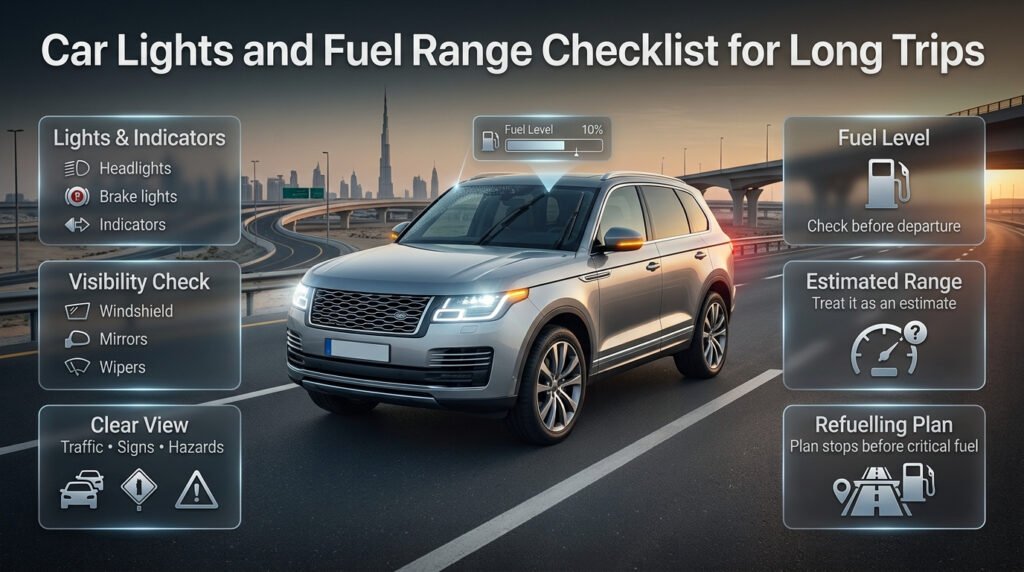
Before departure, test:
- Headlights
- High beams
- Brake lights
- Indicators
- Hazard lights
- Reverse lights
- Fog lights where fitted
Also inspect the windshield and mirrors.
Replace damaged or ineffective wiper blades before travelling if they are leaving large areas uncleared.
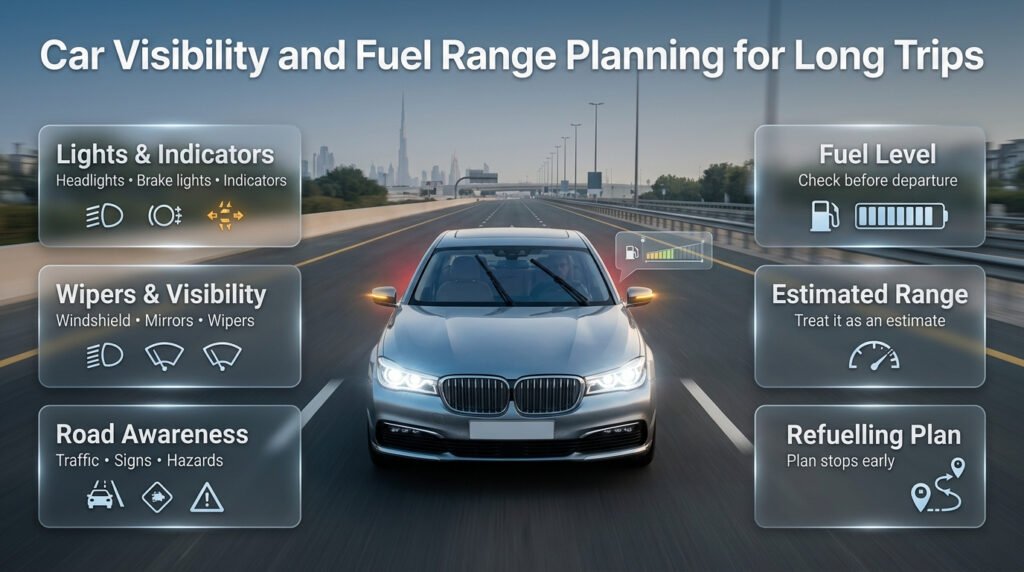
Good visibility is not an optional comfort feature during a long journey. It directly affects how quickly you can identify traffic, obstacles, signs and hazards.
Check Your Fuel Level and Remaining Range
Fuel planning should be part of your emergency preparation, not something you think about only when the fuel warning light appears.
Before leaving:
- Know your current fuel level.
- Know the approximate fuel range shown by your vehicle.
- Identify suitable refuelling opportunities.
- Consider traffic and detours.
- Avoid assuming the displayed range is a guaranteed distance.
- Refuel before your fuel situation becomes critical.
Your displayed range is an estimate, not a promise.
If you want a deeper explanation of this subject, see Understanding Vehicle Fuel Range.
For a more specific look at the dashboard reading, How Accurate Is a Car Fuel Gauge? explains why the gauge and remaining-range estimate shouldn’t be treated as perfectly precise.
You can also use How to Estimate Remaining Fuel Range in Dubai when planning longer drives.
Don’t Wait Too Long After the Low Fuel Warning
A low-fuel warning is an instruction to pay attention, not a target.
The distance remaining after the warning can vary depending on:
- Vehicle model
- Fuel tank design
- Driving style
- Traffic
- Speed
- Road gradient
- Air-conditioning use
- Vehicle load
- Fuel consumption
Low Fuel Warning Light Meaning in Dubai provides more context about what the warning means.
If you’re already driving on low fuel, How Far Can a Car Drive on Low Fuel in Dubai? can help you understand why the remaining distance should be treated cautiously.
The safest strategy is still simple: don’t plan a long trip around the assumption that you can drive until the tank is almost empty.
Carry the Right Emergency Communication Equipment
A vehicle emergency kit is much less useful if you can’t communicate when something happens.
At minimum, keep your phone charged before departure.
Consider carrying:
- Phone charging cable
- Vehicle charger
- Power bank
- Backup charging option
- Important phone numbers
- Roadside assistance details
- Insurance information
For longer or remote journeys, don’t depend on one method of communication if a second option is practical.
Before leaving, make sure you know how to describe your location.
A useful location description can include:
- Road name
- Direction of travel
- Exit number
- Nearby landmark
- Service road
- Junction
- Parking area
- Recognisable building
This information can make assistance easier to coordinate.
Keep a First-Aid Kit in the Vehicle
A first-aid kit is one of the most practical items to keep in a vehicle.
A basic kit may include suitable supplies for minor injuries, such as:
- Adhesive bandages
- Sterile dressings
- Antiseptic supplies
- Medical tape
- Disposable gloves
- Scissors
- Basic personal medicines where appropriate
The kit should be checked periodically.
Don’t keep expired or damaged supplies and assume they will be useful in an emergency.
For families, also consider whether the kit meets the needs of children or anyone travelling with specific personal requirements.
Carry a Flashlight
A flashlight becomes extremely useful when a problem happens after dark.
It can help you:
- Inspect a tyre
- Find equipment in the boot
- Read labels
- Locate a safe place to stand
- Signal your position
- Inspect the immediate surroundings
A small rechargeable flashlight can be useful, but make sure it is charged before leaving.
A backup light or spare batteries can be useful on longer journeys.
Jumper Cables or a Portable Jump Starter
A weak or discharged battery is one of the common reasons a vehicle may fail to start.
Depending on your vehicle and your level of familiarity with the equipment, consider carrying:
- Jumper cables
- A compatible portable jump starter
If using jumper cables, understand the correct connection procedure for your specific vehicle.
Modern vehicles may have special jump-start points or battery-management systems, so don’t guess.
Check the owner’s manual.
A portable jump starter can also have limitations. It needs to be charged, rated appropriately for your vehicle, and stored according to its instructions.
Carry Basic Tyre Equipment
Your long-trip emergency kit should support basic tyre problems where appropriate.
Useful equipment can include:
- Tyre pressure gauge
- Jack
- Wheel spanner
- Spare wheel or manufacturer-approved repair kit
- Gloves
- Small work light
Don’t assume that carrying a jack means you’re prepared.
Make sure you know where the vehicle’s proper jacking points are and understand the procedure.
If changing the tyre would place you dangerously close to moving traffic, prioritise safety and professional assistance instead of attempting the repair yourself.
Warning Triangle and Visibility Equipment
Visibility is especially important when a vehicle becomes disabled.
Suitable warning equipment can help alert approaching road users, but it must be used in accordance with local rules and only where it is safe to deploy.
Reflective equipment can also improve your visibility.
The important principle is this:
Never put yourself in danger simply to place warning equipment.
If traffic is moving quickly around your vehicle, getting out and walking behind the car may be more dangerous than staying in a protected position and contacting assistance.
Carry Water and Basic Supplies
Water is useful for both routine travel and unexpected delays.
For longer trips, consider carrying:
- Drinking water
- Non-perishable snacks
- Tissues
- Paper towels
- Basic hygiene supplies
- Suitable personal medication
- Extra drinking supplies for passengers
The exact quantity depends on trip length, weather, passengers and route.
In hot conditions, preparation becomes even more important because a short delay can become uncomfortable quickly.
Don’t Overload the Vehicle
Emergency preparation doesn’t mean filling the boot with every tool you own.
Extra weight can affect:
- Handling
- Braking
- Fuel consumption
- Available boot space
- Vehicle balance
Carry equipment that has a genuine purpose.
If you’re travelling with luggage, distribute the load securely and avoid blocking visibility.
A heavy or poorly secured load can create a different type of emergency.
Review Your Driving and Fuel-Saving Habits
Emergency preparedness also includes reducing unnecessary fuel consumption.
A vehicle that uses fuel efficiently gives you more flexibility when traffic, detours or unexpected delays occur.
You can review Fuel Saving Driving Tips before a long trip.
Smooth driving also matters. Smooth Driving Techniques for Better Fuel Economy explains how unnecessary aggressive acceleration and inconsistent driving can affect fuel use.
Another useful resource is How Acceleration Affects Fuel Consumption, particularly if your journey involves frequent speed changes.
Braking habits matter as well. How Braking Habits Affect Fuel Economy in Dubai can help you understand the relationship between traffic awareness, braking and fuel efficiency.
Maintain a Sensible Highway Speed
Higher speed can increase fuel consumption, while constantly changing speed can also reduce efficiency.
For longer highway journeys, see Optimal Driving Speed for Fuel Efficiency in Dubai.
The goal isn’t to drive unnaturally slowly. The goal is to maintain a legal, controlled and appropriate speed for road, traffic and weather conditions.
For more highway-specific guidance, Highway Driving Fuel Efficiency and Fuel-Efficient Highway Driving provide useful preparation points.
Plan for Traffic and Delays
A journey that normally takes two hours can take considerably longer when traffic, roadworks, incidents or route changes occur.
That matters for emergency planning because your fuel range is affected by how long the engine operates.
Stop-and-go driving can increase fuel use compared with steady driving conditions.
If your trip passes through congested areas, review:
- How Traffic Affects Fuel Economy in Dubai
- Stop-and-Go Driving Fuel Efficiency
- How to Reduce Fuel Use in Traffic
These aren’t just fuel-saving topics. They also help you understand why your actual range may be lower than expected during a difficult journey.
Don’t Ignore Idling
Extended idling consumes fuel without moving the vehicle.
In traffic or while waiting, drivers sometimes underestimate how much time the engine spends running.
For additional information, see Fuel Consumption While Idling and Car Idling Fuel Consumption in Dubai.
This becomes particularly relevant when you’re already operating with limited fuel.
If you’re delayed in traffic, avoid unnecessary engine operation where doing so is safe, legal and appropriate for the circumstances.
Prepare the Vehicle for Long Highway Driving
A long highway journey deserves more preparation than simply filling the tank.
Before departure, consider:
- Tyre condition
- Tyre pressure
- Spare tyre
- Engine fluids
- Battery
- Brakes
- Lights
- Wipers
- Fuel range
- Emergency equipment
- Route
- Weather
- Rest stops
For additional planning, review Improving Fuel Economy on Long Trips and Long-Distance Driving Fuel Efficiency Tips.
The purpose is not to make your preparation complicated. It’s to make sure obvious problems are dealt with before the journey begins.
Consider Vehicle Weight and Roof Accessories
Luggage affects how your vehicle behaves and how much fuel it consumes.
Avoid carrying unnecessary items simply because there is room in the boot.
You can read How Vehicle Weight Affects Fuel Economy for a deeper explanation.
The same principle applies to the way luggage is arranged. Car Load and Fuel Consumption covers the relationship between load and efficiency.
If you use a roof rack, roof box or other external equipment, aerodynamic drag can become relevant.
See Roof Racks and Fuel Economy and Vehicle Accessories and Fuel Economy in Dubai.
You can also review How Aerodynamics Affects Fuel Efficiency and Vehicle Drag and Fuel Consumption in Dubai when preparing for a longer highway journey.
Check Air Conditioning Before a Long Dubai Trip
Air conditioning is particularly important during hot-weather travel.
Before departure, make sure the system is functioning normally.
Look for:
- Weak cooling
- Unusual smells
- Unusual noises
- Poor airflow
- Electrical issues
- Signs of an existing problem
A faulty cooling system can make a long journey uncomfortable, but more importantly, an unrelated mechanical issue should not be confused with normal air-conditioning behaviour.
Keep the cabin comfortable while also avoiding unnecessary fuel waste.
Make Sure Your Documents Are Ready
Your emergency preparation should include the documents and information you may need if something goes wrong.
Depending on your circumstances, keep access to:
- Driving licence
- Vehicle registration information
- Insurance information
- Roadside assistance details
- Vehicle identification information
- Emergency contacts
- Important medical information where appropriate
Digital copies can be useful, but don’t rely exclusively on a phone that could lose battery power.
Keep essential information accessible.
Save Your Roadside Assistance Details
Don’t wait until you’re stranded to search for a roadside assistance number.
Save relevant contacts before leaving.
Your emergency contact list can include:
- Roadside assistance provider
- Insurance provider
- Vehicle manufacturer assistance where applicable
- Family or trusted contact
- Local emergency services
- Fuel delivery service
For fuel-related emergencies, it’s useful to understand your options before the tank becomes completely empty.
What Should You Do If the Vehicle Breaks Down?
If the vehicle develops a serious problem during the journey, the first priority is traffic safety, not mechanical diagnosis.
If possible:
- Reduce speed gradually.
- Move toward a safe stopping location.
- Switch on hazard lights.
- Avoid stopping where the vehicle blocks moving traffic.
- Keep passengers away from immediate traffic danger.
- Contact appropriate assistance.
- Clearly communicate your location.
For a detailed safety-focused approach, see Emergency Roadside Fuel Advice.
You can also review Roadside Breakdown Safety Tips in Dubai before a long journey.
What If You Have to Stop on a Highway?
A highway breakdown requires extra caution because vehicles may be travelling at high speed.
If the vehicle can be moved safely, position it away from active traffic as much as possible.
Use hazard lights and appropriate warning equipment where safe and permitted.
Do not stand unnecessarily beside the vehicle or walk along the highway looking for help.
For more detailed preparation, see:
- Running Out of Fuel on a Highway
- Highway Fuel Emergency Safety in Dubai
- Highway Breakdown Safety Procedures in Dubai
The key principle is simple: don’t turn a vehicle problem into a personal safety emergency.
What If the Car Runs Out of Fuel?
Running out of fuel can happen even to careful drivers.
Traffic, unexpected detours, inaccurate range assumptions, missed fuel stops or simply forgetting to refuel can all contribute.
If the engine stops because the fuel tank is empty, don’t immediately leave the vehicle and start walking toward a fuel station.
First make the situation safe.
If possible:
- Move the vehicle to a safer location.
- Turn on hazard lights.
- Stay away from moving traffic.
- Contact assistance.
- Provide your exact location.
- Confirm whether the vehicle requires petrol or diesel.
For a detailed overview, see What to Do When Your Car Runs Out of Fuel.
You can also review Car Ran Out of Fuel Safety in Dubai for additional roadside precautions.
Safely Deal With an Empty Fuel Tank
An empty tank creates a practical problem, but unsafe decisions can make the situation worse.
Don’t:
- Walk beside a high-speed road unnecessarily.
- Stand behind the vehicle in an active traffic lane.
- Accept fuel from an unknown source without considering safety.
- Guess whether the vehicle needs petrol or diesel.
- Continue attempting to start the engine repeatedly.
- Leave passengers exposed to traffic.
Instead, get assistance and clearly explain the situation.
Safely Dealing With an Empty Fuel Tank in Dubai provides a dedicated guide for this situation.
If you need to understand the immediate sequence after running out, Steps After Running Out of Petrol can be useful.
For broader roadside situations, Running Out of Fuel on the Road covers the safety considerations when the vehicle stops unexpectedly.
What If the Car Stops Because of an Empty Tank?
When a vehicle stops because the tank is empty, avoid repeatedly turning the engine over.
The immediate priorities are:
Vehicle safety → passenger safety → visibility → communication → fuel assistance
This order matters.
A driver may become focused on getting the engine running again and forget that the vehicle is positioned in an unsafe location.
Car Stops Due to Empty Fuel Tank provides further information about this specific situation.
Build a Practical Road Trip Emergency Kit
A good emergency kit should be practical rather than excessive.
A useful kit can be divided into four groups.
Group 1: Vehicle equipment
- Tyre pressure gauge
- Jack
- Wheel spanner
- Spare tyre or approved repair kit
- Jumper cables
- Portable jump starter
- Basic tools
- Work gloves
- Flashlight
Group 2: Safety equipment
- Warning triangle where appropriate
- Reflective equipment
- First-aid kit
- Phone
- Power bank
- Charging cable
Group 3: Personal supplies
- Drinking water
- Non-perishable snacks
- Tissues
- Personal medication
- Basic hygiene supplies
Group 4: Information
- Driving licence
- Vehicle documents
- Insurance details
- Roadside assistance number
- Emergency contacts
- Route information
Keep the emergency equipment organised so you can find it quickly.
A flashlight buried under luggage isn’t much use when you need it immediately.
Organise the Boot Before Departure
One surprisingly common preparation mistake is poor storage.
Drivers may technically carry everything they need, but the equipment is buried beneath suitcases.
Before a long journey:
- Keep the emergency kit accessible.
- Keep the warning equipment easy to reach.
- Make sure the jack and wheel equipment can be located.
- Don’t bury the first-aid kit.
- Keep water where passengers can reach it safely.
- Secure heavy luggage.
Think about what you would need first if the car stopped unexpectedly.
That equipment should not be at the bottom of the boot.
Common Mistakes Drivers Make Before Long Trips
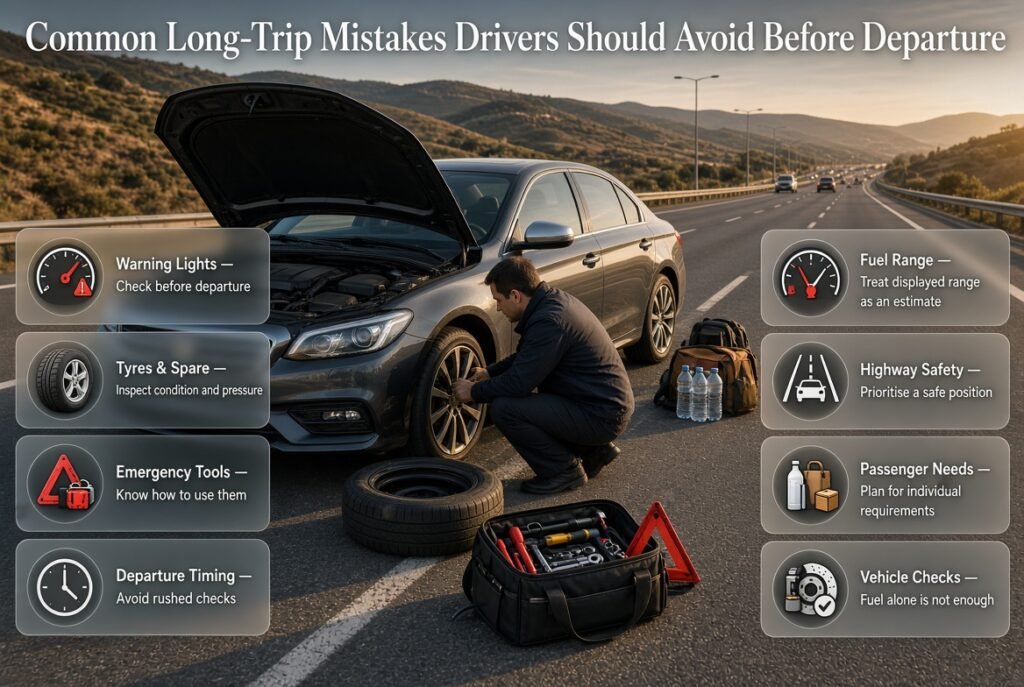
Ignoring a Warning Light
A warning light should not automatically be treated as something that can wait until after the journey.
If the vehicle is already showing a significant warning, understand what it means before driving long distance.
Checking Only the Fuel
A full tank doesn’t mean the car is road-trip ready.
You also need to consider tyres, fluids, battery, brakes, lights and emergency equipment.
Forgetting the Spare Tyre
A spare tyre can lose pressure while sitting unused.
Check it before departure.
Carrying Tools You Don’t Know How to Use
Having equipment isn’t the same as knowing how to use it.
Read your owner’s manual and understand basic emergency procedures.
Leaving Too Late
A rushed departure makes people skip checks.
Give yourself enough time to inspect the vehicle without pressure.
Overestimating Remaining Fuel Range
The displayed range can change according to driving conditions.
Don’t treat it as a guaranteed distance.
Walking Away From the Vehicle on a Highway
This can expose you to serious traffic risk.
If you’re unsure what to do, prioritise a safe position and contact assistance.
Forgetting Passenger Needs
A long journey with children, older passengers or people with specific needs requires additional planning.
Carry suitable water, food, medicines and comfort items.
Expert Advice: Think in Layers
A professional approach to emergency preparation is to think in layers rather than relying on one solution.
Layer 1: Prevent the problem
Maintain the vehicle and identify issues before departure.
Layer 2: Detect the problem early
Pay attention to warning lights, unusual sounds, smells, temperature changes and handling.
Layer 3: Reduce the consequences
Carry the correct emergency equipment.
Layer 4: Protect people
If something happens, prioritise passengers and traffic safety.
Layer 5: Get assistance
Know who to call and how to explain your location.
This approach is more useful than simply buying a large emergency kit and leaving it untouched in the boot.
Emergency Preparation for Long-Distance Driving
Long-distance preparation should also include your own condition as the driver.
Fatigue can become a serious problem during extended driving.
Before a long trip:
- Get adequate rest.
- Plan breaks.
- Avoid driving when excessively tired.
- Share driving where appropriate.
- Don’t rush because you’re behind schedule.
- Keep your attention on the road.
Your emergency checklist is not complete if the vehicle is perfectly prepared but the driver is too tired to drive safely.
What to Do During a Roadside Breakdown
A simple breakdown sequence can prevent panic.
Step 1: Stay Calm
Don’t make sudden decisions simply because the vehicle has stopped.
Assess what happened.
Step 2: Reduce Traffic Risk
If possible and safe, move to a suitable location away from active traffic.
Step 3: Use Hazard Lights
Make the vehicle more visible.
Step 4: Protect Passengers
Keep everyone away from immediate traffic danger.
Step 5: Contact Assistance
Explain:
- Your location
- Direction of travel
- Vehicle type
- Problem
- Number of passengers
- Any immediate safety concern
Step 6: Wait Safely
Don’t unnecessarily walk into traffic or attempt complicated repairs in an unsafe location.
For a more detailed procedure, see What to Do During a Roadside Breakdown.
You can also review Staying Safe During a Car Breakdown and Vehicle Breakdown Safety Procedures before travelling.
Roadside Safety Is More Important Than Saving Time
One of the biggest mistakes during an emergency is trying to solve the problem too quickly.
For example, a driver may decide to:
- Walk to a petrol station
- Stand beside the vehicle
- Change a tyre immediately
- Repair the car beside fast-moving traffic
- Ask another driver to stop
- Move around the highway unnecessarily
Saving 20 minutes isn’t worth increasing the risk to yourself or your passengers.
The better approach is to secure the situation first and solve the vehicle problem second.
For broader preparation, Roadside Vehicle Emergency Precautions is another useful resource to review.
How to Prepare the Night Before a Long Trip
The night before departure is an ideal time to complete your checklist.
Vehicle
- Check tyres.
- Check fluids.
- Check lights.
- Check fuel.
- Check battery symptoms.
- Look for leaks.
- Check the spare.
Emergency kit
- Charge your power bank.
- Test the flashlight.
- Confirm the first-aid kit.
- Check jumper equipment.
- Confirm tyre-changing equipment.
Journey
- Review the route.
- Identify refuelling opportunities.
- Check expected traffic.
- Check weather.
- Save emergency contacts.
- Tell someone your travel plan if appropriate.
Personal
- Rest properly.
- Prepare water.
- Prepare food.
- Take required medication.
- Keep essential documents accessible.
This routine can take much less time than dealing with an avoidable roadside problem later.
Quick Vehicle Emergency Checklist Before You Leave
Use this final checklist immediately before departure:
Tyres
- Pressure correct
- Tread acceptable
- No visible damage
- Spare ready
Fluids
- Oil checked
- Coolant checked
- Washer fluid available
- No obvious leaks
Electrical
- Battery starts normally
- Lights working
- Indicators working
- Hazard lights working
Safety
- First-aid kit
- Flashlight
- Reflective equipment
- Warning equipment
- Gloves
Tools
- Jack
- Wheel spanner
- Tyre gauge
- Jumper cables or jump starter
- Basic tools
Communication
- Phone charged
- Charger available
- Power bank charged
- Assistance number saved
Fuel
- Adequate starting fuel
- Refuelling points identified
- Range understood
- No dependence on the final few kilometres of estimated range
Passengers
- Water
- Food
- Personal medication
- Necessary comfort items
Journey
- Route checked
- Weather considered
- Traffic considered
- Rest stops planned
What should I check on my vehicle before a long trip?
Before starting a long trip, don’t limit your inspection to the fuel level. A proper pre-trip check should cover the systems that can leave you stranded or create a safety problem during the journey. Start with the tyres, including the spare, then check engine oil, coolant, battery condition, brakes, lights, wipers and any warning lights on the dashboard.
It’s also worth paying attention to anything that has recently changed. Unusual vibrations, strange noises, slow starting, fluid leaks or changes in braking should be investigated before travelling a long distance. A problem that seems minor during a short city drive can become much more inconvenient when you’re several kilometres away from home.
Before leaving, check:
Tyre pressure and visible tyre damage
Spare tyre or approved tyre repair equipment
Engine oil and coolant levels
Battery and starting performance
Brake behaviour
Headlights, brake lights and indicators
Wipers and windshield visibility
Dashboard warning lights
Fuel level and expected driving range
Jack, wheel spanner and basic emergency equipment
The professional approach is simple: don’t use a long trip to test an existing vehicle problem. If something doesn’t feel normal before departure, deal with it first.
What should I keep in my car emergency kit for a long road trip?
A useful car emergency kit should help you deal with common problems while also making it easier to stay safe until assistance arrives. You don’t need to fill your boot with unnecessary equipment. Instead, focus on items that have a clear purpose and that you know how to use.
A flashlight, charged phone, power bank, first-aid kit, tyre pressure gauge, jack, wheel spanner, jumper cables or a suitable jump starter, gloves and appropriate warning equipment are good starting points. For longer journeys, drinking water and basic non-perishable food can also be useful if an unexpected delay occurs.
A practical emergency kit can include:
Flashlight or rechargeable work light
Phone charging cable and vehicle charger
Fully charged power bank
First-aid kit
Tyre pressure gauge
Jack and wheel spanner
Spare tyre or manufacturer-approved repair kit
Jumper cables or compatible jump starter
Work gloves
Reflective equipment
Warning triangle where appropriate
Drinking water
Basic non-perishable snacks
Important vehicle and roadside-assistance information
One important point is accessibility. Keep essential emergency items where you can reach them without removing all your luggage. Equipment that is technically in the vehicle but buried underneath several bags isn’t much help when you need it urgently.
What should I do if my car breaks down during a long highway trip?
If your vehicle breaks down on a highway, your first priority should be traffic safety rather than diagnosing the mechanical problem. If the vehicle can still be moved safely, reduce speed gradually and move toward a safer position away from active traffic. Turn on the hazard lights and make the vehicle as visible as reasonably possible.
Once you’ve stopped, avoid unnecessary movement around the vehicle. Don’t walk along the highway looking for help or attempt a roadside repair if your position exposes you to moving traffic. Contact the appropriate roadside assistance service and provide a clear description of your location.
When requesting assistance, provide:
Road or highway name
Direction of travel
Exit or interchange number if known
Nearby landmark
Vehicle make, model and colour
Nature of the problem
Number of passengers
Any immediate safety concern
If you’re travelling through Dubai or on a major UAE highway, location accuracy can make assistance easier to coordinate. Your phone’s location information, road signs, exits and nearby landmarks can all help you describe where you’ve stopped.
The biggest mistake is allowing frustration to change your safety decisions. A breakdown may be inconvenient, but standing in an unsafe area or walking beside fast-moving traffic can create a much more serious situation.
How can I avoid running out of fuel on a long road trip?
The best way to avoid a fuel emergency is to treat fuel planning as part of the journey rather than waiting for the low-fuel warning to appear. Before leaving, consider your vehicle’s current fuel level, typical consumption, route length, available refuelling points and possible traffic or detours.
Your dashboard’s remaining-range figure should be treated as an estimate rather than a guaranteed distance. Heavy traffic, frequent acceleration, high speeds, air-conditioning use, vehicle load and changes in driving conditions can all affect actual fuel consumption.
For better fuel planning:
Start the trip with an appropriate fuel level.
Identify convenient refuelling points along the route.
Don’t deliberately drive until the tank is nearly empty.
Allow extra range for traffic and unexpected detours.
Pay attention when the low-fuel warning appears.
Don’t assume the displayed remaining range will stay constant.
Refuel before reaching a critical fuel level when practical.
If the fuel warning has already appeared, don’t treat the remaining estimated range as a challenge. Your objective should be to reach a suitable refuelling point safely, not to see how far you can continue driving.
For an even safer approach, drivers should understand how their particular vehicle’s fuel gauge and range calculation behave. This is especially useful before undertaking unfamiliar long-distance routes.
What should I do if my car runs out of fuel during a long trip?
If your car runs out of fuel, focus on getting yourself and your passengers into the safest practical situation before worrying about getting the engine running again. If the vehicle can be moved safely, position it away from active traffic and switch on the hazard lights. Avoid repeatedly trying to start the engine, as this won’t solve an empty tank and may unnecessarily drain the battery.
The next step is to arrange appropriate assistance. When contacting a fuel delivery or roadside assistance provider, clearly confirm your vehicle’s location and whether it requires petrol or diesel. Giving the correct fuel type is important because supplying the wrong fuel can create an additional vehicle problem.
When requesting fuel assistance, provide:
Exact or live location where possible
Road name
Direction of travel
Exit number or nearby landmark
Vehicle make and model
Petrol or diesel requirement
Number of passengers
Any immediate roadside safety concern
Most importantly, don’t leave the vehicle simply because a fuel station appears to be nearby. Walking along a busy road or highway can expose you to unnecessary danger, particularly in poor visibility or heavy traffic.
A fuel emergency is much easier to manage when you’ve already planned for it. Keeping your phone charged, knowing your location and having emergency assistance details available can save valuable time when the tank unexpectedly reaches empty.
Conclusion
A long journey should begin with preparation, not last-minute problem solving. A well-prepared vehicle, practical emergency kit, sufficient fuel planning, and a clear breakdown procedure can make unexpected problems much easier to manage.
Before leaving, check the tyres, fluids, brakes, battery, lights, wipers, fuel level, and spare tyre or approved repair equipment. Keep essential emergency supplies accessible, including a charged phone, power bank, flashlight, first-aid kit, tyre equipment, and suitable safety equipment. It is also important to review your route, identify refuelling opportunities, consider traffic and weather conditions, and plan appropriate rest stops.
Fuel planning deserves particular attention during long-distance travel. Avoid relying completely on the dashboard’s remaining-range estimate, especially when traffic, detours, vehicle load, air conditioning, or driving conditions may increase fuel consumption. Refuelling before the fuel level becomes critical gives you a greater safety margin.
If a breakdown or fuel emergency does occur, remember that personal safety comes before the vehicle. Move to a safer location when possible, use hazard lights, keep passengers away from moving traffic, and contact appropriate roadside assistance rather than attempting an unsafe repair.
A few minutes of preparation before departure can help prevent avoidable problems and make unexpected situations easier to handle. With a properly checked vehicle, organized emergency equipment, sensible fuel planning, and a clear safety plan, you can approach your long trip with greater confidence and better preparedness.
Leave a Reply