Introduction
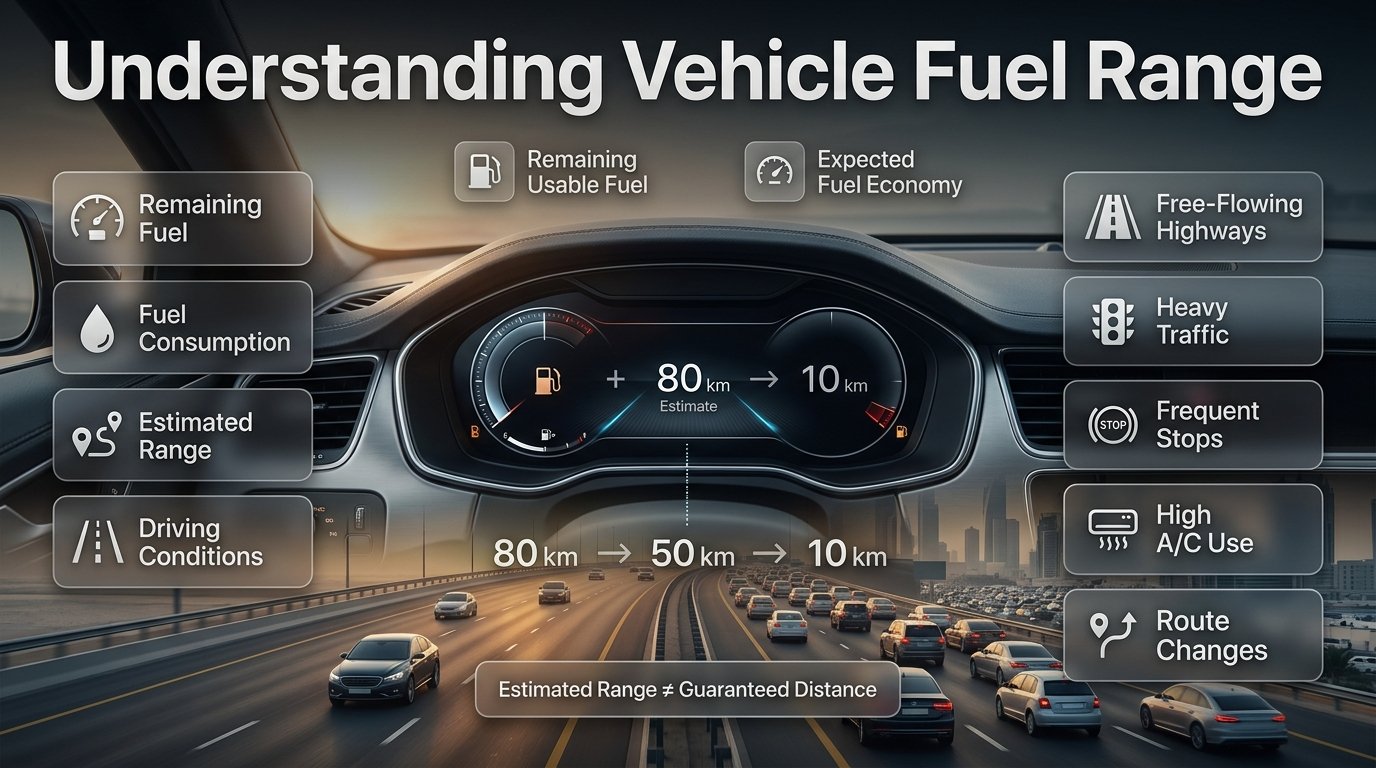
Understanding Vehicle Fuel Range | Running low on fuel is one of those situations most drivers don’t think much about until the fuel warning appears and the dashboard suddenly becomes the most important thing in the car. You may see a remaining range of 80 km, 50 km, or even 10 km and immediately wonder: Can I trust this number, or am I about to run out of fuel?
Understanding vehicle fuel range can make that situation much easier to manage. Your car’s estimated range is designed to help you plan, but it isn’t a guaranteed distance. It is an estimate based on remaining fuel and fuel consumption, and the estimate can change as your driving conditions change. Research into distance-to-empty systems similarly treats remaining usable fuel and expected fuel economy as key parts of the calculation.
This matters even more in Dubai, where a journey can move from free-flowing highway driving to heavy traffic, frequent stops, high air-conditioning use, or a different route within the same trip.
In this guide, we’ll explain what vehicle fuel range means, how your car estimates it, why the number changes, how to calculate your own approximate range, what affects fuel consumption, how to interpret the low-fuel warning, and what to do if the estimated range becomes dangerously low.
For drivers who need roadside fuel assistance in Dubai, you can also use Fuel Delivery Dubai as a practical starting point when you need fuel delivered to your vehicle.
What Is Vehicle Fuel Range?
Vehicle fuel range is the estimated distance your car can travel using the fuel currently available in the tank.
Most modern vehicles display this information as distance to empty, range, or remaining range. Depending on the vehicle, it may be shown in kilometres or miles.
The basic idea is simple:
Remaining fuel + expected fuel consumption = estimated driving range
However, the calculation isn’t fixed. Your vehicle continually uses information about fuel consumption to estimate how much distance may be possible.
A simple example
Imagine your vehicle has enough usable fuel for an estimated 100 km and your dashboard displays:
Range: 100 km
If you suddenly enter heavy traffic and your fuel consumption increases, the displayed range may fall more quickly.
If traffic clears and you return to smoother driving, the range may decrease more slowly.
That’s why the number on the dashboard should be viewed as a live estimate, not a guaranteed promise.
Why this distinction matters
A driver who treats 100 km as an exact guarantee may plan a 100-km journey and arrive at the destination with virtually no fuel margin.
A driver who treats 100 km as an estimate can make a safer decision by considering:
- Current traffic
- Route distance
- Expected congestion
- Driving speed
- Air-conditioning use
- Vehicle load
- Recent fuel consumption
- Availability of fuel stations
The second approach gives you much more room to handle unexpected conditions.
How Does a Car Calculate Its Fuel Range?
A simplified formula looks like this:
Estimated Range = Usable Fuel Remaining ÷ Fuel Consumption
For a vehicle using litres per 100 km:
Range = Remaining Litres ÷ L/100 km × 100
For example, if approximately 20 litres remain and the vehicle is consuming 10 L/100 km:
20 ÷ 10 × 100 = 200 km
So the theoretical range would be approximately 200 km.
Real vehicle systems can be considerably more sophisticated than this simple calculation. Distance-to-empty estimation can involve usable fuel quantity and predicted fuel economy, while factors such as traffic, speed profile, weather and vehicle accessories can influence expected consumption.
This is one reason the dashboard number can change while you’re driving.
What your vehicle may consider
Depending on the vehicle, the calculation can be influenced by:
- Fuel level
- Recent fuel consumption
- Average fuel economy
- Driving pattern
- Vehicle speed
- Engine operating conditions
- Route conditions
- Air-conditioning and other accessories
- Previous driving history
The exact algorithm is manufacturer-specific, so there isn’t one universal formula used by every vehicle.
Why Does My Fuel Range Change While I’m Driving?
This is one of the most common questions about vehicle fuel range.
The answer is simple: your car is constantly reassessing how much distance the remaining fuel may provide.
Suppose your car initially estimates 250 km.
You then spend 30 minutes in stop-and-go traffic. Your vehicle is using more fuel per kilometre than it was during your previous efficient driving.
The estimated range may fall much faster than expected.
Later, you reach an open road and drive smoothly. Your consumption improves, so the remaining range may decrease more slowly.
Example
At 8 L/100 km:
20 litres theoretically provide:
20 ÷ 8 × 100 = 250 km
At 12 L/100 km:
20 litres theoretically provide:
20 ÷ 12 × 100 = 167 km
The fuel quantity hasn’t changed in this simplified example. The expected distance changed because the rate of consumption changed.
That’s why a fuel range display isn’t a static measurement.
Is the Fuel Range on Your Dashboard Accurate?
The dashboard range can be useful, but it should not be treated as an exact guarantee.
A vehicle’s distance-to-empty estimate depends partly on how much fuel the system believes is available and how much fuel it expects the vehicle to use. Future driving conditions are difficult to predict perfectly.
Think of range in three categories
High range:
Normal planning is usually straightforward.
Moderate range:
Start considering your next refuelling opportunity.
Very low range:
Stop treating the number as spare capacity and make refuelling a priority.
The lower the displayed range becomes, the less useful it is to gamble on the last few kilometres.
A practical rule
If the dashboard says:
200 km
you have some flexibility.
If it says:
20 km
you should already be thinking about the nearest safe refuelling option.
The objective isn’t to discover the maximum distance your car can travel after the warning appears. The objective is to avoid becoming stranded.
Fuel Gauge vs Distance to Empty: What’s the Difference?
Your fuel gauge and fuel-range display answer two different questions.
Fuel gauge
The gauge tells you approximately how much fuel is in the tank.
It might show:
- Full
- ¾
- ½
- ¼
- Empty
Some vehicles use digital segments rather than a traditional needle.
Distance to empty
The range display estimates:
How far can I potentially travel with the fuel remaining?
These two measurements work together.
A fuel gauge alone doesn’t tell you how many kilometres remain.
For example, half a tank in a small economical car can represent a very different driving range from half a tank in a large SUV.
If you want to understand how much confidence you should place in the gauge itself, see How Accurate Is a Car Fuel Gauge?.
How to Estimate Remaining Fuel Range Yourself
Knowing how to estimate range manually is useful when your dashboard doesn’t provide a reliable distance-to-empty figure or when you want to double-check the number.
Step 1: Find your recent fuel economy
Look at your vehicle’s trip computer or calculate your actual consumption.
For example:
10 L/100 km
Step 2: Estimate the fuel remaining
Suppose you estimate that around:
12 litres
remain.
Step 3: Apply the calculation
12 ÷ 10 × 100 = 120 km
Your theoretical range is approximately 120 km.
But don’t automatically plan to drive 120 km.
Step 4: Create a safety margin
Your actual consumption could become higher because of:
- Traffic
- High speed
- Detours
- Air conditioning
- Heavy load
- Hills
- Frequent acceleration
- Road conditions
Therefore, a theoretical 120-km range should not be treated as 120 km of guaranteed travel.
For a Dubai-focused explanation of this calculation, see How to Estimate Remaining Fuel Range in Dubai.
Why Your Own Fuel Economy Matters More Than a Generic Range
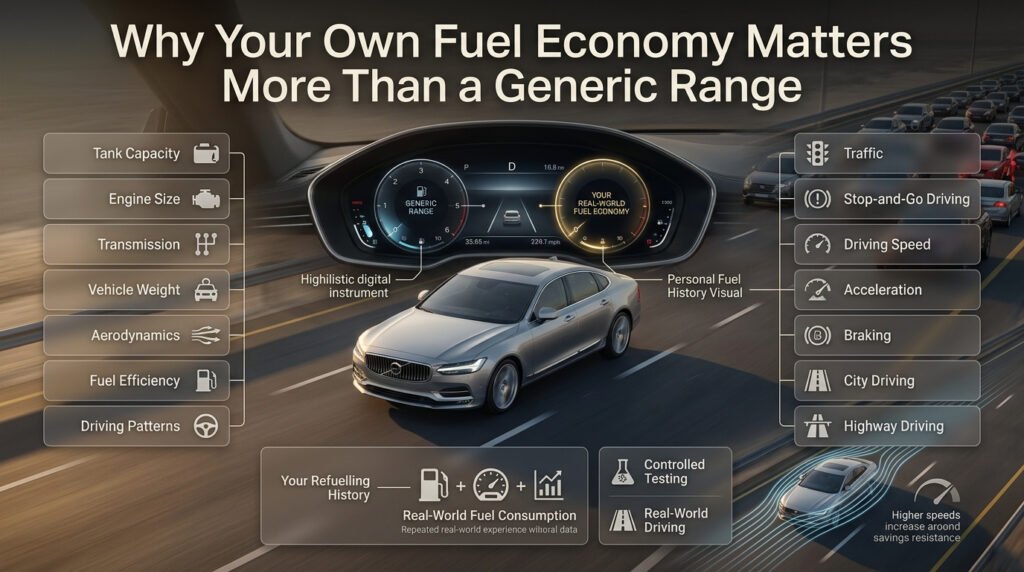
A common mistake is searching for a single number such as:
“How many kilometres does a car travel on a full tank?”
There isn’t one useful answer.
Different cars have different:
- Tank capacities
- Engine sizes
- Transmission systems
- Vehicle weights
- Aerodynamics
- Fuel efficiencies
- Driving patterns
Even the same model can achieve different real-world results depending on how and where it is driven.
Official fuel-economy testing also uses controlled cycles that represent different driving conditions, including city, highway, high-speed, air-conditioning and temperature-related conditions. Real-world driving won’t necessarily match those conditions.
That’s why your own refuelling and fuel-consumption history is valuable.
The Main Factors That Affect Vehicle Fuel Range
Your remaining fuel range isn’t determined by the fuel gauge alone.
Several driving and vehicle factors can change how far your fuel takes you.
1. Traffic and Stop-and-Go Driving
Heavy traffic can significantly change fuel consumption.
Repeatedly moving forward, stopping, accelerating and braking means the engine is continually working through changing operating conditions.
In a traffic jam, you may cover only a short distance while the engine continues consuming fuel.
That’s why a journey that normally takes 30 minutes can produce very different fuel consumption when congestion becomes severe.
For a deeper look at the relationship between congestion and fuel use, see How Traffic Affects Fuel Economy in Dubai.
Practical advice
When traffic is unavoidable:
- Maintain a safe following distance.
- Avoid unnecessary acceleration.
- Anticipate slowdowns.
- Don’t repeatedly accelerate just to brake again.
- Avoid unnecessary idling when safely parked.
2. Driving Speed
Speed has an important effect on fuel consumption.
As vehicle speed increases, aerodynamic resistance becomes increasingly important. Your engine may need to produce more power to maintain higher speeds.
This means driving faster doesn’t simply mean arriving sooner. It can also mean using fuel more quickly.
The U.S. Department of Energy notes that fuel economy generally decreases at higher speeds and that aggressive driving can substantially increase fuel consumption, particularly in stop-and-go traffic.
For Dubai drivers interested in the relationship between speed and efficiency, see Optimal Driving Speed for Fuel Efficiency in Dubai.
3. Acceleration Habits
Rapid acceleration can consume considerably more fuel than smooth acceleration.
This doesn’t mean you should accelerate dangerously slowly. The goal is to accelerate smoothly and appropriately for traffic.
Good acceleration habits include:
- Look ahead.
- Anticipate traffic.
- Avoid unnecessary bursts of acceleration.
- Maintain a steady pace when conditions allow.
- Don’t race toward a red light only to brake immediately.
You can learn more about this in How Acceleration Affects Fuel Consumption.
4. Braking Habits
Braking itself doesn’t directly burn fuel in the same way acceleration does, but frequent unnecessary acceleration followed by braking wastes energy.
If you repeatedly accelerate and then brake because you aren’t anticipating traffic, you’re using fuel to create speed that you immediately remove.
Smooth traffic awareness can reduce this cycle.
For more detail, read How Braking Habits Affect Fuel Economy in Dubai.
5. Engine Idling
An idling engine is still consuming fuel even though the vehicle isn’t covering distance.
This is particularly relevant during long waiting periods.
For example, if your vehicle is stationary outside a location with the engine running, you’re consuming fuel without adding kilometres to your trip.
The U.S. Department of Energy notes that idling can consume a measurable amount of fuel, making unnecessary long-duration idling an avoidable source of fuel use.
See Car Idling Fuel Consumption in Dubai for more practical information.
Important distinction
Short stops in normal traffic aren’t something you need to obsess over.
The real issue is unnecessary prolonged idling.
6. Air Conditioning
Air conditioning can influence fuel consumption because the system requires energy.
In Dubai’s climate, however, air conditioning isn’t simply an optional luxury. Cabin temperature can become extremely uncomfortable and potentially unsafe in hot conditions.
The sensible approach is not to avoid air conditioning altogether.
Instead:
- Use the system appropriately.
- Avoid leaving doors or windows open unnecessarily.
- Allow the system to work normally.
- Maintain the vehicle’s cooling and climate-control systems.
- Don’t compromise safety just to save a small amount of fuel.
Fuel-economy testing recognizes air-conditioning use as a condition that can affect fuel economy.
7. Vehicle Weight
The heavier the vehicle, the more energy may be required to accelerate it.
That doesn’t mean removing every item from your car.
It means avoiding unnecessary permanent loads.
Examples include:
- Unused heavy tools
- Old equipment
- Boxes
- Unnecessary luggage
- Heavy items stored in the trunk
The U.S. Department of Energy has also documented the relationship between increased vehicle weight and energy requirements.
For more detail, read How Vehicle Weight Affects Fuel Economy.
8. Tyre Pressure
Tyre pressure affects rolling resistance and can influence fuel economy.
Underinflated tyres can increase resistance, meaning the engine may need to work harder.
Check your vehicle manufacturer’s recommended pressure rather than using a random number from another car.
Proper tyre pressure is also important for handling and tyre performance, so this isn’t only about saving fuel.
For more information, see Tire Pressure and Fuel Efficiency.
9. Vehicle Aerodynamics
At higher speeds, aerodynamic drag becomes increasingly important.
Roof-mounted equipment, poorly positioned cargo and certain accessories can increase resistance.
This is particularly relevant on highway journeys.
A vehicle that is efficient in city driving can experience different consumption characteristics at highway speed because aerodynamic resistance becomes more significant.
See How Aerodynamics Affects Fuel Efficiency for a deeper explanation.
10. Roof Racks and Accessories
Roof racks can affect aerodynamic performance, particularly at higher speeds.
If you don’t need a roof rack or external carrier for a particular journey, removing unnecessary equipment can reduce avoidable aerodynamic drag.
For more information, read Roof Racks and Fuel Economy.
The same principle applies to other accessories that alter the airflow around the vehicle.
See Vehicle Accessories and Fuel Economy in Dubai for additional context.
11. Gear Selection and Transmission
The way a vehicle changes gears can influence fuel consumption.
Modern automatic transmissions are designed to select suitable gears automatically, while drivers of manual vehicles have greater direct control over gear selection.
Driving at unnecessarily high engine speeds can waste fuel, while selecting an unsuitable gear can affect performance and efficiency.
For manual and automatic vehicles alike, smooth operation is generally more useful than constantly trying to manipulate the transmission.
See Gear Shifting and Fuel Economy and Fuel-Efficient Use of Automatic Transmission for more guidance.
12. Vehicle Drag
Anything that makes it harder for the vehicle to move through the air can affect energy use.
This is why vehicle shape, accessories and external loads can matter.
Aerodynamic effects become increasingly relevant as speed rises, so the same accessory may have a smaller practical effect at low city speeds than during sustained highway driving.
For Dubai driving conditions, see Vehicle Drag and Fuel Consumption in Dubai.
Understanding Fuel Range in Dubai Driving Conditions
Dubai presents several driving environments that can produce very different fuel-consumption patterns.
You may drive:
- Through congested urban roads
- Along major highways
- Between residential areas
- Through commercial districts
- On long-distance routes
- During extremely hot weather
- With heavy air-conditioning use
Therefore, the range shown after a highway journey may not remain equally reliable once you enter heavy urban traffic.
Example
Imagine your vehicle displays:
180 km remaining
You expect a straightforward journey.
But halfway through, traffic becomes heavily congested.
Your vehicle’s consumption increases, and the displayed range starts falling faster.
The correct response isn’t to panic.
Instead:
- Identify the nearest practical refuelling option.
- Consider current traffic.
- Avoid unnecessary detours.
- Continue driving smoothly.
- Don’t wait until the estimated range becomes critical.
What Does the Low Fuel Warning Light Mean?
The low-fuel warning light tells you that the fuel level has reached a low threshold determined by the vehicle manufacturer.
It doesn’t mean every vehicle has exactly the same amount of fuel remaining.
It also doesn’t mean:
“You have exactly 50 km left.”
The remaining distance depends on the vehicle and current consumption.
For a detailed explanation, see Low Fuel Warning Light Meaning in Dubai.
What should you do when the warning appears?
The best response is to start thinking about refuelling rather than calculating how long you can delay it.
If a suitable petrol station is nearby, refuel.
If you’re far from a station and the range is dropping quickly, consider roadside assistance before the vehicle becomes stranded.
How Far Can a Car Drive on Low Fuel?
There is no universal distance.
One vehicle may have a different reserve level from another. Tank design, fuel-level calibration, engine consumption and warning thresholds all vary.
Even your own car may travel different distances after the warning appears depending on traffic and driving conditions.
That is why statements such as:
“Every car can drive another 50 km after the warning.”
shouldn’t be treated as reliable.
For a detailed Dubai-focused guide, read How Far Can a Car Drive on Low Fuel in Dubai?.
What Happens When Your Fuel Range Reaches Zero?
A displayed range of zero doesn’t necessarily mean that every drop of fuel has physically disappeared.
However, it is also unsafe to assume that you have a predictable reserve.
Once the range reaches zero, the vehicle’s estimate has reached the limit of its normal calculation.
At that point, your objective should be to refuel or arrange assistance.
Don’t make this mistake
Some drivers intentionally continue after the range reaches zero because they want to discover the car’s “real” reserve.
That experiment can end with the vehicle stopping in traffic or on an isolated road.
The possible inconvenience isn’t worth the risk.
What to Do When Your Vehicle Runs Out of Fuel
If your engine stops because the tank is empty, your priorities change.
Fuel economy is no longer the main issue.
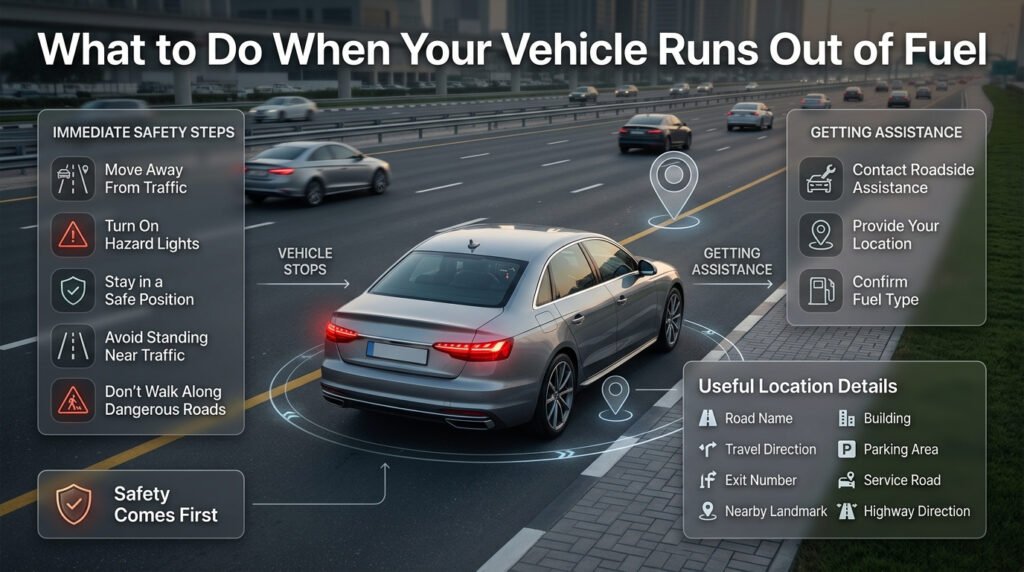
Safety comes first.
If possible and safe, move the vehicle away from moving traffic.
Then:
- Turn on hazard lights.
- Stay in a safe position.
- Avoid standing unnecessarily close to traffic.
- Don’t walk along dangerous roads looking for a petrol station.
- Contact suitable roadside assistance.
- Provide your location accurately.
- Confirm the correct fuel type before refuelling.
For a detailed step-by-step guide, read What to Do When Your Car Runs Out of Fuel.
Car Ran Out of Fuel? Safety Comes First
An empty tank is inconvenient.
Standing in an unsafe location near moving traffic is potentially much more serious.
If your car has stopped, avoid making the situation worse by walking into an unsafe area simply because a fuel station appears nearby.
Use your phone to contact assistance and provide useful location details.
Your location information can include:
- Road name
- Direction of travel
- Exit number
- Nearby landmark
- Building
- Parking area
- Service road
- Highway direction
For additional guidance, see Car Ran Out of Fuel Safety in Dubai.
Safely Dealing With an Empty Fuel Tank
When the tank is empty, don’t focus only on getting fuel.
Think about where the vehicle has stopped and how exposed you are to traffic.
A safe response generally involves:
- Hazard lights
- Safe positioning where possible
- Staying alert to surrounding traffic
- Avoiding unsafe roadside walking
- Contacting assistance
- Clearly communicating your location
You can also read Safely Dealing With an Empty Fuel Tank in Dubai for additional practical advice.
Steps After Running Out of Petrol
If your petrol vehicle has stopped because of an empty tank, work through the situation calmly.
Step 1: Confirm the problem
Make sure the vehicle isn’t experiencing another mechanical issue.
Step 2: Make the vehicle visible
Use hazard lights.
Step 3: Find the safest available position
If you can move the vehicle without creating danger, do so.
Step 4: Request assistance
Give the provider your exact or useful location details.
Step 5: Confirm the fuel
Petrol and diesel vehicles require different fuels.
If you’re uncertain, check the vehicle information before fuel is supplied.
For more detail, see Steps After Running Out of Petrol.
Running Out of Fuel on the Road
Running out of fuel on a normal road can still be stressful, particularly if you’re blocking traffic or stopped somewhere with limited visibility.
Don’t assume that walking to a station is automatically the best option.
Instead, consider:
- Traffic conditions
- Road type
- Visibility
- Your vehicle’s position
- Your personal safety
- Whether professional fuel delivery is available
For more practical advice, see Running Out of Fuel on the Road.
Roadside Breakdown Safety When Fuel Is the Problem
An empty tank is one type of roadside breakdown, but the same basic safety principles apply.
Your first job is to make yourself and other road users aware that your vehicle has stopped.
If possible:
- Activate hazard lights.
- Move away from active traffic lanes when safe.
- Avoid sudden movements around the vehicle.
- Don’t stand where passing traffic can strike you.
- Contact appropriate assistance.
For more information, see Roadside Breakdown Safety Tips in Dubai.
What to Do During a Roadside Breakdown
A roadside breakdown requires calm decision-making.
Don’t immediately leave the vehicle and start walking.
First assess:
Where am I?
Where is the traffic?
Can the vehicle be moved safely?
Who can provide assistance?
If you’re in an exposed position, minimize unnecessary movement around the vehicle.
More detailed guidance is available in What to Do During a Roadside Breakdown.
Staying Safe During a Car Breakdown
Your location makes a major difference.
A breakdown inside a relatively safe parking area is very different from a breakdown beside a high-speed road.
Regardless of location, useful precautions include:
- Hazard lights
- Clear communication
- Avoiding dangerous walking
- Staying alert
- Providing accurate location information
- Waiting for appropriate assistance
You can read Staying Safe During a Car Breakdown for more practical information.
Vehicle Breakdown Safety Procedures
Good breakdown preparation isn’t complicated.
Before travelling, it’s useful to know:
- Your vehicle’s fuel type
- Approximate fuel economy
- Typical driving range
- Emergency contact options
- How to share your location
- Basic roadside safety procedures
If your car stops unexpectedly, having this information already available can make the situation much easier to manage.
See Vehicle Breakdown Safety Procedures for additional guidance.
Roadside Vehicle Emergency Precautions
Fuel emergencies often become stressful because drivers react too late.
A few simple precautions can reduce that risk:
- Don’t deliberately run the tank to empty.
- Watch the estimated range.
- Refuel before the situation becomes critical.
- Keep your phone charged during longer journeys.
- Know your route.
- Pay attention to the road environment.
- Don’t walk into dangerous traffic areas for fuel.
More guidance is available in Roadside Vehicle Emergency Precautions.
What If You Run Out of Fuel on a Highway?
Highway fuel emergencies require additional caution because vehicles may be moving at high speeds.
If your vehicle stops:
- Turn on hazard lights.
- Try to reach a safer position if this can be done safely.
- Avoid standing in traffic lanes.
- Don’t attempt unsafe highway walking.
- Contact appropriate assistance.
- Share your direction of travel.
- Provide the nearest exit, landmark or road reference.
For a dedicated guide, see Running Out of Fuel on a Highway.
Highway Fuel Emergency Safety in Dubai
A highway breakdown is not the right time to experiment with the vehicle’s remaining reserve.
If the estimated range becomes very low while you’re travelling on a major road, identify a safe refuelling opportunity before the fuel disappears completely.
If the vehicle stops, focus on safety rather than trying to walk to a fuel station.
For more information, read Highway Fuel Emergency Safety in Dubai.
What If the Car Stops Because of an Empty Fuel Tank?
A car that stops because of an empty fuel tank may restart once fuel is supplied, but don’t assume that adding fuel automatically solves every possible problem.
If the vehicle doesn’t restart after receiving the correct fuel, another mechanical or electrical issue may be involved.
That’s why it’s important to distinguish:
Fuel problem → Empty tank
from:
Mechanical problem → Engine won’t run despite having fuel
For more guidance, see Car Stops Due to Empty Fuel Tank.
Highway Breakdown Safety Procedures
Highway safety deserves its own attention because the speed and density of traffic can make even a simple fuel shortage more dangerous.
Avoid:
- Standing unnecessarily near moving traffic
- Walking across high-speed roads
- Trying to push a vehicle across active lanes
- Waiting in an unsafe location
- Ignoring hazard lights
Instead, make your location known and arrange suitable assistance.
For additional guidance, see Highway Breakdown Safety Procedures in Dubai.
How to Improve Your Vehicle Fuel Range
Understanding range is useful, but improving your everyday efficiency can make range management much easier.
Start with simple habits.
Drive smoothly
Smooth acceleration and braking reduce unnecessary energy use.
Avoid unnecessary idling
If you’re safely parked and don’t need the engine running, avoid keeping it running without purpose.
Maintain tyre pressure
Check tyre pressure regularly according to manufacturer specifications.
Remove unnecessary weight
Don’t permanently carry heavy objects you don’t need.
Maintain the vehicle
A vehicle with mechanical problems may not operate as efficiently as intended.
Plan your route
Avoid unnecessary detours and consider traffic conditions.
The Department of Energy notes that driving behaviour, vehicle condition, tyre inflation and accessories can all affect fuel economy.
For a broader collection of practical habits, see Fuel Saving Driving Tips.
How Long-Distance Driving Changes Fuel Range
Long trips can produce more predictable fuel consumption than heavily congested short journeys, but that doesn’t mean you should ignore range planning.
Before a long trip:
- Fill the tank appropriately.
- Check tyre pressure.
- Know your route.
- Identify potential refuelling stops.
- Consider traffic.
- Check your vehicle’s condition.
- Avoid unnecessary load.
For longer journeys, you can also review Improving Fuel Economy on Long Trips and Long-Distance Driving Fuel Efficiency Tips.
Common Beginner Mistakes With Vehicle Fuel Range
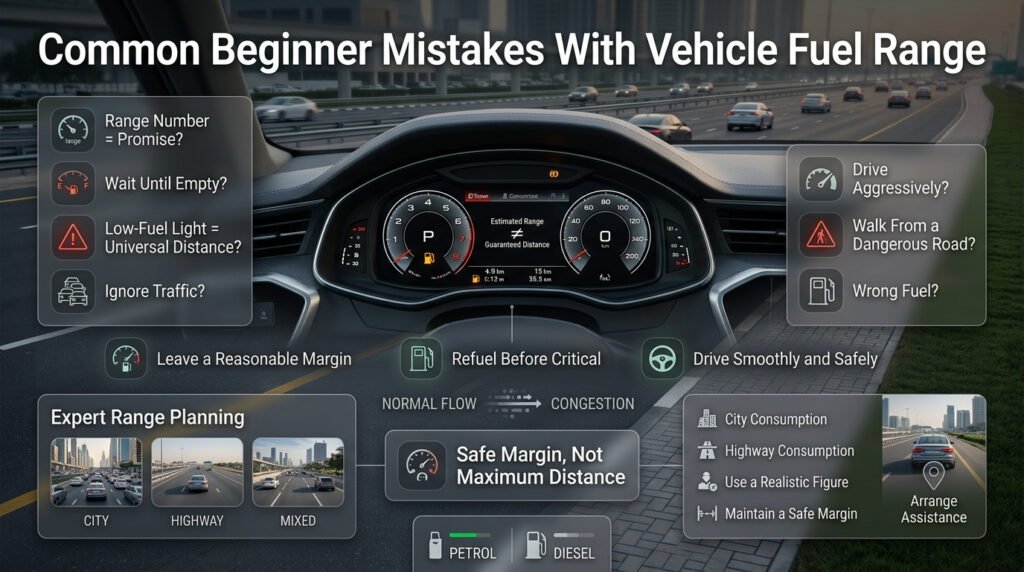
Mistake 1: Treating the range number as a promise
The number looks precise, but it is still an estimate.
Better approach: Leave a reasonable margin.
Mistake 2: Waiting for the tank to become completely empty
This turns routine refuelling into an emergency.
Better approach: Refuel before the remaining range becomes critical.
Mistake 3: Believing the low-fuel light gives a universal distance
It doesn’t.
Better approach: Learn your vehicle’s behaviour.
Mistake 4: Ignoring traffic
A range estimate based on efficient driving may change quickly in congestion.
Better approach: Consider current road conditions.
Mistake 5: Driving aggressively to reach the petrol station
Trying to get there faster can increase fuel consumption.
Better approach: Drive smoothly and safely.
Mistake 6: Walking to a fuel station from a dangerous road
This can create a greater safety problem than the fuel shortage itself.
Better approach: Arrange assistance.
Mistake 7: Using the wrong fuel
Petrol and diesel vehicles aren’t interchangeable.
Better approach: Confirm the correct fuel type before delivery.
Expert Tips for Managing Fuel Range
💡 Pro Tip: Learn your car’s normal consumption in three conditions: city, highway and mixed driving. This gives you a much more realistic understanding of your range.
⭐ Expert Tip: Don’t use the highest range you’ve ever achieved as your standard calculation. Use a realistic figure based on normal driving.
📌 Quick Tip: When the estimated range becomes low, look at the route ahead rather than only the number on the dashboard.
⚠ Common Mistake: Never treat the distance remaining after the low-fuel warning as guaranteed reserve distance.
A professional way to think about range
Instead of asking:
“How many kilometres can I squeeze out of this fuel?”
ask:
“How much distance can I cover while maintaining a safe margin?”
That small change in thinking can prevent many unnecessary roadside emergencies.
A Simple Vehicle Fuel Range Checklist
Before a longer journey, ask yourself:
Fuel
- Is the tank sufficiently filled?
- Is the fuel range realistic for my route?
Vehicle
- Are the tyres correctly inflated?
- Is the vehicle carrying unnecessary weight?
- Is there any warning light?
Journey
- What roads will I use?
- Could traffic significantly increase travel time?
- Where can I refuel?
Emergency preparation
- Is my phone charged?
- Do I know how to share my location?
- Do I know the correct fuel type for my vehicle?
- Do I know what to do if the car stops?
This checklist takes very little time but can make fuel management considerably easier.
How Accurate Is the Vehicle Fuel Range Display?
The vehicle fuel range display is useful for planning, but it should never be treated as an exact promise of how many kilometres you can drive. Your car estimates the remaining distance using the fuel it believes is available and recent or expected fuel consumption. Because driving conditions change, the displayed number can change as well.
For example, if your dashboard shows 120 km remaining after a period of smooth highway driving, that estimate may be based on relatively good fuel economy. If you then enter heavy traffic, accelerate frequently, or spend a long time idling, your actual fuel consumption can increase and the range may fall faster.
AAA testing found that distance-to-empty estimates can vary with changes in speed, acceleration and driving conditions, even though the systems can be useful overall.
Important points to remember:
Treat the displayed range as an estimate, not guaranteed distance.
Your recent driving style can influence the calculation.
Heavy traffic can make the remaining range decrease faster.
High-speed driving can also change fuel consumption.
A low range should be treated as a reason to refuel, not an opportunity to test the vehicle’s maximum reserve.
Professional advice: If your dashboard says 50 km remaining, don’t plan a 50-km journey assuming you’ll arrive with the tank empty. Leave a practical margin for traffic, route changes and unexpected delays.
How Far Can You Drive After the Low Fuel Warning Comes On?
There isn’t one exact distance that applies to every vehicle after the low-fuel warning appears. The remaining fuel at the warning point varies by vehicle, while fuel consumption changes according to driving conditions, speed, traffic, load and driving habits.
AAA’s current guidance notes that many vehicles may travel roughly 30–50 miles (about 48–80 km) after the fuel light comes on, but it also stresses that the actual distance depends on the vehicle and conditions. That figure should therefore be treated as a broad reference rather than a guaranteed reserve for your particular car.
For example, a fuel-efficient vehicle travelling smoothly on an open road may achieve more distance from its remaining fuel than the same vehicle stuck in congested traffic. Similarly, aggressive acceleration or prolonged idling can reduce the distance available.
What affects the distance after the warning?
Vehicle make and model
Fuel tank design
Fuel remaining when the warning activates
Real-world fuel economy
Traffic conditions
Driving speed
Acceleration habits
Vehicle load
Road conditions
Weather and air-conditioning use
Professional advice: Don’t use the low-fuel warning as your normal refuelling point. Once the warning appears, your focus should shift toward finding a suitable fuel station rather than calculating how many extra kilometres you can squeeze out of the tank.
If you’re already driving with very low fuel in Dubai, understanding how far a car can drive on low fuel can help you understand the situation without relying on a single generic number.
What Factors Can Reduce Your Vehicle’s Fuel Range?
Your vehicle’s fuel range can fall faster than expected when fuel consumption increases. The most common causes are heavy traffic, high speeds, aggressive acceleration, prolonged idling, additional vehicle weight, incorrect tyre pressure and demanding driving conditions.
This is why the same amount of fuel can produce very different distances on different days.
Consider two journeys using the same car. On the first journey, you’re travelling smoothly with moderate speed and little congestion. On the second, you’re stuck in stop-and-go traffic, repeatedly accelerating and braking while using the air conditioner. The fuel remaining may be similar, but the second journey can consume fuel at a different rate.
The U.S. Department of Energy’s fuel-economy testing recognizes different driving conditions, including stop-and-go city driving, highway driving, aggressive acceleration and braking, air-conditioning use and temperature conditions.
The biggest factors to watch include:
Traffic: Repeated stopping and accelerating can increase consumption.
Speed: Higher speeds can increase aerodynamic resistance and fuel demand.
Acceleration: Hard acceleration generally uses more fuel than smooth acceleration.
Idling: The engine consumes fuel even when the vehicle isn’t moving.
Air conditioning: Climate-control demand can affect fuel consumption.
Vehicle weight: Carrying unnecessary heavy items can reduce efficiency.
Tyre pressure: Incorrect pressure can affect rolling resistance and efficiency.
Aerodynamic drag: Roof racks and external cargo can become more significant at higher speeds.
Professional advice: When your fuel range is already low, don’t try to compensate by driving aggressively to reach a petrol station faster. Smooth, controlled driving is generally a more sensible approach because unnecessary acceleration can increase fuel consumption.
The better strategy is to monitor the range early, understand the road conditions ahead and refuel before the situation becomes critical.
What Does It Mean When the Fuel Range Reaches 0 km?
When your dashboard reaches 0 km, it means the vehicle’s calculated remaining range has reached zero. It does not give you a reliable measurement of exactly how much fuel is physically left in the tank.
Some vehicles may still have a small amount of usable fuel when the display reaches zero, but the amount isn’t predictable enough to use as a safety margin. Your car’s calculation is an estimate, and once it reaches zero, you shouldn’t assume that another fixed number of kilometres is available.
This is where many drivers make a dangerous mistake. They see “0 km” and think, “The car must still have another 20 or 30 kilometres.” There is no universal reserve distance that you can safely depend on.
AAA specifically warns that drivers shouldn’t rely too heavily on miles-to-empty displays because their accuracy can vary when driving conditions change.
If your range reaches zero:
Don’t deliberately continue driving to test the reserve.
Look for the safest available refuelling option.
Avoid unnecessary detours.
Drive smoothly if you’re still able to reach a safe fuel station.
If you don’t believe you can reach fuel safely, arrange roadside assistance.
If the vehicle stops, prioritize roadside safety rather than walking along a dangerous road.
Regularly driving until the tank is completely empty also isn’t a good habit. AAA advises drivers to avoid pushing the tank to empty and recommends maintaining a practical fuel reserve.
Professional advice: Think of 0 km as a warning boundary, not a challenge. The purpose of a range display is to help you plan refuelling, not to tell you how far you can continue after the calculation has reached its limit.
How Can You Calculate Your Realistic Remaining Fuel Range?
You can make your own approximate fuel-range calculation by combining the amount of fuel remaining with your vehicle’s real-world fuel economy.
The basic formula is:
Estimated Range = Remaining Fuel ÷ Fuel Consumption × 100
For example, suppose your vehicle is averaging 10 L/100 km and you estimate that approximately 15 litres remain.
15 ÷ 10 × 100 = 150 km
So the theoretical range would be approximately 150 km.
However, that doesn’t mean you should plan a 150-km journey without a reserve. If traffic becomes heavier or your consumption increases to 12 L/100 km, the same 15 litres would theoretically provide:
15 ÷ 12 × 100 = 125 km
That’s a 25-km difference created simply by the change in consumption.
A more reliable approach is to learn your own vehicle’s real fuel economy over several refuelling cycles. Reset the trip meter after filling the tank, record how much fuel you add at the next refill, and calculate your actual consumption. This gives you a much better understanding of how your particular car behaves.
AAA also describes a practical method for determining how much fuel remains when the low-fuel light activates by comparing tank capacity, fuel added and distance travelled.
For a more realistic calculation, consider:
Your recent average fuel economy
Current fuel level
City versus highway driving
Current traffic
Expected journey distance
Air-conditioning use
Vehicle load
Road conditions
A reasonable safety margin
Professional advice: Don’t use your car’s best-ever fuel economy when calculating an emergency range. Use a realistic figure based on the conditions you’re actually driving in.
If you want a Dubai-specific calculation method, How to Estimate Remaining Fuel Range in Dubai is a useful next step.
Conclusion
Understanding your vehicle’s fuel range is not simply about knowing the number shown on the dashboard. It is about understanding how that estimate is calculated, why it changes, and how your driving conditions can affect the distance you can realistically travel. Your vehicle’s range display can be a useful planning tool, but it should always be treated as an estimate rather than a guaranteed distance.
Traffic, driving speed, acceleration, braking, idling, air-conditioning use, vehicle weight, tyre pressure and road conditions can all influence real-world fuel consumption. This is especially important in Dubai, where heavy traffic, long highway journeys and high temperatures can create different driving conditions from one trip to another.
The safest approach is to monitor your fuel level before it becomes critically low, understand your vehicle’s normal fuel economy and maintain a practical reserve instead of depending on the final kilometres shown on the dashboard. If the low-fuel warning appears or the range reaches zero, avoid treating the remaining fuel as a challenge. Make refuelling the priority and take appropriate roadside safety precautions.
For drivers who regularly travel long distances or deal with unpredictable traffic, developing good fuel-range awareness can make journeys more predictable and reduce the risk of being stranded. And if your vehicle does run out of fuel, knowing the correct safety steps and arranging professional roadside fuel assistance can help you handle the situation without unnecessary risk.
Ultimately, the best fuel-range strategy is simple: know your car, understand your real fuel consumption, monitor changing driving conditions, and refuel before the situation becomes an emergency.
Leave a Reply