
Introduction
How Accurate Is a Car Fuel Gauge? | You’re driving through Dubai, the fuel gauge is sitting slightly above the quarter mark, and everything seems fine. You know there’s fuel in the tank, so you keep driving. Then, after some traffic, a few kilometres of highway driving, or a long stretch with the air conditioning running, the needle suddenly appears much closer to empty.
At that point, one question naturally comes to mind: how accurate is a car fuel gauge?
The short answer is that a car fuel gauge is useful, but it isn’t a precision instrument. It gives you an estimate of the fuel level rather than telling you the exact number of litres inside the tank. The system normally relies on a fuel-level sensor or sending unit, which detects the position of a float and sends an electrical signal to the dashboard or vehicle electronics.
This is why a gauge can stay near “F” for longer than expected, appear to move faster around the middle or lower part of the tank, or temporarily change when you’re driving uphill, braking, accelerating, or taking a corner.
For drivers in Dubai, understanding this difference matters. Traffic, high temperatures, air conditioning, highway speeds, vehicle load, and long-distance driving can all affect how quickly the fuel shown on the gauge is actually consumed.
If you need practical roadside fuel assistance in Dubai, Fuel Delivery Dubai provides a useful option when your vehicle is low on fuel or has already stopped because the tank is empty.
In this guide, you’ll learn how accurate a car fuel gauge really is, how the system works, why the gauge doesn’t always move proportionally, what “E” actually means, how reliable the low-fuel warning is, whether the distance-to-empty display can be trusted, how to identify a faulty fuel gauge, and what to do if your vehicle runs out of fuel.
How Accurate Is a Car Fuel Gauge?
A car fuel gauge is generally accurate enough for everyday fuel monitoring, but it should not be treated as an exact measurement of litres remaining. Its main purpose is to tell the driver whether the tank is full, partly full, low, or approaching empty.
The system measures fuel level through a sensor inside the tank and then translates that information into a dashboard reading. In many vehicles, a float moves with the fuel level and changes the resistance in an electrical circuit. The vehicle then interprets that signal and displays the approximate level.
That sounds simple, but several things make an exact reading difficult.
Fuel tanks aren’t perfectly rectangular containers. They have irregular shapes because they must fit around suspension components, exhaust systems, body structures and other vehicle parts. The float also responds to fuel movement rather than directly measuring litres.
So, when your gauge shows half, it doesn’t necessarily mean that exactly half of the tank’s capacity remains.
The simplest way to understand fuel gauge accuracy
Think of your fuel gauge as a decision-making tool, not a measuring cup.
It helps you answer:
- Do I have plenty of fuel?
- Should I start planning to refuel?
- Is my fuel level becoming low?
- Should I avoid a long journey?
- Do I need roadside assistance?
It isn’t designed to answer with laboratory precision:
“Exactly how many litres are left in my tank?”
That’s an important distinction.
How Does a Car Fuel Gauge Work?
A conventional fuel-level system normally has two major parts: the fuel sending unit inside or associated with the tank and the indicator or display on the dashboard.
The sending unit commonly contains a float connected to a variable resistor. As the fuel level rises or falls, the float moves. That movement changes the electrical signal sent to the vehicle’s gauge or control system.
A simplified process looks like this:
Fuel level changes → Float moves → Sensor signal changes → Vehicle electronics interpret signal → Dashboard displays fuel level
Modern vehicles may add electronic processing, software filtering, or control modules between the sensor and dashboard.
The reason for filtering is practical. Fuel moves around while the vehicle is driving. Without some form of smoothing, the gauge could constantly bounce when you accelerate, brake or turn.
Why the float matters
The float is designed to move with the fuel level.
When the tank is full, the float is high.
As fuel is consumed, the float moves downward.
The electrical signal changes as the float moves, allowing the vehicle to estimate the fuel level.
However, the relationship isn’t necessarily perfectly proportional.
A 10-litre reduction in fuel doesn’t have to produce exactly the same visible needle movement at every point of the tank.
Why Doesn’t the Fuel Gauge Move Proportionally?
One of the most common misunderstandings is assuming that every section of the gauge represents the same amount of fuel.
Drivers often think:
F = 100%
3/4 = 75%
1/2 = 50%
1/4 = 25%
E = 0%
That is a useful visual guide, but it isn’t necessarily an exact representation of the actual fuel volume.
The physical shape of the tank makes this more complicated. A tank can have areas where a small change in float height represents a relatively large volume of fuel and other areas where the same float movement represents much less fuel.
Manufacturers can also calibrate the display to make the gauge more stable and useful to drivers.
This is why one vehicle might appear to stay near full for quite a while, while another seems to move away from “F” sooner.
Neither behaviour automatically means the gauge is inaccurate.
Why Does the Fuel Gauge Stay on Full for So Long?
This is one of the most common fuel-gauge questions.
You fill the tank, drive 80 or 100 kilometres, and the needle still looks almost full.
That doesn’t mean the vehicle isn’t using fuel.
The fuel gauge may be calibrated so that the display doesn’t immediately move significantly after filling. The shape of the tank and the physical position of the float can also contribute to this behaviour. Fuel-level sensors can be less representative of actual volume at the very top of the tank.
For example, imagine a vehicle with a 60-litre tank.
You might expect 10 litres of fuel consumption to move the gauge from:
Full → approximately 5/6
But the actual gauge may remain visually close to “F.”
Later, another 10 litres may cause a more noticeable movement.
This is why judging fuel economy by the needle alone can be misleading.
💡 Pro Tip: Measure fuel economy using kilometres travelled and litres added at refuelling rather than judging consumption from how quickly the gauge moves.
Why Does the Fuel Gauge Sometimes Drop Faster After Half a Tank?
A gauge that appears to fall faster after the halfway point isn’t necessarily faulty.
The fuel tank’s shape can affect how much fuel corresponds to a particular float position. The calibration can also make the gauge movement appear non-linear.
For example, the visual movement could look something like:
F ───────
3/4 ─────
1/2 ────
1/4 ──
E ─
The spaces aren’t necessarily proportional to litres.
This means you shouldn’t calculate your remaining fuel simply by dividing the gauge into equal sections.
If your vehicle has a 60-litre tank, seeing the needle at halfway doesn’t guarantee that 30 litres are available.
Is Half a Tank Really Half the Fuel?
Not necessarily.
The halfway point is best understood as an approximate indication rather than an exact percentage.
Several factors can influence the relationship between gauge position and actual volume:
- Fuel tank shape
- Fuel sender design
- Float position
- Gauge calibration
- Electronic filtering
- Vehicle angle
- Fuel movement
- Sensor wear
- Electrical faults
A modern fuel gauge can be quite consistent without being mathematically linear.
This is why experienced drivers don’t normally calculate their exact remaining range from the needle position alone.
Does the Fuel Gauge Change When You Drive Uphill?
Yes, it can.
When a vehicle travels uphill, fuel moves inside the tank because of gravity.
Depending on the tank design and location of the fuel-level sensor, that movement can temporarily influence the sensor reading.
The same principle applies when travelling downhill.
For example, if you’re climbing a steep road and the fuel gauge suddenly appears lower, it doesn’t necessarily mean you’ve suddenly consumed a large amount of fuel.
Once the vehicle returns to level ground and the fuel settles, the gauge may move closer to its previous position.
What about sharp corners?
Cornering can also move fuel from one side of the tank to another.
When the tank is nearly full, this may have little visible effect.
When the fuel level is relatively low, the effect can become more noticeable.
Can Acceleration and Braking Affect the Fuel Gauge?
They can temporarily influence the reading.
During hard acceleration, fuel can move toward the rear of the vehicle.
During braking, it can move forward.
During cornering, it can move sideways.
Modern vehicles may use filtering or software to reduce these fluctuations, but the fuel inside the tank is still physically moving.
This is one reason you shouldn’t make a major fuel-planning decision based on a single momentary gauge position.
⚠ Common Mistake: Looking at the gauge immediately after hard braking or acceleration and assuming the vehicle has suddenly gained or lost a significant amount of fuel.
The fuel hasn’t disappeared. It has moved.
Why Does the Gauge Return to Its Previous Position?
You may have noticed this when parking on a slope.
You park your car facing uphill and the gauge looks slightly different.
Later, you drive onto a flat surface and the reading changes again.
That’s because the fuel settles differently when the vehicle’s orientation changes.
A short-term variation can therefore be normal.
If the gauge changes dramatically under ordinary level-road driving, repeatedly jumps between readings, or gives obviously incorrect information after refuelling, then further inspection may be appropriate.
Is the “E” Mark Actually Empty?
The “E” marking should not automatically be interpreted as meaning that absolutely no fuel remains.
In many vehicles, the empty indication is a low-fuel reference point rather than a guarantee that every last drop has been consumed. Some vehicles intentionally retain a reserve before the engine actually stops. However, the size of that reserve varies by vehicle, and drivers should not assume a universal number.
This is why you shouldn’t use a rule such as:
“When my gauge reaches E, I always have 50 kilometres left.”
That may be true under one set of conditions for one vehicle and completely wrong for another.
The safest interpretation is:
E means you are at a critically low fuel level and should refuel as soon as practical.
How Much Fuel Is Left When the Gauge Says Empty?
There isn’t one universal answer.
Some vehicles may have a small amount of usable fuel remaining when the gauge reaches E. Others may have a different reserve strategy.
The actual distance you can travel depends on:
- Fuel remaining
- Fuel consumption
- Traffic
- Speed
- Vehicle load
- Air conditioning
- Road gradient
- Tyre condition
- Driving style
- Mechanical condition
Even if you know that your particular car usually travels another 30 or 40 kilometres after the gauge reaches E, that doesn’t mean it will do so every time.
If traffic becomes heavier or your consumption increases, that estimated distance can disappear quickly.
How Accurate Is the Low-Fuel Warning Light?
The low-fuel warning is designed to tell you that the remaining fuel has reached a predefined low level.
However, the warning threshold varies between vehicles.
It isn’t safe to assume that every low-fuel light means exactly:
- 5 litres remaining
- 10% remaining
- 50 kilometres remaining
- 30 minutes of driving
The warning should be treated as an early action signal.
When it comes on, the sensible decision is to start looking for a suitable fuel station rather than trying to discover exactly how far the reserve can take you.
⭐ Expert Tip: Your low-fuel warning is most useful when you respond to it early. Its purpose is to give you time to refuel, not to encourage you to test the absolute limit of your vehicle.
How Accurate Is the Distance-to-Empty Display?
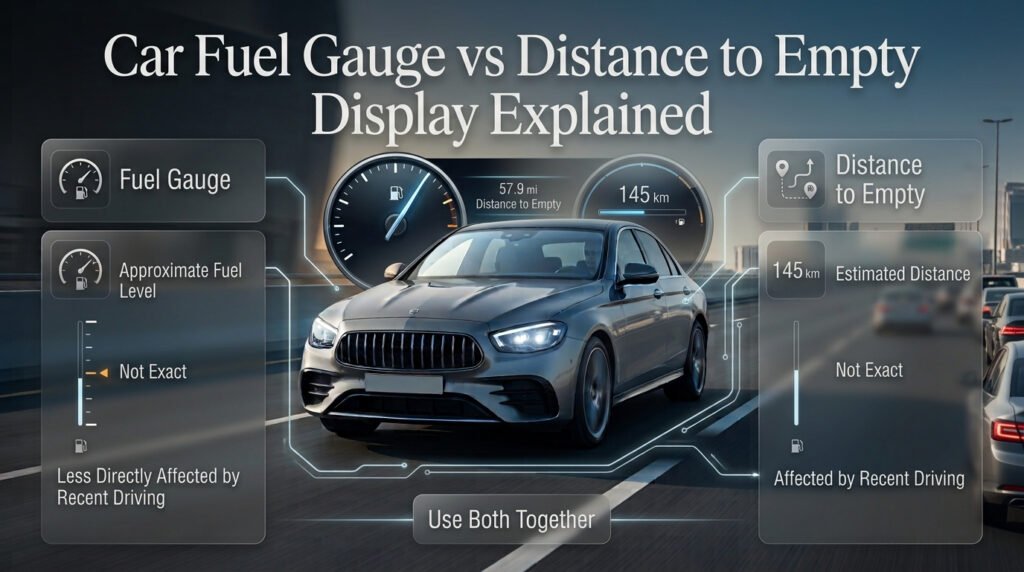
Many modern cars provide a digital estimate such as:
Range: 145 km
This can be more useful than the fuel gauge alone because the system can combine fuel-level information with recent fuel-consumption data.
However, the number is still an estimate.
If you’ve recently been driving efficiently on a clear highway, the system may calculate a relatively optimistic range.
If you then enter heavy traffic, the vehicle may consume fuel faster and the estimated range can fall.
The opposite can also happen.
If you have been stuck in traffic and then move onto an efficient highway route, your estimated range may behave differently.
Gauge vs range display
| Feature | Fuel Gauge | Distance-to-Empty |
|---|---|---|
| Shows | Approximate fuel level | Estimated remaining distance |
| Exact? | No | No |
| Influenced by recent driving? | Less directly | Strongly |
| Useful for | Monitoring fuel level | Planning refuelling |
| Can guarantee remaining distance? | No | No |
Use both systems together rather than relying completely on either one.
How Should You Calculate Your Actual Fuel Range?
Your own fuel records can give you a much better understanding of your vehicle’s practical range.
The basic formula is:
Range = Available Fuel × Average Fuel Economy
For example:
If your vehicle averages 12 km/L and you have approximately 20 litres available:
20 × 12 = 240 km
But this is only an estimate.
If you’re driving in heavy Dubai traffic, your real consumption may be higher.
If you’re travelling at steady highway speeds under favourable conditions, it may be different again.
A better method
Track your vehicle over several tanks.
Record:
- Odometer reading before refuelling
- Litres added
- Kilometres travelled
- Average fuel economy
- Type of driving
- Approximate gauge position
After several refuelling cycles, you’ll have a much better picture of how your car behaves.
Why Your Fuel Gauge Doesn’t Tell You Your Fuel Economy
The gauge tells you approximately how much fuel remains.
Fuel economy tells you how quickly you’re using it.
These are two different things.
Imagine two identical cars starting with a full tank.
Driver A spends most of the journey on an open road.
Driver B spends most of the journey in heavy traffic with repeated acceleration and braking.
Both drivers begin with the same gauge reading.
But Driver B may consume significantly more fuel over the same distance.
This is why a driver can suddenly discover that the estimated range has dropped faster than expected even though the fuel gauge appears to be functioning normally.
If you’re driving in Dubai traffic, understanding how traffic affects fuel economy in Dubai can help you make better fuel-planning decisions.
Does Stop-and-Go Traffic Reduce Your Fuel Range?
Yes.
Repeated acceleration requires energy, and frequent braking means some of that energy is lost rather than being used to maintain speed.
Traffic can therefore reduce fuel efficiency compared with smoother driving.
This becomes particularly important when the fuel level is already low.
You may look at your gauge and think:
“I can easily make another 50 kilometres.”
But if the route suddenly becomes congested, your actual fuel consumption can increase.
For practical advice, see stop-and-go driving and fuel efficiency and how to reduce fuel use in traffic.
Does Highway Driving Affect the Remaining Range?
Highway driving can improve fuel efficiency under suitable conditions, but speed is important.
As vehicle speed increases, aerodynamic resistance becomes more significant.
A car travelling steadily at an efficient speed may consume less fuel per kilometre than a vehicle repeatedly accelerating, braking and idling.
However, very high speeds can increase fuel consumption.
This is particularly relevant when you’re estimating whether your remaining fuel is enough for a long route.
For more detailed guidance, see fuel-efficient highway driving.
If you’re planning a long journey, long-distance driving fuel efficiency tips can also help you plan fuel stops more realistically.
Can Vehicle Weight Reduce Your Actual Fuel Range?
Yes.
A heavier vehicle generally requires more energy to accelerate.
Passengers, luggage, tools, equipment and unnecessary items can therefore increase fuel consumption.
This doesn’t necessarily make the fuel gauge inaccurate.
Instead, the gauge may be working perfectly while your fuel is being consumed faster.
For example, suppose your normal fuel economy is 12 km/L.
After loading the vehicle with passengers and heavy luggage, you might consume more fuel per kilometre.
Your gauge is still measuring the fuel level.
The difference is that the fuel represented by the gauge isn’t taking you as far.
For a detailed explanation, see how vehicle weight affects fuel economy.
Can Roof Racks and Accessories Affect Fuel Consumption?
Yes.
External accessories can increase aerodynamic drag.
Roof racks, roof boxes and other equipment positioned outside the vehicle can affect airflow around the car.
The result may be increased fuel consumption, especially at higher speeds.
Again, this doesn’t necessarily make the gauge less accurate.
It changes the amount of distance you can travel with the fuel that the gauge says you have.
You can read more about roof racks and fuel economy and vehicle accessories and fuel economy in Dubai.
Does Air Conditioning Affect Fuel Range?
In hot climates, air conditioning can have a noticeable effect on energy consumption.
This is especially relevant in Dubai, where drivers often depend heavily on climate control.
The exact effect varies by vehicle and driving conditions, so there isn’t one universal number that applies to every car.
However, if your tank is already close to empty, you shouldn’t assume that the same range you normally achieve under mild conditions will always be available.
For a deeper look at this subject, see air conditioning and fuel consumption.
Can Tyre Pressure Affect the Distance You Get From a Tank?
Yes.
Incorrect tyre pressure can increase rolling resistance and contribute to higher fuel consumption.
The fuel gauge itself may remain perfectly accurate, but the vehicle may travel fewer kilometres on the same amount of fuel.
That’s why tyre pressure is part of practical fuel management.
Follow the vehicle manufacturer’s recommended pressure rather than simply using the maximum pressure printed on the tyre.
You can learn more through tyre pressure and fuel efficiency.
Does Gear Shifting Affect Fuel Consumption?
Gear selection influences engine operating conditions and can affect fuel economy.
In manual vehicles, unnecessarily high engine speeds or aggressive acceleration can increase fuel consumption.
Automatic vehicles manage shifting electronically, but driving behaviour still matters.
Smooth acceleration and avoiding unnecessary aggressive inputs can help reduce fuel consumption.
For more information, see gear shifting and fuel economy and fuel-efficient use of automatic transmission.
The important point is that these factors don’t necessarily make the fuel gauge inaccurate.
They affect how quickly the fuel represented by the gauge is consumed.
How Does Idling Affect the Fuel Shown on the Gauge?
Your engine consumes fuel even when the vehicle isn’t moving.
If you’re waiting in traffic, parked with the engine running, or sitting outside a location with the air conditioning operating, fuel can continue to be consumed.
This is particularly important when you’re already close to empty.
A vehicle that spends a long time idling may use enough fuel to make the difference between reaching a fuel station comfortably and needing roadside assistance.
For more information, see fuel consumption while idling and car idling fuel consumption in Dubai.
How Do Aerodynamics Affect Your Remaining Range?
Aerodynamics become increasingly important as speed rises.
When a vehicle moves through the air, it has to overcome aerodynamic resistance.
A vehicle with additional drag may therefore require more energy to maintain speed.
This can happen because of:
- Roof racks
- Roof boxes
- External accessories
- Open windows at higher speeds
- Vehicle design
- Additional external equipment
The fuel gauge doesn’t necessarily know that the vehicle is producing more aerodynamic drag.
It simply continues showing the fuel level.
For additional information, read vehicle drag and fuel consumption in Dubai and how aerodynamics affects fuel efficiency.
How Can You Tell If Your Fuel Gauge Is Faulty?
Normal fuel-gauge behaviour can sometimes look strange.
However, certain symptoms suggest that the system may actually have a problem.
Watch for:
- Gauge permanently stuck on full
- Gauge permanently stuck on empty
- Needle jumping dramatically
- Reading changing unpredictably
- Gauge showing empty after filling the tank
- Gauge remaining full for an unusually long time
- Fuel warning appearing at an obviously incorrect level
- Distance-to-empty behaving abnormally
- Gauge changing dramatically during normal level-road driving
A fault can originate in the fuel sending unit, wiring, electrical connections, dashboard gauge, instrument cluster or related electronic control system.
Don’t automatically assume the sensor is the only problem.
What Causes a Fuel Gauge to Read Incorrectly?

Faulty fuel sending unit
The sending unit is one of the most important components in the system.
A worn resistor track, damaged float, stuck mechanism or electrical fault can produce an incorrect reading.
Wiring problems
A broken or damaged wire can interrupt the signal between the tank and the dashboard.
Poor electrical connection
Corrosion, loose connectors or grounding problems can affect the signal.
Dashboard or instrument-cluster fault
The gauge itself can malfunction.
Modern vehicles may also process the signal through electronic modules before displaying it.
Software or control-module issue
Some modern systems rely on electronic processing, so a fault may occur after the signal leaves the sensor.
A fuel gauge that reads empty when the tank is full can therefore have several possible causes rather than one universal fault.
Why Does a Fuel Gauge Read Empty When the Tank Is Full?
This is a particularly important warning sign.
If you have just filled the tank and the gauge still says empty, don’t assume that the gauge will correct itself indefinitely.
Possible causes include:
- Faulty sending unit
- Stuck float
- Damaged sensor resistor
- Wiring fault
- Poor electrical connection
- Instrument-cluster problem
- Control-module issue
Some systems are designed so that an electrical fault can cause the gauge to move toward empty rather than falsely showing full. This is intended to warn the driver rather than give false confidence.
If this happens repeatedly, have the system diagnosed.
Why Does a Fuel Gauge Stay Full Even After Driving?
The opposite problem can also occur.
If the gauge stays at full for an unusually long time and then suddenly falls, there may be a normal calibration characteristic or a sensor issue.
If it literally remains at full for hundreds of kilometres regardless of actual fuel use, that’s more concerning.
A stuck float, wiring issue, sender fault or dashboard problem can potentially cause an incorrect full reading.
Don’t use a permanently full gauge as evidence that your vehicle has an unlimited fuel supply.
What Should You Do If You Don’t Trust Your Fuel Gauge?
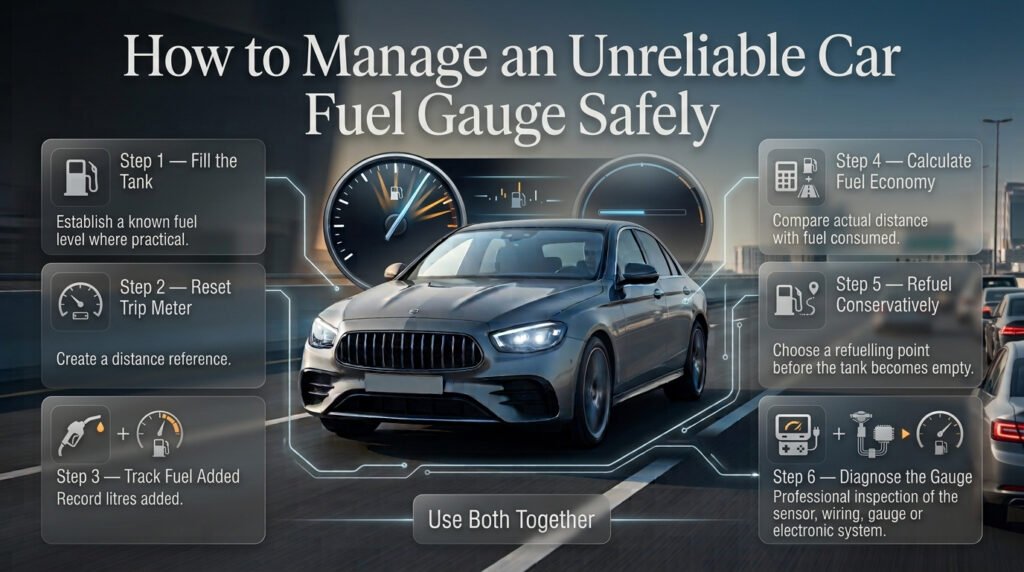
If your gauge has become unreliable, stop treating it as your primary fuel measurement.
Instead:
1. Fill the tank
Start from a known fuel level where practical.
2. Reset the trip meter
This gives you a distance reference.
3. Track fuel added
Record how many litres you put in.
4. Calculate fuel economy
Use actual distance and litres consumed.
5. Set a conservative refuelling point
Don’t deliberately drive until the engine stops.
6. Have the gauge diagnosed
A proper inspection can determine whether the fault is in the sensor, wiring, gauge or electronic system.
This temporary method can help you manage fuel, but it isn’t a substitute for repairing an unreliable gauge.
What Are the Biggest Mistakes Drivers Make With Fuel Gauges?
Mistake 1: Assuming half means exactly half
The gauge may not be linear.
Better approach: Learn your vehicle’s actual behaviour.
Mistake 2: Treating E as a guaranteed reserve
Different vehicles have different reserve characteristics.
Better approach: Refuel before reaching empty whenever possible.
Mistake 3: Trusting distance-to-empty as a guarantee
The number can change as driving conditions change.
Better approach: Maintain a safety margin.
Mistake 4: Ignoring traffic
A low-fuel journey through heavy traffic is very different from the same journey on a clear highway.
Better approach: Consider current conditions.
Mistake 5: Waiting for the engine to stop
This turns ordinary fuel planning into an emergency.
Better approach: Refuel before the situation becomes critical.
Mistake 6: Walking along a highway to find fuel
This can expose you to serious traffic hazards.
Better approach: Stay in a safe position and arrange professional assistance.
Mistake 7: Assuming every engine stop is caused by an empty tank
A vehicle can stop because of a battery, electrical, overheating, mechanical or fuel-system problem.
Better approach: Consider the broader breakdown situation.
What Should You Do If Your Car Runs Out of Fuel?
If the engine stops because the tank is empty, your priority is no longer fuel economy.
It’s safety.
If it is safe to do so, move the vehicle away from active traffic.
Then:
- Switch on hazard warning lights.
- Keep the vehicle visible to approaching traffic.
- Avoid standing in an active lane.
- Don’t walk along a busy road searching for fuel.
- Share your location with the assistance provider.
- Confirm your vehicle’s fuel type.
- Arrange appropriate roadside fuel assistance.
For a broader step-by-step guide, see what to do when your car runs out of fuel.
What If You Are Already Stranded With an Empty Tank?
An empty fuel tank is inconvenient, but the situation becomes much more serious when the vehicle is stopped somewhere unsafe.
If you are on a busy road, don’t leave the vehicle simply because you believe a fuel station is nearby.
Assess the traffic environment first.
If the vehicle is safely positioned and you can remain somewhere protected, wait for assistance.
For additional practical guidance, read safely dealing with an empty fuel tank.
What Should You Do If Your Car Stops on the Road?
Not every roadside stop is caused by fuel.
Your vehicle may also stop because of:
- Battery failure
- Alternator problems
- Overheating
- Electrical failure
- Mechanical failure
- Tyre problems
- Fuel-system problems
If you’re unsure of the cause, don’t keep trying to drive a vehicle that may have a mechanical problem.
Start with safety.
The guide on what to do during a roadside breakdown provides broader advice for handling an unexpected vehicle stop.
How Should You Stay Safe During a Breakdown?
If your vehicle is stopped in or near traffic, visibility and positioning matter.
Turn on your hazard lights where appropriate.
If you can safely move the vehicle to a safer location, do so.
Don’t stand behind the vehicle in an exposed lane.
Don’t attempt unnecessary roadside repairs in dangerous traffic.
And don’t walk along a highway simply because you think a fuel station is close.
For more information, see staying safe during a car breakdown.
You can also review vehicle breakdown safety procedures for additional precautions.
What Location Details Should You Give Roadside Assistance?
When requesting assistance, “I’m on the highway” isn’t enough information.
Give as much useful location information as you can safely provide.
Include:
- Road name
- Direction of travel
- Exit number
- Nearby landmark
- Junction
- Safe shoulder or stopping area
- Nearest identifiable location
- Live location when available
This can make it much easier for assistance providers to locate your vehicle.
For additional preparation and safety guidance, see roadside vehicle emergency precautions.
What If You Run Out of Fuel on a Highway?
Highway fuel emergencies require additional caution because traffic speeds are higher and vehicles may approach quickly.
If your vehicle stops:
- Switch on hazard lights.
- Move to a safer position if you can do so safely.
- Avoid walking along the highway.
- Stay away from active traffic lanes.
- Provide your exact location.
- Arrange professional fuel assistance.
For highway-specific advice, see running out of fuel on a highway.
You can also read highway fuel emergency safety for additional guidance.
What If the Car Stops Because the Fuel Tank Is Empty?
When the fuel tank is genuinely empty, adding the correct fuel may allow the vehicle to restart, although the exact starting behaviour can vary between vehicles.
However, don’t assume every vehicle that stops has simply run out of fuel.
If the gauge was showing fuel before the engine stopped, investigate the situation rather than repeatedly attempting to start the engine.
For more context, see car stops due to empty fuel tank.
How Can You Plan Fuel Better Before a Long Journey?
Good fuel planning is much easier than dealing with an empty tank.
Before a long trip:
Check your actual fuel economy
Don’t rely only on the manufacturer’s advertised figure.
Use your real-world consumption.
Estimate the total distance
Consider the actual route rather than the straight-line distance.
Identify fuel stops
Know where suitable stations are available.
Allow a safety margin
Don’t plan to arrive with the tank almost empty.
Consider traffic
A traffic-heavy route may consume more fuel.
Consider vehicle load
Passengers and luggage can affect consumption.
Check tyre pressure
Incorrect pressure can reduce efficiency.
Consider weather and air conditioning
Hot conditions can increase energy demand.
For additional long-trip planning guidance, see long-distance driving fuel efficiency tips.
What Is the Best Way to Learn Your Car’s Fuel Gauge?
The best approach is to combine the gauge with real-world data.
For several fuel cycles, record:
| Information | Why It Matters |
|---|---|
| Fuel added | Shows actual fuel used |
| Odometer | Measures distance |
| Trip meter | Makes tracking easier |
| Gauge position | Shows how the display behaves |
| Driving conditions | Explains consumption changes |
| Range estimate | Provides another reference |
After a few tanks, you’ll have your own baseline.
You may discover that your vehicle:
- Stays near full for a long time
- Moves more quickly around half
- Drops faster near quarter
- Gives a warning at a predictable point
- Has a consistent real-world range
This knowledge is more useful than memorising a generic rule from another vehicle.
Should You Always Fill the Tank Completely?
Not necessarily.
The decision depends on your driving pattern and circumstances.
For everyday driving, partial refuelling can be perfectly practical.
For a long highway journey, starting with a known higher fuel level may make planning easier.
The important point isn’t whether you always fill the tank completely.
It’s whether you understand how much fuel you have and whether your planned journey leaves an appropriate margin.
How Can You Make Your Fuel Last Longer?
A more accurate understanding of the fuel gauge is only part of the solution.
You can also reduce unnecessary fuel consumption by improving your driving habits.
Useful practices include:
- Accelerate smoothly
- Avoid unnecessary hard braking
- Maintain appropriate tyre pressure
- Reduce unnecessary vehicle weight
- Avoid prolonged idling
- Use appropriate cruising speeds
- Maintain the vehicle properly
- Plan routes efficiently
- Avoid unnecessary short trips where practical
For broader guidance, fuel-saving driving tips can help you understand the habits that influence consumption.
Can Smooth Driving Improve the Range You Get From the Gauge?
Yes.
A smooth driving style can reduce unnecessary energy losses.
Frequent hard acceleration followed by heavy braking is generally less efficient than maintaining a steady driving pattern when traffic conditions allow.
You can explore smooth driving techniques for better fuel economy for more practical guidance.
The key idea is simple:
The gauge tells you what fuel you have. Your driving determines how far that fuel can take you.
How Does Acceleration Affect Fuel Consumption?
Hard acceleration can increase fuel consumption because the engine is being asked to produce more power.
Repeated aggressive acceleration is especially inefficient in congested urban driving where you may immediately have to brake again.
This is why fuel gauge readings should always be interpreted alongside your driving conditions.
If your gauge appears to be dropping quickly, don’t immediately assume the sensor is faulty.
Check whether your driving conditions have changed.
For more detail, see how acceleration affects fuel consumption.
Can Braking Habits Affect Fuel Economy?
Braking itself doesn’t directly make a fuel gauge less accurate.
However, frequent unnecessary braking often means energy was used to accelerate and then discarded through braking.
In stop-and-go traffic, this cycle can reduce efficiency.
Understanding how braking habits affect fuel economy in Dubai can help you reduce unnecessary fuel use.
This matters when you’re estimating how far the remaining fuel will actually take you.
What Is a Safe Way to Think About Fuel Gauge Readings?
Instead of thinking:
“The gauge says 1/4, so I have exactly 25% fuel.”
Think:
“The gauge says my fuel level is getting low, so I should plan my next refuelling stop.”
This small change in thinking makes fuel planning much safer.
The gauge is there to support a decision.
It’s not there to give you a laboratory-grade volume measurement.
Practical Fuel Gauge Decision Table
| Gauge Situation | What It Usually Means | Recommended Action |
|---|---|---|
| Near Full | High fuel level | Normal driving |
| Around 3/4 | Plenty of fuel | Continue monitoring |
| Around Half | Moderate fuel | Consider journey distance |
| Around 1/4 | Fuel becoming limited | Plan refuelling |
| Low-fuel warning | Low fuel | Refuel soon |
| Near E | Critically low | Avoid unnecessary driving |
| E + engine hesitation | Possible fuel starvation | Find a safe place and seek help |
| E + engine stopped | Possible empty tank | Prioritize roadside safety |
This table is a practical decision guide rather than a universal measurement chart because fuel-gauge calibration varies between vehicles.
When Should You Stop Trusting the Fuel Gauge?
A normally functioning fuel gauge doesn’t have to be perfectly linear.
But you should investigate if it becomes unpredictable.
For example, if the gauge:
- Suddenly jumps from full to empty
- Doesn’t respond after refuelling
- Remains stuck in one position
- Changes dramatically on level roads
- Shows completely different readings under similar conditions
- Doesn’t match your actual fuel use over repeated tanks
then it may be time for a professional inspection.
The issue could be relatively simple, such as a wiring connection, or it could involve the sender, gauge or electronic system.
How accurate is a car fuel gauge?
A car fuel gauge is accurate enough for everyday fuel monitoring, but it isn’t designed to tell you the exact number of litres remaining in the tank. Most vehicles use a fuel-level sending unit with a float that moves according to the amount of fuel in the tank. The vehicle then converts that movement into the reading you see on the dashboard.
The important point is that the gauge is showing an estimated fuel level, not directly measuring litres. The shape of the tank, sensor position, calibration and fuel movement can all affect how the gauge behaves. This is why a gauge can stay near “F” for a relatively long time and then appear to drop faster later.
Important points to remember:
Treat the gauge as an approximate fuel-level indicator.
Don’t assume every marking represents an exact percentage.
Half a tank doesn’t necessarily mean exactly 50% remains.
Your trip meter and refuelling history can help you understand your actual range.
If the gauge suddenly becomes erratic or stays permanently full or empty, have it inspected.
The best approach is to use the fuel gauge for refuelling decisions, rather than trying to calculate the exact litres remaining from the needle position.
Does half a tank really mean 50% fuel is left?
Not necessarily. The halfway position on a fuel gauge doesn’t guarantee that exactly half of the tank’s fuel capacity remains. Fuel tanks aren’t perfectly uniform containers, and the fuel-level sensor measures the position of a float rather than directly measuring the volume of fuel.
For example, if your vehicle has a 60-litre tank, you shouldn’t automatically assume that the gauge showing half means exactly 30 litres remain. Depending on the tank’s shape and calibration, the actual amount can be different.
This is also why some drivers feel that the first half of their tank lasts longer than the second half. The apparent movement of the gauge isn’t necessarily proportional to the amount of fuel being consumed.
A more reliable way to understand your fuel level is to:
Reset the trip meter after refuelling.
Record how many litres you add at the next fill-up.
Calculate your actual kilometres per litre.
Repeat the process over several tanks.
Learn how your particular vehicle’s gauge behaves.
This gives you a much better understanding of your vehicle’s real-world fuel range than simply assuming that each gauge marking represents an exact percentage.
How accurate is the distance-to-empty or range display?
The distance-to-empty display can be very useful, but it should still be treated as an estimate rather than a guaranteed driving distance. The vehicle normally calculates the remaining range using the estimated fuel level and recent fuel-consumption data.
That means the displayed range can change as your driving conditions change.
For example, your dashboard may show 120 km remaining after efficient highway driving. If you then enter heavy traffic, spend a long time idling, accelerate frequently or use the vehicle under heavier conditions, fuel consumption can increase. The estimated range may then decrease much faster than the distance you’re actually travelling.
When using a distance-to-empty display:
Use it together with the fuel gauge.
Don’t assume the displayed number is guaranteed.
Leave a reasonable safety margin.
Consider traffic and road conditions.
Remember that recent fuel economy influences the calculation.
Refuel before the range becomes critically low.
The range display is best used to help you plan when and where to refuel, not to test how close you can get to zero.
How far can you drive after the low-fuel warning light comes on?
There isn’t one guaranteed distance that applies to every vehicle. The low-fuel warning is activated at a vehicle-specific fuel level, and the amount of fuel remaining can vary between models. Your actual driving range after the warning also depends on your fuel consumption and current driving conditions.
For example, a vehicle travelling smoothly on an open highway may consume fuel differently from the same vehicle stuck in heavy city traffic. Speed, acceleration, vehicle load, air conditioning and road conditions can all affect how quickly the remaining fuel is used.
That’s why statements such as “you always have 50 kilometres left after the fuel light comes on” shouldn’t be treated as a reliable rule.
When the low-fuel light appears, it’s better to:
Start looking for a suitable fuel station.
Avoid unnecessary detours.
Be more conservative on highways.
Consider current traffic conditions.
Avoid relying completely on the range display.
Refuel before the remaining fuel becomes critical.
The low-fuel warning should be treated as a prompt to refuel, not as a guaranteed reserve-distance calculation.
Why does my fuel gauge read incorrectly or suddenly jump?
A fuel gauge that behaves differently from what you expect doesn’t always mean there’s a fault. Fuel naturally moves around inside the tank when the vehicle accelerates, brakes, corners or travels uphill and downhill. Depending on the vehicle’s design, this movement can temporarily influence the fuel-level sensor.
However, repeated or extreme changes can indicate a genuine problem. A faulty fuel-level sending unit, damaged float, wiring problem, poor electrical connection or instrument-cluster issue can cause the gauge to behave incorrectly.
Signs that your fuel gauge may need professional inspection include:
It stays on full after you’ve driven a significant distance.
It shows empty immediately after refuelling.
The needle repeatedly jumps between levels.
It changes dramatically while driving normally on a level road.
It remains stuck at one position.
The fuel warning appears at an obviously unusual level.
The gauge readings don’t make sense when compared with your actual refuelling history.
If the gauge becomes unreliable, don’t continue depending on it for fuel planning. Track your distance and fuel added temporarily, but have the fuel-level system properly diagnosed so you know whether the problem is with the sensor, wiring, gauge or another component.
Conclusion
A car fuel gauge is useful, but it should not be treated as a precision measuring instrument. The reading gives you a practical indication of how much fuel remains, while the actual fuel level can vary because of tank shape, sensor design, fuel movement and vehicle calibration. The same principle applies to the distance-to-empty display: it can provide a helpful estimate, but changes in speed, acceleration, traffic and driving conditions can affect the calculation.
The safest approach is to use your fuel gauge as an early warning system rather than waiting until the needle reaches empty. Understanding how your particular vehicle behaves, tracking your real-world fuel consumption and refuelling before the tank becomes critically low can greatly reduce the risk of unexpectedly running out of fuel.
If your gauge suddenly jumps, remains stuck, shows an obviously incorrect level or behaves differently after every refuelling, don’t simply compensate by guessing. The fuel-level sensor, wiring or gauge system may need professional inspection.
Key takeaway: your fuel gauge can tell you when it’s time to refuel, but it shouldn’t be used to calculate your exact remaining litres or to deliberately stretch the vehicle until the tank is completely empty.
Leave a Reply