Introduction
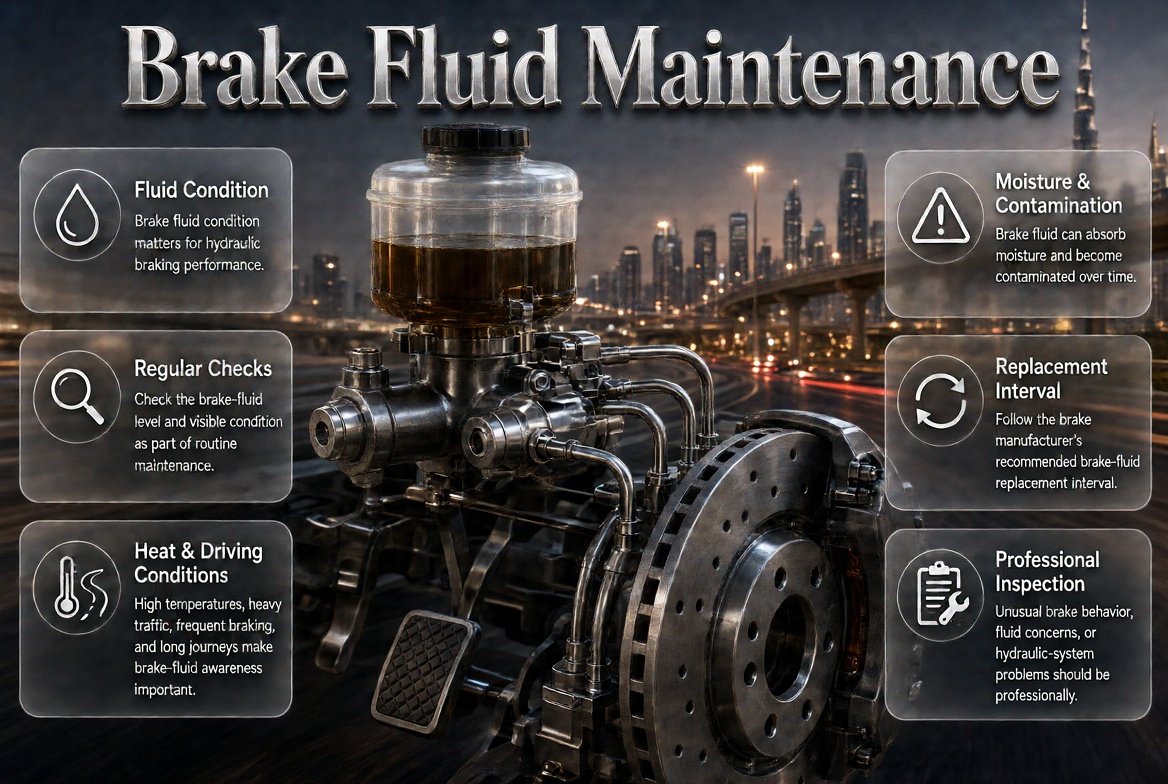
Brake Fluid Maintenance | A brake pedal can feel completely normal one day and noticeably different another day. Sometimes the cause is worn brake pads or a mechanical problem. In other cases, the issue may involve the hydraulic system and the condition of the brake fluid.
This is why brake fluid maintenance deserves a place in every vehicle’s regular maintenance routine.
Brake fluid is responsible for transferring hydraulic pressure from the brake pedal to the braking components at the wheels. If the fluid becomes contaminated, absorbs excessive moisture, or remains in service beyond the manufacturer’s recommended interval, the braking system may not perform as intended.
For drivers in Dubai, where vehicles regularly deal with high temperatures, heavy traffic, frequent braking, and long journeys, understanding basic brake-fluid care is particularly useful. Fuel Delivery Dubai provides broader vehicle and roadside information, while this guide focuses specifically on how brake fluid works, how to check it, when it should be replaced, what warning signs to watch for, and which mistakes to avoid.
You don’t need to become a mechanic to understand brake fluid maintenance.
You do need to know what the fluid does, what normal looks like, when a low level is a warning sign, and when professional inspection is necessary.
This guide explains everything step by step.
What Is Brake Fluid?
Brake fluid is a specialized hydraulic fluid used to transfer pressure through a vehicle’s braking system.
When you press the brake pedal, the master cylinder creates hydraulic pressure. That pressure travels through the brake fluid inside the brake lines and hoses to the calipers or wheel cylinders. These components then apply the brake pads or shoes against the rotating braking surfaces.
The basic process is:
Brake pedal → Master cylinder → Hydraulic pressure → Brake fluid → Brake lines → Calipers/wheel cylinders → Brake pads/shoes → Vehicle slows
Brake fluid isn’t the same as engine oil.
Engine oil primarily lubricates and protects moving engine components. Brake fluid’s primary purpose is to transmit hydraulic pressure while operating reliably across a wide range of temperatures.
A properly maintained braking system therefore depends on more than just good brake pads.
It also depends on:
- Correct brake fluid
- Correct fluid level
- Proper hydraulic pressure
- Clean fluid
- Properly sealed brake lines
- Functional calipers or wheel cylinders
- A healthy master cylinder
- Properly maintained brake components
This is one reason brake maintenance should be considered as part of the wider vehicle maintenance process. The Vehicle Maintenance Guides section provides a broader framework for understanding how brakes, fluids, tyres, batteries, cooling systems, and other vehicle components fit into an overall maintenance routine.
Why Is Brake Fluid Maintenance Important?
Brake fluid maintenance matters because braking is a hydraulic process.
When you press the brake pedal, the system needs to transfer that pressure consistently. Brake fluid must remain suitable for that job even when the braking system becomes very hot.
Over time, however, brake fluid can change.
Depending on the type of fluid and vehicle system, it can:
- Absorb moisture
- Become contaminated
- Darken
- Experience chemical degradation
- Contribute to corrosion when moisture levels become excessive
- Develop a lower boiling point
- Become unsuitable for continued service
The important point is that brake fluid doesn’t necessarily fail dramatically overnight.
Its condition can deteriorate gradually.
A vehicle may continue to drive normally while the fluid is slowly aging.
That’s why scheduled maintenance is important.
What Does Brake Fluid Maintenance Include?
Brake fluid maintenance isn’t simply opening the reservoir and adding more fluid.
A proper maintenance approach may include:
- Checking the reservoir level
- Confirming the correct fluid specification
- Inspecting for leaks
- Reviewing the service history
- Checking fluid condition
- Following the manufacturer’s replacement interval
- Bleeding the braking system when required
- Inspecting related brake components
- Investigating changes in pedal feel
The exact requirements vary by vehicle.
Your owner’s manual remains the best starting point for the manufacturer’s specification and service schedule.
For a practical step-by-step approach to checking oil levels, choosing the correct oil, understanding warning signs, and maintaining proper engine lubrication, read our detailed Engine Oil Maintenance Guide before your next oil service.
How Does Brake Fluid Work?
Brake fluid works by transferring hydraulic pressure through a sealed braking system.
Unlike air, brake fluid is effectively incompressible under normal operating conditions. That characteristic allows movement at the brake pedal to be transmitted through the hydraulic system.
Imagine pushing a sealed syringe filled with liquid.
When you push one end, pressure is transferred through the liquid.
A vehicle’s braking system works on the same basic principle, although the actual system is considerably more sophisticated.
When you press the brake pedal:
- The pedal moves the master-cylinder mechanism.
- The master cylinder pressurizes brake fluid.
- Hydraulic pressure travels through the brake lines.
- Calipers or wheel cylinders respond to the pressure.
- Brake pads or shoes apply force.
- Friction slows the wheels.
- The vehicle decelerates.
If air enters the hydraulic system, the behavior changes because air can compress.
That is one reason air in the braking system can create a soft or spongy pedal.
For a clear guide to checking coolant levels, recognising cooling-system warning signs, choosing the right coolant, and maintaining reliable engine temperature control, see our detailed Coolant Fluid Maintenance Guide before your next vehicle inspection or service.
What Happens to Brake Fluid Over Time?
Brake fluid doesn’t remain chemically unchanged forever.
One of the most important factors affecting conventional glycol-based brake fluids is moisture absorption.
Many commonly used brake fluids are hygroscopic, meaning they can absorb moisture from the surrounding environment.
As moisture content increases, the fluid’s boiling characteristics can change.
This becomes particularly important during heavy braking.
When brakes operate, friction generates heat. Under normal driving, the system can manage that heat. But repeated hard braking, long downhill driving, heavy loads, or other demanding conditions can raise brake temperatures significantly.
If fluid has a substantially reduced boiling point, excessive heat can create a risk of vapor formation.
Vapor is compressible.
That means the hydraulic system may not transmit pedal force as consistently as it should.
This is one reason old brake fluid shouldn’t be ignored simply because the vehicle still stops.
How Often Should Brake Fluid Be Changed?
There is no single replacement interval that applies to every vehicle.
The correct interval should come from the vehicle manufacturer.
Some manufacturers specify replacement after a particular number of years. Others provide different recommendations depending on the vehicle, brake system, climate, or service conditions.
Mileage isn’t always the deciding factor.
A car that travels relatively few kilometres can still have old brake fluid.
For example:
Vehicle A
- Driven 40,000 km
- Three years old
- Brake fluid serviced according to schedule
Vehicle B
- Driven 15,000 km
- Six years old
- Original brake fluid
Vehicle B has lower mileage, but its fluid has been in service considerably longer.
That’s why brake fluid maintenance should be based on both the manufacturer’s schedule and the actual condition of the braking system.
What If You Don’t Know When the Brake Fluid Was Last Changed?
This is common with used vehicles.
If service records don’t clearly show when the brake fluid was replaced, don’t assume that the fluid is fresh.
A sensible approach is to have the braking system inspected and determine what service is appropriate based on:
- Vehicle age
- Manufacturer requirements
- Previous records
- Fluid condition
- Brake-system condition
- Moisture condition where applicable
Establishing a known maintenance baseline can make future servicing much easier.
What Are the Signs of Bad or Old Brake Fluid?
Brake-fluid problems don’t always produce a single obvious symptom.
Possible warning signs include:
- Soft brake pedal
- Spongy brake pedal
- Brake pedal traveling farther than normal
- Brake warning light
- Low brake-fluid level
- Repeatedly falling fluid level
- Visible hydraulic leakage
- Changes in braking consistency
- Unusual fluid appearance
- Known overdue fluid service
However, it’s important not to assume that every one of these symptoms is caused by old fluid.
A soft pedal, for example, can have several possible causes.
It may involve:
- Air in the hydraulic system
- A fluid leak
- A master-cylinder problem
- Brake adjustment issues on certain systems
- Worn or damaged components
- Other hydraulic faults
The symptom tells you that something deserves attention.
It doesn’t necessarily identify the exact cause.
What Color Should Brake Fluid Be?
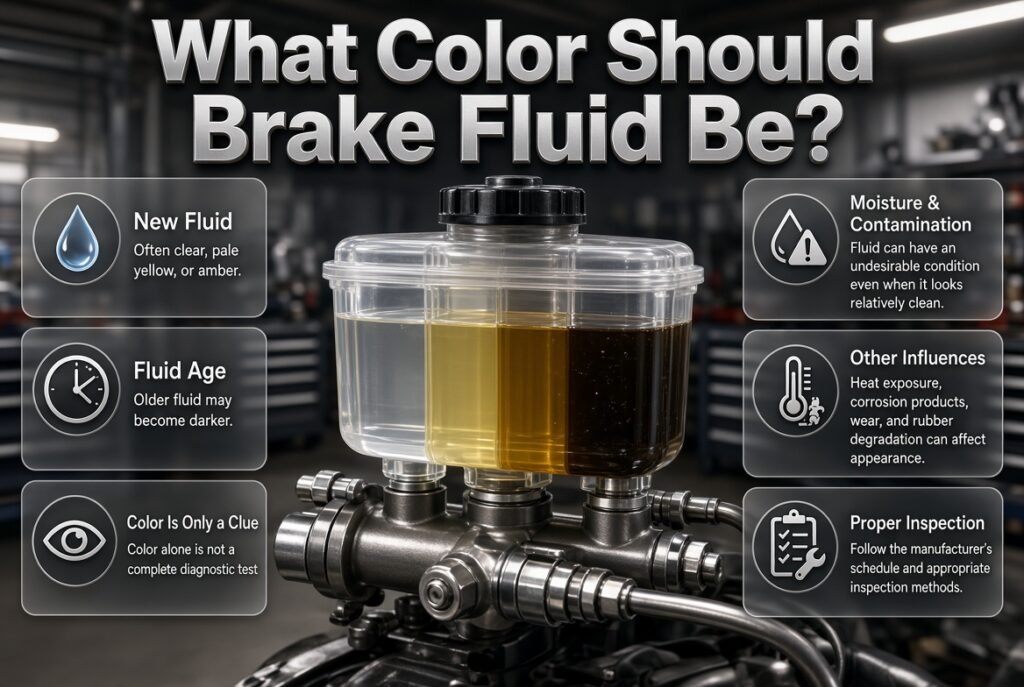
Brake fluid can vary in color depending on its type, manufacturer, age, and condition.
New fluid is often clear, pale yellow, or amber.
Older fluid may become darker.
However, color should not be treated as a complete brake-fluid diagnostic test.
A fluid can look relatively clean while still having an undesirable moisture condition.
Likewise, dark fluid doesn’t automatically tell you exactly why it changed color.
Other factors can include:
- Age
- Contamination
- Internal component wear
- Rubber degradation
- Corrosion products
- Heat exposure
- Previous servicing
Therefore, don’t make a replacement decision solely because the fluid looks dark.
Use the manufacturer’s maintenance schedule and proper inspection methods.
How Do You Check Brake Fluid?
Checking the reservoir level is one of the simpler vehicle-maintenance inspections, but you should only do it if you’re confident that you can identify the correct reservoir and follow the vehicle manufacturer’s instructions.
Step 1: Park Safely
Park the vehicle on reasonably level ground.
Switch off the engine and allow the vehicle to cool if you’ve just completed demanding driving.
Step 2: Open the Bonnet
Locate the brake-fluid reservoir.
On many vehicles, it’s positioned near the master cylinder at the rear of the engine compartment.
The exact location varies.
If you’re unsure, consult the owner’s manual.
Step 3: Check the Reservoir Markings
Most reservoirs have:
MIN
and
MAX
markings.
The fluid level should generally remain within the specified range.
Don’t simply assume that a low level means the reservoir needs topping up.
The reason for the low level needs to be considered.
Step 4: Look for Visible Problems
Check around the reservoir and nearby components for:
- Wetness
- Fluid residue
- Cracks
- Damaged components
- Contamination
- Unusual leakage
Step 5: Check the Fluid Specification
Never choose brake fluid based simply on the fact that the bottle says “brake fluid.”
The vehicle requires a particular specification.
Common classifications include:
- DOT 3
- DOT 4
- DOT 5
- DOT 5.1
These classifications have different characteristics.
Use the specification approved by the vehicle manufacturer.
Why Is a Low Brake-Fluid Level a Warning Sign?
Brake-fluid level deserves attention because the system is not supposed to consume brake fluid during normal operation.
A gradual decrease can occur as brake pads wear because caliper pistons may move farther outward to maintain contact with the brake pads.
But a significant or sudden reduction can indicate a problem.
Possible causes include:
- Hydraulic leakage
- Worn brake components
- Damaged lines or hoses
- Caliper leakage
- Master-cylinder problems
This is why simply adding fluid can be the wrong response.
If the level keeps falling, find out why.
⚠ Common Mistake: Treating the brake-fluid reservoir like the engine-oil dipstick. If engine oil is low, you normally add oil after determining the appropriate level. With brake fluid, a falling level may indicate a condition that needs investigation.
Can You Top Up Brake Fluid?
Sometimes, yes—but topping up isn’t a substitute for diagnosis or scheduled fluid replacement.
If the level is slightly low, the correct fluid may be added when appropriate and according to the manufacturer’s instructions.
But first consider why the level changed.
If brake fluid repeatedly needs topping up, that’s not normal maintenance behavior.
It may indicate:
- A leak
- Significant pad wear
- A hydraulic-system issue
Adding fluid repeatedly can hide the symptom while the underlying problem continues.
A technician should inspect the system if the level is unexpectedly low.
Brake Fluid Flush vs Brake Fluid Top-Up
These terms are often confused.
A top-up means adding fluid to bring the reservoir back to the appropriate level.
A fluid change or flush involves removing old fluid and replacing it with fresh fluid according to the vehicle’s service procedure.
They are not equivalent.
| Service | Main Purpose |
|---|---|
| Top-up | Correct a low fluid level when appropriate |
| Bleeding | Remove air from the hydraulic system |
| Fluid replacement | Replace old brake fluid |
| Brake repair | Correct a mechanical or hydraulic fault |
Adding a small amount of fresh fluid to old fluid doesn’t transform the entire system into a freshly serviced system.
If the fluid is due for replacement, follow the appropriate service procedure.
What Is Brake Fluid Bleeding?
Brake bleeding is a procedure used to remove trapped air from the hydraulic braking system and, depending on the procedure, help replace old fluid.
The exact process differs between vehicles.
A typical professional procedure can involve:
- Inspecting the brake system
- Identifying the correct fluid
- Preparing the vehicle
- Maintaining the reservoir level
- Opening designated bleed points
- Removing air and old fluid
- Introducing fresh fluid where appropriate
- Closing the system
- Checking pedal feel
- Testing the braking system
Modern vehicles can have sophisticated ABS systems, so some procedures may require manufacturer-specific steps or diagnostic equipment.
This is one reason brake-fluid servicing isn’t always a good DIY experiment.
Why Does Air in the Brake System Cause a Soft Pedal?
Air can compress.
Brake fluid under normal conditions does not compress nearly as easily.
Imagine pressing the brake pedal with a hydraulic system containing only fluid.
Your pedal movement creates hydraulic pressure.
Now imagine there is a pocket of air inside the system.
Part of your pedal movement compresses that air instead of immediately transferring pressure through the hydraulic system.
The result can be a pedal that feels:
- Soft
- Spongy
- Less responsive
- Lower than usual
A sudden change in pedal feel should never be ignored.
What Is the Difference Between DOT 3, DOT 4, DOT 5, and DOT 5.1?
The DOT classification identifies performance requirements for brake fluid, but the different classifications shouldn’t be treated as interchangeable products.
DOT 3
DOT 3 is a glycol-based brake fluid used in many braking systems.
DOT 4
DOT 4 is also glycol-based and is commonly specified in many modern vehicles.
DOT 5
DOT 5 is silicone-based.
It is chemically different from glycol-based DOT 3, DOT 4, and DOT 5.1.
It should not simply be substituted for them.
DOT 5.1
DOT 5.1 is glycol-based despite the similar name to DOT 5.
That’s an important distinction.
DOT 5 ≠ DOT 5.1
Always use the fluid specified by the vehicle manufacturer.
Can You Mix Different Brake Fluids?
Never assume that two brake fluids are compatible simply because they are both marketed for vehicles.
Some glycol-based fluids may have compatibility relationships, but the correct approach is still to follow the manufacturer’s specification rather than improvising.
DOT 5, in particular, is chemically different from glycol-based fluids.
If you’re unsure what fluid is currently in the system, don’t experiment.
Check the service documentation or have the system inspected.
⭐ Expert Tip: The safest rule is simple: don’t choose brake fluid by brand, price, color, or a friend’s recommendation. Choose it according to the vehicle manufacturer’s required specification.
How Does Brake Fluid Maintenance Fit Into Regular Vehicle Maintenance?
Brake fluid shouldn’t be maintained in isolation.
It belongs within a broader vehicle maintenance program.
A practical maintenance routine may include:
- Engine oil
- Coolant
- Brake fluid
- Transmission fluid where applicable
- Tyre pressure
- Battery
- Brake pads
- Brake discs
- Air filters
- Belts
- Hoses
- Steering
- Suspension
- Lights
- Wipers
- Air-conditioning system
If you’re building a complete maintenance routine, the Essential Car Fluids guide can help you understand the different fluids and why each has a separate maintenance purpose.
Brake fluid should never be confused with coolant or engine oil.
Each fluid has a different job.
Why Should Brake Fluid Be Checked During Brake Maintenance?
Brake pads and discs receive most of the attention because they’re visible wear components.
But the hydraulic system is equally important.
A proper brake inspection should consider:
Brake Pads
Check thickness and wear pattern.
Uneven wear may indicate another problem.
Brake Discs
Look for excessive wear, scoring, cracking, or abnormal surface conditions.
Calipers
Check for proper operation and signs of leakage.
Brake Hoses
Inspect flexible hoses for damage, deterioration, or leakage.
Brake Lines
Look for corrosion, damage, or fluid leakage.
Brake Fluid
Check:
- Level
- Service history
- Specification
- Condition
- Signs of contamination
This complete approach is more useful than inspecting only one component.
How Does Heavy Traffic Affect Brake Maintenance?
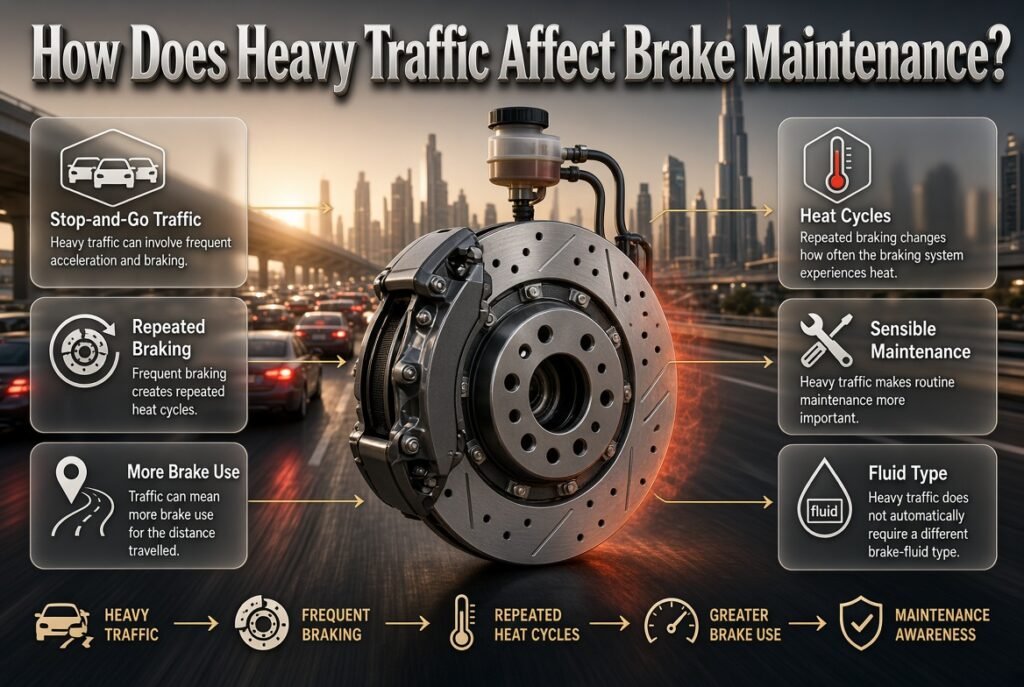
Dubai driving can involve significant stop-and-go traffic.
Repeated acceleration and braking don’t necessarily mean the braking system is defective, but frequent braking creates repeated heat cycles.
Traffic can also mean that the driver spends much more time using the brakes than expected for the distance travelled.
For fuel-efficiency considerations, understanding How Traffic Affects Fuel Economy in Dubai is useful because traffic affects more than fuel consumption. It also changes how frequently the vehicle accelerates, decelerates, idles, and operates under heat.
Similarly, Stop-and-Go Driving Fuel Efficiency explains why repeated acceleration and braking affect vehicle operation.
The key point is that heavy traffic doesn’t automatically mean you need a different brake-fluid type.
It does mean that sensible maintenance becomes more important.
Can Driving Style Affect Brake Wear?
Yes.
Driving style can influence brake wear and brake-system heat.
Frequent aggressive acceleration followed by hard braking can create more heat and wear than smoother driving with better anticipation.
Useful driving habits include:
- Looking farther ahead
- Maintaining a sensible following distance
- Anticipating traffic
- Avoiding unnecessary hard braking
- Maintaining appropriate speed
- Braking smoothly when conditions allow
- Avoiding unnecessary acceleration followed by immediate braking
The principles discussed in Smooth Driving Techniques for Better Fuel Economy also demonstrate how smoother vehicle control can reduce unnecessary acceleration and braking.
Similarly, How Braking Habits Affect Fuel Economy in Dubai explains the relationship between braking behavior and vehicle efficiency.
This doesn’t mean avoiding braking when braking is necessary.
Safety always comes first.
Can Braking Habits Affect Fuel Consumption?
Yes, indirectly.
When a vehicle accelerates, it uses energy to increase speed.
If the driver immediately brakes hard because traffic wasn’t anticipated, much of that kinetic energy is dissipated through the braking system.
The driver then needs to accelerate again.
This repeated cycle can increase fuel consumption.
For broader practical advice, Fuel-Saving Driving Tips covers smooth acceleration, sensible speed, traffic awareness, idling, tyres, vehicle load, and other efficiency factors.
Similarly, How to Reduce Fuel Use in Traffic explains how anticipation and smoother driving can reduce unnecessary fuel use.
These practices don’t replace brake maintenance.
They simply help reduce unnecessary braking and acceleration.
Does Vehicle Speed Affect Brake and Fuel Performance?
Speed affects the amount of energy involved when a vehicle slows down.
Higher speeds mean more kinetic energy must be dissipated during braking.
That doesn’t mean a specific speed is universally appropriate for every road.
Always follow posted limits and road conditions.
From a fuel-efficiency perspective, Optimal Driving Speed for Fuel Efficiency in Dubai explains how speed can influence fuel consumption.
The broader lesson is straightforward:
Safe, legal, predictable driving reduces unnecessary stress on the vehicle.
How Does Vehicle Weight Affect Braking?
Vehicle weight matters because a heavier vehicle has more mass to slow down.
Additional weight can influence:
- Acceleration
- Fuel consumption
- Braking effort
- Tyre loading
- Suspension loading
This is why carrying unnecessary items isn’t just a fuel-economy issue.
The How Vehicle Weight Affects Fuel Economy guide explains the efficiency side of additional weight, while Car Load and Fuel Consumption provides practical context around carrying unnecessary items.
A heavily loaded vehicle should be driven with appropriate awareness of stopping distance and road conditions.
Does Air Conditioning Affect Vehicle Operation?
Air conditioning adds load to the vehicle’s engine or electrical system depending on the vehicle design.
In Dubai’s climate, air conditioning is often essential for driver and passenger comfort.
The solution isn’t to avoid using it when conditions require it.
Instead, use it sensibly and keep the system maintained.
The relationship between air conditioning and vehicle efficiency is discussed in Air Conditioning and Fuel Consumption.
Brake fluid itself doesn’t become unsuitable simply because you use the air conditioner.
However, overall vehicle heat management and maintenance still matter.
Why Is Tyre Pressure Important for Brake Maintenance?
Tyres and brakes work together to slow the vehicle and maintain traction.
Even if the brake system generates sufficient braking force, the tyres must maintain suitable contact with the road.
Incorrect tyre pressure can affect:
- Handling
- Stability
- Tyre wear
- Rolling resistance
- Braking behavior
For this reason, Tyre Pressure and Fuel Efficiency is relevant to the wider vehicle-maintenance picture.
Don’t overinflate tyres simply to improve fuel economy.
Use the manufacturer’s recommended pressure.
What Happens If Brake Fluid Is Contaminated?
Contamination can affect brake-fluid performance and potentially the condition of hydraulic components.
Potential contaminants include:
- Moisture
- Dirt
- Incorrect fluids
- Chemical contamination
- Internal system debris
Even the fluid reservoir can be affected if the cap or surrounding area isn’t kept reasonably clean.
When servicing brake fluid, avoid introducing dirt into the system.
Use appropriate, clean equipment and properly sealed fluid containers.
Why Should You Avoid Using an Old Open Bottle of Brake Fluid?
Once a container has been opened, the fluid can be exposed to atmospheric moisture.
Because many brake fluids are hygroscopic, storage matters.
That doesn’t mean every opened bottle immediately becomes unusable.
It means brake fluid should be stored according to the manufacturer’s recommendations and handled carefully.
If you’re unsure about the age or storage history of a bottle, don’t take unnecessary chances with a safety-critical fluid.
Use suitable fresh fluid that meets the required specification.
Can Brake Fluid Damage Car Paint?
Yes, many brake fluids can damage automotive paint.
That’s why spills should be dealt with promptly and carefully according to appropriate handling guidance.
When checking or servicing brake fluid:
- Avoid unnecessary spills
- Keep the reservoir area clean
- Don’t place tools where they can fall into the reservoir
- Use suitable protective materials
- Follow the product’s safety instructions
Brake fluid maintenance is a small job that benefits from cleanliness and care.
What Are the Most Common Brake Fluid Maintenance Mistakes?
Mistake 1: Waiting for a Warning Light
A dashboard warning light is important, but it shouldn’t be your only maintenance reminder.
Better approach: Follow the service schedule and pay attention to changes in braking performance.
Mistake 2: Topping Up Without Investigating
If fluid is low, simply adding more may hide a leak.
Better approach: Find the reason for the low level.
Mistake 3: Using the Wrong Fluid
Brake-fluid specifications aren’t universal.
Better approach: Check the manufacturer’s requirement before purchasing fluid.
Mistake 4: Judging Fluid Only by Color
Dark fluid can be a reason for inspection, but color doesn’t provide a complete diagnosis.
Better approach: Consider service history, specification, condition, and proper testing.
Mistake 5: Ignoring a Soft Pedal
A soft pedal isn’t something to “get used to.”
Better approach: Have the braking system inspected.
Mistake 6: Assuming Low Mileage Means Fresh Fluid
A vehicle can have low mileage and old brake fluid.
Better approach: Consider time as well as mileage.
Mistake 7: Treating Brake Fluid Like Engine Oil
Brake fluid isn’t a consumable fluid in the same way fuel or engine oil is.
Better approach: Investigate unexplained fluid loss.
Mistake 8: Mixing Fluids Without Checking Compatibility
Different fluid specifications have different characteristics.
Better approach: Follow the manufacturer’s specification.
Mistake 9: Ignoring Service Records
Without records, you may have no reliable idea when the fluid was last replaced.
Better approach: Keep a simple maintenance history.
How Should You Keep a Brake Fluid Maintenance Record?
A maintenance record doesn’t need to be complicated.
You can record:
| Information | Example |
|---|---|
| Service date | September 2026 |
| Vehicle mileage | 65,000 km |
| Fluid specification | Manufacturer-specified DOT type |
| Service performed | Brake fluid replacement |
| Brake inspection | Pads and discs checked |
| Leakage inspection | No leak found |
| Next service | According to manufacturer schedule |
| Technician notes | Hydraulic system inspected |
This record becomes especially useful when you own a vehicle for several years.
It also helps if another workshop services the vehicle later.
Good records reduce guesswork.
How Does Brake Fluid Maintenance Fit Into Preventive Maintenance?
Preventive maintenance means addressing service requirements before they become failures.
Brake-fluid replacement is a good example.
You don’t wait for the fluid to become completely unusable.
You follow the recommended maintenance interval.
The same philosophy applies to:
- Engine oil
- Coolant
- Filters
- Tyres
- Batteries
- Belts
- Brake pads
- Other scheduled components
For a broader explanation, Preventive Vehicle Maintenance provides a useful framework for dealing with vehicle-service needs before they become larger problems.
The goal isn’t to replace every part early.
The goal is to maintain components according to their actual service requirements.
What Other Fluids Should Be Maintained Alongside Brake Fluid?
A vehicle may contain several important fluids.
These can include:
- Engine oil
- Coolant
- Brake fluid
- Transmission fluid
- Power-steering fluid on applicable vehicles
- Washer fluid
- Differential fluid
- Transfer-case fluid on applicable vehicles
Each has a different purpose.
For example:
Engine oil → lubrication and engine protection
Coolant → temperature control and corrosion protection
Brake fluid → hydraulic pressure transmission
Transmission fluid → lubrication, cooling, hydraulic operation, and component protection depending on transmission type
If you’re building a complete fluid-maintenance routine, the Essential Car Fluids guide is a useful starting point.
How Does Coolant Maintenance Differ From Brake Fluid Maintenance?
Coolant and brake fluid are both important, but they perform completely different jobs.
Coolant helps manage engine temperature.
Brake fluid transfers hydraulic pressure.
A coolant problem can lead to overheating.
A brake-fluid or hydraulic-system problem can affect braking performance.
That’s why the two systems require separate inspection and maintenance procedures.
For the cooling side, see the Coolant Fluid Maintenance guide.
Don’t substitute one fluid for another.
A fluid reservoir should always be identified before anything is added.
How Does Engine Oil Maintenance Differ From Brake Fluid Maintenance?
Engine oil primarily protects and lubricates the engine.
Brake fluid operates the hydraulic braking system.
Engine oil is normally monitored according to mileage, time, operating conditions, and manufacturer recommendations.
Brake fluid also follows manufacturer-specific service requirements, but its condition can be strongly influenced by moisture absorption and hydraulic-system requirements.
For drivers building a complete maintenance history, Engine Oil Maintenance provides additional guidance on maintaining engine oil records and service intervals.
The important lesson is simple:
Never treat all vehicle fluids as if they have the same maintenance schedule.
What Should You Do If Brake Fluid Is Leaking?
A suspected brake-fluid leak should be treated seriously.
Potential signs include:
- Wetness near a wheel
- Fluid around brake components
- Falling reservoir level
- Brake warning light
- Soft pedal
- Pedal sinking unusually far
- Reduced braking performance
The exact source may be difficult to identify without proper inspection.
Possible leak points can include:
- Brake hoses
- Brake lines
- Calipers
- Wheel cylinders
- Master cylinder
- Connections
Don’t simply add more fluid and continue driving if the system is leaking.
A hydraulic leak can compromise braking performance.
If braking is significantly impaired, stop in a safe location and arrange appropriate professional assistance.
What Should You Do If the Brake Pedal Suddenly Feels Different?
A sudden change in pedal feel deserves attention.
If the pedal becomes:
- Soft
- Spongy
- Unusually low
- Harder than normal
- Slow to return
- Inconsistent
don’t assume the change will disappear.
Possible causes vary, so diagnosis is important.
If braking performance is seriously compromised, don’t continue normal driving just because the engine and transmission still operate.
Vehicle safety takes priority.
Does Running Out of Fuel Have Anything to Do With Brake Fluid?
Not directly.
Running out of fuel is a fuel-system problem, while brake fluid belongs to the hydraulic braking system.
However, both situations demonstrate the importance of understanding different vehicle systems.
If your car runs out of fuel, What to Do When Your Car Runs Out of Fuel explains the correct roadside response.
The most important point is to prioritize safety, especially on busy roads.
Similarly, Emergency Roadside Fuel Advice explains how to respond when a vehicle cannot reach a petrol station.
These resources are separate from brake-fluid maintenance, but they belong to the same broader goal: knowing what to do when a vehicle problem occurs unexpectedly.
What Should You Do If Your Car Runs Out of Petrol?
If the engine stops because the tank is empty, safely move the vehicle away from traffic if possible, switch on hazard lights, and arrange suitable assistance.
Don’t walk along a dangerous highway simply because a petrol station appears nearby.
The Steps After Running Out of Petrol guide provides a practical emergency sequence for drivers dealing with an empty fuel tank.
Again, this has nothing to do with brake-fluid condition itself.
But it reinforces an important vehicle-ownership principle:
Know the difference between a routine maintenance issue and a roadside safety problem.
What Should You Do If the Car Has a Brake Problem on the Road?
If you notice serious brake problems while driving, your first priority is to control the vehicle safely.
Depending on the situation:
- Reduce speed carefully.
- Avoid unnecessary acceleration.
- Move toward a safe location when possible.
- Activate hazard lights if appropriate.
- Stop somewhere away from active traffic.
- Don’t continue driving if braking is unsafe.
- Arrange professional assistance.
Do not attempt a roadside brake repair unless you have the correct tools, knowledge, safe working environment, and appropriate procedures.
A roadside location isn’t always suitable for brake-system work.
Does Long-Distance Driving Require Extra Brake Fluid Checks?
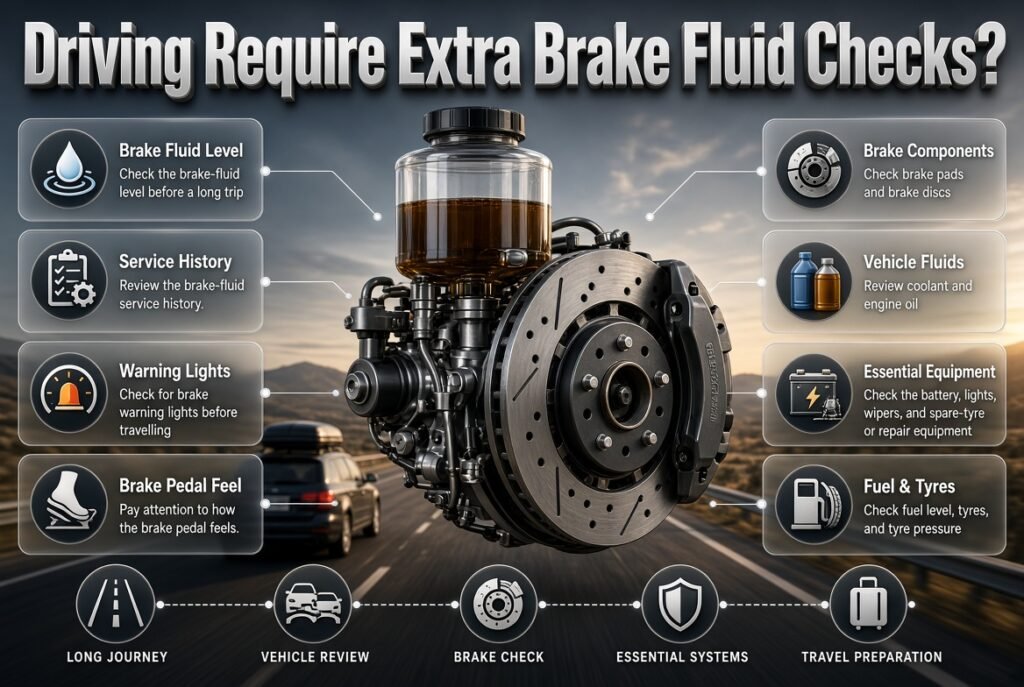
A long journey is a good reason to review the vehicle’s overall condition.
Before a long trip, check:
- Brake-fluid service history
- Brake-fluid level
- Brake warning lights
- Brake pedal feel
- Brake pads
- Brake discs
- Tyres
- Tyre pressure
- Coolant
- Engine oil
- Battery
- Lights
- Wipers
- Spare tyre or repair equipment
- Fuel level
Long-distance driving can expose weaknesses that aren’t obvious during short local trips.
For the wider maintenance side, Improving Fuel Economy on Long Trips and Long-Distance Driving Fuel Efficiency Tips provide useful information about preparing a vehicle for extended journeys.
Brake condition should always be part of that preparation.
How Do Vehicle Accessories Affect Overall Vehicle Performance?
Accessories such as roof racks and other external equipment can increase aerodynamic drag and vehicle load.
They don’t directly determine brake-fluid condition.
However, they can influence overall vehicle operation, especially during longer trips.
For related information, see:
- Roof Racks and Fuel Economy
- Vehicle Accessories and Fuel Economy in Dubai
- Vehicle Drag and Fuel Consumption in Dubai
- How Aerodynamics Affects Fuel Efficiency
The common theme is vehicle condition.
A well-maintained vehicle should be considered as a complete system rather than a collection of unrelated parts.
Can Gear Selection Affect Brake Wear?
Transmission behavior can influence how a vehicle slows down.
Depending on the vehicle and transmission, appropriate use of lower gears or engine braking can reduce the need for continuous brake application in certain situations.
However, engine braking doesn’t replace the service brake.
Drivers should never avoid using the brakes when braking is necessary.
For transmission-related efficiency guidance, see Gear Shifting and Fuel Economy and Fuel-Efficient Use of Automatic Transmission.
The correct approach is to use the vehicle’s transmission and brakes appropriately for the road conditions.
Why Should You Not Ignore Brake Warning Lights?
A brake warning light can have different meanings depending on the vehicle.
It may relate to:
- Low brake fluid
- Parking brake status
- Brake-system fault
- Electronic braking-system issue
The exact meaning should be checked in the owner’s manual.
Don’t assume that a warning light is harmless simply because the vehicle still drives.
Some warnings may be minor.
Others may indicate a condition that requires immediate attention.
When Should Brake Fluid Be Professionally Inspected?
Professional inspection is appropriate when:
- The brake pedal becomes soft
- The brake pedal sinks
- Fluid level is unexpectedly low
- Fluid repeatedly disappears
- A leak is visible
- The brake warning light appears
- The fluid-service history is unknown
- The braking system has been opened
- Brake components have recently been replaced
- You don’t know which fluid specification is required
- Braking performance changes
- The vehicle has been stored for a long period
A professional inspection can evaluate the fluid and the surrounding braking system together.
That matters because replacing fluid won’t repair a damaged hose, leaking caliper, faulty master cylinder, or worn brake component.
What Is a Practical Brake Fluid Maintenance Schedule?
Your manufacturer’s schedule should always take priority, but a practical routine can look like this:
During Routine Checks
Inspect:
- Reservoir level
- Warning lights
- Brake-pedal feel
- Visible leaks
During Scheduled Servicing
Review:
- Brake-fluid service date
- Brake-fluid condition
- Brake pads
- Brake discs
- Brake hoses
- Brake lines
- Calipers
Before Long Trips
Confirm:
- Fluid level
- Service history
- Pedal feel
- Brake-system condition
- Tyre condition
- Overall vehicle readiness
When Symptoms Appear
Don’t wait for the next routine service.
Investigate:
- Soft pedal
- Warning lights
- Leakage
- Reduced braking performance
- Unusual brake behavior
Brake Fluid Maintenance Checklist
Use this checklist as a quick reference.
Brake Fluid
- Check fluid level
- Confirm the correct specification
- Check service history
- Inspect for contamination
- Follow replacement interval
- Use properly stored fluid
- Avoid unnecessary mixing
Hydraulic System
- Inspect brake lines
- Inspect hoses
- Check calipers
- Check master cylinder
- Look for leakage
- Check for air-related symptoms
Brake Components
- Inspect pads
- Inspect discs/rotors
- Check wear patterns
- Check for unusual noise
- Monitor braking performance
Driver Feedback
- Pedal feels normal
- No sudden pedal changes
- No brake warning light
- No unusual pulling
- No unusual vibration
- No unexplained reduction in braking performance
How Often Should Brake Fluid Be Changed?
Brake fluid should be replaced according to the vehicle manufacturer’s recommended service interval rather than a fixed mileage rule that applies to every car. Brake fluid can absorb moisture over time, even when the vehicle isn’t driven frequently. As moisture content increases, the fluid’s boiling point can decrease, which becomes more important when the brakes are exposed to repeated or heavy heat. If you’re buying a used vehicle and don’t have reliable service records, it’s sensible to have the braking system inspected and establish when the fluid was last replaced.
Important points:
Follow the interval specified in your owner’s manual.
Consider time as well as mileage.
Check the service history before assuming the fluid is fresh.
Heavy braking and demanding driving make proper maintenance more important.
Don’t wait for obvious braking problems before following scheduled maintenance.
What Are the Signs That Brake Fluid Needs to Be Changed?
There isn’t one single symptom that proves brake fluid needs replacement. A change in brake-pedal feel, unusually dark or contaminated-looking fluid, an unknown service history, or an overdue maintenance interval can all be reasons to investigate the fluid. A soft or spongy pedal, however, shouldn’t automatically be blamed on old fluid because air in the system, hydraulic leaks, or other brake-system faults can produce similar symptoms.
Watch for:
Soft or spongy brake pedal
Brake pedal travelling farther than usual
Brake warning light
Unusually low brake-fluid level
Repeated loss of fluid
Visible hydraulic leakage
Fluid that appears significantly contaminated
No reliable record of previous brake-fluid service
If braking performance has changed suddenly, the entire brake system should be inspected rather than simply replacing the fluid.
Can You Drive With Old or Low Brake Fluid?
Driving with overdue or degraded brake fluid isn’t something that should be treated as normal simply because the vehicle still stops. Old fluid may have absorbed moisture and can have different thermal characteristics from fresh fluid. A low fluid level is even more important because it can indicate brake-pad wear or a hydraulic leak. If the level continues to fall, adding more fluid without finding the cause can allow a potentially serious problem to remain hidden.
Before continuing to drive, consider:
Is the brake pedal still firm and consistent?
Has the fluid level suddenly dropped?
Is there visible leakage?
Is a brake warning light illuminated?
Has braking performance changed?
Is the vehicle due for scheduled brake-fluid service?
If the pedal becomes significantly soft, sinks unusually far, or braking performance is reduced, stop driving when it is safe to do so and arrange a professional brake inspection.
What Is the Difference Between a Brake Fluid Change, Flush, and Bleeding?
These terms are related but don’t always describe exactly the same service. A brake-fluid change or flush generally involves replacing old fluid with fresh fluid throughout the hydraulic system according to the vehicle’s service procedure. Brake bleeding focuses on removing trapped air from the system and may be performed during fluid replacement or after hydraulic components have been opened. Simply topping up the reservoir is different because it only adds fluid and doesn’t remove the old fluid or trapped air.
The main difference is:
Top-up: Corrects the fluid level when appropriate.
Bleeding: Removes air from the hydraulic system.
Fluid replacement/flush: Replaces old fluid with fresh fluid.
Brake repair: Fixes the underlying mechanical or hydraulic fault.
Modern vehicles may have ABS components and manufacturer-specific bleeding procedures, so brake-fluid servicing should follow the correct procedure for the specific vehicle.
Which Brake Fluid Should You Use: DOT 3, DOT 4, DOT 5, or DOT 5.1?
The correct brake fluid isn’t determined by which product sounds more advanced or has the highest number. It must match the specification approved by the vehicle manufacturer. DOT 3 and DOT 4 are glycol-based fluids commonly used in many vehicles, while DOT 5 is silicone-based and chemically different. DOT 5.1 is glycol-based despite its similar name to DOT 5. Because these fluids have different characteristics, choosing the wrong type can create compatibility and performance problems.
Before adding or replacing brake fluid:
Check the owner’s manual.
Follow the manufacturer’s specified DOT classification.
Don’t confuse DOT 5 with DOT 5.1.
Don’t choose fluid based only on price or brand.
Don’t assume that a higher DOT number is automatically better.
If you’re unsure which fluid is already in the system, get professional advice before adding anything.
The safest approach is simple: use the exact brake-fluid specification recommended for your vehicle and follow the manufacturer’s service procedure.
Conclusion
Brake fluid maintenance is an important part of keeping your braking system safe, responsive, and reliable. Although brake fluid is easy to overlook because it doesn’t require the same frequent attention as engine oil or fuel, its condition directly affects how effectively hydraulic braking components transfer pressure to the wheels.
Over time, brake fluid can absorb moisture, become contaminated, and lose some of its performance under heat. That’s why regular inspection, using the correct fluid specification, and following the vehicle manufacturer’s recommended replacement interval are important parts of preventive maintenance.
Pay attention to warning signs such as a soft or spongy brake pedal, unusual changes in braking response, a low-fluid warning, visible leakage, or repeatedly falling fluid levels. These symptoms shouldn’t simply be solved by adding more fluid. They may indicate a leak, worn brake components, air in the system, or another problem that needs professional inspection.
For better long-term brake performance:
- Check the brake-fluid reservoir periodically.
- Follow the manufacturer’s recommended service interval.
- Use only the correct DOT specification for your vehicle.
- Keep the fluid reservoir and cap clean.
- Never ignore unexplained fluid loss.
- Have contaminated or moisture-affected fluid replaced when necessary.
- Get the braking system inspected if pedal feel suddenly changes.
- Keep a simple maintenance record so brake-fluid service isn’t forgotten.
Good brake fluid maintenance isn’t about changing the fluid unnecessarily. It’s about understanding its condition, recognizing problems early, and servicing the braking system at the right time. A small amount of preventive attention can help maintain consistent braking performance and reduce the risk of a neglected brake-system problem becoming a serious safety issue.
Leave a Reply