Introduction
Essential Car Fluids | A car can appear perfectly healthy while an important fluid is already low, contaminated, or overdue for service. You may not notice the problem while driving around town, but the same issue can become serious during heavy traffic, extreme heat, or a long-distance journey. That is why understanding essential car fluids is an important part of responsible vehicle ownership.
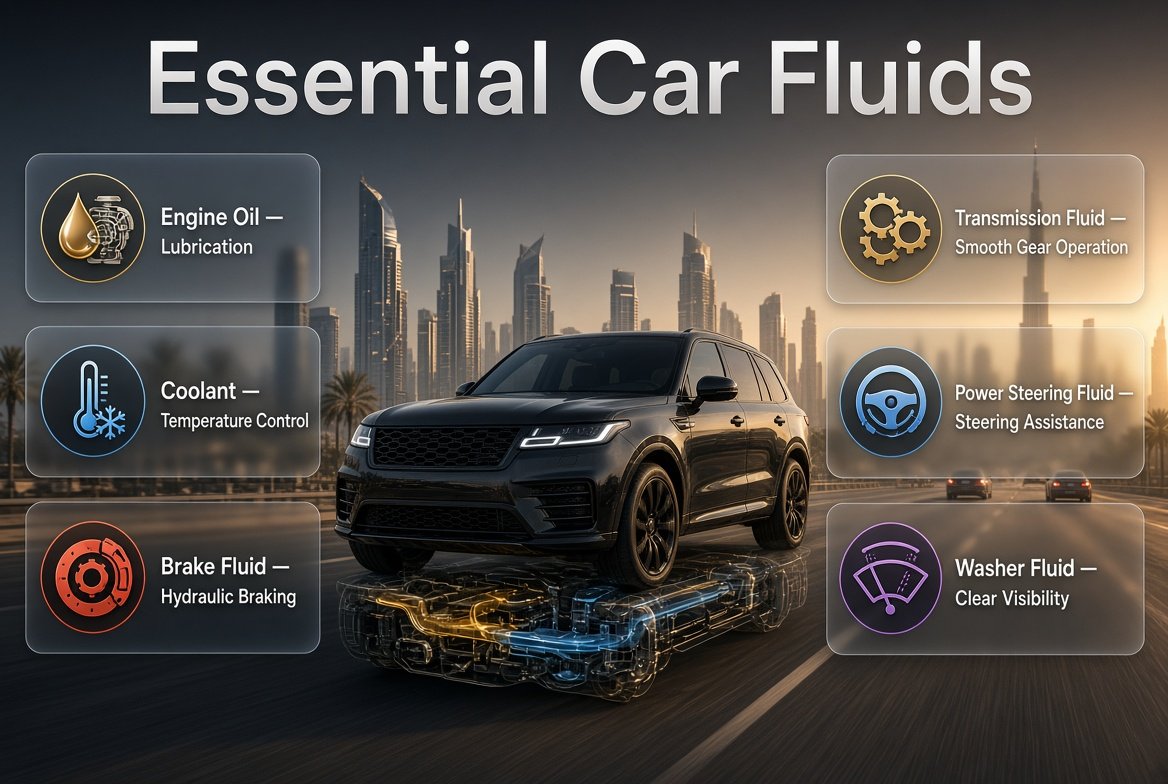
From engine oil and coolant to brake fluid, transmission fluid, power steering fluid, and windshield washer fluid, each fluid has a specific job. Some lubricate moving parts, some control temperature, some transfer hydraulic pressure, and others help maintain visibility.
For drivers in Dubai, proper fluid maintenance is especially important because high temperatures, heavy traffic, frequent air-conditioning use, dusty conditions, and long journeys can place additional demands on a vehicle.
Fuel Delivery Dubai provides practical vehicle and roadside guidance, but maintaining your fluids is something you should think about long before a breakdown happens.
In this complete guide, you’ll learn what the essential fluids in a car do, how to check them safely, when they need attention, what warning signs to watch for, which mistakes to avoid, and when a fluid problem requires professional inspection.
What Are Essential Car Fluids?
Essential car fluids are specialized liquids used by different vehicle systems to lubricate, cool, clean, protect, or transfer hydraulic pressure between components.
The exact fluids used depend on the vehicle’s design, engine, transmission, steering system, and drivetrain.
Common automotive fluids include:
- Engine oil
- Engine coolant
- Brake fluid
- Automatic transmission fluid
- Manual transmission fluid
- Differential fluid
- Transfer-case fluid
- Power steering fluid
- Windshield washer fluid
- Air-conditioning refrigerant
Not every vehicle uses all of these fluids.
For example, some modern vehicles have electric power steering and therefore don’t have a power steering fluid reservoir. Similarly, an electric vehicle doesn’t use conventional engine oil because it doesn’t have an internal-combustion engine.
The owner’s manual should always be your final reference for the correct fluid specification, checking procedure, capacity, and replacement interval.
Why Are Car Fluids So Important?
Fluids perform jobs that mechanical components cannot perform efficiently on their own.
Engine oil reduces friction between moving engine components. Coolant carries heat away from the engine. Brake fluid transfers pressure from the brake pedal through the hydraulic braking system.
Transmission fluid lubricates and cools transmission components while also supporting hydraulic functions in many automatic transmissions.
A fluid problem can therefore affect much more than the fluid itself.
For example:
Low coolant → reduced cooling ability → higher engine temperature → potential overheating
Or:
Low engine oil → reduced lubrication → increased friction and heat → accelerated engine wear
This is why fluid checks are an important part of preventive maintenance rather than something to think about only when a warning light appears.
The broader principle is simple: the right fluid, at the right level, with the right specification, helps the vehicle’s systems operate as designed.
1. Engine Oil
Engine oil is one of the most important fluids in a petrol or diesel vehicle.
Inside an operating engine, many components move extremely quickly and experience substantial friction and heat. Engine oil forms a lubricating film between these surfaces, helping reduce direct metal-to-metal contact.
But lubrication isn’t its only job.
Engine oil also helps:
- Reduce friction
- Control heat
- Carry contaminants toward the oil filter
- Protect internal surfaces
- Reduce wear
- Support smooth engine operation
- Help prevent corrosion
The correct oil specification matters just as much as the oil level.
How Do You Check Engine Oil?
The checking method depends on the vehicle.
If your car has a traditional dipstick:
- Park on a level surface.
- Follow the manufacturer’s instructions regarding engine temperature.
- Switch off the engine.
- Wait for the recommended period if required.
- Remove the dipstick.
- Wipe it clean.
- Insert it fully.
- Remove it again.
- Check the level against the marked range.
Some newer vehicles don’t have a traditional dipstick and instead display oil-level information electronically.
Don’t assume the same procedure works for every vehicle.
What Does Low Engine Oil Mean?
A low oil level can happen for several reasons.
Possible causes include:
- Normal oil consumption
- External leakage
- Worn seals
- Internal engine wear
- Incorrect previous service
- Oil consumption caused by an engine fault
If the oil level repeatedly falls between services, topping it up isn’t the complete solution.
You need to determine why the oil is disappearing.
A small amount of consumption may be expected in some engines, while sudden or excessive loss requires investigation.
What Does Dirty Engine Oil Mean?
Engine oil naturally becomes darker as it circulates and collects contaminants.
Dark oil alone doesn’t automatically mean that the engine has a serious problem.
The more useful questions are:
- Is the oil due for replacement?
- Is the correct oil being used?
- Is the level correct?
- Is the engine consuming excessive oil?
- Are there signs of contamination?
- Is the vehicle following its recommended service schedule?
Common Engine Oil Mistake
⚠️ Common Mistake: Adding oil repeatedly without checking why the level keeps dropping.
If you find yourself adding oil frequently, have the vehicle inspected rather than treating topping up as the permanent solution.
For a broader maintenance routine, you can also refer to the site’s Vehicle Maintenance Guides.
2. Engine Coolant
Coolant is responsible for helping the engine operate within its intended temperature range.
An engine produces a large amount of heat during combustion. Without an effective cooling system, temperatures can rise to levels capable of causing serious mechanical damage.
The cooling system can include:
- Coolant
- Radiator
- Water pump
- Thermostat
- Cooling fans
- Hoses
- Expansion tank
- Temperature sensors
All of these components need to work together.
What Does Coolant Do?
Engine coolant helps:
- Carry heat away from the engine
- Control engine temperature
- Protect against freezing where relevant
- Reduce corrosion
- Protect cooling-system components
- Support stable engine operation
In a hot environment, maintaining the cooling system becomes particularly important.
How Do You Check Coolant?
Most modern vehicles have a transparent expansion reservoir with minimum and maximum markings.
Check the coolant level according to the manufacturer’s instructions.
In many vehicles, the level should be checked when the engine is cold.
Never casually remove a radiator cap from a hot engine.
A hot cooling system can be pressurized, and releasing that pressure can cause hot coolant or steam to escape.
That can cause serious burns.
What If Coolant Keeps Disappearing?
A coolant reservoir that repeatedly becomes low should not simply be topped up indefinitely.
Possible causes include:
- Damaged hoses
- Radiator leaks
- Water-pump problems
- Thermostat housing leaks
- Reservoir problems
- Gasket or engine-related issues
The important distinction is between maintaining a correct level and constantly replacing lost coolant.
If coolant repeatedly disappears, find the cause.
Current vehicle-maintenance guidance also emphasizes that repeated coolant loss should be investigated rather than treated as a normal condition.
3. Brake Fluid
Brake fluid is one of the most safety-critical fluids in your vehicle.
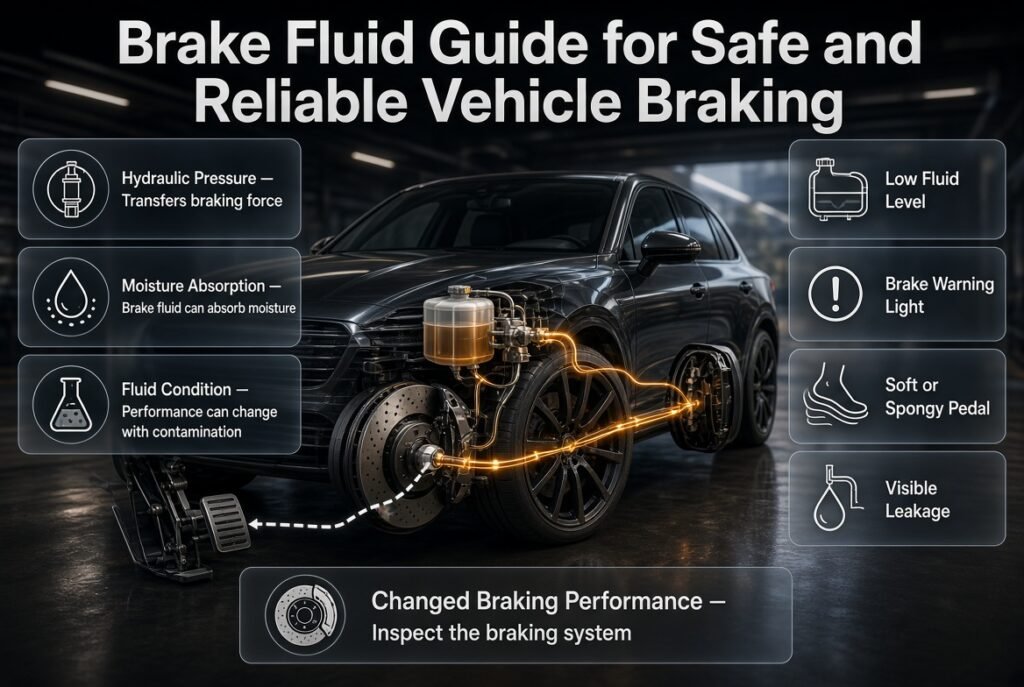
When you press the brake pedal, hydraulic pressure needs to be transferred through the braking system. Brake fluid allows this hydraulic force to reach the braking components.
A problem with brake fluid can therefore affect braking performance.
Why Does Brake Fluid Matter?
Brake fluid needs to maintain its hydraulic properties under demanding conditions.
Many brake fluids are hygroscopic, meaning they can absorb moisture over time.
As moisture contamination increases, the fluid’s performance characteristics can change.
This is one reason brake fluid should be inspected and replaced according to the vehicle manufacturer’s recommendations.
Signs of a Brake Fluid Problem
Watch for:
- Low brake-fluid level
- Brake warning light
- Soft or spongy brake pedal
- Visible leakage
- Changes in braking performance
- Fluid contamination
- Unusual brake behavior
A low reservoir does not automatically mean that you simply need more fluid.
It could indicate:
- Brake-pad wear
- A hydraulic leak
- Another braking-system problem
What Should You Do If Brake Fluid Is Low?
Don’t treat unexplained brake-fluid loss as a routine top-up.
Because brakes are safety-critical, the system should be inspected to determine the cause.
If braking performance has changed significantly, don’t continue driving normally simply because the vehicle still moves.
4. Automatic Transmission Fluid
Automatic transmission fluid, often called ATF, performs several functions inside an automatic transmission.
It lubricates components, helps control temperature, and in many transmission designs provides hydraulic pressure required for gear operation.
What Does Transmission Fluid Do?
Depending on the transmission design, it helps with:
- Lubrication
- Cooling
- Hydraulic pressure
- Clutch operation
- Gear engagement
- Internal component protection
Transmission fluid is not simply another type of engine oil.
The formulation and specification can be completely different.
What Happens If Transmission Fluid Is Low?
Possible symptoms include:
- Delayed gear engagement
- Harsh shifting
- Slipping
- Unusual transmission noises
- Overheating
- Difficulty selecting gears
These symptoms don’t prove that the fluid is the cause.
A transmission can develop similar symptoms because of mechanical, electrical, hydraulic, or control-system problems.
That is why proper diagnosis matters.
Can You Add Any ATF?
No.
Different transmissions can require very specific fluid specifications.
Using an incorrect fluid can affect:
- Shift quality
- Hydraulic operation
- Clutch behavior
- Component protection
- Transmission performance
Always verify the manufacturer’s specification.
5. Manual Transmission Fluid
Manual transmissions also require lubrication, although the fluid specification can differ substantially from automatic transmission fluid.
Depending on the vehicle, the manufacturer may specify gear oil, manual transmission fluid, or another specific lubricant.
The important point is that manual transmission fluid isn’t automatically interchangeable with automatic transmission fluid.
Signs of a Manual Transmission Fluid Problem
Possible symptoms include:
- Difficulty selecting gears
- Grinding
- Unusual transmission noise
- Increased resistance when shifting
- Fluid leakage
A manual transmission problem can have several causes, including clutch-related issues, linkage problems, internal wear, or incorrect fluid.
Don’t diagnose the entire transmission based on one symptom.
6. Differential Fluid
Differential fluid is particularly important in vehicles with conventional differentials.
The differential allows wheels on the same axle to rotate at different speeds while transmitting power to them.
Its gears and bearings require appropriate lubrication.
Why Does Differential Fluid Matter?
Differential fluid helps:
- Lubricate gears
- Reduce friction
- Control heat
- Protect bearings
- Reduce wear
A worn or leaking differential can eventually become expensive to repair.
Signs of a Differential Problem
Potential warning signs include:
- Whining noise
- Grinding
- Clunking
- Fluid leakage
- Increased drivetrain noise
A differential fluid service should follow the vehicle manufacturer’s recommendations.
Don’t assume that every car needs differential fluid checked or replaced at the same interval.
7. Transfer-Case Fluid
Vehicles with four-wheel drive or certain all-wheel-drive systems may have a transfer case.
The transfer case manages power distribution between axles in systems designed with that component.
It can contain its own specialized lubricant.
Why Does Transfer-Case Fluid Matter?
Correct fluid helps protect:
- Gears
- Bearings
- Chains where applicable
- Internal mechanical components
The exact maintenance requirement depends on the drivetrain design.
If you own a 4WD vehicle, check the manufacturer’s service schedule for transfer-case maintenance.
8. Power Steering Fluid
Power steering fluid is used in hydraulic power-steering systems.
However, this section is important because not every modern vehicle uses hydraulic power steering.
Many newer vehicles use electric power steering.
If your vehicle has electric power steering, there may be no power-steering fluid reservoir at all.
What Are the Signs of a Power Steering Fluid Problem?
On vehicles with hydraulic steering, you may notice:
- Heavy steering
- Whining when turning
- Fluid leakage
- Low fluid level
- Difficulty turning the steering wheel
But these symptoms can have other causes too.
Don’t automatically add fluid without identifying the correct steering system and fluid specification.
9. Windshield Washer Fluid
Washer fluid may not protect an engine or transmission, but it is still an important vehicle fluid.
It helps keep the windshield clear of:
- Dust
- Road grime
- Insects
- Dirt
- Other contaminants
Clear visibility is a safety requirement.
A dirty windshield can become especially difficult to see through when sunlight, headlights, or rain create glare.
Can You Use Plain Water?
Water may be usable temporarily in certain conditions, but dedicated washer fluid is generally designed to provide better cleaning performance.
Use a product suitable for your vehicle and local conditions.
Don’t add household cleaning chemicals unless the manufacturer specifically says they are suitable.
10. Air-Conditioning Refrigerant
Air-conditioning refrigerant isn’t normally something drivers should treat like windshield washer fluid or engine oil.
The AC system is a closed system, and refrigerant should not simply be topped up whenever cooling becomes weak.
Why Is My AC Not Cooling?
Low refrigerant is one possibility, but not the only one.
Other causes can include:
- Refrigerant leaks
- Compressor problems
- Condenser issues
- Electrical faults
- Expansion-device problems
- Cooling-fan problems
- Other HVAC faults
If AC performance changes, professional diagnosis can identify the actual cause.
This is particularly relevant in Dubai, where air conditioning isn’t simply a comfort feature. It is an important part of normal driving.
Essential Car Fluids Comparison
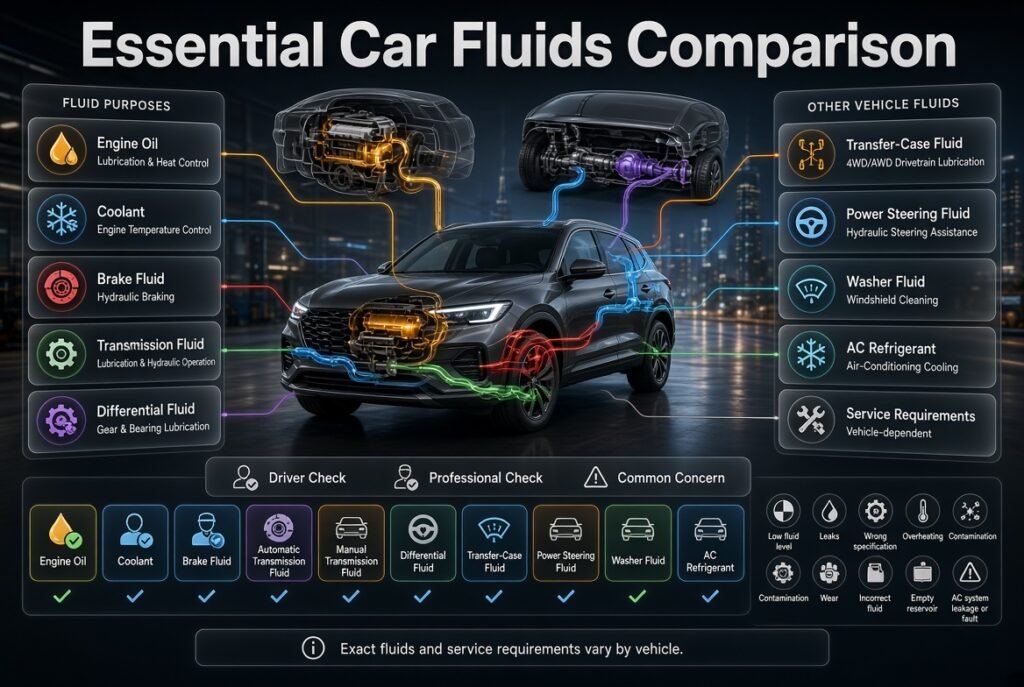
| Fluid | Main Purpose | Driver Check | Typical Concern |
|---|---|---|---|
| Engine oil | Lubrication and heat control | Usually | Low level, leaks, wrong specification |
| Coolant | Engine temperature control | Usually when cold | Low level, leaks, overheating |
| Brake fluid | Hydraulic braking | Usually | Low level, contamination, leaks |
| Automatic transmission fluid | Lubrication, cooling, hydraulic operation | Vehicle-dependent | Wrong level/specification |
| Manual transmission fluid | Gear lubrication | Usually professional | Wear, leakage, incorrect fluid |
| Differential fluid | Gear and bearing lubrication | Usually professional | Leakage, wear |
| Transfer-case fluid | 4WD/AWD drivetrain lubrication | Usually professional | Wear, incorrect fluid |
| Power steering fluid | Hydraulic steering assistance | Vehicle-dependent | Low level, leaks |
| Washer fluid | Windshield cleaning | Yes | Empty reservoir |
| AC refrigerant | Air-conditioning cooling | Usually professional | Leakage or system fault |
The exact fluids and service requirements vary between vehicles.
How Often Should You Check Essential Car Fluids?
There isn’t one universal schedule for every fluid.
A practical routine combines:
Regular visual checks + manufacturer service intervals + attention to warning signs.
The manufacturer’s maintenance schedule should remain the primary source for scheduled fluid replacement.
Driving conditions can also matter.
A vehicle that spends most of its time in heavy traffic can experience different operating conditions from one used mainly for highway driving.
Similarly, frequent short trips, extreme temperatures, heavy loads, towing, and dusty environments can increase demands on certain vehicle systems.
A Simple Routine
Every Few Weeks
Check accessible items such as:
- Engine oil
- Coolant reservoir
- Washer fluid
- Visible leaks
Before Long Trips
Check:
- Engine oil
- Coolant
- Brake fluid
- Washer fluid
- Transmission condition
- Visible leaks
- Tyres
- Battery
- Lights
During Scheduled Maintenance
Follow the manufacturer’s recommendations for:
- Fluid replacement
- Filters
- Brake inspection
- Transmission servicing
- Differential servicing
- Cooling-system inspection
- Other scheduled maintenance
Why You Shouldn’t Wait for a Warning Light
Dashboard warning lights are valuable, but they shouldn’t become your only maintenance system.
A warning may appear only after a problem has already developed.
For example:
A driver may notice a small coolant leak before the temperature warning appears.
A driver may notice repeated oil-level reduction before an oil-related warning appears.
A driver may notice a soft brake pedal before a serious braking warning occurs.
The earlier you notice a change, the more opportunity you have to investigate it.
How Do You Know If Your Car Is Losing Fluid?
Fluid loss can happen slowly enough that you don’t notice it immediately.
One useful habit is to pay attention to the ground where you normally park.
Look for:
- Fresh spots
- Wet patches
- Drops under the engine area
- Fluid around wheels
- Fluid around hoses
- Fluid around reservoirs
- Fluid levels that repeatedly fall
However, don’t try to identify a fluid solely by its color.
Fluid color can change with age, contamination, and manufacturer formulation.
If you’re unsure what a fluid is, avoid touching it unnecessarily and have the source identified.
What Should You Do When a Fluid Level Is Low?
The correct response depends on the fluid.
If Engine Oil Is Low
Check the correct oil specification and manufacturer’s procedure before topping up.
If the level repeatedly drops, investigate the cause.
If Coolant Is Low
Check it safely according to the manufacturer’s instructions.
If the engine is hot or overheating, don’t open a pressurized cooling system.
If Brake Fluid Is Low
Treat unexplained loss seriously.
Have the braking system inspected.
If Transmission Fluid Is Low
Don’t automatically add fluid.
Confirm the exact fluid specification and checking procedure first.
If Washer Fluid Is Low
This is usually straightforward to refill with an appropriate washer fluid.
How Dubai Conditions Can Affect Vehicle Fluids
Dubai’s environment creates some specific considerations for vehicle maintenance.
High temperatures can increase thermal demands on the engine and cooling system.
Heavy traffic can mean long periods of engine operation at low road speeds.
Air-conditioning systems can operate extensively.
Dust can affect filters and other vehicle components.
Long-distance highway driving can also expose a weak component to sustained operating loads.
This doesn’t mean Dubai drivers should automatically change every fluid more frequently than the manufacturer recommends.
Instead, it means drivers should be more attentive to:
- Coolant condition
- Engine oil level
- Cooling-system leaks
- Transmission behavior
- Brake-fluid condition
- AC performance
- Warning lights
- Service intervals
The objective is condition-aware maintenance, not unnecessary replacement.
Common Mistakes When Maintaining Car Fluids
Mistake 1: Using Any Fluid That “Looks Right”
A bottle labeled for vehicles doesn’t automatically mean it’s compatible with your specific car.
Always check the required specification.
Mistake 2: Mixing Coolants Without Checking Compatibility
Coolant color isn’t a reliable compatibility guide.
Different formulations can have different chemical properties.
Check the manufacturer’s specification before mixing or changing coolant.
Mistake 3: Overfilling Engine Oil
Drivers sometimes assume that more oil means more protection.
That’s incorrect.
The engine is designed to operate within a specified oil-level range.
Follow the correct level markings.
Mistake 4: Ignoring Small Leaks
A small leak can become a large leak.
More importantly, the leak may indicate wear or damage in another component.
Identify the source rather than simply cleaning the driveway.
Mistake 5: Opening a Hot Radiator
This is one of the most dangerous fluid-maintenance mistakes.
Never casually open a hot pressurized cooling system.
Mistake 6: Checking Every Fluid the Same Way
Different fluids have different checking procedures.
Some need to be checked cold.
Some require a specific operating temperature.
Some require the vehicle to be positioned in a particular way.
Some are not designed for routine owner-level checking at all.
Mistake 7: Assuming Every Car Has Power Steering Fluid
Many modern cars use electric power steering.
Always check the vehicle’s design before looking for a power-steering reservoir.
What Are the Signs That a Fluid Problem Is Becoming Serious?
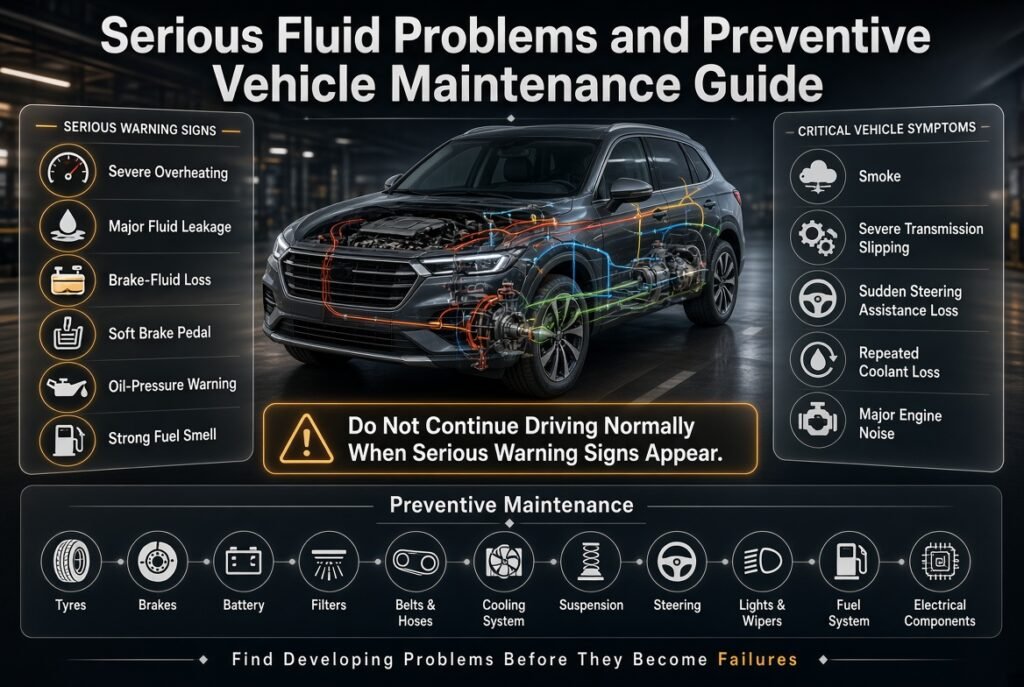
Some symptoms deserve immediate attention.
Watch for:
- Severe overheating
- Major fluid leakage
- Brake-fluid loss
- Soft brake pedal
- Oil-pressure warning
- Strong fuel smell
- Smoke
- Severe transmission slipping
- Sudden loss of steering assistance
- Repeated coolant loss
- Major engine noise
Don’t continue driving simply because the vehicle still starts.
A vehicle can remain operational while becoming increasingly unsafe or mechanically vulnerable.
How Essential Fluids Connect With Preventive Maintenance
Fluid maintenance is only one part of a larger vehicle-maintenance strategy.
A proper preventive maintenance routine also considers:
- Tyres
- Brakes
- Battery
- Filters
- Belts
- Hoses
- Cooling system
- Suspension
- Steering
- Lights
- Wipers
- Fuel system
- Electrical components
You can read more about this approach in the site’s Preventive Vehicle Maintenance guide.
The principle is straightforward:
Find developing problems before they become failures.
Preventive maintenance doesn’t mean replacing everything early.
It means following manufacturer requirements and responding appropriately to actual vehicle condition.
How Proper Fluid Maintenance Can Support Fuel Economy
Fluid maintenance isn’t a magic fuel-saving trick.
However, a vehicle operating correctly can generally avoid some mechanical conditions that contribute to inefficient operation.
For example, maintenance can help identify:
- Incorrect engine oil
- Engine problems
- Transmission issues
- Cooling-system faults
- Brake drag
- Tyre-related problems
Proper tyre pressure, correct maintenance, smooth driving, and appropriate vehicle condition all work together.
For additional guidance, see Fuel-Saving Driving Tips.
The important point is that maintenance should be based on manufacturer requirements rather than products marketed as universal fuel-saving solutions.
Essential Fluids Before a Long Journey
Long-distance driving deserves a more careful inspection because a small issue can become much more inconvenient when you’re far from home.
Before leaving, check:
Engine
- Oil level
- Warning lights
- Unusual noises
- Visible leaks
Cooling System
- Coolant level
- Visible leaks
- Temperature behavior
- Hoses where safely visible
Brakes
- Brake-fluid level
- Brake-pedal feel
- Unusual sounds
- Warning lights
Transmission
- Unusual shifting
- Delayed engagement
- Fluid leaks
Visibility
- Washer fluid
- Wipers
- Windscreen condition
- Lights
General Vehicle Condition
- Tyre pressure
- Tyre condition
- Battery
- Spare tyre
- Emergency equipment
Current breakdown-safety guidance similarly recommends checking fuel, tyres, engine oil, coolant, battery, lights, warning indicators, washer fluid, and spare/repair equipment before a long journey.
What If Your Car Breaks Down Because of a Fluid Problem?
If a fluid-related issue causes your vehicle to stop, your first priority should be safety—not immediately diagnosing the mechanical problem.
A practical roadside sequence is:
- Move to a safer position if possible.
- Turn on hazard lights.
- Keep passengers away from traffic.
- Don’t open hot cooling-system components.
- Identify the warning or symptom.
- Contact appropriate assistance.
- Avoid unnecessary roadside repairs in an unsafe location.
The same principle applies whether the issue is overheating, low fluid, battery failure, tyre damage, or fuel shortage.
Current roadside guidance recommends securing the scene and protecting people before focusing on the vehicle problem.
If the problem is actually fuel-related, don’t walk along a dangerous road looking for fuel.
Use appropriate roadside assistance and provide your exact location or a clear landmark.
Essential Fluids and Fuel Emergencies
Fluid maintenance can’t prevent every fuel emergency.
You can maintain the engine perfectly and still run out of fuel because of:
- Poor fuel planning
- Unexpected traffic
- Long detours
- Incorrect range estimates
- An inaccurate fuel gauge
- Forgetting to refuel
That’s why fuel management is a separate part of vehicle preparedness.
If you want to understand how maintenance and fuel emergencies connect, the site’s Emergency Roadside Fuel Advice provides additional guidance.
A sensible approach is to avoid making an almost-empty tank your normal driving habit, especially when travelling through unfamiliar areas.
How Should You Keep Track of Fluid Maintenance?
A simple maintenance record can prevent confusion.
Record:
- Date
- Mileage
- Fluid replaced
- Fluid specification
- Service performed
- Technician recommendations
- Next service due
For example:
26 September — 72,000 km
- Engine oil replaced
- Oil filter replaced
- Coolant inspected
- Brake fluid inspected
- Transmission fluid checked
- Next service due according to manufacturer schedule
This makes it easier to know what has already been done.
It also helps prevent unnecessary duplicate servicing.
Which Car Fluids Can You Check Yourself?
Many drivers can safely perform basic visual checks.
Depending on the vehicle, these may include:
- Engine oil
- Coolant reservoir
- Brake-fluid reservoir
- Washer fluid
- Visible leaks
However, “can check” doesn’t always mean “can service.”
For example, you may be able to observe a transmission-fluid leak without being equipped to inspect or refill the transmission correctly.
Similarly, you may see a low brake-fluid reservoir but should not assume that simply adding fluid solves the problem.
A Good Rule
Inspect what you understand. Service what you’re qualified and equipped to service.
For complex or safety-critical systems, professional assistance is appropriate.
Which Fluid-Related Jobs Should a Professional Handle?
Professional servicing is generally appropriate for:
- Transmission-fluid service
- Differential-fluid service
- Transfer-case service
- Brake-fluid replacement
- Cooling-system diagnosis
- Refrigerant service
- Fluid leaks
- Hydraulic steering problems
- Major engine-oil leaks
- Contaminated fluids
- Fluid-related warning lights
Modern vehicles can have complex procedures and electronic systems.
A mistake during servicing can create a bigger problem than the original issue.
What Are the Most Important Fluids in a Car?
The most important car fluids are engine oil, coolant, brake fluid, transmission fluid, and power steering fluid where the vehicle uses hydraulic steering. Other fluids, such as windshield washer fluid, differential fluid, transfer-case fluid, and air-conditioning refrigerant, are also important depending on the vehicle’s design.
Each fluid has a different job, so they should never be treated as interchangeable. Engine oil protects moving engine components from excessive friction, coolant manages engine temperature, brake fluid transfers hydraulic pressure, and transmission fluid supports lubrication and gear operation.
Key fluids to keep an eye on include:
Engine oil: Lubricates and protects internal engine components.
Coolant: Helps prevent overheating and controls engine temperature.
Brake fluid: Transfers pressure through the hydraulic braking system.
Transmission fluid: Lubricates, cools, and supports transmission operation.
Power steering fluid: Provides hydraulic assistance on vehicles equipped with hydraulic steering.
Washer fluid: Helps maintain clear windshield visibility.
The exact fluid requirements depend on your vehicle, so always check the owner’s manual for the correct specification and maintenance interval.
How Often Should You Check Your Car Fluids?
Car fluids should be checked regularly rather than only when a warning light appears. A practical routine is to inspect accessible fluid levels periodically and perform a more thorough check before long-distance trips. Scheduled fluid replacement should follow the vehicle manufacturer’s maintenance recommendations.
Your driving conditions also matter. Frequent short trips, heavy traffic, high temperatures, towing, dusty environments, and extended highway driving can place additional demands on different vehicle systems.
A good maintenance routine includes:
Check engine oil according to the manufacturer’s procedure.
Check the coolant reservoir when the engine is safely cool.
Inspect the brake-fluid reservoir.
Keep windshield washer fluid at an appropriate level.
Look for fresh fluid spots underneath the vehicle.
Pay attention to unusual smells, noises, or warning lights.
Check transmission or power-steering fluid only according to the vehicle-specific procedure.
If a fluid level keeps dropping between scheduled services, don’t simply continue topping it up. Repeated fluid loss can indicate a leak, component problem, or another mechanical issue that needs investigation.
What Happens If Your Car Is Low on Essential Fluids?
Driving with a low fluid level can affect the system that depends on that fluid and, in some cases, can lead to expensive mechanical damage or a safety problem. The consequences depend on which fluid is low. Low engine oil can increase friction and engine wear, while insufficient coolant can cause overheating. Low brake fluid can indicate a braking-system problem and should be treated seriously.
Different low-fluid conditions require different responses:
Low engine oil: Check the correct oil specification and investigate repeated oil loss.
Low coolant: Check safely when the engine is cool and look for signs of leakage or overheating.
Low brake fluid: Have the braking system inspected, especially if the level has fallen unexpectedly.
Low transmission fluid: Follow the manufacturer’s checking procedure and investigate leaks or shifting problems.
Low power-steering fluid: Check for leaks and confirm that the vehicle actually uses hydraulic power steering.
Never assume that adding more fluid automatically fixes the problem. A falling fluid level is often a symptom, while the leak or mechanical fault is the actual cau
Can You Mix Different Types of Car Fluids?
Different automotive fluids should not be mixed unless the vehicle manufacturer or fluid specification specifically confirms compatibility. Similar-looking fluids can have very different chemical properties and may be designed for completely different components.
This is particularly important with coolant, transmission fluid, brake fluid, and engine oil. Even within the same category, different vehicles can require different specifications.
Before adding any fluid:
Check the owner’s manual.
Confirm the required fluid specification.
Don’t select a product based only on its color.
Don’t assume two products are compatible because they have similar names.
Avoid overfilling the reservoir.
If you’re unsure what is already in the system, get professional advice.
Coolant is a common source of confusion because different formulations can have different colors. Color alone isn’t a reliable indication that two coolants can safely be mixed.
When the wrong fluid has already been added, the safest response depends on the fluid, quantity, and system involved. If significant contamination may have occurred, professional inspection is preferable to continuing to drive and hoping the problem won’t develop.
How Do You Know When Your Car Fluid Needs to Be Replaced?
A fluid doesn’t always need replacement simply because it looks darker or slightly different from when it was new. The correct replacement decision should consider the manufacturer’s service interval, fluid specification, vehicle mileage, operating conditions, and the actual condition of the system.
Some warning signs can indicate that a fluid or the system using it needs attention:
The fluid level repeatedly drops.
You notice a visible leak.
The vehicle develops unusual smells or noises.
The engine begins running hotter than normal.
The transmission starts shifting differently.
The brake pedal feels soft or unusual.
Steering becomes heavier on a hydraulic steering system.
A dashboard warning light appears.
A scheduled fluid service is due.
For example, dark engine oil isn’t automatically proof that it needs immediate replacement. Engine oil naturally becomes darker as it circulates and carries contaminants. The manufacturer’s recommended service interval is a much more reliable reference.
The same principle applies to other fluids: don’t replace fluids based only on appearance, and don’t ignore clear signs of contamination, degradation, leakage, or overdue maintenance.
For the best results, keep a simple maintenance record showing the date, mileage, fluid serviced, specification used, and the next recommended service. This makes it much easier to manage vehicle maintenance without unnecessary replacements.
Conclusion
Understanding essential car fluids is one of the simplest ways to protect your vehicle’s performance, reliability, and long-term condition. Engine oil, coolant, brake fluid, transmission fluid, power steering fluid, differential fluid, and washer fluid each perform a different job, but they all contribute to safe and dependable driving.
Regularly checking fluid levels can help you identify problems before they become expensive repairs. A low level, unusual fluid colour, burning smell, visible leak, warning light, or change in vehicle performance should not be ignored. These signs can indicate anything from normal maintenance needs to a developing mechanical problem.
For Dubai drivers, regular fluid checks are particularly useful because high temperatures, heavy traffic, frequent air-conditioning use, and long-distance driving can place additional demands on a vehicle. Following a proper vehicle maintenance guide and keeping up with preventive vehicle maintenance can make it easier to catch fluid-related issues early.
The most practical approach is simple: check the fluids regularly, use the correct specification recommended by your vehicle manufacturer, never ignore leaks or warning signs, and replace fluids according to the appropriate maintenance schedule. If you are unsure about a fluid, avoid guessing or mixing products and have the vehicle inspected by a qualified professional.
A few minutes spent checking essential car fluids can help prevent overheating, poor braking performance, transmission problems, unnecessary wear, and unexpected breakdowns. Good fluid maintenance is not just about keeping a car running—it is an important part of keeping the vehicle safe, efficient, and ready for everyday driving and longer journeys.
Leave a Reply