
Introduction
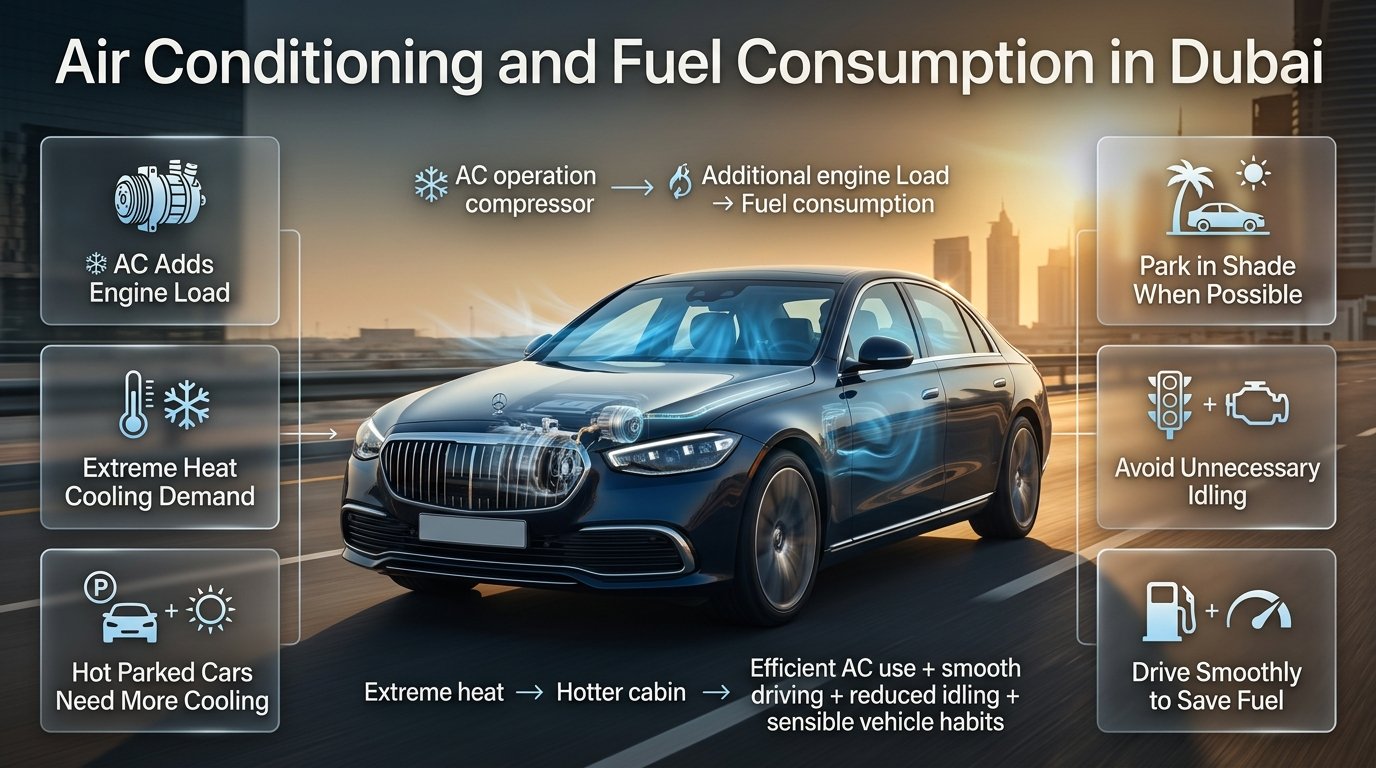
Air Conditioning and Fuel Consumption | In Dubai, air conditioning isn’t a luxury for most drivers. It’s part of everyday driving. When temperatures rise, getting into a parked car can feel like stepping into an oven, and keeping the cabin cool becomes essential for comfort and concentration. But there’s one question many drivers eventually ask: how much does air conditioning affect fuel consumption?
If you’re looking for practical fuel-related information and emergency fuel support in Dubai, Fuel Delivery Dubai provides a useful starting point for understanding fuel-related services and driving needs.
The relationship between air conditioning and fuel consumption isn’t as simple as turning the AC on and watching fuel economy suddenly drop by a fixed percentage. The effect depends on the vehicle, engine, compressor, outside temperature, cabin temperature, driving speed, traffic, maintenance condition and how the AC is being used.
A small car travelling steadily on an open road won’t necessarily experience the same effect as a large SUV sitting in heavy Dubai traffic with the AC running continuously.
This guide explains exactly why car AC uses additional energy, when its effect on fuel economy becomes more noticeable, whether windows are better than AC, how Dubai’s climate changes the situation, and what practical habits can help you stay cool without wasting unnecessary fuel.
The goal isn’t to tell you to stop using your AC. In Dubai’s climate, that would be unrealistic. The smarter goal is to understand how the system works and use it efficiently.
Does Air Conditioning Increase Fuel Consumption?
Yes. In conventional petrol and diesel vehicles, using the air conditioner generally increases fuel consumption because the AC system requires energy to operate.
The main component responsible for this additional engine load is the AC compressor.
When the air conditioner is switched on, the compressor circulates refrigerant through the system. The compressor requires mechanical power, which in many conventional vehicles comes from the engine.
That means the engine has to perform two jobs at the same time:
- Produce power to move the vehicle.
- Provide energy for the air-conditioning system.
The additional workload can increase fuel consumption.
However, there isn’t one universal number that tells every driver exactly how much fuel their AC will use. Different vehicles and driving conditions produce different results.
Why the Effect Isn’t the Same in Every Car
Several factors influence the fuel impact of AC use:
- Engine size
- Vehicle size
- AC compressor design
- Outside temperature
- Cabin temperature
- Desired cabin temperature
- Driving speed
- Traffic conditions
- Vehicle maintenance
- Refrigerant condition
- Cabin air-filter condition
- Electrical load
- Driving style
A modern vehicle may manage compressor operation efficiently, while an older vehicle with an inefficient or poorly maintained AC system may behave differently.
That’s why it’s better to understand the factors involved rather than rely on a single fuel-consumption figure.
How Does a Car AC System Use Engine Power?
A conventional automotive AC system works through a cycle involving refrigerant, pressure and heat transfer.
The simplified process looks like this:
Engine → AC Compressor → Refrigerant Circulation → Heat Removal → Cooler Cabin
The compressor pressurizes the refrigerant and sends it through the air-conditioning system.
The refrigerant eventually passes through components that allow heat to be removed from the cabin air. The cooled air is then circulated back into the vehicle.
The important point for fuel economy is that the compressor needs power.
In many conventional cars, that power comes from the engine through a belt-driven arrangement.
When the compressor engages, the engine experiences an additional load.
Modern engine-management systems can compensate for this load, but compensation still requires energy.
And energy in a petrol or diesel vehicle ultimately comes from fuel.
What Happens When the Compressor Turns On?
Some drivers notice a slight change in engine sound or idle speed when the AC compressor engages.
This is normal in many vehicles.
The engine-management system may adjust engine operation to prevent the additional compressor load from causing the engine to stall or run poorly.
The exact behavior depends on the vehicle.
Modern systems can also cycle compressor operation depending on cooling demand, cabin temperature and climate-control requirements.
This means the compressor doesn’t necessarily operate at exactly the same level throughout an entire journey.
Why Does Dubai’s Heat Make AC Fuel Consumption More Important?
Dubai presents a particularly demanding environment for automotive air conditioning.
The combination of high outdoor temperatures, intense sunlight and hot vehicle interiors means the AC system can have a substantial amount of heat to remove.
Imagine parking your car outside during the afternoon.
The vehicle may absorb solar heat through:
- Windshield glass
- Side windows
- Roof
- Dashboard
- Seats
- Door panels
- Interior trim
When you return, the cabin may be far hotter than the surrounding environment feels.
The AC then has to remove that accumulated heat before it can maintain a comfortable cabin temperature.
This initial cooling phase can require considerable effort from the climate-control system.
Why Does a Parked Car Become So Hot?
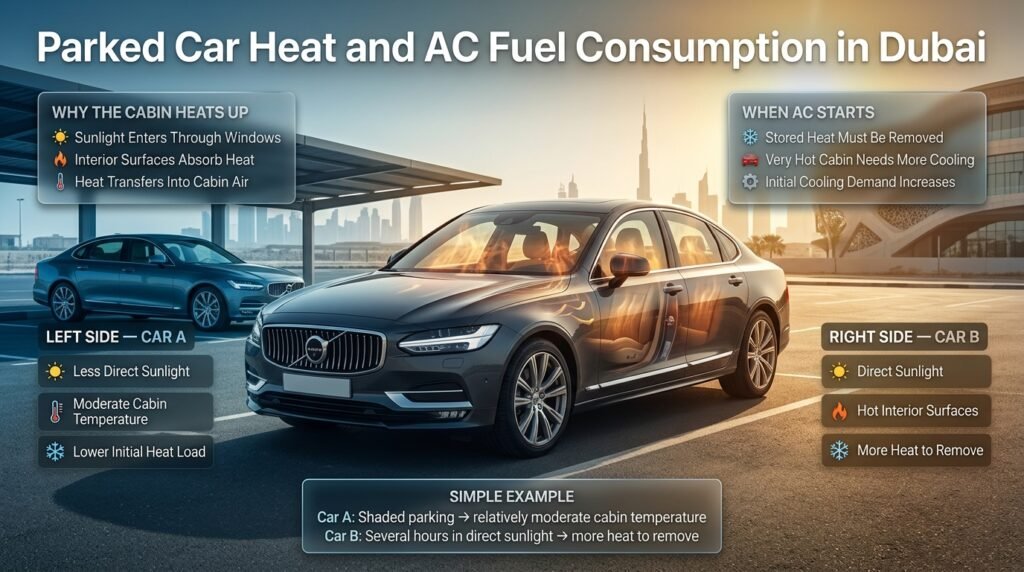
A closed vehicle acts like a heat trap.
Sunlight enters through the windows and heats interior surfaces. Those surfaces then transfer heat into the cabin air.
The dashboard, steering wheel and seats can become particularly hot because they absorb solar radiation.
This is why a car that felt comfortable before parking can feel extremely hot after sitting outside.
When the driver starts the vehicle and immediately requests maximum cooling, the AC system has to deal with this stored heat.
A Simple Example
Suppose two identical cars are driven for 30 minutes.
Car A begins the trip from a shaded parking area with a relatively moderate cabin temperature.
Car B has been sitting under direct sunlight for several hours.
Both drivers set their AC to the same temperature.
The AC system in Car B has more heat to remove before reaching the desired cabin condition.
This is one reason parking strategy can indirectly influence energy consumption.
Does Parking in the Shade Help Fuel Economy?
It can help indirectly.
Parking in shade doesn’t directly make the engine more fuel efficient, but it can reduce the initial heat load inside the cabin.
That means the AC may not have to work as hard for as long to reach a comfortable temperature.
Useful strategies include:
- Parking in covered parking when available.
- Using a windshield sunshade.
- Parking with the vehicle’s most exposed surfaces protected when possible.
- Avoiding unnecessary direct sunlight during long parking periods.
- Ventilating excessive trapped heat safely before starting intensive cooling.
These simple habits are especially useful during Dubai’s hottest periods.
Fuel-Efficient Driving Techniques
Fuel-efficient driving techniques can help reduce unnecessary fuel consumption while making everyday driving smoother and more economical. Avoid aggressive acceleration, sudden braking, and excessive speeding, as these habits can make the engine work harder and waste energy. Instead, maintain a steady speed, anticipate traffic changes, and accelerate gradually whenever road conditions allow. Keeping the tires properly inflated, removing unnecessary vehicle weight, and avoiding prolonged idling can further support better fuel economy. In Dubai, where drivers may experience heavy traffic, high temperatures, and frequent highway travel, combining efficient driving habits with regular vehicle maintenance can make a noticeable difference over time.
For practical advice on smoother acceleration, controlled braking, steady-speed driving, reducing unnecessary idling, and other habits that can support better fuel economy, explore our detailed Fuel-Efficient Driving Techniques guide.
Should You Open the Windows Before Turning on the AC?
When a vehicle has been sitting in extreme heat, allowing some of the trapped hot air to escape can make the initial cooling process more effective.
The important word is safe.
If the vehicle is parked somewhere secure and ventilation can be done safely, opening doors or windows briefly can help remove some of the hottest air.
Once you’re driving, however, window use becomes a separate aerodynamic question.
At low speeds, open windows may be a practical ventilation option in suitable weather.
At higher speeds, open windows can disturb airflow around the vehicle and increase aerodynamic drag.
That makes the answer more complicated than simply saying “windows save fuel.”
For a detailed look at the aerodynamic side of fuel consumption, see How Aerodynamics Affects Fuel Efficiency.
AC vs Open Windows: Which Uses Less Fuel?
There is no single answer that works in every situation.
The better choice depends on:
- Vehicle speed
- Outside temperature
- Window opening
- Vehicle design
- AC efficiency
- Traffic
- Cabin temperature
- Driver comfort requirements
At low speeds, opening the windows may sometimes be reasonable.
At highway speeds, aerodynamic drag becomes increasingly important.
An open window changes the airflow around the vehicle and can increase resistance.
This means that at higher speeds, keeping the windows closed and using the AC can be a more practical overall approach.
Quick Comparison
| Driving situation | Practical approach |
|---|---|
| Mild weather, low speed | Windows may provide sufficient ventilation |
| Extreme summer heat | AC is generally necessary |
| High-speed highway driving | Closed windows are usually preferable |
| Heavy urban traffic | Efficient AC use + smooth driving |
| Very hot parked vehicle | Remove trapped heat when safe, then cool |
| Comfortable evening weather | Natural ventilation may be enough |
The goal is to choose the option that makes sense for the actual conditions.
Does AC Use More Fuel in City Traffic?
It can become more noticeable in city traffic.
The problem isn’t just the AC itself.
It’s the combination of several energy demands.
During heavy traffic, your vehicle may repeatedly:
- Accelerate
- Brake
- Stop
- Idle
- Move slowly
- Accelerate again
The engine continues operating while the AC system also demands energy.
At the same time, the vehicle may travel only a short distance.
This can produce poor fuel economy even if the driver isn’t travelling very far.
For a deeper explanation of this problem, see How Traffic Affects Fuel Economy in Dubai.
Why Stop-and-Go Driving Makes AC Use Feel More Expensive
Fuel economy is often expressed as fuel consumed per distance travelled.
During stop-and-go traffic, the vehicle can consume fuel while covering relatively little distance.
For example, imagine sitting at a traffic signal for several minutes.
The engine is running.
The AC is operating.
But the vehicle isn’t travelling.
The same thing happens during congestion.
The car may move only a few metres, stop again, and repeat the cycle.
This is one reason traffic can have a bigger practical impact on fuel economy than many drivers expect.
For more information, read Stop and Go Driving Fuel Efficiency.
Fuel-Efficient Highway Driving in Dubai
Fuel-efficient highway driving in Dubai is mainly about maintaining a steady, sensible speed and avoiding unnecessary changes in acceleration. Rapid acceleration, frequent braking, and excessive speeds can increase fuel consumption, while smooth driving helps the engine operate more efficiently. Before a long highway trip, check tire pressure, remove unnecessary weight, and make sure the vehicle is properly maintained. Using cruise control on suitable roads and keeping windows closed at higher speeds can also help reduce unnecessary aerodynamic resistance. By combining good vehicle preparation with consistent driving habits, you can make highway journeys more efficient and reduce avoidable fuel use.
For practical strategies to reduce unnecessary fuel consumption on Dubai highways, including maintaining a steady speed, managing acceleration, reducing aerodynamic drag, and preparing your vehicle before a long journey, explore our detailed Fuel-Efficient Highway Driving in Dubai guide.
Does Idling With AC Consume Fuel?
Yes.
A conventional petrol or diesel vehicle generally continues consuming fuel while the engine is running at idle.
If the AC is operating during that period, the engine is also supporting the AC system.
The vehicle may not be moving, but fuel is still being consumed.
This matters when drivers sit in a parked vehicle for long periods with the engine running simply to maintain a cool cabin.
For detailed information about this issue, see Fuel Consumption While Idling.
You can also explore Car Idling Fuel Consumption in Dubai for a Dubai-specific discussion.
⚠ Common Mistake: Assuming that because the car isn’t moving, it isn’t using much fuel. An idling engine is still burning fuel, and running the AC adds to the vehicle’s operating load.
How Much Fuel Does AC Use While Idling?
There isn’t one fixed number that applies to every car.
Fuel consumption while idling varies depending on:
- Engine displacement
- Engine design
- AC compressor
- Compressor load
- Outside temperature
- Cooling demand
- Electrical accessories
- Engine condition
- Vehicle age
A large engine can have different idle fuel requirements from a small engine.
The AC load can also change depending on how hard the system has to cool the cabin.
Therefore, quoting a universal litres-per-hour figure can be misleading.
The better lesson is simple:
If the engine is running while the vehicle is stationary, fuel is being consumed even though no distance is being covered.
Does Turning the AC Off Save Fuel?
Yes, switching the AC off can reduce the compressor load in a conventional vehicle.
But the amount of fuel saved depends on the circumstances.
More importantly, drivers shouldn’t assume that turning off the AC is always the best fuel-saving decision.
In Dubai’s extreme heat, an uncomfortable or excessively hot cabin can affect concentration and driving comfort.
Fuel economy should never be pursued at the expense of sensible driving conditions.
A better strategy is to reduce unnecessary AC workload while continuing to use the system when needed.
How Can You Save Fuel While Using AC?
You don’t need to sacrifice comfort to improve fuel economy.
Instead, focus on efficient AC habits.
1. Reduce the Cabin’s Initial Heat
Use shade, covered parking and sunshades whenever practical.
The cooler the cabin starts, the less heat the AC has to remove.
For practical strategies to reduce unnecessary fuel consumption during Dubai’s congested roads, including smoother acceleration, better traffic anticipation, reducing idling, and route planning, explore our detailed How to Reduce Fuel Use in Dubai Traffic guide.
2. Don’t Demand Maximum Cooling Forever
Maximum cooling can make sense when the cabin is extremely hot.
Once the cabin becomes comfortable, there’s little reason to maintain extreme settings unnecessarily.
Use a reasonable temperature and allow the climate-control system to maintain it.
3. Keep Windows Closed at Higher Speeds
At highway speeds, unnecessary open windows can increase aerodynamic drag.
Keeping the cabin sealed allows the vehicle’s aerodynamic shape to work as designed.
4. Avoid Unnecessary Idling
If you’re parked and don’t need the engine running, avoid leaving it running simply for cooling whenever practical and safe.
5. Maintain the AC System
An inefficient AC system may struggle to cool the cabin.
If cooling performance changes significantly, have the system inspected.
6. Drive Smoothly
Fuel efficiency isn’t only about AC settings.
Smooth acceleration and less unnecessary braking can improve overall economy.
See Smooth Driving Techniques for Better Fuel Economy in Dubai for practical driving habits.
Does the AC Temperature Setting Affect Fuel Consumption?
It can.
The greater the cooling demand, the harder the climate-control system may need to work.
For example, asking the system to maintain an extremely cold cabin while outside temperatures are very high creates a significant temperature difference.
However, modern automatic climate-control systems are designed to regulate temperature automatically.
Drivers generally don’t need to continuously adjust the temperature.
A sensible approach is to select a comfortable temperature rather than constantly choosing the coldest possible setting.
Is 16°C Better Than 22°C for Fuel Economy?
Not necessarily.
Setting the system to 16°C doesn’t mean the cabin will cool twice as fast as when set to 22°C.
The cooling process depends on the system’s design and control strategy.
Once the cabin reaches the desired condition, the climate system regulates operation according to demand.
So instead of constantly selecting the lowest setting, choose a comfortable temperature.
Does Maximum Fan Speed Use More Fuel?
The cabin blower is an electrical component, so changing fan speed changes electrical demand.
However, the blower itself isn’t usually the main reason AC affects fuel consumption.
The larger concern is the cooling system and compressor workload.
High fan speed can help distribute cooled air more quickly, but running the fan at maximum continuously isn’t automatically the most fuel-efficient strategy.
Use the fan level that provides comfortable airflow.
Does a Dirty Cabin Air Filter Affect Fuel Economy?
A dirty cabin air filter can restrict airflow through the ventilation system.
When airflow becomes restricted, the AC may not distribute cooled air effectively.
Drivers may respond by increasing fan speed or selecting more aggressive cooling settings.
A blocked filter can therefore reduce comfort and ventilation performance.
However, it shouldn’t automatically be blamed for a dramatic increase in fuel consumption.
The practical solution is to inspect and replace the cabin air filter according to the vehicle manufacturer’s maintenance recommendations.
Can Poor AC Maintenance Increase Fuel Consumption?
Potentially, especially when a system develops a mechanical or cooling problem.
A properly functioning AC system should cool the vehicle effectively under normal conditions.
If the system develops a fault, cooling may become inefficient.
Potential issues can include:
- Refrigerant leaks
- Compressor problems
- Condenser problems
- Cooling fan faults
- Restricted airflow
- Electrical faults
- Dirty components
- Faulty sensors
When cooling suddenly becomes weak, don’t simply compensate by setting everything to maximum.
Find out why the system isn’t performing normally.
Can Low Refrigerant Affect Fuel Consumption?
Low refrigerant can reduce cooling performance.
However, refrigerant shouldn’t simply be added without determining why the level is low.
If there is a leak, repeatedly adding refrigerant only treats the symptom.
A professional inspection can determine whether the system has:
- A refrigerant leak
- A compressor issue
- A pressure problem
- A condenser problem
- Another mechanical or electrical fault
If your AC performance has changed noticeably, diagnosis is more useful than guessing.
Does Engine Size Affect AC Fuel Consumption?
Engine size can influence how noticeable the AC load feels.
In a small engine, compressor engagement can represent a noticeable portion of the engine’s available output.
In a larger engine, the additional load may feel less noticeable to the driver.
But this doesn’t mean large engines don’t consume additional fuel when AC is operating.
The compressor still requires energy.
Vehicle efficiency depends on the complete system rather than engine displacement alone.
Petrol vs Diesel: Does AC Affect Them Differently?
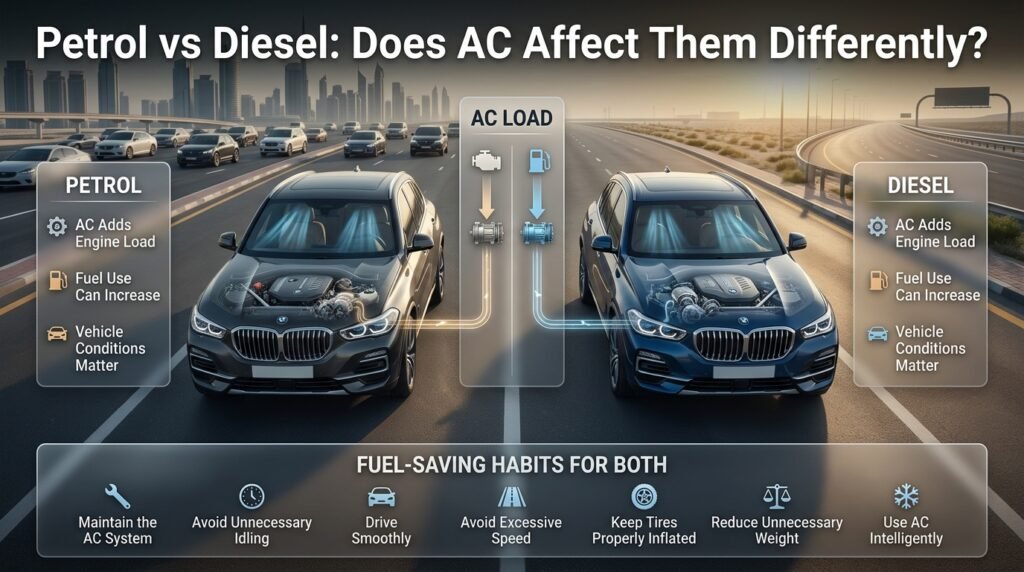
Both petrol and diesel vehicles can experience increased fuel consumption when their conventional AC systems place additional load on the engine.
The exact effect depends on the vehicle and operating conditions.
Diesel engines often have different torque characteristics and efficiency behavior compared with petrol engines, but drivers shouldn’t assume that AC is “free” on one fuel type.
In both cases, the compressor requires energy.
The practical fuel-saving advice remains similar:
- Maintain the AC system.
- Avoid unnecessary idling.
- Drive smoothly.
- Avoid excessive speed.
- Keep tires properly inflated.
- Reduce unnecessary vehicle weight.
- Use AC intelligently.
Does Automatic Transmission Affect AC Fuel Consumption?
Automatic transmissions continuously manage gear selection and engine operation.
When the AC compressor adds load, the vehicle’s control systems can respond automatically.
Drivers generally don’t need to interfere manually.
Instead, smooth throttle control is more important.
Aggressive acceleration while the AC is operating can increase overall fuel demand.
If you drive an automatic vehicle, learn more through Fuel-Efficient Use of Automatic Transmission.
For a broader explanation of gear selection and economy, see Gear Shifting and Fuel Economy.
How Does Acceleration Combine With AC Load?
Acceleration already requires additional engine power.
When the AC compressor is also operating, the engine has another load to manage.
That doesn’t mean you need to drive unusually slowly.
It simply means unnecessary hard acceleration can increase fuel consumption.
Imagine accelerating aggressively from every traffic light while running the AC continuously.
The vehicle repeatedly demands high engine output.
Now compare that with a driver who accelerates progressively and anticipates traffic.
The second driving style generally creates fewer unnecessary energy demands.
For more information, read How Acceleration Affects Fuel Consumption in Dubai.
Does Braking Technique Matter When Using AC?
Yes, although braking doesn’t directly change how much energy the AC compressor needs.
The issue is overall efficiency.
When a driver accelerates hard and then brakes unnecessarily, some of the energy used to accelerate the vehicle is lost during braking.
In a conventional vehicle, braking generally converts kinetic energy into heat.
That means the fuel used to create that momentum doesn’t provide useful forward movement for very long.
Anticipating traffic and reducing unnecessary acceleration can therefore improve overall fuel economy while the AC is running.
See How Braking Habits Affect Fuel Economy in Dubai for a detailed explanation.
Does Driving Speed Affect Fuel Consumption More Than AC?
It can.
At higher road speeds, aerodynamic drag becomes an increasingly important factor.
The engine must produce more power to push the vehicle through the air.
That means excessive speed can have a significant effect on fuel consumption.
When AC is added to the equation, you’re dealing with multiple energy demands at the same time.
This is why efficient driving isn’t about obsessing over one feature.
It’s about controlling the biggest avoidable sources of energy loss.
For Dubai driving, see Optimal Driving Speed for Fuel Efficiency in Dubai.
How Highway Speed Affects Fuel Consumption
Highway speed has a significant effect on fuel consumption because aerodynamic resistance increases as a vehicle travels faster. At moderate speeds, the engine can often operate more efficiently, while driving at very high speeds requires substantially more energy to overcome air resistance. Frequent speed changes, rapid acceleration, and unnecessary overtaking can also increase fuel use. On Dubai highways, maintaining a steady and sensible speed, following posted speed limits, and using cruise control where appropriate can help reduce unnecessary fuel consumption and make long-distance driving more efficient.
To understand how different highway speeds, aerodynamic drag, acceleration, and driving consistency can influence your vehicle’s fuel consumption, explore our detailed How Highway Speed Affects Fuel Consumption guide before your next long-distance journey.
How Does Highway Driving Change the AC Equation?
Highway driving is different from urban driving.
There is usually:
- Less stopping
- Less idling
- More consistent speed
- Fewer repeated accelerations
These factors can improve fuel economy.
However, high speed increases aerodynamic drag.
So while highway travel can be more efficient than stop-and-go traffic, excessive speed can reduce that advantage.
AC adds another energy demand, but maintaining a sensible cruising speed and avoiding unnecessary acceleration can help manage overall fuel use.
For additional guidance, read Highway Driving Fuel Efficiency and Improving Fuel Economy on Long Trips.
Should You Turn AC Off on a Highway?
Not necessarily.
If the outside temperature is comfortable, you may not need AC.
But if the weather is extremely hot, turning the AC off simply to save fuel may not be a sensible choice.
Instead:
- Keep the windows closed.
- Use a reasonable temperature.
- Maintain steady speed.
- Avoid excessive acceleration.
- Reduce unnecessary stops.
- Keep the vehicle properly maintained.
For longer journeys, Long-Distance Driving Fuel Efficiency Tips can complement your AC strategy.
Does Vehicle Weight Affect AC Fuel Economy?
Vehicle weight doesn’t necessarily make the AC compressor itself consume dramatically more energy.
However, a heavier vehicle requires more energy to accelerate and move.
If you’re driving through urban traffic, this becomes especially relevant.
Carrying unnecessary items can therefore contribute to higher overall fuel consumption.
A practical habit is to remove heavy items you don’t need.
For a detailed discussion, see How Vehicle Weight Affects Fuel Economy.
Car Load and Fuel Consumption
The amount of weight carried by a vehicle can influence fuel consumption, particularly during frequent acceleration, hill climbing, and stop-and-go driving. Extra luggage, heavy equipment, or unnecessary items in the trunk increase the vehicle’s overall weight, requiring more energy to move. While a small amount of additional weight may have a limited effect on a single trip, carrying unnecessary loads regularly can gradually reduce fuel efficiency. For better economy, remove items you do not need, distribute essential luggage safely, and avoid treating your vehicle as permanent storage. In Dubai, combining a sensible vehicle load with smooth driving and proper tire pressure can help support more efficient everyday driving.
For practical tips on how luggage, heavy equipment, passenger load, and unnecessary items can affect your vehicle’s fuel consumption, explore our detailed Car Load and Fuel Consumption guide and learn how to manage vehicle weight more efficiently.
Vehicle Accessories and Fuel Economy
Vehicle accessories and fuel economy are closely connected because certain add-ons can increase aerodynamic drag, vehicle weight, or electrical load. Roof racks, cargo boxes, oversized accessories, and other external equipment may make the engine work harder, especially during highway driving. Even small changes can affect fuel consumption when they are used regularly. For better efficiency, remove unnecessary accessories when they are not needed, keep external equipment streamlined, and avoid carrying extra weight without a purpose. In Dubai, where long highway journeys and high-speed driving are common, choosing practical accessories and maintaining the vehicle properly can help support better overall fuel economy.
For a practical guide on how roof racks, cargo boxes, extra weight, larger wheels, and other accessories can influence fuel consumption, read our detailed Vehicle Accessories and Fuel Economy in Dubai guide before choosing or removing accessories from your vehicle.
What About Roof Racks and AC?
Roof-mounted accessories can affect aerodynamics.
A roof rack, cargo box or other external equipment can increase aerodynamic drag.
At highway speeds, that additional drag can increase the amount of engine power required to maintain speed.
If you’re already running the AC, the vehicle is dealing with both aerodynamic and climate-control energy demands.
If you don’t need a roof rack or cargo carrier for a particular journey, removing it can help reduce unnecessary aerodynamic resistance.
See Roof Racks and Fuel Economy for more information.
Vehicle Drag and AC: Why Both Matter
Fuel economy is affected by the forces the vehicle must overcome.
These include:
- Rolling resistance
- Air resistance
- Vehicle weight
- Mechanical losses
- Engine load
- Auxiliary systems such as AC
Aerodynamic drag becomes particularly important at higher speeds.
That means drivers shouldn’t evaluate AC consumption separately from the rest of the vehicle.
For a deeper look at this subject, read Vehicle Drag and Fuel Consumption in Dubai.
Does Tire Pressure Matter When AC Is Running?
Tire pressure affects rolling resistance.
Underinflated tires can require more energy to move.
If your tires are underinflated and the AC is running in hot weather, you’re combining multiple avoidable energy demands.
Correct tire pressure is therefore an important part of overall fuel efficiency.
Check the pressure when the tires are cold and follow the vehicle manufacturer’s recommended specifications.
Don’t simply use a generic pressure number because another vehicle uses it.
For more guidance, read Tire Pressure and Fuel Efficiency.
A Practical Dubai AC Fuel-Efficiency Routine
The following routine is simple enough to use every day.
Before Entering the Vehicle
If the car has been parked outside:
- Use a sunshade where possible.
- Ventilate the cabin safely if it is extremely hot.
- Remove trapped hot air when practical.
- Start the AC.
- Use appropriate airflow settings.
Once the Cabin Starts Cooling
Don’t continuously demand the coldest possible temperature.
Instead:
- Set a comfortable temperature.
- Allow the system to regulate cabin conditions.
- Keep windows closed when appropriate.
- Avoid unnecessary idling.
- Drive smoothly.
During Traffic
Pay attention to the driving pattern.
Try to:
- Anticipate traffic.
- Avoid hard acceleration.
- Avoid unnecessary braking.
- Leave appropriate following distance.
- Minimize unnecessary idling where safe.
- Keep the AC at a comfortable setting.
During Highway Travel
For long-distance driving:
- Check tire pressure before leaving.
- Remove unnecessary weight.
- Remove unnecessary roof equipment.
- Keep windows closed at higher speeds.
- Maintain a sensible steady speed.
- Use the AC normally rather than constantly switching it on and off.
Common Mistakes Drivers Make With Car AC
Mistake 1: Turning the AC Off Completely to Save Fuel
Some drivers believe the only way to save fuel is to avoid AC.
In Dubai’s heat, that’s often impractical.
Better approach: Use AC efficiently rather than eliminating it.
Mistake 2: Keeping the Temperature at the Lowest Setting
The coldest possible setting isn’t always necessary.
Better approach: Use a comfortable temperature once the cabin has cooled.
Mistake 3: Leaving the Engine Running While Parked
The car may be stationary, but fuel is still being consumed.
Better approach: Avoid unnecessary idling where practical and safe.
Mistake 4: Opening Windows at Highway Speed
Open windows can increase aerodynamic drag.
Better approach: At higher speeds, keep windows closed when practical.
Mistake 5: Ignoring AC Maintenance
Weak cooling doesn’t always mean the weather is simply too hot.
Better approach: Investigate unusual AC performance.
Mistake 6: Focusing Only on AC
A driver might turn off AC but continue accelerating aggressively, speeding or carrying unnecessary weight.
Better approach: Improve the whole driving pattern.
Mistake 7: Using Generic Tire Pressure Numbers
Incorrect tire pressure can reduce efficiency and affect handling.
Better approach: Follow the manufacturer’s recommended pressure.
Expert Advice for Better Fuel Economy With AC
The most practical way to approach AC fuel consumption is to think about unnecessary energy use.
You don’t need to avoid every source of energy consumption.
Your vehicle is designed to use fuel to provide transportation, climate control and other functions.
Instead, identify waste.
Unnecessary idling is waste.
Aggressive acceleration followed by unnecessary braking is waste.
Excessive highway speed can create unnecessary aerodynamic losses.
Carrying equipment you don’t need can increase the vehicle’s workload.
Driving with poorly inflated tires can increase rolling resistance.
And using an AC system that isn’t properly maintained can reduce cooling performance.
When these issues are addressed together, the vehicle can operate more efficiently without forcing the driver to sit in an uncomfortable cabin.
⭐ Expert Tip: In Dubai, don’t make “AC off” your primary fuel-saving strategy. Make efficient driving + sensible AC use + proper vehicle maintenance your strategy instead.
How to Know if Your AC Is Using More Energy Than Normal
Drivers don’t need sophisticated equipment to notice potential problems.
Pay attention to changes such as:
- Cabin takes much longer to cool.
- AC becomes weak during normal driving.
- Cooling varies unexpectedly.
- Compressor makes unusual noises.
- Engine idle becomes unusually rough when AC engages.
- Fuel economy changes significantly without another obvious reason.
- AC performance suddenly deteriorates.
One symptom doesn’t automatically identify a particular fault.
But a noticeable change from the vehicle’s normal behavior is worth investigating.
How Can Drivers Track the Effect of AC on Fuel Economy?
If you want to understand your own vehicle rather than rely on generic claims, you can track fuel consumption over several comparable journeys.
Record:
- Distance
- Fuel added
- Average speed
- Traffic conditions
- AC usage
- Outside temperature
- Highway or city driving
- Vehicle load
Try to compare similar journeys.
For example:
Test A: AC on, moderate traffic, steady driving.
Test B: AC on, heavy traffic, frequent stops.
Test C: AC on, highway, steady speed.
The results can help you understand how your specific vehicle behaves.
Avoid drawing conclusions from a single short journey because traffic, weather and driving conditions can change dramatically.
A Simple AC and Fuel Consumption Decision Guide
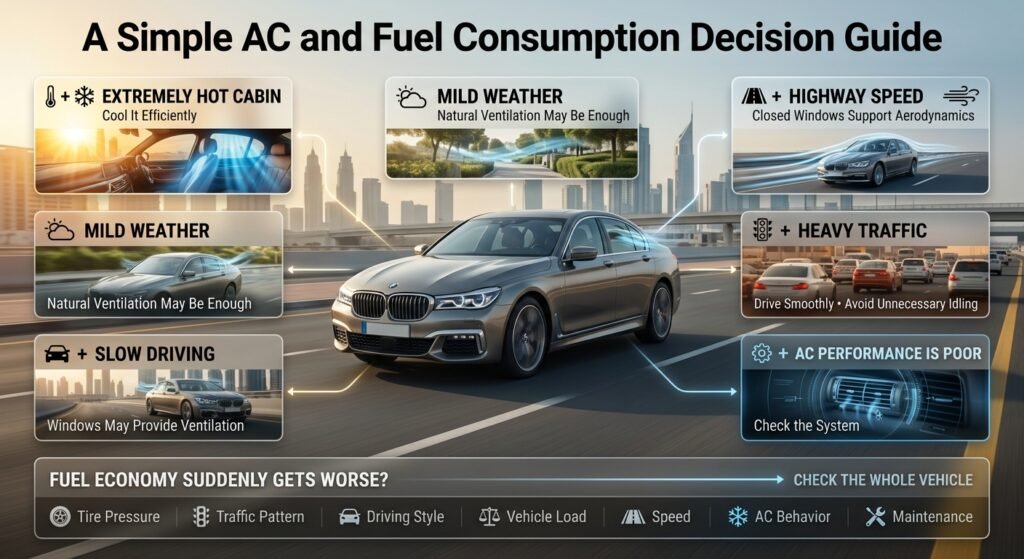
Use this quick guide when deciding how to manage AC use.
If the Cabin Is Extremely Hot
Cool it efficiently.
Don’t worry about saving a tiny amount of fuel by refusing to use AC in extreme conditions.
If the Weather Is Mild
Natural ventilation may be enough.
If You’re Driving Slowly
Windows can sometimes provide useful ventilation.
If You’re Driving at Highway Speed
Closed windows are generally more practical for maintaining vehicle aerodynamics.
If You’re Sitting in Traffic
Focus on smooth driving and minimizing unnecessary idling.
If AC Performance Is Poor
Don’t simply turn the temperature lower.
Check the system.
If Fuel Economy Suddenly Gets Worse
Look at the whole vehicle.
Check:
- Tire pressure
- Traffic pattern
- Driving style
- Vehicle load
- Speed
- AC behavior
- Maintenance condition
Does Turning AC On and Off Frequently Save Fuel?
Constantly switching the AC on and off isn’t necessarily the best strategy.
Modern climate-control systems are designed to manage cooling demand.
Repeated manual intervention can make it harder to maintain a stable cabin temperature and may not provide meaningful fuel savings.
A better approach is to let the system maintain a reasonable temperature.
Use manual intervention when circumstances genuinely change.
For example, if the outside temperature drops significantly in the evening and you no longer need cooling, you may choose natural ventilation.
But during extreme heat, simply switching the AC off and on repeatedly isn’t a reliable fuel-saving technique.
What Is the Best AC Temperature for Fuel Economy?
There isn’t one universal temperature that guarantees maximum fuel economy for every vehicle.
Comfort matters.
The most practical approach is to avoid unnecessarily extreme cooling.
Set the cabin to a comfortable level and allow the climate-control system to maintain it.
If the cabin is extremely hot, stronger cooling at the beginning may be appropriate.
Once the interior stabilizes, reduce unnecessary cooling demand.
This is more realistic than trying to identify a magic temperature number.
Does AC Affect Fuel Economy More in Summer?
Generally, higher outside temperatures increase cooling demand.
The hotter the cabin and outside environment, the more heat the AC system has to remove.
That’s particularly relevant in Dubai.
During cooler months, the AC may have a smaller cooling workload.
During extreme summer conditions, the system may operate under much greater demand.
This is another reason seasonal driving conditions should be considered when comparing fuel economy.
What Should You Do Before a Long Summer Drive?
Before a long trip:
- Check tire pressure.
- Inspect tires.
- Make sure the AC cools properly.
- Check the cabin air filter if service is due.
- Remove unnecessary weight.
- Remove unnecessary roof equipment.
- Plan the route.
- Avoid unnecessary traffic where practical.
- Carry sufficient fuel.
Planning matters because running out of fuel in extreme weather is an avoidable problem.
Key Takeaways
- Car AC generally increases fuel consumption in conventional petrol and diesel vehicles.
- The AC compressor requires energy from the vehicle.
- Extreme heat increases cooling demand.
- A car parked under direct sunlight can require more cooling effort.
- Shade and sunshades can reduce initial cabin heat.
- Opening windows may be reasonable at low speeds in suitable weather.
- Open windows can increase aerodynamic drag at higher speeds.
- Unnecessary idling consumes fuel while the vehicle is stationary.
- Heavy traffic can make the overall fuel impact more noticeable.
- Smooth acceleration helps control total fuel consumption.
- Excessive speed can increase aerodynamic losses.
- Underinflated tires increase rolling resistance.
- Unnecessary vehicle weight adds to the overall workload.
- Roof racks can increase aerodynamic drag.
- Poor AC performance should be investigated rather than compensated for with extreme settings.
- There is no universal AC fuel-consumption figure for every vehicle.
- In Dubai, efficient AC use is more realistic than avoiding AC completely.
Does Car AC Increase Fuel Consumption, and How Much Fuel Can It Use?
Running the air conditioner can increase fuel consumption because the compressor places an additional load on the engine. In a conventional petrol or diesel vehicle, the engine has to provide power not only to move the car but also to operate the AC system. The actual effect isn’t a fixed number for every vehicle. It changes with outside temperature, cabin temperature, vehicle size, compressor design, driving speed, traffic and how heavily the AC is working. Research from Natural Resources Canada notes that AC can increase fuel consumption by up to 20% under some conditions, while controlled testing has shown that the impact varies significantly with operating conditions.
For a Dubai driver, the effect can become more noticeable during extremely hot weather because the system has to remove much more heat from the cabin. A car that has been sitting in direct sunlight may require intensive cooling before it reaches a comfortable temperature. That doesn’t mean every trip will produce a dramatic drop in mileage, but it does mean AC should be considered as one of the vehicle’s energy demands.
Important factors that influence AC fuel consumption:
Outside temperature: Hotter conditions generally increase cooling demand.
Cabin temperature: A sun-heated interior takes more work to cool.
Vehicle size: Larger cabins may require more cooling capacity.
Driving conditions: Stop-and-go traffic can make the overall fuel penalty more noticeable.
AC condition: A properly maintained system can operate more effectively than one with cooling or airflow problems.
Driving style: Aggressive acceleration and unnecessary braking can have a much larger effect on total fuel consumption than small AC-setting changes.
The practical takeaway is not to avoid AC completely. In Dubai’s climate, that’s unrealistic for much of the year. A better strategy is to use the AC efficiently while controlling the other factors that waste fuel.
Is It More Fuel-Efficient to Use AC or Drive With the Windows Down?
There isn’t one answer that applies to every driving situation. The choice between AC and open windows depends heavily on vehicle speed, outside temperature and how much the windows are opened.
At lower speeds, opening the windows can sometimes be a sensible alternative because aerodynamic drag caused by the open windows is relatively small. At higher speeds, however, the airflow disturbance created by open windows becomes more important. In those conditions, keeping the windows closed and using the AC can be more fuel-efficient. Ford specifically notes this difference between lower-speed and highway driving, while Oak Ridge National Laboratory testing also found that the comparison changes with vehicle and speed.
This is why the old advice that “windows down always saves more fuel than AC” is too simplistic.
Think about it practically. If you’re moving slowly through a local road on a mild evening, opening the windows may provide enough ventilation without requiring the compressor to cool the cabin. But if you’re travelling on a highway at higher speed, open windows can interfere with the vehicle’s airflow and increase aerodynamic resistance.
A useful rule of thumb:
Low-speed driving + mild weather: Windows may be a reasonable option.
High-speed driving: Closed windows with AC are generally the better aerodynamic choice.
Extreme heat: AC is the practical option for maintaining a comfortable cabin.
Very hot parked vehicle: Letting some trapped heat escape before intensive cooling can help.
AC + windows open continuously: Avoid this combination because it allows cooled air to escape and makes the system work harder.
So don’t think of it as an absolute AC-versus-windows rule. Think about speed and conditions. That’s the more accurate way to approach fuel efficiency.
Does Running AC While the Car Is Idling Consume More Fuel?
Running the AC while the vehicle is stationary still consumes fuel because the engine remains running. The car doesn’t need to move to consume fuel; it only needs the engine to be operating. When the AC compressor is working, it adds an additional load while the vehicle is sitting still.
This becomes particularly relevant when someone parks or waits in a vehicle for a long time with the engine running simply to keep the cabin cool. You’re consuming fuel without travelling any distance, so that fuel contributes nothing to your kilometres-per-litre result.
Interestingly, controlled research shows that the absolute fuel penalty from AC operation can behave differently at idle than during cruising, while the percentage impact can be particularly noticeable because the engine is otherwise doing very little useful work.
For Dubai drivers, prolonged idling with AC is worth paying attention to because hot weather makes it tempting to leave the engine running whenever you’re waiting.
If you regularly wait in your vehicle, keep these points in mind:
Avoid unnecessary long periods of engine idling.
Don’t leave the vehicle running simply because you expect to wait for a long time.
If you’re parked, consider whether the engine genuinely needs to remain running.
Don’t assume that a stationary car isn’t consuming fuel.
Remember that the AC continues requiring energy while the engine is running.
There’s no universal hourly fuel figure that applies to every vehicle. Engine size, AC compressor design, temperature and vehicle condition all change the result.
The more useful principle is simple: if the engine is running while you’re stationary, fuel is being consumed, and running the AC adds another demand to that operating system.
Why Does Car AC Use More Fuel in Hot Weather?
Hot weather can increase AC-related fuel consumption because the system has to remove more heat from the vehicle before it can maintain the desired cabin temperature. This is especially relevant in Dubai, where a car parked under direct sunlight can become extremely hot inside.
The AC doesn’t simply have to cool the air. Heat is also stored in the dashboard, seats, steering wheel, door panels and other interior surfaces. When you first start cooling a very hot vehicle, the system has a substantial heat load to overcome.
Temperature is one of the factors identified by automotive and government sources as influencing AC fuel demand. The load varies according to outdoor conditions, vehicle interior size and other operating factors.
That’s why a useful fuel-saving habit isn’t necessarily to switch the AC off. It’s to reduce the amount of heat the system has to remove in the first place.
Practical ways to reduce the initial cooling workload:
Park in covered or shaded parking when possible.
Use a windshield sunshade during long parking periods.
Avoid leaving the vehicle exposed to direct sunlight unnecessarily.
When safe, allow extremely hot trapped cabin air to escape before intensive cooling.
Once the cabin becomes comfortable, avoid continuously demanding maximum cooling.
Keep the AC system properly maintained so it can remove heat effectively.
For example, imagine two identical cars parked for several hours. One is parked under cover while the other sits directly under the afternoon sun. When both drivers start their vehicles, the second car has a much greater amount of heat to remove.
That difference doesn’t mean shade will suddenly transform fuel economy, but it can make the initial cooling process easier.
For Dubai driving, this is a much more practical approach than simply telling drivers to “use less AC.”
How Can I Reduce Fuel Consumption While Still Using My Car’s AC?
The best approach is to reduce unnecessary AC workload rather than stop using the system altogether. In a hot climate, completely avoiding AC isn’t realistic, and trying to save fuel by driving in an excessively hot cabin can make the journey uncomfortable and potentially affect concentration.
Start with the vehicle itself. If the cabin is extremely hot, reduce the initial heat load before expecting the AC to bring the temperature down. A sunshade, shaded parking and sensible ventilation can all help. Once the cabin reaches a comfortable temperature, there’s usually no reason to keep demanding the most aggressive cooling setting.
Then look beyond the AC button. Fuel economy is affected by the entire way the vehicle is operated.
The most useful habits include:
Avoid unnecessary idling: Don’t leave the engine running for long periods when the vehicle isn’t being driven.
Drive smoothly: Progressive acceleration generally wastes less energy than repeated hard acceleration.
Avoid unnecessary braking: Anticipating traffic helps preserve momentum.
Maintain sensible speeds: Excessive speed increases aerodynamic drag.
Keep tires correctly inflated: Underinflated tires increase rolling resistance.
Remove unnecessary weight: Don’t carry heavy items you don’t need.
Remove unused roof equipment: Roof racks and carriers can increase aerodynamic drag.
Maintain the AC system: Poor cooling performance can indicate a maintenance problem.
Keep windows closed at higher speeds: This helps avoid unnecessary aerodynamic disturbance.
Use a comfortable temperature: There’s no need to make the cabin excessively cold.
This broader approach is more effective than obsessing over whether the AC should be switched off for every few minutes.
A driver who keeps the AC on but drives smoothly, maintains correct tire pressure, avoids excessive speed and minimizes unnecessary idling can have a much more sensible fuel-efficiency strategy than someone who switches the AC off but drives aggressively.
The professional approach is simple: use the AC when you need it, maintain it properly, and eliminate the other avoidable sources of fuel waste.
Conclusion
Air conditioning and fuel consumption are closely connected, especially in a hot climate like Dubai. Running the AC places an additional load on a conventional vehicle’s engine, so some increase in fuel use is expected. However, that doesn’t mean drivers should avoid using the AC or sacrifice comfort just to save fuel.
The smarter approach is to focus on efficient AC use and better overall driving habits. Parking in the shade, using a windshield sunshade, reducing excessive cabin heat before cooling, maintaining the AC system, and avoiding unnecessary idling can all help reduce wasted energy.
It’s also important to remember that AC is only one part of the fuel-economy equation. Aggressive acceleration, excessive speed, frequent braking, heavy traffic, incorrect tire pressure, unnecessary vehicle weight and aerodynamic drag can all increase fuel consumption. Improving several of these areas together can make a much bigger difference than simply switching the AC off.
For Dubai drivers, the practical goal isn’t to drive without air conditioning. It’s to stay comfortable while avoiding unnecessary fuel waste. Use the AC when you need it, maintain the system properly, drive smoothly, and make sensible decisions based on the weather and road conditions.
In the end, better fuel economy comes from consistent habits rather than one quick trick. A well-maintained vehicle, sensible AC use and efficient driving style can help you control fuel consumption while keeping every journey comfortable and practical.
Leave a Reply