Introduction
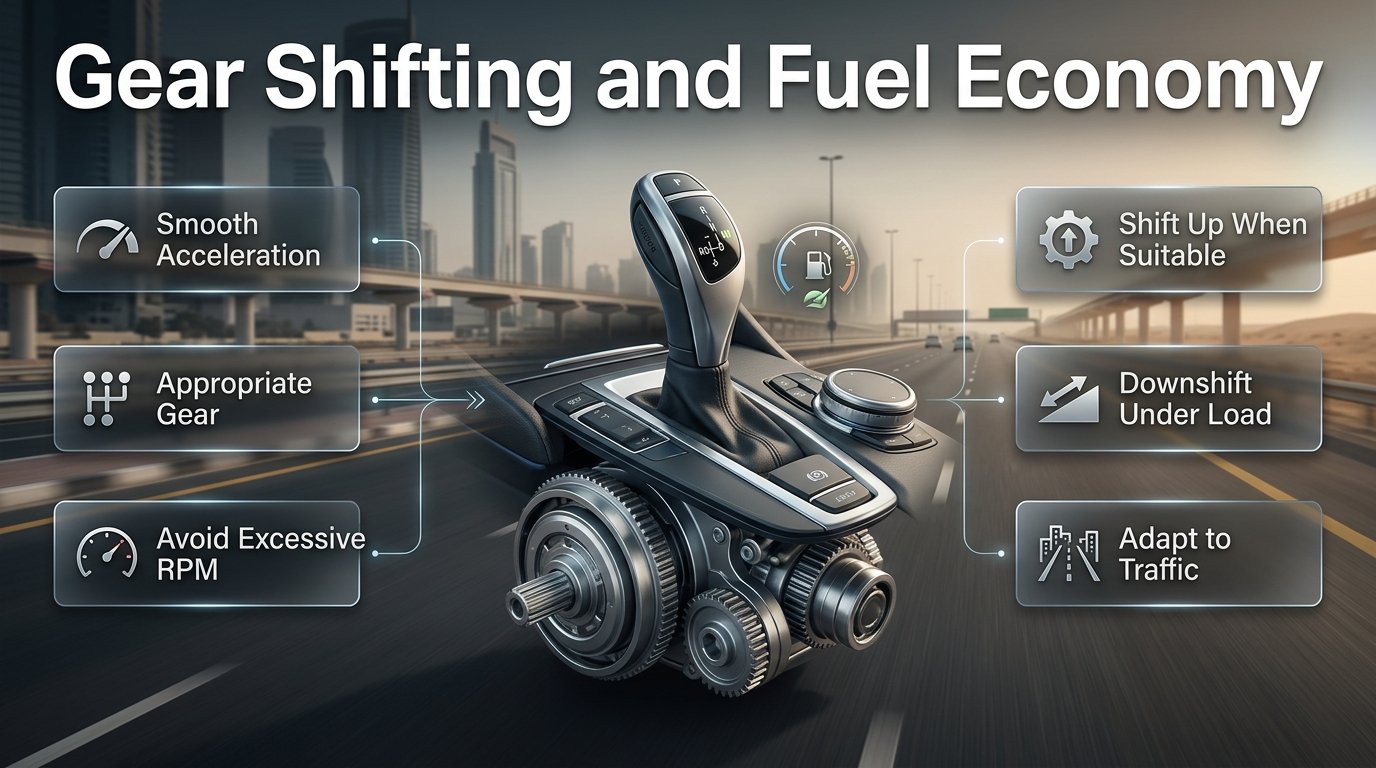
Gear Shifting and Fuel Economy | Have you ever noticed that two people can drive the same car on the same roads and still get different fuel economy? One driver may regularly need to refuel, while another gets noticeably more kilometres from the same tank. The difference can come from several things, but gear shifting and fuel economy are closely connected, especially in vehicles with manual transmissions.
For drivers in Dubai, where daily driving can involve congested city roads, frequent stops, highways, and long-distance journeys, understanding how gears affect engine operation can make everyday driving more efficient. Fuel Delivery Dubai is also a useful resource for drivers looking for practical information about fuel and vehicle operation.
The important thing is not to follow a rigid rule such as “always shift as early as possible” or “always use the highest gear.” Both approaches can be wrong depending on the situation. Efficient gear selection means choosing a gear that allows the engine to work smoothly without unnecessarily high RPM or excessive load.
This guide explains how gear selection affects fuel consumption, when to shift up or down, how manual and automatic transmissions differ, what happens in traffic and on highways, and which driving habits can quietly increase fuel use.
What Is the Connection Between Gear Shifting and Fuel Economy?
Gear shifting affects fuel economy because the transmission controls the relationship between engine speed and road speed. A suitable higher gear can allow the engine to turn more slowly during steady driving, while a lower gear provides more mechanical advantage when starting, climbing, or accelerating.
In simple terms:
Lower gear → higher engine speed and stronger pulling power
Higher gear → lower engine speed and efficient cruising
The transmission exists because an engine cannot operate efficiently at every road speed using one fixed ratio.
When a car starts from a complete stop, it needs considerable torque at the wheels. First gear provides the mechanical advantage required to get the vehicle moving. As the vehicle accelerates, staying in first gear would cause the engine RPM to rise unnecessarily.
Shifting into second, third, fourth, fifth, or sixth gear changes that relationship.
The engine can continue moving the vehicle while operating at a lower rotational speed.
That is where fuel economy comes into the picture.
However, lower RPM alone doesn’t guarantee lower fuel consumption. Engine load matters too.
If you select a high gear too early and the engine struggles to maintain speed, you may need to press the accelerator much harder. The result may be less efficient than using a lower gear.
So the most useful rule is:
Use the highest suitable gear that allows the engine to operate smoothly and comfortably.
Why Does Gear Selection Affect Engine Efficiency?
An internal-combustion engine consumes fuel to produce power. The amount of fuel required changes according to factors such as engine speed, load, throttle position, vehicle speed, road gradient, and driving conditions.
Gear selection influences several of these factors.
When you’re in a low gear at relatively high road speed, the engine can be spinning rapidly. The vehicle may not need that much engine speed, especially if you’re simply cruising.
Moving into a higher gear reduces the engine’s speed relative to the vehicle.
This is why modern vehicles often have multiple forward gears.
A six-speed transmission, for example, gives the vehicle more opportunities to keep the engine operating in a suitable range.
Low gears are useful for:
- Moving away from a stop
- Slow manoeuvring
- Steep climbs
- Heavy loads
- Strong acceleration
- Situations where additional engine braking is useful
Higher gears are useful for:
- Stable city-road cruising
- Open roads
- Highways
- Maintaining speed with modest engine load
- Reducing unnecessary engine RPM
The transmission therefore isn’t simply changing numbers on the dashboard. It’s managing how the engine’s available power reaches the road.
Does a Higher Gear Always Mean Better Fuel Economy?
No. A higher gear can improve fuel economy when the vehicle is ready for it, but using a high gear too early can make the engine work harder.
This is one of the most common misunderstandings about fuel-efficient driving.
Suppose you’re travelling on a flat road at a steady speed. You select a higher gear and the engine RPM falls. The vehicle continues moving smoothly and responds normally to gentle accelerator input.
That’s generally a sensible gear choice.
Now consider a different situation.
You’re climbing a steep hill at relatively low speed. You select the highest possible gear because you want to reduce RPM. The engine begins to struggle, and you have to press the accelerator much further to maintain speed.
In this situation, a lower gear may be more appropriate.
The engine can operate at a more useful speed and provide the required torque without being forced to labour in an unsuitable gear.
The goal is therefore not:
“Use the highest gear.”
The goal is:
“Use the highest appropriate gear.”
That distinction is important for both fuel economy and good vehicle control.
When Should You Shift Gears to Save Fuel?
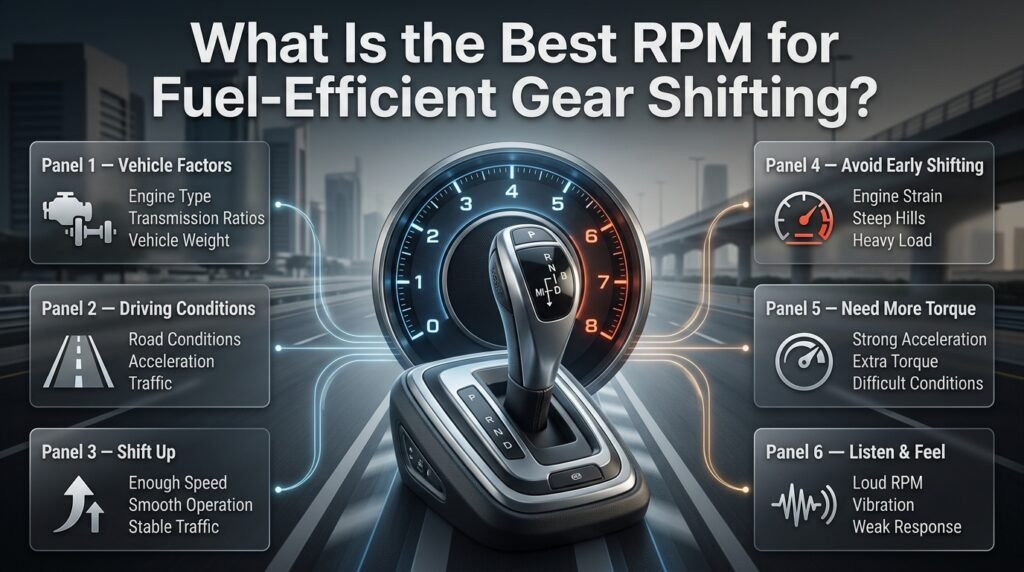
There isn’t a universal RPM figure that works for every vehicle.
The ideal shift point depends on the engine, transmission ratios, vehicle weight, fuel type, road conditions, and how strongly you’re accelerating.
A small petrol hatchback, a large diesel SUV, and a hybrid vehicle can all have very different ideal operating characteristics.
For normal driving, however, you can follow several practical principles.
Shift up when:
- The vehicle has gained enough speed.
- The engine is becoming unnecessarily busy.
- You don’t need strong acceleration.
- The next gear allows smooth operation.
- The road is relatively level.
- Traffic conditions are stable.
Don’t rush into a higher gear when:
- The engine is struggling.
- You’re climbing a steep hill.
- The vehicle is heavily loaded.
- You need immediate acceleration.
- Road conditions require additional torque.
Your ears and the vehicle’s response can be surprisingly useful.
If the engine is revving loudly without a good reason, it may be time to shift up.
If the vehicle vibrates, hesitates, or feels weak after shifting up, the gear may be too high.
Is There a Perfect RPM for Fuel-Efficient Gear Shifting?
Not really.
You may find general recommendations suggesting a particular RPM range, but treating that number as a universal rule can be misleading.
Different engines produce their useful torque and power at different speeds.
A naturally aspirated petrol engine may respond differently from a turbocharged diesel engine. A heavily loaded vehicle may need more engine speed than an empty one. A hill requires a different approach from a flat road.
Your vehicle owner’s manual should take priority over generic internet recommendations.
For everyday driving, focus on the following:
Avoid unnecessarily high RPM.
Avoid extremely low RPM under heavy load.
Shift smoothly.
Maintain enough engine response for the situation.
Adapt to road conditions.
That approach is much more practical than watching the tachometer every second.
Experienced drivers often develop an instinct for when the engine needs another gear simply from sound, vibration, and throttle response.
How Does Acceleration Influence Gear-Shifting Fuel Economy?
Acceleration is one of the biggest factors affecting fuel consumption.
Even if you’re changing gears correctly, aggressive acceleration can increase fuel use significantly.
When you press the accelerator heavily, the engine must produce more power. Fuel consumption rises because you’re demanding more energy in a short period.
This is why gear selection should be combined with smooth acceleration.
For a more detailed look at this relationship, see How Acceleration Affects Fuel Consumption in Dubai.
A fuel-conscious driver doesn’t necessarily accelerate extremely slowly. Instead, they accelerate progressively and avoid demanding more power than the situation requires.
For example, when a traffic light turns green, there’s usually no benefit in racing away from the intersection only to brake at the next light.
A smoother acceleration pattern allows the vehicle to build speed without unnecessary fuel consumption.
A practical pattern
Move smoothly → accelerate progressively → shift appropriately → reach cruising speed → maintain steady speed
This works better than repeatedly using maximum throttle between every gear change.
How Can Manual Drivers Shift Gears More Efficiently?
Manual transmissions give the driver direct control over gear selection.
That can be an advantage for fuel economy, but only when the driver understands how the engine responds.
Start smoothly in first gear
First gear is designed for getting the vehicle moving.
You generally don’t need excessive accelerator input.
A smooth launch reduces unnecessary fuel use and also reduces clutch wear.
Move into second gear when appropriate
Once the vehicle has enough speed and first gear is no longer necessary, shift into second.
Avoid holding first gear simply because the engine can rev higher.
Continue progressively
As speed increases, shift through the gears according to road conditions and engine response.
You don’t need to use exactly the same shift point every time.
Avoid engine lugging
Lugging happens when the engine is operating at very low RPM while under substantial load.
The vehicle may feel rough or unwilling to accelerate.
If you experience this, select a lower gear.
Use higher gears during cruising
Once the vehicle is moving at a stable speed, a higher gear can reduce engine RPM and support better economy.
What Is Engine Lugging and Why Is It Bad?
Engine lugging occurs when a driver selects too high a gear for the current speed and load.
For example, imagine you’re travelling uphill in a high gear. Instead of downshifting, you keep pressing the accelerator to maintain speed.
The engine may begin to shake or produce a deep, strained sound.
That’s a sign that the gear isn’t appropriate.
Lugging isn’t the same as efficient low-RPM driving.
Low RPM can be perfectly normal during light-load cruising. The problem occurs when low engine speed is combined with heavy demand.
Signs of lugging can include:
- Engine vibration
- Poor acceleration response
- Rough running
- Deep or strained engine sound
- Need for excessive accelerator input
If you notice these signs, downshifting is usually more appropriate.
⚠ Common Mistake: Assuming that the lowest possible RPM always provides the best fuel economy. The engine still needs to operate comfortably under the load being placed on it.
How Does Smooth Driving Improve Fuel Economy?
Gear shifting becomes much more effective when it is part of a smooth driving style.
A driver who selects appropriate gears but constantly accelerates and brakes may still get poor fuel economy.
Why?
Because acceleration uses energy, and braking converts much of that vehicle energy into heat.
If you accelerate hard toward a red light and then brake heavily, the fuel used to create that speed has largely been wasted.
Smooth driving reduces these unnecessary cycles.
Our guide to Smooth Driving Techniques for Better Fuel Economy in Dubai explains how acceleration, braking, and anticipation work together.
Good habits include:
- Looking well ahead.
- Leaving a safe following distance.
- Accelerating progressively.
- Shifting without excessive RPM.
- Releasing the accelerator early when traffic slows.
- Avoiding unnecessary braking.
- Maintaining a steady speed when possible.
The transmission is only one part of this process.
Highway Driving Fuel Efficiency
Highway driving fuel efficiency depends largely on maintaining a steady speed, avoiding aggressive acceleration, and reducing unnecessary aerodynamic resistance. Driving at very high speeds can increase fuel consumption because air resistance rises rapidly as speed increases. Before a highway trip, check tire pressure, remove unnecessary items from the vehicle, and ensure the engine is properly maintained. On suitable roads, cruise control can help maintain a consistent speed, while smooth acceleration and gradual braking can prevent unnecessary fuel use. These simple habits can help your vehicle use fuel more efficiently during longer highway journeys.
For a practical guide to maintaining better fuel efficiency on highways, including speed management, smooth acceleration, vehicle preparation, and reducing unnecessary fuel consumption, explore our detailed Highway Driving Fuel Efficiency guide.
How Highway Speed Affects Fuel Consumption
Highway speed has a significant effect on fuel consumption because aerodynamic resistance increases as a vehicle travels faster. At moderate speeds, the engine can often operate more efficiently, while driving at very high speeds requires substantially more energy to overcome air resistance. Frequent speed changes, rapid acceleration, and unnecessary overtaking can also increase fuel use. On Dubai highways, maintaining a steady and sensible speed, following posted speed limits, and using cruise control where appropriate can help reduce unnecessary fuel consumption and make long-distance driving more efficient.
To understand how different highway speeds, aerodynamic drag, acceleration, and driving consistency can influence your vehicle’s fuel consumption, explore our detailed How Highway Speed Affects Fuel Consumption guide before your next long-distance journey.
How Does Braking Affect the Benefits of Good Gear Shifting?
Imagine two drivers leaving the same intersection.
Driver A accelerates aggressively, reaches the vehicle ahead quickly, and then brakes hard.
Driver B accelerates smoothly and maintains enough distance to avoid unnecessary braking.
Even if both drivers shift gears perfectly, Driver B is likely to use energy more efficiently.
This is why fuel economy isn’t simply about getting the gear change right.
For a detailed explanation of this side of driving, see How Braking Habits Affect Fuel Economy in Dubai.
Anticipation is extremely valuable.
Look beyond the car directly in front of you.
If several vehicles ahead are slowing, you can often begin reducing your speed earlier instead of accelerating into a situation that will immediately require braking.
That approach saves fuel and usually makes driving calmer.
Tire Pressure and Fuel Efficiency
Tire pressure plays an important role in fuel efficiency because underinflated tires create greater rolling resistance, forcing the engine to work harder and potentially increasing fuel consumption. Maintaining the recommended tire pressure can help your vehicle roll more efficiently while also supporting better handling, braking, and tire wear. In Dubai’s hot climate, checking tire pressure regularly is especially useful because temperature changes can affect pressure readings. Always follow the vehicle manufacturer’s recommended pressure rather than relying on the maximum pressure printed on the tire sidewall.
For practical guidance on maintaining the correct tire pressure, reducing unnecessary rolling resistance, and supporting better fuel economy in Dubai’s driving conditions, read our detailed Tire Pressure and Fuel Efficiency guide.
What Gear Should You Use in City Traffic?
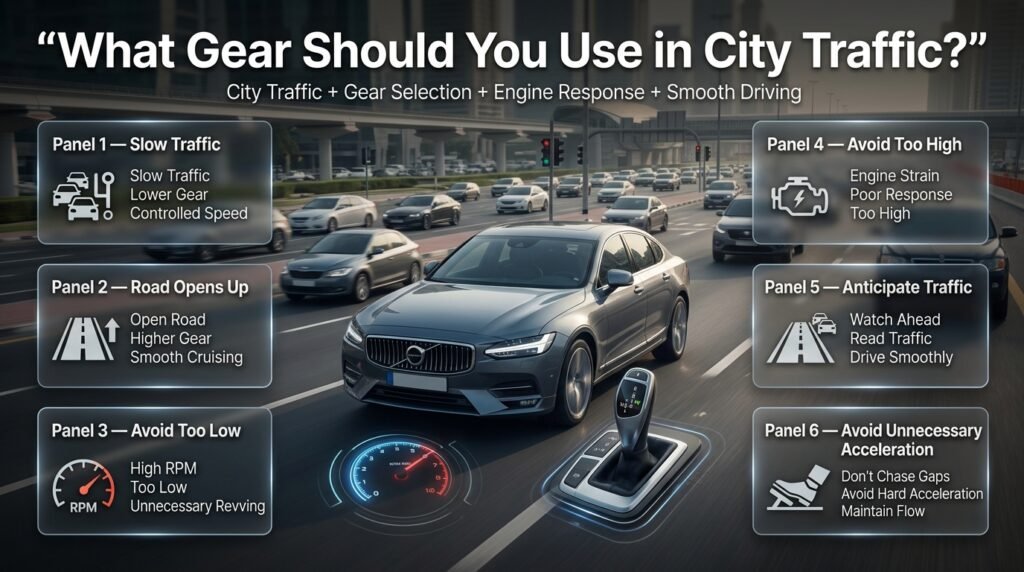
City driving requires constant adaptation.
There isn’t one ideal gear for all urban conditions.
When traffic is moving slowly, lower gears may be necessary.
When the road opens up, you can move into higher gears.
The main objective is to avoid two extremes:
Too low: unnecessarily high engine RPM.
Too high: engine strain and poor response.
During normal city driving, don’t worry about shifting as little as possible. Change gear when the conditions require it.
At the same time, don’t constantly change gears because traffic speed changes by a few kilometres per hour.
A smooth driver anticipates the traffic flow.
If vehicles ahead are already slowing, there’s little point in accelerating hard just to close a small gap.
Vehicle Accessories and Fuel Economy
Vehicle accessories and fuel economy are closely connected because certain add-ons can increase aerodynamic drag, vehicle weight, or electrical load. Roof racks, cargo boxes, oversized accessories, and other external equipment may make the engine work harder, especially during highway driving. Even small changes can affect fuel consumption when they are used regularly. For better efficiency, remove unnecessary accessories when they are not needed, keep external equipment streamlined, and avoid carrying extra weight without a purpose. In Dubai, where long highway journeys and high-speed driving are common, choosing practical accessories and maintaining the vehicle properly can help support better overall fuel economy.
For a practical guide on how roof racks, cargo boxes, extra weight, larger wheels, and other accessories can influence fuel consumption, read our detailed Vehicle Accessories and Fuel Economy in Dubai guide before choosing or removing accessories from your vehicle.
Vehicle Drag and Fuel Consumption in Dubai
Vehicle drag can have a significant effect on fuel consumption, particularly as driving speed increases. Aerodynamic resistance becomes more noticeable on highways, meaning vehicles may need more engine power to maintain higher speeds. Roof racks, cargo boxes, open windows at high speeds, and bulky external accessories can increase drag and reduce efficiency further. In Dubai, where drivers often use high-speed roads for longer journeys, keeping the vehicle streamlined and removing unnecessary external equipment can help reduce aerodynamic resistance. Combining good aerodynamics with moderate speeds and smooth driving can support better overall fuel economy.
For a deeper understanding of how aerodynamic resistance, driving speed, roof equipment, external cargo, wind, and vehicle design can influence fuel consumption, explore our detailed Vehicle Drag and Fuel Consumption in Dubai guide.
How Does Traffic Affect Fuel Economy and Gear Selection?
Heavy traffic can make fuel economy difficult because the vehicle repeatedly accelerates, slows, and stops.
Dubai drivers can experience this during busy commuting periods, around major intersections, and on heavily used urban routes.
In these conditions, gear selection still matters, but anticipation becomes even more important.
How Traffic Affects Fuel Economy in Dubai explains why congestion can increase fuel consumption.
When traffic is slow:
- Use an appropriate lower gear.
- Avoid excessive accelerator input.
- Leave enough space ahead.
- Don’t race toward every small opening.
- Anticipate when traffic is likely to stop.
- Avoid unnecessary high-RPM acceleration.
The objective is to keep the vehicle moving smoothly rather than constantly switching between acceleration and braking.
How Can You Improve Fuel Economy in Stop-and-Go Traffic?
Stop-and-go traffic is difficult because the vehicle has to repeatedly overcome inertia.
Every time the car stops, energy must be used again to accelerate it.
That’s why the best strategy is to reduce unnecessary acceleration.
The techniques explained in Stop and Go Driving Fuel Efficiency are particularly useful when traffic is crawling.
A practical approach is to watch the movement of several vehicles ahead.
If the queue is slowing, don’t accelerate aggressively simply because the car in front has moved forward slightly.
Maintain a safe gap and allow the traffic wave to reach you naturally.
This doesn’t mean blocking traffic or driving unpredictably. Safety and normal traffic flow always come first.
The idea is simply to avoid unnecessary “accelerate-brake-accelerate” cycles.
Should You Shift Differently When Driving Uphill?
Yes.
An uphill road increases the load on the engine because the vehicle has to work against gravity.
If you’re climbing and the engine begins struggling in the current gear, downshift.
This allows the engine to operate at a more suitable speed and provides additional torque at the wheels.
You may still use more fuel uphill because climbing requires additional energy. Good gear selection doesn’t eliminate the physical work involved.
It simply helps the engine handle that work appropriately.
On an uphill road:
- Watch for declining engine response.
- Downshift when necessary.
- Avoid forcing a high gear.
- Maintain a sensible speed.
- Don’t use aggressive acceleration unless necessary.
On a downhill road:
An appropriate gear can help control speed through engine braking.
Avoid unnecessary acceleration simply because the vehicle is descending.
📌 Quick Tip: A temporary increase in fuel consumption while climbing a hill isn’t necessarily a sign of poor driving. Look at your overall journey rather than judging fuel economy from one section of road.
Does Vehicle Weight Change the Best Gear?
Yes.
A heavily loaded vehicle requires more energy to accelerate and climb.
Passengers, luggage, equipment, tools, and other cargo all add weight.
As load increases, you may need to stay in lower gears slightly longer during acceleration or downshift more frequently on hills.
That doesn’t mean driving aggressively.
It means allowing the engine to operate in a range where it can handle the load without struggling.
If you’re carrying items that you don’t need, removing them can help.
For a broader explanation, see How Vehicle Weight Affects Fuel Economy.
You can also learn more about the relationship between cargo and fuel use in Car Load and Fuel Consumption.
The practical lesson is simple: don’t carry unnecessary weight permanently.
Do Roof Racks Affect Fuel Economy Even When Gear Selection Is Correct?
They can.
Roof racks, roof boxes, bicycles, cargo carriers, and other external equipment can change the vehicle’s aerodynamic profile.
At low speeds, their effect may be relatively small.
At highway speeds, aerodynamic resistance becomes increasingly important.
This means you can be using the correct high gear and still consume more fuel because the vehicle has to push more air.
Roof Racks and Fuel Economy explains this issue in more detail.
If you don’t need a roof rack or cargo box for a particular journey, removing it can reduce unnecessary aerodynamic resistance.
How Does Aerodynamics Interact With Gear Selection?
Gear selection controls engine speed and torque delivery.
Aerodynamics determines how much resistance the vehicle faces as it moves through the air.
Both influence fuel consumption.
At higher speeds, aerodynamic drag becomes increasingly significant. That’s why simply shifting into the highest gear doesn’t guarantee excellent highway economy.
A vehicle travelling quickly may require substantially more power to overcome air resistance.
For more information, see How Aerodynamics Affects Fuel Efficiency.
This is particularly relevant to highway driving.
The vehicle may be operating at low RPM in a high gear, yet fuel consumption can still rise because the engine needs to produce more power to overcome aerodynamic resistance.
Why Does Highway Speed Matter Even in the Highest Gear?
Highway driving often allows the use of higher gears, which is generally helpful.
But speed matters too.
As speed increases, aerodynamic drag rises significantly.
That means there can be a substantial fuel-economy difference between moderate cruising and very high-speed driving even when the vehicle remains in the same gear.
For Dubai drivers, this makes sensible cruising speed an important part of fuel management.
Optimal Driving Speed for Fuel Efficiency in Dubai provides additional guidance on this subject.
The best highway strategy combines:
- Appropriate high gear
- Sensible cruising speed
- Smooth acceleration
- Predictable braking
- Correct tire pressure
- Reasonable vehicle load
- Good aerodynamic condition
For longer journeys, Fuel-Efficient Highway Driving provides additional practical guidance.
How Can Gear Selection Help During Long-Distance Driving?
Long-distance journeys are often more fuel-efficient than short urban trips because the vehicle can maintain a stable speed for longer periods.
Once the vehicle is cruising, an appropriate high gear can keep engine RPM relatively low.
However, long-distance fuel economy can still be affected by:
- Excessive speed
- Heavy luggage
- Roof-mounted equipment
- Tire pressure
- Strong acceleration
- Frequent overtaking
- Unnecessary braking
- Air conditioning
- Traffic
- Road gradient
For longer trips, planning matters.
Improving Fuel Economy on Long Trips covers the broader strategy.
Drivers can also review Long-Distance Driving Fuel Efficiency Tips before setting out.
The key is to treat the journey as a complete fuel-management exercise rather than focusing only on gear changes.
Does Downshifting Increase Fuel Consumption?
Downshifting increases engine speed, but it doesn’t automatically mean you’re wasting fuel.
A lower gear may be necessary when the vehicle needs more torque.
For example, you’re climbing a hill and the current gear isn’t allowing the engine to maintain speed comfortably. Downshifting may improve the engine’s operating condition.
Similarly, engine braking can make a lower gear useful during certain descents.
The problem is unnecessary downshifting.
If you’re cruising comfortably and repeatedly selecting lower gears just to make the engine rev, you’re not gaining a fuel-economy advantage.
Downshift when:
- The engine is struggling.
- You’re climbing.
- You need stronger acceleration.
- You need additional control on a descent.
- Road conditions require it.
Avoid unnecessary downshifting when:
- The current gear is working well.
- You’re only trying to increase engine noise.
- It creates unnecessarily high RPM.
- There’s no practical driving reason.
Can Coasting in Neutral Save Fuel?
Putting the vehicle into neutral isn’t a universal fuel-saving technique.
Many modern fuel-injected vehicles can reduce or stop fuel delivery during certain deceleration conditions while remaining in gear, depending on the vehicle’s control system.
Coasting in neutral can also reduce engine-braking capability.
For this reason, don’t assume that neutral automatically means zero fuel consumption or better economy.
Follow your vehicle manufacturer’s recommendations and prioritize proper vehicle control.
The broader principle remains the same: fuel-efficient driving should never compromise safety or control.
Air Conditioning and Fuel Consumption
Air conditioning can have a noticeable effect on fuel consumption, especially during hot weather and heavy traffic. When the AC system is running, the engine needs additional power to operate the compressor, which can increase fuel use. In Dubai’s hot climate, however, avoiding AC completely is not practical or comfortable. A better approach is to use the system efficiently by parking in shade when possible, ventilating the cabin briefly before cooling it, maintaining the AC system properly, and avoiding unnecessary idling with the AC running. These simple habits can help reduce unnecessary fuel consumption while keeping the cabin comfortable.
For practical tips on reducing unnecessary fuel consumption while keeping your car comfortable in Dubai’s hot climate, explore our detailed Air Conditioning and Fuel Consumption guide, which explains how AC use, traffic, idling, driving speed, and vehicle maintenance can affect overall fuel economy.
Does Idling Reduce Overall Fuel Economy?
Yes.
An engine can consume fuel even when the vehicle isn’t moving.
That means unnecessary idling can reduce overall fuel economy regardless of how well you shift gears.
This is particularly relevant when drivers sit in parked vehicles with the engine running.
For a detailed explanation, see Fuel Consumption While Idling.
Dubai’s hot climate can make this habit more common because drivers may want to keep the air conditioning operating while waiting.
Our guide to Car Idling Fuel Consumption in Dubai discusses the issue in a local context.
The important point is that efficient driving isn’t just about what happens while the vehicle is moving.
How to Reduce Fuel Use in Dubai Traffic
Reducing fuel use in Dubai traffic starts with smoother, more predictable driving. Heavy congestion, frequent stopping, rapid acceleration, and unnecessary idling can all increase fuel consumption. Instead of constantly accelerating and braking, maintain a safe following distance and anticipate traffic flow so you can slow down gradually when needed. Avoid leaving the engine running unnecessarily while parked or waiting, and keep your tires properly inflated. Planning your route around severe congestion when practical can also reduce time spent in stop-and-go traffic. These simple habits can help your vehicle use fuel more efficiently during busy Dubai commutes.
For practical strategies to reduce unnecessary fuel consumption during Dubai’s congested roads, including smoother acceleration, better traffic anticipation, reducing idling, and route planning, explore our detailed How to Reduce Fuel Use in Dubai Traffic guide.
How Does Automatic Transmission Gear Shifting Affect Fuel Economy?
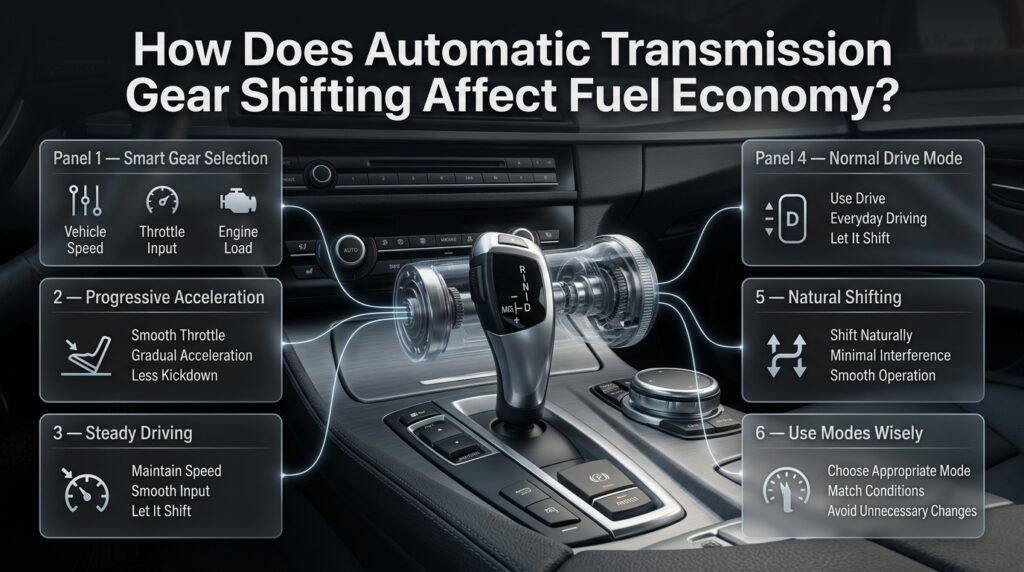
Automatic transmissions handle gear selection differently from manuals.
Modern automatic transmissions use electronic controls to monitor factors such as vehicle speed, throttle position, engine load, and driving conditions.
They can change gears quickly and often select a ratio that keeps the engine within a useful operating range.
Because of this, drivers don’t usually need to manually interfere with every gear change.
A smooth accelerator pedal is often more useful.
Good habits for automatic drivers include:
- Use normal Drive mode for ordinary driving.
- Accelerate progressively.
- Avoid unnecessary kickdowns.
- Maintain a steady speed.
- Let the transmission shift naturally.
- Use specific transmission modes only when appropriate.
For more information, see Fuel-Efficient Use of Automatic Transmission.
Should You Manually Select Gears in an Automatic Car?
Sometimes.
Many automatic vehicles allow manual gear selection or special transmission modes.
These can be useful in situations such as steep descents, certain uphill conditions, towing, or when the manufacturer specifically recommends a particular mode.
But manually forcing gear changes during normal driving isn’t automatically more efficient.
Modern transmissions are designed to make these decisions themselves.
If the vehicle is behaving normally, smooth throttle control and predictable driving are usually more valuable than constantly overriding the transmission.
Is a Manual Transmission More Fuel-Efficient Than an Automatic?
There is no universal answer.
Older automatic transmissions often consumed more fuel than comparable manuals because they had fewer gears and less sophisticated control systems.
Modern automatic transmissions are very different.
Many now have numerous ratios and highly advanced electronic control systems.
In some vehicles, the automatic version can match or even outperform the manual version for official fuel-economy figures.
| Factor | Manual Transmission | Automatic Transmission |
|---|---|---|
| Gear selection | Driver | Transmission computer |
| Driver control | High | Lower |
| Risk of incorrect gear | Higher | Lower |
| Traffic convenience | Lower | Higher |
| Modern fuel economy | Can be excellent | Can be excellent |
| Main driver influence | Shift timing and throttle | Throttle and driving style |
The specific vehicle matters more than simply choosing “manual” or “automatic.”
What Are the Most Common Gear-Shifting Mistakes?
Holding a Low Gear Too Long
A driver may remain in second or third gear even after the vehicle has reached a speed where a higher gear would be more appropriate.
This keeps engine RPM unnecessarily high.
Solution: Shift up when the engine and road conditions allow it.
Shifting Too Early
Some drivers are so focused on low RPM that they shift before the engine can comfortably handle the next gear.
Solution: Listen for engine strain and observe throttle response.
Using Too Much Accelerator
Aggressive throttle input increases the engine’s power demand.
Solution: Accelerate progressively unless stronger acceleration is genuinely necessary.
Ignoring Hills
A gear that works on level ground may not work on a steep climb.
Solution: Downshift when the engine begins struggling.
Following a Fixed RPM Rule
A universal shift number doesn’t account for every engine and road condition.
Solution: Adapt your technique to your vehicle.
Constantly Changing Gears in Traffic
Frequent unnecessary shifting can make driving less smooth.
Solution: Anticipate traffic and select a suitable gear.
Staying in High Gear During Heavy Loads
A loaded vehicle may need more torque.
Solution: Use a lower gear when necessary instead of forcing the engine to struggle.
What Is the Best Gear-Shifting Routine for Everyday Driving?
If you drive a manual vehicle and want a simple routine, follow these principles.
Step 1: Move Away Smoothly
Use first gear and moderate throttle.
Why it matters: Hard launches require more power.
Step 2: Build Speed Progressively
Don’t try to reach your desired speed immediately.
Why it matters: Smooth acceleration generally uses less fuel than aggressive acceleration.
Step 3: Shift Up When Appropriate
Move into higher gears once the vehicle has enough speed and the engine can handle the next ratio.
Why it matters: This can reduce unnecessary RPM.
Step 4: Monitor Engine Response
Listen for excessive RPM or signs of strain.
Why it matters: Engine sound and vehicle response help identify unsuitable gear selection.
Step 5: Downshift When Necessary
Use a lower gear for hills, stronger acceleration, or additional control.
Why it matters: The engine can operate more comfortably under higher demand.
Step 6: Anticipate Traffic
Look ahead and avoid unnecessary acceleration toward vehicles that are slowing.
Why it matters: Preventing wasted acceleration is one of the easiest ways to improve real-world economy.
How Can You Measure Whether Your Driving Is Becoming More Efficient?
Don’t rely only on the vehicle’s instantaneous fuel-consumption display.
The better approach is to monitor fuel consumption over several refuelling cycles.
Record:
- Odometer reading
- Amount of fuel added
- Distance travelled
- Type of driving
- Major traffic conditions
- Long highway trips
- Heavy loads, if any
Then compare similar periods.
For example, if you normally get around 10 litres per 100 kilometres and gradually achieve 9.3 under comparable conditions, that can indicate a meaningful improvement.
But don’t expect identical results every time.
A hot day, heavy traffic, strong headwind, higher highway speed, or additional passengers can all change fuel consumption.
This is why trends over several tanks are more useful than one isolated journey.
How Do Fuel-Efficient Driving Techniques Work Together?
Gear shifting should be considered one part of a larger fuel-efficiency strategy.
A useful way to think about it is:
Efficient gear selection + smooth acceleration + sensible speed + anticipation + correct tire pressure + appropriate load + reduced idling = better overall fuel economy
The principles explained in Fuel-Efficient Driving Techniques can help turn individual habits into a complete driving strategy.
For example, using a high gear won’t compensate for driving at excessive highway speeds.
Likewise, perfect acceleration won’t compensate for severely underinflated tires.
And excellent gear selection won’t compensate for carrying unnecessary heavy equipment every day.
Fuel economy is the combined result of many small decisions.
Expert Advice: Don’t Chase the Lowest Possible RPM
One of the most useful lessons for fuel-conscious drivers is that lower RPM isn’t automatically better.
If the engine is lightly loaded and the vehicle is cruising smoothly, lower RPM can be beneficial.
But if the engine is struggling to maintain speed, the low RPM may indicate that you’ve selected too high a gear.
Instead of watching a number and trying to keep it as low as possible, pay attention to:
- Engine smoothness
- Throttle response
- Road gradient
- Vehicle load
- Traffic
- Required acceleration
- Vehicle speed
An experienced driver adapts to the conditions.
⭐ Expert Tip: Learn how your own vehicle sounds and responds in different gears. That practical awareness is often more useful than memorizing a universal shift RPM.
A Practical Fuel-Efficient Gear-Shifting Checklist
Before your next drive, ask yourself:
- Am I holding low gears unnecessarily?
- Am I shifting into high gears too early?
- Does the engine feel comfortable after each shift?
- Am I accelerating harder than necessary?
- Am I approaching traffic lights too quickly?
- Am I braking heavily after unnecessary acceleration?
- Am I adapting gear selection to hills?
- Is the vehicle carrying unnecessary weight?
- Are the tires correctly inflated?
- Am I driving faster than necessary on highways?
- Am I leaving the engine idling unnecessarily?
- If I drive an automatic, am I allowing the transmission to shift naturally?
These questions cover much more than gear selection alone.
Does Changing Gears Properly Improve Fuel Economy?
Proper gear shifting can improve fuel economy because the transmission helps keep the engine operating at an appropriate speed for the work the vehicle is doing. In general, using a higher gear during steady cruising can reduce unnecessary engine RPM, but shifting too early can have the opposite effect if the engine starts struggling. The real goal is to select the highest suitable gear without forcing the engine to work under excessive load. Modern transmissions are specifically designed with multiple ratios so the engine can operate closer to an efficient range across different speeds and conditions.
For a manual car, this means you shouldn’t hold first, second, or third gear longer than necessary during normal acceleration. Once the vehicle has gained enough speed and the engine is operating comfortably, moving to the next appropriate gear can reduce engine speed and unnecessary fuel use.
At the same time, fuel-efficient shifting doesn’t mean changing gears as early as physically possible. If you’re climbing a hill, carrying several passengers, or accelerating, the engine may need a lower gear to produce the required torque.
Points to remember:
Shift up when the vehicle has gained sufficient speed.
Avoid unnecessarily high engine RPM.
Don’t force a high gear when the engine is struggling.
Use a lower gear when additional torque is required.
Focus on smooth operation rather than a fixed RPM number.
Is Driving in a Higher Gear Always Better for Fuel Economy?
A higher gear is often beneficial during steady driving, but higher isn’t automatically better in every situation. When the vehicle is cruising comfortably, a higher gear can reduce engine RPM and help the engine operate more efficiently. However, if the vehicle is travelling too slowly for that gear or is climbing a hill, the engine may struggle and require more accelerator input. That can eliminate the expected fuel-saving benefit. Research on vehicle gearing also shows why additional transmission ratios can improve efficiency: they allow the drivetrain to match vehicle speed and engine operating conditions more closely.
Think about driving on a flat road. Your car is moving at a steady speed and the engine sounds relaxed. Moving into a higher suitable gear may lower RPM while allowing the car to maintain speed with modest throttle input. That’s generally the situation where a higher gear makes sense.
Now imagine the same car climbing a steep road. If you remain in that high gear and push the accelerator deeply just to maintain speed, you’re asking the engine to produce substantial torque at an unsuitable operating point.
In that situation, downshifting can actually be the more efficient choice because it gives the engine a more appropriate mechanical advantage.
A useful rule is:
Use the highest gear that lets the engine work smoothly without excessive throttle or strain.
Watch for these signs that your gear is too high:
Engine vibration or shuddering
Weak acceleration
Heavy throttle input
Strained engine sound
What Is the Best RPM for Fuel-Efficient Gear Shifting?
There isn’t one universal RPM number that guarantees the best fuel economy for every car. Engine design, transmission ratios, vehicle weight, road gradient, fuel type, and driving conditions all influence the appropriate shift point. A small petrol engine, a turbocharged diesel, and a larger petrol SUV can have very different efficient operating ranges. Therefore, drivers should use RPM as a useful indicator rather than treating one specific number as a strict rule.
During normal driving, the better approach is to avoid both extremes. Excessively high RPM can increase fuel consumption because the engine is spinning much faster than necessary. On the other hand, extremely low RPM under heavy load can make the engine struggle.
The driver’s goal should be smooth, responsive engine operation.
For example, if you shift into a higher gear and the car continues accelerating normally with light throttle input, the change was probably appropriate. If the vehicle suddenly feels sluggish and you need to press the accelerator much harder, you’ve probably shifted too early.
Instead of memorizing one RPM figure, consider:
Is the engine running smoothly?
Does the car respond normally to the accelerator?
Are you accelerating, cruising, or climbing?
Is the vehicle heavily loaded?
Are you driving on a flat road or an incline?
Does the owner’s manual provide specific recommendations?
💡 Professional tip: Experienced drivers often use a combination of engine sound, road speed, throttle response, and RPM. That combination is more useful than watching the tachometer alone.
Is Manual Driving More Fuel-Efficient Than Automatic Driving?
Manual transmissions can be very fuel-efficient when driven well, but it’s no longer accurate to assume that every manual car automatically consumes less fuel than an automatic. Transmission technology has changed significantly. The U.S. Department of Energy reports that, beginning with model year 2016, automatic transmissions had better average fuel economy than manual transmissions in its comparison of vehicles offered with both transmission types. Improvements such as additional gears and more sophisticated electronic control have helped modern automatics operate efficiently.
For manual vehicles, the driver’s gear-selection decisions have a direct influence on engine speed and torque delivery. A skilled driver can shift smoothly, anticipate traffic, avoid unnecessary acceleration, and select appropriate gears for hills and cruising.
Modern automatic transmissions, however, can make these decisions extremely quickly. Many have six, eight, nine, ten, or more ratios, while CVTs can continuously vary the ratio rather than relying on fixed gears. More ratios can help keep the engine closer to an efficient operating range as vehicle speed changes.
So the transmission type alone doesn’t determine fuel economy.
What matters more in real-world driving:
Smooth acceleration
Appropriate speed
Proper gear selection
Avoiding unnecessary braking
Correct tire pressure
Vehicle load
Traffic conditions
Vehicle maintenance
⚠ Common mistake: Buying or driving a manual vehicle purely because you believe it must use less fuel. The actual efficiency of the specific vehicle and the driver’s habits matter far more than that simple assumption.
How Can I Shift Gears to Save Fuel in City and Highway Driving?
The best gear-shifting technique changes with the driving environment. In city traffic, the priority is smooth acceleration, avoiding unnecessary gear changes, and anticipating traffic so you don’t repeatedly accelerate and brake. On highways, the vehicle can usually remain in a higher gear for longer periods, allowing the engine to operate at a lower RPM while maintaining a steady cruising speed.
City driving is particularly challenging because frequent stops and acceleration cycles consume energy. Aggressive acceleration and braking can significantly reduce fuel economy, especially in stop-and-go traffic. The U.S. Department of Energy notes that aggressive driving can reduce gas mileage substantially compared with smooth driving.
On highways, however, gear selection is only part of the equation. Speed also matters because aerodynamic resistance increases as vehicle speed rises. DOE data shows that fuel economy generally declines as speeds increase beyond moderate cruising speeds.
In city driving:
Accelerate progressively.
Shift up when the engine is ready.
Don’t hold low gears unnecessarily.
Downshift when the engine struggles.
Look ahead for traffic changes.
Avoid accelerating hard toward a red light.
Maintain a safe following distance.
On highways:
Use an appropriate high gear.
Maintain a steady speed.
Avoid unnecessary rapid acceleration.
Don’t drive at excessive speeds simply because the road is open.
Use cruise control when appropriate and safe.
Keep tires correctly inflated.
📌 The professional approach: Don’t think of gear shifting as a standalone fuel-saving trick. The biggest improvement comes when correct gear selection is combined with smooth acceleration, sensible speed, anticipation, proper maintenance, and reduced unnecessary load.
Bottom Line
The most fuel-efficient driver isn’t necessarily the person who shifts at the lowest RPM or reaches the highest gear fastest. It’s the driver who understands what the vehicle needs at that moment and adjusts accordingly.
The simple formula is:
Appropriate gear + smooth throttle + sensible speed + anticipation = better real-world fuel economy.
Conclusion
Gear shifting has a direct influence on how efficiently your vehicle uses fuel, but saving fuel isn’t about following a single gear or RPM rule. The most effective approach is to choose the right gear for the road, vehicle speed, engine load, and driving situation. Shifting up when the engine no longer needs a lower gear can reduce unnecessary RPM, while downshifting at the right time can prevent the engine from struggling under heavy load.
For everyday driving, smoothness matters just as much as gear selection. Avoid aggressive acceleration, unnecessary high RPM, premature upshifting, and repeated braking after gaining speed. In city traffic, look ahead and maintain a steady flow whenever conditions allow. On highways, combine an appropriate high gear with a sensible cruising speed because driving faster can increase aerodynamic resistance and fuel consumption.
Automatic transmission drivers can also improve efficiency by using smooth throttle inputs and allowing the transmission to select suitable gears during normal driving. Manual drivers have more direct control, so learning to recognize when the engine is comfortable, overloaded, or unnecessarily revved can make a noticeable difference over time.
Ultimately, fuel-efficient gear shifting is about balance. Don’t chase the lowest possible RPM, and don’t keep the engine revving unnecessarily. Use the gear that allows the vehicle to move smoothly, respond properly, and handle the road conditions without excessive effort.
When you combine appropriate gear selection with smooth driving, sensible speed, proper tire pressure, reasonable vehicle load, reduced idling, and regular maintenance, you create a much more effective fuel-saving strategy. Small improvements in everyday driving may seem insignificant on one trip, but over hundreds or thousands of kilometres, those habits can translate into meaningful fuel savings and a smoother driving experience.
Leave a Reply