Introduction
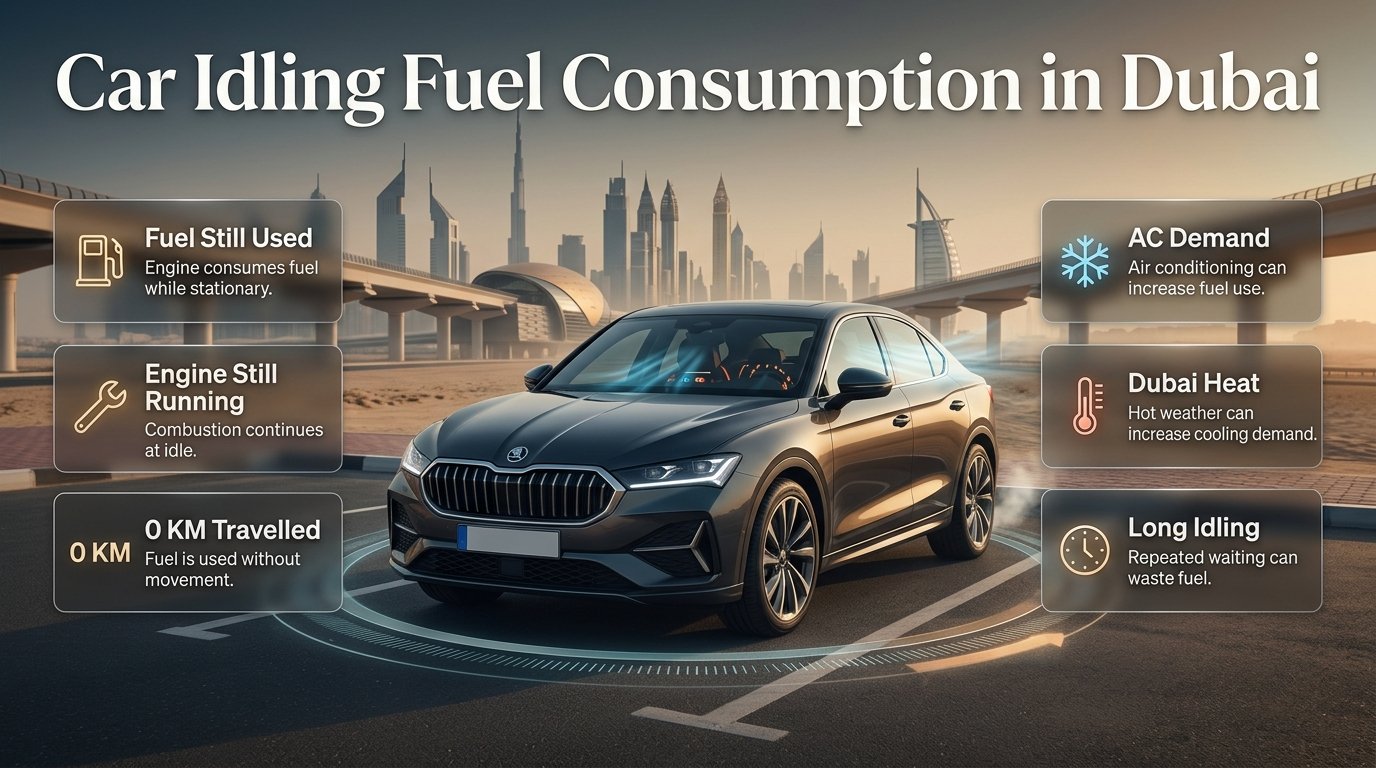
Car Idling Fuel Consumption in Dubai | You’re sitting in your car outside a shop, waiting for someone to return. The engine is running, the air conditioner is keeping the cabin cool, but the car hasn’t moved even a few metres. After 20 or 30 minutes, it may seem like no fuel has been used because the vehicle is stationary. In reality, the engine continues burning fuel, making car idling fuel consumption an important part of everyday fuel efficiency.
An idling engine still needs fuel to maintain combustion and operate essential systems such as the alternator, cooling system, and air conditioning. The vehicle may be covering zero kilometres, but fuel is still being consumed. If you unexpectedly run low while waiting or driving around Dubai, Need Petrol Emergency Dubai 👉 Fuel Delivery Dubai can provide a practical option for emergency fuel assistance.
For drivers in Dubai, unnecessary idling can become particularly common because of high temperatures and frequent air-conditioner use. Drivers may leave the engine running while waiting outside shops, during school pickups, in parking areas, or while sitting in congested traffic. A few minutes may not seem significant, but repeated idling can gradually increase fuel consumption.
This guide explains how idling affects fuel use, why consumption varies between vehicles, how air conditioning changes fuel demand, when switching the engine off makes sense, and what practical driving habits can help reduce unnecessary fuel waste.
What Is Car Idling Fuel Consumption?
Car idling fuel consumption is the amount of petrol or diesel an engine uses while the vehicle is stationary but the engine remains running. Although the car isn’t travelling, the engine continues burning fuel to maintain its idle speed and operate necessary systems and accessories.
When you start a conventional petrol or diesel vehicle, the engine needs fuel and air to maintain combustion. The engine’s crankshaft continues rotating even when your foot is on the brake and the vehicle isn’t moving.
At idle, engine speed is usually much lower than during normal driving. Depending on the vehicle, idle speed may commonly be around 600–1,000 RPM, although the exact figure varies between engines.
The engine is still performing work during this period.
It may be:
- Maintaining engine rotation
- Running the alternator
- Operating cooling fans
- Powering the air-conditioning compressor
- Supporting electrical systems
- Maintaining vacuum or hydraulic systems
- Running electronic control modules
- Keeping the engine ready to move
This creates an important fuel-efficiency issue.
The vehicle is consuming fuel but gaining no travelling distance.
That doesn’t mean every moment of idling is unnecessary. Waiting briefly at a traffic light, sitting in slow traffic, or keeping the vehicle running when immediate movement is required are normal situations.
The real concern is unnecessary prolonged idling.
How Much Fuel Does a Car Use While Idling?
A typical passenger vehicle may consume approximately 0.5 to 1.5 litres of fuel per hour while idling, although actual consumption can be lower or higher depending on the engine and operating conditions.
There isn’t one universal number for every vehicle.
A small modern petrol engine may use considerably less fuel at idle than a large SUV. Air-conditioning demand, electrical accessories, engine temperature, engine size, and vehicle condition can all change the result.
A useful general estimate looks like this:
| Vehicle or operating condition | Approximate idle consumption |
|---|---|
| Small modern petrol car | 0.5–0.8 L/hour |
| Medium petrol car | 0.6–1.0 L/hour |
| Larger petrol SUV | 0.8–1.5+ L/hour |
| Typical diesel passenger vehicle | Around 0.5–1.0 L/hour |
| Heavy AC demand | May increase consumption |
| Hybrid with engine switched off | Little or no engine fuel use during shutdown |
These figures are general estimates, not guaranteed specifications.
Your actual vehicle could be outside these ranges.
The most accurate figure comes from manufacturer data, diagnostic information, or a controlled fuel-consumption measurement.
A Simple Example
Suppose your car uses 0.8 litres per hour while idling.
If the engine remains running for:
- 10 minutes → approximately 0.13 litres
- 20 minutes → approximately 0.27 litres
- 30 minutes → approximately 0.40 litres
- 45 minutes → approximately 0.60 litres
- 1 hour → approximately 0.80 litres
- 2 hours → approximately 1.60 litres
One short idle period may not seem important.
The bigger issue is repetition.
If you unnecessarily idle for 20 minutes every day, that’s about 10 hours of idle time over 30 days. At 0.8 litres per hour, that’s approximately 8 litres of fuel used while the car covers no distance during those periods.
Why Does a Car Use Fuel When It Isn’t Moving?
A common question is: if the wheels aren’t turning, why is the engine still using fuel?
The answer is simple.
The engine itself is still operating.
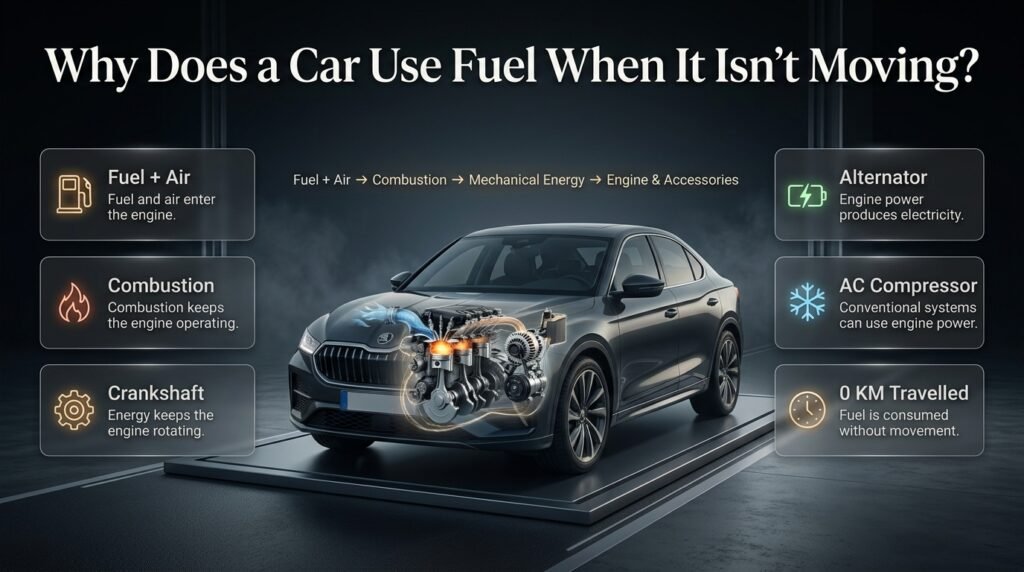
In a conventional internal-combustion engine, fuel and air enter the engine, combustion takes place, and the resulting energy keeps the pistons and crankshaft moving. The engine needs to maintain a minimum operating speed to prevent stalling.
The wheels don’t need to be turning for combustion to continue.
The engine may also be powering other components.
For example, the alternator uses mechanical energy from the engine to produce electricity. In many conventional vehicles, the air-conditioning compressor also receives mechanical power from the engine.
So when your vehicle is stationary with the engine running, fuel is still being converted into energy.
The important difference is that this energy isn’t being used to move the car.
A useful way to think about it is:
Engine running + vehicle stationary = fuel consumed without travelling distance.
That’s why unnecessary idling can reduce your overall fuel efficiency.
Is Idling Fuel Consumption Really Significant?
It depends on how frequently it happens.
A driver who spends two minutes waiting at a traffic signal isn’t in the same situation as someone who leaves the engine running for 30 minutes every day while parked.
Consider two drivers.
Driver A spends a few minutes idling at traffic lights and in normal congestion.
Driver B arrives at school 20 minutes early every day, leaves the engine and AC running, and waits inside the vehicle.
Driver B has created a much larger opportunity for unnecessary fuel consumption.
This is why fuel-saving advice should be practical rather than extreme.
You don’t need to switch your engine off every time the vehicle stops.
Instead, identify the periods when the vehicle is stationary for a significant amount of time and the engine isn’t actually needed.
That is where reducing idle time can make the biggest difference.
What Factors Affect Car Idling Fuel Consumption?
Idle fuel consumption varies from one vehicle to another because several factors affect how much energy the engine needs.
Engine Size
Engine displacement can influence fuel use at idle.
A large six-cylinder or eight-cylinder engine will often require more fuel than a small four-cylinder engine, although modern technology can change the comparison.
Engine size alone isn’t enough to predict consumption.
Fuel injection, turbocharging, cylinder deactivation, engine-management software, hybrid technology, and mechanical condition all matter.
Air Conditioning
Air conditioning is one of the most relevant factors for Dubai drivers.
In conventional vehicles, the AC compressor can add mechanical load to the engine.
When cooling demand increases, the engine may need to produce additional power.
This can increase fuel consumption.
Electrical Load
Electrical accessories also require energy.
Examples include:
- Headlights
- Cabin blower
- Audio system
- Phone chargers
- Heated seats
- Rear defogger
- Cooling fans
- Other electronic systems
The alternator produces electrical energy by taking mechanical energy from the engine.
Greater electrical demand can therefore increase engine load.
The exact effect depends on the vehicle.
Engine Temperature
A cold engine may operate differently from a fully warmed engine.
Engine-management systems adjust fuel delivery and other parameters according to operating conditions.
After startup, the vehicle may use different fuelling strategies until normal operating temperature is reached.
Once warm, engine operation generally becomes more stable.
Idle Speed
Idle RPM also matters.
An engine operating at a higher-than-normal idle speed can potentially use more fuel.
If your car normally idles at around 700 RPM but suddenly remains around 1,200 RPM after warming up, that could deserve investigation.
A high idle can have several causes, including temperature, accessory loads, engine-management settings, or mechanical problems.
Vehicle Condition
Maintenance can have a significant effect on engine operation.
Problems with:
- Spark plugs
- Fuel injectors
- Air intake
- Sensors
- Throttle components
- Ignition systems
- Engine-management systems
can affect idle quality and fuel consumption.
If your fuel consumption suddenly becomes worse, don’t automatically assume idling is responsible.
There could be an underlying mechanical issue.
Vehicle Accessories and Fuel Economy
Vehicle accessories and fuel economy are closely connected because certain add-ons can increase aerodynamic drag, vehicle weight, or electrical load. Roof racks, cargo boxes, oversized accessories, and other external equipment may make the engine work harder, especially during highway driving. Even small changes can affect fuel consumption when they are used regularly. For better efficiency, remove unnecessary accessories when they are not needed, keep external equipment streamlined, and avoid carrying extra weight without a purpose. In Dubai, where long highway journeys and high-speed driving are common, choosing practical accessories and maintaining the vehicle properly can help support better overall fuel economy.
For a practical guide on how roof racks, cargo boxes, extra weight, larger wheels, and other accessories can influence fuel consumption, read our detailed Vehicle Accessories and Fuel Economy in Dubai guide before choosing or removing accessories from your vehicle.
Vehicle Drag and Fuel Consumption in Dubai
Vehicle drag can have a significant effect on fuel consumption, particularly as driving speed increases. Aerodynamic resistance becomes more noticeable on highways, meaning vehicles may need more engine power to maintain higher speeds. Roof racks, cargo boxes, open windows at high speeds, and bulky external accessories can increase drag and reduce efficiency further. In Dubai, where drivers often use high-speed roads for longer journeys, keeping the vehicle streamlined and removing unnecessary external equipment can help reduce aerodynamic resistance. Combining good aerodynamics with moderate speeds and smooth driving can support better overall fuel economy.
For a deeper understanding of how aerodynamic resistance, driving speed, roof equipment, external cargo, wind, and vehicle design can influence fuel consumption, explore our detailed Vehicle Drag and Fuel Consumption in Dubai guide.
How Vehicle Weight Affects Fuel Economy
Vehicle weight has a direct influence on fuel economy because a heavier car requires more energy to accelerate and maintain movement, particularly in stop-and-go traffic. Carrying unnecessary luggage, tools, equipment, or other heavy items can gradually increase fuel consumption, especially when the vehicle is used frequently. The effect may be more noticeable during repeated acceleration, hill climbs, and city driving than during steady cruising. Keeping the vehicle load reasonable, removing items that are no longer needed, and distributing essential cargo safely can help reduce unnecessary energy demand and support better overall fuel efficiency.
For a deeper look at how passenger load, luggage, heavy equipment, and overall vehicle weight can influence fuel consumption, explore our detailed How Vehicle Weight Affects Fuel Economy guide for practical ways to manage unnecessary weight and improve driving efficiency.
Does Air Conditioning Increase Fuel Consumption While Idling?
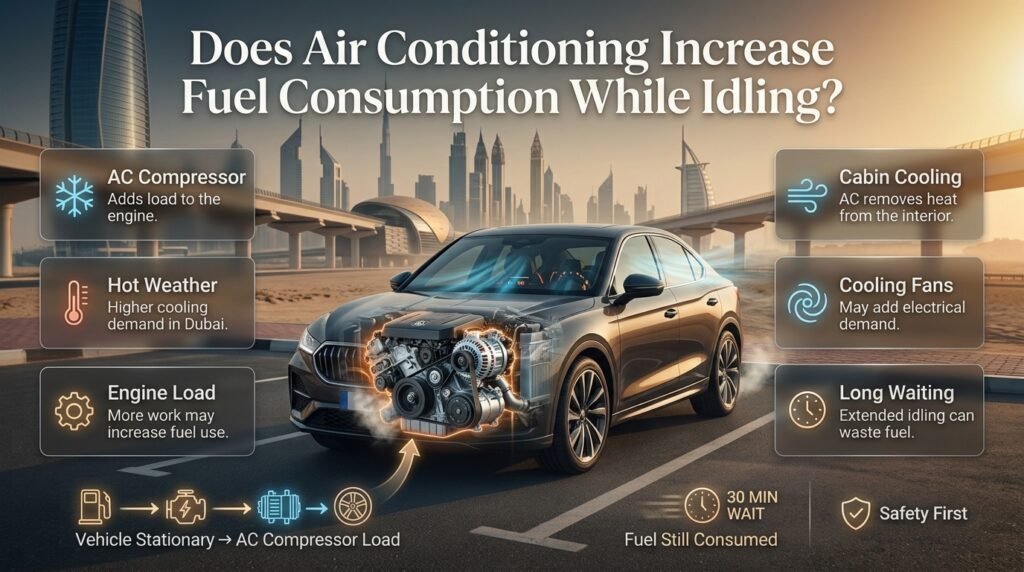
Yes. Running the air conditioner generally increases fuel consumption while idling in a conventional vehicle because the AC compressor adds load to the engine. The exact increase varies according to the vehicle, compressor, outside temperature, cabin temperature, and cooling demand.
This is particularly important in Dubai.
When outdoor temperatures are extremely high, the cabin can become very hot. The AC system has to remove that heat and maintain a comfortable interior temperature.
That can increase the workload placed on the engine.
The cooling fans may also operate more frequently, adding electrical demand.
However, there’s an important practical point.
You shouldn’t sacrifice safety or comfort in extreme heat simply to save fuel.
If you’re driving, waiting in an unsafe location, or need climate control for your wellbeing, use the AC.
The better strategy is to reduce unnecessary stationary waiting rather than avoiding essential air conditioning.
Example
Imagine you’re waiting for a passenger for 30 minutes in a Dubai parking area.
If your vehicle consumes 0.8 litres per hour under a particular set of conditions, 30 minutes represents around 0.4 litres.
If the AC increases the vehicle’s fuel demand, actual consumption could be higher.
The exact figure depends on the vehicle.
This is why long stationary waiting is a much better target for fuel-saving than trying to eliminate every short period of normal idling.
Does Idling Use More Fuel Than Driving?
This depends on what you mean by “more.”
A vehicle travelling at highway speed can consume more fuel per hour than the same vehicle sitting at idle because the engine is producing much more power and overcoming aerodynamic resistance.
But idling is extremely inefficient from a distance travelled perspective.
When driving:
Fuel → engine power → vehicle movement
When idling:
Fuel → engine operation → zero kilometres travelled
That distinction matters.
For example, a car might use one litre of fuel while travelling several kilometres.
Another litre could be consumed while sitting stationary.
Both consumed fuel, but only one situation produced useful travel.
That’s why unnecessary idling lowers practical fuel efficiency.
Idling vs Stop-and-Go Traffic
Stop-and-go traffic isn’t exactly the same as pure idling.
In heavy congestion, the vehicle may:
- Accelerate slightly.
- Brake.
- Stop.
- Idle.
- Move again.
- Brake again.
- Stop again.
This repeated cycle creates several forms of fuel waste.
Acceleration requires energy.
Braking removes kinetic energy, mostly as heat.
Repeated acceleration and braking therefore prevent the vehicle from maintaining efficient momentum.
If you want to understand the bigger picture of congestion and fuel use, see How Traffic Affects Fuel Economy in Dubai.
The key lesson is that traffic-related fuel consumption isn’t caused by idling alone.
Traffic flow, acceleration, braking, speed changes, road conditions, and stationary periods all interact.
Stop and Go Driving Fuel Efficiency in Dubai
Stop-and-go driving can significantly increase fuel consumption because the vehicle repeatedly accelerates from a standstill and then brakes again. In Dubai’s busy traffic, this pattern is common and can make city driving less efficient than steady-speed cruising. Drivers can reduce unnecessary fuel use by maintaining a safe following distance, anticipating traffic movement, accelerating smoothly, and avoiding sudden braking whenever conditions allow. It is also helpful to avoid unnecessary idling during extended stops and to keep the vehicle properly maintained. By adopting smoother driving habits, you can reduce wasted energy and improve overall fuel efficiency in congested traffic.
For practical guidance on handling congested roads more efficiently, including smoother acceleration, better traffic anticipation, reducing unnecessary braking, and limiting fuel waste during repeated stops, explore our detailed Stop and Go Driving Fuel Efficiency in Dubai guide.
Roof Racks and Fuel Economy in Dubai
Roof racks can affect fuel economy by increasing a vehicle’s aerodynamic drag, particularly when driving at higher speeds on Dubai’s highways. Even when the rack is not carrying cargo, its added exposure to airflow can create additional resistance, which may require more engine power to maintain speed. The effect can become greater when carrying bulky items such as bicycles, luggage, or roof boxes. If a roof rack is not needed for a particular journey, removing it can help keep the vehicle more aerodynamic. For regular users, choosing a streamlined design, securing cargo properly, and avoiding unnecessary weight can support better fuel efficiency.
If you regularly use a roof rack for luggage, bicycles, or other equipment, our detailed Roof Racks and Fuel Economy in Dubai guide explains how roof-mounted accessories can increase aerodynamic drag and influence fuel consumption, especially during highway driving.
How Aerodynamics Affects Fuel Efficiency
Aerodynamics plays an important role in fuel efficiency, especially when a vehicle is traveling at higher speeds. As speed increases, air resistance creates more drag, requiring the engine to use additional energy to keep the vehicle moving. Features such as roof racks, cargo boxes, open windows, and bulky external accessories can increase aerodynamic drag and contribute to higher fuel consumption. Keeping the vehicle streamlined, removing unnecessary external equipment, and maintaining a sensible highway speed can help reduce resistance and support more efficient driving.
For a clearer understanding of how air resistance, vehicle design, speed, roof accessories, and external load can influence your car’s fuel consumption, explore our detailed How Aerodynamics Affects Fuel Efficiency guide.
How Much Fuel Does a Car Use While Idling for 10 Minutes?
A vehicle using approximately 0.5–1.5 litres per hour could consume around 0.08–0.25 litres during 10 minutes of idling.
The calculation is straightforward:
Hourly consumption × 10 ÷ 60
For example:
0.8 × 10 ÷ 60 = 0.13 litres
This doesn’t mean every vehicle will use exactly 0.13 litres.
It’s simply an example based on an assumed rate.
Ten minutes may not sound like much, but repeated daily idle periods add up.
If a driver unnecessarily idles for 10 minutes every day for 30 days, that’s approximately five hours of idle time.
At 0.8 litres per hour, that’s about four litres of fuel.
Tire Pressure and Fuel Efficiency
Tire pressure plays an important role in fuel efficiency because underinflated tires create greater rolling resistance, forcing the engine to work harder and potentially increasing fuel consumption. Maintaining the recommended tire pressure can help your vehicle roll more efficiently while also supporting better handling, braking, and tire wear. In Dubai’s hot climate, checking tire pressure regularly is especially useful because temperature changes can affect pressure readings. Always follow the vehicle manufacturer’s recommended pressure rather than relying on the maximum pressure printed on the tire sidewall.
For practical guidance on maintaining the correct tire pressure, reducing unnecessary rolling resistance, and supporting better fuel economy in Dubai’s driving conditions, read our detailed Tire Pressure and Fuel Efficiency guide.
Long-Distance Driving Fuel Efficiency Tips in Dubai
Long-distance driving in Dubai can be more fuel-efficient when you maintain a steady speed, avoid unnecessary acceleration and braking, and keep the vehicle properly maintained. Before a long journey, check tire pressure, remove unnecessary weight, and make sure the engine and fluids are in good condition. Using cruise control where appropriate can help maintain a consistent speed on suitable highways, while avoiding excessive speeds can reduce aerodynamic drag and fuel consumption. Planning your route in advance can also help you avoid heavy traffic, unnecessary detours, and prolonged idling.
Planning a long journey in Dubai? Explore our detailed Long-Distance Driving Fuel Efficiency Tips in Dubai guide for practical advice on maintaining steady speeds, reducing unnecessary stops, preparing your vehicle, and improving fuel efficiency throughout your trip.
Improving Fuel Economy on Long Trips in Dubai
Improving fuel economy on long trips in Dubai starts with preparing the vehicle before you leave and maintaining efficient driving habits throughout the journey. Check tire pressure, remove unnecessary luggage, and make sure the engine and other essential systems are properly maintained. During the trip, maintain a steady and sensible speed, avoid aggressive acceleration and unnecessary braking, and use cruise control when road and traffic conditions allow. Reducing aerodynamic drag by removing unused roof racks or bulky external equipment can also help, particularly on highways. These simple practices can reduce unnecessary fuel use and make long-distance driving more efficient and predictable.
Planning a long-distance journey? Our detailed Improving Fuel Economy on Long Trips in Dubai guide offers practical advice on vehicle preparation, steady-speed driving, route planning, reducing aerodynamic drag, and managing fuel consumption more efficiently throughout your trip.
How Much Fuel Does a Car Use While Idling for 30 Minutes?
At an estimated idle rate of 0.5–1.5 litres per hour, a vehicle could use approximately 0.25–0.75 litres during 30 minutes of idling.
Using a middle example of 0.8 litres per hour:
0.8 × 0.5 = 0.4 litres
So the car would use approximately 0.4 litres during that half-hour period.
The actual amount can be higher or lower.
AC operation, engine size, electrical demand, temperature, and vehicle condition all matter.
For drivers who frequently wait in their vehicles, 20–30-minute idle periods are worth paying attention to.
How Much Fuel Does a Car Use While Idling for One Hour?
A typical passenger vehicle may consume approximately 0.5–1.5 litres per hour while idling.
For example:
- At 0.5 L/hour → 0.5 litres
- At 0.8 L/hour → 0.8 litres
- At 1.0 L/hour → 1 litre
- At 1.5 L/hour → 1.5 litres
Large engines and heavy accessory loads can result in higher consumption.
This is why leaving a vehicle running for an hour while parked isn’t fuel-neutral.
The engine is still burning fuel even though the vehicle has travelled zero kilometres.
Does Idling Damage a Car Engine?
Normal short-term idling isn’t automatically harmful.
Vehicles are designed to idle.
The concern is prolonged and unnecessary idling, particularly when it becomes a regular operating pattern.
Long idle periods increase engine operating hours without adding useful travel distance.
Depending on the vehicle and operating conditions, prolonged low-load operation may also contribute to deposits or other concerns.
Diesel vehicles can have additional considerations because modern diesel emissions systems operate according to specific temperature and load conditions.
However, it would be inaccurate to say that every idle period damages an engine.
Watch for These Signs
If you notice:
- Rough idle
- Engine shaking
- Unstable RPM
- Stalling
- High idle speed
- Strong fuel smell
- Unusual smoke
- Warning lights
- Sudden fuel-economy changes
the vehicle should be inspected.
Don’t simply assume the behaviour is normal idling.
Gear Shifting and Fuel Economy in Dubai
Gear shifting has a direct impact on how efficiently a vehicle uses fuel, particularly in Dubai’s busy traffic and changing road conditions. Driving in the appropriate gear helps keep the engine operating within an efficient range, while unnecessarily high engine speeds or using the wrong gear can increase fuel consumption. Manual drivers can improve efficiency by shifting smoothly and selecting the appropriate gear for their speed and road conditions. Automatic transmissions generally manage gear changes themselves, but smooth acceleration and avoiding unnecessary aggressive driving can still support better fuel economy.
For a practical understanding of how to choose the right gear, avoid unnecessary engine strain, and improve fuel efficiency in Dubai’s city traffic and highway conditions, read our detailed Gear Shifting and Fuel Economy in Dubai guide.
How Highway Speed Affects Fuel Consumption
Highway speed has a significant effect on fuel consumption because aerodynamic resistance increases as a vehicle travels faster. At moderate speeds, the engine can often operate more efficiently, while driving at very high speeds requires substantially more energy to overcome air resistance. Frequent speed changes, rapid acceleration, and unnecessary overtaking can also increase fuel use. On Dubai highways, maintaining a steady and sensible speed, following posted speed limits, and using cruise control where appropriate can help reduce unnecessary fuel consumption and make long-distance driving more efficient.
To understand how different highway speeds, aerodynamic drag, acceleration, and driving consistency can influence your vehicle’s fuel consumption, explore our detailed How Highway Speed Affects Fuel Consumption guide before your next long-distance journey.
How Long Can You Leave a Car Idling?
There is no single universal time limit for every vehicle.
A healthy car may be capable of idling for a long period if the cooling system, lubrication system, electrical system, and other components are functioning correctly.
But capability isn’t the same as efficiency.
If you’re safely parked and don’t need the engine running, prolonged idling simply wastes fuel.
Keep the Engine Running When:
- You’re in moving or slow traffic.
- You need immediate vehicle movement.
- Climate control is important for safety.
- You’re in a situation where switching off isn’t practical.
- The vehicle requires continued operation.
Consider Switching It Off When:
- You’re safely parked.
- You’re waiting for an extended period.
- You don’t need the engine running.
- There is no safety concern.
- The vehicle isn’t required for an active task.
The goal is not to follow an arbitrary number of minutes.
The goal is to avoid unnecessary prolonged idling.
Car Load and Fuel Consumption
The amount of weight carried by a vehicle can influence fuel consumption, particularly during frequent acceleration, hill climbing, and stop-and-go driving. Extra luggage, heavy equipment, or unnecessary items in the trunk increase the vehicle’s overall weight, requiring more energy to move. While a small amount of additional weight may have a limited effect on a single trip, carrying unnecessary loads regularly can gradually reduce fuel efficiency. For better economy, remove items you do not need, distribute essential luggage safely, and avoid treating your vehicle as permanent storage. In Dubai, combining a sensible vehicle load with smooth driving and proper tire pressure can help support more efficient everyday driving.
For practical tips on how luggage, heavy equipment, passenger load, and unnecessary items can affect your vehicle’s fuel consumption, explore our detailed Car Load and Fuel Consumption guide and learn how to manage vehicle weight more efficiently.
Should You Turn Off Your Engine at Every Stop?
No.
You don’t need to manually shut the engine off every time you stop.
A brief traffic light, a short queue, or temporary congestion is part of normal driving.
Modern vehicles with automatic stop-start technology can handle suitable short stops automatically.
If you manually turn the engine off and immediately restart it at every brief stop, the process may become inconvenient and may not provide meaningful benefits in every situation.
Focus instead on longer stationary periods.
For example:
Brief stop: Normal traffic light.
Long stop: Sitting in a parking space for 20–30 minutes waiting for someone.
The second situation presents a clearer opportunity to avoid unnecessary fuel consumption.
What Is Stop-Start Technology?
Stop-start technology is designed to reduce fuel consumption during suitable stationary periods.
When conditions allow, the system automatically switches the engine off when the vehicle stops.
When the driver is ready to move, the system restarts the engine.
The vehicle’s computer may consider:
- Engine temperature
- Battery condition
- AC demand
- Brake input
- Steering
- Outside temperature
- Vehicle speed
- Electrical demand
The system isn’t simply turning the engine off randomly.
It’s designed to balance fuel savings with vehicle operation.
If your vehicle is factory-equipped with stop-start technology, allowing the system to operate normally is generally more sensible than trying to manually manage every stop.
Stop and Go Driving Fuel Efficiency in Dubai
Stop-and-go driving can significantly increase fuel consumption because the vehicle repeatedly accelerates from a standstill and then brakes again. In Dubai’s busy traffic, this pattern is common and can make city driving less efficient than steady-speed cruising. Drivers can reduce unnecessary fuel use by maintaining a safe following distance, anticipating traffic movement, accelerating smoothly, and avoiding sudden braking whenever conditions allow. It is also helpful to avoid unnecessary idling during extended stops and to keep the vehicle properly maintained. By adopting smoother driving habits, you can reduce wasted energy and improve overall fuel efficiency in congested traffic.
For practical guidance on handling congested roads more efficiently, including smoother acceleration, better traffic anticipation, reducing unnecessary braking, and limiting fuel waste during repeated stops, explore our detailed Stop and Go Driving Fuel Efficiency in Dubai guide.
Does Idling Drain the Car Battery?
A common misconception is that idling automatically drains the battery.
In a properly functioning vehicle, the alternator normally produces electricity while the engine is running and helps supply electrical loads.
However, the charging system still has limits.
If the battery is weak, the alternator is faulty, or electrical demand is unusually high, problems can occur.
Signs of a charging-system problem may include:
- Slow engine cranking
- Battery warning light
- Dim headlights
- Electrical glitches
- Difficulty restarting
- Repeated battery failure
If these symptoms appear, have the charging system checked.
Don’t assume that normal idling is the sole cause.
Is Idling Worse for Petrol or Diesel Cars?
Both petrol and diesel engines consume fuel while idling.
The amount varies according to engine design and operating conditions.
A diesel engine may have relatively low fuel consumption at idle in some situations, but it still burns fuel.
Petrol engines also continue consuming fuel because combustion must continue to keep the engine running.
Modern diesel vehicles may have additional considerations involving emissions systems and prolonged low-load operation.
For both fuel types, the practical advice remains the same:
Avoid unnecessary prolonged idling, but allow normal idling when required for safe and proper operation.
Does Idling Use More Fuel in Summer?
It can.
The biggest factor is usually air-conditioning demand.
When the outside temperature is extremely high, the AC system has to work harder to cool the cabin.
The cooling fans and compressor may therefore operate more frequently or under greater demand.
This can increase fuel consumption while the vehicle is stationary.
Dubai’s climate makes this particularly relevant.
A driver who sits in a parked car with the AC running for 30 minutes is using fuel to produce cooling even though the vehicle isn’t travelling.
That doesn’t mean you should avoid AC in dangerous heat.
Instead, reduce the amount of unnecessary time spent stationary with the engine running.
Fuel-Saving Driving Tips
Fuel-saving driving tips can help reduce unnecessary fuel consumption and improve your vehicle’s overall efficiency. Smooth acceleration, gradual braking, maintaining a steady speed, and avoiding unnecessary idling are simple habits that can make everyday driving more economical. Keeping tires at the recommended pressure, removing unnecessary weight, limiting excessive speeds, and planning routes around heavy traffic can further reduce fuel waste. In Dubai, where hot weather, congestion, and frequent highway driving are common, combining efficient driving techniques with regular vehicle maintenance can support better fuel economy and lower running costs.
For practical guidance on reducing unnecessary fuel consumption through smoother acceleration, better braking, steady-speed driving, and smarter everyday habits, explore our detailed Fuel-Saving Driving Tips guide.
Fuel-Efficient Use of Automatic Transmission
Using an automatic transmission efficiently can help reduce unnecessary fuel consumption, especially during Dubai’s busy traffic and frequent stop-and-go driving. Avoid aggressive acceleration, sudden braking, and repeatedly switching between Drive and other gears when it is not necessary. When waiting for longer periods, follow the vehicle manufacturer’s guidance rather than keeping the engine unnecessarily engaged. Regular transmission maintenance and using the correct manufacturer-recommended fluid can also support smooth gear changes and efficient vehicle operation. The key is to let the transmission work naturally while maintaining a smooth, predictable driving style.
For practical guidance on using an automatic transmission more efficiently, including smooth acceleration, proper gear modes, traffic management, and highway driving habits, explore our detailed Fuel-Efficient Use of Automatic Transmission guide.
Fuel-Efficient Highway Driving in Dubai
Fuel-efficient highway driving in Dubai is mainly about maintaining a steady, sensible speed and avoiding unnecessary changes in acceleration. Rapid acceleration, frequent braking, and excessive speeds can increase fuel consumption, while smooth driving helps the engine operate more efficiently. Before a long highway trip, check tire pressure, remove unnecessary weight, and make sure the vehicle is properly maintained. Using cruise control on suitable roads and keeping windows closed at higher speeds can also help reduce unnecessary aerodynamic resistance. By combining good vehicle preparation with consistent driving habits, you can make highway journeys more efficient and reduce avoidable fuel use.
For practical strategies to reduce unnecessary fuel consumption on Dubai highways, including maintaining a steady speed, managing acceleration, reducing aerodynamic drag, and preparing your vehicle before a long journey, explore our detailed Fuel-Efficient Highway Driving in Dubai guide.
How to Calculate Your Own Idling Fuel Cost
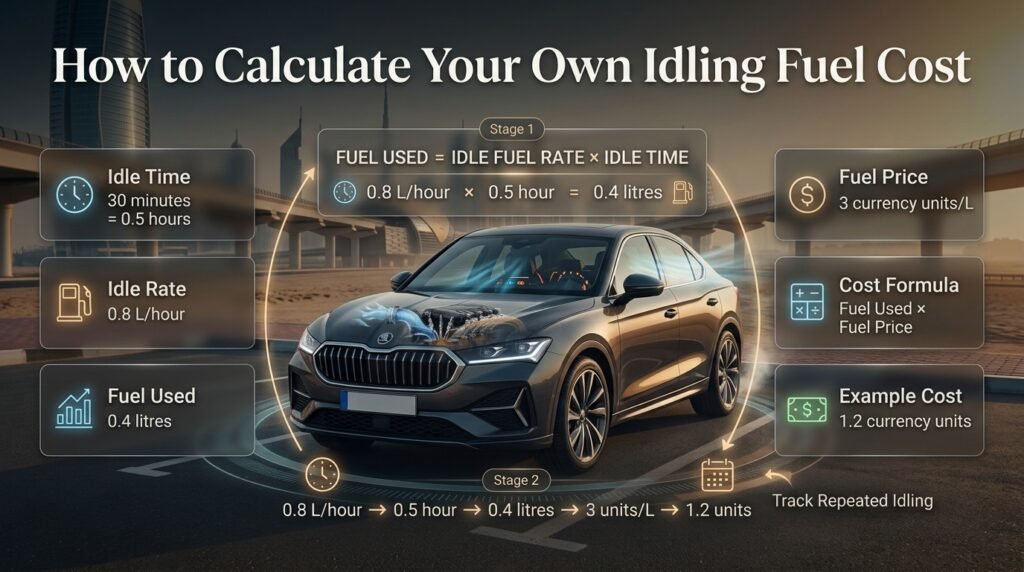
You can estimate the cost using two simple formulas.
Step 1: Calculate Fuel Used
Fuel used = idle fuel rate × idle time in hours
For example:
- Idle rate = 0.8 L/hour
- Idle time = 30 minutes
- 30 minutes = 0.5 hours
Therefore:
0.8 × 0.5 = 0.4 litres
Step 2: Calculate Cost
Cost = fuel used × fuel price per litre
If fuel costs 3 currency units per litre for illustration:
0.4 × 3 = 1.2 currency units
Use your actual fuel price to calculate the real cost.
This method is particularly useful when analysing repeated behaviour.
How to Reduce Car Idling Fuel Consumption
How to Reduce Fuel Use in Dubai Traffic
Reducing fuel use in Dubai traffic starts with smoother, more predictable driving. Heavy congestion, frequent stopping, rapid acceleration, and unnecessary idling can all increase fuel consumption. Instead of constantly accelerating and braking, maintain a safe following distance and anticipate traffic flow so you can slow down gradually when needed. Avoid leaving the engine running unnecessarily while parked or waiting, and keep your tires properly inflated. Planning your route around severe congestion when practical can also reduce time spent in stop-and-go traffic. These simple habits can help your vehicle use fuel more efficiently during busy Dubai commutes.
For practical strategies to reduce unnecessary fuel consumption during Dubai’s congested roads, including smoother acceleration, better traffic anticipation, reducing idling, and route planning, explore our detailed How to Reduce Fuel Use in Dubai Traffic guide.
Step 1: Identify Your Unnecessary Idle Time
Before changing your habits, observe them.
For one week, pay attention to when your engine remains running while you’re stationary.
Look at:
- Parking
- Passenger pickup
- School pickup
- Shopping
- Waiting outside offices
- Drive-through queues
- Roadside stops
You may discover that the biggest source of idle fuel consumption isn’t traffic.
It may be waiting.
Why It Matters
You can’t control every traffic light.
You can often control whether you sit in a parking space for 25 minutes with the engine running.
Professional Advice
Start with the easiest behaviour to change.
Don’t try to eliminate unavoidable idling.
Fuel Consumption While Idling
Fuel consumption while idling occurs when the engine remains running while the vehicle is stationary, such as when waiting in traffic, parked, or stopped outside a location. Although the car is not moving, the engine still burns fuel to keep operating, and using the air conditioner can increase the energy demand further. In Dubai, where drivers may spend time waiting in heavy traffic or during hot weather, unnecessary idling can gradually waste fuel. When it is safe and practical, avoid leaving the engine running during extended stationary periods and plan journeys to minimize unnecessary stops.
For a practical explanation of how idling affects fuel consumption, including the impact of waiting in traffic, prolonged stationary periods, and AC use, explore our detailed Fuel Consumption While Idling guide.
Step 2: Switch Off During Longer Safe Stops
If you’re safely parked and expect a longer wait, consider switching the engine off.
This immediately stops engine fuel consumption.
Common Mistake
Some drivers leave the engine running because they believe restarting the vehicle wastes more fuel than letting it idle.
Modern vehicles are designed for normal starting and restarting.
The exact break-even point varies by vehicle, so avoid treating one universal “X-minute rule” as applicable to every car.
Step 3: Avoid Excessive Warm-Up Idling
Many drivers were taught to leave a vehicle idling for several minutes before driving.
Modern vehicles generally don’t require long stationary warm-up periods under normal conditions.
Follow your vehicle manufacturer’s instructions.
Once operating safely, drive gently rather than immediately demanding high engine load.
Why It Matters
Long warm-up idling consumes fuel while producing no useful travel.
Step 4: Reduce Unnecessary Waiting
If you arrive at a destination 20 minutes early, don’t automatically keep the engine running.
If conditions allow, switch off and wait safely.
This simple habit can make a larger difference than worrying about short traffic-light stops.
Step 5: Maintain the Vehicle
Fuel economy isn’t only about driving habits.
A poorly maintained vehicle may not operate as efficiently as it should.
Pay attention to:
- Engine oil
- Air filter
- Spark plugs
- Fuel injectors
- Cooling system
- Sensors
- Tyres
- Battery
- Alternator
- Warning lights
If your fuel consumption changes suddenly, investigate the cause.
How to Reduce Fuel Use in Dubai Traffic
Reducing fuel use in Dubai traffic starts with smoother, more predictable driving. Heavy congestion, frequent stopping, rapid acceleration, and unnecessary idling can all increase fuel consumption. Instead of constantly accelerating and braking, maintain a safe following distance and anticipate traffic flow so you can slow down gradually when needed. Avoid leaving the engine running unnecessarily while parked or waiting, and keep your tires properly inflated. Planning your route around severe congestion when practical can also reduce time spent in stop-and-go traffic. These simple habits can help your vehicle use fuel more efficiently during busy Dubai commutes.
For practical strategies to reduce unnecessary fuel consumption during Dubai’s congested roads, including smoother acceleration, better traffic anticipation, reducing idling, and route planning, explore our detailed How to Reduce Fuel Use in Dubai Traffic guide.
How Smooth Driving Helps After Idling
Reducing unnecessary idle time is only one part of fuel-efficient driving.
Imagine a driver who saves fuel by switching the engine off during long parking waits but then accelerates aggressively at every traffic signal.
Those savings may be partly cancelled by inefficient driving.
Smooth acceleration can reduce unnecessary fuel demand.
Try to:
- Accelerate progressively.
- Look farther ahead.
- Maintain a sensible following distance.
- Avoid unnecessary lane changes.
- Reduce repeated speed changes.
- Anticipate traffic conditions.
For practical guidance on smoother acceleration, controlled braking, steady-speed driving, and better traffic anticipation, explore our detailed Smooth Driving Techniques for Better Fuel Economy in Dubai guide to develop more fuel-efficient driving habits.
How Acceleration Affects Fuel Consumption
Acceleration requires energy.
When you press the accelerator aggressively, the engine must produce more power.
If you then brake heavily a few seconds later, much of that energy is lost as heat through the braking system.
This creates an inefficient cycle:
Hard acceleration → high fuel demand → hard braking → energy lost
A smoother pattern is:
Anticipate → accelerate progressively → maintain speed → slow smoothly
For a deeper explanation, see How Acceleration Affects Fuel Consumption in Dubai.
The important point is that fuel efficiency is about avoiding wasted energy throughout the journey, not only while parked.
Highway Driving Fuel Efficiency
Highway driving fuel efficiency depends largely on maintaining a steady speed, avoiding aggressive acceleration, and reducing unnecessary aerodynamic resistance. Driving at very high speeds can increase fuel consumption because air resistance rises rapidly as speed increases. Before a highway trip, check tire pressure, remove unnecessary items from the vehicle, and ensure the engine is properly maintained. On suitable roads, cruise control can help maintain a consistent speed, while smooth acceleration and gradual braking can prevent unnecessary fuel use. These simple habits can help your vehicle use fuel more efficiently during longer highway journeys.
For a practical guide to maintaining better fuel efficiency on highways, including speed management, smooth acceleration, vehicle preparation, and reducing unnecessary fuel consumption, explore our detailed Highway Driving Fuel Efficiency guide.
How Braking Habits Affect Fuel Economy
Braking is necessary for safety, but unnecessary braking can indicate that the driver isn’t anticipating traffic well.
For example, repeatedly accelerating toward a red light and then braking hard wastes the energy used to reach that speed.
Looking farther ahead can help you respond earlier.
If traffic is slowing, easing off the accelerator may sometimes allow the vehicle to slow naturally instead of maintaining speed and then braking heavily.
This is why How Braking Habits Affect Fuel Economy in Dubai is a useful companion topic.
Of course, safety comes first.
Never avoid braking simply to save fuel.
Air Conditioning and Fuel Consumption
Air conditioning can have a noticeable effect on fuel consumption, especially during hot weather and heavy traffic. When the AC system is running, the engine needs additional power to operate the compressor, which can increase fuel use. In Dubai’s hot climate, however, avoiding AC completely is not practical or comfortable. A better approach is to use the system efficiently by parking in shade when possible, ventilating the cabin briefly before cooling it, maintaining the AC system properly, and avoiding unnecessary idling with the AC running. These simple habits can help reduce unnecessary fuel consumption while keeping the cabin comfortable.
For practical tips on reducing unnecessary fuel consumption while keeping your car comfortable in Dubai’s hot climate, explore our detailed Air Conditioning and Fuel Consumption guide, which explains how AC use, traffic, idling, driving speed, and vehicle maintenance can affect overall fuel economy.
Does Driving Speed Matter More Than Idling?
It can.
As speed increases, aerodynamic resistance becomes increasingly important.
The engine has to produce additional power to maintain higher speeds.
This means excessive highway speed can significantly affect fuel consumption.
A driver who reduces unnecessary idling but consistently drives at very high speeds may still have poor fuel economy.
Fuel efficiency is therefore a combination of:
- Idling
- Speed
- Acceleration
- Braking
- Traffic
- Tyre pressure
- AC use
- Vehicle load
- Maintenance
For more information, see Optimal Driving Speed for Fuel Efficiency in Dubai.
Common Mistakes That Increase Car Idling Fuel Consumption
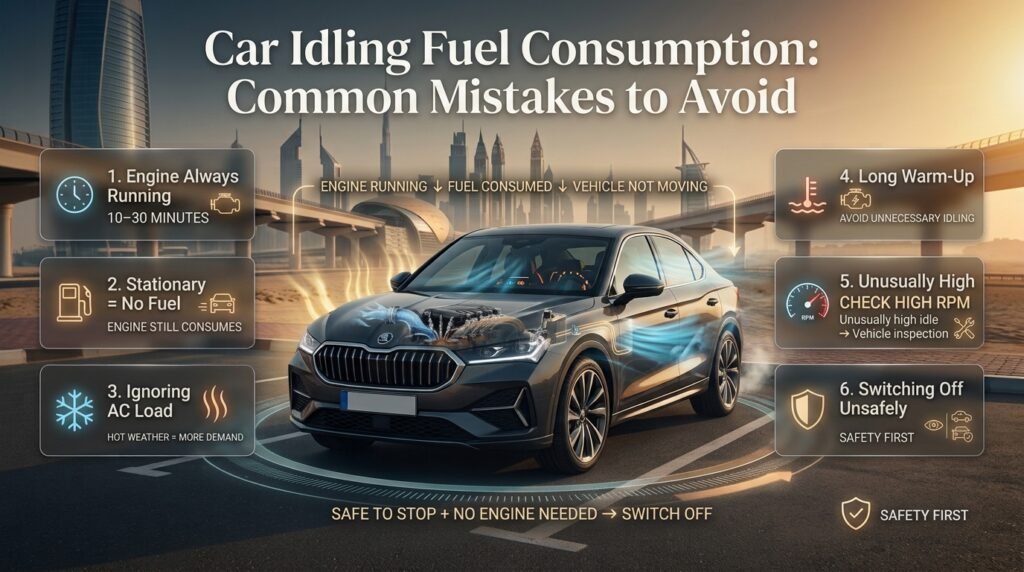
Mistake 1: Leaving the Engine Running Automatically
Some drivers develop a habit of keeping the engine running whenever they are inside the car.
They may sit for 10, 20, or 30 minutes simply because restarting feels inconvenient.
Why It Happens
The driver thinks of the car as being “ready” rather than actively consuming fuel.
Why It’s a Problem
The engine is still burning fuel.
Better Approach
If you’re safely parked and don’t need the engine, consider switching it off.
Mistake 2: Thinking a Stationary Engine Uses No Fuel
The car isn’t moving, but combustion is still occurring.
Better Approach
Remember:
Stationary doesn’t mean fuel-free.
Mistake 3: Ignoring AC Consumption
Drivers sometimes estimate idle fuel consumption without considering air-conditioning demand.
This can produce unrealistic expectations in Dubai.
Better Approach
Remember that AC load can increase fuel consumption, particularly in very hot conditions.
Mistake 4: Warming the Engine for Too Long
Long stationary warm-up periods are often unnecessary for modern vehicles.
Better Approach
Follow manufacturer guidance and drive gently after startup.
Mistake 5: Ignoring an Unusually High Idle
A vehicle that suddenly idles at a much higher RPM than normal may have an issue.
Better Approach
If high idle persists after the engine is warm, have the vehicle inspected.
Mistake 6: Switching Off in Unsafe Conditions
Fuel savings should never come before safety.
Better Approach
If climate control, visibility, traffic, security, or vehicle operation requires the engine to remain running, keep safety first.
Expert Advice for Reducing Idle Fuel Waste
Focus on Long Idle Periods First
Don’t start by worrying about every 30-second stop.
Instead, find the situations where your engine runs for 10, 20, or 30 minutes while the vehicle isn’t moving.
Those periods are usually easier to eliminate.
Track Your Behaviour
For one week, observe your idle habits.
Ask yourself:
- How often do I wait in the car?
- How long do I normally wait?
- Do I leave the AC running?
- Do I arrive early?
- Do I keep the engine running while parked?
Once you know the pattern, you can make practical changes.
Don’t Blame Idling for Every Fuel Problem
If your fuel economy suddenly gets worse, investigate the entire vehicle.
Consider:
- Tyre pressure
- Driving style
- Traffic
- AC use
- Vehicle load
- Maintenance
- Engine condition
- Fuel system
- Sensors
A sudden change is worth investigating.
Use Vehicle Technology
If your car has automatic stop-start technology, understand what it is designed to do.
Don’t assume that the engine shutting off at a stop means there is a fault.
Think About Total Fuel Consumption
The best fuel-saving strategy combines multiple small improvements.
Reducing unnecessary idling is useful.
But so are:
- Smooth acceleration
- Sensible braking
- Appropriate speed
- Correct tyre pressure
- Regular servicing
- Trip planning
- Reducing unnecessary vehicle load
For a broader guide, see Fuel-Efficient Driving Techniques.
Car Idling Fuel Consumption Comparison
| Driving or vehicle situation | Potential fuel effect | Practical approach |
|---|---|---|
| Brief traffic-light stop | Small | Follow normal traffic conditions |
| Long parking wait | Noticeable | Switch off if safe |
| 30-minute AC idle | Higher potential consumption | Avoid unnecessary waiting |
| Long warm-up idle | Unnecessary in many modern vehicles | Follow manufacturer advice |
| Rough high-RPM idle | May indicate a fault | Diagnose the cause |
| Smooth acceleration | Generally more efficient | Accelerate progressively |
| Aggressive acceleration | Higher fuel demand | Avoid unnecessary hard launches |
| Excessive speed | Can increase fuel consumption | Use sensible speeds |
| Low tyre pressure | Increases rolling resistance | Check pressure regularly |
| Heavy congestion | Increased fuel use | Anticipate traffic and reduce unnecessary changes |
A Practical Daily Routine for Better Fuel Economy
Fuel-saving doesn’t need to become complicated.
Before Starting
Avoid unnecessary stationary warm-up.
Check that the vehicle is ready to drive safely.
During the Journey
Look ahead.
Maintain a sensible following distance.
Accelerate smoothly.
Avoid unnecessary braking.
Use sensible speeds.
During Stops
Ask whether the stop is unavoidable.
If you’re safely parked and expect a longer wait, consider switching off.
At the Destination
Don’t leave the engine running while you complete tasks around the vehicle unless there is a genuine reason.
Small changes become useful when repeated consistently.
Is It Better to Turn Off the Engine During a Traffic Jam?
Not always.
A traffic jam can change from stationary to moving very quickly.
If you’re in a congested road environment, follow traffic conditions and remain prepared to move.
If the vehicle has automatic stop-start technology, the system can manage suitable stationary periods automatically.
If you’re completely stationary for a prolonged period and conditions clearly allow the engine to be switched off, doing so can prevent fuel consumption.
But don’t create a safety problem just to save fuel.
The correct approach depends on the situation.
Can Idling Cause Carbon Deposits?
Prolonged low-load operation can contribute to deposits under certain circumstances, particularly in some engine designs.
Diesel engines and their emissions systems can be especially relevant because they may require particular temperature and load conditions for proper operation.
However, it would be inaccurate to say that every period of idling automatically causes carbon buildup.
The practical recommendation is much simpler:
Avoid unnecessary prolonged idling and maintain the vehicle according to the manufacturer’s recommendations.
If the engine develops rough running, smoke, warning lights, or unusual performance, get it checked.
How Idling Affects Exhaust Emissions
A running internal-combustion engine produces exhaust emissions while idling.
The vehicle doesn’t need to move for combustion to occur.
This means unnecessary idling produces emissions without providing useful transportation distance.
Reducing unnecessary idling can therefore have two benefits:
- Less wasted fuel
- Less unnecessary exhaust production
This is one reason modern vehicles increasingly use automatic engine stop-start systems.
Does Turning Off the Engine Save Money?
Yes, if the engine would otherwise continue consuming fuel unnecessarily.
The amount depends on:
- Idle fuel consumption
- Fuel price
- Idle duration
- Frequency
Suppose your car uses 0.8 litres per hour at idle.
If you avoid 30 minutes of unnecessary idling:
0.8 × 0.5 = 0.4 litres saved
Do that regularly, and the savings accumulate.
The key isn’t the size of one individual saving.
It’s the repetition.
Small fuel losses become meaningful when they happen every day.
When Should You Keep the Engine Running?
Fuel-saving advice should never be absolute.
There are situations where keeping the engine running is the sensible choice.
For example:
- You’re actively driving in traffic.
- You need immediate movement.
- You’re in extreme heat and need climate control.
- You’re in an unsafe location.
- Vehicle operation requires the engine.
- You need the vehicle’s systems to remain active.
The goal isn’t:
“Turn the engine off whenever possible.”
The better rule is:
“Keep the engine running when necessary, and switch it off when you’re safely parked and don’t need it.”
That approach is safer and more practical.
How Traffic and Idling Work Together
Traffic is one of the biggest reasons drivers experience frequent idling.
Urban congestion can create a pattern of:
Stop → Idle → Move → Accelerate → Brake → Stop → Idle
Every part of this cycle affects fuel economy.
The longer the vehicle remains stationary, the more fuel is consumed without movement.
The harder the vehicle accelerates between stops, the more fuel is demanded.
The harder it brakes afterward, the more energy is lost.
This is why traffic management and driving technique are closely connected.
For a complete explanation of congestion-related fuel use, read How Traffic Affects Fuel Economy in Dubai.
How Fuel-Efficient Driving Techniques Reduce Overall Waste
Reducing idle time should be part of a wider driving strategy.
A fuel-efficient driver generally tries to avoid unnecessary energy use throughout the journey.
That includes:
- Avoiding excessive idling
- Accelerating smoothly
- Maintaining steady speeds
- Anticipating traffic
- Avoiding unnecessary braking
- Keeping tyres properly inflated
- Maintaining the engine
- Avoiding excessive vehicle load
For a complete overview, Fuel-Efficient Driving Techniques can help connect these individual habits into one practical strategy.
How Much Fuel Does a Car Use While Idling?
A car can consume a noticeable amount of fuel even when it isn’t moving. The U.S. Department of Energy notes that idling can typically use around 0.25–0.5 gallons of fuel per hour—roughly 0.95–1.9 litres per hour—depending on the vehicle and accessories being used. Actual consumption varies with engine size, temperature, air conditioning, electrical loads, and vehicle condition.
For example, if a vehicle uses 1 litre per hour while idling, leaving it running for 30 minutes consumes approximately 0.5 litres without covering any distance. One isolated incident isn’t a major concern, but repeated waiting can turn into a meaningful amount of wasted fuel over a month.
Important factors that affect idle fuel consumption:
Engine size and design
Petrol or diesel engine
Air-conditioning demand
Outside temperature
Electrical accessories
Idle RPM
Vehicle maintenance
Engine operating temperature
Professional tip: Don’t rely on one universal “litres per hour” number for every car. If you want a realistic estimate, check your vehicle’s fuel-use data or calculate consumption based on a controlled measurement.
Does Running the AC While Idling Use More Fuel?
Yes, and this is particularly relevant in hot climates such as Dubai. In a conventional vehicle, the air-conditioning system places additional load on the engine, especially when the compressor is working hard to remove heat from the cabin. The Department of Energy specifically notes that idling fuel consumption varies with heat, air conditioning, and other accessories.
This is why sitting in a parked car with the AC running for 20 or 30 minutes isn’t the same as simply having the engine running with minimal accessory demand. When temperatures are extremely high, the cooling system may have to work harder to maintain the desired cabin temperature.
That doesn’t mean you should avoid using AC when you’re driving or when you need it for comfort and safety. The better approach is to reduce unnecessary stationary waiting.
For example:
Waiting 2 minutes at a normal stop → relatively small fuel impact
Waiting 20–30 minutes in a parked car → much more avoidable fuel use
Leaving the engine running for an hour → potentially significant fuel waste
Professional tip: If you’re safely parked and expect a long wait, switching the engine off is generally more effective than trying to minimise AC use while continuing to idle.
Is It Better to Turn Off the Engine or Leave It Idling?
For a vehicle that is safely parked and doesn’t need to remain running, switching the engine off eliminates the fuel being consumed during that idle period. Modern vehicle guidance increasingly supports reducing unnecessary idling, and stop-start systems are specifically designed to shut the engine down during suitable stationary periods.
The important part is understanding the difference between necessary stops and unnecessary stops.
You don’t need to become obsessed with turning the engine off at every brief traffic light. In moving traffic, you should remain focused on safety and traffic conditions. But if you’re parked outside a shop waiting for someone for 20 minutes, keeping the engine running simply to maintain cabin comfort can consume fuel without providing any transportation benefit.
The Department of Energy also reports that, under its cited conditions, even relatively short idling can use more fuel than stopping and restarting.
A practical rule is:
Short traffic stop: Follow normal driving conditions.
Heavy traffic: Don’t switch off unless the situation clearly allows it.
Long stationary wait: Consider switching off if safe.
Parked at your destination: Turn the engine off rather than leaving it running unnecessarily.
Expert tip: Don’t use an arbitrary “one-minute rule” as if it applies perfectly to every vehicle. Modern cars, hybrids, stop-start systems, battery condition, AC demand, and driving conditions can all change the calculation.
Does Idling Damage a Car Engine?
Normal idling is a standard operating condition, so a healthy engine isn’t automatically being damaged every time it sits at idle. The bigger concern is unnecessary prolonged idling, particularly when it becomes a daily habit. Excessive idle time increases engine operating hours while producing no useful travelling distance, and the Department of Energy identifies unnecessary idling as a source of wasted fuel and excess engine wear.
There’s also an important distinction between occasional idling and a vehicle that spends a large part of its operating life stationary. A taxi, delivery vehicle, fleet car, or vehicle regularly used for long waiting periods can accumulate far more idle hours than an ordinary commuter.
If your engine is idling normally, there’s usually no reason to panic. However, unusual idle behaviour deserves attention.
Watch for signs such as:
Unstable or unusually high RPM
Engine shaking
Frequent stalling
Rough running
Unusual exhaust smoke
Strong fuel smell
Check-engine warning
Sudden deterioration in fuel economy
These symptoms may point to a mechanical or electronic issue rather than ordinary fuel consumption.
Professional advice: Don’t try to solve an unusual idle by simply driving differently. If the engine suddenly starts idling poorly, have the vehicle diagnosed. A fuel-efficiency problem can sometimes be an early sign of a maintenance issue.
How Can I Reduce Fuel Consumption While My Car Is Idling?
The most effective strategy is surprisingly simple: reduce unnecessary time with the engine running while the vehicle is stationary. The Department of Energy recommends idle-reduction practices for personal vehicles because unnecessary idling wastes fuel and contributes to emissions.
Start by looking at your everyday routine rather than trying to change everything at once.
If you regularly:
Wait for passengers with the engine running
Sit in parking areas with the AC on
Arrive early and remain inside the car
Wait in long drive-through queues
Leave the engine running while doing a quick task
Spend extended periods stationary in non-moving traffic
you may have several easy opportunities to reduce fuel waste.
A practical fuel-saving routine
1. Identify your longest idle periods.
Don’t worry about every few seconds. Find the situations where you’re stationary for 10, 20, or 30 minutes.
2. Switch off when safely parked.
If you don’t need the engine and you’re in a safe location, there’s little benefit in continuing to burn fuel.
3. Don’t over-warm modern vehicles.
For most modern cars, prolonged stationary warm-up isn’t necessary under normal conditions. Follow the manufacturer’s instructions and drive gently after starting.
4. Maintain the vehicle properly.
Correct tyre pressure, appropriate engine oil, and a healthy engine help support efficient operation. The Department of Energy notes that properly inflated tyres and the manufacturer’s recommended oil can improve fuel economy.
5. Look beyond idling.
Fuel efficiency also depends on acceleration, braking, speed, traffic, tyre pressure, vehicle load, and maintenance.
Expert tip: The biggest savings usually come from changing a repeated habit. Saving a small amount once isn’t impressive; eliminating unnecessary idling every day can make the difference noticeable over weeks and months.
The Bottom Line
The goal isn’t to eliminate every second of idling. That’s unrealistic.
The smarter approach is to recognise when the engine is running without a genuine need and eliminate those longer periods. When combined with smoother driving and proper vehicle maintenance, reducing unnecessary idle time can become a simple and practical way to improve overall fuel economy.
Conclusion
Car idling fuel consumption is easy to overlook because the vehicle isn’t moving, but the engine is still burning fuel every minute it remains running. Whether you’re waiting for a passenger, sitting outside a shop, or keeping the AC running while parked, those small periods can add up when they become part of your daily routine.
The key isn’t to switch the engine off at every short stop. Normal traffic, brief signals, and unavoidable congestion are part of everyday driving. Instead, focus on unnecessary prolonged idling. If you’re safely parked and expect to wait for a longer period, turning the engine off can prevent fuel from being consumed without providing any useful distance.
For Dubai drivers, air conditioning deserves particular attention because hot weather can increase the load placed on the engine while idling. You shouldn’t compromise comfort or safety in extreme temperatures, but avoiding unnecessary stationary waiting can still reduce wasted fuel.
A better fuel-efficiency strategy combines several simple habits:
- Reduce unnecessary idle time.
- Avoid prolonged warm-up idling.
- Use the AC sensibly.
- Maintain correct tyre pressure.
- Keep the engine properly serviced.
- Accelerate smoothly.
- Avoid unnecessary hard braking.
- Maintain sensible driving speeds.
- Pay attention to traffic conditions.
- Investigate sudden changes in fuel consumption.
Ultimately, fuel efficiency isn’t about one perfect driving trick. It’s about eliminating small sources of waste consistently. When you reduce unnecessary idling and combine it with efficient driving and proper vehicle maintenance, you can make better use of every litre of fuel while reducing unnecessary engine operation and emissions.
For more practical guidance, explore Fuel Delivery Dubai and the related fuel-efficiency resources throughout this guide.
Leave a Reply