Introduction
What to Do When Fuel Runs Out on a Highway | Running out of fuel on a highway can turn an ordinary journey into a stressful roadside emergency within minutes. You may notice the fuel warning light, watch the estimated range fall, and think you can reach the next petrol station. But traffic, road closures, unexpected delays, or a longer-than-expected route can quickly change the situation.
If your vehicle actually runs out of petrol or diesel, the most important thing is not to panic and not to put yourself in danger trying to find fuel. Your first priority should be getting the vehicle into the safest practical position and protecting yourself, your passengers, and other road users.
For drivers in Dubai, Fuel Delivery Dubai can be a useful resource when a vehicle cannot safely reach a petrol station and fuel needs to be brought to the vehicle.
This guide explains exactly what to do when fuel runs out on a highway, including what to do while the engine is losing power, how to position your vehicle, how to communicate your location, whether you should leave the car, what mistakes to avoid, how fuel delivery works, and how to prevent the same situation on your next long-distance journey.
What Should You Do When Your Car Runs Out of Fuel on a Highway?
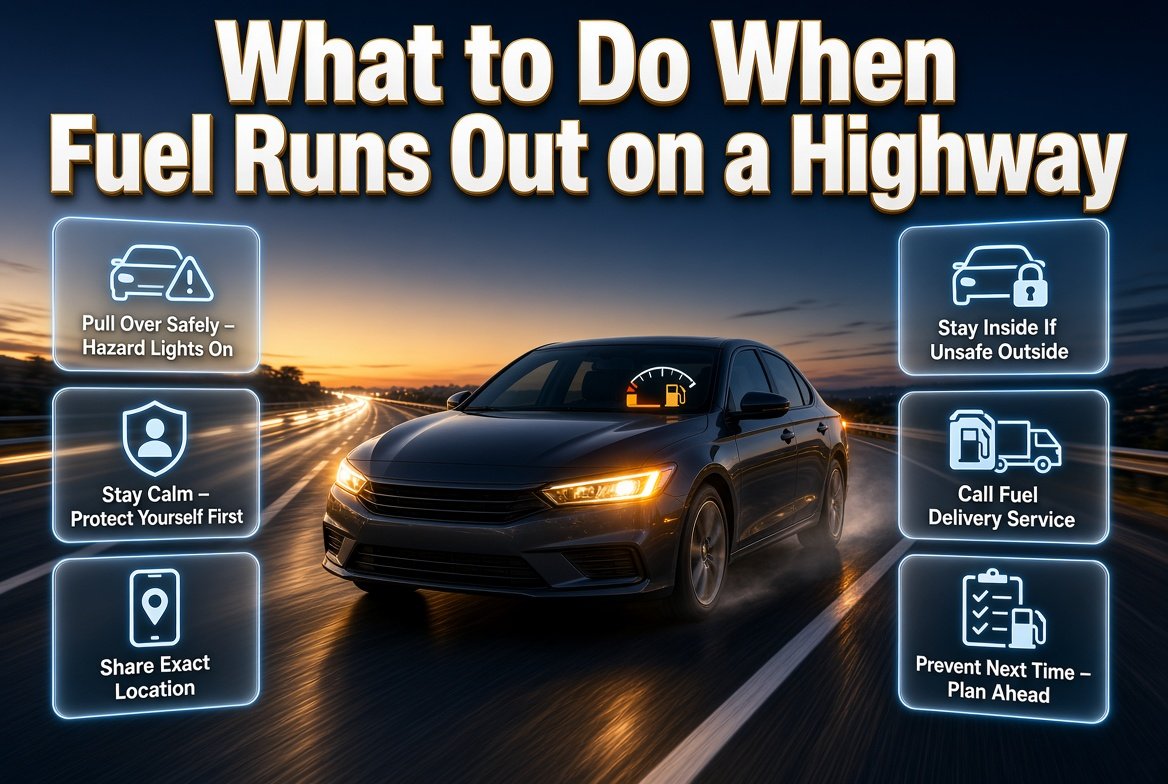
If your car runs out of fuel on a highway, keep control of the vehicle, move toward the safest available location if you can do so safely, activate the hazard warning lights, and arrange appropriate roadside assistance or fuel delivery. Don’t walk along the highway or make dangerous lane changes simply to reach a petrol station.
The basic sequence is:
- Stay calm.
- Keep control of the vehicle.
- Use the remaining momentum safely.
- Move away from active traffic if possible.
- Switch on hazard warning lights.
- Stop in the safest practical position.
- Identify your exact location.
- Contact fuel delivery or roadside assistance.
- Tell the provider whether you need petrol or diesel.
- Wait in the safest available place.
The correct response can change depending on whether your car has completely stopped, is still moving, or has stopped in an active traffic lane.
Why Is Running Out of Fuel on a Highway Dangerous?
Running out of fuel isn’t necessarily dangerous because the fuel itself has disappeared. The greater danger is what happens when a vehicle becomes unexpectedly stationary around moving traffic.
A highway is designed for continuous traffic flow. Vehicles may be travelling at relatively high speeds, and drivers behind you may not expect a stationary vehicle ahead.
A stranded vehicle can therefore become a collision hazard.
The risk can be greater when:
- Traffic is heavy
- Visibility is poor
- It’s dark
- The highway has narrow shoulders
- Large trucks are nearby
- The vehicle stops around a bend
- The vehicle remains in a live lane
- Drivers are changing lanes frequently
- Weather conditions reduce visibility
This is why a fuel emergency should be treated as a roadside safety problem first and a fuel problem second.
Your goal isn’t simply to obtain petrol.
Your goal is to make the situation safe enough for professional help to reach you.
What Should You Do When the Engine Starts Losing Power?
When a vehicle runs out of fuel, the engine may begin to lose power rather than stopping instantly.
You may notice:
- The engine hesitates
- Acceleration becomes weak
- The engine begins to sputter
- The vehicle struggles to maintain speed
- The engine eventually stops
Don’t panic when this happens.
Keep both hands on the steering wheel and maintain predictable control.
If the vehicle still has momentum, use that momentum to move toward the safest practical location.
Don’t suddenly cross several lanes just because you see a shoulder or exit.
A safe, controlled manoeuvre is more important than reaching the nearest possible stopping point.
💡 Pro Tip: When the engine begins losing power, use the remaining momentum to improve your position rather than wasting it on repeated attempts to restart the engine.
Step 1: Move Toward a Safe Location
If your vehicle is still moving, look for a location that separates you from active traffic.
Depending on the highway, this could be:
- A suitable shoulder
- A designated emergency stopping area
- A safe lay-by
- A nearby area clearly separated from moving traffic
- Another appropriate location identified by road authorities
However, don’t make an aggressive manoeuvre simply to get off the road.
For example, if your car is in a middle lane and reaching the shoulder requires crossing several lanes of fast-moving traffic, attempting that manoeuvre could create more danger.
The safest reachable location is more important than the ideal location.
Step 2: Turn on Your Hazard Warning Lights
Hazard warning lights help communicate that your vehicle is experiencing a problem.
Use them appropriately when the vehicle is stopped or moving unusually slowly because of the fuel emergency.
They are particularly important when:
- Traffic is approaching from behind
- Your vehicle is stopped
- Visibility is reduced
- You are positioned near moving traffic
- Other drivers need additional warning
Remember that hazard lights don’t make a dangerous position safe.
They simply make other drivers more aware that something is wrong.
Step 3: Stop the Vehicle Safely
Once you reach the safest practical location, stop the vehicle.
Apply the parking brake and select the appropriate transmission position.
If your vehicle has an automatic transmission, select Park once the vehicle has come to a complete stop.
Don’t leave the vehicle rolling.
Don’t leave it in a position where it can unexpectedly move toward traffic.
Once stopped, focus on the next priority: getting help.
For additional guidance about dealing with a fuel-related roadside stop, see Running Out of Fuel on the Road.
Step 4: Don’t Keep Restarting an Empty-Fuel Vehicle
One common reaction is to keep turning the key or pressing the start button.
If the tank is genuinely empty, repeated starting attempts won’t create fuel.
They can instead drain the vehicle’s battery.
Once you’ve confirmed that fuel is the problem, stop unnecessary starting attempts and arrange assistance.
If the vehicle later receives the correct fuel but still won’t start, the issue may be something else and professional diagnosis may be required.
Step 5: Identify Your Exact Location
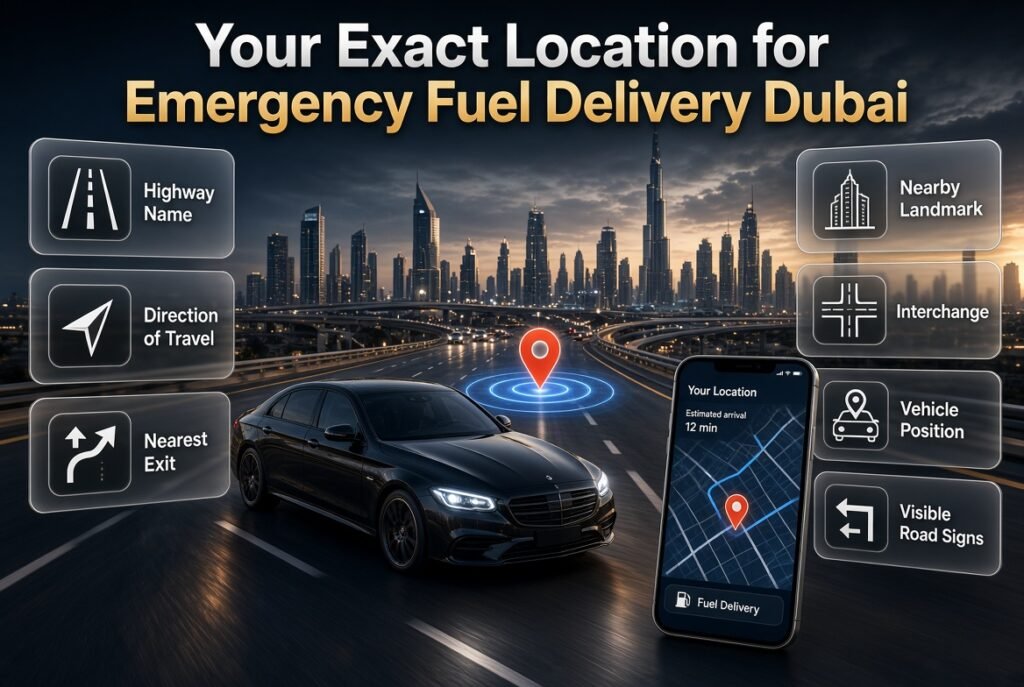
Accurate location information is one of the most useful things you can provide to roadside assistance.
Don’t simply say:
“I’m on Sheikh Zayed Road.”
A long highway can contain many exits, interchanges, ramps, bridges, and service roads.
Instead, provide as much useful information as possible.
Try to identify:
- Highway name
- Direction of travel
- Nearest exit
- Exit number
- Nearby landmark
- Interchange
- Road marker
- Vehicle position
- Shoulder side
- Nearby visible signs
For example:
“I’m travelling toward Abu Dhabi on Sheikh Zayed Road, near the Dubai Internet City area, stopped on the right shoulder.”
That’s far more useful than simply saying you’re somewhere on Sheikh Zayed Road.
How Can You Share Your Location With Fuel Delivery?
Use your navigation application to identify your current position.
When contacting assistance, explain:
Road + direction + landmark + nearest exit + vehicle position
If you can safely provide a map location or pin, that can make the meeting point even clearer.
If you’re unsure about the exact location, don’t guess.
Tell the provider what you can actually see.
A road sign, interchange, building, bridge, or exit number may be enough to help identify the area.
📌 Quick Tip: If you can’t identify a road marker, give your direction of travel and the nearest visible landmark instead.
Step 6: Contact Fuel Delivery or Roadside Assistance
Once your vehicle is in a reasonably safe position, contact an appropriate assistance provider.
If the problem is simply an empty tank, fuel delivery can be particularly convenient because you don’t need to walk to a petrol station.
For additional safety guidance, see Emergency Roadside Fuel Advice.
When requesting fuel assistance, provide:
- Your location
- Direction of travel
- Vehicle make and model
- Fuel type
- Approximate amount of fuel required
- Whether the vehicle is on a shoulder
- Any access restrictions
- Whether the vehicle is safely reachable
The more accurate the information, the easier it is to coordinate assistance.
What Fuel Type Does Your Vehicle Need?
Before fuel is delivered, confirm whether the vehicle uses petrol or diesel.
These fuels are not interchangeable.
If you’re uncertain, check:
- Fuel filler label
- Owner’s manual
- Vehicle documentation
- Manufacturer information
- Dashboard information
Don’t guess based on the vehicle’s appearance.
A wrong-fuel situation can create a more serious mechanical problem.
If you’ve accidentally added the wrong fuel, don’t continue driving until you receive appropriate professional guidance.
Should You Stay Inside Your Car After Running Out of Fuel?
There’s no single answer that applies to every highway emergency.
Your decision depends on where the vehicle is stopped and what surrounds it.
Consider:
- Is the vehicle completely away from traffic?
- Is it on a narrow shoulder?
- Are vehicles passing close to you?
- Is there a physical barrier?
- Is the area illuminated?
- Is there a safe location away from traffic?
- Are weather conditions making it dangerous to remain outside?
If the vehicle is safely positioned away from moving traffic, staying inside with the doors secured may be preferable to standing beside the road.
If the vehicle is in a dangerous position, follow instructions from appropriate emergency or roadside personnel.
The important point is not to leave the vehicle automatically just because you’re waiting for fuel.
What Should You Never Do After Running Out of Fuel?
Several actions that seem helpful can actually increase your risk.
Don’t Walk Along the Highway
A petrol station may look close, but that doesn’t mean it is safely accessible on foot.
There may be:
- Barriers
- Ramps
- High-speed traffic
- Restricted pedestrian areas
- Service roads
- Multiple carriageways
Walking beside moving traffic exposes you to unnecessary danger.
Arrange assistance instead.
Don’t Push the Vehicle Through Active Traffic
Never push a vehicle across multiple highway lanes just to reach an exit or shoulder.
The vehicle may be heavy, difficult to control, and unpredictable to approaching drivers.
Your body is also exposed while you’re pushing it.
If the car can’t be moved safely, professional assistance is the better option.
Don’t Make a Sudden Lane Change
Seeing a shoulder ahead doesn’t mean you should immediately cross traffic to reach it.
Check the surrounding traffic.
If the manoeuvre cannot be completed safely, don’t force it.
Don’t Stand Directly Behind the Vehicle
A stationary car can be difficult for approaching drivers to judge.
Standing behind it adds another unnecessary hazard.
If you need to exit the vehicle, choose the safest available location based on the actual road environment.
What If Your Car Stops in a Live Traffic Lane?
This is one of the most serious situations.
If the vehicle stops in an active lane:
- Keep control of the vehicle.
- Activate hazard warning lights.
- If possible, move toward a safer position without creating another hazard.
- Contact appropriate emergency or roadside assistance.
- Clearly communicate your exact location.
- Follow instructions from road authorities or emergency personnel.
Don’t try to solve the fuel problem before addressing the immediate traffic danger.
The priority is to reduce the possibility of a collision.
For a more detailed breakdown of this type of situation, see Highway Fuel Emergency Safety in Dubai.
How Much Information Should You Give the Assistance Provider?
Good communication can save time.
A useful message might look like this:
Road: Sheikh Zayed Road
Direction: Abu Dhabi
Location: Near a major interchange
Position: Right shoulder
Vehicle: Sedan
Fuel: Petrol
Problem: Tank empty
This tells the provider almost everything they need to understand the basic situation.
If your vehicle is difficult to see, mention a nearby landmark or visible sign.
What If You Don’t Know Your Exact Highway Location?
Don’t worry and don’t invent an answer.
Open your navigation application.
Look for:
- Current position
- Road name
- Direction
- Exit
- Landmark
- Coordinates or map pin
If you can safely identify a sign, read it carefully.
You can also tell the assistance provider what you see around you.
For example:
“I’m travelling toward Abu Dhabi. I can see a large interchange ahead and my vehicle is stopped on the right shoulder.”
That can be much more useful than guessing an exit number.
How Does Fuel Delivery Help During a Highway Emergency?
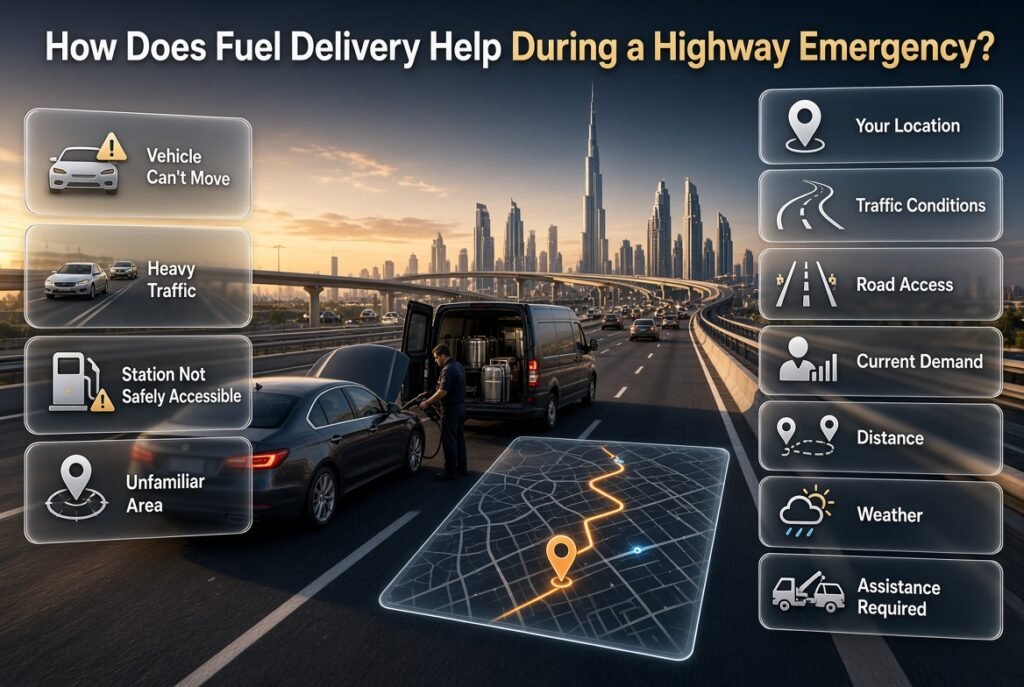
Mobile fuel delivery is designed to bring the required fuel to the vehicle rather than requiring the driver to reach a petrol station.
This can be particularly useful when:
- The vehicle can’t move
- The nearest petrol station isn’t safely accessible
- Traffic is heavy
- You don’t want to walk beside the highway
- The vehicle is stopped on a suitable roadside location
- You’re unfamiliar with the area
If you need broader guidance, see What to Do When Your Car Runs Out of Fuel.
How Long Does It Take to Receive Fuel Assistance?
Response times can vary.
Factors include:
- Your location
- Traffic conditions
- Road access
- Current demand
- Distance from the service vehicle
- Weather
- Exact assistance requirements
Don’t assume assistance will arrive instantly.
While waiting, keep monitoring your surroundings.
If your position becomes unsafe, communicate that change to the assistance provider or relevant emergency service.
What If You’re Stranded in Dubai During Extreme Heat?
A highway fuel emergency can be especially uncomfortable during Dubai’s hot weather.
A stationary vehicle may expose occupants to significant heat if the engine and air conditioning cannot continue operating normally.
If you’re waiting for assistance:
- Keep drinking water available.
- Avoid unnecessary exposure to direct sunlight.
- Don’t stand close to active traffic.
- Follow appropriate safety instructions.
- Keep your phone available for communication.
- Monitor your vehicle and surroundings.
This is another reason why walking several kilometres to a petrol station is usually a poor solution.
Can Air Conditioning Affect Fuel Consumption?
Yes, air conditioning can contribute to fuel consumption.
In Dubai, drivers often depend heavily on AC because of the hot climate.
This doesn’t mean you should turn the AC off simply to squeeze a few extra kilometres from an almost empty tank if doing so creates uncomfortable or unsafe conditions.
Instead, plan fuel stops before the tank becomes critically low.
For more detailed information, see Air Conditioning and Fuel Consumption.
Why Does Traffic Make a Low-Fuel Situation Worse?
Imagine your dashboard says you have approximately 40 or 50 kilometres of estimated range remaining.
Under ideal conditions, you might think that is enough.
Then traffic becomes congested.
The vehicle repeatedly accelerates and brakes.
The journey takes much longer.
Your fuel consumption changes.
The petrol station that looked comfortably reachable may no longer be a safe target.
This is why remaining range should be treated as an estimate, not a guarantee.
For more information, see How Traffic Affects Fuel Economy in Dubai.
How Can You Prevent Running Out of Fuel in Traffic?
The easiest solution is not allowing the fuel level to become critical in the first place.
If you’re entering a long traffic-heavy journey and the fuel level is already low, refuelling before the journey is usually the sensible choice.
You can also improve efficiency by avoiding unnecessary acceleration and braking.
See How to Reduce Fuel Use in Traffic and Stop-and-Go Driving Fuel Efficiency for practical fuel-saving guidance.
How Does Driving Style Affect Your Fuel Reserve?
Aggressive acceleration can consume more fuel than smooth, controlled driving.
Repeatedly accelerating hard and then braking wastes energy.
A smoother approach can help make better use of the fuel already in the tank.
Useful habits include:
- Accelerating progressively
- Maintaining a steady speed where practical
- Anticipating traffic
- Avoiding unnecessary braking
- Maintaining appropriate tire pressure
- Removing unnecessary weight
For more guidance, see Fuel-Efficient Driving Techniques and Smooth Driving Techniques for Better Fuel Economy.
Why Does Highway Speed Affect Fuel Consumption?
At highway speeds, aerodynamic resistance becomes increasingly important.
As speed increases, the engine generally has to overcome greater aerodynamic resistance.
This means very high-speed driving can consume fuel considerably faster than a moderate, steady driving pattern.
For long journeys, maintaining a sensible speed within posted limits can help improve efficiency.
See How Highway Speed Affects Fuel Consumption for a deeper explanation.
Drivers can also review Optimal Driving Speed for Fuel Efficiency in Dubai when planning longer journeys.
Can Tire Pressure Contribute to Higher Fuel Consumption?
Yes.
Underinflated tires can increase rolling resistance, which means the vehicle may require more energy to move.
Before a long highway trip, check your tires according to the vehicle manufacturer’s recommended pressure.
Don’t use a generic pressure value simply because another car uses it.
Correct tire pressure is also important for handling and tire performance.
Read Tire Pressure and Fuel Efficiency for additional information.
Does Vehicle Weight Affect Fuel Consumption?
Yes.
A heavily loaded vehicle generally needs more energy to accelerate and move.
You don’t need to remove useful equipment from your car, but unnecessary items don’t need to stay in the vehicle indefinitely.
Before a long journey, remove items you don’t need.
For additional information, see How Vehicle Weight Affects Fuel Economy and Car Load and Fuel Consumption.
Can Roof Racks Increase Fuel Consumption?
Roof racks, cargo boxes, and other external equipment can increase aerodynamic drag.
The effect can become more noticeable at highway speeds.
If you’re not using a roof rack, removing it may reduce unnecessary aerodynamic resistance.
If you regularly travel with roof-mounted equipment, include its effect when planning long-distance fuel requirements.
See Roof Racks and Fuel Economy for more detail.
What Should You Do If You Run Out of Fuel at Night?
A night-time fuel emergency requires additional caution because visibility is lower.
Make the vehicle visible.
Use hazard warning lights appropriately.
Avoid standing close to moving traffic.
Keep your phone charged and accessible.
Give assistance a clear location.
If you’re on a highway, don’t assume that darkness makes the shoulder a safe place to walk.
For broader guidance, see Roadside Breakdown Safety Tips in Dubai.
What If Your Vehicle Runs Out of Fuel During Bad Weather?
Rain or reduced visibility can make roadside conditions more difficult.
If your vehicle stops during poor weather:
- Stay calm.
- Make the vehicle visible.
- Avoid unnecessary movement around traffic.
- Communicate your exact location.
- Follow professional instructions.
- Don’t walk along the highway looking for fuel.
If you want more information about handling different roadside emergencies, see Roadside Vehicle Emergency Precautions.
What If You Run Out of Fuel in Heavy Highway Traffic?
Heavy traffic creates a difficult environment because vehicles may pass close to the stranded car.
Don’t assume slow-moving traffic makes it safe to walk between vehicles.
It doesn’t.
If you can safely move the car away from the traffic flow, do so.
Otherwise, make the vehicle visible and seek professional assistance.
The same principle applies whether traffic is moving at 100 km/h or crawling through congestion:
Don’t expose yourself unnecessarily to moving vehicles.
What If You Run Out of Fuel on a Long-Distance Journey?
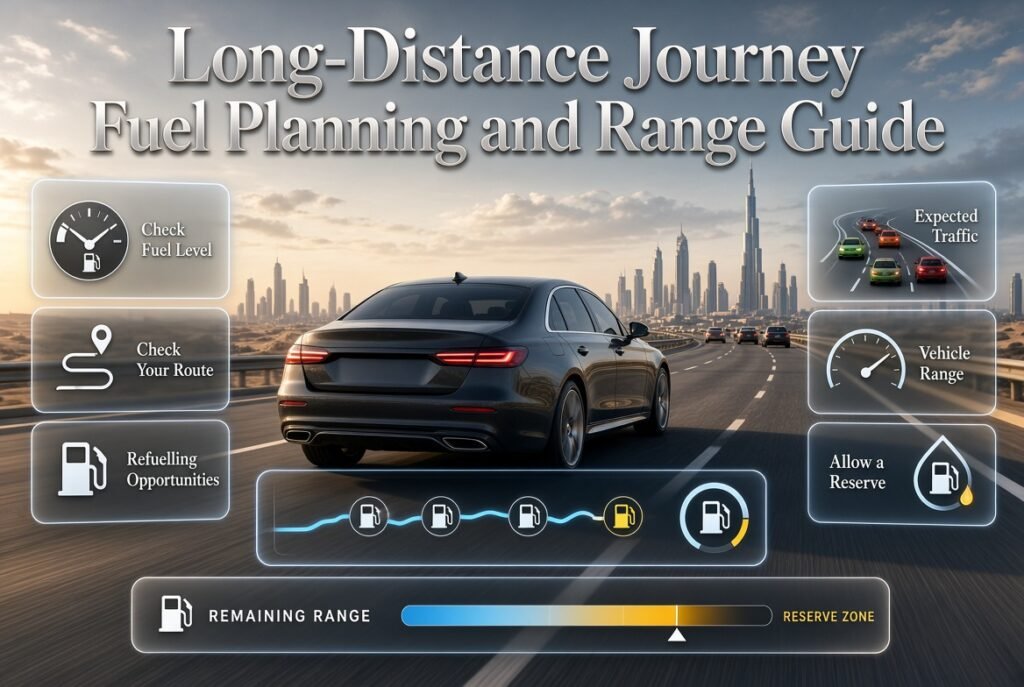
Long-distance driving requires more fuel planning than a short city journey.
Before leaving:
- Check your fuel level.
- Check the expected route.
- Identify major refuelling opportunities.
- Consider expected traffic.
- Check your vehicle’s estimated range.
- Allow a reasonable reserve.
Don’t plan a journey based on the assumption that you will use every last kilometre shown on the fuel-range display.
Unexpected traffic, detours, weather and road conditions can all change your consumption.
For additional planning guidance, see Improving Fuel Economy on Long Trips and Long-Distance Driving Fuel Efficiency Tips.
A Realistic Example of a Highway Fuel Emergency
Imagine you’re driving from Dubai toward Abu Dhabi.
Your fuel warning light has already appeared, but the dashboard estimates that you still have enough range to continue.
Traffic becomes heavier.
Your journey takes longer than expected.
Eventually, the engine begins to lose power.
Instead of suddenly crossing multiple lanes to reach a petrol station, you keep control of the vehicle and move toward the safest available stopping position.
You switch on the hazard warning lights.
Once stopped, you identify:
- Road
- Direction
- Nearest interchange
- Vehicle position
- Vehicle model
- Fuel type
You contact fuel assistance.
Rather than walking along the highway, you wait in the safest available location and provide the service provider with clear information.
That’s the correct mindset:
Control first. Safety second. Assistance third. Fuel fourth.
Common Mistakes Drivers Make When They Run Out of Fuel
1. Ignoring the Fuel Warning
Some drivers continue driving because they believe they still have plenty of range.
The problem is that the displayed range is only an estimate.
Better approach
Treat the low-fuel warning as a reminder to refuel rather than an invitation to see how far the car can go.
2. Trying to Reach a Petrol Station at Any Cost
A driver may see a station on the navigation screen and decide to reach it regardless of traffic.
Why it’s dangerous
A sudden lane change or unsafe shoulder manoeuvre can create a collision.
Better approach
If reaching the station requires an unsafe manoeuvre, stop and request assistance.
3. Walking Along the Highway
This often happens because the driver thinks the station is “only a few minutes away.”
Why it’s dangerous
The pedestrian is exposed to high-speed traffic and may encounter barriers or restricted areas.
Better approach
Have fuel brought to the vehicle.
4. Pushing the Vehicle
Drivers sometimes think pushing the car will solve the problem.
Why it’s dangerous
The driver and passengers become pedestrians in an active traffic environment.
Better approach
Don’t push the vehicle through live traffic.
5. Repeatedly Starting the Engine
Why it happens
The driver hopes another attempt will somehow get the vehicle moving.
Why it’s unhelpful
It can drain the battery.
Better approach
Once the tank is confirmed empty, arrange fuel.
6. Giving an Incomplete Location
Example
“I’m somewhere on Sheikh Zayed Road.”
Better approach
Provide direction, landmark, exit and position.
7. Guessing the Fuel Type
Why it’s dangerous
Petrol and diesel are different fuels.
Better approach
Verify before fuel is added.
What Should You Keep in Your Vehicle for a Highway Emergency?
A basic emergency kit can make unexpected roadside situations easier to manage.
Consider carrying:
- Drinking water
- Phone charging cable
- Power bank
- Basic first-aid supplies
- Vehicle documents
- Emergency contact information
- Tire-pressure information
- Manufacturer roadside-assistance details
- Appropriate safety equipment
You don’t need to fill your car with unnecessary equipment.
The most valuable preparation is knowing what to do and having a reliable way to communicate.
How Can You Prevent Running Out of Fuel on the Highway?
Prevention is easier than roadside recovery.
Refuel Before the Tank Becomes Critically Low
Don’t wait until the final part of the fuel gauge.
If you’re beginning a long journey, refuel beforehand.
Know Where You Can Refuel
Before a long journey, identify practical refuelling opportunities along your route.
This becomes particularly useful when travelling between cities or emirates.
Monitor Traffic
If congestion is building, reconsider whether your remaining fuel range provides enough margin.
Don’t Rely Entirely on the Range Display
Treat the displayed range as an estimate.
Actual consumption can change.
Maintain Your Vehicle
A vehicle that’s properly maintained is generally easier to plan and operate efficiently.
Problems with tires, engine operation, or other components can affect consumption and reliability.
What If Fuel Is Added but the Car Still Won’t Start?
If the correct fuel has been added and the engine still doesn’t start, don’t assume you simply need more fuel.
Possible causes include:
- Weak battery
- Fuel-system issue
- Electrical fault
- Mechanical failure
- Wrong fuel
- Another unrelated vehicle problem
At that point, professional roadside or mechanical assistance may be necessary.
Don’t continue making repeated starting attempts.
What If the Car Stops Because the Fuel Tank Is Completely Empty?
A completely empty tank doesn’t necessarily mean the vehicle has suffered major damage.
However, the situation should still be handled properly.
Stop unnecessary attempts to start the engine.
Make the vehicle safe.
Arrange the correct fuel.
Once fuel is added, follow the vehicle manufacturer’s normal starting procedure.
If the vehicle doesn’t restart, request further assistance.
For a more focused guide, see Car Stops Due to Empty Fuel Tank.
Highway Breakdown Safety vs Fuel Assistance
It’s useful to distinguish between the two.
Fuel assistance solves the immediate problem of an empty tank.
Breakdown safety protects you while the vehicle is stopped.
You may need both.
For example, a vehicle may require fuel, but if it is stopped in a dangerous traffic lane, the immediate concern is its position rather than the empty tank.
For broader safety procedures, see Vehicle Breakdown Safety Procedures.
What Should You Do While Waiting for Help?
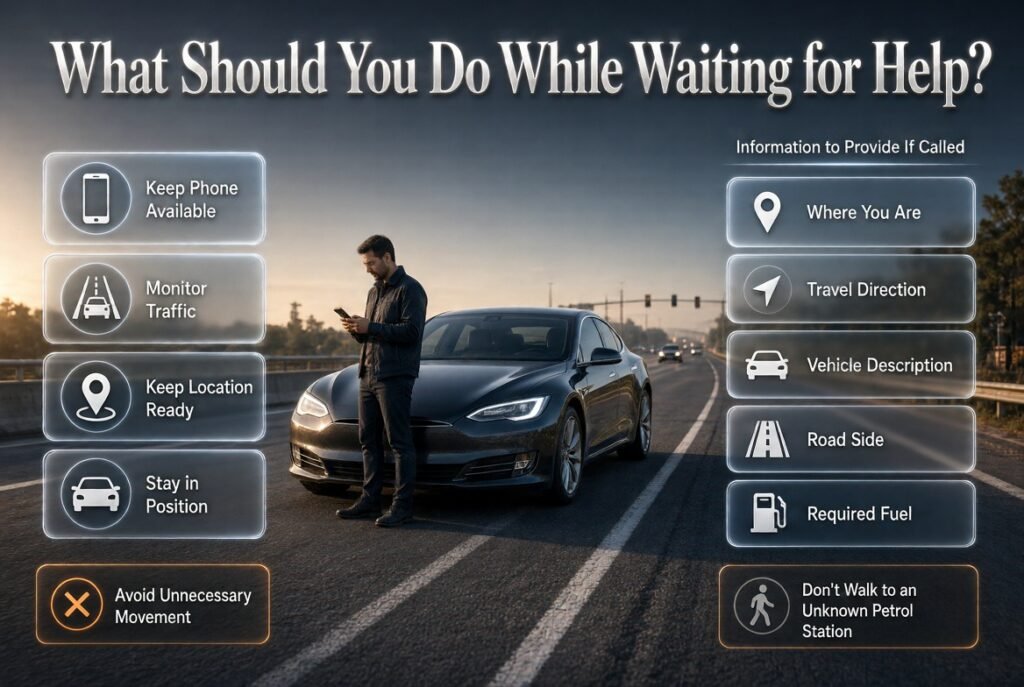
Once assistance has been arranged, avoid unnecessary activity.
Keep your phone available.
Monitor the traffic.
Keep your location information ready.
Don’t repeatedly move around the roadside.
Don’t walk toward an unknown petrol station.
If the service provider calls, be prepared to describe:
- Where you are
- What direction you’re travelling
- What your vehicle looks like
- Which side of the road you’re on
- What fuel you require
Clear communication makes roadside assistance easier.
Expert Advice: Treat Fuel Emergencies as Road-Safety Events
The biggest difference between an inexperienced response and a professional response is priorities.
An inexperienced driver thinks:
“I need to find petrol.”
A safer approach is:
“I need to make my vehicle and passengers safe, then arrange petrol.”
That change in thinking prevents many unnecessary risks.
Professional roadside planning focuses on:
- Vehicle control
- Safe positioning
- Visibility
- Accurate location
- Appropriate assistance
- Correct fuel
- Safe continuation of the journey
⭐ Expert Tip: Never allow the urgency of getting fuel to make you take a road-safety risk that you wouldn’t normally take.
Quick Decision Guide
| Situation | Best general response |
|---|---|
| Engine losing power but vehicle moving | Maintain control and move safely |
| Vehicle safely on shoulder | Activate hazards and request assistance |
| Vehicle stopped in live lane | Prioritize immediate traffic safety |
| Petrol station appears nearby | Don’t walk along active highway |
| Fuel tank confirmed empty | Stop repeated starting attempts |
| Unsure of location | Use navigation and visible landmarks |
| Unsure of fuel type | Verify before adding fuel |
| Vehicle won’t start after fuel | Request further diagnosis |
| Extreme heat | Minimize unnecessary exposure |
| Heavy traffic | Avoid walking or crossing lanes |
What should I do immediately if my car runs out of fuel on a highway?
Running out of fuel on a highway should be treated as a road-safety situation first and a fuel problem second. If the engine starts losing power, stay calm, keep the steering under control, and use whatever safe momentum remains to move toward the nearest suitable shoulder, emergency area, exit, or other place away from moving traffic. Don’t make a sudden lane change simply because you see a shoulder ahead.
Once you’re in the safest practical position, switch on the hazard warning lights and stop the vehicle securely. Then identify your exact location and contact roadside assistance or a fuel-delivery service. On a high-speed road, the objective isn’t to solve the fuel problem yourself; it’s to reduce your exposure to moving traffic while professional help is arranged.
What to do:
Keep control of the vehicle while it still has momentum.
Move away from active traffic only when it can be done safely.
Switch on hazard warning lights.
Identify the highway, direction, nearest exit, and landmark.
Arrange professional fuel or roadside assistance.
Avoid unnecessary attempts to restart an empty tank.
Expert point: Don’t gamble on reaching the next petrol station. Once the engine begins to sputter, the remaining momentum may be your best opportunity to get the vehicle out of the traffic flow.
Should I walk to a petrol station if my car runs out of fuel on the highway?
Walking to a petrol station should generally not be your first solution on a highway. A station that looks close on your navigation screen may be separated from you by fast-moving traffic, barriers, ramps, service roads, or areas where pedestrians aren’t expected. Walking along the carriageway can expose you to a much greater risk than simply waiting for professional assistance.
The safer approach is to keep yourself in a protected location and arrange fuel delivery or roadside assistance that can come to the vehicle. Official motorway-breakdown guidance specifically warns drivers not to walk along high-speed roads when it isn’t safe to do so.
Instead of walking:
Share your exact location with the assistance provider.
Give the road name and direction of travel.
Mention the nearest exit or visible landmark.
Confirm whether the vehicle needs petrol or diesel.
Wait in the safest available position.
Common mistake: Drivers often think, “It’s only 10 minutes to the petrol station.” Ten minutes on foot beside a busy highway can be far more dangerous than it sounds.
Professional advice: Don’t measure the problem by how close the petrol station appears. Measure it by how safely you can reach it.
Should I stay inside my car when it runs out of fuel on a highway?
There isn’t one rule that fits every highway situation. The safest choice depends on where the vehicle has stopped and how close moving traffic is. If the car is safely positioned away from traffic, remaining inside with your seat belt fastened can be appropriate while you arrange assistance. If the vehicle is in a dangerous position, however, following emergency or roadside-assistance instructions becomes more important than simply staying inside.
Modern breakdown guidance emphasizes getting yourself away from moving traffic when there is a genuinely safer protected area available, while also warning against exposing yourself unnecessarily on a high-speed road.
Before leaving the vehicle, consider:
Is the car completely away from moving traffic?
Is there a safety barrier or protected area?
Can you exit without stepping into traffic?
Is the roadside itself safe?
Are children, elderly passengers, or other vulnerable people with you?
Is the weather extremely hot or otherwise hazardous?
If leaving the car would put you closer to traffic, don’t do it simply because you’re waiting for fuel.
Expert point: The safest location is usually the one that gives you the greatest separation from moving vehicles. Your decision should be based on the actual road layout, not a general rule that says everyone must either stay inside or get out.
What is the safest way to get fuel after running out on a highway?
The safest practical solution is usually to arrange professional roadside fuel assistance rather than walking to a station or trying to transport fuel yourself. A fuel-delivery or roadside-assistance provider can bring the required fuel to your location, allowing you to deal with the problem without unnecessarily exposing yourself to highway traffic.
When requesting assistance, don’t just say, “I need petrol.” Give enough information for the service provider to find you efficiently.
Provide:
Highway or road name
Direction of travel
Nearest exit
Nearby landmark
Exact or map-based location
Vehicle make and model
Petrol or diesel requirement
Whether the vehicle is on the shoulder or another safe area
Roadside fuel services commonly use the driver’s location to send assistance directly to a stranded vehicle.
One important detail: Always confirm the correct fuel type before fuel is delivered. Petrol and diesel aren’t interchangeable, and turning a simple empty-tank problem into a wrong-fuel problem can create a much bigger recovery issue.
Professional advice: Think of fuel delivery as part of the safety solution—not simply a convenience. The real benefit is that you don’t have to leave a potentially unsafe highway location just to obtain fuel.
How can I prevent my car from running out of fuel on a long highway journey?
The best way to deal with a highway fuel emergency is to prevent the tank from becoming critically low in the first place. Before a long journey, check the fuel level, understand your route, identify suitable refuelling points, and leave a reasonable reserve instead of planning to use every kilometre shown on the dashboard.
Your vehicle’s estimated remaining range is only a guide. Traffic congestion, high speeds, aggressive acceleration, air-conditioning use, vehicle load, tire pressure, and unexpected detours can all affect actual fuel consumption. Road-safety guidance also recommends checking that you have sufficient fuel before beginning a journey.
Before a long highway trip:
Refuel before the tank becomes critically low.
Check the expected journey distance.
Identify practical fuel stops.
Allow extra fuel for unexpected traffic.
Check tire pressure.
Avoid unnecessary vehicle weight.
Maintain a smooth driving style.
Don’t treat the “distance to empty” display as a guarantee.
Expert point: The biggest mistake isn’t necessarily forgetting to refuel. It’s planning a journey with no fuel margin. A driver who leaves enough reserve has options when traffic, weather, detours, or delays change the original plan.
Conclusion
Running out of fuel on a highway can be stressful, but the situation becomes much easier to manage when you put safety first. The most important thing is not to panic, make sudden lane changes, or attempt to walk along a busy highway looking for fuel. Instead, use any remaining momentum to reach the safest possible location, switch on your hazard lights, keep a safe distance from moving traffic, and arrange professional assistance.
Knowing what to do when fuel runs out on a highway can protect you, your passengers, and other road users from unnecessary risk. Always identify your exact location, including the highway name, direction of travel, nearest exit, landmark, or service area, so help can reach you efficiently.
A little preparation can also prevent most fuel emergencies. Check your fuel level before long journeys, understand your vehicle’s realistic driving range, plan suitable refueling points, and remember that traffic, high speeds, air conditioning, vehicle load, tire pressure, and driving habits can all affect fuel consumption.
If your vehicle does become stranded because the tank is empty, getting yourself to a safe position is more important than getting fuel immediately. Once you are secure, reliable roadside assistance or a professional fuel delivery service can help you get back on the road without taking unnecessary risks.
Leave a Reply