Introduction
Running Out of Fuel on a Highway | Running out of fuel on a highway can happen when you least expect it. You may have planned your journey carefully, checked the fuel gauge before leaving, and still find yourself watching the engine lose power while traffic continues moving around you. On a normal city street, an empty tank is frustrating. On a highway, it can become a serious safety situation within seconds.
If you’re dealing with running out of fuel on a highway, your first priority shouldn’t be finding a petrol station. It should be getting yourself, your passengers, and other road users out of immediate danger. Knowing how to respond can make a major difference, especially on busy Dubai roads where vehicles may be travelling at high speeds.
For practical information about roadside fuel emergencies and mobile assistance in Dubai, Fuel Delivery Dubai provides a useful starting point for drivers who need fuel-related roadside support. In this guide, you’ll learn what to do when your vehicle runs out of petrol or diesel, how to stop safely, when to call for emergency help, what mistakes to avoid, and how to reduce the chance of being stranded on a highway again.
The most important thing to remember is simple: an empty fuel tank is a vehicle problem, but a vehicle stopped in a dangerous traffic position is a safety problem. Deal with the safety problem first.
What Should You Do If You Run Out of Fuel on a Highway?
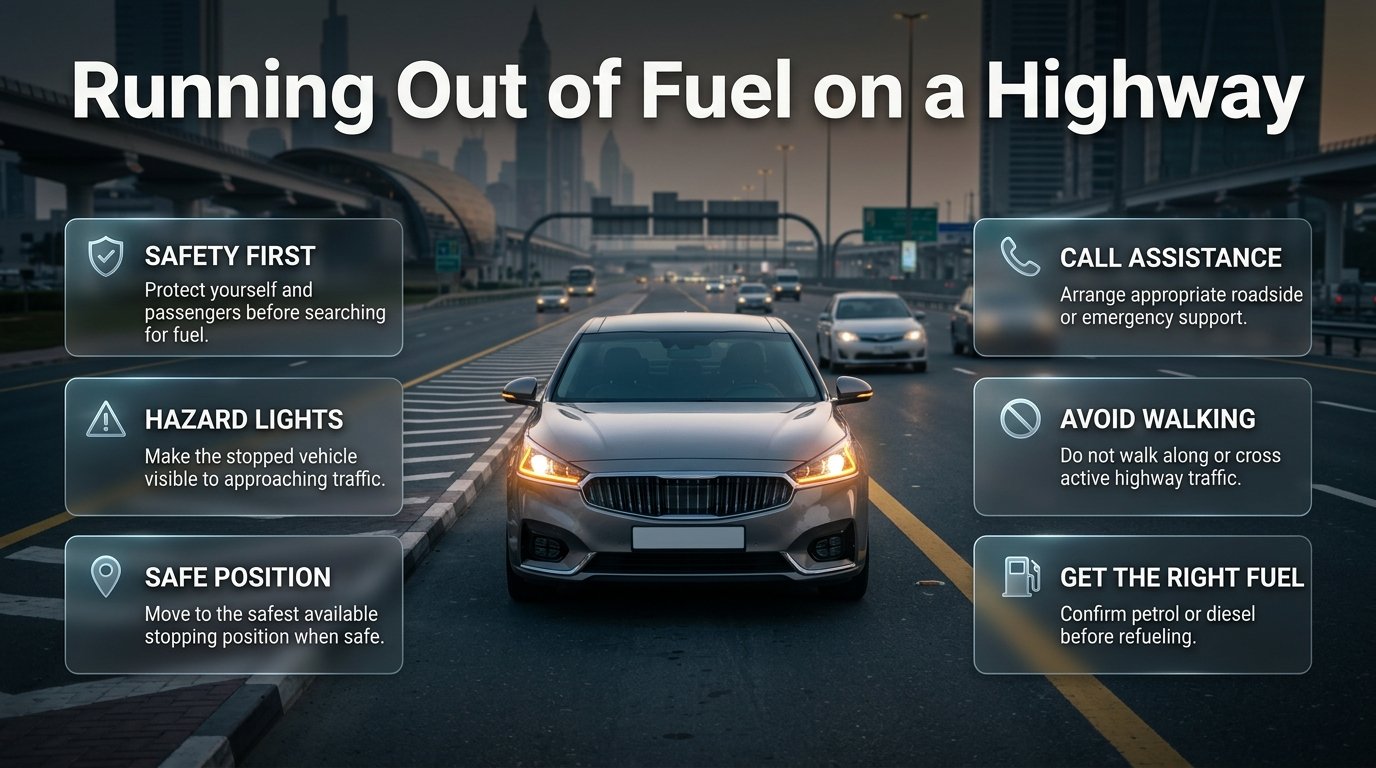
If your vehicle runs out of fuel on a highway, stay calm, maintain control, and move toward the safest available stopping position if you can do so without making a dangerous manoeuvre. Switch on your hazard warning lights, keep away from moving traffic, identify your exact location, and contact appropriate roadside assistance or emergency services.
Don’t immediately leave your vehicle to walk to a petrol station.
Don’t attempt to cross the highway.
Don’t make a sudden lane change simply because you know the engine is about to stop.
Instead, think through the situation in this order:
- Maintain control.
- Look for the safest possible place to stop.
- Get out of a live traffic lane if it can be done safely.
- Switch on hazard lights.
- Identify your location.
- Contact professional assistance.
- Keep yourself away from unnecessary traffic exposure.
This basic sequence is useful whether you’re driving through Dubai, travelling between emirates, or taking a long-distance highway journey.
For a broader explanation of immediate roadside fuel precautions, see Emergency Roadside Fuel Advice.
Why Is Running Out of Fuel on a Highway More Dangerous?
A highway creates a very different environment from a residential street or parking area. Traffic can be moving quickly, vehicles may approach from behind with limited reaction time, and there may be no convenient place to leave the road.
A vehicle that suddenly stops in a live lane can become an unexpected obstacle.
The danger can become greater if the driver:
- Makes a sudden lane change.
- Stops around a blind bend.
- Gets out into moving traffic.
- Walks along the shoulder.
- Attempts to cross several lanes.
- Tries to push the vehicle manually.
- Performs unnecessary mechanical repairs.
- Leaves passengers standing outside the vehicle.
The empty fuel tank itself isn’t necessarily the most dangerous part of the situation. The position of the vehicle and the driver’s response usually matter much more.
Imagine you’re travelling on a busy highway in Dubai during the evening. Your fuel warning has already appeared, but you continue because the next station seems close. A few kilometres later, the engine begins to lose power. You have limited momentum and traffic is moving around you.
At that point, the decision to keep driving until the last possible moment has reduced your options.
That’s why fuel planning is part of highway safety.
What Should You Do When the Engine Starts Losing Power?
When fuel is almost completely exhausted, a petrol or diesel vehicle may begin to hesitate, lose acceleration, or respond poorly to the accelerator.
Don’t panic.
Keep both hands available for steering and pay attention to surrounding traffic.
If the vehicle still has momentum, use it carefully to reach a suitable stopping location. Depending on the road, that might be a hard shoulder, designated emergency stopping area, or another place where the vehicle can safely be positioned.
The key word is safely.
Don’t suddenly cross multiple lanes because you’ve noticed a shoulder.
Check mirrors and blind spots before changing lanes. Signal normally. Give other drivers as much warning as possible.
If moving across lanes would create a greater risk than remaining where you are, don’t make a dangerous manoeuvre simply to get closer to the edge.
Why Maintaining Control Matters
When an engine stops, some vehicles may experience changes in steering assistance, braking assistance, or other systems depending on their design.
That doesn’t mean the steering suddenly becomes impossible, but the vehicle can feel different.
A driver who panics may overcorrect or make abrupt movements.
Your objective is to keep the vehicle predictable.
Pro Tip: If you notice the fuel level is critically low before the engine stops, begin planning where you can safely leave the main traffic flow rather than waiting until the last few seconds.
How Do You Safely Stop a Car on a Highway?
The safest stopping point is one that puts as much distance as reasonably possible between your vehicle and moving traffic while complying with the road environment.
If you have enough momentum to reach the shoulder or another designated stopping area without a risky manoeuvre, move there gradually.
Once stopped:
- Keep the vehicle positioned as safely as possible.
- Activate hazard warning lights.
- Apply the parking brake.
- Keep passengers calm.
- Assess traffic conditions.
- Avoid unnecessary movement around the vehicle.
- Contact appropriate assistance.
If your vehicle has stopped in a dangerous position, don’t focus exclusively on arranging fuel. Tell the assistance provider or emergency service that the vehicle is in a live traffic lane or otherwise exposed to immediate traffic danger.
That information can affect how the situation should be handled.
For additional guidance on dealing with an empty tank, you can also read Safely Dealing With an Empty Fuel Tank in Dubai.
Should You Turn On Your Hazard Lights?
Yes. If your vehicle has broken down or stopped unexpectedly, hazard warning lights help alert approaching drivers that your vehicle is stationary or experiencing a problem.
Turn them on as soon as the vehicle becomes disabled or while you’re slowing down because of the problem, when appropriate.
Hazard lights don’t make the vehicle invisible to traffic, so don’t assume that other drivers will automatically see you and move away.
Visibility is only one part of the safety strategy.
Your other priorities are:
- Positioning the vehicle safely.
- Staying away from traffic.
- Calling the right assistance.
- Communicating your location clearly.
Common Mistake: Some drivers become so focused on finding fuel that they forget to make the stopped vehicle visible. The first few moments after losing power should be about reducing collision risk.
Should You Get Out of the Car After Running Out of Fuel?
Not automatically.
Whether remaining inside or exiting the vehicle is safer depends on where the vehicle has stopped and the surrounding traffic conditions.
If the vehicle is safely away from moving traffic, staying inside with seat belts fastened may be preferable while waiting.
If the vehicle is in an extremely dangerous location, follow instructions from emergency responders or relevant road authorities.
What you should avoid is casually standing beside the vehicle, walking around the shoulder, or standing close to the traffic lane simply because you’re waiting for fuel.
If children or other passengers are travelling with you, keep them away from moving traffic.
Your goal isn’t to make the breakdown look less stressful. Your goal is to reduce exposure to traffic.
Is It Safe to Walk to a Petrol Station?
Walking along a highway to find fuel is generally a poor choice.
A petrol station may look close on a map, but the route can involve:
- High-speed traffic.
- Entry and exit ramps.
- Barriers.
- Multiple lanes.
- Limited pedestrian access.
- Blind curves.
- Bridges.
- Interchanges.
A short distance doesn’t automatically mean a safe walk.
You also don’t know how long you’ll be away from the vehicle or what may happen while you’re gone.
Instead of treating the highway like a city street, contact professional assistance and request fuel delivery or roadside recovery.
If you’re already stranded, What to Do When You Run Out of Fuel in Dubai provides additional guidance on the immediate steps to take.
What Information Should You Give Roadside Assistance?
One of the easiest ways to speed up roadside assistance is to provide an accurate location.
Saying:
“I’m somewhere on Sheikh Zayed Road.”
is usually not enough.
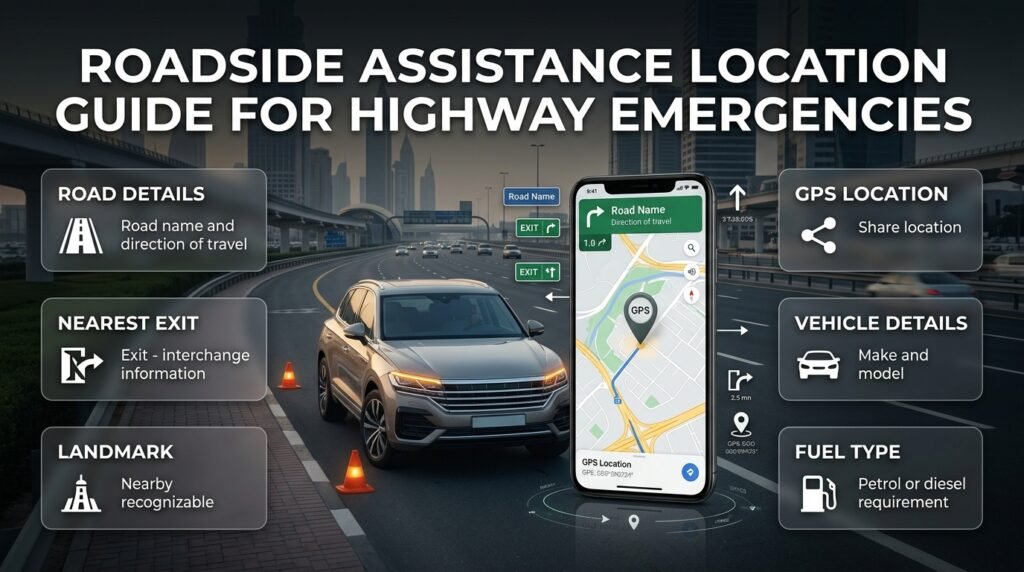
A better location description includes:
- Road name.
- Direction of travel.
- Nearest exit.
- Nearest interchange.
- Nearby landmark.
- Highway marker if available.
- GPS location.
- Vehicle make and model.
- Petrol or diesel requirement.
For example:
“I’m travelling toward Abu Dhabi. My car has stopped on the right side near the next exit. I’m approximately 500 metres before the interchange, and my GPS location is available.”
That’s much more useful to an assistance provider.
Use Your Phone’s Location Carefully
Your smartphone can usually identify your approximate position through its mapping application.
Before making the call:
- Open your map application.
- Check the blue location marker.
- Identify the road.
- Check the direction of travel.
- Look for the nearest exit or landmark.
- Share the location when appropriate.
Don’t stand outside a dangerous vehicle simply to get a better GPS reading.
Your phone should help you stay safe, not create another risk.
When Should You Call Emergency Services?
Not every empty fuel tank requires emergency services.
If your vehicle is safely positioned and the only problem is an empty tank, fuel delivery or roadside assistance may be appropriate.
Emergency services are more suitable when there is an immediate danger involving people or traffic.
Call emergency assistance when:
- The vehicle is stopped in a dangerous live lane.
- Someone is injured.
- There has been a collision.
- You cannot safely get away from traffic.
- The vehicle presents an immediate road hazard.
- There is smoke or fire.
- Someone is experiencing a serious medical problem.
- You are trapped in an unsafe location.
Don’t use an emergency line simply because you forgot to refuel. But don’t hesitate to contact emergency assistance when the situation has become an immediate safety threat.
For more information about general breakdown precautions, see Roadside Breakdown Safety Tips in Dubai.
What If Your Car Stops in a Live Traffic Lane?
This is one of the most serious situations a driver can face after running out of fuel.
If the vehicle stops in an active lane, immediately focus on visibility and traffic exposure.
Turn on hazard lights.
If the vehicle can be moved safely using remaining momentum or vehicle capability, move toward a safer position.
But don’t attempt a dangerous manoeuvre across traffic.
If you cannot safely move the vehicle, contact emergency assistance and clearly explain that the car is stopped in a live lane.
Do not:
- Push the vehicle yourself through moving traffic.
- Stand behind it.
- Walk between lanes.
- Attempt to flag down passing vehicles.
- Cross the highway.
- Carry a fuel container through traffic.
The safest solution may be professional traffic management and vehicle recovery rather than trying to solve the fuel problem yourself.
What Should You Do While Waiting for Fuel Delivery?
Once assistance has been arranged, the next challenge is waiting safely.
Keep communication available with the provider.
Your phone should have enough battery to receive calls or messages, so avoid unnecessary use.
While waiting:
- Keep hazard lights on where appropriate.
- Stay in the safest available position.
- Monitor your surroundings without standing in traffic.
- Keep passengers together.
- Keep children away from the roadside.
- Don’t walk toward the approaching assistance vehicle.
- Don’t attempt unnecessary repairs.
- Be ready to explain your exact location again.
If the provider asks you to identify the vehicle, describe its make, model, colour, and position.
If conditions change, such as the vehicle moving into a more dangerous position or traffic becoming heavier, update the assistance provider.
For broader guidance, see What to Do During a Roadside Breakdown.
What Happens When a Petrol Car Runs Out of Fuel?
A petrol engine needs a consistent supply of fuel to maintain combustion.
When the fuel supply becomes insufficient, the engine may hesitate, lose power, and eventually stop.
You might notice:
- Engine hesitation.
- Reduced acceleration.
- Surging.
- Difficulty maintaining speed.
- Engine shutdown.
Once the tank is empty, adding the correct petrol may allow the vehicle to restart.
However, don’t assume that every vehicle will start immediately after fuel is delivered.
The fuel system may need to restore pressure, and there may be another underlying issue if the vehicle had been experiencing problems before it ran out.
Avoid repeatedly cranking the engine for long periods.
If it doesn’t start after an appropriate amount of fuel has been added, arrange qualified assistance.
You can find more specific guidance in Steps After Running Out of Petrol.
What Happens When a Diesel Car Runs Out of Fuel?
Diesel vehicles can require additional attention after completely running out of fuel.
Depending on the vehicle’s fuel system, air may enter parts of the system when fuel is exhausted.
Adding diesel may therefore not always be enough to get the engine running immediately.
Some vehicles require a specific priming procedure.
This is one reason diesel drivers shouldn’t repeatedly crank the engine for extended periods after running dry.
If the vehicle doesn’t restart after the correct diesel has been added, contact a qualified technician or roadside assistance provider.
Petrol vs Diesel After Fuel Exhaustion
| Situation | Petrol | Diesel |
|---|---|---|
| Engine can stop when fuel is exhausted | Yes | Yes |
| Correct fuel required | Yes | Yes |
| May restart after refuelling | Often | Not always immediately |
| Fuel-system priming concern | Usually lower | Can be more significant |
| Repeated long cranking advisable | No | No |
| Professional help may be required | Sometimes | More likely if it won’t restart |
Can Running Out of Fuel Damage the Engine?
An occasional empty tank doesn’t necessarily mean that the engine has suffered major damage.
However, repeatedly driving until the fuel is completely exhausted is not a good operating habit.
Fuel systems depend on the correct fuel supply and pressure, and the fuel pump in many vehicles is designed to operate with fuel around it.
More importantly, repeatedly running the vehicle to empty increases the likelihood of becoming stranded in an unsafe location.
The bigger concern on a highway is often not engine damage.
It’s the risk of having the vehicle stop where there is nowhere safe to wait.
Why Should You Avoid Repeatedly Starting an Empty Car?
Once you’ve confirmed the tank is empty, repeatedly turning the engine over isn’t a useful solution.
It can drain the battery.
A weak battery creates a second problem on top of the empty tank.
This is particularly inconvenient if fuel eventually arrives but the vehicle no longer has enough battery power to start.
The better approach is to stop unnecessary starting attempts and arrange the correct fuel and assistance.
Expert Tip: Think of the battery as another limited resource during a roadside emergency. Don’t waste it trying the same unsuccessful action repeatedly.
What Are the Most Common Mistakes Drivers Make?
Running out of fuel creates stress, and stress can lead to poor decisions.
Driving Until the Last Possible Moment
A driver may see the fuel warning and think:
“The station is only a few kilometres away.”
Sometimes that calculation works.
Sometimes traffic, detours, congestion, or unexpected delays mean the car stops before reaching the station.
The better strategy is to treat the low-fuel warning as an opportunity to refuel rather than as a challenge to discover the vehicle’s absolute range.
Making a Sudden Lane Change
When power starts disappearing, some drivers immediately try to move toward the shoulder.
If the shoulder is across one or more lanes, that can create a dangerous situation.
Never trade a fuel problem for a collision risk.
Walking on the Highway
This is one of the most avoidable mistakes.
The petrol station may appear close, but the highway environment can be extremely dangerous for pedestrians.
Stay away from moving traffic and request assistance.
Standing Beside the Vehicle
A driver may get out and stand beside the car while waiting.
That exposes the person to passing vehicles.
If the vehicle is safely positioned, remaining inside may be preferable depending on circumstances and professional guidance.
Trying to Push the Vehicle
Pushing a vehicle manually on a busy highway is extremely risky.
If the vehicle cannot be safely moved, contact professional assistance.
Performing Unnecessary Repairs
An empty fuel tank isn’t something that requires roadside mechanical work.
Don’t expose yourself to traffic while attempting repairs that aren’t necessary.
Giving an Unclear Location
The assistance provider cannot help efficiently if they can’t find you.
Always provide the direction of travel and the most precise location available.
For more general advice, see Staying Safe During a Car Breakdown.
How Can You Prevent Running Out of Fuel on a Highway?
Prevention starts before you enter the highway.
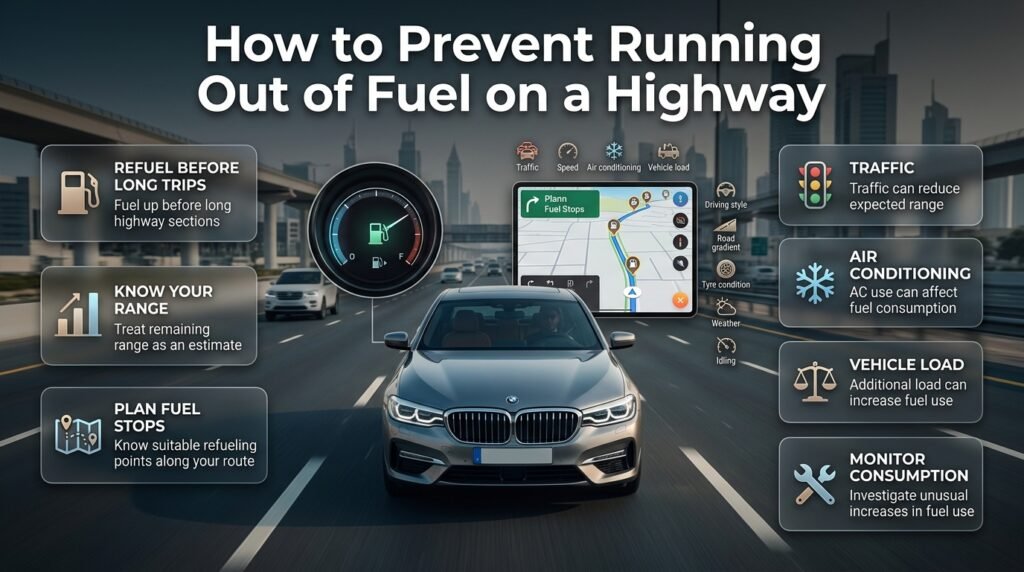
You don’t need to keep the tank completely full at all times, but you should maintain a reasonable reserve, especially before long journeys.
Refuel Before Long Trips
If you’re about to travel a significant distance, refuel before entering a long highway section.
This is especially useful when you don’t know exactly where the next fuel station will be.
Understand Your Vehicle’s Range
Your vehicle’s estimated remaining range is useful, but it isn’t a guarantee.
Range can change because of:
- Traffic.
- Speed.
- Air-conditioning use.
- Vehicle load.
- Driving style.
- Road gradient.
- Tyre condition.
- Weather.
- Idling.
Treat the displayed range as an estimate rather than a promise.
Know Fuel Stations Along Your Route
For longer journeys, identify suitable fuel stops before departure.
This doesn’t mean you need to plan every kilometre.
Simply knowing where you can refuel reduces the temptation to push the tank too far.
Watch for Changes in Fuel Consumption
If your vehicle normally consumes a predictable amount of fuel but suddenly begins using much more, investigate.
Possible causes include aggressive acceleration, heavy traffic, excessive idling, tyre-pressure problems, additional load, or mechanical issues.
Your site’s Fuel-Saving Driving Tips resource can support drivers who want to improve their overall fuel efficiency.
How Does Highway Speed Affect Fuel Consumption?
Driving faster generally increases aerodynamic resistance, and that can increase fuel consumption.
This becomes particularly relevant on highways because speed is often higher than in urban areas.
However, fuel efficiency isn’t about choosing one magical speed and maintaining it everywhere.
A better strategy is to:
- Follow posted speed limits.
- Maintain a steady pace when traffic permits.
- Avoid unnecessary acceleration.
- Anticipate traffic changes.
- Avoid aggressive braking followed by rapid acceleration.
For readers interested in the technical side, resources such as How Highway Speed Affects Fuel Consumption can provide further context.
How Does Traffic Increase the Risk of Running Out of Fuel?
Heavy traffic can make a low-fuel situation worse.
Imagine your vehicle’s estimated range says you have enough fuel for 40 kilometres.
Then traffic slows dramatically.
Instead of moving at a steady highway speed, you spend a long time accelerating, braking, and idling.
Your actual fuel consumption may be very different from what you expected.
Dubai’s busy roads can experience periods of heavy congestion, making this especially relevant.
You can learn more about the issue through How Traffic Affects Fuel Economy in Dubai.
Does Idling Waste Fuel?
Yes. An engine that is running while the vehicle is stationary is consuming fuel without covering distance.
Long periods of idling can therefore reduce the practical range available from your tank.
This matters when you’re already operating with a low fuel level.
If you’re stuck in traffic, waiting outside a location, or sitting with the engine running unnecessarily, fuel consumption can add up.
See Fuel Consumption While Idling for a deeper explanation.
How Can You Improve Highway Fuel Efficiency?
Fuel efficiency isn’t controlled by one factor.
It’s the result of several small decisions.
Maintain Proper Tyre Pressure
Underinflated tyres can increase rolling resistance and affect fuel economy.
Check tyre pressures according to your vehicle manufacturer’s recommendations.
Your resource on Tire Pressure and Fuel Efficiency can be linked here for drivers who want to understand the relationship in more detail.
Avoid Unnecessary Weight
Carrying heavy items that you don’t need can increase the energy required to move the vehicle.
For drivers who frequently carry equipment or luggage, How Vehicle Weight Affects Fuel Economy is a useful supporting resource.
Remove Unnecessary Roof Equipment
Roof racks and carriers can affect aerodynamic drag, especially at highway speeds.
If a roof-mounted accessory isn’t needed for the journey, removing it may improve aerodynamic efficiency.
Read Roof Racks and Fuel Economy for more information.
Use Smooth Acceleration
Aggressive acceleration consumes more fuel than a smooth, controlled driving style.
The same principle applies to braking.
Instead of repeatedly accelerating hard and braking suddenly, anticipate traffic and maintain a smoother driving pattern whenever conditions allow.
Relevant supporting resources include Smooth Driving Techniques for Better Fuel Economy and How Acceleration Affects Fuel Consumption.
How Does Air Conditioning Affect Fuel Use in Dubai?
Air conditioning is an important part of driving in Dubai, especially during hot weather.
The system requires energy, and that can contribute to additional fuel consumption.
This doesn’t mean you should avoid using air conditioning in unsafe heat.
Comfort and occupant safety remain important.
Instead, focus on efficient vehicle use and proper maintenance.
Your resource Air Conditioning and Fuel Consumption can explain the relationship in greater detail.
Can Driving Habits Help Prevent a Fuel Emergency?
Absolutely.
Your driving style affects how quickly your fuel reserve disappears.
Helpful habits include:
- Accelerating smoothly.
- Avoiding unnecessary hard braking.
- Maintaining a steady pace.
- Anticipating traffic.
- Avoiding excessive idling.
- Checking tyre pressure.
- Removing unnecessary load.
- Refuelling before the tank becomes critically low.
For example, How Braking Habits Affect Fuel Economy in Dubai explains why frequent acceleration followed by unnecessary braking can work against fuel efficiency.
What If You Run Out of Fuel at Night?
Nighttime creates an additional visibility challenge.
A stationary vehicle may be harder for approaching drivers to recognise, particularly where lighting conditions change or traffic is moving quickly.
Turn on hazard lights.
Keep yourself away from traffic.
Avoid walking around the vehicle unnecessarily.
When contacting assistance, tell them that the vehicle is stopped at night and provide your location as precisely as possible.
If you can safely identify a nearby exit, road sign, bridge, or other landmark, include it in your description.
Don’t stand in the roadway trying to make yourself visible.
What If You Run Out of Fuel During Extreme Heat?
Dubai’s hot climate makes unnecessary exposure outside the vehicle particularly undesirable.
If your vehicle stops during very hot conditions, avoid walking long distances to find fuel.
Don’t assume that a nearby petrol station is close enough to reach safely on foot.
Arrange assistance.
Keep passengers protected from excessive heat as much as the circumstances allow.
If someone begins showing signs of serious heat-related illness or another medical emergency, seek emergency medical assistance.
The fuel problem becomes secondary when someone’s health is at risk.
What Should You Keep in Your Car for Highway Emergencies?
A small emergency kit can make a roadside situation easier to manage.
Useful items can include:
- Fully charged mobile phone.
- Power bank.
- Drinking water.
- Basic first-aid supplies.
- Reflective safety equipment where appropriate.
- Vehicle documentation.
- Emergency contact information.
- A tyre-pressure gauge.
- Manufacturer-recommended emergency information.
The exact contents depend on your vehicle and travel pattern.
The most important preparation, however, isn’t an item.
It’s knowing what to do.
For broader vehicle emergency precautions, see Roadside Vehicle Emergency Precautions.
What Should You Do If Fuel Delivery Arrives?
When professional fuel assistance arrives, confirm that the provider has the correct location and that the vehicle requires the correct fuel type.
Petrol and diesel are not interchangeable.
Don’t guess.
If you’re unsure which fuel your vehicle uses, check the vehicle information, fuel cap marking, owner’s manual, or other reliable source.
Once the correct fuel has been supplied, follow the provider’s instructions.
If the engine doesn’t restart normally, don’t keep trying indefinitely.
There may be another issue requiring mechanical assistance.
What If the Car Doesn’t Start After Refuelling?
Fuel may not have been the only problem.
A vehicle can fail to start because of:
- Weak battery.
- Fuel-system problem.
- Ignition issue.
- Electrical fault.
- Mechanical fault.
- Incorrect fuel.
- Air in a diesel fuel system.
If the vehicle still doesn’t start after the correct fuel has been delivered, request appropriate roadside assistance.
Forcing repeated starting attempts isn’t a substitute for diagnosis.
Your Vehicle Breakdown Safety Procedures resource can also be used as a supporting internal reference.
How Should You Handle Passengers During a Highway Fuel Emergency?
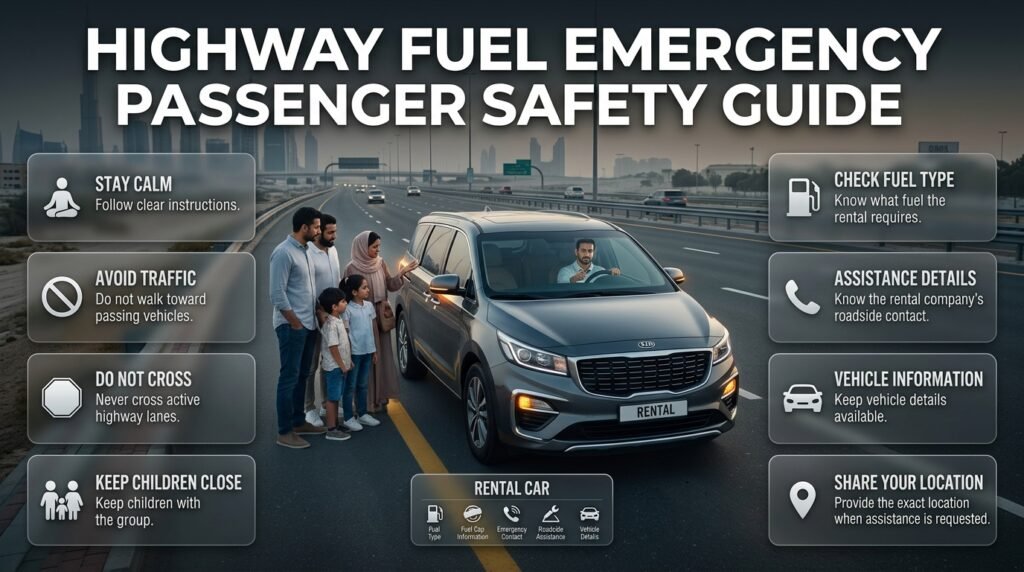
Passengers can make a stressful situation harder if everyone reacts independently.
The driver should give clear instructions.
Tell passengers:
- Stay calm.
- Don’t walk toward traffic.
- Don’t cross the road.
- Don’t leave the safe area without instruction.
- Keep children close.
- Don’t approach passing vehicles.
If the vehicle is safely positioned, remaining together can simplify communication with assistance.
If authorities or emergency responders arrive, follow their instructions rather than trying to continue with your original plan.
What If You’re Driving a Rental Car?
Rental vehicles can create additional uncertainty because you may not know the vehicle’s exact fuel range or roadside assistance arrangements.
Before a long rental journey, know:
- What fuel the vehicle requires.
- How the fuel cap opens.
- Where the emergency contact information is.
- What roadside assistance number the rental company provides.
- Whether fuel-related callouts have specific conditions.
Don’t assume the same rules apply to every rental company.
If you run out of fuel, provide the rental company or roadside provider with your exact location and vehicle details.
Highway Fuel Emergency Checklist
Before a long highway journey, keep this simple checklist in mind:
Before Driving
- Check fuel level.
- Consider the journey distance.
- Identify major fuel stops.
- Check tyre pressure.
- Remove unnecessary load.
- Make sure your phone is charged.
- Know your vehicle’s fuel type.
If Fuel Becomes Critically Low
- Don’t panic.
- Avoid aggressive driving.
- Look for a safe refuelling opportunity.
- Don’t rely blindly on the estimated range.
- Start planning where you can safely stop if necessary.
If the Engine Stops
- Maintain control.
- Move to a safer location if possible.
- Switch on hazard lights.
- Avoid live traffic.
- Don’t walk along the highway.
- Don’t cross traffic.
- Identify your location.
- Contact assistance.
While Waiting
- Stay in the safest available position.
- Keep your phone available.
- Monitor changing conditions.
- Keep passengers away from traffic.
- Follow professional instructions.
A Simple Decision Guide for Drivers
When your fuel runs out, ask these questions in order.
Is the vehicle moving?
If yes, maintain control and look for a safe stopping location.
Can I move out of the traffic lane safely?
If yes, do so gradually.
If no, don’t create a greater danger through an aggressive manoeuvre.
Is the vehicle safely positioned?
If yes, activate hazards and arrange assistance.
If no, communicate the traffic danger clearly when contacting emergency or roadside support.
Do I need fuel or emergency assistance?
If the vehicle is safely stopped and the only problem is an empty tank, fuel delivery may be appropriate.
If there’s immediate danger, injury, collision, or a serious obstruction, emergency assistance takes priority.
This decision process keeps the response simple when you’re under pressure.
What should you do if you run out of fuel on a highway?
If your vehicle runs out of fuel on a highway, your first priority should be getting the vehicle and everyone inside it into the safest possible position, not immediately finding petrol. If the car still has momentum, carefully move toward a suitable shoulder or designated stopping area when you can do so without making a dangerous lane change. Once stopped, switch on your hazard lights, avoid unnecessary exposure to moving traffic, and contact roadside assistance or emergency help if the vehicle is creating an immediate hazard.
The situation becomes much easier to manage when you follow a simple order rather than reacting in panic:
Keep control of the vehicle while it still has momentum.
Move away from live traffic if this can be done safely.
Switch on hazard warning lights.
Find your exact road location and direction of travel.
Contact professional roadside assistance or fuel delivery.
Don’t walk along the highway looking for a petrol station.
Don’t attempt to push the vehicle through moving traffic.
If the vehicle is stuck in a dangerous lane or there is an immediate safety threat, contact emergency services.
Professional advice: Don’t make a risky manoeuvre just because you’re trying to reach the shoulder. A fuel shortage is a manageable problem; a collision caused by an unsafe lane change can turn it into a serious emergency.
Is it safe to walk to a petrol station after running out of fuel on a highway?
Walking to a petrol station is generally not a good option when you’re stranded on a highway. A station that appears close on your phone may require you to cross ramps, multiple lanes, barriers, or areas with fast-moving traffic. Highway environments are designed primarily for vehicles, so the safest solution is usually to remain in a protected location and arrange roadside assistance or mobile fuel delivery.
This is especially important when travelling on busy roads or during poor visibility. Leaving the vehicle can also make it harder for assistance providers to locate you, particularly if you walk a significant distance from the original breakdown location.
Instead:
Stay away from live traffic.
Don’t cross the highway on foot.
Don’t walk along the shoulder unless instructed by authorities and it is genuinely safe.
Contact a roadside assistance or fuel delivery provider.
Share your live GPS location where possible.
Keep passengers, particularly children, away from traffic.
Wait for professional assistance at the safest available location.
A common mistake: Drivers often think, “The petrol station is only 10 minutes away.” The distance isn’t the important part. The question is whether there is a safe pedestrian route to that station. On a highway, there often isn’t.
What should you do if your car runs out of fuel in a live highway lane?
If your car stops in a live highway lane, treat the situation as a potentially dangerous traffic emergency, not simply an empty-tank problem. Immediately activate your hazard lights and, if the vehicle can be moved safely without crossing traffic dangerously, try to reach a safer stopping position. If it cannot be moved, contact emergency assistance and clearly explain that your vehicle is stopped in an active lane.
Don’t try to solve the problem by physically pushing the car through moving traffic. Don’t stand behind the vehicle to warn approaching drivers, and don’t walk between lanes looking for help.
Your priorities should be:
Make the vehicle visible: Use hazard warning lights.
Reduce traffic exposure: Move out of the live lane only if it is genuinely safe.
Communicate the danger: Tell the assistance provider that you’re blocking or exposed to active traffic.
Give your exact location: Road name, direction, exit, landmark, and GPS location can all help.
Follow professional instructions: Emergency responders may need to manage traffic before the vehicle can be safely recovered.
Expert point: The biggest mistake in this situation is thinking, “I need to get out of the car and fix this.” On a highway, your first job is not repairing the vehicle. It’s reducing the chance of being hit by another vehicle.
Can roadside assistance or fuel delivery bring fuel to a car that has run out on a highway?
Yes, mobile fuel delivery or roadside assistance may be able to bring the appropriate fuel directly to a stranded vehicle, depending on the service and location. This can be much more practical than walking to a petrol station or arranging a tow when the only problem is an empty tank. Roadside assistance providers commonly offer emergency fuel delivery as part of their breakdown services.
When requesting fuel delivery, give the provider enough information to reach you without unnecessary delays:
Exact road or highway name.
Direction of travel.
Nearest exit or interchange.
Nearby landmark.
GPS/live location.
Vehicle make and model.
Whether the vehicle needs petrol or diesel.
Whether the vehicle is safely parked or blocking a live lane.
For example, instead of saying:
“My car ran out of fuel on the highway.”
give a location such as:
“I’m travelling toward Abu Dhabi and my vehicle has stopped near the next exit. I’m on the right side of the highway and can share my GPS location.”
That difference can make communication much more efficient.
Professional advice: Always confirm the fuel type before assistance is dispatched. Petrol and diesel are not interchangeable, and putting the wrong fuel into a vehicle can create a second problem after the original fuel emergency.
If the vehicle is safely positioned, fuel delivery may be all you need. If it remains in a dangerous location, however, traffic safety takes priority over ordinary fuel delivery.
How can you prevent running out of fuel on a highway?
The easiest way to deal with a highway fuel emergency is to prevent it from happening. Don’t treat the low-fuel warning as a challenge to see how many kilometres the car can squeeze out of the remaining fuel. Your displayed driving range is an estimate, and real-world conditions such as congestion, high speeds, air-conditioning use, vehicle load, and driving style can change how quickly fuel is consumed.
A better approach is to maintain a reasonable fuel reserve, particularly before long highway journeys.
Useful habits include:
Refuel before long trips: Don’t enter a long highway section with critically low fuel.
Don’t rely completely on “distance to empty”: Treat it as an estimate rather than a guarantee.
Plan fuel stops: Know where suitable petrol stations are along unfamiliar routes.
Allow for traffic: Congestion can increase fuel consumption and reduce your expected range.
Avoid unnecessary idling: A stationary engine still consumes fuel.
Maintain tyre pressure: Incorrect tyre pressure can affect rolling resistance and efficiency.
Avoid unnecessary weight: Extra load can increase fuel consumption.
Drive smoothly: Aggressive acceleration and frequent hard braking can reduce efficiency.
Pay attention to unusual fuel consumption: A sudden change may indicate a maintenance issue.
Keep roadside assistance information available: Preparation matters when something unexpected happens.
The professional mindset is simple: don’t plan a highway journey around the minimum fuel your vehicle can theoretically use. Plan around a reasonable safety margin.
That margin becomes especially valuable when traffic suddenly slows, you miss an exit, take a detour, or discover that the next fuel station is farther away than expected.
Conclusion
Running out of fuel on a highway can turn an ordinary journey into a serious roadside situation within minutes. The most important thing is not getting fuel as quickly as possible—it is protecting yourself, your passengers, and other road users first. Stay calm, keep control of the vehicle, and move to the safest available position only when it is safe to do so.
Once your vehicle is safely positioned, switch on the hazard lights, make your location clear, and contact appropriate roadside assistance or emergency support. Avoid walking along the highway, crossing active lanes, pushing your vehicle through traffic, or attempting unnecessary roadside repairs. These actions can expose you to far greater danger than the original empty fuel tank.
Planning ahead can also prevent most fuel emergencies. Monitor your fuel level, understand your vehicle’s realistic driving range, allow extra fuel for Dubai traffic and delays, and refuel before the tank becomes critically low. Keeping roadside assistance information available can make a major difference when an unexpected breakdown occurs.
If you do run out of petrol or diesel, professional mobile fuel assistance can provide a practical alternative to leaving your vehicle and searching for a petrol station on foot. The correct fuel should be delivered safely to your vehicle, with the fuel type confirmed before refueling.
Ultimately, running out of fuel on a highway is manageable when you respond calmly and put road safety first. A few simple precautions, better fuel planning, and knowing what to do during an emergency can help you avoid unnecessary risks and get back on the road safely.
Leave a Reply