Introduction
Fuel-Efficient Driving Techniques | Fuel costs can rise quickly when everyday driving habits work against your vehicle. A driver may have a well-maintained car and still use noticeably more fuel because of hard acceleration, unnecessary braking, excessive speed, long idling, or poor trip planning. The good news is that many of these losses can be reduced without driving unusually slowly or making your journey uncomfortable.
Fuel-efficient driving techniques focus on using the engine, transmission, brakes, and vehicle momentum more intelligently. The goal isn’t simply to drive as slowly as possible. It’s to avoid wasting energy while maintaining safe, predictable, and practical driving habits.
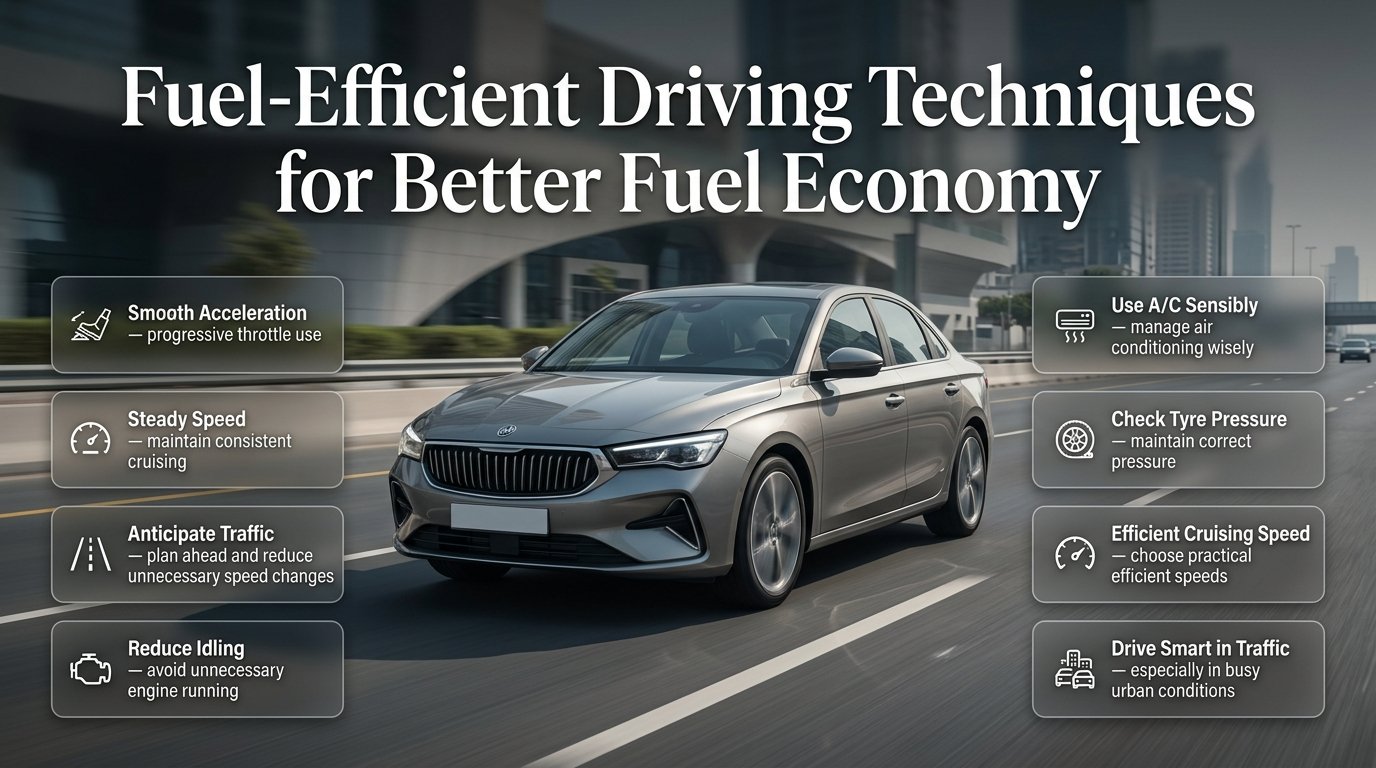
This guide explains the most useful techniques for improving fuel economy, including smooth acceleration, maintaining a steady speed, anticipating traffic, reducing unnecessary idling, using air conditioning sensibly, checking tyre pressure, and choosing an efficient cruising speed. It also explains common mistakes and shows how to build fuel-saving habits that work in everyday driving, including busy city conditions such as Dubai traffic.
What Are Fuel-Efficient Driving Techniques?
Fuel-efficient driving techniques are practical driving habits that reduce unnecessary fuel consumption while maintaining safe and normal road speeds. They include smooth acceleration, avoiding aggressive braking, maintaining steady momentum, reducing unnecessary idling, keeping tyres properly inflated, and planning ahead for traffic.
These techniques work because a vehicle consumes more fuel when the engine repeatedly has to overcome unnecessary acceleration, speed changes, aerodynamic resistance, or mechanical drag.
The basic principle is simple:
Less wasted energy = less fuel required for the same journey.
That doesn’t mean every fuel-saving technique produces the same result. Driving behaviour, traffic, vehicle type, road conditions, weather, tyre condition, and air-conditioning use all influence actual fuel consumption.
Petrol at My Location Dubai 👉 Fuel Delivery Dubai homepage.
Why Does Driving Style Affect Fuel Economy?
Your driving style affects how much work the engine has to perform. Rapid acceleration demands more power, while repeated braking throws away some of the momentum you’ve already created. If you then accelerate again, the engine has to spend more fuel rebuilding that speed.
A smoother driver generally creates fewer unnecessary changes in speed.
For example, imagine two drivers approaching the same traffic signal. The first accelerates hard, reaches the queue quickly, brakes sharply, stops, and accelerates again. The second observes the traffic earlier, eases off the accelerator, arrives more gradually, and may avoid a complete stop.
Both drivers travel the same route, but the second driver has avoided several unnecessary energy changes.
💡 Pro Tip: Think about maintaining useful momentum rather than constantly trying to gain speed. Smoothness is one of the simplest foundations of efficient driving.
1. Accelerate Smoothly Instead of Aggressively
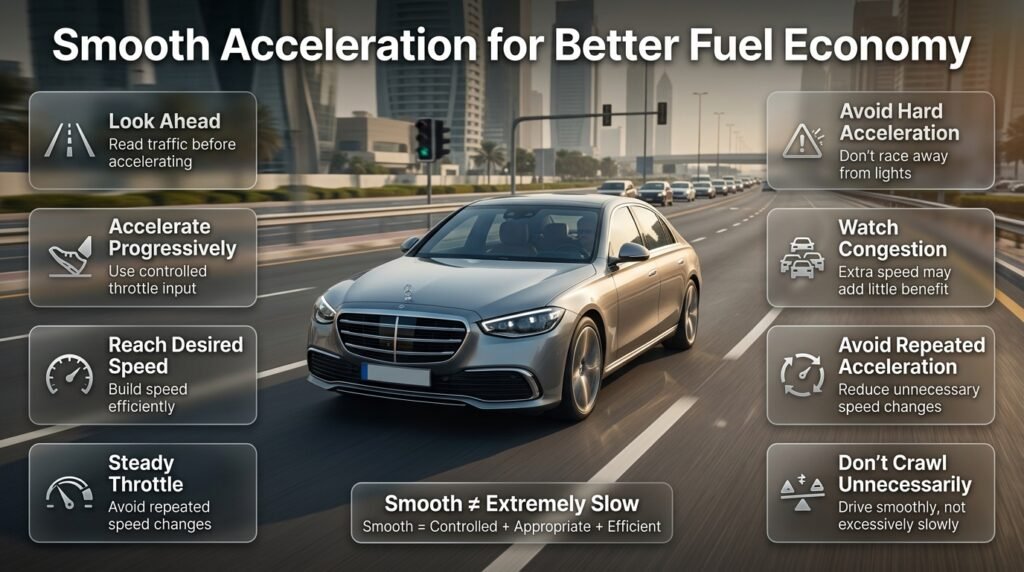
One of the most important fuel-efficient driving techniques is progressive acceleration. Pressing the accelerator aggressively causes the engine to produce a large amount of power in a short period. That can increase fuel consumption, especially when aggressive acceleration is followed by braking.
Smooth acceleration doesn’t mean crawling away from every traffic light. You should accelerate normally and confidently, but avoid unnecessarily deep throttle inputs.
A practical approach is:
- Look ahead before moving.
- Accelerate progressively.
- Reach your desired road speed efficiently.
- Ease into a steady throttle position.
- Avoid repeatedly accelerating and lifting off the accelerator.
The right technique depends on the vehicle. A small naturally aspirated petrol car, turbocharged engine, hybrid, and diesel vehicle can respond differently to throttle input.
For a deeper explanation, see How Acceleration Affects Fuel Consumption in Dubai.
What Is the Biggest Acceleration Mistake?
The biggest mistake is treating every traffic light or gap in traffic like a race. Drivers sometimes accelerate hard simply to reach the next red light sooner.
If the road ahead is already congested, that extra acceleration usually provides little practical benefit.
Better approach: accelerate smoothly while looking far enough ahead to understand what traffic is doing.
⚠️ Common Mistake: Trying to save fuel by accelerating extremely slowly can also be counterproductive if it disrupts traffic or keeps the engine operating inefficiently. The objective is smooth, appropriate acceleration—not unnecessarily slow driving.
2. Maintain a Steady Speed Whenever Conditions Allow
Frequent speed changes can increase fuel consumption because the engine repeatedly moves between different load levels. Once you’re travelling at an appropriate speed, maintaining that speed smoothly can be more efficient than repeatedly accelerating and slowing down.
This is especially useful on open roads and highways.
Cruise control can help maintain consistent speed on suitable roads, but it isn’t automatically better in every situation. Heavy traffic, steep hills, frequent curves, or changing road conditions may make manual control more appropriate.
Fuel-Efficient Highway Driving
Fuel-efficient highway driving focuses on maintaining a steady speed, smooth acceleration, and controlled braking throughout the journey. Avoiding excessive speed can reduce aerodynamic drag, which increases fuel consumption as speed rises. Keeping tires properly inflated and removing unnecessary weight can also support better mileage on longer trips. Using cruise control where appropriate may help maintain consistent speed on suitable roads. By combining these habits with proper vehicle maintenance, drivers can reduce fuel waste and make highway journeys more economical.
For practical tips to maintain steady speed and improve mileage on longer highway journeys, 👉 Fuel-Efficient Highway Driving offers useful guidance for more economical driving.
Gear Shifting and Fuel Economy in Dubai
Gear shifting has a direct impact on how efficiently a vehicle uses fuel, particularly in Dubai’s busy traffic and changing road conditions. Driving in the appropriate gear helps keep the engine operating within an efficient range, while unnecessarily high engine speeds or using the wrong gear can increase fuel consumption. Manual drivers can improve efficiency by shifting smoothly and selecting the appropriate gear for their speed and road conditions. Automatic transmissions generally manage gear changes themselves, but smooth acceleration and avoiding unnecessary aggressive driving can still support better fuel economy.
For a practical understanding of how to choose the right gear, avoid unnecessary engine strain, and improve fuel efficiency in Dubai’s city traffic and highway conditions, read our detailed Gear Shifting and Fuel Economy in Dubai guide.
Why Steady Speed Helps
Consider this simplified pattern:
Accelerate → Brake → Accelerate → Brake
Compared with:
Accelerate → Stabilize → Maintain speed
The second pattern generally involves less unnecessary energy loss.
However, fuel economy isn’t determined by speed consistency alone. Driving at a very high constant speed can still consume significantly more fuel because aerodynamic drag increases as speed rises.
3. Choose an Efficient Driving Speed
There isn’t one universal “perfect” fuel-saving speed for every car. The most efficient cruising speed depends on the vehicle’s engine, transmission, tyres, road conditions, load, weather, and speed limit.
As speed increases, aerodynamic resistance becomes increasingly important. This means a vehicle can use substantially more fuel at high highway speeds even if the accelerator position feels relatively stable.
Highway Driving Fuel Efficiency
Highway driving fuel efficiency improves when you maintain a steady, moderate speed and avoid unnecessary acceleration or braking. Consistent cruising helps the engine operate more efficiently, while excessive speed can increase aerodynamic drag and fuel consumption. Keeping tires properly inflated, reducing unnecessary vehicle weight, and using air conditioning sensibly can also support better mileage. Following posted speed limits and driving smoothly throughout the journey can help reduce fuel waste. These simple habits make long highway trips more economical and fuel-efficient.
For practical strategies to maintain better mileage and reduce fuel consumption on highways, 👉 Highway Driving Fuel Efficiency provides a useful guide for more economical driving.
The practical rule is:
Follow the legal speed limit and avoid unnecessarily high speeds.
Don’t reduce speed below a safe or legally appropriate level just to chase a small fuel saving.
For Dubai-specific guidance, see Optimal Driving Speed for Fuel Efficiency in Dubai.
| Driving behaviour | Typical fuel impact |
|---|---|
| Aggressive high-speed driving | Higher consumption |
| Smooth moderate-speed driving | Generally more efficient |
| Frequent acceleration and braking | Higher consumption |
| Steady cruising | Generally more efficient |
| Driving above the legal limit | Unsafe and inefficient |
⭐ Expert Tip: Don’t focus on one magic speed number. Focus on legal speed, smooth throttle control, and avoiding unnecessary high-speed driving.
How Highway Speed Affects Fuel Consumption
How highway speed affects fuel consumption is mainly related to aerodynamic drag and the engine’s workload. As speed increases, the vehicle needs more energy to overcome air resistance, which can raise fuel consumption. Maintaining a steady, moderate speed is generally more efficient than driving at excessive speeds or constantly changing speed. Smooth acceleration and controlled braking can further reduce unnecessary fuel use. By following speed limits and maintaining consistent highway speeds, drivers can improve mileage and make longer journeys more fuel-efficient.
For practical insight into how speed choices can influence fuel use, 👉 How Highway Speed Affects Fuel Consumption provides useful guidance for more efficient highway driving.
Vehicle Drag and Fuel Consumption in Dubai
Vehicle drag can have a significant effect on fuel consumption, particularly as driving speed increases. Aerodynamic resistance becomes more noticeable on highways, meaning vehicles may need more engine power to maintain higher speeds. Roof racks, cargo boxes, open windows at high speeds, and bulky external accessories can increase drag and reduce efficiency further. In Dubai, where drivers often use high-speed roads for longer journeys, keeping the vehicle streamlined and removing unnecessary external equipment can help reduce aerodynamic resistance. Combining good aerodynamics with moderate speeds and smooth driving can support better overall fuel economy.
For a deeper understanding of how aerodynamic resistance, driving speed, roof equipment, external cargo, wind, and vehicle design can influence fuel consumption, explore our detailed Vehicle Drag and Fuel Consumption in Dubai guide.
Vehicle Accessories and Fuel Economy
Vehicle accessories and fuel economy are closely connected because certain add-ons can increase aerodynamic drag, vehicle weight, or electrical load. Roof racks, cargo boxes, oversized accessories, and other external equipment may make the engine work harder, especially during highway driving. Even small changes can affect fuel consumption when they are used regularly. For better efficiency, remove unnecessary accessories when they are not needed, keep external equipment streamlined, and avoid carrying extra weight without a purpose. In Dubai, where long highway journeys and high-speed driving are common, choosing practical accessories and maintaining the vehicle properly can help support better overall fuel economy.
For a practical guide on how roof racks, cargo boxes, extra weight, larger wheels, and other accessories can influence fuel consumption, read our detailed Vehicle Accessories and Fuel Economy in Dubai guide before choosing or removing accessories from your vehicle.
Fuel-Efficient Use of Automatic Transmission
Using an automatic transmission efficiently can help reduce unnecessary fuel consumption, especially during Dubai’s busy traffic and frequent stop-and-go driving. Avoid aggressive acceleration, sudden braking, and repeatedly switching between Drive and other gears when it is not necessary. When waiting for longer periods, follow the vehicle manufacturer’s guidance rather than keeping the engine unnecessarily engaged. Regular transmission maintenance and using the correct manufacturer-recommended fluid can also support smooth gear changes and efficient vehicle operation. The key is to let the transmission work naturally while maintaining a smooth, predictable driving style.
For practical guidance on using an automatic transmission more efficiently, including smooth acceleration, proper gear modes, traffic management, and highway driving habits, explore our detailed Fuel-Efficient Use of Automatic Transmission guide.
4. Look Far Ahead and Anticipate Traffic
Good anticipation is one of the most underrated fuel-saving skills.
Instead of reacting to traffic at the last moment, watch several vehicles ahead whenever visibility allows. Look for brake lights, merging traffic, traffic signals, pedestrian crossings, congestion, roundabouts, and changes in lane movement.
This gives you more time to adjust your speed gradually.
For example, if you can see that traffic is stopped 200 metres ahead, continuing to accelerate until you’re close to the queue makes little sense. Lifting off earlier and allowing the vehicle to slow naturally can reduce the amount of braking and re-acceleration required.
A Simple Anticipation Pattern
See the problem early → reduce throttle → adjust speed → avoid unnecessary braking → regain steady momentum
This technique is particularly useful in urban traffic, where sudden changes in speed are common.
5. Use the Brakes Wisely
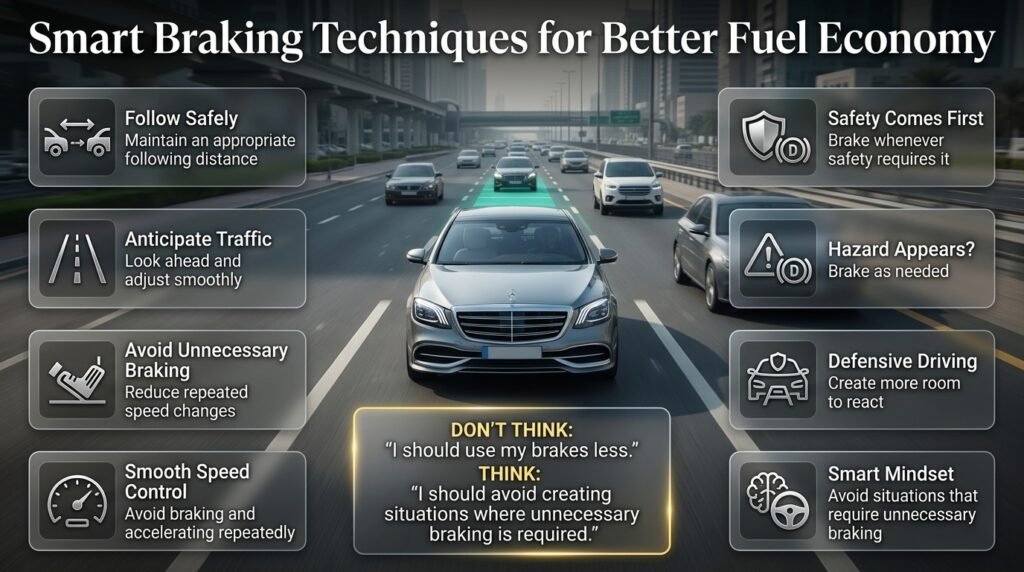
Brakes are essential for safety, so fuel economy should never influence a decision to delay necessary braking.
The fuel-saving opportunity comes from avoiding unnecessary braking rather than avoiding braking itself.
If you’re following too closely, you may repeatedly brake for minor changes in traffic and then accelerate again. Maintaining an appropriate following distance gives you more room to adjust speed smoothly.
This is why fuel economy and defensive driving often support each other.
For a more detailed explanation, read How Braking Habits Affect Fuel Economy in Dubai.
The Right Mindset About Braking
Don’t think:
“I should use my brakes less.”
Think:
“I should avoid creating situations where unnecessary braking is required.”
Safety always comes first. If a hazard appears, brake as needed.
6. Avoid Unnecessary Idling
Idling means the engine is running while the vehicle isn’t moving. During long waits, this can consume fuel without moving you any distance.
Short stops can be different depending on the vehicle and situation. Modern vehicles often manage fuel during stopping and restarting efficiently, but drivers should follow the manufacturer’s recommendations rather than repeatedly switching the engine on and off in inappropriate situations.
Fuel Consumption While Idling
Fuel consumption while idling occurs when the engine continues running even though the vehicle is stationary. Extended idling during traffic, waiting periods, or parked stops can waste fuel without adding any distance to your journey. Turning the engine off when safe and practical can help reduce unnecessary fuel use, while avoiding frequent and prolonged idle periods supports better overall efficiency. In hot climates like Dubai, drivers should also balance fuel-saving efforts with passenger comfort and safety.
For practical advice on minimizing unnecessary fuel use during stationary periods, 👉 Fuel Consumption While Idling explains how prolonged idling can affect fuel efficiency.
Avoid unnecessary idling when:
- Waiting for someone for an extended period
- Parked while using the vehicle as a stationary air-conditioned room
- Stopped for non-driving activities
- Sitting in a predictable long-duration queue where local conditions allow safe engine-off operation
Never turn off the engine in a situation where doing so could compromise safety, visibility, climate needs for vulnerable occupants, or your ability to respond quickly.
7. Use Air Conditioning Sensibly
Air conditioning can increase fuel consumption because the system requires energy from the vehicle.
That doesn’t mean you should avoid air conditioning in hot weather. In places such as Dubai, climate control is often a practical necessity.
Instead, use it intelligently.
Practical Air-Conditioning Habits
- Park in shade when possible.
- Ventilate a very hot cabin briefly before intensive cooling when conditions allow.
- Set a comfortable temperature rather than an unnecessarily extreme setting.
- Keep windows closed at higher road speeds when air conditioning is being used.
- Maintain the air-conditioning system properly.
- Replace or inspect filters according to the vehicle manufacturer’s recommendations.
A common mistake is turning the climate system to maximum cooling and leaving it there throughout every journey regardless of cabin temperature.
The goal is comfort with sensible energy use—not discomfort in pursuit of tiny fuel savings.
Air Conditioning and Fuel Consumption
Air conditioning can have a noticeable effect on fuel consumption, especially during hot weather and heavy traffic. When the AC system is running, the engine needs additional power to operate the compressor, which can increase fuel use. In Dubai’s hot climate, however, avoiding AC completely is not practical or comfortable. A better approach is to use the system efficiently by parking in shade when possible, ventilating the cabin briefly before cooling it, maintaining the AC system properly, and avoiding unnecessary idling with the AC running. These simple habits can help reduce unnecessary fuel consumption while keeping the cabin comfortable.
For practical tips on reducing unnecessary fuel consumption while keeping your car comfortable in Dubai’s hot climate, explore our detailed Air Conditioning and Fuel Consumption guide, which explains how AC use, traffic, idling, driving speed, and vehicle maintenance can affect overall fuel economy.
8. Keep Tyres Properly Inflated
Tyre pressure directly affects rolling resistance, handling, tyre wear, and fuel economy.
Underinflated tyres generally create greater rolling resistance, meaning the engine has to work harder to move the vehicle.
Check tyre pressure when the tyres are cold and use the pressure recommended by the vehicle manufacturer. Don’t automatically use the maximum pressure printed on the tyre sidewall as your everyday target.
Also remember that tyre pressure can change with temperature.
Tyre Pressure Checklist
- Check pressure regularly.
- Follow the vehicle manufacturer’s recommended pressure.
- Inspect tyres for visible damage.
- Check pressure before long journeys.
- Don’t rely only on visual inspection.
- Monitor the spare tyre if your vehicle has one.
📌 Quick Tip: Proper tyre pressure is a maintenance habit, not just a fuel-saving trick. Correct pressure also supports predictable handling and tyre life.
Tire Pressure and Fuel Efficiency
Tire pressure plays an important role in fuel efficiency because underinflated tires create greater rolling resistance, forcing the engine to work harder and potentially increasing fuel consumption. Maintaining the recommended tire pressure can help your vehicle roll more efficiently while also supporting better handling, braking, and tire wear. In Dubai’s hot climate, checking tire pressure regularly is especially useful because temperature changes can affect pressure readings. Always follow the vehicle manufacturer’s recommended pressure rather than relying on the maximum pressure printed on the tire sidewall.
For practical guidance on maintaining the correct tire pressure, reducing unnecessary rolling resistance, and supporting better fuel economy in Dubai’s driving conditions, read our detailed Tire Pressure and Fuel Efficiency guide.
9. Reduce Unnecessary Vehicle Weight
Carrying heavy objects that you don’t need can increase the energy required to move the vehicle, particularly during acceleration and stop-and-go driving.
This doesn’t mean removing every useful item from the car. Emergency equipment, tools, child seats, and other necessary items should remain available.
Instead, remove unnecessary loads that have accumulated over time.
For example, a boot filled with unused equipment, old boxes, heavy tools, or other items may add weight without providing any benefit during normal commuting.
Simple rule: if you don’t need it for the journey and don’t need it in the vehicle, consider removing it.
How Vehicle Weight Affects Fuel Economy
How vehicle weight affects fuel economy is most noticeable during acceleration, frequent stops, and uphill driving because a heavier vehicle requires more energy to move. Carrying unnecessary luggage, tools, or equipment can therefore increase fuel consumption and reduce mileage. Removing items that are not needed can help lower the vehicle’s workload and support better efficiency. However, weight is only one factor, alongside driving habits, tire pressure, traffic, and vehicle condition. Keeping the vehicle sensibly loaded can help make everyday and long-distance driving more economical.
For practical guidance on managing vehicle load and reducing unnecessary fuel consumption, 👉 How Vehicle Weight Affects Fuel Economy explains how excess weight can influence mileage and efficiency.
How Aerodynamics Affects Fuel Efficiency
Aerodynamics plays an important role in fuel efficiency, especially when a vehicle is traveling at higher speeds. As speed increases, air resistance creates more drag, requiring the engine to use additional energy to keep the vehicle moving. Features such as roof racks, cargo boxes, open windows, and bulky external accessories can increase aerodynamic drag and contribute to higher fuel consumption. Keeping the vehicle streamlined, removing unnecessary external equipment, and maintaining a sensible highway speed can help reduce resistance and support more efficient driving.
For a clearer understanding of how air resistance, vehicle design, speed, roof accessories, and external load can influence your car’s fuel consumption, explore our detailed How Aerodynamics Affects Fuel Efficiency guide.
Car Load and Fuel Consumption
Car load and fuel consumption are closely connected because extra weight can make the engine work harder, especially during acceleration, uphill driving, and frequent stops. Carrying unnecessary luggage, tools, or equipment may gradually increase fuel consumption and reduce mileage. Removing items that are not needed can help reduce the vehicle’s workload and support better efficiency. However, driving style, tire pressure, traffic, and vehicle condition also affect fuel economy. Keeping your car sensibly loaded is a simple way to support more economical driving.
For practical guidance on managing vehicle load and minimizing fuel waste, 👉 Car Load and Fuel Consumption explains how excess weight can affect fuel efficiency.
10. Remove Unnecessary Roof Loads
Roof boxes, racks, carriers, and other external accessories can affect aerodynamics.
The effect can become more noticeable at highway speeds because aerodynamic drag increases with speed.
If a roof-mounted accessory isn’t needed, removing it can improve aerodynamic efficiency.
This is particularly relevant for drivers who use roof equipment only occasionally. Leaving a roof box permanently installed when it isn’t needed can create unnecessary aerodynamic resistance.
Roof Racks and Fuel Economy
Roof racks and fuel economy are closely connected because external equipment can increase aerodynamic drag and make the engine work harder, particularly at highway speeds. An empty roof rack may still affect airflow, while loaded racks, roof boxes, or bulky equipment can increase resistance even further. Removing the rack when it is not needed can help reduce unnecessary drag and support better fuel efficiency. Proper installation and sensible loading are also important for maintaining stable airflow and avoiding unnecessary fuel consumption during longer journeys.
For practical guidance on reducing aerodynamic drag and improving efficiency when using roof-mounted equipment, 👉 Roof Racks and Fuel Economy explains how roof racks can influence fuel consumption.
11. Plan Trips Before You Drive
Fuel efficiency doesn’t begin when you press the accelerator. It can begin before you leave home.
Combining multiple errands into one trip can reduce unnecessary mileage. Choosing a practical route can also reduce time spent in congestion.
For example:
Poor planning:
Home → shop → home → office → another shop → home
Better planning:
Home → shop → office → second shop → home
The exact route depends on your schedule, but combining destinations can eliminate unnecessary journeys.
Navigation apps can help identify congestion, although the shortest route isn’t always the most fuel-efficient route. A slightly longer route with smoother traffic may sometimes use less fuel than a shorter route involving repeated stops.
Improving Fuel Economy on Long Trips
Improving fuel economy on long trips starts with maintaining a steady speed and avoiding sudden acceleration or unnecessary braking. Before departure, check tire pressure, remove excess weight, and ensure the vehicle is properly maintained. Planning the route can also help reduce detours, congestion, and unnecessary fuel use. Using air conditioning sensibly and avoiding prolonged idling during stops can further support better mileage. These practical habits can make long-distance journeys smoother, more economical, and fuel-efficient.
For practical strategies to reduce fuel consumption and improve mileage on extended journeys, 👉 Improving Fuel Economy on Long Trips offers useful guidance for more economical long-distance driving.
Long-Distance Driving Fuel Efficiency Tips
Long-distance driving fuel efficiency tips can help you achieve better mileage while reducing unnecessary fuel consumption on extended journeys. Maintain a steady speed, accelerate smoothly, and avoid frequent braking whenever traffic conditions allow. Before starting the trip, check tire pressure, remove unnecessary cargo, and make sure the vehicle is properly maintained. Planning your route and fuel stops can also reduce detours and inefficient driving. These simple practices can make long-distance travel more economical, comfortable, and fuel-efficient.
For practical ways to improve mileage and reduce fuel waste during extended journeys, 👉 Long-Distance Driving Fuel Efficiency Tips provides useful guidance for more economical driving.
12. Don’t Carry the “Fuel-Saving” Idea Too Far
Some drivers become so focused on fuel economy that they create unsafe or impractical habits.
Avoid:
- Driving below appropriate traffic speed
- Delaying necessary braking
- Switching off safety-related systems
- Driving aggressively to maintain momentum
- Following other vehicles too closely
- Coasting in ways not recommended by the manufacturer
- Ignoring warning lights or mechanical problems
Fuel economy should be a secondary benefit of good driving—not a reason to compromise safety.
A Practical Fuel-Efficient Driving Routine
If you want a simple routine to follow every day, use this sequence.
Step 1: Prepare the Vehicle
Check tyres, remove unnecessary weight, and make sure the vehicle is mechanically healthy.
Why it matters: A poorly maintained vehicle can waste fuel regardless of how carefully you drive.
Step 2: Plan the Journey
Combine errands and consider traffic conditions.
Professional advice: Don’t obsess over finding the shortest route. A smooth route can sometimes be more useful than a route filled with stops.
Step 3: Accelerate Progressively
Reach the appropriate road speed without aggressive throttle inputs.
Common mistake: Accelerating hard simply because the road is clear.
Step 4: Look Ahead
Watch traffic signals, brake lights, queues, lane changes, and road conditions.
Why it matters: Early observation allows smoother speed adjustments.
Step 5: Maintain Momentum
When conditions permit, maintain a consistent speed instead of constantly changing it.
Step 6: Brake Smoothly When Required
Never sacrifice safety for fuel economy.
Professional advice: Create more space and anticipate traffic rather than trying to eliminate braking altogether.
Step 7: Avoid Unnecessary Idling
If you’re going to remain stationary for a meaningful period, consider whether the engine needs to keep running, provided doing so is safe and appropriate for the vehicle.
Car Idling Fuel Consumption
Car idling fuel consumption can increase unnecessarily when the engine remains running while the vehicle is stationary. Extended idling during traffic, waiting periods, or parking consumes fuel without adding any distance to the journey. Reducing unnecessary idle time can therefore help improve overall fuel efficiency and lower fuel waste. In Dubai’s hot climate, drivers should balance fuel-saving practices with comfort and safety, especially when air conditioning is needed. Smart idling habits, combined with smooth driving, can contribute to better mileage over time.
For practical guidance on reducing unnecessary fuel use while your vehicle is stationary, 👉 Car Idling Fuel Consumption in Dubai explains how prolonged idling can affect fuel efficiency.
Step 8: Review Your Results
Track fuel consumption over several refills rather than judging efficiency from one short trip.
Which Driving Habits Save the Most Fuel?
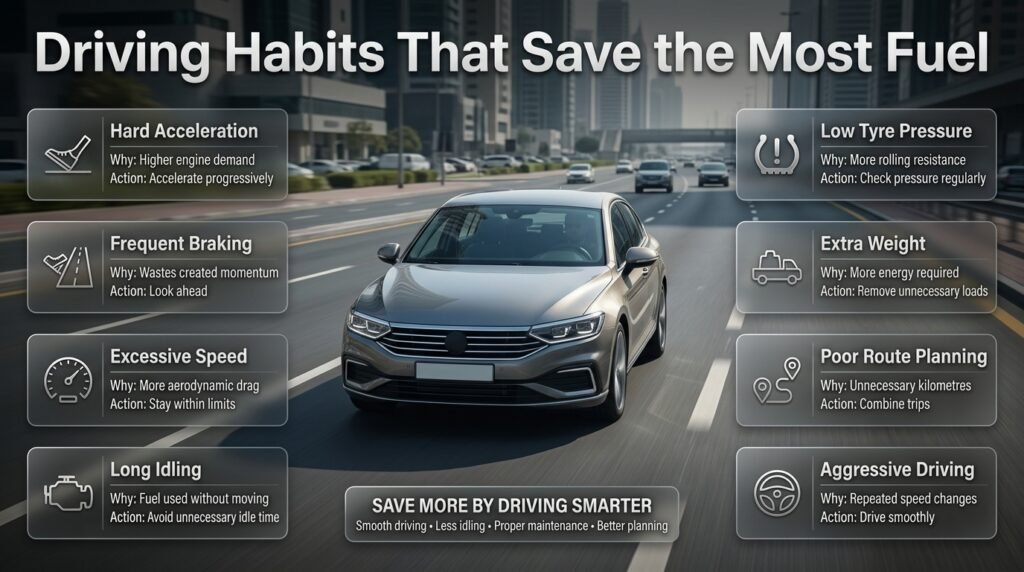
The biggest gains usually come from reducing aggressive driving, unnecessary speed changes, excessive speed, long idling, and poor vehicle maintenance.
| Habit | Why it matters | Practical action |
| Hard acceleration | Increases engine demand | Accelerate progressively |
| Frequent braking | Wastes previously created momentum | Look ahead |
| Excessive speed | Increases aerodynamic drag | Stay within limits |
| Long idling | Burns fuel without moving | Avoid unnecessary idle time |
| Low tyre pressure | Increases rolling resistance | Check pressure regularly |
| Extra weight | Requires more energy to move | Remove unnecessary loads |
| Poor route planning | Adds unnecessary kilometres | Combine trips |
| Aggressive driving | Creates repeated speed changes | Drive smoothly |
Common Fuel-Efficient Driving Mistakes Beginners Make
Driving Too Slowly
Some people assume the slower they drive, the more fuel they save.
That’s too simplistic. Driving speed should remain appropriate for the road, traffic, and legal limits. Extremely slow driving can create safety and traffic-flow problems.
Accelerating Slowly but Constantly
Gentle acceleration is useful, but unnecessarily long acceleration can keep the vehicle from reaching an efficient cruising condition.
The better approach is smooth and purposeful acceleration.
Braking at the Last Second
Late braking often follows poor anticipation. It can create harsh deceleration followed by another hard acceleration.
Look further ahead and make earlier, smoother adjustments.
Ignoring Tyre Pressure
Many drivers wait until a tyre looks obviously low.
That’s unreliable. A tyre can be underinflated without appearing dramatically different.
Chasing Tiny Fuel Savings
Saving fuel should fit naturally into your driving routine. If a technique makes driving stressful, unsafe, or impractical for a tiny potential benefit, it’s probably not worth using.
⚠️ Common Mistake: Treating fuel economy as a competition. The best strategy is a collection of sensible habits that you can maintain consistently.
Expert Advice for Better Real-World Fuel Economy
Professional-style fuel-saving advice is less about one secret trick and more about consistency.
First, focus on the largest controllable factors: speed, acceleration, braking, idling, tyre condition, vehicle load, and maintenance.
Second, measure your actual fuel economy. If you normally get a certain fuel consumption and suddenly notice a substantial decline, don’t automatically blame your driving. Changes in tyre pressure, traffic, air conditioning, load, mechanical condition, fuel quality, or driving pattern can all contribute.
Third, compare similar journeys. A highway trip shouldn’t be compared directly with a short urban trip because traffic, warm-up time, stops, and average speed can make the conditions very different.
Finally, remember that fuel economy is not about making every journey perfect. It’s about eliminating waste where doing so is easy.
Fuel-Efficient Driving Techniques for Dubai Traffic
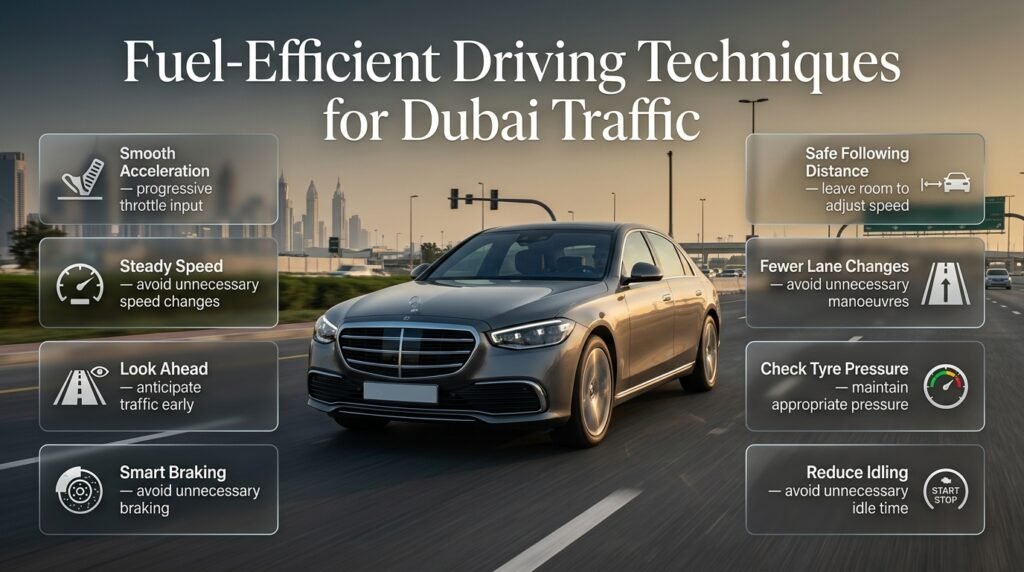
Dubai driving can involve highways, urban roads, heavy traffic, frequent lane changes, traffic signals, high temperatures, and extensive air-conditioning use. That combination makes smooth driving particularly valuable.
In busy traffic, don’t constantly chase small gaps. Sudden acceleration followed by immediate braking rarely saves meaningful time.
Instead:
- Maintain a suitable following distance.
- Look several vehicles ahead.
- Avoid unnecessary lane changes.
- Accelerate smoothly when traffic begins moving.
- Prepare for predictable slowdowns.
- Use air conditioning sensibly.
- Check tyre pressure regularly, especially when temperatures change.
- Avoid unnecessary idling while parked.
For a broader guide to everyday fuel-saving habits, see Fuel-Saving Driving Tips.
Stop and Go Driving Fuel Efficiency
Stop and go driving fuel efficiency can be reduced by frequent acceleration, braking, and repeated stops in congested traffic. Each acceleration from a standstill requires additional engine power, while frequent braking wastes momentum that could otherwise support better mileage. Maintaining a safe following distance and anticipating traffic flow can help reduce unnecessary speed changes. Smooth, controlled driving is generally more efficient than aggressive stop-and-start movements. These habits can help minimize fuel waste and improve overall fuel economy in busy driving conditions.
For practical strategies to reduce fuel waste during repeated stops and starts, 👉 Stop and Go Driving Fuel Efficiency offers useful guidance for smoother, more economical driving.
How Traffic Affects Fuel Economy
How traffic affects fuel economy becomes particularly important when frequent stops, slow movement, and repeated acceleration increase the engine’s workload. Stop-and-go conditions can waste fuel because the vehicle repeatedly uses energy to accelerate and then loses that momentum through braking. Long waits may also lead to unnecessary idling, further increasing fuel consumption. Maintaining a safe following distance and anticipating traffic changes can help reduce sudden speed adjustments. By driving smoothly and planning routes carefully, drivers can improve fuel economy even in busy traffic conditions.
For practical ways to reduce fuel waste in congested conditions, 👉 How Traffic Affects Fuel Economy in Dubai explains how traffic patterns and driving habits can influence fuel efficiency.
How to Reduce Fuel Use in Traffic
How to reduce fuel use in traffic starts with smoother acceleration, gentle braking, and avoiding unnecessary engine idling. Maintaining a safe following distance gives you more time to anticipate traffic changes and reduces repeated stop-and-go movements. Planning your route to avoid severe congestion when practical can also limit wasted fuel and travel time. Keeping your vehicle properly maintained, including correct tire pressure, further supports efficient driving. By adopting these simple habits, drivers can reduce unnecessary fuel consumption and improve everyday fuel economy.
For practical strategies to save fuel during congested journeys, 👉 How to Reduce Fuel Use in Traffic provides useful guidance for more efficient traffic driving.
Smooth Driving vs Aggressive Driving
| Smooth driving | Aggressive driving |
| Progressive acceleration | Hard acceleration |
| Predictable speed | Constant speed changes |
| Early traffic observation | Last-second reactions |
| Appropriate following distance | Tailgating |
| Controlled braking | Hard braking |
| Fewer unnecessary lane changes | Frequent lane changes |
| Better comfort | More stressful driving |
Smooth driving isn’t only about fuel. It can also make journeys more comfortable for passengers and reduce unnecessary stress on the vehicle’s braking and drivetrain components.
For more detail, explore Smooth Driving Techniques for Better Fuel Economy in Dubai.
What are the most effective fuel-efficient driving techniques?
The most effective fuel-efficient driving techniques are smooth acceleration, maintaining a steady speed, anticipating traffic, avoiding unnecessary high speeds, reducing unnecessary idling, and keeping tyres correctly inflated. The important point is that fuel economy doesn’t usually improve because of one magic trick. It improves when several small driving habits work together consistently.
A driver who repeatedly accelerates hard, brakes late, sits idling, and drives at unnecessarily high speeds can use considerably more fuel than someone who drives smoothly under the same general conditions. Research summarized by the U.S. Department of Energy indicates that aggressive driving can reduce fuel economy by roughly 10–40% in stop-and-go traffic and 15–30% at highway speeds, although the actual effect varies by vehicle and conditions.
The habits worth prioritizing are:
Accelerate progressively instead of making aggressive starts.
Look ahead and anticipate traffic.
Maintain a suitable, steady speed when conditions allow.
Avoid unnecessarily high speeds.
Reduce prolonged unnecessary idling.
Keep tyres at the vehicle manufacturer’s recommended pressure.
Remove unnecessary cargo and unused roof equipment.
Combine errands where practical.
The biggest improvement usually comes from changing your overall driving pattern, rather than trying to save fuel with one isolated technique.
Does driving faster use more fuel, and what is the best speed for fuel economy?
Driving faster generally increases fuel consumption, particularly at higher road speeds, because aerodynamic resistance becomes increasingly significant. There isn’t one universal speed that is most fuel-efficient for every car, so drivers shouldn’t chase a specific number at the expense of safety or legal requirements. The practical approach is to follow the speed limit and avoid unnecessarily high speeds.
For example, Natural Resources Canada notes that many conventional cars, vans, pickups, and SUVs are most fuel-efficient in a broad range around 50–80 km/h, while fuel use generally rises as speed increases beyond that range. It also reports that travelling at 120 km/h can use about 20% more fuel than travelling at 100 km/h under its example conditions.
This doesn’t mean you should drive at 50 or 60 km/h on a highway. Road design, traffic flow, and posted limits matter first.
For better real-world fuel economy:
Stay within the posted speed limit.
Avoid unnecessary high-speed cruising.
Use cruise control on suitable open roads when appropriate.
Don’t repeatedly speed up and slow down.
Choose a speed that allows smooth, predictable driving.
The smart question isn’t “What is the slowest speed I can drive?” It’s “What is an appropriate legal speed that lets me travel smoothly without unnecessary fuel use?”
How does acceleration affect fuel consumption?
Acceleration has a direct effect on fuel consumption because the engine needs to produce additional power to increase the vehicle’s speed. Hard, rapid acceleration generally uses more fuel than progressive acceleration, particularly when it is followed by immediate braking. Fuel-economy guidance therefore recommends accelerating smoothly and avoiding unnecessary speed changes.
A common real-world example is approaching a red traffic signal. A driver may accelerate aggressively from one signal, reach high speed, and then discover that traffic ahead has already stopped. The driver then brakes heavily and has to accelerate again when the light changes.
A smoother driver sees the signal and traffic earlier, builds speed normally, and begins reducing speed sooner when necessary.
A better acceleration habit looks like this:
Press the accelerator progressively.
Reach the desired speed without excessive throttle.
Avoid racing away from traffic lights.
Look ahead before accelerating.
Don’t accelerate toward a queue or red light.
Once at cruising speed, maintain it where conditions permit.
Smooth acceleration doesn’t mean crawling away from every junction. It means using only the acceleration needed to reach the appropriate speed efficiently and safely.
Does braking reduce fuel economy?
Braking doesn’t mean you are directly “burning fuel,” but unnecessary braking can lead to higher fuel consumption because it removes momentum that the engine previously used fuel to create. If you repeatedly accelerate, brake, and accelerate again, the vehicle has to rebuild that speed repeatedly. Anticipating traffic can reduce this unnecessary cycle.
This is why good fuel-efficient driving isn’t about avoiding the brakes completely. Safety comes first. If you need to brake because of another vehicle, pedestrian, obstacle, signal, or road condition, brake properly.
The fuel-saving opportunity is to avoid situations where poor anticipation causes unnecessary braking.
For example:
Instead of:
Hard acceleration → late braking → complete stop → hard acceleration
Aim for:
Observe traffic → ease off accelerator → reduce speed smoothly → continue when appropriate
Maintaining a sensible following distance also gives you more time to respond to changes in traffic.
Remember these points:
Never delay necessary braking to save fuel.
Look farther ahead.
Maintain a suitable following distance.
Avoid tailgating.
Reduce speed early when a slowdown is clearly developing.
Try to keep traffic movements smooth rather than constantly changing speed.
Good anticipation can improve both fuel efficiency and driving safety, which makes it one of the most valuable habits to develop.
How can I save fuel while driving in heavy city traffic?
Heavy city traffic makes fuel-efficient driving more challenging because frequent stopping, acceleration, braking, and idling can increase fuel consumption. The best strategy isn’t to fight the traffic by constantly changing lanes or accelerating aggressively. Instead, look ahead, maintain a safe gap, anticipate slowdowns, and keep your speed changes as smooth as traffic allows.
For example, if you can already see that traffic is slowing 100–200 metres ahead, there’s little benefit in accelerating hard to close the gap. Ease off the accelerator and let the traffic flow determine your speed.
In busy Dubai conditions, this approach is particularly practical because journeys can involve traffic signals, queues, merging vehicles, multilane roads, and frequent speed changes.
Useful city-driving habits include:
Watch several vehicles ahead instead of only the car directly in front.
Keep a comfortable following distance.
Avoid unnecessary lane changes.
Don’t accelerate aggressively into short gaps.
Reduce unnecessary idling when safely appropriate.
Combine errands to reduce total kilometres.
Check tyre pressure regularly.
Use air conditioning sensibly in hot weather.
One more point is often overlooked: trip planning matters. Combining several short errands into one practical journey can reduce unnecessary mileage, while avoiding predictable congestion can reduce time spent idling and repeatedly accelerating.
The goal in city traffic isn’t to make every metre of the journey perfectly efficient. It’s to avoid creating additional fuel waste through aggressive reactions to traffic.
Conclusion
Fuel-efficient driving is not about driving unusually slowly or sacrificing comfort. It is about making smarter decisions behind the wheel so the vehicle uses fuel more efficiently during everyday driving. Smooth acceleration, maintaining a steady speed, anticipating traffic, avoiding unnecessary idling, and braking progressively can all help reduce unnecessary fuel consumption.
For Dubai drivers, these habits are particularly useful because stop-and-go traffic, frequent short trips, high-speed roads, and heavy air-conditioning use can all influence fuel economy. A small improvement in driving behavior may not seem significant on a single trip, but consistent habits can make a noticeable difference over weeks and months.
The most effective approach is to combine fuel-efficient driving techniques with proper vehicle maintenance. Correct tyre pressure, a well-maintained engine, clean filters, suitable engine oil, and timely servicing help the vehicle operate as efficiently as possible.
If you want to learn more about practical fuel-saving strategies and fuel-related guidance for Dubai drivers, explore Fuel Delivery Dubai for additional automotive fuel information and helpful resources.
Ultimately, better fuel economy comes from consistency. By anticipating the road ahead, avoiding aggressive driving, maintaining your vehicle properly, and using fuel wisely, you can reduce unnecessary fuel consumption while making everyday driving smoother, safer, and more economical.
Leave a Reply