Introduction
Essential Roadside Emergency Items | A vehicle can be perfectly fine when you leave home and still develop a problem several hours later. A flat tyre, discharged battery, empty fuel tank, overheating warning, damaged hose, or unexpected roadside delay can quickly turn an ordinary drive into a stressful situation.
The good news is that you don’t need to carry a huge workshop in your car to be better prepared. A carefully selected set of essential roadside emergency items can help you stay visible, communicate with assistance, handle simple problems safely, and remain more comfortable while waiting for professional help.
Whether you’re commuting around the city, driving across Dubai, travelling on a highway, or preparing for a long road trip, emergency preparation should be part of your normal vehicle routine. Before a longer journey, you can also visit FuelDeliveryDubai for additional information about fuel emergencies and roadside preparation.
This guide explains what belongs in a practical roadside emergency kit, why each item matters, what to check before a journey, which mistakes to avoid, and how to prepare differently for fuel problems, tyre problems, battery issues, highway breakdowns, and longer trips.
What Are Essential Roadside Emergency Items?
Essential roadside emergency items are practical supplies kept inside a vehicle to help a driver respond safely to unexpected situations such as a flat tyre, battery problem, fuel shortage, mechanical breakdown, poor visibility, or an extended roadside wait.
The most useful items generally fall into four categories:
- Safety and visibility equipment
- Communication and power supplies
- Vehicle emergency equipment
- Personal comfort and basic emergency supplies
A sensible kit doesn’t have to contain every tool available. Instead, it should contain the items that can make the biggest difference during a realistic roadside problem.
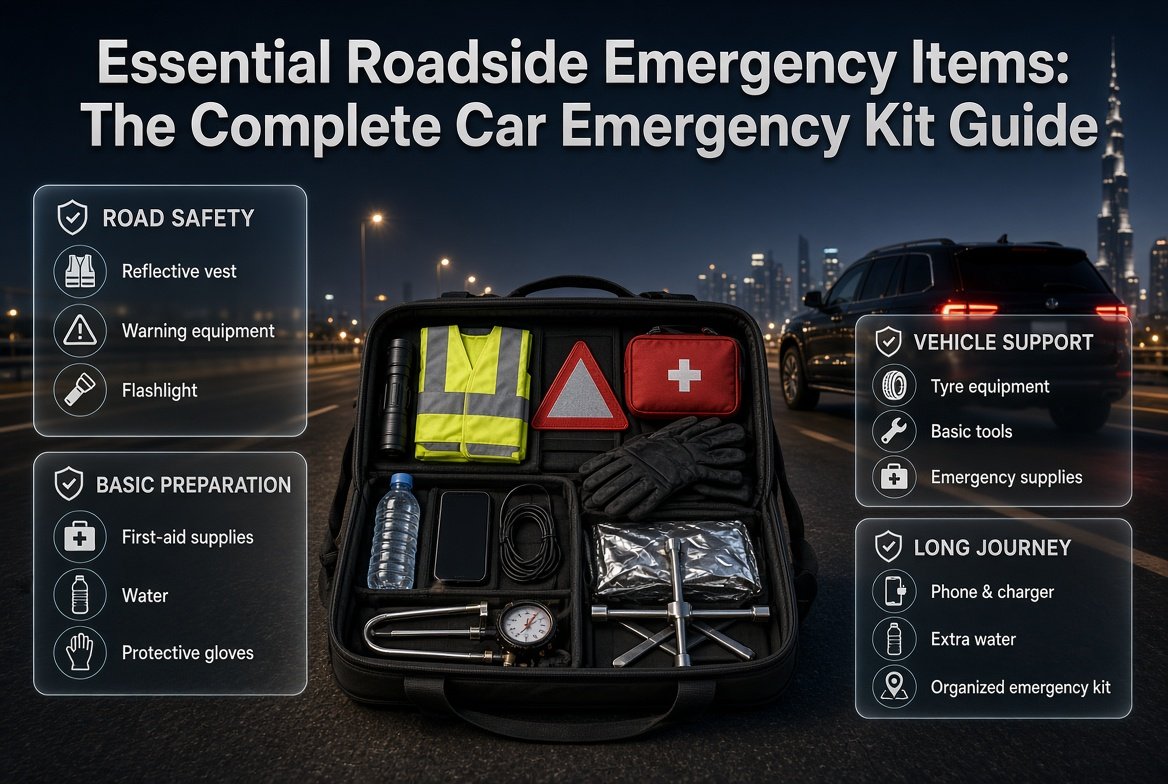
A basic kit may include:
- Mobile phone and charging cable
- Power bank
- Flashlight
- Reflective vest
- Warning triangle or appropriate warning device
- First-aid kit
- Drinking water
- Non-perishable snacks
- Work gloves
- Tyre-pressure gauge
- Spare tyre and required changing equipment where applicable
- Jumper cables where suitable for the vehicle
- Basic tools
- Emergency blanket
- Vehicle and roadside-assistance information
NHTSA similarly recommends carrying an emergency roadside kit because even a well-maintained vehicle can experience a breakdown. Its suggested equipment includes communication equipment, first aid, lighting, tyre equipment, jumper cables, tools, water, food, maps, and emergency blankets.
Why Is a Roadside Emergency Kit Important?
The purpose of an emergency kit isn’t necessarily to repair every vehicle problem yourself.
Its main purpose is to help you manage the situation safely until the problem can be resolved.
For example, imagine your car stops unexpectedly at night. You may not be able to repair the vehicle, but a flashlight can help you see, a reflective vest can make you more visible, a phone can help you contact assistance, and a power bank can keep that phone available if the vehicle battery is no longer supplying power.
That difference is important.
Good emergency preparation is about reducing uncertainty.
Instead of asking:
“How am I going to deal with this?”
you already have a basic plan and the equipment needed to follow it.
What does an emergency kit help you do?
A practical kit can help you:
- Make yourself more visible
- Communicate with assistance
- Inspect a simple problem
- Check tyre pressure
- Deal with a flat tyre when appropriate
- Protect your hands
- Stay hydrated
- Remain comfortable during delays
- Provide basic first aid
- Keep important information accessible
However, equipment should never encourage you to take unnecessary risks. If the vehicle is stopped in a dangerous traffic environment, personal safety should come before attempting a repair.
What Should Every Driver Keep in the Car?
A good starting point is to divide your emergency equipment into essential, useful, and situation-specific items.
| Item | Main Purpose | Priority |
|---|---|---|
| Mobile phone | Communication | Essential |
| Charging cable | Phone power | Essential |
| Power bank | Backup power | Essential |
| Flashlight | Visibility | Essential |
| Reflective vest | Personal visibility | Essential |
| Warning device | Warn approaching traffic | Essential |
| First-aid kit | Minor injuries | Essential |
| Drinking water | Hydration | Essential |
| Tyre-pressure gauge | Tyre checking | Essential |
| Spare tyre/equipment | Flat tyre response | Vehicle dependent |
| Jumper cables | Battery assistance | Useful |
| Work gloves | Hand protection | Useful |
| Basic tools | Minor tasks | Useful |
| Emergency blanket | Extended waits | Useful |
| Snacks | Longer delays | Useful |
The exact contents should be adjusted according to your vehicle and driving environment.
For example, a driver who regularly travels long distances may need more personal supplies than someone who only drives short urban journeys.
1. Mobile Phone and Charger
Your mobile phone is arguably one of the most important emergency items you can carry.
A roadside problem may require you to contact:
- Roadside assistance
- Emergency services
- A towing provider
- Your insurance company
- Family members
- A vehicle recovery service
A phone also allows you to communicate your location and describe the problem.
However, a phone becomes much less useful when its battery is almost empty.
That’s why the phone should be paired with a reliable charging solution.
Before a long journey, check that:
- Your phone is sufficiently charged
- The charging cable works
- Your vehicle charging port works
- Important contact numbers are accessible
- Location services work when needed
Don’t wait until you are already stranded to discover that your charging cable is damaged.
2. Power Bank
A power bank is a simple backup for your phone.
It becomes particularly useful when:
- The vehicle battery is discharged
- You don’t want to keep the vehicle running
- The charging port isn’t working
- You are waiting for assistance for an extended period
Keep the power bank charged and store it somewhere accessible.
A common mistake is buying a power bank, placing it inside the emergency kit, and never checking it again.
How often should you check it?
A quick check every few months is enough for most drivers.
If you use it, recharge it afterward.
⭐ Expert Tip: Treat the power bank as emergency equipment rather than your everyday charging device. That makes it less likely to be missing when you actually need it.
3. Flashlight
A flashlight is one of the most practical roadside items.
It can help you see:
- Around the vehicle
- Inside the engine compartment
- Around a tyre
- Inside the trunk
- In dark parking areas
- During nighttime emergencies
Using your phone’s flashlight is possible, but it uses the same battery you may need for emergency calls and communication.
A separate flashlight therefore provides an additional layer of preparedness.
Choose one that is compact, easy to operate, and suitable for your normal driving conditions.
If it uses replaceable batteries, check those batteries regularly. If it is rechargeable, make sure it remains charged.
4. Reflective Vest
A reflective vest can improve your visibility when you need to be outside the vehicle.
This can be particularly useful during:
- Nighttime breakdowns
- Flat-tyre situations
- Roadside inspections
- Waiting for recovery assistance
The vest should be stored somewhere accessible.
There’s little benefit in having one if it’s buried under luggage in the deepest part of the trunk.
⚠ Common Mistake: Don’t treat a reflective vest as permission to stand close to moving traffic. Visibility equipment helps make you easier to see, but it doesn’t eliminate roadside traffic hazards.
5. Warning Triangle or Other Warning Device
A warning triangle or another appropriate warning device can alert approaching road users that your vehicle has stopped.
The exact equipment and placement requirements can vary by location, so drivers should follow applicable local rules.
The most important principle is to avoid putting yourself in danger while trying to place or retrieve warning equipment.
If traffic is heavy or conditions are unsafe, contacting professional assistance may be more appropriate than attempting roadside work.
Warning equipment is especially useful as part of a wider roadside breakdown safety tips plan.
6. First-Aid Kit
A compact first-aid kit is another sensible item for your vehicle.
It can contain basic supplies such as:
- Adhesive bandages
- Gauze
- Medical tape
- Antiseptic wipes
- Disposable gloves
- Other basic wound-care supplies
A first-aid kit isn’t intended to replace professional medical care.
Its purpose is to provide basic support for minor situations while appropriate assistance is being arranged.
Check the contents periodically and replace supplies that have been used or are no longer suitable.
7. Drinking Water
Water is particularly important during long journeys and unexpected delays.
A breakdown that should have taken 20 minutes to resolve can sometimes take much longer because of traffic, distance, weather, or the availability of assistance.
Having drinking water available provides a simple backup.
However, don’t confuse drinking water with vehicle coolant.
If your engine is overheating, don’t automatically open a hot cooling system and pour water into it. Follow the vehicle manufacturer’s instructions and avoid exposing yourself to burns or other hazards.
NHTSA’s emergency-kit guidance also includes drinking water and other personal supplies.
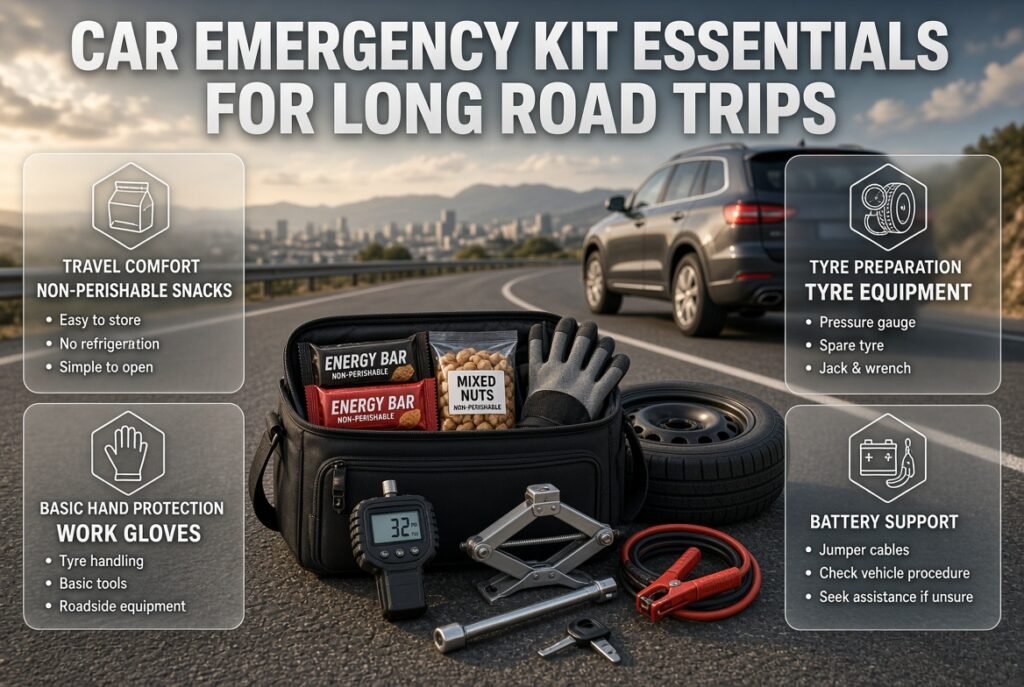
8. Non-Perishable Snacks
Food is easy to overlook because drivers usually expect to reach their destination on schedule.
But an unexpected breakdown can change that plan.
A few suitable non-perishable snacks can be useful during long journeys or extended waits.
Choose food that:
- Stores well
- Doesn’t require refrigeration
- Is easy to open
- Doesn’t make a major mess
- Is appropriate for the people travelling with you
If you’re travelling with children, your emergency food preparation may need to be more comprehensive.
9. Work Gloves
Work gloves are useful for simple vehicle tasks.
They can protect your hands when handling:
- Tyres
- Tools
- Dirty vehicle components
- Roadside equipment
They can also make a basic inspection more comfortable.
You don’t need heavy professional workshop gloves for most emergency kits. A durable pair suitable for basic vehicle work is generally enough.
10. Tyre-Pressure Gauge
A tyre-pressure gauge is a small but useful tool.
It allows you to check whether a tyre is significantly underinflated before starting or continuing a journey.
Correct tyre pressure should be based on your vehicle manufacturer’s recommended specification rather than simply using the maximum pressure printed on the tyre.
NHTSA advises drivers to check tyre pressure and condition before travelling and emphasizes using the vehicle manufacturer’s recommended inflation pressure.
Why does tyre pressure matter?
Incorrect pressure can affect:
- Handling
- Tyre wear
- Driving stability
- Fuel consumption
- Overall tyre performance
A pressure gauge doesn’t replace regular tyre inspections, but it provides useful information when preparing for a journey.
11. Spare Tyre, Jack and Wheel Equipment
If your vehicle is designed to carry a spare tyre, inspect it before a long journey.
Check:
- Spare tyre condition
- Spare tyre pressure
- Jack
- Wheel wrench
- Wheel-lock key if applicable
- Any manufacturer-supplied tyre-changing equipment
A spare tyre without a usable jack isn’t a complete solution.
Likewise, a jack without a suitable wheel wrench may not help much.
Some modern vehicles use a tyre repair kit instead of a traditional spare tyre. Follow the equipment supplied with your vehicle and the manufacturer’s instructions.
12. Jumper Cables
Jumper cables can be useful when a vehicle’s battery has become discharged.
However, they’re not something you should connect blindly.
Different vehicles can have different battery locations, electrical systems, and manufacturer procedures.
Before using jumper cables, consult the owner’s manual and follow the recommended procedure.
If you aren’t confident about what you’re doing, professional roadside assistance is a safer choice.
A battery that repeatedly goes flat may also indicate a deeper problem with the battery or charging system.
For that reason, don’t assume that a jump-start has permanently solved the issue.
13. Basic Vehicle Tools
A compact tool kit can help with simple tasks.
Depending on your vehicle, this might include:
- Screwdrivers
- Pliers
- Small socket set
- Adjustable wrench
- Electrical tape
- Cable ties
The purpose is not to turn your vehicle into a mobile workshop.
Carry tools you understand and can use safely.
A complicated mechanical repair beside an active road can create more risk than benefit.
14. Emergency Blanket
An emergency blanket can be useful when a roadside delay becomes longer than expected.
Its usefulness depends heavily on your climate and journey.
In colder environments, warmth may be the priority.
In hot environments, heat management becomes more important.
The general lesson is to adapt your emergency kit to the conditions you actually drive in rather than copying a generic kit without considering your environment.
15. Paper Towels and Cleaning Supplies
Paper towels can be surprisingly useful.
They can help clean:
- Hands
- Small spills
- Tools
- Dirty vehicle components
- Minor messes inside the vehicle
NHTSA includes paper towels and cleaning-related supplies among its suggested roadside emergency items.
You don’t need a large cleaning kit.
A small roll or compact pack is enough for most situations.
16. Emergency Contact Information
Your phone should contain your important emergency contacts, but a written backup can also be useful.
Consider keeping information such as:
- Roadside assistance number
- Insurance contact
- Vehicle recovery provider
- Emergency contact
- Vehicle information
- Manufacturer assistance details
This is particularly helpful if your phone becomes unavailable.
When contacting assistance, be ready to explain your location and the nature of the problem.
Some roadside assistance systems may also ask for vehicle identification information. The exact process depends on the provider.
17. Vehicle Documents
Keep the documents and information that you are required or expected to carry according to your location and vehicle situation.
This may include relevant:
- Registration information
- Insurance information
- Roadside assistance details
- Vehicle identification information
Avoid carrying unnecessary original documents if a secure digital or legally accepted alternative is available.
Always follow local requirements.
What Should You Keep in Your Car for a Long Road Trip?
A long journey deserves more preparation than a short local trip because you may travel farther from familiar services.
A long-distance emergency kit should cover four areas:
Safety
- Reflective vest
- Warning equipment
- Flashlight
- Gloves
Communication
- Phone
- Charger
- Power bank
- Emergency contacts
Vehicle
- Spare tyre or approved alternative
- Jack
- Wheel wrench
- Tyre-pressure gauge
- Suitable tools
- Jumper cables where appropriate
Personal supplies
- Water
- Food
- First-aid supplies
- Weather-appropriate emergency equipment
Before leaving, you can also review this road trip emergency preparation guide for a broader pre-trip checklist.
For an even more structured approach, the vehicle emergency checklist for long trips can help you combine vehicle checks with emergency preparation.
What Items Are Most Important During a Fuel Emergency?
Fuel problems deserve their own category because running out of fuel can leave a vehicle stationary in an inconvenient location.
Your most useful fuel-emergency equipment is often not a complicated tool.
It is:
- A working phone
- Backup phone power
- Emergency contact information
- Visibility equipment
- Drinking water
- A clear plan for getting assistance
Fuel planning should begin before the warning becomes critical.
If you want to understand how fuel planning fits into a longer journey, read this guide on fuel planning for long distance driving.
You can also learn more about understanding vehicle fuel range and why the displayed range shouldn’t be treated as an absolute guarantee.
How Accurate Is a Car’s Fuel Range?
Modern vehicles may display an estimated remaining range, but that number is an estimate rather than a guarantee.
Actual range can change according to:
- Traffic
- Driving speed
- Road conditions
- Vehicle load
- Air-conditioning use
- Driving style
- Terrain
- Fuel consumption
- Vehicle condition
If you’re unsure how much usable distance remains, don’t deliberately push the vehicle until the tank is empty.
The guide on how accurate is a car fuel gauge explains why fuel readings should be treated as useful information rather than a promise.
Similarly, understanding the low fuel warning light meaning can help you respond before a fuel shortage becomes a roadside emergency.
How Far Can a Car Drive on Low Fuel?
There isn’t one universal answer.
Two vehicles showing a similar low-fuel warning can have very different remaining ranges.
Even the same vehicle can achieve different results depending on driving conditions.
That’s why you shouldn’t treat a low-fuel warning as a challenge to see how far the car can go.
Instead:
- Recognize the warning.
- Reduce unnecessary detours.
- Identify a suitable fuel stop.
- Avoid relying on the final estimated kilometres.
- Refuel before the situation becomes critical.
If you’re interested in the factors involved, see how far can a car drive on low fuel in Dubai.
What Should You Do If Your Car Runs Out of Fuel?
If the vehicle has already stopped because the tank is empty, the priority changes from fuel planning to roadside safety.
First, try to get the vehicle into the safest practical position without creating additional risk.
Then:
- Switch on appropriate hazard warnings.
- Make yourself visible.
- Contact roadside or emergency assistance.
- Provide your location clearly.
- Avoid walking along dangerous roads looking for fuel.
- Wait in an appropriate safe location according to the circumstances.
For a detailed explanation, read what to do when your car runs out of fuel.
You can also review steps after running out of petrol for a practical sequence of actions.
If the vehicle has stopped on an active roadway, the running out of fuel on the road guide provides additional safety considerations.
How Should You Handle an Empty Fuel Tank Safely?
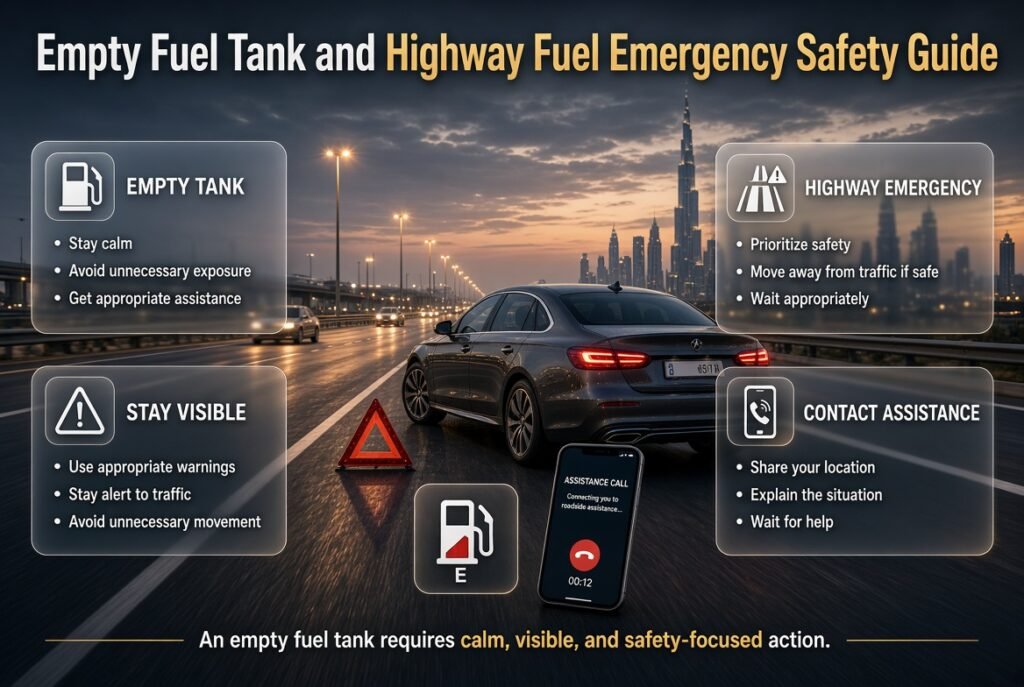
An empty tank can be frustrating, but frustration shouldn’t lead to risky decisions.
Don’t assume that the nearest fuel station is safe to reach on foot.
Don’t stand unnecessarily close to moving traffic.
Don’t attempt improvised fuel-handling methods.
Instead, focus on getting appropriate assistance.
The guide to safely dealing with an empty fuel tank in Dubai provides additional information for drivers dealing with this specific situation.
For situations where the vehicle has stopped completely because of the tank, you can also review car stops due to empty fuel tank.
What If You Run Out of Fuel on a Highway?
A highway fuel emergency requires additional caution because traffic may be moving at higher speeds.
Your emergency kit should support visibility and communication, but your most important decision is where and how you wait for assistance.
If you can safely move the vehicle away from active traffic, do so according to the circumstances.
Once stopped:
- Use appropriate warning systems.
- Stay alert to surrounding traffic.
- Contact assistance.
- Clearly communicate your location.
- Avoid unnecessary movement around the vehicle.
For more detailed guidance, see running out of fuel on a highway and highway fuel emergency safety in Dubai.
What Should You Do During a General Roadside Breakdown?
Not every breakdown is a fuel problem.
Your vehicle could stop because of:
- Battery failure
- Alternator or charging problems
- Tyre damage
- Overheating
- Electrical faults
- Mechanical failure
- Warning-system issues
The first step is always to consider safety.
If the vehicle can be moved safely, position it appropriately.
Then make the vehicle visible, contact assistance, and avoid unnecessary roadside repairs.
For a complete overview, read what to do during a roadside breakdown.
How Can You Stay Safe During a Car Breakdown?
A roadside emergency kit is only useful when combined with good decisions.
If you’re dealing with a breakdown, think in this order:
Safety → Visibility → Communication → Assistance → Vehicle problem
Don’t reverse that order.
A driver may become focused on the mechanical issue and forget that traffic is the greater immediate risk.
For additional guidance, see staying safe during a car breakdown and vehicle breakdown safety procedures.
What Are the Most Important Highway Breakdown Safety Items?
Highway driving changes the priority of your emergency kit.
Visibility equipment becomes particularly important.
Consider keeping:
- Reflective vest
- Appropriate warning device
- Flashlight
- Phone
- Power bank
- Water
- First-aid kit
- Vehicle-specific emergency equipment
However, equipment alone cannot make a dangerous location safe.
The safest response depends on the circumstances, road layout, traffic, vehicle position, weather, and local procedures.
For more information, read highway breakdown safety procedures in Dubai.
How Should You Prepare Before a Long Journey?
Emergency preparation shouldn’t start after the vehicle breaks down.
Before leaving, check the vehicle itself.
NHTSA recommends checking areas such as tyre condition and pressure, fluids, lights, battery and charging system, belts and hoses, and other vehicle components before travel.
A simple pre-trip routine can include:
Tyres
Check condition and recommended pressure.
Battery
Look for warning signs and consider professional testing if the battery is showing symptoms.
Fluids
Check relevant fluid levels according to the owner’s manual.
Lights
Check headlights, brake lights, indicators, and hazard lights.
Fuel
Plan fuel stops before the tank becomes critically low.
Emergency Kit
Confirm that essential items are present and working.
Route
Review the route, expected conditions, and possible stops.
NHTSA also recommends checking weather, road conditions, and traffic and sharing route information and expected arrival time with others when appropriate.
Common Mistakes Drivers Make With Emergency Kits
Keeping the Kit Out of Reach
An emergency kit buried under luggage isn’t very practical.
Why it happens: Drivers prioritize storage space.
Better approach: Keep the most important equipment easily accessible.
Never Checking the Flashlight
A flashlight may sit unused for months.
Why it happens: Drivers assume emergency equipment remains ready indefinitely.
Better approach: Check batteries or charge regularly.
Forgetting the Spare Tyre
Some drivers check the four tyres on the road but forget the spare.
Why it happens: The spare isn’t visible during normal driving.
Better approach: Inspect it periodically.
Carrying Tools You Can’t Use
A huge tool kit doesn’t help if you don’t understand the problem.
Why it happens: More equipment can look like better preparation.
Better approach: Carry simple, appropriate tools and know their basic purpose.
Relying Only on the Fuel Gauge
A fuel gauge can provide useful information, but it doesn’t eliminate the need for fuel planning.
Better approach: Refuel before the tank becomes critically low.
Using Your Phone as the Only Emergency Light
Your phone is primarily a communication device.
Better approach: Keep a dedicated flashlight.
Trying to Repair Everything Yourself
A roadside breakdown can create pressure to solve the problem immediately.
Better approach: If the problem is complicated or the location is unsafe, contact professional assistance.
How Should You Organize Your Emergency Kit?
A simple organization system makes your kit much easier to use.
Section One: Immediate Safety
Store:
- Reflective vest
- Warning equipment
- Flashlight
- Gloves
These items should be quickly accessible.
Section Two: Vehicle Equipment
Store:
- Tyre equipment
- Basic tools
- Jumper cables
- Tyre-pressure gauge
Section Three: Personal Supplies
Store:
- Water
- Snacks
- First-aid kit
- Emergency blanket
- Charging equipment
This approach prevents you from searching through unrelated supplies when something happens.
Essential Items vs Optional Items
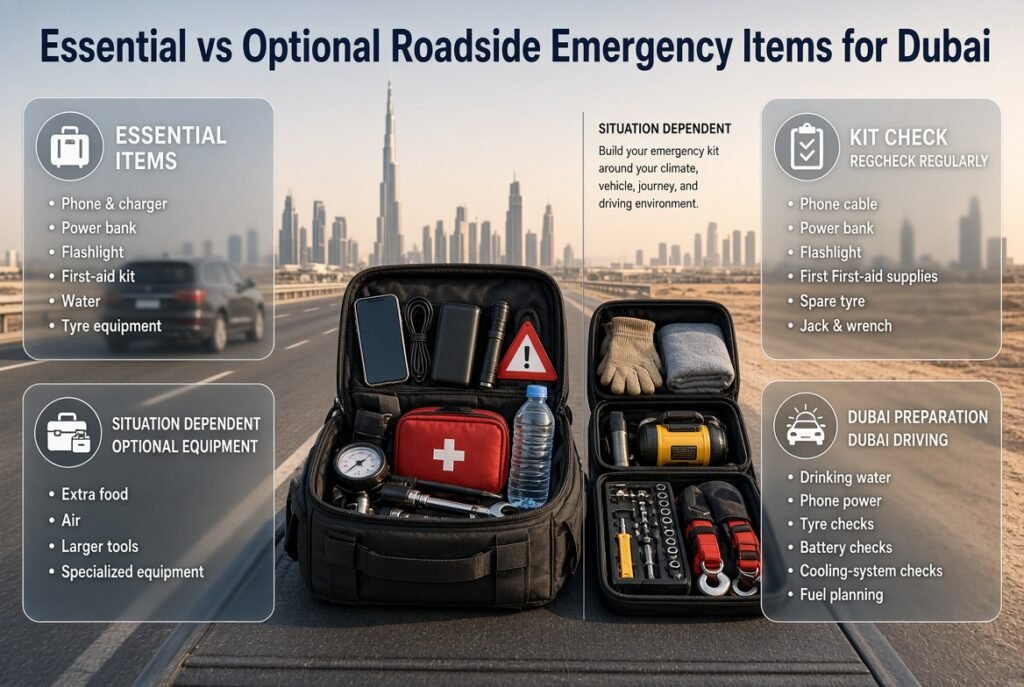
Not every driver needs the same emergency kit.
| Essential for Most Drivers | Depends on Your Situation |
|---|---|
| Phone | Snow equipment |
| Charger | Extra blankets |
| Power bank | Portable air compressor |
| Flashlight | Larger tool kit |
| Visibility equipment | Additional food |
| First-aid kit | Specialized equipment |
| Water | Extra clothing |
| Tyre equipment | Recovery-specific equipment |
Your climate, vehicle, journey length, and driving environment should determine what you add.
A driver in a hot climate may prioritize hydration and heat-aware preparation.
A driver travelling through remote areas may need additional food, water, navigation backup, and communication planning.
How Often Should You Check Your Roadside Emergency Items?
You don’t need to inspect the entire kit every morning.
A periodic check is enough for most items.
Every few months, verify:
- Phone cable works
- Power bank is charged
- Flashlight works
- Batteries are usable
- First-aid supplies are available
- Water is available
- Snacks haven’t become unsuitable
- Spare tyre is present
- Jack is present
- Wheel wrench is present
- Warning equipment is accessible
- Emergency contacts are current
You should also inspect the kit before a major road trip.
If you use something, replace it.
This simple habit prevents the common situation where a driver discovers an empty or damaged emergency kit precisely when it is needed.
How Should the Emergency Kit Change for Dubai Driving?
Driving conditions matter.
In Dubai and other hot environments, vehicle preparation should take heat and long-distance driving conditions seriously.
NHTSA’s current road-trip guidance similarly emphasizes vehicle checks such as cooling-system condition, fluid levels, battery and charging system, lights, tyres, and air-conditioning performance before travel.
For Dubai drivers, useful preparation can include:
- Adequate drinking water
- Reliable phone power
- Good-quality flashlight
- Reflective equipment
- Tyre-pressure checks
- Spare tyre preparation
- Battery condition checks
- Cooling-system checks
- Fuel planning
- Roadside assistance information
The exact equipment should still be based on the vehicle and journey.
Why Fuel Planning Is Part of Roadside Emergency Preparation
Emergency preparation isn’t only about what you carry.
It’s also about what you do before the emergency begins.
Fuel planning is a good example.
If you know you’re travelling a long distance, identify practical fuel stops before departure.
Don’t assume that the displayed remaining range guarantees that you will reach a specific station.
Traffic, detours, weather, vehicle load, and driving conditions can all affect consumption.
If you’re unsure how to estimate remaining fuel, read how to estimate remaining fuel range in Dubai.
What Should You Pack for a Fuel-Focused Long Journey?
A fuel-focused journey doesn’t require a complicated collection of fuel-related equipment.
Instead, prepare around planning and communication.
Consider carrying:
- Charged phone
- Charging cable
- Power bank
- Water
- Emergency contacts
- Vehicle documents
- Appropriate visibility equipment
- Basic vehicle emergency equipment
Most importantly, plan fuel stops before the tank becomes critically low.
If you want to understand the relationship between fuel level and driving distance, review how far can a car drive on low fuel in Dubai.
When Should You Call Roadside Assistance?
Roadside assistance is appropriate when the vehicle problem is beyond your ability to resolve safely.
Examples can include:
- Serious mechanical failure
- Repeated battery failure
- Vehicle overheating
- Unsafe tyre damage
- Vehicle immobilization
- Empty fuel tank
- Electrical problems
- Highway breakdowns
- Situations where you don’t know what caused the failure
You don’t need to prove that you can fix the vehicle before asking for assistance.
Your emergency kit should support the waiting period and improve safety while professional help is arranged.
What Should You Tell Roadside Assistance?
When contacting assistance, give clear information.
Useful details may include:
- Exact or approximate location
- Road name
- Nearby landmark
- Direction of travel
- Vehicle make and model
- Vehicle colour if useful
- Nature of the problem
- Whether anyone is injured
- Whether the vehicle is obstructing traffic
For example:
“My vehicle has stopped on the side of the road. I have a flat tyre and am near [landmark]. I’m travelling toward [direction].”
Clear information can make it easier for the provider to understand the situation.
What Should You Do While Waiting for Assistance?
Once help has been contacted, avoid creating additional risks.
Keep communication available.
Monitor your surroundings.
Use appropriate visibility equipment.
Don’t wander away from the vehicle without a good reason, particularly in unfamiliar or high-traffic areas.
If the vehicle is in a dangerous position, follow appropriate local emergency procedures.
The goal is not to stay busy.
The goal is to stay safe until the problem is resolved.
For more detailed guidance, see roadside vehicle emergency precautions.
What Roadside Emergency Items Should Families Carry?
Families may need a slightly larger kit.
In addition to the standard equipment, consider:
- Extra drinking water
- Additional snacks
- Child-appropriate food
- Extra basic clothing where useful
- Necessary personal items
- Additional phone charging capability
- More comprehensive first-aid supplies
The kit should reflect the people travelling in the vehicle.
For example, a family travelling several hours away from home may need more personal supplies than a solo commuter.
What Roadside Emergency Items Are Often Overlooked?
Some small items can become surprisingly useful.
Paper towels
Useful for cleaning hands or small spills.
Spare charging cable
A damaged cable can make your power bank useless.
Gloves
Helpful for tyres and basic vehicle tasks.
Emergency contact list
Useful if phone access becomes difficult.
Water
Important during extended delays.
Spare batteries
Useful for battery-powered flashlights.
Vehicle owner’s manual
Helpful when you need vehicle-specific instructions.
Wheel-lock key
Essential for some vehicles when changing a wheel.
The best emergency kit isn’t determined by how impressive it looks.
It’s determined by whether the contents are useful when you actually need them.
A Simple Roadside Emergency Kit Checklist
Before leaving for a long journey, use this checklist.
Communication
- Phone charged
- Charging cable
- Power bank
- Emergency contacts
Visibility
- Reflective vest
- Warning triangle or appropriate warning device
- Flashlight
- Spare flashlight batteries if applicable
Tyres
- Tyre-pressure gauge
- Spare tyre if equipped
- Jack
- Wheel wrench
- Wheel-lock key if required
- Manufacturer-approved repair equipment if supplied
Vehicle
- Jumper cables where suitable
- Basic tools
- Work gloves
- Vehicle owner’s manual
Personal
- First-aid kit
- Drinking water
- Non-perishable snacks
- Emergency blanket
- Weather-appropriate supplies
Journey Preparation
- Fuel planned
- Tyres checked
- Battery checked
- Fluids checked
- Lights checked
- Route reviewed
- Emergency contacts available
What are the most important roadside emergency items every driver should keep in the car?
A practical roadside emergency kit should focus on the things that help you stay safe, visible, connected, and prepared while waiting for assistance. You don’t need to carry a complete mechanic’s workshop. The priority is having a few reliable items that are useful during common situations such as a flat tyre, dead battery, empty fuel tank, nighttime breakdown, or unexpected delay.
The most useful essentials include:
A fully charged mobile phone and charging cable
A reliable power bank
Flashlight with spare or rechargeable power
Reflective vest
Warning triangle or appropriate warning device
First-aid kit
Drinking water
Work gloves
Tyre-pressure gauge
Spare tyre, jack, and wheel wrench where applicable
Jumper cables when suitable for the vehicle
Basic vehicle tools
Emergency contact and roadside-assistance information
The kit should also be accessible. There’s little benefit in carrying a flashlight or reflective vest if both are buried underneath luggage when you need them quickly.
What should I keep in my car for a long road trip or highway journey?
Long-distance driving requires more preparation because you may be farther from familiar services and a simple vehicle problem can result in a longer wait for assistance. Your emergency kit should therefore cover both the vehicle and the people travelling in it.
Before a long journey, combine your emergency equipment with a basic vehicle inspection. Check your tyres, recommended tyre pressure, spare-wheel equipment, battery condition, fluids, lights, fuel level, and any warning indicators before departure.
For a longer journey, consider carrying:
Reflective vest and warning equipment
Flashlight
Fully charged phone and power bank
First-aid supplies
Drinking water
Non-perishable snacks
Tyre-pressure gauge
Spare tyre and changing equipment where fitted
Jumper cables where appropriate
Basic tools and gloves
Emergency contact information
Weather-appropriate emergency supplies
A good long-trip kit isn’t about carrying everything. It’s about preparing for the problems that would be most difficult to manage when you’re several hours away from home.
What should I do if my car breaks down on the roadside?
When a vehicle breaks down, the first priority should be personal safety rather than diagnosing or repairing the mechanical problem. If the vehicle can be moved safely, position it in a safer location away from active traffic where practical. Then make the vehicle visible, contact appropriate assistance, and avoid unnecessary movement around the roadway.
Your emergency items become useful at this stage. A reflective vest can improve visibility, a flashlight can help in low-light conditions, and a charged phone allows you to contact roadside assistance and communicate your location.
Follow these priorities:
Move to a safer position if it can be done without creating additional risk.
Use appropriate hazard and warning equipment.
Wear reflective equipment if you need to be outside the vehicle.
Contact roadside assistance or emergency services when appropriate.
Clearly provide your location and direction of travel.
Avoid complicated repairs beside moving traffic.
Keep your phone available while waiting for assistance.
A roadside emergency is not the right time to experiment with unfamiliar mechanical repairs. If the vehicle has a serious fault or the location is dangerous, professional assistance is the safer approach.
What emergency items are most useful if a car runs out of fuel?
For a fuel emergency, communication and safety equipment are generally more useful than carrying a collection of improvised fuel-handling items. If the vehicle has stopped because the tank is empty, the immediate objective is to remain safe, make the situation clear to other road users, and arrange appropriate assistance.
A useful fuel-emergency setup includes:
Fully charged mobile phone
Power bank
Charging cable
Reflective vest
Appropriate warning equipment
Drinking water
Emergency contact information
Roadside-assistance details
Fuel planning should happen before the fuel level becomes critical. The displayed remaining range is an estimate, and actual fuel consumption can change because of traffic, speed, vehicle load, air-conditioning use, road conditions, and driving habits.
For better preparation:
Plan fuel stops before starting a long journey.
Don’t deliberately drive until the tank is empty.
Treat the low-fuel warning as a signal to plan refuelling.
Don’t rely entirely on the displayed remaining range.
If the vehicle stops, avoid walking along high-speed roads looking for fuel.
Contact an appropriate roadside assistance provider.
The safest fuel emergency is often the one prevented by sensible fuel planning before the journey begins.
How often should I check and replace my roadside emergency kit?
An emergency kit should be checked periodically rather than being placed in the vehicle and forgotten. Small items can become unavailable without you noticing: batteries can lose charge, power banks can be empty, first-aid supplies can be used, cables can become damaged, and tyre equipment can go missing.
A quick inspection every few months is a practical routine, with an additional check before a long road trip.
During the inspection, check:
Flashlight operation and battery level
Power bank charge
Phone charging cable
First-aid supplies
Drinking water
Emergency snacks
Reflective vest
Warning equipment
Spare tyre condition where applicable
Jack and wheel wrench
Tyre-pressure gauge
Jumper cables
Basic tools
Emergency contacts
Roadside-assistance information
Also check the kit after every emergency or roadside repair. If you used something, replace it immediately rather than waiting for the next journey.
A well-prepared emergency kit isn’t simply a collection of items. It’s equipment that is present, accessible, functional, and appropriate for your vehicle and driving conditions.
Conclusion
Keeping the right essential roadside emergency items in your vehicle is a simple step that can make an unexpected breakdown, tyre problem, fuel emergency, or long-distance delay much easier to manage. A well-prepared emergency kit is not about carrying every possible tool; it is about having practical items that support safety, communication, visibility, and basic preparedness when normal driving does not go as planned.
Every driver should consider the essentials based on their vehicle, driving habits, journey length, and local road conditions. A phone and charger, flashlight, reflective vest, warning equipment, first-aid supplies, drinking water, gloves, basic vehicle equipment, and appropriate tyre or emergency items can provide useful support when you need them most.
For longer journeys, preparation should go beyond the emergency kit. Check your fuel level, tyres, fluids, battery condition, lights, and important vehicle equipment before leaving. Reviewing your road trip emergency preparation and vehicle emergency checklist for long trips can also help you identify important preparations before a long drive.
Most importantly, know when an emergency requires professional assistance. If your vehicle becomes unsafe to drive, you are stranded in a dangerous location, or you experience a fuel-related emergency, prioritize your personal safety rather than attempting an unnecessary roadside repair. A properly organized emergency kit gives you preparation; good judgment helps you use that preparation safely.
A few minutes spent checking your roadside emergency supplies before a journey can prevent a small problem from becoming a much more stressful situation. Keep your kit accessible, replace expired or damaged items, and review it regularly so that it is ready whenever you need it.
Leave a Reply