
Introduction
Dubai Fuel Quality and Refuelling | Fuel quality and correct refuelling practices play an important role in vehicle performance, engine protection, fuel economy and everyday driving reliability. In Dubai, where motorists experience high temperatures, busy highways, frequent stop-and-go traffic and long-distance journeys, understanding the fuel going into a vehicle is particularly important. Choosing the correct petrol or diesel, recognising signs of possible fuel contamination, following safe refuelling procedures and maintaining a suitable refuelling routine can help drivers avoid unnecessary vehicle problems.
Dubai motorists have access to different petrol grades and diesel products through established fuel distribution networks. However, knowing which fuel to select is only one part of responsible vehicle ownership. Drivers also need to understand octane ratings, fuel specifications, storage conditions, fuel-system cleanliness and the relationship between fuel quality and engine performance.
This guide from Fuel Delivery Dubai explains how fuel quality works, how to choose the right petrol or diesel, what to consider when refuelling in Dubai, and how to recognise potential fuel-related problems. Whether you drive a compact city car, a family SUV, a high-performance vehicle or a diesel-powered commercial vehicle, the information will help you make more informed decisions.
1. Understanding Fuel Quality in Dubai
Fuel quality refers to the characteristics of petrol or diesel that determine whether it can operate correctly and safely in an engine designed for that fuel. It is not simply a matter of how clean the fuel looks or how much power a vehicle produces after refuelling. Quality involves several measurable properties, including composition, ignition behaviour, volatility, contamination levels and compliance with the applicable fuel specifications.
Modern vehicle engines are designed around particular fuel requirements. Petrol engines need fuel with suitable resistance to uncontrolled combustion, while diesel engines require fuel with appropriate ignition characteristics and other properties that support efficient combustion and fuel-system operation.
In Dubai, motorists should purchase fuel through authorised, established retail fuel stations. Fuel obtained through an unknown source may create uncertainty about its origin, storage conditions and specification. This is particularly important for diesel users, fleet operators and drivers of vehicles with sophisticated fuel-injection systems.
Fuel quality can influence several aspects of vehicle operation:
- Consistency of engine performance.
- Combustion efficiency and smooth running.
- Protection of injectors and other fuel-system components.
- Exhaust emissions and after-treatment performance.
- Fuel economy under comparable driving conditions.
- Long-term reliability when the correct fuel is used consistently.
It is important to understand that a vehicle can experience poor performance for reasons unrelated to fuel quality. Air filters, spark plugs, injectors, sensors, engine oil, cooling systems and mechanical faults can produce similar symptoms. Therefore, drivers should avoid assuming that every engine problem is caused by the fuel they recently purchased.
A useful starting point is understanding the basic principles explained in Fuel Fundamentals. These principles make it easier to understand why fuel selection, combustion and proper handling matter.
2. Different Types of Automotive Fuel Available to Drivers
Vehicles are manufactured to operate with specific fuel systems. Selecting fuel according to the manufacturer’s requirements is essential because petrol and diesel are not interchangeable.
Petrol is commonly used in spark-ignition engines. It is designed to mix with air and burn when ignited by the spark plug. Diesel is used in compression-ignition engines, where compressed air reaches a high temperature and helps ignite the injected fuel.
Other vehicles may use alternative energy sources, including compressed natural gas, liquefied petroleum gas, electricity or hybrid power systems. These technologies have different energy-storage and operating requirements.
For ordinary petrol and diesel motorists in Dubai, the main distinction is straightforward:
Petrol vehicles: Require the correct unleaded petrol grade specified by the vehicle manufacturer.
Diesel vehicles: Require suitable automotive diesel that meets the vehicle’s fuel-system and engine requirements.
Drivers should never choose fuel simply because another vehicle owner recommends it. Two vehicles from the same manufacturer may have different engine designs and fuel requirements.
Understanding the differences between these products is easier through the guide to Types of Automotive Fuel and the explanation of Petrol and Diesel Fuel Types.
3. Dubai Petrol Grades: E-Plus 91, Special 95 and Super 98
One of the most important refuelling decisions for petrol vehicle owners in Dubai is selecting the correct petrol grade. Commonly available grades include E-Plus 91, Special 95 and Super 98.
These grades are distinguished primarily by their octane ratings. Octane measures petrol’s resistance to engine knocking, which is uncontrolled combustion that can occur under certain operating conditions.
A higher octane number does not automatically mean that petrol contains more energy or that every vehicle will produce more power from it. The engine must be designed or calibrated to benefit from the higher octane rating.
E-Plus 91
E-Plus 91 is a lower-octane petrol grade generally intended for compatible engines with relatively modest octane requirements.
It may be suitable for certain standard passenger cars, older vehicles and fleet vehicles, depending on the manufacturer’s instructions.
Before selecting it, drivers should check the vehicle handbook or fuel-filler label. A vehicle that requires a higher minimum octane rating should not be filled with a lower grade simply to reduce refuelling costs.
Special 95
Special 95 is a commonly used petrol grade for many everyday passenger vehicles.
It is suitable for engines whose manufacturers specify 95 RON or an equivalent minimum octane requirement. Many family cars, sedans and SUVs are designed around this type of petrol specification.
For a driver whose vehicle recommends 95 RON, using the correct grade is generally more sensible than automatically paying extra for a higher-octane product.
Super 98
Super 98 has a higher octane rating and is intended for vehicles that require or can benefit from higher-octane petrol.
Certain high-performance engines, turbocharged engines and vehicles with specific compression or calibration requirements may recommend this grade.
However, using Super 98 in a vehicle designed for a lower grade does not guarantee better mileage, stronger acceleration or improved engine life. The vehicle’s design determines whether the additional octane provides a meaningful benefit.
How to select the correct petrol grade
Before refuelling:
- Check the recommended petrol grade in the owner’s manual.
- Read the fuel information displayed near the filler cap.
- Follow the manufacturer’s minimum octane requirement.
- Do not rely solely on advice from other motorists.
- Avoid changing grades repeatedly without a technical reason.
- Consult an authorised workshop if the fuel requirement is unclear.
The distinction between ordinary and higher-octane petrol is explained further in Regular vs Premium Petrol Octane.
4. What Makes Good-Quality Petrol?
Good-quality petrol is not identified by colour, smell or appearance alone. Petrol must meet the relevant technical specifications to perform correctly in an engine.
Several properties help determine whether petrol is suitable for automotive use.
Correct octane rating
Petrol must provide adequate resistance to knocking for the engine in which it is used. Using the manufacturer’s recommended grade helps maintain the intended combustion behaviour.
Suitable volatility
Volatility describes how readily petrol evaporates. It affects how fuel behaves during starting, warm-up and normal engine operation.
Petrol formulations must account for operating conditions and temperature requirements. This is particularly relevant in hot environments, where fuel handling and evaporation need appropriate control.
Low contamination levels
Water, sediment and unwanted materials can interfere with fuel delivery and combustion. Fuel should meet the applicable requirements for cleanliness and composition.
Appropriate chemical composition
Petrol specifications control different chemical characteristics to support engine operation and manage undesirable emissions.
Proper handling and storage
Even fuel that originally meets the required specification can be affected by unsuitable storage, contamination or mishandling. Maintaining the integrity of the fuel throughout distribution is therefore important.
Drivers can learn more about these characteristics in Good Quality Petrol Characteristics.
One important point is that motorists cannot reliably confirm petrol quality by inspecting it themselves. Technical testing is needed to assess characteristics that are not visible to the eye.
5. Understanding Fuel Quality Standards in the UAE
Fuel specifications exist to establish consistent technical requirements for petroleum products. They help ensure that fuel is appropriate for its intended use and that products supplied to consumers meet recognised requirements.
In the UAE, petroleum products are subject to applicable national specifications and regulatory controls. These requirements are important for petrol, diesel, fuel distribution, storage, transportation and safe handling.
Fuel standards may address properties such as:
- Octane rating for petrol.
- Ignition characteristics for diesel.
- Sulphur content.
- Density and distillation behaviour.
- Water and sediment levels.
- Chemical composition.
- Flash point and other safety-related properties.
- Compatibility with the intended engine and application.
These characteristics are not equally important for every fuel type. For example, petrol octane rating relates to resistance to knocking, whereas diesel cetane number relates to ignition quality.
Why standards matter to Dubai motorists
Consistent fuel specifications help protect motorists from products that may be unsuitable for modern engines. They also support more reliable operation across different vehicles and applications.
Fuel-system components have become increasingly precise. Modern petrol injectors, high-pressure diesel pumps, particulate filters and emission-control systems can be sensitive to unsuitable fuel characteristics.
Drivers should therefore avoid purchasing automotive fuel from unknown or unauthorised sources. A lower advertised price is not a sufficient reason to accept uncertainty about the product’s origin or compliance.
For a deeper explanation of technical requirements, see Fuel Quality Standards.
6. Diesel Fuel Quality and Its Importance

Diesel quality is especially important for vehicles that rely on high-pressure fuel injection. Modern diesel engines are engineered to deliver accurately measured quantities of fuel through sophisticated injectors and pumps.
Unlike petrol engines, diesel engines use compression ignition. The fuel must have appropriate ignition characteristics and physical properties to support the intended combustion process.
Cetane number
Cetane number indicates how readily diesel ignites under compression. It is an important measure of diesel ignition quality.
A suitable cetane level supports the engine’s intended combustion behaviour. However, the highest available number is not automatically necessary for every vehicle.
Sulphur content
Sulphur content matters because it influences emissions and the operation of exhaust after-treatment equipment.
Modern diesel vehicles may use advanced emission-control systems that depend on suitable low-sulphur fuel. Drivers should use the automotive diesel specified for their vehicles.
Water contamination
Water in diesel can cause serious problems. It may contribute to corrosion, interfere with fuel delivery and create conditions that affect fuel-system reliability.
Sediment and particles
Solid contamination can restrict filters and interfere with the precise operation of diesel injection components.
Fuel lubricity
Diesel fuel also needs appropriate lubricating properties to help protect components within the fuel-injection system. The required characteristics must be maintained according to the relevant fuel specification.
Commercial vehicle operators should pay particular attention to fuel sourcing and storage because large quantities of diesel may remain in tanks for extended periods.
Understand Dubai Fuel Standards Before Choosing the Right Fuel
Choosing the right fuel involves more than comparing petrol prices or selecting a higher-octane option. Drivers should understand how fuel quality, petrol grades, diesel specifications and vehicle compatibility affect everyday engine operation. Before making refuelling decisions, it is worth learning about Dubai fuel standards, including the technical requirements that influence fuel quality, safe distribution and responsible fuel selection. This knowledge helps motorists identify the correct fuel for their vehicle, avoid common refuelling mistakes and make more informed decisions when driving across Dubai. It is particularly useful for drivers who want to maintain engine reliability while managing their regular fuel expenses.
7. How Fuel Quality Affects Engine Performance
Fuel quality and engine performance are connected through combustion. When the correct fuel is supplied under suitable conditions, the engine can operate according to its intended design.
However, poor performance does not automatically prove that the fuel is defective. The condition of the engine, maintenance history, driving environment and fuel-system health all influence results.
Engine smoothness
Unsuitable fuel or contamination may contribute to rough running, hesitation or inconsistent combustion. Drivers should have persistent symptoms professionally inspected.
Acceleration response
An engine needs the correct air-fuel mixture and accurate fuel delivery to respond properly to accelerator input. Problems involving fuel quality, injectors or sensors can affect this response.
Fuel consumption
Fuel economy depends on several factors, including driving speed, traffic, vehicle load, tyre pressure, air-conditioning use and mechanical condition.
A fuel-related issue may contribute to increased consumption, but it is not the only possible explanation.
Engine protection
Using the correct grade and avoiding contamination can help reduce unnecessary stress on the fuel and combustion systems.
Exhaust emissions
Fuel composition and combustion conditions influence exhaust emissions. A vehicle with an unsuitable fuel supply or a malfunctioning engine may produce abnormal emissions.
The relationship between these factors is covered in Fuel Quality and Engine Performance.
8. Petrol Engine Combustion and Fuel Quality
Petrol engines generally use spark plugs to ignite an air-fuel mixture. The engine control system manages fuel delivery, ignition timing and other operating parameters to maintain the intended combustion process.
During normal operation, petrol is delivered through the fuel system, mixed with air and compressed inside the cylinder. A spark initiates combustion, producing pressure that moves the piston and ultimately powers the vehicle.
The quality and octane characteristics of petrol matter because the engine is designed around a particular combustion environment.
Why octane matters
When petrol cannot adequately resist uncontrolled ignition under the engine’s operating conditions, knocking may occur.
Modern vehicles may use sensors and electronic controls to adjust ignition timing, but these systems should not be treated as a substitute for using the correct fuel.
Fuel injection and combustion
Modern petrol engines use carefully controlled fuel injection. Contamination or unsuitable fuel can interfere with delivery and may affect the engine’s operation.
What drivers should monitor
Pay attention to persistent knocking, hesitation, unusual engine vibration, difficulty starting or an unexpected change in fuel consumption.
These symptoms can have multiple causes. A qualified technician should inspect the vehicle rather than assuming that changing petrol grades will solve the problem.
For a more detailed technical explanation, read Petrol Engine Combustion Process.
9. Diesel Engine Combustion and Fuel Quality
Diesel combustion works differently from petrol combustion. A diesel engine compresses air inside the cylinder until its temperature rises sufficiently for injected diesel to ignite.
The timing, quantity and spray pattern of the injected fuel are important for smooth operation.
Diesel quality therefore needs to support the requirements of the injection system and combustion process.
Accurate fuel injection
Modern diesel engines use high-pressure injection systems. These components require clean fuel and suitable operating characteristics.
Ignition behaviour
The cetane characteristics of diesel influence ignition delay and combustion behaviour. Fuel must meet the appropriate specification for the intended application.
Fuel filtration
Diesel filters help remove contaminants before fuel reaches sensitive components. Filters should be inspected and replaced according to the manufacturer’s service schedule.
Emission-control compatibility
Some diesel vehicles use diesel particulate filters and other emission-control systems. Suitable fuel and proper vehicle maintenance help support these systems.
Drivers who notice difficult starting, reduced power, unusual smoke or repeated fuel-filter warnings should arrange a professional inspection.
The mechanical process is explained in Diesel Engine Combustion Process.
Follow a Proper Refuelling Approach for Better Vehicle Care
A well-planned refuelling routine helps drivers maintain consistent vehicle performance, avoid unnecessary fuel-related problems and manage everyday driving more efficiently. Instead of waiting until the fuel tank is nearly empty, motorists should monitor fuel levels, understand their vehicle’s recommended fuel grade and choose suitable refuelling options according to their driving requirements. Following a structured approach also makes it easier to recognise common refuelling mistakes and take practical steps to avoid them. For a more detailed understanding, explore this Dubai Refuelling Guide, which explains important refuelling practices, fuel selection considerations and useful guidance for motorists travelling across Dubai.
10. Fuel Quality Testing: What Is Actually Checked?
Fuel quality cannot be confirmed through a simple visual inspection. Professional testing uses suitable methods to examine the properties of a fuel sample.
Depending on the fuel type and applicable specification, testing may examine:
- Octane number in petrol.
- Cetane number in diesel.
- Density.
- Sulphur content.
- Water and sediment.
- Distillation characteristics.
- Flash point for diesel.
- Chemical composition.
- Other relevant contamination indicators.
Why testing is important
Testing helps determine whether a fuel sample meets the required technical characteristics. It can also help investigate suspected contamination or inconsistencies in fuel supply.
For commercial operators, fuel testing and documented sourcing may be particularly important where large storage tanks or repeated deliveries are involved.
Can motorists test fuel themselves?
Ordinary drivers generally cannot establish full fuel compliance using visual checks or simple observations.
If a vehicle develops problems shortly after refuelling, keep the receipt, note the time and location, and record the symptoms. A workshop can inspect the vehicle and, where appropriate, arrange fuel-system or fuel-sample checks.
Learn more about the subject in Fuel Quality Testing Basics.
11. Fuel Contamination: Causes, Warning Signs and Prevention
Fuel contamination occurs when unwanted materials enter petrol or diesel. It can happen through unsuitable storage, poor handling, water ingress or the use of an unauthorised fuel source.
The seriousness of contamination depends on the type and amount of material involved, the fuel system and the vehicle’s design.
Common causes
Water ingress: Water may enter a storage system through damaged seals, unsuitable tank conditions or other failures.
Sediment: Dirt, rust and particles can accumulate in poorly maintained storage systems.
Microbial contamination: Microbial growth can occur in certain fuel-storage environments, particularly where water is present.
Incorrect fuel: Accidentally putting petrol into a diesel vehicle or diesel into a petrol vehicle can cause serious problems.
Unsuitable containers: Containers that are not designed for fuel storage may introduce contaminants or create safety hazards.
Warning signs
Possible symptoms include:
- Engine hesitation or rough running.
- Difficulty starting.
- Unexpected power loss.
- Repeated fuel-filter blockage.
- Unusual engine noise.
- Stalling after refuelling.
- Warning lights or abnormal engine behaviour.
None of these symptoms proves contamination by itself. A proper diagnosis is necessary.
What to do if contamination is suspected
Stop driving if the engine is running abnormally or if the vehicle may have received the wrong fuel. Avoid repeatedly attempting to start it.
Contact a qualified workshop or appropriate roadside assistance provider. Keep the fuel receipt and explain exactly what happened.
Prevention is easier than repair: use established fuel stations, avoid unknown fuel sources, follow the correct grade and maintain the vehicle’s fuel filters.
How to Choose Convenient Fuel Stations Across Dubai
Selecting a suitable fuel station is an important part of managing everyday driving, particularly for motorists who regularly travel between business districts, residential communities and major roads in Dubai. Drivers should consider more than just the distance to the nearest station. Fuel availability, access from regular routes, operating convenience and the availability of the required petrol or diesel grade can all influence the decision. Planning refuelling stops around familiar routes can help reduce unnecessary detours and make daily journeys more convenient. To understand the available refuelling options and explore different locations, read this detailed guide to Dubai fuel stations before planning your next refuelling stop.
12. Choosing the Right Fuel Station in Dubai
Selecting a fuel station is not only about convenience. Drivers should consider reliability, accessibility, safe operation and confidence in the fuel supply.
Dubai motorists can choose from established fuel retail networks. A practical refuelling location should make it easy to access the correct grade and complete the process safely.
Consider these points when choosing a station:
Use established fuel providers. Choose recognised stations with proper operating facilities.
Check the displayed grade. Confirm that the pump corresponds to the fuel specified for your vehicle.
Read the pump information. Make sure the product and price are clear before refuelling.
Follow staff instructions. Station personnel are responsible for maintaining safe procedures around the pumps.
Keep your receipt. It provides a record of the transaction if a problem needs investigation.
Avoid suspicious offers. Unusually cheap fuel from an unknown source can create unnecessary risks.
Drivers should also plan refuelling around their normal journeys. A convenient station close to a regular route can reduce unnecessary detours and help avoid running the vehicle too low on fuel.
13. Safe Refuelling Practices at Dubai Fuel Stations
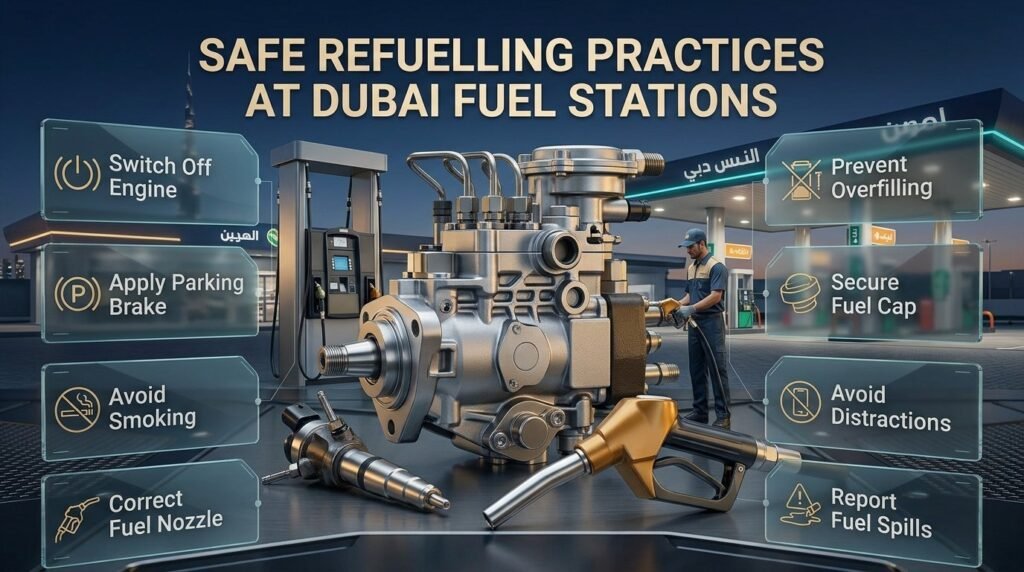
Safe refuelling protects motorists, passengers, station employees and surrounding property. It should be treated as a routine safety procedure rather than an activity that can be completed carelessly.
Before the pump is activated, follow the station’s instructions and ensure the vehicle is positioned correctly.
Essential safety steps
- Stop the vehicle in the designated refuelling position.
- Switch off the engine.
- Apply the parking brake where appropriate.
- Follow all instructions displayed at the station.
- Avoid smoking or using ignition sources.
- Do not use mobile devices if station rules prohibit them.
- Make sure the correct fuel nozzle is selected.
- Do not overfill the tank.
- Replace and secure the fuel cap after refuelling.
- Check that the pump is returned to its holder before moving away.
Why the engine should be switched off
Leaving the engine running during refuelling is an unnecessary safety risk. Switching it off is a basic precaution recommended in fuel-station safety guidance.
Avoid distractions
Refuelling requires attention. Drivers should not leave the nozzle unattended or allow children to play around the pump area.
What if fuel spills?
Do not ignore a spill or attempt to handle a significant spill without assistance. Inform station staff immediately and follow their instructions.
Safe behaviour at fuel stations is particularly important during Dubai’s hot summer months, when high ambient temperatures make responsible handling and compliance with safety procedures essential.
14. Refuelling in Dubai’s Hot Climate
Dubai’s climate creates practical challenges for vehicle owners. High temperatures, strong sunlight and extended periods of outdoor parking can affect vehicle operating conditions.
However, drivers should distinguish between normal temperature-related behaviour and an actual fuel-system problem.
Heat and fuel evaporation
Petrol is volatile, meaning it can evaporate under suitable conditions. Modern vehicle fuel systems are designed to manage vapours through controlled systems.
Drivers should keep the fuel cap properly secured and avoid leaving fuel containers exposed to direct sunlight.
Heat and fuel-system performance
High ambient temperatures increase the demands placed on vehicle cooling systems, electrical components and other systems. A vehicle that has an underlying mechanical problem may become more noticeable during demanding operating conditions.
Parking and fuel storage
Where possible, park in suitable shaded or covered locations. Do not store petrol or diesel in unsuitable containers or in areas where heat, ignition sources or poor ventilation can create risks.
Long journeys
Before travelling across Dubai or taking longer highway journeys, check the fuel level, tyre condition, engine temperature and general vehicle condition.
A sensible preparation routine reduces the chance of an avoidable roadside interruption.
Understand Different Petrol Grades Before Refuelling
Selecting the correct petrol grade is essential for maintaining engine efficiency, supporting reliable performance and avoiding unnecessary fuel-related complications. In Dubai, motorists commonly encounter E-Plus 91, Special 95 and Super 98 petrol, but choosing between them should always depend on the vehicle manufacturer’s recommended octane requirement rather than price or personal preference. Using a fuel grade that matches the engine specifications helps drivers make informed refuelling decisions and avoid selecting an unsuitable option. If you want to understand the differences between available petrol grades, their octane ratings and how to choose the appropriate option for your vehicle, explore this detailed guide to Dubai petrol grades.
15. How Often Should You Refuel Your Vehicle?
There is no single refuelling schedule that suits every vehicle. The right approach depends on the size of the tank, fuel consumption, journey distance, driving conditions and the availability of convenient fuel stations.
For everyday motorists, the best approach is to avoid regularly allowing the fuel level to become extremely low.
Establish a personal refuelling routine
Drivers who travel mainly within the city may benefit from checking the fuel gauge at the beginning of the day or before a longer journey.
Motorists who frequently use major highways should plan refuelling before reaching remote or unfamiliar sections of their route.
Fleet operators should use a consistent refuelling and record-keeping process to monitor fuel usage.
Avoid unnecessary last-minute refuelling
Waiting until the warning light appears can reduce flexibility, particularly when traffic is heavy or a suitable station is not nearby.
It is more practical to refuel when the remaining range comfortably covers the next journey and any expected delays.
Do not overfill the tank
Filling beyond the automatic pump cut-off is unnecessary. Follow the pump’s normal stopping mechanism and avoid trying to force additional fuel into the tank.
16. Understanding Your Fuel Gauge and Low-Fuel Warning
A fuel gauge provides an estimate of the fuel remaining in the tank. It is useful for planning, but it should not be treated as an exact measurement of the distance a vehicle can travel.
The reading may be influenced by tank shape, vehicle movement, sensor design and the way the vehicle’s electronics calculate fuel range.
Why the fuel gauge may change
A gauge may move slightly when a vehicle accelerates, brakes, turns or travels on an incline. This can happen because fuel moves inside the tank.
A sudden or persistent inaccurate reading may indicate a problem with the fuel-level sensor, wiring or instrument system.
What the low-fuel warning means
The warning light indicates that the remaining fuel has reached a low level according to the vehicle’s monitoring system.
It is not a recommendation to continue driving for as long as possible. The actual remaining range depends on consumption, traffic, speed, road conditions and the vehicle’s design.
What drivers should do
- Reduce unnecessary detours.
- Identify a suitable refuelling point.
- Avoid aggressive acceleration.
- Do not depend on the estimated range as a guarantee.
- Arrange assistance if the vehicle cannot reach a safe refuelling location.
Understanding the limits of fuel-gauge readings helps prevent unnecessary roadside problems.
17. How Dubai Traffic Affects Refuelling Decisions
Dubai’s traffic conditions can change considerably throughout the day. Busy urban roads, school traffic, commercial activity, highway congestion and events can all affect journey duration.
When a vehicle spends more time moving slowly or idling, fuel consumption may increase compared with an uninterrupted journey.
This means a driver who normally has enough fuel for a particular route may need additional planning when traffic conditions change.
Plan around expected journeys
Before travelling, consider the distance, expected congestion and availability of refuelling locations.
Avoid unnecessary idling
If you are stationary for an extended period, follow safe and lawful vehicle-operating practices. Unnecessary engine idling consumes fuel without providing useful distance.
Monitor actual consumption
If fuel consumption changes significantly under comparable driving conditions, consider checking tyre pressure, air filters, engine condition and driving habits.
Maintain a practical reserve
Do not calculate every journey using the vehicle’s maximum estimated range. A reasonable reserve provides flexibility when traffic or route conditions change unexpectedly.
18. Common Refuelling Mistakes Dubai Drivers Should Avoid
Even experienced motorists can make mistakes when refuelling. Most are preventable through a consistent routine.
Selecting the wrong petrol grade: Always check the manufacturer’s recommendation rather than choosing based on price or assumptions.
Using diesel in a petrol vehicle: The two fuels are not interchangeable. Stop the refuelling process immediately if an error occurs.
Using petrol in a diesel vehicle: Do not start the engine after discovering this mistake. Seek professional assistance.
Ignoring the fuel cap: A poorly secured or damaged cap can create problems with the vehicle’s fuel system.
Overfilling the tank: Stop when the pump automatically cuts off.
Purchasing fuel from unknown sources: Use authorised and established suppliers.
Ignoring warning signs: Persistent hesitation, stalling or unusual engine behaviour requires proper diagnosis.
Driving repeatedly with very little fuel: This creates avoidable inconvenience and may increase the risk of being stranded.
Ignoring maintenance: Fuel filters, injectors and related components require attention according to the manufacturer’s service schedule.
A careful refuelling routine can prevent many of these problems before they affect everyday driving.
Why Fuel Quality Matters for Vehicle Performance in Dubai
Fuel quality is an important consideration for motorists who want to maintain consistent engine performance, efficient combustion and long-term vehicle reliability. However, fuel quality should not be judged by price, colour or brand preference alone. Drivers should consider recognised fuel specifications, the correct petrol or diesel type and compatibility with their vehicle’s engine requirements. Using suitable fuel and following recommended refuelling practices can help reduce avoidable fuel-related issues and support responsible vehicle maintenance. To understand the factors that influence fuel quality, its importance for engine operation and what motorists should consider when selecting fuel, explore this detailed guide to Dubai fuel quality.
19. Fuel-System Maintenance and Long-Term Vehicle Protection
Fuel quality is only one part of maintaining a healthy fuel system. The vehicle’s components must also be inspected and serviced at suitable intervals.
A modern fuel system may include a tank, pump, fuel lines, filters, injectors, sensors and electronic controls. Diesel systems may operate at particularly high injection pressures and require specialised maintenance.
Fuel-filter maintenance
Fuel filters help prevent particles and other contaminants from reaching sensitive components. Follow the recommended replacement schedule and use suitable replacement parts.
Injector condition
Injectors must deliver fuel in the correct quantity and pattern. Poor running or inconsistent performance may justify professional inspection.
Fuel-pump condition
A fuel pump must deliver sufficient fuel pressure and volume. Starting problems, loss of power or unusual noises may require diagnosis.
Fuel-line inspection
Damaged, leaking or deteriorating fuel lines should be addressed promptly by a qualified technician.
Warning-light checks
Do not ignore engine-management or fuel-system warnings. Diagnostic equipment can help identify faults and prevent unnecessary component replacement.
Drivers should remember that adding aftermarket fuel additives is not a substitute for proper maintenance. Use only products that are compatible with the vehicle and recommended by the manufacturer.
20. What to Do When Your Vehicle Runs Out of Fuel in Dubai
Running out of fuel can happen to anyone. A traffic delay, an unexpected diversion, an inaccurate fuel gauge or a miscalculated journey can leave a driver unable to reach a fuel station.
The first priority is safety.
Move to a safe location if possible
If the vehicle still has enough momentum and it is safe to do so, move away from active traffic lanes. Do not make dangerous manoeuvres to reach a particular stopping place.
Activate hazard warning lights
Make your vehicle visible to other road users and follow applicable roadside safety instructions.
Avoid standing in dangerous areas
Do not stand behind or immediately beside a vehicle in an active traffic lane. Follow local road-safety guidance and seek help when needed.
Identify the vehicle’s exact location
Use a recognisable road name, nearby landmark or accurate live location so that assistance can identify where you are.
Arrange appropriate fuel assistance
If reaching a fuel station is not practical, consider a suitable roadside fuel-assistance service.
A reliable provider should confirm the vehicle location, required fuel type and delivery arrangements before dispatch.
For additional guidance on dealing with fuel-related roadside situations, drivers can consult Emergency Roadside Fuel Advice.
21. Fuel Delivery and Refuelling Convenience in Dubai
Traditional fuel stations remain an essential part of everyday motoring. However, some situations make reaching a station difficult or inconvenient.
A vehicle may run out of fuel in a residential parking area, commercial location or roadside situation. Drivers may also face time constraints or have difficulty accessing a fuel station because of vehicle problems.
Fuel delivery services can provide an additional option when a driver needs assistance at a suitable location.
When fuel delivery may be useful
- A vehicle has run out of fuel.
- A driver cannot conveniently reach a fuel station.
- A vehicle is parked in an accessible location and needs refuelling.
- A roadside situation requires additional fuel assistance.
- A fleet or business needs an appropriate refuelling arrangement.
What to confirm before requesting assistance
Provide the vehicle’s exact location and identify whether it uses petrol or diesel.
Confirm the required grade where applicable, explain the situation and check the provider’s service arrangements.
Drivers should also make sure the proposed delivery is lawful and complies with applicable safety requirements.
Why accurate location information matters
Dubai includes busy roads, residential developments, commercial districts and large parking facilities. A clear location helps reduce confusion and makes it easier for an assistance provider to reach the correct vehicle.
Fuel delivery is a convenience and assistance option, not a replacement for responsible fuel planning. Checking the fuel level before a journey remains the simplest way to avoid an unnecessary interruption.
For drivers who need assistance, Fuel Delivery Dubai provides a starting point for understanding the available fuel assistance service.
22. Petrol and Diesel: Which Refuelling Considerations Are Different?

Petrol and diesel drivers share many basic refuelling responsibilities, but their engines and fuel systems have different requirements.
Petrol motorists should pay particular attention to the correct octane grade and the vehicle’s minimum fuel specification.
Diesel motorists should focus on the correct automotive diesel product, fuel cleanliness, filter condition and protection of high-pressure injection components.
Petrol vehicle considerations
- Follow the recommended RON grade.
- Avoid incorrect fuel selection.
- Monitor engine knocking or unusual hesitation.
- Maintain the ignition and fuel-injection systems.
- Follow the manufacturer’s service requirements.
Diesel vehicle considerations
- Use suitable automotive diesel.
- Avoid unknown or unapproved fuel sources.
- Maintain fuel filters and water-separation systems where fitted.
- Monitor warning lights and unusual smoke.
- Follow the manufacturer’s diesel-system maintenance schedule.
Neither fuel type should be selected based on assumptions about which one is inherently better. The correct choice is determined by the vehicle’s engine design.
23. Practical Fuel Quality Checklist for Dubai Drivers
A simple checklist makes it easier to maintain consistent refuelling habits.
Before refuelling
- Check the manufacturer’s fuel requirement.
- Confirm whether the vehicle uses petrol or diesel.
- Identify the correct grade.
- Choose an established fuel station.
- Check the fuel level before starting a long journey.
During refuelling
- Switch off the engine.
- Follow the station’s safety instructions.
- Select the correct pump and nozzle.
- Avoid distractions.
- Do not overfill the tank.
- Report any spill to station personnel.
After refuelling
- Secure the fuel cap.
- Keep the receipt.
- Check that no warning lights or unusual symptoms appear.
- Monitor fuel consumption over time.
- Arrange an inspection if the vehicle develops persistent problems.
During regular maintenance
- Replace fuel filters as recommended.
- Inspect the fuel system for leaks.
- Investigate repeated starting problems.
- Monitor injector and pump performance.
- Use suitable replacement components.
- Follow the vehicle manufacturer’s maintenance schedule.
This approach keeps fuel selection, refuelling safety and vehicle maintenance organised without making everyday driving unnecessarily complicated.
24. Building Better Refuelling Habits for Everyday Dubai Driving
Good refuelling habits are not complicated. They depend on consistency, attention and a basic understanding of vehicle requirements.
Start by knowing exactly which fuel your vehicle needs. Keep this information available so that there is no uncertainty when visiting a fuel station or requesting assistance.
Second, make fuel-level checks part of your normal driving routine. Checking before leaving home or starting a longer journey is more convenient than reacting to a warning light in heavy traffic.
Third, use established fuel sources and keep a record of refuelling transactions. Receipts can be useful if a problem needs investigation.
Fourth, treat changes in engine performance seriously but avoid making assumptions. A rough-running engine may need an ignition-system inspection, fuel-pressure test, sensor diagnosis or another form of maintenance.
Finally, remember that fuel economy and engine reliability depend on the entire vehicle. Correct tyre pressure, suitable engine oil, a healthy cooling system, clean filters and sensible driving behaviour all contribute to dependable performance.
The most effective approach is to combine correct fuel selection with safe refuelling, preventive maintenance and sensible journey planning.
How can drivers identify good-quality petrol in Dubai?
Identifying good-quality petrol starts with choosing an established fuel supplier and selecting a grade that meets the vehicle manufacturer’s requirements. Petrol quality is determined by technical characteristics such as octane rating, volatility, chemical composition and contamination limits. These properties influence how fuel behaves inside the engine and whether it supports the intended combustion process.
Drivers should not rely on petrol colour, smell or appearance to determine its quality. Fuel that looks clear is not necessarily free from unwanted substances, and visual inspection cannot confirm whether it meets the required specifications.
When refuelling in Dubai, motorists should consider the following practices:
Purchase petrol from recognised and established fuel stations.
Select E-Plus 91, Special 95 or Super 98 according to the vehicle’s requirements.
Keep the refuelling receipt for future reference.
Avoid purchasing fuel from unknown or unauthorised sources.
Monitor unusual engine behaviour after refuelling.
Using the correct fuel specification consistently is a more reliable approach than choosing petrol based on assumptions about price or performance.
Which petrol grade is best for cars in Dubai: E-Plus 91, Special 95 or Super 98?
The best petrol grade depends on the engine design and the manufacturer’s recommended octane requirement. Dubai motorists commonly have access to E-Plus 91, Special 95 and Super 98, but these grades are not interchangeable for every vehicle.
E-Plus 91 is intended for compatible engines with a lower octane requirement. Special 95 suits many everyday passenger vehicles, while Super 98 is designed for vehicles requiring or benefiting from a higher octane rating.
Choosing a higher grade does not automatically improve fuel economy or engine power. If a vehicle is designed for Special 95, using Super 98 may provide no noticeable advantage under normal driving conditions.
Before selecting a grade, drivers should:
Check the owner’s manual for the minimum octane requirement.
Read the fuel recommendation displayed near the filler cap.
Consider the manufacturer’s guidance for turbocharged and high-performance engines.
Avoid using a lower grade than the manufacturer specifies.
Consult a qualified technician if the correct grade is unclear.
The most cost-effective decision is to use the grade that meets the vehicle’s actual requirements rather than automatically purchasing the most expensive option.
What are the common signs of poor-quality or contaminated fuel in a vehicle?
Poor-quality or contaminated fuel may affect engine operation, particularly when unwanted water, sediment or unsuitable substances enter the fuel system. However, drivers should understand that similar symptoms can also result from mechanical faults, damaged sensors, clogged filters or ignition problems.
One common warning sign is unusual engine hesitation. A vehicle may struggle to accelerate smoothly or experience inconsistent power delivery. Other symptoms may include difficulty starting, unexpected stalling or an unusual change in fuel consumption.
Important warning signs include:
Rough engine operation: The engine may vibrate or run less smoothly than usual.
Reduced acceleration: The vehicle may respond slowly when the accelerator is pressed.
Starting difficulties: The engine may take longer than normal to start.
Repeated filter problems: Contamination may cause fuel filters to become restricted.
Unexpected warning lights: Engine-management or fuel-system warnings may appear.
Unusual exhaust behaviour: Changes in smoke or exhaust appearance may indicate a combustion or mechanical problem.
If these symptoms appear shortly after refuelling, keep the receipt and record where the fuel was purchased. Avoid continuing to drive if the vehicle is running severely or may have received the wrong fuel. Arrange a professional inspection to identify the actual cause before replacing components or adding fuel treatments.
How does Dubai’s hot weather affect petrol and diesel quality during refuelling and storage?
Dubai’s high temperatures make responsible fuel handling and vehicle maintenance particularly important. Heat affects the operating environment of vehicles and can influence fuel evaporation, storage conditions and the demands placed on fuel-system components.
Petrol is a volatile fuel, meaning it can produce vapours under normal environmental conditions. Modern vehicles use sealed fuel systems and vapour-control equipment to manage these emissions. Drivers should ensure that the fuel cap is properly secured and avoid storing petrol in unsuitable containers.
Diesel has different storage considerations. Water contamination can encourage microbial growth in certain storage environments, while accumulated sediment may restrict filters and affect fuel-system operation.
For safer fuel handling in Dubai, motorists and vehicle operators should follow these practices:
Use approved fuel containers and storage arrangements where storage is necessary.
Keep fuel away from direct heat and ignition sources.
Avoid storing fuel in unsuitable residential or vehicle spaces.
Ensure fuel tanks and storage equipment are properly maintained.
Inspect diesel storage systems for water contamination where applicable.
Follow the manufacturer’s fuel-handling and maintenance recommendations.
High temperatures do not automatically mean that petrol or diesel purchased from an established station is poor quality. Proper storage, distribution and handling are the important factors in maintaining fuel integrity.
What should you do if your car runs out of fuel or receives the wrong fuel in Dubai?
Running out of fuel or accidentally selecting the wrong fuel can create an unexpected roadside situation. The correct response depends on what happened, but safety should always come first.
If your vehicle runs out of fuel, move it to a safe location if possible without creating a traffic hazard. Activate the hazard warning lights and avoid standing in an exposed position near moving traffic. Identify your exact location using a road name, nearby landmark or live location so that appropriate assistance can reach you.
Fuel delivery assistance may be a practical option when the vehicle cannot conveniently reach a fuel station.
If the wrong fuel has been added, the situation requires greater care. Petrol in a diesel vehicle and diesel in a petrol vehicle can cause serious fuel-system problems.
Follow these steps:
Stop refuelling immediately when you recognise the mistake.
Do not start the engine.
If the engine is already running, stop safely as soon as possible.
Do not attempt to drive the vehicle to another location.
Inform the recovery provider or qualified workshop about the incorrect fuel.
Follow professional advice regarding draining and inspecting the fuel system.
For ordinary low-fuel situations, keeping a reasonable fuel reserve and checking the gauge before longer journeys can prevent many roadside interruptions. For additional guidance, drivers can also consult the Emergency Roadside Fuel Advice guide.
Conclusion
Understanding fuel quality and refuelling requirements helps Dubai motorists make better decisions about vehicle performance, fuel selection and everyday safety. Choosing the correct petrol or diesel, avoiding contaminated fuel sources, following safe refuelling procedures and maintaining the fuel system can reduce unnecessary problems.
The most important habit is to follow the vehicle manufacturer’s fuel recommendations rather than relying on assumptions about premium grades or advertised performance benefits. Combined with sensible fuel planning and regular maintenance, these practices support more dependable driving across Dubai.
Conclusion: Making Better Fuel Quality and Refuelling Decisions in Dubai
Maintaining good fuel quality and following correct refuelling practices are essential for reliable vehicle performance in Dubai. From selecting the appropriate petrol grade to understanding diesel specifications, preventing fuel contamination and following safe refuelling procedures, every decision contributes to the overall condition of a vehicle.
Dubai’s hot climate, busy roads and demanding driving conditions make responsible fuel management particularly important. Motorists should purchase fuel from established suppliers, follow manufacturer recommendations, monitor unusual engine behaviour and maintain their fuel systems according to the recommended service schedule.
Most importantly, drivers should not assume that premium petrol always delivers better performance or that every engine problem is caused by poor-quality fuel. Understanding the actual requirements of your vehicle helps avoid unnecessary expenses and supports better long-term maintenance decisions.
By combining the correct fuel selection, safe refuelling habits, regular vehicle inspections and sensible fuel planning, motorists can enjoy more confident and dependable journeys throughout Dubai. When reaching a fuel station becomes difficult, a reliable fuel delivery service can also provide a convenient roadside assistance option.
Leave a Reply