
Introduction
Dubai Fuel Quality | Imagine driving through Dubai during a busy afternoon when your vehicle suddenly starts losing power, acceleration becomes inconsistent or the engine begins running roughly. You recently refuelled, so naturally, one of the first things that comes to mind is whether the fuel was suitable for your vehicle.
Fuel-related problems can be confusing because several different issues can produce similar symptoms. Incorrect petrol grade, water contamination, unsuitable diesel, restricted filters and mechanical faults can all affect vehicle performance. Understanding these possibilities helps drivers avoid unnecessary repairs and make better refuelling decisions.
Dubai fuel quality is an important consideration for residents, commuters, tourists, commercial drivers and anyone who depends on a vehicle for everyday transportation. Knowing how petrol and diesel specifications work, how fuel is stored and handled, and how to recognise possible contamination can help protect your vehicle.
Whether you drive a petrol sedan, a diesel SUV, a luxury vehicle or a commercial fleet, this guide explains what you should know before, during and after refuelling. For additional information about petrol and diesel services, vehicle assistance and refuelling, visit Fuel Delivery Dubai.
You will learn how different fuel grades work, what affects fuel quality, how Dubai’s climate influences storage and vehicle operation, what warning signs deserve attention and how to make informed decisions when selecting a refuelling provider.
1. What Does Fuel Quality Mean?
Fuel quality describes the physical and chemical characteristics of petrol or diesel that determine whether it is suitable for a particular engine and meets the applicable specifications.
Good fuel quality is not simply about how fuel looks or how much it costs. It involves several characteristics that influence combustion, fuel delivery, engine operation and emissions.
The most important considerations include:
- Correct fuel type and specification.
- Suitable octane rating for petrol engines.
- Appropriate ignition characteristics for diesel engines.
- Acceptable levels of water and unwanted contamination.
- Suitable fuel composition and stability.
- Proper transportation, storage and dispensing.
- Compliance with applicable technical requirements.
For motorists, these characteristics matter because modern engines depend on accurately controlled fuel delivery.
For example, a petrol engine designed for a particular octane rating may experience knocking when unsuitable fuel is used under demanding conditions. Similarly, a modern diesel injection system can be affected by water or particles entering the fuel supply.
Why Should Dubai Drivers Understand Fuel Quality?
Dubai motorists experience different driving conditions, including heavy traffic, long-distance journeys, frequent air-conditioning use and high ambient temperatures.
These conditions can influence fuel consumption and vehicle operation. They also make responsible fuel storage, correct refuelling and regular maintenance important.
However, higher fuel consumption in hot weather does not automatically mean that fuel quality is poor. Drivers should consider the complete operating conditions before reaching that conclusion.
Understanding fuel quality helps motorists distinguish between fuel compatibility, fuel contamination and ordinary mechanical or driving-related problems.
2. Which Petrol Grades Are Available in Dubai?
Petrol motorists commonly encounter three grades: E-Plus 91, Special 95 and Super 98.
The numbers refer to the Research Octane Number (RON), which measures petrol’s resistance to engine knocking.
| Petrol grade | Octane rating | General suitability |
|---|---|---|
| E-Plus 91 | 91 RON | Vehicles designed for 91 RON |
| Special 95 | 95 RON | Vehicles requiring or recommending 95 RON |
| Super 98 | 98 RON | Vehicles requiring or recommending 98 RON |
The correct petrol grade depends on the engine manufacturer’s specifications.
E-Plus 91 Petrol
E-Plus 91 is a regular petrol grade suitable for compatible vehicles.
Some everyday passenger cars and commercial vehicles are designed to operate on this octane level.
It can be an appropriate choice when the owner’s manual or fuel-filler label permits 91 RON.
Drivers should not automatically assume that smaller engines, older vehicles or economical cars always require E-Plus 91. The manufacturer’s recommendation should determine the choice.
Special 95 Petrol
Special 95 provides a higher octane rating than E-Plus 91.
It is suitable for vehicles that require or recommend 95 RON petrol. Many motorists use this grade for compatible everyday passenger vehicles.
If your manufacturer specifies 95 RON as the minimum requirement, using a lower grade without approval may affect engine operation under certain conditions.
Super 98 Petrol
Super 98 has a higher octane rating and is intended for compatible engines that require or recommend this specification.
Some high-performance, turbocharged and higher-compression engines are designed to benefit from higher-octane petrol.
However, using Super 98 does not automatically make every car faster or more fuel-efficient.
Professional advice: Always check the fuel-filler label and owner’s manual. The correct petrol grade is the one that meets your engine’s requirements, not necessarily the most expensive grade available.
3. How Does Petrol Quality Affect Engine Performance?
Petrol quality influences combustion and the way an engine responds to different operating conditions.
Several characteristics are particularly important.
Octane Rating and Engine Knocking
Octane rating measures resistance to knocking, which is uncontrolled combustion within the engine.
When an engine requires higher-octane petrol than the fuel being used, knocking may occur under certain operating conditions.
Modern vehicles often have knock sensors and electronic engine management systems that adjust ignition timing to protect the engine. However, these systems do not make incorrect fuel selection a good practice.
Volatility and Evaporation
Volatility describes how readily petrol evaporates.
Suitable volatility helps petrol support starting, combustion and normal engine operation across different temperatures.
In hot environments, evaporation management is particularly important. Modern vehicles have fuel-system components designed to manage fuel vapours during normal operation.
Drivers should never store petrol in unsuitable containers or expose fuel containers to excessive heat.
Fuel Stability
Petrol can change during prolonged storage, especially under unsuitable conditions.
Oxidation and other chemical changes can affect its suitability over time.
This is important for vehicles that remain unused for extended periods, as old fuel may contribute to starting difficulties or inconsistent operation.
Cleanliness
Petrol should be protected from water, dirt and other unwanted materials.
Contamination may affect:
- Fuel filters.
- Fuel pumps.
- Injectors.
- Combustion consistency.
- Engine performance.
Clear-looking petrol is not necessarily proof of correct fuel composition or freedom from every contaminant.
4. What Determines Diesel Fuel Quality?
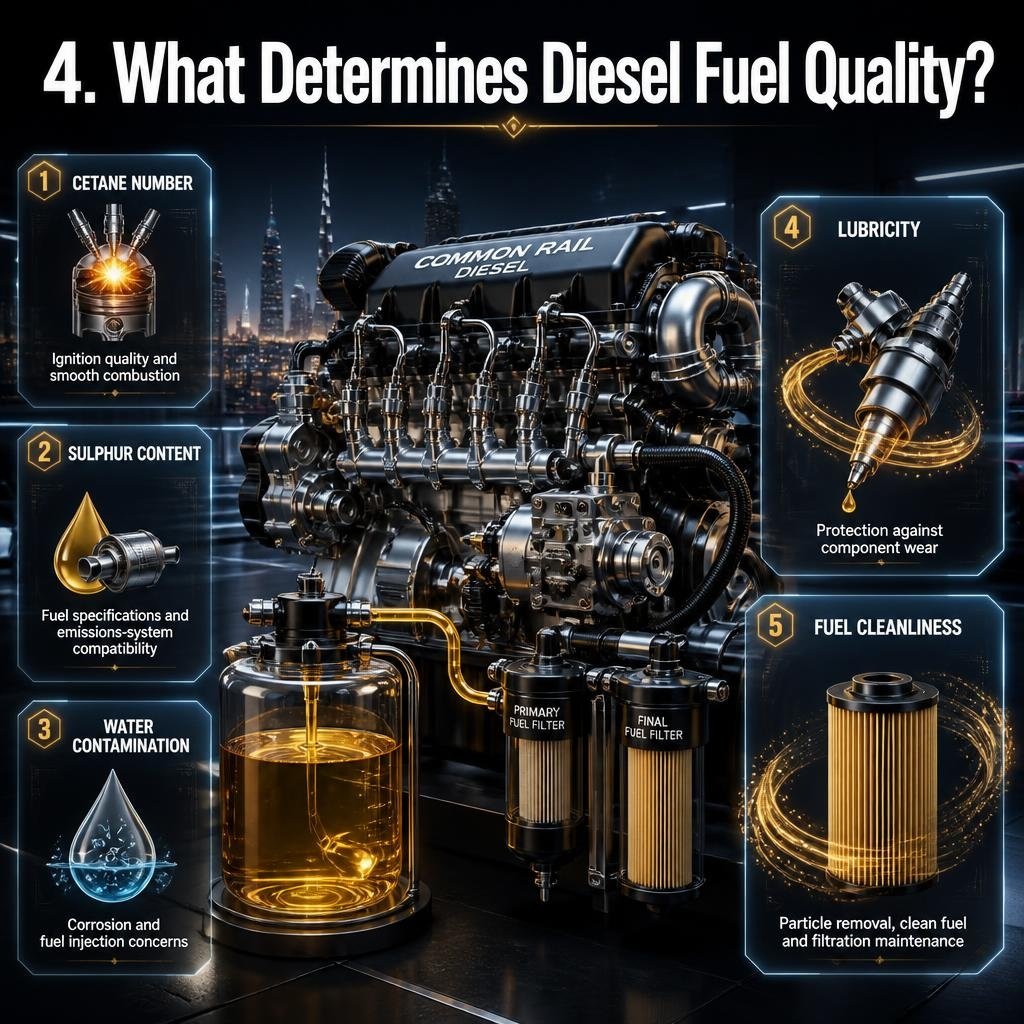
Diesel quality involves different characteristics because diesel engines operate through compression ignition rather than spark ignition.
Modern diesel engines also depend on highly precise injection systems, making fuel cleanliness particularly important.
Cetane Number
The cetane number indicates the ignition quality of diesel fuel.
Suitable cetane characteristics support reliable ignition and smooth engine operation.
Using diesel that does not meet the required specification may contribute to difficult starting, rough running and combustion-related problems.
Sulphur Content
Sulphur content is an important diesel specification.
Modern diesel vehicles may use emissions-control equipment such as diesel particulate filters, exhaust gas recirculation systems and selective catalytic reduction systems.
Using diesel that meets the vehicle’s required specification helps maintain compatibility with these systems.
Water Contamination
Water is one of the important concerns in diesel storage and handling.
It can contribute to corrosion, poor lubrication and problems in sensitive fuel injection components.
Some diesel vehicles have water separators and warning indicators, but these systems do not remove the need for proper fuel handling and maintenance.
Lubricity
Diesel fuel must provide suitable lubricating properties for fuel-system components.
Insufficient lubricity can increase wear in pumps and injectors.
This is particularly important in modern common-rail diesel engines, where components operate under very high pressure.
Fuel Cleanliness
Particles and sediment can restrict diesel filters and affect injection components.
Regular filter maintenance and appropriate storage practices help reduce these risks.
Know the Fuel Standards That Guide Refuelling in Dubai
Understanding fuel standards is an important part of making informed refuelling decisions, particularly for drivers who want to ensure that their vehicles receive fuel that meets the appropriate technical requirements. Fuel standards establish important specifications relating to fuel composition, quality, performance characteristics and suitability for different engine types. These requirements help maintain consistency across the fuel supply chain and give motorists a clearer understanding of what they are purchasing at the pump. Rather than choosing fuel based solely on price or availability, drivers should consider the manufacturer’s recommendations alongside recognised fuel specifications. For a deeper understanding of these requirements and their relevance to everyday motorists, explore this comprehensive guide to Dubai fuel standards.
5. Petrol vs Diesel: Understanding Their Different Quality Requirements
Petrol and diesel cannot be evaluated using exactly the same characteristics.
Although both must meet their respective specifications, their ignition processes and fuel-system requirements are different.
| Factor | Petrol | Diesel |
|---|---|---|
| Ignition method | Spark ignition | Compression ignition |
| Important rating | Octane | Cetane |
| Fuel-system concerns | Injector cleanliness and correct RON | Water, particles and lubricity |
| Common engine type | Petrol engine | Diesel engine |
| Storage concerns | Evaporation and stability | Water, sediment and microbial contamination |
| Important maintenance | Petrol filter and injection system | Diesel filter and water separator where fitted |
Petrol vehicles require attention to the recommended octane rating, while diesel motorists should pay particular attention to fuel cleanliness and the manufacturer’s diesel specification.
Can Petrol and Diesel Be Mixed?
No. Petrol and diesel are different fuels and must not be used interchangeably.
Putting petrol into a diesel vehicle can reduce the lubrication available to important diesel fuel-system components. Putting diesel into a petrol vehicle can interfere with normal combustion and fuel delivery.
If the wrong fuel enters your tank, do not start the engine. If it is already running, stop it safely and seek professional assistance.
6. How Is Fuel Quality Maintained During Supply and Storage?
Fuel quality does not depend only on the original product. Transportation, storage, handling and dispensing also play important roles.
Fuel can become contaminated if unsuitable equipment or poor storage practices are used.
Transportation and Handling
Fuel should be transported through appropriate systems designed for petroleum products.
These systems should help prevent contamination, leakage and unintended mixing between different products.
A properly managed supply chain protects fuel before it reaches a storage facility or dispensing point.
Storage Tank Maintenance
Fuel storage tanks require suitable inspection and maintenance.
Important areas include:
- Tank condition and structural integrity.
- Water accumulation.
- Sediment management.
- Leakage prevention.
- Suitable monitoring arrangements.
- Cleaning and maintenance procedures.
Water and sediment deserve particular attention because they can affect fuel quality even when the original product was suitable.
Filtration and Dispensing Equipment
Dispensing equipment should be maintained according to its operating requirements.
Suitable filtration and equipment maintenance help control unwanted particles and support reliable fuel delivery.
Equipment should also be checked for leakage, damage and other problems that could affect safe operation.
Why Does Professional Fuel Handling Matter?
Professional handling helps maintain consistency throughout the supply process.
For drivers, this means selecting established refuelling facilities and avoiding unknown sources where product specifications and handling procedures cannot be confirmed.
Develop Better Refuelling Habits for Everyday Driving in Dubai
Efficient refuelling is not simply about filling the tank whenever the fuel warning light appears. It involves understanding your vehicle’s fuel requirements, monitoring fuel levels, planning refuelling stops and choosing suitable fuel according to the manufacturer’s specifications. For motorists who regularly travel across Dubai, developing a consistent refuelling routine can make daily journeys easier to manage and help prevent avoidable interruptions caused by low fuel levels. Drivers should also consider their regular travel distances, traffic conditions and access to convenient refuelling locations when planning their fuel requirements. To explore practical refuelling methods, fuel selection considerations and essential advice for everyday motorists, read this comprehensive Dubai Refuelling Guide.
7. Does Dubai’s Climate Affect Fuel Quality?
Dubai’s climate creates important considerations for fuel storage, vehicle operation and refuelling.
However, high temperatures do not automatically mean that properly specified petrol or diesel becomes unsuitable.
The main concern is whether fuel is stored and handled under appropriate conditions.
How Heat Affects Petrol
Petrol is volatile, meaning it evaporates relatively easily.
High temperatures can increase evaporation-related challenges, particularly when petrol is stored in unsuitable containers.
Modern vehicles have systems designed to manage fuel vapours during normal operation.
Drivers should:
- Avoid storing petrol in ordinary household bottles.
- Use only appropriate approved containers where storage is permitted.
- Keep fuel away from ignition sources.
- Avoid unnecessary long-term storage.
- Follow applicable safety requirements.
How Heat Affects Diesel
Diesel also requires appropriate storage conditions.
Prolonged storage, moisture and poor tank maintenance can contribute to deterioration and contamination.
Water accumulation can create conditions that support microbial growth at the water-fuel interface.
This may lead to sludge, filter blockage and other fuel-system problems.
How Hot Weather Affects Vehicle Operation
High temperatures can influence vehicle operation through:
- Increased air-conditioning demand.
- Cooling-system workload.
- Engine operating conditions.
- Traffic-related idling.
- Tyre pressure changes.
- Driving conditions and vehicle load.
These factors can increase fuel consumption even when the fuel itself meets the required specifications.
For a better understanding of everyday driving conditions, read our guide to Dubai City Driving.
8. What Are the Signs of Possible Poor-Quality or Contaminated Fuel?

Fuel-related problems can produce several noticeable symptoms.
However, no single symptom proves that the fuel is contaminated. Mechanical problems involving ignition, sensors, filters, injectors and fuel pumps can create similar behaviour.
Engine Knocking
Persistent knocking in a petrol engine may indicate an unsuitable octane rating or an engine-related problem.
If knocking begins after refuelling, note the fuel grade and arrange an inspection.
Difficult Starting
A vehicle that suddenly struggles to start may have a fuel delivery, ignition or combustion problem.
Contamination is one possible explanation, but battery condition and other mechanical faults should also be considered.
Rough Idling
An engine that shakes or struggles to maintain a stable idle may have inconsistent fuel delivery or another mechanical issue.
A technician may need to inspect the injectors, filters and engine management system.
Reduced Acceleration
If a vehicle loses power or responds slowly when the accelerator is pressed, possible causes include:
- Restricted fuel filters.
- Incorrect fuel pressure.
- Injector problems.
- Sensor faults.
- Ignition-related issues.
- Fuel contamination.
Unusual Fuel Consumption
Unexpectedly high consumption after refuelling deserves investigation.
However, compare driving conditions before blaming the fuel.
Heavy traffic, air-conditioning, tyre pressure and driving habits can all influence consumption.
Warning Lights
An illuminated check-engine light may indicate a problem with combustion, emissions or fuel delivery.
A diagnostic scan can help identify the fault.
What Should You Do If You Suspect Fuel Contamination?
- Stop driving if the engine is behaving dangerously.
- Switch off the engine if incorrect or contaminated fuel is suspected.
- Avoid repeatedly restarting the vehicle.
- Keep your refuelling receipt.
- Record the fuel grade, date and location.
- Contact a qualified automotive technician.
- Request appropriate fuel-system inspection and diagnosis.
Never assume that adding more petrol or diesel will solve a contamination problem.
Plan Refuelling Stops Around Suitable Fuel Stations in Dubai
Choosing the right refuelling location can make everyday driving more convenient, especially for motorists who frequently travel across different parts of Dubai. A suitable fuel station should be accessible from your regular route, offer the fuel grade recommended for your vehicle and provide a convenient opportunity to refuel without unnecessary detours. Drivers should also consider their journey distance, traffic conditions and fuel requirements when deciding where to stop. Planning refuelling locations in advance can help avoid last-minute searches when the fuel level becomes low. To explore available refuelling locations and understand how to identify convenient options across the city, visit this detailed guide to Dubai fuel stations.
9. Can Poor Fuel Quality Damage Your Vehicle?
Yes. Fuel that does not meet the required specifications or contains harmful contaminants can contribute to damage in different engine and fuel-system components.
The severity depends on the contaminant, the amount involved, the vehicle design and whether the engine continues operating.
Potential Effects on Petrol Vehicles
Unsuitable or contaminated petrol may contribute to:
- Unstable combustion.
- Engine knocking.
- Injector deposits or blockages.
- Fuel filter restrictions.
- Fuel pump strain.
- Reduced performance.
Some symptoms may appear immediately, while others may develop gradually.
Potential Effects on Diesel Vehicles
Diesel fuel contamination can be especially concerning for modern high-pressure injection systems.
Possible problems include:
- Injector damage.
- Fuel pump wear.
- Corrosion caused by water.
- Restricted filters.
- Poor combustion.
- Problems with emissions-control systems.
Why Professional Diagnosis Is Important
Replacing expensive components without identifying the actual fault can waste money.
A technician may inspect fuel samples, filters, fuel pressure, injector operation and diagnostic trouble codes before recommending repairs.
Not every performance issue requires a complete fuel-system replacement.
10. How Should You Choose the Correct Fuel Grade?
Selecting the correct fuel is one of the easiest ways to reduce avoidable refuelling problems.
Use the following process.
Step 1: Read the Owner’s Manual
Find the manufacturer’s fuel recommendation.
For petrol vehicles, check the minimum required octane rating.
For diesel vehicles, check the specified diesel product and any relevant fuel requirements.
Step 2: Check the Fuel-Filler Label
Many vehicles display fuel information near the filler opening.
This is particularly useful when driving a rented or unfamiliar vehicle.
Step 3: Understand the Engine Requirement
Some engines require higher-octane petrol because of their compression characteristics, turbocharging or calibration.
However, engine type alone is not enough to determine the correct grade.
Step 4: Follow the Minimum Specification
If a manufacturer specifies 95 RON as the minimum, do not automatically assume 91 RON is suitable.
If the manufacturer allows multiple grades, follow the conditions explained in the owner’s manual.
Step 5: Avoid Unnecessary Upgrading
Higher octane does not automatically mean higher engine performance.
Choose the specification that suits your engine.
A Practical Example
Imagine two drivers:
- Driver A owns a vehicle designed for 91 RON.
- Driver B owns a vehicle requiring 98 RON.
Using Super 98 in Driver A’s vehicle may not provide a meaningful advantage.
Using 91 RON in Driver B’s vehicle may be unsuitable.
Both drivers should follow their own manufacturer’s specifications rather than copying each other’s fuel choices.
11. Does More Expensive Petrol Always Mean Better Quality?
No. Price and octane rating are not interchangeable measures of overall fuel quality.
A higher-priced petrol grade may have a higher octane rating, but that does not automatically mean it provides better results in every engine.
The main question is whether the fuel matches the vehicle’s requirements.
When Is Super 98 Appropriate?
Super 98 may be appropriate when:
- The manufacturer requires 98 RON.
- The manufacturer recommends it for particular operating conditions.
- The engine is calibrated to benefit from higher-octane fuel.
When Is It Unnecessary?
It may be unnecessary when:
- The engine is designed for 91 or 95 RON.
- The manufacturer does not recommend higher octane.
- The engine cannot make practical use of the additional octane rating.
What About Fuel Additives?
Aftermarket fuel additives are not automatically necessary.
Some products may be unsuitable for certain fuel systems or emissions equipment.
Use only additives approved by the manufacturer and avoid mixing products without proper guidance.
Select the Correct Petrol Grade for Your Vehicle
Understanding petrol grades is essential for motorists who want to make informed fuel choices and maintain their vehicle’s recommended operating performance. In Dubai, the commonly available petrol options include E-Plus 91, Special 95 and Super 98, each offering a different octane rating. However, a higher octane number does not automatically mean better performance or greater fuel efficiency for every vehicle. The most important consideration is whether the selected petrol grade meets the engine manufacturer’s specifications. Drivers should check their owner’s manual or fuel-filler label before choosing between available options. For a closer look at octane ratings, petrol grade differences and vehicle compatibility, explore this comprehensive guide to Dubai petrol grades.
12. How Does Fuel Storage Influence Petrol and Diesel Quality?
Fuel storage matters for motorists, fleet operators, commercial businesses and anyone responsible for fuel kept outside a vehicle’s normal tank.
Unsuitable storage can contribute to contamination, deterioration and safety risks.
Safe Petrol Storage
Petrol should only be stored where permitted and in suitable approved containers.
Important precautions include:
- Keep containers properly closed.
- Use suitable storage equipment.
- Keep fuel away from flames and ignition sources.
- Avoid direct exposure to excessive heat.
- Follow relevant safety and legal requirements.
- Never use ordinary water or soft-drink bottles.
Petrol vapours can ignite easily, so unnecessary home storage should be avoided.
Safe Diesel Storage
Diesel storage requires attention to moisture, sediment and tank condition.
Useful practices include:
- Inspecting storage tanks.
- Preventing water entry.
- Maintaining appropriate filtration.
- Monitoring sediment accumulation.
- Checking seals and connections.
- Following recommended fuel turnover practices.
What If Your Vehicle Remains Parked for Months?
Prolonged inactivity can create additional fuel-storage concerns.
Petrol may deteriorate during extended storage, while diesel storage systems may develop moisture and contamination problems.
Follow the vehicle manufacturer’s long-term storage recommendations.
Do not assume that stored fuel remains suitable simply because it looks normal.
13. How Can You Check Fuel Quality Before Refuelling?
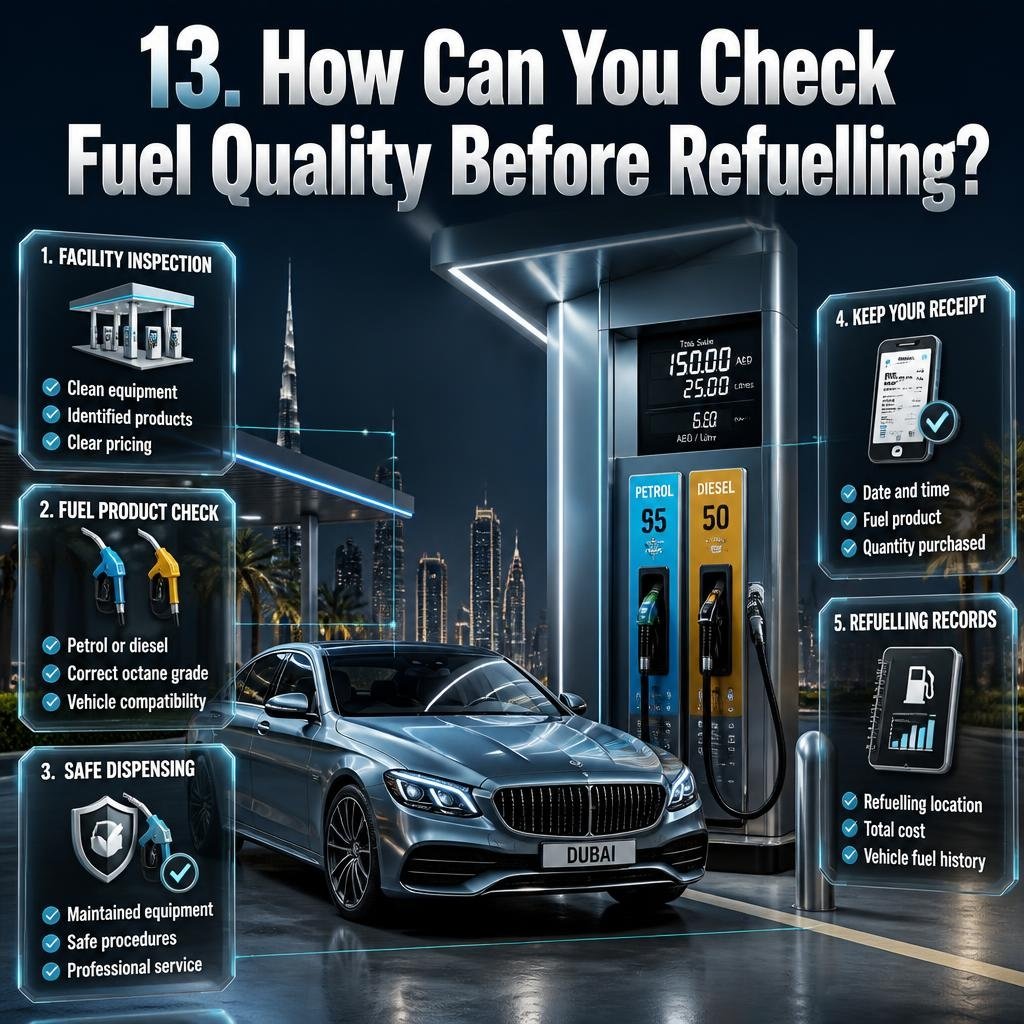
Ordinary motorists cannot perform a complete laboratory fuel-quality test at a refuelling station.
However, you can make sensible checks before choosing a provider.
Check the Refuelling Facility
Consider whether the facility appears properly maintained and operates through an established supply arrangement.
Look for:
- Clearly identified fuel products.
- Appropriate dispensing equipment.
- General cleanliness and maintenance.
- Safe operating procedures.
- Clear pricing information.
- Professional service practices.
These observations do not certify fuel quality, but they help you make a more informed choice.
Confirm the Correct Product
Before refuelling, verify:
- Petrol or diesel.
- Required petrol octane grade.
- Vehicle compatibility.
- Correct dispensing nozzle.
This is particularly important when using a rental car or unfamiliar vehicle.
Keep the Receipt
A receipt provides useful information if a problem develops after refuelling.
Keep details such as:
- Date and time.
- Refuelling location.
- Fuel product.
- Quantity purchased.
- Total cost.
If you manage multiple vehicles, these records can help identify unusual patterns.
14. How Can Fuel Quality Be Compared Between Providers?
Comparing providers should involve more than choosing the cheapest option.
Motorists should consider product suitability, service reliability, storage management and appropriate handling.
| Comparison factor | What to evaluate |
|---|---|
| Fuel specification | Does the product meet applicable requirements? |
| Petrol selection | Are suitable octane grades available? |
| Diesel product | Is it appropriate for the vehicle? |
| Supply arrangements | Is the source authorised and traceable? |
| Storage management | Are suitable storage procedures followed? |
| Dispensing equipment | Is the equipment maintained? |
| Documentation | Can relevant product details be provided? |
| Customer service | Is support available if a problem occurs? |
Questions for Commercial Customers
Businesses purchasing larger fuel quantities should ask additional questions.
For example:
- What fuel product will be supplied?
- Which specifications does it meet?
- How is the product transported?
- What contamination-control measures are followed?
- Is product documentation available?
- How are delivery quantities measured?
- What procedures apply if a quality concern occurs?
For businesses operating multiple vehicles, consistent procurement and record-keeping can make fuel management easier.
15. How Does Fuel Quality Relate to Fuel Consumption?
Fuel quality and fuel economy are connected, but they describe different things.
Fuel quality concerns whether the product meets the required characteristics. Fuel economy measures how efficiently a vehicle uses fuel to cover a distance.
A vehicle can use suitable fuel and still consume more than expected because of its operating conditions.
Driving Behaviour
Aggressive acceleration, excessive braking and inconsistent speeds can increase fuel consumption.
Smooth driving helps reduce unnecessary energy use.
Traffic Conditions
Stop-and-go traffic can increase fuel consumption, particularly during long periods of congestion.
Frequent acceleration from a complete stop requires additional energy.
Tyre Pressure
Underinflated tyres increase rolling resistance.
Checking tyre pressure according to the manufacturer’s recommendation helps maintain efficient operation.
Air-Conditioning
Air-conditioning can increase engine workload.
In Dubai, cooling demand may be substantial, especially during hot weather.
Vehicle Maintenance
Restricted air filters, incorrect engine oil, worn components and fuel-system problems can influence vehicle efficiency.
How Can You Calculate Fuel Consumption?
Use this formula:
Fuel consumption (L/100 km) = Litres used ÷ Distance travelled × 100
For example, if a vehicle travels 600 kilometres using 60 litres:
60 ÷ 600 × 100 = 10 litres per 100 kilometres.
Record several refuelling cycles to establish a more reliable average.
For more information about driving conditions and efficiency, explore Dubai Driving and Fuel Insights.
16. What Are the Most Common Fuel Quality Mistakes?
Small mistakes can create avoidable fuel-related problems.
Mistake 1: Selecting Petrol Without Checking the Manual
Drivers sometimes choose a grade based on price or assumptions.
This can result in using petrol that does not meet the engine’s requirements.
Better approach: Check the owner’s manual and fuel-filler label.
Mistake 2: Assuming Clear Fuel Is Always Suitable
Fuel appearance cannot confirm every chemical characteristic or contaminant.
Better approach: Use appropriate supply channels and request professional testing when a genuine contamination concern exists.
Mistake 3: Ignoring Unusual Engine Symptoms
Persistent knocking, rough running and difficult starting should not be ignored.
Better approach: Arrange an inspection and identify the actual cause.
Mistake 4: Mixing Petrol and Diesel
Distraction or unfamiliarity with a vehicle can lead to incorrect refuelling.
Better approach: Confirm the fuel type before inserting the nozzle.
Mistake 5: Buying Fuel From Unknown Sources
Unverified supply arrangements may create additional quality and safety concerns.
Better approach: Choose established and appropriately authorised providers.
Mistake 6: Overfilling the Tank
Continuing to add fuel after the automatic nozzle shuts off can cause spillage and interfere with the vehicle’s vapour-control system.
Better approach: Stop refuelling when the nozzle automatically switches off.
Mistake 7: Ignoring Fuel Filter Maintenance
Fuel filters protect important components from unwanted particles.
Better approach: Follow the manufacturer’s replacement schedule.
Mistake 8: Blaming Every Problem on Fuel
Many engine symptoms have several possible causes.
Better approach: Obtain a proper diagnostic assessment before paying for unnecessary repairs.
17. Professional Recommendations for Better Fuel Management
Good fuel management involves consistent habits rather than occasional checks.
The following recommendations can help private motorists and commercial vehicle operators.
Maintain a Refuelling Record
Record the fuel grade, quantity, date, odometer reading and provider.
These details can help identify changes in fuel consumption and investigate complaints.
Follow Filter Replacement Intervals
Fuel filters should be replaced according to manufacturer recommendations.
Diesel motorists should also follow any water-separator inspection and maintenance requirements.
Avoid Unnecessary Additives
Use only products approved for the vehicle.
An additive is not a substitute for suitable fuel or proper maintenance.
Monitor Fuel Consumption
Compare consumption across several refuelling cycles.
A persistent increase may justify inspection of tyre pressure, filters, injectors and other systems.
Investigate Repeated Problems
If similar symptoms occur after multiple refuelling visits, keep the relevant records and request professional assessment.
Do not rely on assumptions or repeated brand changes.
Maintain the Entire Vehicle
Fuel performance depends on several interconnected systems.
Include these areas in routine maintenance:
- Engine oil.
- Air filters.
- Cooling system.
- Tyre condition and pressure.
- Ignition components.
- Fuel filters.
- Injectors.
- Exhaust and emissions systems.
Our Preventive Vehicle Maintenance guidance can help you understand the importance of maintaining the complete vehicle rather than focusing only on fuel.
18. What Should Drivers Know About Emergency Refuelling?
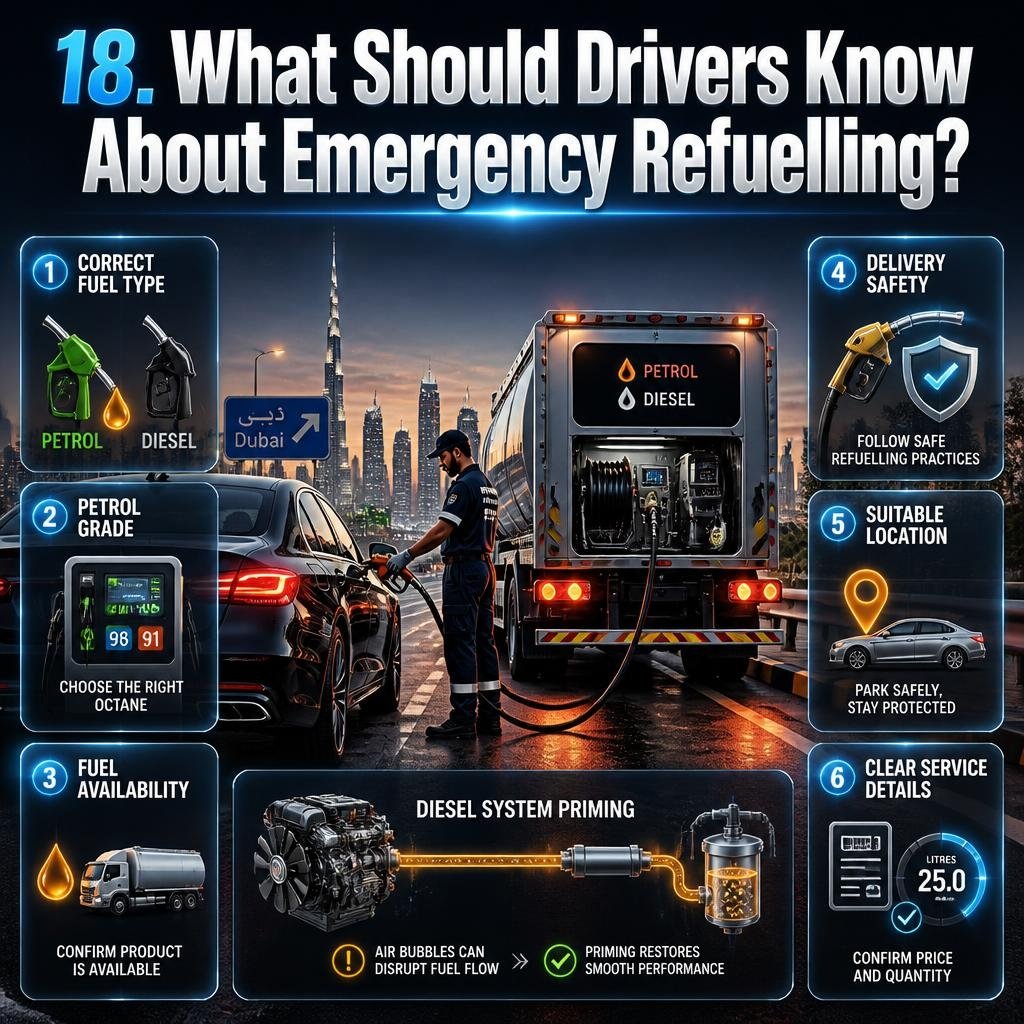
Unexpected fuel shortages can happen even to careful motorists.
A driver may underestimate the remaining range, encounter unexpected traffic or forget to refuel before a longer journey.
Emergency fuel assistance can be useful when reaching a refuelling station is inconvenient or impossible.
However, emergency refuelling should follow the same fuel compatibility and safety principles as ordinary refuelling.
What Should You Confirm Before Arranging Fuel Delivery?
Check the following:
- Whether your vehicle requires petrol or diesel.
- Which petrol grade is suitable.
- Whether the required product is available.
- Whether the delivery provider follows appropriate safety procedures.
- Whether the delivery location is suitable.
- Whether the service charges and quantity are clear.
What If the Vehicle Has Completely Run Out of Fuel?
Running out of fuel does not automatically mean that the vehicle has suffered mechanical damage.
However, some vehicles may require additional attention before restarting.
Diesel engines can be particularly sensitive because air may enter the fuel system when the tank becomes empty.
Some models require a specific priming procedure.
Follow the manufacturer’s instructions or seek professional assistance rather than repeatedly attempting to start the engine.
How Can Fuel Delivery Help Motorists?
Fuel delivery can provide a practical refuelling option when a vehicle cannot conveniently reach a station.
For information about petrol and diesel assistance, visit Fuel Delivery Dubai.
When arranging assistance, confirm the correct fuel type, required grade and suitable delivery arrangements.
Convenience should always go together with fuel compatibility and safety.
19. How Should You Plan Fuel Requirements and Monthly Expenses?
Fuel quality decisions are closely related to vehicle requirements and everyday fuel planning.
Drivers should first identify the correct fuel product and then estimate how much they need for their usual journeys.
A practical monthly fuel plan should consider:
- Average monthly distance.
- Vehicle fuel consumption.
- Required petrol or diesel grade.
- Applicable fuel prices.
- Traffic and driving conditions.
- Unexpected additional journeys.
A Simple Monthly Fuel Calculation
Suppose a vehicle travels 1,800 kilometres each month and averages 10 litres per 100 kilometres.
Its estimated monthly consumption is:
1,800 ÷ 100 × 10 = 180 litres.
Multiply 180 litres by the applicable price per litre to estimate the monthly fuel expense.
This calculation provides a starting point, not a guaranteed bill. Actual consumption changes with driving conditions and vehicle performance.
For a more organised approach, read our Dubai Fuel Planning guide.
Drivers who want to manage monthly spending can also explore Dubai Fuel Budget.
For a broader understanding of refuelling expenses, see Dubai Fuel Costs and Dubai Fuel Expenses.
These subjects are related to fuel management, but each answers a different question: planning focuses on expected requirements, budgeting focuses on available spending, costs explain the price of fuel use, and expenses consider the wider financial impact of vehicle operation.
20. Understanding Fuel Requirements Before Refuelling
Every vehicle has its own fuel requirements.
Drivers should not assume that all petrol vehicles accept the same octane grade or that all diesel vehicles have identical fuel specifications.
Before refuelling, consider:
- Manufacturer-approved fuel type.
- Minimum petrol octane requirement.
- Suitable diesel specification.
- Any restrictions mentioned in the owner’s manual.
- Requirements for rented or imported vehicles.
This is particularly important when travelling between different areas or using a vehicle that you do not normally drive.
For a more detailed explanation of vehicle compatibility and refuelling specifications, read Dubai Fuel Requirements.
21. How Can You Respond to a Fuel-Related Problem?
When a vehicle develops a problem after refuelling, a calm and organised response is more useful than guessing.
Use this simple process.
Step 1: Identify the symptoms.
Note whether the vehicle has difficult starting, knocking, rough idling, reduced power or warning lights.
Step 2: Record the refuelling details.
Keep the receipt and note the fuel product, quantity and time.
Step 3: Avoid unnecessary driving.
If the engine is knocking severely, stalling or behaving dangerously, stop safely.
Step 4: Request professional inspection.
A qualified technician can inspect the relevant fuel-system and engine components.
Step 5: Keep the inspection findings.
Ask for an explanation of the identified fault and the recommended repair.
Step 6: Avoid unsupported conclusions.
A problem appearing after refuelling does not automatically prove that the fuel was responsible.
A proper diagnosis protects both your vehicle and your maintenance budget.
For a wider explanation of safe fuel handling and refuelling decisions, refer to our Dubai Fuel Quality and Refuelling guide.
How Can You Tell If Petrol or Diesel Is Poor Quality in Dubai?
Poor-quality or contaminated fuel can affect how smoothly your vehicle operates. Drivers may notice unusual engine knocking, rough idling, difficult starting, reduced acceleration or unexpected changes in fuel consumption after refuelling. However, these symptoms can also result from mechanical faults, so they should not be treated as automatic proof of contaminated fuel.
If you notice unusual behaviour after visiting a refuelling station, record the fuel grade, quantity, date and location. A professional inspection can help determine whether the problem involves fuel contamination, incorrect specifications or another engine component.
Important warning signs to investigate:
Persistent engine knocking or unusual combustion sounds.
Difficulty starting shortly after refuelling.
Unstable idling or inconsistent acceleration.
Unexpected fuel filter restrictions.
Water or sediment detected during professional fuel inspection.
Which Petrol Grade Should You Choose in Dubai: E-Plus 91, Special 95 or Super 98?
Choosing the correct petrol grade depends on your vehicle’s engine design and manufacturer’s minimum octane requirement. Dubai motorists commonly encounter E-Plus 91, Special 95 and Super 98, but these grades are not interchangeable for every vehicle.
A higher octane rating does not automatically provide better mileage or performance. If your vehicle is designed for Special 95, upgrading to Super 98 may not produce a noticeable improvement. However, using a lower grade than the manufacturer requires can cause engine knocking under certain operating conditions.
Before selecting a petrol grade:
Check the minimum RON requirement in your owner’s manual.
Inspect the fuel-filler label for recommended specifications.
Follow any manufacturer instructions for turbocharged or high-performance engines.
Avoid selecting petrol based only on price or vehicle category.
Never downgrade below the manufacturer’s minimum requirement without approval.
Does Dubai’s Extreme Heat Affect Petrol and Diesel Quality?
Dubai’s high temperatures create additional considerations for fuel storage and vehicle operation. Petrol is volatile and can experience increased evaporation-related challenges under unsuitable storage conditions. Diesel also requires proper storage because moisture, water accumulation and prolonged unsuitable storage can contribute to contamination and deterioration.
However, high outdoor temperatures do not automatically mean that fuel supplied through properly managed channels is poor quality. Drivers should distinguish between actual fuel contamination and normal changes in vehicle performance caused by hot weather.
Practical precautions for motorists:
Avoid storing petrol in ordinary plastic bottles or unsuitable containers.
Use appropriate approved storage equipment where storage is permitted.
Protect diesel storage systems against water entry.
Monitor vehicle performance during extended periods of hot weather.
Maintain cooling systems, air filters and fuel filters according to manufacturer recommendations.
Can Poor-Quality Fuel Damage Modern Petrol and Diesel Engines?
Fuel that does not meet the required specifications or contains harmful contaminants can affect modern engines, particularly their fuel delivery and injection systems. Petrol engines may experience combustion problems, injector deposits or fuel pump difficulties. Diesel engines can be particularly sensitive to water contamination and inadequate fuel cleanliness because modern common-rail systems operate under extremely high pressure.
Continuing to operate a vehicle with serious fuel-related symptoms may increase the risk of additional damage. Early inspection is generally more sensible than waiting for the problem to become severe.
Components that may be affected include:
Fuel injectors and injection pumps.
Fuel filters and fuel lines.
Petrol engine combustion components.
Diesel high-pressure fuel systems.
Emissions-control equipment, including diesel particulate filters.
A qualified technician should inspect the vehicle before recommending fuel-system cleaning, component replacement or other repairs.
What Should You Check Before Choosing a Fuel Delivery Service in Dubai?
When your vehicle runs out of petrol or diesel, convenience matters, but choosing the correct fuel product and a suitable delivery provider is equally important. A responsible fuel delivery arrangement should confirm the vehicle’s fuel type, required petrol grade, supplied product and safe delivery procedure.
This is particularly important for motorists who need roadside assistance and cannot conveniently reach a refuelling station. Providing the correct vehicle and location details before arranging assistance can also reduce unnecessary delays.
Before confirming a fuel delivery, check:
Whether the provider supplies petrol or diesel suitable for your vehicle.
Whether the required petrol grade is available.
Whether the delivery process follows applicable safety requirements.
Whether the delivery location is suitable and permitted.
Whether fuel quantity and service charges are clearly explained.
Whether the provider can clarify the supplied fuel product.
Choosing a suitable provider helps make emergency refuelling more convenient while keeping fuel compatibility and safety at the centre of the decision.
Conclusion
Fuel quality plays an important role in vehicle performance, engine protection, fuel efficiency and long-term maintenance costs in Dubai. Choosing the correct petrol grade or diesel specification is only one part of responsible refuelling. Drivers should also pay attention to fuel handling, storage conditions, vehicle requirements and signs that may indicate contamination or an unusual change in engine behaviour.
Dubai’s hot climate and demanding driving conditions make consistent vehicle care particularly important. Using the fuel grade recommended by the vehicle manufacturer, purchasing fuel from reliable sources and responding promptly to possible fuel-related problems can help reduce avoidable risks. Regular maintenance and sensible refuelling habits also support more predictable vehicle performance and fuel expenses.
For motorists who want to make better refuelling decisions, understanding Dubai fuel quality and refuelling requirements provides a practical starting point. Whether you are managing everyday journeys, planning monthly fuel expenses or dealing with an unexpected roadside shortage, informed decisions can help protect your vehicle and make driving more convenient.
Ultimately, good fuel management is not simply about filling the tank. It is about using the right fuel, maintaining the vehicle properly and choosing a dependable refuelling solution when support is needed.
Leave a Reply