

Introduction
Dubai Fuel Budget | Driving in Dubai offers convenience, flexibility and freedom, but keeping a car on the road also comes with recurring expenses. Among these expenses, petrol and diesel can take a noticeable portion of a monthly household or business budget. Whether you commute to work every morning, travel between different Dubai communities, or regularly drive to other emirates, your fuel spending depends on more than just the distance shown on your navigation app.
Traffic congestion, vehicle efficiency, driving habits, air conditioning, road conditions and monthly fuel price changes all influence how much you spend. Without a proper plan, it is easy to underestimate your monthly requirements and find yourself spending more than expected.
Creating a realistic Dubai Fuel Budget helps you understand your vehicle’s running costs, organise regular refuelling and avoid unnecessary expenses. It also makes it easier to plan family journeys, business travel and unexpected trips without disrupting your other financial commitments.
For drivers looking for practical information about fuel availability, vehicle support and fuel-related services, Fuel Delivery Dubai provides a starting point for understanding local fuel assistance options.
This guide explains how to calculate monthly petrol and diesel expenses, estimate fuel costs for different driving routines, compare vehicle efficiency, manage changing fuel prices and reduce unnecessary consumption. You’ll also learn how to track your spending and prepare a fuel budget that reflects your actual driving requirements.
1. What Is a Dubai Fuel Budget and Why Does It Matter?
A Dubai fuel budget is a planned amount of money allocated to purchasing petrol or diesel over a particular period. Most motorists prepare a monthly budget because it makes fuel expenses easier to compare with their salary, household spending or business operating costs.
However, a useful fuel budget is not simply an amount chosen without calculation. It should reflect how much you drive, how efficiently your vehicle uses fuel and how much you currently pay per litre.
For example, two people might own similar SUVs but have completely different monthly fuel expenses. One may drive between home and the office every day, while the other may use the vehicle mainly for weekend activities. Their engine types might be similar, but their driving requirements are not.
Why should drivers plan their fuel expenses?
A fuel budget provides a clearer understanding of your regular transportation costs. Instead of discovering that you’ve spent more than expected at the end of the month, you can identify your requirements in advance.
The main benefits include:
- Better financial planning: You can allocate an appropriate amount for regular refuelling.
- Expense control: You can identify unnecessary journeys and avoidable fuel consumption.
- Improved vehicle management: Regular fuel records help you notice unexpected changes in efficiency.
- More reliable travel planning: You can prepare for longer journeys without overlooking their fuel requirements.
- Better household budgeting: You can separate vehicle fuel expenses from groceries, utilities and other commitments.
A fuel budget is particularly useful for people who depend on their vehicles for daily commuting or professional activities.
Fuel budget versus total vehicle budget
It’s important to understand that fuel expenses represent only one part of vehicle ownership.
Your total vehicle budget may also include:
- Vehicle servicing and repairs.
- Tyres and replacement parts.
- Insurance and registration.
- Parking expenses.
- Salik and other applicable road charges.
- Cleaning and vehicle care.
Keep these costs separate when calculating your fuel requirements. This prevents you from confusing a temporary maintenance expense with an increase in fuel consumption.
2. Which Factors Determine Your Monthly Fuel Expenses in Dubai?
Your monthly fuel spending is influenced by several connected factors. Understanding them helps you prepare a more accurate estimate instead of relying on the amount you usually spend when filling your tank.
Monthly driving distance
The number of kilometres you cover is one of the most important factors.
A person travelling 800 kilometres each month will generally require less fuel than someone covering 2,500 kilometres, assuming similar vehicle efficiency and driving conditions.
Calculate your normal journeys, including commuting, shopping, school runs and weekend activities.
Vehicle fuel efficiency
Fuel efficiency describes how far your vehicle can travel using a specific quantity of fuel.
In the UAE, fuel consumption is commonly displayed as kilometres per litre (km/L) or litres per 100 kilometres (L/100 km).
For example:
- A car averaging 15 km/L uses approximately 6.67 litres per 100 km.
- A car averaging 10 km/L uses 10 litres per 100 km.
- A car averaging 8 km/L uses 12.5 litres per 100 km.
A lower km/L figure means the vehicle requires more fuel to cover the same distance.
Engine type and vehicle size
A vehicle’s engine design, weight, transmission and overall efficiency influence its fuel requirements.
A small petrol sedan may use considerably less fuel than a large petrol SUV. Similarly, a modern diesel vehicle may deliver better mileage than an older vehicle with a comparable engine size.
Don’t assume that every petrol vehicle is expensive to operate or every diesel vehicle is economical. Compare actual consumption figures for the vehicles you’re considering.
Dubai traffic conditions
Driving through congested roads can increase fuel consumption because of repeated acceleration, braking and engine idling.
A journey that covers only 15 kilometres may take considerably longer during busy commuting periods than during quieter hours.
Air conditioning requirements
Dubai’s hot weather makes air conditioning an important part of everyday driving. Cooling demand can increase the energy required to operate your vehicle, particularly when the cabin is extremely hot.
The effect depends on the vehicle, outside temperature, cooling settings and driving conditions.
Monthly fuel prices
UAE petrol and diesel prices are reviewed monthly. Therefore, the same quantity of fuel can cost different amounts in different months.
Your budget should use the current price of the correct fuel grade rather than an outdated estimate.
3. How to Calculate Your Monthly Dubai Fuel Budget
The easiest way to calculate your fuel budget is to use your monthly driving distance, average fuel efficiency and current price per litre.
You can complete this calculation using a calculator, spreadsheet or basic notebook.
Step 1: Calculate your monthly distance
Start by recording how far you travel during a normal week.
For example, imagine your daily office journey covers 28 kilometres in one direction.
Your return journey is:
28 × 2 = 56 km.
If you travel to the office for 22 working days:
56 × 22 = 1,232 km.
Now include an additional 250 kilometres for shopping, family activities and personal travel.
Your estimated monthly distance becomes:
1,232 + 250 = 1,482 km.
This is a more useful estimate than calculating your budget using your office journey alone.
Step 2: Find your actual fuel efficiency
Check your vehicle’s trip computer to identify its average consumption.
If your dashboard shows kilometres per litre, use that figure as your initial estimate. However, compare it with actual fuel purchases over several refuelling cycles.
For example, a vehicle may display 12 km/L, but its actual average may be slightly lower because of congestion, short journeys and air conditioning use.
For accurate budgeting, your own driving records are more useful than relying entirely on manufacturer figures.
Step 3: Calculate the required fuel quantity
Use this formula:
Monthly fuel required = Monthly driving distance ÷ Average km/L
Suppose your monthly distance is 1,482 kilometres and your average fuel efficiency is 12 km/L.
1,482 ÷ 12 = 123.5 litres.
You should therefore estimate approximately 124 litres for the month.
Step 4: Calculate the monthly fuel cost
Multiply your estimated fuel quantity by the current price per litre.
Monthly fuel cost = Required litres × Price per litre
For an illustrative calculation using a fuel price of AED 4.00 per litre:
123.5 × 4.00 = AED 494.
Your estimated monthly fuel expense would be AED 494.
The AED 4.00 figure is only an example for demonstrating the calculation. Replace it with the actual price of your vehicle’s required fuel grade when preparing your budget.
Step 5: Include additional driving requirements
Your calculated amount represents your expected regular fuel consumption. It may not cover every journey.
Consider whether you regularly:
- Travel to another emirate.
- Make additional family journeys.
- Drive during busy commuting periods.
- Use your vehicle for business.
- Change your route because of roadworks or traffic.
- Take longer trips during weekends or holidays.
Add a reasonable allowance based on your actual circumstances.
Example of a complete monthly calculation
| Budget component | Example |
|---|---|
| Monthly driving distance | 1,482 km |
| Average fuel efficiency | 12 km/L |
| Estimated fuel quantity | 123.5 litres |
| Illustrative fuel price | AED 4.00/L |
| Calculated fuel expense | AED 494 |
| Additional allowance | AED 50 |
| Planned monthly budget | AED 544 |
This example demonstrates how a driver can move from an approximate spending guess to a structured monthly budget.
4. How Much Should You Budget for Petrol in Dubai?
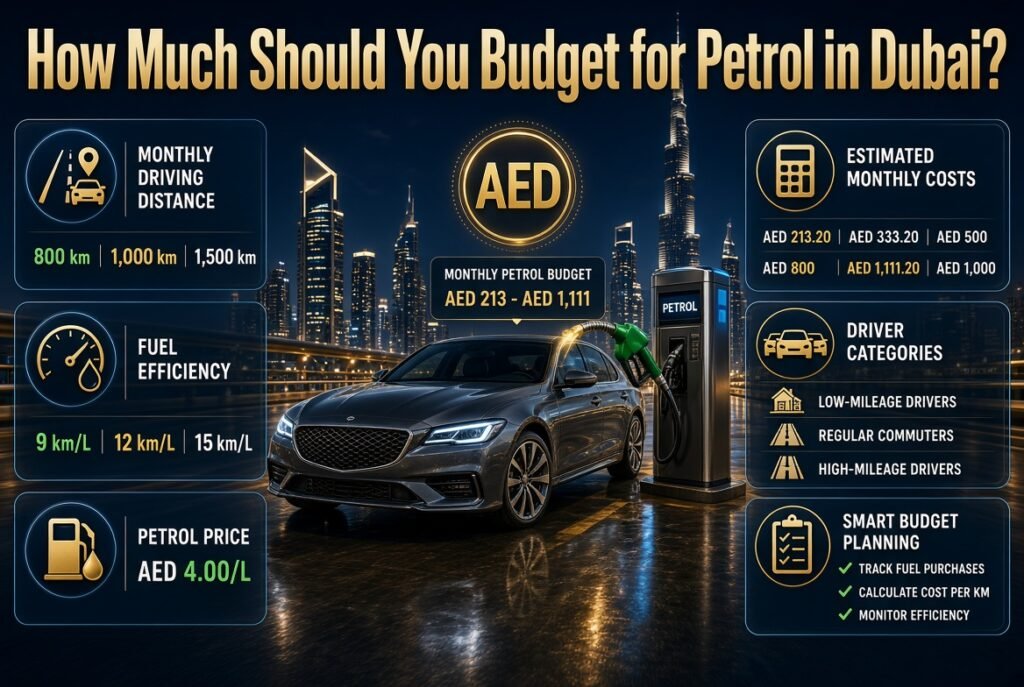
There isn’t one monthly petrol budget that suits every driver. Your expenses depend on how often you drive, the type of vehicle you use and the routes you regularly travel.
A compact sedan used for local commuting may have considerably lower fuel requirements than a large SUV used for frequent inter-emirate journeys.
The following examples use an illustrative petrol price of AED 4.00 per litre. Actual expenses will change according to the current fuel price and real-world consumption.
| Monthly distance | Average efficiency | Estimated litres | Estimated cost |
|---|---|---|---|
| 800 km | 15 km/L | 53.3 L | AED 213.20 |
| 1,000 km | 12 km/L | 83.3 L | AED 333.20 |
| 1,500 km | 12 km/L | 125 L | AED 500 |
| 2,000 km | 10 km/L | 200 L | AED 800 |
| 2,500 km | 9 km/L | 277.8 L | AED 1,111.20 |
| 3,000 km | 12 km/L | 250 L | AED 1,000 |
These are mathematical examples, not guaranteed spending averages for Dubai motorists.
Budget for low-mileage drivers
If you mainly use your car for shopping, occasional appointments and weekend journeys, your monthly distance may be relatively low.
Your budget should reflect the journeys you actually make rather than the maximum distance your vehicle could cover.
However, don’t overlook occasional longer trips when calculating your monthly requirements.
Budget for regular commuters
Daily commuters should prioritise their return journey, working days and additional personal driving.
If your work schedule changes frequently, use an average from the previous two or three months instead of assuming every month will involve exactly the same distance.
Budget for high-mileage drivers
People covering more than 2,000 kilometres monthly should pay closer attention to fuel consumption.
A small difference in average efficiency can produce a noticeable change in total expenditure.
For these drivers, recording fuel purchases and calculating cost per kilometre is especially useful.
5. How Do November Fuel Prices Affect Your Dubai Fuel Budget?
Fuel prices are an important part of monthly budgeting because UAE petrol and diesel rates are subject to monthly revisions.
Drivers should check the current rate before calculating their next month’s fuel allowance.
For November 2026, the announced UAE prices are:
| Fuel type | Price per litre |
|---|---|
| E-Plus 91 | AED 3.97 |
| Special 95 | AED 4.04 |
| Super 98 | AED 4.16 |
| Diesel | AED 4.75 |
These rates provide a reference for November 2026. They should not be treated as permanent prices.
Why do fuel prices change?
The UAE follows a monthly fuel pricing mechanism that reflects movements in international fuel markets.
When the approved rates change, motorists may notice a difference in their monthly expenditure even if they maintain exactly the same driving routine.
For example, a driver purchasing 150 litres monthly will experience a different total cost whenever the price per litre changes.
How should you respond to a price increase?
Don’t immediately assume you need to reduce essential journeys.
First, calculate the financial difference.
For example, if the price increases by AED 0.15 per litre and your monthly consumption is 150 litres:
150 × 0.15 = AED 22.50.
This means your monthly fuel expenditure increases by AED 22.50, assuming your consumption remains unchanged.
A calculation like this helps you make decisions based on actual financial impact rather than uncertainty.
What if prices decrease?
When fuel prices decrease, you may have some additional room in your monthly budget.
Instead of automatically increasing your spending elsewhere, consider keeping the difference as a reserve for future fuel purchases.
Practical Tip: Review the monthly fuel announcement before updating your budget. Never use an old price as the basis for a new month’s calculation.
6. How Much Fuel Does Your Daily Dubai Commute Require?
Daily commuting is often the largest predictable part of a personal fuel budget.
However, two people travelling similar distances can have different fuel expenses because their vehicles and routes may not be equally efficient.
Consider a driver travelling 40 kilometres daily on a return journey for 22 working days.
Monthly commuting distance:
40 × 22 = 880 km.
If the vehicle averages 11 km/L:
880 ÷ 11 = 80 litres.
At an illustrative price of AED 4.00 per litre:
80 × 4.00 = AED 320.
This calculation covers commuting only. It doesn’t include shopping, weekend activities or unexpected travel.
Account for your actual route
A route with continuous traffic may require more fuel than a smoother journey covering a similar distance.
For example, travelling through busy urban areas can involve:
- Repeated stopping at intersections.
- Slow movement during peak periods.
- Frequent acceleration.
- Longer journey times.
- Additional engine idling.
If you regularly drive between residential communities and commercial areas, consider how these conditions affect your actual consumption.
Include working days and holidays
Your monthly commute may change according to your working schedule.
A month with public holidays or annual leave may involve fewer office journeys. A month with additional office attendance may increase your fuel requirements.
Calculate your working days rather than automatically using the same figure every month.
7. How Should Families Plan a Combined Fuel Budget?
Families often underestimate fuel expenses because their driving is spread across several different activities.
One person may use the vehicle for work, while another journey involves school collection, shopping or family appointments.
Individually, these trips may appear small. Together, they can account for a considerable amount of monthly mileage.
Identify regular family journeys
Start by listing the journeys your household makes regularly.
For example:
- Morning school drop-off.
- Office commuting.
- Afternoon school collection.
- Grocery shopping.
- Medical appointments.
- Weekend family visits.
- Recreational activities.
Calculate the approximate distance of each routine.
You don’t need to record every journey perfectly. A reasonable monthly estimate is enough to create a useful starting budget.
Combine journeys where practical
If you have several errands in nearby locations, consider completing them during one planned outing.
This can reduce unnecessary driving and repeated journeys.
For example, instead of visiting a supermarket on one day and returning to the same area for another appointment the following day, you may be able to organise both activities together.
Monitor fuel spending for multiple vehicles
If your household operates two or more vehicles, track each one separately.
Different engines, vehicle sizes and driving schedules make it difficult to use a single consumption estimate.
A separate record helps identify which vehicle is more economical for regular journeys.
8. Petrol vs Diesel: Which Is More Economical for Your Budget?
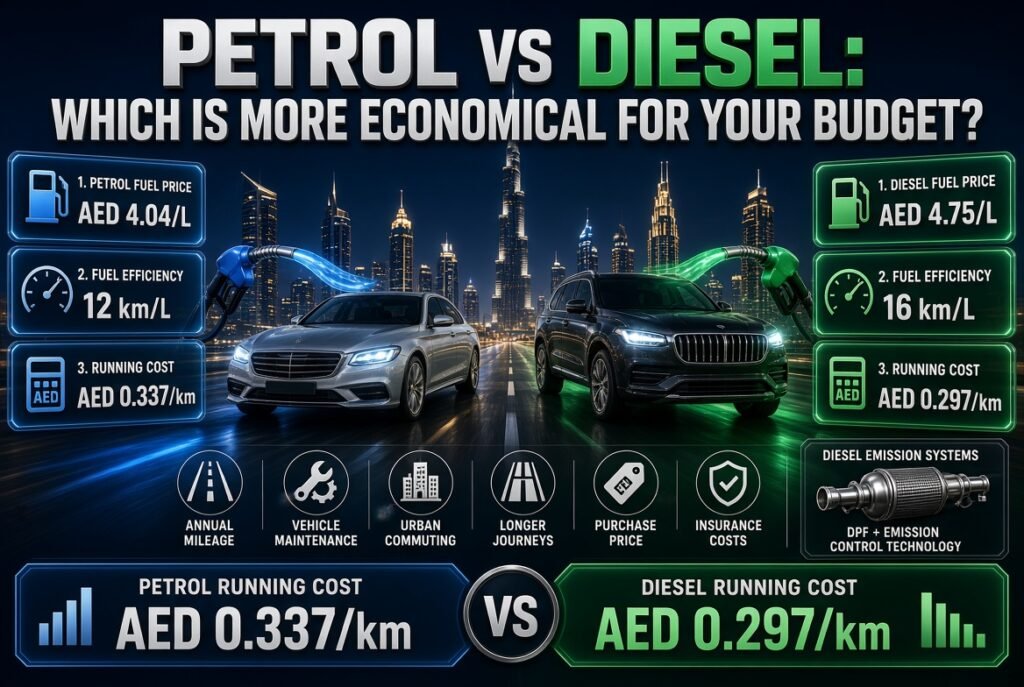
Choosing between petrol and diesel requires more than comparing their prices per litre.
Diesel generally offers better fuel efficiency in many comparable engine applications, but its higher price per litre and vehicle-specific maintenance requirements must also be considered.
The right choice depends on your annual mileage, vehicle type and intended use.
Compare the main running-cost factors
| Factor | Petrol | Diesel |
|---|---|---|
| Price per litre | Depends on selected grade | Usually higher |
| Fuel efficiency | Varies by vehicle | Often better in comparable applications |
| Urban commuting | Suitable for many vehicles | Depends on engine and usage |
| Longer journeys | Depends on efficiency | Can offer an advantage |
| Maintenance | Vehicle-specific | Some emission systems can add costs |
| Budget suitability | Depends on annual mileage | Depends on total running costs |
Calculate fuel cost per kilometre
The most useful comparison is the cost of travelling one kilometre.
Cost per kilometre = Fuel price per litre ÷ Average km/L
For example:
Petrol vehicle:
- Fuel price: AED 4.04 per litre.
- Efficiency: 12 km/L.
- Cost: approximately AED 0.337 per kilometre.
Diesel vehicle:
- Fuel price: AED 4.75 per litre.
- Efficiency: 16 km/L.
- Cost: approximately AED 0.297 per kilometre.
In this hypothetical comparison, the diesel vehicle has a lower fuel cost per kilometre despite the higher price of diesel.
However, a proper ownership comparison should also include servicing, insurance, purchase price, repairs and vehicle suitability.
When should you consider a petrol vehicle?
Petrol vehicles can be suitable for drivers who mainly cover moderate distances, make frequent local journeys or prefer a vehicle with maintenance requirements that suit their ownership plans.
The decision should be based on the specific vehicle rather than a general assumption about every petrol engine.
When should you consider diesel?
Diesel may be worth considering for drivers covering substantial distances, particularly where the vehicle’s efficiency provides a meaningful reduction in fuel cost per kilometre.
However, some modern diesel engines use diesel particulate filters and other emission-control systems that have specific operating and maintenance requirements.
Compare the complete running cost before making a purchase decision.
9. How Does Dubai Traffic Increase Your Fuel Spending?
Traffic is one of the practical challenges motorists should consider when preparing a fuel budget.
A vehicle may deliver reasonable fuel economy on an uninterrupted journey but consume more fuel during repeated stops and slow movement.
Stop-and-go driving
Frequent acceleration requires the engine to produce additional power.
When a driver repeatedly accelerates, brakes and moves forward a short distance, the vehicle may use more fuel than it would during a steady journey.
This is particularly relevant to busy urban routes and congested intersections.
Long periods of idling
An engine that remains running while the vehicle is stationary continues consuming fuel without covering any distance.
Common examples include:
- Waiting outside a shop.
- Keeping the engine running while waiting for passengers.
- Extended stationary periods.
- Unnecessary waiting with the air conditioning operating.
Switching off the engine when safely appropriate can prevent avoidable consumption.
Plan around predictable congestion
If your work schedule allows flexibility, consider whether changing your departure time could help you avoid some of the busiest traffic periods.
Don’t make unsafe speed or route decisions simply to save fuel.
The objective is to reduce unnecessary driving and prolonged waiting, not to compromise road safety.
For a wider understanding of local driving conditions, explore our Dubai Driving and Fuel Insights guide.
10. How Does Air Conditioning Affect Your Fuel Budget?
Air conditioning is an important part of comfortable driving in Dubai. During hot weather, drivers rely on it to maintain a suitable cabin temperature, especially when vehicles are parked outdoors.
However, cooling the cabin requires energy and can increase fuel consumption.
Why does AC affect fuel consumption?
In conventional vehicles, the air conditioning compressor places an additional load on the engine.
When cooling demand increases, the system may require more energy to maintain the selected cabin temperature.
The actual impact depends on several factors:
- Outside temperature.
- Cabin temperature before cooling.
- Vehicle design.
- AC system condition.
- Fan and cooling settings.
- Driving speed and traffic.
How can you manage AC-related fuel use?
You shouldn’t sacrifice cabin comfort or safe driving conditions to reduce fuel expenses.
Instead, use practical habits:
- Park in shaded areas when available.
- Use sunshades to reduce direct sunlight entering the cabin.
- Maintain the AC system according to manufacturer recommendations.
- Avoid unnecessary engine idling.
- Ensure the cabin air filter is maintained.
- Use suitable cooling settings rather than constantly adjusting the system.
A properly maintained air conditioning system helps maintain comfortable operation without overlooking vehicle efficiency.
11. How Can You Reduce Your Monthly Fuel Budget Without Buying Another Car?
Reducing fuel expenditure doesn’t always require replacing your vehicle.
In many cases, better driving habits, suitable maintenance and improved journey planning can help reduce unnecessary consumption.
Maintain smooth acceleration
Sudden acceleration requires more power than gradual, controlled acceleration.
Anticipate traffic movements and increase speed smoothly when road conditions allow.
This also helps create a more comfortable driving experience for passengers.
Avoid unnecessary braking
Look ahead and maintain a safe following distance.
When you recognise slowing traffic early, you may be able to reduce speed gradually instead of braking sharply at the last moment.
Never compromise a safe stopping distance to save fuel.
Maintain recommended tyre pressure
Tyres with insufficient pressure can increase rolling resistance and affect fuel efficiency.
Check pressure regularly using the vehicle manufacturer’s recommended figures.
Don’t overinflate tyres. Incorrect pressure can affect handling, braking and tyre life.
Remove unnecessary weight
Carrying unnecessary equipment or heavy items in the boot increases the energy required to move the vehicle.
Remove items you don’t need for your regular journeys.
Roof racks and external cargo carriers can also increase aerodynamic resistance, particularly at higher speeds.
Follow the maintenance schedule
Poor vehicle condition can affect fuel economy.
Pay attention to:
- Engine oil specifications.
- Air filter condition.
- Spark plugs where applicable.
- Brake condition.
- Wheel alignment.
- Tyre condition.
- Fuel and ignition system performance.
Only replace parts when inspection or manufacturer guidance indicates that maintenance is necessary.
Combine nearby journeys
Plan shopping, appointments and other activities around nearby locations where practical.
Reducing unnecessary kilometres can help lower fuel expenses without changing your essential travel requirements.
12. How Should You Track Your Monthly Petrol and Diesel Spending?
A fuel budget becomes more useful when you compare your planned spending with actual purchases.
Without tracking, you may know how much money you spend but not understand why the amount changes.
A basic spreadsheet or notebook is enough to monitor your vehicle’s fuel consumption.
What information should you record?
Whenever you refuel, record:
- Date of purchase.
- Vehicle odometer reading.
- Litres purchased.
- Fuel type and grade.
- Total amount paid.
- Current fuel price.
These details allow you to compare your consumption over time.
Calculate monthly fuel consumption
At the end of each month, review:
- Total distance travelled.
- Total litres consumed or purchased over the measurement period.
- Total fuel expenditure.
- Average kilometres per litre.
- Average fuel cost per kilometre.
For accurate fuel-efficiency calculations, use consistent full-tank-to-full-tank measurements and account for the odometer distance between refills. Simply adding litres purchased during a month may not equal the exact fuel consumed if your tank starts and ends at different levels.
Use a simple monthly record
| Month | Distance | Fuel quantity | Fuel spending |
|---|---|---|---|
| August | 1,300 km | 110 L | AED 440 |
| September | 1,400 km | 117 L | AED 468 |
| October | 1,500 km | 125 L | AED 500 |
| November | 1,400 km | 117 L | AED 468 |
These are illustrative figures using a constant example price of AED 4.00 per litre.
The purpose is to demonstrate how fuel spending can be tracked consistently, not to represent actual historical monthly prices.
What should you do when spending increases?
Compare the distance travelled with the fuel purchased.
If both increase, your higher expense may simply reflect additional driving.
If the distance remains similar but fuel consumption rises, investigate traffic conditions, tyre pressure, driving habits and possible vehicle issues.
This approach helps you identify the reason instead of making unnecessary changes to your budget.
13. How Should Business Drivers and Delivery Vehicles Plan Fuel Expenses?
Business drivers often have different budgeting requirements from private motorists.
Their routes may change daily, their vehicles may carry additional loads and their working hours can involve extensive driving.
For these drivers, fuel is not simply a household expense. It is part of the operating cost of providing a service.
Calculate cost against business mileage
Record the distance covered during working hours and compare it with the fuel consumed.
For example, a business vehicle covering 3,000 kilometres monthly at an average efficiency of 10 km/L will require approximately 300 litres.
Multiply this quantity by the current applicable fuel price to calculate the estimated fuel expenditure.
Monitor vehicle usage
A useful business fuel record should include:
- Vehicle identification within the company’s own records.
- Monthly starting and ending mileage.
- Fuel purchases.
- Driver and route information.
- Business-related additional journeys.
- Unusual consumption changes.
Understand the effect of vehicle load
Heavy loads can increase the energy required to move a vehicle.
Avoid carrying unnecessary equipment and distribute cargo according to the manufacturer’s recommendations.
For commercial vehicles, compare fuel consumption against the type of work being completed rather than judging every month by the same target.
Review fuel expenses regularly
A monthly review helps businesses identify vehicles with unusual consumption patterns.
It can also support better route planning and help managers understand the cost of individual operating activities.
14. How Should You Prepare for Unexpected Fuel Expenses?
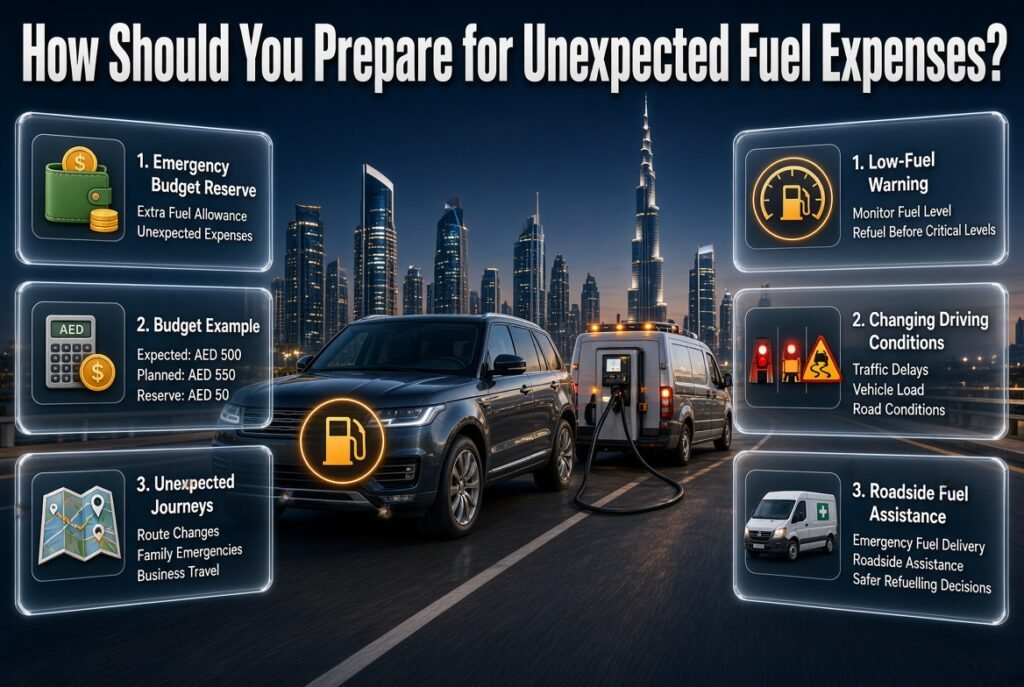
Even a well-planned fuel budget cannot predict every journey.
A route change, family emergency, extended traffic delay or unexpected business trip may increase your fuel requirements.
This is why a realistic budget should include some flexibility.
Create a small reserve
Set aside an additional amount based on your monthly driving pattern and available finances.
For example, if your expected fuel expenditure is AED 500, you might plan a total allowance of AED 550.
The additional AED 50 is a reserve, not an amount you must spend.
Avoid relying on the low-fuel warning light
Your vehicle’s low-fuel warning system is intended to alert you that the available fuel is becoming limited.
It should not be treated as a regular refuelling reminder.
The remaining driving range is an estimate and can change according to traffic, vehicle load, road conditions and driving style.
Plan to refuel before your tank becomes critically low.
Know your available fuel assistance options
If an unexpected situation leaves you unable to reach a suitable fuel station safely, consider appropriate roadside assistance.
Depending on your location and circumstances, fuel delivery may provide an alternative to travelling to a station yourself.
Always prioritise your safety and avoid stopping in a dangerous traffic location.
15. What Are the Most Common Fuel Budgeting Mistakes in Dubai?
Many drivers don’t have a fuel problem; they have an inaccurate budgeting method.
They may calculate their expenses using incomplete information or overlook factors that regularly increase their consumption.
Understanding these mistakes makes it easier to prepare a realistic monthly plan.
Mistake 1: Using the fuel tank capacity as the monthly budget
A 60-litre tank only tells you how much fuel the vehicle can hold. It doesn’t indicate how much fuel you’ll use during a month.
Why it happens: Drivers focus on the amount paid during a full-tank refill.
Why it creates problems: A vehicle requiring two refills monthly has different expenses from one requiring five.
How to avoid it: Calculate monthly consumption using kilometres travelled and actual fuel efficiency.
Mistake 2: Forgetting personal and family journeys
Many drivers calculate their office commute but overlook shopping, appointments and weekend activities.
Why it happens: Work travel is easier to estimate because it follows a regular schedule.
Why it creates problems: Your estimated monthly distance becomes lower than your actual mileage.
How to avoid it: Include all regular journeys and review additional driving at the end of each week.
Mistake 3: Depending entirely on advertised fuel economy
Manufacturer figures help compare vehicles, but they may not represent your real-world consumption.
Why it happens: Drivers assume their vehicle will always deliver its advertised efficiency.
Why it creates problems: Traffic, air conditioning, vehicle load and driving style can affect actual consumption.
How to avoid it: Track your own mileage and fuel purchases over several refuelling cycles.
Mistake 4: Ignoring monthly price changes
UAE fuel prices can change from one month to another.
Why it happens: Some motorists continue using the previous month’s rate.
Why it creates problems: Their estimated monthly expenditure may no longer match the amount paid at the pump.
How to avoid it: Update your calculation using the latest applicable fuel price.
Mistake 5: Choosing fuel only because it is cheaper
The cheapest fuel grade is not necessarily appropriate for every vehicle.
Why it happens: Drivers compare prices without checking engine requirements.
Why it creates problems: Using a grade that doesn’t meet the manufacturer’s specifications may affect engine operation.
How to avoid it: Follow the recommended fuel grade in your owner’s manual or fuel-filler information.
Mistake 6: Ignoring unnecessary idling
An engine that remains running while stationary can consume fuel without adding mileage.
Why it happens: Drivers become accustomed to keeping the engine on while waiting.
Why it creates problems: Fuel is consumed without providing useful travel.
How to avoid it: Switch off the engine when safely appropriate and follow your vehicle’s operating recommendations.
Mistake 7: Failing to monitor vehicle condition
Changes in fuel efficiency may sometimes be connected to maintenance issues.
Why it happens: Drivers assume every increase is caused by fuel prices or longer journeys.
Why it creates problems: A mechanical issue may remain unnoticed.
How to avoid it: Monitor consumption and arrange a professional inspection when an unexplained change continues.
Mistake 8: Setting an unrealistic monthly spending limit
Some motorists choose an extremely low budget without considering their actual travel requirements.
Why it happens: They focus on reducing spending rather than understanding necessary expenses.
Why it creates problems: The budget becomes difficult to maintain and doesn’t reflect everyday needs.
How to avoid it: Build your spending limit from actual driving data and adjust it gradually.
16. Expert Advice for Creating a More Accurate Dubai Fuel Budget
A reliable fuel budget should be based on measurable information rather than assumptions.
The following recommendations can make your monthly calculations more useful.
Use a three-month average
One month may not represent your normal driving routine.
You may have travelled more during a holiday period or used your vehicle less because of annual leave.
Comparing three months of mileage and fuel expenditure provides a more balanced estimate.
Separate fuel price changes from consumption changes
A higher fuel bill doesn’t always mean your vehicle has become less efficient.
There are two different measurements:
- The amount of fuel consumed.
- The amount paid for each litre.
If your fuel quantity remains stable but the total bill increases, the price may be responsible.
If the quantity increases while your driving distance remains similar, investigate efficiency.
Calculate cost per kilometre regularly
Cost per kilometre helps you understand the financial impact of your vehicle’s fuel consumption.
For example, if your fuel cost is AED 0.35 per kilometre, an additional 400 kilometres would represent approximately AED 140 in fuel expenses.
This makes it easier to decide whether an additional journey fits your monthly budget.
Keep emergency travel separate from routine travel
Don’t use your normal commuting allowance to cover every unexpected journey.
Maintain a small reserve so that additional travel doesn’t immediately affect your regular budget.
Review your vehicle’s efficiency after maintenance
If you have carried out maintenance because of a fuel-related issue, compare consumption before and after the repair.
Use similar routes and driving conditions where possible.
This provides a more meaningful indication of whether the work has improved efficiency.
Don’t chase fuel savings at the expense of safety
Driving too slowly on roads where it is inappropriate, delaying necessary maintenance or ignoring tyre problems can create greater risks.
A sensible fuel-saving approach should support safe driving and proper vehicle care.
17. A Practical Monthly Dubai Fuel Budget Checklist
Use this checklist at the beginning of each month to organise your expected fuel expenditure.
Driving requirements
- Record your current odometer reading.
- Estimate your monthly commuting distance.
- Include weekend and family journeys.
- Consider any expected inter-emirate travel.
- Identify additional business mileage if applicable.
Fuel calculations
- Confirm your vehicle’s required fuel grade.
- Check the current price per litre.
- Review your average km/L.
- Calculate estimated monthly litres.
- Calculate the expected fuel expenditure.
Expense management
- Set a realistic monthly spending limit.
- Include a reasonable emergency allowance.
- Record every fuel purchase.
- Compare weekly spending with your target.
- Review your total expenditure at month-end.
Vehicle efficiency
- Check tyre pressure.
- Monitor engine performance.
- Follow the servicing schedule.
- Avoid unnecessary engine idling.
- Investigate unusual changes in consumption.
Following this checklist gives you a repeatable system rather than forcing you to calculate your fuel requirements from the beginning every time.
18. How Can Dubai Fuel Planning Improve Your Everyday Driving?
Fuel planning is not only about reducing expenses. It also helps you make better decisions before starting a journey.
A driver who understands their monthly requirements can organise refuelling, prepare for longer trips and avoid unnecessary last-minute decisions.
For example, if you know your vehicle normally uses approximately 100 litres monthly, you can estimate your regular refuelling requirements and identify when additional journeys may affect your budget.
Planning also becomes easier when you understand your usual routes, traffic patterns and vehicle efficiency.
A practical driving routine should include:
- Checking your fuel level before longer journeys.
- Reviewing your planned route.
- Allowing time for expected congestion.
- Maintaining a suitable driving speed.
- Avoiding unnecessary detours.
- Monitoring fuel consumption.
- Refuelling before the tank becomes critically low.
For more guidance on organising journeys and managing fuel requirements, explore our Dubai City Driving guide.
The aim is not to make every journey complicated. It is to develop simple habits that reduce unnecessary driving and make your monthly fuel expenses more predictable.
How Much Should I Budget for Monthly Petrol Expenses in Dubai?
The monthly petrol budget in Dubai depends on your vehicle’s fuel efficiency, daily commuting distance and driving conditions. A driver covering 1,500 kilometres per month in a vehicle averaging 12 km/L will require approximately 125 litres of petrol. At AED 4.04 per litre for Special 95 (November 2026 example), the estimated monthly expense would be AED 505.
However, drivers using larger SUVs or travelling regularly through congested roads may need a higher budget. The most reliable approach is to calculate expenses using actual fuel consumption rather than relying on general estimates.
Important factors to consider:
Monthly commuting and personal driving distance.
Vehicle engine type and fuel efficiency.
Current UAE petrol prices.
Traffic congestion and air conditioning usage.
Additional journeys during weekends and holidays.
How Can I Calculate My Monthly Fuel Budget Accurately?
To calculate your monthly fuel budget, divide your total monthly driving distance by your vehicle’s average kilometres per litre. Multiply the resulting fuel quantity by the current price per litre. This gives you an estimated monthly fuel expense based on your actual driving requirements.
For example, if you travel 1,800 kilometres monthly and your vehicle delivers 12 km/L, you will require approximately 150 litres. At AED 4.04 per litre, your estimated expense will be AED 606.
For better accuracy, compare this calculation with your actual refuelling records over several months.
A reliable budgeting method includes:
Recording your monthly odometer readings.
Tracking litres purchased during each refuelling.
Checking the latest petrol or diesel prices.
Separating regular commuting from additional journeys.
Reviewing actual spending at the end of each month.
How Do Dubai Traffic and Air Conditioning Affect Monthly Fuel Costs?
Dubai’s traffic conditions and hot weather can influence how much fuel your vehicle consumes. Frequent stopping, repeated acceleration, prolonged idling and continuous air conditioning can increase fuel requirements, even when your monthly driving distance remains relatively unchanged.
For example, a driver travelling the same route every day may notice higher fuel consumption during periods of heavy congestion compared with smoother traffic conditions. Similarly, cooling an extremely hot cabin requires additional energy, which can affect fuel efficiency.
Rather than reducing essential air conditioning or compromising driving comfort, focus on managing unnecessary consumption.
Practical ways to manage these expenses:
Avoid unnecessary engine idling.
Maintain smooth acceleration and braking.
Combine nearby journeys where practical.
Maintain the recommended tyre pressure.
Service the air conditioning system regularly.
Plan journeys to avoid predictable delays when possible.
Is Petrol or Diesel More Economical for Driving in Dubai?
Petrol and diesel vehicles have different fuel consumption characteristics, and the more economical option depends on the vehicle and driving routine. Diesel engines often deliver better fuel efficiency in comparable applications, but diesel generally costs more per litre than petrol in the UAE.
For example, consider a petrol vehicle averaging 12 km/L at AED 4.04 per litre and a diesel vehicle averaging 16 km/L at AED 4.75 per litre.
Their estimated fuel costs would be:
Petrol: AED 0.337 per kilometre.
Diesel: AED 0.297 per kilometre.
In this example, the diesel vehicle has a lower fuel cost per kilometre. However, purchase price, servicing, repairs and annual mileage should also influence your decision.
Before choosing between petrol and diesel:
Compare actual fuel consumption.
Calculate fuel cost per kilometre.
Consider your monthly driving distance.
Review maintenance requirements.
Evaluate the vehicle’s suitability for your daily routes.
What Is the Best Way to Reduce Monthly Fuel Expenses in Dubai Without Changing Your Car?
Reducing monthly fuel expenses doesn’t necessarily require purchasing another vehicle. Improving driving habits, maintaining your existing car and planning journeys more efficiently can help control unnecessary fuel consumption.
Start by understanding how much fuel your vehicle uses under normal driving conditions. Once you have a reliable baseline, you can identify areas where unnecessary consumption may be occurring.
For example, incorrect tyre pressure, unnecessary vehicle weight and aggressive acceleration can affect fuel economy. Addressing these factors can improve efficiency without making major changes to your daily routine.
Professional recommendations:
Check tyre pressure according to manufacturer specifications.
Remove unnecessary items from your vehicle.
Maintain a steady and appropriate driving speed.
Avoid sudden acceleration and unnecessary braking.
Follow the recommended servicing schedule.
Monitor monthly fuel consumption and expenditure.
Combine multiple nearby errands into one journey.
The most important point: Consistent driving habits and proper vehicle maintenance are more reliable long-term budgeting strategies than simply trying to spend less at every refuelling.
Conclusion
Managing a Dubai fuel budget is not simply about setting aside money for petrol or diesel. It requires understanding how far you drive, how often you travel, your vehicle’s fuel efficiency, and how local driving conditions affect consumption. Daily commuting, heavy traffic, long-distance journeys, frequent air-conditioning use and unexpected route changes can all influence monthly fuel expenses.
A realistic budget starts with your average monthly mileage and your vehicle’s actual fuel consumption. By tracking refuelling costs, reviewing driving habits and allowing a small amount for unexpected journeys, you can plan your expenses more accurately and avoid unnecessary fuel spending.
For better control over your monthly fuel budget, focus on these practical habits:
- Monitor your monthly distance and fuel purchases.
- Compare your vehicle’s actual fuel economy over time.
- Maintain correct tyre pressure and follow regular servicing schedules.
- Avoid unnecessary idling, harsh acceleration and repeated braking.
- Plan journeys around traffic conditions whenever possible.
- Keep an emergency allowance for unexpected travel.
Dubai drivers do not need to make major lifestyle changes to manage fuel expenses more effectively. Consistent planning, responsible driving and regular monitoring can make a meaningful difference to monthly costs. A well-planned Dubai fuel budget gives you better control over everyday travel expenses while helping you make more informed decisions about your vehicle and driving routine.
Leave a Reply