Introduction
Dubai Fuel Costs | Fuel expenses are one of the regular costs that every car owner needs to consider when driving in Dubai. Whether you use your vehicle for daily office travel, family transportation, business activities or long-distance journeys, the amount you spend on petrol or diesel can make a noticeable difference to your monthly budget.
However, understanding Dubai fuel costs involves more than knowing the price of one litre. Your actual expenses depend on several factors, including the fuel grade, vehicle type, engine efficiency, driving distance, traffic conditions and maintenance habits.
For example, two people travelling the same distance may have completely different monthly fuel expenses because one drives a compact sedan while the other uses a large SUV. Similarly, a person regularly travelling through congested city roads may use more fuel than someone covering longer distances on relatively clear highways.
Knowing how these factors work together helps you make better financial decisions.
In this complete guide, we’ll explain Dubai petrol and diesel prices, full-tank expenses, monthly fuel calculations, differences between vehicle categories and practical methods for managing fuel expenditure. You’ll also learn how to compare your vehicle’s actual running costs and prepare a realistic budget for everyday driving.
For additional information about local fuel services and practical driving guidance, visit Fuel Delivery Dubai.
1. Understanding Dubai Fuel Costs and the UAE Pricing System
Dubai follows the UAE’s national fuel pricing system. Petrol and diesel rates are reviewed monthly, which means the amount motorists pay can change from one month to another.
The UAE introduced a monthly fuel pricing mechanism that reflects international fuel market movements and local market conditions. This makes it important for drivers to review the latest rates instead of relying on previous months’ prices.
What are the current petrol and diesel prices in Dubai?
For November 2026, the approved retail fuel prices are:
| Fuel Type | Price Per Litre |
|---|---|
| E-Plus 91 | AED 3.97 |
| Special 95 | AED 4.04 |
| Super 98 | AED 4.16 |
| Diesel | AED 4.75 |
These prices became effective on 1 November 2026.
Compared with October 2026, all three petrol grades decreased by AED 0.24 per litre, while diesel decreased by AED 0.05.
The change matters because even a small difference in the price per litre can influence monthly expenses for motorists who regularly travel long distances.
Why are there different petrol grades?
Petrol grades are classified according to their octane ratings. Octane rating indicates a fuel’s resistance to engine knocking under compression.
The three commonly available petrol grades in the UAE are E-Plus 91, Special 95 and Super 98.
E-Plus 91
E-Plus 91 is the lowest-priced petrol grade among the three. It is suitable for vehicles whose manufacturers permit the use of 91-octane petrol.
Special 95
Special 95 is suitable for vehicles requiring 95-octane petrol. It is an appropriate choice for many conventional petrol vehicles, depending on their engine specifications.
Super 98
Super 98 has a higher octane rating and is intended for engines that require or recommend higher-octane fuel.
One important point is that a higher octane rating does not automatically improve fuel economy. Always follow the fuel requirement specified in your owner’s manual or on the fuel-filler label.
Do fuel prices change between Dubai and other emirates?
The approved retail prices are national rates. Therefore, motorists generally pay the same published price for the same fuel grade in Dubai, Abu Dhabi, Sharjah, Ajman and the other UAE emirates.
Changing the fuel station brand does not normally provide a lower official price per litre.
Your actual expenditure is therefore influenced more by the fuel grade, amount purchased and vehicle consumption than by choosing a different emirate for refuelling.
2. How Much Does a Full Tank Cost in Dubai?
A full tank can cost different amounts depending on the vehicle’s fuel tank capacity and the type of fuel required.
A compact vehicle with a 40-litre tank naturally requires less money to refill than a large SUV with an 80-litre tank.
The following examples use November 2026 prices.
| Tank Capacity | E-Plus 91 | Special 95 | Super 98 | Diesel |
|---|---|---|---|---|
| 40 litres | AED 158.80 | AED 161.60 | AED 166.40 | AED 190 |
| 50 litres | AED 198.50 | AED 202 | AED 208 | AED 237.50 |
| 60 litres | AED 238.20 | AED 242.40 | AED 249.60 | AED 285 |
| 70 litres | AED 277.90 | AED 282.80 | AED 291.20 | AED 332.50 |
| 80 litres | AED 317.60 | AED 323.20 | AED 332.80 | AED 380 |
| 100 litres | AED 397 | AED 404 | AED 416 | AED 475 |
These figures represent estimated costs when filling the stated capacity from empty. Actual refuelling amounts will depend on the remaining fuel in your tank.
How do you calculate your own full-tank expense?
Use this simple formula:
Tank Capacity × Price Per Litre = Full-Tank Cost
For example, suppose your vehicle has a 65-litre tank and requires Special 95.
65 × AED 4.04 = AED 262.60
Your estimated full-tank cost is AED 262.60.
If you normally refill when approximately 20 litres remain, you only need around 45 litres.
45 × AED 4.04 = AED 181.80
This distinction is important because most motorists don’t refill from completely empty.
Practical Tip: Check your vehicle’s actual tank capacity in the owner’s manual. Don’t use another vehicle’s specifications simply because the models look similar.
3. What Determines Your Monthly Fuel Expenses?
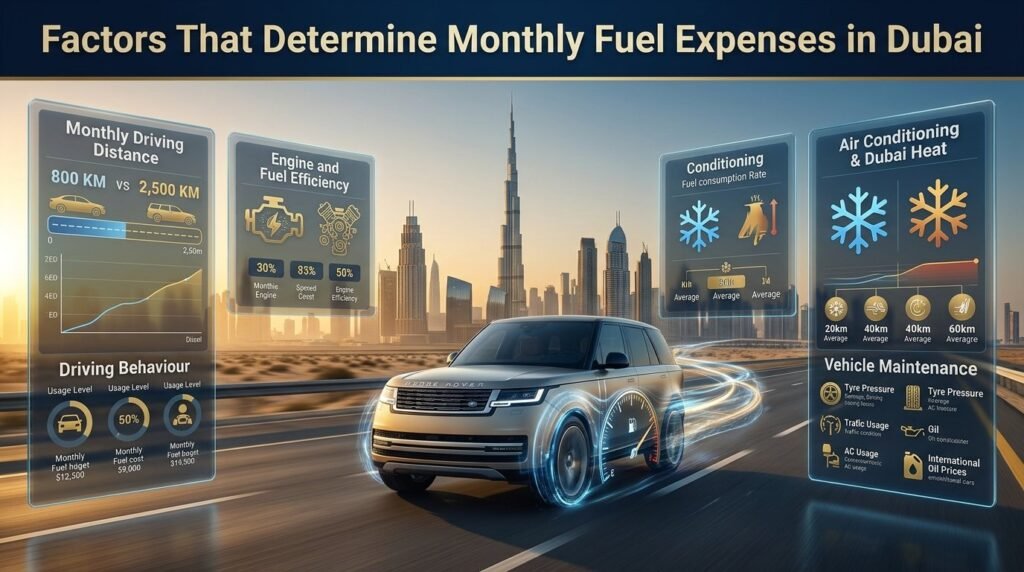
Your monthly fuel expenditure depends on how much fuel your vehicle consumes during everyday driving.
Two vehicles using the same petrol grade can have very different running costs because of differences in engine efficiency, weight, transmission and driving conditions.
Understanding these factors helps you identify where your money goes.
Monthly driving distance
The more kilometres you cover, the more fuel your vehicle generally requires.
Consider two Dubai residents.
The first person drives approximately 800 kilometres monthly, mainly for office commuting and nearby shopping.
The second person covers around 2,500 kilometres because of daily business travel, family transportation and frequent journeys between emirates.
Even if both vehicles have similar fuel consumption, the second driver will naturally spend considerably more on fuel.
This is why your monthly distance should be the starting point when estimating expenses.
Vehicle engine and fuel efficiency
Engine design plays an important role in determining fuel consumption.
Smaller engines may require less fuel under suitable driving conditions, while larger engines can consume more because they are designed to produce greater power.
However, engine displacement alone does not determine efficiency.
Other important factors include:
- Engine technology.
- Vehicle weight.
- Transmission design.
- Aerodynamic resistance.
- Driving speed.
- Mechanical condition.
- Fuel injection and engine management systems.
A modern turbocharged engine may provide better efficiency than an older naturally aspirated engine in certain applications. Actual results depend on the vehicle and driving conditions.
Driving behaviour
Your driving style can influence how frequently you need to refuel.
Repeated hard acceleration, unnecessary braking and maintaining excessive speeds can increase fuel consumption.
A driver who accelerates smoothly and anticipates traffic changes may achieve better efficiency than someone who constantly changes speed.
Small differences become more noticeable when repeated across hundreds of kilometres.
Air conditioning and outside temperature
Dubai’s climate makes air conditioning an essential part of daily driving.
In conventional petrol and diesel vehicles, the AC compressor requires energy from the engine. This can increase fuel consumption depending on cooling demand, outside temperature and vehicle design.
The impact may become more noticeable during:
- Long periods of stationary operation.
- Frequent short journeys.
- Very hot weather.
- Heavy traffic.
- Cooling a cabin after prolonged parking in direct sunlight.
Maintaining the AC system properly can help it operate efficiently without sacrificing comfort.
Vehicle maintenance
A poorly maintained vehicle may consume more fuel than expected.
Incorrect tyre pressure, unsuitable engine oil, restricted air filters and mechanical problems can influence overall efficiency.
Regular maintenance helps identify these problems before they become expensive.
4. How Much Should You Budget for Petrol Every Month?
A realistic monthly fuel budget should reflect your actual driving distance and vehicle consumption.
Instead of estimating an amount randomly, calculate how many litres your vehicle needs and multiply that quantity by the current fuel price.
The monthly fuel cost formula
Monthly Fuel Cost = (Monthly Distance × Consumption per 100 km ÷ 100) × Price Per Litre
Let’s consider a practical example.
Suppose you:
- Travel 1,800 kilometres monthly.
- Use a vehicle consuming 9 litres per 100 kilometres.
- Purchase Special 95 at AED 4.04 per litre.
First, calculate monthly fuel consumption:
1,800 × 9 ÷ 100 = 162 litres.
Now calculate the expense:
162 × AED 4.04 = AED 654.48.
Your estimated monthly fuel expenditure is AED 654.48.
Monthly fuel budget examples
The following table assumes Special 95 at AED 4.04 per litre.
| Monthly Distance | 6 L/100 km | 8 L/100 km | 10 L/100 km | 12 L/100 km |
|---|---|---|---|---|
| 500 km | AED 121.20 | AED 161.60 | AED 202 | AED 242.40 |
| 1,000 km | AED 242.40 | AED 323.20 | AED 404 | AED 484.80 |
| 1,500 km | AED 363.60 | AED 484.80 | AED 606 | AED 727.20 |
| 2,000 km | AED 484.80 | AED 646.40 | AED 808 | AED 969.60 |
| 2,500 km | AED 606 | AED 808 | AED 1,010 | AED 1,212 |
| 3,000 km | AED 727.20 | AED 969.60 | AED 1,212 | AED 1,454.40 |
These are planning examples, not official averages for Dubai motorists.
How should different drivers plan their budgets?
Occasional drivers
People who use their vehicles mainly for shopping, personal appointments and weekend activities may cover relatively few kilometres each month.
Their fuel budgets should reflect actual usage rather than assuming a daily commuting pattern.
Daily office commuters
Office commuters should consider the distance between home and work, the number of working days and additional personal journeys.
For example, a person travelling 35 kilometres each working day over 22 working days covers approximately 770 kilometres just for commuting.
Business and delivery drivers
Business drivers may cover significantly more kilometres because their journeys involve multiple destinations.
They should monitor fuel consumption regularly and compare actual fuel expenditure against business mileage.
Families
Family transportation often involves school journeys, shopping, medical appointments and weekend activities.
Combining nearby errands into practical journeys can help reduce unnecessary kilometres.
5. Petrol vs Diesel: Which Is More Economical in Dubai?
Petrol and diesel engines operate differently, and their fuel consumption patterns are not identical.
Diesel is more expensive per litre in November 2026, but certain diesel vehicles can travel further on each litre.
This means you should compare the actual cost of covering a particular distance instead of judging economy by pump prices alone.
Main differences between petrol and diesel
| Factor | Petrol | Diesel |
|---|---|---|
| November 2026 price | AED 3.97–4.16 | AED 4.75 |
| Ignition method | Spark ignition | Compression ignition |
| Typical efficiency | Depends on engine | Often efficient in suitable applications |
| Common applications | Sedans and SUVs | Pickups, commercial vehicles and some SUVs |
| Low-speed characteristics | Engine-dependent | Often strong low-speed torque |
| Servicing | Vehicle-dependent | Some systems can involve additional maintenance |
A practical running-cost comparison
Imagine two vehicles travelling 2,000 kilometres every month.
Vehicle A is a petrol car consuming 8 litres per 100 kilometres.
Vehicle B is a diesel vehicle consuming 6 litres per 100 kilometres.
Petrol vehicle:
2,000 × 8 ÷ 100 = 160 litres.
160 × AED 4.04 = AED 646.40.
Diesel vehicle:
2,000 × 6 ÷ 100 = 120 litres.
120 × AED 4.75 = AED 570.
The diesel vehicle saves AED 76.40 monthly in this example.
However, this calculation considers fuel expenditure only.
Purchase price, servicing, insurance, vehicle condition and repair costs must also be considered before deciding which engine type is more economical.
Which option should you choose?
Petrol vehicles can be practical for everyday city driving, depending on the model and engine.
Diesel vehicles may offer advantages for drivers who regularly cover long distances or require strong pulling power.
The best option is the vehicle that matches your actual driving requirements rather than the one with the lowest advertised fuel consumption.
6. How Do Different Vehicle Categories Affect Fuel Costs?
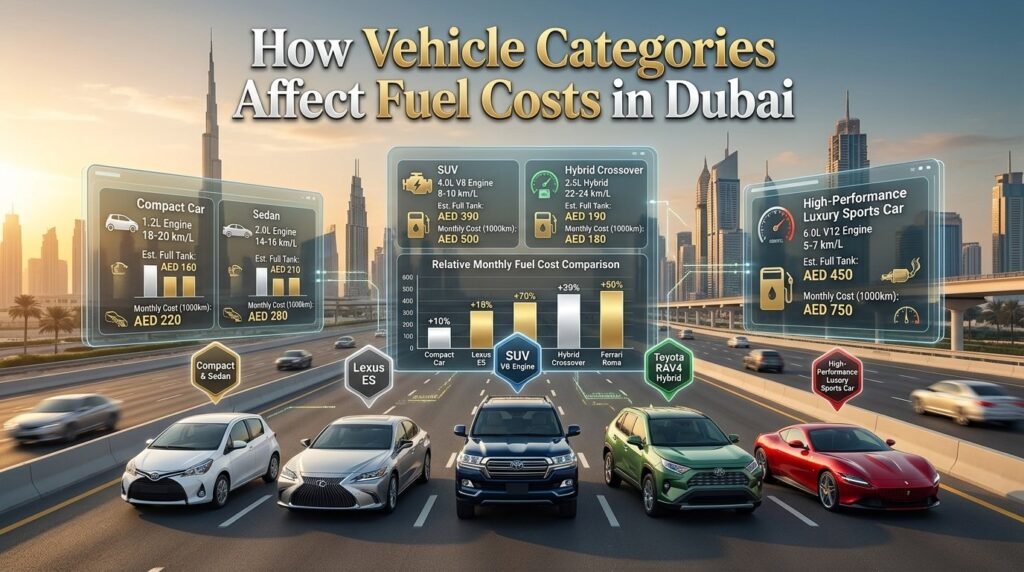
Your vehicle category can make a considerable difference to monthly fuel expenses.
A compact sedan, family SUV, luxury vehicle and hybrid may all have different fuel requirements even when driven over the same distance.
Compact cars
Compact cars are often suitable for everyday commuting and urban travel.
Their relatively small size and lower weight can contribute to lower fuel consumption.
However, actual efficiency depends on the specific engine, transmission, model year and mechanical condition.
When comparing compact vehicles, look at their real-world consumption rather than relying exclusively on manufacturer figures.
Sedans
Sedans provide a balance between passenger comfort, luggage space and everyday practicality.
Smaller-engine sedans may offer reasonable fuel economy, while larger luxury models can consume considerably more.
For drivers travelling regularly across Dubai, compare fuel consumption alongside maintenance and servicing expenses.
SUVs
SUVs provide additional passenger space and luggage capacity, making them suitable for families and drivers who need more room.
However, larger SUVs may consume more fuel because of:
- Higher vehicle weight.
- Larger engines.
- Increased aerodynamic resistance.
- Larger tyres.
- Additional passenger and luggage loads.
Some modern hybrid SUVs offer improved efficiency, although results depend on the model and driving conditions.
Hybrid vehicles
Hybrid vehicles combine a petrol engine with an electric motor and battery.
They can reduce petrol consumption in suitable driving conditions, particularly during urban journeys involving frequent acceleration and braking.
Potential benefits include regenerative braking and reduced engine operation in certain situations.
However, highway efficiency, battery condition, vehicle weight and maintenance remain important considerations.
Luxury and performance vehicles
Performance vehicles are designed to provide higher power, stronger acceleration and specific driving characteristics.
Their fuel requirements depend on engine design and recommended fuel grade.
Some high-performance engines require Super 98, while others have different manufacturer specifications.
Drivers should include both fuel expenses and maintenance requirements when planning ownership costs.
7. How Dubai Traffic and Road Conditions Influence Fuel Consumption
Dubai’s road environment can affect how efficiently your vehicle uses fuel.
A journey involving smooth highway movement is different from one involving repeated stopping, acceleration and extended waiting periods.
Understanding these differences helps drivers make better travel decisions.
Congested commuting routes
Traffic congestion can increase fuel consumption because vehicles repeatedly accelerate, slow down and stop.
Routes around Business Bay, Downtown Dubai, Deira and Dubai Marina may experience heavy traffic depending on the time, day and surrounding activities.
For example, a journey that normally takes 20 minutes may take considerably longer during a busy commuting period.
Although the additional time does not always translate into a proportional increase in fuel consumption, repeated low-speed movement can reduce efficiency.
Highway driving
Highway driving can offer better efficiency when vehicles maintain a steady speed.
However, fuel consumption generally increases at excessive speeds because aerodynamic resistance becomes greater.
Drivers using Sheikh Zayed Road or travelling towards Abu Dhabi should maintain a safe and legal speed rather than repeatedly accelerating and braking.
Short-distance journeys
Short journeys can sometimes use more fuel per kilometre than longer trips.
This is because an engine may require additional fuel during its initial warm-up period.
Repeated short journeys can also prevent certain vehicle systems from operating under their intended conditions.
Whenever practical, combine nearby errands into one planned journey.
Weekend and seasonal travel
Weekend trips, holidays and family outings can increase monthly driving distance.
During hotter periods, additional air-conditioning demand may also influence fuel consumption.
Planning these journeys in advance can help you estimate your fuel requirements more accurately.
For more detailed guidance about local routes and driving conditions, explore Dubai Driving and Fuel Insights.
8. How Can You Measure Your Vehicle’s Actual Fuel Consumption?
Your vehicle’s advertised fuel economy provides a useful starting point, but actual consumption can differ.
The most reliable approach is to monitor how much fuel you purchase and how many kilometres you cover.
Calculate litres per 100 kilometres
Use the following formula:
Fuel Consumption = Litres Used ÷ Kilometres Travelled × 100
For example:
- Distance travelled: 500 kilometres.
- Fuel used: 45 litres.
45 ÷ 500 × 100 = 9 litres per 100 kilometres.
Your vehicle’s calculated consumption is 9 L/100 km.
Calculate fuel cost per kilometre
You can also calculate how much each kilometre costs in fuel.
Fuel Cost Per Kilometre = Consumption per 100 km × Price Per Litre ÷ 100
If your vehicle consumes 9 litres per 100 kilometres and uses Special 95:
9 × AED 4.04 ÷ 100 = AED 0.3636.
Your fuel expense is approximately 36.36 fils per kilometre.
Use a consistent tracking method
For more reliable results:
- Fill the tank to a consistent stopping point.
- Record the odometer reading.
- Reset the trip meter.
- Drive normally.
- Refill the vehicle after a reasonable distance.
- Record the litres purchased.
- Calculate consumption using the distance travelled.
Repeat the process across several refuelling periods.
One reading may be affected by traffic, route changes or unusual driving conditions. Multiple records provide a better indication of normal vehicle efficiency.
9. Practical Ways to Reduce Fuel Expenses in Dubai
Reducing fuel expenses doesn’t always require buying another vehicle.
Your driving habits, maintenance routine and journey planning can all contribute to better efficiency.
The aim should be to eliminate unnecessary fuel consumption while maintaining comfort and safety.
Maintain smooth acceleration
Hard acceleration requires additional engine power and can increase fuel consumption.
Accelerate gradually whenever traffic conditions permit.
Try to maintain a consistent driving pattern instead of repeatedly speeding up and braking.
Avoid unnecessary braking
Look ahead and anticipate changes in traffic.
Maintaining an appropriate following distance gives you more time to respond smoothly when vehicles ahead slow down.
This can reduce unnecessary acceleration after every braking event.
Check tyre pressure regularly
Underinflated tyres can increase rolling resistance.
Check tyre pressure according to the manufacturer’s recommendations, preferably when tyres are cold.
Also inspect tyres for unusual wear, damage or other problems.
Remove unnecessary vehicle weight
Heavy luggage and unnecessary equipment increase the energy required to move your vehicle.
Remove items that you don’t regularly need.
If you have an unused roof rack or carrier, removing it when practical can also reduce aerodynamic resistance.
Maintain your engine
Regular maintenance supports efficient vehicle operation.
Follow the manufacturer’s service schedule and use the correct engine oil specification.
Pay attention to air filters, cooling systems, spark plugs where applicable and warning lights.
Plan your journeys
Route planning helps reduce unnecessary driving.
For example, instead of travelling separately for shopping, banking and other errands, combine nearby activities into one practical trip.
This can reduce total distance and repeated engine starts.
Use air conditioning sensibly
Keep the AC system properly maintained.
Use a sunshade when parking and avoid leaving the vehicle running unnecessarily while stationary.
Comfort and safe driving should always remain priorities.
10. How to Prepare a Monthly Fuel Budget That Actually Works
A useful fuel budget should be based on your own driving routine.
An allowance that works for one household may be completely unsuitable for another.
Use a simple process to establish a realistic monthly amount.
Step 1: Review your driving distance
Check your previous month’s odometer readings or trip records.
Separate regular commuting from additional personal and business journeys.
This helps you understand your normal monthly distance.
Step 2: Establish your average fuel consumption
Use dashboard readings and actual refuelling records.
If your vehicle normally consumes 8.5 litres per 100 kilometres, use that figure rather than assuming an ideal manufacturer consumption figure.
Step 3: Calculate your expected fuel expenditure
Suppose your monthly distance is 1,600 kilometres and your average consumption is 8.5 litres per 100 kilometres.
1,600 × 8.5 ÷ 100 = 136 litres.
At AED 4.04 per litre:
136 × AED 4.04 = AED 549.44.
Your estimated monthly fuel expense is AED 549.44.
Step 4: Add a reasonable reserve
Fuel prices can change monthly, and your driving requirements may increase unexpectedly.
If your estimated monthly expense is AED 550, you could set aside AED 600.
The additional amount provides flexibility for unexpected journeys or changes in driving conditions.
Step 5: Review your actual spending
At the end of each month, compare your planned amount with your actual expenditure.
If the difference is significant, investigate whether it came from additional mileage, higher fuel prices or reduced vehicle efficiency.
For a more detailed approach to organising vehicle-related expenses, read Dubai Fuel Budget.
11. Common Fuel-Budgeting Mistakes Dubai Drivers Should Avoid
Even drivers who regularly monitor petrol prices can make mistakes when estimating their vehicle expenses.
The following problems are particularly important to avoid.
Using the wrong fuel grade
Choosing petrol only because it is cheaper can be harmful if the grade does not meet your engine’s requirements.
Check the manufacturer’s specifications before refuelling.
Underestimating monthly distance
Many motorists calculate only their daily office commute.
However, shopping, family journeys, weekend travel and unexpected trips also contribute to monthly mileage.
Include these journeys when preparing your budget.
Confusing tank capacity with actual fuel consumption
A 70-litre tank does not mean the vehicle consumes 70 litres every month.
Tank capacity describes how much fuel the tank can hold, while consumption describes how much fuel the engine uses over a particular distance.
These are two different measurements.
Ignoring changes in fuel efficiency
If your vehicle starts requiring more fuel for familiar journeys, don’t automatically assume that petrol prices are responsible.
Investigate possible maintenance issues and compare several refuelling records.
Relying on one unusually good reading
A single journey with low fuel consumption doesn’t necessarily represent your normal driving pattern.
Traffic, weather, AC use and vehicle load can change from one journey to another.
Use several measurements to establish a realistic average.
Forgetting emergency expenses
A fuel budget should include some flexibility for unexpected journeys and changes in travel plans.
Without a reserve, an otherwise manageable situation can create unnecessary financial pressure.
12. What Should You Do When Your Vehicle’s Fuel Consumption Suddenly Increases?
A noticeable increase in fuel consumption deserves attention, particularly when your driving distance and routes remain similar.
The first step is to determine whether the difference comes from driving conditions or a vehicle-related issue.
Check the basic maintenance items
Start with the following:
- Tyre pressure.
- Air filter condition.
- Engine oil specification.
- Brake condition.
- Wheel alignment symptoms.
- Dashboard warning lights.
These checks can help identify common reasons for reduced efficiency.
Look for changes in driving conditions
Compare your recent journeys with your normal routine.
You may have experienced longer traffic delays, additional AC use or more frequent short-distance travel.
Such changes can influence fuel consumption without indicating a mechanical fault.
Arrange professional inspection when necessary
If consumption remains unusually high, arrange a professional diagnostic inspection.
A technician may check engine sensors, fuel delivery, ignition components, brake resistance and other systems depending on the symptoms.
Avoid replacing parts without a proper diagnosis.
A systematic inspection is generally more useful than guessing which component is responsible.
13. Fuel Planning for Everyday Driving Across Dubai
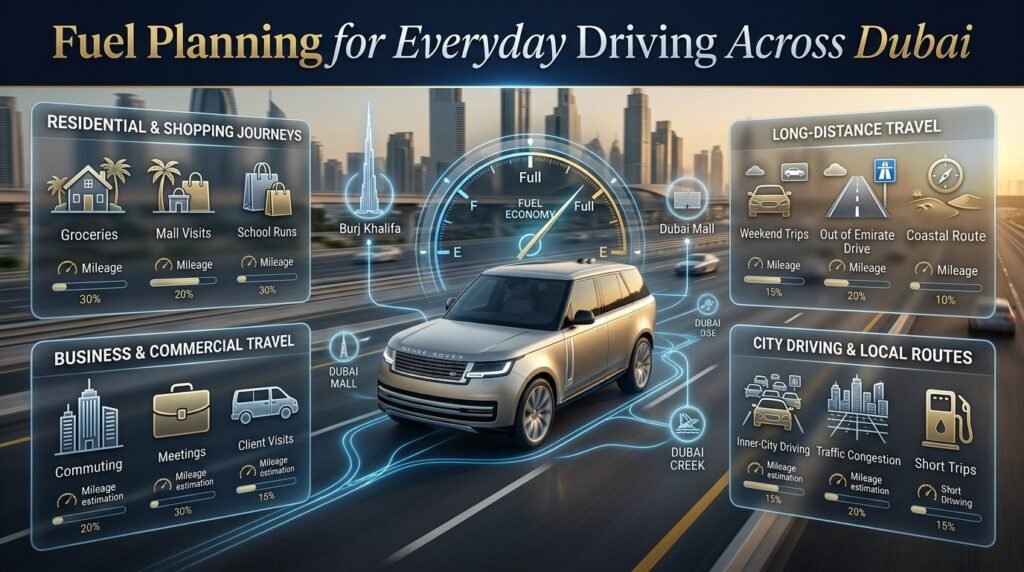
Fuel planning becomes easier when you understand the type of journeys you regularly make.
Different parts of Dubai involve different travel patterns, and your requirements may change depending on where you live, work and spend your time.
Residential and shopping journeys
People travelling between residential communities, supermarkets, schools and shopping centres should consider how frequently they make short trips.
Combining nearby activities can help reduce repeated journeys.
Business and commercial travel
Business drivers should maintain records of total kilometres, fuel purchases and vehicle consumption.
This information helps identify the cost of operating individual vehicles and supports more accurate business budgeting.
Long-distance travel
Drivers travelling between Dubai and other emirates should consider the full journey rather than calculating only the distance to their destination.
Allow for traffic, detours, passenger loads and return travel.
Avoid starting a long journey with an unnecessarily low fuel level.
City driving and local routes
Urban driving requires more attention to congestion, parking, short journeys and repeated stops.
Understanding these conditions can help you plan more practical routes and manage your fuel allowance.
For further guidance on navigating local roads, explore Dubai City Driving.
14. How Can Fuel Delivery Help During Unexpected Situations?
Even drivers with careful budgets and regular refuelling habits can experience unexpected low-fuel situations.
An extended traffic delay, route change, unfamiliar location or additional journey may leave you with less fuel than expected.
In such circumstances, roadside fuel assistance may provide a practical solution.
When might you need emergency fuel assistance?
Common situations include:
- Your fuel warning light appears during a journey.
- You run out of fuel before reaching a petrol station.
- Unexpected traffic delays affect your travel plans.
- You miscalculate the remaining fuel.
- Your journey becomes longer than originally expected.
What should you do if you run out of fuel?
Safety should always come first.
- Move the vehicle to a safe location if possible.
- Switch on hazard warning lights when appropriate.
- Avoid stopping in a dangerous traffic lane.
- Follow applicable road safety requirements.
- Contact suitable roadside assistance.
- Share your exact location and vehicle information.
Never attempt to walk across a busy highway to find a petrol station.
Include emergency planning in your vehicle budget
Emergency fuel requirements are not part of normal monthly consumption, but they should be considered when preparing a realistic transportation budget.
Maintain a sensible fuel reserve and identify suitable refuelling opportunities before longer journeys.
If you need roadside fuel assistance, Fuel Delivery Dubai provides a starting point for understanding the available service.
Fuel delivery is a backup option for unexpected situations, not a replacement for regular refuelling.
15. How Should You Compare Fuel Costs Before Buying a Vehicle?
If you’re planning to purchase a car in Dubai, fuel consumption should be one of your important comparison factors.
A vehicle with a lower purchase price may have higher long-term running expenses, while a more expensive fuel-efficient model may offer savings for someone who drives regularly.
Compare the right ownership factors
| Factor | What to Consider |
|---|---|
| Fuel consumption | Litres required per 100 km |
| Recommended fuel grade | Suitable petrol or diesel |
| Annual mileage | Total distance covered |
| Vehicle weight | Influence on fuel requirements |
| Maintenance | Regular servicing and repairs |
| Engine type | Petrol, diesel or hybrid |
| Driving conditions | City, highway or mixed use |
Example: Comparing annual fuel expenses
Suppose two petrol vehicles travel 24,000 kilometres annually using Special 95 at AED 4.04 per litre.
Vehicle A consumes 7 litres per 100 kilometres.
Annual fuel requirement:
24,000 × 7 ÷ 100 = 1,680 litres.
Annual cost:
1,680 × AED 4.04 = AED 6,787.20.
Vehicle B consumes 11 litres per 100 kilometres.
Annual fuel requirement:
24,000 × 11 ÷ 100 = 2,640 litres.
Annual cost:
2,640 × AED 4.04 = AED 10,665.60.
The difference is AED 3,878.40 annually.
This is a substantial difference for someone who regularly covers long distances.
However, fuel savings should be compared with purchase price, maintenance and other ownership expenses before making a final decision.
16. Expert Recommendations for Managing Dubai Fuel Costs
Experienced motorists generally focus on consistent vehicle care and practical driving habits rather than expecting unrealistic fuel savings.
The following recommendations can help you maintain better control over your expenses.
Keep a simple monthly record
Record your monthly kilometres, litres purchased and total fuel expenditure.
This provides a clearer picture of your actual running costs.
Monitor cost per kilometre
Cost per kilometre is useful when comparing vehicles or evaluating changes in consumption.
It also makes it easier to estimate the fuel expense of an individual journey.
Review fuel prices monthly
Use the current approved rate when calculating your next month’s budget.
Don’t continue using an old price after the monthly revision.
Follow vehicle specifications
Use the correct fuel grade, engine oil and tyre pressure.
Avoid unnecessary modifications that could affect efficiency or engine operation.
Investigate unusual changes early
If your vehicle begins consuming more fuel than normal, investigate the reason instead of accepting higher expenses as unavoidable.
Maintain an emergency reserve
Keep a reasonable allowance for unexpected travel and roadside situations.
Good fuel management is not simply about reducing spending. It is also about making sure your vehicle remains ready for the journeys you need to complete.
How Much Does It Cost to Fill a Full Tank of Petrol in Dubai?
The cost of filling a full tank in Dubai depends on your vehicle’s fuel tank capacity and the petrol grade it requires. A compact car with a 40-litre tank will naturally cost less to refill than an SUV with a 70-litre tank. The final amount also depends on how much fuel is already remaining when you visit the petrol station.
For example, using November 2026 fuel prices, filling a 50-litre tank with Special 95 costs AED 202, while a 70-litre tank costs AED 282.80. Drivers using Super 98 or E-Plus 91 will have different expenses.
Important points to consider:
Check your vehicle’s actual tank capacity before estimating refuelling expenses.
Use only the petrol grade recommended by your vehicle manufacturer.
Calculate the cost using the current monthly fuel price.
Remember that a partial refill will cost less than filling an empty tank.
How Much Should You Budget for Monthly Fuel Expenses in Dubai?
Monthly fuel budgeting depends mainly on your driving distance, vehicle efficiency and fuel grade. A person commuting a short distance every day will generally spend less than someone travelling between Dubai and other emirates regularly. Therefore, your budget should be based on your actual driving pattern rather than a general estimate.
For example, if your vehicle covers 1,500 kilometres monthly and consumes 8 litres per 100 kilometres, it requires approximately 120 litres. At the November 2026 Special 95 price of AED 4.04 per litre, your estimated monthly fuel expense would be AED 484.80.
A practical budgeting approach:
Record your monthly driving distance.
Check your vehicle’s average fuel consumption.
Calculate your expected fuel requirements.
Include a small additional allowance for unexpected journeys.
Review your spending whenever monthly fuel prices change.
This approach helps you control transportation expenses without unnecessarily restricting your everyday travel.
Why Are Fuel Costs Different for Petrol and Diesel Vehicles in Dubai?
Petrol and diesel vehicles have different engine designs, fuel prices and consumption characteristics. Although diesel costs more per litre than Special 95 in November 2026, some diesel engines use fewer litres to cover the same distance. This means comparing the price per litre alone doesn’t provide an accurate picture of total running expenses.
For example, a petrol vehicle consuming 8 litres per 100 kilometres at AED 4.04 costs AED 32.32 to cover 100 kilometres. A diesel vehicle consuming 6 litres over the same distance at AED 4.75 costs AED 28.50.
Before comparing petrol and diesel vehicles, consider:
Actual fuel consumption per 100 kilometres.
Cost per kilometre rather than price per litre.
Engine servicing and maintenance requirements.
Your monthly and annual driving distance.
Purchase price and long-term ownership expenses.
The most economical choice depends on how you use your vehicle, not simply which fuel has the lower pump price.
What Factors Increase Fuel Consumption and Driving Costs in Dubai?
Fuel consumption in Dubai can increase because of traffic congestion, high temperatures, frequent short journeys, aggressive acceleration and poor vehicle maintenance. These conditions can make everyday driving more expensive, even when the petrol price remains unchanged.
For example, a driver travelling through congested roads during busy commuting periods may experience more frequent braking and acceleration than someone driving on an open highway. Continuous air-conditioning use can also increase engine load in conventional petrol and diesel vehicles.
Factors that deserve attention:
Traffic congestion: Repeated stopping and starting can increase fuel consumption.
Air conditioning: Cooling demand can affect engine efficiency.
Tyre pressure: Underinflated tyres increase rolling resistance.
Driving behaviour: Aggressive acceleration and excessive speed can waste fuel.
Vehicle maintenance: Mechanical problems can reduce fuel efficiency.
Unnecessary idling: Leaving the engine running while stationary consumes fuel.
Monitoring these factors helps identify avoidable expenses and maintain more consistent fuel efficiency.
How Can You Reduce Monthly Fuel Costs Without Changing Your Car?
Reducing monthly fuel expenses doesn’t always require purchasing a different vehicle. Improving driving habits, maintaining the engine properly and planning journeys more efficiently can help reduce unnecessary fuel consumption. The most effective approach is to understand which habits affect your vehicle and make practical improvements consistently.
For example, combining nearby shopping trips, maintaining correct tyre pressure and avoiding unnecessary acceleration can help reduce fuel usage over time. Regularly monitoring consumption also makes it easier to identify problems before they become expensive.
Practical ways to manage fuel expenses:
Maintain tyre pressure according to manufacturer recommendations.
Accelerate smoothly and avoid unnecessary braking.
Remove unnecessary weight from your vehicle.
Maintain the engine and air-conditioning system.
Plan routes to avoid unnecessary additional kilometres.
Track fuel purchases and monthly mileage.
Investigate sudden increases in fuel consumption.
These improvements can help you manage your fuel budget while maintaining comfortable and reliable everyday driving.
Conclusion
Managing fuel costs in Dubai is not simply about choosing a petrol or diesel vehicle. It requires understanding how fuel prices, daily travel distances, traffic conditions, driving habits, vehicle condition and route choices affect your overall expenditure. A realistic fuel budget helps drivers prepare for regular journeys, manage unexpected travel and avoid unnecessary spending.
The most effective approach is to monitor your vehicle’s actual fuel consumption rather than relying only on advertised mileage figures. Keep your tyres correctly inflated, maintain the engine, avoid unnecessary idling, drive smoothly and plan routes according to traffic conditions. Small improvements in these areas can make a noticeable difference to monthly fuel expenses over time.
Whether you drive mainly within residential communities, commute through busy business districts or regularly travel between Dubai and other emirates, consistent fuel planning makes vehicle ownership more predictable. By reviewing your expenses and adjusting your driving habits, you can make better decisions without compromising safety or convenience.
For more practical information, explore our guides to Dubai driving and fuel insights and Dubai fuel planning. You can also use our fuel delivery service in Dubai when an unexpected fuel shortage interrupts your journey.
Leave a Reply