Introduction
Dubai Fuel Stations | Running low on fuel while driving through Dubai can quickly become inconvenient, especially when you’re travelling through busy roads, unfamiliar neighbourhoods or areas with heavy traffic. Even when petrol stations are widely available, finding the right station at the right time requires some planning.
Dubai has a well-developed network of fuel stations serving private motorists, tourists, daily commuters, commercial drivers and transport businesses. However, not every station offers the same facilities, fuel options or operating arrangements. Some locations are convenient for everyday refuelling, while others are better suited to drivers who need additional vehicle services.
Understanding how Dubai fuel stations operate can help you make better decisions before starting your journey. Whether you’re looking for petrol, diesel, a convenient refuelling location or additional facilities, knowing what to expect can save time and prevent unnecessary detours.
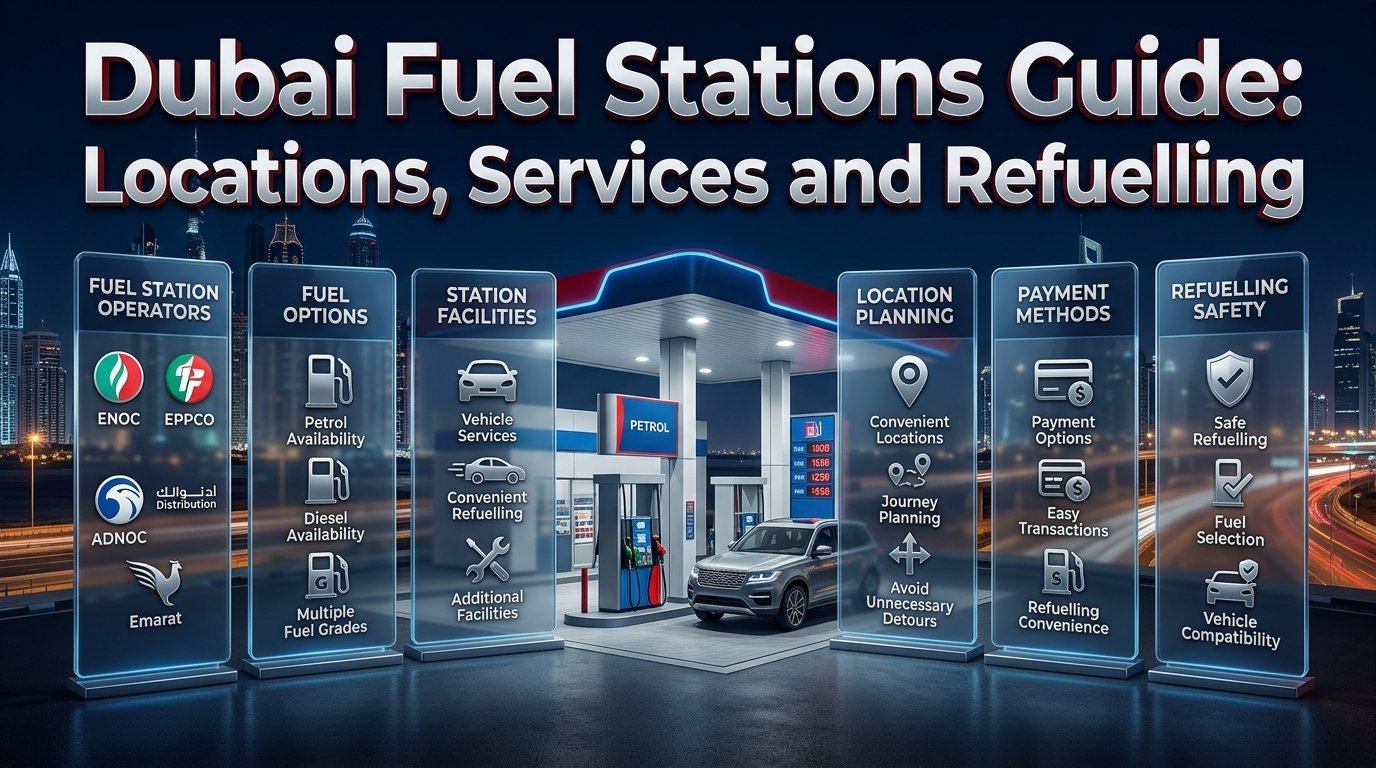
This comprehensive guide explains the major fuel station operators in Dubai, petrol and diesel availability, station facilities, location planning, payment methods, safety considerations and practical solutions when reaching a fuel station becomes difficult.
For additional roadside assistance information and fuel-related services, you can also explore Fuel Delivery Dubai.
1. Understanding Dubai’s Fuel Station Network
Dubai’s fuel station network supports a large number of vehicles travelling throughout the emirate every day. It serves residential communities, business districts, industrial areas, commercial transport routes and major highways.
Fuel stations are operated by established petroleum retailers, each offering different locations and additional customer services.
The network is designed to support several types of motorists:
- Residents travelling between home and work.
- Tourists using rental vehicles.
- Commercial drivers and delivery fleets.
- Taxi and private transport operators.
- Families travelling across different neighbourhoods.
- Motorists travelling between Dubai and other emirates.
Why Is a Reliable Fuel Station Network Important?
A reliable network gives motorists more flexibility when planning journeys. Drivers can select suitable refuelling points instead of depending on one location.
It also helps reduce unnecessary travel when fuel levels become low.
For example, someone travelling from Al Barsha towards Downtown Dubai may prefer to refuel before entering a congested section rather than searching for a station after reaching the destination.
A good understanding of the network is particularly useful when:
- Travelling through unfamiliar parts of Dubai.
- Driving during morning or evening peak periods.
- Planning longer journeys.
- Operating commercial vehicles.
- Travelling with passengers or family members.
- Driving in areas where convenient station access may require a detour.
Expert Tip: Save a few convenient fuel stations along your regular routes. Having alternative locations makes it easier to adjust your journey if one station is crowded or temporarily unavailable.
2. Which Companies Operate Fuel Stations in Dubai?
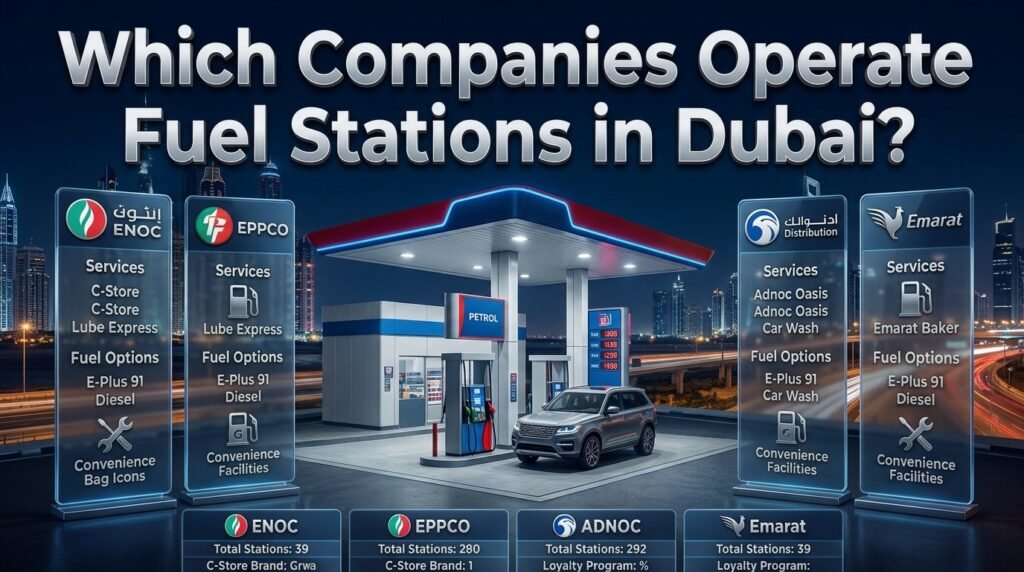
Several established fuel retailers serve motorists in Dubai. Their networks provide petrol, diesel and selected additional services.
The main operators motorists should recognise include ENOC, EPPCO, ADNOC Distribution and Emarat.
ENOC Fuel Stations
Emirates National Oil Company, commonly known as ENOC, is one of the recognised fuel retailers in Dubai.
Its stations serve motorists across different parts of the city and provide refuelling facilities for everyday vehicles and other compatible transport requirements.
Depending on the individual location, customers may find:
- Different petrol grades.
- Diesel refuelling.
- Convenience retail.
- Car washing facilities.
- Vehicle care services.
- Lubricants and automotive products.
- Supported digital payment facilities.
ENOC stations can be useful for drivers who regularly travel through established urban routes.
However, the facilities available at one branch should not automatically be assumed to exist at another.
EPPCO Fuel Stations
EPPCO is another familiar fuel station brand in Dubai and is associated with ENOC’s retail network.
Its locations provide motorists with access to refuelling services and selected additional facilities.
Drivers may find:
- Petrol and diesel pumps.
- Convenience shopping.
- Automotive products.
- Selected vehicle services.
- Available payment facilities.
When selecting an EPPCO location, motorists should consider its accessibility and the services available at that particular branch.
ADNOC Distribution Fuel Stations
ADNOC Distribution is a major UAE fuel retailer with a network of service stations.
Its locations serve motorists travelling within Dubai and across other parts of the UAE.
Depending on the station, services may include:
- Petrol and diesel.
- Convenience stores.
- Car washing.
- Vehicle care facilities.
- Automotive essentials.
- Digital and card-based payment options.
ADNOC is also a familiar option for motorists travelling between different emirates.
Emarat Fuel Stations
Emarat is another established petroleum retailer operating in the UAE.
Its stations support everyday refuelling requirements and may provide additional facilities depending on the location.
These can include:
- Petrol and diesel.
- Convenience retail.
- Vehicle washing.
- Automotive products.
- Selected maintenance-related services.
Motorists should check individual branch facilities before making a special journey.
Comparing Dubai’s Major Fuel Retailers
| Fuel retailer | Main consideration | Suitable for |
|---|---|---|
| ENOC | Station locations and additional services | Everyday motorists |
| EPPCO | Convenient branch accessibility | Regular commuters |
| ADNOC Distribution | Fuel availability and retail facilities | Local and inter-emirate travel |
| Emarat | Nearby locations and available services | Everyday refuelling |
Which company is best?
There is no single operator that is automatically the best choice for every motorist. Your decision should depend on the station’s location, required fuel type, available facilities and convenience.
A nearby station with the correct fuel and suitable access is often a better choice than travelling a long distance to visit a particular brand.
Why Understanding Dubai Fuel Standards Matters for Motorists
Fuel standards provide an important reference for understanding the quality, composition and technical specifications of petrol and diesel supplied to motorists. These requirements help establish consistency in fuel characteristics and ensure that fuel products meet the applicable specifications before reaching consumers. For drivers in Dubai, understanding fuel standards is particularly useful when comparing fuel types, selecting suitable products and making informed decisions about vehicle maintenance. However, compliance with fuel quality requirements does not mean every fuel grade is suitable for every engine. Motorists should always follow their vehicle manufacturer’s recommended fuel specifications to support reliable operation and avoid unnecessary compatibility issues. For a more detailed understanding of these requirements and their practical importance, explore this comprehensive guide to Dubai fuel standards.
3. What Types of Fuel Are Available at Dubai Fuel Stations?
Dubai motorists can generally find different petrol grades and diesel at established fuel stations.
The correct fuel depends on the vehicle’s engine design and manufacturer’s recommendations.
Choosing the appropriate fuel is more important than selecting the most expensive option.
E-Plus 91 Petrol
E-Plus 91 is a petrol grade with a 91 RON octane rating.
It is intended for compatible vehicles whose manufacturers specify 91 RON petrol or an equivalent minimum requirement.
Drivers should check the owner’s manual or the fuel information displayed inside the vehicle’s fuel-filler area.
Special 95 Petrol
Special 95 has a 95 RON octane rating.
It is a commonly used petrol grade for vehicles designed to operate on 95 RON or compatible lower-octane specifications.
Many everyday passenger vehicles use this grade, depending on their manufacturer’s requirements.
Super 98 Petrol
Super 98 has a higher octane rating than E-Plus 91 and Special 95.
It is designed for vehicles that require or recommend higher-octane petrol.
Certain performance vehicles and engines with higher compression or specific tuning requirements may need this grade.
However, using Super 98 in every vehicle does not automatically improve performance or fuel economy.
Diesel
Diesel is a separate fuel type used by compatible diesel engines.
It is commonly required by certain passenger vehicles, commercial transport vehicles, pickup trucks and logistics fleets.
Diesel must never be confused with petrol.
Dubai Fuel Type Comparison
| Fuel type | General purpose | Important consideration |
|---|---|---|
| E-Plus 91 | Compatible petrol engines | Requires 91 RON suitability |
| Special 95 | Compatible petrol engines | Follow manufacturer specification |
| Super 98 | Higher-octane petrol requirements | Not necessary for every vehicle |
| Diesel | Diesel-powered engines | Never substitute petrol |
Common Mistake: Some drivers believe that using a higher petrol grade automatically protects their engine or increases its power. This is not necessarily true. Always follow the manufacturer’s fuel specification.
For a detailed explanation of available petrol options, read our Dubai Petrol Grades guide.
4. Where Can Drivers Find Fuel Stations in Dubai?
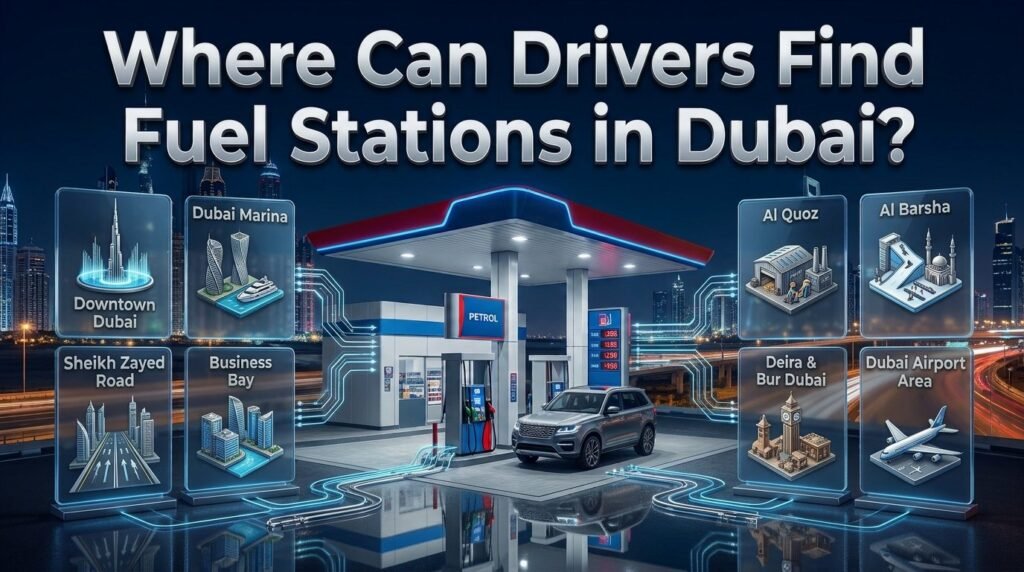
Fuel stations serve many parts of Dubai, including major commercial districts, residential communities, industrial zones and connecting roads.
However, choosing a location involves more than checking the distance on a map.
Drivers should also consider traffic direction, road entrances, exit points and the time needed to reach the station.
Downtown Dubai
Downtown Dubai is one of the city’s busiest commercial and residential destinations.
The area includes major attractions and destinations such as:
- Burj Khalifa.
- Dubai Mall.
- Dubai Opera.
- Sheikh Mohammed bin Rashid Boulevard.
- Souk Al Bahar.
- Emaar Square.
Motorists travelling around Downtown Dubai should consider refuelling before entering particularly busy sections.
Parking restrictions, traffic movement and busy intersections can make unnecessary detours inconvenient.
If you’re travelling into the area for shopping, work or sightseeing, checking your fuel level before departure is a practical habit.
Dubai Marina
Dubai Marina attracts residents, tourists, office commuters and visitors throughout the week.
Drivers travelling around Marina should consider their next destination before selecting a fuel station.
Traffic conditions may change considerably during busy periods, particularly around major connecting roads.
Plan your refuelling stop according to your actual route rather than choosing a station simply because it appears close.
Sheikh Zayed Road
Sheikh Zayed Road is one of Dubai’s most important transport corridors.
It connects several commercial and residential destinations and supports substantial daily traffic.
Drivers travelling along this road should pay attention to their remaining fuel range.
A station may be geographically close but require a particular exit or access road.
Professional Advice: Avoid waiting until your fuel warning light appears when travelling on a major highway. Identify suitable refuelling opportunities before starting longer journeys.
Business Bay
Business Bay contains residential towers, commercial buildings, offices and connecting transport routes.
Office commuters and residents often travel between Business Bay, Downtown Dubai and surrounding districts.
Refuelling before peak commuting periods can help avoid unnecessary stops when traffic becomes heavy.
Al Quoz
Al Quoz includes industrial, commercial and residential areas.
It is particularly relevant to commercial drivers, delivery vehicles, workshops and businesses operating vehicles throughout the day.
Drivers should check the accessibility of a selected station, especially when operating larger vehicles.
Al Barsha
Al Barsha is an established residential and commercial destination.
Its connections to major roads make it an important area for daily commuters and residents.
Motorists travelling between Al Barsha, Dubai Marina, Mall of the Emirates and other destinations should plan their refuelling stops around their journey.
Deira and Bur Dubai
Deira and Bur Dubai are established parts of the city with residential, retail and commercial activity.
Drivers may travel through these areas for work, shopping, deliveries and everyday activities.
Because road conditions and traffic movement can vary, checking the route to a suitable fuel station before departure can save time.
Dubai International Airport Area
Motorists travelling around Dubai International Airport should consider their travel schedule and the direction of their route.
Airport drop-offs, pick-ups and surrounding traffic can make last-minute refuelling inconvenient.
Rental vehicle users should also check their rental company’s return-fuel requirements before travelling to the airport.
Follow Practical Refuelling Guidelines for Better Fuel Management
Managing fuel efficiently requires more than simply keeping the vehicle’s tank full. Motorists should develop a refuelling routine that considers fuel consumption, daily travel distances, traffic conditions and the manufacturer’s recommended fuel type. Monitoring the fuel gauge regularly, avoiding unnecessary delays when the tank reaches a low level and identifying convenient refuelling locations can make everyday journeys easier to manage. Drivers should also understand how different refuelling practices affect vehicle operation and why choosing the correct fuel grade matters for engine compatibility. Following these practical considerations can help reduce avoidable refuelling problems and support better journey preparation. For additional insights into fuel selection, refuelling methods and everyday fuel management, explore this detailed Dubai Refuelling Guide.
5. How to Find the Nearest Fuel Station in Dubai
Finding a nearby petrol station is usually straightforward, but selecting the most convenient one requires a little more attention.
A station that appears close may not be accessible from your current direction of travel.
Follow these steps to make a better choice.
Step 1: Check Your Current Location
Open your preferred navigation application and search for petrol stations.
Review the locations displayed around your current position.
Step 2: Compare Available Routes
Look at the road connections, entrances and exits.
Consider whether reaching the station requires crossing a busy road or making a long detour.
Step 3: Confirm Fuel Availability
Check whether the station offers the fuel type required by your vehicle.
This is especially important for motorists who need diesel or a particular petrol grade.
Step 4: Review Operating Hours
Some stations operate around the clock, while others may follow different schedules.
Additional facilities can have separate opening hours.
Step 5: Check Customer Facilities
If you require a car wash, convenience store or vehicle care service, confirm that the selected branch provides it.
Step 6: Keep an Alternative Location
If your preferred station is crowded, temporarily unavailable or difficult to access, having another option can make your journey easier.
Quick Tip: Search for fuel stations along your destination route instead of searching only around your current location. This helps you avoid unnecessary backtracking.
6. What Additional Services Are Available at Dubai Fuel Stations?
Modern fuel stations often provide facilities beyond basic refuelling.
These additional services can make a routine stop more convenient, particularly for drivers who need to complete several small tasks during one journey.
However, availability varies by branch.
Convenience Stores
Selected stations have convenience stores where motorists can purchase everyday essentials.
Common products include:
- Bottled water.
- Snacks and refreshments.
- Packaged food.
- Basic travel products.
- Selected automotive accessories.
- Everyday convenience items.
These stores are useful when drivers need refreshments during a journey or want to purchase something without visiting a separate retail location.
Car Washing Facilities
Some fuel stations provide vehicle washing services.
Depending on the location, options may include automatic washing, manual cleaning or additional vehicle cleaning packages.
Before visiting, check:
- Whether a car wash is available.
- Which washing options are offered.
- Whether appointments are required.
- The applicable service charges.
- The facility’s operating hours.
Don’t assume that every branch has the same washing equipment.
Tyre Inflation and Basic Vehicle Care
Selected stations provide basic vehicle care facilities.
These may include tyre inflation equipment, pressure checks and automotive essentials.
Maintaining correct tyre pressure is important for vehicle handling, tyre life and fuel efficiency.
For more detailed guidance, explore our Tire Pressure Maintenance resource.
Lubricants and Engine Oil
Certain stations sell engine oil, lubricants and other vehicle products.
Drivers should always check the manufacturer’s recommended specifications before purchasing automotive fluids.
The correct oil grade and specification depend on the engine.
Vehicle Maintenance Services
Some locations have dedicated vehicle service facilities.
Depending on the branch, these may provide basic inspections, oil changes and other maintenance-related work.
A fuel station should not automatically be treated as a full-service workshop.
If your vehicle has a mechanical problem, use an appropriate professional service facility.
7. Are Dubai Fuel Stations Open 24 Hours?
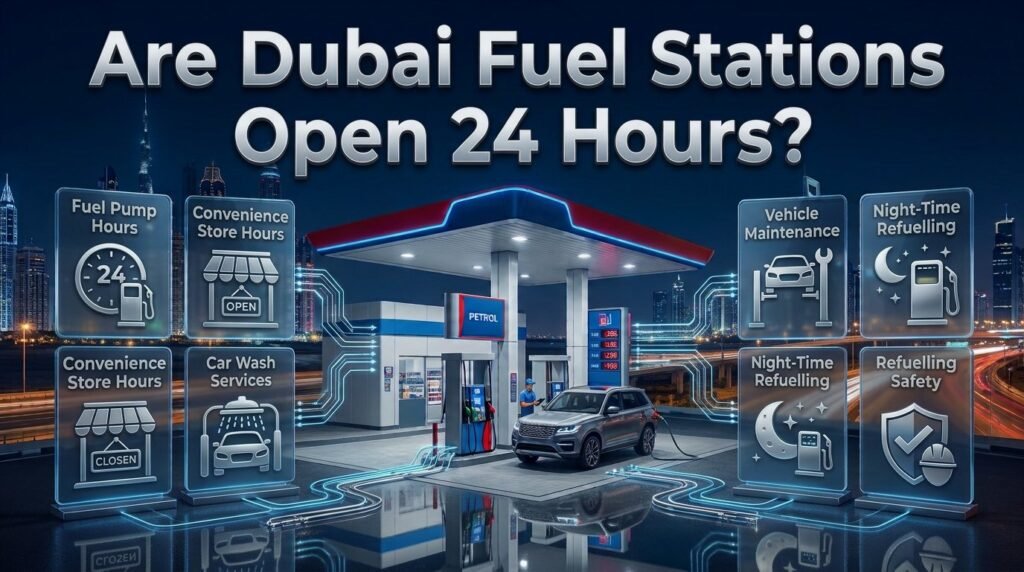
Some Dubai fuel stations operate 24 hours a day, but not every station or additional facility follows the same schedule.
This distinction matters when travelling late at night, early in the morning or during public holidays.
A station may provide fuel throughout the day while its convenience store or car wash operates according to separate timings.
What Should You Check Before Visiting?
Consider the following:
- Fuel pump operating hours.
- Convenience store opening times.
- Car wash availability.
- Vehicle maintenance service timings.
- Temporary closures or service interruptions.
- Accessibility during road restrictions.
Is It Better to Refuel at Night?
Night-time refuelling can be convenient for motorists who prefer quieter travel periods.
However, there is no universal requirement to refuel at night.
The better time depends on your schedule, station accessibility and traffic conditions.
Choose a well-lit, accessible station and follow normal safety precautions.
8. Payment Methods at Dubai Fuel Stations
Payment facilities are an important consideration when selecting a fuel station.
Established fuel retailers generally provide multiple payment options, although the available methods can vary by location and service.
Cash Payments
Cash in UAE dirhams can be useful for motorists who prefer traditional transactions.
Keeping a small amount available may also help when a payment terminal experiences a technical issue.
Debit and Credit Cards
Many fuel stations support debit and credit card payments.
Drivers can generally use supported cards to pay for their refuelling transactions.
Contactless Payments
Selected stations support contactless payment methods.
These can make transactions faster and reduce the need to handle cash.
Digital Payment Services
Some fuel retailers provide digital payment facilities through supported applications or account-based services.
Availability and eligibility depend on the retailer and the payment arrangement.
Expert Tip: Check accepted payment options before using a particular station if you depend on a specific card or digital wallet.
9. How Should You Prepare Before Refuelling?
Refuelling is a routine activity, but following a few simple precautions can prevent avoidable mistakes.
Before entering a fuel station, make sure you understand your vehicle’s requirements.
Check Your Fuel Type
Confirm whether your vehicle requires petrol or diesel.
Never rely on assumptions, especially when driving a rental vehicle or an unfamiliar car.
Identify the Correct Petrol Grade
If your vehicle uses petrol, check the manufacturer’s recommended octane rating.
Do not choose a grade simply because it is more expensive.
Switch Off the Engine
Follow station safety instructions and switch off the vehicle engine before refuelling.
Avoid smoking, open flames or other ignition sources around fuel pumps.
Avoid Using Your Phone Near Fuel Operations
Follow the station’s posted instructions regarding mobile phone use and refuelling safety.
Check the Fuel Amount
Before completing the transaction, make sure the pump display shows the correct quantity and applicable price.
Close the Fuel Cap Properly
After refuelling, make sure the fuel cap is securely closed.
A loose cap can trigger warning lights on some vehicles.
10. Understanding Fuel Station Safety in Dubai
Fuel station safety is important for motorists, passengers, employees and other customers.
Petrol and diesel must be handled carefully, and drivers should follow the instructions displayed at the station.
Important Safety Practices
- Switch off the engine before refuelling.
- Do not smoke near fuel pumps.
- Keep children away from fuel dispensing equipment.
- Follow the instructions of station employees.
- Avoid spilling fuel.
- Never attempt unauthorised fuel transfers.
- Do not use damaged or unsuitable containers.
- Report fuel spills or unusual situations to station staff.
- Never leave a vehicle in a position that blocks emergency access.
What If the Wrong Fuel Is Put Into Your Vehicle?
If petrol is accidentally added to a diesel vehicle, or diesel is added to a petrol vehicle, do not start the engine.
If the engine is already running, stop safely as soon as possible.
Contact appropriate professional assistance and explain exactly what happened.
Trying to drive the vehicle can circulate the incorrect fuel through the fuel system and increase the potential damage.
Professional Advice: The safest approach is to confirm the fuel type before dispensing begins, particularly when several people use the same vehicle.
11. How Do Dubai’s Traffic Conditions Affect Fuel Station Access?
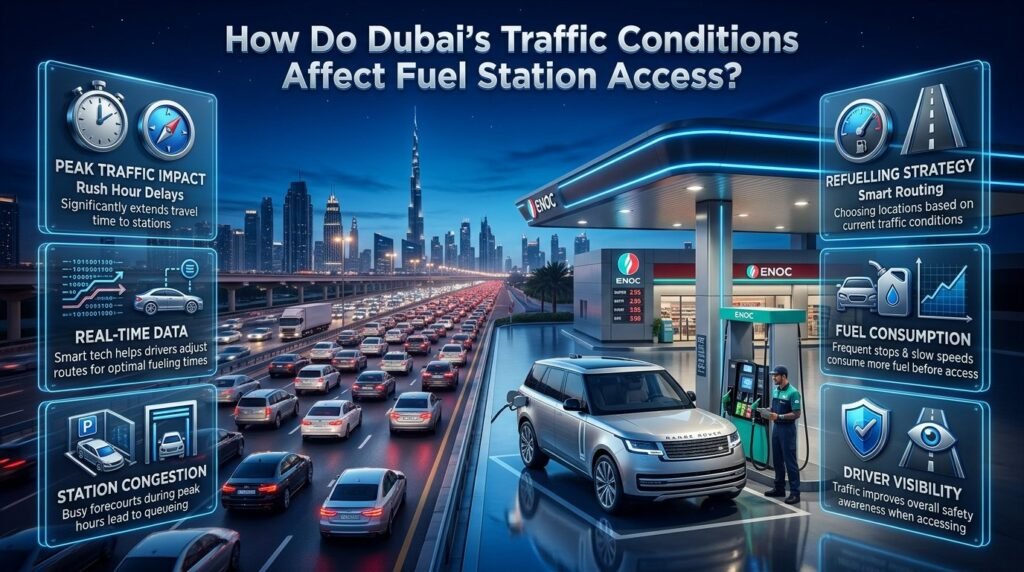
Dubai’s traffic conditions can influence how quickly motorists reach a fuel station.
Even when a station is nearby, busy intersections, road restrictions and congestion may increase the time required to reach it.
Peak-Hour Traffic
Morning and evening commuting periods can make some routes considerably slower.
Drivers should consider refuelling before starting a journey that passes through busy areas.
Stop-and-Go Traffic
Repeated acceleration and braking can increase fuel consumption.
This is particularly relevant when travelling through congested urban roads.
Road Diversions
Temporary roadworks, accidents and diversions may affect station accessibility.
A familiar station may become inconvenient if the normal entrance or connecting road is restricted.
Long-Distance Travel
Motorists travelling towards other emirates should consider the next suitable refuelling opportunity before leaving Dubai.
Don’t assume that your normal urban refuelling routine will always work during longer journeys.
For more information about local driving conditions, explore Dubai City Driving.
You can also read our broader Dubai Driving and Fuel Insights guide.
12. How to Choose the Right Fuel Station for Your Vehicle
Different motorists have different requirements.
A private car owner may simply need convenient petrol refuelling, while a commercial vehicle operator may need diesel availability and suitable access for larger vehicles.
Consider these factors before making your decision.
Fuel Compatibility
The station must provide the correct fuel for your vehicle.
Never compromise on fuel compatibility to save time.
Location
Choose a station that fits your journey.
A convenient location reduces unnecessary driving and makes regular refuelling easier.
Vehicle Size
Drivers of larger vehicles should consider entrance arrangements, pump accessibility and available space.
Some locations may be more suitable than others for commercial vehicles.
Additional Services
If you need a car wash, tyre inflation or vehicle products, check availability beforehand.
Payment Options
Make sure you can complete the transaction using an accepted payment method.
Station Accessibility
Consider traffic movement, road entrances and the direction from which you are approaching.
A practical station choice should make the overall journey easier, not more complicated.
13. Common Mistakes Drivers Make When Using Dubai Fuel Stations
Even experienced motorists can make mistakes that create unnecessary expenses, inconvenience or vehicle problems.
Understanding these common issues can help you avoid them.
Mistake 1: Choosing a Station Only Because It Is Nearby
A station may look close on a map but require a long detour because of road layouts.
Why it happens: Drivers focus on straight-line distance rather than actual driving routes.
How to avoid it: Compare navigation routes and entrances before making a decision.
Mistake 2: Ignoring Fuel Availability
Not every station necessarily provides every fuel type or grade.
Why it happens: Motorists assume all branches offer identical facilities.
How to avoid it: Confirm the required fuel availability before visiting.
Mistake 3: Using the Wrong Petrol Grade
Selecting petrol without checking the manufacturer’s recommendation can increase costs or create compatibility concerns.
Why it happens: Some drivers believe the highest octane rating is always the best.
How to avoid it: Follow the manufacturer’s specified minimum and recommended octane rating.
Mistake 4: Waiting Until the Fuel Warning Appears
Waiting too long can leave drivers with limited route choices.
Why it happens: They rely entirely on the remaining-range estimate.
How to avoid it: Make refuelling part of your regular journey planning.
Mistake 5: Assuming Every Branch Has a Car Wash
A motorist may visit a station expecting a service that is not available.
Why it happens: Facilities differ between locations.
How to avoid it: Check branch-specific services before travelling.
Mistake 6: Ignoring Unusual Fuel Consumption
A vehicle that suddenly consumes more fuel may need attention.
Why it happens: Drivers sometimes blame traffic without investigating other possible causes.
How to avoid it: Monitor mileage, tyre pressure and vehicle condition.
Mistake 7: Forgetting Basic Refuelling Safety
Leaving the engine running or failing to close the fuel cap properly can create avoidable problems.
Why it happens: Drivers treat refuelling as an automatic routine.
How to avoid it: Follow station safety instructions every time.
14. Expert Recommendations for Better Fuel Station Planning
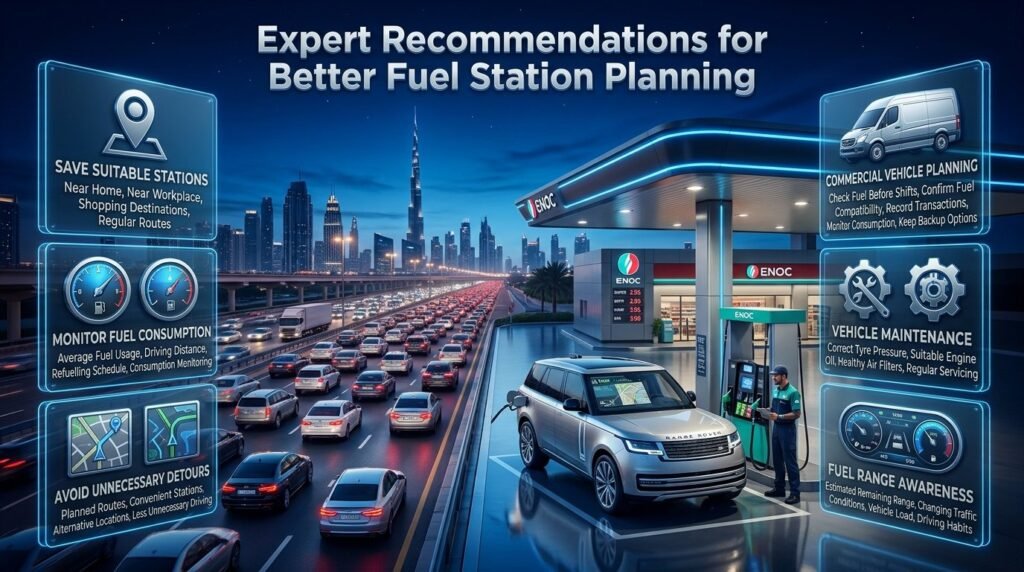
A convenient refuelling routine begins before you reach the petrol station.
The following practices can help private motorists and commercial drivers manage their journeys more effectively.
Keep a Personal List of Suitable Stations
Save fuel stations close to:
- Your home.
- Your workplace.
- Regular shopping destinations.
- Frequently used roads.
- Common business locations.
This makes it easier to identify alternatives when your normal station is crowded.
Understand Your Vehicle’s Average Consumption
Knowing your vehicle’s approximate fuel consumption helps you recognise when refuelling is becoming necessary.
For example, someone who travels long distances every working day should not follow the same refuelling schedule as someone who drives occasionally.
Avoid Unnecessary Detours
Choose a station that fits your planned route.
Driving extra kilometres just to visit a particular brand may not be worthwhile when a suitable alternative is available nearby.
Plan Commercial Vehicle Refuelling
Businesses operating delivery vehicles should establish convenient refuelling routines.
A simple process can include:
- Checking vehicle fuel levels before shifts.
- Identifying suitable stations along regular routes.
- Confirming fuel compatibility.
- Recording refuelling transactions.
- Monitoring unusual consumption.
- Maintaining a backup refuelling option.
This can help reduce interruptions during working hours.
Keep Vehicle Maintenance Up to Date
Fuel consumption depends on several vehicle-related factors.
Correct tyre pressure, suitable engine oil, healthy air filters and regular servicing can support efficient vehicle operation.
Avoid Depending Entirely on Fuel Range Estimates
A vehicle’s remaining-range display is an estimate based on driving conditions and previous consumption.
Traffic, road conditions, driving habits and vehicle load can change the actual distance available.
Treat the display as a planning aid rather than a guarantee.
15. What Are the Alternatives When You Cannot Visit a Fuel Station?
Visiting a fuel station is usually the normal way to refuel a vehicle.
However, there are situations where reaching one may be inconvenient or impractical.
For example:
- Your vehicle has run out of petrol.
- You are stranded in an unfamiliar location.
- Heavy traffic is delaying your journey.
- Your vehicle is parked at home or at work.
- You cannot conveniently leave your current location.
- A commercial vehicle requires refuelling support.
In such situations, a suitable fuel delivery service may provide an alternative, depending on location coverage and availability.
When Is Fuel Delivery Useful?
Fuel delivery can be helpful when a motorist cannot conveniently reach a petrol station.
Instead of attempting to drive a vehicle with insufficient fuel, the driver can explore whether an appropriate delivery service operates in that location.
Before arranging assistance, confirm:
- Your exact vehicle location.
- Whether petrol or diesel is required.
- The correct fuel grade, where applicable.
- Delivery availability.
- The quantity required.
- Applicable charges.
- Expected service arrangements.
What Should You Do If Your Vehicle Stops on a Busy Road?
Your safety should always come first.
If the vehicle stops because of insufficient fuel:
- Move to a safe location if possible.
- Switch on hazard warning lights when appropriate.
- Avoid standing in live traffic lanes.
- Do not attempt dangerous roadside refuelling.
- Contact appropriate roadside assistance.
- Follow the instructions provided by qualified assistance personnel.
Fuel delivery is not a substitute for emergency services when a vehicle is creating a road hazard.
For motorists who need an alternative to visiting a station, Fuel Delivery Dubai provides information about available petrol and diesel delivery assistance.
16. Dubai Fuel Stations and Everyday Driving Requirements
Fuel station requirements can change depending on how a vehicle is used.
Understanding these differences helps motorists plan refuelling more effectively.
Private Vehicle Owners
Private motorists generally need convenient access to suitable petrol or diesel.
Their main considerations include location, fuel compatibility, payment options and additional services.
Rental Car Drivers
Tourists and visitors using rental cars should check the vehicle’s fuel requirements and rental agreement.
Some rental companies specify the required fuel grade and return-fuel arrangements.
Never assume that every rental vehicle uses the same fuel.
Commercial Drivers
Commercial motorists often require dependable access to fuel during working hours.
Their priorities may include:
- Suitable diesel or petrol availability.
- Convenient road access.
- Vehicle size compatibility.
- Consistent refuelling arrangements.
- Transaction records.
- Reduced journey interruptions.
Delivery and Logistics Businesses
Businesses operating multiple vehicles should plan refuelling as part of their daily operations.
Monitoring fuel usage can help identify unusual consumption and improve vehicle management.
A consistent refuelling routine can also reduce unnecessary stops during scheduled deliveries.
Which Are the Best Fuel Stations in Dubai, and How Should Drivers Choose Between Them?
Dubai has several established fuel station operators, including ENOC, EPPCO, ADNOC Distribution and Emarat. Each serves motorists through different locations and station facilities. The best option depends on your driving route, required fuel type, station accessibility and the additional services you need.
Rather than choosing a fuel station based only on its brand, consider the practical benefits of each location.
What should drivers compare before choosing a station?
Location accessibility: Choose a station that is easy to reach from your current route.
Fuel availability: Confirm that your required petrol grade or diesel is available.
Additional facilities: Check whether the station provides car washing, convenience shopping or vehicle care.
Operating hours: Consider whether the station is suitable for your travel schedule.
Payment facilities: Check which payment methods are accepted.
Professional recommendation: Save two or three convenient fuel station locations around your regular driving routes. This gives you alternative options when your preferred station is crowded or temporarily unavailable.
What Is the Difference Between E-Plus 91, Special 95 and Super 98 at Dubai Fuel Stations?
The main difference between these petrol grades is their octane rating, which indicates their resistance to engine knocking. E-Plus 91 has a 91 RON rating, Special 95 has a 95 RON rating, and Super 98 has a 98 RON rating. Each grade is intended for vehicles with compatible engine requirements.
Choosing the correct petrol grade is important because a higher octane rating doesn’t automatically provide better performance in every vehicle.
Understanding the three petrol grades:
E-Plus 91: Suitable for vehicles whose manufacturers specify 91 RON petrol.
Special 95: Suitable for engines designed for 95 RON or compatible lower-octane specifications.
Super 98: Intended for vehicles requiring or recommending higher-octane petrol.
What should you check before refuelling?
Check the fuel recommendation in your vehicle owner’s manual.
Look for the fuel specification inside the fuel-filler flap.
Follow the manufacturer’s minimum octane requirement.
Never substitute petrol for diesel or diesel for petrol.
Expert advice: Don’t spend extra money on Super 98 simply because it has a higher octane rating. If your vehicle is designed for Special 95, using Super 98 may not provide a meaningful improvement.
Are Dubai Fuel Stations Open 24 Hours, and Can Drivers Refuel at Night?
Many fuel stations in Dubai operate around the clock, making them convenient for motorists travelling during early mornings, late evenings and overnight hours. However, operating hours can differ between individual locations, and additional facilities may not remain open for the same duration as the fuel pumps.
This distinction is important for drivers who need more than basic refuelling.
What services should you check before visiting at night?
Fuel pump availability and operating hours.
Convenience store opening times.
Car washing service availability.
Vehicle maintenance facility timings.
Accessibility during temporary road restrictions.
Night-time refuelling can be particularly convenient for motorists who prefer avoiding busy commuting periods.
However, drivers should still choose well-lit stations, follow safety instructions and avoid stopping in isolated or unsafe locations.
Professional tip: If you regularly travel late at night, identify a few suitable 24-hour stations along your usual routes. Don’t assume that every branch or additional facility operates throughout the night.
What Services Can You Get at Dubai Petrol Stations Besides Fuel?
Modern Dubai fuel stations can provide several facilities beyond petrol and diesel refuelling. Depending on the location, motorists may find convenience stores, car washing facilities, tyre services, lubricants, vehicle maintenance and selected digital payment options.
These services can make a routine fuel stop more useful, particularly for people with busy schedules.
Common additional services include:
Convenience stores: Drinks, snacks, refreshments and everyday essentials.
Car washing: Selected stations offer automatic or manual vehicle cleaning.
Tyre services: Certain locations provide tyre inflation and basic pressure checks.
Automotive products: Some branches sell engine oil, lubricants and vehicle accessories.
Vehicle maintenance: Selected service centres provide oil changes and basic inspections.
Digital payments: Supported stations may offer contactless or application-based payment facilities.
Not every location provides all these services. A smaller station may focus mainly on refuelling, while a larger service station may offer several additional facilities.
Expert recommendation: Before visiting a station specifically for a car wash, tyre service or maintenance, confirm that the particular branch offers the facility. This prevents unnecessary journeys and saves time.
What Should You Do If Your Car Runs Out of Fuel Before Reaching a Petrol Station in Dubai?
Running out of fuel can happen even to experienced drivers. Unexpected traffic, longer journeys, incorrect range estimates and delayed refuelling can leave a vehicle stranded away from a convenient petrol station.
The most important priority is to protect yourself, your passengers and other road users rather than attempting to drive further with insufficient fuel.
Follow these practical steps:
Find a safe position: If possible, move the vehicle away from moving traffic.
Switch on hazard lights: Make your vehicle more visible when stopped in a potentially hazardous location.
Check your surroundings: Avoid standing near moving traffic or attempting unsafe roadside refuelling.
Identify your location: Note your nearest landmark or share your location with the assistance provider.
Arrange suitable assistance: Contact appropriate roadside assistance or check whether fuel delivery is available.
Confirm fuel compatibility: Specify whether your vehicle requires petrol or diesel and confirm the correct petrol grade.
Fuel delivery can be a practical alternative when visiting a station is inconvenient or your vehicle cannot reach one.
Before requesting assistance, confirm the service area, availability, applicable charges and expected arrangements.
Professional advice: Never assume that your vehicle’s remaining-range display guarantees a particular driving distance. Treat low-fuel warnings seriously and plan refuelling before your tank becomes critically low.
Conclusion: Choosing and Using Dubai Fuel Stations Wisely
Dubai has a well-developed network of fuel stations that helps residents, visitors and commercial drivers keep their vehicles ready for everyday journeys. However, choosing the right station involves more than simply finding the nearest location. Drivers should consider fuel availability, the correct petrol or diesel grade, station accessibility, operating hours, payment options and additional services.
Before refuelling, always check your vehicle manufacturer’s recommended fuel specification. Choosing the correct grade helps maintain engine performance and avoids unnecessary spending on a higher-octane option that your vehicle may not require. It is also useful to plan refuelling stops around your regular routes, monitor your fuel level and avoid waiting until the warning light appears.
A practical approach to refuelling in Dubai includes:
- Select a convenient station along your usual route.
- Confirm the correct fuel type and grade before filling up.
- Compare current fuel prices when planning your monthly expenses.
- Check whether the station offers services such as tyre inflation, car washing or convenience shopping.
- Refuel before long journeys or routes where convenient stops may be limited.
- Keep an alternative plan for unexpected low-fuel situations.
Good refuelling habits can make everyday driving more convenient and help you manage vehicle running costs. Whether you commute across the city, travel between residential and business districts or drive longer distances, understanding Dubai’s fuel station network allows you to make better decisions.
If your vehicle runs out of fuel before you can reach a station, arranging suitable emergency fuel assistance can help you avoid unnecessary disruption. With sensible planning, the correct fuel choice and awareness of available refuelling options, you can keep your journeys across Dubai more organised and stress-free.
Leave a Reply