

Introduction
Tire Pressure Maintenance | A tire can look perfectly normal and still be running with the wrong amount of air. That’s one of the reasons tire pressure maintenance is often overlooked. Drivers may notice a flat tire immediately, but a tire that is gradually losing pressure can continue looking fine while affecting handling, braking, tire wear, comfort, and fuel consumption.
For drivers in Dubai, this matters even more because vehicles regularly deal with hot weather, busy traffic, long highway journeys, frequent air-conditioning use, and roads that can expose tires to potholes, curbs, and other impacts.
If you want a simple starting point for keeping your vehicle in good condition, FuelDeliveryDubai provides practical vehicle and roadside information for Dubai drivers.
This guide explains how tire pressure maintenance works, how to find the correct tire pressure for your vehicle, when and how to check it, what underinflation and overinflation can do, how TPMS works, why one tire may repeatedly lose air, and which pressure-related problems should be checked by a professional.
What Is Tire Pressure Maintenance?
Tire pressure maintenance is the regular process of checking and adjusting the air pressure in your vehicle’s tires according to the vehicle manufacturer’s recommended specification.
The goal isn’t simply to keep the tires full of air.
The goal is to keep each tire at the correct cold inflation pressure so that the tire can perform as intended.
A proper tire pressure maintenance routine includes:
- Checking all tires regularly
- Checking pressure when the tires are cold
- Using an accurate pressure gauge
- Following the vehicle manufacturer’s specification
- Adjusting pressure when necessary
- Checking for slow pressure loss
- Inspecting the tread and sidewalls
- Paying attention to TPMS warnings
- Checking the spare tire when applicable
- Investigating repeated pressure loss
Tire pressure is part of basic vehicle maintenance because it directly affects how the tires interact with the road.
The National Highway Traffic Safety Administration identifies proper inflation as one of the most important parts of tire maintenance and recommends checking tires monthly when cold.
Why Is Tire Pressure Maintenance So Important?
The tire is the only part of your vehicle that is supposed to remain in direct contact with the road.
That makes its condition important for more than comfort.
Correct tire pressure helps support:
- Vehicle stability
- Steering response
- Braking performance
- Tire durability
- Even tread wear
- Rolling resistance
- Fuel economy
- Driving comfort
When pressure is too low or too high, the tire doesn’t behave exactly as intended.
This doesn’t mean every small difference creates an immediate danger. Tire pressure naturally changes with temperature and gradual air loss. The important habit is to keep checking it and correct it according to the manufacturer’s specification.
Why Can Underinflation Be a Problem?
When a tire is underinflated, its sidewalls can flex more as the tire rolls.
That additional flex can increase heat buildup and rolling resistance. Significant underinflation can also affect handling and stopping performance and contribute to premature tire wear.
This is why repeatedly driving on a noticeably low tire isn’t a good maintenance strategy.
Why Can Overinflation Also Be a Problem?
Overinflation isn’t automatically better.
A tire inflated above the vehicle manufacturer’s recommended pressure can have a different contact pattern with the road and may produce a firmer ride. Depending on the vehicle and tire, excessive pressure can also contribute to irregular tread wear.
The practical approach is simple:
Don’t deliberately underinflate or overinflate your tires. Follow the vehicle manufacturer’s recommended cold pressure.
What Is the Correct Tire Pressure for Your Car?
There is no single tire pressure that is correct for every vehicle.
A small hatchback, luxury sedan, SUV, pickup truck, and performance car may all require different pressures.
Even the front and rear tires can have different recommended pressures.
The correct specification is normally found on:
- The driver’s door-jamb label
- The driver’s door-frame placard
- The vehicle owner’s manual
- Manufacturer service information
The recommended pressure is normally given in PSI and/or kPa.
Don’t Use the Tire Sidewall Number as Your Normal Pressure
This is one of the most common mistakes.
A number molded into the tire sidewall can relate to the tire’s maximum permitted inflation pressure or other tire specifications. It isn’t necessarily the pressure your vehicle manufacturer recommends for everyday driving.
Your vehicle’s recommended pressure is the one you should use for routine inflation.
NHTSA specifically advises drivers to use the pressure listed on the vehicle’s tire-information label or in the owner’s manual rather than simply using the number on the tire itself.
Common Mistake: Seeing “44 PSI” on the tire and assuming the tire should always be inflated to 44 PSI.
That’s not how normal vehicle tire-pressure maintenance should be approached.
Where Can You Find the Recommended Tire Pressure?
If you’re unsure about your car’s correct pressure, don’t guess.
Open the driver’s door and look around the door frame or pillar.
You may find a label showing information such as:
- Front tire pressure
- Rear tire pressure
- Recommended cold pressure
- Tire size
- Vehicle loading information
Your owner’s manual may provide additional information for different load conditions.
Why Front and Rear Pressures May Differ
The weight distribution of a vehicle isn’t always equal between the front and rear axles.
The manufacturer may therefore specify different pressures.
For example, a vehicle could have a higher recommended rear pressure when carrying additional passengers or luggage.
The exact values vary by vehicle, so don’t copy a pressure from another car just because the tire size appears similar.
How Often Should You Check Tire Pressure?
For normal driving, a monthly tire pressure check is a practical minimum routine.
You should also check before:
- Long-distance journeys
- Highway trips
- Heavy vehicle loading
- Extended periods of parking
- After hitting a pothole
- After contacting a curb
- A tire repair
- A tire replacement
- A TPMS warning
- Noticeable changes in handling
NHTSA recommends checking all tires, including the spare when provided, at least once a month when cold.
Why Monthly Checks Matter
Tires naturally lose some air over time.
They can also lose air faster because of:
- Punctures
- Valve leaks
- Wheel damage
- Bead leaks
- Temperature changes
- Previous repair problems
You don’t need to wait for a tire to look flat.
A pressure gauge can identify a problem much earlier.
Should Tire Pressure Be Checked When Tires Are Cold?
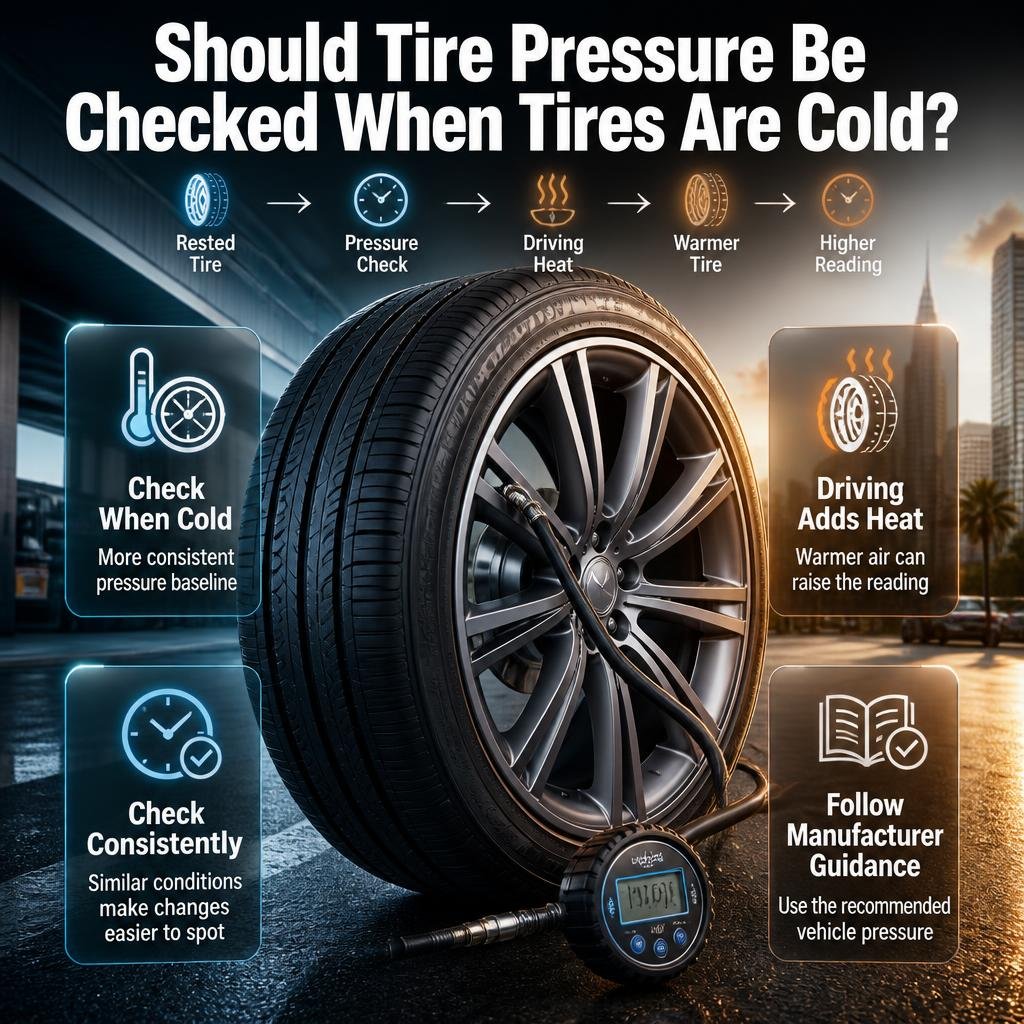
Yes.
For the most useful comparison with the manufacturer’s recommended pressure, check the tires when they are cold.
A common definition of a cold tire is a tire that hasn’t been driven for at least about three hours, although exact manufacturer guidance should take priority.
Why Does Driving Change Tire Pressure?
As a tire rolls, friction and flexing generate heat.
The air inside the tire becomes warmer, and the pressure reading can rise.
That doesn’t mean the tire has suddenly been overinflated.
It’s simply a result of temperature.
This is why checking your tires consistently under cold conditions gives you a more useful baseline.
Expert Tip: If you check your tires at the same time of day and under similar conditions, it’s easier to notice genuine pressure changes instead of temporary temperature-related differences.
How to Check Tire Pressure Correctly
Checking tire pressure is simple, but the process should be consistent.
Step 1: Find the Manufacturer’s Recommended Pressure
Before touching the tire valve, find the correct pressure on the driver’s door-jamb label or in the owner’s manual.
If the front and rear pressures are different, make a note of both.
Step 2: Make Sure the Tires Are Cold
Ideally, check before driving or after the vehicle has been parked long enough for the tires to cool.
Step 3: Remove the Valve Cap
Unscrew the valve cap carefully.
Keep it clean and don’t leave it on the ground where dirt can enter the valve area.
Step 4: Attach the Pressure Gauge
Press the gauge firmly against the valve stem.
A poor connection can cause air to escape and produce an inaccurate reading.
Step 5: Read the Pressure
Record the reading.
For example:
Recommended: 35 PSI
Actual: 29 PSI
That tire is below the recommended pressure and should be adjusted.
Step 6: Add or Release Air
If pressure is low, add air gradually.
If pressure is too high, release a small amount and measure again.
Step 7: Recheck
Don’t assume the first adjustment is perfect.
Measure the tire again after adding or releasing air.
Step 8: Check Every Tire
Repeat the process for all tires.
Don’t stop after finding one low tire.
Step 9: Replace the Valve Caps
Secure the valve caps after checking.
This entire process can take only a few minutes once you’ve made it a habit.
Can You Tell Tire Pressure by Looking at the Tire?
Not reliably.
Modern tires can maintain a relatively normal appearance even when they have lost a meaningful amount of pressure.
That’s why visual inspection and pressure measurement should be treated as two different tasks.
Visual Inspection Tells You About:
- Cuts
- Cracks
- Bulges
- Objects in the tread
- Sidewall damage
- Uneven wear
- Obvious deformation
A Pressure Gauge Tells You About:
- Actual inflation pressure
- Differences between tires
- Gradual pressure loss
- Whether inflation adjustment is needed
You need both.
NHTSA specifically notes that proper tire inflation cannot be determined simply by looking at the tire.
What Happens When Tire Pressure Is Too Low?
Low tire pressure can change the way the tire behaves.
A significantly underinflated tire may experience:
- Increased sidewall flex
- Greater rolling resistance
- Increased heat generation
- Faster or uneven tread wear
- Reduced steering response
- Changes in braking behavior
- Reduced fuel efficiency
One important point is that low pressure doesn’t always mean the tire is punctured.
A tire can gradually lose air naturally, or it may have a slow leak.
But if the same tire keeps losing pressure, the cause should be investigated.
What Happens When Tire Pressure Is Too High?
Overinflation can also affect the tire.
Potential effects include:
- Firmer ride
- Reduced cushioning over road impacts
- Changes in road contact
- Irregular tread wear
- Different handling characteristics
The solution isn’t to deliberately run higher pressure because you believe it will improve fuel economy.
Use the manufacturer’s recommended pressure.
What If Someone Has Inflated the Tires Too Much?
Don’t panic.
Check the actual pressure with a reliable gauge.
If it exceeds the manufacturer’s recommended cold pressure, release air carefully until the correct pressure is reached.
Then recheck the reading.
Tire Pressure and Fuel Economy
Tire pressure and fuel consumption are connected through rolling resistance.
When tires are underinflated, they can deform more as they rotate. That can increase the energy required to move the vehicle.
This can contribute to higher fuel consumption.
However, tire pressure is only one part of fuel economy.
Other factors include:
- Driving speed
- Acceleration
- Braking
- Traffic congestion
- Vehicle weight
- Tire condition
- Wheel alignment
- Air conditioning
- Engine condition
- Aerodynamics
So correcting tire pressure isn’t a magic fuel-saving solution.
It’s one part of maintaining the vehicle in a condition that supports efficient operation.
If you’re also trying to reduce unnecessary fuel consumption, your driving habits matter. Smooth acceleration, appropriate speed, and avoiding unnecessary idling can all form part of a wider fuel-efficiency strategy.
Tire Pressure and Tire Wear
Incorrect inflation can contribute to uneven tread wear.
Underinflation
Underinflated tires can experience increased flexing and may show greater wear toward the shoulders.
Overinflation
Overinflation can contribute to greater wear around the central tread area.
However, don’t diagnose a tire problem from tread wear alone.
Uneven wear can also result from:
- Wheel alignment problems
- Suspension issues
- Incorrect wheel balance
- Worn suspension components
- Aggressive cornering
- Tire rotation problems
If your tire pressure is correct but the wear pattern remains unusual, the vehicle may need a broader inspection.
For a complete tire-care routine, see the Tire Maintenance Guide in Dubai.
How Does TPMS Help With Tire Pressure Maintenance?
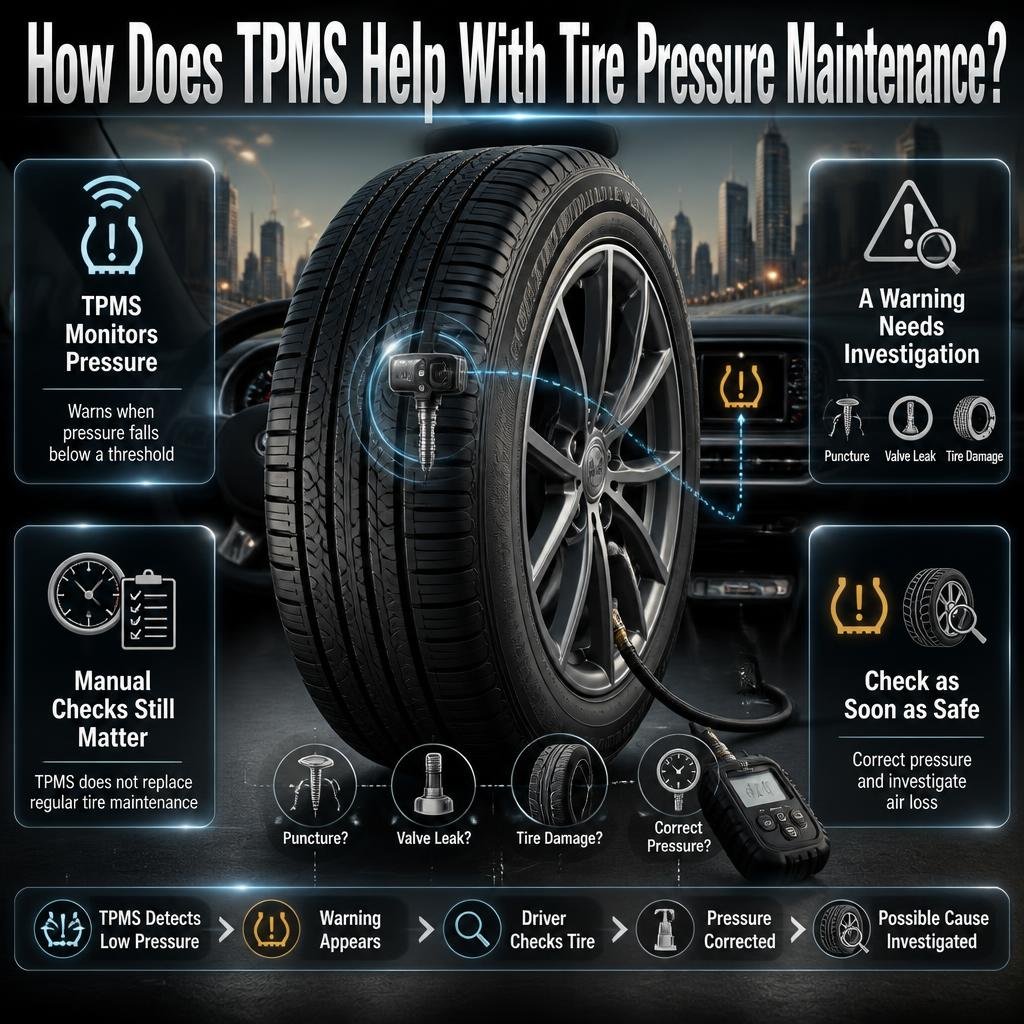
TPMS stands for Tire Pressure Monitoring System.
It uses vehicle sensors to monitor tire pressure and warns the driver when pressure falls below a specified threshold.
It’s an extremely useful safety feature, but it doesn’t replace manual tire pressure checks.
Why Not?
A TPMS warning generally tells you that pressure has reached a level requiring attention.
It doesn’t necessarily tell you:
- Why pressure dropped
- Whether there’s a puncture
- Whether the valve is leaking
- Whether the tire has physical damage
- Whether all four tires are correctly inflated
NHTSA states that TPMS is not a substitute for regular tire maintenance and recommends continuing monthly pressure checks.
What Should You Do When the TPMS Light Appears?
Don’t ignore it.
Check the tires as soon as safely possible.
If a tire is significantly underinflated, correct the pressure to the manufacturer’s recommended cold pressure and investigate whether the tire is losing air.
Why Does the TPMS Light Sometimes Come On in the Morning?
Temperature can influence tire pressure.
A tire that’s close to the TPMS warning threshold may trigger a warning after a temperature drop and then show a different pressure after driving warms the tire.
This doesn’t mean the warning should be ignored.
If the TPMS light appears, check the actual pressure.
A warning that repeatedly appears can indicate that the tires are marginally low or that another issue needs attention.
Some vehicle manuals specify that tire pressure changes by roughly 1 PSI for a 12°F/6.5°C temperature change, although the exact behavior varies with conditions.
Why Does One Tire Keep Losing Air?
This is one of the most important questions in tire pressure maintenance.
If three tires maintain their pressure but one repeatedly becomes low, don’t simply keep adding air.
A slow pressure loss may be caused by:
A Small Puncture
A nail, screw, or other object can create a slow leak.
Valve Leakage
The valve stem or valve core may not seal properly.
Wheel Damage
A damaged wheel can prevent the tire from sealing correctly.
Bead Leakage
The area where the tire meets the wheel can sometimes develop a leak.
Previous Repair
An incorrectly repaired puncture may continue losing air.
Tire Damage
Damage to the tire itself can result in repeated pressure loss.
A professional inspection is appropriate when the same tire repeatedly needs inflation.
What Should You Do If a Tire Is Losing Pressure Quickly?
A tire that is rapidly losing pressure requires more attention than a tire that loses a small amount over a longer period.
If you discover a significantly underinflated tire:
- Move to a safe location if you’re driving.
- Avoid unnecessary driving on a severely underinflated tire.
- Inspect the tire visually if it is safe to do so.
- Check pressure with a gauge.
- Inflate only if doing so is appropriate and safe.
- Arrange professional inspection if the tire continues losing pressure.
Driving on a significantly underinflated tire can cause overheating and contribute to tire failure.
Don’t Keep Topping It Up Forever
Adding air can be a temporary measure.
It isn’t a repair.
If a tire repeatedly loses pressure, find the cause.
Tire Pressure Maintenance in Dubai’s Hot Climate
Dubai’s climate makes regular tire inspection particularly practical.
High temperatures don’t change the manufacturer’s recommended cold pressure.
Instead, they make it even more important to understand the difference between cold pressure and warm pressure.
During driving, tire pressure naturally rises as the tire heats up.
That doesn’t mean you should release air from a warm tire simply because the number is higher.
The better approach is:
- Check tires when cold
- Follow the manufacturer’s specification
- Avoid unnecessary pressure adjustments based on warm readings
- Inspect for damage
- Monitor repeated pressure loss
- Check before long highway trips
What About Hot Roads?
Hot road surfaces and ambient temperatures can increase tire temperature during operation.
That doesn’t mean you should intentionally underinflate the tire to compensate.
The manufacturer’s recommended cold pressure remains your baseline.
Tire Pressure Before a Long Highway Journey
A long trip is one of the worst times to discover a pressure problem.
Before leaving, check all tires.
Long-Trip Tire Checklist
- Front-left pressure
- Front-right pressure
- Rear-left pressure
- Rear-right pressure
- Spare tire where applicable
- Tread condition
- Sidewall condition
- Valve condition
- Visible punctures
- Uneven wear
- TPMS status
Also check the vehicle’s other essential systems.
For broader preparation, the Vehicle Maintenance Guides section can help you review other maintenance areas before a journey.
Does Vehicle Load Affect Tire Pressure?
Yes, vehicle loading can matter.
A vehicle carrying several passengers and heavy luggage may have different recommended tire-pressure requirements than a lightly loaded vehicle, depending on the manufacturer’s specifications.
That’s why you should check the information provided for your specific vehicle.
Don’t simply increase pressure because the vehicle feels heavier.
Instead, look at the manufacturer’s load-related recommendations.
Before a Fully Loaded Trip
Check:
- Recommended pressure
- Front/rear pressure requirements
- Tire condition
- Maximum vehicle load
- Spare tire
- Luggage distribution
Never exceed the vehicle’s specified load capacity.
Tire Pressure and Driving Comfort
Pressure also affects ride quality.
A tire with the correct pressure is designed to provide the balance between road contact, structural support, and cushioning expected by the vehicle manufacturer.
If pressure is significantly higher than recommended, the vehicle may feel noticeably harder over bumps.
If pressure is too low, the tire may feel softer but that doesn’t mean the vehicle is being protected.
Comfort shouldn’t be achieved by deliberately running incorrect pressure.
Can Tire Pressure Affect Steering?
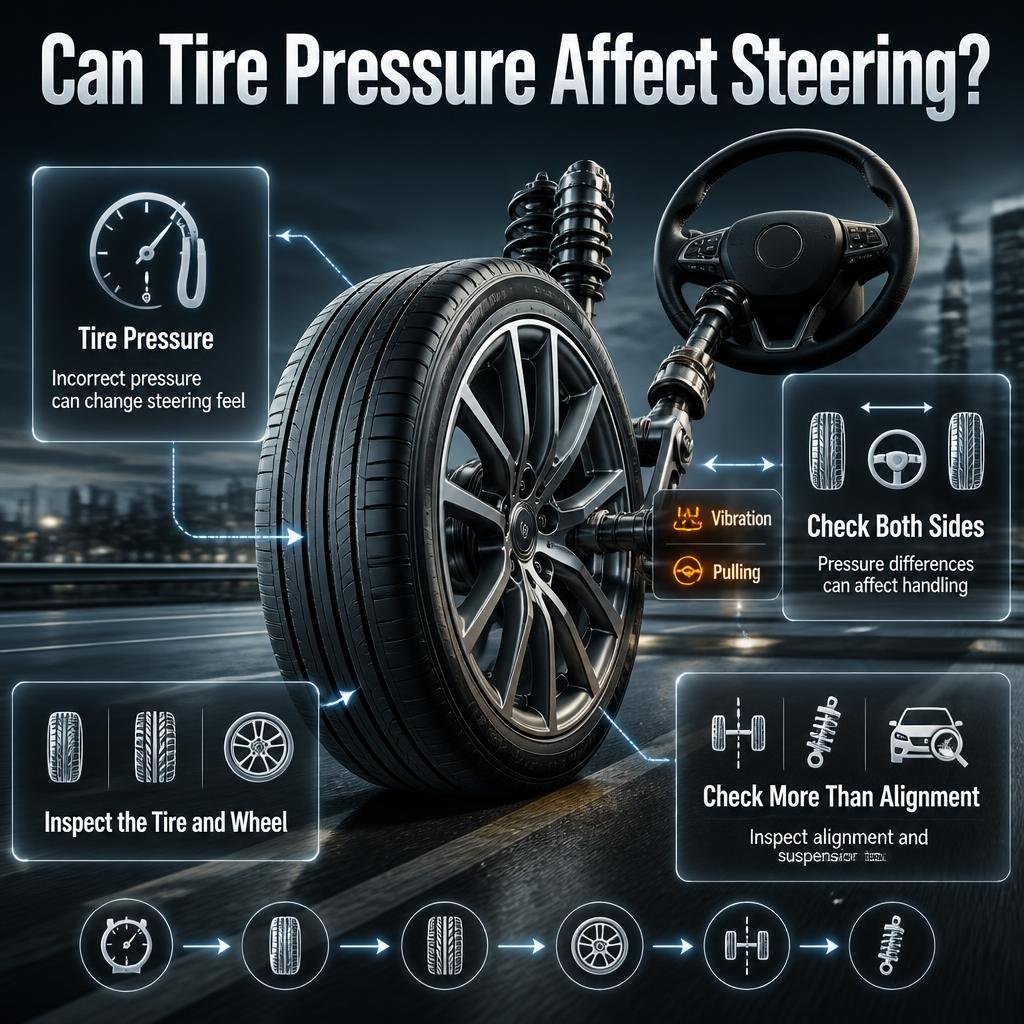
Yes.
Incorrect pressure can change steering feel.
An underinflated tire may feel less responsive, while significant differences between left and right tires on the same axle can contribute to unusual handling.
If the steering suddenly feels different, don’t assume it’s simply an alignment problem.
Check:
- Tire pressure
- Tire condition
- Tread wear
- Wheel condition
- Alignment
- Suspension components
A change in steering behavior deserves attention, especially when combined with vibration or pulling.
Tire Pressure vs Wheel Alignment
These two maintenance areas are connected but not the same.
Tire Pressure
Concerns the amount of air inside the tire.
Wheel Alignment
Concerns the angles and geometry of the wheels relative to the vehicle and road.
Incorrect alignment can cause uneven tire wear even when tire pressure is correct.
Similarly, correct alignment doesn’t compensate for an underinflated tire.
You need both systems maintained appropriately.
Tire Pressure vs Suspension Condition
Suspension components help keep the tires in controlled contact with the road.
If suspension components become worn, the vehicle may develop:
- Uneven tire wear
- Bouncing
- Excessive body movement
- Steering changes
- Unusual noises
That’s why persistent tire wear shouldn’t automatically be blamed on pressure.
For a wider look at suspension-related maintenance, see the Suspension Maintenance Guide in Dubai.
How Tire Pressure Relates to Brake Performance
Tires are part of the braking system’s overall contact with the road.
The brakes create the stopping force, but the tires must transfer that force to the road.
Incorrect tire pressure can affect tire behavior and therefore influence how the vehicle responds during braking.
That doesn’t mean a low tire automatically means your brakes have failed.
But if you notice:
- Longer stopping distance
- Pulling while braking
- Vibration
- Brake noise
- Soft brake pedal
- Brake warning lights
the issue should be investigated separately.
For brake-specific maintenance information, read Brake Maintenance Basics in Dubai.
Common Tire Pressure Maintenance Mistakes
Checking Only When the Tire Looks Low
This doesn’t work reliably because tires can be significantly underinflated without looking obviously flat.
Better approach: Use a pressure gauge regularly.
Using the Sidewall Number
The sidewall number isn’t necessarily your vehicle’s recommended operating pressure.
Better approach: Use the driver’s door-jamb label or owner’s manual.
Checking Only One Tire
A single tire may have a leak while the others remain correctly inflated.
Better approach: Check all four tires.
Checking Immediately After Driving
Warm tires produce different readings.
Better approach: Check when cold.
Ignoring TPMS
A warning light is there for a reason.
Better approach: Check the actual pressure and investigate.
Adding Air Without Investigating a Slow Leak
Repeated pressure loss isn’t normal simply because the tire still holds some air.
Better approach: Have the tire inspected.
Overinflating for Fuel Economy
More air doesn’t automatically mean better fuel economy.
Better approach: Follow the manufacturer’s specification.
Forgetting the Spare
A spare tire can lose pressure while sitting unused.
Better approach: Include it in your maintenance routine when applicable.
A Simple Tire Pressure Maintenance Schedule
A simple schedule makes maintenance easier.
Weekly Visual Check
Take a quick look at:
- Obvious damage
- Flat appearance
- Bulges
- Objects in the tread
- Uneven wear
Monthly Pressure Check
Measure all tires when cold.
Compare them with the manufacturer’s specification.
Before Long Trips
Perform a complete tire inspection.
Check pressure, tread, sidewalls, spare, and TPMS.
After a Significant Impact
If you’ve hit a pothole or curb hard, inspect the tire and wheel.
Don’t assume everything is fine because the tire isn’t flat.
After Tire Repair
Monitor the repaired tire for continued pressure loss.
A Practical Tire Pressure Checklist
Use this simple checklist once a month:
Pressure
☐ Manufacturer’s pressure confirmed
☐ Tires checked when cold
☐ Front pressures checked
☐ Rear pressures checked
☐ Spare checked where applicable
Tire Condition
☐ Tread inspected
☐ Sidewalls inspected
☐ No visible bulges
☐ No major cuts
☐ No obvious punctures
☐ No unusual wear
Vehicle
☐ TPMS checked
☐ Steering feels normal
☐ No unusual vibration
☐ No unusual pulling
If anything appears abnormal, investigate it rather than waiting for the next scheduled check.
Expert Advice for Better Tire Pressure Maintenance
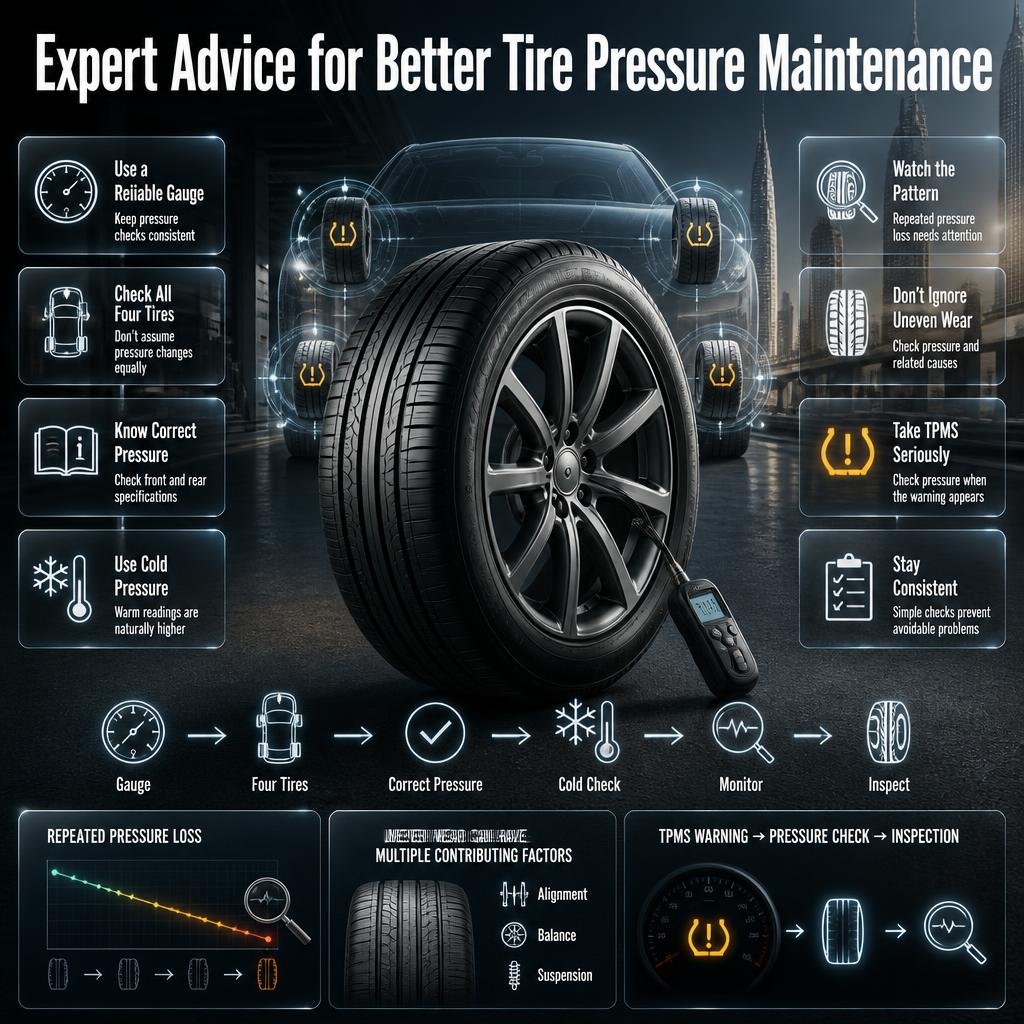
The best tire-pressure routine isn’t complicated.
It’s consistent.
1. Keep a Reliable Gauge
A small pressure gauge is inexpensive compared with the cost of replacing a damaged tire or dealing with an avoidable roadside problem.
2. Check All Four Tires
Don’t assume the tires lose pressure equally.
3. Learn Your Vehicle’s Correct Pressure
Save it somewhere accessible.
Once you know the correct front and rear specifications, checking becomes much faster.
4. Don’t Chase Warm Pressure Readings
Warm pressure is expected to be higher than cold pressure.
Use cold pressure as your normal reference.
5. Watch the Pattern
If a tire repeatedly drops pressure, that’s useful information.
The pattern itself may help identify a leak.
6. Don’t Ignore Uneven Wear
Tire pressure is one possible cause, but alignment, balance, suspension, and other issues can also contribute.
7. Take TPMS Seriously
A warning light should lead to a pressure check and inspection.
What Equipment Do You Need for Tire Pressure Maintenance?
You don’t need a professional workshop to perform basic pressure checks.
Useful equipment includes:
Tire Pressure Gauge
A digital gauge can be easy to read, while a quality mechanical gauge can also work well.
Portable Air Compressor
Useful if you want to adjust pressure at home.
Valve Caps
Keep valve areas protected from dirt and moisture.
Tire Tread Gauge
Optional but useful for monitoring tread depth.
Flashlight
Helpful when inspecting sidewalls and tread in poor lighting.
The most important tool is still a reliable pressure gauge.
What If the Tire Pressure Is Different in Every Tire?
Some variation can occur.
But large differences deserve attention.
For example:
- Front-left: 34 PSI
- Front-right: 35 PSI
- Rear-left: 34 PSI
- Rear-right: 35 PSI
If the manufacturer’s recommended pressure is 35 PSI, these readings may simply need minor adjustment.
But imagine:
- Front-left: 35 PSI
- Front-right: 35 PSI
- Rear-left: 35 PSI
- Rear-right: 25 PSI
That is a much more significant difference.
The low tire should be checked for a possible leak or other problem.
The important thing is to compare each tire with the manufacturer’s recommended pressure rather than assuming all vehicles should have the same number.
What Does a Sudden Pressure Drop Mean?
A sudden pressure drop can indicate:
- Puncture
- Tire damage
- Valve failure
- Wheel damage
- Severe impact
- Other air-loss problems
A sudden loss is different from normal gradual pressure loss.
If the pressure drops rapidly, don’t treat it as a routine inflation issue.
Safety comes first.
If you’re on the road and the vehicle develops a serious tire problem, move away from traffic where possible and arrange appropriate roadside assistance.
What If the Tire Looks Damaged but Still Has Normal Pressure?
Don’t assume it’s safe simply because the gauge shows normal pressure.
A tire can have structural or external damage without immediately losing air.
Pay attention to:
- Sidewall bulges
- Deep cuts
- Cracks
- Exposed internal material
- Severe tread damage
- Deformation
- Separation
- Unusual vibration
NHTSA advises drivers to inspect tread and sidewalls for cuts, punctures, bulges, scrapes, cracks, and other damage.
If you see serious damage, have the tire assessed professionally.
How Often Should I Check My Tire Pressure?
Tire pressure should generally be checked at least once a month and before a long journey. Waiting until a tire looks visibly low isn’t a reliable maintenance method because modern tires can lose a noticeable amount of pressure without appearing flat. Regular checks help you identify gradual air loss before it starts affecting handling, tire wear, or fuel efficiency.
It’s also worth checking more frequently if you regularly drive on highways, carry heavy loads, have recently repaired a tire, or have noticed that one tire loses air faster than the others.
Practical points:
Check all four tires, not just the one that looks low.
Measure pressure when the tires are cold.
Check before long highway journeys.
Recheck a tire that has previously developed a slow leak.
Include the spare tire when your vehicle has one that requires inflation.
What Is the Correct Tire Pressure for My Car?
The correct tire pressure depends on your specific vehicle, not simply on the tire size or the number printed on the tire sidewall. The recommended pressure is normally listed on the driver’s door-jamb label, door-frame placard, or in the owner’s manual. Some vehicles also specify different pressures for the front and rear tires or for particular loading conditions.
One of the most common mistakes is using the maximum pressure printed on the tire sidewall as the normal operating pressure. That number shouldn’t automatically be treated as your vehicle’s recommended everyday pressure. Always use the manufacturer’s specification as your reference.
Practical points:
Check the driver’s door-jamb label first.
Follow front and rear pressure recommendations separately if they differ.
Use cold-tire pressure as your normal reference.
Don’t copy the pressure from another vehicle.
Don’t automatically use the maximum PSI shown on the tire.
Should I Check Tire Pressure When the Tires Are Hot or Cold?
For routine tire pressure maintenance, cold tires are the preferred time to check pressure. Driving causes the tires to heat up, and the air inside them expands, resulting in a temporarily higher pressure reading. Comparing a hot reading directly with the manufacturer’s recommended cold pressure can therefore give you a misleading result.
Ideally, check the tires before driving or after the vehicle has been parked long enough for the tires to cool. The important thing is to use a consistent method so that you’re comparing meaningful readings from one check to the next.
Practical points:
Check pressure before a journey whenever possible.
Avoid adjusting pressure simply because a warm tire reads higher.
Use the manufacturer’s recommended cold pressure.
Check all tires under similar conditions.
If a tire is seriously underinflated, don’t keep driving unnecessarily just to obtain a cold reading.
Why Does One Tire Keep Losing Air Even After I Inflate It?
If one tire repeatedly loses air while the other tires remain relatively stable, there may be an underlying leak or tire-related problem. Possible causes include a small puncture, leaking valve, damaged wheel, bead-area leak, tire damage, or an issue with a previous puncture repair.
Simply adding air every few days may keep the tire temporarily usable, but it doesn’t solve the underlying problem. A tire that repeatedly loses pressure should be inspected so the source of the air loss can be identified.
Practical points:
Compare the pressure of all four tires.
Monitor the problem tire over several days.
Look for nails, screws, or other objects in the tread.
Check for visible sidewall damage.
Have persistent pressure loss professionally inspected.
Don’t assume repeated air loss is normal.
Professional tip: A gradual pressure drop in the same tire is useful information. Tell the technician how often you’ve needed to add air and approximately how much pressure the tire loses.
Can Incorrect Tire Pressure Affect Fuel Economy and Tire Life?
Yes, incorrect tire pressure can influence both fuel economy and tire wear. Underinflated tires generally create greater rolling resistance, which means the vehicle may need more energy to move. Low pressure can also increase tire flexing and contribute to heat buildup and uneven or accelerated wear.
However, tire pressure isn’t the only factor affecting fuel consumption or tire lifespan. Driving style, speed, traffic, vehicle loading, wheel alignment, suspension condition, tire quality, road conditions, and vehicle maintenance can also play important roles.
Maintaining the manufacturer’s recommended pressure is therefore best viewed as one essential part of overall vehicle maintenance rather than a standalone fuel-saving solution.
Practical points:
Keep pressure within the manufacturer’s recommended range.
Check pressure monthly.
Inspect tread wear regularly.
Don’t overinflate tires to try to save fuel.
Check alignment if tread wear remains uneven.
Inspect suspension components when tire wear doesn’t match pressure conditions.
For Dubai drivers, regular checks are especially useful because frequent traffic, highway driving, high temperatures, and long journeys can place additional demands on tires. A consistent tire-pressure routine helps you identify problems early rather than discovering them during a roadside situation.
Conclusion
Proper tire pressure maintenance is one of the simplest yet most important parts of routine vehicle care. Keeping your tires at the manufacturer’s recommended pressure can support safer handling, more consistent braking, even tire wear, better driving comfort, and efficient fuel use.
The key is consistency. Check your tire pressure at least once a month, preferably when the tires are cold, and always use the pressure specified by your vehicle manufacturer. Don’t rely only on the appearance of the tire or wait for the TPMS warning light before checking.
For Dubai drivers, regular checks are particularly useful because hot weather, heavy traffic, highway driving, and long journeys can put additional demands on tires. If one tire repeatedly loses air, shows unusual wear, or develops visible damage, don’t simply keep adding air—have the underlying problem inspected.
A few minutes spent checking tire pressure can help prevent avoidable tire problems and keep your vehicle ready for everyday driving and longer journeys. Make tire pressure checks a regular part of your maintenance routine, and treat unusual pressure changes as an early warning that deserves attention.
Leave a Reply